Leading Men ~ A Capsule Book Review

Leading Men ~ A Capsule Book Review by Allen Kopp

Tennessee Williams was the greatest American playwright of the twentieth century. He was a Southern gentlemen with a charming accent, a homosexual, a gadabout, a world traveler, a party animal, a wit and a genius. He drank to excess and took too many pills. He was as sexually promiscuous as his fame, wealth and position allowed. For about fifteen years, he had one live-in lover, one Frank “Frankie” Merlo, who was ostensibly an “assistant” whose principal duties were “sleeping with Mr. Williams” and doing whatever job needed doing.

Frank Merlo had little going for him other than his good looks and imposing physique. He wasn’t “connected,” wealthy or well educated. He had the idea that he wanted to be a movie actor but was never able to quite pull it off. (His one big chance came in Italy with Italian movie director Luscino Visconti, but his part was ultimately eliminated.) He was about ten years younger than Tennessee Williams (or “Tenn” as is he mostly known throughout this book).

Leading Men, by Christopher Castellani, is a mix of fact and fiction, real-life people and fictional constructs. Among the real-live people in the book are the two main characters, Tennessee Williams and Frank Merlo; fellow American writer Truman Capote; Italian actress Anna Magnani; now-forgotten American novelist John Horne Burns; Italian movie director Luscino Visconti.

Anja Blomgren (later changed to Bloom) is a major character in the book, but she is a fictional character. She is only seventeen years old in 1953 when Tenn and Frank befriend her on their summer in Italy. After 1953, she is taken up by a famed Swedish movie director, one Martin Hovland (again a fictional character), and becomes a big movie star, always remaining friends with Tenn and Frank until their deaths. As an old woman, Anja Bloom propels the modern-day story. It seems that Tenn, right before he died in 1983, gives her the only copy of his last play, Call It Joy. This play has never seen the light of day until Anja decides, at the urging of two young, gay men, Sandro and Trevor, both Tennessee Williams aficionados, to stage it.

So, Leading Men moves back and forth from the past to the present. A lot of the past concerns Tenn and Frank in Italy in the summer of 1953 and their friendship with Anja Bloom. It is mostly the story of the stormy and co-dependent relationship between these two very different men. Frank longs to be an “artist” but always remains on the fringes of the artists’ colony. He is a member only because of his relationship with Tenn.

In later years (but also part of the chapters in the book dealing with the past) Frank develops lung cancer. For two people who spent as many years together as Frank and Tenn did, Tenn isn’t nearly as attentive to Frank as he should be after he becomes ill. He always seems to be galivanting off, pursuing his own interests, while Frank remains in the hospital, every day getting worse and closer to death.

Leading Men is only partly effective for me as a reader. The story of the relationship between Frank and Tenn is interesting and compelling, as is the story of the trajectory of Tenn’s life as a great writer, but a large part of the book is taken up with Anja Bloom and her gay friends Sandro and Trevor and their efforts to bring Tenn’s fictional last play, Call It Joy, to the forefront. I would have preferred if the story had focused exclusively on Tenn and Frank and their coterie of real-life friends, instead of on these fictional characters and fictional situations. The second half of the book doesn’t seem worthy of the first half. On the whole, however, Leading Men is worth reading and has enough good stuff in it to make it worth the time and effort.

Copyright © 2019 by Allen Kopp

Tractor Pulls and Wrestle Mania

Tractor Pulls and Wrestle Mania ~ A Short Story by Allen Kopp

My mother-in-law’s name is Elna Olmstead. She has pink hair and looks like Edward G. Robinson. Imagine, if you will, Little Caesar (not the pizza but the Prohibition-era movie gangster) wearing a cotton-candy wig, a mass of pink curlicues and ringlets, encasing his melon-shaped head. Whenever I see Elna, I expect her to be wearing a double-breasted suit with a machine gun as a fashion accessory, but instead she’s wearing a horned helmet and an iron breastplate, like a tiny Brunehilde (complete with the German accent). Yes, she’s very small but don’t be fooled by her size. She would cut off your head with her battle-axe and serve it to the neighborhood dogs and then, without missing a beat, go inside and watch today’s episode of General Hospital.

Elna doesn’t have very high regard for men. She has had four husbands. Two of them died and the other two escaped. Of the two that died, one of them, Julius, had his heart burst (or, as Elna likes to say, his heart “busted”), and the other one, Hec, committed suicide by hanging himself from a rafter in the attic. Elna was very put out with Hec because he hadn’t finished his housework. When he was laid out at the funeral home (with a smile on his face), she was there with a big bag of pork rinds in one hand and a pint of malt liquor in the other. When she lit a cigarillo over Hec’s casket with a lighter like a torch, it activated the very sensitive fire sprinklers, and water came pouring down on her and poor dead Hec. She threatened to sue the funeral home because she had spent four hours that day at Mitzie’s House of Beauty getting her hair re-pinked.

Elna’s best friend is a former lady boxer named Doris Grotnick. Elna brought Doris along one Thanksgiving to our house for dinner. Doris proudly raised her sleeve and showed us the tattoo of the grim reaper on her upper arm and then she informed us that “Grim Reaper” was her professional name when she was in wrestling. After dinner, Elna and Doris sat at the kitchen table arm-wrestling and drinking margaritas, while the rest of us ate pumpkin pie and watched Miracle on 34th Street on television.

More than anything else, Elna and Doris love sports, but especially wrestling. They go to all the matches and have their favorite wrestlers. Elna calls them “my boys.” She got arrested at one of the wrestling matches because she had too much to drink and wouldn’t sit down and shut up. When security guards came and tried to make her leave, she hit him one of them in the face and broke his nose. When we went to bail her out of jail the next day, she had the man’s blood all over her clothes and underneath her fingernails.

Next to wrestling, Elna and Doris, these two paragons of refinement, love tractor pulls. They watch tractor pulls on TV and get so excited they pull down the curtains and bust up the furniture. Elna screams at the tractor she hopes will win, jumps up and down and flails her fists. One time she accidentally clopped Doris on the side of the head with her doubled-up fist and knocked her out. She waited until the tractor pull was over (her tractor won) and then called for an ambulance. Doris was taken to the hospital and spent two weeks recovering from a concussion.

We found out later that Doris Grotnick was a Satan worshipper and that she persuaded Elna to join her “church” (or “anti-church” if you prefer). They both dressed in black and went arm-in-arm to all the services. Elna told us that making Satan her master was the best thing she had ever done and that it had “set her free.” She tried to get the rest of us interested in Satanism. She gave us pamphlets to read, extolling the value of Satan worship, but I refused to look at them and threw them in the trash.

Elna and Doris became minor celebrities for a time when they appeared on a TV talk show in white makeup as witches and practitioners of black magic. They moaned, frothed at the mouth and rolled around on the floor to invoke the spirit of Satan for the studio audience. My wife was embarrassed and refused to leave the house for a few days. She realized, finally, that her mother was insane. I had known it all along.

For Christmas Elna bought three cemetery plots, one for herself, one for my wife and one for me. I was to be on one side of her and my wife on the other side. We were her children. Children of Satan. That’s when I decided to be cremated.

Copyright © 2019 by Allen Kopp

From the Shallow to the Deep

From the Shallow to the Deep ~ A Short Story by Allen Kopp

The first lesson was a lecture in a small room that smelled like wet towels. Nelson Hess hated it already. He sat in the back of the room observing the fifteen or so other boys who, like him, were lucky enough to be going to learn how to swim. They were all forceful, confident types; they swaggered when they walked and their voices were loud and bursting with authority. They couldn’t wait to get their suits on and get into the water.

When Boss walked into the room, the voices stopped. He was a stocky, middle-aged man with a face like a movie hoodlum. He wore a sweatshirt and black shorts and around his neck a whistle. He had more hair on his thick legs than he did on his head.

“Now, beginning swimming is not easy,” Boss barked, the gruff drill sergeant whipping the raw recruits into shape. “Most of you are not in shape for swimming and we’re going to have to get you into shape. I hope none of you are babies or whiners because if there’s one thing I can’t stand it’s a baby or a whiner. Or a sissy. Sissies are even worse. So if there are any sissies, whiners or babies among you, you are welcome to leave right now!”

The boys attested confidently that they were manly enough for what was coming.

“No babies?” Boss asked, holding up all his fingers. “No whiners? No sissies? No? Well, good, then! Let’s get started.” He took a deep breath and smiled sadistically.

“Everybody must have his own suit and his own towel. If you arrive for your lesson without either of these two items, you will not be allowed to participate. You will fall behind and end up failing the class and we don’t like failures. Now, do we have any failures here?”

No!” the boys shouted.

“You will not at any time ask to borrow someone else’s towel if for some reason you do not have your own. That is an unsanitary practice that we do not engage in. Does everybody understand this simple rule?”

Yes!

“Good! Now, your suit may be any color you like. Except pink. I wouldn’t recommend pink.”

The boys laughed appreciatively.

“And it must be presentable.”

“What does that mean?” somebody asked.

“Well, you don’t want your manly parts hanging out, now, do you?”

The boys laughed loud and long. Boss was one of them. He was a good guy!

“Now, we all know what horseplay is, don’t we? That’s another thing that will not be tolerated here. You will have fun, of course, but you will walk and not run at all times when you are near the pool and you will never play grab-ass with another swimmer.”

Hah-hah-hah!

“Is there anybody here who doesn’t understand what I’m saying?”

“No!”

“Good. Now, whenever you hear my whistle, whether you are in the water or out of it, you will stop what you are doing and listen to what I have to say. The whistle is the signal for you to stop and pay attention. Is there anybody here who doesn’t understand this?”

No!”

“All right, then! Over the next eight weeks, each and every one of you will learn how to swim like a champion. Are we all champions?”

Yes!

“Is there any one of you who doesn’t firmly believe in his heart that he is a champion?”

Nelson Hess took a deep breath and when he exhaled his breath was shaky. He wanted to raise his hand and dismiss himself, say he was having chest pains or had had a sudden premonition of the end of the world, but the time was past for such a move. Everybody would laugh at him and Boss would deliberately embarrass him.

“Now, at the end of your eight weeks,” Boss continued, “you will take a final exam.”

A collective groan went up.

“It’s not the kind of exam you take sitting at a desk with a pencil in your hand, though. It’s an exam that will consist of swimming the length of the pool, from the shallow to the deep, and back again. And that’s not all. Each of you will be required to dive at least once off the high dive.”

“How high?” somebody asked.

“Thirty feet.”

“What if we can’t do it?”

“Then you fail the class. You will have wasted your time and mine and made a complete ass of yourself in the bargain. Is there anybody here who thinks he can’t do it?”

No, sir!

“All right, then. Be here on Friday at two o’clock, suited up and ready to swim. And that doesn’t mean two minutes after two, either. It means two on the dot!”

Yes, sir!

After the others had left in high spirits, Nelson hung back to have a word with Boss.

“I won’t be here on Friday, sir,” he said. “Or any other day.”

Boss looked at him, seeing him for the first time, and frowned. “Why the hell not?” he asked.

“Well, this was all kind of a mistake.”

“What was?”

“My being signed up for a swimming class. I don’t want to learn how to swim.”

“Why did you sign up for a swimming class if you don’t want to learn how to swim?”

“My father signed me up. Without checking with me first.”

“Don’t you think swimming would be a good skill for a young fellow like you to have?”

“Not for me.”

“Why not?”

“I’m afraid of being in the water over my head. I’m afraid of drowning.”

“Do you think I’d let you drown?”

“I don’t know, sir. Would you?”

“If you have to ask that question, you’re in the wrong place.”

“Not only am I afraid of the water, I’m also afraid of heights. I could never jump thirty feet into the water.”

“That’s what swimming class is about. Helping you overcome your fears. Wouldn’t you like to reconsider?”

“No, sir. I made up my mind the minute I walked into this room.”

“It’s irreversible, you know. You can’t change your mind again. There are other people who want your spot.”

“I understand that, sir!”

“So, when you tell your father that you quit swimming before it even started, don’t make him think he can make a couple of phone calls and pull some strings to get you back in again.”

“That’s perfectly all right, sir. I understand completely. This is absolutely the end of the line for me when it comes to swimming.”

“You won’t get your money back. The tuition is nonrefundable.”

“I understand, sir. That’s perfectly all right.”

“What name?”

“What?”

“What’s your name?”

“Nelson Hess Junior. It’ll be under the H’s.”

Boss opened the class roll and marked out Nelson’s name. “I knew a Nelson Hess in high school,” he said.

“That would be Nelson Hess Senior,” Nelson said. “He’s my father.”

“I see. Give him my regards.”

Boss went out the door and Nelson was left alone in the quiet room. He laughed to himself, as he often did when he found himself alone. He felt weak with relief at having escaped the high dive, but, of course, that was just a small part of it.

At the dinner table that evening, Nelson Junior knew that Nelson Senior would be curious about the first day of swimming. It came about ten minutes into the deli fried chicken and potato salad.

“Well, how did it go today?” Nelson Senior asked.

“How did what go?”

“The swimming lesson, of course! I want to hear about it!”

“There’s something I need to talk to you about,” Nelson Junior said.

He told Nelson Senior everything that happened in the swimming class, everything Boss had said, leaving nothing out. When he was finished, Nelson Senior glared at him.

“I’m disappointed in you,” Nelson Senior said.

“I know you are, sir.”

“Can’t you ever be normal like other boys?”

“I guess I’m just not normal.”

“Do you know how embarrassing that is for me?”

“Really, when you think about it, sir, there’s no need for you to be embarrassed.”

“Do you know what my father would have done if I had defied him the way you’re defying me?”

“I don’t know. Had a fit?”

“It just wasn’t done when I was your age.”

“Mother would never have signed me up for a class she knew I’d hate!”

“How do you know you’d hate it? You’ve never done it!”

“You just know these things. I know I’d hate tightrope walking, too, even though I’ve never done it.”

“That’s not funny!”

“It’s not meant to be.”

“For the next month your wings are clipped.”

“What does that mean?”

“It means you won’t get out of the house except to go to school. There’ll be no TV, no sleeping until ten a.m., and no lounging around the house. There’s lots of work to be done around here. You’ll clean the gutters, reseed the lawn, patch the holes in the driveway, trim the pear tree and the hedges, clean out the basement and the attic…”

“What will you be doing that whole time?” Nelson Junior asked Nelson Senior.

“I’ll be standing over you to make sure you get everything done.”

“Sounds like a million laughs.”

Nelson Hess stood up from the table and started to walk away.

“Oh, yes!” he said. “There’s one other thing. I expect you to pay me back the lost tuition money.”

“Yes, sir!” Nelson Junior said. “I’ll see how much I have in my piggy bank, sir!”

Nelson Senior went out the back door, slamming it. Nelson Junior was relieved to hear him get into his car and drive away. He hoped he’d never come back.

That night he dreamed he was drowning in the deep end of the pool. He was flailing around at the bottom, panicking, and he couldn’t make himself rise to the surface. The worst thing about it was that everybody was standing around watching with smiling interest—the boys in the swimming class, Boss, Nelson Senior, even his mother—and nobody made a move to help him. He woke up gasping for air and crying. He was sick then and barely made it into the bathroom before vomiting.

When it was time to get up and get dressed and go to school, he turned over and went back to sleep. He just didn’t have the heart to face another day. Let them come and get me, he thought.

Copyright © 2019 by Allen Kopp

Over the Edge of the World ~ A Capsule Book Review

Over the Edge of the World ~ A Capsule Book Review by Allen Kopp

In the 1500s, many people still believed the earth was flat and that if you sailed far enough, you’d fall over the edge, even though the Bible states (around 800 B.C.) in the Old Testament Book of Isaiah that the world is an orb suspended in nothing. Around 1520, Portuguese explorer and navigator Ferdinand Magellan proved the world was round by sailing west to get to the East. Although Portuguese by nationality, Magellan was employed by Spain for the simple reason that the King of Portugal wouldn’t finance an expedition for him. Magellan set out to find the Spice Islands on the other side of the world to bring back treasure for Spain (all-important spices) that was to be found there.

Spain and Portugal, side-by-side European countries, were both world powers and were involved in a fierce struggle to be the first to the Spice (Molucca) Islands. Spices (nutmeg, cinnamon, cloves, pepper, etc.) were more valuable than gold and were playing an ever-important role in the world’s economy. Whichever country claimed the Spice Islands for its own was going to have an enormous economic and political advantage.

In 1519, Magellan set out with 260 men in five ships. This fleet of ships was called the “Armada de Molucca.” Over the next three years or so, the men of these five ships would experience untold danger, hardship and deprivation. Magellan was a good administrator and manager, but he was driven by ambition and seemed to lack the human element to make him popular with this men. Most of his men despised him for his hardness and cruelty and for his steadfast adherence to rules. He refused at times to give his men as much food as they needed, even when supplies were plentiful.

Magellan’s voyage to find the Spice Islands was only marginally successful, but he has taken his place in the history books because he was the first person to circumnavigate (go all the way around) the earth, a voyage of 60,000 miles. His men believed that, if they were just able to survive the hardships (hunger, danger, extremes of weather, loneliness, fear, discomfort, disease) of the voyage, they’d have enough money at the end of it to live the rest of their lives in financial security. Sadly, their dreams were never to be realized.

Magellan met a bloody end in the Philippine Islands when he overplayed his hand in trying to convert some of the natives to Christianity; some were compliant while others were not. (The irony is that Magellan wasn’t supposed to be trying to convert the natives; he was only there to claim the Spice Islands for Spain.) After Magellan’s death, his men continued on to the Spice Islands, but they knew, even the ones who despised him, that they were at a loss without his guiding hand and managerial skills.

Over the Edge of the World, by Laurence Bergreen, is a fascinating and detailed account of the life and times of Ferdinand Magellan and his daring voyage all the way around the world. It’s a true-life story with an ironic and bitter ending. Once again, we see how truth is stranger than fiction. People play only a small part in controlling their own destinies.

Copyright © 2019 by Allen Kopp

Boulevard of Broken Dreams ~ A Capsule Book Review

Boulevard of Broken Dreams ~ A Capsule Book Review by Allen Kopp

Paul Alexander’s Boulevard of Broken Dreams—The Life, Times and Legend of James Dean is a fascinating and compulsively readable biography of bad-boy 1950s movie actor James Dean.

There has never been anybody else quite like James Dean. He was born in 1931, an Indiana farm boy. His mother died when he was nine years old, causing him lifelong emotional insecurity. (He was always looking for a surrogate mother.) His father never really wanted him (or even liked him), so he was raised by an uncle and aunt. Despite his unlikely environment, he wanted to be an actor from an early age. He was always artistic and temperamental, the kind of boy that most people don’t even try to understand. As he grew to manhood, he was extraordinarily good-looking (though slight, weighing only about 135 pounds) and was discovered to be an exceptionally gifted and unique actor. Overcoming many obstacles, including lack of money, he ended up in Hollywood after appearing in a couple of Broadway plays and studying acting at the prestigious Actors’ Studio in New York City.

James Dean was a rebel in the 1950s, an age of clean-cut, cookie-cutter conformity. He was homosexual but never in a fey, obvious, or stereotypical way. (He played basketball in high school and was a racing-car enthusiast, for Christ’s sake.) His manner and style of dress put off most traditional-minded people. When he dated young “starlets” in Hollywood (as part of the Hollywood image-making machine), he was any mothers’ worst nightmare.

In Hollywood, James Dean traded on his good looks to get acting jobs in exchange for sex from gay male producers and casting agents (the other side of the “casting couch”). When he landed his first part in an important movie, a film adaptation of John Steinbeck’s novel East of Eden, directed by the most important director of the day, Elia Kazan, he was still only twenty-three years old but had struggled to “make it” in the difficult profession of acting for a long time. He was still an unknown, of course, but anybody who knew him believed he was destined for movie stardom.

When East of Eden was released, James Dean was found to be a sensation. He connected with audiences (and not just teenage girls) in a visceral, emotional, unique way. He had a style of acting that was new and mostly his own. People went crazy over him. His next move, Rebel Without a Cause, seemed tailor-made for him. He played a sensitive, moody, misunderstood, spectacularly good-looking boy named Jim Stark. His self-absorbed parents mostly ignored him. He didn’t fit in at school. It wasn’t until he became friends with Judy (Natalie Wood) and Plato (Sal Mineo) that he seemed like a person, a real human being.

After Rebel Without a Cause was Giant, a movie about Texans based on a best-selling novel by Edna Ferber. Two of the biggest stars in Hollywood, Rock Hudson and Elizabeth Taylor, played opposite James Dean. He was Jett Rink, the Texas outsider, the counterpoint to Rock Hudson’s character, the “nobody” who becomes a big man in his own right. Again, the rebel.

Sadly, after those three movies (East of Eden, Rebel Without a Cause, Giant), there would be no more for James Dean. On September 30, 1955, at age 24, he was killed in a gruesome, two-car crash on a California highway. He was driving his sportscar, a Spyder Porsche (which he had just recently had the money to buy), to a racing competition in Salinas, California, when he collided with another car. (Nobody’s fault, just an accident.) The wreck was so violent that he had no way of surviving. On that day, the day of his death, the myth of James Dean was born.

East of Eden was the only one of James Dean’s three movies to be released during his lifetime. Rebel Without a Cause and Giant were released posthumously, to great acclaim and increasing sorrow over his tragic and unexpected death. People went to see his movies to cry over what was lost and what “might have been” if he had lived. Is there anything any sadder to contemplate?

When he died, James Dean was still mostly an unknown actor. In the year following his death, after the release of Rebel Without a Cause and Giant, he became as famous as any movie actor of the 1950s. Not since the death of Rudolph Valentino in 1926 had the death of a Hollywood figure caused such a stir, in America and around the world. Today the cult of James Dean lives on, the myth of the tragic young hero who was too good for this world.

Copyright © 2019 by Allen Kopp

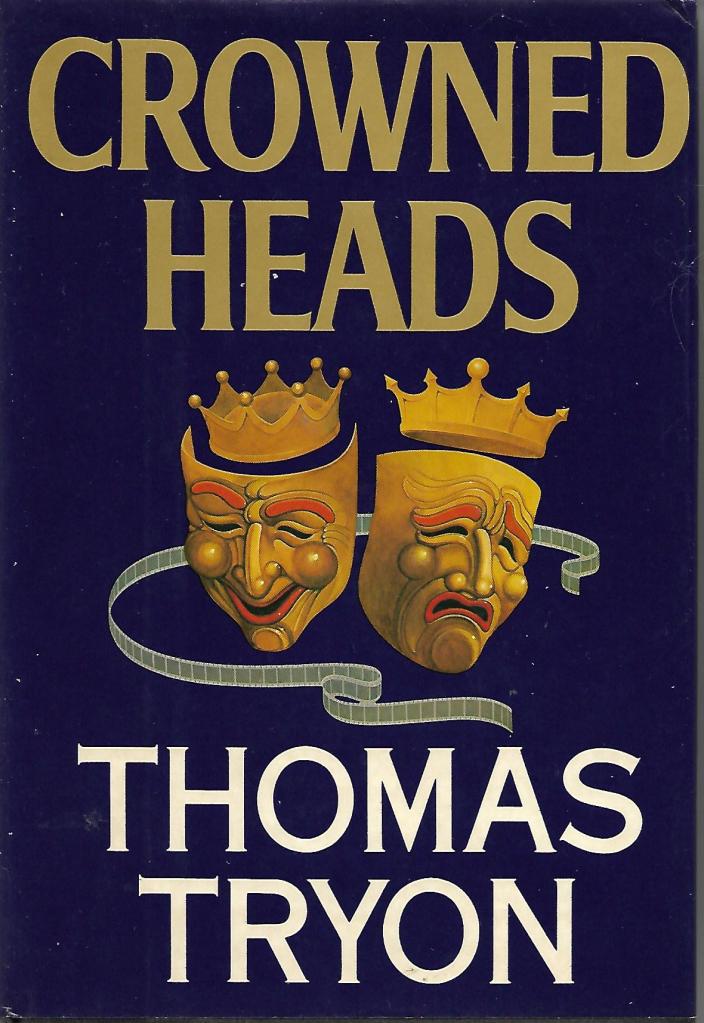
Crowned Heads ~ A Capsule Book Review

Crowned Heads ~ A Capsule Book Review

Thomas Tryon (1926-1991) was a movie actor turned fiction writer who had several successful and best-selling books in the 1970s and ‘80s. Crowned Heads is a 1976 collection of four novellas (each about a hundred pages) in one book about (fictional) movie people who, after they have become as famous as they’re ever going to be, are on the down-side of movie fame. Though these characters are fictional inventions, we assume that they are all based, at least in part, on real people.

The four novellas in Crowned Heads are “Fedora,” “Lorna,” “Bobbitt” and “Willie.”

“Fedora” is a Garbo-like movie star, reclusive and mysterious. She is described as being one of the biggest movie stars ever. She has an alluring European accent and when she gets in front of a movie camera, she generates movie magic. People love her and flock to her movies. One of the amazing things about her is that, even well into her seventies, she still looks young and can play characters much younger than her actual years. Just what is her secret? (No, she hasn’t made a pact with the devil and, no, she doesn’t have a magic youth potion like the one Meryl Streep and Goldie Hawn had in Death Becomes Her.)

“Lorna” is one Lorna Doone, a middle-aged, one-time movie actress better known for TV commercials she has appeared in. She has tons of personal problems, including a shoplifting charge and an insurance investigation into a fire she supposedly set in her home, and she needs a “rest.” She takes her rest at a remote, seaside Mexican resort, where she alienates all the guests, sleeps with as many men as she can, drinks lots of booze, takes pills, and has the kind of breakdown that only a woman can have in a tropical paradise. She only goes downhill from there, setting fire to her cabana, inflaming the local riffraff to passion, and having an encounter with a snake god in an ancient jungle temple. If you like stories about a woman coming “undone,” you’ll love this one.

“Bobbitt” is a character in a series of popular movies for children. The name of the child actor who plays Bobbitt is Bobby Ransome. Decades after Bobby Ransome’s star has fallen, he reappears to the people who knew him and worked with him. He is now an adult, of course, and, except for being “older,” he seems much the same as the kid actor who played the part in the movies. In fact, he hasn’t changed at all. As he adult, he lives in a world of fantasy, make-believe and illusion. Will a little sky-writing help to straighten him out?

“Willie” is Willie Marsh, a has-been movie star who seems to have nothing better to do than sit around his lavish Hollywood home and remember the glory days when his star was at its pinnacle. His home is a kind of museum, but, alas, he is alone and has no one to enjoy it with him. His “mate,” Bee Marsh, has died and left him alone. (We believe, of course, that Bee Marsh was Willie’s wife until it is revealed to us, bizarrely, that she was his mother.) With the obvious Hollywood “treasures” that Willie has in his home, he is certain to attract a criminal element (the “have-nots”) who resents him because he is one of the “haves” and is obviously rich. When a trio of “have-nots” make their way into Willie’s home (under false pretenses), he at first welcomes them because he is lonely but soon discovers what a mistake he has made. The leader of the trio, whose name is Arco, is a lunatic and will resort to any means to get his hands on a certain priceless artifact that Willie is rumored to own. (This novella is based on the infamous 1968 Hollywood murder of silent-screen idol Ramon Navarro.)

Crowned Heads is a “dark” book, engaging, breezy to read, somewhere about halfway between pop fiction and contemporary American literature. It has become a kind of minor classic of the crime/Hollywood lore genre. Thomas Tryon was a talented writer who knew how to deliver a chilling story. He probably made the right decision to give up acting for writing. I first read all of his books years ago and was reading Crowned Heads for the second time.

Copyright © 2019 by Allen Kopp

Vice ~ Capsule Movie Review

Vice ~ A Capsule Movie Review by Allen Kopp

He’s laconic, soft-spoken (“beware the quiet man…”), smart, cautious, chooses his words carefully, and is as reckless, ruthless and unapologetic as he needs to be in performing what he perceives as his duty to his country. He’s not the traditional politician with the 1000-megawatt smile and the standard line of bullcrap. (“If you want it, we’ll be sure and get it for you.”) He’s overweight, has a serious heart condition, is uncharismatic, unexciting, faithful to his wife and family, with no hint of scandal attached to his name (except for a lesbian daughter, which doesn’t seem to bother him in in the least). He’s Dick Cheney, Vice-President for eight years under President George W. Bush, probably the most powerful and consequential vice-president in U.S. history.

According to the new movie about Dick Cheney’s life, Vice, Dick Cheney was unambitious and unmotivated as a young man. He drank to excess and worked as a telephone lineman in his home state of Wyoming. His girlfriend (and soon to be wife), Lynne, forced him to snap-to and, as the saying goes, “make something of himself.” She was the motivating force in his life and was responsible for his being a “something” rather than a “nothing.” If it hadn’t been for Lynne, none of us would have ever heard of Dick Cheney.

Soon Mr. Cheney found himself in Washington as a young congressional intern. He “caught on” in Washington and found himself taking to Republican politics. He ran for Congress from his home state of Wyoming, won, and later served in a number of high-level government positions, spurred on, as always, by his wife, Lynne Cheney. He was just about finished with politics, was raking in the dough as CEO of Haliburton, when he was tapped to be George W. Bush’s unlikely presidential running mate in 2000. “I think we can make this work,” he says to GWB over fried chicken in the back yard.

Regardless of your political affiliation, Vice is an entertaining, wry, ironic behind-the-scenes political story and a panorama of recent American history. It’s the story of a man without political connections or family connections who came from nowhere and became the ultimate Washington insider and power player. Christian Bale and Amy Adams are sensational as Dick Cheney and his wife. Sam Rockwell, who won an Oscar last year as the amazingly dumb small-town deputy in Three Billboards Outside Ebbing, Missouri, plays the swaggering George W. Bush, “black sheep” of the Bush family,  governor of the state of Texas and two-term Republican president.

Copyright © 2019 by Allen Kopp

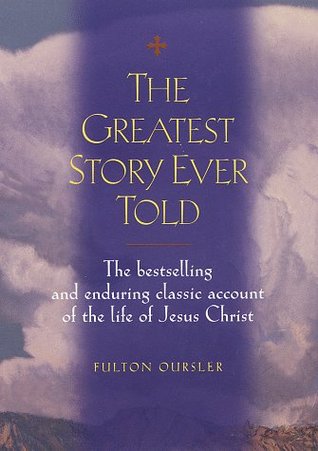
The Greatest Story Ever Told ~ A Capsule Book Review

The Greatest Story Ever Told ~ A Capsule Book Review by Allen Kopp

The subtitle of The Greatest Story Ever Told is A Tale of the Greatest Life Ever Lived. It is, of course, the life of Jesus Christ and is essentially a retelling of the first four books (Matthew, Mark, Luke and John) of the Bible in the form of an accessible, 300-page novel by a writer named Fulton Oursler. It’s a story that most people, Christians and non-Christians, believers and non-believers, will be at least partly familiar with.

What can you say about Jesus Christ that hasn’t been said millions of times before? He was a teacher, philosopher and prophet who came into the world as the living embodiment of God to live life on earth as a human being for 33-1/3 years, to experience human pain, hunger, thirst, despair, disappointment, and persecution, and to die a slow, painful and horribly cruel death at the hands of his persecutors and be resurrected three days later.

Jesus Christ’s message was one of peace, not to overthrow the government by violence, but to change men’s hearts and make them see things in a different way. Kings and magistrates and public officials hated and feared Him because He was an existential threat to their power. What if He decided to set himself up as king and ruler with the backing of most (many) of the “common” people. When asked if He was a king, His reply was: “My kingdom is not of this world.” How was the status quo to deal with Him? The answer was simple: They would deal with Him by wiping him out, destroying Him, removing Him from the world, and in a short time people would forget He ever existed.

The life of Jesus Christ has been called the most influential life ever lived. Do you believe He healed lepers, gave blind people the power to see, lame people the power to walk, brought the dead back to life, changed water into wine, turned a small amount of fish and bread into enough food to feed the multitudes, walked on water, and, after His life on earth, was resurrected into eternal life in heaven? Whether you choose to believe or not in this cynical age is up to you. As always, we are all given the choice of deciding for ourselves.

Copyright © 2018 by Allen Kopp          

The Favourite ~ A Capsule Movie Review

The Favourite ~ A Capsule Movie Review by Allen Kopp

It’s the early 1700s. Queen Anne sits on the throne of England. She has had seventeen children, all of whom died. (“Some were born in blood, some never breathed, and others were with me only for a short time.”) She has seventeen rabbits that she keeps in the royal bedchamber which serve as surrogate children. (“They are my babies.”) She is child-like, petty, temperamental, mentally unstable, sick, gout-ridden, obese, and in every way unfit to run affairs of state. England is, of course, engaged in endless, expensive warfare with France. (God help England!)

Queen Anne (played by an actress named Olivia Colman) has a “favourite,” a woman who goes by the name of Sarah (the ever-frightening Rachel Weisz). Sarah is what is known as a forceful woman. She has Queen Anne firmly in hand. She treats her at times like a child and she will slap her in the face if she feels like it (when they are alone, of course). Sarah tells the queen what to say, what to do, how to dress, and in general manages her life behind closed doors. She is the power behind the throne. And, oh, yes, they are lesbian lovers. We can’t leave that out.

There’s a new bitch in town, though. Her name is Abigail (Emma Stone). She is a wily manipulator. She has recently lost her “status” in life (her father lost her in a card game), and she longs to be a “lady” again. When she comes into the household as a lowly maid, she sizes up the relationship between Queen Anne and Sarah and decides that the situation is rife with possibilities for her. She eventually discovers the sexual nature of the association between Queen Anne and Sarah and learns the way to the queen’s heart.

I didn’t care which of the two dragons (Abigail or Sarah) prevails with the queen. They are equally unlikeable. When they resort to poisoning, I don’t really care which one gets up off the floor. Queen Anne is the most interesting and compelling character, the one character with whom our sympathies lie. We pity her and also find her repulsive.  The often-tragic, often-ugly lives of English kings and queens make for fascinating viewing.

The real fun of The Favourite is the way it looks and sounds. It is a wig movie of the highest order and we don’t get many of those. (The voluminous curly wigs are worn by the men; in the battle of the hair, the women recede into the background.) The early eighteenth century sets look absolutely authentic and believable. The music of the period (Bach, Handel, Vivaldi) is loud and there’s lots of it. There’s plenty here to like, especially if you are a fan of historical costume drama and don’t really care for most of the youth-oriented crap at the multiplex.

Copyright © 2018 by Allen Kopp

Twenty Thousand Leagues Under the Sea ~ A Capsule Book Review


Twenty Thousand Leagues Under the Sea ~ A Capsule Book Review by Allen Kopp

Jules Verne’s 1870 novel Twenty Thousand Leagues Under the Sea is an imaginative science fiction/fantasy adventure set in the 1860s aboard the Nautilus, the electrically powered, fabulously futuristic submarine designed and built by the enigmatic and misanthropic Captain Nemo. Captain Nemo (he knows no other name) remains something of a one-dimensional character throughout the book because we never learn much about him other than that he has cut himself off from his fellow man and prefers to live under the sea. Like Captain Ahab in Moby Dick, Captain Nemo is out for vengeance, but we never learn exactly what happened to him to make him so bitter. Captain Ahab was seeking to destroy the whale that cost him his leg, while Captain Nemo seems to want to kill as many people in the world as he can. His small, uncommunicative crew (if they speak at all, they don’t speak in any identifiable language) of ten or so men on the Nautilus seem to share his disdain for the people of the world.

The American ship Abraham Lincoln was seeking a destructive “narwhal” (an enormous, apparently very cantankerous, whale-like animal) that was known to have destroyed and sunk several unoffending vessels for no apparent reason when it is rammed by the Nautilus and three men are thrown overboard: A French naturalist named Pierre Aronnax (he narrates the story in his first-person voice), his faithful manservant named Conseil, and Canadian harpooner Ned Land. Captain Nemo rescues these three from the sea and takes them on board the Nautilus, where they are essentially held prisoner only in the sense that they are not allowed to leave. Otherwise, they are treated well, with comfortable accommodations, shelter, comfort and plenty of good food. (I’d like a ten-month vacation like this where I can see all the wonders and splendors underneath the sea with minimal danger or discomfort.)

The Nautilus goes all over the world under the sea, witnessing wonders never before seen by man, including the lost continent of Atlantis, the inside of an extinct volcano, wrecked vessels, an attack by monstrous squids, an undersea cemetery, the South Pole, and myriad fish, plants, animals and undersea creatures that most people never have a chance to see in their lives unless they are passengers on the Nautilus. (Captain Nemo, on more than one occasion, takes them on a “walk” on the bottom of the sea.) As a scientist, Pierre Aronnax is fascinated by all he sees, while the Canadian harpooner Ned Land is unhappy and resents not being able to leave the Nautilus. Pierre Aronnax’s faithful manservant, Conseil, just seems to be happy to be able to go along for the ride.

The submarine can go to fantastic depths in the ocean because it is so solidly built by Captain Nemo. It is also equipped with sliding panels in the outside walls so passengers can get a closeup view of all the strange and wondrous sights in the undersea world (illuminated by powerful electric outside lights). The three captives, no matter how diverted they are by all they see, cannot help asking themselves exactly where the Nautilus is going and what is Captain Nemo’s end game? As cordial as he is to his guests (prisoners), he doesn’t reveal anything to them.

The Nautilus is like a character in Twenty Thousand Leagues Under the Sea, as is the sea itself.  Background information tells us that Jules Verne studied submarines (which, in the 1860s, were still unsophisticated) before he wrote the novel and that a lot of the information he “fabricates” for the story later came to pass. In this way he was a visionary. Also the technical knowledge he displays in describing fish, animals, plants and undersea topography is impressive. He apparently had more than just a passing interest in his subject matter.

Copyright © 2018 by Allen Kopp