Psycho ~ A Capsule Book Review

Psycho ~ A Capsule Book Review by Allen Kopp

Alfred Hitchcock’s 1960 movie, Psycho, is a slice of pure cinema. In the directorial hands of a master, it’s a movie where all the different parts—writing, acting, music, film editing, sound, set design, directing—come together in just the right way to create an enduring film masterpiece that has easily stood the test of time. In the hands of a less talented director, it could easily have been just another schlocky, soon-to-be-forgotten stab movie with breasts, a scintillating boudoir scene, and a sensational shower scene, complete with blood going down the drain.

Psycho is a horror movie about a cross-dressing, knife-wielding, multiple-personality maniac, but it’s a high-class horror movie that somehow manages to be tasteful, eschewing blood and cheap horror for a more subtle brand of thrills. It broke new artistic ground and set the standard for movies of its kind. It has been copied, imitated, parodied and emulated, but the one thing it never has been is equaled.

There never would have been the movie Psycho without the novel Psycho by Robert Bloch. Before the movie comes the novel. When Alfred Hitchcock chose the novel to make into a movie, he plucked it from almost certain obscurity. Not that it wasn’t read by readers of its day, but if would never have lasted the way it has if the Hitchcock movie hadn’t made it famous. It is “pop” fiction with little literary merit, except that it makes entertaining reading.

We all know the story. Norman Bates is an odd boy-man who runs an obscure motel on an out-of-the-way California highway. The Bates Motel doesn’t get many guests, except one rainy night, a runaway girl who has lost her way stumbles onto the motel and decides to spend the night. She has just stolen forty thousand big ones from her employer and is on her way to her debt-ridden boyfriend in Fairvale, California.

If the runaway girl, Mary Crane (Marian in the movie), has a secret, Norman Bates has an even bigger one. He has always had a mother fixation. He murdered his dear old mother out of jealousy (she had a lover, you see), but mother’s not resting in her grave. Years earlier, Norman stole her body from her grave and keeps it in the creepy old house behind the motel. He has a split personality. He’s Norman, but he’s also mother. He dresses up in her clothes and wears her wig and, as mother, stabs Mary Crane to death as she’s taking a shower. He hides the body, of course, crying to cover up mother’s crime. Then he has the arduous task of keeping people from finding out what he is and what he has done.

All right, if you want some light reading and you want to read a story that by now is familiar to you, you can’t go wrong with Robert Bloch’s Psycho. It’s not Sister Carrie, but it’s plenty engaging and will keep you turning the pages. The movie follows the novel closely, but, as I said, it makes a much better movie than it does a novel. The movie is distinctive and the novel is not.

Copyright © 2019 by Allen Kopp

The Lighthouse ~ A Capsule Movie Review

The Lighthouse ~ A Capsule Movie Review by Allen Kopp

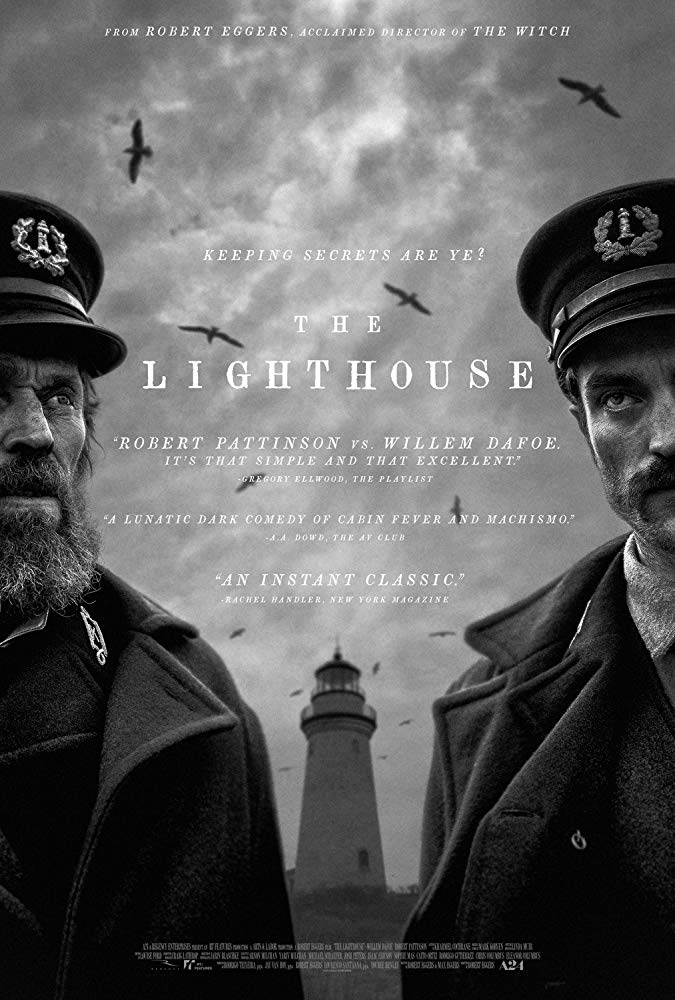
The Lighthouse has to be the most unusual new movie of the year. It’s set in 1890 and shot in black and white, with an aspect ratio of approximately 1.19:1, which means the picture is practically square (instead of elongated, which is what we’re used to) to emulate early motion picture photography. The music score (with a nod to the classic film scores of Bernard Hermann) is made up of a foghorn, horns and pipes, glass harmonica and an ocean harp (a stainless steel bowl with bronze rods around the rim that gives off an ethereal sound when used struck a friction mallet). The dialogue spoken by the two characters is based on the “local color” poems and writings of Sarah Orne Jewett. All these filmmaking elements come together to spell “A-R-T” instead of a commercial project designed to generate box office revenue. (You know, like about 98% of the movies released during the year.)

The only two characters in The Lighthouse are two very different men, one younger (Robert Pattison) and the other older (Willem Dafoe). Both men are named Thomas (although the younger man lies and says his name is Winslow). The older Thomas used to be an old seafaring man and is now a lighthouse keeper who knows all about tending the light. The younger Thomas has a murder on his conscience from when he worked in logging (he let a fellow worker die when he could have saved him). He is hired for a period of four weeks to be lighthouse assistant.

The film is set entirely in and around a lighthouse on the Atlantic seacoast of the United States. It’s not an inviting, scenic or hospitable place. The work the younger Thomas does is backbreaking labor and very often involves nasty chores, such as emptying chamber pots and cleaning out the cistern. “I did not take this post be a housewife or slave,” he says defiantly. The older Thomas is something of an uncouth swine and, understandably, gets on the younger Thomas’s nerves. They sleep in very cramped quarters and are always together. The older Thomas talks incessantly, sometimes in soaring soliloquies that don’t make much sense.

The loneliness and isolation begin to play on the younger Thomas’s mind. The four weeks he was supposed to be at the lighthouse are up, but a terrible storm sets in and the person who was supposed to relieve him doesn’t show up. So, now there’s a psychological element in play. Is any of this really happening or is it all just in the younger Thomas’s head? He’s already killed one man. Will he be driven to kill again?

The Lighthouse is not for everybody, of course. If you see it, you might think it’s not your cup of tea, but you can honestly say it isn’t like anything you ever saw before. Remember The Artist in 2011, a silent, black-and-white movie set in the 1920s? The Lighthouse is as uniquely memorable as The Artist, but in its own special way.

Copyright © 2019 by Allen Kopp

God’s Secretaries ~ A Capsule Book Review

God’s Secretaries ~ A Capsule Book Review by Allen Kopp

England’s Queen Elizabeth I died in 1603, after a reign of forty-four years. She failed to produce an heir, a successor, during her lifetime, so James I of Scotland succeeded her to the English throne. He was the son of Elizabeth’s cousin and political rival, Mary Queen of Scots. The twenty-two years that he sat on the throne of England is called the “Jacobean Age” because “Jacobus” is Latin for James.

Hundreds of years ago in England, religion was of the utmost importance, much more important than it is today. People were willing to fight and to die for their religion. There was much in-fighting between Catholics and Protestants and between other sects and splinter groups. It was about this time that a small group of religious dissenters who weren’t happy with the way they were treated in their own country came to the “New World” for a fresh start in a new place where they could decide the dictates of their own religion. They were what we today might call the “lunatic fringe.”

Early in his reign (which turned out to be fairly disastrous for the country), King James I commissioned a new translation of the Bible. There were existing translations of the Bible, of course, including the Geneva Bible and the Bishops’ Bible, but they were considered inadequate (for whatever reason) and there was a perceived need for a uniform Bible. The King James translation of the Bible was to be a Bible for all the people, not just for the elite and educated. It was to be written in elegant, yet accessible to everyone, Jacobean English.

The translation was a huge undertaking, involving some fifty Translators and taking about eight years. The Translators were not writers or journalists but high-level churchmen, bishops and ministers. They used as their source material existing versions of the Bible, principally that of William Tyndale. King James, who had taken a personal interest in the translation, kept a close watch on the project through to its completion in 1611.

The King James translation of the Bible was not an immediate success. For many years, people still preferred other translations. However, it still remains the “standard” Bible translation hundreds of years later. There are more modern translations but, for millions of people, the stately, soaring language of the King James Bible is the voice of Christianity.

God’s Secretaries by Adam Nicholson is not only about the King James Bible but about the times in which it was written, the king who brought the translation about, and the political climate of the times. It was a time in which the government was in charge of religion; church attendance was mandatory; religion played a central role in everyday life. Churchmen were some of the most powerful people in the country. People lived and breathed the Scriptures. If you were not of the proper faith, you just mind find yourself dead. How different the times are in which we live today!

Copyright © 2019 by Allen Kopp

Tomato Red ~ A Capsule Book Review

Tomato Red ~ A Capsule Book Review by Allen Kopp

Daniel Woodrell (b. 1953) is one of the best and most innovative of current American writers. His 1998 novel, Tomato Red, is set in the fictional town of West Table, in the Missouri Ozarks, in a poor section of town known as Venus Holler. Jamalee Merridew is nineteen years old, with hair the color of tomatoes. She has a seventeen-year-old brother named Jason Merridew, “the prettiest boy in the Ozarks.” (He has green eyes and full, pouty lips.) “Grown-up women,” Jamalee says, “throw their underpants at Jason with their phone numbers written on them in the grocery store.” Jason is a hairdresser; the fact that he is gay does not deter his female admirers.

Bev Merridew is Jamalee and Jason’s mother. She is about forty years old, is a whore and apparently has always been a whore. She lives in a shack in Venus Holler, next door to the shack that Jamalee and Jason live in. She drinks and smokes cigarettes and entertains men. “If she had all the dicks sticking out of her that she’s had stuck in her,” Jamalee says, “she’d look like a porcupine.”

Enter one Sammy Barlach, a decidedly trashy drifter, twenty-four years old. (The novel is told in Sammy’s first-person voice.) One night when Sammy is doing a little house-breaking in the expensive part of West Table, he meets Jamalee and Jason in a mansion-like home. He believes they live there, but soon discovers they are also house-breakers like him. He latches on to them and later their mother, Bev, as his adopted family. He refers to them as “the bunch that would have me.”

Jamalee, Jason and their mother Bev are constantly reminded that they are “trash” and “rednecks” because of where they live, their low socio-economic status, their drinking and their general all-around “no-goodness.” Many people around town are openly hostile to them.

When Jason fails as a pay-for-his-services stud for the ladies (he just doesn’t have it in him), Jamalee goes for an interview at the country club for a job as hostess, during which she encounters the meanness of the country club set toward her “kind.” When she is bodily ejected, she and Jason and Sammy (they have been waiting outside in the car for her) are drawn into an ugly and insulting brawl with some of the country club people that results in fists being thrown.

In retaliation for their rejection and humiliation, Jamalee, Jason and Sammy make a middle-of-the-night raid on the country club and do some serious and costly damage to the golf course. Their mischief may give them some temporary satisfaction, but it ends up having serious consequences for them. In a battle between “white trash” and the “country club set,” guess who is always going to win?

Tomato Red is an almost perfect contemporary American novel, with fascinating and believable characters, killer dialogue, and an unhappy, but completely satisfying and pitch-perfect, ending. I’ve read it twice and I might read it again before the curtain falls. Another novel I love, also by Daniel Woodrell, is The Death of Sweet Mister. It’s another fascinating foray into the world of trashy rednecks and a perfect companion piece to Tomato Red.

Copyright © 2019 by Allen Kopp

They Shall Not Grow Old ~ A Capsule Movie Review

They Shall Not Grow Old ~ A Capsule Movie Review by Allen Kopp

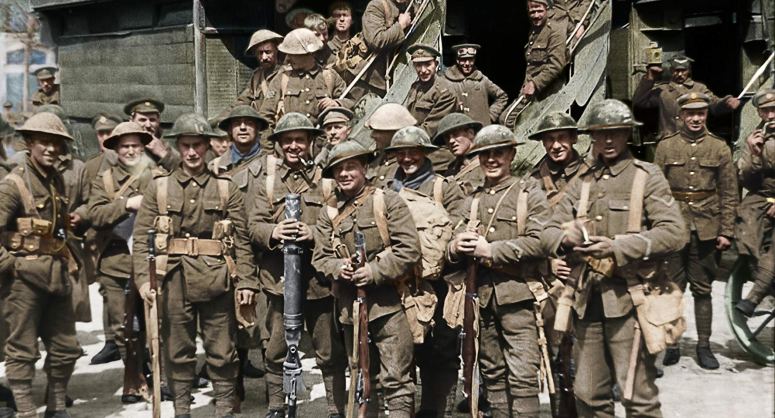
We already know that war is hell. If you still doubt it, you need to see the 2018 movie documentary They Shall Not Grow Old, made for theatrical release and currently being shown on HBO.

It’s now one hundred years since World War I, called the “Great War” at the time, or better yet, “the war to end all wars” (it wasn’t). It was the world’s first (and sadly not the last) experience with global warfare. Millions of people lost their lives, were displaced from their homes, and generally made miserable by food shortages, worthless currencies and dithering leaders who probably should have been locked up at the start.

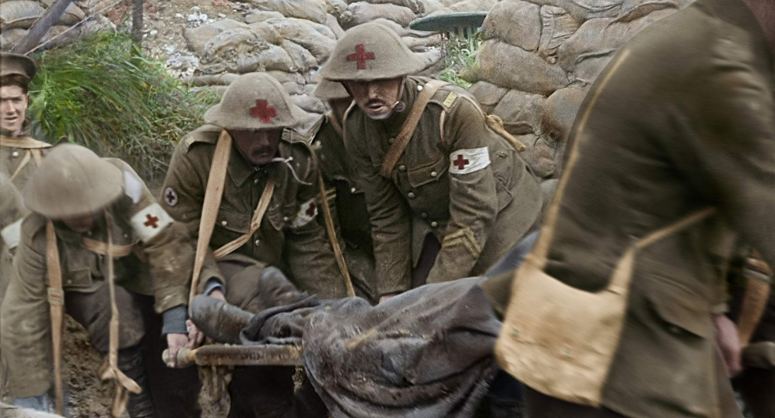
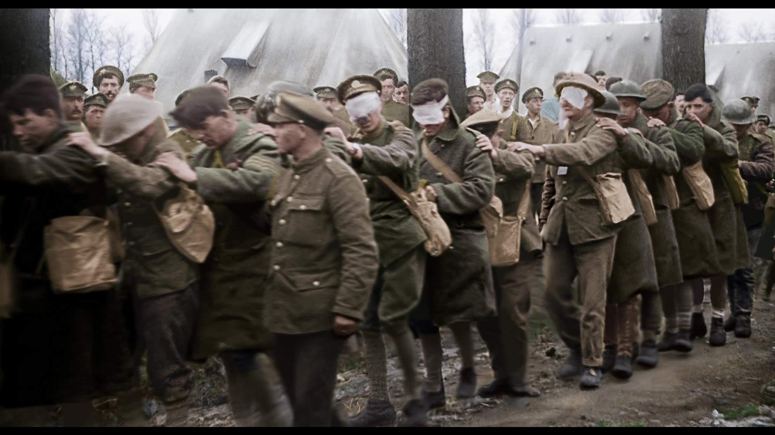
The premise of They Shall Not Grow Old is a simple one. English men who served in the front lines, in the infantry, are talking about their experiences. We don’t see them but only hear their voices. What they are saying is accompanied by moving pictures of life on the front lines, on the “Western Front” in France. Many of these men were very young at the time, no more than eighteen or nineteen years old; they had limited experience of the world, let alone of war. While fighting the enemy at the frontlines, they lived through the worst and most terrifying experiences imaginable, knowing that at any moment a shell bearing their name might come out of the sky and slam into their heads. “You never see the shell that kills you,” they say, “because it’s traveling faster than the speed of sound.”

What makes They Shall Not Grow Old so impressive is that the hundred-year-old film clips have been reprocessed (digitized, colorized, enlarged, restored), giving them a sense of immediacy and a “you are there” feeling. Sound has been added, making it appear that the long-dead people in the film clips are talking, when you know they couldn’t be talking because synchronized sound in film hadn’t been invented yet. I don’t know how this technique is accomplished, but I guess it can be explained by a cliched phrase such as “state-of-the-art technology.” Whatever you call it, They Shall Not Grow Old is worth seeing as a testament to human suffering and the lunacy of war.

Copyright © 2019 by Allen Kopp

Fahrenheit 451 ~ A Capsule Book Review

Fahrenheit 451 ~ A Capsule Book Review by Allen Kopp

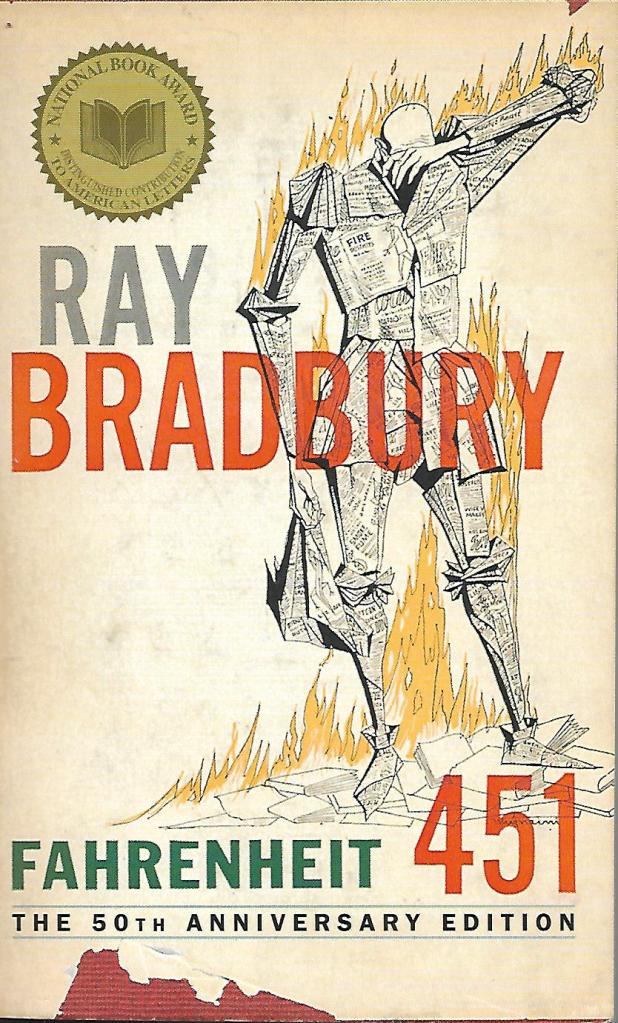
Paper burns at a temperature of 451 degrees Fahrenheit. What more perfect title could Ray Bradbury have chosen for his 1953 novel about a “fireman” in a future society whose job it is to burn books? Yes, books have been declared subversive and dangerous in this future time and owning them—specifically reading them—is a crime for which you might pay with your life.

In this future society (no time is given), books are seen as giving people ideas and making them think. Thinking is dangerous and makes people unhappy. A bunch of people got together and decided to ban all books and, not only ban them, but make a public exhibition of destroying them while also destroying the homes and lives of anybody who might have the audacity to resist. “Firemen” don’t go around putting out fires to save lives and property; they carry flame throwers fueled with kerosene and set fire to books or to homes where books are kept, and they don’t mind setting fire to any book owners who get in their way.

Fireman Guy Montag, thirty years old, is the protagonist of Fahrenheit 451. He has a shallow, hideous wife name Mildred who is addicted to her “wall screens” (a future version of wide-screen TV) and her “parlor families” (TV characters). Guy and Mildred obviously don’t care for each other at all. Guy meets a seventeen-year-old girl named Clarisse McClellan in the neighborhood who is, in every way, the opposite of Mildred. She makes Guy see the world in a different way; she makes him see the shallowness and narrowness of his own life.

When the firemen go out on a call, Guy takes pity (something firemen should never do) on a defiant older woman who chooses to burn up with her books. He develops an unhealthy curiosity for books; if people are willing to die for books, they must be very powerful and compelling. On some of his professional calls, he begins stealing books, one or two at a time, and hiding them in an air conditioning vent in his house. His own wife, Mildred, reports him, and when the firemen show up to burn his house, headed by his boss, Captain Beatty, he is driven to extreme measures and desperate acts.

Guy Montag, the fireman in Fahrenheit 451, is similar to Winston Smith, the office worker in George Orwell’s 1949 novel, 1984. Both characters live in future, repressive societies. They both take a look at their lives, don’t like what they see, and rebel against the dehumanization and enforced conformity of their worlds. Both novels, Fahrenheit 451 and 1984, foreshadow present-day America. There are plenty of people, including some running for high political office, who would strip away our rights and freedoms, make us all the same, and make us forget how unique we are as individuals. We can’t let that happen. It’s a dangerous precedent when only one viewpoint is allowed and any opposing viewpoint is shouted down or not tolerated. That’s a violation of our Constitutional rights. It’s how tyrannical regimes get started.

Copyright © 2019 by Allen Kopp

Downton Abbey ~ A Capsule Movie Review

Downton Abbey ~ A Capsule Movie Review by Allen Kopp

The television series Downton Abbey ran for six seasons and fifty-two episodes from 2010 to 2015. Now there is a Downton Abbey movie. It’s not a sequel or a rehash of the television series but a continuation, set two years after the series left off. If you never saw the series and are not familiar with the characters, you probably won’t find the movie meaningful or interesting. Familiarity with the characters is what will provide the spark.

It’s now 1927. The world has been changing since the Great War (“the war to end all wars”). The uppercrust Crawleys (he’s a peer, don’t you know) have witnessed the slow demise of their “class,” their privilege, and all that goes with it. People on the huge estates, such as Downton, have been selling out and moving into more modest homes. The Crawleys hang on, but sometimes they get discouraged and talk about giving up the ghost, which would mean, of course, letting their servants go out into the cold world and fending for themselves.

King George V and his wife, Queen Mary, are going to be touring Yorkshire, so they will spend one night at Downton Abbey. A royal visit, of course, always provides lots of opportunity for drama and intrigue. After the snooty royal retinue arrives, the Downton Abbey servants are incensed to find that they will be displaced for the duration of the royal visit by the king’s own. Mrs. Patmore will not be required to cook the dinner after all, after laying in mountains of supplies from the local grocer; the cooking will be handled by the king’s French chef. Mr. Barrow, now head butler at Downton, will not need to lift a finger because the king’s butler (although he will not allow himself to be called by that title) will see to everything. Mrs. Hughes’s housekeeping skills will not be needed; the king has brought his own hatchetfaced housekeeper with him; she can scare anybody away just by looking at them.

The royal visit goes off smoothly enough, but, of course, with complications. There is a plot to assassinate the king during a parade (politics, don’t you know) that is thwarted by the ever-brave and resourceful Mr. Tom Branson. (It has now been seven years since the death of his wife, Lady Sybil, so he has an eye again for the ladies.) The Dowager Countess (Maggie Smith) must confront (and make peace with) a detested relative who is part of the king’s retinue. Lady Mary’s husband, Henry Talbot, can’t be present for the royal visit because he is off in Chicago at an auto show, but he appears at the last moment. Lady Edith’s husband, Bertie Pelham, is planning on being on an extended trip in South Africa with the king at the time that their first child is due to be born, so what will Lady Edith do with an absentee husband at such an important time? Our Mr. Barrow (more handsome than ever now that he’s “older”) gets into a jam by being in a “men’s” club—men dancing with each other!—when it is raided by the police. “I’ve never been here before!” he says as he is pushed into the paddy wagon. “You’re here now!” a helpful policeman states.

If you liked Downton Abbey on TV, you should like the movie, which is grander, bigger, broader and more lavish than the TV series. It’s old-fashioned entertainment for those, like me, who need to escape into another time and place. And if the Downton Abbey movie makes enough money, there will undoubtedly be more to come.

Copyright © 2019 by Allen Kopp

Ethan Frome ~ A Capsule Book Review

Ethan Frome ~ A Capsule Book Review by Allen Kopp

American author Edith Wharton (1862-1937) gained fame for her novels about wealthy New Yorkers during America’s Gilded Age, such as House of Mirth and The Age of Innocence. Her 1911 novel, Ethan Frome, is not about high society but is instead about a poor farmer in a bleak New England village, set at some unidentified time in the late eighteenth century.

Ethan Frome has a wife named Zenobia (“Zeena”) that he doesn’t like very much, and who can blame him? He married her out of convenience (inertia) in a weak moment when she came to help him take care of his sick mother. Zeena is older than Ethan and is a bundle of complaints and physical ailments. There is no warmth or kind feelings between Ethan and Zeena.

Zeena has a “poor relation” (even more poor than Ethan and Zeena) named Mattie Silver. Mattie comes and lives in the Frome household to help Zeena with the farm work. Mattie is the opposite of Zeena. She is young, pretty and sunny. Zeena doesn’t like Mattie very much and is always quick to find fault with her.

Ethan is naturally drawn to Mattie Silver. He knows it’s wrong to have “feelings” for her, right in the house under Zeena’s nose, but Mattie makes him feel good, maybe for the first time in his life. Zeena is such a whiny old thing, so sick all the time. Why doesn’t she just die and leave Ethan and Mattie alone in their little love nest? Hah! No such luck!

This ménage a trois can’t end well. Ethan dreams of running away with Mattie, but they are desperately poor, and where would they go and how would they get there? Is he really the kind of man to leave his life for a younger, prettier woman? Has he no decency? Well, yes, he has.

A new doctor advises Zeena to bring in a “hired girl,” meaning somebody who is more competent than Mattie. That means Mattie Silver is going to be tossed out of the Frome household on her ear. On the day that Mattie is supposed to go, Ethan’s hand is forced. Is he just going to keep his mouth shut and let Mattie Silver go out of his life forever without even letting her know how he feels about her? When he discovers that the feelings he has for her are reciprocated, will that make a difference, or will it just lead to an ill-advised action on his part?

Ethan Frome is an American classic about a love affair that is doomed from the start, set in a snowy Massachusetts landscape. It’s a simple story about loneliness, alienation and hidden feelings. When Ethan married Zeena, he missed his chance of ever meeting a woman like Mattie Silver who might have made him happy. He missed the boat and then he paid the price, as so many people do.

Copyright © 2019 by Allen Kopp

Lord of the Flies ~ A Capsule Book Review

Lord of the Flies ~ A Capsule Book Review by Allen Kopp

Author William Golding was born in Cornwall, England, in 1911, and died in 1993. His most famous and enduring work is his 1954 novel, Lord of the Flies. In it, a group of about twenty British schoolboys, ranging in age from six to fourteen, crash-lands on an uninhabited and unnamed island in the Pacific. We learn nothing of where they come from, where they’re going, or of the crash that landed them on the island. Their world begins and ends on the island.

The first thing the boys must do when they find themselves alone (no adults) on the island is to figure out how to survive. There’s plenty of fruit (we never know what kind of fruit it is) on the island, so they aren’t going to starve to death. There are also wild pigs but they’re very difficult to catch and kill. The problem of food and fresh water solved, they build crude shelters to sleep in. They find a large shell (conch) which they blow into to call meetings. The shell becomes a symbol for law and order because, in the meetings, only the person who holds the conch can speak.

Their only hope of being rescued is to keep a smoky signal fire burning all the time, which they believe will be seen by passing ships. They can have fun on the island, but their top priority needs to be the signal fire, according to their elected leader, Ralph. He is the most sensible boy on the island and the one most likely to maintain a semblance of “civilization.” Ralph’s chief ally is Piggy, a chubby boy who uses bad English and is afraid of almost everything. The boys have no matches, of course, so they cleverly use Piggy’s glasses to kindle flames from the rays of the sun.

Months go by. The longer the boys remain on the island, the less chance they have of surviving their ordeal. A boy named Jack challenges Ralph’s authority as leader. He and his group of followers gradually break off from the group as a whole and begin doing things their own way, which is Jack’s way. They become less and less civilized and more like savages. So now we have two warring factions, Ralph’s small group (representing rules and a sensible approach to survival) and Jack’s group (chaos and savagery). They become the world in microcosm.

Lord of the Flies is an influential book that has influenced and inspired many writers—and readers—over the many years since it was first published. If you’ve never read it and you don’t know how it ends, you might be surprised and gratified (or disappointed) by its deus ex machina conclusion.

Copyright © 2019 by Allen Kopp

Reflections in a Golden Eye ~ A Capsule Book Review

Reflections in a Golden Eye ~ A Capsule Book Review by Allen Kopp

Carson McCullers was an American writer who lived from 1917 to 1967. She published her first novel, The Heart is a Lonely Hunter, when she was only in her early twenties. It was a literary sensation that established her as an important American writer and one of the most gifted writers of her generation. Her second novel, Reflections in a Golden Eye, was published in 1941, when she was twenty-four. While it was not the critical and commercial success of The Heart is a Lonely Hunter, it is still a fascinating and highly readable book.

Reflections in a Golden Eye is set at a sleepy peacetime army base in Georgia in, let us say, the late 1930s. The story, the plot, is centered around five characters: Leonora Penderton is the wife of an officer. She is free-spirited, rather course and vulgar, attractive and not very smart. She is married to Captain Weldon Penderton and it is not a happy marriage. He is bitter, withdrawn, suspicious, and a closeted homosexual. He and Leonora have separate bedrooms. Major Morris Langdon is much more temperamentally suited to Leonora Penderton than her husband is. He drinks to excess, is jovial, likes a good time, and is having an affair with Leonora. Major Langdon’s wife is Alison, a nervous, sickly, neurotic woman who despises her husband and depends a great deal on her feminine Filipino houseboy, Anacleto, to make life palatable for her. The fifth character is private Ellgee Williams; he is a country boy who doesn’t know much of the world before enlisting in the U.S. army. He has never been around women much, being raised by a woman-hating father, and becomes obsessed (silently and secretly) with Leonora when he glimpses her naked. He takes to breaking into her house at night and, without making a sound, stands in her bedroom and watches her sleep.

Private Williams tends the stables on the base and, since Captain Penderton rides almost every day, the two of them come into contact frequently. Captain Penderton develops an infatuation (love and same-sex attraction mixed in with an unreasoning hatred) for private Williams, not knowing or not caring that private Williams is infatuated with his wife, Leonora. Of course, private Williams is only vaguely aware (or not aware at all) of Captain Penderton’s sexual longing for him. It might be that he is too unsophisticated to know of those things or to understand, even if he does know.

Reflections in a Golden Eye moves along almost in the way of a Greek tragedy toward its inevitable tragic conclusion. It’s a simple story with clear-cut themes of lust, longing, and isolation. All the characters are flawed in some way, misfits in some fundamental way. Happiness and satisfaction are qualities that don’t exist in this world. It’s a world of superficial, self-indulgent people, destructive to themselves and to their world. Keep those before-dinner cocktails coming and also the after-dinner ones. We must keep drinking to give ourselves the impression we’re happy.

Copyright © 2019 by Allen Kopp