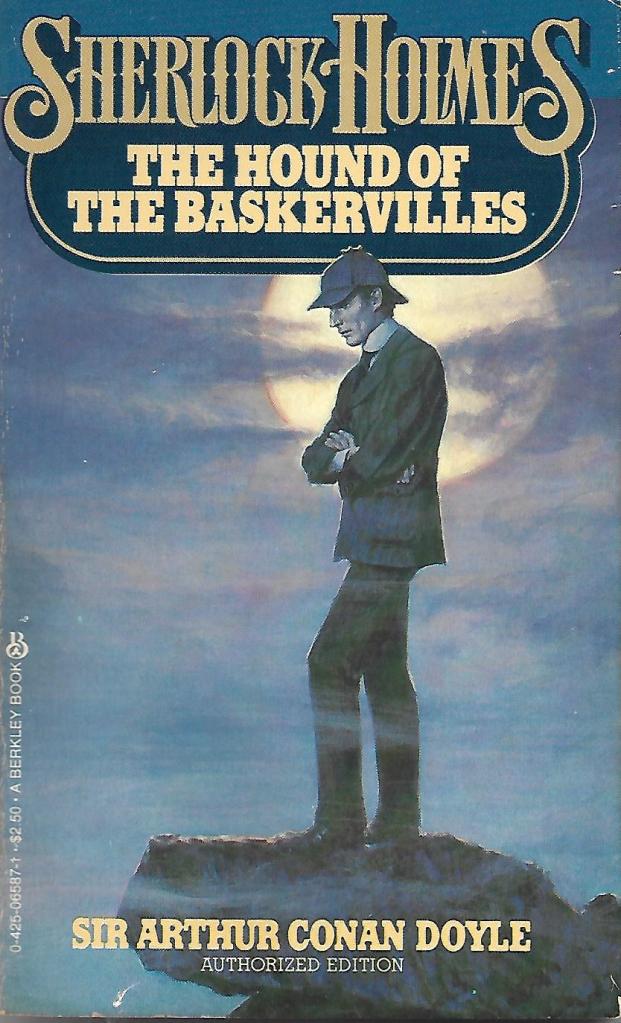
The Hound of the Baskervilles ~ A Capsule Book Review

The Hound of the Baskervilles ~ A Capsule Book Review by Allen Kopp

Sir Arthur Conan Doyle (1859-1930) wrote five novels and over fifty short stories featuring the most famous fictional detective in literature, Sherlock Holmes. The Hound of the Baskervilles, first published in 1902, was the second novel of the five and is the most famous and popular.

The Hound of the Baskervilles is set (mostly) on the lonely, desolate moor in England, far from civilization. The wealthy Baskerville family has been plagued by a curse since the days of the English Civil War (1642-1651). According to the curse, a hellish hound has killed every male heir in the Baskerville line. The most recent heir to be killed was Sir Charles Baskerville; the devil hound never touched him, however; he died of fright when he believed the hound was pursuing him. The new heir is Sir Henry Baskerville. After the death of Sir Charles, he moves in to take over the Baskerville estate and fortune.

Believing his life to be in danger, Sir Henry Baskerville, along with his friend Dr. James Mortimer, enlists the aid of world-renowned detective Sherlock Holmes to solve the mystery of the hound. Since Holmes is busy with other cases in London, he sends his assistant and sidekick, Dr. Watson, down to the country to help make sure that Sr. Henry Baskerville doesn’t become the next victim of the fiendish hound.

From Baskerville hall on the moor, Dr. Watson uncovers what he can about the hell hound and the characters involved in the case and forwards written reports to Sherlock Holmes in London. The case is too fascinating for Holmes to stay away, however, and soon he makes an unexpected appearance in the middle of the proceedings. With his uncanny insights, he unravels the truth behind the hound of the Baskervilles and exposes the villain and the reasons for his villainy.

The Hound of the Baskervilles is a genre novel, classic detective fiction, easy to read at under two hundred pages, for the casual reader or the student of literature. It has served as the blueprint for many stories of its kind and has been made available in many different film versions. What actor could have made a better Sherlock Holmes than Basil Rathbone in the 1939 film version of the novel? It was the part he was born to play.

Copyright © 2020 by Allen Kopp

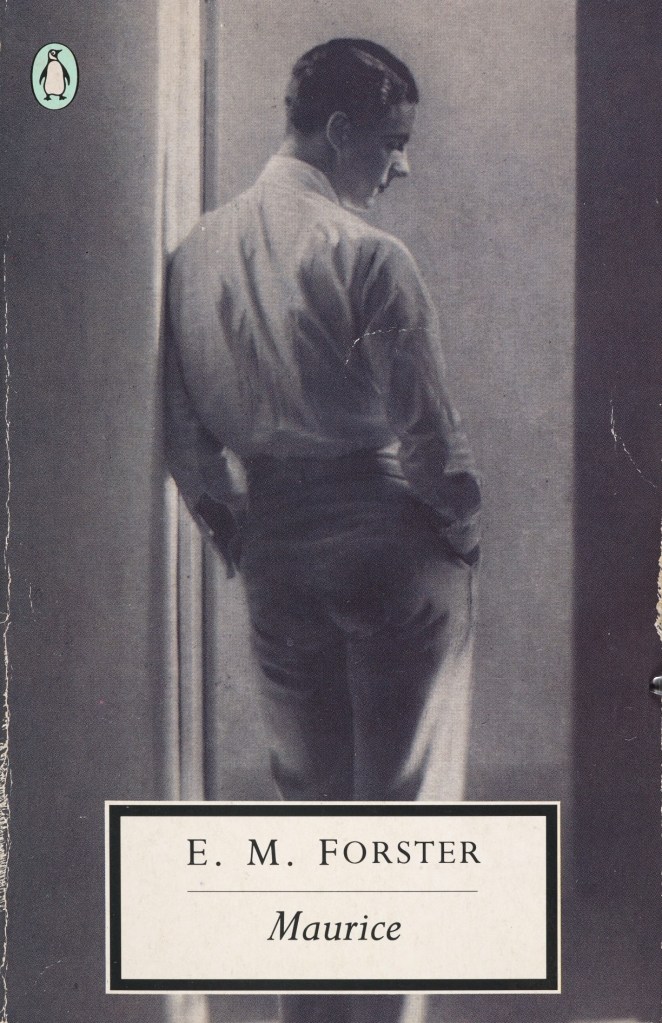
Maurice ~ A Capsule Book Review

Maurice ~ A Capsule Book Review by Allen Kopp 

E. M. Forster (1879-1970) was one of the best English novelists of the twentieth century. His novels are intelligent and literate, while also being entertaining and broadly appealing. He wrote the novel Maurice in 1913, but, because of its unconventional subject matter, it wasn’t published for decades, not until 1971.

The novel is set during the years before World War I. Maurice Hall is an upper middle-class youth from a conventional family; his father is dead; he has a mother and two sisters. He attends Cambridge University, where he meets and comes to know Clive Durham. These two “boys” (young men) are quite different from each other. Maurice doesn’t mind breaking the rules when it suits him, which eventually gets him “sent down” (expelled) from school. Clive is more mindful of convention.

As was common with English schoolboys living away from home, Maurice and Clive enter into a furtive homosexual relationship. For Maurice, his passion for Clive is all-consuming, all-important, and built to last a lifetime. He comes to care more for Clive than for anything else in the world.

The love affair (to others, it’s a very close friendship) between Maurice and Clive continues after school. Maurice works in the business his father worked in. Clive manages his family’s estate and gives dinner parties. Maurice spends as many evenings a week with Clive (and weekends) as he can manage.

A bad bout of influenza at age twenty-four leaves Clive weak and debilitated, but, more to the point, it leaves him preferring women. He and Maurice are finished as lovers but they can, of course, remain friends. Clive soon lands a woman named Anne, with whom he becomes besotted in a very short time. They soon marry, which is what every young man is supposed to do.

Maurice doesn’t really understand how Clive can suddenly prefer Anne over him, but he takes the news with apparent equanimity. As hurt as he is, he knows, logically, that turning to women is the exact right thing for men of his sort. He consults a medical doctor who instructs him to quit having morbid thoughts. A hypnotist advises him to move to Italy or France, where homosexuality is not recognized as a crime.

Enter Alec Scudder. He is an uncouth country lad, the gamekeeper on Clive’s estate. Even though Maurice and Alec are of separate classes, Alec recognizes in Maurice a fellow traveler. They come together when Maurice is visiting Clive’s estate and soon they are in love. As Maurice says, there is “one chance in a thousand” that he and Alec found each other. The only problem is that Alec is emigrating to the Argentine in about a week. Can Maurice persuade him to remain in England? Any kind of a longtime relationship between the two is by definition going to be fraught with difficulties. Not only are they of different classes, but they are outcasts from the world. (He was despise-ed, he was rejected, and acquainted with grief.)

The novel has a happy ending. How can that be? The happy ending is why the novel wasn’t publishable at the time it was written. Homosexuality was a criminal offense in England. Any novel, regardless of its literary merit, that allows two homosexual men to go on their merry way without destroying themselves or ending up in prison was an outrage against public morals. People wanted to see these people punished. Not happy. Never happy.

Copyright © 2020 by Allen Kopp

1917 ~ A Capsule Movie Review

1917 ~ A Capsule Movie Review by Allen Kopp

Film director Sam Mendes hit it big twenty years ago with American Beauty (Best Picture, Best Director, Best Actor Oscars). He has hit it big again with his latest directorial effort, 1917, a war drama set in France in World War I.

1917 is a simple story with a simple premise. Two young British soldiers, Lance Corporal Blake and Lance Corporal Schofield—who would rather be anyplace else other than fighting a war—are given an urgent assignment by their commanding officer. They must cross enemy territory to deliver a message of the utmost importance. Two battalions (1600 men) of English soldiers are being tricked by the Germans. These 1600 men and their commanders believe they are going to engage with the enemy, but the truth is they are being tricked and led into a slaughter. The message the two young British soldiers carry to the two battalions is that they are to “stand down” and don’t go on with the battle as planned.

Time is of the essence. If Lance Corporal Blake and Lance Corporal Schofield don’t deliver their message in time, the results will be disastrous. Lance Corporal Blake is told at the outset that his own brother is among the 1600 English soldiers, so he has an additional reason for wanting to succeed.

The odds are against Lance Corporal Blake and Lance Corporal Schofield making their way across enemy territory without being shot or captured. What they see and experience over the next two hours is what we (the audience) sees: endless mud, foxholes, dead bodies of men and animals, flies, stench, rats, barbed wire, gray skies. It’s a story told in “real time,” meaning that the two-hour runtime of the movie is how much time elapses in the story. We (the viewers) see it as it happens. The camera movement is so fluid that we are hardly aware of any edits. It’s an amazing two hours of filmmaking.

Lance Corporal Blake doesn’t make it. He’s stabbed, ironically, by a downed German pilot whose life they save by pulling him out of his burning aircraft, and bleeds to death. Lance Corporal Schofield must carry on alone. He is the “one against many,” “the last man standing.”

There is much to admire in 1917, including its sense of realism and its stirring music score by Thomas Newman. It’s a movie that pushes the boundaries of art. I can’t wait to see it again.

Copyright © 2020 by Allen Kopp

At the Mountains of Madness ~ A Capsule Book Review

At the Mountains of Madness ~ A Capsule Book Review by Allen Kopp

H. P. Lovecraft (1890-1937) wrote At the Mountains of Madness in 1931. (It was first published in serialized form in a magazine in 1936). It’s a horror/fantasy/science fiction novel about an exploratory expedition to Antarctica, possibly the most inhospitable place on earth, where men go, not to get a good suntan or to meet girls, but to engage in scientific research. Besides frigid temperatures, rugged terrain, discomfort and loneliness, these explorers must also deal with something unexplained: the massive ruins of a fantastic, ancient city. (“Ancient” in this case meaning 500 million years.)

The Antarctic expedition in At the Mountains of Madness is led by a geologist named William Dyer from the fictional Miskatonic University from the fictional Arkham, Connecticut. He is relating the story in his first-person voice. After the explorers discover the remains of fourteen prehistoric life forms, previously unknown to science and also unidentifiable as either plants or animals, they find a vast, abandoned stone city, alien to any human architecture. By exploring these fantastic structures, they learn through hieroglyphic murals that the creatures (dubbed the “Elder Things”) who built the mysterious city came to earth shortly after the moon took form and built their cities with the help of “shoggoths,” biological entities created to perform any task, assume any form, and reflect any thought. There is a suggestion that life on earth evolved from cellular material left over from creation of the shoggoths.

The explorers soon realize the Elder Things have returned to life and to their ancient city. They (the explorers) are ultimately drawn towards the entrance of a tunnel, into the subterranean region depicted in murals. Here, they find evidence of various Elder Things killed in a brutal struggle and blind six-foot-tall penguins wandering placidly, apparently used as livestock. They are then confronted by a black, bubbling mass, which they identify as a shoggoth, and escape. The survivors of the expedition then make it their mission to discourage any future exploration to the region.

H. P. Lovecraft is considered the premiere American fantasy writer of the twentieth century. I think he is not an easy writer to read. His work is generally very wordy, laden with ponderous description. It’s not light or breezy reading. You have to pay particular attention to the text and if you’re reading late it night, it might put you to sleep.

Along with the short novel At the Mountains of Madness, there are three short stories in this Belle Epoque Original edition: “The White Ship,” “The Doom that Came to Sarnath,” and “Herbert West—Reanimator.” “The White Ship” and “The Doom that Came to Sarnath” are verbose fantasies set in other realms. “Herbert West—Reanimator” is the famous story about a doctor obsessed with bringing the dead back to life. He rifles cemeteries for fresh corpses, aided by his assistant and friend, also a doctor. These two “mad scientists” conduct unholy experiments with dead people, often with tragic and horrifying results. Delicious.

Copyright © 2020 by Allen Kopp

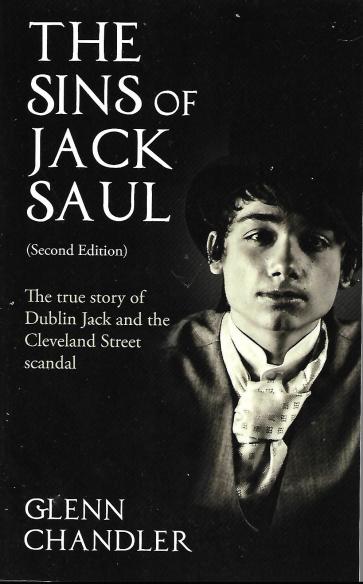
The Sins of Jack Saul ~ A Capsule Book Review

The Sins of Jack Saul ~ A Capsule Book Review by Allen Kopp

Who the hell is John “Jack” Saul, you might ask. He was a real-life person who lived from 1857 to 1904. He was five feet, five inches tall, well-endowed sexually, slightly effeminate, and a notorious male prostitute. He was born in Dublin, Ireland, and when he went to London he was widely known as “Dublin Jack.” He is known today for writing (or at least partly writing) a pornographic novel titled The Sins of the Cities of the Plain and for being a witness in a high-profile libel case involving an important person known as Henry James Fitzroy, Earl of Euston, who was reported to have visited a male brothel in London at 19 Cleveland Street. When the male brothel was discovered and publicized, it became the major sex scandal of the Victorian Era.

Lord Euston filed a suit and (and won) against a crusading newspaper man, Ernest Parke, who claimed that he (Lord Euston) went to the brothel to have sex with young men. Lord Euston claimed in court that he was taken to the brothel under false pretenses and that when he realized what kind of establishment he was in, he left. Jack Saul was a witness for the defense, meaning that he testified against Lord Euston. He was defiant on the witness stand and admitted he was a professional male prostitute and that Lord Euston did indeed visit the male brothel at 19 Cleveland Street to engage in forbidden sex acts with men. The court eventually decided the case in favor of Lord Euston, although his later life was plagued with blackmail and allegations of homosexuality.

In the 1880s, as now, the news media and the public love a good sex scandal, especially if it involves important or highly connected persons. Other important or notable people were implicated in the Cleveland Street brothel scandal, including Lord Arthur Somerset (equerry to the Prince of Wales) and several high-ranking army officers. (There was a persistent rumor at the time, that has never been disproved, that Prince Albert Victor, son of the Prince of Wales and grandson of Queen Victoria, second in line for the English throne, was a visitor to the brothel.) At this time in English history, any sex act between two men was illegal and punishable by imprisonment. Many of the male prostitutes working in the brothel were only about seventeen and worked as messenger boys for the post office. They became prostitutes to supplement their meager wages.

The Sins of Jack Saul by Glenn Chandler is as much about the times (Victorian era) as it is about a single person. Jack Saul had a sad, difficult, dangerous life, oftentimes picking up men on the street to have sex with them. He worked at several “legitimate” jobs from time to time, but nothing was as lucrative for him as prostitution. He could read and write, as many of his contemporaries could not. He died at age forty-six in 1904 of tuberculosis in his native Dublin. There has been a renewed interest in his life because he was a kind of symbol of gay defiance long before there was anything resembling gay rights. (He disproved the belief, widely held at the time, that homosexuality was a vice of the wealthy that corrupted the innocent.) He was what he was and if you didn’t like it, that was just too bad. He claimed to be covered in shame, but on the other hand he made no apologies and always sent money home to his mother.

Copyright 2019 by Allen Kopp

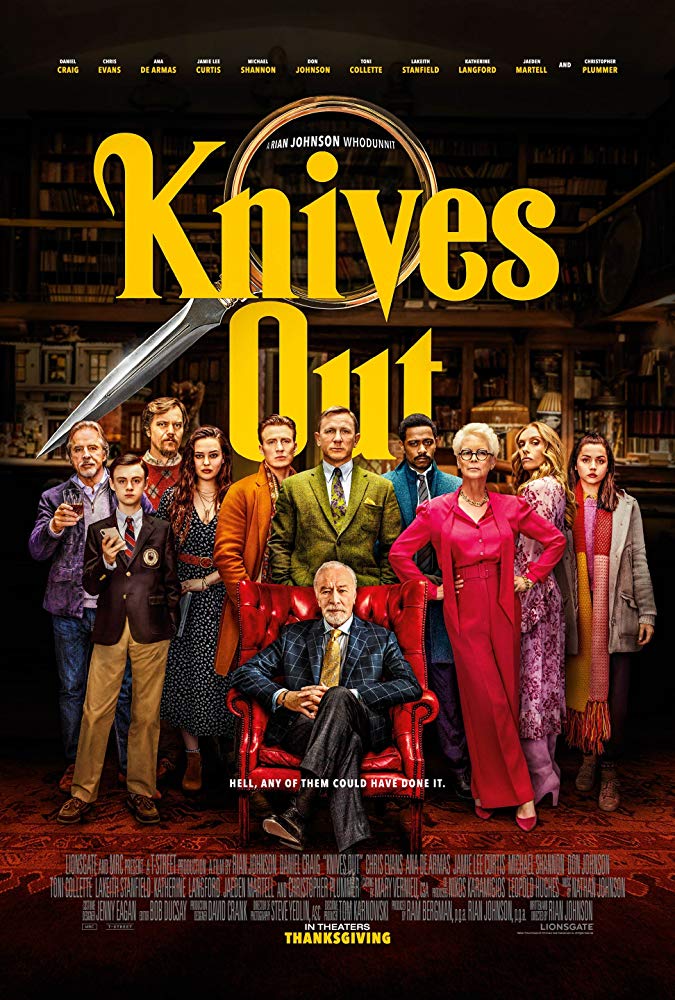
Knives Out ~ A Capsule Movie Review

Knives Out ~ A Capsule Movie Review by Allen Kopp

Knives Out is an old-fashioned murder mystery in the style of English mystery writer Agatha Christie. Benoit Blanc (played by the versatile Daniel Craig, with a Southern drawl right out of Old Virginny), is the astonishingly perceptive, methodical, deceptively unflappable detective. He is in the style of Agatha Christie’s detective Hercule Poirot, without the elaborate mustache and the Belgian accent, of course. (Benoit comes from the Latin word “benedictus,” which means “the one who says the good.” Blanc is the French word for “white.”)

Harlan Thrombey (played by Christopher Plummer) is the eighty-five-year-old patriarch of the Thrombey family. As a successful writer of murder mysteries, he has amassed a fortune in excess of sixty million dollars. He lives with his family in a gloomy, spacious, Massachusetts country house.

Since Harland Thrombey is getting along in years, all his children and grandchildren are mightily concerned for his welfare. He is, don’t you know, the Goose that Lays the Golden Eggs. Nobody in the family has to hold down a job because Harlan Thrombey, the wealthy writer of murder mysteries, supports all of them in grand style.

Harlan Thrombey’s son, Walt, ostensibly runs the family publishing business, but all he does he does is publish his father’s twice-yearly books. Daughter Linda and her husband, Richard, seem to do nothing except stand around and talk (she smokes cigarettes) and keep an eye on the old man, the source of all “their” wealth. Linda and Richard have a son in his mid-thirties, Ransome. He’s handsome, dissolute and unscrupulous. Harlan’s daughter-in-law, Joni, is a flaky matron who was once married to Harlan’s now-deceased son. She knows where her bread is buttered. She has been “double-dipping” her daughter Meg’s tuition money to an expensive school (cheating her generous father-in-law) to the tune of a hundred thousand dollars a year.

On the night of Harlan Thrombey eighty-fifth birthday party, he ends up dead, apparently murdered, with his throat cut. The last person to see him alive is his immigrant nurse from Uruguay, a young woman named Marta Cabrera. The family treats her as one of them. She seems to be the only one in the group who genuinely cares for Harlan Thrombey without any selfish motives.

There are plenty of suspects with reason enough to want to see the old man dead, aren’t there? Hours before he died, he threatened to cut off his over-indulged grandson Ransome without a penny. Hours before he died, he discovered that his daughter-in-law Joni was cheating him out of a considerable amount of money and also threatened to cast her out into the cruel world without a penny. Hours before he died, he had a little talk with this son-in-law Richard to the effect that he knew that Richard was cheating on his wife, Linda. Hours before he died, he threatened to remove his son Walt from the publishing company. Wouldn’t any of them, or any of the others, for that matter, have reason enough to want to see the old man dead?

Enter aforementioned Benoit Blanc. He sees right away what a bunch of greedy, grasping, self-serving assholes the Thrombeys are. “I am eliminating no one as a suspect,” he drawls. If anybody can figure out who killed Harlan Thrombey, Benoit Blanc can.

Knives Out is a story that relies heavily on character and the spoken word. There are plenty of twists and wrong turns in the story but, never fear, the truth will be revealed in the end. If you’re used to lots of action, gunshots and screeching tires in your movies, then Knives Out probably isn’t the movie for you. Let’s just say it’s geared toward the older, and calmer, audience.

Copyright © 2019 by Allen Kopp

A Son of the Middle Border ~ A Capsule Book Review

A Son of the Middle Border ~ A Capsule Book Review by Allen Kopp

Hamlin Garland was an American writer who lived from 1860 to 1940. His memoir novel, A Son of the Middle Border, was first published in 1917. It’s the story of Hamlin Garland’s farm childhood and his struggles to gain success as a writer in early adulthood.

The Garland family lived in the Wisconsin wilderness, in a deep ravine known as a “coulee.” His father, Richard Garland, came home from the Civil War in 1865. He was forever after a military man who believed in military discipline, even when dealing with his four small children. He became disenchanted with life in Wisconsin and moved his family father west to the barren plains of Iowa, where he became a wheat farmer.

Life in Iowa for the Garland family was no better than it had been in Wisconsin. The barren Iowa plains were lacking in vegetation, brutally cold in winter and blisteringly hot in summer. Every living thing, man and animal, suffered in Iowa. When the wheat crops were abundant, a farmer could make a living for himself and his family, but the trouble was that wheat farming was dependent on the whims of weather and nature. When “chinch bugs” destroyed the wheat crops two years in a row, many wheat farmers had to sell out and find an easier way to make a living.

The lure of the West was strong for many people during this time. Richard Garland once again moved his family farther west, this time to the Dakotas. He tried various enterprises but was never able to attain more than marginal success as a tiller of the soil. His long-suffering wife always went along with whatever he wanted without complaint, but anybody could see that she was fast becoming an old woman before her time. Of the Garlands’ four children, their two daughters died in young adulthood without ever escaping the farm.

Despite Hamlin Garland’s hard life as an Iowa farm boy, he was determined to get an education and not be a poor farmer all his life. Sometimes his work on the farm left him little time or energy for anything else, but he overcame many obstacles and went to school whenever and wherever he could. The third act of A Son of the Middle Border concerns how he, as a young man, left the farm, went away to Boston and established himself in the literary world. It is a particularly American story about how one man, born poor and with few advantages in life, went after what he most desired in life and succeeded.

Copyright © 2019 by Allen Kopp

Joker ~ A Capsule Movie Review

Joker ~ A Capsule Movie Review by Allen Kopp

There’s no Batman in Joker. Let’s get that clear. Batman is yet to be. The character who will be Batman when he’s grown up, Bruce Wayne, is a child in Joker. Bruce Wayne is the son of Thomas Wayne, mayoral candidate of Gotham City. Gotham City is a sort of fictional New York City, only grittier, uglier and more crime-ridden. Thomas Wayne says he can clean up Gotham City if voters will give him a chance. He doesn’t seem very trustworthy. He seems like just another phony asshole politician who will say and do anything to get elected.

Arthur Fleck (Joaquin Phoenix) lives with his invalid mother, Penny Fleck, in a squalid apartment building in Gotham City. Penny Fleck used to be employed by the Thomas Wayne family as a domestic. Arthur bears a physical resemblance to Thomas Wayne. Do you get the connection here without having it spelled out?

Arthur is a study unto himself. You don’t even need Batman. He is a former mental patient (why did they ever let him out?) who takes seven medications and, yet, he “feels so bad all the time.” He is a professional “party clown.” He goes wherever a clown is needed, whether it’s to children’s hospital or to carry a sign on the street to advertise a going-out-of-business sale.

The thing with Arthur is that the world has not been very kind to him. He has been (or believes he has) largely mistreated. Funding is cut off for his psychiatric care and his drugs. When he is savagely beaten and kicked by thugs on the street, a co-worker gives him a gun for self-defense. A mental patient with a distorted view of things carrying a gun? I don’t think so. Sounds like a disaster waiting to happen.

One night when he is going home from work dressed as a clown, Arthur Fleck has an ugly encounter with three bullies on the subway and ends up killing all three of them vigilante-style. The three dead bullies are elite Wall Street types. By killing them, Arthur becomes a hero to the downtrodden. A kind of class warfare begins between the haves and the have nots. People all over the city begin dressing as clowns to show their solidarity with the subway killer. This is just the beginning for Arthur. He has had enough and he’s not going to take it anymore. He goes from being Arthur Fleck, the sad little man who lives with his mother in a creepy apartment building, to being the “Joker,” the arch-villain of the city and nemesis of the yet-to-be Batman, who is still just Bruce Wayne, child of an affluent family.

Joker is not just another superhero movie (there have been too many of them) based on comic book characters. It’s not for children; it’s dark, violent and sad. At the core of it all is the characterization of the Joker by an actor who obviously immerses himself in the role. We see before our very eyes the evolution of an arch-villain. He puts on a happy face. He dances. He sings. He kills.

Copyright © 2019 by Allen Kopp

A House for Mr. Biswas ~ A Capsule Book Review

A House for Mr. Biswas ~ A Capsule Book Review by Allen Kopp

Trinidad is a small island off the coast of Venezuela. Tobago is an even smaller island to the northeast of Trinidad. The two together make the Republic of Trinidad and Tobago, the southernmost island country in the Caribbean. V. S. Naipaul was a Trinidadian and Tobagonian British writer of works of fiction and nonfiction in English who lived from 1932 to 2018. His 1961 novel, A House for Mr. Biswas, was the first of his many books that brought him international acclaim as a writer. It ranks number 78 on the Modern Library’s List of the Hundred Greatest Novels in English of the Twentieth Century.

Mohun Biswas is the “everyman” protagonist of A House for Mr. Biswas. He is the son of immigrant parents from India, a Hindu, living in the Caribbean country of Trinidad. Mr. Biswas (the title by which he is known throughout the novel) is a the “little man,” the “one against the world.” A House for Mr. Biswas is the story of his unspectacular life. We are told on the very first page of the novel that he dies in his mid-forties. He marries Shama, a woman from a family of many daughters. It is a strictly matriarchal family, dominated by Shama’s mother, Mrs. Tulsi. He doesn’t like being dominated by his wife’s family, but he doesn’t seem to be able to help it. He and Shama never seem to care very much for each other, never seem to share any kind of an emotional bond, but they have four children, one boy and three girls.

Not being particularly well-educated, smart or competent, Mr. Biswas seems to have trouble making a meager living for himself and his family. He manages a “rum shop,” works as a sign-painter, and works in his wife’s family’s store, which seems to be kind of “everything” store. His main ambition in life is to be independent (from his wife’s family and from anybody else) and to have his own home that belongs to him and nobody else. About midway through the novel he undertakes to have his own house built by an anything-but-reliable builder, but it doesn’t go well, and his unfinished house is destroyed in a storm. In the second half of the novel, he gets a job as a journalist for a small newspaper, where he writes a column about “deserving destitutes.” This is a step-up for him, where he makes about $150 a month, and he eventually he owns his own car, but still lives by his wife’s family’s dictates (especially his wife’s mother) in a house they own.

Despite its length (568 pages) and exotic setting, A House for Mr. Biswas isn’t difficult to read. It’s in clear, concise, easy-to-understand English. There are no tangled sentences, no tortured descriptive passages. There are lots of character names, though, sometimes difficult to remember and keep straight because many of them are similar (Shama, Sharma, Savi, Chinta, etc.). This is a minor quibble, though, and no reason not to read the book. For American readers, A House for Mr. Biswas is a glimpse at a life in another country, on another continent, in another culture. If you think life is difficult for you, consider the life of Mr. Mohun Biswas.

Copyright © 2019 by Allen Kopp
JoJo Rabbit ~ A Capsule Movie Review

JoJo Rabbit ~ A Capsule Movie Review by Allen Kopp

Johannes “JoJo” Betzler is a winsome, ten-year-old boy living with his unconventional mother in Nazi Germany during World War II. His father is fighting in Italy, unseen for two years and presumed dead. JoJo has an “imaginary” companion, who turns out to be none other than the Fuehrer himself, Adolf Hitler. Caught up in the fervor of his time and place, JoJo believes he is a loyal Nazi, until he starts seeing things in a different way.

The Hitler of JoJo’s imagination is funny and endearing, or at least that’s the way JoJo sees him. He has a funny accent and a comical mustache and he’s fun to be with and to talk to, a really nice fellow. Sometimes when he’s talking he lapses into his “fiery speech” mode. JoJo has some growing up to do before he sees Hitler for what he really is and becomes disenchanted with him.

Jews are the enemy, according to Germans of the era, the cause of all the world’s woes. JoJo is more than willing to go along with the hatred of Jews until he discovers that his own mother is hiding one of them in her house, a teen girl named Elsa. JoJo and Elsa becomes friends. After JoJo becomes friends with a Jew, he comes to see the race in an entirely different light. (“What will you do when the war is over and you no longer have to hide?” JoJo asks Elsa. “Dance,” she says.) JoJo wants Elsa to tell him all about the Jews because all he knows about them is the stereotypes. He plans on writing a book that will be the definitive book on how Jews are different from Aryans. JoJo is intelligent beyond his years.

The war isn’t going well for Germany. Allied forces are closing in. The Russians are on Germany’s doorstep. Realistic Germans see the war is lost. The time for believing in miracles is past. When JoJo’s mother pays the ultimate sacrifice for hiding a Jew in her house, JoJo finds himself all alone in the world. Suddenly the war has ended. What do JoJo and Elsa do now? Isn’t it time to dance?

New Zealand actor Taika Waititi plays Hitler in JoJo Rabbit. (I saw Taika Waititi in a little-seen, crazy, funny and dark movie from New Zealand about vampires called What We Do in the Dark.) Taika Waititi also wrote the screenplay for JoJo Rabbit from a novel by Christine Leunens. Taika Waititi also directed JoJo Rabbit. (Give the multi-talented Taika Waititi an Oscar.) A child actor named Roman Griffin Davis is perfect as JoJo Rabbit (so-named because he refuses to strangle a rabbit early in the movie). He’s cute without being cloyingly cutesie-pie. Archie Yates is another child actor who plays JoJo Rabbit’s pudgy, well-meaning friend, Yorki. There’s something reassuring and endearing about Yorki. He’s the perfect friend to be with if you’re stuck in a war.

Copyright © 2019 by Allen Kopp