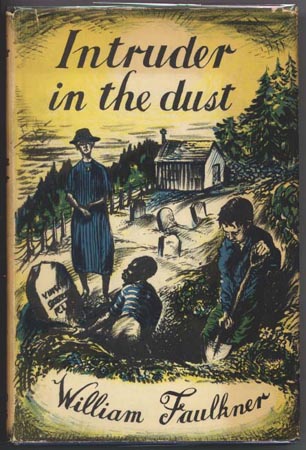
Intruder in the Dust ~ A Capsule Book Review

Intruder in the Dust ~ A Capsule Book Review by Allen Kopp

In the small town of Oxford, Mississippi, a white man named Vinson Gowrie is murdered, while a black man named Lucas Beauchamp stands accused and is put in jail. The Gowries (from “Beat Four”) are sure to want revenge. They can get enough of their redneck friends together to storm the jail and remove Lucas Beauchamp and lynch him. The law is conceivably helpless against such a mob.

A sixteen-year-old boy name Charles “Chick” Mallison is convinced of Lucas’s innocence, while everybody else believes he is guilty. When he was twelve years old, out hunting in the woods, Chick fell into the river and was pulled out by Lucas Beauchamp. Lucas took him home with him, gave him dry clothes and half his dinner. Chick tried to pay him for his kindness with some coins he had, but Lucas didn’t take well to being given money by a white child. Chick never forgot Lucas’s kindness, his dignity, and how much he was unlike other black people of his acquaintance.

With little more than a hunch to go on, Chick wants to prove that Lucas is innocent. He gets his friend, Aleck Sander (a black youth his own age), to go along with him to the cemetery where Vincent Gowrie is buried, miles outside of town. But, wait a minute, there’s at least one adult who also believes Lucas is innocent. A seventy-year-old spinster named Miss Habersham grew up with Lucas’s now-deceased wife, so she has a personal interest in the matter. She goes along on the nighttime visit to the cemetery to dig up Vinson Gowrie’s body and take it back to town so it can be examined by an expert to prove that Lucas’s gun didn’t fire the fatal bullet.

Well, wouldn’t you know it? There’s a body in Vincent Gowrie’s grave all right, but it’s not Vincent Gowrie. Now it becomes a murder mystery. While everybody else is waiting around for the Gowries to lynch Lucas Beauchamp, a handful of people (Chick Mallison, his lawyer uncle, Miss Habersham) are willing to miss sleep and put themselves out to prove that something more sinister is going on that a black man murdering a white man in a small Southern town.

Intruder in the Dust was first published in 1948. It is, we are told, William Faulkner’s answer to race relations in the South. It’s written in a stream of consciousness style, making it wordy and at times difficult to read. Some of the sentences are hundreds of words long and some of the paragraphs go on for two pages or more. A thought will obtrude on a thought and then another thought will obtrude on that thought. Faulkner was the supreme literary stylist of American literature. Nobody else even comes close.

Copyright © 2018 by Allen Kopp

The Seagull ~ A Capsule Movie Review

The Seagull ~ A Capsule Movie Review by Allen Kopp

The Seagull is based on the famous play by Anton Chekhov of the same name. It’s set in Russia in 1904, in summer, in a country house beside a lake. Irina (Annette Benning) is a Moscow stage actress in her mid-fifties come to visit her elderly brother (Brian Dennehy) and her son, Konstantin. She has her boyfriend, Boris Trigorin (Corey Stoll), with her. Boris is a famous and celebrated novelist, about fifteen years younger than Irina. He is drawn to Nina (Saoirse Ronan), an innocent country girl who wants to go on the stage. Nina is dazzled by Boris’s fame as a writer and imagines his life is much more romantic than it really is. Boris and Nina spend time away from the others, partly in a boat on the lake, much to Irina’s displeasure.

Then there is Masha (Elizabeth Moss), daughter of the housekeeper, Polina. Masha is one of the most interesting characters. She wears black all the time (“in mourning for my life”), takes snuff, drinks to excess, and looks older than her twenty-eight years. She is in love with Konstantin and, since she can’t have him, she marries the schoolteacher, Miguel, a sincere if unprepossessing fellow.

Like Boris Trigorin, Konstantin is also a writer, but an untested one. He’s jealous of Boris for his success, for the esteem with which his mother holds him, and, more importantly, for his attraction to Nina. Konstantin is in love (unhappily as we will see) with Nina. He shoots and kills a seagull and throws it at Nina’s feet for no reason other than that he feels sorry for himself. The destroyed seagull is a symbol for innocence lost.

In the final act, a kind of coda to the whole thing, we see what becomes of all these characters two years later. Nothing has really changed, as we will see. The more things change, the more they stay the same.

With the multiplex given over almost entirely to comic book movies and youth-oriented fare, it’s hard to find a movie like The Seagull. It’s a chance to see a film version of a world-famous Russian play, if that should interest you, as it does me. You may come away enriched for having had the experience and you won’t go home with a special effects headache.

Copyright © 2018 by Allen Kopp

The Truce ~ A Capsule Book Review

The Truce ~ A Capsule Book Review by Allen Kopp

Mario Benedetti was a Uruguayan writer who lived from 1920 to 2009. Although not well known in the English-speaking world, he is considered one of the most important Latin American writers of the second half of the twentieth century. His novel, The Truce, was first published in 1960. The 2015 Penguin Classics edition was translated from Spanish to English by Harry Morales.

The subtitle of The Truce is The Diary of Martín Santomé. Martín Santomé is the common man protagonist of The Truce and, as such, he is subject to all the ills and foibles of being alive. He doesn’t have a lot of money and isn’t especially smart or well educated. He has spent his life toiling in a tedious accounting job (“…that sentence of being ensnared in something unimportant for eight hours, something which inflates the bank account of those useless people who sin by the mere fact of being alive…”). At forty-nine, he is a few months away from retirement, but, instead of looking forward to retirement, he doesn’t know how well he is going to take to it.

Martín’s private life is no more exemplary than his professional one. He has been a widower since age twenty-eight. (His wife, Isabel, was twenty-five when she died of complications of childbirth.) He has had perfunctory affairs with women, one-night stands, but nothing that lasts. His three grown children (Esteban, Blanca and Jaime) live with him but he is not good at understanding them or communicating with them. When his son Jaime confesses to him that he is gay, he writes: “My son is a queer. A queer…I would have preferred that he turn out to be a thief, a morphine addict or an imbecile. I would like to feel pity for him, but I can’t.”

There is a young woman half his age with whom he works in his office. Her first name is Laura, but he refers to her always by her last name, Avellaneda. He is drawn to her in a way that is new for him. When he discovers the attraction he feels for her is reciprocated, the two of them begin a tentative affair. It is this affair that forms the emotional core of the novel.

Avellaneda and Martín rent an apartment together, but their happiness seems as fragile as a helium balloon. He knows he is not the man he once was. The difference in their ages bothers him more than it does her. If they remain together for any length of time, will she end up dumping him for a younger man? Adding to his anxieties is the feeling that his own children, especially Esteban, disapprove of his seeing a woman other than their mother.

Instead of chapters, The Truce is divided into diary entries, making it very easy to read in Martín Santomé’s first-person voice. And, although set in the exotic (to us) locale of Montevideo, Uruguay, it could be anywhere. Its themes of loneliness, love and loss are universal.

Copyright © 2018 by Allen Kopp

From the Earth to the Moon ~ A Capsule Book Review

From the Earth to the Moon ~ A Capsule Book Review by Allen Kopp

From the Earth to the Moon is an 1865 science fiction/fantasy novel by Jules Verne. Even though Jules Verne was a Frenchman and wrote in French, the novel is set in America because that is where people think big and accomplish the impossible.

The Civil War has ended and American military men are unhappy that there’s nobody else to fight. But, wait a minute, there’s some other way for these people to expend their excess energy. The president of the Baltimore Gun Club, one Impey Barbicane (with a name like that, we know we’re not being serious), comes up with the interesting idea of shooting a projectile all the way to the moon out of a cannon. It won’t be easy, of course, but these are Americans, and they don’t know the meaning of “impossible.”

Soon people all over the world are fascinated by the idea of sending a vessel to the moon. Most think it’s a good idea whose time has come, but there are always the naysayers who are sure it’s a disaster in the making. Donations come pouring in from every part of the globe, in the millions, to finance the expensive project.

It’s going to take a very large cannon to shoot a projectile with enough force to traverse the quarter-of-a-million miles between the earth and the moon. It is decided, after much thought and research, that the cannon will have to be nine hundred feet long, buried in the ground, and will be ignited with something known as guncotton. The place chosen for the cannon is Florida because it’s part of the United States proper and is below the twenty-eighth parallel, which is necessary to allow for the best shot at the moon. And, since the moon and the earth are constantly moving, the projectile must be launched at a certain time to be capable of reaching the moon. Many thousands of people, from all over the world, are fascinated by the prospect of a vessel traveling to the moon and converge on Florida, making a city out of a wasteland.

Many chapters are devoted to the construction of the cannon and the logistical problems that must be overcome to send a vessel to the moon. In the spirit of American adventurism, no problem is too difficult. As the date for the launch approaches, Impey Barbicane and two other of his associates decide they will make the trip more interesting by placing themselves in the projectile and riding along to the moon. After they figure out problems of food, water and air, there isn’t anything that will stop them. Are there people on the moon and, if so, how will they receive men from earth? Are there fearsome animals that might be dangerous? The intrepid trio take along firearms just in case.

From the Earth to the Moon is interesting because it’s written by a master of the fantasy/fantastic genre and is a nineteenth century Frenchman’s view of America, complete with boastful characters who love to fight and never shrink from a challenge. There’s lots of humor in the novel and a lightness to the proceedings. We never once think that Impey Barbicane and his two compatriots will die in the vessel or that they won’t be able to return safely to earth. There is no death in a book like this. Death is not part of the equation.

Copyright © 2018 by Allen Kopp

To the Lighthouse ~ A Capsule Book Review

To the Lighthouse ~ A Capsule Book Review by Allen Kopp

Modernist English author Virginia Woolf was born in 1882 and died in 1941, age 59, a suicide by drowning. Her acclaimed novel To the Lighthouse (number 15 on the Modern Library’s list of the greatest novels of the twentieth century) was published in 1927. There is no plot, action or story to speak of in To the Lighthouse. The narrative consists of philosophical introspection (thoughts and observations) of the characters. This was a technique pioneered by modernist writers Marcel Proust and James Joyce.

The novel is set on the Scottish island of Skye between 1910 and 1920. (We aren’t told where the story is set, or when, but we can find out by reading background information on the Internet.) The Ramsay family is “vacationing” in a seaside house on the island. Mrs. Ramsay is fifty and we are constantly told how beautiful she is (or how beautiful people think she is). Mr. Ramsay is a stuffy, grouchy philosophical professor and writer. The Ramsays have eight children, among them James, who dislikes his father. They have several “guests” staying with them, including the young painter, Lily Briscoe, who knows that her paintings will end up in the attic; Charles Tansley, who asserts that women can’t paint or write; Augustus Carmichael, a poet who riles Mr. Ramsay by asking for a second helping of soup; Paul Rayley and Minta Doyle, two acquaintances with whom Mrs. Ramsay is practicing her matchmaking skills.

The second part of the novel takes place ten years later. The Ramsays return to the house on the Island of Skye for the summer, but there have been some changes to the dramatis personae. Mrs. Ramsay has died in the interim. Prue Ramsay, the Ramsays’ daughter, has married and died in childbirth. And then there’s that awful war, the Great War, in which Andrew Ramsay has died in France, blown up by a shell.

At the end of the book, the long-awaited trip to the Lighthouse takes place, with Mr. Ramsay, James Ramsay and Cam Ramsay in attendance. Lily Briscoe remains behind on the lawn, watching the Ramsays’ boat from a distance. She is still trying to paint without much success, possibly the same picture she was painting ten years earlier. She has never married and, as she watches the boat, she decides she will marry Mr. Ramsay, now in his seventies. Good luck with that, Lily.

What can you say about Virginia Woolf? Of twentieth century English writers, she is the most cerebral. To the Lighthouse cannot be said to be light reading. It requires concentration and a dedicated effort to make it through to the end. I’ve read it twice and the second time was no easier than the first. If you like a book where absolutely nothing happens, except what goes into inside people’s heads, you’ll love To the Lighthouse.

Copyright © 2018 by Allen Kopp

Ring the Night Bell

Ring the Night Bell ~ A Short Story by Allen Kopp

(Published in the online publication Short-Story.Me under a different title.)

I knew Mrs. Beaufort on sight. She was a faded, middle-aged woman who had probably been pretty in her day, except that her day was past. I was surprised when she called me on the telephone and asked me to come out to her house. Strictly business, she said. I knew there would be money involved—quite a lot of money, I hoped—so I told her I’d be there at the time she indicated. I had experienced several reversals—failures, if you know what I mean—so I had been praying for just the kind of opportunity I hoped this would be: one that would pay me a maximum amount of money with a minimum amount of involvement and risk.

I had been doing some investigative work for years that allowed me to remain on the sidelines of the criminal underworld. I could go either way—I could tip off the police or I could perjure myself in court; I could provide a hiding place for somebody on the lam or help a murderer get across the border if there was enough in it for me. I had done some work for Mrs. Beaufort’s husband. Work he called “under the table” because it was work he didn’t want anybody to know about. That’s how Mrs. Beaufort knew about me and my reputation.

I had a feeling it would not be a good idea for people to see my car parked at Mrs. Beaufort’s house, so I took the bus out there and when I got off the bus I walked about four blocks to her place. It was raining but I was prepared for it; I was wearing a raincoat and a hat and carrying an umbrella. I looked as nondescript as I could.

The Beauforts lived in the biggest, fanciest house I had ever seen. It was like a house out of a dream, the kind of house that rich people in movies live in. There must have been thirty or forty rooms. When I rang the bell, I expected a butler to open the door, but Mrs. Beaufort opened it herself. She smiled at me and waved me in with the gracious air of a hostess. She took my coat and hat and ushered me into the most beautiful sitting room I had ever seen and pointed to a white sofa where she wanted me to sit. When I was comfortable, she offered me a glass of champagne. I had tasted champagne once or twice before in my life. She gave me the impression she had it every day of her life.

While sipping champagne—she made sure my glass stayed nearly full—we talked idly of this and that: the weather and the stock market, music and movies. I found her a smart and witty woman—a good companion on a rainy night when all you want is somebody to talk to. Pretty soon we were swapping stories of our childhoods and telling each other things we ordinarily would never tell anybody. She had been a tomboy who hated music lessons and briefly, in her youth, entertained the notion of becoming a nun. I told her the sad tale of my disadvantaged youth and how I had run away from home and lied about my age to get a job as a longshoreman. What I told her was mostly true but I wasn’t above adding a few embellishments.

After I had been sitting on the white sofa for an hour or so and the big grandfather clock chimed, reminding me of the passage of time, I suddenly remembered I was there for a reason other than reminiscing about my past. I asked Mrs. Beaufort what it was she had wanted to see me about.

She became serious and sat down beside me. She said she liked me and trusted me. She told me her husband had spoken well of me on several occasions and had found me reliable and amenable. I thanked her for the compliment and set my glass on the side table.

She and her husband had been married nearly twenty-five years, she said. They had had two daughters, one of whom died in an automobile accident at the age of seventeen. They owned six food processing plants and were about to open two more. Business had never been better. Money was pouring in every second of the day.

“That’s fine,” I said, “but what does it have to do with me?”

Her husband, she continued, had told her he wanted a divorce. He had started seeing a younger woman and had found that, even at his advanced age (he was fifty-two) he was still capable of feeling emotion.

“Isn’t that ridiculous?” Mrs. Beaufort asked, looking me steadily in the eye. “Feeling emotion? It sounds like an impressionable schoolgirl.”

“It takes all kinds,” I said.

“I don’t want to divorce my husband,” Mrs. Beaufort said. “A divorce would be ruinous to my business that I’ve built up over all these years and also ruinous to my family. I have to consider my only surviving daughter and her future happiness. I don’t want her to have the stigma of divorced parents hanging over her head.”

“Yes, I can see that,” I said.

“Since you are a reliable and a discreet man and you have a reputation for getting a job done, I was hoping you would be able to put me onto someone who could put my husband out of the way.”

“What do you mean ‘put out of the way’?”

“I mean exactly what you think I mean, Mr. Tyler.”

“Wait a minute,” I said, suddenly on my feet. “That’s way out of my line. I may be willing to bend the law one way or another to suit the situation but I don’t go in for that sort of thing. Do you think I want to spend the rest of my life in prison?”

“Of course not, Mr. Tyler. Nobody wants that. If a thing were to be done properly, there would be no fear of going to prison.”

“I really think I ought to be going,” I said. “It’s been, uh, interesting, but when you start talking about something as serious as—“

Mrs. Beaufort laughed. “You should hear yourself,” she said. “You sound like a silly naïf.”

“Like a what?”

“Here, have another glass of champagne and we’ll talk over my proposition.”

Mrs. Beaufort was willing to pay upwards of fifty thousand dollars to have her husband and his mistress killed. Ideally, she wanted it to look like a murder-suicide. The jealous older man discovers his paramour has been maintaining an open-door policy where old boyfriends are concerned. He flies into a rage and shoots said paramour in the head while she is sleeping and then turns the gun on himself—as simple as that. There would be no one to blame because both parties involved would be dead; no one snooping around asking questions.

If I could connect Mrs. Beaufort with someone who would do the job, she would pay me ten thousand dollars; forty thousand would go to the trigger man. If, on the other hand, I decided I was capable of doing the job myself, the entire fifty thousand would be mine. She hoped I would do the job myself, because, well, it just seemed better not to involve another party if we didn’t have to.

I told her I would think over the proposition. Fifty thousand was certainly an attractive sum and would give me the chance to get away and start afresh in a new locale, but I had to admit I didn’t relish the idea of killing two innocent people in cold blood.

Not innocent,” she said. “And think of it as just another job, a job for which you will be handsomely rewarded.”

After a couple more glasses of champagne, I said that, yes, of course, I would be happy to do the job myself. I didn’t see how I could turn down fifty thousand dollars.

“Oh, I’m so glad!” she said, clasping her hands together like a schoolgirl. She poured her own glass full and proposed a toast. “To the success of our little venture,” she said. We clicked glasses and laughed.

When I left Mrs. Beaufort’s house that night, we were both happy and giddy. She was about to be relieved of a philandering husband who was all too willing to wreck her business and her life—also her daughter’s life—and I was about to make the biggest score of my life. I saw dollar signs before my eyes.

She told me to do nothing until I heard from her; she would know when the time was right to proceed. I waited almost two weeks and was starting to think the deal was off when she called me up late one night and woke me out of a sound sleep. She asked me if I could meet her the next evening at the Embassy Club at eight o’clock. I told her I’d be there at whatever time she said and then I rang off and went back to sleep.

The reason we were meeting at the Embassy Club, I discovered that next night, was because that’s where Mrs. Beaufort’s husband’s paramour (or mistress, whatever you want to call her) worked as a singer. Her name was Adele Kluge. Mrs. Beaufort wanted me to get a good look at her.

At the Embassy Club we were all smiles. We sat at a cozy little booth and made small talk and drank martinis like they were going out of style. We had dinner and then the floorshow began. The small orchestra came out and warmed up with a couple of mellow numbers and then the lights went down and the featured singer came out onto the little stage and waited for her musical intro.

When the lights came up enough for me to get a good look at Adele Kluge, I had to admit that Mr. Beaufort had good taste in dames. She was smart and elegant-looking, not cheap or flashy. She was maybe thirty-eight or forty years old, a mature woman and not a flighty young girl. She had chestnut-colored hair and looked stunning in a tasteful black-and-white gown. Her voice was polished and mellow and the orchestra was good too.

During Adele’s act Mrs. Beaufort was ill at ease; she wouldn’t look directly at Adele. She stared hard at the table or looked off to the side where the waiters came and went. When Adele was finished and left the stage to politely enthusiastic applause, Mrs. Beaufort was her old smiling self again.

“She’s good,” I said. I couldn’t resist.

“Do you think you’ll know her when you see her again?” Mrs. Beaufort asked me.

“Of course,” I said.

When we left the Embassy Club, Mrs. Beaufort asked me to drive her home. I pulled into her driveway and stopped at the front door, expecting her to get out, but she put her hand on the door handle and looked over at me and smiled sweetly.

“Would you mind coming in?” she asked. “I don’t feel like being alone.”

As we went up the steps in the dark to her front door, she held on to my arm a little more than was necessary. I could tell right away that she was putting on the helpless female act. I was determined to maintain my professional demeanor. She was just a person I was doing some work for; I wasn’t interested in more than that.

Once we were cozily inside with all the lights on, Mrs. Beaufort made some coffee and showed me a picture of her daughter that had been taken two years earlier. Stephanie was a pretty girl in an ordinary way. She had dark hair and a pleasing face with a hint of sadness around the eyes that told me she was something more than just a rich man’s spoiled daughter. I could tell that all Mrs. Beaufort’s hopes were riding on Stephanie.

After that, our conversation took a more serious tone. Mrs. Beaufort had decided that a week from Friday, the twenty-first, was when she wanted the murders to take place. That was only a week and a half away. Friday night was Mr. Beaufort’s night for recreation away from business. He would play poker with his poker club until midnight or so, and then he would go to Adele Kluge’s apartment on the eighteenth floor of the Marquand apartment building.

This was the way Mrs. Beaufort had it planned: I was to go to Adele Kluge’s apartment at around eleven-thirty and shoot her in the head while she slept in her bed. Then I would wait in the dark until Mr. Beaufort arrived and when he did I would kill him before he discovered Adele’s body. The best part of the plan, according to Mrs. Beaufort, was that I would kill them both with Mr. Beaufort’s own gun, which would be certain to be covered with his own fingerprints because it was his favorite gun and he was known to carry it with him on business trips for protection. When I asked Mrs. Beaufort how I was to acquire this gun, she went into another room and came back carrying a leather holster with the gun in it. I unfastened the holster to get a look at the gun; she warned me against touching it with my bare hands.

I was starting to get a sick feeling about killing Mr. Beaufort and Adele Kluge. When Mrs. Beaufort and I had talked about it earlier, it didn’t seem real to me, but now, since we had settled on a date, it was too real for comfort and I was thinking that I was probably too squeamish to pull that kind of a job—fifty thousand dollars notwithstanding. I kept my I-don’t-think-I-can-do-it thoughts to myself, though, and after a while I was comforted by the thought of the money I was going to get.

I didn’t know how I was going to break into Adele Kluge’s apartment without being seen or heard, but Mrs. Beaufort told me not to worry; she had a key to Adele’s door. When I looked at her with wonder and asked her how she came to have a key, she just laughed and told me it was one of her secrets that she didn’t care to divulge.

I told Mrs. Beaufort I was going to need some money in advance for a job that difficult and she didn’t give me any argument. She said she would have twenty-five thousand dollars in cash delivered to me before the twenty-first, and she would pay me the rest of the money after the job was done. She didn’t say how she would have the money delivered, but she seemed to have thought of everything so I let it go at that.

That night I spent a nearly sleepless night. I kept seeing Adele Kluge on that stage singing her songs; I hated to be the one to bring down the final curtain on her act.

True to her word, Mrs. Beaufort had twenty-five thousand dollars delivered to me on Thursday the twentieth in a neatly wrapped parcel. I knew the delivery boy didn’t have any idea what was in the package. I took it from him and ran into the bedroom and closed the door, even though I was alone, and pulled down the curtain and ripped the package open. I had never seen that much green before. It was the most beautiful salad I had ever laid my eyes on. And it was only half of what I was going to get.

The next day I was calmer than I thought I would be. I slept away half the morning and when I got up I walked to a café down the street and had eggs and ham. When I left the café, I knew I would be restless if I went back home, so I went to an early matinee and sat in the balcony and completely lost myself in the picture.

After that I went to a quiet little bar and had a couple of beers. The beers made me sleepy, so I went home and went to sleep on the couch. When I woke up, it was after dark and raining again and I had the jitters. I felt the way an actor must feel before he goes on the stage for the first time. I hoped I could keep from getting rattled and remember what I was supposed to do.

About ten o’clock I started getting ready. I dressed all in black, including black sneakers. I put the gun in the holster in my pants pocket and the key to Adele’s apartment in my other pocket. I rolled my gloves together with my ski mask and put them in the pocket of my raincoat. I put on my hat and looked all around my apartment—I don’t know what I was looking for—and turned off the lights and went out the door.

I walked down the street a couple of blocks to a cab stand where I got a cab and took it to the neighborhood of the Marquand apartments. I knew better than to have the driver let me out right in front of the building, so I got off at a drugstore a couple of streets over. I cut through a connecting alley and approached the Marquand building from the rear.

I went into the lobby breezily as if I belonged there. As I walked past the sleepy night watchman sitting behind a desk, he gave me a glance but I was careful not to look directly at him. I went to the elevator and up to the eighteenth floor.

At this point I told myself I could still cancel the operation if things didn’t look good; for example, if somebody was standing waiting for the elevator and got a good look at my face. I saw no one, though, and as I padded down the carpeted hallway looking for apartment 1806, I didn’t hear a sound.

When I found the door to Adele’s apartment, I stood there for a moment breathing deeply, trying to slow down the beating of my heart. I slipped on the gloves, took off my hat and pulled the ski mask over my face, put my hat back on, and pulled the gun out of its holster. Before I put the key into the lock to open the door, I glanced at my watch—it was exactly eleven-thirty.

The door opened effortlessly and I stepped out of the half-light of the hallway into the darkness of Adele’s apartment. I closed the door silently and returned the key to my pocket before I lost track of it and dropped it. I waited a couple of minutes for my eyes to adjust before I proceeded down the hallway to the right.

I came to a door that was partway closed—obviously the bedroom where Adele lay sleeping—and pushed the door opened with my left hand, holding on to the gun in my right hand.

There was just enough light in the room for me to be able to see the bed and Adele lying in it. She lay on her back with her arms outstretched; it was so quiet in the room I could hear the sound of her breathing, almost like a dainty little snore. I approached the bed from the left. She was lying toward the right side, with her head canted slightly toward the wall. I leaned over the side of the bed and put the gun within two inches of her head and pulled the trigger; she was dead instantly as the bullet entered her brain. I knew from the expression on her face that she felt nothing and knew nothing. That knowledge would comfort me in the days to come.

As I looked around the room for a place to hide, I told myself I was halfway home and this would soon be over. I was afraid that a neighbor might have heard the gunshot and would come running or, worse, call the police, but nothing happened; everything was as quiet as before.

On the other side of the room opposite the bed I saw a door that was obviously a closet. I crossed the room and opened the door and stepped inside and pulled the door closed, but still opened enough that I could see out into the bedroom. I felt oddly secure inside the closet, as if this was all in the past and I was only remembering it.

I waited inside the closet for maybe a half-hour, with only the sound of my own breathing, when I heard the door to the apartment open and close softly. I knew it was Mr. Beaufort and he was exactly at the time I expected. When he came into the bedroom, he didn’t turn on a light—another lucky break for me—and I could tell he was trying to keep from waking Adele.

He went into the bathroom and closed the door and turned on the bathroom light. I could hear the toilet flush and water running in the sink. In a minute he came out of the bathroom and stood beside the bed looking down at Adele. I thought he must know that something was amiss with her, but he turned his back to the bed and began unbuttoning his shirt. He removed his shirt first and then his shoes and pants and then he moved to the bureau and opened the drawer and took out a pair of pajamas. He was partway bent over from the waist when I moved up behind him like a disembodied spirit and shot him in the right temple. I knew he was dead right away, probably before he hit the floor.

With Mr. Beaufort dead at my feet and Adele Kluge dead in the bed, I let out my breath, not realizing until that moment that I had been holding it in. I took off my hat just long enough to take the ski mask off, put my hat back on, rolled up the ski mask and put it in my pocket. I bent over Mr. Beaufort’s body and pressed the gun into his right hand, molding his fingers around it.

“It’s nothing personal,” I whispered into his right ear.

I took a quick look around the room to make sure I hadn’t forgotten anything and then I moved through the dark apartment back to the door. I listened at the door for a moment and, hearing nothing, opened it and moved out into the hallway. As I closed the door, I made sure it locked.

Walking back up the hallway to the elevator, I took off the gloves and stuffed them into the pocket of my coat and ran my fingers through my hair. If I met anybody, I didn’t want to look disheveled. I didn’t want anybody to be taking a second look at me for any reason.

When I got off the elevator in the lobby, the night watchman was asleep in his chair and didn’t see me. I went out the door, took a deep breath of the night air, and began walking down the street. I had the sensation of being alive and that there was nothing better. I walked for several blocks through the deserted streets. I just wanted to keep moving. I didn’t feel like being still.

When I came to a phone booth at an intersection, I called Mrs. Beaufort, as we had planned. She answered the phone on the first ring.

“Hello,” she said in her quiet voice.

“The day is done,” I said.

She said nothing. All I heard was the click as she hung up the phone.

I was feeling hungry—I felt like I hadn’t eaten in days—so I stopped at a greasy-spoon diner and wolfed down a couple of hamburgers. After I left the diner, I walked and walked through unfamiliar streets until about two-thirty in the morning. When I spotted a cab, I flagged it down and went back to my apartment.

The next day I was asleep when the morning editions of the newspapers came out, but there was plenty of coverage in the afternoon editions. Millionaire businessman Everett Beaufort was found slain, along with a female companion, in a luxury apartment belonging to the female companion. There was no sign of forced entry, no sign of a struggle. Nothing was stolen from the apartment. Police were investigating the crime but so far had no leads and no suspects. One police detective at the scene, when interviewed, said it appeared the male victim had shot the female victim in the head and then killed himself. It was too early in the investigation, however, to know for sure exactly what happened.

About six in the evening when I was dressing to go out, there was a knock at my door. It was the same delivery boy as before with a parcel identical to the one he had delivered two days earlier. It was the other half of my fifty thousand dollars. I was happy to be able to mark the account “paid in full” and to be finished with Mrs. Beaufort forever.

Mrs. Beaufort wasn’t finished with me, though. She called me every day for two weeks, sometimes two or three times a day. She had taken to calling me in the middle of the night. She was distraught and said she couldn’t live with what she had done. She was going to go to the police and tell them everything. She was gong to commit suicide.

I tried to be patient with her, but I had to admit my patience was running thin. I tried to give her the old pep talk. I told her to think of her daughter’s future happiness. I told her the news reports of the incident looked good, very much in our favor, and she had nothing to worry about. And, anyway, I said, we shouldn’t be talking about this on the phone. We shouldn’t even be talking at all. We didn’t want the police to connect the two of us in any way. It was safer for both of us if we just went our separate ways.

One Sunday evening when I was planning on staying at home and going to bed early, she called me and told me she had to see me, she had to talk to me. I could tell from the sound of her voice that she had been drinking heavily. I drove out to her place and parked on the street a couple of blocks over and walked the rest of the way.

She was in a terrible state when I got there, crying and very drunk. I told her she was staying at home too much alone; she needed to get out and have some fun. She had most of the money in the world and she could do whatever she wanted, go anyplace, buy anything. She had every reason to be happy.

She said she was going to the police the next day; she planned on telling them everything. It was the only way out. They would come and pick me up unless I left town; she wanted to warn me.

I slipped a bottle of pills out of my pocket that I had brought with me. I hadn’t been sure if I was going to use them, but I brought them with me anyway. It was a powerful sedative; there was a warning on the bottle not to take them while drinking alcohol.

I gave her the bottle of pills and told her they would make her feel better, much better than alcohol. They would help her to sleep and make her forget all her troubles. She was grateful; she took two or three of the pills at first and washed them down with her vodka martini.

I stayed with her for several more hours. She talked and swilled liquor; I remained sober and listened. Occasionally she took a couple more of the pills, as if she didn’t know what she was doing or had forgotten how many she had already taken. By four in the morning she had taken almost all the pills and was unconscious. I figured that with the pills and the alcohol she would be dead by the time the sun was up.

The next day the story was all over the papers. The bereaved widow of Everett Beaufort had been found unconscious by her maid at around eight o’clock in the morning. By the time a doctor was summoned, Mrs. Beaufort was dead. All indications were that she had committed suicide. A daughter, Stephanie Beaufort, age nineteen, was the only surviving member of the Beaufort family.

I had my fifty thousand dollars and could take it easy for a while. I planned on going out West—possibly to San Francisco—and starting my own private detective agency, but I decided for the time being I would stay put. Stephanie Beaufort interested me. She was one of the richest girls in the country and was all alone. I watched the newspapers for any news of her. I had even spotted her a few times. She looked better in person than she did in her pictures. One day soon I planned on approaching her on the street and introducing myself. She would be hostile at first, thinking I was a reporter, but I would tell her I knew her parents; I would extend my condolences and offer my services. She was sure to warm up to me in time.

Copyright © 2018 by Allen Kopp

Less ~ A Capsule Book Review

Less ~ A Capsule Book Review by Allen Kopp

Arthur Less is a writer. He is not a very good writer but has enjoyed modest success with the publication of a couple of novels. He has just turned fifty and is lamenting the loss of his youth. He is tall, blond (balding), and gay. He has had several failed relationships with men, including a nine-year stretch with a poet named Robert Brownburn, who is a generation older than Arthur. We are told frequently what a GREAT poet Robert Brownburn is. He is a Pulitzer Prize winner. Robert Brownburn’s name is rarely spoken in a sentence without the word “genius” in the same sentence. When Arthur Less was twenty-one, he met Robert Brownburn on a San Francisco beach and reputedly “stole” him from his wife.

As Arthur Less approaches his fiftieth birthday, he is alone. He broke up with his most recent boyfriend, one Freddy Pelu, the son (more like nephew) of one of his friends. To assuage the pain of being alone, turning fifty, and knowing that Freddy is marrying somebody else, Arthur embarks on a multi-phase trip (Mexico, Italy, France, Germany, India, Morocco, Japan). He has a reason to go to each country. In Italy, he picks up a literary prize (determined by high school students) for a novel he wrote. It’s not a very good novel, we’re told, but the poet who translated it into Italian made it much better than it ever was in English. In Japan, he’s writing a magazine article about Japanese cuisine, about which he knows nothing. In Berlin, he uses his execrable German to teach a five-week class. He engages in a sexual fling with a young Bavarian, while flirting with, and lusting after, every attractive man he meets in his travels, including a Spaniard his own age whom he meets at a party in Paris right before he must go to the airport to board a plane to his next destination. Don’t worry, though; this is not a “gay” novel and there are no boudoir scenes involving men. The gay stuff is only mentioned in passing and is suitable for twelve-year-olds if twelve-year-olds happen to be reading this book.

So, we see Arthur Less as something of a bumbler. His friends laugh at him and imitate him. He gets lost; his luggage gets lost. Unpleasant things happen to him. He seems to say the wrong thing, wear the wrong thing, or do the wrong thing a lot of the time. He is innocent, self-effacing and full of doubt. Smug and arrogant are two things that Arthur Less is not. We like him and identify with him because he’s not perfect and does stupid things the way we all do.

Less by Andrew Sean Greer is this year’s Pulitzer Prize winner for fiction. It cleverly interweaves flashbacks from Arthur Less’s (less than wonderful) life with his foreign travels. It’s a character study that incorporates themes of getting older in a youth-obsessed culture, change and acceptance (disappointment) in life, the pretense and pomposity of the literary world, the American traveling abroad. It’s a breezy 260 pages that will not tax your brain too much and that might make you glad you can read.

Copyright © 2018 by Allen Kopp

We Don’t Ask Much of You

We Don’t Ask Much of You ~ A Short Story by Allen Kopp

Dinner was spaghetti and meatballs. Gil ate a plateful, barely tasting the stuff, and passed on angel food cake for dessert. Thinking he was finished, he wiped his mouth and stood up, remembering, as always, to push in his chair.

“Your father and I wanted to have a talk with you this evening,” mother said.

“Can’t it wait? I’m going out.”

“No, I’m afraid it can’t.”

If there was anything Gil hated, it was “serious” conversations with his parents. It usually meant his mother had an ax to grind. Had he failed to straighten up sufficiently in the bathroom after taking a shower? Was two o’clock in the morning too late for him to be coming home?

Father wasn’t hearing anything she said. His attention was focused on the television, where an adenoidal female reporter was blatting about the latest political scandal in Washington.

“Harvey, would you please turn that thing off for a while?” mother yelled into father’s ear.

He looked at her, her words slowly registering, and picked up the clicker and turned the set off.

“What’s the matter with you?” he said. “They were just getting to the interesting part.”

“It’s all shit,” she said. “Everything they say is shit for shit brains like you to lap up. If it was up to me, television would cease to exist!”

“What was it you wanted to talk to me about?” Gil asked.

“Let’s go into the living room,” she said. “I’ll clean up the dishes later.”

Gil went into the living room, followed first by mother and then by father, and sat on the edge of the chair so he could make a quick getaway.

“Let’s make this quick,” he said. “I have people waiting for me.”

“They can wait,” mother said. “This is much more important.”

“Well, let’s have it.”

“When you graduated from high school, we told you you could stay here as long as you wanted, until you found your way in life.”

“Yes?”

“High school was five years ago. You’re twenty-three now.”

“So, you want me to move out. Is that it? I can move out, if that’s what you want.”

“You tried college and you flunked out.”

“I didn’t flunk out. I quit.”

“You’ve tried several different jobs and none of them suited you.”

“I have a job. I’m paying my share.”

“You’re a messenger boy. Do you think that’s a suitable job for a twenty-three-year old man?”

“I’m not a messenger boy. I’m a courier.”

“Do you think you’re living up to your potential?”

“Maybe I don’t have any potential.”

“Do you plan on still being a messenger boy when you’re fifty?”

“No, I don’t plan on anything, mother. When I’m fifty, I’ll worry about it then.”

“With that attitude, you’ll never get anywhere in life.”

“Yeah, I guess I’m pretty worthless. Can I go now?”

We’re not entirely without hope, though,” she said.

“What do you mean?”

“You remember our friends the Byersons.”

“How could I forget?”

“And their lovely daughter Bethany.”

“Yeah, what about her?”

Will you please get to the point?” father said.

“Well, it seems that Bethany Byerson is in a bit of a dilemma.”

“What does that have to do with my job as a courier?”

Father groaned and shifted his bulk on the couch.

“She’s a year younger than you are,” mother said. “She had an affair with a married man. She thought the man was going to marry her but he didn’t. He ran out on her.”

“She shouldn’t have been so stupid.”

“The trouble is now she’s going to have a baby.”

“I’m sure it happens all the time. Why are we even talking about it?”

“You know how the Byersons are. Very active in the church. While some girls would go out and get an abortion, Bethany Byerson would never do such a thing.”

Gil sighed and looked at his watch. “If you want me to take her to a country club dance, the answer is no. I haven’t been to one of those dances since I was nineteen.”

Mother laughed and looked at father. “We spent all evening with the Byersons last night. They think very highly of you.”

“In spite of your low opinion?”

“They see you as a clean, decent, intelligent American boy.”

Gil looked at father and father looked away.

“All right, out with it!” Gil said. “What have you got on your mind?”

“Well, the Byersons believe, and your father and I agree, that you’d be a good match for Bethany.”

What?

“I know it’s probably going to take you some time to get used to the idea, but I want you to keep an open mind.”

“Do you know what people called Beth Byerson in high school? The snitch witch. She’s got a pointed nose and a pointed chin and long black hair and she looks like a witch. She was always reporting somebody for smoking or skipping class. She was so self-righteous! I could never stand the sight of her.”

“Well, maybe she’s changed since high school. People do.”

“No! I’m not dating Bethany Byerson!”

“Well, I’m afraid it’s moved rather past the dating stage.”

“What do you mean?”

“The Byersons thought you’d make an excellent husband for poor Bethany.”

Gil laughed at the absurdity of it. “Are you out of your mind? I hardly know her!”

“It doesn’t have to stay that way, does it? I wrote her phone number on a little slip of paper and put it on your dresser. We all want you to call her. Take her out to a nice restaurant for dinner and see a show. I’ll pay for it. That would be an excellent start. And remember, time is of the essence.”

“I’m not going to call her, mother.”

“It’s your chance to do a real nice thing for another person.”

“Tell him the rest,” father said. “He should expect something in return, shouldn’t he?”

“Oh, yes,” mother said. “You marry Bethany, make a respectable woman of her, and Vernon Byerson will take you into the bank with him.”

“Take me into the what?

“That’s right! Vernon Byerson will give you a job in his bank if you marry his daughter!”

“There’s more,” father said.

“Oh, yes,” mother said. “The house! Vernon and Gerry own some six rental houses. I’ve seen them and they’re quite nice. They will allow you and Bethany to live in one of their houses rent-free for a year and at the end of the year you have the option to buy! Doesn’t that sound wonderful?”

“Is there a garage with exposed rafters?” Gil asked.

“Why, I don’t know. Why with rafters?”

“Because that’s where I’ll be hanging myself.”

“Oh, Gil! Don’t be so melodramatic!”

“And what about the baby? Didn’t you say there’s a baby involved?”

“Well, of course, everybody will believe you’re the father.”

“That’s what they’ll be led to believe.”

“Well, yes, appearances are important to people like the Byersons.”

“It sounds like a real sweet deal,” father said. “A chance to move up in the world. Have some security. Join the country club. Show the world you’re better than a messenger boy.”

“Yes,” mother said. “I think you could go your whole life and never get a better offer than this.”

“So I get a wife, a job, a house and a baby all in one package?”

“How many young men do you know who have ever had such a wonderful offer?”

“I have to admit, mother, I don’t know of anybody.”

“So you’ll at least think about it, then? Give Bethany a call?”

“It suddenly occurs to me,” Gil said. “Why are you so interested in helping the Byersons find a husband for their pregnant daughter? You must be getting something out of it, other than getting rid of me.”

“Go ahead and tell him,” father said.

“Well, if things go according to plan,” mother said with a girlish giggle, “Vernon Byerson will absorb our mortgage.”

“What does that mean?”

“It means we’ll own the house outright and won’t have any more mortgage payments.”

“So, Vernon Byerson is buying a husband for his creepy daughter and you’re selling me, your son, to pay off your mortgage.”

“It sounds so sordid when you put it that way!”

Isn’t it sordid?”

“Well, I know you’re a smart boy and you won’t let a chance like this get away. Give it a couple of days and I’m sure you’ll see how much sense the whole thing makes.”

“Is that all, then? Are we finished?”

“Yes, you can go now,” mother said, “but don’t stay out so late. You need your rest. You’re not a teenager anymore!”

Gil drove downtown after his mother dismissed him, met his friends and spent the next six hours playing pool and drinking. After he left his friends, he drove around by himself for hours until a police car began tailing him. He went home at three o’clock, slept for a few hours and woke up with the sun shining in his face.

He wasn’t used to drinking and felt sick at first but after he vomited he felt all right again, only a little tired from not enough sleep. He took a long shower and after he was dressed he packed his two old suitcases with the possessions from his room he especially wanted to keep. The rest of the stuff he would leave behind as a reminder that he once occupied the room.

When he was taking the suitcases out the door, his mother appeared from the back of the house wearing her long bathrobe, hair askew.

“Where are you going?” she asked.

“I don’t know,” he said.

“So, you’re running out on us?”

“If that’s the way you want to look at it.”

“In all the years you’ve lived here, we…”

“Yeah, I know, mother. You can tell it to the wall after I’m gone.”

“Once you leave, you’re never coming back.”

“Fair enough.”

“You’re dead to me. Don’t forget that. I no longer have a son.”

With one final look at the old house he had lived in his whole life, he drove out of town and began driving in a westerly direction, because, to Americans, west is the direction of promise. He had two hundred in cash, two thousand in the bank, and a six-year-old car that would take him as far as he wanted to go. More importantly, though, he had youth, health, and a stout heart.

Copyright © 2018 by Allen Kopp

Hell’s Princess ~ A Capsule Book Review

Hell’s Princess ~ A Capsule Book Review by Allen Kopp

In the annals of American crime, serial killer Belle Gunness of La Porte, Indiana, stands tall. Born Brynhild Paulsdatter Størset 1859 in Norway, she emigrated to America in the 1880s, eventually settling in Chicago, where she changed her first name to the more American-sounding “Belle,” acquired herself a husband, one Mads Sorenson, and several adopted children. (Whether she gave birth to the any of the children herself is not known.) She experienced two suspicious fires in Chicago, one in her home and one in a small (unsuccessful) business she owned, and collected insurance on both fires.

Eventually she poisoned her husband without bringing suspicion to herself and collected on his life insurance. With the insurance money, she bought herself a farm in La Porte, Indiana, and from there she was on her way to a life of cruel, vicious crime. Soon she found herself another husband, a decent widower with two small children named Peter Gunness. Within a few days of her wedding, she murdered her new husband’s infant daughter. The doctor in La Porte found the death of the child to have been caused by edema of the lungs. Children dying was nothing unusual. Once again, Belle got away with murder.

The murder of her second husband, Peter Gunness, was a little more difficult for Belle to sustain. She bashed his head in with a meat grinder and said it was an accident. Many people were suspicious of her story and an inquest was held, but Belle was eventually cleared of any wrongdoing. Again she collected money on his life insurance. Peter Gunness left behind a five-year-old daughter in Belle’s care. Peter’s brother, the girl’s uncle, would eventually abduct the girl and take her away to get her away from Belle. He knew what others refused to see.

Being from Norway and herself speaking the language, Belle began advertising in Norwegian-language newspapers for a “farmhand.” She offered an easy job managing a prosperous farm with a beautiful farmhouse, lots of good food, and the potential for a bright and happy future. The only stipulation was that respondents be willing to pay $1000 to “buy in.” This was the early twentieth century and $1000 was a significant sum of money.

There were lots of Norwegian-speaking immigrant men who would jump at the chance for a good life on an Indiana farm. Some of them were alone in the world and were looking for a wife. While Belle weighed nearly three hundred pounds and had a face that might cause nightmares, there were plenty of men willing to marry her for all the advantages that such a marriage might bring them. She corresponded with a few of the men, flirted with them via letter and offered them all kinds of inducements. The most important thing to her, though, was that they convert all their assets into cash and bring the cash with them, thereby severing all ties with their old lives.

Of course, Belle was interested only in the money. She had no regard for human life, no empathy, no humanity. She was what would later come to be known as a psychopath. She generally poisoned her victims and then beat them to death. After they were dead, she mutilated their bodies, cut off their heads, arms and legs, and then buried them in her “hog yard.” She reduced her victims to a subhuman state. An exact number was never known, but it was believed she murdered as many as twenty-eight. Perhaps even worse, she killed a number of her own children, including her sixteen-year-old daughter, Jennie. She had no qualms about doing away with anybody she found inconvenient, and for a long time she got away with it. She was a master at self-preservation, at covering up her crimes and then lying and prevaricating when confronted.

There was one young farmhand, a man named Ray Lamphere, with whom Belle had an ongoing feud. They had been “close” at one time, carrying on a difficult-to-comprehend sexual relationship, but Ray, according to Belle, was jealous of her male friends and eventually took her to task for money he said she owed him. Belle had Ray arrested on several occasions for trespassing. She claimed to be afraid of him, stating that he threatened her with bodily harm and worse. (Ironic, isn’t it?) In time, Ray would be the perfect foil for Belle’s diabolical machinations.

One of Belle’s respondents was a “well-to-do” farmer from North Dakota named Andrew Helgelien. Belle cajoled him to come to her, making him all kinds of promises, assuring him the two of them would be happy together. She gave him specific instructions about converting all of his assets into cash before coming to La Porte and bringing the cash with him. When he arrived, she murdered him within a few days of his arrival, mutilated his body and buried him in the hog yard.

Andrew Helgelien had a brother named Asle. When Asle tried to find out what happened to Andrew in Indiana, he was met with Belle’s lies, but he refused to believe her and was not going to let the matter rest. His determination to get answers threatened Belle’s entire criminal enterprise.

In late April 1908, in the middle of the night, a fire completely destroyed Belle’s house. In the charred rubble of the house were found four bodies, those of a headless adult female and three small children. The children were almost certainly the bodies of Belle’s children, aged five, seven and nine, but the identity of the female body was never fully established.

The fire had the marks of Belle’s unfettered cruelty. For all the people who believed the headless female corpse was Belle, there were just as many who fervently believed she had staged the whole thing and escaped, placing the body of a female acquaintance inside the house to make people think it was her own body. She had, of course, over weeks or months, “set up” Ray Lamphere to make people think he had sufficient motive for setting the fire and wanting to exact revenge upon her.

In a sensational, headline-grabbing trial, Belle’s former farmhand Ray Lamphere was tried for the murder of the four victims of the fire. He was found guilty of arson but not murder and sentenced to two to twenty years in prison. After serving only a small portion of his sentence, he died in prison of tuberculosis.

The Gunness “murder farm,” of LaPorte, Indiana, was the most sensational case of the day, eliciting slavering interest on the part of the public, not only in the U.S. but also abroad. And, after the fire that apparently brought the case to a close, everybody had an opinion as to whether Belle was still alive and performing her foul deeds in some other location. As late as the 1930s, there were regular Belle Gunness “sightings” coming from every part of the country, but authorities investigating “leads” always came up with nothing.

Hell’s Princess by Harold Schechter is a fascinating true-life crime story, a real page turner. Sadly, the Belle Gunness case is one that was never solved, a case that left many unanswered questions. It’s not an exaggeration to say that millions of people wanted to know what really happened to Belle Gunness after the fire that destroyed her home. Why was the body of the woman found in the fire without a head, when it’s an established fact that the head is the last portion of the body to be consumed in a fire? Did Ray Lamphere really set the fire or did Belle set it herself to fake her own death? If the body of the woman found in the fire was really Belle, did she kill herself and her children because she believed she would eventually be caught and brought to justice? Or did she escape after setting the fire and continue her killing ways in some other location under another name? Only God knows the answers to these questions and he’s not telling.

Copyright © 2018 by Allen Kopp

The Song of Achilles ~ A Capsule Book Review

The Song of Achilles ~ A Capsule Book Review by Allen Kopp

In Greek mythology, Achilles was a blond-haired perfect youth, the “best of the Greeks,” the most capable warrior who ever lived. (His opponents would run screaming from the battlefield when they saw he was fighting against them.) His father was a mortal, King Peleus, and his mother a very unpleasant goddess sea nymph named Thetis. Achilles is the central character in Homer’s epic poem about the Trojan War, The Iliad.

The Trojan War, according to mythology, occurred approximately twelve hundred years before Christ. It was fought between Greece and the city of Troy and came about when Paris of Troy kidnapped Helen, the wife of King Menelaus of Sparta. Helen was thought to be the most beautiful woman in the world (or at least the most beautiful woman in Greece) and was so prized the Greeks were willing to go to war to get her back. They assembled a huge fighting force and traveled in boats to the city of Troy, in what is now Turkey. They set up an encampment near Troy with the intention of staying there until Helen was returned unharmed. It was not to be a brief military engagement, as some predicted. It ended up lasting all of ten years or more. Homer’s The Iliad is about the Trojan War and The Odyssey about the Greek soldiers’ struggles to get home again after the war was over.

The Song of Achilles by Madeline Miller is a retelling in novel form of the Trojan War and the exploits of Achilles. It is told in the first-person voice of Patroclus, Achilles’ lover and companion. Patroclus is not a warrior but just goes along to Troy for the ride with Achilles, the person he loves most in the world. He is Achilles’ confidant, advisor and sometimes his conscience when Achilles is just about to be undone by his hubris (a Greek word meaning pride). Patroclus is aware of the prophesy that says Achilles will die and never return to Greece. Their union is such that when one of them dies, the other will die.

The Song of Achilles lies somewhere in the borderland between pop fiction and contemporary literature. It brings the ancient world to life and makes the story of the Trojan War accessible, if you, like me, don’t think you could ever read through the six hundred pages of Homer’s The Iliad. It’s an epic poem, for heaven’s sake, and I’m not one for poetry.

The book lags in the third quarter, as the Greeks are encamped outside of Troy for such a long time and there isn’t much going on except the blood feud between Agamemnon and Achilles over the slave girl Briseis. Agamemnon and Achilles have resented each other since the beginning and the matter of Briseis only brings things to a head. The pace picks up in the last thirty pages or so, and the conclusion is satisfying and moving. Achilles’ mother Thetis, who has disliked Patroclus from the beginning, makes an uncharacteristic gesture at the end that makes us think she wasn’t so bad after all.

Copyright © 2018 by Allen Kopp