
Cemetery Christmas

Cemetery Christmas ~ A Short Story by Allen Kopp

Calvin Horne took the wreath out of the back of his car and walked down the hill with it slung over his shoulder like a garden hose to his parents’ grave. It was the day before Christmas and he didn’t want to be in the cemetery; didn’t want to be reminded of death on a joyous holiday. Christmas was about birth, about what’s good in the world.

He hadn’t been especially close to either of his parents. His mother, dead two years, was a difficult and obstinate old woman. The two of them, Calvin and his mother, could hardly be in the same room together without a clash of wills. His father had been dead for twenty years and was only a distant memory.

He trudged down one hill and up another one. It was there, at the top of the next hill, where his parents were buried. His mother had generously offered to buy the plot for him on the other side of her, but he declined the offer. (He wanted simply to vaporize into the air as if he never existed at all.) Now that space was occupied by a stranger that his mother, in all probability, wouldn’t have liked.

His parents had a large and rather ostentatious granite headstone as tall as a man’s head that his mother bought and paid for. In the middle of the stone, at the top, the name Horne was etched in large letters. Below were the names, birth and death dates of Byron and Julia. Under the names were two intertwined hearts with an arrow shot through them and, in fancy script, the ironic words Together Forever. They were together, he was sure, only in the sense that they were both dead.

He took a deep breath, a little winded from his climb up the hill, and pushed the legs of the wreath’s tripod into the soft earth in front of the headstone. Now, if his sister or any other family members came snooping around, they wouldn’t be able to say he hadn’t discharged his duty to his parents at Christmas.

The wreath seemed secure enough to withstand any winter blasts, so he pulled his gloves back on over his frozen fingers and was just about to retrace his steps back to the car, when he heard someone coming.

“I hear voices in the cemetery, don’t you?” a voice said.

He turned and saw a large woman in a fur coat and fur hat coming toward him. “What?” he asked.

“I said I hear voices when I’m in the cemetery. Don’t you?”

He thought she might be making a joke, but he wasn’t sure.

“No, I don’t hear any voices,” he said. “All I hear is quiet.”

“Yes, the quiet of the grave,” the woman said. “Do you need any help?”

“Why, no,” he said. “I was just leaving.”

“What are you doing here today?”

“I came to put a Christmas wreath on my parents’ graves.”

The woman looked down at the headstone and nodded. “They’re dead,” she said.

“Yes, that’s why they’re buried in the cemetery.”

“I’ll bet you were a good son.”

“Well, I can say I at least tried.”

“Do you have other family?”

“A sister and a son.”

“How old’s your son.”

“Twenty-two.”

“What happened to your wife?”

“We got divorced. She’s married to somebody else now.”

“What does she…

“I think that’s enough questions,” he said. “Especially since we don’t know each other.”

“Are you in a hurry to get away?” she asked.

“No more questions, I said.”

“I’ll bet you have a girlfriend waiting for you someplace, don’t you? Or maybe a boyfriend?”

“Let’s just say that’s for me to know and you to find out.”

“Okay. I get the picture. You don’t want to talk to me.”

“Well, it’s cold and it is Christmas.”

“Not today. Today is the day before Christmas. Tomorrow is Christmas.”

“Yeah. Enjoy your walk through the cemetery, or whatever it is you’re doing. I’ve got to be going.”

“Can’t you stay and visit a while?”

“No. I did what I came to do and now I need to go.”

“Haven’t we met before?” she asked. “A long time ago.”

“It isn’t likely.”

“I feel as if I’ve always known you.”

“We’ve never met, I’m sure of it.”

“Do you find me at all attractive?” she asked.

“What kind of a question is that? Of course I don’t!”

“What’s wrong with me?”

“I have to be going.”

He started to move away and she stepped in front of him.

“Could you spare me some change?” she asked.

“No, I can’t spare you any change. I don’t have any change. I might ask why you need change in a cemetery, wearing a fur coat, but the honest truth is I don’t care.”

“That’s not very nice. I thought at first you were a nice man.”

“Well, I’m not!”

“Where is your Christmas spirit?”

“It disappeared as soon as you started talking to me.”

“Don’t you like me?”

“I have no opinion of you one way or the other.”

“My brother, Ogden, will be along to pick me up any minute. He went to buy some cigarettes. When I tell him how you insulted me, he’ll be awfully mad.”

“I didn’t insult you!”

“You did! You said you found me unattractive and you didn’t want to talk to me.”

“If you hadn’t spoken to me first, I would never have said anything to you at all!”

“Well, how are people supposed to get to know one another?”

“They’re not!”

“Can I come home with you?”

“No!”

“I’ll bet you have a beautiful home, don’t you?”

“None of your business!”

“I’ll do anything you want!”

“None of your… I don’t want anything from you except for you to stop annoying me!”

“If you get to know me, I’m sure you’ll like me.”

“Dear Lord, why me?”

She lifted her arms up and put her hands behind his neck, locking her fingers at the back of his head.

“Stop that!” he said. “What do you think you’re doing?”

He took hold of her wrists and forced her to release her grasp.

“You don’t like women at all, do you?” she asked.

“It isn’t any of your business what I like! When I leave here, I’m going straight to the police station and tell them there’s a crazy woman in a bearskin coat accosting people in the cemetery. They’ll send a squad car out here and pick you up.”

“Well, you don’t have to be so unkind about it!”

Down the hill she saw Ogden, her brother, lurking behind a tree. She called to him, he spotted her and began walking up the hill. In less than a minute, he was standing before them.

“Who’s this bozo?” Ogden said with a sneer. With his fat face, fur coat and fur hat, he was the male equivalent of the woman.

“He wanted to leave, but I kept him here,” she said.

“Good work, Bootsie girl!” Ogden said.

“Your names are Bootsie and Ogden?” Calvin asked.

“Yeah, what of it?” Ogden said.

“He insulted me, Oggie!” Bootsie said.

“Oh, he did, did he? How did he insult you?”

“He doesn’t like me. I offered to go home with him and do anything he wants, but he said he’s not interested.”

“Well, that’s not very gentlemanly, is it?”

“Oh, I get it.” Calvin said. “She’s a whore and you’re her pimp.”

Ooh! Some words are so ugly, don’t you think?” Ogden said.

He pulled a small gun out of his jacket and pointed it at Calvin.

“You’re wasting your time robbing me,” Calvin said. “I only have about two dollars.”

“Prove it!” Ogden said. “Give me your wallet!”

Calvin removed his wallet and handed it to Ogden as if it was something he did every day. Ogden opened it; after he had thoroughly examined its interior, he looked back at Calvin with hatred.

“You’ve got two lousy dollars? And no credit cards? What kind of a loser doesn’t have any credit cards?”

“I always pay for everything in cash.”

“You’re a deadbeat, you know that?”

“I told you it wouldn’t do you any good.”

“How about if I drive you to your bank and you withdraw about two thousand dollars from your account and give it to me and Bootsie here as a Christmas present?”

“What makes you think I have two thousand dollars in the bank?” Calvin said.

“Fellows like you always have lots of money in the bank.”

“The bank is closed for the Christmas holiday.”

“Well, isn’t that that just too convenient!”

Bootsie whispered in Ogden’s ear. His bewildered expression faded and he smiled. “I’ll bet you’ve got an expensive watch, haven’t you?”

“I have a Timex. It cost twenty-nine dollars and ninety-five cents and I’ve had it for six years.

“All right, Mr. Smart Aleck! Hand it over!”

Calvin unfastened the watch and gave it to Ogden with a smile.

“All right!” Ogden said. “I have two dollars from you and a cheap watch. If that’s the best you can do, I’m going to have to kill you and if I do nobody will find your frozen body at least for a couple of days, since it’s a holiday and all.”

“No, don’t kill him,” Bootsie said reasonably. “He’s not worth it. Just let him go.”

“And he’ll go straight to the police.”

“We’ll be long gone by the time they get here.”

“He knows what we look like, for Christ’s sake!”

“So what? Do you really want to spend the rest of your life in the penitentiary? I don’t think I do! Only a crazy person would kill a guy over two dollars and a cheap watch.”

“I can’t just let him go without doin’ nothin’ to him,” Ogden said.

“Just kick his ass good.”

“No, I know!” Ogden said. “I’ll make him strip naked and he’ll have to walk home with his best parts on display for all the world to see.”

“You really are sick, you know that?” Bootsie said. “Nobody’s going to strip naked! It’s too damn cold for that shit!”

“Hey! You know what?” Calvin said. “I just saw two police cars turn into the cemetery. They’ll be on top of us in about one minute!”

Ogden and Bootsie turned all the way around in confusion and, seeing nothing, began running down the hill to get away.

A couple of professional criminals!” Calvin said to himself and laughed.

He picked up the gun where Ogden had dropped it beside the trunk of a tree and slipped it into the pocket of his coat. He doubted the gun would even shoot, but it would be an interesting piece of evidence to turn over to the police so they could know he wasn’t just making the whole thing up.

Copyright © 2020 by Allen Kopp

The Moving Picture

The Moving Picture ~ A Short Story by Allen Kopp

People said we didn’t need an opera house, but an opera house we had, and it was smack in the middle of a row of commercial buildings in the downtown district, between a furniture store and the bank. Two or three times a year the opera house opened its doors for a “serious” play or for a semi-famous author who gave a “reading” from a book he had written in an attempt to boost sales of said book. The vast majority of people in the town were happily ignorant of these, and all, cultural events.

I had been in the opera house on a couple of earlier occasions. The first time was to hear a lecture on the Egyptian pyramids and the second time for a political rally given by a candidate for the United States Senate. (He lost.) Now, here I was at the opera house again, for the third time, to witness for myself the miracle, in the year of our Lord nineteen hundred and twelve, the innovation called the “moving picture.” People in places like New York City would already be familiar with this phenomenon, but out here in the hinterlands of the North American continent, we were still as uninitiated as pygmies in the wilds of Africa.

Standing on the sidewalk, I looked up at the less-than-impressive edifice of the opera house and shivered in the wind. I paid my twenty cents admission to the pompadoured lady behind the window out front and went inside.

The cave-like interior of the opera house smelled like every old attic or damp basement I had ever been in. About half the seats were already taken (a surprising turnout for this town), at fifteen minutes before the moving picture was even supposed to start, so I went down close to the front and took a seat on the aisle.

The first thing I noticed after sitting down was that a tarpaulin or large canvas had been stretched across the stage. It didn’t take a genius to know, I suppose, that the moving picture would be projected onto the canvas, which glowed as if a lamp were burning behind it. (It occurred to me when I saw the glow that the opera house might be on fire and nobody knew it yet.)

In a few minutes, a young man in a frock coat came down the aisle; the audience knew instinctively that he had something to do with the moving picture and stopped talking and shuffling about. The young man took a seat at an upright piano to the right of the stage, struck a few chords of music, and the moving picture began right before our eyes. (The piano music will be continuous throughout the moving picture. The music will reflect and embellish what’s going on in the moving picture.)

The moving picture is called Cleopatra: The Romance of a Woman and a Queen. I wouldn’t be surprised if most of the people in this town had never heard of Cleopatra, but I knew she was a Queen of Egypt who lived a long time ago in biblical times. I didn’t find her unsavory life all that compelling, but I could see that there were people who found her interesting enough to make a moving picture about her, and I was sure there would be plenty of other people on the receiving end willing to put forward their twenty cents to see it.

The Cleopatra of the moving picture is as broad and tall as a man, a formidable woman and a force to be reckoned with. She has copious amounts of black hair gathered around her face and hanging down her back to her waist. She wears a loose-fitting gown almost down to her ankles and strapped sandals. The tiniest hint of cleavage shows. Her armpits are shaved; we know this because she gestures a lot with her arms, raising them above her head.

Pharon also gestures a lot with his arms. He is thin and young, dressed in a short tunic that shows his legs. He is in love with Cleopatra, but it won’t matter because he is, not only a fisherman, but also a slave. He can only worship Cleopatra from afar and gather flowers that he hopes to give her. Iras, attendant to Cleopatra, is in love with Pharon and is jealous of his love for the queen.

When Cleopatra discovers that Pharon is in love with her, she decides she will kill him. But—wait a minute—she will give him another chance. She will give him ten days of bliss with her, in her arms, at the end of which he must kill himself. He readily agrees to die at the end of the ten days.

Cleopatra likes Pharon more than she expected to, but, a bargain is a bargain, so at the end of ten days she poisons him. The attendant Iras, loving Pharon as she does, goes to him and revives him by giving him an antidote to Cleopatra’s poison. Iras lies to Pharon and tells him that Cleopatra wanted her (Iras) to save Pharon’s life and he believes her. With Pharon once again among the living, Iras tells him he must leave Alexandria. He is taken to the outskirts of the city and released.

Marc Antony, Roman general, has heard all about Cleopatra and wants to meet her. He has heard rumors that she has been conspiring against Rome. He summons her to come to Tarsus to meet with him. She is late but finally arrives in her stately barge. When Cleopatra steps off her barge and Marc Antony looks into her seductive eyes, he falls instantly in love her. He can’t keep his hands off her. Then he is easily swayed to go back to Alexandria with Cleopatra and live with her in adulterous sin. To hell with Rome and its politics!

Marc Antony and Cleopatra are happy together at Cleopatra’s home in Alexandria, but the happiness can’t last. A messenger arrives to inform Marc Antony that his wife Flavia is dead and Rome is in turmoil. He says he doesn’t care and won’t go, but Cleopatra entreats him to go and take care of matters at home, even though she loves and will miss him terribly.

Cleopatra waits months for Marc Antony to return, but he doesn’t come back for the longest kind of time. Finally she receives word that he has taken another wife, this one named Octavia, and is arming for war. She agrees to send her warships to help him at a place called Actium.

Well, the Battle of Actium doesn’t go well and Marc Antony is defeated and terrifically embarrassed. He returns to Alexandria and here is where the slave Pharon re-emerges. He takes an assassin’s arrow in his chest meant for Marc Antony because he knows how much Cleopatra loves him (Marc Antony). Cleopatra sees the sacrifice that Pharon has made her and decides he is an all right fellow.

Marc Antony can’t live with the humiliation of his defeat at Actium and kills himself by “running” on his own sword. He apparently dies without pain and makes a beautiful corpse.

Cleopatra doesn’t want to go on living without her boyfriend Marc Antony. A sympathetic friend gives her a basket of figs with a tiny, poisonous asp (snake) in it. She picks up the basket of figs, the asp bites her, and she dies with her body draped across the body of Marc Antony.

The piano music ended with a flourish, the canvas across the stage became a piece of canvas again, and everybody in the audience got up and left. I walked home with a feeling of satisfaction, knowing I had seen my first moving picture. Was it something I would tell my grandchildren about, or something I would forget about in one week?

Moving pictures caught fire (not literally but figuratively) in the United States and around the world. In a few years, the opera house was converted into a moving picture theatre. Moving pictures became the most popular form of entertainment in our town, surpassing the dance hall, the tavern, the church and the whorehouse.

In 1920 I got on a train and traveled across the plains and the desert to get to Hollywood, California, the moving picture capital of the world, and I stayed there for the rest of my life. I became employed in the moving picture business, not as an actor, but as a publicist and then a scenario writer, and it all began in the little opera house in my home town on an autumn night in 1912 when I first met Cleopatra.

Copyright © 2020 by Allen Kopp
Dickie Manly

Dickie Manly ~ A Short Story by Allen Kopp 

Arlene Upjohn sat on the high porch of the old house she shared with her mother, swinging herself gently in the old-fashioned porch swing that belonged to her grandparents. She held a woman’s magazine on her knees and, turning the pages, looked at the pictures and the advertising without much interest. When someone passed on the street in front of the house, she watched them warily to see if it was anybody she knew.

In a little while a young man approached on foot. When Arlene saw him, she felt a little flush of pleasure and interest. One didn’t often see his kind on this street. He wore dark glasses and a dark suit and carried a briefcase.

Arlene watched him without letting him know she was watching him. Surprising her, he approached the porch and, looking up, spoke to her.

“Excuse me, ma’am,” he said. “I’m a little lost. I’m looking for the Presbyterian church.”

“The what church?”

“Presbyterian.”

“It’s not on this street,” she said. “Keep going for a couple more blocks and then turn to the right when you come to Fulton Street. That’s where the church is.”

“I’m not too far off then.”

“Are you a minister?” she asked.

“Do I look like a minister? I’m a salesman.”

“What do you sell at a church?”

“Books.”

“Books for people to sing songs out of?”

“Something like that.”

She went back to her magazine, thinking the young man would walk on, but he continued to look up at her.

“My name’s Dickie Manly,” he said.

“Well, isn’t that fine!”

“What’s your name?”

“I don’t think my name could possibly be of any concern to you.”

“Why don’t you come down off that porch and let me get a better look at you?”

“I’ll stay where I am, thank you!”

“Can I come up there and sit beside you? I’ve been on my feet all morning and I’m pretty tired.”

“No! Don’t come up! My mother’s in the house! She’s getting ready to go for her doctor’s appointment and she wants me to go with her.”

“Is she sick?”

“That’s why she’s seeing the doctor.”

“Well, could I trouble you for a glass of water? I’m very thirsty.”

“You can have a drink of water if you promise to leave before my mother sees you.”

“All right. I’ll leave.”

“I’ll go inside now and get your water.”

“Might I come inside with you?”

“No! My mother is very particular! I’ll get the water and bring it out here.”

“When you have the glass of water in your hand, will it be all right if I come up the porch steps and take it from you?”

“No, that won’t do! I’ll set the glass on the top step and after I’ve resumed my seat you can come up the steps and get it.”

“Well, if that’s the best you can do.”

“I’ll be right back in just a minute. If you go away before I come back, it’ll be altogether fine with me.”

“I won’t go away. I’ll wait right here.”

Entering the house, she went into the kitchen, filled a clean glass with cool water and took it back out to the porch. When she saw that Dickie Manly was still there, she set the glass on the top step and stepped back.

With a smile, he climbed the eight steps and picked up the glass of water and drank until it was empty.

“Thank you,” he said, setting the glass back down.

“Now, will you please go before my mother comes down from upstairs and sees you?”

“All right. I’ll go. Might I ask you a question first?”

“What is it?”

“What do people do in this town for fun?”

“Stay at home and mind their own business.”

Hah-hah! You’re really not as hard as you pretend to be! You’re lonely like everybody else. Why don’t you loosen up and have some fun?”

“Look, mister…”

“Dickie.”

“Look, Mr. Dickie, you don’t know anything about me and I’ll thank you to stop pretending you do.”

“You must be thirty years old. I would venture to guess you don’t get asked out on too many dates. You have a lot of lonely evenings at home with mama.”

“How do you know I don’t have a husband and three children?”

“I noticed right away you’re not wearing a wedding ring. That generally means a person isn’t married. I’ve trained myself to notice little details like that.”

“You might do well to mind your own business.”

“For myself, I’m twenty-six. If you’re thirty or thirty-one, I don’t mind a few years’ age difference.”

“I think I hear my mother coming.”

“Will you have dinner with me tonight at my hotel?”

“No! I can’t! You’re a stranger!”

“What’s so bad about that? We’re all strangers until we get to know each other.”

“You’re trying my patience!

“It’s the Edgewater Hotel. Meet me in the lobby at six-thirty and I’ll reserve a table in the restaurant.”

“No! Don’t expect me to be there because I won’t!”

“I’ll bet it’s been a long time since a man asked you out to dinner. Maybe never.”

“I have a boyfriend.”

“No, you don’t!”

“I’ll be spending the evening with my boyfriend, if it’s all the same to you!”

“I know when people are lying.”

“Why would I take the trouble to lie to you?”

“Edgewater Hotel, room three-twenty-six. Dickie Manly’s the name.”

“Good-bye, Mr. Manly.”

“Call me Dickie.”

“I can’t say it’s been a pleasure meeting you because it hasn’t.”

“Until this evening, then.”

“I won’t be there! Plain and simple!”

He bowed from the waist like a viscount and then he was gone.

As Arlene sat and waited in the doctor’s office waiting room for her mother that afternoon, she felt a pang of conscience that she had been so unyielding with Dickie Manly. He was probably a very decent fellow and not at all bad looking. What would be the harm in having dinner with him at his hotel? How many times was she going to be asked out before she was too old to be of interest to anybody?

She was restless all the rest of the day and her mother said she looked “peaked.” She could hardly stand her mother’s incessant chatter about trivialities. She went out into the back yard to be alone, but her mother soon came out, too, wanting polish applied to her fat fingers and toes.

“I want you to drive me to prayer meeting tonight,” her mother said. “We’ll  need to leave at about quarter to seven.”

“Sorry, mother. I have plans. You’ll have to call a cab or get Beulah to come by and pick you up.

Plans? What plans?”

“My friend Edith Farris and I are going to take in the new movie at the Odeon downtown.”

“I thought you said Edith Farris was in New York.”

“She’s back.”

“Well, isn’t that strange?”

“What’s strange about it?”

“She was on a trip to New York and now suddenly she’s back.”

“Well, you know what people are like. They change their minds pretty fast sometimes.”

“Well, all right! If seeing a movie with a high school friend is more important that doing what your mother wants, then go ahead and see the damned movie!”

“I’ll call Beulah and ask her to come by and pick you up.”

“Don’t bother! I think I can take care of it myself!”

Her mother didn’t speak to her or look at her for the rest of the day.

She changed her clothes and at six o’clock sped off in her mother’s old Chrysler that her mother was no longer able to drive. She arrived at the Edgewater Hotel at twenty minutes after six and went into the lobby and sat down in a conspicuous spot where anybody getting off the elevators would be sure and see her.

At fifteen minutes before seven Dickie Manly hadn’t appeared. She began to worry that possibly he forgot that he invited her to dinner. He had seemed so determined, though, so confident. She was certain he wouldn’t give up so easily.

At five minutes after seven she went to the hotel desk and asked the clerk to ring Dickie Manly’s room, number three-twenty-six.

“Mr. Manly checked out, ma’am,” the clerk said cheerfully.

“Checked out?”

“That’s right.”

“Did he say where he was going?”

“Not to me, ma’am.”

She didn’t want to go back home so early, with nothing to show for her evening. She thought about going into the restaurant and ordering dinner alone, but she wasn’t hungry and couldn’t eat. She had to ask herself an important question: What do people do when they feel lonely, disappointed and foolish?

She went into the dark hotel cocktail lounge and took a seat at the bar. She ordered a martini and after she drank it down ordered another one. When she was on her fourth martini, a man came and sat down on the stool beside her. He smiled and offered her a cigarette which she readily accepted.

“Could I buy you a drink?” he asked.

She nodded and the drink was placed on the bar in front of her.

“My name is Cleo Hall,” the man said.

“Happy to meet you,” she said, but didn’t offer her own name.

In ten minutes Cleo Hall was nuzzling against her. He put his hand on her shoulder and when she didn’t object he put his other hand on her upper thigh.

“Would you like to go someplace more…intimate?” he breathed his hot alcohol breath into her ear.

She looked at him and nodded solemnly. Standing up from the stool, a little shakily, she waited for him to disentangle his feet and stand beside her. She took his arm then, like an old acquaintance, and together they walked out of the bar—through the hotel lobby—through the slapping revolving door—and out into the cover of night.

Copyright © 2020 by Allen Kopp

Maroon and Yellow

Maroon and Yellow ~ A Short Story by Allen Kopp

Everybody knew Miss Penny. She was the elderly widow who lived in the trim white house on the corner with green window shutters and a pear tree in the front yard. She was frequently seen tending her lawn, walking along the street carrying groceries, or soliciting donations in the neighborhood for a charitable cause or to buy flowers for someone who had died. When she saw any of her neighbors, she always called out to them cheerily and waved and smiled. Everybody loved Miss Penny.

Suffer the little children to come unto me. Miss Penny’s home was something of a haven for the better-behaved, calmer children of the neighborhood. On warm summer evenings, they liked to sit in the glider on Miss Penny’s screened-in porch, sipping Kool-Aid and eating cookies, while she sat in her old-fashioned rocking chair beside her huge fern and listened to them prattle on about school or their families. She smiled and laughed, encouraged them to be themselves, not be sullen and withdrawn. She was like the indulgent grandmother they wished they had. Sometimes she gave them small amounts of money to do little jobs for her, such as sweeping the front walk, putting birdseed out for the birds, or lifting down a box from the top shelf in the closet.

Tippy Kepke lived on the other side of the street, down the block from Miss Penny. She was fourteen years old and lived with her parents and her two manly older brothers. She thought all her teachers in school were bitches or assholes. Her parents were assholes, and she wanted, more than anything, to see her two brothers eat shit and die. She regarded Miss Penny warily and pondered why a woman that old was still allowed to live.

Tippy was unpopular in school, but she knew a way to change all that. She would try out for cheerleader, and if she was lucky enough to be chosen over the other nitwits who tried out, she would be welcomed into the world to which she so fervently aspired: the world of handsome, sleek, well-dressed boys, and pretty girls with perfect hair and skin; the world in which boys would pick her up in their very own cars for Saturday night dates; the world in which she, even she, might be homecoming queen and get her picture in the society column.

She stole a book from the library that told all about cheerleading, with cheerleader routines and yells; pictures of how cheerleaders dressed, how they deported themselves. There were drawings at the back of the book that demonstrated exercises that cheerleaders ought to undertake, because—don’t you know?—a cheerleader needs to be in tiptop physical condition and have winning muscle tone. A cheerleader is a winner and not a whiner. A cheerleader sets an example for the other students in the school, girls and boys alike. A cheerleader excels in all things, at all times. Yes, being a cheerleader is not something to be taken lightly. The cheerleader of today might be the movie star of tomorrow. Anything is possible in the world of the cheerleader.

She began to think of herself as the “cheerleader type.” She tried to do the exercises in the book but she hated any kind of physical exertion and soon became bored and achy. What she was able to do, though, was to pay closer attention to her grooming and appearance. She began washing her hair and face more often and making sure she didn’t have dirt under her fingernails.

The biggest obstacle to not becoming a cheerleader, she believed, was not having the cheerleader outfit with the school colors, maroon and yellow. The outfit consisted of short skirt, long-sleeved blouse, jumper, knee socks, and optional sweater for colder weather. The entire outfit might be purchased at Delaney’s department store for thirty-nine dollars and ninety-five cents: not a lot of money when one considered what it might mean to her future. If she had the outfit, she’d wear it to the tryouts and, surely—if there was a God in heaven—that would give her an edge over the others, even if her cheerleader moves were not all they should be.

She knew it was useless to ask her mother for the money. It would only get her started on one of her boring lectures about how hard money is to earn and to keep after it’s earned. She might steal the money if she knew who she might steal it from.

Then she thought of Miss Penny. She knew that Miss Penny sometimes paid children in the neighborhood money for doing little things for her. She would go to Miss Penny and offer her services for the paltry sum of thirty-nine and ninety-five cents, plus tax. She could work the money out somehow: cleaning house, washing dishes, doing laundry, yard work, or whatever the silly old cow needed.

It was a good plan and she congratulated herself for thinking of it.

The next morning after her mother left for work and her brothers were away doing whatever brothers do, she went to Miss Penny’s front door and knocked timidly. Not getting any answer, she walked all the way around the house a couple of times. Then she tried the back door, found it unlocked, and entered the kitchen without making a sound.

Standing for a moment just inside the door, listening, she heard nothing. Miss Penny must be gone, probably to the store or the beauty parlor, or maybe visiting a neighbor. Maybe she would only be gone for a minute or two. Whatever Tippy was going to do, she had to do it fast before Miss Penny came back and found her. If she could find some money and take it and then leave, that would be perfect. Miss Penny would never know who took it. But where would an old woman keep money in her house? That was the question.

She crept soundlessly through the kitchen and then the dining room into the front room, and there was Miss Penny, asleep on her back on the couch, her chest moving up and down with her breathing. Her right arm was up over her head and her left arm by her side. The television set, to the right of the couch, was on, but with the sound turned so low it could barely be heard.

If Miss Penny woke up at that moment and saw her in her house, she’d scream and jump up and call the police and have a great squawking fit. Tippy couldn’t let that happen. They’d come and take her away in handcuffs and lock her up and she’d never, ever, be cheerleader after a thing like that happened.

She had to act fast. A sound outside scared her. Someone was coming! She felt genuine panic rising inside her, the panic of being found out doing something horrible. She felt faint with confusion and fear. Not knowing what else to do, she ran into the kitchen and grabbed a knife from a knife rack on the counter beside the sink. Gripping the knife so hard it hurt her hand, she ran back into the front room where Miss Penny lay.

A sudden solution occurred to her, as though whispered into her ear. Stab the old bitch to death and take the money out of her purse and get out of the house as quickly as she could! Nobody would ever know she did it. She had hardly known Miss Penny and had never been in her house before. The police would think a burglar or a drifter had done it.

With the first thrust of the knife into her flesh, the old woman woke up, gasped for air, tried to sit up. She opened her eyes and when she saw Tippy and knew what was happening to her, she closed them again quickly, as if on a horrible vision. The life went out of her so fast and so easily!

The deed done, Tippy took the knife back into the kitchen, washed it off with hot water—including the handle—and put it back into its rack along with the other knives.

Miss Penny’s purse was easy to find. It sat on top of the dresser in the bedroom, plain as day. Tippy didn’t even have to look for it. She opened the purse, took out the wallet and inside found two twenties, a ten, and two ones. Fifty-two dollars! Enough to buy the cheerleader outfit and have some left over to buy something else. It had all been easier than she thought it would be.

That evening she was especially kind to her family. She smiled at her brothers and helped her mother with dinner and then, when the meal was over, cleared the table and washed the dishes while the rest of the family watched television.

The next morning she slept late, after a night of untroubled sleep. After a light breakfast, she got dressed and walked downtown to Delaney’s. The day was sunny and fresh and much cooler than it had been. There was a hint of autumn in the breeze.

Delaney’s had the cheerleader outfit in stock, in exactly the right size. Tippy’s heart sang! Finally, good things were going to happen for her. Doors would open that had previously been closed. It was the turning point she had been hoping for.

With the bulky Delaney’s bag containing its treasure gripped tightly in her fingers, she went straight home, without any dawdling. She couldn’t wait to take the bag up to her room, lock herself in, take the things out of the bag, admire them one by one and try them on in front of the mirror.

When she got home, she went into the house by the back door, as she usually did. She couldn’t have seen the police cars parked at the curb.

Her mother was standing in the living room. When she heard Tippy entering from the kitchen, she turned and looked in her direction, her face pale and stricken. She took the Delaney’s bag from Tippy’s hands as if not really seeing it and gestured to the two police officers standing a few feet away. Tippy hadn’t seen them at first. She showed by the look on her face that she knew why they were there and what it was going to mean to her future.

Copyright © 2020 by Allen Kopp

Spiritus

Spiritus ~ A Ghost Story by Allen Kopp 

(This is a re-post. It has been published in The Literary Hatchet.)

My name is Igor Dillingham. In 1893 I was twenty-one years of age. I was twenty-one then and I’m twenty-one now. Twenty-one I shall always be. Every time I look at myself in a mirror, I see my twenty-one-year-old self looking back at me. I will never be forty or sixty or eighty, but always the same as I am now, for I am dead and I dwell in the spirit world.  

A lot of years have gone by, I know, although time, the passage of years, means nothing to me. I still dwell in our old house. The house, old as it is, is also big. I forget exactly how many rooms there are in it but, since I am the only one left, all the rooms belong to me. The house, I was told, was built a long time ago by a rich man with many children. All of the original family are gone—I’ve never met any of them—and I have never encountered any of them in the spirit world. They have all moved on, as the saying goes.

Now the house is falling down in places. The paint is all gone, the wood is old, ugly and gray, the roof has holes in it; mice, bats and spiders are my eternal companions. I hear, always, the flutter of wings above my head as birds nest in the attic. Some of the windows are broken out, but it makes no difference to me because I am a spirit and spirits don’t mind the cold wind and rain.       

Sometimes I go out of the house, but the truth is I have no place to go. On occasion, just to prove to myself that I still can, I go outside and travel a mile or two in any direction. In these little forays out into the world, I never see a living person but only wild animals and birds, which is altogether fine with me. Animals, even if they can’t see me, sense that I’m there and are not afraid.

The road that leads down to our house was washed out in a flood forty years ago. Nobody bothered to build the road back. Even if people could get down here, they have no reason to do so. It is a place completely shut off from the world and forgotten. I think isolated is the word. If I saw a living person who wasn’t a spirit, like me, I wouldn’t know what to do. I suppose I’d run and hide and make sure I gave him good enough reason to want to leave.  

In my aloneness, I am sometimes reminded of the people I once knew when I was alive. I had a sister, Sobriety, and a brother, Claxon. Sobriety had an enormous head; she was what’s known as hydrocephalic. She stayed in a crib in an upstairs room most of the time, tended only by a mute servant that mother employed. I used to go into her room to visit her and try her to keep from feeling lonely, but I’m not sure if she ever knew I was even there. Mother sold her to a traveling freak show when she was about twelve years old for fifty dollars. After the freak show people took her away, I never saw her again. I don’t know what ever became of her but I hope one day I will meet her in the spirit world and rejoice to see that she is cured of her affliction.

My brother Claxon was covered with a scaly growth all over his body that made him look like a human frog. He never spoke in words but he made croaking sounds and he knew how to laugh. He was my closest friend; he and I communicated without words in the way of brothers. One day he made the mistake of defying mother in a very bad place—at the top of the stairs. She rushed him and pushed him. He fell all the way to the bottom of the stairs and broke his neck. He died later the same day. She didn’t want anybody to know what she had done, so she buried him in the hog yard out back before anybody had a chance to ask any questions. I nailed together a small cross and put it over the place where I thought he was buried, but the hogs trampled it into the mud.

Claxon wasn’t the first person mother killed, nor would he be the last. When I was six years old, she poisoned the man who was my father, or the man I believed was my father. She claimed he became sick in the night of unknown causes and was dead by the rising of the sun. She collected on his life insurance and become a modestly wealthy woman. That’s when she realized how profitable death could be for her.

She soon married another man with whom she had been communicating through a lonely hearts club. After six months of marriage, she murdered him by dropping a meat grinder on his head and claiming it was an accident. He didn’t have life insurance, but he had over a thousand dollars in a bank account and a small horde of silver coins, all of which became hers as his grieving widow.

About the time mother killed her second husband, she hired an itinerant worker to do small jobs for her. She had him tend the garden, paint the barn and mend the fence before she took him into her bed. He was her plaything for a few weeks, until he became tiresome to her and then she poisoned him—making certain first, however, that he had no relations who might come looking for him later. 

There were others after that. She placed an ad in a newspaper in the city for single gentlemen who might be interested in the pastoral life on a lush farm away from the hustle-bustle of the city. With a small investment of a thousand dollars, they might “buy into” a growing enterprise that had unlimited potential for growth and profit.

I don’t know how many “gentlemen” mother lured away from the city and killed, but I do know our hog yard out behind the barn became quite crowded with rotting corpses, while the wad of cash she kept hidden underneath the floorboards in her bedroom grew ever larger.    

I was the only living witness to mother’s depredations, but she thought I was too stupid to see anything, to know anything. From the time I was eight years old, I began writing everything down: names and ages of the people who ended up in the hog yard, where they came from, physical characteristics (bald, wears glasses, speaks with a stutter, speaks with an accent, missing fingers on right hand), how much money they brought to the “enterprise” and anything else I could see that set each one apart from the others. I also added to the record the details of how she sold Sobriety to a traveling freak show for fifty dollars and how she pushed Claxon down the stairs and broke his neck. I spared none of the distasteful details.

By the time I was a grown man, I had filled an entire notebook with these observations. If mother killed me, as I was certain she would one day, I hoped that my notebook would end up in the proper hands and justice would be served.  

She was gone for three days and didn’t tell me where she was going. When she came back, she had a new husband, a man named Jules DuFray. He was slick, well-dressed, the opposite of a farming man; he wore suits instead of overalls, even all the way out here where nobody ever saw him. I don’t know whatever possessed him to want to marry a pizzle-faced old harridan like my mother, but there you have it. She had always had a way with men. There’s no accounting for tastes, I suppose.

For several days I stayed out of mother’s way, keeping to myself in my room or in the woods. She and her new husband spent most of their time in mother’s bedroom with the door closed. When I passed by in the hallway, I could hear them grunting, breathing,  groaning. When we all sat down to dinner (cooked by a moronic “serving girl” that mother hired with one of her newspaper ads), mother was polite and subdued, almost as if she had been drugged. I knew she was putting on an act for her new husband, while all the time hatching some scheme in her head that would bring her enough money to live like the queen she imagined herself to be.

When I saw the cans of kerosene she had stored under the stairs, I knew that her plans involved burning the house—with me in it, of course—and then collecting on the insurance. She would make it look so convincingly like an accident that she would fool anybody who needed fooling.

I was afraid to go to bed and go to sleep, afraid that I would wake up and the house would be burning and it would be too late for me to get out. I sat in a chair in my room, fully clothed, dozing lightly, clutching my notebook, ready to escape the house at the first sign of smoke or fire.

Finally I could stand it no longer, this waiting for mother to kill me, waiting for the house to go up in flames. One morning I set out on the road for the nearest town, over ten miles away, to deliver my notebook to a man of the law, a person of authority who could set about bringing mother’s killing to an end.

I hitched rides part of the way, so I came to the town of Wadsworth by noontime. I asked an old man sweeping the sidewalk in front of a store where I might find the sheriff. He told me what I needed to know and in a half-hour I was sitting across a desk from an old man wearing a badge. I gave him my notebook and told him my fantastic story, or as much of it as I could get out without crying. He listened to me with unremitting seriousness and told me he would read every word of what I had written and look into my allegations as soon as time permitted. He gave me some water and some jailhouse food and, after I had rested for a while, I began the long walk back home.

Mother was waiting for me. She somehow knew where I had been and who I had been talking to. Without a word, she split my head with an ax and then hit me with a cane until I was dead as I lay on the floor. I felt my spirit leave my body and go up through the ceilings and floors of the house to the attic. It is here I have been ever since.

Mother and her new husband Jules DuFray got away before the sheriff and his men arrived. I don’t know where they went, but my mother, true to her fashion, disappeared as completely as if she had never existed. I’d like to think that she somehow, somewhere, met justice, but I’m more inclined to believe she just transferred her activities to another location.

I stood at the attic window and watched the men exhume the thirty or so bodies from the hog yard. When they were all finished collecting bodies and collecting evidence from the house, they put a heavy padlock on the front door and left. They didn’t know I was still here, and if they had known they wouldn’t have cared. I was as nothing, a tiny puff of air that disappears as soon as you see it.  

Copyright © 2020 by Allen Kopp

Don’t Wait Up

Don’t Wait Up ~ A Short Story by Allen Kopp

On a beautiful Friday evening in October, nobody under the age of twenty wanted to stay at home and listen to Jack Benny on the radio. Ruby Leftridge arranged to meet her friend Marcella Rogers on the corner by the cemetery. They were going to walk downtown to see the horror double feature at the Odeon Theatre.

“I don’t want you to go!” Ruby’s mother said. “There’s a crazed killer on the loose killing people! He strangles women!”

“Nobody’s going to strangle me, mother!” Ruby said. “You can’t let your life be ruled by fear. I’ll be fine. I won’t be alone. I’ll be with Marcella the whole time.”

“And what could she do for you?”

“She can scream really loud!”

“You always have to make a joke out of everything, don’t you?”

“Not always, but usually.”

“I don’t want two uniformed officers to wake me up late tonight with the sad news that my daughter has been murdered!”

“You won’t! I’ll be home about eleven. Don’t wait up!”

Ruby had known Marcella Rogers since sixth grade. She was a tall girl who sometimes seemed all knees and elbows. She saw herself as a great beauty. She had a receding chin and an unflattering mane of hair that she barely kept clean. She was twenty years old and worked as a typist in a real estate office full of men. She was always imagining the men in her office were in love with her and would leave their wives if only she gave them a little encouragement.

“Did you hear about the killer on the loose?” Marcella asked.

“Yes,” Ruby said.

“Isn’t it thrilling?”

“No.”

“Why not?”

“It scares all the old ladies, including my mother.”

“I think it’s tremendously exciting to have a maniac on the loose,” Marcella said.

“I hope they catch him soon,” Ruby said.

“Why? Are you afraid?”

“No. I don’t think it’s my destiny to die at the hands of a strangler.”

“Well, you never know. I wonder if he’s good-looking!”

“Who?”

“The strangler, silly!

“As long as he’s killing people, I don’t think it matters whether he’s good-looking or not. He can be an absolute perfect specimen of manhood and they’ll still fry his carcass in the electric chair. He’ll make a handsome corpse, as if anybody will be paying attention to the way he looks.”

“Oh, Ruby! You have no romance in your soul!”

“Not when it comes to cold, sadistic killers, I don’t.”

“You don’t know anything about him. Maybe he’s just misunderstood.”

“We’re all misunderstood but we don’t go around murdering people.”

“Say, I want to tell you about this new man in our office,” Marcella said. “His name is Jake something or other. I haven’t spoken one word to him yet, but I feel a sort of connection with him. I’ll be sitting at my desk working and I’ll look up and he’ll be looking at me from across the room. He can’t seem to take his eyes off me.”

“He’s probably the strangler and he’s planning on making you his next victim,” Ruby said.

“He is so good-looking and he has the most beautiful eyes! I’m hoping he’ll ask me out on a date.”

“Why don’t you ask him?”

“Oh, Ruby! I could never do anything so forward!”

“Send him a love note the way we used to do in junior high school.”

“Now you’re being silly.”

In two more blocks they came to the Odeon, its marquee of a thousand lights that welcomed all comers to step in out of the darkness and escape in a cinematographic dream.

“I wonder if I’ll see anybody here tonight I know,” Marcella said, as they took their place in line.

“You’d better not go off with one of your cute boys and leave me to walk home by myself at eleven o’clock. If you do that, our friendship is over!”

“Oh, honey, I would never do that!

After they bought their tickets, they went inside and stood in line at the refreshment stand to buy popcorn and sodas.

“It’s really crowded tonight!” Marcella said. “Hey, you! I want a large popcorn with extra butter and a large Coke!”

Most of the good seats were taken, so they sat close to the screen to get away from the rowdy high-schoolers who whistled and stamped their feet and threw popcorn.

The lights went down and the audience grew quiet. For the next three hours they would be drawn into the fabulous black-and-white fantasy world so far removed from real life. The first feature cast its spell and when it finished the second feature began after a five-minute interval.

When the show was over and Ruby and Marcella were filing out with the crowd, Marcella said, “There wasn’t a single person here I knew tonight.”

“You knew me,” Ruby said.

“Of course, dear,” Marcella said. “I wasn’t talking about you.”

“Well, after that horror extravaganza, are you ready to go home?”

“Let’s walk slow. The wind is blowing the leaves so beautifully.”

Three blocks past the movie theatre, the streetlights were farther apart; the streets were dark and deserted. They met a dark figure walking toward them, but he walked past without seeming to notice them.

“That might have been the strangler,” Marcella said.

“If it was, he wasn’t interested in us,” Ruby said.

“Don’t horror movies make you a little afraid to go upstairs by yourself with no lights on?” Marcella asked.

“Horror movies are just make-believe.”

“Well, I guess it’s kind of fun to be scared,” Marcella said, “as long as you know it’s not going to hurt you. In ninth grade, we used go into the cemetery at midnight without a flashlight and try not to scream. The first person to scream had to buy the next pack of ciggies.”

“My mother would never let me go out at midnight,” Ruby said.

“Mine, either, but I did anyway. I climbed out the window after she went to bed.”

“If my mother thought I was smoking, she would have killed me.”

“Mine too. Ever hear of Sen-Sen?”

“Yeah, it tastes worse than the cigarettes.”

“You’ve smoked?”

“Once or twice. I’d never take it up as a regular habit.”

“Well, I think it’s fun to smoke,” Marcella said. “It makes you feel sophisticated. Do you have any cigarettes on you?”

“No, do you?”

“No, I smoked my last one at the office this afternoon.”

“When did you take up smoking?”

“Oh, ages ago! I smoked all the way back in high school.”

“I never knew it.”

“Say, did you notice that boy taking the tickets when we went in tonight? He was awfully good-looking. I’ve seen him before. When I handed him my ticket, his hand touched mine and I felt an electric current pass between us.”

“He might be the strangler.”

“Oh, honey! You can’t believe that every man you see is the strangler!”

“Isn’t that what we’re supposed to think to protect ourselves?”

“The strangler is probably far away from here by now, in another state. Maybe ‘he’ is a ‘she’.”

“Did you ever hear of a woman strangling other women?”

“No, but I’ll bet it’s happened before.”

“That would really surprise people!”

“Yeah, what fun!”

They came to the corner by the cemetery.

“Well, I guess it’s time to go home,” Marcella said. “I hope my mother has gone to bed so I don’t have to listen to any more of her nagging.”

“It’s been fun,” Ruby said. “We’ll have to do it again sometime.”

“Surest thing you know!”

“Don’t let the strangler get you!”

“Not a chance!”

They parted there, Ruby going in one direction and Marcella in another.

In the three blocks she had to walk to get home, Ruby saw no one. A dog barked at her and a car passed, blinding her with its headlights, but all was quiet except for the wind in the trees.

Her mother had left a light on for her downstairs and gone to bed. She went into the kitchen and made sure the back door was locked and then she went upstairs and went to bed.

She went to sleep right away and slept soundly. She was in a deep sleep when her mother came into her bedroom and woke her up after three o’clock.

“Marcella’s mother is on the phone,” she said. “She wants to talk to you.”

The voice sounded remote and far away when it said, “Marcella didn’t come home last night.”

“Who is this?”

“It’s Eunice Rogers, Marcella’s mother. I thought maybe she decided to spend the night at your house.”

“No, she’s not here. I left her on the corner about eleven o’clock and came home. That was the last I saw of her.”

“Did she say where she was going after you left her?”

“She didn’t say, but I’m sure she meant to go home.”

“I’m worried.”

“Have you called the police?”

“No, I wanted to check with you first.”

“I’m sure she’s all right.”

“I’m not sure. This is so unlike her.”

“If I can do anything to help, let me know.”

“Thank you, dear, and if you hear from Marcella, will you call me?”

“Of course I will!”

Ruby didn’t sleep any more that night. She was sure something terrible had happened. If Marcella had been going someplace else after they parted, she would have mentioned it.

Two grim-faced police officers came in the morning and questioned Ruby in her bathrobe. She told them everything, about the two of them walking to the movies and then walking home, but she knew she wasn’t able to add anything they didn’t already know.

Marcella’s body was found in a ditch alongside the highway a mile or so out of town late the next day. She had been strangled with a two-foot length of rope. Police were investigating but had few leads.

After Marcella, everybody was waiting for the next strangulation. If it could happen to a girl like her, who would be next? People were afraid to go out at night and talked of little else. There were neighborhood watches and vigilantes roaming the streets with guns.

The strangler never struck again and was never apprehended. People speculated about what happened to him. Did he go away to continue his killing in some other location? Did he decide he had killed enough and didn’t need to do it anymore? Was he alive or was he dead? Was he somebody who people saw everyday shopping and paying his bills and going about his business in town? The possibilities were almost limitless.

Copyright © 2020 by Allen Kopp

This Morning It Looked Like Rain

This Morning It Looked Like Rain ~ A Short Story by Allen Kopp

It was the annual end-of-school picnic for the teachers. Another school year filed and put away. Ethel Fix, Pauline Schoonover, Grace Wolfe and Margaret Durfee sat with Mr. Goodapple, the school principal, at his table along with Mr. Goodapple’s son, Zeke. Of the four women, three were married. Only Margaret Durfee was without a husband. Knowing that Mr. Goodapple was a recent divorcee, she made no secret of the fact that she would make herself available to him if he so desired. Mr. Goodapple, for his part, wasn’t interested in Margaret Durfee or anybody else. Whenever he realized that she was looking at him with a secret and suggestive smile (suggestive of what?), the only thing he felt for her was embarrassment.

“It turned out to be a lovely day after all,” Grace Wolfe said.

“Yes, lovely,” Ethel Fix said. “It’s supposed to rain tonight, though.”

“When we’re all safely in our beds.”

“The park is lovely in the springtime,” Pauline Schoonover said.

“Summer is right around the corner,” Grace Wolfe said.

“What are you going to do this summer?” Ethel Fix said.

“My husband and I bought a camping trailer. We thought we’d take a few little trips. Fishing trips, mostly.”

“Do you fish?”

“No, mostly I swat mosquitoes.”

“I’m going to give my house a thorough cleaning during vacation. Do a little painting.”

“Oh, do you paint landscapes or portraits?”

“No. Walls.”

“I’m going to keep to town,” Margaret Durfee said. “I don’t really have any special plans, other than to relax. I’m not seeing anybody special or anything like that. I’ll be alone most of the time.”

“Goodness!” Pauline Schoonover said. “Don’t you get lonely?”

“Well, sometimes. Maybe a little.”

Young Zeke Goodapple, age thirteen, sighed loudly and yawned. All the ladies turned and looked at him.

“I think we’re boring Zeke to death with our talk,” Ethel Fix said.

“I’m sure he didn’t mean to be rude,” Mr. Goodapple said. “Did you, Zeke?”

“Huh?”

“Tell the ladies you didn’t mean to be rude.”

“No.”

“No, what?”

“No, I didn’t mean to be rude.”

“Do you have some interesting plans for the summer, Zeke?” Margaret Durfee asked.

“No.”

“That’s not true, now, is it, Zeke?” Mr. Goodapple said. “You do have some interesting plans.”

“What kind of plans?” Grace Wolfe asked.

“Tell them, Zeke,” Mr. Goodapple said. “Tell the ladies what you’re going to be doing this summer.”

“Um, I don’t remember.”

“Zeke will be taking a couple of remedial courses in summer school so he’ll be ready for junior high when school takes up again. English and math. And that’s not all, is it, Zeke?”

“What?”

“When he’s not in school, he’ll be taking swimming lessons at the YWMC.”

“Oh, won’t that be fun!” Pauline Schoonover said.

“I don’t have a suit,” Zeke said.

“A suit? Why do you need a suit?”

“A swimsuit.”

“Oh, yes! Of course!”

“I don’t really want to go into the pool,” Zeke said. “I’m afraid of the water. I have dreams where I can see myself being pulled out with hooks. Dead.”

“Oh, my!”

“The boy has a vivid imagination,” Mr. Goodapple said. “He reads horror stories every night before going to bed and I’m afraid they make him a little more morbid than he should be.”

“He probably misses his mother,” Margaret Durfee said. “He needs the steadying influence of a woman.”

“We get along fine,” Mr. Goodapple said. “We’ve adjusted quite well to the new order of things.”

“Do you like to read, Zeke?” Grace Wolfe asked.

“Sure. I like stories where all the characters get killed. I also like monster movies. I always want the monsters to win and kill all the people, but that never happens.”

“See what I mean?” Mr. Goodapple said with a laugh.

“Well, I like monster movies, too,” Margaret Durfee said, looking appreciatively at Zeke.

“Did you know my mother went off and left me?” Zeke asked.

“I don’t think we need to talk about that now,” Mr. Goodapple said.

“She married some guy I never met. He already has three kids so they didn’t have room for me.”

“We discussed it at length and decided it was best for Zeke to remain with me,” Mr. Goodapple said.

“That seems the sensible thing,” Pauline Schoonover said.

“They live in New Mexico,” Zeke said. “I don’t think I’d like living in the desert. I have sensitive skin. Mother says she’ll send me the money for a plane ticket so I can come out and visit her sometime and meet her husband and his kids. I’ve never flown in a plane.”

“That should be quite an adventure,” Grace Wolfe said.

“I’m not afraid to fly by myself. If the plane crashes, I’ll probably die quick without really knowing what happened.”

“The plane won’t crash. You’ll be fine.”

“And when you come back,” Ethel Fix said, “you can tell your friends at school all about it.”

“I don’t have many friends,” Zeke said. “I mostly just like to be alone.”

Mr. Goodapple took out a pack of cigarettes and lit up, blowing smoke over the ladies’ heads.

“I didn’t know you smoked, Mr. Goodapple!” Pauline Schoonover said.

“Never at school. Only when I’m out like this.”

“Might I have one, dear?” Margaret Durfee asked, in imitation of a screen vamp.

He handed her the pack and his lighter, avoiding her touch, and looked away as she lit her own.

“You never really know people until you have lunch with them,” Ethel Fix said.

When everybody was finished eating, the ladies started cleaning up.

“Would you like to walk down the hill to the soldiers’ memorial with me, Zeke?” Margaret Durfee asked.

“I’m kind of tired and I have a sore toe,” Zeke said, “but I guess it’ll be all right.”

“Well, let’s go, then!”

Margaret Durfee took him by the hand as if he was a small child, but when he showed her he didn’t like that, she settled with putting her hand on his shoulder.

When they were out of sight, Grace Wolfe leaned over and said confidentially to Mr. Goodapple, “I think Miss Durfee has a terrible crush on you!”

“Don’t you see what she’s doing?” Pauline Schoonover  said. “She’s trying to get to you through your son!”

“I’d watch out for her if I were you!” Ethel Fix said. “She’s one of those crazy, passionate types and you never know what they’re up to!”

He had nothing to say, but only lit another cigarette and looked at his watch. The picnic was over and, thanks be to the Lord, it was time to go home.

Copyright © 2020 by Allen Kopp

Things I Must Have

Things I Must Have ~ A Short Story by Allen Kopp

Mrs. Koenig lay near death. Her four grown children had taken it upon themselves to gather in her house to discuss the disposition of her personal belongings.

“I want the Tiffany lamp,” Gwendolyn said.

“I already said the Tiffany lamp is mine!” Cupcake said.

“I’ve loved that lamp since I was a baby!”

“So? It’s still mine!”

“I want the dining room table and chairs,” Kent said. “Mother said I could have them.”

“Not so fast!” Gwendolyn said. “She said I could have them.”

“When did she say that?”

“I don’t know. Last Christmas, I think.”

“Well, she just told me last month that I could have them, so I guess that cancels you out.”

“I get the antique bed and dresser that were grandma’s,” Cupcake said. “Mother told me when I was fifteen that she wanted me to have them.”

“Well, isn’t that funny, Miss Cupcake!” Gwendolyn said. “I always thought I would get the antique bed and dresser.”

“I want the complete set of Dickens and the set of Britannica,” Kent said.

“You can have them!” Gwendolyn said. “Nobody cares about books.”

I care. The Dickens set is over a hundred years old. It’s valuable. I’m going to sell it and buy a car I’ve been wanting.”

“Why don’t you keep the Dickens books and pass them on to your children, chowderhead?”

“I don’t have any children. Remember?”

“Oh, that’s right! There’s something funny about you, isn’t there?”

“There’s something even funnier about you!”

“I get the set of antique china,” Cupcake said, “and I’m not going to sell it, either.”

“What are you going to do with it, dear?” Gwendolyn asked.

“I’m going to keep it. What do you think? I also want the china cabinet. What good is the china without the cabinet?”

“I want the rolltop desk,” Cupcake said. “Mother told me in high school when I made the honor roll that I could have it.”

“I think the rolltop desk should go to me!” Kent said.

“And why is that?” Cupcake asked.

“It’s a man’s desk. I’m a man. Remember?”

“Oh, yes, darling! I keep forgetting!”

“I get the piano,” Gwendolyn said. “I’m the only one who plays.”

“You haven’t played since you were twelve years old,” Kent said, “and you were horrible! You used to cry when mother made you practice, and then she cried when she heard how bad your playing was.”

“Well, maybe I’ll take it up again. I always feel there’s something lacking in my life. Maybe it’s the piano.”

“Maybe it’s good judgment and common sense!” Cupcake said.

“Oh, and I also get the antique vase from China,” Gwendolyn said. “Mother’s piano wouldn’t be mother’s piano without the vase sitting on it.”

“Wait a minute!” Cupcake said. “I’m the only one here who knows antiques. I think I should get the antique vase from China.”

“I want mother’s photo albums and the big picture in the attic of grandma and grandpa,” Kent said. “Also the hall tree, the antique sideboard, the library table and the brocade sofa.”

“You can have them!” Gwendolyn said. “I never liked them, anyway.”

“Excuse me!” Cupcake said. “The library table is mine! I’ve already decided where I’m going to put it!”

I’ll tell you where you can put it!” Kent said.

“I must have mother’s silver that she only used for special occasions,” Cupcake said. “The china is nothing without the silver to go with it.”

“I’m going to take the grandfather clock,” Kent said. “I’ve had my eye on it for  a long time. I’m sure mother wanted me to have it.”

“Then why didn’t she say so when she was in her right mind?”

“She did! She said it to me!”

“Don’t you think it’s funny she never told any of the rest of us?”

Dickie was the fourth and youngest child. He had not spoken until now. “You should hear yourselves!” he said. “Squabbling like a bunch of old hens over things! Mother’s not even dead yet! She may recover! She may come home from the hospital! She may live many more years!”

“We’re just trying to be prepared for when the time comes,” Kent said.

“These are the things we grew up with,” Gwendolyn said. “They’re meaningful to us. We want to make sure they end up in the right hands.”

“Meaning your hands,” Dickie said.

“Don’t you want to stake your claim to the things you want to keep” Cupcake asked. “To remember mother by?”

“No, I don’t want any of this stuff!”

“Why not?” Gwendolyn said.

“This stuff isn’t your stuff and it’s not my stuff!”

“What are you talking about?” Kent asked. “Of course it’s our stuff! Who else would it belong to?”

“I am in possession of some information that the rest of you sons-of-bitches don’t know!”

“What are you talking about?” Gwendolyn asked.

“Have you lost your mind?” Cupcake asked.

“No, I haven’t lost my mind. Mother’s lawyer called me yesterday. On the phone. Mother knew you would be fighting over her things, so she made a last-minute provision to her will. She wants everything in the house sold at auction and the money—all of it!—to go to charity.”

What?” Cupcake said.

“I don’t think mother would do that!” Gwendolyn said.

“I don’t believe it!” Kent said. “You’re making this up out of spite!”

“And that’s not all!” Dickie said. “She donated the house to the church.”

Church?” Cupcake said. “What church?”

“People from the church talked to her many times about giving them the house when she died. They finally broke her down and got her to sign an agreement.”

“This isn’t right!” Gwendolyn said. “Mother wasn’t right in the head! We can contest it! We can file a lawsuit! We can hold it up for years in the courts!”

“I don’t think so,” Dickie said. “It’s all legal and valid. If you don’t believe me, call mother’s lawyer. His name is Kenneth Ormiston.”

“Mother disinherited us!” Kent said, as if in a daze. “We don’t get anything!”

“Mother wouldn’t do that!” Cupcake said. “Not to me! I was always her favorite!”

“She won’t get away with this!” Gwendolyn said. “I’m going to have her buried face-down!”

“I don’t think it’ll make any difference to her,” Dickie said, “one way or another.”

“I don’t think I can walk!” Cupcake said, sobbing. “I need somebody to take me home!”

“Dickie,  you bastard!” Gwendolyn said. “Look what you did to your sister! I’m going to kill you!”

Copyright © 2020 by Allen Kopp

Seven Seconds

Seven Seconds ~ A Short Story by Allen Kopp

Angela McNeill traveled down by train to see Harry Vance and they spent that last Sunday together. They walked in the park, holding hands, and sat for a long time watching the swans gliding back and forth across the lake. It was a day in April and the weather could not have been finer.

He took her hand and said he wanted to marry her in June.

She avoided looking directly at him. “That doesn’t give me much time,” she said.

“Time to do what?” he asked.

“A wedding takes a lot of planning,” she said.

“It’s going to be a small wedding,” he said.

“Yes, but I want everything to be just right.”

It was a conversation they had had many times before. She was in “no hurry” to get married, while he couldn’t get it done fast enough. He was a college student and wanted to get the wedding out of the way in June, between semesters. Then, by the beginning of the fall semester, they would have found a place to live and would be “settled.” His parents were giving them a thousand dollars as a wedding gift to “get started” on.

“I don’t think your parents like me very much,” she said.

“Of course they like you! Why wouldn’t they?”

“They think I’m not right for you.”

“Nobody said any such thing! You’re just looking for complications that don’t exist.”

“I just want everything to be right, that’s all.”

“You’re thinking about your parents, aren’t you?” he said.

“No. Why should I?”

“You’re afraid you’ll have a bad marriage just because they did.”

“I didn’t say that.”

“You don’t have to say it. I know what you’re thinking.”

“Let’s not talk about it,” she said. “Let’s not spoil the day.”

Angela hadn’t told Harry the whole truth about her mother. When Angela was little, her mother cast a pall over her family with her dark moods and sudden emotional shifts. In one evening or one afternoon, she would go from laughing and happy to raging and accusing. She’s just high-strung and emotional, Angela’s father used to say. She doesn’t mean anything by it.

Angela thought for years her mother was evil but then she found out the truth: she suffered from hereditary mental illness, passed down to her from her mother and grandmother. Feckless doctors gave her pills that were supposed to “calm her down,” but they only seemed to make her worse. When the pills didn’t provide the kick she wanted, she began supplementing them with whiskey. Soon she was an alcoholic in addition to being a drug abuser. She smoked countless cigarettes and had started at least two small fires in the house.

A divorce followed soon after. Angela and her brothers and sisters (nine all together) went with their father and moved to another city to make a fresh start. Angela’s mother, unable to take care of herself, went to live with her sister, who ran a kind of boarding house.

Angela was certain she was following in her mother’s footsteps. She would not escape the mental illness. She felt it, like a cancer inside her, that would one day consume her: the black moods, the despair, the hopelessness, the days when she couldn’t get out of bed. Could she marry Harry Vance and let him find out too late what she was going on inside her? The answer was no. She wasn’t going to inflict such pain on Harry or any children they might have.

That last Sunday evening they had a lavish, candlelit dinner together, paid for by money that Harry’s father gave him. When they were finished eating, it was almost time for Angela’s train.

“You can spend the night if you want to,” Harry said.

“I have a job to go to in the morning, dear,” she said. “I have to get up early.”

“When we’re married, you’re going to quit that job.”

“And what will we do for money until you graduate and get a job?”

“I don’t know. I can always rob a bank, I guess.”

“I don’t think that’s a very practical idea.”

He got her to the station just in time. She boarded her train and waved to him from the window. It was the last time they would ever see each other.

The next morning she arose at the usual time and ate a light breakfast. She dressed herself with care, making sure everything was exactly right. Before she was ready to go, she sat down at the kitchen table and wrote out a quick note. She didn’t even have to think before she wrote because she had thought it all out beforehand.

When it was time to leave for work, she put the note in her purse, put on her new spring jacket, slipped on her shoes and left her apartment. She didn’t go to her job, though, and didn’t bother to call to say she wasn’t coming.

She took a cab to the tallest building in the city, about twelve blocks from where she lived. She tipped the driver generously and he helped her out of the car and wished her a good day.

As usual, there were lots of people everywhere. Always a busy city. She took the crowded elevator to the eighty-sixth floor. She had been there before and knew there was an observation deck on that floor.

The people on the observation deck were so enthralled by the exhilarating view at more than eight hundred feet (it was like looking down from the top of a mountain) that nobody looked at her.

After standing at the rail for a few minutes, looking down, she took off her coat, folded it neatly and placed it over the rail, putting her purse on the floor underneath the coat. She then swung her legs over the rail, first the left and then the right, until she was sitting on the rail. Before anybody had a chance to see what she was doing and try to stop her, she let go of the railing and leaned forward slightly. Gravity did the rest.

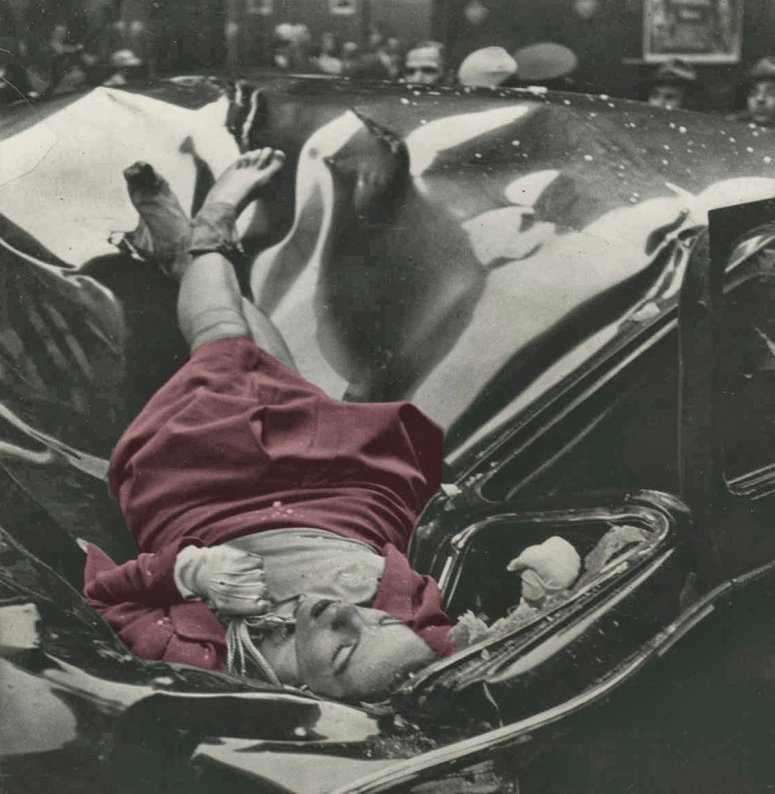
She landed, feet first, on the roof of a parked limousine. Hardly anybody saw it. It happened so fast. Somebody called for an ambulance. In a minute or two, a couple hundred people knew that something had happened and wanted to see what it was.

A student photographer happened to be nearby with his camera. Approximately four minutes after Angela died, the student photographer took her picture. Instead of a grisly, horrifying scene of a smashed body, the picture was of a young woman with her shoes off, her stockings down around her ankles, her clothing barely disarranged. The expression on her face was one of peace and composure. The picture, when printed in the newspaper, bore the caption: The Most Beautiful Suicide.

In her purse was the note she had written right before leaving her apartment: I don’t want anyone in or out of my family to see any part of me. Could you destroy my body by cremation? I beg of you and my family—don’t have any service for me or remembrance for me. My fiancé asked me to marry him in June. I don’t think I would make a good wife for anybody. He is much better off without me. Tell my father I have too many of my mother’s tendencies.

Harry Vance saw no hint (he told everybody), not the slightest suggestion, in all the time he spent with her on Sunday, that she was contemplating such a move. If he had known, he would never have let her out of his sight. She was the one he wanted to marry, the only one. There would be nobody else. Sixty years later, when he went to his grave, it was as a single man.

Copyright © 2020 by Allen Kopp

It’s You I Adore

It’s You I Adore ~ A Short Story by Allen Kopp

(I posted a different version of  this story previously.) 

Roland Finney is a mystery. He is forty-two years old and lives with his mother. He’s quiet and unassuming, keeps to himself, mows his lawn, picks up his morning newspaper, shovels the snow after a storm, never speaks to anybody. At seven-thirty every morning he leaves quietly for work and gets home at four in the afternoon and hardly ever goes out again. Nobody knows where he works or what kind of a job he has. On weekends he takes his mother on errands.

Carmen Giles lives next door to Roland Finney. She also lives with her mother. She is nearing forty years old, has been married and divorced two times. After the second divorce, she moved “back home,” as the saying goes, “to get her life in order.” She and her mother get along fine together as long as they avoid discussion of certain topics, such as Carmen’s choice of boyfriends.

Over a period of a year or more, Carmen Giles has developed an unhealthy interest in Roland Finney, amounting almost to obsession. It maddens her that he is single, she is single, they seem compatible in every appreciable way, and their paths never cross.

She watches him out the upstairs window with her binoculars as he cuts the grass in his back yard. He wears a sleeveless undershirt, khaki pants and tennis shoes. She likes the play of his biceps as he pushes and then pulls the mower. On his face is a look of concentration. She likes the neat, straight rows of his cutting. A man who cuts that precisely and evenly must have a lot of good qualities. He would hang up his own clothes and rinse his own dishes and not leave it for somebody else.

He shuts off the mower and sits in a lawn chair and picks up a newspaper and opens it. He is a man who likes to read and wants to know what’s going on in his world. He’s not the kind who would lay on the couch in front of the TV all the time. His mother comes out of the house and brings him a bottle of beer. She is a troll-like woman with stooped shoulders and hair dyed an awful red that hangs down to her shoulders. He takes a drink of the beer and holds the bottle between his thighs so his hands are free to turn the pages of the paper.

In the year-and-a-half that Carmen has lived next door to Roland Finney, she has never heard him utter a single syllable. He is possibly the quietest, most maddening man she has ever encountered. She has thought on occasion that she will go over and introduce herself, begin a friendly conversation with him, but somehow she just doesn’t have the nerve. Maybe he doesn’t speak, or maybe there’s something wrong with him, like mental retardation, and she would only embarrass him and herself, too.

When a letter is misdelivered to her mailbox, a letter that belongs to him, she sees it as her chance to engage him in conversation. She takes the letter and knocks on his door assertively, but he doesn’t answer—nobody answers, not even his troll-like mother—so she drops it through the mail slot in the door and leaves. She is certain he is at home since his car in the driveway and believes he might have come to the door if he had wanted to.

At night she lies in her upstairs bedroom and thinks about him and imagines him lying in his own bed in the room just across the yard from hers behind the heavily curtained window. When his light is off, she’s sure he must be asleep. He’s the type who would wear pajamas. His mother would take them out of the clothes dryer and fold them neatly and put them in his dresser drawer for him. He’d wear them for a few nights and then take them off and put them in the laundry and get out a clean pair.

One Saturday night she is watching TV with her mother when she hears a car stop out front and the honk of a horn. She goes to the front window and pulls back the curtain a little and peeks out. The idling car is stopped at the curb in front of Roland’s house, taillights gleaming in the darkness. The horn honks again and in a minute Roland comes running out of his house and gets into the car and it speeds off.

Where is he going on a Saturday night and who is he going with? With this question burning in her mind, she can no longer concentrate on the TV programs. Here she sits with her mother, while she should be the one going out having a good time on Saturday night. She feels lonely and left out, maybe even a little jealous.

“Aren’t you feeling well?” her mother asks.

“I feel all right,” Carmen says. “It must be something I ate.”

“Want an Alka-Seltzer?”

“No, I’m going to bed.”

“Don’t you want to watch the late movie? It’s Joan Crawford.”

“Joan Crawford gives me nightmares.”

Lying in her bed in the dark, she realizes she is in love with Roland Finney, or close to it. That’s why she feels so unhappy and jealous to know he left in a car with somebody else on Saturday night. Yes, she loves him. There can be no other explanation. Absolutely she loves him, in a way she’s never loved before. She knows deep down that he would love her too if only he was given the chance.

The next morning is Sunday. She sleeps late and when she wakes up she begins drinking vodka martinis instead of eating breakfast. While she’s enjoying the lightheaded feeling alcohol always gives her, she goes into the kitchen and begins making oatmeal raisin cookies. She prepares the batter and, while the cookies are in the oven, she washes her face, puts on clean clothes and makeup to make herself look better than she feels.

When the cookies are done baking and have cooled long enough, she puts three dozen in a tin box in a nest of wax paper and closes the lid. After a couple more quick drinks, she makes her drunken way out the door with the tin of cookies and goes over to Roland’s house and knocks on his door.

She is certain Roland will answer the door this time but, no, it’s the woman. She scowls at Carmen as if she’s an annoying vacuum cleaner salesman. The corners of her mouth turn down.

“Yes?” she says.

Carmen smiles but her mouth is suddenly dry. “Good morning! My name is Carmen. I’m your next door neighbor.”

“Yes?”

“I know we’ve never been properly introduced, but I just wanted to…”

“Are you selling something?”

“Why, no.”

“What’s that you got there?”

“It’s some cookies I baked. Oatmeal raisin. I baked more than my mother and I can possibly eat, so I thought you and your son might like to have some of them.”

“My son? What are you talking about?”

“Is he here?”

“Is who here?”

“I’d like to give them to him myself.”

Who is it?” she hears his voice call from another room. The first words she ever hears him speak.

Carmen pushes past the woman and enters the house uninvited.

“Wait a minute!” the woman says. “You can’t just come barging…”

Who is it?” Roland calls again.

She follows the sound of his voice into the kitchen. He’s sitting at the table with a newspaper spread out before him. When he stands up, she sees he’s wearing a bathrobe. His legs are bare.

What?” he says, and that one word is all he can say because she surprises him by running to him and holding him in a tight embrace around the shoulders. Dropping the tin of cookies to the floor, she tries to kiss him on the lips but he deflects it by stepping back.

He takes hold of her arms to try to free himself. “I think you have the wrong house!” he says. “I don’t know you!”

“I’ve wanted to meet you for the longest time!” she sobs.

What? Who are you, anyway?”

“Oh, I’m sorry! My name is Carmen Giles. I’m your next door neighbor. I see you every day. I watch you out the upstairs window with my binoculars.”

“I think you have the wrong person.” He pushes Carmen gently aside and goes out of the room.

The woman is standing in the doorway to the kitchen, looking at her, wondering what’s she’s going to do next.

“That’s about it, girly!” she says. “We don’t know you and from what I’ve seen we don’t want to know you.”

“Oh, dear!” Carmen says. “I’ve made a terrible mistake, haven’t I? I’ve been drinking vodka martinis all day and I’m not myself. I don’t ordinarily act like this. I hope you can forgive me.”

“Just go.”

“I’d like to apologize to your son.”

“What are you talking about? My son?”

“I’m sorry if I embarrassed him.”

“My son? You think he’s my son?”

“Well, isn’t he?”

She starts to say something else, but the words won’t come. She bends over and vomits vodka martinis all the floor. When she is finished, she stands up and wipes her mouth on her sleeve. The woman, the wife, takes her by the arm, escorts her to the door and ejects her with a little shove.

The next day, once again sober, she tells her mother about meeting the Finneys.

“I was feeling generous and a little sentimental, I guess, and I wanted some company. I baked more cookies than I wanted. I put some of them in one of those tins from Christmas and I took it over to give to them. Just a friendly gesture and so innocent! After living next door to them all this time, I wanted to meet them. In all innocence, I swear! When I knocked on the door, that horrible woman answered. She’s even worse-looking up-close than she is from a distance. She invited me into the kitchen for a cup of coffee. He was sitting at the kitchen table practically naked.  He stood up and smiled at me. Then he wanted to give me a big hug. I don’t object to an innocent hug, but I could see right away that he was putting more oomph into it than was necessary. He actually groped my backside with both hands until I squirmed loose. I was plenty embarrassed, but I tried to laugh it off. I handed him the tin of cookies and I said, ‘I have all these home-baked cookies, more than I will ever eat, and I thought you and your mother would like some.’ At that, they both started laughing, a sickening, cackling laugh! They were laughing at me! I felt humiliated! Then the old woman said, ‘You think he’s my son, you silly goose? He’s not my son! He’s my husband! I’m his wife! Hah-hah-hah!’ Then the man said, ‘Just because I’m married doesn’t mean I can’t have some fun!’ Then he leered at me suggestively and laughed. Well, I got out of there as fast as I could and came home. They are thoroughly distasteful people and when I see them again I’m going to pretend they’re not even there!”

“That reminds me of something I heard in the beauty shop,” her mother says. “Do you remember Arlene Trussell? I knew her all the way back in high school. Her name was Arlene Archer then. She married Benny Trussell. He had a face like a bulldog. I never could see what she saw in him, but I think she had a bun in the oven, so I suppose it was a case of marrying him or giving birth to a bastard child. Anyway, to make a long story short…”

Copyright © 2020 by Allen Kopp