

I Have Never Known the River Ishcabob to Flood ~ A Short Story by Allen Kopp
(I previously posted these three interconnected short stories separately, and now together.)
***
Part 1
I was in a place where I had never been before. I was buying a house next to a rocky river. The house was four stories tall and there were four houses in a row, all the same shape and height. (Things seem to come in fours here.) Mrs. Goldoni was the woman from whom I was buying the house. She had white-blonde hair like Jean Harlow but that’s where the similarity ended. Her face was very wrinkled and, due to an arthritic condition, she sometimes walked parallel to the floor like an insect. Think of a cockroach or a cricket and there you have the image I’m trying to convey.
I was on the top floor looking out the window at the view. “What’s the name of the river?” I asked Mrs. Goldoni, who was standing on her hind legs fussing with the curtains.
“It’s the River Ishcabob,” she said.
“I don’t think I’ve ever heard of it,” I said.
“It’s a popular tourist attraction.”
“Does it ever flood?”
“Oh, no, sir!” she said. “Why would it flood?”
“Where I come from the rivers flood and cause a great deal of damage.”
“I’ve lived here all my life,” Mrs. Goldoni said, “and I’ve never know the River Ishcabob to flood.”
“That’s a relief,” I said. “I don’t like floods, especially if they inconvenience me.”
I had been talking to Mrs. Goldoni over my shoulder and when I turned and looked out the window again, I saw hundreds of workmen swarming over the river and on the rocky beach between the house and the river. Just a few seconds ago, they hadn’t been there. They were moving very fast so I couldn’t see what they were trying to accomplish.
“What are those workmen doing?” I asked Mrs. Goldoni.
“They’ve incurred debt, sir,” she said.
“What kind of debt?” I asked.
“Not the kind that has to do with money.”
“You mean like moral debt?”
She laughed her tinkling laugh. “I wouldn’t expect you to understand yet, sir.”
“Understand what? Am I missing something?”
Mrs. Goldoni chuckled and dropped to her tiny, clicking feet and skittered out of the room.
“What kind of arthritis is it that makes you walk like that?” I asked, but of course she was gone and didn’t hear me.
After lunch, I noticed a little room in my house that I hadn’t seen before. There were two steps going up to it and at the top of the steps were French doors just like my Aunt Susie had between her living room and dining room when I was a little boy. When you see the doors, you can’t keep from opening them.
“What’s in here?” I asked Mrs. Goldoni, who just seemed to appear from nowhere.
“Oh, we don’t go in there!” she said.
“This is my house!” I said “I think I’ll go wherever I want!”
When I opened the French doors, I could see they hadn’t been opened in a long time. Gobs of cobwebs came loose in artful drapes, and little chips of paint and tiny slivers of wood fell on my head.
Mrs. Goldoni was standing at my right shoulder looking anxiously on, and when I turned my head to look at her, I realized there were other people standing all around me.
“Who are they?” I asked Mrs. Goldoni.
“Oh, they’re always here,” she said. “They won’t bother you.”
“This is my house,” I said. “I came here to get away. I don’t want lots of strange people hanging around.”
“You’ll get used to them,” Mrs. Goldoni said, “and you’ll forget they’re even here.”
“Lord in heaven,” I said. “What have I got myself in to?”
I swung the French doors open as far as they would go and stepped inside the little room, which, to my surprise, had pink wallpaper on the walls. A tiny window kept the room from being without light. I took a few cautious steps into the room, with Mrs. Goldoni and the others behind me.
In the little room were hundreds of obviously very old, gold pocket watches suspended from gold chains, displayed on racks.
“What’s all this?” I asked.
I reached out to pick up one of the watches to get a better look and Mrs. Goldoni said, “I wouldn’t touch those if I were you!”
“Why not?” I said. “They’re in my house. Anything in my house belongs to me, doesn’t it?”
“They’re haunted,” she said.
I turned and looked at her, not sure if my ears were working right. “How can a watch be haunted?” I asked.
“If you don’t leave them alone,” she said, “you’ll find out the hard way.”
“I don’t know what you mean.”
“You’ll stir up some mean merde if you’re not careful!”
I knew just enough French to know what she was saying. I refrained from handling the watches any further while promising myself I’d find out more about them later.
After I reclosed the French doors and the crowd around me had dispersed, I decided to take a little walk outside and have a look at my immediate environs.
The “beach” between my house and the river wasn’t pretty. It was very rocky. You could walk on it, but only with sturdy shoes. I walked down close to the river and turned and looked at my house.
There they were: four, narrow, four-story houses of identical shape; almost like four pillars. The four houses were so close together, there wasn’t even room to park a car between them, but that didn’t seem to make any difference because nobody here seemed to have cars, anyway.
My house was the third house in the row, if you count from the left. I figured that all the other houses were occupied, but I knew nothing of the people who lived in them. All I knew was the fourth house in the row was a “bed and breakfast” run by an old woman who looked as if she had at some point in her life been smashed flat. I wasn’t quite sure what a bed and breakfast was, but I knew it to be some kind of commercial enterprise. I would have to let the smashed-flat woman know that I didn’t intend to take any kind of merde from anybody.
When I turned back to the river, I saw the workmen moving around furiously. One man who came near to me slowed down long enough for me to make eye contact with him.
“What are you doing?” I asked.
“You’re not supposed to ask questions,” he said.
“Why not?” I asked.
“You’re not supposed to talk to us.”
“What kind of a place is this?” I asked.
And then I went furniture shopping. There was a piece of furniture I wanted for my new house. I didn’t know what it was or what purpose it served, but I only knew I had to have it. After looking around for a long time in the store, I found one I liked. It looked like an old console TV in a wood cabinet, but nobody had those anymore. A salesman in a suit hovered near me. He spent a lot of time with me while I made my selection.
Finally I found the one I wanted to buy. The salesman said it cost four hundred dollars. I told him I’d take it and I wanted it delivered.
When I went to pay for the piece of furniture, the salesman told me it was four thousand and four hundred dollars.
“I thought you said four hundred,” I said.
“Oh, no, sir!” he said. “Its four thousand and four hundred.”
“That’s too much!” I said. “The thing’s not worth that much money.”
I found another one that I liked better that was nearer to the price I wanted to pay, and when I got home it was waiting there for me in a big box.
The pleasant-faced actor named Kyle Chandler was in a recent movie I had seen. He wasn’t the lead in the movie, but he played the brother of the lead. In the construct of the movie I saw him in, he had a congestive heart condition and died, even though he was only forty-five. We saw him dead in the hospital morgue when his brother, the lead character in the movie, showed up to identify the body.
Anyway, when I got home from buying my piece of furniture that looked like an old-fashioned console TV in a wood cabinet but wasn’t that because nobody had those anymore, Kyle Chandler was there and he was waiting to help me take the thing out of the box. We got the thing out of the box and were struggling with it to get it to the place in the room that was just right for it, when Kyle Chandler grabbed his chest and fell to the floor on his back.
Lying on the floor, his eyes were closed and he seemed to not be breathing. I leaned over and put my ear against his chest. There was no heartbeat. I realized then that all the people who had been standing around me when I opened the little room with the French doors were there again.
“Somebody get a doctor!” I said.
Nobody made a move to do anything, so I began thumping Kyle Chandler on the chest where I thought his heart must be, the way I had seen it done in the movies. I put one hand over his heart and hit the top of my hand with my other fist as hard as I could.
Kyle Chandler sputtered and opened his eyes. He looked at me and smiled. “What happened?” he asked.
“I think you were having a heart episode,” I said, “but you seem all right now.”
He stood up, smiling, not seeming to realize he would be dead if it hadn’t been for me.
At the end of the day I was lying on the floor with my biggest cat on top of me. He was purring and covered almost my entire body. I felt, as always, comforted by his warm and loving presence. We were listening to the fifties station on satellite radio and Little Richard was singing You Keep A-Knocking but You Can’t Come In!”
There was a woman sitting behind a desk a few feet away from me, but she didn’t seem to notice me. I found it very easy to pretend she wasn’t there. Mrs. Goldoni was right—I was getting used to those people in my house and wasn’t bothered so much by their presence. I still didn’t know who they were or why they didn’t leave since it was my house, but I felt sure all would be revealed in time.
***
Part 2: Birth of the Dodo
The sky was overcast. No sunshine for days. I was sitting on the couch with my feet propped up, reading an article entitled “How to Take the Rigor Out of Rigor Mortis,” when Mrs. Goldoni came into the room. I heard her insect feet clicking long before she appeared.
I looked up from my magazine and said, “Why are you still here?” There was just a touch of malice in my voice, but nothing I said ever seemed to bother her.
“I’m staying on as housekeeper,” she said. “At least for a little while.”
“Did I say I need a housekeeper?”
“No, sir,” she smiled, “but I’ve lived in this house for many years, and I think it’s only fair that I stay on and help you until you’ve had a chance to get used to the place.”
“I can get used to the place on my own,” I said, “without any help from you or anybody else.”
“Yes, sir,” she said.
“And while we’re on the subject of ‘this place’,” I said, “yesterday I was downstairs and I noticed some rooms I hadn’t seen before. When I tried to go into them, I discovered to my disappointment that they were locked.”
“Yes, sir,” Mrs. Goldoni said.
“Isn’t this my house?”
“That cannot be disputed, sir.”
“I bought it, paid for it with every cent I had. You signed the papers transferring ownership to me.”
“That’s right, sir.”
“Rooms in my house belong to me, then, don’t they? I should be able to go into them whenever I want.”
“That’s true, sir, but this is not like any other house,” she said.
“In what way is it not like any other house?”
“You’re finding out, sir, as you go along.”
“As I go along,” I said.
“That’s the thing we all have to do. Learn as we go.”
“I tell you I don’t need a housekeeper!”
“I think you do, sir,” she said.
“Wouldn’t you say that I’m the boss and you’re the employee?”
I would expect these words to hurt Mrs. Goldoni’s feelings, but they seemed to have no visible effect on her.
“I’ll leave, sir, whenever you say.”
“What I want you to do,” I said, “is get the keys to the rooms that are locked so I can open the doors and see what’s inside the rooms.”
“That might not be so easy, sir,” she said.
“Why not?”
“As I’ve said before, it’s an old house and a different sort of a house.”
“Different, yes. I turned a corner yesterday and saw a strange woman walking toward me. She was holding her arms out stiffly at her sides and taking skating steps as though she walked on invisible skis. She was wearing a billowing white robe that went from her neck down to her feet. I just caught a glimpse of her face, but she had, I’m sure, the face of Kay Francis.”
“Who, sir?”
“Kay Francis, the nineteen-thirties movie star. Long dead and mostly forgotten.”
“I don’t keep up with the movies,” Mrs. Goldoni said. “Did the lady speak to you?”
“No, Mrs. Goldoni, she didn’t. I wanted to ask her what she was doing in my house, but she was gone before I had a chance to say anything.”
Mrs. Goldoni laughed. “That’s the way things happen here.”
“How many times do I have to tell you I don’t want people in my house?”
“Is anybody bothering you, sir?”
I thought for a moment. “Well, no,” I said. “Not exactly.”
“If anybody bothers you, sir, you be sure and let me know and I’ll tell them to stop.”
“Yes, but who are they?”
She laughed and straightened the dust bonnet on her head, apparently casting about in her head for the right words. “So many people have lived in the world and have died. You are now in the place where you can see some of them.”
“I can hardly accept that as an answer,” I said with what I hoped was a measure of sternness.
“Yes, sir,” she said.
She gave me a wan little smile and maneuvered her legs about to leave the room.
“How’s the arthritis?” I asked.
“Oh, we manage!” she said cheerily.
“Sometime we’ll have a long talk over a cup of tea,” I said, “and you can explain to me how arthritis turns you into an insect.”
She was gone, though, so I was sure she didn’t hear me. Like a mother, she had the facility of not hearing what she didn’t want to hear, but always hearing what you wish she hadn’t.
Two days later, I was walking along an unexplored corridor on one of the lower floors in my house, when I turned a corner and saw several people, mostly women, crowded around the doorway of a room I had not had the pleasure of visiting.
“What’s going on here?” I asked.
Some of them turned and looked at me and, I swear, they dissolved into the air as soon as they saw me. There were still four or five people remaining, though, blocking my way and keeping me from going into the room.
“It’s all right,” I heard Mrs. Goldoni say. “Let him come in.”
The room was small with a bed; four women, including Mrs. Goldoni, were standing around the bed. There was a person in the bed and a sort of tent over the person made of bedsheets. The only parts of the person that weren’t underneath the tent were head and shoulders.
“What’s all this?” I asked.
“This is Lulu, your wife,” Mrs. Goldoni said. “She’s giving birth.”
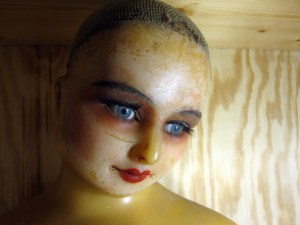
As astonished as I was at that statement, I was more astonished at Lulu in the bed. She was a human-sized doll with a painted face and a lacy Jane Austen cap on her head. Her lips were drawn on in the shape of a cupid’s bow and her cheeks were red. Her eyes were small and sparkling, with lashes like spiders’ legs.
“Very funny,” I said. “You know I don’t have a wife.”
“Well, if didn’t have a wife before, you have one now!” Mrs. Goldoni said.
“So, that’s the way marriage happens here?” I asked. “You’re not married and then you are married before you even know it?”
“Well, yes, if sometimes happens that way here.”
A woman standing at the foot of the bed was holding a stopwatch. “The pains are closer together now,” she said anxiously to Mrs. Goldoni.
Mrs. Goldoni said to me, “You can either go back upstairs where you’re comfortable, or you can stay here and witness the birth of the dodo bird.”
“’The birth of the dodo bird’,” I said. “I believe the dodo is extinct.”
“You’re about to find out!” Mrs. Goldoni said. “Here comes the head!”
Lulu the doll didn’t make a sound, but the women standing around the bed made encouraging little clucks with their tongues. I stood there watching, not sure what I was about to see. In about two minutes, Mrs. Goldoni pulled from underneath the sheet-tent a fully formed dodo bird. She held it up so I and the others could get a look at it.
“Is that really a dodo bird?” I asked in amazement.
“What do your eyes tell you?” Mrs. Goldoni said.
“Wait a minute!” I said. “A dodo is a bird and birds are hatched from eggs.”
“Not always!” Mrs. Goldoni said.
“Nobody has seen a dodo bird for hundreds of years,” I said with real and not fabricated wonder.
The dodo bird made pitiful little squeaks with its mouth. Mrs. Goldoni handed it off to one of the women and bent over Lulu with her ear to Lulu’s mouth. I didn’t hear a sound but I knew that Lulu was whispering into Mrs. Goldoni’s ear.
“She wants to know if the baby is all right,” Mrs. Goldoni said. “Yes, dear, the baby is a fine male dodo bird, exactly as you expected.”
I looked at Lulu’s face but saw no change in her expression because she was a doll and doll’s expressions remained the same, no matter if a dodo bird has just come out of their bodies.
“She’s wants to name him Sheridan,” Mrs. Goldoni said.
The women clapped their hands and gave little expressions of approval and Mrs. Goldoni turned to me.
“The baby needs to be fed and changed and I think it’s time for the poppa to go back upstairs.”
“I’m not really the father of a dodo bird,” I said. “I think you’re playing a joke on me.”
“You’ll have plenty of time to sort this all out before you’re through,” Mrs. Goldoni said.
“Through with what?” I asked, but she took hold of my elbow and ushered me out of the room and closed the door firmly.
I went back upstairs, excited at the prospect of being the father of a dodo bird. Nobody else I knew could claim the distinction. I wanted to take a picture of the dodo, my son Sheridan, because I was sure my friends were not going to believe me. (I was forgetting for the moment, I suppose, that I didn’t have any friends and wasn’t likely to make any new ones.)
I began looking through my things for the camera that I once owned, but had no luck finding it. I needed to buy myself a new one. It’s so seldom that you become a father, especially the father of a male dodo bird named Sheridan, that you must have pictorial documentation so that people may know you’re not going insane or are already there.
Out the windows on the upper floor of my house, I could see the scenic little town of New Garland nestled among the hills. Somebody had told me when I first came to the house that New Garland was a mile-and-a-half away. Since shank’s mare was my only means of getting anywhere, I would walk there tomorrow and find a shop that sells cameras and buy one.
In the morning after breakfast, I went to my room and dressed in outdoorwear, cap, jacket and hiking shoes. When I went back to the kitchen to tell Mrs. Goldoni I was going to be gone for at least a couple of hours, she was sitting at the table with Mrs. Woolwine, the smashed-flat woman who ran the bed and breakfast next door. They liked to have confabs a couple of times a week in which they exchanged gossip and talked about their various ailments.
“How are you, Mrs. Woolwine?” I asked.
“Feeling a little flat these days,” she said.
“How’s business?”
“We’re full up,” she said. “We’re always full up. People love to stay here on their way to some other place.”
“Wonderful!” I said.
“Are you going somewhere?” Mrs. Goldoni asked me.
“Yes, I’m going to walk to New Garland. I’m in the market for a camera. I want to take some pictures of Sheridan so people will believe that I really have a dodo bird in my house.”
“The proud poppa!” Mrs. Woolwine said with her flat smile.
“No, it’s not so much pride as it is amazement. You know and I know and everybody else knows that I can’t be the father of a dodo bird, except in the sense that I would be the father of a kitten that I found on the street and took home to raise into a cat.”
“I wouldn’t talk that way around Lulu if I were you,” Mrs. Goldoni said. “She’ll think you don’t love her anymore.”
“I don’t love her and never have loved her. She’s a doll. You know she’s a doll, I know it, and I’m sure Lulu knows it. Dolls don’t give birth to anything, but especially they don’t give birth to dodo birds.”
“Sometimes they do,” Mrs. Goldoni said.
“I might eat lunch in town,” I said, “so If I’m not back by lunchtime, go ahead without me.”
“New Garland is a long way to walk,” Mrs. Goldoni said. “Watch out for the Followers.”
“The Followers? The Followers of what?”
“The Followers of the Father of All Lies.”
“He’s also called by a lot of other names,” Mrs. Woolwine said.
“I don’t know what you’re talking about,” I said.
“They want your soul,” Mrs. Goldoni said. “They’ll take it, too, if you let them. You’ll be safe as long as you ignore them and don’t engage with them. They can’t take your soul without touching you, and they can’t touch you unless you allow it.”
“They try to seduce you,” Mrs. Woolwine said.
“It sounds like a story to scare children,” I said with a laugh. “Believe me, I’ll be fine.”
So, I set out in a northerly direction alongside the River Ishcabob toward the town of New Garland. After a half-hour or so of walking, I heard screaming and looked to the source of the screaming out in the middle of the river. It was a woman flailing about in the water, apparently drowning.
“Help me!” she screamed. “Save me! I’m drowning! Oh, I’m drowning!”
I stood on the banks of the River Ishcabob watching the drowning woman. I didn’t for one second consider trying to save her. My shoes were new and I didn’t know how to swim, anyway. I had had a scratchy throat for the last couple of days and I knew that getting myself all wet wouldn’t help it any.
The woman stopped screaming, stopped waving her arms, and went under for the last time.
“You’ll have to do better than that,” I said, hoping that if there were any Followers around they would hear me.
The town of New Garland was old and quaint. There were a few people on the streets, but they moved quickly and didn’t look at me. As I looked at the little shops on the main thoroughfare, I doubted that I would be able to buy a camera in this place.
After I walked a couple of blocks, I saw a place of business with a shining glass window on which was painted the legend Witherspoon’s Photographic Studio, and underneath that, Photographs of the Deceased. I went inside and was greeted by a tall man with a drooping mustache and a high collar.
“What might I do for you today, sir?” he asked with a friendly smile.
“I’m looking to buy a camera,” I said.
“A camera?” he asked. “You want to buy your own camera?”
“Yes. I had a camera before but I can’t seem to find it anymore.”
“They’re very expensive, I’m afraid, sir,” he said.
“What year are we in here?” I asked.
“Would you like to sit for your portrait?” he asked. “It only takes a few minutes.”
“Well, no, I wasn’t wanting a picture of myself. I have plenty of pictures of myself and I keep them hidden away. I have a dodo bird in my house and I want a picture of my dodo bird before it gets away or before something happens to it.”
“Do you have your dodo bird with you?” he asked, looking down at my feet.
“No, no!” I said, running out of patience. “I want to buy a camera so I can take my own picture of my dodo bird.”
“You can’t buy a camera here, I’m afraid, sir.”
“Well, where, then?”
“You could try the town of Gladstone.”
“And where is that?”
“It’s about twenty miles that way,” he said, thrusting his chin toward the street.
“I’m walking,” I said. “I obviously won’t be walking twenty miles to buy myself a camera.”
“Well, sir, since you’re here, would you like to sit for your photograph today?”
He took me into another room and I sat on a small dais that resembled the throne of an emperor. After the man and another man fussed with my hair and clothing, I was aware of a bright flash and then it was all over.
“Call for your picture in a week,” the man said. “You don’t have to pay until then.”
After I left the photography studio, I was hungry and thirsty. I spotted a place across the street with a sign that said Fine Eats, so I crossed over and went inside.
There was nobody else inside Fine Eats, so I sat down at a table next to a window overlooking the street. A very small woman came out from the back and set a glass of water down by my elbow and handed me a menu.
“Fried catfish today’s specialty,” she said. “Served with slaw and fried potatoes.”
I looked at the menu, but I couldn’t keep from looking at the tiny woman over the top of the menu. She had red wooly hair piled high on top of her head. Her ears stuck out very far on each side of her head and her eyes were blank but bright like the eyes of a doll. On the backs of her hands were what appeared to be the kind of spikes you would find on the back of a Gila monster in the Mohave Desert. I couldn’t help but believe that she had an affliction like the one that was causing Mrs. Goldoni to turn into an insect.
I glanced over the menu and said, “The fried catfish will do.”
She brought me a beer in a large glass container to keep me occupied until the fried catfish was ready.
The food was excellent, I had to admit. I couldn’t remember when I had food that tasted so good. I couldn’t, in fact, ever remember eating any food of any kind before, although I had a vague recollection of eating breakfast that morning. Something was happening to me and I didn’t know what it was. I was experiencing many things I had never experienced, including an uncharacteristic loss of memory. Maybe I too was turning into something other than what I started out to be.
The tiny woman waitress didn’t come back, so I paid for my lunch with Roman coins and left Fine Eats and went back out onto the street.
The clouds had dissipated and the sun was shining. The birds were singing. It was a spring day that reminded me of spring days when I was a small child. The thought of the long walk to get back home didn’t tire me. I breathed the pure air deeply into my lungs and set out with my left foot. I would keep my eye open for a present to take to Sheridan. Just what do dodo birds like? I wasn’t sure. I had no knowledge to go on since dodo birds had been extinct for so long. I would make it my business to find out, though.
***
Part 3: In My House are Many Rooms
For several days, rain and thunderstorms kept me inside, but I didn’t mind. I had always liked the rain. The sound of the thunder gently rolling over the hills was pleasing in a way I wouldn’t have been able to explain. I had no obligations to fulfill and so spent my time—for the first time in my life, it seemed—doing exactly as I pleased. I read, napped and, of course, I still had plenty to do putting my house in order.
Sometimes I liked getting out the hammer and nails and hanging a picture on the wall in a certain spot and then sitting for an hour or more looking at the picture, trying to decide what I had liked about it in the first place. Some of the pictures, and some of the books and other articles I took out of boxes, I couldn’t remember from my previous home. My memory continued to play tricks on me. I remembered things that hadn’t happened and forgot things I should be able to remember. I wondered if I should see a doctor, but, if I did, what kind of doctor would it be? Was I losing my mind? Mrs. Goldoni, when I bothered to ask, could offer no explanation. I told you it’s a different kind of house, she’d say.
In the evenings after supper I enjoyed sitting and reading with some music playing quietly in the background. We had no radio or television—Mrs. Goldoni explained we were too far away to get the signal—but I didn’t mind. Sometimes I would close my eyes and when I opened them again Lulu the life-sized doll and Sheridan, my dodo bird son, would be sitting in the room with me. When Sheridan saw I was looking at him, he’d give a playful squawk to let me know he knew I was there, and I was astounded all over again by his existence. I had had pets all my life, cats and dogs, but I never expected to own a real-live dodo bird. As for Lulu, she never made a sound and only moved when I wasn’t looking.
On the day one week after I had sat for my photographic portrait in the town of New Garland, I purposed to go back and get my finished portrait, as the man in the shop had told me it would be ready on that day. The rain had stopped, at least temporarily, so the day seemed auspicious for walking. I put on the same walking shoes and clothes I wore the first time I made the trip and then appeared in the kitchen to tell Mrs. Goldoni not to expect me for lunch as I intended to dine again at Fine Eats.
“I can go with you if you’d like,” she said.
I could barely suppress a smile, thinking about walking out anywhere with an old woman who was becoming an insect, with many legs to prove it. “It’s all right,” I said. “I don’t need a chaperone.”
“You have no experience with the Followers,” she said. “They can be especially nasty when they know you are uninformed. I know how to handle them.”
“Believe me, I’ll be fine. I remember: they can’t hurt me if they can’t touch me and they can’t touch me unless I let them.”
“Be suspicious of all,” she said.
“I can take care of myself.”
I was a half-mile or so from my house, walking toward the town of New Garland, when I saw a disturbing sight. A group of eight or so small children were pelting a man with rocks and clumps of mud. He, the man, was bent over, holding his coat up around his head. I don’t like getting involved in something that isn’t my business, but if I see a person or a thing being mistreated for no apparent reason, I must try to help if I can.
“Here, now!” I said, very loud, causing all the children to stop what they were doing and look at me. “Stop that! What has that poor fellow done for you to stone him?”
A grotesque girl of about eight, shoulders back and head thrust forward, approached me. She was very dirty and dressed in rags. Her matted hair hung about her head like tangled moss. I thought she was going to spit on me or jump at me and rip out my throat.
“Here, now!” she said, imitating me. “Why don’t you mind your own damn business?”
The other children laughed and they all turned their attention on me. I saw at once they were Followers. The man they had been pelting looked helplessly at me across a distance of about thirty feet.
When I saw a small boy with a large, deformed head about to throw a rock at me, I held up my finger at him threateningly and said, “I have a gun in my pocket and, while I may not like to shoot children, I won’t hesitate for a second to shoot you if you throw that.”
The children laughed derisively at me, but the boy let the rock fall to the ground without throwing it. I picked a limb off the ground as big as a man’s arm and when I took a few steps toward them with the limb raised in the air, I could see they were afraid of me. They receded and retreated down a hole in the ground. A few seconds after they had all jumped in, the hole disappeared.
The man was sobbing softly. I approached him to see if I might be of help. “Are you hurt?” I asked.
His head was bleeding and the blood was running down the side of his face onto his neck. All I could do was take my handkerchief out of my pocket and hand it to him. Realizing that he might also be a Follower, I made sure my hand didn’t touch his.
“I’m new to this place,” I said. “Every day I see sights that surprise me.”
He managed a weak smile. “I’ve been her a while,” he said. “I don’t remember every being any place else.”
“Do you live around here?” I asked.
“I’m not sure.”
“How can you not know where you live?”
He shrugged his shoulders and I had a chance to look at him closely. He had red hair the color of a new penny, skin as white as alabaster, and a small, pencil-line mustache. His eyes were a clear blue, but they had dark rings around them, as though he had been ill. He seemed all right, but I still wasn’t sure he wasn’t a Follower.
“How did those children come to be throwing rocks at you?” I asked.
“They wanted me to play a game with me and I wouldn’t comply. The object of the game was to get me in a vulnerable position and then to snatch my soul and take it with them back to hell. That’s what they’ve been trained to do.”
“That seems highly implausible,” I said. “Small children?”
“Sometimes they’re worse than the adults.”
“And you’re not a Follower?” I asked.
“Do I look like one to you?”
“I couldn’t say. What’s your name?”
“Farina Alvarez,” he said.
“Well, Farina Alvarez, since you are obviously in a bad way, I’ll help you get to where you’re going.”
“I’m not going anywhere,” he said. “I’m only trying to keep away from the Followers.”
“I have a house,” I said, “on the banks of the River Ishcabob, which I have been told never floods.”
“I’m so happy for you,” he said, closing his eyes as though experiencing a wave of nausea.
“In my house I have many rooms,” I continued. “So many rooms that I haven’t even seen all of them yet.”
“What are you trying to say?”
“I think we could put you up for a while, at least until you find out where you live and where you’re going.”
“I wouldn’t want to put you out any,” he said.
“I have a housekeeper. Her name is Mrs. Goldoni. She has arthritis that’s turning her into an insect.”
“What kind of an insect?”
“I also have a son named Sheridan who is a dodo bird.”
“Aren’t they extinct?”
“Well, not all of them, I guess.”
“I have a wife named Lulu. She’s not my wife in the biblical sense. She’s a doll with a funny, old-fashioned cap on her head. I was in the room when she gave birth to Sheridan.”
“Quite a family you have there,” Farina Alvarez said.
“Well, with all the room we have, I was thinking you could come and stay with us for a few days. I don’t have any friends here and you seem like a decent sort, if we can fully establish that you’re not one of them.”
“I’ve already told you I’m not.”
“Mrs. Goldoni will know as soon as she lays eyes on you.”
“Where is this house on the banks of the River Ishcabob?” Farina Alvarez asked.
“It’s back that way,” I said, pointing with the index finger of my left hand.
“But you were headed this way,” he said, pointing in the opposing direction.
“Yes, I’m on my way to the town of New Garland on an errand. If you want, you can wait here for me and I’ll pick you up on my way back home. I don’t mean that in a literal sense, of course.”
“I don’t know,” he said. “If I wait around here, the Followers are sure to come back and get me.”
“Suit yourself,” I said.
“How long do you think it’ll be before you come back this way?” he asked.
“I’m not sure. Clocks and time don’t seem to have much meaning here. Let’s just say in about three hours.”
“I know what I’ll do,” he said. “I’ll find a hiding place in a tree or a cave and in three hours I’ll meet you here on this spot.”
“All right,” I said, “but if you’re not here, I’m not going to wait.”
I walked on to the town of New Garland and went straight to Witherspoon’s Photographic Studio. The same man with the drooping mustache and high collar greeted me at the door.
“Remember me?” I asked.
“Indeed, I do, sir!” he said with a smile. “You’re the one with the dodo bird son.”
“What a memory you have!”
“Not at all, sir. It’s only been one week.”
“Is my photo portrait ready for me to take home?”
“Yes, it is, sir. I have it right here.”
He bent over and produced a little photo album from underneath the counter, which he hastily wrapped in paper, tied up with a string. After he was finished wrapping the album, he put it inside a small drawstring canvas bag and handed it over the counter to me.
“For you to look at later, when you’re at home, sir,” he said.
I paid the man and thanked him and went across the street to Fine Eats. I sat at the same table as before and the same tiny waitress came out from the back. Her hair was higher and more triangular than before, her brilliant, round eyes staring and unblinking. I wasn’t sure how she was seeing me because she always seemed to be looking out the window at the street.
When I tried to get her to look directly at me and she didn’t, it occurred to me that she wasn’t a “she” but an “it.” She was a doll endowed with motion like my Lulu at home. Had the man in the photographic studio with the dropping mustache been a doll, too? Was I a doll? I was pretty sure Mrs. Goldoni wasn’t a doll because she was an insect. Was Sheridan a real dodo bird, or was he, too, a mechanical “thing.” I would be most disappointed to find out that he, above all the others, wasn’t what he appeared to be.
“Today’s special is pickled herring or spaghetti and meatballs served with a red wine and breadsticks,” the waitress intoned in her odd voice that seemed to be coming from another room.
“I’ll have the spaghetti,” I said, having no desire to engage her in further talk.
She brought the wine before the food was ready and I had two full glasses while I waited. As before, there was nobody else in the place. The street also was empty. I heard music coming from some faraway place. When I strained to hear the music better, it stopped and then when I stopped thinking about it, it started up again.
The waitress brought the food and set it down in front of me and I began eating. It was the best spaghetti and meatballs I ever had. The wine was the best I had ever tasted. When I finished eating and was ready to leave, I was a little wobbly on my legs from all the wine. I threw some money on the table and went back out onto the sunny street.
When I came to the spot where I had left Farina Alvarez, he was waiting there for me, sitting on a little hillock beside the road. He smiled and stood up and waved at me.
“No more trouble with Followers?” I asked.
“I think you scared them off for now,” he said.
After we had walked some little ways without speaking, I turned to him and said, “Are you a thing other than what you appear to be?”
“I don’t understand the question,” he said.
“Some of the people here are dolls.”
“I know it,” he said, “but I don’t think I’m one of them. And, another thing about these dolls, they can change their size really fast. One minute they’re full-sized and the next minute they’re small enough to fit into a shoebox.”
“What’s it all about?” I asked.
“I don’t know anything,” he said.
When we got to my house on the banks of the River Ishcabob, it had been raining on us for the last quarter mile or so. I didn’t mind so much because it was a warm rain and I knew I was near home and could dry off and get into clean clothes soon enough, but Farina Alvarez was freezing. His teeth chattered; he held the collar of his thin coat up around his ears. Still, I made him wait outside for a minute while I went into the house and got Mrs. Goldoni. I wanted her to look at him and confirm that he really wasn’t a Follower.
She took a step outside the front door and shaded her eyes with her hand, even though the sun wasn’t shining. Insect eyes are different from human eyes.
“Who do we have here?” she asked.
“His name is Farina Alvarez,” I said. “On my way to New Garland, I happened on a bunch of Followers taunting him and throwing rocks at him. I took pity.”
She made little clicking insect sounds with her mouth and looked him up and down. “Tell me, son,” she said. “What’s the Holy Trinity?”
“Father, Son and Holy Ghost,” Farina Alvarez said.
“He’s all right,” Mrs. Goldoni said. “He’s not a Follower.”
“You can tell just from asking that one little question?” I asked.
“Sure can,” she said. “If you ask a Follower a religious question, it makes them vomit.”
“So, he’s all right, then.”
“I just said he was, didn’t I?”
I smiled at Farina Alvarez and took him by the sleeve and pulled him into the house.
“He’s going to be staying with us for a few days,” I explained to Mrs. Goldoni. “Find a comfortable room for him to stay in.”
“Do you suppose I could get a bath?” Farina Alvarez asked.
Mrs. Goldoni took him by the arm and started to lead him away. “Give him a good room that has a view and that isn’t gloomy and scary,” I said, “and give him some of my clothes to wear. I have more clothes than I know what to do with. Let him take his pick.”
I was weary from my long walk to and from New Garland, so I laid down and had a little nap. In an hour or so, Farina Alvarez emerged, looking scrubbed and wearing some of my clothes. Mrs. Goldoni had fixed him up with a bandage on his head.
“Feeling better?” I asked.
“Except for a headache,” he said.
We sat down to supper and, as we ate, a tremendous thunderstorm shook the house and made the lights go off. Mrs. Goldoni appeared with an antique candelabra and set it in the middle of the table.
“I like I good thunderstorm,” Farina Alvarez said, “as long as I have a roof over my head.”
I could tell we were going to be friends.
After supper the lights came back on. Mrs. Goldoni washed the supper dishes and went to bed. Farina Alvarez retired to his room and I was left all alone. I remembered I hadn’t yet looked at the little photographic album wrapped in paper that I had carried home with me in a drawstring canvas bag from the photographic studio in New Garland.
I wasn’t prepared for what I saw in the album. The first picture was of me laid out dead in a coffin, my hands crossed over my chest. I’m wearing a dress suit, my hair is neatly parted and I have a tiny pencil-line mustache, but, more astonishingly, Sheridan the dodo bird is sitting on the half-open lid of my coffin looking down into my face. He is obviously dismayed at seeing me dead. His beak is open partway as if he is emitting one of his most pitiful squawks and his eyes look watery.
I turn the page and the second picture is equally surprising. It’s of Mrs. Goldoni, dead in a coffin, a lily in her crossed hands. Her mouth is drawn down at the corners and her hair is arranged in a severe style. I had only ever seen her with Jean Harlow hair, but this dead woman is obviously her.
On the third page is a picture of Farina Alvarez. I had only known him for a few hours, so I didn’t know why his picture would be in my photographic album. If I had learned anything in my new home, though, it was not to ask questions for which there were no answers.
On the other pages of the album were photographs of other dead people I didn’t know, even though a couple of them looked slightly familiar. The others were, I suppose, of people who somehow played a part in my long-ago life that I didn’t remember.
Then I remembered the letters on the window of the photographic studio: Photographs of the Deceased.
I could hear it raining through much of the night. Ordinarily the sound of rain acts as a soporific to me, but I had trouble sleeping. About daylight I got out of bed since I couldn’t sleep, took a long shower, and dressed. When I went into the kitchen, Mrs. Goldoni was cooking breakfast.
“We’re all dead, aren’t we?” I said to her by way of greeting.
She stopped what she was doing and looked at me. “I knew you’d figure it out on your own,” she said. “That’s what we all have to do.”
“Why didn’t you tell me when I first came here?” I asked.
“Because that’s not the way it works. For it to be meaningful, you have to find it yourself.”
“Like an Easter egg hunt?” I asked.
“We’re all put here to learn,” she said. “To find things out. You’re no different from any of the rest of us.”
“We’re in hell, aren’t we?”
“No, it’s not hell,” she said. “And it’s not heaven, either. It’s somewhere in between. It’s what the Catholics used to call Purgatory. We have to learn what we’re sent here to learn before we can advance to the next step.”
“What’s the next step?” I asked.
“Nobody knows.”
“Some people have been here for hundreds of years, if not longer. This is not a physical place. It exists in the spirit world. That’s why things are so different here from what you’re used to.”
“I have to tell you,” I said. “I don’t feel dead.”
“I know,” she said. “I don’t feel dead, either.”
“So, we just wait here and let things happen to us and try to escape from the clutches of the Followers and then, one day, we move on.”
“That’s right.”
“Why are you turning into an insect?”
“I wish I knew. It’s part of the plan of the one who made us all.”
“What will happen when you’re an insect and no longer a person?” I asked.
“I try not to think about it,” she said.
“You want to keep on being a person?”
“Yes. That’s why I say my trouble is arthritis. It’s a little conceit of mine. I don’t think insects get arthritis. If I can convince the world, and myself, that arthritis is the reason I’m turning into an insect, it makes me feel more human.”
I went and got the photo album and showed it to her. She turned the pages to the end, making the clicking sounds with her mouth.
“It’s the same for all of us,” she said.
She turned to her own picture and laid the album flat on the breakfast table.
“That’s you, isn’t it?” I asked.
“Have you asked yourself why I’m in your photographic album?” she asked.
“My mother died when I was five years old,” I said. “I don’t remember much about her.”
“I remember everything about you, though,” she said. “I remember the day you were born.”
“So, you’re telling me you’re my mother?”
“Yes.”
“Who is Farina Alvarez?”
“I suppose you’ll find out one day.”
I put the photographic album away and Farina Alvarez emerged from his room and we had breakfast. I wanted to ask him if he knew we were dead; I wanted to show him the photographic album, but I knew I couldn’t. He had to discover these things on his own, just as I had done.
I took Farina Alvarez on a tour of my four-story house. I showed him the room with the haunted watches and the room where Sheridan was born. I took him into the room where Lulu the human-sized doll and Sheridan my dodo bird son spent most of my time, and he seemed genuinely happy to see them. He was as astonished as I was at seeing a real-live dodo bird.
When I saw the people I didn’t know lurking in the hallways or standing in a doorway, he saw them too, and he saw them as they seemed to dissolve in the air. I explained to him that how they were always there but never bothered me. I showed him the River Ishcabob, which I had been told would never flood, and he saw the hundreds of workers on the river who moved so fast they were just a blur. I took him next door to the bed and breakfast and introduced him to the smashed-flat woman, Mrs. Woolwine. She gave us beer and we spent a couple of hours laughing and talking at her kitchen table.
In our long and serious conversations, Farina Alvarez told me he didn’t know how long he had been in this place and he couldn’t remember being in any other. I was gratified in a way to know that his experiences paralleled my own.
It continued to rain almost every day for two weeks and I started feeling sick. For a while I could keep my sickness hidden, but then I started to feel worse and couldn’t get out of bed. My days passed in a blur. I woke and slept and woke. I couldn’t tell the waking from the sleeping. At times I was aware that Mrs. Goldoni, Mrs. Woolwine, Farina Alvarez, and Lulu the doll were standing around my bed, looking anxiously on. Sheridan the dodo perched on the footboard, looking intently at me.
And then, once when I woke up, I was in a different place. I was in a high bed. To my right was a blue wall and to my left a bank of medical instruments. A man stood at the foot of the bed, looking down at something he held in his hands. He didn’t know I was awake so I spoke his name.
He looked at my face and smiled. He had red hair the color of a new penny and a pencil-line mustache and icy blue eyes. I was glad to see somebody there that I knew.
“Farina Alvarez,” I said again.
He came around to side of the bed where he was closer and I could see him better. “What did you say?” he asked.
“I just spoke your name. Are you going to tell me you don’t know who I am?”
“Yes, I know who you are,” he said. “You’re my patient. You’ve been very ill for a while.”
“I know,” I said. “You don’t need to tell me I’m dead because I already know it.”
“I could call you Sleepy Beauty, but since you’re a man, I guess I’ll have to settle for Rip Van Winkle.”
“Where’s Mrs. Goldoni? She needs to know where I am.”
“Is that somebody you know?” he asked.
“She’s my mother. She’s my housekeeper.”
“All right. Just keep yourself calm. We’ll bring you back by degrees.”
He turned to a woman all dressed in white. She stepped forward and took his place beside the bed. I felt a needle jabbed into my arm and then she began fussing with something I couldn’t see that was over my head.
“What is that place?” I asked.
“You’re in a hospital,” the woman in white said. “You’re going to be fine.”
“Where did he go? Where did Farina Alvarez go?”
“If you mean your doctor, he’ll be right back. He went to see another patient for a minute.”
“Tell him I need to see him. I need to tell him something.”
“You can tell me,” the woman in white said.
“I don’t want to be here! I want to go back to where I was! Tell him for me! Will you tell him for me? It’s very important!”
“Would you like to try to sit up?”
“No! I want to go back to where I was! I have people waiting for me. If I don’t come back, they’ll wonder where I am! I have to see my dodo bird and make sure he’s all right.”
“You’re very confused,” the woman in white said, “but that will pass.”
“No!” I said. “I don’t want it to pass. I want to go back to my home on the banks of the River Ishcabob.”
“There is no such place,” she said. “You’ve been dreaming. Imagining things.”
“No,” I said, more weakly this time. “I have a four-story house with many rooms on the banks of the River Ishcabob. I have family there and friends. They’ll be worried about me. I want to go back. I don’t want to be here. I want to be back there, in my home, with my friends and family.”
Farina Alvarez came back into the room and I felt comforted. He took my hand in both of his. He smiled at me and I smiled at him. He had hair the color of a new penny and a pencil-line mustache. His eyes were the bluest I had ever seen. He squeezed my hand and when he did I was borne away on a bank of black fog. I knew then that in just a few seconds I’d be back where I belonged.
Copyright © 2017 by Allen Kopp






 Literary Fictions