Welcome to the Neighborhood

Welcome to the Neighborhood ~ A Short Story by Allen Kopp

A moving van pulled up at the house across the street and three bear-like men got out and began unloading furniture. A late-model red car pulled into the driveway from which four people emerged: a gangly boy wearing a backwards baseball cap and an older man from the front and a girl and a middle-aged woman from the back. The man had white hair and walked with a limp. The girl looked like a younger version of the woman, obviously mother and daughter.

“Looks like a girl about my age,” Carmen said. “She’s fat and ugly but I’ll bet she has her driver’s license. Probably even her own car.”

“You’d better quit spying on the neighbors,” Zane said from his spot on the couch, where he was reading a story in True Romance magazine about a woman with four husbands at the same time. “They’re going to see you and know what a crazy person you are.”

“You ought to see this old couch they’ve got. It looks like it’s about a hundred years old. If it was mine, I’d set it out in the yard and douse it with kerosene and set fire to it.”

“Maybe they’re just waiting for the right moment to do that very thing.”

“And there’s a big glass thing that looks like a fish tank. I always wanted a fish tank.”

“Why don’t you go over there and ask them if they’ll give it to you?”

“If they can afford a fish tank, that must mean they have lots of money and that girl must have her own car. I wonder what her name is. I’m sure she’ll have an ugly-girl name like Mabel or Bertha.”

“When she sees you, she’ll think the same thing about you.”

“Hey, look at this! They’ve got a big thing that looks like a sun lamp and a huge dining room table and one, two, three, four, five, six chairs that go with it. They must have a lot of people over for dinner if they need six dining room chairs.”

“Who cares?”

“Now here comes a dresser with a big round mirror and a bed and some mattresses and a chest of drawers and—wait a minute!—here’s another bed and some more mattresses. The mattresses look brand new. They haven’t been peed on yet. Now they’re bringing out a couple of big upholstered chairs and some more boxes and—oh, my gosh!—here’s another bed and another set of mattresses. How many beds do they have, anyway?”

“Your interest in their beds is a little disturbing.”

“Now, what do you suppose that thing is? It looks like a big square washing machine.”

“Why do you care what it is?”

“I have natural curiosity. I want to know what’s going on around me. Oh, wait a minute! The girl is standing on the sidewalk looking up at the roof with her hands on her hips. She just pulled her underpants out of her crack. That’s the kind of thing people do when they think nobody’s looking at them. Come and take a look!”

“I don’t want to see any ugly girl messing with her crack or anybody else’s,” Zane said, but he put the magazine aside and stood up from the sofa and went over to the window. He took the binoculars from Carmen and adjusted them to his own eyes.

“She’s ugly all right,” he said. “Her hair looks like a fright wig you’d wear on Halloween.”

“What did I tell you? Wait until she turns around and you get a look at her face.”

“She’s turning around now and she’s saying something to one of the moving men. She’s telling him where to take some boxes. I can almost read her lips because her mouth is so big.”

“What are you talking about?” Carmen said. She snatched the binoculars back from him. “That’s not the girl, you goof! That’s the mother! Oh, wait a minute! Here’s the girl now, just coming out of the house.”

“Oh,” he said. “The mother and the daughter look just alike. They’re both horribly freakish.”

“Well, the mother is middle-aged and has on a ton of makeup and the girl is about my age. That’s how you tell them apart.”

“What do I care how to tell them apart? Maybe I just want to ignore them and mind my own business.”

“I think we should go over there and welcome them to the neighborhood. That’s what you’re supposed to do when somebody new moves in.”

“Not me!”

“You won’t go with me?”

“No.”

“I might just have to tell mother about the collection of questionable magazines hidden in your room.”

“I don’t have any magazines in my room.”

“Don’t you know there isn’t anything that goes on in this house that I don’t know about?”

“I think you should mind your own damn business and stop snooping around!”

“So you will admit that you have magazines hidden in your room?”

“I admit nothing.”

“Just the suggestion of those magazines in the house would probably kill mother. You know she’s not a well woman.”

“Could we please talk about something else, or not talk at all?”

“Then you’ll go with me?”

“I’ll go because you’re a sick person who needs help, not because I have any magazines in my room.”

Carmen put on grandma’s widow’s hat with black feathers. The almost-opaque veil resembled a mosquito net that hung down past her chin. She got her baton out of the closet and held it in the crook of her arm, ready to twirl. Zane put on his steampunk goggles and his Trader Horn pith helmet. Arm in arm, they went out to the front yard.

The woman and the girl were taking boxes out of the back of the red car and didn’t look up when Carmen and Zane appeared. The moving men were moving something heavy out of the back of the van, keeping up a steady patter of invective.

“They look busy,” Zane said. “Maybe we’d better wait and go over later when they’re finished moving.”

“I know how to get them to notice me,” Carmen said. She began marching up and down in front of the house like a soldier on sentry duty with the baton as her gun. She marched until she was out of breath.

When they still didn’t pay any attention to her, she went into her drum majorette routine. She had auditioned for drum majorette two years earlier and, even though she hadn’t been chosen, she still knew all the moves. She kicked her left leg as high as her head, and then her right leg. She threw the twirling baton six feet into the air and caught it with the tips of her fingers.

“I saw a woman doing this on TV with both ends of the baton flaming,” she said. “She was blindfolded, but she never burned her hands. I’d like to try that sometime.”

While Carmen was twirling frenetically, Zane began doing experimental cartwheels on the grass. His pith helmet fell off every time, so he began doing them much faster. When he was able to do a cartwheel and not have the helmet fall off, he congratulated himself effusively.

The baton twirling and the cartwheels still garnered no attention from the new people, as they continued to be absorbed in the business of moving furniture, boxes and barrel-like cartons into the house.

“Am I going to set off an explosion to get them to notice me?” Carmen said. She threw the baton down and began walking on her hands on the sidewalk and then up the steps of the porch and down again, all the time maintaining her superb balance.

Zane left off doing cartwheels and began walking on his hands too, but he wasn’t as accomplished a hand-walker as Carmen. When he tried going up the steps to the porch, his arms weakened and he fell on his head.

“You’ll never be able to do that,” Carmen said. “There are some things I’m just naturally better at than you.”

“I could do it with more practice,” he said.

“This isn’t working,” Carmen said. “They haven’t looked over here a single time. I think I should sing a showtune.”

“Please don’t do that!”

“How about ‘Seventy-Six Trombones’?”

“No, I hate that song!”

“I know! I’m going to get grandpa’s wheelchair out of the basement.”

It was in a corner underneath some old clothes and a box of fur pieces and hats. Carmen brushed away the cobwebs and rolled the chair to the door and out into the yard.

They took turns riding the wheelchair down the slope of the yard toward the street, stopping just short of the sidewalk. The chair didn’t move very well on the grass, so Carmen sat in the chair and Zane got behind and pushed.

On one run, he pushed a little too hard and the chair didn’t stop at the sidewalk but kept on going and jumped the curb and went out into the street, out of Carmen’s control. She put her hands on the wheels to try to stop them but she was going too fast.

Up the hill, half a block away, Milton Sills the midget was working on his classic Cadillac-with-no-engine in front of his house. He was lying on his back and, as he was coming out from underneath, he accidentally kicked the jack loose that was holding up the front end of the car. It began rolling backwards down the hill at about fifteen miles an hour.

Carmen was on a collision course with the Cadillac but she couldn’t stop the chair. She tried dragging her feet but it didn’t help; she was going too fast. She screamed and closed her eyes and threw her arms up over her head.

The wheelchair grazed off the rear bumper of the Cadillac and turned over. The Cadillac continued down the hill until it came to rest against a tree in the yard of an old woman who wore a white pageboy wig named Mrs. Franchetti.

Carmen was half in and half out of the wheelchair. She had hit her head on the pavement and was dizzy. She was bleeding from her the bump on her head and skinned places on her arm and leg. She was certain the people across the street would have seen what happened to her, but they had all gone inside and hadn’t seen a thing.

She spent five hours in the emergency room at the hospital waiting to get fixed up. When the doctor finally saw her, he had her admitted to a semi-private room overnight, where she had to listen to the all-night moaning and gurgling of an elderly roommate. In addition to contusions and bruises, she had a mild concussion and a fractured wrist. The doctor asked her why she was playing around with old an old wheelchair. She was lucky she wasn’t killed.

When mother found out, she called Carmen a dangerous fool. She ought to be ashamed of herself for dishonoring grandpa’s memory by using his wheelchair as a toy. She was confined to the house for the rest of the summer. It was a setback to her mad desire to get her driver’s license before school started. Since she was twelve, she had dreamed of having her own car to drive to school and anyplace else she wanted to go.

After a few days, the headaches lessened and she was able to come out of her room. She sat in the living room with the TV on, looking out the window, when Zane came in, looking pleased with himself.

“Leave me alone,” Carmen said, before he had said a word.

“I heard some news that might be of interest to you,” he said.

“What is it?”

“No, if you don’t want to be bothered, I’ll just keep it to myself.”

“You’d better tell me and tell me quick.”

“I’ve been over at Kent Collier’s house all morning.”

“How could that possibly interest me? Kent Collier is a weasel.”

“His mother knows those people.”

“What people?”

“Don’t be coy.”

“You know that old thing about appearance versus reality?”

“I don’t think I’ve heard that one.”

“To bring it down to your level: appearances can be deceiving.”

“What are you talking about?”

“That ugly girl’s name is Gwennie Bell.”

“So?”

“You won’t be going to school with her and you won’t have to suck up to her so she’ll take you places in her car.”

“Why not?”

“Every morning she’ll be walking the three blocks down the hill to catch the retarded bus to take her to retarded school.”

“Oh, my gosh! She’s retarded?”

“You catch on fast.”

Mother came in from the kitchen and stood in the doorway so she could hear every word. Carmen and Zane knew she was there but pretended she wasn’t.

“And that’s not all,” Zane said. “That skinny ‘boy’ in the backward baseball cap is really a woman, thirty-three years old.”

“Are you making this up?” Carmen said.

“She’s a lesbian.”

“A what?”

“It gets better. That middle-aged woman that you thought was the mother of the ugly girl is really her sister and she’s also a lesbian. She and the ‘boy’ in the backward baseball cap are lesbian lovers.”

“Hey!” mother said. “We don’t use that kind of language in this house!”

“Who is the old man?” Carmen asked, continuing to ignore mother. “Are you going to tell me he’s really a woman, too?”

“No, he’s the father of the middle-aged woman and retarded Gwennie. So, you have an old man, two lesbian lovers and a retarded girl living in the house, making up the family. It’s a story of sexual deviancy and mental retardation.”

“You’d better not be spreading gossip,” mother said, “or you’re going to be confined to the house for the rest of the summer like your sister.”

“If you don’t believe me, call Kent Collier’s mother and ask her.”

When Carmen and Zane were out of hearing, she called the Collier home, spoke to Kent’s mother, an old friend from her school years, and confirmed all that Zane had said.

As part of Carmen’s punishment for the wheelchair, mother had the “really good idea” of making Carmen take a small gift to retarded Gwennie across the street, introducing herself and asking her to go with her to the outdoor concert in the park on Friday night. It was a lesson that would help teach Carmen humility and having respect for other people’s feelings.

“I’d rather die that be seen out in public with her!” Carmen moaned.

“That’s all the more reason for you to do it, then,” mother said.

The next day, Carmen, holding a potted philodendron as a gift, went and knocked on the door of the house across the street. The old man, the father, came to the door and when he saw Carmen he frowned and the corners of his mouth turned down.

“Is Gwennie at home?” Carmen asked, swallowing hard.

“Who are you?” the old man asked.

“I live across the street.”

“Just a minute. I’ll see if she’s busy.”

The old man went away and in less than a minute, Gwennie appeared in his place. When Gwennie saw Carmen, she had an I-don’t-know-you look on her face but then she managed a small smile. Carmen held out the potted plant; Gwennie took it from her and invited her in.

“She’s in!” Zane said, watching from the window across the street. “I just know they’re going to be the best of friends!”

Copyright © 2019 by Allen Kopp

Tractor Pulls and Wrestle Mania

Tractor Pulls and Wrestle Mania ~ A Short Story by Allen Kopp

My mother-in-law’s name is Elna Olmstead. She has pink hair and looks like Edward G. Robinson. Imagine, if you will, Little Caesar (not the pizza but the Prohibition-era movie gangster) wearing a cotton-candy wig, a mass of pink curlicues and ringlets, encasing his melon-shaped head. Whenever I see Elna, I expect her to be wearing a double-breasted suit with a machine gun as a fashion accessory, but instead she’s wearing a horned helmet and an iron breastplate, like a tiny Brunehilde (complete with the German accent). Yes, she’s very small but don’t be fooled by her size. She would cut off your head with her battle-axe and serve it to the neighborhood dogs and then, without missing a beat, go inside and watch today’s episode of General Hospital.

Elna doesn’t have very high regard for men. She has had four husbands. Two of them died and the other two escaped. Of the two that died, one of them, Julius, had his heart burst (or, as Elna likes to say, his heart “busted”), and the other one, Hec, committed suicide by hanging himself from a rafter in the attic. Elna was very put out with Hec because he hadn’t finished his housework. When he was laid out at the funeral home (with a smile on his face), she was there with a big bag of pork rinds in one hand and a pint of malt liquor in the other. When she lit a cigarillo over Hec’s casket with a lighter like a torch, it activated the very sensitive fire sprinklers, and water came pouring down on her and poor dead Hec. She threatened to sue the funeral home because she had spent four hours that day at Mitzie’s House of Beauty getting her hair re-pinked.

Elna’s best friend is a former lady boxer named Doris Grotnick. Elna brought Doris along one Thanksgiving to our house for dinner. Doris proudly raised her sleeve and showed us the tattoo of the grim reaper on her upper arm and then she informed us that “Grim Reaper” was her professional name when she was in wrestling. After dinner, Elna and Doris sat at the kitchen table arm-wrestling and drinking margaritas, while the rest of us ate pumpkin pie and watched Miracle on 34th Street on television.

More than anything else, Elna and Doris love sports, but especially wrestling. They go to all the matches and have their favorite wrestlers. Elna calls them “my boys.” She got arrested at one of the wrestling matches because she had too much to drink and wouldn’t sit down and shut up. When security guards came and tried to make her leave, she hit him one of them in the face and broke his nose. When we went to bail her out of jail the next day, she had the man’s blood all over her clothes and underneath her fingernails.

Next to wrestling, Elna and Doris, these two paragons of refinement, love tractor pulls. They watch tractor pulls on TV and get so excited they pull down the curtains and bust up the furniture. Elna screams at the tractor she hopes will win, jumps up and down and flails her fists. One time she accidentally clopped Doris on the side of the head with her doubled-up fist and knocked her out. She waited until the tractor pull was over (her tractor won) and then called for an ambulance. Doris was taken to the hospital and spent two weeks recovering from a concussion.

We found out later that Doris Grotnick was a Satan worshipper and that she persuaded Elna to join her “church” (or “anti-church” if you prefer). They both dressed in black and went arm-in-arm to all the services. Elna told us that making Satan her master was the best thing she had ever done and that it had “set her free.” She tried to get the rest of us interested in Satanism. She gave us pamphlets to read, extolling the value of Satan worship, but I refused to look at them and threw them in the trash.

Elna and Doris became minor celebrities for a time when they appeared on a TV talk show in white makeup as witches and practitioners of black magic. They moaned, frothed at the mouth and rolled around on the floor to invoke the spirit of Satan for the studio audience. My wife was embarrassed and refused to leave the house for a few days. She realized, finally, that her mother was insane. I had known it all along.

For Christmas Elna bought three cemetery plots, one for herself, one for my wife and one for me. I was to be on one side of her and my wife on the other side. We were her children. Children of Satan. That’s when I decided to be cremated.

Copyright © 2019 by Allen Kopp

From the Shallow to the Deep

From the Shallow to the Deep ~ A Short Story by Allen Kopp

The first lesson was a lecture in a small room that smelled like wet towels. Nelson Hess hated it already. He sat in the back of the room observing the fifteen or so other boys who, like him, were lucky enough to be going to learn how to swim. They were all forceful, confident types; they swaggered when they walked and their voices were loud and bursting with authority. They couldn’t wait to get their suits on and get into the water.

When Boss walked into the room, the voices stopped. He was a stocky, middle-aged man with a face like a movie hoodlum. He wore a sweatshirt and black shorts and around his neck a whistle. He had more hair on his thick legs than he did on his head.

“Now, beginning swimming is not easy,” Boss barked, the gruff drill sergeant whipping the raw recruits into shape. “Most of you are not in shape for swimming and we’re going to have to get you into shape. I hope none of you are babies or whiners because if there’s one thing I can’t stand it’s a baby or a whiner. Or a sissy. Sissies are even worse. So if there are any sissies, whiners or babies among you, you are welcome to leave right now!”

The boys attested confidently that they were manly enough for what was coming.

“No babies?” Boss asked, holding up all his fingers. “No whiners? No sissies? No? Well, good, then! Let’s get started.” He took a deep breath and smiled sadistically.

“Everybody must have his own suit and his own towel. If you arrive for your lesson without either of these two items, you will not be allowed to participate. You will fall behind and end up failing the class and we don’t like failures. Now, do we have any failures here?”

No!” the boys shouted.

“You will not at any time ask to borrow someone else’s towel if for some reason you do not have your own. That is an unsanitary practice that we do not engage in. Does everybody understand this simple rule?”

Yes!

“Good! Now, your suit may be any color you like. Except pink. I wouldn’t recommend pink.”

The boys laughed appreciatively.

“And it must be presentable.”

“What does that mean?” somebody asked.

“Well, you don’t want your manly parts hanging out, now, do you?”

The boys laughed loud and long. Boss was one of them. He was a good guy!

“Now, we all know what horseplay is, don’t we? That’s another thing that will not be tolerated here. You will have fun, of course, but you will walk and not run at all times when you are near the pool and you will never play grab-ass with another swimmer.”

Hah-hah-hah!

“Is there anybody here who doesn’t understand what I’m saying?”

“No!”

“Good. Now, whenever you hear my whistle, whether you are in the water or out of it, you will stop what you are doing and listen to what I have to say. The whistle is the signal for you to stop and pay attention. Is there anybody here who doesn’t understand this?”

No!”

“All right, then! Over the next eight weeks, each and every one of you will learn how to swim like a champion. Are we all champions?”

Yes!

“Is there any one of you who doesn’t firmly believe in his heart that he is a champion?”

Nelson Hess took a deep breath and when he exhaled his breath was shaky. He wanted to raise his hand and dismiss himself, say he was having chest pains or had had a sudden premonition of the end of the world, but the time was past for such a move. Everybody would laugh at him and Boss would deliberately embarrass him.

“Now, at the end of your eight weeks,” Boss continued, “you will take a final exam.”

A collective groan went up.

“It’s not the kind of exam you take sitting at a desk with a pencil in your hand, though. It’s an exam that will consist of swimming the length of the pool, from the shallow to the deep, and back again. And that’s not all. Each of you will be required to dive at least once off the high dive.”

“How high?” somebody asked.

“Thirty feet.”

“What if we can’t do it?”

“Then you fail the class. You will have wasted your time and mine and made a complete ass of yourself in the bargain. Is there anybody here who thinks he can’t do it?”

No, sir!

“All right, then. Be here on Friday at two o’clock, suited up and ready to swim. And that doesn’t mean two minutes after two, either. It means two on the dot!”

Yes, sir!

After the others had left in high spirits, Nelson hung back to have a word with Boss.

“I won’t be here on Friday, sir,” he said. “Or any other day.”

Boss looked at him, seeing him for the first time, and frowned. “Why the hell not?” he asked.

“Well, this was all kind of a mistake.”

“What was?”

“My being signed up for a swimming class. I don’t want to learn how to swim.”

“Why did you sign up for a swimming class if you don’t want to learn how to swim?”

“My father signed me up. Without checking with me first.”

“Don’t you think swimming would be a good skill for a young fellow like you to have?”

“Not for me.”

“Why not?”

“I’m afraid of being in the water over my head. I’m afraid of drowning.”

“Do you think I’d let you drown?”

“I don’t know, sir. Would you?”

“If you have to ask that question, you’re in the wrong place.”

“Not only am I afraid of the water, I’m also afraid of heights. I could never jump thirty feet into the water.”

“That’s what swimming class is about. Helping you overcome your fears. Wouldn’t you like to reconsider?”

“No, sir. I made up my mind the minute I walked into this room.”

“It’s irreversible, you know. You can’t change your mind again. There are other people who want your spot.”

“I understand that, sir!”

“So, when you tell your father that you quit swimming before it even started, don’t make him think he can make a couple of phone calls and pull some strings to get you back in again.”

“That’s perfectly all right, sir. I understand completely. This is absolutely the end of the line for me when it comes to swimming.”

“You won’t get your money back. The tuition is nonrefundable.”

“I understand, sir. That’s perfectly all right.”

“What name?”

“What?”

“What’s your name?”

“Nelson Hess Junior. It’ll be under the H’s.”

Boss opened the class roll and marked out Nelson’s name. “I knew a Nelson Hess in high school,” he said.

“That would be Nelson Hess Senior,” Nelson said. “He’s my father.”

“I see. Give him my regards.”

Boss went out the door and Nelson was left alone in the quiet room. He laughed to himself, as he often did when he found himself alone. He felt weak with relief at having escaped the high dive, but, of course, that was just a small part of it.

At the dinner table that evening, Nelson Junior knew that Nelson Senior would be curious about the first day of swimming. It came about ten minutes into the deli fried chicken and potato salad.

“Well, how did it go today?” Nelson Senior asked.

“How did what go?”

“The swimming lesson, of course! I want to hear about it!”

“There’s something I need to talk to you about,” Nelson Junior said.

He told Nelson Senior everything that happened in the swimming class, everything Boss had said, leaving nothing out. When he was finished, Nelson Senior glared at him.

“I’m disappointed in you,” Nelson Senior said.

“I know you are, sir.”

“Can’t you ever be normal like other boys?”

“I guess I’m just not normal.”

“Do you know how embarrassing that is for me?”

“Really, when you think about it, sir, there’s no need for you to be embarrassed.”

“Do you know what my father would have done if I had defied him the way you’re defying me?”

“I don’t know. Had a fit?”

“It just wasn’t done when I was your age.”

“Mother would never have signed me up for a class she knew I’d hate!”

“How do you know you’d hate it? You’ve never done it!”

“You just know these things. I know I’d hate tightrope walking, too, even though I’ve never done it.”

“That’s not funny!”

“It’s not meant to be.”

“For the next month your wings are clipped.”

“What does that mean?”

“It means you won’t get out of the house except to go to school. There’ll be no TV, no sleeping until ten a.m., and no lounging around the house. There’s lots of work to be done around here. You’ll clean the gutters, reseed the lawn, patch the holes in the driveway, trim the pear tree and the hedges, clean out the basement and the attic…”

“What will you be doing that whole time?” Nelson Junior asked Nelson Senior.

“I’ll be standing over you to make sure you get everything done.”

“Sounds like a million laughs.”

Nelson Hess stood up from the table and started to walk away.

“Oh, yes!” he said. “There’s one other thing. I expect you to pay me back the lost tuition money.”

“Yes, sir!” Nelson Junior said. “I’ll see how much I have in my piggy bank, sir!”

Nelson Senior went out the back door, slamming it. Nelson Junior was relieved to hear him get into his car and drive away. He hoped he’d never come back.

That night he dreamed he was drowning in the deep end of the pool. He was flailing around at the bottom, panicking, and he couldn’t make himself rise to the surface. The worst thing about it was that everybody was standing around watching with smiling interest—the boys in the swimming class, Boss, Nelson Senior, even his mother—and nobody made a move to help him. He woke up gasping for air and crying. He was sick then and barely made it into the bathroom before vomiting.

When it was time to get up and get dressed and go to school, he turned over and went back to sleep. He just didn’t have the heart to face another day. Let them come and get me, he thought.

Copyright © 2019 by Allen Kopp

Another Mile from Home

Another Mile from Home ~ A Short Story by Allen Kopp

(I posted this short story earlier with a different title.) 

We were lost again. We had a map but didn’t know how to use it. I had been driving earlier but now Drusus was driving. His wife, Alma, sat between us, and I sat next to the window. Mama and Chickie were in the back.

The seat wasn’t long enough for mama to stretch out all the way so when she needed to lie down she used Chickie’s lap as a pillow. We were all a little worried about mama. She was so thin and now a little stoop-shouldered as if she didn’t have the strength to stand up straight anymore. We had to stop every now and then for her to get out of the car and walk around. She was car sick and sometimes she vomited. I couldn’t help but notice one time that there was some blood coming up.

“Sing to me, honey,” mama said.

“Oh, mama, I don’t want to sing now,” Chickie said. “I’m supposed to be resting my voice anyhow.”

“Are you nervous about the radio contest?” Alma asked.

“A little jittery,” Chickie said. “I’m trying not to think too much about it.”

“I just know you’re going to win with your lovely voice.”

“I wouldn’t be so sure,” Drusus said. “There’s thirty or forty other people think they’re going to win, too.”

“I’ll do my best,” Chickie said. “That’s all I can do.”

The old woman giving Chickie singing lessons had taught her some opera from a piece called Madame Butterfly, but she was best at singing popular tunes like “Pennies from Heaven” and “Ten Cents a Dance.” She could sing anything, though, even church music; that’s the kind of voice she had.

“And I just know that doctor at the clinic is going to make you well again, Mrs. McCreary,” Alma said.

“I’m not sure he’ll even see me,” mama said. “We leave it in the hands of the Lord.”

“We’re praying for you and Chickie both.”

“He’ll see you, mama!” Drusus said. “We’ll make him see you.”

“How you gonna do that, son?”

“I don’t know. We’ll think of something. Rough him up a little bit, if we have to.”

We all laughed but mama groaned. “He’ll think you’re a bunch of ruffians,” she said.

“We are a bunch of ruffians.”

We came to a tiny town with a cutoff to a different highway. Drusus took the cutoff a little too fast. Mama almost fell to the floor and gave a little yelp. Alma fell over against me and pulled herself away as if I was poison to the touch.

“We’re not in no race, honey!” she said to Drusus.

“Well, this is it!” Drusus said. “This is the right way now. I just know it. We are officially not lost anymore. We are found!”

Happy days are here again,” sang Chickie. “The skies above are clear again. So let us sing a song of cheer again. Happy days are here again!”

We passed a sign then that told how far it was to the city. “Only two hundred and thirty-seven more miles,” I said.

“I don’t know if I can last that long,” Chickie said. “Seems like we’ve already gone about a thousand miles.

“We’re doing it all for you,” Drusus said.

“I know,” Chickie said. “I didn’t mean it that way.”

“How about you, Wynn?” Drusus asked me. “Do you want to drive for a while?”

“No thanks,” I said. “You’re doing fine.”

I went to sleep with my head against the door and woke up when we had a blowout and Drusus pulled off the highway to change the tire.

We all got out of the car, including mama. She took a few steps and smoked a cigarette and said she was feeling a little better. She wanted to know what state we were in. When I told her I wasn’t sure, she laughed.

We took advantage of the unscheduled stop to have a drink of water and a bite to eat. We still had some bread left over, Vienna sausages, fruit, cookies and other stuff. Mama didn’t want anything to eat but she drank a little water. Alma spread a blanket on the ground for her and Chickie to sit on. Mama sat for a while and then lay down and looked up into the trees.

“This is nice,” she said, “laying on the ground and not having no tires turning underneath me.”

“I think mama’s sicker than she lets on,” I said to Drusus when we were changing the tire.

“The doctor in the city will fix her up,” he said.

“She’s trying to put a good face on it for Chickie’s sake. She doesn’t want to spoil her chance of singing on the radio.”

“Everything will be all right,” he said. “Don’t worry so much.”

Mama went to sleep on the blanket and we had to wake her up to get her back in the car. I took over driving from there, even though I liked it better when Drusus drove and I could just sit and watch the scenery and think.

We were all tired and we knew we were going to have to stop someplace for the night. We hadn’t made very good time, what with our getting lost and mama being sick and all.

At dusk we stopped at an auto court where, according to the sign, the cabins were clean and cheap. I went into the little office in the front and engaged our room and then we drove around to our cabin, number twelve in the back. With the shade trees, the two rows of trim white cabins, and the azalea bushes everywhere, it was a pretty place and plenty inviting.

We tried to get mama to eat some supper, but she just wanted to go to bed. Alma and Chickie helped to get her out of her clothes and into bed while Drusus and I sat on the front step and smoked.

“If Chickie wins the prize money,” Drusus said, “we can pay back Uncle Beezer the money he advanced us for this trip.”

“We can’t expect her to give up the prize money for that,” I said. “If she wins, I hope she’ll use it to advance her singin’.”

“Advance her singin’ how?”

“Go to the city and live there and meet the right people in the music business, agents and promoters and people like that. She could get a real singing career going for herself.”

“Do you really think she has a chance?”

“You’ve heard her sing,” I said. “Isn’t she as good as anybody you’ve ever heard?”

“Yeah, she’s good,” he said.

“If she wins the money, it’s hers. We can’t touch it.”

“Okay, but maybe she’ll offer part of it to help pay for this little trip.”

“We wouldn’t take it,” I said.

After a couple of minutes in which neither of us spoke, Drusus said, “Alma thinks she’s going to have a baby.”

“A baby!” I said. “You’ve only been married a month!”

“The curse of the married man,” he said.

“What do you mean? Don’t you want it?”

“We’re poor,” he said. “We don’t have anything. Even the car I’m driving belongs to somebody else. If we start off married life havin’ babies left and right, we’ll always be poor. Just like mama and papa.”

“There’s things even poor people can do, I guess, to keep from havin’ so many.”

“I’m not ready to be anybody’s daddy yet. I’m still young.”

I laughed at that line of reasoning. “People are gonna have babies, I guess, no matter what.”

“That’s a lot of comfort.”

“You’re not sorry you married Alma, are you?” I asked.

“Well, no. Not exactly. I probably wouldn’t do it again, though, if I had it to do over.”

“I’ll be sure and tell Alma you said that.”

“Don’t tell anybody about this,” he said. “She doesn’t want anybody to know about the baby just yet, because it makes it look like we had a shotgun wedding. I swear the baby wasn’t on the way yet when we got married.”

“You don’t have to convince me of anything,” I said.

“Not a word to mama or Chickie yet. Alma wants to make sure about the baby before she tells anybody.”

“I won’t breathe a word of it,” I said.

The women took the beds, so Drusus and I had to sleep on the floor of the cabin but I didn’t mind. I was just glad to be able to stretch out and rest my weary bones. I laid down near the screen door where I could feel a cool breeze and hear the trees rustling. After being on the dusty road all day, it felt like heaven.

As I drifted off to sleep, I could hear Chickie softly singing to mama her favorite song: “Deep night, stars in the sky above. Moonlight, lighting our place of love. Night winds seem to have gone to rest. Two eyes, brightly with love are gleaming. Come to my arms, my darling, my sweetheart, my own. Vow that you’ll love me always, be mine alone. Deep night, whispering trees above. Kind night, bringing you nearer, dearer and dearer. Deep night, deep in the arms of love...”

I slept all night long without waking up a single time and woke up at seven in the morning to the sound of the birds singing. I stood up from my makeshift bed on the floor to slip into my shirt and pants and that’s when I saw Chickie and Alma sitting quietly at the foot of the bed where mama lay. Alma was smoking a cigarette and I could tell Chickie had been crying, I knew her so well.

“What’s the matter?” I asked.

“We can’t wake mama,” Chickie said.

“Is she breathing?”

“I don’t think so.”

“We’d better get a doctor,” I said.

Alma looked at me and shook her head and that’s when I knew mama was dead.

I shook Drusus by the shoulder to wake him up. When I told him what had happened, he had to see for himself. He went over to the bed and put his ear to mama’s chest and then he took Alma’s makeup mirror and held it to mama’s nose. He looked at the mirror and threw it down on the bed like a child with a toy that no longer works.

“What should we do?” I asked.

“I don’t want to go another mile from home,” Chickie said.

“We’d better call somebody and tell them what happened,” Alma said.

“No!” Drusus said. “We’re not calling nobody! They’ll ask us a lot of nosy questions. They won’t believe the truth about what really happened, that mama was sick a long time and we were on our way to the city to take her to a clinic. They’ll keep us here and make Chickie miss her chance to sing on the radio.”

“I think he’s right,” I said.

“We can’t go off and leave mama here,” Chickie said.

“Of course not,” Drusus said. “We’re taking her with us.”

After Chickie and Alma got mama dressed, Drusus carried her out to the car across his arms. I opened the door for him and he slid mama into the corner of the back seat with her head held in place on two sides so it wouldn’t wobble. He then took a length of rope and tied it around mama’s chest so she would stay upright and not fall over from the movement of the car. Chickie gave mama’s dark glasses to Drusus to put on her and we found a straw hat that belonged to Uncle Beezer in the trunk and put it on her head. With the hat and the glasses and in her regular clothes, she didn’t look like a dead person.

We all got into the car and Drusus started her up. As we were pulling out of the place, the manager stopped us and leaned in at the window and said he was glad to have had us stay in his establishment and he hoped we had a pleasant journey, wherever we were going. He never noticed or suspected anything unusual about mama.

“I’m glad she died in a pretty place like this instead of on the road,” I said.

“She went quick and peaceful,” Drusus said. “That’s about as much as anybody can expect.

“We have a lot to be thankful for,” Alma said.

Drusus turned around in the seat and said to Chickie, “You’ve got to win the radio contest now. Not for fame or fortune, but for mama’s sake.

When we were on the highway again, going at full speed, Chickie began singing mama’s favorite hymn: “O Lord, my God, when I in awesome wonder, consider all the works Thy hand hath made, I see the stars, I hear the mighty thunder, Thy power throughout the universe displayed. When through the woods and forest glades I wander I hear the birds sing sweetly in the trees. When I look down from lofty mountain grandeur and hear the brook and feel the gentle breeze, then sings my soul, my savior God, to Thee, how great Thou art! How great Thou art! Then sings my soul, my savior God, to Thee, how great Thou art! How great Thou art!

“I felt the baby stir in my womb just then,” Alma said.

Drusus groaned. “I could sure use some ham and eggs,” he said, turning and looking at some cows standing alongside the road.

Nobody said anything after that. Nobody needed to. We all felt good, though, even though everything hadn’t worked out as we hoped. We had the feeling, or at least I did, that nothing was going to stop us now. That old car of ours was sure burning up the miles.

Copyright © 2018 by Allen Kopp

Thanksgiving Like the Pilgrims


Thanksgiving Like the Pilgrims ~ A Short Story by Allen Kopp

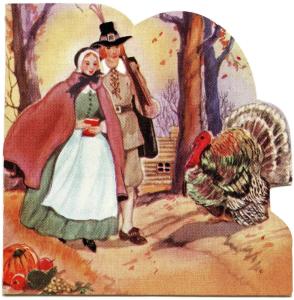
Veradean held up a picture from a magazine of a family seated around a large table for Thanksgiving dinner—all good-looking, clean and healthy, about to partake of the bountiful meal spread out before them.

“I wish this was my family,” Veradean said.

“Do they look poor to you?” Vicki-Vicki asked.

“No.”

“You’re poor. A poor family doesn’t set a table like that.”

“But why are we poor?” Veradean asked. “Why was I born into a poor family?”

“There has to be poor people in the world, I guess.”

“Why?”

“To balance things out. For every twenty or thirty poor people, there is one rich one.”

“Well, that isn’t fair!”

“Yeah, tell me about it,” Vicki-Vicki said.

“When I grow up, I’m going to be a famous movie actress. I’ll make a million dollars and live in a mansion and I’ll never be poor again.”

“Every young person thinks they’re going to be rich and famous, but then when they grow up they see it’s never going to happen. The sooner you face reality, the better off you’ll be.”

“What are we going to have for Thanksgiving dinner?”

“I don’t know. We’ll think of something. You don’t have to worry about it. You won’t go hungry.”

“But are we going to have turkey and all the other stuff they have in the picture?”

“No.”

“Why not?”

“No money.”

“Can’t you get us some money?”

“When you find out a good way, you let me know.”

“I sure wish we had a TV,” Veradean said.

“You say that at least once a day.”

“Everybody I know has a TV.”

“Maybe you should go and live with them.”

“It’s terribly boring sitting here all the time with no TV to watch.”

“Read a book. It doesn’t cost anything.”

“Everything is always about money, isn’t it?”

“I didn’t make the world,” Vicki-Vicki said.

Baby Eddie came into the room laughing, wearing his pajamas backwards. He twirled around so Veradean and Vicki-Vicki could see them from the back.

“You look so stupid!” Veradean said.

Vicki-Vicki groaned. “Go put ‘em on right!” she said.

“No! I like ‘em like this! I’m always gonna wear ‘em like this! I’m gonna start wearin’ all my clothes backwards!”

“That’s because you’re trash,” Veradean said.

“I am not trash! You’re trash!”

“We’re all trash,” Vicki-Vicki said. “That’s why we live in a falling-down dump like this in a rat-infested neighborhood!”

I’m not trash!” Baby Eddie screamed. “You’re trash! You’re trash! You’re trash!”

“The pilgrims were trash,” Veradean said. “They didn’t have any money and look what they did.”

“What did they do?”

“They started their own country.”

“What’s a pilgrim?” Baby Eddie screamed.

“Go to bed, Baby Eddie,” Vicki-Vicki said. “You’re giving me a headache.”

“No! I don’t want to go to bed!”

“Miss Edmonds read us a story about the pilgrims,” Veradean said. “They wore black and prayed all the time. The king got mad at them and kicked them out of the country. They didn’t have any place to go so they came over here from England in a little wooden boat. They just about died on the ocean on the way over and when they got here they landed on a big rock. When they climbed down off the rock and looked around, they saw it was nothing but woods and wild animals. There were no hotels or stores or anything like that. The only other people around were Indians and the Indians were afraid of the pilgrims. They hid from them and shot arrows at them.”

“I know what Indians are!” Baby Eddie shrieked.

“The pilgrims didn’t know how to take care of themselves and a lot of them died right away in the snow. They didn’t have any food because they didn’t know how to grow corn and stuff in the ground. Finally the Indians started to feel sorry for the pilgrims and came out of their hiding places and helped them. They showed them how to grow corn and pumpkins and green beans and stuff and raise turkeys so they’d always have something to eat.”

“That’s bullshit!” Baby Eddie said.

“You’re not supposed to use that word,” Vicki-Vicki said.

“But I like to say it! Bullshit! Bullshit! Bullshit!

“After the first harvest when the pilgrims had all the food they needed, they were so happy they decided to thank God and have a big party. They all sat down at a big table and the Indians served food to them and they all ate so much they had to go lay down. Some of them vomited. That was the first Thanksgiving.”

“The Indians served food to the pilgrims?” Vicki-Vicki asked.

“Yes, they did.”

“When did the Indians eat?”

“They sat down and had their Thanksgiving dinner after all the pilgrims were finished eating.”

“I want a hot dog!” Baby Eddie said.

“So, are we going to have turkey and all the stuff the pilgrims had for our Thanksgiving?” Veradean asked.

“Not unless you know some Indians,” Vicki-Vicki said.

On the day before Thanksgiving, Vicki-Vicki saw the ad in the paper: Thanksgiving Day dinner served at the Heavenly Light Mission. Everybody welcome! Come early! Bring the entire family!

When Veradean came home from school Wednesday afternoon, Vicki-Vicki told her, “We’re going to have turkey on Thanksgiving after all and it’s not going to cost us anything.”

“How we gonna do that?” Veradean asked.

“It’s a surprise.”

On Thursday morning Vicki-Vicki awoke early with a sense of purpose. She made Veradean and Baby Eddie get out of bed and take baths and wash their hair. She dressed Veradean in a hand-me-down schoolgirl dress of plaid material with a sash in the back. For Baby Eddie she found an old sailor suit in grandma’s trunk that some little boy had worn long ago.

For herself she had a gray, vintage suit she had been saving for a special occasion, exactly like the one Kim Novak wore in Vertigo. She always believed that she looked at least a little like Kim Novak without the blond hair and dramatic eyebrows.

Trash though they were, they didn’t have to go looking like trash. They would look distinctive, different from anybody else.

It was a mile or so into town, to the Heavenly Light Mission. A cold wind was blowing and the sky threatened rain.

“What’ll we do if it rains before we get there?” Veradean asked.

“Get wet.”

Baby Eddie complained that his shoes hurt, so Vicki-Vicki had to carry him part of the way, with her high heels pinching her toes every step of the way. Veradean tried carrying him some, but he was too much for her.

“It’s like carrying a calf,” she said.

Finally they reached the Heavenly Light Mission. There were already a lot of people and cars, even though the place hadn’t opened its doors yet. They took their place at the end of the long line.

“How long do we have to wait here?” Veradean asked.

“I’m hungry!” Baby Eddie said.

The doors opened at the appointed time and the line began moving, slowly at first and then faster.

“Oh, boy! I smell the turkey!” Veradean said.

While waiting in line, Vicki-Vicki was aware of a group of young men standing off to the side, talking and laughing. She saw after a while that they had noticed her and were looking her way. She made a point of ignoring them, looking down at Baby Eddie and taking his hand.

After a while one of the young men detached himself from the group and approached her.

“You probably don’t remember me,” he said.

“No.”

“Rollo Ruff? People used to call me RR?”

“I don’t think so.”

“High school?”

“Oh,” she said, feeling let down. “That was a long time ago.”

“Not that long,” he said.

“I know so many people.”

“These your kids?”

Veradean and Baby Eddie both looked at Vicki-Vicki to see what she would say.

“No, they’re foundling children,” she said. “I don’t know where they came from.”

“Sister and brother,” Veradean said.

“Yes, my mother is touring the Continent,” Vicki-Vicki said, “and I stayed behind this time to take care of the little ones.”

“Yes, that’s always a problem with the better people,” he said.

“Well, it was so nice seeing you again. Be sure and remember me to your people.”

“Thought I might call you up some time.”

“That would be rather difficult,” Vicki-Vicki said, “since I live in a house where there are no phones.”

“No phones! Hah-hah! You were always so funny!”

“I don’t know what’s funny about it.”

“Tell me where you live and I’ll drop by later this evening and we can get reacquainted.”

“I’m afraid that isn’t possible,” she said.

“Well, okay for now. I’ll be seeing you again, though. You can be sure of that.”

“You don’t like him?” Veradean asked after he was gone.

“No, I never saw him before in my life.”

“I think he’s cute. He’s got a quiff.”

“He’s got a what?

“I think a man looks cute with a quiff.”

“Oh, what do you know? You’re in fourth grade.”

“Why didn’t you tell him mama’s in jail?”

“That’s the same as admitting we’re trash,” Vicki-Vicki said.

“We are trash.”

The line lurched forward and they were all the way inside the Heavenly Light Mission. They were handed trays and, as they moved forward in the line, fat women in hairnets and white aprons began thrusting plates of food at them across a counter.

There were rows of tables placed end to end, covered with white table cloths. Balancing her own tray with one hand and helping to keep Baby Eddie from dropping his tray with the other hand, Vicki-Vicki jostled her way through the noisy crowd to the edge and took a seat at the end of a table. Veradean sat on her left and Baby Eddie across from her.

Veradean began stuffing food into her mouth. “This is just like the pilgrims,” she said.

“What’s this stuff?” Baby Eddie asked.

“It’s good,” Vicki-Vicki said. “Eat it.”

Soon Vicki-Vicki noticed a man moving down the table toward them, shaking people’s hands and patting them on the backs. He was dressed all in black like a pilgrim. She knew she was going to have to talk to him.

“So happy to see you here today, sister,” he said, touching Vicki-Vicki on the shoulder and moving around to the end of the table where he stood beside her. “My name is Brother Galvin. I don’t think I’ve seen you here before. What is your name?”

“My name is Vicki-Vicki Novak,” she said, almost choking.

“Are you the mother of these two children?”

“No.”

“I’m her sister and he’s her brother,” Veradean said.

“My, my!” Brother Galvin said. “I might have guessed as much.”

He flashed them all a grin and patted Baby Eddie on the head.

“All are welcome in the house of the Lord,” he said. “All are welcome. I hope the three of you will honor us with your presence at the service that begins in about half an hour in the building next door.”

“Thank you,” Vicki-Vicki said, and Brother Galvin moved on.

“I’ll bet he’s rich,” Veradean whispered. “Maybe you could marry him and we could come and live with you.”

“He’s at least forty years old.”

“What difference does that make as long as he’s got money?”

After they finished eating, they stood up to let others take their places and went outside.

“Now it’s time for church,” Vicki-Vicki said.

“Do we have to go?” Veradean asked.

“It’s the least we can do.”

The church was part of the same building but reached by going out one door and through another. There were about ten people inside sleepily waiting for the service to begin. An old woman played hymns on a small organ at the front.

In a couple of minutes, Brother Galvin came to the front and looked out at the people assembled. He held up his hands and smiled and the organ music stopped.

“Brothers and sisters!” he said. “Is there anybody here who does not believe that this is a day that the Lord hath made.”

“No!” somebody shouted from the back.

“We are so happy that you have made your way into our little fold on this blessed Thanksgiving Day. I’m here to tell you that the Lord loves you, no matter what you’ve done and no matter how low you might have sunk in this life. That is our message of hope at the Heavenly Light Mission: You are loved, in spite of all your transgressions, as only He can love, and you will be redeemed!”

“Amen!”

“Amen!”

A-men!

Now,” Brother Galvin said, looking directly at Vicki-Vicki, “I’m going to ask each of you to come forward, one by one, on this glorious Thanksgiving Day, and be washed of your sins in the house of the Lord! What better thing could you do on this Thanksgiving Day than be washed in the blood of our blessed savior?”

Baby Eddie quickly went to sleep, while Veradean played with a piece of string. Vicki-Vicki listened and watched the people stand up one at a time and go forward to the front timidly, where Brother Galvin prayed over them and listened to their oaths that they were ready to turn their lives and hearts over to the Lord Jesus Christ.

Vicki-Vicki knew her turn was coming and she was going to have to go to the front of the church with everybody watching. It was the kind of display she hated and the thought of it made her feel shy and awkward. What if she fell down in her high heels and everybody laughed? She wasn’t going to let that happen.

When Brother Galvin had his eyes closed in prayer, Vicki-Vicki scooped Baby Eddie up in her arms and, with Veradean following closely behind, made for the door. As soon as they were outside, it began to rain.

“We don’t even have an umbrella!” Veradean said.

“Carry me!” Baby Eddie whined.

They hadn’t walked very far when a red-and-white Chevrolet came along slowly and, honking at them first, pulled off the highway in front of them. The driver’s side door opened and a head popped up.

“Care for a lift?” Rollo Ruff asked.

“Who’s that?” Veradean said.

“Oh, it’s that silly boy, Rollo Ruff, from high school,” Vicki-Vicki said.

“What kind of a name is that?”

Other cars were slowing down and people were gawking, thinking they were witnessing an accident.

“Come on!” he yelled. “Get in before we all get killed!”

Vicki-Vicki got into the passenger seat beside Rollo Ruff and Veradean and Baby Eddie got into the back seat.

“I wouldn’t ordinarily accept a ride from a stranger,” Vicki-Vicki said, “but I have these little ones to think about.”

“I’m not such a stranger,” he said. “We knew each other in high school. Remember?”

“Well, if you say so.”

“You don’t remember me at all?”

“I guess I do. You were just one of so many silly boys.”

“I asked you to a Halloween dance once and you turned me down.”

“I’ll bet I wasn’t very nice about it, either, was I?”

He laughed and looked at her appreciatively. “No, you weren’t. You just about broke my heart.”

“You’re exaggerating!”

“Well, maybe a little.”

She hated now to have him know where she lived, but there was no other choice.

“Turn left on Bryson Road going out of town,” she said. “Go past the mill and the sewage treatment plant and I’ll tell you where to turn.”

“Oh, you live down here!” he said and she heard the disappointment in his voice.

“It’s just temporary,” she said. “We plan on moving soon.”

“I didn’t know we were moving,” Veradean said.

When Rollo Ruff pulled up in front of the house, Vicki-Vicki was glad it was raining so hard that he wouldn’t be able to see the peeling paint and sagging porch.

Vicki-Vicki made Veradean and Baby Eddie both thank Rollo Ruff for giving them all a ride and keeping them from having to walk home in the rain.

“Can I see you a little later?” Rollo Ruff asked.

“What for?” Vicki-Vicki asked.

“I can swing by about seven o’clock and we can have a little fun.”

“I don’t think so.”

“Why not?”

She pointed with her thumb toward the back seat.

“Put them to bed and we can go for a drive.”

“I can’t leave them alone. They’re too young.”

“Well, then,” he said, “put them to bed and you and I can just sit and talk.”

“I don’t think so. I’m tired. My feet ache. We walked all that way.”

“I’m not giving up,” Rollo Ruff said. “When I saw you again today, I wondered why I let you get away in high school.”

“You’re a smooth talker, aren’t you?”

“Not really. I’m usually tongue-tied.”

“Well, good night. It was lovely seeing someone from high school again.”

She opened the door and started to get out.

“I can’t call you because you don’t have a phone,” he said. “If I give you my number, will you call me?”

“Well, I suppose I might consider calling you some time when it’s convenient, if I don’t forget.”

“Do you have a piece of paper?”

“No.”

He took a pen out of his pocket and wrote the number on the back of Vicki-Vicki’s hand.

“Write it down before you wash it off,” he said.

“I will,” she said. “If I don’t forget.”

Rollo Ruff drove off into the night and Vicki-Vicki carried Baby Eddie into the house and put him to bed.

“I hope I don’t catch a cold,” Veradean said.

At ten o’clock, Vicki-Vicki and Veradean were sitting at the kitchen table. Vicki-Vicki leafed through a magazine and Veradean shuffled a deck of cards. The house was silent except for the rain on the roof.

“Do you want to play some two-handed pinochle?” Veradean asked.

“I hate card games,” Vicki-Vicki said.

“That was the best Thanksgiving dinner I ever had. It made me feel just like a pilgrim.”

“I’m so happy for you.”

“Are you going to marry that boy?”

“What boy?”

“That Rollo boy.”

“I don’t even know him.”

“I think he really likes you.”

“He’ll get over it.”

“Are you going to call him up sometime?”

“I don’t know. It depends on how bored I get sitting around this dump.”

“If you marry him, will you let me and Baby Eddie come and live with you?”

“I’m not going to marry him.”

“Okay, but if you do.”

“Don’t worry about it.”

“I don’t want to end up in foster care.”

“You worry like an old woman.”

“I wonder if I’ll ever make it to high school,” Veradean said.

“Don’t be in any hurry to get to high school,” Vicki-Vicki said. “It’s a hell hole.”

“It’s supposed to be a good time.”

“Well, it’s not.”

They heard a car out front and then voices and then a thump followed by another thump. Veradean ran and looked out the front window.

“Mama’s coming up the front walk!” she said.

“What?” Vicki-Vicki said, running into the front room.

The front door opened and mama came into the house, dripping wet.

Veradean ran to mama and put her arms around her big waist. “Mama! Oh, mama! Why didn’t you tell us you were coming home?”

“I didn’t know it myself until last night. They let me out to spend Thanksgiving with my family.”

“I’m so glad you’re here!”

“Are you home for good this time?” Vicki-Vicki asked.

“Well, we’ll see, won’t we? Get me a towel. Can’t you see I’m dripping water on the floor?”

Veradean took mama’s little suitcase and mama sat down on the couch, out of breath, and dried her hair with the towel Vicki-Vicki handed her.

“Where’s Baby Eddie?” she asked.

“He was tired out. He went to sleep.”

“I want to see him.”

“Don’t wake him up!” Vicki-Vicki said. “I’ll never get him to go back to sleep.”

“Who do you think are you telling me what to do in my own home?”

“I just meant…”

“I don’t care what you meant.”

“Mama, what did you do to your hair?” Veradean asked. “It’s blond now!”

“You like it?”

“Yes, it looks very glamorous.”

“A gal in prison who murdered her husband fixed it for me. I think it’s a little too short, but I guess it’ll grow out quick enough.

“Oh, it’s elegant!

“Did you kids eat today?”

“Oh, mama! We had the most wonderful Thanksgiving dinner I ever saw. We had turkey and dressing and candied sweet potatoes and corn and pumpkin pie and all the stuff the pilgrims had. The only difference was religious people took the place of the Indians.”

“Where did this take place?”

“At the Heavenly Light Mission in town,” Vicki-Vicki said.

“You walked all that way?”

“It’s the only way we could get there.”

“I was going to stop and pick up some chicken on my way home,” mama said. “I’m glad now I didn’t bother, since you already ate.”

“We started walking home in the rain and one of Vicki-Vicki’s boyfriends came along and gave us a ride.”

“He’s not my boyfriend,” Vicki-Vicki said.

“He was cute, too,” Veradean said.

Mama looked suspiciously at Vicki-Vicki. “You been whoring around while I was gone?”

“Isn’t that what you do? Isn’t that how you get three kids by three different men without ever being married to any one of them?”

“You’d better watch that smart mouth of yours, my girl. I can still slap you silly and don’t think I won’t do it, either!”

“Mama, can I sleep with you tonight?” Veradean said. “I’ve missed you so much!”

“Hell no!” mama said. “I don’t want you breathin’ on me all night. And, anyway, I’ve got a date. I just came home to change clothes. Somebody’s pickin’ me up in about ten  minutes.”

She went into the bedroom and closed the door. In a few minutes she emerged wearing her fancy black dress and left in a hurry without speaking another word.

“Can you sleep with me and Baby Eddie tonight?” Veradean asked. “When mama comes home she’ll be drunk and I don’t want to be around her when she’s like that.”

At two in the morning Vicki-Vicki was still awake. She lay in the bed next to Veradean, listening to the rain and wind buffeting the house. Baby Eddie lay in another smaller bed on the other side of the room. Sometimes he made little mouse sounds in his throat like there was something inside that was trying to come out.

There was a flash of lightning, unusual for the time of year, and sirens out on the highway. The sirens usually meant a car wreck. If Vicki-Vicki could have any wish tonight, it would be for one particular traffic fatality. Just the one and no others.

Copyright © 2018 by Allen Kopp

Thanksgiving Like the Pilgrims

Thanksgiving Like the Pilgrims ~ A Short Story by Allen Kopp

Veradean held up a picture from a magazine of a family seated around a large table for Thanksgiving dinner—all good-looking, clean and healthy, about to partake of the bountiful meal spread out before them.

“I wish this was my family,” Veradean said.

“Do they look poor to you?” Vicki-Vicki asked.

“No.”

“You’re poor. A poor family doesn’t set a table like that.”

“But why are we poor?” Veradean asked. “Why was I born into a poor family?”

“There has to be poor people in the world, I guess.”

“Why?”

“To balance things out. For every twenty or thirty poor people, there is one rich one.”

“Well, that isn’t fair!”

“Yeah, tell me about it,” Vicki-Vicki said.

“When I grow up, I’m going to be a famous movie actress. I’ll make a million dollars and live in a mansion and I’ll never be poor again.”

“Every young person thinks they’re going to be rich and famous, but then when they grow up they see it’s never going to happen. The sooner you face reality, the better off you’ll be.”

“What are we going to have for Thanksgiving dinner?”

“I don’t know. We’ll think of something. You don’t have to worry about it. You won’t go hungry.”

“But are we going to have turkey and all the other stuff they have in the picture?”

“No.”

“Why not?”

“No money.”

“Can’t you get us some money?”

“When you find out a good way, you let me know.”

“I sure wish we had a TV,” Veradean said.

“You say that at least once a day.”

“Everybody I know has a TV.”

“Maybe you should go and live with them.”

“It’s terribly boring sitting here all the time with no TV to watch.”

“Read a book. It doesn’t cost anything.”

“Everything is always about money, isn’t it?”

“I didn’t make the world,” Vicki-Vicki said.

Baby Eddie came into the room laughing, wearing his pajamas backwards. He twirled around so Veradean and Vicki-Vicki could see them from the back.

“You look so stupid!” Veradean said.

Vicki-Vicki groaned. “Go put ‘em on right!” she said.

“No! I like ‘em like this! I’m always gonna wear ‘em like this! I’m gonna start wearin’ all my clothes backwards!”

“That’s because you’re trash,” Veradean said.

“I am not trash! You’re trash!”

“We’re all trash,” Vicki-Vicki said. “That’s why we live in a falling-down dump like this in a rat-infested neighborhood!”

I’m not trash!” Baby Eddie screamed. “You’re trash! You’re trash! You’re trash!”

“The pilgrims were trash,” Veradean said. “They didn’t have any money and look what they did.”

“What did they do?”

“They started their own country.”

“What’s a pilgrim?” Baby Eddie screamed.

“Go to bed, Baby Eddie,” Vicki-Vicki said. “You’re giving me a headache.”

“No! I don’t want to go to bed!”

“Miss Edmonds read us a story about the pilgrims,” Veradean said. “They wore black and prayed all the time. The king got mad at them and kicked them out of the country. They didn’t have any place to go so they came over here from England in a little wooden boat. They just about died on the ocean on the way over and when they got here they landed on a big rock. When they climbed down off the rock and looked around, they saw it was nothing but woods and wild animals. There were no hotels or stores or anything like that. The only other people around were Indians and the Indians were afraid of the pilgrims. They hid from them and shot arrows at them.”

“I know what Indians are!” Baby Eddie shrieked.

“The pilgrims didn’t know how to take care of themselves and a lot of them died right away in the snow. They didn’t have any food because they didn’t know how to grow corn and stuff in the ground. Finally the Indians started to feel sorry for the pilgrims and came out of their hiding places and helped them. They showed them how to grow corn and pumpkins and green beans and stuff and raise turkeys so they’d always have something to eat.”

“That’s bullshit!” Baby Eddie said.

“You’re not supposed to use that word,” Vicki-Vicki said.

“But I like to say it! Bullshit! Bullshit! Bullshit!

“After the first harvest when the pilgrims had all the food they needed, they were so happy they decided to thank God and have a big party. They all sat down at a big table and the Indians served food to them and they all ate so much they had to go lay down. Some of them vomited. That was the first Thanksgiving.”

“The Indians served food to the pilgrims?” Vicki-Vicki asked.

“Yes, they did.”

“When did the Indians eat?”

“They sat down and had their Thanksgiving dinner after all the pilgrims were finished eating.”

“I want a hot dog!” Baby Eddie said.

“So, are we going to have turkey and all the stuff the pilgrims had for our Thanksgiving?” Veradean asked.

“Not unless you know some Indians,” Vicki-Vicki said.

On the day before Thanksgiving, Vicki-Vicki saw the ad in the paper: Thanksgiving Day dinner served at the Heavenly Light Mission. Everybody welcome! Come early! Bring the entire family!

When Veradean came home from school Wednesday afternoon, Vicki-Vicki told her, “We’re going to have turkey on Thanksgiving after all and it’s not going to cost us anything.”

“How we gonna do that?” Veradean asked.

“It’s a surprise.”

On Thursday morning Vicki-Vicki awoke early with a sense of purpose. She made Veradean and Baby Eddie get out of bed and take baths and wash their hair. She dressed Veradean in a hand-me-down schoolgirl dress of plaid material with a sash in the back. For Baby Eddie she found an old sailor suit in grandma’s trunk that some little boy had worn long ago.

For herself she had a gray, vintage suit she had been saving for a special occasion, exactly like the one Kim Novak wore in Vertigo. She always believed that she looked at least a little like Kim Novak without the blond hair and dramatic eyebrows.

Trash though they were, they didn’t have to go looking like trash. They would look distinctive, different from anybody else.

It was a mile or so into town, to the Heavenly Light Mission. A cold wind was blowing and the sky threatened rain.

“What’ll we do if it rains before we get there?” Veradean asked.

“Get wet.”

Baby Eddie complained that his shoes hurt, so Vicki-Vicki had to carry him part of the way, with her high heels pinching her toes every step of the way. Veradean tried carrying him some, but he was too much for her.

“It’s like carrying a calf,” she said.

Finally they reached the Heavenly Light Mission. There were already a lot of people and cars, even though the place hadn’t opened its doors yet. They took their place at the end of the long line.

“How long do we have to wait here?” Veradean asked.

“I’m hungry!” Baby Eddie said.

The doors opened at the appointed time and the line began moving, slowly at first and then faster.

“Oh, boy! I smell the turkey!” Veradean said.

While waiting in line, Vicki-Vicki was aware of a group of young men standing off to the side, talking and laughing. She saw after a while that they had noticed her and were looking her way. She made a point of ignoring them, looking down at Baby Eddie and taking his hand.

After a while one of the young men detached himself from the group and approached her.

“You probably don’t remember me,” he said.

“No.”

“Rollo Ruff? People used to call me RR?”

“I don’t think so.”

“High school?”

“Oh,” she said, feeling let down. “That was a long time ago.”

“Not that long,” he said.

“I know so many people.”

“These your kids?”

Veradean and Baby Eddie both looked at Vicki-Vicki to see what she would say.

“No, they’re foundling children,” she said. “I don’t know where they came from.”

“Sister and brother,” Veradean said.

“Yes, my mother is touring the Continent,” Vicki-Vicki said, “and I stayed behind this time to take care of the little ones.”

“Yes, that’s always a problem with the better people,” he said.

“Well, it was so nice seeing you again. Be sure and remember me to your people.”

“Thought I might call you up some time.”

“That would be rather difficult,” Vicki-Vicki said, “since I live in a house where there are no phones.”

“No phones! Hah-hah! You were always so funny!”

“I don’t know what’s funny about it.”

“Tell me where you live and I’ll drop by later this evening and we can get reacquainted.”

“I’m afraid that isn’t possible,” she said.

“Well, okay for now. I’ll be seeing you again, though. You can be sure of that.”

“You don’t like him?” Veradean asked after he was gone.

“No, I never saw him before in my life.”

“I think he’s cute. He’s got a quiff.”

“He’s got a what?

“I think a man looks cute with a quiff.”

“Oh, what do you know? You’re in fourth grade.”

“Why didn’t you tell him mama’s in jail?”

“That’s the same as admitting we’re trash,” Vicki-Vicki said.

“We are trash.”

The line lurched forward and they were all the way inside the Heavenly Light Mission. They were handed trays and, as they moved forward in the line, fat women in hairnets and white aprons began thrusting plates of food at them across a counter.

There were rows of tables placed end to end, covered with white table cloths. Balancing her own tray with one hand and helping to keep Baby Eddie from dropping his tray with the other hand, Vicki-Vicki jostled her way through the noisy crowd to the edge and took a seat at the end of a table. Veradean sat on her left and Baby Eddie across from her.

Veradean began stuffing food into her mouth. “This is just like the pilgrims,” she said.

“What’s this stuff?” Baby Eddie asked.

“It’s good,” Vicki-Vicki said. “Eat it.”

Soon Vicki-Vicki noticed a man moving down the table toward them, shaking people’s hands and patting them on the backs. He was dressed all in black like a pilgrim. She knew she was going to have to talk to him.

“So happy to see you here today, sister,” he said, touching Vicki-Vicki on the shoulder and moving around to the end of the table where he stood beside her. “My name is Brother Galvin. I don’t think I’ve seen you here before. What is your name?”

“My name is Vicki-Vicki Novak,” she said, almost choking.

“Are you the mother of these two children?”

“No.”

“I’m her sister and he’s her brother,” Veradean said.

“My, my!” Brother Galvin said. “I might have guessed as much.”

He flashed them all a grin and patted Baby Eddie on the head.

“All are welcome in the house of the Lord,” he said. “All are welcome. I hope the three of you will honor us with your presence at the service that begins in about half an hour in the building next door.”

“Thank you,” Vicki-Vicki said, and Brother Galvin moved on.

“I’ll bet he’s rich,” Veradean whispered. “Maybe you could marry him and we could come and live with you.”

“He’s at least forty years old.”

“What difference does that make as long as he’s got money?”

After they finished eating, they stood up to let others take their places and went outside.

“Now it’s time for church,” Vicki-Vicki said.

“Do we have to go?” Veradean asked.

“It’s the least we can do.”

The church was part of the same building but reached by going out one door and through another. There were about ten people inside sleepily waiting for the service to begin. An old woman played hymns on a small organ at the front.

In a couple of minutes, Brother Galvin came to the front and looked out at the people assembled. He held up his hands and smiled and the organ music stopped.

“Brothers and sisters!” he said. “Is there anybody here who does not believe that this is a day that the Lord hath made.”

“No!” somebody shouted from the back.

“We are so happy that you have made your way into our little fold on this blessed Thanksgiving Day. I’m here to tell you that the Lord loves you, no matter what you’ve done and no matter how low you might have sunk in this life. That is our message of hope at the Heavenly Light Mission: You are loved, in spite of all your transgressions, as only He can love, and you will be redeemed!”

“Amen!”

“Amen!”

A-men!

Now,” Brother Galvin said, looking directly at Vicki-Vicki, “I’m going to ask each of you to come forward, one by one, on this glorious Thanksgiving Day, and be washed of your sins in the house of the Lord! What better thing could you do on this Thanksgiving Day than be washed in the blood of our blessed savior?”

Baby Eddie quickly went to sleep, while Veradean played with a piece of string. Vicki-Vicki listened and watched the people stand up one at a time and go forward to the front timidly, where Brother Galvin prayed over them and listened to their oaths that they were ready to turn their lives and hearts over to the Lord Jesus Christ.

Vicki-Vicki knew her turn was coming and she was going to have to go to the front of the church with everybody watching. It was the kind of display she hated and the thought of it made her feel shy and awkward. What if she fell down in her high heels and everybody laughed? She wasn’t going to let that happen.

When Brother Galvin had his eyes closed in prayer, Vicki-Vicki scooped Baby Eddie up in her arms and, with Veradean following closely behind, made for the door. As soon as they were outside, it began to rain.

“We don’t even have an umbrella!” Veradean said.

“Carry me!” Baby Eddie whined.

They hadn’t walked very far when a red-and-white Chevrolet came along slowly and, honking at them first, pulled off the highway in front of them. The driver’s side door opened and a head popped up.

“Care for a lift?” Rollo Ruff asked.

“Who’s that?” Veradean said.

“Oh, it’s that silly boy, Rollo Ruff, from high school,” Vicki-Vicki said.

“What kind of a name is that?”

Other cars were slowing down and people were gawking, thinking they were witnessing an accident.

“Come on!” he yelled. “Get in before we all get killed!”

Vicki-Vicki got into the passenger seat beside Rollo Ruff and Veradean and Baby Eddie got into the back seat.

“I wouldn’t ordinarily accept a ride from a stranger,” Vicki-Vicki said, “but I have these little ones to think about.”

“I’m not such a stranger,” he said. “We knew each other in high school. Remember?”

“Well, if you say so.”

“You don’t remember me at all?”

“I guess I do. You were just one of so many silly boys.”

“I asked you to a Halloween dance once and you turned me down.”

“I’ll bet I wasn’t very nice about it, either, was I?”

He laughed and looked at her appreciatively. “No, you weren’t. You just about broke my heart.”

“You’re exaggerating!”

“Well, maybe a little.”

She hated now to have him know where she lived, but there was no other choice.

“Turn left on Bryson Road going out of town,” she said. “Go past the mill and the sewage treatment plant and I’ll tell you where to turn.”

“Oh, you live down here!” he said and she heard the disappointment in his voice.

“It’s just temporary,” she said. “We plan on moving soon.”

“I didn’t know we were moving,” Veradean said.

When Rollo Ruff pulled up in front of the house, Vicki-Vicki was glad it was raining so hard that he wouldn’t be able to see the peeling paint and sagging porch.

Vicki-Vicki made Veradean and Baby Eddie both thank Rollo Ruff for giving them all a ride and keeping them from having to walk home in the rain.

“Can I see you a little later?” Rollo Ruff asked.

“What for?” Vicki-Vicki asked.

“I can swing by about seven o’clock and we can have a little fun.”

“I don’t think so.”

“Why not?”

She pointed with her thumb toward the back seat.

“Put them to bed and we can go for a drive.”

“I can’t leave them alone. They’re too young.”

“Well, then,” he said, “put them to bed and you and I can just sit and talk.”

“I don’t think so. I’m tired. My feet ache. We walked all that way.”

“I’m not giving up,” Rollo Ruff said. “When I saw you again today, I wondered why I let you get away in high school.”

“You’re a smooth talker, aren’t you?”

“Not really. I’m usually tongue-tied.”

“Well, good night. It was lovely seeing someone from high school again.”

She opened the door and started to get out.

“I can’t call you because you don’t have a phone,” he said. “If I give you my number, will you call me?”

“Well, I suppose I might consider calling you some time when it’s convenient, if I don’t forget.”

“Do you have a piece of paper?”

“No.”

He took a pen out of his pocket and wrote the number on the back of Vicki-Vicki’s hand.

“Write it down before you wash it off,” he said.

“I will,” she said. “If I don’t forget.”

Rollo Ruff drove off into the night and Vicki-Vicki carried Baby Eddie into the house and put him to bed.

“I hope I don’t catch a cold,” Veradean said.

At ten o’clock, Vicki-Vicki and Veradean were sitting at the kitchen table. Vicki-Vicki leafed through a magazine and Veradean shuffled a deck of cards. The house was silent except for the rain on the roof.

“Do you want to play some two-handed pinochle?” Veradean asked.

“I hate card games,” Vicki-Vicki said.

“That was the best Thanksgiving dinner I ever had. It made me feel just like a pilgrim.”

“I’m so happy for you.”

“Are you going to marry that boy?”

“What boy?”

“That Rollo boy.”

“I don’t even know him.”

“I think he really likes you.”

“He’ll get over it.”

“Are you going to call him up sometime?”

“I don’t know. It depends on how bored I get sitting around this dump.”

“If you marry him, will you let me and Baby Eddie come and live with you?”

“I’m not going to marry him.”

“Okay, but if you do.”

“Don’t worry about it.”

“I don’t want to end up in foster care.”

“You worry like an old woman.”

“I wonder if I’ll ever make it to high school,” Veradean said.

“Don’t be in any hurry to get to high school,” Vicki-Vicki said. “It’s a hell hole.”

“It’s supposed to be a good time.”

“Well, it’s not.”

They heard a car out front and then voices and then a thump followed by another thump. Veradean ran and looked out the front window.

“Mama’s coming up the front walk!” she said.

“What?” Vicki-Vicki said, running into the front room.

The front door opened and mama came into the house, dripping wet.

Veradean ran to mama and put her arms around her big waist. “Mama! Oh, mama! Why didn’t you tell us you were coming home?”

“I didn’t know it myself until last night. They let me out to spend Thanksgiving with my family.”

“I’m so glad you’re here!”

“Are you home for good this time?” Vicki-Vicki asked.

“Well, we’ll see, won’t we? Get me a towel. Can’t you see I’m dripping water on the floor?”

Veradean took mama’s little suitcase and mama sat down on the couch, out of breath, and dried her hair with the towel Vicki-Vicki handed her.

“Where’s Baby Eddie?” she asked.

“He was tired out. He went to sleep.”

“I want to see him.”

“Don’t wake him up!” Vicki-Vicki said. “I’ll never get him to go back to sleep.”

“Who do you think are you telling me what to do in my own home?”

“I just meant…”

“I don’t care what you meant.”

“Mama, what did you do to your hair?” Veradean asked. “It’s blond now!”

“You like it?”

“Yes, it looks very glamorous.”

“A gal in prison who murdered her husband fixed it for me. I think it’s a little too short, but I guess it’ll grow out quick enough.

“Oh, it’s elegant!

“Did you kids eat today?”

“Oh, mama! We had the most wonderful Thanksgiving dinner I ever saw. We had turkey and dressing and candied sweet potatoes and corn and pumpkin pie and all the stuff the pilgrims had. The only difference was religious people took the place of the Indians.”

“Where did this take place?”

“At the Heavenly Light Mission in town,” Vicki-Vicki said.

“You walked all that way?”

“It’s the only way we could get there.”

“I was going to stop and pick up some chicken on my way home,” mama said. “I’m glad now I didn’t bother, since you already ate.”

“We started walking home in the rain and one of Vicki-Vicki’s boyfriends came along and gave us a ride.”

“He’s not my boyfriend,” Vicki-Vicki said.

“He was cute, too,” Veradean said.

Mama looked suspiciously at Vicki-Vicki. “You been whoring around while I was gone?”

“Isn’t that what you do? Isn’t that how you get three kids by three different men without ever being married to any one of them?”

“You’d better watch that smart mouth of yours, my girl. I can still slap you silly and don’t think I won’t do it, either!”

“Mama, can I sleep with you tonight?” Veradean said. “I’ve missed you so much!”

“Hell no!” mama said. “I don’t want you breathin’ on me all night. And, anyway, I’ve got a date. I just came home to change clothes. Somebody’s pickin’ me up in about ten  minutes.”

She went into the bedroom and closed the door. In a few minutes she emerged wearing her fancy black dress and left in a hurry without speaking another word.

“Can you sleep with me and Baby Eddie tonight?” Veradean asked. “When mama comes home she’ll be drunk and I don’t want to be around her when she’s like that.”

At two in the morning Vicki-Vicki was still awake. She lay in the bed next to Veradean, listening to the rain and wind buffeting the house. Baby Eddie lay in another smaller bed on the other side of the room. Sometimes he made little mouse sounds in his throat like there was something inside that was trying to come out.

There was a flash of lightning, unusual for the time of year, and sirens out on the highway. The sirens usually meant a car wreck. If Vicki-Vicki could have any wish tonight, it would be for one particular traffic fatality. Just the one and no others.

Copyright © 2018 by Allen Kopp

Night Train

Night Train ~ A Short Story by Allen Kopp

(Published in a slightly different form in Bartleby-Snopes.) 

Martin Haythorne disliked riding trains at night. They moved too slow and made too many stops. At one of the stops a woman boarded the train carrying a sleeping child. Martin was facing the door and as he saw her coming toward him, he hoped she wouldn’t sit in the seat facing him, but she did. He uncrossed his legs and sighed and pulled himself up straighter, thinking it’s going to be a long night.

The woman fussed with getting the child fixed just right in her lap and, after she was settled in the seat across from him, she looked searchingly at Martin until he looked back and gave her a wan smile.

“It’s so crowded tonight,” she said.

He could see all the way down to the other end of the coach and it was more than half empty.

“I think traveling at night is so lonely,” she said. “I like to find somebody I can talk to. It helps to pass the time.”

He looked away and picked up and began reading a newspaper that somebody had left behind, but that didn’t deter the woman.

“This is my little girl,” she said, looking down at the child draped across her lap. “She’s three. Her name is Ivette. She always gets sick to her stomach on a train, so before we left home I gave her a little pill to make her got to sleep. She doesn’t have any idea she’s on the train just now. Don’t you think that was the smart thing for me to do?”

He shook his head and looked at the child, who barely seemed to be breathing. She was tiny and pale, with scraggly blond hair and a throbbing blue vein in her temple. She was wearing a cowboy shirt with a horse embroidered on the yoke, blue jeans and cowboy boots.

“What about you?” the woman asked him. “You have any children?”

“Not me,” Martin said. “I don’t have time.”

“I always thought I would have three or four children, but Ivette is my only one so far. I guess there’s always a chance for more.”

Martin looked longingly at the empty seats, wanting to move but not wanting to appear overly rude. Instead he picked up the newspaper again, turned the pages and, not finding anything of interest, began studying a sofa ad.

“You’re probably wondering where my husband is,” the woman said. “You’re probably asking yourself  why I’m traveling at night by myself with a small child.”

“You need a book or a magazine,” Martin said. “Reading is what really helps to pass the time at night.”

“Oh, I don’t read much and, anyway, reading on a moving train would only make me sick to my stomach.”

He kept looking at the sofa ad with feigned interest, wondering how he might make the woman stop talking. After a while he refolded the paper and set it on the seat beside him. Remembering the pack of cigarettes he had in his pocket, he took one out, lit it and blew out a big cloud of smoke. That would surely make the woman want to take the child and move to a different seat.

She didn’t seem to notice. She moved the child off her lap onto the seat beside her until the child’s head was resting against her thigh and the cowboy books were sticking out in the aisle.

“Aren’t children just the most precious things?” she said. “God’s greatest gift.” She smoothed the child’s hair back from its face.

“Look,” he said, “if you don’t mind, it’s late and I would really like to just sit quietly. When I’m riding on a train at night, I like to just sit and think about things.”

“Oh, no!” she said. “I don’t want to bother you. Just pretend as if I wasn’t even here.”

He leaned his head back, turned his face toward the window and closed his eyes. He could go to sleep if only he was alone.

“You know,” the woman said, “when I’m riding on a train I love to watch the scenery, but at night all you can see is the darkness, unless you pass through a little town where there are lights. The towns always seem kind of lonely and sad, somehow, at night, don’t you think?”

He reopened his eyes and sighed. He was ready to move now to another seat, no matter how rude it seemed. When he started to stand up he saw the woman was crying.

She saw he was looking at her and said, “Oh, don’t mind me! I try not to cry in public but sometimes I just can’t help it.”

She took a handkerchief out of her purse and wiped her eyes.

“Are you sick or something?” he asked. “Do you need to get off the train?”

“No. Why would I want to get off the train all the way out here?”

“I just thought…”

“Look, would you mind getting me a cup of water? I need to take some pills.”

He went to the men’s restroom and filled a tiny, cone-shaped paper cup with water at the wash basin and took it back to her.

“Thanks,” she said. “I sometimes get hysterical, but I have these little pills that help.”

“Look, I’ll move to another seat and you can put your baby here and I’ll just get out of your way.”

“Oh, no, no, no! I want you to stay with me!”

“But I thought…”

“No, I feel better if you’re here.”

He looked at his watch, calculating how much longer the trip would take, and sat back down. The woman put the handkerchief over her face and let loose with a torrent of sobs, causing a throbbing in his head. A crying woman always brought unwelcome associations; his mother used to cry for no reason at all.

When he saw the conductor standing at the front of the car, he stood up and approached him. “I’d like to move to another car,” he said. “There’s a woman who keeps saying things.”

“What kind of things?” the conductor asked. “Indecent things?”

“Oh, no, nothing like that.”

“Well, what is she saying?”

“She’s just bothering me. I want to rest.”

“Well, you can’t move to another car because this is the only car carrying passengers tonight.”

“I see.”

“Why don’t you just move to another seat?”

“I think she would move, too.”

“Well, tell her to stop annoying you. Tell her to shut up. Sometimes that’s what it takes.”

“I will. Thanks.”

He went back to his seat and sat back down. If only he could sleep the rest of the way, blot everything out, he’d feel much better. The time would go by so fast that before he knew it the trip would be over. He wasn’t going to let the woman bother him anymore.

He tried closing his eyes again, leaning his head against the window and folding his arms across his chest. He could feel himself starting to drift off when another train passed by going in the other direction, letting  off a shrill blast.

The blond-haired girl woke up and began screaming. The woman picked her up and set her across her lap.

“My goodness!” she said. “That frightened little baby, didn’t it? Bad old train woke little girl up!”

She jiggled her up and down, but the girl kept screaming. After a while, the screams tapered away to subdued sobbing. “We make quite a pair, don’t we?” the woman said with a laugh. “I don’t know what they’re going to do with us, I swear I don’t!”

When the girl continued crying, the woman took a candy bar out of her purse, unwrapped it and gave it to her. She instantly settled down, making little cooing noises as she ate the candy, looking at the ceiling.

“Sometimes with children things are so simple,” the woman said.

“Look,” he said, “I’ve tried to be patient with you, but you don’t seem to be getting the message. I want to just sit quietly and not be bothered and not talk! Is that so hard to understand?”

“We’ve just been so upset because my husband ran off and left us.”

“I can’t say I blame him.”

“Of course, Ivette is too young to understand, but children know things instinctively.”

“Okay, I’m going to move to another seat now.”

“I wish you wouldn’t. I like talking to you.”

“Well, I don’t like talking to you!”

“He has a kind of recurring amnesia, my husband does. He’s fine for a while and then he has these spells come over him where he forgets things. He forgets he has a wife and a child, and he goes away on the train or the bus, and I have to go get him and bring him back home. He seems to have it in his head that he’s escaping from something.”

“I think I know what he’s escaping.”

“The doctor believes he has a kind of a growth thing on the brain that makes him act the way he does. If we could just get him to agree to have an operation, that might make him just as normal as anybody.”

“Maybe he doesn’t want to be normal.”

“Of course he does. Everybody wants to be normal and live a normal life.”

I don’t!”

“I love my husband very much and little Ivette loves him too, and I believe that in his own peculiar way he loves us just as much. I’ll go to the ends of the earth to bring him back home as many times as it takes.”

“You don’t seem to be getting the message, lady, so I’ll put it to you in very plain language: I don’t care about your troubles and I don’t want to hear about them!

He stood up, picked up his coat, hat and suitcase and moved all the way to the front of the car next to the window. He was so relieved to get away from the woman and the little girl that he felt close to tears and his hands were shaking. He put his suitcase on the seat beside him so she wouldn’t get it into her head to come and sit there.

Sleep at last came to him and he awoke to the sounds of the train pulling into the station. The sun was just coming up. The interminable night was over.

He got off the train as quickly as he could to avoid another encounter, but he didn’t see the woman and the little girl again. He took a cab to the hotel, checked into his room, changed his clothes and went downstairs in the elevator.

The hotel restaurant was crowded, but he didn’t mind it because he got a little table at a remove from the others. After placing his order for breakfast, he lit a cigarette and closed his eyes, feeling pleasantly fatigued. He was looking forward to a day of solitude and relaxation—visiting a museum or two and possibly seeing a movie, and then returning to his hotel room for a nap before dinner.

While eating his ham and eggs, he noticed a woman come into the restaurant. He wouldn’t have noticed her at all if she hadn’t been carrying a small, blond-haired child. She sat down facing him at a table about thirty feet away. She held the child on her lap for a while and then pulled a chair up close on her right side and set the child on the chair.

The woman looked closely at him and when he looked back she smiled at him and he saw then that it was the woman from the train, although she looked much different, dressed in finer clothes and wearing a hat. She reached over and said something to the child and then she pointed her finger at him to indicate to the child that he was there. He wanted to move around to the other side of the table facing away from her, but he knew it was no use. There would be no getting away from her.

I’ve seen her before, he thought, and not just on the train. I’ve seen her many times in many places. I forget about her, and then I see her again, in the least-expected places at the least-expected times. She is everything to me that I abhor in the world, everything I hate and fear, and she will not relent until she has overpowered me and forced me to her will.

He closed his eyes and wished the woman and the blond-haired child gone. He would kill them if he had to, to save himself. He’d buy a small gun that he could conceal easily in his pocket and lure them away from the hotel and kill them. Nobody would ever know, as long as he planned things out carefully. Yes, he could kill a child because this child wasn’t just any child—it was her child.

When he opened his eyes again, the woman and child, to his great relief, were gone. He finished his breakfast, paid for it, and went up to his room on the tenth floor of the hotel and locked himself in. He didn’t want to be disturbed.

The room was quiet and cool. The faraway sounds of the traffic on the street below were comforting. He kicked off his shoes and lay on the bed and put his arm over his eyes.

He fell into a deep sleep, losing track of the passage of time. He woke to the sound of a faint stirring, as of someone in the room with him. He opened his eyes and when he saw the woman from the train standing beside the bed, he jerked himself to a sitting position.

“What the…what the hell is this?” he said, not sure of what he was seeing.

“We’re here,” she said. “We’re both here.”

She touched the head of the blond child standing beside her and then reached down and picked her up in her arms. The child, seeing him lying on the bed, stuck her finger in her mouth and then pointed it at him and leaned far over toward him from her mother’s arms.

“She certainly has missed her daddy!” the woman said.

She placed the child on the bed beside him in a sitting position. It was the same cowboy shirt with a horse embroidered on the yoke, the same blue jeans and cowboy boots.

“Who is this?” he said to the woman.

The child looked at him knowingly. She had the same face, the same upturned nose, the same washed-out blue eyes. When she opened her dribbling mouth and smiled at him, he could see her tiny, animal-like teeth. He was sure he had never seen a more despicable child. He wanted nothing more than to put his hands around her throat and strangle the life out of her and then do the same to the mother.

Copyright © 2018 by Allen Kopp

Time That is No Time

Time That is No Time ~ A Short Story by Allen Kopp

Leatrice awoke and found herself in a strange place. It wasn’t morning and she wasn’t in her familiar room, in the bed where she had slept for the twelve years of her life. All around her was darkness, allowing her to see only a short distance in front of her; she was afraid of what the darkness might be concealing. “Hello! “Hello!” she called out for someone to help her but no one answered.

Finally someone approached her, an old woman. Leatrice had never seen the old woman before but she was somehow familiar.

“Where am I?” she asked. “Who are you? I want my mother!”

The old woman made a shushing motion with her hands. “Not so loud, child! You’ll wake the others.”

“What others?”

She noticed then that the old woman carried a glow inside her chest that allowed one to see inside her to her ribs and veins. The glow made the room a little brighter by about one candle’s worth. “What is that?” Leatrice asked in alarm. “Why are you glowing?”

“You’re glowing too,” the old woman said.

When she looked down she saw it was so. “All right, what is this? Am I dreaming?”

“In a way you are.”

“In what way? Am I asleep?”

“Asleep, yes, but not in the way you’re used to.”

“Can you please tell me where I am?”

“First things first. Tell me your full name.”

“Leatrice Geneva Fitch.”

“And in what year were you born?”

“Nineteen hundred.”

“What year is it now?”

“Nineteen-twelve.”

“That makes you twelve years old.”

“Yes.”

“You will always be twelve years old now. The year, for you, will always be nineteen-twelve.”

“What are you talking about?”

“My dear, haven’t you figured it out yet?”

“Figured what out?”

“You’ve made the transition that we all must make.”

“What transition? What is this place?”

“You have passed from one realm of existence to another, from the physical to the spiritual realm.”

“Are you saying I’m dead?”

“My dear, that word doesn’t mean anything here.”

“Well, am I?”

“If that’s the way you way you want to put it, then, yes, you are. Dead.”

Leatrice let out a breath, mostly to reassure herself that she could still breathe and said, matter-0f-factly, “I don’t like this place. I want to go home.”

“This is your home now.”

“What happened, anyway?” she asked, fighting back tears. “I don’t remember being sick.”

“You weren’t sick. It was very sudden. You got in the way of the streetcar downtown. The conductor rang his bell, but for some reason you didn’t get out of the way.”

“Funny thing, I don’t remember.”

“No, we never do.”

“And who are you, if I may be so bold? You look something like my mother.”

“I’m your mother’s grandmother, your great-grandmother. I’ve been here since long before you were born.”

“Here? Where?

“The family crypt.”

“What?”

“Yes, you’re in the family crypt, in the cemetery, surrounded by all those who went before.”

“Oh, no! That can’t it be!”

“Why can’t it be?”

“I’ve seen the family crypt and I don’t like it.”

“You’ve only seen it from the outside.”

“Yes, and it’s scary. It seems to me that, once you’re on the inside, you’ll never get out again.”

“Well, now you’re on the inside so you’ll know firsthand, won’t you?”

Leatrice let loose with the tears she had been trying to restrain. “I don’t like this place and I want to go home! Where are my mother and father? I want to see them.”

“Where do you think they are? They’re still alive. They’re where they’ve always been.”

“Will I ever see them again?”

“More than likely you will, but who can say for sure?”

“But I have cats. What will happen to my cats now that I’m no longer at home to take care of them?”

“Your brother will take care of them. They’re his cats now.”

“Will they come here to me when they die?”

“You’ll find out in time,” great-grandmother said.

There was a lapse then, a darkness, as of a veil being drawn. When this nothingness ended (and who knows how long it might have lasted because in this place there is no time?) great-grandmother was leading Leatrice by the hand, inviting her to meet the “others.”

Cousins Parry and Lomax, twins, were ten at the time they came to the family crypt. (They went over a waterfall in a rowboat and drowned on a summer’s day.) They looked at Leatrice with curiosity. She knew from their manner that they were shy of her and didn’t know what to say.

Great-grandfather was tall and broad, wearing a dress suit, with the elaborate mustache and side whiskers fashionable at the time of his passing. (He was the one who built the family crypt so he could have his family all together in one place.) He smiled at Leatrice and patted her on the head and then he was gone.

Uncle Evan, great-grandfather’s son, was handsome in his military uniform. He entered the spirit realm in Cuba when a bullet struck him in the neck during the Spanish-American War. He smiled at Leatrice and winked and touched her on the shoulder.

Aunt Ursula was a tall, thin woman with a sad face. She carried her three-month old son, George, in her arms. George entered the spirit world over thirty years before aunt Ursula. Since Aunt Ursula arrived, she had held baby George in her arms and refused to part with him. They would be together forever and forever.

And then there was aunt Zel, great-grandfather’s sister. She was a formidable woman, coiffed and bejeweled. By her side always was her husband, Little Otis. (People called him Little Otis to distinguish him from his father, Big Otis.) He was eight inches shorter than aunt Zel, with one arm missing. (He lost his arm not on the field of battle but from the bite of a skunk.)

Uncle Jordan was dressed in an expensive dress suit, with diamond stickpin and silk cravat. He kissed Leatrice on each cheek and then he was gone. He avoided being around the other family members for very long because they were contemptuous of him. In life, he had enjoyed himself a little too much, spent more money than he had a right to spend and died, deeply in debt, in young middle age of alcoholism.

Cousin Phillip’s appendix burst when he was only thirty-two. Immediately after he entered the spirit world, his young wife married a man she hardly knew named Milt Clausen. Odette was not in the family crypt and never would be. Cousin Phillip had renounced all women, bitter than his lovely young Odette had not honored his memory by staying a widow.

Cousin Gilbert was sixteen when he entered the spirit world as the result of a crushed larynx that he sustained in an impromptu game of keep-it-away with some of his friends. Leatrice immediately saw cousin Gilbert as a kindred spirit. The glow in his chest was a little brighter than anybody else’s. When he touched her hand, she felt a kind of connection with him that she hadn’t felt with any of the others.

“How do you like being a ghost?” he asked her.

She shook her head and looked down, again on the point of tears.

“I was the same way when I first came here,” he said. “I couldn’t believe that God would have me die so young. We learn not to ask why we’re here but just to accept it.”

She nodded her head to show him she understood and he leaned in to her and whispered in her ear, “I can show you around if you’d like.”

There were other introductions but the truth was that Leatrice wasn’t paying much attention after cousin Gilbert. He gave her a glimmer of hope, somehow; not that she could go home but that she might find death and the family crypt more to her liking.

The dark nothingness came upon her then and she and all the others slept peaceably for a piece of time in the place where time no longer existed but peace was in ample supply.

When next she saw cousin Gilbert, she was delighted to learn that she might leave the family crypt at will. He showed her how to press herself against the outer wall. Since the wall was solid and she was not, she could pass through it with the right amount of concentration, a trick of the will.

The cemetery was much larger than Leatrice imagined. Gilbert took her to visit some of his spirit friends: a twenty-seven-year-old policeman in uniform; a Civil War soldier who had exchanged words with Abraham Lincoln; a victim of the Johnstown Flood (“the water came roaring down the mountain and swept away everything in its path”); a governor of the state who one day hoped to be president but never was; a group of twenty girls who died in an orphanage fire (all buried in the same grave); a twelve-year-old boy named Jesse who stood just outside his vault until another spirit came along and engaged him in conversation.

“He’s lonely and seeks companionship,” Gilbert explained.

On one of their forays outside the crypt, they came upon a funeral on a hillside that resembled an aggregation of crows because all the attendees were dressed in black.

“This is the fun part,” Gilbert said.

He walked among the mourners, pretending to kiss or touch or put his arm around certain of them. He also demonstrated the technique of coming up quickly behind them and making the more sensitive of them turn around to see who—or what—was there.

“They sense I’m there but when they turn around they’re not so sure.”

He made her laugh when he floated over a couple of old ladies in large feathered hats and, assuming a reclining position over them, pretended to pat them on the sides of their heads.

“I, for one, love being a ghost!” he said.

“Can I fly, too?” Leatrice asked.

“We don’t really fly like a duck going south for the winter. What we do is float. We float because we’re lighter than air.”

“Can I try it?” Leatrice asked.

“If you want to do it, you can.”

He demonstrated his floating technique and they spent the afternoon floating all over the cemetery.

“Maybe there are some good things about being a spirit,” Leatrice said.

“Of course there are!” Gilbert said cheerily.

“No more head colds. No more stomach aches. No more trips to the doctor. No more nightmares, math quizzes, boring church sermons, liver and onions or squash.”

Gilbert laughed, but then Leatrice started thinking about all the good things she had left behind, such as her cats and her beautiful room at home, and she started to cry.

“I think it’s time to go back,” Gilbert said.

Leatrice began venturing outside the family crypt often, either with Gilbert or on her own. And then, on a beautiful Sunday afternoon in October, she saw them.

She recognized father’s automobile that he was so proud of, and then she saw who was riding inside: father, mother and her brother Reginald. She floated after the car—it wasn’t going very fast—and attached herself to the back of it.

Leatrice held on until father pulled the automobile into the driveway of the old house. She was happy to see that everything looked exactly the same. The first thing she did was to go around back and check on her kittens. They were all there and seemed healthy and happy, halfway on their way to being grown. She cried when she saw they recognized her. She longed to pick them up and nuzzle them against her face and hear their sweet purring.

Her room upstairs was the same. Everything was just as she left it, the books and pencils on her desk, the dolls and stuffed animals on the bed and the chair, the pictures on the wall, the lamp, the rocking chair, the clothes hanging neatly in the closet. Mother hadn’t changed a thing.

While mother, father and Reginald were having dinner in the dining room, Leatrice walked around the table, stopping and putting her hands on the back of each chair, experiencing the odd sensation of being in the same room with those closest to her in life and their not knowing it.

It felt good to be home, but she knew things could never be the same again. She could only observe life going on around her and not be a part of it. But still, wasn’t it better than nothing?

Since she dwelt in the spirit world, time, of course, didn’t exist. All time was the same. A minute was the same as an hour, a day the same as a year. In the time that was no time, her brother grew up, got a job in another state and left home. Mother and father grew old and frail. At ninety-one years, father died in his own bed and mother was left alone.

On winter evenings, while mother sat and read or knitted, or sometimes played the piano, Leatrice was nearby.

“I’m here, mother!” she said. “Don’t you see me? I want you to know you’re not alone!”

At times she was certain mother knew she was there but at other times she wasn’t so sure.

In the time that was no time, mother also died. The house was sold and all the furniture moved out. Another family took up residence, four children, two dogs and no cats.

She couldn’t stay in a house that was no longer hers, even if she was just a spirit, so she went back to the family crypt. Since time didn’t exist in the spirit world, cousin Gilbert and great-grandmother and the others didn’t realize she had been gone, although, in the world of the living it would have been decades.

There were additions to the family crypt, of course, in all that time that was no time. Mother and father were there with their own glows and they had a surprise for her: her cats were there, too—all the cats she had ever owned. Nothing else could have made her happier. She experienced a feeling of completeness, then, of going full circle and ending up back where she had always meant to be. Happy in life and now happy in death. She could never want anything more.

Copyright © 2018 by Allen Kopp 

A Head of Its Time


A Head of Its Time ~ A Short Story by Allen Kopp

(Published in Death’s Head Grin.)

Frankie Zell was not accustomed to the fast life. She grew up on a farm, where she lived plainly and simply with her mother, father and two brothers. Painfully shy and stick-thin, she was never pretty or attractive in the way other girls thought themselves and in fact she never gave much thought at all to the way she looked.

In her late teens, though, Frankie began to change. She lost her adolescent awkwardness; she became rounded in the places where she had always been angular. She developed flawless, pale skin and a head of lustrous, chestnut-colored hair. She turned into the beauty she was always meant to be, like the lowly caterpillar turning into the ravishing butterfly.

She began to attract the attention of young boys and older boys into manhood, some of them as old as forty or fifty years. When she would go into town on a shopping trip or to pay the light bill or see the dentist, people would stop what they were doing and look at her because they weren’t used to see so pretty a girl on the streets of such a dreary town. Some more astute observers said she ought to go to Hollywood and try out for the movies. She was as pretty as Rita Hayworth or Ava Gardner or any of those others.

Through a friend she became acquainted with a boy named Angus Persons who lived with his parents in the best neighborhood in town, where the finest homes were. His father was president of the bank and raised horses on a ranch he owned. Angus was the same age as Frankie and planned to be an attorney and one day go into politics. With his good looks and family connections, he would go far. He might one day be governor of the state or a senator in Washington. Frankie would be just the right kind of wife for him. They planned an elaborate June wedding to which everybody in town was invited.

Angus and Frankie indeed made a handsome couple. When they drove around town in Angus’s beautiful convertible sports car, they were like something out of a dream. People who saw them were admiring, envious, or maybe even a little bit jealous.

Frankie had never driven a car before but Angus taught her to drive. When he was busy working or at school and didn’t have time to spend with her, he let her drive his car as if it were her own. She enjoyed driving on the hilly, curvy country roads between the farm she lived on and the town where Angus lived. She liked nothing better than letting the top down on the car and driving as fast as she could and letting the wind blow her hair. She discovered that fast driving exhilarated her and made her feel free in a way that nothing else did.

On a brilliant May morning one month before Frankie and Angus were to be married, Frankie was driving in the hills and valleys she had known all her life. Bathed in the fresh morning sunlight as it was, the landscape was as beautiful as anything she had ever seen. Past fences and farms, horses and cows, and the occasional scenic barn or grain silo, she drove with abandon around curves and up hill and down dale. Her car—or rather Angus’s—was the only car on the road.

At one long downward hill with a sharp curve that wrapped around a scenic promontory of rock, signs warned prudent drivers to drive slowly and carefully. The treacherous curve could be difficult to negotiate even for the most experienced of drivers.

When Frankie Heywood came to the hill, she ignored the signs. She had driven the hill many times before and didn’t fear it. She sped up to experience once again the thrilling downward whoosh and the tension on the wheel as she struggled to keep the little car on the road.

In the middle of the curve, with her downward momentum and her accelerated speed, she lost control of the car as if an invisible hand had reached out and pulled the steering wheel sharply to the right. In the blink of an eye, the car left the road, became airborne, and sailed out over the tops of the trees. In her final seconds, Frankie had the time-stands-still sensation of being suspended above the earth—breathless and in defiance of the laws of gravity.

When she failed to appear for her luncheon date with Angus in town, he became alarmed and started calling all the places she might be, but nobody had seen her. He called her home and Frankie’s mother told him not to worry, that Frankie was probably enjoying herself too much—wherever she was—to be aware of the time. Deep down, though, Frankie’s mother believed that something bad had happened to Frankie.

The next day, when nobody still had not seen or heard from Frankie, her mother called the police and filed a missing person’s report. The police questioned Frankie’s mother and father and brothers extensively about Frankie’s habits and associations, but none of them were able to tell them anything that helped in finding her.

The police began an extensive search for Frankie between her home and the town. They theorized that she was living a secret life and had run away from home or that she had been abducted by a person or persons unknown. If they were able to find the car she had been driving, that at least might give them some clues.

Two days later a young police officer found a hubcap in the underbrush near the dangerous curve. Angus recognized the hubcap as belonging to his car. From this clue they were able to piece together what had happened to Frankie on the day she disappeared.

When they found the sports car a quarter of a mile or so from the road, concealed in the trees, Frankie’s body was in it. Her head had been sheared off at the shoulders, neatly and cleanly, as with a sharp blade.

Logic dictated that Frankie’s head would be not far from her body, but when police searched the surrounding area (and much farther away), they were never able to find any sign of the head. After a few days they gave up the search, telling Frankie’s mother and father that the head must have been carried off by wolves or some other wild animals. It was still possible, though, that the head would be found and, if so, whoever found it would be sure to report it to the police. Finding a head by itself was not that common an occurrence.

As distraught as Frankie’s mother was at having lost her only daughter, she was even more distraught at the idea of Frankie having to go to her grave without her head.

Frankie’s mother took an old china vase she had had for a long time that was roughly equivalent to the size and shape of a human head. On the front of the vase was painted a bouquet of flowers, but on the back was nothing, so on the back of this vase she painted a semblance of Frankie’s features using the watercolor paints that Frankie sometimes worked with. (Handles on the sides of the vase were a good approximation of human ears.)

When she was finished painting a fairly credible approximation of Frankie’s face on the vase, she put Frankie’s wig on it and then took it to the funeral parlor and asked the undertaker if he would put the vase where Frankie’s head should be. The undertaker was happy to comply, knowing that grief sometimes causes people to make unusual requests.

At the funeral-home visitation, people were surprised to see a painted vase in place of a real head, but most agreed the vase was less jarring than no head at all. The undertaker artfully arranged the collar of Frankie’s dress around the neck of the vase so that the vase did indeed look like a part of her body. He draped a veil across the open lid of the coffin to soften the effect, as he frequently did with the bodies of accident victims.

The entire town turned out for Frankie’s funeral, as they would have turned out for her wedding. Angus Persons, looking solemn and more handsome than ever, was impeccably dressed in a dark-blue suit and dark glasses that hid his eyes. Several young women, friends of Frankie’s who considered themselves fully capable of stepping into Frankie’s shoes, kept their eyes on Angus in the hope that he would look their way. Which one among them wouldn’t jump at the chance to marry the future governor?

Frankie’s head was never found. According to local legend, her ghost was said to walk along the highway at night near the dangerous curve, looking for her head. She wanted to find her head, the legend went, so she could stick it back on her body and go through with her wedding to Angus Persons. Every year at Halloween, different variations on the headless bride theme appeared at parties and on the streets of the town.

As for Frankie’s head, the truth was quite simple, as the truth often is. Not long after her head was separated from her body, a buzzard spotted her head lying in the brush about fifty feet from the wrecked car. It swooped down and picked up the head (by the hair) in its talons and flew away. Carrying its gruesome cargo, the buzzard was flying back to its lair (or wherever buzzards go when nobody sees them) when the weight of the head became too much and the buzzard dropped the head quite without meaning to.

The head landed in a tree, on a natural shelf formed by the convergence of several large branches thirty feet off the ground. The head was perfectly upright and lodged in such a way in the top of the tree that no amount of wind and weather would ever shake it loose. As long as the tree remained upright, the head would stay where it was and nobody would ever see it.

Crows pecked at the eyes until there was nothing left. Birds used the hair for their nests. Insects and other birds ate away at the flesh, tissue, and brain until, over time, the head was only a skull.

Several generations of chipmunks used the empty skull as their home. When the chipmunks moved on, as they inevitably do, the skull became a sanctuary for small birds, with one eye socket serving as a way into the skull and the other as a way out. As you see, nature always finds its own way to make use of things.

Copyright 2018 by Allen Kopp

The Doctor Dispenses Drugs from His Office

The Doctor Dispenses Drugs from His Office ~ A Short Story by Allen Kopp

Verna Shelton’s husband was long gone. The only thing she had to remember him by was a son, Cullen, and a daughter, Corinne. The three of them—Verna, Cullen and Corinne—lived in a small frame house in a seedy neighborhood on the edge of town near the railroad tracks. Verna had a job as office assistant for an osteopathic doctor, Dr. Bunch, on the upper floor of an old building across from the county courthouse. All day long she answered phones and coordinated a steady stream of people in and out of the doctor’s two examining rooms.

As a single mother, Verna did the best she could but she sometimes she felt she wasn’t equal to the task. The problems were unrelenting. One day it was a fever and a sick stomach and then the next day a chipped tooth, a new pair of shoes, a note from the teacher demanding money, or an injured ankle that needed to be x-rayed. The money she made never went far enough.

Her personal life was no more rewarding than her professional one. She was lonely, she wanted a companion, a mate, but she had an abysmal record with the unfathomable (to her) male of the species. To make it through her difficult days, she took handfuls of tranquilizers that kindly old Dr. Bunch provided to her free of charge and without a prescription. She frequently augmented the pills with wine, beer or whiskey straight out of the bottle.

And then Cary Mulvihill drifted into town from parts unknown. He was thirty-one years old, trim-waisted, dark-haired, blue-eyed, angel-faced. As soon as Verna saw him, her heart skipped a beat and she knew she was gone. He seemed equally taken with her. He asked her out on a date and, when that went well, he asked her out again and again.

All at once she developed a new outlook on life. She woke up in the morning with a smile on her face that lasted all day long, even through the most difficult days of car troubles, payments in arrears, and three-day measles. The number-one thought in her mind was when she was going to see him again. She was—dare she even speak the words?—in love.

He had a room in a hotel outside of town, causing her to think he wouldn’t be around long. When she asked him what his business was and what he did for a living, he told her he was a writer, traveling around gathering research for a book. When she asked him what the book was about, he told her she’d find out but not until it was published and sold in bookstores everywhere.

Unlike other men of her acquaintance, Cary was always a gentlemen. He held doors for her, helped her with her wrap, lighted her cigarettes. When they were alone, he never behaved inappropriately. Not only was he good-looking, he was smart and cultured; he knew about good food, good music, foreign films, books and paintings. He was a good dancer, fond of animals and children, and spoke lovingly of his mother. He was all the things she might have hoped for in a man and never expected to find.

One Friday at the end of October, he picked her up at Dr. Bunch’s office at the end of the day. With a headache, cough and sore throat, she was out of sorts and not feeling at all well.  How can you work in a doctor’s office with people coming and going all the time and not catch whatever is going around?

Cary was sympathetic. He smiled at her and put his arm around her and drew her close in the car. “I have just the thing that will make you feel better,” he said.

He reached into the back seat and brought forth a little leather case. He opened it and took out a syringe and a little bottle of liquid.

“What is that?” she asked.

“Trust me,” he said. “It’s just the thing you need for what ails you.”

She didn’t think to resist but rolled up her sleeve dutifully. He found her vein easily enough. It was over in a few seconds.

“You surprise me,” she said. “Are you a doctor?”

“Of course not,” he said, “but I’ve done this a lot.”

They went on to dinner and the injection, whatever it was, made her feel wonderful. She reveled in the food, the music, the dancing and the wine. The feeling of well-being lasted all through the evening. When Cary took her home at two in the morning, she believed she had just passed the most best evening of her life. She awoke in the morning happy, certain the happiness would last forever.

There were other injections, of course, any time motherhood was getting her down, a tooth was bothering her, it was her time of the month, or Dr. Bunch put extra work on her. And the injections always cast their magic spell. Whenever she asked him what the injections were that made her feel so good, he smiled and told her she asked too many questions. She came to see the injections as part of the wonderment of Cary Mulvihill, unexpected and delightful.

She had every reason to believe that Cary would ask her to become his wife. She invited him for a special dinner that she cooked herself so that he might see her domestic side. Cullen and Corinne loved him, as she knew they would, and he had a special way with them. He brought Corinne a stuffed elephant and Cullen a telescope.

It was all too wonderful! She had met the man of her dreams and he was going to rescue her from her dreary life. Cullen and Corinne would at last have the father they deserved and advantages in life they wouldn’t ordinarily have: travel, good schools, a promising future. Their names would appear in the society columns.

Finally Cary asked Verna to spend the night with him in his hotel room. She knew it was coming and was thrilled beyond measure. She saw it as the prelude to marriage. She arranged for a teenage sitter to stay overnight with Cullen and Corinne, packed an overnight bag, and waited out front for Cary to pick her up. She had bought all new underwear and sleepwear so he wouldn’t see her shabby stuff.

First they had a wonderful dinner, where they laughed and danced and relaxed. When she thought about what was to come later in his hotel room, her heart pounded with excitement. It was all so romantic!

After dinner, they went for a drive through town. Cary stopped his car on the street in front of Dr. Bunch’s office.

“I though it’d be fun to see where you spend your days,” he said.

“It’s not very exciting, I’m afraid.”

“Please.”

She took the keys out of her purse and unlocked the downstairs door and they went up the stairs in the dark, laughing and holding hands.

“Better not turn on too many lights,” she said, slurring her words.

When they were in the doctor’s office, he grabbed her and kissed her in the dark. She giggled, pushed away from him and turned on the lights.

“This is it,” she said.

He looked around admiringly. “I like being in a daytime place at night after everybody has gone home, don’t you?”

He wanted to see the examining rooms where the doctor saw patients. She took him into one and then the other. There was the table, cabinets, a sink, two chairs, a small, heavily curtained window.

“I’m impressed,” he said.

“We should go,” she said. “If the night watchman sees the lights, he’ll wonder what’s going on.”

“I want to see where the drugs are kept,” Cary said.

“What?”

“Didn’t you say the doctor dispenses drugs from a large closet.”

“Oh, yes. It isn’t much to see. Just shelves of stuff.”

She opened the door to the drug closet and turned on the light. Cary whistled. “That is a lot of drugs,” he said.

“Three-quarters of a million dollars worth,” she said. “That’s why we keep the door locked at all times.”

“I like it,” he said. “I like the whole layout. I’d like anyplace where you worked.”

When at last they were in his hotel room, he ordered a bottle of champagne in a bucket of ice, just like in the movies. They sat on the couch, drinking the champagne, talking in throaty voices. She nestled closer to him, took his arm and draped it around her shoulders. He kissed her and she purred like a kitten.

“Would you like an injection?” he asked after a while.

“Everything is perfect already,” she said. “I don’t know how it could be any better.”

“It will release you from your inhibitions.”

He gave her the injection and, as she was starting to feel it, he picked her up in his strong arms and carried her over to the bed and laid her on it.

“What are you doing?” she asked.

“I just want you to be comfortable,” he said.

“What about you?”

“Just rest. Everything will be fine.”

When she awoke, it was daylight. Fully clothed, she lay in the same position on the bed where Cary Mulvihill had placed her. She gasped and sat up, not at all sure of what had happened.

He left her a note that read: Please be out of the room by noon. I’m leaving you money for cab fare.

When she saw a hundred-dollar bill sticking out of the top of her purse, she knew he was gone. Gone and not coming back. She ran into the bathroom and heaved up the contents of her stomach.

Cary Mulvihill—with help from compatriots, of course—took Verna’s keys and cleaned out the drug closet in Dr. Bunch’s office in the early hours of the morning while the night watchman was napping. Three-quarters of a million dollars worth of drugs.

When Dr. Bunch arrived to open the office, he saw what had happened. Verna’s not showing up for work at the usual hour aroused his suspicions. He called her at home and when he didn’t get her he called the police. They were waiting for her as she got out of the cab in front of her house.

Copyright © 2018 by Allen Kopp