Fahrenheit 451 ~ A Capsule Book Review

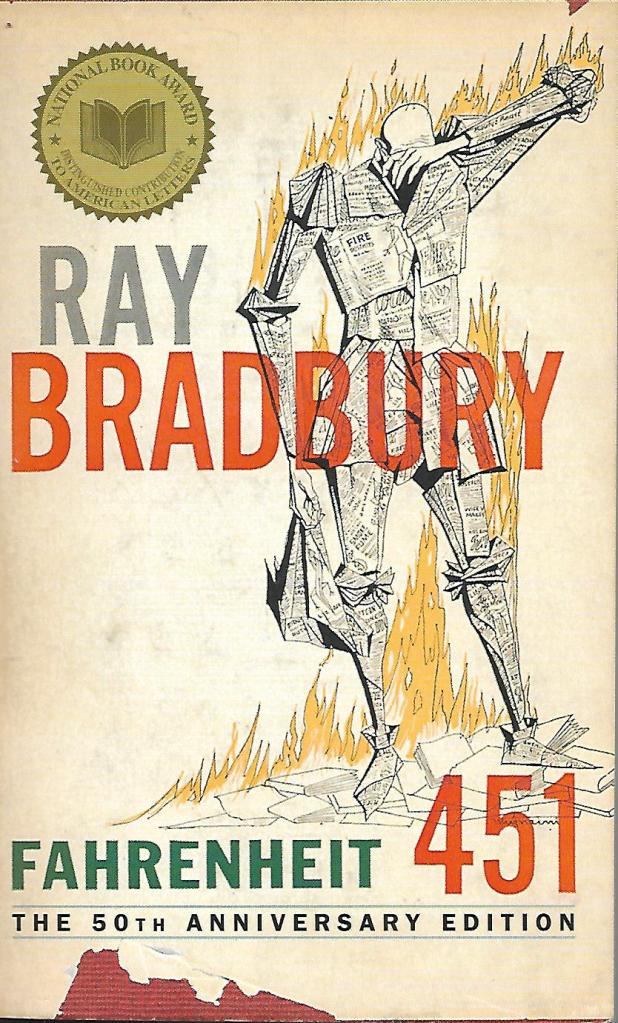
Fahrenheit 451 ~ A Capsule Book Review by Allen Kopp

Paper burns at a temperature of 451 degrees Fahrenheit. What more perfect title could Ray Bradbury have chosen for his 1953 novel about a “fireman” in a future society whose job it is to burn books? Yes, books have been declared subversive and dangerous in this future time and owning them—specifically reading them—is a crime for which you might pay with your life.

In this future society (no time is given), books are seen as giving people ideas and making them think. Thinking is dangerous and makes people unhappy. A bunch of people got together and decided to ban all books and, not only ban them, but make a public exhibition of destroying them while also destroying the homes and lives of anybody who might have the audacity to resist. “Firemen” don’t go around putting out fires to save lives and property; they carry flame throwers fueled with kerosene and set fire to books or to homes where books are kept, and they don’t mind setting fire to any book owners who get in their way.

Fireman Guy Montag, thirty years old, is the protagonist of Fahrenheit 451. He has a shallow, hideous wife name Mildred who is addicted to her “wall screens” (a future version of wide-screen TV) and her “parlor families” (TV characters). Guy and Mildred obviously don’t care for each other at all. Guy meets a seventeen-year-old girl named Clarisse McClellan in the neighborhood who is, in every way, the opposite of Mildred. She makes Guy see the world in a different way; she makes him see the shallowness and narrowness of his own life.

When the firemen go out on a call, Guy takes pity (something firemen should never do) on a defiant older woman who chooses to burn up with her books. He develops an unhealthy curiosity for books; if people are willing to die for books, they must be very powerful and compelling. On some of his professional calls, he begins stealing books, one or two at a time, and hiding them in an air conditioning vent in his house. His own wife, Mildred, reports him, and when the firemen show up to burn his house, headed by his boss, Captain Beatty, he is driven to extreme measures and desperate acts.

Guy Montag, the fireman in Fahrenheit 451, is similar to Winston Smith, the office worker in George Orwell’s 1949 novel, 1984. Both characters live in future, repressive societies. They both take a look at their lives, don’t like what they see, and rebel against the dehumanization and enforced conformity of their worlds. Both novels, Fahrenheit 451 and 1984, foreshadow present-day America. There are plenty of people, including some running for high political office, who would strip away our rights and freedoms, make us all the same, and make us forget how unique we are as individuals. We can’t let that happen. It’s a dangerous precedent when only one viewpoint is allowed and any opposing viewpoint is shouted down or not tolerated. That’s a violation of our Constitutional rights. It’s how tyrannical regimes get started.

Copyright © 2019 by Allen Kopp

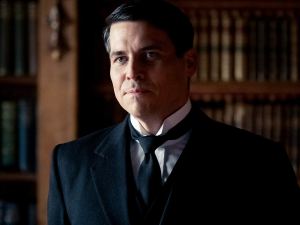
Downton Abbey ~ A Capsule Movie Review

Downton Abbey ~ A Capsule Movie Review by Allen Kopp

The television series Downton Abbey ran for six seasons and fifty-two episodes from 2010 to 2015. Now there is a Downton Abbey movie. It’s not a sequel or a rehash of the television series but a continuation, set two years after the series left off. If you never saw the series and are not familiar with the characters, you probably won’t find the movie meaningful or interesting. Familiarity with the characters is what will provide the spark.

It’s now 1927. The world has been changing since the Great War (“the war to end all wars”). The uppercrust Crawleys (he’s a peer, don’t you know) have witnessed the slow demise of their “class,” their privilege, and all that goes with it. People on the huge estates, such as Downton, have been selling out and moving into more modest homes. The Crawleys hang on, but sometimes they get discouraged and talk about giving up the ghost, which would mean, of course, letting their servants go out into the cold world and fending for themselves.

King George V and his wife, Queen Mary, are going to be touring Yorkshire, so they will spend one night at Downton Abbey. A royal visit, of course, always provides lots of opportunity for drama and intrigue. After the snooty royal retinue arrives, the Downton Abbey servants are incensed to find that they will be displaced for the duration of the royal visit by the king’s own. Mrs. Patmore will not be required to cook the dinner after all, after laying in mountains of supplies from the local grocer; the cooking will be handled by the king’s French chef. Mr. Barrow, now head butler at Downton, will not need to lift a finger because the king’s butler (although he will not allow himself to be called by that title) will see to everything. Mrs. Hughes’s housekeeping skills will not be needed; the king has brought his own hatchetfaced housekeeper with him; she can scare anybody away just by looking at them.

The royal visit goes off smoothly enough, but, of course, with complications. There is a plot to assassinate the king during a parade (politics, don’t you know) that is thwarted by the ever-brave and resourceful Mr. Tom Branson. (It has now been seven years since the death of his wife, Lady Sybil, so he has an eye again for the ladies.) The Dowager Countess (Maggie Smith) must confront (and make peace with) a detested relative who is part of the king’s retinue. Lady Mary’s husband, Henry Talbot, can’t be present for the royal visit because he is off in Chicago at an auto show, but he appears at the last moment. Lady Edith’s husband, Bertie Pelham, is planning on being on an extended trip in South Africa with the king at the time that their first child is due to be born, so what will Lady Edith do with an absentee husband at such an important time? Our Mr. Barrow (more handsome than ever now that he’s “older”) gets into a jam by being in a “men’s” club—men dancing with each other!—when it is raided by the police. “I’ve never been here before!” he says as he is pushed into the paddy wagon. “You’re here now!” a helpful policeman states.

If you liked Downton Abbey on TV, you should like the movie, which is grander, bigger, broader and more lavish than the TV series. It’s old-fashioned entertainment for those, like me, who need to escape into another time and place. And if the Downton Abbey movie makes enough money, there will undoubtedly be more to come.

Copyright © 2019 by Allen Kopp

Ethan Frome ~ A Capsule Book Review

Ethan Frome ~ A Capsule Book Review by Allen Kopp

American author Edith Wharton (1862-1937) gained fame for her novels about wealthy New Yorkers during America’s Gilded Age, such as House of Mirth and The Age of Innocence. Her 1911 novel, Ethan Frome, is not about high society but is instead about a poor farmer in a bleak New England village, set at some unidentified time in the late eighteenth century.

Ethan Frome has a wife named Zenobia (“Zeena”) that he doesn’t like very much, and who can blame him? He married her out of convenience (inertia) in a weak moment when she came to help him take care of his sick mother. Zeena is older than Ethan and is a bundle of complaints and physical ailments. There is no warmth or kind feelings between Ethan and Zeena.

Zeena has a “poor relation” (even more poor than Ethan and Zeena) named Mattie Silver. Mattie comes and lives in the Frome household to help Zeena with the farm work. Mattie is the opposite of Zeena. She is young, pretty and sunny. Zeena doesn’t like Mattie very much and is always quick to find fault with her.

Ethan is naturally drawn to Mattie Silver. He knows it’s wrong to have “feelings” for her, right in the house under Zeena’s nose, but Mattie makes him feel good, maybe for the first time in his life. Zeena is such a whiny old thing, so sick all the time. Why doesn’t she just die and leave Ethan and Mattie alone in their little love nest? Hah! No such luck!

This ménage a trois can’t end well. Ethan dreams of running away with Mattie, but they are desperately poor, and where would they go and how would they get there? Is he really the kind of man to leave his life for a younger, prettier woman? Has he no decency? Well, yes, he has.

A new doctor advises Zeena to bring in a “hired girl,” meaning somebody who is more competent than Mattie. That means Mattie Silver is going to be tossed out of the Frome household on her ear. On the day that Mattie is supposed to go, Ethan’s hand is forced. Is he just going to keep his mouth shut and let Mattie Silver go out of his life forever without even letting her know how he feels about her? When he discovers that the feelings he has for her are reciprocated, will that make a difference, or will it just lead to an ill-advised action on his part?

Ethan Frome is an American classic about a love affair that is doomed from the start, set in a snowy Massachusetts landscape. It’s a simple story about loneliness, alienation and hidden feelings. When Ethan married Zeena, he missed his chance of ever meeting a woman like Mattie Silver who might have made him happy. He missed the boat and then he paid the price, as so many people do.

Copyright © 2019 by Allen Kopp

Lord of the Flies ~ A Capsule Book Review

Lord of the Flies ~ A Capsule Book Review by Allen Kopp

Author William Golding was born in Cornwall, England, in 1911, and died in 1993. His most famous and enduring work is his 1954 novel, Lord of the Flies. In it, a group of about twenty British schoolboys, ranging in age from six to fourteen, crash-lands on an uninhabited and unnamed island in the Pacific. We learn nothing of where they come from, where they’re going, or of the crash that landed them on the island. Their world begins and ends on the island.

The first thing the boys must do when they find themselves alone (no adults) on the island is to figure out how to survive. There’s plenty of fruit (we never know what kind of fruit it is) on the island, so they aren’t going to starve to death. There are also wild pigs but they’re very difficult to catch and kill. The problem of food and fresh water solved, they build crude shelters to sleep in. They find a large shell (conch) which they blow into to call meetings. The shell becomes a symbol for law and order because, in the meetings, only the person who holds the conch can speak.

Their only hope of being rescued is to keep a smoky signal fire burning all the time, which they believe will be seen by passing ships. They can have fun on the island, but their top priority needs to be the signal fire, according to their elected leader, Ralph. He is the most sensible boy on the island and the one most likely to maintain a semblance of “civilization.” Ralph’s chief ally is Piggy, a chubby boy who uses bad English and is afraid of almost everything. The boys have no matches, of course, so they cleverly use Piggy’s glasses to kindle flames from the rays of the sun.

Months go by. The longer the boys remain on the island, the less chance they have of surviving their ordeal. A boy named Jack challenges Ralph’s authority as leader. He and his group of followers gradually break off from the group as a whole and begin doing things their own way, which is Jack’s way. They become less and less civilized and more like savages. So now we have two warring factions, Ralph’s small group (representing rules and a sensible approach to survival) and Jack’s group (chaos and savagery). They become the world in microcosm.

Lord of the Flies is an influential book that has influenced and inspired many writers—and readers—over the many years since it was first published. If you’ve never read it and you don’t know how it ends, you might be surprised and gratified (or disappointed) by its deus ex machina conclusion.

Copyright © 2019 by Allen Kopp

Reflections in a Golden Eye ~ A Capsule Book Review

Reflections in a Golden Eye ~ A Capsule Book Review by Allen Kopp

Carson McCullers was an American writer who lived from 1917 to 1967. She published her first novel, The Heart is a Lonely Hunter, when she was only in her early twenties. It was a literary sensation that established her as an important American writer and one of the most gifted writers of her generation. Her second novel, Reflections in a Golden Eye, was published in 1941, when she was twenty-four. While it was not the critical and commercial success of The Heart is a Lonely Hunter, it is still a fascinating and highly readable book.

Reflections in a Golden Eye is set at a sleepy peacetime army base in Georgia in, let us say, the late 1930s. The story, the plot, is centered around five characters: Leonora Penderton is the wife of an officer. She is free-spirited, rather course and vulgar, attractive and not very smart. She is married to Captain Weldon Penderton and it is not a happy marriage. He is bitter, withdrawn, suspicious, and a closeted homosexual. He and Leonora have separate bedrooms. Major Morris Langdon is much more temperamentally suited to Leonora Penderton than her husband is. He drinks to excess, is jovial, likes a good time, and is having an affair with Leonora. Major Langdon’s wife is Alison, a nervous, sickly, neurotic woman who despises her husband and depends a great deal on her feminine Filipino houseboy, Anacleto, to make life palatable for her. The fifth character is private Ellgee Williams; he is a country boy who doesn’t know much of the world before enlisting in the U.S. army. He has never been around women much, being raised by a woman-hating father, and becomes obsessed (silently and secretly) with Leonora when he glimpses her naked. He takes to breaking into her house at night and, without making a sound, stands in her bedroom and watches her sleep.

Private Williams tends the stables on the base and, since Captain Penderton rides almost every day, the two of them come into contact frequently. Captain Penderton develops an infatuation (love and same-sex attraction mixed in with an unreasoning hatred) for private Williams, not knowing or not caring that private Williams is infatuated with his wife, Leonora. Of course, private Williams is only vaguely aware (or not aware at all) of Captain Penderton’s sexual longing for him. It might be that he is too unsophisticated to know of those things or to understand, even if he does know.

Reflections in a Golden Eye moves along almost in the way of a Greek tragedy toward its inevitable tragic conclusion. It’s a simple story with clear-cut themes of lust, longing, and isolation. All the characters are flawed in some way, misfits in some fundamental way. Happiness and satisfaction are qualities that don’t exist in this world. It’s a world of superficial, self-indulgent people, destructive to themselves and to their world. Keep those before-dinner cocktails coming and also the after-dinner ones. We must keep drinking to give ourselves the impression we’re happy.

Copyright © 2019 by Allen Kopp

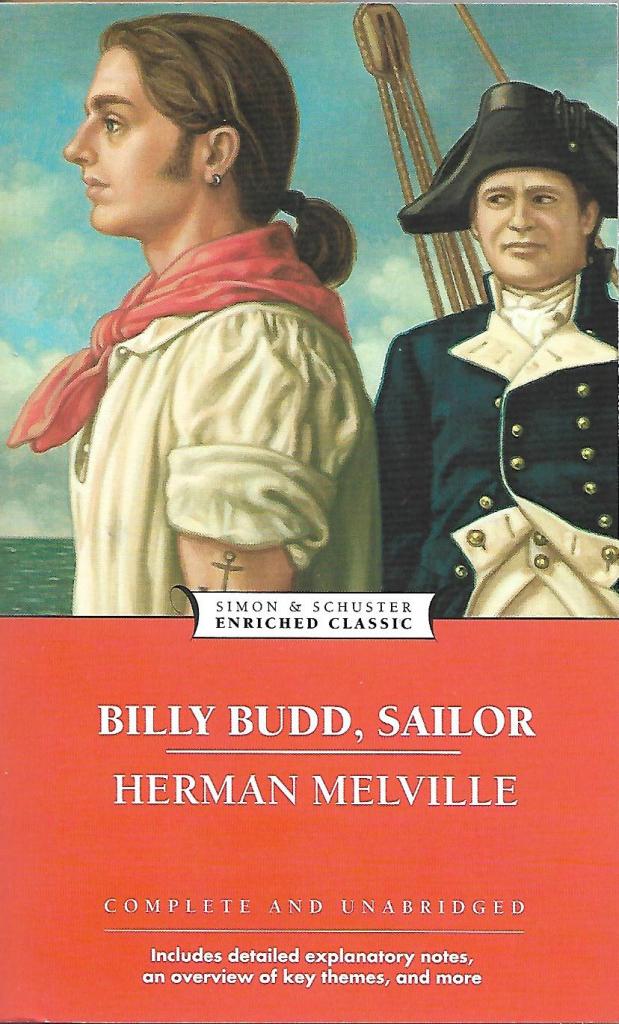
Billy Budd, Sailor ~ A Capsule Book Review

Billy Budd, Sailor ~ A Capsule Book Review by Allen Kopp

American author Herman Melville (1819-1891) wrote his last novel, Billy Budd, Sailor, toward the end of his life and it wasn’t published until more than thirty years after his death. As with his contemporary, Edgar Allan Poe (1809-1849), Melville wasn’t recognized as a literary genius until after he was in his grave.

Billy Budd, Sailor is set on board a British man-of-war (battleship) in the 1790s. It is a serious exploration of the ethics of capital punishment, the rights of the individual versus the good of the collective, and the what happens when a “decent” man is confronted with a situation where what he “feels” to be right (his conscience) is in conflict with what the law is saying must be done.

Billy Budd is twenty-one years old. He is “impressed” into naval service on a British man-of-war, the Bellipotent; this means he is forced to serve against his will as if he is a slave. (This was a common practice during these times.) Billy possesses great physical beauty, a child-like innocence, and charm; he is well-liked and even loved by most of the other sailors and also the officers on the Bellipotent. There is something about him that is almost noble. He is more than once likened to Christ. His only defect, as far as anybody can see, is a stutter that manifests itself at inopportune moments.

Naval commanders are more than usually aware of mutiny at the time of Billy Budd, Sailor, because a couple of mutinies have occurred that are still fresh in everyone’s minds. Enter John Claggart, the master-at-arms on board the Bellipotent. He is the snake in Billy Budd’s garden whose mission it is to corrupt innocence. He goes to the captain of the Bellipotent, Captain Edward Fairfax Vere, with stories that Billy Budd has been making remarks that could incite mutiny among the men. Anybody who knows Billy Budd knows this not to be true. Is it just that Claggart is envious of Billy Budd’s good looks and his popularity among the men and is out to “get” him?

When Captain Vere brings Billy Budd and John Claggart together and Billy Budd hears what Claggart is saying about him, he punches him once in the face; with just this one blow, Claggart falls to the floor dead. Now Captain Vere is faced with a dilemma. Will he follow the law, which calls for the execution of the offender, or will he allow his personal feelings for Billy Budd to stand in the way of his “duty?”

Billy Budd, Sailor is not an easy novel to read or comprehend. A great piece of writing though it may be, it’s not always “enjoyable” reading. Melville’s style of writing (the style of the time in which is was written) is wordy; he makes far too many digressions and parenthetical statements for the narrative to flow smoothly. Our interest is constantly challenged. How many readers just give up and don’t finish reading the book to the end? I doubt if Herman Melville cared or gave it much thought.

Copyright © 2019 by Allen Kopp

The City and the Pillar ~ A Capsule Book Review

The City and the Pillar ~ A Capsule Book Review by Allen Kopp

Jim Willard and Bob Ford are high school friends, growing up together in Richmond, Virginia, in the 1930s. Bob is one year older than Jim; when Bob graduates from high school, he and Jim spend the night together at the river in a falling-down “slave cabin.” During that one night before Bob goes off “to sea,” Jim and Bob do more than sleep. They have a never-to-be-forgotten (by Jim) and much-hoped-for (by Jim) sexual encounter. Of course, they are both “straight,” but that doesn’t keep them from commemorating their friendship with (then-taboo) homosexual sex. To Bob, their night of sexual adventuring has little or no meaning; to Jim it is of monumental significance.

After their one night together, Bob goes off on his seafaring adventures. For the next seven years or so, Jim carries around the memory of his night at the river with Bob. He believes, even though they both go their separate ways after high school, that he and Bob will get together again one day and will be together always. We, the reader, know this is never going to happen.

Jim has plenty of adventures while he is pining for Bob. He ends up in Hollywood, where he has a gay affair with a closeted gay movie star. (This is the most unrealistic part of the novel.) During World War II, he finds himself doing military duty but he never goes overseas and never sees any fighting. When he develops health problems, including rheumatoid arthritis, he is honorably discharged from the service.

Jim’s athleticism and masculinity, his “butchness,” are stressed throughout the novel. He is such a good tennis player that he makes his living for a time as a tennis instructor. Even though he is essentially “in love” with a man from his past, he is always masculine, never fitting into the stereotypes of gay men that were prevalent during the time this book was published (1947). He is not self-loathing because he is “different” and doesn’t destroy himself, either through drinking, pills, promiscuous sex, or self-pity. For that reason, The City and the Pillar by Gore Vidal (1925-1912) is a groundbreaking novel because it is a positive portrayal of a proudly gay man, written at a time when such a thing hardly existed.

Copyright © 2019 by Allen Kopp

Where Angels Fear to Tread ~ A Capsule Book Review

Where Angels Fear to Tread ~ A Capsule Book Review by Allen Kopp

E. M. Forster (1879-1970) was one of the best and most readable English writers of the twentieth century. His first novel, Where Angels Fear to Tread, was published in 1905. It’s a story of a clash of cultures, in this case English and Italian. Stodgy, conventional, keeping-up-appearances, English middle-class morality goes head to head with emotional, hot-blooded Italian effusiveness. The English characters in Where Angels Fear to Tread are all fools who can’t see farther than the ends of their noses. The principal Italian character, Gino, is forgiving, kind and generous. Which would you rather be?

Lilia Herriton is an English widow, thirty-three years old. She lives with and is dominated by her late husband’s narrow-minded family in a small English town. She has a small daughter named Irma, who seems to prefer her grandmother and her aunt over her mother. When Lilia travels to Italy, she is captivated by its romance and beauty. Rebelling against the middle-class English morality to which she has long been captive, she meets, falls in love with, and marries a charming Italian fellow named Gino, ten years younger than she is. He has a handsome face and not much else in the way of prospects. When Lilia, early in her marriage, has a child, a boy, she dies in childbirth. Her first husband’s (the dead husband, if you will recall) family back in England believes they must go to Italy and “rescue” Lilia’s child and bring it back to England to give it a proper (English) upbringing.

Philip and Harriet Herriton, brother and sister of Lilia’s late husband, go to the little town of Monteriano, along with family friend, Caroline Abbott, ostensibly to get Lilia’s baby and bring it back to England. They fail to consider the father’s (Gino’s) feelings in the matter. Harriet is an unpleasant, bossy spinster who believes she can bully and bluff Gino into giving up the baby because it is the “right” thing to do. Philip is also of the same mind as Harriet, but when the trio arrives in Italy, Philip once again falls under Italy’s spell (partly as a result of the opera Lucia di Lammermoor) and is charmed by Gino into believing that he, Gino, is a loving and caring father and the baby is better off remaining where it is.

The Herritons don’t really give a hoot about Gino and Lilia’s baby. They want it only so they can assert their English superiority, keep up appearances, and make a point. They will do anything, including kidnapping, to get what they want. With pig-headed Harriet leading the way, they screw up monumentally, with tragic and unforeseen consequences.

Where Angels Fear to Tread was published when the author was only twenty-six. It is a meticulously written, intelligent English classic, accessible and easy to read, well worth another look. A faithful and memorable movie adaptation of the novel was made in 1991.

Copyright © 2019 by Allen Kopp

Alexander the Fabulous ~ A Capsule Book Review

Alexander the Fabulous ~ A Capsule Book Review by Allen Kopp

Alexander the Great (356-323 BCE) certainly made his mark on the ancient world. He lived about three-hundred-and-fifty years before Christ. He was born son of a king, one-eyed King Philip of the ancient kingdom of Macedonia and a strange woman named Olympias. While both of his parents were mere mortals, he was really believed to be the son of the god Zeus.

From an early age, Alexander showed a talent for military strategy and winning battles against the enemy. When King Philip died, Alexander became king (although he had been regent before that, which is almost the same as king). While still in his teens, he set about conquering the known world. He commanded the allegiance and love of a huge army. Within ten years, he had conquered the known world. He was the first and only “king of the world,” although others have aspired to that title since then.

Alexander’s role model was Achilles from Homer’s The Iliad. He patterned his life after Achilles, right down to the lifelong boyfriend (Achille’s boyfriend was Patroklos, Alexander’s was Hephaestion). As with Achilles, Alexander was a fierce adversary in warfare and he had a talent for winning battles when the odds were against him and he went against far bigger fighting forces. He was so good that Julius Caesar is known to have wept because he knew he would never be as good as Alexander.

Alexander never lost a battle, but his constant campaigning and warfare took their toll. He always went into the battle at the front line along with is men, never hanging back to give orders. He was wounded many times, including his lung being pierced by a crossbow. He wouldn’t rest or eat or take a drink of water until his men had been taken care of; this is one of the reasons why he was so loved and respected.

He was grief-stricken at the unexpected death of his boyfriend Hephaestion. The two of them had been inseparable since Alexander was fourteen. Just eight months after Hephaestion’s death, in 323 BCE, Alexander himself died at the age of thirty-two, either from pneumonia, typhoid, malaria, or infection. His heavy use of alcohol was believed to have been a contributing factor in his early death.

Alexander the Fabulous by Michael Alvear is an entertaining, campy, not-always-serious account of the life of one of the most interesting and influential men in history. If you like your ancient history entertaining and peppered with gay jokes and snarky and funny comments, this is it. A quote from the first paragraph of chapter eight reads: “The ancient world had crow’s feet, sagging tits, and a loose box. Then Alexander gave it the kind of makeover that inspires Cher to dedicate songs to her plastic surgeons. Alexander didn’t just inject a little botox; he radically transformed the face of the earth with a unique surgical tool known as Hellenism, which spread Greek language, ideas, arts, politics, architecture, science, and philosophy to the rest of the known world. Don’t confuse Hellenism with equally important “Nellyism,” which spread Greek musical theatre, flowing robes, Doric columns, rich Corinthian leather, and floral appliques.”

Copyright © 2019 by Allen Kopp

Querelle ~ A Capsule Book Review

Querelle ~ A Capsule Book Review by Allen Kopp

The notion of murder often brings to mind the notion of sailors and the sea.” This is the opening sentence of the novel Querelle by French author Jean Genet (1910-1986). Querelle (also known as Querelle de Brest) was written in 1945 and published anonymously in 1947. It was controversial for the 1940s (thus the anonymous publication), involving, as it does, homosexuality, murder, romantic obsession and prostitution.

Georges Querelle is a young, muscular, good-looking French sailor, in the French seaport town of Brest where the action of the novel takes place. His good looks make him a sort of magnet for almost anyone who sees him. His being a sailor and moving around from place to place makes him able to escape detection for the murders and thefts he commits. He has a look-alike brother, Robert, who is a gigolo in the local brothel in Brest called La Feria. There is this persistent theme running throughout the novel of the two brothers, Querelle and Robert, being so much alike that the love they have for each other is self-love, and the two brothers are, in fact, one and the same person.

The only female character in the book is Madame Lysiane. She is the madame of the Brest brothel, La Feria; Robert, Querelle’s brother, is her lover. Madame Lysiane is married to the owner of the brothel, whose name is Nono. Nono likes to roll dice with the young sailors who frequent his establishment. If Nono wins the throw of the dice, he takes the sailor into the back room and has sex with him. In this way, Querelle becomes Nono’s lover.

Lieutenant Seblon is an officer on the ship that Querelle serves on. He keeps to himself as much as he can and confides to his diary how much he loves, and lusts after, Querelle. Querelle figures out that Lieutenant Seblon loves him and, with this knowledge, exercises a sort of control over him. Lieutenant Seblon imagines scenes in which he and Querelle are in love and live together always.

Gilbert Turko is a young mason in Brest and an acquaintance of Querelle’s. He murders a coworker who taunts him and flees to an abandoned prison. Querelle helps him by bringing him food and encouraging him. In the meantime, Querelle has murdered a fellow sailor and left his body in the weeds to be found later. Querelle is able to make it appear that Gilbert Turko murdered the sailor that Querelle himself murdered, since Gilbert Turko is already known to have murdered a coworker. Querelle helps Gilbert Turko to get away by train but notifies police where he can be found before the train pulls out of the station.

Querelle is a walk on the wild side, a dark excursion down a fog-enshrouded alleyway. There’s nothing romantic about it, or charming or uplifting; it’s the dark side of human nature. Querelle might be thought of an agent of the devil with the face of an angel and the body of a god. People are drawn to him for his beauty, often at their own peril. He’s pretty poison. He has no equal in twentieth century literature.

Copyright © 2019 by Allen Kopp