Knives Out ~ A Capsule Movie Review

Knives Out ~ A Capsule Movie Review by Allen Kopp

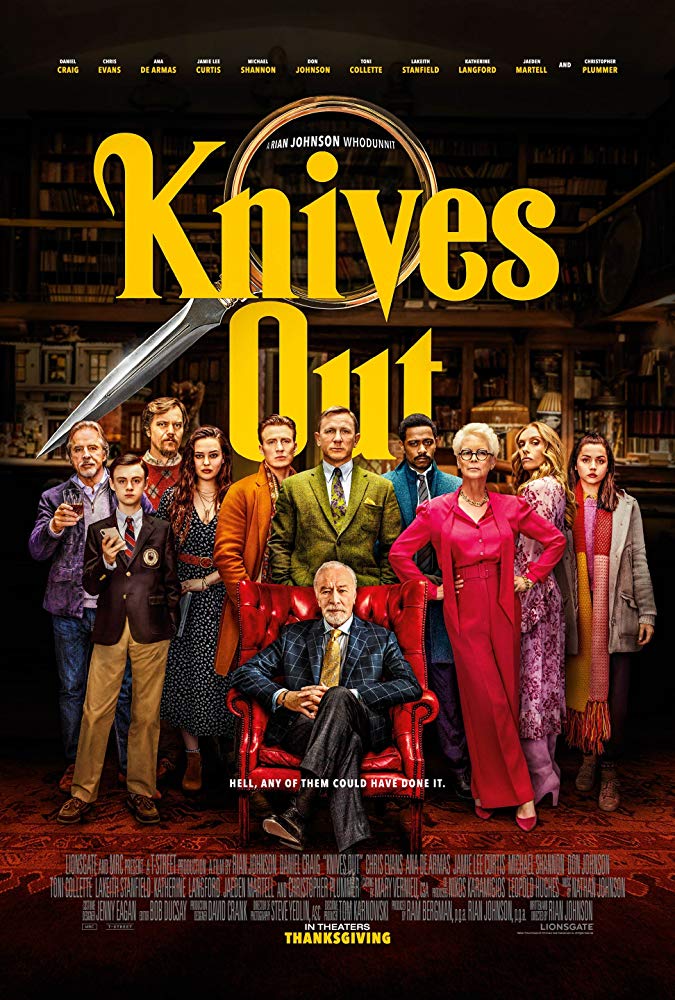
Knives Out is an old-fashioned murder mystery in the style of English mystery writer Agatha Christie. Benoit Blanc (played by the versatile Daniel Craig, with a Southern drawl right out of Old Virginny), is the astonishingly perceptive, methodical, deceptively unflappable detective. He is in the style of Agatha Christie’s detective Hercule Poirot, without the elaborate mustache and the Belgian accent, of course. (Benoit comes from the Latin word “benedictus,” which means “the one who says the good.” Blanc is the French word for “white.”)

Harlan Thrombey (played by Christopher Plummer) is the eighty-five-year-old patriarch of the Thrombey family. As a successful writer of murder mysteries, he has amassed a fortune in excess of sixty million dollars. He lives with his family in a gloomy, spacious, Massachusetts country house.

Since Harland Thrombey is getting along in years, all his children and grandchildren are mightily concerned for his welfare. He is, don’t you know, the Goose that Lays the Golden Eggs. Nobody in the family has to hold down a job because Harlan Thrombey, the wealthy writer of murder mysteries, supports all of them in grand style.

Harlan Thrombey’s son, Walt, ostensibly runs the family publishing business, but all he does he does is publish his father’s twice-yearly books. Daughter Linda and her husband, Richard, seem to do nothing except stand around and talk (she smokes cigarettes) and keep an eye on the old man, the source of all “their” wealth. Linda and Richard have a son in his mid-thirties, Ransome. He’s handsome, dissolute and unscrupulous. Harlan’s daughter-in-law, Joni, is a flaky matron who was once married to Harlan’s now-deceased son. She knows where her bread is buttered. She has been “double-dipping” her daughter Meg’s tuition money to an expensive school (cheating her generous father-in-law) to the tune of a hundred thousand dollars a year.

On the night of Harlan Thrombey eighty-fifth birthday party, he ends up dead, apparently murdered, with his throat cut. The last person to see him alive is his immigrant nurse from Uruguay, a young woman named Marta Cabrera. The family treats her as one of them. She seems to be the only one in the group who genuinely cares for Harlan Thrombey without any selfish motives.

There are plenty of suspects with reason enough to want to see the old man dead, aren’t there? Hours before he died, he threatened to cut off his over-indulged grandson Ransome without a penny. Hours before he died, he discovered that his daughter-in-law Joni was cheating him out of a considerable amount of money and also threatened to cast her out into the cruel world without a penny. Hours before he died, he had a little talk with this son-in-law Richard to the effect that he knew that Richard was cheating on his wife, Linda. Hours before he died, he threatened to remove his son Walt from the publishing company. Wouldn’t any of them, or any of the others, for that matter, have reason enough to want to see the old man dead?

Enter aforementioned Benoit Blanc. He sees right away what a bunch of greedy, grasping, self-serving assholes the Thrombeys are. “I am eliminating no one as a suspect,” he drawls. If anybody can figure out who killed Harlan Thrombey, Benoit Blanc can.

Knives Out is a story that relies heavily on character and the spoken word. There are plenty of twists and wrong turns in the story but, never fear, the truth will be revealed in the end. If you’re used to lots of action, gunshots and screeching tires in your movies, then Knives Out probably isn’t the movie for you. Let’s just say it’s geared toward the older, and calmer, audience.

Copyright © 2019 by Allen Kopp
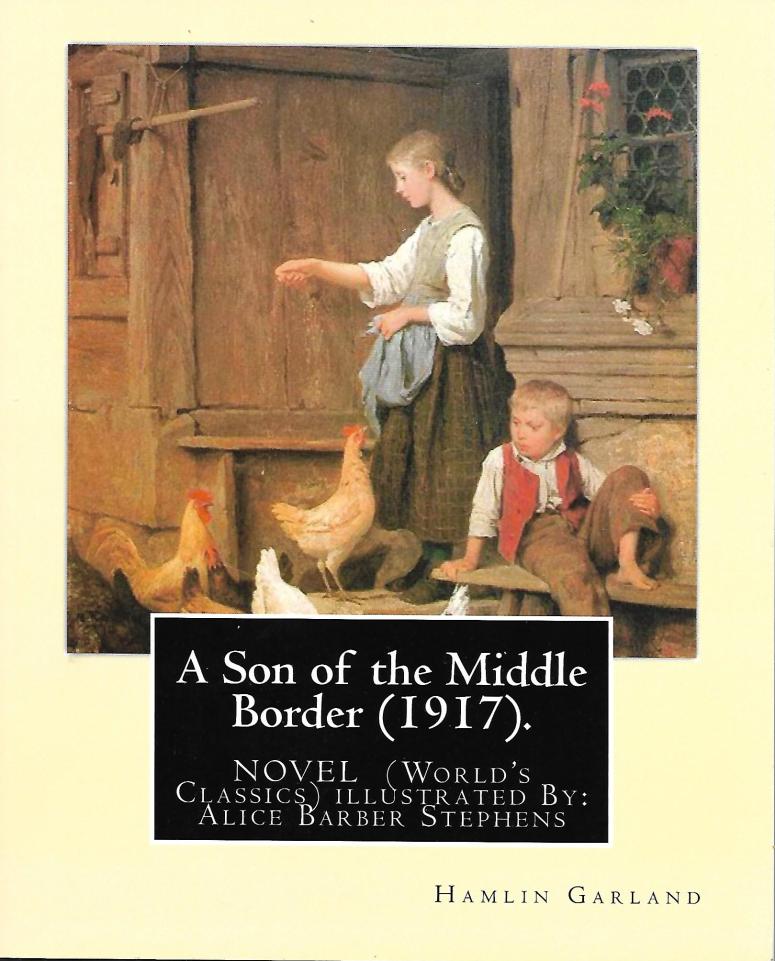
A Son of the Middle Border ~ A Capsule Book Review

A Son of the Middle Border ~ A Capsule Book Review by Allen Kopp

Hamlin Garland was an American writer who lived from 1860 to 1940. His memoir novel, A Son of the Middle Border, was first published in 1917. It’s the story of Hamlin Garland’s farm childhood and his struggles to gain success as a writer in early adulthood.

The Garland family lived in the Wisconsin wilderness, in a deep ravine known as a “coulee.” His father, Richard Garland, came home from the Civil War in 1865. He was forever after a military man who believed in military discipline, even when dealing with his four small children. He became disenchanted with life in Wisconsin and moved his family father west to the barren plains of Iowa, where he became a wheat farmer.

Life in Iowa for the Garland family was no better than it had been in Wisconsin. The barren Iowa plains were lacking in vegetation, brutally cold in winter and blisteringly hot in summer. Every living thing, man and animal, suffered in Iowa. When the wheat crops were abundant, a farmer could make a living for himself and his family, but the trouble was that wheat farming was dependent on the whims of weather and nature. When “chinch bugs” destroyed the wheat crops two years in a row, many wheat farmers had to sell out and find an easier way to make a living.

The lure of the West was strong for many people during this time. Richard Garland once again moved his family farther west, this time to the Dakotas. He tried various enterprises but was never able to attain more than marginal success as a tiller of the soil. His long-suffering wife always went along with whatever he wanted without complaint, but anybody could see that she was fast becoming an old woman before her time. Of the Garlands’ four children, their two daughters died in young adulthood without ever escaping the farm.

Despite Hamlin Garland’s hard life as an Iowa farm boy, he was determined to get an education and not be a poor farmer all his life. Sometimes his work on the farm left him little time or energy for anything else, but he overcame many obstacles and went to school whenever and wherever he could. The third act of A Son of the Middle Border concerns how he, as a young man, left the farm, went away to Boston and established himself in the literary world. It is a particularly American story about how one man, born poor and with few advantages in life, went after what he most desired in life and succeeded.

Copyright © 2019 by Allen Kopp

Joker ~ A Capsule Movie Review

Joker ~ A Capsule Movie Review by Allen Kopp

There’s no Batman in Joker. Let’s get that clear. Batman is yet to be. The character who will be Batman when he’s grown up, Bruce Wayne, is a child in Joker. Bruce Wayne is the son of Thomas Wayne, mayoral candidate of Gotham City. Gotham City is a sort of fictional New York City, only grittier, uglier and more crime-ridden. Thomas Wayne says he can clean up Gotham City if voters will give him a chance. He doesn’t seem very trustworthy. He seems like just another phony asshole politician who will say and do anything to get elected.

Arthur Fleck (Joaquin Phoenix) lives with his invalid mother, Penny Fleck, in a squalid apartment building in Gotham City. Penny Fleck used to be employed by the Thomas Wayne family as a domestic. Arthur bears a physical resemblance to Thomas Wayne. Do you get the connection here without having it spelled out?

Arthur is a study unto himself. You don’t even need Batman. He is a former mental patient (why did they ever let him out?) who takes seven medications and, yet, he “feels so bad all the time.” He is a professional “party clown.” He goes wherever a clown is needed, whether it’s to children’s hospital or to carry a sign on the street to advertise a going-out-of-business sale.

The thing with Arthur is that the world has not been very kind to him. He has been (or believes he has) largely mistreated. Funding is cut off for his psychiatric care and his drugs. When he is savagely beaten and kicked by thugs on the street, a co-worker gives him a gun for self-defense. A mental patient with a distorted view of things carrying a gun? I don’t think so. Sounds like a disaster waiting to happen.

One night when he is going home from work dressed as a clown, Arthur Fleck has an ugly encounter with three bullies on the subway and ends up killing all three of them vigilante-style. The three dead bullies are elite Wall Street types. By killing them, Arthur becomes a hero to the downtrodden. A kind of class warfare begins between the haves and the have nots. People all over the city begin dressing as clowns to show their solidarity with the subway killer. This is just the beginning for Arthur. He has had enough and he’s not going to take it anymore. He goes from being Arthur Fleck, the sad little man who lives with his mother in a creepy apartment building, to being the “Joker,” the arch-villain of the city and nemesis of the yet-to-be Batman, who is still just Bruce Wayne, child of an affluent family.

Joker is not just another superhero movie (there have been too many of them) based on comic book characters. It’s not for children; it’s dark, violent and sad. At the core of it all is the characterization of the Joker by an actor who obviously immerses himself in the role. We see before our very eyes the evolution of an arch-villain. He puts on a happy face. He dances. He sings. He kills.

Copyright © 2019 by Allen Kopp

A House for Mr. Biswas ~ A Capsule Book Review

A House for Mr. Biswas ~ A Capsule Book Review by Allen Kopp

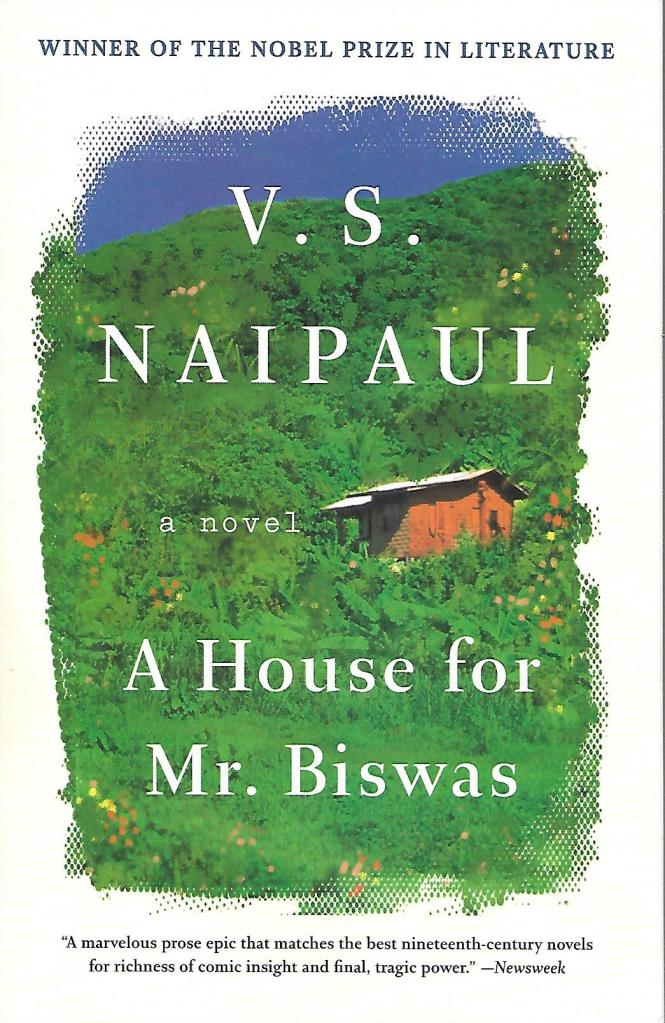
Trinidad is a small island off the coast of Venezuela. Tobago is an even smaller island to the northeast of Trinidad. The two together make the Republic of Trinidad and Tobago, the southernmost island country in the Caribbean. V. S. Naipaul was a Trinidadian and Tobagonian British writer of works of fiction and nonfiction in English who lived from 1932 to 2018. His 1961 novel, A House for Mr. Biswas, was the first of his many books that brought him international acclaim as a writer. It ranks number 78 on the Modern Library’s List of the Hundred Greatest Novels in English of the Twentieth Century.

Mohun Biswas is the “everyman” protagonist of A House for Mr. Biswas. He is the son of immigrant parents from India, a Hindu, living in the Caribbean country of Trinidad. Mr. Biswas (the title by which he is known throughout the novel) is a the “little man,” the “one against the world.” A House for Mr. Biswas is the story of his unspectacular life. We are told on the very first page of the novel that he dies in his mid-forties. He marries Shama, a woman from a family of many daughters. It is a strictly matriarchal family, dominated by Shama’s mother, Mrs. Tulsi. He doesn’t like being dominated by his wife’s family, but he doesn’t seem to be able to help it. He and Shama never seem to care very much for each other, never seem to share any kind of an emotional bond, but they have four children, one boy and three girls.

Not being particularly well-educated, smart or competent, Mr. Biswas seems to have trouble making a meager living for himself and his family. He manages a “rum shop,” works as a sign-painter, and works in his wife’s family’s store, which seems to be kind of “everything” store. His main ambition in life is to be independent (from his wife’s family and from anybody else) and to have his own home that belongs to him and nobody else. About midway through the novel he undertakes to have his own house built by an anything-but-reliable builder, but it doesn’t go well, and his unfinished house is destroyed in a storm. In the second half of the novel, he gets a job as a journalist for a small newspaper, where he writes a column about “deserving destitutes.” This is a step-up for him, where he makes about $150 a month, and he eventually he owns his own car, but still lives by his wife’s family’s dictates (especially his wife’s mother) in a house they own.

Despite its length (568 pages) and exotic setting, A House for Mr. Biswas isn’t difficult to read. It’s in clear, concise, easy-to-understand English. There are no tangled sentences, no tortured descriptive passages. There are lots of character names, though, sometimes difficult to remember and keep straight because many of them are similar (Shama, Sharma, Savi, Chinta, etc.). This is a minor quibble, though, and no reason not to read the book. For American readers, A House for Mr. Biswas is a glimpse at a life in another country, on another continent, in another culture. If you think life is difficult for you, consider the life of Mr. Mohun Biswas.

Copyright © 2019 by Allen Kopp

JoJo Rabbit ~ A Capsule Movie Review

JoJo Rabbit ~ A Capsule Movie Review by Allen Kopp

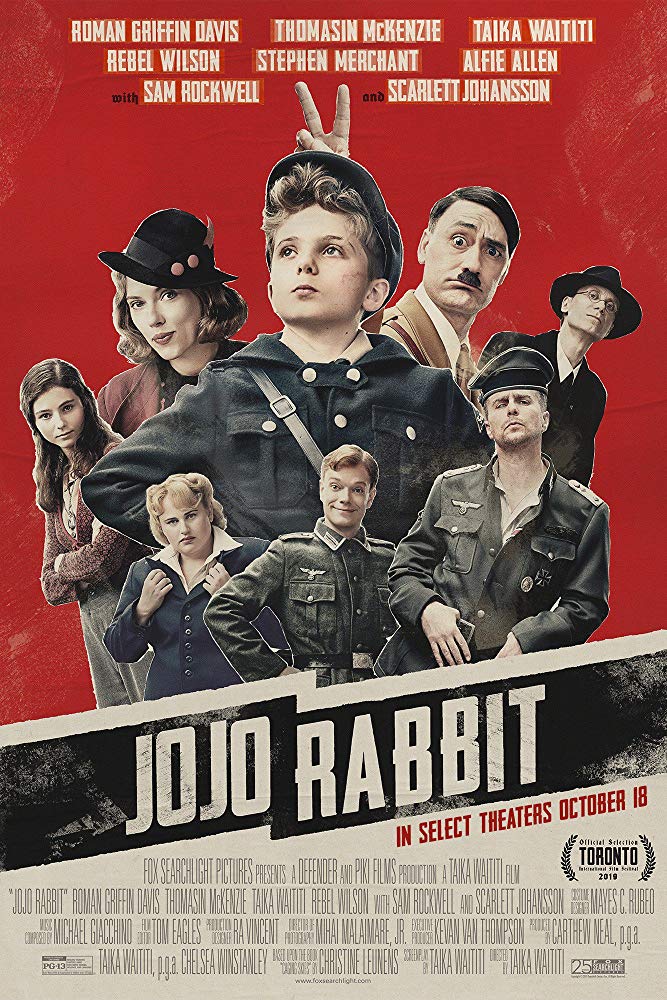
Johannes “JoJo” Betzler is a winsome, ten-year-old boy living with his unconventional mother in Nazi Germany during World War II. His father is fighting in Italy, unseen for two years and presumed dead. JoJo has an “imaginary” companion, who turns out to be none other than the Fuehrer himself, Adolf Hitler. Caught up in the fervor of his time and place, JoJo believes he is a loyal Nazi, until he starts seeing things in a different way.

The Hitler of JoJo’s imagination is funny and endearing, or at least that’s the way JoJo sees him. He has a funny accent and a comical mustache and he’s fun to be with and to talk to, a really nice fellow. Sometimes when he’s talking he lapses into his “fiery speech” mode. JoJo has some growing up to do before he sees Hitler for what he really is and becomes disenchanted with him.

Jews are the enemy, according to Germans of the era, the cause of all the world’s woes. JoJo is more than willing to go along with the hatred of Jews until he discovers that his own mother is hiding one of them in her house, a teen girl named Elsa. JoJo and Elsa becomes friends. After JoJo becomes friends with a Jew, he comes to see the race in an entirely different light. (“What will you do when the war is over and you no longer have to hide?” JoJo asks Elsa. “Dance,” she says.) JoJo wants Elsa to tell him all about the Jews because all he knows about them is the stereotypes. He plans on writing a book that will be the definitive book on how Jews are different from Aryans. JoJo is intelligent beyond his years.

The war isn’t going well for Germany. Allied forces are closing in. The Russians are on Germany’s doorstep. Realistic Germans see the war is lost. The time for believing in miracles is past. When JoJo’s mother pays the ultimate sacrifice for hiding a Jew in her house, JoJo finds himself all alone in the world. Suddenly the war has ended. What do JoJo and Elsa do now? Isn’t it time to dance?

New Zealand actor Taika Waititi plays Hitler in JoJo Rabbit. (I saw Taika Waititi in a little-seen, crazy, funny and dark movie from New Zealand about vampires called What We Do in the Dark.) Taika Waititi also wrote the screenplay for JoJo Rabbit from a novel by Christine Leunens. Taika Waititi also directed JoJo Rabbit. (Give the multi-talented Taika Waititi an Oscar.) A child actor named Roman Griffin Davis is perfect as JoJo Rabbit (so-named because he refuses to strangle a rabbit early in the movie). He’s cute without being cloyingly cutesie-pie. Archie Yates is another child actor who plays JoJo Rabbit’s pudgy, well-meaning friend, Yorki. There’s something reassuring and endearing about Yorki. He’s the perfect friend to be with if you’re stuck in a war.

Copyright © 2019 by Allen Kopp

Psycho ~ A Capsule Book Review

Psycho ~ A Capsule Book Review by Allen Kopp

Alfred Hitchcock’s 1960 movie, Psycho, is a slice of pure cinema. In the directorial hands of a master, it’s a movie where all the different parts—writing, acting, music, film editing, sound, set design, directing—come together in just the right way to create an enduring film masterpiece that has easily stood the test of time. In the hands of a less talented director, it could easily have been just another schlocky, soon-to-be-forgotten stab movie with breasts, a scintillating boudoir scene, and a sensational shower scene, complete with blood going down the drain.

Psycho is a horror movie about a cross-dressing, knife-wielding, multiple-personality maniac, but it’s a high-class horror movie that somehow manages to be tasteful, eschewing blood and cheap horror for a more subtle brand of thrills. It broke new artistic ground and set the standard for movies of its kind. It has been copied, imitated, parodied and emulated, but the one thing it never has been is equaled.

There never would have been the movie Psycho without the novel Psycho by Robert Bloch. Before the movie comes the novel. When Alfred Hitchcock chose the novel to make into a movie, he plucked it from almost certain obscurity. Not that it wasn’t read by readers of its day, but if would never have lasted the way it has if the Hitchcock movie hadn’t made it famous. It is “pop” fiction with little literary merit, except that it makes entertaining reading.

We all know the story. Norman Bates is an odd boy-man who runs an obscure motel on an out-of-the-way California highway. The Bates Motel doesn’t get many guests, except one rainy night, a runaway girl who has lost her way stumbles onto the motel and decides to spend the night. She has just stolen forty thousand big ones from her employer and is on her way to her debt-ridden boyfriend in Fairvale, California.

If the runaway girl, Mary Crane (Marian in the movie), has a secret, Norman Bates has an even bigger one. He has always had a mother fixation. He murdered his dear old mother out of jealousy (she had a lover, you see), but mother’s not resting in her grave. Years earlier, Norman stole her body from her grave and keeps it in the creepy old house behind the motel. He has a split personality. He’s Norman, but he’s also mother. He dresses up in her clothes and wears her wig and, as mother, stabs Mary Crane to death as she’s taking a shower. He hides the body, of course, crying to cover up mother’s crime. Then he has the arduous task of keeping people from finding out what he is and what he has done.

All right, if you want some light reading and you want to read a story that by now is familiar to you, you can’t go wrong with Robert Bloch’s Psycho. It’s not Sister Carrie, but it’s plenty engaging and will keep you turning the pages. The movie follows the novel closely, but, as I said, it makes a much better movie than it does a novel. The movie is distinctive and the novel is not.

Copyright © 2019 by Allen Kopp

The Lighthouse ~ A Capsule Movie Review

The Lighthouse ~ A Capsule Movie Review by Allen Kopp

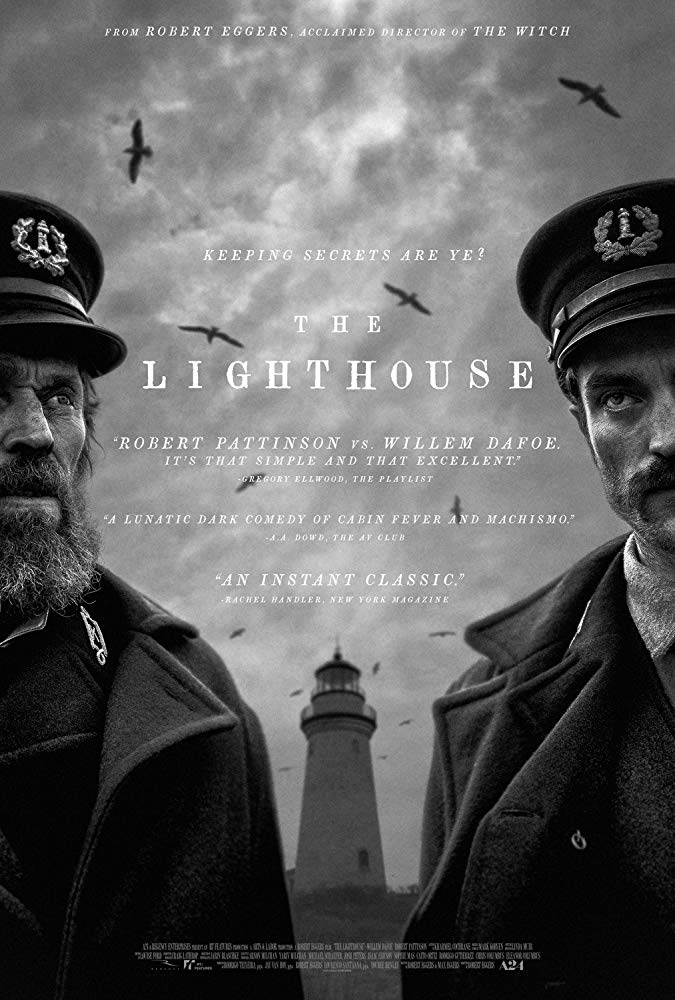
The Lighthouse has to be the most unusual new movie of the year. It’s set in 1890 and shot in black and white, with an aspect ratio of approximately 1.19:1, which means the picture is practically square (instead of elongated, which is what we’re used to) to emulate early motion picture photography. The music score (with a nod to the classic film scores of Bernard Hermann) is made up of a foghorn, horns and pipes, glass harmonica and an ocean harp (a stainless steel bowl with bronze rods around the rim that gives off an ethereal sound when used struck a friction mallet). The dialogue spoken by the two characters is based on the “local color” poems and writings of Sarah Orne Jewett. All these filmmaking elements come together to spell “A-R-T” instead of a commercial project designed to generate box office revenue. (You know, like about 98% of the movies released during the year.)

The only two characters in The Lighthouse are two very different men, one younger (Robert Pattison) and the other older (Willem Dafoe). Both men are named Thomas (although the younger man lies and says his name is Winslow). The older Thomas used to be an old seafaring man and is now a lighthouse keeper who knows all about tending the light. The younger Thomas has a murder on his conscience from when he worked in logging (he let a fellow worker die when he could have saved him). He is hired for a period of four weeks to be lighthouse assistant.

The film is set entirely in and around a lighthouse on the Atlantic seacoast of the United States. It’s not an inviting, scenic or hospitable place. The work the younger Thomas does is backbreaking labor and very often involves nasty chores, such as emptying chamber pots and cleaning out the cistern. “I did not take this post be a housewife or slave,” he says defiantly. The older Thomas is something of an uncouth swine and, understandably, gets on the younger Thomas’s nerves. They sleep in very cramped quarters and are always together. The older Thomas talks incessantly, sometimes in soaring soliloquies that don’t make much sense.

The loneliness and isolation begin to play on the younger Thomas’s mind. The four weeks he was supposed to be at the lighthouse are up, but a terrible storm sets in and the person who was supposed to relieve him doesn’t show up. So, now there’s a psychological element in play. Is any of this really happening or is it all just in the younger Thomas’s head? He’s already killed one man. Will he be driven to kill again?

The Lighthouse is not for everybody, of course. If you see it, you might think it’s not your cup of tea, but you can honestly say it isn’t like anything you ever saw before. Remember The Artist in 2011, a silent, black-and-white movie set in the 1920s? The Lighthouse is as uniquely memorable as The Artist, but in its own special way.

Copyright © 2019 by Allen Kopp

God’s Secretaries ~ A Capsule Book Review

God’s Secretaries ~ A Capsule Book Review by Allen Kopp

England’s Queen Elizabeth I died in 1603, after a reign of forty-four years. She failed to produce an heir, a successor, during her lifetime, so James I of Scotland succeeded her to the English throne. He was the son of Elizabeth’s cousin and political rival, Mary Queen of Scots. The twenty-two years that he sat on the throne of England is called the “Jacobean Age” because “Jacobus” is Latin for James.

Hundreds of years ago in England, religion was of the utmost importance, much more important than it is today. People were willing to fight and to die for their religion. There was much in-fighting between Catholics and Protestants and between other sects and splinter groups. It was about this time that a small group of religious dissenters who weren’t happy with the way they were treated in their own country came to the “New World” for a fresh start in a new place where they could decide the dictates of their own religion. They were what we today might call the “lunatic fringe.”

Early in his reign (which turned out to be fairly disastrous for the country), King James I commissioned a new translation of the Bible. There were existing translations of the Bible, of course, including the Geneva Bible and the Bishops’ Bible, but they were considered inadequate (for whatever reason) and there was a perceived need for a uniform Bible. The King James translation of the Bible was to be a Bible for all the people, not just for the elite and educated. It was to be written in elegant, yet accessible to everyone, Jacobean English.

The translation was a huge undertaking, involving some fifty Translators and taking about eight years. The Translators were not writers or journalists but high-level churchmen, bishops and ministers. They used as their source material existing versions of the Bible, principally that of William Tyndale. King James, who had taken a personal interest in the translation, kept a close watch on the project through to its completion in 1611.

The King James translation of the Bible was not an immediate success. For many years, people still preferred other translations. However, it still remains the “standard” Bible translation hundreds of years later. There are more modern translations but, for millions of people, the stately, soaring language of the King James Bible is the voice of Christianity.

God’s Secretaries by Adam Nicholson is not only about the King James Bible but about the times in which it was written, the king who brought the translation about, and the political climate of the times. It was a time in which the government was in charge of religion; church attendance was mandatory; religion played a central role in everyday life. Churchmen were some of the most powerful people in the country. People lived and breathed the Scriptures. If you were not of the proper faith, you just mind find yourself dead. How different the times are in which we live today!

Copyright © 2019 by Allen Kopp
Tomato Red ~ A Capsule Book Review

Tomato Red ~ A Capsule Book Review by Allen Kopp

Daniel Woodrell (b. 1953) is one of the best and most innovative of current American writers. His 1998 novel, Tomato Red, is set in the fictional town of West Table, in the Missouri Ozarks, in a poor section of town known as Venus Holler. Jamalee Merridew is nineteen years old, with hair the color of tomatoes. She has a seventeen-year-old brother named Jason Merridew, “the prettiest boy in the Ozarks.” (He has green eyes and full, pouty lips.) “Grown-up women,” Jamalee says, “throw their underpants at Jason with their phone numbers written on them in the grocery store.” Jason is a hairdresser; the fact that he is gay does not deter his female admirers.

Bev Merridew is Jamalee and Jason’s mother. She is about forty years old, is a whore and apparently has always been a whore. She lives in a shack in Venus Holler, next door to the shack that Jamalee and Jason live in. She drinks and smokes cigarettes and entertains men. “If she had all the dicks sticking out of her that she’s had stuck in her,” Jamalee says, “she’d look like a porcupine.”

Enter one Sammy Barlach, a decidedly trashy drifter, twenty-four years old. (The novel is told in Sammy’s first-person voice.) One night when Sammy is doing a little house-breaking in the expensive part of West Table, he meets Jamalee and Jason in a mansion-like home. He believes they live there, but soon discovers they are also house-breakers like him. He latches on to them and later their mother, Bev, as his adopted family. He refers to them as “the bunch that would have me.”

Jamalee, Jason and their mother Bev are constantly reminded that they are “trash” and “rednecks” because of where they live, their low socio-economic status, their drinking and their general all-around “no-goodness.” Many people around town are openly hostile to them.

When Jason fails as a pay-for-his-services stud for the ladies (he just doesn’t have it in him), Jamalee goes for an interview at the country club for a job as hostess, during which she encounters the meanness of the country club set toward her “kind.” When she is bodily ejected, she and Jason and Sammy (they have been waiting outside in the car for her) are drawn into an ugly and insulting brawl with some of the country club people that results in fists being thrown.

In retaliation for their rejection and humiliation, Jamalee, Jason and Sammy make a middle-of-the-night raid on the country club and do some serious and costly damage to the golf course. Their mischief may give them some temporary satisfaction, but it ends up having serious consequences for them. In a battle between “white trash” and the “country club set,” guess who is always going to win?

Tomato Red is an almost perfect contemporary American novel, with fascinating and believable characters, killer dialogue, and an unhappy, but completely satisfying and pitch-perfect, ending. I’ve read it twice and I might read it again before the curtain falls. Another novel I love, also by Daniel Woodrell, is The Death of Sweet Mister. It’s another fascinating foray into the world of trashy rednecks and a perfect companion piece to Tomato Red.

Copyright © 2019 by Allen Kopp

They Shall Not Grow Old ~ A Capsule Movie Review

They Shall Not Grow Old ~ A Capsule Movie Review by Allen Kopp

We already know that war is hell. If you still doubt it, you need to see the 2018 movie documentary They Shall Not Grow Old, made for theatrical release and currently being shown on HBO.

It’s now one hundred years since World War I, called the “Great War” at the time, or better yet, “the war to end all wars” (it wasn’t). It was the world’s first (and sadly not the last) experience with global warfare. Millions of people lost their lives, were displaced from their homes, and generally made miserable by food shortages, worthless currencies and dithering leaders who probably should have been locked up at the start.

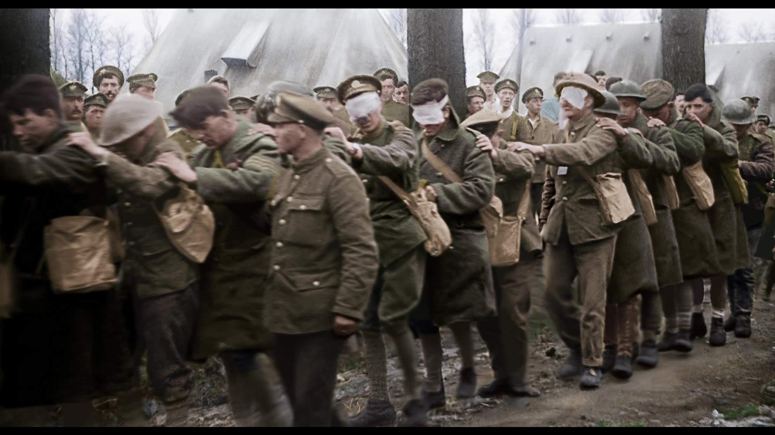
The premise of They Shall Not Grow Old is a simple one. English men who served in the front lines, in the infantry, are talking about their experiences. We don’t see them but only hear their voices. What they are saying is accompanied by moving pictures of life on the front lines, on the “Western Front” in France. Many of these men were very young at the time, no more than eighteen or nineteen years old; they had limited experience of the world, let alone of war. While fighting the enemy at the frontlines, they lived through the worst and most terrifying experiences imaginable, knowing that at any moment a shell bearing their name might come out of the sky and slam into their heads. “You never see the shell that kills you,” they say, “because it’s traveling faster than the speed of sound.”

What makes They Shall Not Grow Old so impressive is that the hundred-year-old film clips have been reprocessed (digitized, colorized, enlarged, restored), giving them a sense of immediacy and a “you are there” feeling. Sound has been added, making it appear that the long-dead people in the film clips are talking, when you know they couldn’t be talking because synchronized sound in film hadn’t been invented yet. I don’t know how this technique is accomplished, but I guess it can be explained by a cliched phrase such as “state-of-the-art technology.” Whatever you call it, They Shall Not Grow Old is worth seeing as a testament to human suffering and the lunacy of war.

Copyright © 2019 by Allen Kopp