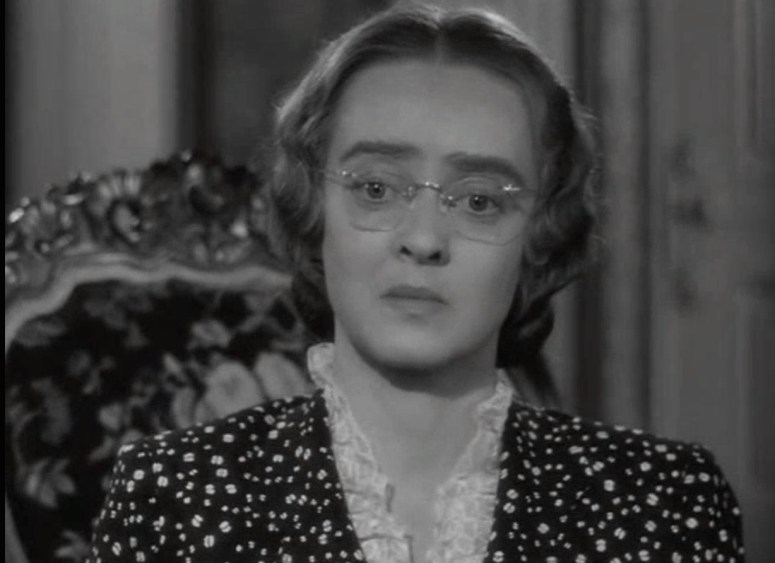
Society Wedding

Society Wedding (2)

Society Wedding
~ A Short Story by Allen Kopp ~

(This is a re-post.)

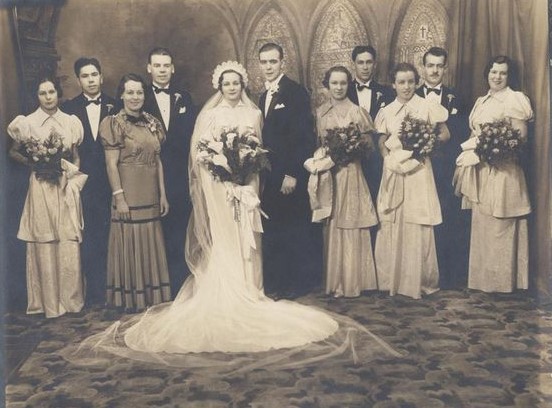
On Saturday evening the sixth of August, marriage vows were solemnized between Ponselle de Fortenay von Hoople and Roger Melville Arcotte-Devaney III. The bride is the youngest daughter of Sebastian Fortescue de Fortenay von Hoople and Mitzi Upjohn de Fortenay von Hoople, both of whom are leading lights of café society and the yacht club set. The groom is a well-known champion polo player and scion of the Arcotte-Devaney manufacturing fortune.

The flower-laden ceremony was held in the lovely gardens of the palatial country estate of the bride’s parents, Forty Winks. The Right Reverend Everett Yawberry Lovell officiated, with a thousand invited guests in attendance, including the governor, Luther Addison Biggs, who is pleased to call himself friend of the family and business associate of the bride’s father. Also in attendance were the renowned novelist Miss Millicent Farquhar Meriwether (whose latest novel, Just Hurry Up and Die, is a huge success), and Broadway hoofer Miss Beulah Doakes.

The bride wore a lovely seventeenth century-inspired gown made entirely of Neapolitan lace that just about swallowed her up and made her look like the dress was walking down the aisle on its own. She chose as her maid of honor her lifelong friend and confidante, Miss Penelope “Pinky” Peebles, who, since she is a midget, was given a stool to stand on to make her as tall as everybody else. Those honored to be bridesmaids were Miss Vesta Cundiff (daughter of the well-known film actress Lola Lola), Miss Marguerite “Tiny” Cadwallader, Miss Fricka Wagstaff, Miss Beryl Belladonna-Stammers, Miss Veronica “Hambone” Turlock, and Miss Hildegard “Puffy” Mannering. In a unique twist for any wedding this season, and, in keeping with the outdoor setting, all the bridesmaids were dressed in costumes representing different birds, from the familiar robin to the sweet mourning dove.

The groom chose as his best man his brother, Mr. Bryce Errol Fennimore Arcotte-Devaney. Groomsmen were Mr. Antonio “Little Tony” Delessio, Mr. Justin Marburg Phipps IV, Mr. Franklin Lester Shumway, Mr. Percy Sherwood-Upjohn, Mr. Troy Biggerstaff, and Mr. Gideon Elijah Gottlieb. The men of the wedding party wore matching linen suits inspired by the planter of the pre-Civil War South, with broad-brimmed Panama hats and black patent-leather knee boots.

The bride’s mother, Mrs. Mitzi Upjohn de Fortenay von Hoople, was a standout among the ladies in her dress and hat made entirely of chicken feathers. She wasn’t able to speak with the beak she wore, but those who know her considered this a great advantage. The father of the bride, Mr. Sebastian Fortescue de Fortenay von Hoople, was the life of the party in his tuxedoed gorilla costume, complete with porkpie hat and cigar.

The mother of the groom, Mrs. Clara Tubbins Arcotte-Devaney, was dressed entirely in black in honor of her late husband, Mr. Roger Melville Arcotte-Devaney II, who died last fall when he fell into the ocean on his return trip to the United States from his travels abroad and was eaten by sharks.

The newly married couple departed on a honeymoon trip around the world on the luxury liner The Virgin Queen. When they return from their travels in about six months, they will reside in their renovated Fifth Avenue townhouse that reportedly cost twelve million dollars, a gift from the bride’s father. Part of the year they will reside in Palm Springs or in the chalet in Switzerland the groom inherited from his father.

This reporter had a chance to chat with the excited bride and groom before they ventured into the world on their own. The bride kissed this reporter on the cheek, leaving the imprint of her lips, and whispered in his ear, “I want a good write-up; no funny business, or my father will have you killed.” The groom gripped this reporter’s hand and, in his booming baritone voice, announced that he wanted him to come back in about ten years and see how many “little bluebloods” they have been able to “pop out” in that length of time. The bride squealed in mock outrage and punched her newly minted husband on the arm.

As the couple made their way to their waiting limousine, the assembled crowd shouted out their good wishes and threw handfuls of rice. The bride’s mother held a handkerchief to her beak and sniffled as the car drove down the winding drive and through the immense gates. She retired to her room in exhaustion as the guests began a drunken bacchanalia that would last until long after daybreak.

Copyright © 2021 by Allen Kopp

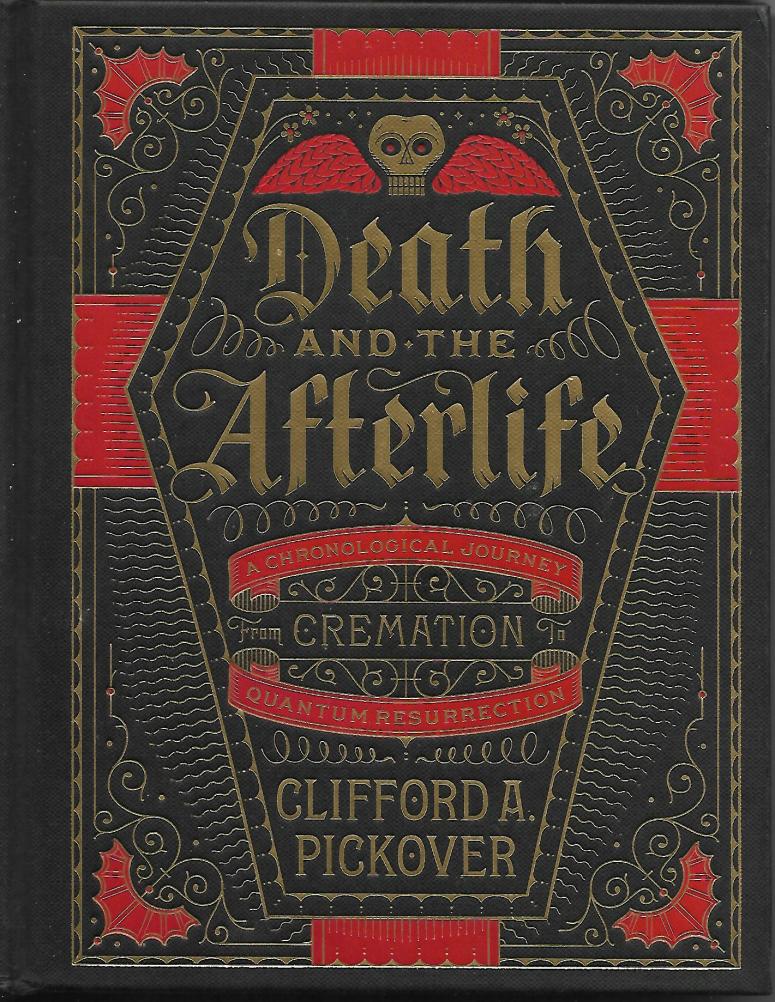
Death and the Afterlife: A Chronological Journey from Cremation to Quantum Resurrection ~ A Capsule Book Review

Death and the Afterlife: A Chronological Journey from Cremation to Quantum Resurrection ~ A Capsule Book Review by Allen Kopp

Death and what comes after have fascinated people for as long as people have existed. When we die, are we cast into a dark oblivion, or do our personalities survive in another place? Are we rewarded for our good deeds and punished for our bad deeds? Will we be born again in another body? Do heaven and hell exist? Where do we go if we’re not good enough for heaven and not bad enough for hell?

Death and the Afterlife will not answer any of these questions, but it is a book that deals with a wide range of topics associated with the science and sociology of death, dying and the afterlife, including such fascinating topics as vampires, zombies, euthanasia, embalming, executions, seances, reincarnation, resurrection, sin eaters, death masks, transhumanism, brain death, near-death experiences, electronic voice phenomena, quantum immortality, thanatourism (visiting sites of suffering and death such as Nazi death camps), death of the universe, and many other topics.

Each entry is only one page long, accompanied by an appropriate painting or drawing on the opposing (left-hand) page. At the end of the book is a list of references that might be consulted for further reading.

Did you know:

  • Certain cultures, going back to the Neolithic Age (13,000 years ago), practiced what was known as “sky burial.” This means that the bodies of the deceased were cut into small pieces, including the bones, and left out on a ledge or hilltop for scavenger birds to carry away.
  • Before Napoleon Bonaparte’s death in 1821 at the age of 51, he insisted that an autopsy be performed on his body, the results of which, he believed, would help his son. He was found, during autopsy, to have stomach cancer.
  • Since 1960, the number of autopsies has declined because doctors are afraid of medical malpractice suits.
  • During the 17th and 18th centuries, “plague doctors,” who often weren’t doctors at all, wore frightening “beak masks.” The idea was to fill the beak of the mask with aromatic spices or fragrant perfumes, which were thought to prevent the wearer from breathing the plague in through the nose or mouth.
  • Walking Corpse Syndrome (WCS) is a mental disorder in which the sufferer believes he is dead, but still living, or that some of his organs have been removed.
  • During the 18th century, fear of premature burial (burial of somebody who wasn’t really dead) led to the rise of “safety coffins,” equipped with air pipes and bells. (Make sure I’m dead first.)
  • In the 13th century, the bubonic plague, originating in Asia, swept through Europe, killing roughly two-thirds of the population. The plague, the greatest biomedical disaster in human history, was still causing problems in Europe five hundred years later.
  • Experiments show that the soul contained in a person’s body weighs seven-tenths (0.7) of an ounce. This weight was arrived at by weighing tuberculosis victims at the moment of death and comparing it with the weight before death.
  • Ondine’s curse is a mental disorder in which a person forgets to breathe while sleeping and dies. It’s named after a water nymph from folklore who is cursed with having to remember to breathe.
  • French painter James Tissot in 1890 painted a famous painting called What Our Lord Saw from the Cross. It is the artist’s vision of what Christ might have seen from the cross while being crucified.
  • While Joseph-Ignace Guillotine did not invent the guillotine (decapitation device), as many people have been led to believe, he promoted its use as a humane method of execution in France in the 1790s. “My machine will take off a head in a twinkling,” Dr. Guillotine stated, “and the victim will feel nothing but a refreshing coolness.”
  • Saint Vincent Pallotti (1795-1850) was an Italian saint who helped the poor in Rome. When his body was exhumed a hundred years after his death, it was found to show no signs of decay, a sign of true holiness.

Copyright © 2021 by Allen Kopp

The End of Eddy ~ A Capsule Book Review

The End of Eddy ~ A Capsule Book Review by Allen Kopp

The End of Eddy, by young French writer Édouard Louis (born 1992), is a novel set in a small factory town in the North of France in a region known as Picardy. Eddy Belleguere is the fictional narrator of the novel, and we learn from the background information of the novel’s author that the story, though fictional, is, in fact, an account of his own life. Eddy Belleguere is the fictional alter-ego of real-life Édouard Louis.

Despite the charm of the region in France where the story takes place, the lives of the factory workers and their families are anything but charming. Life is hard in the factory, and the men who toil there all their lives sometimes die at an early age. They drink to excess, beat their wives, and watch porn and Wheel of Fortune on TV. The women, who sometimes also work in the factory, are long-suffering custodians of the children. The children are unmotivated, unhygienic boobs who usually want nothing more out of life than to get a minimum of education and then get a job in the factory and live the same life of toil that their parents have lived.

Every now and then a boy comes along who isn’t like the others, and that boy is Eddy Belleguere, the protagonist of the novel. He isn’t comfortable with the masculine gender role (as personified by his father, his brothers and every other male in his sphere) that he is supposed to adopt for himself. Eddy has feminine gestures and is attracted to boys and men. His friends at school are all girls. He is brutally bullied and abused by older boys in school and has no way to fight back. As he gets older and realizes he is gay, he tries to “fit in” and be like all the other boys, but he knows (and we know) that it isn’t going to work out. Eddy has an identity crisis and it is never going to resolves itself until he escapes his family, his town and his environment.

The End of Eddy is a story about identity, conforming, belonging, and finding one’s own place in the world, whatever that might be. It’s a breezy novel, simply written, engaging, engrossing and not at all taxing to the brain. Highly recommended to those readers who appreciate a good story about being “a square peg in a round hole.” I think we have all been there, at least in one way or another, when we were young. (Remember how you loathed gym class, dreaded it for days in advance, and might even still have nightmares about it?)

Copyright © 2021 by Allen Kopp

Tchaikovsky, A Biography ~ A Capsule Book Review

Tchaikovsky ~ A Capsule Book Review by Allen Kopp

The great Russian composer Peter (“Petyr”) Ilyich Tchaikovsky was born in 1840 and died in 1893. He was a complex man who experienced many setbacks in his life, but one who, despite his fragile psyche, managed to write some of the great symphonic masterpieces of Russian music and of the nineteenth century, including six symphonies, three ballets, several operas, four serenades for orchestra, chamber music, songs, and (still) wildly popular concertos for piano and orchestra and violin and orchestra. His music is, today, still very accessible and popular and is performed and played wherever music is appreciated. Tchaikovsky never falls “out of favor” or becomes “passé,” as some composers do. (Writer-physician Anton Chekhov said during Tchaikovsky’s life that Tolstoy occupied the first place in Russian art while Tchaikovsky occupied the second place and Chekhov himself occupied the ninety-eighth.)

Tchaikovsky was born into a large and loving family (four brothers and one sister), in an isolated region of Russian where his father was a civil servant. His mother was rather cold to her children, but Tchaikovsky idolized her. Her death at age forty from cholera was a terrible blow from which he never fully recovered.

Tchaikovsky was morbidly sensitive with the soul of an artist, tending to be withdrawn and introspective. He was a homosexual who openly engaged in homosexual activity from the time he was a young student. (His turbulent inner life played a large part in the music he composed.) While not hiding his sexuality, or denying it, he always believed that it wasn’t “right.” After he became famous and successful, he lived in fear that he would be “exposed” and his career ruined or irreparably damaged. In his efforts to appear “normal,” he entered into a disastrous marriage with an unstable (possibly insane) woman named Antonina Milyukova. It turned out to be the biggest mistake of his life. He only lived with Antonina for two or three months, but she spent the rest of his life antagonizing and threatening him. He referred to her as a “demon” and “spawn of hell.” He could only assuage her, temporarily, by giving her money. She was a bitch on wheels.

About the same time as Tchaikovsky’s disastrous marriage to Antonina, another woman entered his life. Her name was Nadezhda von Meck. She was a wealthy widow, whose deceased husband had made a fortune in railroads. She had an almost obsessive admiration for Tchaikovsky and his music. She idealized him as the perfect artist, the perfect musician, the perfect man. She became his patron, which means she partly subsidized (supported) him while he composed. Madame von Meck was as eccentric in her way as Tchaikovsky was in his. The one condition of her financial support was that the two of them never meet in person. They corresponded for fourteen years, thousands of letters, and were both in the same place at the same time on many occasions, but they never met. Many of the letters they wrote to each other still exist.

Unlike many composers, Tchaikovsky achieved astounding success and popularity during his lifetime. His fame spread from his native Russia to Europe and the United States. Despite his never-ending personal struggles, his output of orchestral masterworks is extraordinary.

Peter Ilyich Tchaikovsky died unexpectedly in St. Petersburg in 1893 at the age of fifty-three. The official account of his death, and the one that was accepted for a century, was that he drank “unboiled water” and died of cholera during an epidemic. However, more than a hundred years after his death, new information came to light which strongly suggests that he deliberately ingested poison to kill himself.

Tchaikovsky, A Biography, by Anthony Holden, is an informative and engaging chronicle of the life and times of Russia’s greatest composer. It’s a long and exhaustively detailed biography, but never too long or too ponderously wordy. If Tchaikovsky’s music “speaks” to you, as it does to me, reading this book and understanding the life of this great man adds a new dimension to enjoyment of his music.

Copyright © 2021 by Allen Kopp

Hollywood Babylon ~ A Capsule Book Review

Hollywood Babylon ~ A Capsule Book Review by Allen Kopp

The silent screen’s greatest lover, Rudolph Valentino, was married twice, both time to lesbians, and neither marriage was ever consummated.

Movie director William Desmond Taylor was murdered in his Hollywood apartment in 1922. Investigation into his death revealed that he had been living a double life. All his colleagues were suspects in his death but, even with this plethora of potential murderers, the truth was never uncovered. The real murderer took the secret to his/her grave.

Silent screen comedian, jovial Roscoe “Fatty” Arbuckle, must certainly have wished he had never thrown a wild party in a San Francisco hotel room in 1921. The sexual shenanigans at the party led to the death of a trashy “starlet” named Virginia Rappe. Fatty was jailed and charged with first-degree murder in Rappe’s death. He was eventually cleared of the murder charge (after three lengthy trials), but his screen career was finished.

Thelma Todd, twenty-nine-year-old comedic actress (she starred with Laurel and Hardy and the Marx brothers), called the “Ice Cream Blonde,” was found murdered in the garage where she kept her car in 1935. Nobody ever found out what really happened, but Thelma was believed to have had an ongoing feud with gangster Lucky Luciano. Thelma Todd’s murder is one the most baffling unsolved murders in Hollywood history.

Twenty-five-year-old Olive Thomas, called “the most beautiful woman in the world,” was vacationing in Paris in 1920 with her husband Jack Pickford (brother of Mary Pickford) when, after a night of nightclubbing and drinking, she drank mercury from a bottle and died at a Paris hospital several days later. Evidence suggests that her poisoning was unintentional, but the story still persists that she killed herself on purpose.

In the late 1920s and early 1930s, Ramon Navarro was the biggest star in Hollywood. His most famous role was in the 1925 silent version of Ben-Hur. In 1968, age 69, he was brutally beaten to death in his Hollywood home by a pair of brothers out to rob him. The brothers were brought to justice but received only light sentences.

In 1932, would-be movie actress Peg Entwistle killed herself by climbing to the top of the famous “Hollywood” sign and jumping off. After her death, she became a symbol for Hollywood disillusionment and broken dreams.

Silent screen superstar Charlie Chaplin was quite a dog with the ladies. (Apparently he wasn’t too particular about which ladies.) In the 1920s, he impregnated sixteen-year-old, would-be actress Lita Grey. He did the right thing and married her, but the marriage was a disaster. It turned out that Lita Grey and her dear mama were planning on taking poor old Charlie for every cent he had.

Screen goddess Lana Turner’s sexy bad-boy boyfriend, Johnny Stompanato, was a shadowy underworld figure with an Oscar-sized tool in his pants. (Lana found him exciting.) In 1958, he was abusing Lana with his fists, when Lana’s fourteen-year-old daughter, Cheryl Crane, intervened with a big knife, stabbing pour Johnny to death in Lana’s Beverly Hills mansion. It was eventually ruled a “justifiable homicide,” but Lana and Cheryl experienced much unfavorable press coverage, not to mention the heartache.

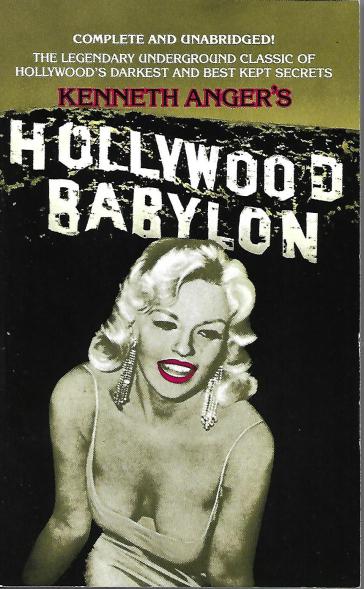
Nearly every Hollywood scandal, from the silent era through the 1960s, is covered, however superficially, in the book Hollywood Babylon. It was banned when first published in 1965 but managed somehow to resurface ten years later. People find Hollywood Babylon objectionable because it makes no pretense of journalistic integrity. A lot of the purported “truth” in it is false, exaggerated, scurrilous, sensationalized and unfair. That’s not to say it doesn’t hold your interest from first page to last, though, as long as you read it with the proper attitude.

Copyright 2021 by Allen Kopp    

From Here To Eternity: Traveling the World to Find the Good Death ~ A Capsule Book Review

From Here To Eternity: Traveling the World to Find the Good Death ~ A Capsule Book Review by Allen Kopp

Did you know that 99.9% of people in Japan are cremated since a cemetery plot in Tokyo costs the equivalent of $53,000 American dollars? Did you know that there’s a “body farm” in North Carolina where people can choose to have their bodies “composted” after death? Did you know that the American funeral industry came into being with the sole purpose of selling you a casket? Did you know that, beginning in 2017, more Americans are choosing cremation over conventional burial? Did you know that the American funeral industry fears cremation because it’s cheaper (no embalming and no casket) than burial? Did you know that in Bolivia there are people who pray to human skulls, believing the skulls can intervene for them in heaven?

Did you know that cemeteries that require a casket to be buried in a steel or concrete vault do so to make maintaining the grounds easier? Did you know that in Colorado there’s a small town where you might have a “natural” cremation (as opposed to “industrial” cremation) for as little as $500? Did you know that many cemeteries have added a section for “natural” burial where (un-embalmed) bodies are buried in a wicker basket or a cardboard box? Did you know that, in Victorian times, crowded cemeteries in large European cities might have as many as twenty bodies in one grave and that dead bodies were frequently displaced to make way for somebody else? Did you know that these overcrowded cemeteries exuded noxious odors, especially after rainfall?  Did you know that, in a section of Indonesia, there are people who exhume the bodies of their long-dead relatives, talk to them, dress them, and bring them offerings of food?

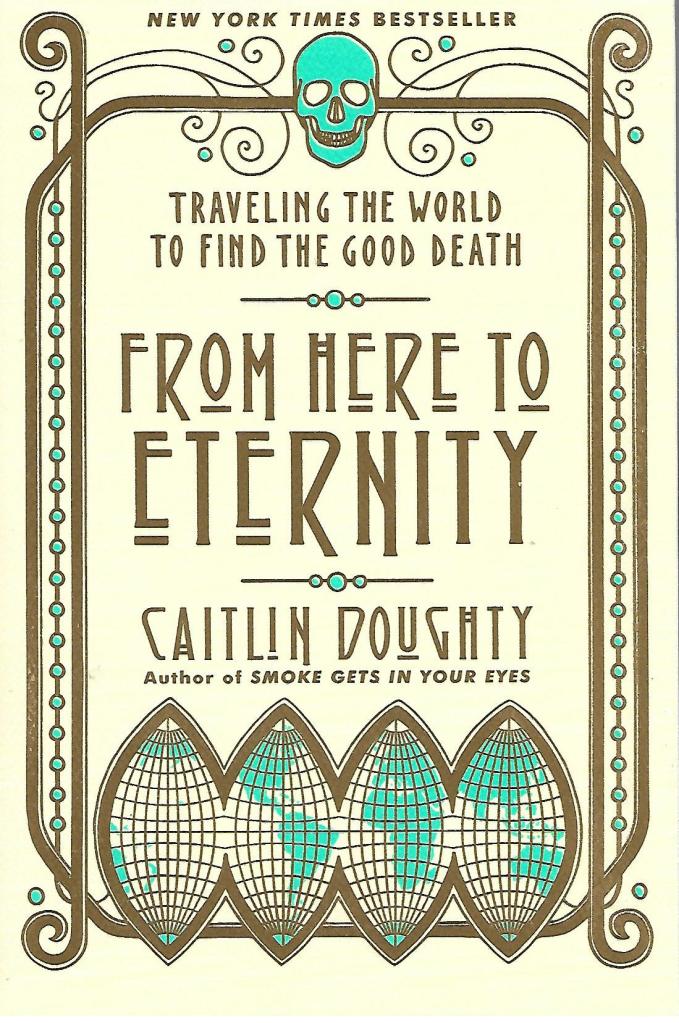
These and other interesting nuggets of information are revealed in From Here To Eternity: Traveling the World to Find the Good Death, by author/mortician Caitlin Doughty. She writes on the grimmest of death-related subjects with humor and insight that only a person who works in the “death industry” could have. It’s an interesting, informative, nonfiction book that will expand your knowledge and make you ponder on your own mortality, unless, of course, you are planning on living forever, which I don’t think is a very pleasant prospect for most of us.

Copyright © 2021 by Allen Kopp

Mrs. Bridge ~ A Capsule Book Review

Mrs. Bridge ~ A Capsule Book Review by Allen Kopp

Mrs. Bridge, the superb novel by Evan S. Connell (1924-2013), was first published in 1959. It is a classic of realist fiction, a piece of Americana, an indelible portrait of the kind of Midwestern American woman who lived in the 1940s and who no longer exists. (The companion piece to Mrs. Bridge, titled Mr. Bridge, was published ten years later.)

India Bridge is a Kansas City “country club matron” of the 1940s. She is married to Walter Bridge and they have three children: Ruth, Carolyn (Corky) and Douglas. Walter is an attorney and he is busy, busy, busy all the time to make enough money to “take care of” his family. In fact, he believes that “providing” for them is much more important than spending time with them or showing them he loves them (even though he does love them). He works from morning ‘til night and sometimes when he gets home all he can do is fall into bed to rest up for the next day of work. (Do we detect a heart attack in the making?)

Walter and India Bridge are “well to do” rather than rich. They have enough money for just about anything. They live in a lovely house and have two cars; they belong to the country club and they have plenty of snooty friends. They can afford a tour of Europe, which they are enjoying until the Nazis invade Poland and they have to go back home.

Mrs. Bridge can afford a maid to run the household, do the cleaning, shopping, laundry, cooking, etc. The maid’s name is Harriet and she is both a blessing and a curse to Mrs. Bridge. She is efficient, but in the very fact of her efficiency she places Mrs. Bridge in a dilemma because it leaves her (Mrs. Bridge) with plenty of time to try to find something to do and think about the past when she had to do all the housework herself and her three children were little and needed her.

One of Mrs. Bridge’s endearing qualities is that she is “traditional” and resistant to change. As her three children grow to adulthood, she is frequently baffled and hurt by their behavior. Her son, Douglas, is aloof and secretive. When she finds a naked girly magazine in his dresser drawer, she burns the magazine and gives Douglas an old-fashioned marriage manual from when she herself was young. The older daughter, Ruth, is something of a bohemian and nothing like her mother. She leaves home as soon as she can and goes to New York to work and become a libertine, unashamedly “sleeping” with a number of different men that she doesn’t care about. The younger daughter, Carolyn (Corky), goes off to college and finds an “inappropriate” man that she wants to marry. Mrs. Bridge must accept the fact that Carolyn’s husband’s father is a low-class plumber instead of a doctor or a lawyer. Carolyn soon finds herself with a baby and discovers that that she “can’t stand” the man she’s married to.

Mrs. Bridge is a slice of life, a chronicle of a specific time in twentieth century American life, an engrossing account of  the small moments that make up a life. India Bridge is a conflicted character: a woman with all the material comforts to make her happy but with plenty of reasons not to be happy. By the time you reach the end of the novel, you will have the feeling that India Bridge not only a character in a book but a person you know, or have known, intimately.

Copyright © 2020 by Allen Kopp

They Have All the Gravediggers They Need

They Have All the Gravediggers They Need ~ A Short Story by Allen Kopp

Somebody was knocking at the door. Who could it be? He was inclined to ignore it, but the knocking continued for longer than it should, so he felt compelled to answer it. It might be something important, but probably wasn’t.

When he opened the door, he saw a man he had never seen before smiling at him. The man was not young, not old; not fat, not thin; not handsome, not ugly; not anything.

“Mr. Arbuckle?” the man asked.

“Yes?”

“Mr. Gerhardt Arbuckle?”

“That’s me. How can I help you?”

“My name is Dexter Peebles. I’m from Sacred Heart Memorial Gardens.”

“Yes?”

“I understand both your parents are interred at Sacred Heart Memorial Gardens in our aboveground mausoleums?”

“That’s right.”

“And your mother just passed over recently?”

“That’s right.”

“Allow me to express my deepest condolences.”

“Thank you.”

“If there’s anything that we of Sacred Heart Memorial Gardens can do to help you in your hour of grief, we are always at your disposal.”

“No, I’m fine. Thanks for stopping by.”

“I wonder if I might have a few moments of your time?”

“What for?”

“I wish to discuss with you some of the services we’re offering at Sacred Heart Memorial Gardens at this time.”

“My parents are already taken care of. There isn’t anything else to be done for them.”

“Yes, I know that. It’s not for them. It’s for you.”

“What do you mean?”

“Might I come in for a few minutes?”

“I’m busy right now. I was just about to wash my clothes.”

“I promise it won’t take more than a few minutes.”

“Well, all right. But let’s make it quick.”

Gerhardt Arbuckle stepped aside and let Dexter Peebles enter. As soon as he was over the threshold, he removed his hat.

“Might we sit down?” Dexter asked.

Gerhardt led the way into the living room and they both sat down.

“Now, what is this about?” Gerhardt asked with a hint of impatience.

Dexter opened the small briefcase he was carrying and took out a sheaf of shiny brochures. He held them hesitantly in his hand and cleared his throat.

“Might I inquire if you have made the final arrangements for yourself and other members of your family?”

“Have I done what?” Gerhardt asked.

“Have you secured your final resting place?”

“Do you mean when I die?”

“Yes.”

“Why, no, I haven’t.”

“Excellent! That’s what I want to discuss with you today.”

“You’re going to try to sell me a cemetery plot, aren’t you?”

“No matter what time of life you are in, it’s such a comfort…”

“I think I can save you a lot of hot air by telling you right off the bat that I’m not interested,” Gerhardt said.

“What?”

“I said I’m not interested.”

“May I ask why?”

“I don’t have to tell you why. Just take my word for it.”

“We are currently offered discounted prices.”

“I don’t care.”

“The type of aboveground mausoleum your mother and father lie in normally sell for thirteen thousand dollars apiece. For a limited time, the vaults are being discounted at twelve thousand each. That’s a savings of a thousand dollars per vault.”

“I’m still not interested.”

“Now, I must tell you, the two vaults immediately adjacent to your mother’s vault are available. These two vaults would be ideal for you and your dear wife.”

“My dear wife took off three years ago and I don’t know where she is. She might be dead and I hope she is.”

“So you have no use for two vaults.”

“I have no use for one vault.”

“Well, as you might expect, the vaults are kind of expensive for certain families. The cemetery plots sell for only a thousand apiece. For a limited time only, I can offer you four adjacent plots at the discounted price of thirty-five hundred dollars.”

“I don’t want those either.”

“May I ask why not?”

“I don’t think it’s any of your business.”

“Do you have children?”

“No.”

“So you would have no use for four cemetery plots?”

“I would have no use for one cemetery plot.”

“Well, uh, you’re getting along in years, as we all are. You must have given some thought to your final resting place.”

“None at all.”

“Most children want to be interred with or beside their parents.”

“Not me.”

“If I may ask, if you die tomorrow, where will your mortal remains repose?”

“I don’t know and I don’t care.”

“You don’t care.”

“That’s right. The city dump will suit me fine.”

“You want your body deposited at the city dump?”

“If I’m dead, I won’t know where I am, will I? The birds can peck at my eyes and the rats eat my flesh and I won’t even know it.”

“Well, I…”

“I told you right at the first I wasn’t interested in hearing your sales pitch. You didn’t believe me, did you?”

“We’re taught in salesman’s training that any sales resistance, no matter how strenuous, can be overcome.”

“You’re finding out that’s not true, aren’t you?”

“I must say your sales resistance is very high.”

“Higher than most?”

“Yes, I think I would say it’s higher than most.”

“You’re not a very effective salesman, then, are you?”

“No, I suppose I’m not.”

“How long have you been selling cemetery plots?”

“Six months.”

“Have you sold any?”

“I’ve sold a few.”

“How many?”

“Two.”

“Two in six months?”

“That’s right.”

“Some people are not cut out to be salesmen.”

“Truer words were never spoken.”

“Do you like selling cemetery plots?”

“I hate it. I’d rather dig graves.”

“Then why don’t you apply for a gravedigger’s job?”

“I’ve inquired about it. They have all the gravediggers they need right now.”

“Try something else altogether. A job that doesn’t have to do with death.”

“Well, the truth is, I don’t have much time to look for a job because I’m out selling cemetery plots all day long.”

“When you get back to Sacred Heart Memorial Gardens, tell them selling cemetery plots is not the right kind of job for you and you’re quitting.”

“They’re going to fire me anyway by the end of the month if I don’t meet my quota and there’s no way that’s going to be possible. I won’t have to quit.”

“Quit before they fire you! Tell them to take their shitty job and stuff it sideways!”

“If only I could!”

“You can! Stand up for yourself! Nobody else will!”

“I’ve thought about killing myself.”

“Don’t do that!”

“I don’t want to kill myself, but it might be my only option.”

“It’s not! It’s not your only option! That’s the wrong way to think!”

Dexter Peebles looked at his watched and slapped both hands on his knees.

“Well, I think I’ve taken up enough of your time already,” he said. “I should be going and let you get back to whatever it was you were doing. Thank you for taking the time to talk to me today. Most people just slam the door in my face as if I was a piece of filth that had blown up on their doorstep.”

“Wait a minute!” Gerhardt said. “You said you want a different job but you don’t have time to look for one?”

“That’s right.”

“Well, hold on! I have a cousin who owns a package liquor store downtown. He’s looking for somebody to train as a manager. Do you know anything about liquor?”

“No, but I could learn.”

“Do you have anything against liquor? Like religious scruples?”

“Not a thing! Both my parents were alcoholics. Also my brother.”

“Well, all right, then! You have alcohol in your family!”

He wrote the cousin’s name and also the address of the package liquor store on a little slip of paper and gave it to Dexter Peebles.

“Tell him Gerhardt sent you.”

“I certainly will!”

“If I were you, I would go down instead of calling. The last I heard, there’s plenty of competition for a manager’s job in a package liquor store.”

“You bet I will, and I certainly do thank you! I just can’t think you enough!”

“I hope you land the job. You need to stop selling cemetery plots before it kills you.”

“Say a little prayer for me!”

Before Dexter Peebles left, he gave Gerhardt a life-affirming hug. Gerhardt hated to be hugged but he tried to hide his distaste. It was a hug that seemed altogether necessary and appropriate.

Copyright © 2021 by Allen Kopp

Flowers by Night ~ A Capsule Book Review

Flowers by Night ~ A Capsule Book Review by Allen Kopp

Set in Japan in the 1820s, Flowers by Night, by Lucy May Lennox, is a fascinating glimpse into an exotic Asian culture of two hundred years ago. Tomonosuke is of the samurai class, but he’s not an especially important samurai. He works as a sort of accountant in the office of the exchequer. He’s in his early thirties and he has a wife named Okyo. They have been married for five years but have no children because they aren’t interested in each other sexually.

Ichi is an “anma,” a blind masseur, only twenty years old. He went blind in childhood as a result of a fever and a rash. His family disowned him when he went blind, so he has no standing in society. He is a “non-person,” but he has learned to be self-reliant and to support himself by giving massages and performing as an amateur musician. He is a member of the Todoza, a guild of blind men. (Most of the Todoza members are moneylenders and for that reason are generally disliked.)

When samurai Tomonosuke meets blind masseur Ichi by chance, he is drawn to him because of his beautiful face and pays him for a massage. After several meetings, their “business” relationship turns sexual. (We are told in the background information for Flowers by Night that sexual relations between men were not only common, especially among the samurai class, but accepted and acceptable, during this period in Japanese history.)

Tomonosuke and his wife Okyo, along with Okyo’s maid, Rin, are relocated to the city of Edo (present-day Tokyo), and Ichi tags along to be near his beloved Tomonosuke. (Ichi lived in Edo before and knows his way around.) Tomonosuke and Okyo are adjusting to life in the city when tragedy strikes.

Tomonosuke is falsely accused of embezzlement (set up by a fellow employee) and is jailed. He is waiting to be executed, he believes, when an earthquake, followed by a fire, strikes Edo. (Fires are so common in Edo that they are called “flowers of Edo.”) The jail where Tomonosuke is being held collapses in the earthquake and Tomonosuke is freed, along with the help of Okyo, Rin and Ichi. All four of them flee Edo since Tomonosuke is a wanted man. They travel, under cover, with a band of itinerant musicians. In their travels, they experience much hardship, including brutal winters (many feet of snow) and near starvation.

In the meantime, we learn that Okyo and Rin have been involved in a long-term lesbian relationship. Rin had been sold as a child to a brothel; Okyo rescued her and vowed to always take care of her. So, we have an unusual foursome: Tomonosuke and his blind lover Ichi and Okyo and her young lesbian lover Rin. The four of them together form a strong bond and, in their highly unusual circumstances, vow to always remain together, no matter what. They become a family in an uncaring and inhospitable world. Okyo feels compelled to produce an heir (especially important in an Asian culture at this time) and, since her husband Tomonosuke doesn’t have sexual relations with her, this is not going to be possible. Tomonosuke and Okyo come to believe in time that a wise expedient is to have the Tomonosuke’s blind lover Ichi conceive a child with Okyo. “Will the child be blind also?” Rin innocently asks. “Of course not!” Okyo tells her. “He wasn’t born blind!”

I haven’t ever read anything like Flowers by Night before. It’s a story about courage, about being on the outside and overcoming the odds in a world that is betting against your survival. More than that, it’s about the bonds that people can form with each other to make life a little more bearable. Highly recommended.

Copyright © 2021 by Allen Kopp

Leave Charlotte Vale Behind

Leave Charlotte Vale Behind ~ A Short Story by Allen Kopp

After washing her hair in the kitchen sink, grandma sat down at the kitchen table before her little round mirror from Woolworth’s to “pin it up.” She twisted each strand of wet hair expertly around the index finger of her right hand and when the strand was a perfect coil she secured it with not one, but two, bobby pins crossed like tiny swords, which she opened with her teeth.

When she was finished, her hair was all-over coils arranged in rows like planted crops. From a distance she looked to have been snatched bald-headed and her hair replaced by a brown skull cap.

She would never have gone outside the house with her hair pinned up that way, so, while the hair dried, she tied it up with a colorful scarf and left the two ends of the scarf sticking up over her forehead like the antennae on an insect.

“What do you think?” she asked Evan.

“That scarf is so cute!” he said.

She lit one of her Pall Mall menthol cigarettes and, balancing it on her favorite ashtray, began applying makeup. She started with a thick layer of face powder all over her face, and then she drew on her eyebrows in graceful arcs over each eye.

“That looks so good!” Evan said. “You look like a movie star!”

“Now for some color,” she said.

She put a spot of rouge on each cheek and then spread it out, blending it in, with her fingertips.

Next came the lipstick. She outlined her lips with the audaciously red stuff and then smacked her lips together several times to even it out, after which she blotted with a limp Kleenex that she produced from the pocket of her house coat.

“Not bad if I do say so myself,” she said, turning her head this way and that before the mirror.

“What time is Finis coming for dinner?” Evan asked.

“About six. He’s bringing dessert.”

“Did he say what?”

“It’ll be something good, you can be sure of that.”

Evan liked grandma’s boyfriend Finis. He was over seventy, tall and thin, a real snappy dresser. He always wore a suit, tie and shiny shoes. He told funny stories about when he was married to one Siamese twin (he wanted to marry the other twin but didn’t want to go to jail for bigamy), and when he worked for gangsters (he got out before members of a rival gang had him killed). Some of his stories were hard to believe, but they were always worth listening to.

“Why don’t you marry Finis?” Evan asked. “Then he’ll already be here at dinnertime and he won’t have to come from someplace else.”

“We’ve talked about it,” grandma said, “but we both like our freedom too much. I don’t want to be tied down and neither does he.”

“How long has grandpa been dead?”

“Seventeen years. You weren’t even born yet.”

“Don’t you miss having a husband?”

“Not anymore.”

Grandma started to put away the mirror and cosmetics, but Evan pointed to his own lips.

“Well, all right,” she said. “Come on over here.”

She set him on her left thigh and, with her left arm around his shoulders, applied lipstick to his lower and then his upper lip with her right hand and then had him smack his lips together the way she showed him.

“How’s that?” she asked.

“Perfect!” he said, looking at himself in the mirror. “I want some eyebrow pencil, too, though. My eyebrows have been so uninteresting lately.”

“Just a little bit,” she said. “We don’t want to ever forget that you’re a boy.”

“I won’t forget it,” he said.

In the space between the table and the refrigerator he minced around, pretending to be a girl, making grandma laugh. He didn’t mind cutting up that way with grandma and Finis, but he wouldn’t want just anybody to see him.

“I’m going to get my wig!” he said.

He ran upstairs to his room and dug the wig out of the bottom drawer of the dresser and put it on in front of the dresser mirror. The wig was long and red, rather shopworn and dusty, but it did make him look like a bonafide girl.

He ran back downstairs to the kitchen to show grandma.

“How do I look?” he asked.

“Stunningly beautiful,” grandma said.

“My name is Charlotte Vale,” he said. “I don’t believe we’ve met.”

“I’m only your old grandma.”

“Oh, yes, that’s right! I remember now!”

“I want you to walk to the store and get a few things.”

“Can I go as Charlotte?”

“You can go as Al Capone if you want to. Now, are you listening? Here are the things I want: a quart of milk…”

“A quart of milk. Check.”

“…a pound of butter…”

“A pound of butter. Check.”

“…a loaf of white bread…”

“A loaf of white break. Check.”

“…and two packs of Pall Mall menthol cigarettes.”

“Two packs of Pall Mall menthols. Check.”

“Can you remember all that without a list?”

“Of course, I can,” he said. “I made it all the way through retarded school, remember?”

She gave him the money and he ran out the kitchen door, the long red hair flying.

When he went into the store, nobody looked at him, but he wouldn’t have been surprised if they had. He felt a little funny as a girl, out in public, but it was only because he wasn’t used to it. He liked the feeling he got from being somebody else. He couldn’t keep from smiling.

He went to the back of the store to get the milk, butter and bread. Then he had to stand in line up front to pay and to get the Pall Mall menthols.

When his turn came, the sour-faced cashier looked at him and then looked away without interest.

“Anything else?” she asked, after ringing up the purchases.

“Two packs of Pall Mall menthol cigarettes.”

She reached around on the other side of the cash register and pulled the two packs of cigarettes out of a rack.

“You don’t ever want to start smokin’ them things,” she said. “They’ll kill ya.”

“They’re for my grandma.”

He paid the money and held out his hand for the change. She put the things into a large bag and folded down the top of the bag and handed it to him.

“Have a nice day,” she said without expression.

When he got home, grandma and Finis were sitting at the kitchen table, laughing and smoking. Grandma had combed her hair out and it was sticking up all over her head. Too much curl, she’d say.

“Who is this enchanting child?” Finis said when Charlotte entered the room.

“That’s my young granddaughter, Charlotte Vale,” grandma said, “visiting from out of town.”

Finis stood up and made a show of shaking Hester’s hand. “So happy to make your acquaintance, my dear!” he said.

The song Amapola was playing on the radio. Finis took hold of Charlotte’s hands and danced her vigorously all over the kitchen until they both collapsed into chairs.

Charlotte wanted something a little fancier for dinner than walking-to-the-store clothes, so she went upstairs and put on a dark-green dress that she found in one of grandma’s trunks in the attic. Since it was a dress for a fully grown lady and since Charlotte was only eleven years old, the dress was a little too big and went all the way to the floor. It didn’t matter, though, because it was elegant. Perfect for a cruise to Buenos Aires and a shipboard romance.

Grandma cooked spaghetti and meatballs for dinner; she had a bottle of rosé wine to go with it. She let Charlotte taste the wine and drink almost a whole glass of it, but then she replaced the wine with iced tea. She didn’t want to be responsible, she said, for turning her grandson into an alcoholic.

“Granddaughter,” Finis said.

“Oh, that’s right! I almost forgot!”

“I’m not really a girl,” Evan said. “I just like pretending sometimes.”

“We know,” grandma said.

“A man wears many masks in his lifetime,” Finis said. “Whatever the moment calls for. When I was a young fellow in college, my friends and I used to get all made up as women and go downtown on the bus. We could flirt like nobody’s business! We could have had any number of dates. It was fun and it felt good!”

“I’ll bet you made the prettiest girl,” grandma said.

She set the big bowl of spaghetti and meatballs in the middle of the table and let Finis and Evan help themselves. They ate until the bowl was nearly empty.

“Best spaghetti I ever ate,” Finis said.

Before grandma cut the cherry pie that Finis brought for dessert, she brought a letter out of her apron pocket and set it on the table by her plate.

“I had a letter from your mother today, Evan,” grandma said.

“Oh?”

“She’s asking me for money again. She’s out of the hospital, but she’s seeing a new psychiatrist and she says he’s more expensive than the others.”

“I think it’s time for her to stand on her own and stop asking you for money!” Finis said.

“The money’s not all,” grandma said, looking directly across the table at Evan. “There’s something else.”

He knew he wasn’t going to like what she was about to say.

“She has a new boyfriend. They’re going to be married right away because she’s going to have a baby.”

Uh-oh!” Finis said.

“Who is she marrying?” Evan asked. “Is he a mental patient too?”

“She didn’t say, but you’ll be able to find out for yourself soon enough.”

Why?

“She wants you to come home.”

What?

“She wants me to put you on the bus on Saturday morning.”

“I don’t want to go! I want to stay here with you and Finis!”

“I know you do, but…”

“But what?”

“She’s your mother and you’re a minor. Where you live is not up to you; it’s up to your mother.”

“Why can’t she just leave me alone?”

“She wants you to start school when the new school year begins.”

“I won’t go!”

“We can take him down in my car,” Finis said. “He doesn’t have to ride on the bus.”

“It’s more than two hours each way,” grandma said.

“I know. I don’t mind.”

“I won’t go!” Evan said. “I’ll run away!”

“And where will you go?”

“I’ll join the circus!”

“What would you do in the circus? Be a tightrope walker?”

“No, I’ll be a He-She in the freak show.”

“But you’re not a He-She. You’re a perfectly normal boy.”

“I’m not normal! I don’t want to be normal if it means I’m like everybody else! I want to be a He-She!”

“All right, then! Be a He-She! Suit yourself!”

“You don’t have to go today or tomorrow,” Finis said. “You have a few more days. Try to enjoy the time you have left.”

“Finis is right,” grandma said. “Let’s have some cherry pie.”

“I don’t want any pie!” Evan said. “I’m going to bed!”

“But cherry pie is your favorite!”

“No, it isn’t!”

He went upstairs to his room, making sure to slam the door loud enough so that grandma and Finis would hear it in the kitchen.

Although it wasn’t quite seven o’clock, he closed the blinds and put on his pajamas, got into bed and covered up his head. How could that bitch (his mother) marry some jackass and then expect him (Evan) to go back home and live with them while she had a stupid baby? He hoped the baby was a freak with two heads. It would be exactly what the bitch deserved.

When Evan awoke in the morning, he swore he was going to be Charlotte Vale the whole time he had left at grandma’s house. If anybody told him to go change back into Evan, he was going to refuse. Even though he was only eleven, he had some rights. If he was too young to have his way about where he lived, at least he could stand up for himself about something as elemental as being a He-She.

As Charlotte, he rode the bus all over the city, by himself, for hours. He loved the city: the crowds and traffic, the buildings, the noise and excitement. He and grandma had had a good time during his stay, seeing all the latest movies, shopping in the stores and eating at the restaurants. Grandma was from the small town, too, but she had lived in the city for thirty years and couldn’t imagine living anyplace else.

Saturday morning came quicker than Evan hoped it would. He awoke early and took a bath and washed his hair. Then, sitting in his underwear before the dresser mirror, he put on heavy rouge, eyebrow pencil and lipstick. When he was satisfied with the way he looked, he slipped a dress on over his head; not the fancy green dress for the cruise to Buenos Aires, but a more sensible, daytime dress of yellow and blue.

When he went down for breakfast with his packed suitcase, Finis had already arrived and was sitting at the table smoking a cigarillo and drinking tea.

“Hello there, Evan,” Finis said.

“It’s Charlotte. Charlotte Vale.”

“Oh, yes. I forgot for the moment.”

“From now on I’m Charlotte. Evan’s dead. Don’t you think the circus freak show would be happy to have me as a He-She?

“I can’t say,” Finis said. “I think eleven is probably a little young for a He-She.”

“I won’t always be eleven.”

“You’re going home today for the first time in three months, Evan,” grandma said.

“Not Evan. Charlotte.”

“Don’t you think it would be best to go home as Evan and leave Charlotte Vale here? She’ll still be here when you get back.”

“No! You’ve already told me I don’t have any choice about going. If I have to go, I’m going as Charlotte. Evan’s dead, I said.”

“All right. If you say so. Evan’s dead.”

“Won’t mother be surprised when she sees I’ve turned into a He-She?”

“We’ve better get a move on,” Finis said. “We’ve got a long drive ahead of us.”

Copyright © 2021 by Allen Kopp