A Christmas Memory ~ A Classic American Short Story
By Truman Capote
Imagine a morning in late November. A coming of winter morning more than twenty years ago. Consider the kitchen of a spreading old house in a country town. A great black stove is its main feature; but there is also a big round table and a fireplace with two rocking chairs placed in front of it. Just today the fireplace commenced its seasonal roar.
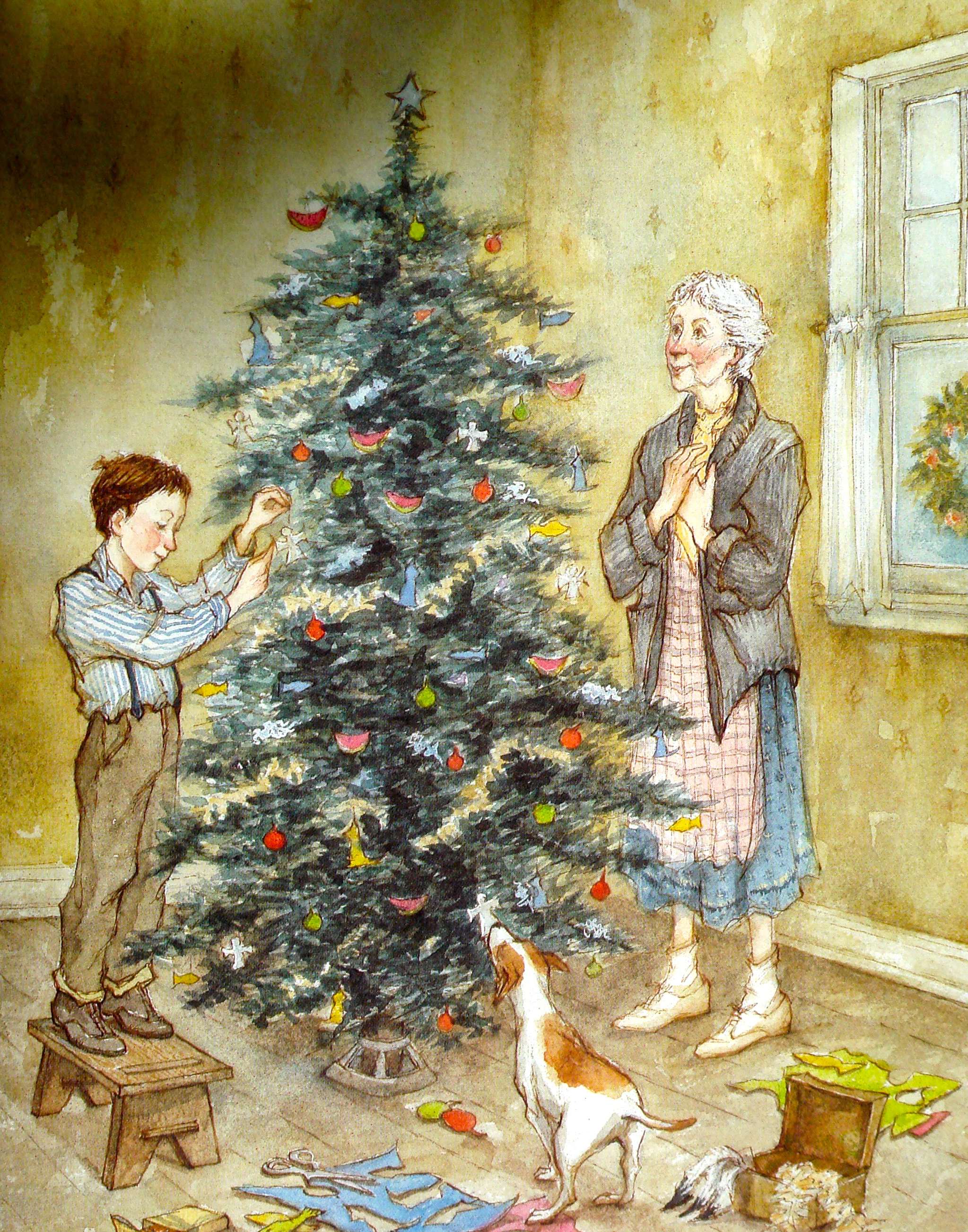
A woman with shorn white hair is standing at the kitchen window. She is wearing tennis shoes and a shapeless gray sweater over a summery calico dress. She is small and sprightly, like a bantam hen; but, due to a long youthful illness, her shoulders are pitifully hunched. Her face is remarkable—not unlike Lincoln’s, craggy like that, and tinted by sun and wind; but it is delicate too, finely boned, and her eyes are sherry-colored and timid. “Oh my,” she exclaims, her breath smoking the windowpane, “it’s fruitcake weather!”
The person to whom she is speaking is myself. I am seven; she is sixty-something, We are cousins, very distant ones, and we have lived together—well, as long as I can remember. Other people inhabit the house, relatives; and though they have power over us, and frequently make us cry, we are not, on the whole, too much aware of them. We are each other’s best friend. She calls me Buddy, in memory of a boy who was formerly her best friend. The other Buddy died in the 1880’s, when she was still a child. She is still a child.
“I knew it before I got out of bed,” she says, turning away from the window with a purposeful excitement in her eyes. “The courthouse bell sounded so cold and clear. And there were no birds singing; they’ve gone to warmer country, yes indeed. Oh, Buddy, stop stuffing biscuit and fetch our buggy. Help me find my hat. We’ve thirty cakes to bake.”
It’s always the same: a morning arrives in November, and my friend, as though officially inaugurating the Christmas time of year that exhilarates her imagination and fuels the blaze of her heart, announces: “It’s fruitcake weather! Fetch our buggy. Help me find my hat.”
The hat is found, a straw cartwheel corsaged with velvet roses out-of-doors has faded: it once belonged to a more fashionable relative. Together, we guide our buggy, a dilapidated baby carriage, out to the garden and into a grove of pecan trees. The buggy is mine; that is, it was bought for me when I was born. It is made of wicker, rather unraveled, and the wheels wobble like a drunkard’s legs. But it is a faithful object; springtimes, we take it to the woods and fill it with flowers, herbs, wild fern for our porch pots; in the summer, we pile it with picnic paraphernalia and sugar-cane fishing poles and roll it down to the edge of a creek; it has its winter uses, too: as a truck for hauling firewood from the yard to the kitchen, as a warm bed for Queenie, our tough little orange and white rat terrier who has survived distemper and two rattlesnake bites. Queenie is trotting beside it now.
Three hours later we are back in the kitchen hulling a heaping buggyload of windfall pecans. Our backs hurt from gathering them: how hard they were to find (the main crop having been shaken off the trees and sold by the orchard’s owners, who are not us) among the concealing leaves, the frosted, deceiving grass. Caarackle! A cheery crunch, scraps of miniature thunder sound as the shells collapse and the golden mound of sweet oily ivory meat mounts in the milk-glass bowl. Queenie begs to taste, and now and again my friend sneaks her a mite, though insisting we deprive ourselves. “We mustn’t, Buddy. If we start, we won’t stop. And there’s scarcely enough as there is. For thirty cakes.” The kitchen is growing dark. Dusk turns the window into a mirror: our reflections mingle with the rising moon as we work by the fireside in the firelight. At last, when the moon is quite high, we toss the final hull into the fire and, with joined sighs, watch it catch flame. The buggy is empty, the bowl is brimful.
We eat our supper (cold biscuits, bacon, blackberry jam) and discuss tomorrow. Tomorrow the kind of work I like best begins: buying. Cherries and citron, ginger and vanilla and canned Hawaiian pine-apple, rinds and raisins and walnuts and whiskey and oh, so much flour, butter, so many eggs, spices, flavorings: why, we’ll need a pony to pull the buggy home.
But before these Purchases can be made, there is the question of money. Neither of us has any. Except for skin-flint sums persons in the house occasionally provide (a dime is considered very big money); or what we earn ourselves from various activities: holding rummage sales, selling buckets of hand-picked blackberries, jars of home-made jam and apple jelly and peach preserves, rounding up flowers for funerals and weddings. Once we won seventy-ninth prize, five dollars, in a national football contest. Not that we know a fool thing about football. It’s just that we enter any contest we hear about: at the moment our hopes are centered on the fifty-thousand-dollar Grand Prize being offered to name a new brand of coffee (we suggested “A.M.”; and, after some hesitation, for my friend thought it perhaps sacrilegious, the slogan “A.M.! Amen!”). To tell the truth, our only really profitable enterprise was the Fun and Freak Museum we conducted in a back-yard woodshed two summers ago. The Fun was a stereopticon with slide views of Washington and New York lent us by a relative who had been to those places (she was furious when she discovered why we’d borrowed it); the Freak was a three-legged biddy chicken hatched by one of our own hens. Every body hereabouts wanted to see that biddy: we charged grown ups a nickel, kids two cents. And took in a good twenty dollars before the museum shut down due to the decease of the main attraction.
But one way and another we do each year accumulate Christmas savings, a Fruitcake Fund. These moneys we keep hidden in an ancient bead purse under a loose board under the floor under a chamber pot under my friend’s bed. The purse is seldom removed from this safe location except to make a deposit or, as happens every Saturday, a withdrawal; for on Saturdays I am allowed ten cents to go to the picture show. My friend has never been to a picture show, nor does she intend to: “I’d rather hear you tell the story, Buddy. That way I can imagine it more. Besides, a person my age shouldn’t squander their eyes. When the Lord comes, let me see him clear.” In addition to never having seen a movie, she has never: eaten in a restaurant, traveled more than five miles from home, received or sent a telegram, read anything except funny papers and the Bible, worn cosmetics, cursed, wished someone harm, told a lie on purpose, let a hungry dog go hungry. Here are a few things she has done, does do: killed with a hoe the biggest rattlesnake ever seen in this county (sixteen rattles), dip snuff (secretly), tame hummingbirds (just try it) till they balance on her finger, tell ghost stories (we both believe in ghosts) so tingling they chill you in July, talk to herself, take walks in the rain, grow the prettiest japonicas in town, know the recipe for every sort of oldtime Indian cure, including a magical wart remover.
Now, with supper finished, we retire to the room in a faraway part of the house where my friend sleeps in a scrap-quilt-covered iron bed painted rose pink, her favorite color. Silently, wallowing in the pleasures of conspiracy, we take the bead purse from its secret place and spill its contents on the scrap quilt. Dollar bills, tightly rolled and green as May buds. Somber fifty-cent pieces, heavy enough to weight a dead man’s eyes. Lovely dimes, the liveliest coin, the one that really jingles. Nickels and quarters, worn smooth as creek pebbles. But mostly a hateful heap of bitter-odored pennies. Last summer others in the house contracted to pay us a penny for every twenty-five flies we killed. Oh, the carnage of August: the flies that flew to heaven! Yet it was not work in which we took pride. And, as we sit counting pennies, it is as though we were back tabulating dead flies. Neither of us has a head for figures; we count slowly, lose track, start again. According to her calculations, we have $12.73. According to mine, exactly $13. “I do hope you’re wrong, Buddy. We can’t mess around with thirteen. The cakes will fall. Or put somebody in the cemetery. Why, I wouldn’t dream of getting out of bed on the thirteenth.” This is true: she always spends thirteenths in bed. So, to be on the safe side, we subtract a penny and toss it out the window.
Of the ingredients that go into our fruitcakes, whiskey is the most expensive, as well as the hardest to obtain: State laws forbid its sale. But everybody knows you can buy a bottle from Mr. Haha Jones. And the next day, having completed our more prosaic shopping, we set out for Mr. Haha’s business address, a “sinful” (to quote public opinion) fish-fry and dancing cafe down by the river. We’ve been there before, and on the same errand; but in previous years our dealings have been with Haha’s wife, an iodine-dark Indian woman with brassy peroxided hair and a dead-tired disposition. Actually, we’ve never laid eyes on her husband, though we’ve heard that he’s an Indian too. A giant with razor scars across his cheeks. They call him Haha because he’s so gloomy, a man who never laughs. As we approach his cafe (a large log cabin festooned inside and out with chains of garish-gay naked light bulbs and standing by the river’s muddy edge under the shade of river trees where moss drifts through the branches like gray mist) our steps slow down. Even Queenie stops prancing and sticks close by. People have been murdered in Haha’s cafe. Cut to pieces. Hit on the head. There’s a case coming up in court next month. Naturally these goings-on happen at night when the colored lights cast crazy patterns and the Victrolah wails. In the daytime Haha’s is shabby and deserted. I knock at the door, Queenie barks, my friend calls: “Mrs. Haha, ma’am? Anyone to home?”
Footsteps. The door opens. Our hearts overturn. It’s Mr. Haha Jones himself! And he is a giant; he does have scars; he doesn’t smile. No, he glowers at us through Satan-tilted eyes and demands to know: “What you want with Haha?”
For a moment we are too paralyzed to tell. Presently my friend half-finds her voice, a whispery voice at best: “If you please, Mr. Haha, we’d like a quart of your finest whiskey.”
His eyes tilt more. Would you believe it? Haha is smiling! Laughing, too. “Which one of you is a drinkin’ man?”
“It’s for making fruitcakes, Mr. Haha. Cooking. “
This sobers him. He frowns. “That’s no way to waste good whiskey.” Nevertheless, he retreats into the shadowed cafe and seconds later appears carrying a bottle of daisy-yellow unlabeled liquor. He demonstrates its sparkle in the sunlight and says: “Two dollars.”
We pay him with nickels and dimes and pennies. Suddenly, as he jangles the coins in his hand like a fistful of dice, his face softens. “Tell you what,” he proposes, pouring the money back into our bead purse, “just send me one of them fruitcakes instead.”
“Well,” my friend remarks on our way home, “there’s a lovely man. We’ll put an extra cup of raisins in his cake.”
The black stove, stoked with coal and firewood, glows like a lighted pumpkin. Eggbeaters whirl, spoons spin round in bowls of butter and sugar, vanilla sweetens the air, ginger spices it; melting, nose-tingling odors saturate the kitchen, suffuse the house, drift out to the world on puffs of chimney smoke. In four days our work is done. Thirty-one cakes, dampened with whiskey, bask on windowsills and shelves.
Who are they for?
Friends. Not necessarily neighbor friends: indeed, the larger share is intended for persons we’ve met maybe once, perhaps not at all. People who’ve struck our fancy. Like President Roosevelt. Like the Reverend and Mrs. J. C. Lucey, Baptist missionaries to Borneo who lectured here last winter. Or the little knife grinder who comes through town twice a year. Or Abner Packer, the driver of the six o’clock bus from Mobile, who exchanges waves with us every day as he passes in a dust-cloud whoosh. Or the young Wistons, a California couple whose car one afternoon broke down outside the house and who spent a pleasant hour chatting with us on the porch (young Mr. Wiston snapped our picture, the only one we’ve ever had taken). Is it because my friend is shy with everyone exceptstrangers that these strangers, and merest acquaintances, seem to us our truest friends? I think yes. Also, the scrapbooks we keep of thank-you’s on White House stationery, time-to-time communications from California and Borneo, the knife grinder’s penny post cards, make us feel connected to eventful worlds beyond the kitchen with its view of a sky that stops.
Now a nude December fig branch grates against the window. The kitchen is empty, the cakes are gone; yesterday we carted the last of them to the post office, where the cost of stamps turned our purse inside out. We’re broke. That rather depresses me, but my friend insists on celebrating—with two inches of whiskey left in Haha’s bottle. Queenie has a spoonful in a bowl of coffee (she likes her coffee chicory-flavored and strong). The rest we divide between a pair of jelly glasses. We’re both quite awed at the prospect of drinking straight whiskey; the taste of it brings screwedup expressions and sour shudders. But by and by we begin to sing, the two of us singing different songs simultaneously. I don’t know the words to mine, just: Come on along, come on along, to the dark-town strutters’ ball. But I can dance: that’s what I mean to be, a tap dancer in the movies. My dancing shadow rollicks on the walls; our voices rock the chinaware; we giggle: as if unseen hands were tickling us. Queenie rolls on her back, her paws plow the air, something like a grin stretches her black lips. Inside myself, I feel warm and sparky as those crumbling logs, carefree as the wind in the chimney. My friend waltzes round the stove, the hem of her poor calico skirt pinched between her fingers as though it were a party dress: Show me the way to go home, she sings, her tennis shoes squeaking on the floor.Show me the way to go home.
Enter: two relatives. Very angry. Potent with eyes that scold, tongues that scald. Listen to what they have to say, the words tumbling together into a wrathful tune: “A child of seven! whiskey on his breath! are you out of your mind? feeding a child of seven! must be loony! road to ruination! remember Cousin Kate? Uncle Charlie? Uncle Charlie’s brother-inlaw? shame! scandal! humiliation! kneel, pray, beg the Lord!”
Queenie sneaks under the stove. My friend gazes at her shoes, her chin quivers, she lifts her skirt and blows her nose and runs to her room. Long after the town has gone to sleep and the house is silent except for the chimings of clocks and the sputter of fading fires, she is weeping into a pillow already as wet as a widow’s handkerchief.
“Don’t cry,” I say, sitting at the bottom of her bed and shivering despite my flannel nightgown that smells of last winter’s cough syrup, “Don’t cry,” I beg, teasing her toes, tickling her feet, “you’re too old for that.”
“It’s because,” she hiccups, “I am too old. Old and funny.”
“Not funny. Fun. More fun than anybody. Listen. If you don’t stop crying you’ll be so tired tomorrow we can’t go cut a tree.”
She straightens up. Queenie jumps on the bed (where Queenie is not allowed) to lick her cheeks. “I know where we’ll find real pretty trees, Buddy. And holly, too. With berries big as your eyes. It’s way off in the woods. Farther than we’ve ever been. Papa used to bring us Christmas trees from there: carry them on his shoulder. That’s fifty years ago. Well, now: I can’t wait for morning.”
Morning. Frozen rime lusters the grass; the sun, round as an orange and orange as hot-weather moons, balances on the horizon, burnishes the silvered winter woods. A wild turkey calls. A renegade hog grunts in the undergrowth. Soon, by the edge of knee-deep, rapid-running water, we have to abandon the buggy. Queenie wades the stream first, paddles across barking complaints at the swiftness of the current, the pneumonia-making coldness of it. We follow, holding our shoes and equipment (a hatchet, a burlap sack) above our heads. A mile more: of chastising thorns, burrs and briers that catch at our clothes; of rusty pine needles brilliant with gaudy fungus and molted feathers. Here, there, a flash, a flutter, an ecstasy of shrillings remind us that not all the birds have flown south. Always, the path unwinds through lemony sun pools and pitchblack vine tunnels. Another creek to cross: a disturbed armada of speckled trout froths the water round us, and frogs the size of plates practice belly flops; beaver workmen are building a dam. On the farther shore, Queenie shakes herself and trembles. My friend shivers, too: not with cold but enthusiasm. One of her hat’s ragged roses sheds a petal as she lifts her head and inhales the pine-heavy air. “We’re almost there; can you smell it, Buddy'” she says, as though we were approaching an ocean.
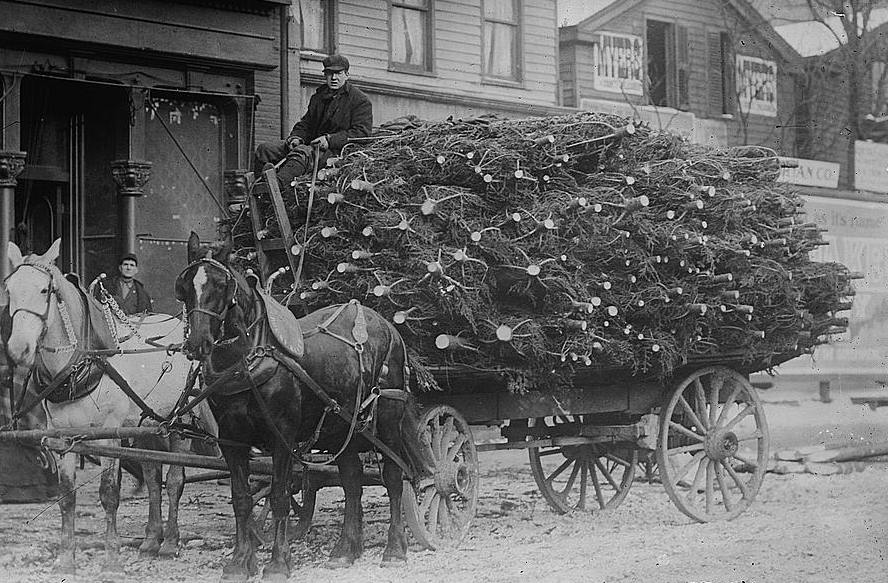
And, indeed, it is a kind of ocean. Scented acres of holiday trees, prickly-leafed holly. Red berries shiny as Chinese bells: black crows swoop upon them screaming. Having stuffed our burlap sacks with enough greenery and crimson to garland a dozen windows, we set about choosing a tree. “It should be,” muses my friend, “twice as tall as a boy. So a boy can’t steal the star.” The one we pick is twice as tall as me. A brave handsome brute that survives thirty hatchet strokes before it keels with a creaking rending cry. Lugging it like a kill, we commence the long trek out. Every few yards we abandon the struggle, sit down and pant. But we have the strength of triumphant huntsmen; that and the tree’s virile, icy perfume revive us, goad us on. Many compliments accompany our sunset return along the red clay road to town; but my friend is sly and noncommittal when passers-by praise the treasure perched in our buggy: what a fine tree, and where did it come from? “Yonderways,” she murmurs vaguely. Once a car stops, and the rich mill owner’s lazy wife leans out and whines: “Giveya two-bits” cash for that ol tree.” Ordinarily my friend is afraid of saying no; but on this occasion she promptly shakes her head: “We wouldn’t take a dollar.” The mill owner’s wife persists. “A dollar, my foot! Fifty cents. That’s my last offer. Goodness, woman, you can get another one.” In answer, my friend gently reflects: “I doubt it. There’s never two of anything.”
Home: Queenie slumps by the fire and sleeps till tomorrow, snoring loud as a human.
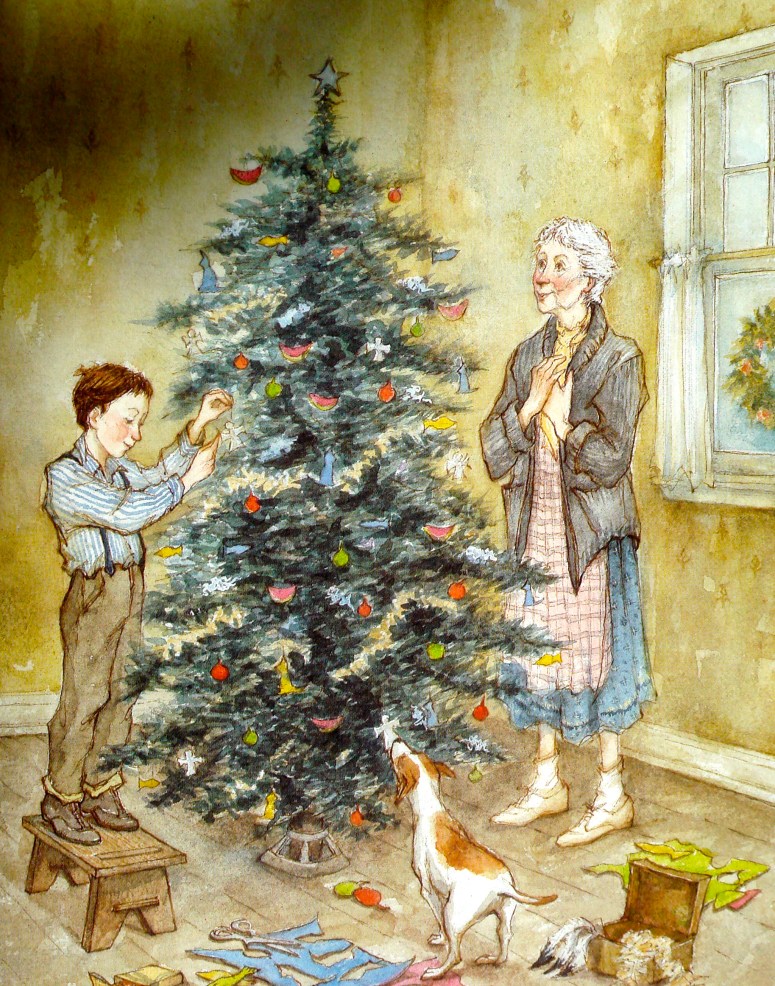
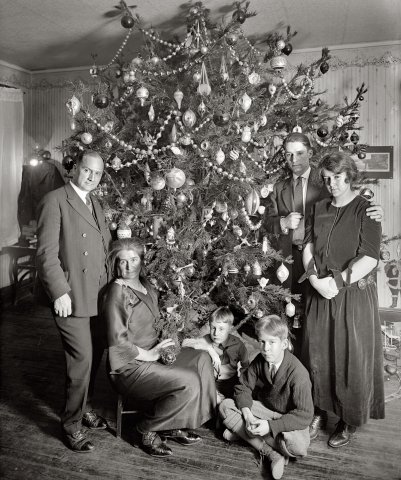
A trunk in the attic contains: a shoebox of ermine tails (off the opera cape of a curious lady who once rented a room in the house), coils of frazzled tinsel gone gold with age, one silver star, a brief rope of dilapidated, undoubtedly dangerous candylike light bulbs. Excellent decorations, as far as they go, which isn’t far enough: my friend wants our tree to blaze “like a Baptist window,” droop with weighty snows of ornament. But we can’t afford the made-in-Japan splendors at the five-and-dime. So we do what we’ve always done: sit for days at the kitchen table with scissors and crayons and stacks of colored paper. I make sketches and my friend cuts them out: lots of cats, fish too (because they’re easy to draw), some apples, some watermelons, a few winged angels devised from saved-up sheets of Hershey bar tin foil. We use safety pins to attach these creations to the tree; as a final touch, we sprinkle the branches with shredded cotton (picked in August for this purpose). My friend, surveying the effect, clasps her hands together. “Now honest, Buddy. Doesn’t it look good enough to eat!” Queenie tries to eat an angel.
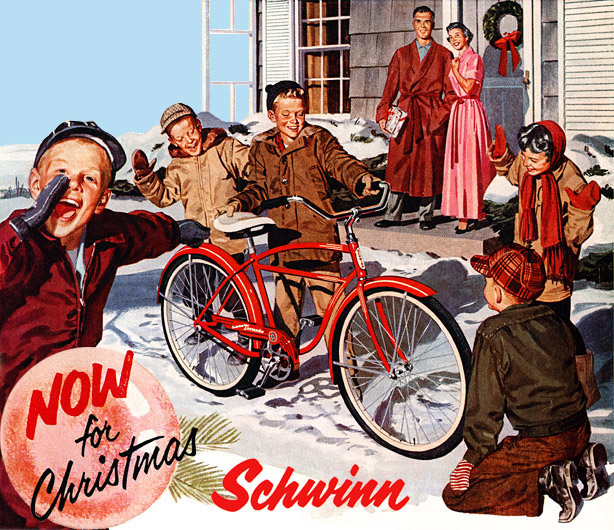
After weaving and ribboning holly wreaths for all the front windows, our next project is the fashioning of family gifts. Tie-dye scarves for the ladies, for the men a homebrewed lemon and licorice and aspirin syrup to be taken “at the first Symptoms of a Cold and after Hunting.” But when it comes time for making each other’s gift, my friend and I separate to work secretly. I would like to buy her a pearl-handled knife, a radio, a whole pound of chocolate-covered cherries (we tasted some once, and she always swears: “1 could live on them, Buddy, Lord yes I could—and that’s not taking his name in vain”). Instead, I am building her a kite. She would like to give me a bicycle (she’s said so on several million occasions: “If only I could, Buddy. It’s bad enough in life to do without something you want; but confound it, what gets my goat is not being able to give somebody something you want them to have. Only one of these days I will, Buddy. Locate you a bike. Don’t ask how. Steal it, maybe”). Instead, I’m fairly certain that she is building me a kite—the same as last year and the year before: the year before that we exchanged slingshots. All of which is fine by me. For we are champion kite fliers who study the wind like sailors; my friend, more accomplished than I, can get a kite aloft when there isn’t enough breeze to carry clouds.
Christmas Eve afternoon we scrape together a nickel and go to the butcher’s to buy Queenie’s traditional gift, a good gnawable beef bone. The bone, wrapped in funny paper, is placed high in the tree near the silver star. Queenie knows it’s there. She squats at the foot of the tree staring up in a trance of greed: when bedtime arrives she refuses to budge. Her excitement is equaled by my own. I kick the covers and turn my pillow as though it were a scorching summer’s night. Somewhere a rooster crows: falsely, for the sun is still on the other side of the world.
“Buddy, are you awake!” It is my friend, calling from her room, which is next to mine; and an instant later she is sitting on my bed holding a candle. “Well, I can’t sleep a hoot,” she declares. “My mind’s jumping like a jack rabbit. Buddy, do you think Mrs. Roosevelt will serve our cake at dinner?” We huddle in the bed, and she squeezes my hand I-love-you. “Seems like your hand used to be so much smaller. I guess I hate to see you grow up. When you’re grown up, will we still be friends?” I say always. “But I feel so bad, Buddy. I wanted so bad to give you a bike. I tried to sell my cameo Papa gave me. Buddy”—she hesitates, as though embarrassed—”I made you another kite.” Then I confess that I made her one, too; and we laugh. The candle burns too short to hold. Out it goes, exposing the starlight, the stars spinning at the window like a visible caroling that slowly, slowly daybreak silences. Possibly we doze; but the beginnings of dawn splash us like cold water: we’re up, wide-eyed and wandering while we wait for others to waken. Quite deliberately my friend drops a kettle on the kitchen floor. I tap-dance in front of closed doors. One by one the household emerges, looking as though they’d like to kill us both; but it’s Christmas, so they can’t. First, a gorgeous breakfast: just everything you can imagine—from flapjacks and fried squirrel to hominy grits and honey-in-the-comb. Which puts everyone in a good humor except my friend and me. Frankly, we’re so impatient to get at the presents we can’t eat a mouthful.
Well, I’m disappointed. Who wouldn’t be? With socks, a Sunday school shirt, some handkerchiefs, a hand-me-down sweater, and a year’s subscription to a religious magazine for children. The Little Shepherd. It makes me boil. It really does.
My friend has a better haul. A sack of Satsumas, that’s her best present. She is proudest, however, of a white wool shawl knitted by her married sister. But shesays her favorite gift is the kite I built her. And it is very beautiful; though not as beautiful as the one she made me, which is blue and scattered with gold and green Good Conduct stars; moreover, my name is painted on it, “Buddy.”
“Buddy, the wind is blowing.”
The wind is blowing, and nothing will do till we’ve run to a Pasture below the house where Queenie has scooted to bury her bone (and where, a winter hence, Queenie will be buried, too). There, plunging through the healthy waist-high grass, we unreel our kites, feel them twitching at the string like sky fish as they swim into the wind. Satisfied, sun-warmed, we sprawl in the grass and peel Satsumas and watch our kites cavort. Soon I forget the socks and hand-me-down sweater. I’m as happy as if we’d already won the fifty-thousand-dollar Grand Prize in that coffee-naming contest.
“My, how foolish I am!” my friend cries, suddenly alert, like a woman remembering too late she has biscuits in the oven. “You know what I’ve always thought?” she asks in a tone of discovery and not smiling at me but a point beyond. “I’ve always thought a body would have to be sick and dying before they saw the Lord. And I imagined that when he came it would be like looking at the Baptist window: pretty as colored glass with the sun pouring through, such a shine you don’t know it’s getting dark. And it’s been a comfort: to think of that shine taking away all the spooky feeling. But I’11 wager it never happens. I’11 wager at the very end a body realizes the Lord has already shown Himself. That things as they are”—her hand circles in a gesture that gathers clouds and kites and grass and Queenie pawing earth over her bone—”just what they’ve always seen, was seeing Him. As for me, I could leave the world with today in my eyes.”
This is our last Christmas together.
Life separates us. Those who Know Best decide that I belong in a military school. And so follows a miserable succession of bugle-blowing prisons, grim reveille-ridden summer camps. I have a new home too. But it doesn’t count. Home is where my friend is, and there I never go.
And there she remains, puttering around the kitchen. Alone with Queenie. Then alone. (“Buddy dear,” she writes in her wild hard-to-read script, “yesterday Jim Macy’s horse kicked Queenie bad. Be thankful she didn’t feel much. I wrapped her in a Fine Linen sheet and rode her in the buggy down to Simpson’s pasture where she can be with all her Bones….”). For a few Novembers she continues to bake her fruitcakes single-handed; not as many, but some: and, of course, she always sends me “the best of the batch.” Also, in every letter she encloses a dime wadded in toilet paper: “See a picture show and write me the story.” But gradually in her letters she tends to confuse me with her other friend, the Buddy who died in the 1880’s; more and more, thirteenths are not the only days she stays in bed: a morning arrives in November, a leafless birdless coming of winter morning, when she cannot rouse herself to exclaim: “Oh my, it’s fruitcake weather! “
And when that happens, I know it. A message saying so merely confirms a piece of news some secret vein had already received, severing from me an irreplaceable part of myself, letting it loose like a kite on a broken string. That is why, walking across a school campus on this particular December morning, I keep searching the sky. As if I expected to see, rather like hearts, a lost pair of kites hurrying toward heaven.