She Wants a Boy She Can Dominate ~ A Short Story by Allen Kopp
Joe Gillis was bored and he wasn’t used to being bored. He paced the floor of his spacious bedroom, looked out one window and then another. Crossing to the desk, he picked up a cigarette and lit it. How many had he smoked since breakfast? Dozens, probably, but he didn’t care. He crushed out the cigarette, not really wanting it, and lay down on the bed. He stared at the ceiling, at the ugly water stain there in the shape of Antarctica, and picked up the novel from the bedside table, The Naked and the Dead.
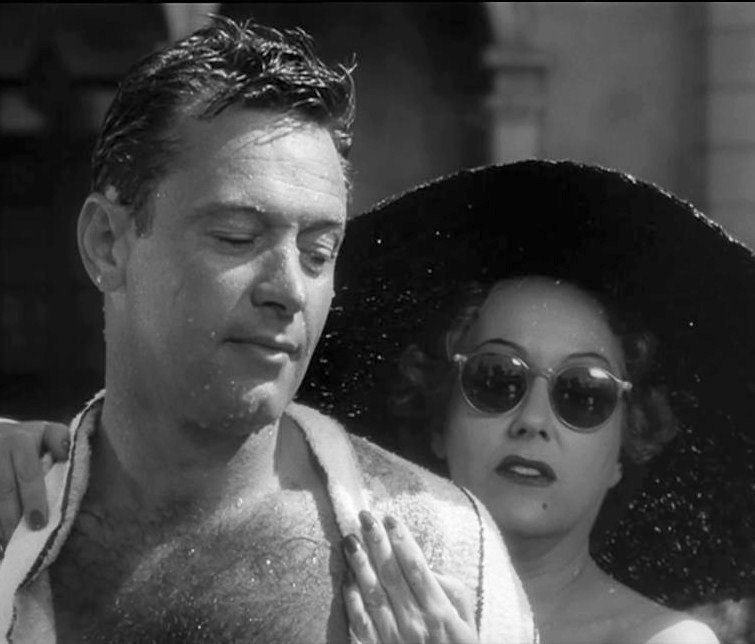
He read about five pages before Norma came bursting into the room. He was used to his privacy and didn’t like people walking in on him whenever they felt like it, even if that person was the great Norma Desmond. He would have to insist that a lock be installed on the door, even though it was a house without locks.
“What is it, Norma?” he asked, closing his eyes and resting the open book on his chest. “Can’t you see I’m busy?”
“How is the script coming, Joe dear?” she asked.
“It’s finished,” he said.
“Oh, Joe, you really are a marvel!” she said. “My only regret is that I didn’t meet you years ago. What a team we make!”
“That makes four scripts I’ve written for you. What good is a movie script that’s never filmed? It’s like a symphony that’s never played.”
“Oh, they will be filmed, my darling! Of that you can be sure! The great directors of the day will line up for the chance to film them. Just wait and see.”
“If that happens, Norma, I’ll be very happy for you.”
“Don’t say it that way, Joe. It isn’t only for me. It’s for you, too!”
“Whatever you say, dear.”
“I have a wonderful idea for our next project,” she said.
“Oh, Norma! I want to take a little time off. Get out of the house for a while.”
“Don’t you like it here?”
“That’s not what I’m saying. I need a change of scenery. The chance to see some friends.”
“There’ll be plenty of time for that later, Joe. I want to keep working while I have the fire in me.”
“Last time I noticed, I was doing all the working.”
“I want you to write a film treatment of Tolstoy’s Anna Karenina.”
“With you playing Anna, of course!”
“Isn’t that the idea?”
“Norma, you’re too old for Anna.”
“I could pass for thirty-five.”
“Do you realize what a huge undertaking it would be to write a script from a novel of that size, Norma? It’s over eight hundred pages.”
“I know, Joe, it’ll be a big job, but you can do it. I know you can. I have such confidence in you!”
“It would take months.”
“That’s all right, Joe. Take as much time as you need.”
“And after I put all the time and effort into writing the script, will anybody be interested?”
“Of course they will!”
“Anna Karenina has already been filmed.”
“I know, but not with me in it!”
“Does anybody want to see a fifty-year-old woman playing a character in her thirties?”
“There you go harping on age again! Age doesn’t matter!”
“Tell that to the world.”
“True stars are ageless! I could play the part at any age!”
“Maybe you could play all the parts. Including the men.”
“Oh, Joe, that isn’t funny.”
“Why don’t you get yourself a new agent and re-enter films by playing character parts. Grandmothers and goofy aunts.”
“Do you know what you’re saying? Stars of my stature don’t play secondary parts. I’m a star! I was born to be star and a star I shall always be.”
“Whatever you say, Norma.”
“So you’ll get started on the script tomorrow?”
“Why not today?”
“There’s just one thing,” she said.
“I’ll probably be sorry I asked, but what is it?”
“I want our version of Anna to have a more upbeat ending.”
“Meaning what?”
“I don’t want her to kill herself this time.”
“I don’t know, Norma. The suicide is what makes Anna what it is.”
“We’ll demand that the audience see Anna in a different light. Instead of being crushed by her disillusionment, she’ll vow to fight on, to make her life meaningful and not so self-centered. That’s the lesson she will have learned from her travails.”
“Who am I to tamper with Tolstoy?”
“What do you mean, Joe?”
“If I do a screen adaptation of Anna Karenina, I’ll have to do it the way Tolstoy intended.”
“Are you saying you won’t write the ending I tell you to write?”
“Yes, that’s what I’m saying, Norma. To preserve what tiny shred of artistic integrity I have, I will only do it as it was originally written.”
“Do you want me to get somebody else?”
“It’s a moot point, anyway, Norma. Nobody will ever produce a screenplay of Anna Karenina with you playing Anna.”
“And just why not?”
“Audiences aren’t interested in literary adaptations. They want laughs. Singing and dancing.”
“I can do that, too!”
“So, you would make Anna Karenina into a musical comedy?”
“I don’t know why not! I can do my Chaplin impression. People love that!”
“How do you explain Chaplin in a story that’s set before he was even born?”
“I don’t know. You’ll think of a way.”
“Norma, I can’t tell you to get out because it’s your room in your house, but if you don’t go away and give me some peace, I’m going to jump out the window and make sure I land on my head!”
“Oh, Joe, now you’re being abrasive. I know that side of you is always there, but I do hate seeing it. I think people should always remain ladies and gentlemen.”
“I have a terrible headache,” he said, “and my stomach hurts from all that rich food you serve in this house.”
“You’re being a big baby now,” she said.
“I don’t care what you call me.”
She lay down on the bed beside him, took hold of his arm and wrapped it around her neck. “What can mama do to make her little boy feel better? I know what! Let’s go to my boudoir and have a little afternoon lie-down. We’ve got the whole house to ourselves. We can make as much noise as we want. Max is out polishing the car.”
“You’re not my mama, Norma, and I’m not your little boy, and, anyway, little boys don’t do with their mamas what you’re suggesting.”
“Oh, Joe, you’re such as old stick! There are times when you have absolutely no sense of humor!”
She attempted to nuzzle his ear but he moved away from her.
“Get off me, Norma! You’re making me sick!”
“Oh, I make you sick, do I?”
“Just go away and leave me along and I won’t feel compelled to hurt you.”
She sat up on the bed, sighed and lit a cigarette. “I have something very important to tell you, Joe.”
“Can’t it wait? I told you I have a headache.”
“I want to get it out in the open.”
“Well, just say it, then, and let’s be done with it.”
“I’m going to have a child, Joe. Your child.”
He raised himself on his elbow and looked at her. “Don’t you think that’s carrying things a little too far, Norma?”
“It’s true.”
He laughed. “I think it’s just a cruel joke you’re playing on me to get me to do what you want. I’ll bet Max is in on it, too, isn’t he?”
She took his hand and put it on her stomach. “Don’t you feel it?”
“Wait a minute,” he said. “I’ve only been here two months.”
“What does that prove?”
“If it’s true—and I’m not saying it is—how do I know it’s mine? How do I know it doesn’t belong to Max or the gardener or the boy who delivers the groceries?”
“Now you really are being insulting!” she said. “It’s true there have been many men in my life but never more than one at a time.”
“Have you had it confirmed by a doctor?”
“I don’t need to.”
“How do you know it’s not a tumor or something? I won’t believe it’s true until it’s been confirmed by a doctor.”
“Very well. If you promise to go with me, I’ll make the appointment.”
“How is it even possible? I’m thirty-two and you’re fifty.”
“Age has nothing to do with it. Some women’s childbearing years extend well into middle age.”
“Why didn’t you take precautions?”
“Men always leave everything up to the women, don’t they?”
“You’ll be seventy years old when he’s in college. If he even lives that long!”
“We’ll raise him together, Joe. We’ll take care of him while we grow old together.”
“What are you saying, Norma?”
“I want us to get married, Joe. We’ll sneak away like a couple of young lovers and drive up the coast. We’ll find one of those scenic little chapels that overlooks the ocean and have the ceremony performed there. Oh, Joe, it’ll be so lovely! Just like a scene from one of my pictures!”
“I’ll never marry you, Norma!”
“Why not? You’re not already married, are you?”
“No, I’m not already married, but the list of reasons I won’t marry you is a long one. The first item on the list is I don’t want to be married. To anybody, but especially not to you!”
“You don’t need to resort to cruelty, Joe.”
“Sometimes that’s all that’s left.”
“You don’t want to be a part of your son’s life?”
“No!”
“I know what to do, then. I’ll go downtown at midnight. It’s sure to be raining. I’ll find the address that was given to me by a nefarious friend. There’ll be a single lightbulb over a doorway in an alley. I’ll knock and be admitted by a hard-faced woman in a dirty white uniform. I won’t be able to see the doctor’s face because he’ll have it hidden behind a surgical mask. He’ll have blood stains on his white coat, which will be the last thing I see before he puts me under the anesthetic.”
“Which one of your pictures is that from, Norma?”
“I won’t have to go alone, though,” she said. “Faithful Max will go with me and hold my hand.”
“Yes, what would we do without Max?”
“So, that’s what you want to see happen?”
“Of course not!”
“Then you do care? At least a little?”
“When it’s confirmed that there really is a baby, we’ll talk then about what’s to be done.”
“Oh, Joe, I think that’s a good plan!”
“And, in the meantime, could we possibly not talk about it? And, please, please, please, don’t tell Max or anybody else until you’re sure!”
“All right. Anything you say, darling.”
She went to the mirror, began primping her hair and face, wiping away the rivulets of mascara.
“I have a wonderful idea,” she said. “Let’s go out someplace for dinner.”
“I wasn’t planning on having any dinner,” he said.
“You’ll have to eat something. How about some spaghetti and meatballs? That’s what I’d like to have. Does that sound good to you?”
“I’m not fit to be seen in public.”
“Take a shower and put on some clean clothes. I’ll wait for you.”
“Anything you say, dear.”
“I’ll have Max get the car out. Come down when you’re ready. And don’t dawdle! I’m hungry!”
“Yes, sir!”
He felt a little conspicuous in the open car with her. He felt people turning their heads and looking at him. Older woman, obviously rich and eccentric. Younger man, a little rough around the edges. He had gigolo written all over him.
They hadn’t gone very far when Norma realized she was out of the brand of cigarettes she liked. She had Max stop at the curb in front of a drugstore and sent Joe in to get them, not without giving him the money for them, though.
“And hurry up!” she said. “It’s no fun sitting in the car like this waiting for you to come back.”
He bought the cigarettes and as he was leaving he saw his old friend Artie Green sitting at the counter having his dinner. He went over and sat down beside him.
“Hey!” Artie said. “Joe Gillis! Whatever happened to you? I thought you were dead.”
“I’ve been here all the time, Artie,” he said.
“Are you all right? I mean, you haven’t been sick or anything, have you?”
“No, not sick. I’ve been working, is all.”
“That girl, Betty Schaefer, that you were working with at the studio, told me she went to your apartment and found you had moved out and left no forwarding address.”
“That’s right. I’ve been staying with a friend temporarily.”
“Every time Betty sees me, she asks if I’ve heard from you or seen you. You must have really made an impression with her.”
“Artie, can you hide for a few days?”
“What? Why would I do that?”
“There’s a dragon waiting outside for me in a golden chariot. She’s going to kill me and I know I deserve to die, but, worse than that, she’s going to force me to marry her because she says she’s going to have my baby.”
“What? I think you’re hallucinating!”
“I’m not sure there is a baby but if there is the blame is going to fall on me and I don’t see how there’s any way to get out of marrying her unless I disappear or unless I kill myself. What would you do if it was you?”
“You’re not making any sense, buddy boy! Explain it to me slowly.”
“Is there a back way out of this place?”
“For employees only, I think.”
“Can you hide me at least for tonight?”
“Yeah, I guess I could put you up.”
“Let’s go.”
Before Artie had a chance to ask a store employee if it was all right for them to use the back way out, Joe was already gone.
He ran down an alley, almost falling a couple of times, turned right down another alley and ran for two blocks. He didn’t stop to wait for Artie but believed he would catch up and would know where he was.
He turned left into another alley, believing it was the way back to the street and far enough from the car so that Norma and Max wouldn’t spot him. He stopped to retie his shoelace and when he looked up, there was a man standing there in a shadow. He didn’t know until the man stepped out of the shadow that it was Max.
“You can’t stop me!” Joe said.
“No, I can’t stop you,” Max said in his heavy German accent. “We can find you, though.”
“Why can’t you just leave me alone?”
“You raped Madame and left her carrying your child. You can’t run out on her now when she needs you most.”
“It’s a lie,” Joe Gillis said, but even he knew how feeble those three words sounded. The biggest rat who ever lived. And with her old enough to be his mother.
Copyright © 2015 by Allen Kopp