Mademoiselle Lulu ~ A Short Story by Allen Kopp
(This short story was published in Danse Macabre and is a re-post on my website.)
A family of the living dead resided in a fine old house on a ten-acre estate outside the town of Harmony Hill. Their name was Farrier and they were a mother and her seven children. People said that Mrs. Farrier was hundreds of years old, although her age had never been verified. The children were five males (Cottonwood, Maurice, Eustace, Junius, and Percy) and two females (Lulu and Esther). Mrs. Farrier’s husband and the father of the brood of seven had long ago departed for the other realm. Mrs. Farrier ate him one evening for dinner.
Most of the people of the town of Harmony Hill knew about the Farriers, but few of them had ever seen the Farriers. There were those who believed that the Farriers were nothing more than an old wives’ tale or a story told around campfires. Everybody had, of course, seen the fenced-in ten-acre estate that belonged to the Farriers with its mysterious old house, but people had been led to believe (by whom, nobody knew) that a very old witch-like woman lived there in seclusion with her two strange daughters.
The truth was that, long ago, the town had come to an agreement with the Farriers; to wit, the town and its people would not bother the Farriers on their estate if the Farriers did not bother the town. If the Farriers should ever go back on their agreement and eat anybody from the town, the town would go after the Farriers with a vengeance, burn down their house and cut off their heads. Cutting off the head was the most commonly known method of killing the flesh-eating living dead.
Mrs. Farrier had learned to control her family of flesh-eaters and make them stay out of the town. The family had developed a system whereby they could have the requisite number of flesh-bearers to eat without putting themselves in danger by letting their appetites run away with them. Eustace and Junius were the most accomplished—and the subtlest—hunters in the family, so they, in general, went out on nighttime hunting excursions. They fed themselves on the “game” they were able to bag and, by daybreak every morning, took the remainder home to their mother, who took a generous portion for herself and distributed the remainder to her other children.
Of the other Farrier children, Percy and Lulu had the most rampant, the most uncontrollable, appetites. They were more likely than not to go into the town and eat the first person that came to hand without ever considering the consequences.
Percy was cunning, very strong and capable of tearing a victim to shreds with one hand tied behind his back. He was also an insensate beast with frightening, blank eyes, a wild man who could not be controlled. His brothers had no other choice but to keep him chained in the basement. His personality—his “self”—had been entirely subverted to his appetite for flesh. He was worse than any wild animal.
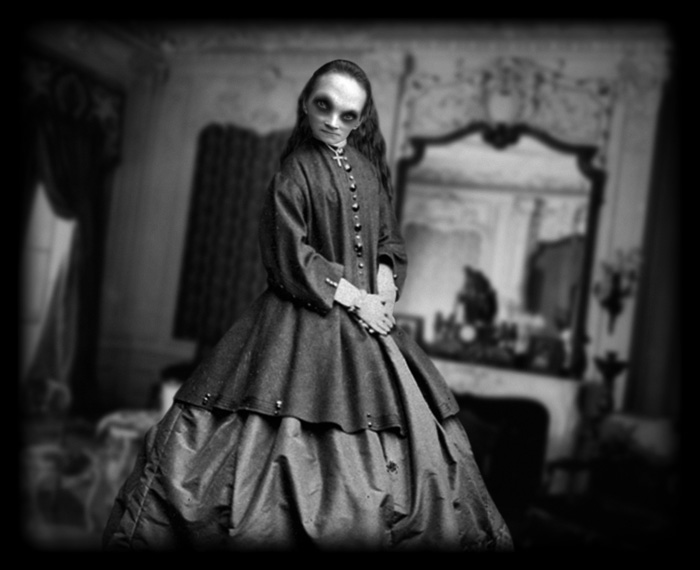
Lulu was very fat and hardly ever left her boudoir in the upper floor of the old house. When she was hungry, she paced the floor and sometimes picked up heavy objects and threw them against the wall. Appetite was for her a physical pain. When she wasn’t eating, though—when her appetite was satisfied—she simpered around the room in her satins and silks, a Chinese fan in her hand, and engaged in lengthy conversations with people who existed only in her imagination; in this way she dealt with her loneliness and isolation.
The other Farrier children—Esther, Cottonwood and Maurice—were docile enough as long as they had enough flesh to eat, although they themselves didn’t possess the penchant for killing. They were content to stay in the background and not bother their mother or their brothers. After they had fed, they would remain on their beds, bloated and happy, for hours or sometimes even days at a time, their blank eyes staring at nothing.
Eustace and Junius were not happy with the arrangement of going out almost every night, in all weathers, to get flesh for themselves and the rest of the family. Since they had to stay out of the town, they had to travel a long way to go to another town. And it was more than just a matter of plucking the first person they saw off the street. They couldn’t kill indiscriminately, as they would have done in a world more favorable to them. They had to plan their strikes with subtlety and finesse. The idea was to make disappearances seem random: a man here and a woman there; a child the next night thirty miles from where they had been the night before; hikers in the mountains sleeping around a campfire; lovers trysting in a deserted country cemetery; hobos waiting at night for a freight train; a drunk making his painful way home after drinking all night in a tavern.
Junius had heard stories about a conclave of the living dead in the Metropolis. For him, the principle attraction of the Metropolis was that there were millions of flesh-bearers living there, milling around on the streets at all hours of the day or night, ripe for the taking. If he could make his way to the Metropolis and become a member of the conclave, he imagined there would be no end of flesh to eat, and he wouldn’t have to spend the better part of every night looking for it. He told his brother Eustace about the conclave, and Eustace agreed that life for the two of them would certainly be easier in the Metropolis. What were they going to do about the rest of the family, though? They would not be able to just run off and leave the others behind, defenseless and with no way of getting flesh for themselves.
After lengthy conversations on the matter, Eustace and Junius agreed that they would go to the Metropolis to live, but first they would abide at home for a while and teach their two younger brothers, Cottonwood and Maurice, the skill of locating, stalking and killing the prey that was necessary to their continued existence. After Cottonwood and Maurice became adept at providing for the family, Eustace and Junius would go to the Metropolis and, in time, they would send for the others, where they would all live the easy life that was to be had there.
Cottonwood and Maurice were dismayed when they learned they were to go hunting with their older brothers, but Junius gave them a lecture about assuming the responsibilities of adulthood. They couldn’t go their entire lives expecting flesh to be brought to them by someone else; they needed to learn to be self-sufficient so they would never have to depend on anybody else. Maurice sniffled and looked at Cottonwood and nodded his head grudgingly, as if to say that, as much as he disliked the idea, he had to admit that he agreed with the logic of the argument.
Eustace and Junius decided not to tell their mother that they were taking Cottonwood and Maurice hunting with them. She would not have been receptive to a different way of doing things and, besides, she was resting in her room until the time that she could feed and was not to be disturbed.
The four of them—Junius, Eustace, Cottonwood and Maurice—set out from home at about eleven o’clock on a balmy moonlit night in the middle of October. They would make a detour around the mountain, covering a range of about twenty miles, and come back toward home from the other direction. They were certain to find at least two or three flesh-bearers out on such a warm and agreeable night.
They had gone a dozen or so miles and were nearing the hamlet of Benbow. Maurice was complaining about his feet hurting because he wasn’t used to walking so far, when Junius with a wave of the hand bade him to be still. He could smell a flesh-bearer nearby; he believed he had spotted movement at the edge of a clump of trees.
As they were closing in on their supposed prey, Eustace stopped and held out his hand for his brothers to halt. He had an uneasy feeling about what lay ahead. He was about to motion to the others to turn around and go back the way they had come, when there was a loud yell, like a signal, and then another yell from another direction. Before they had a chance to take cover, there was a blast of gunfire coming at them. They had walked into an ambush.
Eustace and Junius, with their lightning reflexes born of years of experience, seemed to the eyes of the flesh-bearers to melt into the earth—that’s how fast they disappeared—while Cottonwood and Maurice simply stood where they were, not understanding what was happening. They were knocked down by bullets and then a group of flesh-bearers—at least ten or twelve of them—swarmed over them and cut off their heads with axes, cheering and laughing the whole time. Eustace and Junius had no other choice but to stand in the darkness and helplessly watch their two younger brothers being slaughtered.
When dawn came, they made their way forlornly back home. Not only did they not have any flesh, but they were going to have to tell their mother and their sisters, Esther and Lulu, that their family had, in the course of the night, been diminished by two.
Their mother accepted the news with equanimity at first, but after her initial shock had passed she became enraged. She began screaming uncontrollably, calling Eustace and Junius every name she had at her command. She struck both of them repeatedly about the head, face and shoulders with her fists and kicked at their legs. She spit and swore and frothed at the mouth. She was as dismayed that Cottonwood and Maurice were dead as she was that no flesh had been brought home.
Esther, who was waiting in the other room to begin her feeding, heard the disturbance and came running. When she saw her mother pummeling her two older brothers, she became frightened and began flailing her arms. Her eyes rolled up into her head and she jumped up and down repeatedly, moaning in a kind of archaic ecstatic chant.
When Junius and Eustace had recovered themselves to a degree and retreated to the far side of the room, they began hurling objects at their mother—a book, a metronome, a marble bust of Nero. Junius picked up a chair and threw it at her, hitting her in the head and knocking her down. She was stunned for a moment, but she soon stood up again and re-entered the fray with renewed vigor.
Reading a romance in her boudoir upstairs, Lulu heard the terrible row that was taking place below stairs. It sounded as if all the forces of hell had been unleashed upon the house. She crept down the stairs slowly, faint with hunger and frightened, but nevertheless determined to discover the source of the disturbance.
She was used to seeing her family members hurling objects at each other, but never before with such anger and vehemence. Her mother had a gash in her forehead oozing purplish liquid and was jerking crazily as though she had taken leave of her senses. Junius, always so dapper and calm, was disheveled and screaming epithets at his mother and hurling anything he get could get his hands on across the room at her. Eustace was lying on the floor behind a table, cradling his arm, bellowing in pain and frustration. Esther was standing in the corner—or rather jumping up and down in the corner—screeching and pulling her hair out by handfuls.
More than anything, Lulu wanted the screaming to stop. Without thinking about what she was doing, she went into the kitchen and picked up the meat cleaver her mother used for dismembering prey, took it back into the parlor and, with one powerful stroke, cut off Esther’s head. Her eyes went blank as if a lamp had been extinguished and her head fell to the floor with a melon-like thud. A spray of foul-smelling black-and-purple matter spewed from the stub of her neck; her body fell over like a collapsing wall.
Seeing what Lulu had done, her mother went for her like a madwoman, hands upraised like claws. She managed to get her hands around Lulu’s neck in an attempt to strangle her but Lulu pulled free and swung the meat cleaver at her in a powerful backhanded motion and cut off her head. Her head left her body and sailed across the room and smashed against the wall. Her body, after she fell, continued to writhe and jerk as with an electric shock.
Having dispatched her sister and her mother, Lulu had no intention of stopping there. She raised the meat cleaver over her head and ran toward Junius. Understanding her intention, he made a valiant attempt to get away but it was no good. She caught him with the meat cleaver across the back of his neck. His head separated from his body as he fell against the wall, purple matter spewing out the hole where his head had been.
Eustace was still lying on his back on the floor behind a table, groaning and emitting intermittent screams. As Lulu approached him, she knew he didn’t see her. His eyes were covered with a gauzy scum and he had lapsed into a sort of stupor. He never saw the meat cleaver as it took off his head, a coupe de grace if there ever was one.
Lulu pulled the four bodies one by one—along with their severed heads—across the room and pushed them into the enormous fireplace. When she had all four of them—her mother, sister and two elder brothers—arranged in the fireplace like stacked firewood, she poured a can of gasoline over them and set fire to them. The fire took hold very fast and in just a few minutes the flames consumed the bodies.
Worn out from her exertions and weak from not having fed at the customary time, Lulu went to the door and went outside. The sky was just brightening with the rising sun and the birds were singing cheerily in the trees. The beauty of the landscape was not lost on her.
She hadn’t been outside the house for so long that just the simple act of walking along the ground felt good. She walked a short distance into the woods until she heard a sound that made her hide behind a tree. When she was sure she hadn’t been seen, she looked around the tree and spotted a hunter carrying a gun, a brown-and-white dog by his side. Before the hunter even knew what was happening, she crept up on him and ate him in the flash of an eye. The dog, not understanding where his master had gone, approached her shyly, wagging his tail. She reached down and patted him on the head and told him to run along home.
Her appetite sated for the moment, she went back to the house, climbed the stairs to her boudoir and had a good rest. When she awoke, she packed her clothes and a few books and keepsakes into two trunks. She dressed herself in a long, flowing black dress that came down to her ankles and an enormous black hat with a veil that hid her face.
When she went down to the basement to unchain her only remaining brother, Percy, she was sure he didn’t know who she was, but he seemed grateful to be out of his chains. She looked into his clouded eyes and pointed toward the door to let him know he was free to leave. When he nodded his head to show that he understood what she was saying, she put her arms on his shoulders in a kind of embrace and helped him to his feet. He needed to be allowed to leave the house or he would starve to death; go into the town if he must.
She called a taxi and, as the taxi man was loading her trunks, she closed the front door and locked it, probably for the last time. The house already had a forlorn, abandoned feel. As the taxi was driving away, she took a last look over her shoulder at the house and saw that a wisp of smoke was still rising from the chimney.
She went to the Metropolis, not to join the conclave of flesh-eaters, but to arrange to go abroad. With the money her father had left her before her mother ate him, she engaged a lavish stateroom on one of the finest passenger ships in the world. She hired a personal maid to help her with her clothes and carry out small errands.
Her destination for the moment was not definite, but she planned on sailing into every port city in the world. When she got tired of traveling, she would settle down for a time in one of the European capitals. She might someday return home, but she couldn’t see herself living by herself in that lonely old house.
While traveling, she rarely had occasion to leave her stateroom, but anytime she appeared in public she always wore the long black dress and the hat with the veil. She effected a slight foreign accent when she spoke, causing her fellow shipmates to refer to her as Mademoiselle Lulu. Everybody knew there was some secret thing about her, but nobody could figure out what it was. She was mysterious; she wasn’t like anybody else. People could gossip all they wanted but they would never know her truth.
At every port of call where passengers were allowed to go ashore for a few hours or an entire day, Lulu was always among them. She loved being in a new place and seeing sights she had never seen before but, most of all, she loved the abundance of flesh-bearers that were always in those places. She always had her fill. Unencumbered by family, she was living the kind of existence she had always dreamed about.
Copyright © 2014 by Allen Kopp