The Flatiron ~ A Capsule Book Review

The Flatiron ~ A Capsule Book Review by Allen Kopp

New York’s iconic Flatiron Building stands at the intersection of Broadway, Fifth Avenue and Twenty-third Street. It’s a triangular-shaped building twenty-two stories tall, completed in 1902. Art critics and arbiters of good taste hated it from the moment it was completed, while the public loved it. The photographer Alfred Stieglitz said the Flatiron is to New York what the Parthenon is to Athens.

The Flatiron was one of the first skyscrapers in New York. Thanks to the use of the steel framework, skyscrapers could be built taller and taller because the lower walls were no longer supporting the weight of the structure. George Allon Fuller (1851-1900) was credited with the invention of the skyscraper. Tall buildings became the trademark of New York. Real estate prices were exorbitant and, the higher the building, the more money investors could get on their investments. It was, and is, all about money. Somebody figured out that a skyscraper doesn’t become profitable until the thirteenth floor.

George Allon Fuller had a daughter named Allon. She married a man named Harry Black and he eventually took over the Fuller Company started by his father-in-law and became a powerful force in the building trades in New York. (The Fuller Company became known as the “Skyscraper Trust.”)

Harry Black wasn’t an architect or an engineer but a businessman, a builder and a wheeler-dealer. He was responsible for many of the landmark buildings that still stand today, including the New York Public Library and the lavish Plaza Hotel. He figures prominently in the story of the Flatiron. He and his wife Allon were divorced after ten years of marriage. She remarried and died at age 37 of pneumonia. He also remarried and committed suicide in 1930 at age 68.

The Flatiron, by Alice Sparberg Alexiou, is a fascinating nonfiction account of the Flatiron Building and the times in which it was built. It was a time of great excitement and growth in New York City, punctuated, of course, by periodic economic “downturns.” Many things were going on during this time. The steal industry flourished with the increased demand for steal used in skyscrapers. Moving pictures were in their infancy; the public was fascinated by this newest—and potentially profitable—form of entertainment. President William McKinley was assassinated by an anarchist; his vice-president, Theodore Roosevelt, then became president. The labor movement was becoming more and more powerful, causing headaches for employers and builders. In the basement of the Flatiron Building was a restaurant that seated 1500 people. It eventually became known for its jazz, another new form of American entertainment. Of course, the good times couldn’t last. They never do. The United States entered the “Great War” in 1917. Prohibition soon after closed down a lot of popular nightspots that served liquor. In 1929, the Great Depression wiped out the fortunes of a lot of the fabulously wealthy. Millionaires became paupers overnight. Nothing ever stays the same. Everything is always in a state of flux. Here today, gone tomorrow. Enjoy it while it lasts.

Copyright © 2018 by Allen Kopp

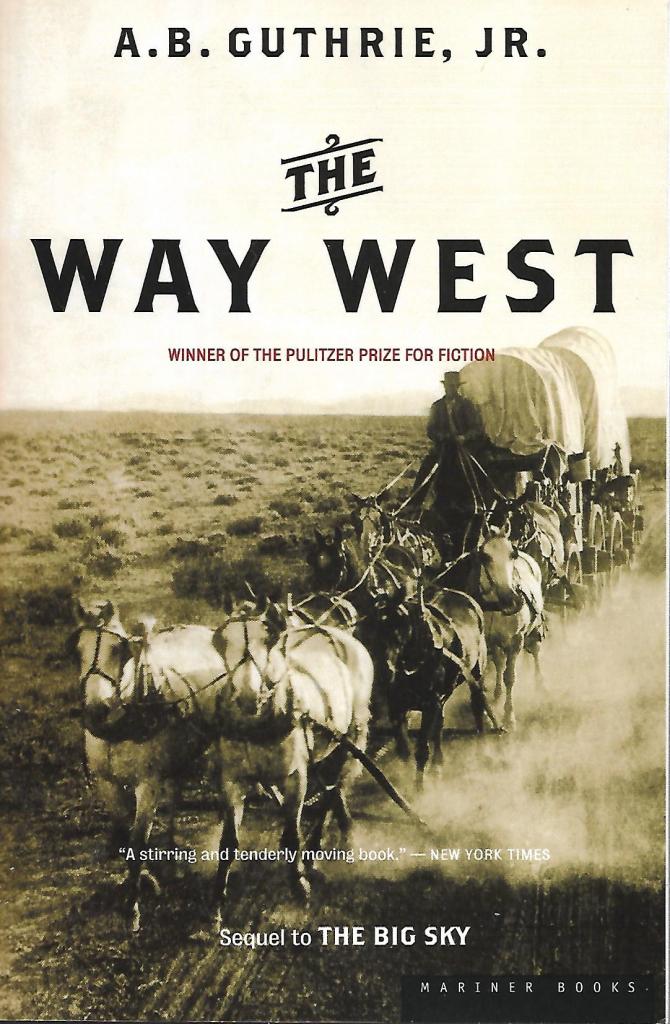
The Way West ~ A Capsule Book Review

The Way West ~ A Capsule Book Review by Allen Kopp

For decades now, we’ve been able to get on a jet plane and fly from the middle of the country, Missouri, all the way to Oregon in the Pacific Northwest in a few hours. In the 1850s it wasn’t so easy. Back then, people traveled the distance in the most difficult way imaginable: in wagon trains of ten, fifteen or twenty wagons, usually one family to a wagon. The trains moved about ten to twelve miles a day, so the trip lasted for months. And the way was fraught with dangers and hardships, including canyons, wild rivers, mountains, vast distances without rest or water; extremes of heat, wind and cold; illness, disease and death; hostile, sometimes murderous, Indians; wild animals including buffalo and rattlesnakes (not to mention mosquitoes and other insects); the inevitable clash of personalities and all the jealousies and ugliness engendered by a group of human beings thrown together. The train comprises a microcosm, a world in miniature, the bad along with the good.

The Way West by A.B. Guthrie Jr. is the simple story of one such wagon train that sets out from Independence, Missouri, with its sites set on the storied land of Oregon. These wagon trains always had a “pilot,” an experienced man who usually knew what most of the travelers didn’t: the way was hard and dangerous and some of them weren’t going to make it. Dick Summers is the pilot in The Way West. He’s forty-nine years old, a widower, a mountain man who has traveled over the terrain before and knows what to expect. He always knows the best route to take, how to deal with the indigents, how to ford raging rivers, etc. Without him, the travelers would be doomed. Think of John Wayne.

Lije Evans was a farmer back in Missouri. Now he’s the captain of the wagon train. He tells the train when to stop and when to get a-goin’ again, but he relies heavily on Dick Summers for practical advice in all matters. Lije is traveling with his wife, Rebecca, his son, Brownie, and his faithful old dog, Rock. Lije is the central character in the novel. We see things through his eyes. His must deal with the usual collection of misfits and egocentric individuals who think they know more than he does. Thrown into the mix is a teenage temptress named Mercy McBee who—innocently enough, it seems—falls under the spell of a handsome married man, Curtis Mack, and ends up pregnant by him. Uh-oh! The leaders already said at the outset that they wouldn’t countenance adultery and fornication and would horsewhip any offenders.

The Way West is a solid, readable classic that won the Pulitzer Prize for fiction in 1950. It’s an American story about westward expansion and the search for a better life in the nineteenth century when the country just wasn’t big enough and people wanted to make it bigger. Now people are much softer. When I’m with a group of people and somebody is complaining about being cold in a stifling room or they want to have all the windows closed in an airless room because they’re afraid of bees getting in, I say, sarcastically, “That’s the pioneering spirit that made this country what it is today.” People today are whiny-assed crybabies who would never be able to suffer the hardship and discomfort of traveling across a continent in a covered wagon to live in an unknown place they’ve never seen before. Does everybody have their cell phones, and how on earth are we going to charge them? How about anti-anxiety pills? Does everybody have theirs? You’re certainly going to need them when an Indian tries to scalp you.

Copyright © 2018 by Allen Kopp

Herman Melville ~ A Capsule Book Review

Herman Melville ~ A Capsule Book Review by Allen Kopp

Herman Melville, by brainy Melville scholar Elizabeth Hardwick, is a short (158 pages) biography in the “Penguin Lives” series. It is an overview of Melville’s life and a dissection of each of his major works, beginning with Redburn, Omoo, Mardi, Typee, and on to Moby Dick and later works such as the short story “Bartleby the Scrivener” and the short novel Billy Budd.    

In a nineteenth century American novel class in college, they had us read Herman Melville’s massive and difficult novel Moby Dick. We had a week to read it, study it, and uncover its secrets. The next week we were to move on to Henry James’ The Ambassadors, which is also a very difficult novel to read. (What is wrong with these people?)

While Moby Dick is notoriously difficult to read, most people in the know agree that it is the greatest American novel ever written. Its central character, Captain Ahab, is a driven megalomaniac. In an earlier encounter with the monster white whale, Captain Ahab lost a leg. Now, spurred onward by vengeance, he will risk his ship, The Pequod, and all the men on it for another chance to bring down the whale that has come to be known as Moby Dick. The whale is a symbol for something. Just what it is a symbol for has never quite been established. Of course, the question has sparked endless speculation.

By all accounts, Herman Melville (1819- 1891) did not have a happy life. When he was young, he worked on a whaling ship, abandoning ship once in Liverpool. This shipboard experience gave him the experience he needed for his books. He lived with his family in New York in shabby gentility. He always had money worries and was frequently on the verge of bankruptcy. He met the by-then established writer Nathaniel Hawthorne, who was fifteen years older than Melville; the two of them became acquaintances, if not the best of friends. He was unhappily married, while his sexual interests seemed to lie elsewhere. (His writing is full of “homoerotic yearnings.”) He was the prolific (and fast) writer of many books, but he was never commercially successful during his lifetime. Of his four children (two boys and two girls), one of his sons committed suicide at age eighteen and the other died in faraway California at age thirty-five. Of his two daughters, one was debilitated by rheumatoid arthritis.

When Herman Melville died at age seventy-two, he was mostly forgotten, spending the last nineteen or so years of his life working as a clerk for a meager salary. It wasn’t until the 1920s that there was a great revival of interest in him and his work, particularly the novel Moby Dick and two shorter works, “Bartleby the Scrivener” and Billy Budd.

Copyright © 2018 by Allen Kopp

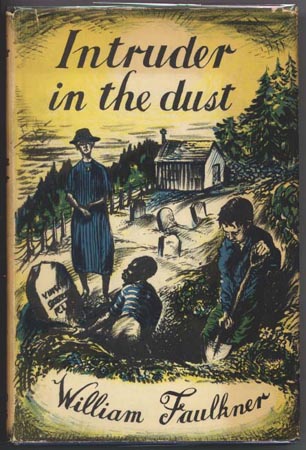
Intruder in the Dust ~ A Capsule Book Review

Intruder in the Dust ~ A Capsule Book Review by Allen Kopp

In the small town of Oxford, Mississippi, a white man named Vinson Gowrie is murdered, while a black man named Lucas Beauchamp stands accused and is put in jail. The Gowries (from “Beat Four”) are sure to want revenge. They can get enough of their redneck friends together to storm the jail and remove Lucas Beauchamp and lynch him. The law is conceivably helpless against such a mob.

A sixteen-year-old boy name Charles “Chick” Mallison is convinced of Lucas’s innocence, while everybody else believes he is guilty. When he was twelve years old, out hunting in the woods, Chick fell into the river and was pulled out by Lucas Beauchamp. Lucas took him home with him, gave him dry clothes and half his dinner. Chick tried to pay him for his kindness with some coins he had, but Lucas didn’t take well to being given money by a white child. Chick never forgot Lucas’s kindness, his dignity, and how much he was unlike other black people of his acquaintance.

With little more than a hunch to go on, Chick wants to prove that Lucas is innocent. He gets his friend, Aleck Sander (a black youth his own age), to go along with him to the cemetery where Vincent Gowrie is buried, miles outside of town. But, wait a minute, there’s at least one adult who also believes Lucas is innocent. A seventy-year-old spinster named Miss Habersham grew up with Lucas’s now-deceased wife, so she has a personal interest in the matter. She goes along on the nighttime visit to the cemetery to dig up Vinson Gowrie’s body and take it back to town so it can be examined by an expert to prove that Lucas’s gun didn’t fire the fatal bullet.

Well, wouldn’t you know it? There’s a body in Vincent Gowrie’s grave all right, but it’s not Vincent Gowrie. Now it becomes a murder mystery. While everybody else is waiting around for the Gowries to lynch Lucas Beauchamp, a handful of people (Chick Mallison, his lawyer uncle, Miss Habersham) are willing to miss sleep and put themselves out to prove that something more sinister is going on that a black man murdering a white man in a small Southern town.

Intruder in the Dust was first published in 1948. It is, we are told, William Faulkner’s answer to race relations in the South. It’s written in a stream of consciousness style, making it wordy and at times difficult to read. Some of the sentences are hundreds of words long and some of the paragraphs go on for two pages or more. A thought will obtrude on a thought and then another thought will obtrude on that thought. Faulkner was the supreme literary stylist of American literature. Nobody else even comes close.

Copyright © 2018 by Allen Kopp

The Truce ~ A Capsule Book Review

The Truce ~ A Capsule Book Review by Allen Kopp

Mario Benedetti was a Uruguayan writer who lived from 1920 to 2009. Although not well known in the English-speaking world, he is considered one of the most important Latin American writers of the second half of the twentieth century. His novel, The Truce, was first published in 1960. The 2015 Penguin Classics edition was translated from Spanish to English by Harry Morales.

The subtitle of The Truce is The Diary of Martín Santomé. Martín Santomé is the common man protagonist of The Truce and, as such, he is subject to all the ills and foibles of being alive. He doesn’t have a lot of money and isn’t especially smart or well educated. He has spent his life toiling in a tedious accounting job (“…that sentence of being ensnared in something unimportant for eight hours, something which inflates the bank account of those useless people who sin by the mere fact of being alive…”). At forty-nine, he is a few months away from retirement, but, instead of looking forward to retirement, he doesn’t know how well he is going to take to it.

Martín’s private life is no more exemplary than his professional one. He has been a widower since age twenty-eight. (His wife, Isabel, was twenty-five when she died of complications of childbirth.) He has had perfunctory affairs with women, one-night stands, but nothing that lasts. His three grown children (Esteban, Blanca and Jaime) live with him but he is not good at understanding them or communicating with them. When his son Jaime confesses to him that he is gay, he writes: “My son is a queer. A queer…I would have preferred that he turn out to be a thief, a morphine addict or an imbecile. I would like to feel pity for him, but I can’t.”

There is a young woman half his age with whom he works in his office. Her first name is Laura, but he refers to her always by her last name, Avellaneda. He is drawn to her in a way that is new for him. When he discovers the attraction he feels for her is reciprocated, the two of them begin a tentative affair. It is this affair that forms the emotional core of the novel.

Avellaneda and Martín rent an apartment together, but their happiness seems as fragile as a helium balloon. He knows he is not the man he once was. The difference in their ages bothers him more than it does her. If they remain together for any length of time, will she end up dumping him for a younger man? Adding to his anxieties is the feeling that his own children, especially Esteban, disapprove of his seeing a woman other than their mother.

Instead of chapters, The Truce is divided into diary entries, making it very easy to read in Martín Santomé’s first-person voice. And, although set in the exotic (to us) locale of Montevideo, Uruguay, it could be anywhere. Its themes of loneliness, love and loss are universal.

Copyright © 2018 by Allen Kopp

From the Earth to the Moon ~ A Capsule Book Review

From the Earth to the Moon ~ A Capsule Book Review by Allen Kopp

From the Earth to the Moon is an 1865 science fiction/fantasy novel by Jules Verne. Even though Jules Verne was a Frenchman and wrote in French, the novel is set in America because that is where people think big and accomplish the impossible.

The Civil War has ended and American military men are unhappy that there’s nobody else to fight. But, wait a minute, there’s some other way for these people to expend their excess energy. The president of the Baltimore Gun Club, one Impey Barbicane (with a name like that, we know we’re not being serious), comes up with the interesting idea of shooting a projectile all the way to the moon out of a cannon. It won’t be easy, of course, but these are Americans, and they don’t know the meaning of “impossible.”

Soon people all over the world are fascinated by the idea of sending a vessel to the moon. Most think it’s a good idea whose time has come, but there are always the naysayers who are sure it’s a disaster in the making. Donations come pouring in from every part of the globe, in the millions, to finance the expensive project.

It’s going to take a very large cannon to shoot a projectile with enough force to traverse the quarter-of-a-million miles between the earth and the moon. It is decided, after much thought and research, that the cannon will have to be nine hundred feet long, buried in the ground, and will be ignited with something known as guncotton. The place chosen for the cannon is Florida because it’s part of the United States proper and is below the twenty-eighth parallel, which is necessary to allow for the best shot at the moon. And, since the moon and the earth are constantly moving, the projectile must be launched at a certain time to be capable of reaching the moon. Many thousands of people, from all over the world, are fascinated by the prospect of a vessel traveling to the moon and converge on Florida, making a city out of a wasteland.

Many chapters are devoted to the construction of the cannon and the logistical problems that must be overcome to send a vessel to the moon. In the spirit of American adventurism, no problem is too difficult. As the date for the launch approaches, Impey Barbicane and two other of his associates decide they will make the trip more interesting by placing themselves in the projectile and riding along to the moon. After they figure out problems of food, water and air, there isn’t anything that will stop them. Are there people on the moon and, if so, how will they receive men from earth? Are there fearsome animals that might be dangerous? The intrepid trio take along firearms just in case.

From the Earth to the Moon is interesting because it’s written by a master of the fantasy/fantastic genre and is a nineteenth century Frenchman’s view of America, complete with boastful characters who love to fight and never shrink from a challenge. There’s lots of humor in the novel and a lightness to the proceedings. We never once think that Impey Barbicane and his two compatriots will die in the vessel or that they won’t be able to return safely to earth. There is no death in a book like this. Death is not part of the equation.

Copyright © 2018 by Allen Kopp

To the Lighthouse ~ A Capsule Book Review

To the Lighthouse ~ A Capsule Book Review by Allen Kopp

Modernist English author Virginia Woolf was born in 1882 and died in 1941, age 59, a suicide by drowning. Her acclaimed novel To the Lighthouse (number 15 on the Modern Library’s list of the greatest novels of the twentieth century) was published in 1927. There is no plot, action or story to speak of in To the Lighthouse. The narrative consists of philosophical introspection (thoughts and observations) of the characters. This was a technique pioneered by modernist writers Marcel Proust and James Joyce.

The novel is set on the Scottish island of Skye between 1910 and 1920. (We aren’t told where the story is set, or when, but we can find out by reading background information on the Internet.) The Ramsay family is “vacationing” in a seaside house on the island. Mrs. Ramsay is fifty and we are constantly told how beautiful she is (or how beautiful people think she is). Mr. Ramsay is a stuffy, grouchy philosophical professor and writer. The Ramsays have eight children, among them James, who dislikes his father. They have several “guests” staying with them, including the young painter, Lily Briscoe, who knows that her paintings will end up in the attic; Charles Tansley, who asserts that women can’t paint or write; Augustus Carmichael, a poet who riles Mr. Ramsay by asking for a second helping of soup; Paul Rayley and Minta Doyle, two acquaintances with whom Mrs. Ramsay is practicing her matchmaking skills.

The second part of the novel takes place ten years later. The Ramsays return to the house on the Island of Skye for the summer, but there have been some changes to the dramatis personae. Mrs. Ramsay has died in the interim. Prue Ramsay, the Ramsays’ daughter, has married and died in childbirth. And then there’s that awful war, the Great War, in which Andrew Ramsay has died in France, blown up by a shell.

At the end of the book, the long-awaited trip to the Lighthouse takes place, with Mr. Ramsay, James Ramsay and Cam Ramsay in attendance. Lily Briscoe remains behind on the lawn, watching the Ramsays’ boat from a distance. She is still trying to paint without much success, possibly the same picture she was painting ten years earlier. She has never married and, as she watches the boat, she decides she will marry Mr. Ramsay, now in his seventies. Good luck with that, Lily.

What can you say about Virginia Woolf? Of twentieth century English writers, she is the most cerebral. To the Lighthouse cannot be said to be light reading. It requires concentration and a dedicated effort to make it through to the end. I’ve read it twice and the second time was no easier than the first. If you like a book where absolutely nothing happens, except what goes into inside people’s heads, you’ll love To the Lighthouse.

Copyright © 2018 by Allen Kopp

Less ~ A Capsule Book Review

Less ~ A Capsule Book Review by Allen Kopp

Arthur Less is a writer. He is not a very good writer but has enjoyed modest success with the publication of a couple of novels. He has just turned fifty and is lamenting the loss of his youth. He is tall, blond (balding), and gay. He has had several failed relationships with men, including a nine-year stretch with a poet named Robert Brownburn, who is a generation older than Arthur. We are told frequently what a GREAT poet Robert Brownburn is. He is a Pulitzer Prize winner. Robert Brownburn’s name is rarely spoken in a sentence without the word “genius” in the same sentence. When Arthur Less was twenty-one, he met Robert Brownburn on a San Francisco beach and reputedly “stole” him from his wife.

As Arthur Less approaches his fiftieth birthday, he is alone. He broke up with his most recent boyfriend, one Freddy Pelu, the son (more like nephew) of one of his friends. To assuage the pain of being alone, turning fifty, and knowing that Freddy is marrying somebody else, Arthur embarks on a multi-phase trip (Mexico, Italy, France, Germany, India, Morocco, Japan). He has a reason to go to each country. In Italy, he picks up a literary prize (determined by high school students) for a novel he wrote. It’s not a very good novel, we’re told, but the poet who translated it into Italian made it much better than it ever was in English. In Japan, he’s writing a magazine article about Japanese cuisine, about which he knows nothing. In Berlin, he uses his execrable German to teach a five-week class. He engages in a sexual fling with a young Bavarian, while flirting with, and lusting after, every attractive man he meets in his travels, including a Spaniard his own age whom he meets at a party in Paris right before he must go to the airport to board a plane to his next destination. Don’t worry, though; this is not a “gay” novel and there are no boudoir scenes involving men. The gay stuff is only mentioned in passing and is suitable for twelve-year-olds if twelve-year-olds happen to be reading this book.

So, we see Arthur Less as something of a bumbler. His friends laugh at him and imitate him. He gets lost; his luggage gets lost. Unpleasant things happen to him. He seems to say the wrong thing, wear the wrong thing, or do the wrong thing a lot of the time. He is innocent, self-effacing and full of doubt. Smug and arrogant are two things that Arthur Less is not. We like him and identify with him because he’s not perfect and does stupid things the way we all do.

Less by Andrew Sean Greer is this year’s Pulitzer Prize winner for fiction. It cleverly interweaves flashbacks from Arthur Less’s (less than wonderful) life with his foreign travels. It’s a character study that incorporates themes of getting older in a youth-obsessed culture, change and acceptance (disappointment) in life, the pretense and pomposity of the literary world, the American traveling abroad. It’s a breezy 260 pages that will not tax your brain too much and that might make you glad you can read.

Copyright © 2018 by Allen Kopp

Hell’s Princess ~ A Capsule Book Review

Hell’s Princess ~ A Capsule Book Review by Allen Kopp

In the annals of American crime, serial killer Belle Gunness of La Porte, Indiana, stands tall. Born Brynhild Paulsdatter Størset 1859 in Norway, she emigrated to America in the 1880s, eventually settling in Chicago, where she changed her first name to the more American-sounding “Belle,” acquired herself a husband, one Mads Sorenson, and several adopted children. (Whether she gave birth to the any of the children herself is not known.) She experienced two suspicious fires in Chicago, one in her home and one in a small (unsuccessful) business she owned, and collected insurance on both fires.

Eventually she poisoned her husband without bringing suspicion to herself and collected on his life insurance. With the insurance money, she bought herself a farm in La Porte, Indiana, and from there she was on her way to a life of cruel, vicious crime. Soon she found herself another husband, a decent widower with two small children named Peter Gunness. Within a few days of her wedding, she murdered her new husband’s infant daughter. The doctor in La Porte found the death of the child to have been caused by edema of the lungs. Children dying was nothing unusual. Once again, Belle got away with murder.

The murder of her second husband, Peter Gunness, was a little more difficult for Belle to sustain. She bashed his head in with a meat grinder and said it was an accident. Many people were suspicious of her story and an inquest was held, but Belle was eventually cleared of any wrongdoing. Again she collected money on his life insurance. Peter Gunness left behind a five-year-old daughter in Belle’s care. Peter’s brother, the girl’s uncle, would eventually abduct the girl and take her away to get her away from Belle. He knew what others refused to see.

Being from Norway and herself speaking the language, Belle began advertising in Norwegian-language newspapers for a “farmhand.” She offered an easy job managing a prosperous farm with a beautiful farmhouse, lots of good food, and the potential for a bright and happy future. The only stipulation was that respondents be willing to pay $1000 to “buy in.” This was the early twentieth century and $1000 was a significant sum of money.

There were lots of Norwegian-speaking immigrant men who would jump at the chance for a good life on an Indiana farm. Some of them were alone in the world and were looking for a wife. While Belle weighed nearly three hundred pounds and had a face that might cause nightmares, there were plenty of men willing to marry her for all the advantages that such a marriage might bring them. She corresponded with a few of the men, flirted with them via letter and offered them all kinds of inducements. The most important thing to her, though, was that they convert all their assets into cash and bring the cash with them, thereby severing all ties with their old lives.

Of course, Belle was interested only in the money. She had no regard for human life, no empathy, no humanity. She was what would later come to be known as a psychopath. She generally poisoned her victims and then beat them to death. After they were dead, she mutilated their bodies, cut off their heads, arms and legs, and then buried them in her “hog yard.” She reduced her victims to a subhuman state. An exact number was never known, but it was believed she murdered as many as twenty-eight. Perhaps even worse, she killed a number of her own children, including her sixteen-year-old daughter, Jennie. She had no qualms about doing away with anybody she found inconvenient, and for a long time she got away with it. She was a master at self-preservation, at covering up her crimes and then lying and prevaricating when confronted.

There was one young farmhand, a man named Ray Lamphere, with whom Belle had an ongoing feud. They had been “close” at one time, carrying on a difficult-to-comprehend sexual relationship, but Ray, according to Belle, was jealous of her male friends and eventually took her to task for money he said she owed him. Belle had Ray arrested on several occasions for trespassing. She claimed to be afraid of him, stating that he threatened her with bodily harm and worse. (Ironic, isn’t it?) In time, Ray would be the perfect foil for Belle’s diabolical machinations.

One of Belle’s respondents was a “well-to-do” farmer from North Dakota named Andrew Helgelien. Belle cajoled him to come to her, making him all kinds of promises, assuring him the two of them would be happy together. She gave him specific instructions about converting all of his assets into cash before coming to La Porte and bringing the cash with him. When he arrived, she murdered him within a few days of his arrival, mutilated his body and buried him in the hog yard.

Andrew Helgelien had a brother named Asle. When Asle tried to find out what happened to Andrew in Indiana, he was met with Belle’s lies, but he refused to believe her and was not going to let the matter rest. His determination to get answers threatened Belle’s entire criminal enterprise.

In late April 1908, in the middle of the night, a fire completely destroyed Belle’s house. In the charred rubble of the house were found four bodies, those of a headless adult female and three small children. The children were almost certainly the bodies of Belle’s children, aged five, seven and nine, but the identity of the female body was never fully established.

The fire had the marks of Belle’s unfettered cruelty. For all the people who believed the headless female corpse was Belle, there were just as many who fervently believed she had staged the whole thing and escaped, placing the body of a female acquaintance inside the house to make people think it was her own body. She had, of course, over weeks or months, “set up” Ray Lamphere to make people think he had sufficient motive for setting the fire and wanting to exact revenge upon her.

In a sensational, headline-grabbing trial, Belle’s former farmhand Ray Lamphere was tried for the murder of the four victims of the fire. He was found guilty of arson but not murder and sentenced to two to twenty years in prison. After serving only a small portion of his sentence, he died in prison of tuberculosis.

The Gunness “murder farm,” of LaPorte, Indiana, was the most sensational case of the day, eliciting slavering interest on the part of the public, not only in the U.S. but also abroad. And, after the fire that apparently brought the case to a close, everybody had an opinion as to whether Belle was still alive and performing her foul deeds in some other location. As late as the 1930s, there were regular Belle Gunness “sightings” coming from every part of the country, but authorities investigating “leads” always came up with nothing.

Hell’s Princess by Harold Schechter is a fascinating true-life crime story, a real page turner. Sadly, the Belle Gunness case is one that was never solved, a case that left many unanswered questions. It’s not an exaggeration to say that millions of people wanted to know what really happened to Belle Gunness after the fire that destroyed her home. Why was the body of the woman found in the fire without a head, when it’s an established fact that the head is the last portion of the body to be consumed in a fire? Did Ray Lamphere really set the fire or did Belle set it herself to fake her own death? If the body of the woman found in the fire was really Belle, did she kill herself and her children because she believed she would eventually be caught and brought to justice? Or did she escape after setting the fire and continue her killing ways in some other location under another name? Only God knows the answers to these questions and he’s not telling.

Copyright © 2018 by Allen Kopp

The Song of Achilles ~ A Capsule Book Review

The Song of Achilles ~ A Capsule Book Review by Allen Kopp

In Greek mythology, Achilles was a blond-haired perfect youth, the “best of the Greeks,” the most capable warrior who ever lived. (His opponents would run screaming from the battlefield when they saw he was fighting against them.) His father was a mortal, King Peleus, and his mother a very unpleasant goddess sea nymph named Thetis. Achilles is the central character in Homer’s epic poem about the Trojan War, The Iliad.

The Trojan War, according to mythology, occurred approximately twelve hundred years before Christ. It was fought between Greece and the city of Troy and came about when Paris of Troy kidnapped Helen, the wife of King Menelaus of Sparta. Helen was thought to be the most beautiful woman in the world (or at least the most beautiful woman in Greece) and was so prized the Greeks were willing to go to war to get her back. They assembled a huge fighting force and traveled in boats to the city of Troy, in what is now Turkey. They set up an encampment near Troy with the intention of staying there until Helen was returned unharmed. It was not to be a brief military engagement, as some predicted. It ended up lasting all of ten years or more. Homer’s The Iliad is about the Trojan War and The Odyssey about the Greek soldiers’ struggles to get home again after the war was over.

The Song of Achilles by Madeline Miller is a retelling in novel form of the Trojan War and the exploits of Achilles. It is told in the first-person voice of Patroclus, Achilles’ lover and companion. Patroclus is not a warrior but just goes along to Troy for the ride with Achilles, the person he loves most in the world. He is Achilles’ confidant, advisor and sometimes his conscience when Achilles is just about to be undone by his hubris (a Greek word meaning pride). Patroclus is aware of the prophesy that says Achilles will die and never return to Greece. Their union is such that when one of them dies, the other will die.

The Song of Achilles lies somewhere in the borderland between pop fiction and contemporary literature. It brings the ancient world to life and makes the story of the Trojan War accessible, if you, like me, don’t think you could ever read through the six hundred pages of Homer’s The Iliad. It’s an epic poem, for heaven’s sake, and I’m not one for poetry.

The book lags in the third quarter, as the Greeks are encamped outside of Troy for such a long time and there isn’t much going on except the blood feud between Agamemnon and Achilles over the slave girl Briseis. Agamemnon and Achilles have resented each other since the beginning and the matter of Briseis only brings things to a head. The pace picks up in the last thirty pages or so, and the conclusion is satisfying and moving. Achilles’ mother Thetis, who has disliked Patroclus from the beginning, makes an uncharacteristic gesture at the end that makes us think she wasn’t so bad after all.

Copyright © 2018 by Allen Kopp