City Dump

City Dump image 1

City Dump ~ A Short Story by Allen Kopp

(This is a repost from November 2015 and has been published in 1947 Journal.)

When I was in the eighth grade, the Dutchman decided our old house needed a new roof. Instead of consulting the Yellow Pages to find a reputable roofer, he decided to save a few greenbacks by—no, not by doing the job himself—but by having a “friend” do it at a cut-rate price.

The price at which the friend agreed to replace the roof didn’t, oddly enough, include any clean-up. That means that pieces of the old roof dating from the time the house was built—boards, shingles, chunks of asbestos, nails, what-have-you—were scattered in the yard on all four sides of the house, looking like the scene of an unspeakable natural disaster. How many houses, I ask you, have a new roof while the old roof adorns the yard in the ugliest way imaginable?

The Dutchman’s solution to the clean-up was simple. He had a thirteen-year-old son: me. I weighed ninety-two pounds but was more than capable of picking chunks of debris out of the shrubs and off the lawn and placing them in a washtub. How many washtubs full does it take to hold the thousands of splintered pieces of an old roof? More than you can imagine.

He didn’t own a pickup truck so he borrowed one from another “friend.” (Where do all these friends come from?) It was an old dark blue truck that had seen better days. It was only a one-day loan, so that meant we only had one day to get rid of all the crap that surrounded the house. I was wishing I would lose consciousness and not regain it until well into the next week. I would rather have thirty hours of gym class than a day of enforced yard clean-up with the Dutchman.

After I got the washtub loaded up with stuff, it was too heavy to lift on my own. “Candy ass,” the Dutchman said. “You’re not worth the powder to blow you to hell.”

“I know,” I said. And I did know, as this phrase had been repeated to me in some form or another almost every day of my life.

The Dutchman saw that I could manage the loaded washtub only if he took the other handle. It occurred to him then for the first time that I didn’t have the strength of a grown man. Who knew?

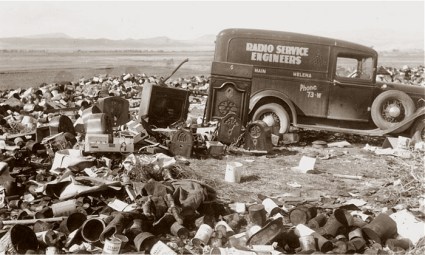
With about eight tubs full of stuff, we had enough in the back of the truck to make a full load. I had to take a rake and distribute the stuff so we could get more in. Then, when the Dutchman was convinced the truck would hold no more, we headed for the city dump, about two miles outside of town. It felt good to sit down, even if the inside of the truck smelled like an old woman who never takes a bath.

At the city dump, the Dutchman carefully backed the truck as close to the edge of the embankment as he could get without going over the side, and we got out and started unloading. I stood up in the bed of the truck and tossed the stuff over the side but, of course, I wasn’t doing it fast enough to suit the Dutchman.

“Do you want to still be working at this at midnight?” he asked.

“I’m starting to feel sick,” I said.

By the time we got back to the house to begin work on the second load, it had started to rain the kind of rain you get in November: slow, cold and steady. The Dutchman made me put on a hat—not to protect my health but because he was thinking about how much money it might cost him if I got sick and had to see a doctor.

The second truckload to the city dump didn’t go any faster than the first one and, after two loads, we had made very little progress. This was taking a lot longer than the Dutchman thought it would. There weren’t going to be enough hours in the day. I was happy, maybe for the first time in my life, at the prospect of going to school the next day.

It was when we were working on the third load that an old man from the neighborhood stepped into the yard and motioned to us. The Dutchman stopped what he was doing and went over to him. I was near enough that I could hear.

“I know somebody that will take all that stuff away for you for a good price,” the old man said.

The Dutchman thought about it for a minute and shook his head. “No, thanks,” he said. “I can do it myself.”

“Looks like that boy there’s about worn out,” the old man said. He meant me, of course.

The Dutchman looked at me as though noticing me for the first time. “He’s stronger than he looks,” he said with a little laugh.

My mother came out of the house then in her plastic rain bonnet. “You know somebody that’ll do this hard work?” she asked.

“My nephew and his friend,” the old man said. “They’ve got themselves an old truck and will do little jobs here and there to earn enough money to fill it up with gas.”

“Does your nephew have a phone number?” she asked.

The old man gave the number and my mother said she would remember it without writing it down. She thanked the old man and he left.

“You come into the house,” she said to me, “and get cleaned up before supper.”

“He’s not going in,” the Dutchman said, “until the work is finished.”

“Says you,” she said.

She put her hand on my shoulder and drew me along with her into the house. It was one of the few times I ever saw her stand up to the Dutchman.

I took a bath as hot as I could stand it to get the roof grit off and put on my pajamas. I had the sniffles afterwards and there were some bleeding cuts on my hands, but I was happy and was sure I would be all right.

The next day when I came home from school, all the roof junk in the yard had been taken away. Mother told me she paid for it out of her own money and that it had been a real bargain. I was beaming with satisfaction at the dinner table that evening while the Dutchman looked unhappy and defeated, too dispirited even to complain that the mashed potatoes weren’t the way he liked them.

Copyright © 2017 by Allen Kopp

Tulip Fever ~ A Capsule Book Review

Tulip Fever ~ A Capsule Book Review by Allen Kopp

Tulip Fever is a novel by Deborah Moggach set in picturesque Amsterdam, Holland, in the year 1636. Cornelis Sandvoort is a wealthy merchant. At sixty-one, he is in the twilight of his years. His young wife, Sophia, is only twenty-six. Cornelis lost his first wife and child to disease; he wants nothing more than for Sophia to give him another child to carry on his name and his business after he is gone. Sophia honors and respects Cornelis—after all, he saved her family from poverty—but she doesn’t love him. She finds his physical presence repellant.

When Cornelis commissions a young painter, Jan Van Loos, to paint his and Sophia’s portrait, Sophia quickly becomes enamored of the painter. She falls so easily. She sneaks out of the house at odd times to meet the painter. They become lovers. She goes to great pains to make sure her husband doesn’t find out.

Sophia has a maid named Maria. Maria has a lover named Willem. Maria and Willem are intimate together and plan on being married. Maria finds herself expecting Willem’s child. Willem, through a misunderstanding, believes that Maria has been unfaithful to him with another man. Heartbroken, he runs off and joins the navy, not even knowing that Maria is going to have his baby.

Sophia tells Maria she will soon have to leave the household since she is going to have a baby and isn’t married. With nothing to lose, Maria threatens to expose Sophia for carrying on a clandestine love affair with the painter Jan Van Loos. Rather than part on bitter terms, Sophia and Maria together devise a plan whereby Sophia will pretend to be pregnant (by her husband, of course), while concealing Maria’s pregnancy. Then, when Maria’s baby is born, they will pretend it is Sophia’s and that Sophia died during the delivery. Pretending to be dead, Sophia will then be free to run off with her lover, Jan Van Loos, to Batavia in the East Indies and start a new life.

While Sophia and Jan’s elaborate deception plays out, the city (Amsterdam) and the country (Holland) are in the grip of “tulip fever.” Fortunes are being made and lost in tulip bulb speculation. Some bulbs are worth a fortune. Never has the adage “a thing is worth what somebody is willing to pay for it” been more appropriate. Jan is counting on one fabulously expensive bulb (which he plans on selling for much more than he paid for it) to get him out of debt and pay for his and Sophia’s passage to a new country and a new life. Their plot to trick Sophia’s husband—and the world—has worked so far. All they need is a bit more luck and for Jan’s bumbling servant, Gerrit, to pick up the bulb and bring it to Jan.

Tulip Fever is a tautly written 280 pages. The themes of infidelity, greed, self-delusion and human failing that we see here are universal. Jan and Sophia’s illicit love affair was one thing, but their plan to fool Sophia’s husband with Maria’s baby and then to run away to another country was something else. Failure was built in from the beginning. A strong story about the extraordinary lengths to which people will go to achieve their own version of happiness.

Copyright © 2017 by Allen Kopp

Call Me by Your Name ~ A Capsule Book Review

Call Me by Your Name ~ A Capsule Book Review by Allen Kopp

Call Me by Your Name, a novel by a writer named Andre Aciman, is set on the Italian Riviera during a summer in the mid-1980s. Elio is seventeen, very astute and with more depth than most people have at three times his age. He plays the piano, knows several languages, and his work for the summer is transcribing Haydn’s The Seven Last Words of Christ. When was the last time you knew a seventeen-year-old boy who could boast of such splendid accomplishments?

Elio’s father is an American college professor and his mother Italian. They are what are called “ex-pats.” They live on the beautiful Italian Riviera near the spot where Percy Shelley drowned in 1822 at the age of twenty-nine. Every summer Elio’s family hosts an academic to stay with them for about six weeks or so. During the summer in which the story takes place, a twenty-four-year-old man named Oliver is chosen from among other applicants. Despite his young age, Oliver is also an academic and is busy working on a book on an esoteric, scholarly subject. That doesn’t mean, however, that during his summer with Elio’s family he doesn’t have plenty of time for nightlife, tennis, swimming and lying around naked, or practically naked, in the sun. Oh, and he’s also very good looking with a fabulous body. And, when it comes to sex, he is absolutely freewheeling, not bound up in rigidity and Puritanism the way most American men are.

So, the story of this summer in the mid-1980s is being told to us in the first-person voice of Elio, about thirty years or so after it occurred. In a way, it is a coming-of-age story, but with a twist. Most adolescent boys living on the Italian Riviera with their well-to-do and sophisticated parents are going to become infatuated and obsessed with a dark-eyed Italian woman with large breasts. In Elio’s case, however, the object of his lust and affection is Oliver, the young American man who came for the summer and changed Elio’s emotional landscape and the way he would forever view the world.

The words “homosexual” or “gay” are never used in Call Me by Your Name, but that’s what we’re talking about here. There is absolutely a blasé attitude toward sex and gender identity that is very European and that most Americans would find offensive. Americans separate “gay” and “straight” like they separate cars and motorcycles. The European attitude toward sex is that it is more of a continuum. If today you are with a woman and tomorrow a man, who cares? It’s just different branches of the same tree.

Copyright © 2017 by Allen Kopp  

The Heavenly Table ~ A Capsule Book Review

the-heavenly-table-cover

The Heavenly Table ~ A Capsule Book Review by Allen Kopp

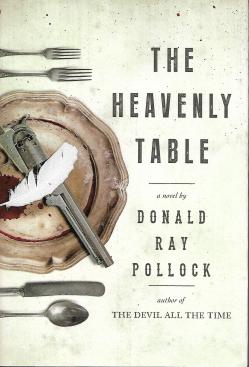
The Heavenly Table by Donald Ray Pollock is set in the year 1917. Three brothers—Cane, Cob and Chimney Jewett—are dirt poor. They live in a shack with a dirt floor and barely have enough food to eat to go on living. Cane, at twenty-one is the oldest, the most sensible of the three and the only one who might be considered handsome (if he could get himself clean). The middle brother is Cob, who is fat and a simpleton. The youngest brother, Chimney, is only seventeen. He’s reckless, impulsive, foul-mouthed and obsessed with sex. When the Jewett brothers’ father, Pearl, dies suddenly one day during his labors, the three boys decide their life is going to be different from that moment on. They kill Mr. Tardweller, the landowner for whom they work for pennies, and after they’ve done that, they go on a spree robbing banks.

Of course, a life of crime requires keeping on the move. As the Jewetts move around, being pursued, of course, by law enforcement officials, they develop a reputation that is bigger than they are. Crimes that they never dreamed of committing are attributed to them. They become, in a way, folk heroes among a downtrodden people who believe the little man will never get a break in life. And, as bad as the Jewett boys are, they really aren’t all that bad. As they immerse themselves in a life of crime, we begin to see little pieces of their decency, even from Chimney, the roughest of the three. They want to make it to Canada, where they believe they can live a peaceful life and eventually partake of the Heavenly Table with the money they have stolen. You and I know, though, that criminals, after committing violent crimes, rarely have their fondest wishes realized.

There is a host of secondary characters in The Heavenly Table. Ellsworth and Eula Fiddler are a poor farm couple whose no-account son, Eddie, causes them plenty of heartache. They believe that Eddie has gone off to fight in the Great War, until they learn what really happened to him. Lieutenant Bovard is an officer in an Ohio army camp where men are being prepared to fight. He is self-loathing because he is secretly a homosexual. He longs to die on the front in the war with a handsome young recruit by his side named Frank Waller. Jasper Cone is a much-maligned outhouse inspector in the little town of Meade, Ohio. His job is to go around the town checking the level in outhouses to make sure they are not in danger of overflowing. A young black man named Sugar lives off a woman in Detroit until she takes up with a younger man and kicks Sugar out of the house. Homeless, Sugar is penniless and mean. He begins rambling to find his way in the world (another woman to support him?). Eventually the paths of all these characters intersect.

The Heavenly Table is full of dark humor and violence. Despite its gothic tone, it is breezy, one might almost say, light, reading. It’s full of folksy anecdotes about things that happened in people’s lives to make them what they are. It’s set in a much quainter, simpler time (1917), and its evocation of that time makes us feel we’re there. Imagine every house in town having an outhouse, while the city council is putting out calls for indoor plumbing. Imagine having a “Whore Barn” on the edge of your town that caters mostly to young soldiers at the nearby training camp, while the “clap doctor” is railing at them about the dangers of venereal disease. Imagine trying to get a 1917 car going and running while you tool around the countryside. The next thing you know, they’ll be converting the livery stable into an auto repair shop.

Copyright © 2017 by Allen Kopp

The Boys on the Rock ~ A Capsule Book Review

the-boys-on-the-rock-cover

The Boys on the Rock ~ A Capsule Book Review by Allen Kopp

The Boys on the Rock by John Fox is similar in theme, tone and style to J. D. Salinger’s Catcher in the Rye. Both are coming-of-age stories with the protagonist/antihero as first-person narrator. In The Boys on the Rock, we have Bill “Billy” Connors as the Holden Caulfield-like narrator. In 1968, we find Billy as a high school sophomore. He’s an only child and his parents are off on their own planet. His mother is an attractive thirty-four-year-old housewife, and his father is ten years older than she is and getting old before his time. Billy is on the swim team at school and, except for swimming, he isn’t much interested in school. He experiments with dating girls, following the lead of all the other boys, but that isn’t really where his interests lie. He smokes, drinks, swears, hangs out with his friends, and lives a private, inner life.

During the arduous and drawn-out process of selecting a presidential candidate in 1968, Billy volunteers in the campaign office of his congressional district in New York for Eugene McCarthy. Billy is for Eugene McCarthy, he says, because McCarthy is against the war and against the draft. Like all the other boys his age, Billy is afraid of having to fight in the Vietnam war. He believes that a liberal candidate like Eugene McCarthy, if elected to the White House, will end the war before Billy has to face the possibility of being drafted into the army.

While working on the McCarthy campaign, Billy meets Al DiCiccio, a college student four years older than Billy to whom Billy is immediately attracted. That’s why Billy was never much of the hit with the gals. He prefers his own gender. He isn’t surprised by his feelings for Al DiCiccio, but he has to keep it a secret. He knows how he will be treated if the truth comes out. When he wants to tell somebody what he is feeling and to ask for advice about “what to do,” he decides to tell a young swim coach at his school, believing the coach will be, if not understanding, at least sympathetic. The coach advises Billy to seek counseling to become “cured” of what the coach sees as a sickness. This is exactly the kind of advice that Billy doesn’t want to hear.

When Billy discovers that his feelings for Al DiCiccio are reciprocated, the two meet in secret a few times, but they are essentially incompatible and the relationship is doomed to failure. Al is interested in a political career, he says, and he believes that a politician must have a wife and children. He is willing to end his volatile relationship with Billy on those terms. We know, though, that with Al out of the picture, there will be others for Billy to turn to. He is, after all, only seventeen years old. He’s just getting started.

The Boys on the Rock is a small, gem-like novel (146 pages) incorporating themes of family, friendship, alienation, and finding one’s way in the world. It’s almost effortless reading and reminds us how effective simple, uncluttered, first-person narration can be.

Copyright © 2017 by Allen Kopp

The Young Pope ~ A Capsule Review

the-young-pope

The Young Pope ~ A Capsule Review by Allen Kopp

His name is Lenny Belardo. When he is about ten years old, his ridiculous-looking hippie parents drop him off at a Catholic orphanage, where a kind nun named Sister Mary becomes a surrogate mother to him. Fast-forward about thirty-seven years. Lenny Belardo is the first American Pope, Pope Pius XIII, Holy Father to a billion Catholics around the globe. In HBO’s ten-part series, The Young Pope, English actor Jude Law plays Lenny Belardo/Pope Pius XIII with an American accent and a sleek hairpiece.

With his youth and good looks, Pope Pius XIII could be the flashiest Pope ever, but he is just the opposite. He doesn’t care about being famous or about inspiring adoration in the masses. He is not the traditional Pope; he is many things; he is a contradiction. He smokes cigarettes. Some think he is a saint, while others fear him. In his first homily to the public, delivered at nighttime in St. Peter’s Square, he appears in very dim light so people cannot see his face. He won’t allow himself to be photographed or for his likeness to be used on Vatican souvenirs to sell to tourists. When someone asks, “What is his sexual orientation?,” the answer is, “He doesn’t have one.” He wants to flush out homosexuals and pedophiles from the priesthood. “Homosexuality and pedophilia are two very different things,” a fellow priest points out to him. “Yes,” he says, “but there is no room in the priesthood for either of them.” In his searing address to the Conclave of Cardinals, he tells them he wants complete obedience to himself and absolute devotion to God. From now he, he tells them, they will isolate themselves from the world so they might worship God in the appropriate manner. This means they must give up their worldly lives and return to the original notion of what it means to be a priest.

As we see in American politics, the Pope’s rivals will attempt to destroy him by any means at their disposal. When they try to manufacture a clandestine love affair for him with the wife of one of the Vatican Swiss Guards, it backfires. The Cardinal Secretary of State, who orchestrated the invented affair, ends up apologizing to the Pope and kissing his foot in the Vatican garden. The Pope refuses to play into the hands of the entrenched, old-guard priests who have been in the Vatican for decades and have outlived their usefulness. He refuses to resort to the old tricks that have been used for centuries. Rivalries and jealousies among the cardinals mean nothing to him. He is supremely confident. If he isn’t a saint, he seems like one at times. Someone asks him, “Just who are you?” They can’t figure him out. This makes for very interesting TV for the discriminating viewer who is looking for something a little more challenging to watch and think about than the usual TV fare.

Copyright © 2017 by Allen Kopp

Gospel Hour ~ A Capsule Book Review

gospel-hour

Gospel Hour ~ A Capsule Book Review by Allen Kopp

Southern writer T. R. Pearson (born 1956 in Winston-Salem, North Carolina) has a writing style all his own, as you will know if you’ve ever read any of his books. It’s a style that might discourage a lot of readers, but if you persevere and don’t give up after a few pages, you get into the rhythm of the writing and find that it’s fun and not all that difficult to read. Some writers, such as William Faulkner, write such long, esoteric, cerebral sentences that it’s sometimes hard to understand what the man is saying; you might have to go back and break the sentence down into its separate clauses before you know what’s going on. While T. R. Pearson writes some very long sentences, he’s not as challenging to read as William Faulkner and you should be able to extract the meaning of his sentences at the first reading, as long as you are paying attention and don’t have too many distractions. Here is an example of one of T. R. Pearson’s sentences, from his novel Gospel Hour:

But she failed unaccountably to disclose to him just what precisely had transpired there in the sanctuary between the doxology and the bi-weekly prayer for the shut-ins which left Donnie Huff quite unable to anticipate the visit he received come Tuesday evening from a Laurel Fork delegation, the call he entertained from Mrs. Troy Haven and Mrs. Norma Baines and the Reverend Mr. Worrell’s wife Louise in addition to Miss Cindy Womble who’d seen fit herself to tote with her her sizeable hooters that Donnie Huff commenced straightaway to appreciate and know in his heart such gladness about that he left the ladies to stand for a time on the front slab while he simple gazed enchantedly through the screenwire until Opal Criner prevailed upon him to admit please the pack of them into the house.

And this is just one sentence!

Gospel Hour is a comic Southern novel about good-old-boy Donnie Huff who lives in a small house with his wife, Marie; his mother-in-law, Opal Criner; and his small son, Delmon. Donnie Huff is not very smart or ambitious. He swills beer and spends his evenings in front of the TV. He works as a lumberjack with a crew of other men just like him. One day when these men are poaching lumber (stealing lumber that doesn’t belong to them), Donnie Huff has an accident with a skidder (whatever that is) and ends up in the river upside down underneath the skidder. When his co-workers pull him out of the river, they believe he’s dead. After a couple of minutes, though, he revives. He has had, they believe, the rare experience of dying and being brought back to life.

Donnie goes on about his business and doesn’t think much about what happened to him in the river. All he saw, he says, were green spots. Nothing much to rave about. When his devoutly religious mother-in-law Opal Criner and other ladies of the church find out that he has had a dying-and-brought-back-to-life episode, they make it into a transformative religious experience. Egged on principally by his religious mother-in-law, Opal Criner, Donnie becomes convinced that he saw Jesus at the portal of heaven and that Jesus touched a “downy patch” on his arm. Suddenly Donnie, who never attracted much positive attention before in his life, becomes a celebrity. People begin donating money to his “ministry.” Donnie knows a good thing when he sees it. He’s tired of scratching out a living as a lumberjack. There’s real dough to be made as a minister. People want to be healed of their afflictions and they believe that touching the “downy spot” on Donnie’s arm that Jesus touched will do it for them. Donnie’s biggest sceptic is his droll wife, Marie. She’s mainly interested in decoupage and she’s not buying into Donnie’s sudden religious conversion.

Religion, as we see in Gospel Hour, is, in some (but not all) instances, a “business” whose main goal is reaping profits. When Donnie sees people in a tent revival who are sincerely crushed by grief, disappointment, and the general nastiness of life, his true conversion begins. He can’t really help these people by letting them touch the “downy spot” on his arm, he realizes, and he can’t fool them into believing he’s something he’s not. Even though he’s not very smart, he sees the phoniness in what he’s doing, and this, at the end of the novel, is his real moment of triumph.

Copyright © 2017 by Allen Kopp

I Want My Money Back

i-want-my-money-back-image

I Want My Money Back ~ By Allen Kopp

What has been seen cannot be unseen. Time lost cannot be recovered. Money wasted cannot be regained. The nominees for recent movies that, to me, were a complete waste of time, money, and effort:

Birdman ~ If the first thing you see in a movie is Michael Keaton in his underpants, you know it’s not a good sign. And, if Michael Keaton in his underpants one time isn’t enough, you will see Michael Keaton in his underpants again later in the movie. Birdman is a boring, pretentious, incomprehensible, talky-talky-talky-blab-blab-blabfest. All the characters do is stand around and talk. The most honored movie of the year, grabbing every award in sight. Everybody wet their pants over this one. Except me.

Gone Girl ~ Based on a novel I have no intention of ever reading, Gone Girl is about a married couple who don’t have such a good marriage. She’s a children’s author (ho-hum, I’m bored already), and he co-owns a bar in Cape Girardeau, Missouri, with his sister. She wants to spice things up in her marriage, so she tries to make it appear that he killed her and, after she has done that, she goes into hiding. She’s a devious, unlikeable, psychopathic, black-hearted bitch. Wait a minute! She is exactly the kind of despicable wife he deserves. This movie is like an episode of Dr. Phil. Excuse me while I locate my vomit bag.

Noah ~ Not much at all is known about Noah from the Bible, so the screenwriters here concocted a completely fictitious story with movie star Russell Crowe as Noah, complete with computer-generated animals. They’ve tried to make the story relevant and trendy by inserting references to the environment. They can’t bring themselves to refer to God for fear of offending anybody, even though God is an important, though unseen, element in the story. Noah is a religion-based movie seemingly made by people who don’t believe in anything other than their potential for box office profits.  A bizarre, fabricated, disappointing story that bears no resemblance to anything in the Bible. What a load of horse hockey!

The Martian ~ A pedestrian sci-fi fantasy starring my least favorite movie actor in the universe, the smirking Matt Damon. He’s stranded alone on Mars after his astronaut colleagues think he’s dead. Well—guess what?—he’s not dead. He’ll have to figure out a way to survive alone in the hostile Martian environment for over a year; that’s how long it’ll be before anybody is scheduled to return. He uses his own excrement to grow potatoes as a food source. Classy, isn’t it?  The Martian is a derivative, implausible, completely predictable exercise in tedium.

Still Alice ~ She’s a classy lady, a professor at a prestigious university, married to a renowned doctor. She lives in a beautiful house and is mother to several handsome, accomplished, successful children. When she’s only about fifty, she develops early-onset Alzheimer’s. We watch her as she forgets where the bathroom is in her own house and wets her pants. We watch her as she completely falls apart, not even being able to remember how to kill herself. Still Alice is like a story line to a soap opera or a TV disease-of-the-week movie. Manipulative and distasteful.

Life of Pi ~ A boy/man is traveling across the ocean from India to Canada on a small ship. His family owns a zoo in India and, because of financial difficulties, they are moving the zoo, which means all its animals, to Canada. A terrible storm wrecks the ship carrying the zoo and kills everybody on the ship except the boy/man and a few of the animals. The boy/man is lost at sea on a lifeboat with the surviving animals. He develops a special relationship with a tiger. Years later, the boy/man (now a middle-aged man and no longer a boy) tells a friend with whom he is having dinner that maybe none of it ever happened. A pointless, slow, uninvolving, dull, over-produced (in 3D no less), tedious story of survival at sea. If you enjoy seeing animals die (even if they are computer-generated), then, by all means, don’t miss Life of Pi.

The Counselor ~ At the end of The Counselor, my first thought was: I wouldn’t want to have to sit through that again. It’s about a lawyer who lives in Texas close to the Mexican border who discovers a way to make a lot of money to satisfy his appetites: get involved in drug smuggling. Of course, he must deal with unsavory types, and things don’t go as he hoped they would. He discovers the truth to the adage: If you lie down with dogs, you get fleas. Don’t waste your time on this tawdry dud. It’s two hours of your life you’ll never get back.

World War Z ~ The world is experiencing a zombie influx. No one is safe. Movie star Brad Pitt might be just the hero to save humanity. He has a wife in blue jeans and two shrieking daughters in deadly peril. World War Z is a lame, silly, bloodless, predictable, big-budget horror film. The scariest thing about World War Z is Brad Pitt’s hairdo.

Copyright © 2017 by Allen Kopp

The Gap of Time ~ A Capsule Book Review

the-gap-of-time-cover

The Gap of Time ~ A Capsule Book Review by Allen Kopp

The Winter’s Tale is one of Shakespeare’s later plays and is less well-known than many of his other plays. It’s about King Leontes, King of a country known as Sicilia, who has a wife, Hermione, and a best friend, Polixenes. Hermione is about to give birth to a baby. With no proof at all, Leontes gets the idea into his head that Hermione and Polixenes have been having an affair and that Polixenes is the father of the baby that Hermione is about to have. When the baby is born, it’s a girl and Hermione names her Perdita. Leontes can’t stand to look upon the baby and threatens to dash its brains out. Rather than killing it, however, he agrees to let a character known as Antigonus take the baby away and “cast it to fortune.”

Antigonus takes the baby to the country of New Bohemia. A terrible storm at sea kills Antigonus, but Perdita is delivered safely to land. A poor shepherd and his dimwitted son named Clown, played by Jerry Lewis (just kidding), find Perdita and raise her as their own. Fast-forward sixteen years. Perdita is now about seventeen years old and has fallen in love with Florizel, the son of Polixenes, the one-time best friend of King Leontes of Sicilia. (Coincidence plays a very large part in this narrative, as you can see.) Polixenes apparently knows who Perdita is and is violently opposed to the match. Florizel and Perdita escape from New Bohemia and end up in good old Sicilia.

When Leontes meets Perdita, he is attracted to her, not knowing she is really his own daughter. (Yuck!) The shepherd who raised her and his son, Clown, show up (just when needed) with proof of who Perdita is (apparently articles that were left with her when they found her as an infant). Everybody is reconciled and Leontes admits that he wronged his wife Hemione and treated her unfairly. When he sees a statue of Hermione in a friend’s home, it is so lifelike that he wants to kiss it.

The Gap of Time is a novel by the English writer Jeanette Winterson. It is a “re-imagining” of Shakespeare’s play The Winter’s Tale. All of Shakespeare’s characters are now hip contemporary characters. Leontes is now an unlikable jerk with a foul mouth known as Leo, head of a big company known as Sicilia. Hermione is a singer (wouldn’t you just know she’d be something like that?) named MiMi. Polixenes is now Xeno and he’s gay. Just to keep things contemporarily politically correct, the shepherd is now black and is known as Shep. His son Clown is now Clo and he and Perdita consider themselves brother and sister, even though he’s white and she’s black.

So, The Gap of Time is a Shakespeare play with the Shakespeare part removed. I’m not sure what the point is here. Did the world really need to have The Winter’s Tale by William Shakespeare “re-imagined” by a contemporary writer?  Does Jeanette Winterson add something that Shakespeare left out? Do Shakespeare’s characters need to be updated and made to sound groovy and hip like characters in a Sylvester Stallone movie? Do we really need to have any of Shakespeare’s plays “dumbed down” for a contemporary reading public? (The vast majority of the public never reads a book.)

The Gap of Time is engaging at times with some good dialogue, especially in the first half. There’s a lot of claptrap interspersed throughout the novel about time, about how time affects its players, and about how time…I’m not sure what time is supposed to do here, and I’m not sure exactly the point that Jeanette Winterson is trying to make about time, but I do know that time is of immense importance to this story.  Am I to conclude that time heals all wounds and wounds all heels? If you think you want to read The Gap of Time, don’t. Instead get a copy of Shakespeare’s play, The Winter’s Tale, and read it. You’ll feel a lot smarter for it.

Copyright © 2017 by Allen Kopp

Lion ~ A Capsule Movie Review

lion

Lion ~ A Capsule Movie Review by Allen Kopp

Five-year-old Saroo lives with his mother, his older bother, Guddu, and his younger sister, Shekila, in a small village in India. The family is poor but loving and close-knit. Saroo’s mother can’t read or write. Saroo and his brother scavenge coal and exchange the coal for food. When Guddu goes out at night to look for work, Saroo insists that Guddu takes him along. When Saroo becomes sleepy, Guddu leaves him on a bench at the railroad station. Many hours later when Saroo wakes up, Guddu hasn’t returned. There is nobody around at all, so we assume it’s the middle of the night.

In looking for Guddu, Saroo boards an abandoned train that is just sitting there. He falls asleep on a bench on the train and when he wakes up the train is in motion. He’s locked in and can’t get out and can’t get anybody to hear his cries for help. Two days later the train is 1600 kilometers away in Calcutta. Saroo is alone in the big, frightening city. He, of course, doesn’t know where he is, nor does he understand how he got there. He is just alone on the streets with hundreds of other children in similar circumstances.

Saroo experiences kindness from strangers, but he also knows that he must be wary of them. A seemingly kind woman takes him in and feeds him and gives him a place to sleep, but Saroo overhears that she is going to give him to a man, for what purpose Saroo doesn’t know. Another kind man spots Saroo on the street outside a restaurant and takes him to the police. The police question him about where he comes from, but they speak a different language, so Saroo isn’t able to tell them anything. When he says the name of his village, they don’t know what he’s talking about.

After months on the streets of Calcutta, Saroo ends up in an orphanage. The orphanage people try to reconnect him with his family by running ads in Calcutta newspapers, but nobody comes forward to claim Saroo. A kind welfare woman informs Saroo that a couple in Australia wants to adopt him.

Saroo travels to Australia and is taken into the home of John and Sue (David Wenham and Nicole Kidman), an almost-too-good-to-be true, middle-class Australian couple. (David Wenham played a pumped-up Greek warrior in the movie 300.) Twenty years go by and Saroo grows into a man. He is smart, decent and respectful, everything John and Sue hoped he would be. Sue tells Saroo after he is grown that she and John opted not to have any children of their own. “There are already enough people in the world,” she says. When she was twelve years old, she says, she had a “vision”  that one day she would take a “brown-skinned” child into her home and give him a better chance at life.

As happy and well-adjusted as Saroo is as an adult, he can’t forget his family back in India. He becomes obsessed with finding them again and letting them know what happened to him. When somebody tells him about Google maps on the Internet, he spends many hours looking for clues to where he came from. Even if he finds the place, he has no guarantee that his family will still be there, or that they are still alive.

Finally, his searching pays off. He recognizes features on Google maps that he recognizes from childhood. When he learns the name of the place, he knows it’s what he was trying to say, but he was saying it wrong. He travels to the place in India that he has located by way of Google maps. More than twenty-five years have gone by since he disappeared. What will he find when he returns to his childhood home?

We never know where Lion is taking us. Where we end up is not where we expected to be. It’s an engaging and emotional (real emotion as opposed to melodrama) movie with many fine touches. If you are capable of being moved by the plight of a homeless five-year-old boy in the slums of Calcutta, India, you will be moved by Saroo. He’s like a little animal with a haunting voice and enormous brown eyes. He loves his mother, his sister, and his brother, and he wants desperately to find them.

Copyright © 2017 by Allen Kopp