This Storm ~ A Capsule Book Review

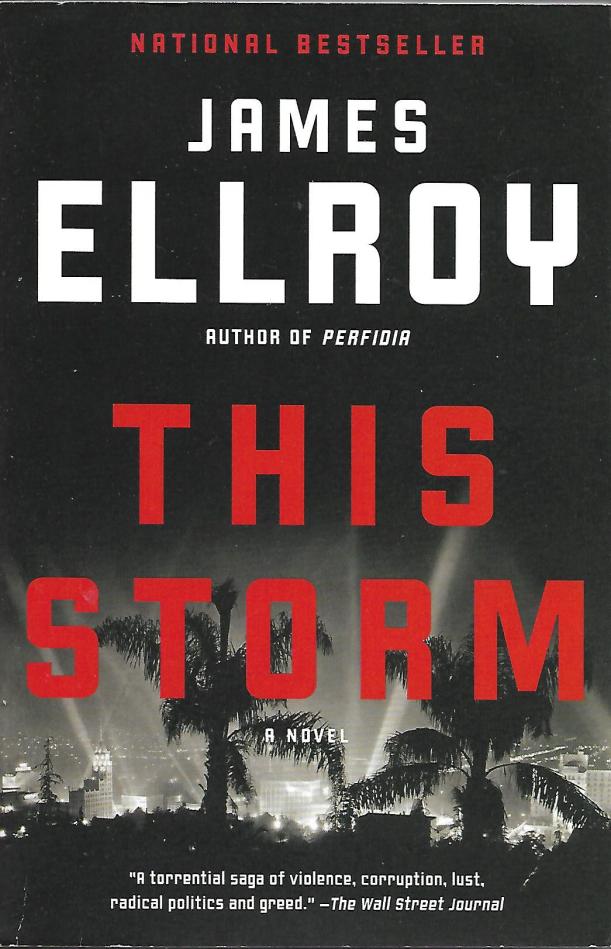
This Storm cover
This Storm by James Ellroy
~ A Capsule Book Review by Allen Kopp ~

James Ellroy’s noir-mystery novel, This Storm, is set in and around Los Angeles in the early days and months of World War II. It is a time of rainstorms, blackouts, fear, paranoia, murder, suicide, racial unrest, Nazis, fascists, European refugees, Japanese internment camps, police corruption, cover-ups, violence, prostitution, promiscuous sex, and Simons Drive-in, where you can get a fantastic cheeseburger and a pineapple malt served by a floozy carhop.

This Storm is a gargantuan novel, almost 700 pages. If you are familiar with James Ellroy’s writing style, you know he doesn’t write like any other writer. “If you want political correctness, you’ll have to go someplace else,” he plainly states. He uses racial epithets the way other writers use adjectives. In short, there is nobody else quite like him. His style is choppy, with lots of slang expressions, punchy chapters, lots of tough-guy language and hair-trigger violence. We see the bad-boy cops in The Storm kill “suspects” they are pursuing when nobody is looking or pound them in the head with the massive LA phone directory while they are “interrogating” them. The war has unleashed all of men’s (and women’s) worst instincts, it seems. Almost all the characters The Storm are horrible people. Some are worse than others. These people are beyond redemption, but they also make for entertaining reading.

Of all the many dozens of characters in The Storm, you might say that police lieutenant Dudley Smith is the principal character. He is an Irish immigrant who killed many British soldiers in his homeland before coming to America, a “shit-heel,” a self-serving, arrogant, corrupt, lying, cheating bastard with the looks and savoir faire the ladies toss their panties over. In Baja during the war, he’s involved in several nefarious and illegal enterprises, such as “selling” Japanese laborers to the highest bidder. If he was ever called to ground, he could be locked up in prison for many lifetimes for all his transgressions. Nothing seems to touch him, though.

Hideo Ashida is the most interesting character in the novel. He’s a Japanese-American, working as a forensic chemist for the Los Angeles Police Department. As a Japanese man, he is spit at and reviled in the days after Pearl Harbor. He is a homosexual and is believed to be in love with Dudley Smith, flaws and all. They have a special kind of man-to-man friendship, which Hideo knows will never be realized sexually.

There are many other characters, sometimes so many of them that it’s hard to keep them all straight and remember their names; some of them are, by necessity, one-dimensional. Barbara Stanwyck, Ellen Drew, Orson Welles and symphony conductor Otto Klemperer are real-life characters among all the fictional ones. (If these people weren’t all dead, they might have grounds for legal action based on the way they are portrayed here.)

This Storm is a follow-up to the earlier novel Perfidia. These two novels are the first two parts of James Ellroy’s Second LA Quartet. (You remember the First LA Quartet, don’t you?) We will be eagerly awaiting the third novel, which, we presume, will pick up where This Storm leaves off.

Copyright © 2021 by Allen Kopp

Alec ~ A Capsule Book Review

Alec cover
Alec
~ A Capsule Book Review by Allen Kopp ~

English author E. M. Forster lived from 1879 to 1970. He wrote his novel Maurice in 1912-1913, but it wasn’t published until 1971, after his death. The reason for the delay in publication is the novel’s unusual subject matter: an upper-class gentleman, Maurice Hall, has a homosexual affair with a man of the lower class, Alec Scudder, who happens to work as a gamekeeper for the salary of twelve pounds a year. Homosexuality was still a crime in Britain in 1912-1913, so Forster feared serious backlash from such a novel, especially since it has a happy, positive conclusion. Maurice Hall and Alec Scudder are not freaks and they don’t destroy themselves at the end of the book.

Fifty years after its publication and more than a hundred years after it was written, Maurice remains enduringly popular. Now a writer named William di Canzio has written a novel, Alec, that picks up where Maurice left off.

It’s 1913, a repressive time in England for men of a different stripe. When Maurice Hall goes to his friend’s estate for a visit, he encounters a gamekeeper named Alec Scudder. They both harbor a secret that they keep from the world. When Alec boldly climbs into the window of Maurice’s room late at night, a barrier between them falls away. They find they connect in all the important ways, even though they belong to different classes. Alec plans to emigrate soon to Argentina, but Maurice gets him to stay in England. They decide they will spend their lives together, knowing they will face tremendous disapproval from the world.

That might be the end of the story, but it’s 1914 and war breaks out (what will later become known as World War I). Maurice and Alec must do their part for their country, so they both enlist. They think they can be together during their military service, but it doesn’t quite work out that way. Alec joins the Welsh Fusiliers and Maurice ends up fighting in Gallipoli in Turkey, a hell-hole if there ever was one, where fighting conditions for English soldiers could not have been worse.

Almost the second half of Alec is about the hellish trials that Alec and Maurice both face in the war. They are both wounded and must endure loneliness, hardship and deprivation. What’s worse, they aren’t able to communicate with each other, so neither knows if the other still lives. In the chaos and confusion of war, Maurice is listed as “missing in action.” Is he one of the many fatalities of war, or does he still live?

If you have ever read Maurice by E. M. Forster and are a fan, you must by all means read Alec. It may offer nothing new about the struggle that gay men face in a hostile world, but it’s a  compelling and intelligent reading experience. The war in Alec is well-researched and has a feeling of immediacy. As with many wars before and after, it was a war of blunders and mismanagement, of “lions being led by donkeys.” The more things change, the more they remain the same.

Copyright © 2021 by Allen Kopp

Do You Take This Clown?

Do You Take This Clown image 5

Do You Take This Clown?
~ A Short Story by Allen Kopp ~

(This short story is a re-post. It has been published in the Australian literary journal, Skive.)

Mercy Buckets felt pains in her midsection. She knew there was something inside her that needed to come out. She checked herself into Clown General Hospital, believing she was dying. After a clown doctor did a perfunctory examination, he knew right away what was wrong with her. She was about to have a clown baby and, being the silly goose she was, didn’t even know it.

Almost at once she went into clown labor. When she was being wheeled into the clown delivery room, she didn’t know what was happening and became distraught.

“Somebody help me!” she screamed, her round red nose quivering with emotion. “They’ve taken my clothes! They’re holding me prisoner and they’re going to do awful things to me! Somebody call the clown authorities before it’s too late!” 

Nobody called the authorities, of course, or anybody else. A clown nurse clonked her on the head with a frying pan and after that she was quite manageable. She wasn’t able to help in the birth of her child, being unconscious as she was, but Dr. Stitches managed just fine, with the help of several clown nurses, and delivered her of a perfect baby boy.

When she woke up, she was in a bed in a little room all to herself where everything was so white and shiny she thought for a moment she might be in heaven. She heard sounds from behind the closed door but they seemed remote and far away and comforting in a way. She felt funny as if all her bodily parts had been stretched and then allowed to snap back into place. She still didn’t know what had happened to her.

In a little while a smiling clown nurse came into her room to check on her. “Are we feeling better now?” she asked. She had an upturned nose that resembled a sweet potato and a huge head with great waves of flame-red hair.

“Who are you?” Mercy Buckets asked.

“I’m Nurse Precious,” she said. “I’m here to take care of you.”

“But where am I?”

“You are on the third floor of Clown General Hospital.”

“Have I been in an accident or something?”

Nurse Precious laughed. “We do have a wry sense of humor, don’t we?”

“I want to go home.”

“Of course we do, but we’re not ready yet. If you and your baby get along well, you should be able to leave by Tuesday.”

“Me and my what?”

Nurse Precious looked at Mercy and wrinkled her brow. “You don’t remember why you came to hospital?”

“I don’t remember anything.”

Nurse Precious looked at Mercy’s medical chart. “Oh, I see,” she said. “They had to put you out, over, and under during the birth. You haven’t even seen your baby yet.”

“If you don’t tell me what you’re talking about right now,” Mercy said, “I’m going to walk out of here and take a jitney home, even though I am wearing a bed sheet with nothing on underneath.”

As if on cue, the door opened with a suck of air and Nurse Nimbus came into the room with what looked like a bundle of dirty laundry in her arms. “Here we are!” she said cheerily. She laid the bundle on the bed beside Mercy Buckets and pulled back a flap to reveal the face of a small animal.

“Ugh!” Mercy said. “That is the ugliest thing I ever saw.”

“You be sure and think of a good name for him now,” Nurse Precious said.

The two nurses linked arms and twirled around in a little jig as if that were part of the ritual that Mercy was unable to understand.

“But what is this thing?” Mercy asked. “It doesn’t even look like a clown. It looks like an ape. It’s all covered with hair.”

“Why, it’s your baby, dear,” Nurse Nimbus said. “What else would it be?”

“Are you telling me that thing came out of my body?”

“Well, the stork didn’t deliver it, if that’s what you mean,” Nurse Precious said, laughing at her own cleverness.

“Take it away!”

“Oh, you have to feed it, dear! The little fellow is hungry.”

“And just what do you have in mind that I feed it?”

Nurse Precious and Nurse Nimbus exchanged a significant look and then Nurse Nimbus discreetly exited while Nurse Precious showed Mercy what was to be done.

Later in the day, after the baby had been fed and taken away again, Mercy was dozing when Dr. Stitches dropped by her little room to see how she was doing. He was wearing a long white doctor’s gown and a rubber chicken on each shoulder like epaulettes. On his old head was a powdered wig like George Washington, only pink.

“Well, well, well,” he said. “That was quite a harrowing scene we had in the delivery room this morning, wasn’t it?”

“Who the hell are you?” Mercy asked, irritated at being awakened.

“I’m only the old fellow who saved your life and the life of your baby,” he said.

“I want to go home. My clown mother and clown father must be worried about me.”

“All in due time, my dear.”

“And when I leave, I’m not taking that thing with me.”

“What thing are we talking about, dear?”

“The little animal that they say came out of my body.”

“I take it you are referring to your son?”

“I go. It stays.”

Dr. Stitches made a note on his clipboard and looked at Mercy over the tops of his Ben Franklin glasses. “You wish to give the baby up for adoption?” he asked.

“I don’t care what you do with it. We’re not even the same species.”

“Hmm,” he said. “Mother exhibits marked ambivalence toward baby,” he said aloud as he wrote.

“My clown mother and clown father are going to die when they find out about this. They don’t know I was ever even with a man. Hell, I don’t even know it myself!”

“So, you have no knowledge or recollection of the act that brought your baby into being?”

“I don’t know anything except that I want to go home and forget that any of this ever happened.”

“You’ve had a shock,” Dr. Stitches said, patting her on the shoulder. “You just rest now and don’t worry about a thing.”

He left and in a few moments Nurse Precious came in and gave Mercy another clonk on the head to calm her down.

When she awoke she was confused. She had been dreaming that a giant chicken was holding her down, trying to put its beak into her mouth. She sputtered and picked some imaginary feathers from between her teeth. She realized then that someone was standing beside her bed and that someone was her own clown mother, Clarabelle Patootie, and her clown father, Petey Patootie. They had both been clown headliners in the biggest show in clowndom but were now retired from the show business.

“My dear!” her mother said, realizing at once that Mercy was awake. “Your clown father and I have been frantic with clown worry.”

“It’s not what you think!” Mercy said, trying to sit up. “I swear I don’t know where that thing came from!”

“Now, now, now,” her mother said. “We’re not judging you. We’ve just had a long talk with Dr. Stitches. He told us the whole story.”

“I’d like to hear that story myself,” Mercy said.

“It’s going to take some time to sort this all out.”

“Have you seen that thing?”

“Yes, we saw him. Our grandson. He’s a fine little fellow.”

“Yes, but he’s some kind of a gorilla or something. I never saw anything like it before in my life!

“You just rest now, dear. You’ve been through a terrible ordeal. We’ll talk it all out later.”

Petey Patootie never had much to say. He always let his clown wife do the talking. He patted Mercy on the hand and looked into her eyes. “You hang in there, old girl,” he said. “We’ll be here if you need us.”

She dozed off again and didn’t know when her clown mother and clown father left. The next time she opened her eyes, she saw a huge clown face looming over her. As she screamed and sat up in the bed, the clown face withdrew to a safe distance.

“Who the hell are you!” she said. “Why are you standing over me like a spook?”

“It’s Mr. Ticklefeather,” a voice said. “I was leaning close to see if you were asleep or only faking it.”

It took her a moment to see the clown from whence the voice came. “You act like a crazy person,” she said. “You scared me nearly half to death.”

“Well, I am sorry, I’m sure,” Mr. Ticklefeather said, putting his hand over his mouth.

“What are you doing here?”

“I came as soon as I heard.”

“Heard what?”

“You know. About the b-a-b-y.”

“Why would that concern you?”

“Well, I’m assuming I’m the f-a-t-h-e-r since we went out together that one time.”

“Stop that spelling! We went rowing on the lake. I’m pretty sure that doesn’t result in a baby of any species.”

“Don’t you remember when we kissed?”

“That doesn’t do it, either.”

“You finished a hot dog that I started and we drank out of the same cup.”

“Mr. Ticklefeather!” she said. “Don’t you know anything about the birds and the bees? You are not the father!”

“Who is, then?”

“That’s just it. I don’t know!”

“Oh, my!” Mr. Ticklefeather said.

“No, no, no! It’s not like that, Mr. Ticklefeather! I don’t know who the father is because there is no father!”

“What do you mean?”

“We’ll save that one for another time.”

Mr. Ticklefeather had only a moment to look perplexed because the door opened and Nurse Precious came into the room bearing the bundle of dirty laundry again.

“Time for the little chappie to feed again,” she said in her sing-song, setting the bundle beside Mercy on the bed as Nurse Nimbus had done earlier and pulling back the face flap.

“Oh, no!” Mercy said. “How many times a day does this happen?”

“It never ends,” Nurse Precious said.

“I want a bottle! Bring me a bottle with milk in it, or whatever it is they drink! I’m not doing that other thing again!”

“I’ll leave,” Mr. Ticklefeather said.

“No!” Mercy said. “I want you to see this odd little baby, even though you are not the father.”

“It’s better if you feed it the old-fashioned way,” Nurse Precious said.

“It won’t matter with this one because I’m not going to keep it anyway,” Mercy said.

Nurse Precious produced a bottle from the folds of her uniform and handed it to Mercy. As Mercy held the baby in the crook of her arm and held the nipple of the bottle to its baby snout, Mr. Ticklefeather leaned in to get a better look.

“He looks a little like me, doesn’t he?” he said.

“He doesn’t look a thing like you!” Mercy said. “You have nothing to do with him at all!”

“He looks like a Percy to me,” Mr. Ticklefeather said. “I’ve always liked the name Percy. How about if we name him Percy? Percy Ticklefeather. I like the way that sounds.”

“You can name him Boll Weevil, for all I care,” Mercy said.

“I know this is going to sound funny to you,” Mr. Ticklefeather said. “I know I’m not really his father, but I wish I was. Since he doesn’t have a father, or at least doesn’t have one that we know about, I’d like to take him and raise him as if I really were his father.”

“I don’t care what you do with him.”

“Since you are the mother and, to the world at least, I’m the presumed father, how would it be if we get married and bring the little fellow up properly, in a home with a mother and a father?”

Mercy looked at him with disbelief. “Why would I want to marry you?” she asked. “I don’t love you. I hardly even know you, even though we went rowing on the lake that one time.”

“We can get married and figure out together who the father really is and what really happened and when it happened. All will be revealed in time.”

“No,” Mercy said. “I suppose I should thank you for the offer, but I won’t ever marry you or anybody else. Not if having peculiar babies is the result.”

The baby drank the entire contents of the bottle, belched and went to sleep. By and by, Nurse Precious came back to collect the baby to take him back to the nursery.

“I’m going to take him,” Mr. Ticklefeather said to Nurse Precious. “Mercy Buckets wants nothing to do with him.”

“Are you his father?” Nurse Precious asked.

“In the absence of the truth,” Mr. Ticklefeather said, “let us say yes. I am the baby’s father.”

“Very well,” Nurse Precious said, slinging the baby onto her shoulder. “Come with me. You’ll have to sign some papers saying you assume full responsibility for his upbringing.”

Mr. Ticklefeather beamed with satisfaction and pride. He followed Nurse Precious and the baby out of the room without saying goodbye to Mercy Buckets.

Mercy got out of the bed and walked slowly to the window. She opened the blind and, looking out at the sky, saw the full yellow moon beaming down on the tired old world, exactly the way it had done on the night she and Mr. Ticklefeather went rowing on the lake. She felt tears welling up in her eyes. Agreeing to give up the baby to Mr. Ticklefeather, who wasn’t really the father, made her feel sad and lonely and a little bit sorry for herself. 

Copyright © 2021 by Allen Kopp

Porch Light


Summer Evening by Edward Hopper

Porch Light  
~ A Short Story by Allen Kopp ~ 

(Note: This is a re-post. It has been published in Dew on the Kudzu, a Journal of Southern Writing.)

Nola was reading a book sitting beside an open window in the quiet house when she heard a soft knock on the door. It was eleven o’clock at night and she wasn’t wearing very much, but she went to the door and opened it anyway. She was feeling lonely, and a little blue, and was glad for the chance to talk to someone.

“Oh, hello,” she said, when she saw Roy standing there. She was neither happy nor unhappy to see him.

“Is she asleep?” he asked.

“For hours.”

“Why don’t you come out and talk to me. I’m not in any hurry to get home just yet.”

“Oh, all right. I suppose I could for a little while.”

She turned on the porch light and stepped out the door.

“What is that you’re wearing?” he asked. “Is that what you sleep in?”

“Of course not! After I took off my uniform, I put this on to try to keep cool. I wasn’t expecting any callers.”

“It looks like your brassiere and your step-ins. And pink, at that!”

“Well, you shouldn’t be looking. If your delicate sensibilities are offended, I’ll go put on a robe.”

“No, no, no, I don’t care what you have on. It’s your porch and you’re a grown-up person and it’s too hot to wear a robe.”

“It was over a hundred degrees today and will be again tomorrow.”

“It’s hotter here than the Sahara Desert in Africa. Did you know?”

“We’ve still got two more months of summer,” she said. “I don’t know if I’m going to last. I just wish it would rain.”

He looked up at the clear, star-laden sky and held out his hand. “Not a chance,” he said.  He sat on the porch railing and she leaned her backside against it beside him. A moth fluttered crazily around the light.

“Do you want a cigarette?” he asked.

“I’ll just take a puff or two off yours.”

He lit up and handed the burning cigarette to her.

“I might call Nellie in the morning,” she said, “and tell her I’m sick and can’t make it in. It won’t be too much of a lie.”

“I thought you were going to quit that job.”

“I can’t quit until I have another job lined up.”

“Let’s go to the park,” he said. “It’s too hot to go home. We can spend the night under the stars.”

“I can’t. I have to get up in about six hours and go to work.”

“I thought you were going to call in sick.”

“Well, I haven’t definitely made up my mind about that yet.”

“I’ll have you back in time to go to work.”

“I can’t stay awake all night and work all day.”

“You won’t sleep anyway in this heat.”

“I’m usually able to forget how hot it is and go to sleep about two o’clock.”

“And then you have to get up at five.”

“And the whole rotten routine starts over again. What a life.”

“Let’s run away together.”

She laughed and blew out a spluttering stream of smoke. “Where to?” she asked.

“I don’t know,” he said. “We could hop a freight train somewhere.”

“Oh, sure! That sounds worse than what I have now. As lousy as my life is, I at least have a bed to sleep in and food to eat.”

“If you ran away, you’d be free of everything here. You could start over somewhere else.”

“What would I do about my mother?”

“Send her a postcard.”

“You’re not being very practical.”

“That doesn’t get you anywhere.”

A police car drove past, slowed almost to a stop, sped away again.

“Must be looking for somebody,” she said.

“I didn’t do anything,” he said.

“Are you still looking for a job?”

“Off and on. I could maybe go to work for my uncle if I wanted to, but I don’t want to.”

“Doing what?”

“Moving furniture.”

“That doesn’t sound very promising.”

“I applied for a job as an usher at a movie theatre downtown, but I probably won’t get it.”

“Why not?”

“Don’t want it.”

She watched the fireflies in the yard and didn’t say anything for a while. “Can you see us going on this way for the next forty or fifty years?” she asked. “Until we die?”

“I don’t think about it much,” he said.

“I think there has to be more to life.”

“Maybe tomorrow will be better. That’s what you have to hope for.”

“I might get married to somebody someday,” she said, “but it’s going to have to be to somebody who can take me away from all this.”

“You wouldn’t marry me?” he asked. She knew he was joking.

“No,” she said. “You’re a bum like everybody else I know.”

“Well, that can always change. I haven’t completely given up on life.”

“Go to school and become a doctor or a lawyer,” she said. “Then I’ll consider marrying you.”

“I’m lacking some necessary ingredients for that,” he said. “Namely, money and ambition.”

“You can’t be a bum all your life.”

“Who says? My father has been a bum all his life and his father before him.”

“Maybe you’re better than that.”

“My mother wants me to join the army. She’s threatened to throw me out of the house if I don’t do something.”

“Maybe that’s what you need.”

“If she tosses me out, can I come and live with you?”

“No. You and my mother wouldn’t get along.”

“You see how it is? If it’s not my mother giving me grief, it’s somebody else’s.”

“What a life,” she said.

“Are you sure you won’t go to the park with me?”

“It’s late. I need to try to go to sleep so I can get up and go to work in the morning.”

“What a life,” he said. “My room is so hot I can’t stand to lie on the bed. I put a quilt on the floor underneath the window and sleep on it naked until the sun comes up.”

“I really should be going in now.”

“Will you go to the park with me tomorrow night?”

“Maybe.”

“Something good is going to happen tomorrow,” he said. “I just know it. Maybe a thunderstorm.”

“Good night,” she said.

“Good night.”

She knew he would leave whenever she told him to. He wouldn’t try to kiss her or touch her, the way some would. He never did that; he wasn’t that kind of a boy. She had known him so long. He was more like the brother she never had.

She went back inside and turned off the porch light, locked the door. She went to the door of her mother’s room to make sure she was still sleeping and then she walked through the dark house she knew so well and got into her bed. Far off in the distance she heard the low rumble of thunder that could only mean one thing. If she stayed awake long enough, she might see lightning and hear some rain on the roof.   

Copyright © 2021 by Allen Kopp 

A Mate for the Monster

The mate for the monster.

A Mate for the Monster
~ A Short Story by Allen Kopp ~

(This is a re-post.)

The monster is seven and a half feet tall and as strong as ten men. He walks in a frightening, slow-gaited, halting manner. He has a bolt in his neck; his face is stitched onto his enormous head. He probably doesn’t know that he is made up of body parts from dead people (and if he did know he wouldn’t care). No matter where he goes or what he does, he scares people without even trying. That’s what makes him a monster.

He lives in a lonely castle on a mountaintop. He has no friends and his days are empty and pointless. His brain is not so addled that he can’t ask himself why he was ever created in the first place. He has recently taken to talking a bit and, when he’s not smoking cigars, drinking wine, or running around the countryside scaring people, he says things like, “Love dead—hate living.” This is not a good sign.

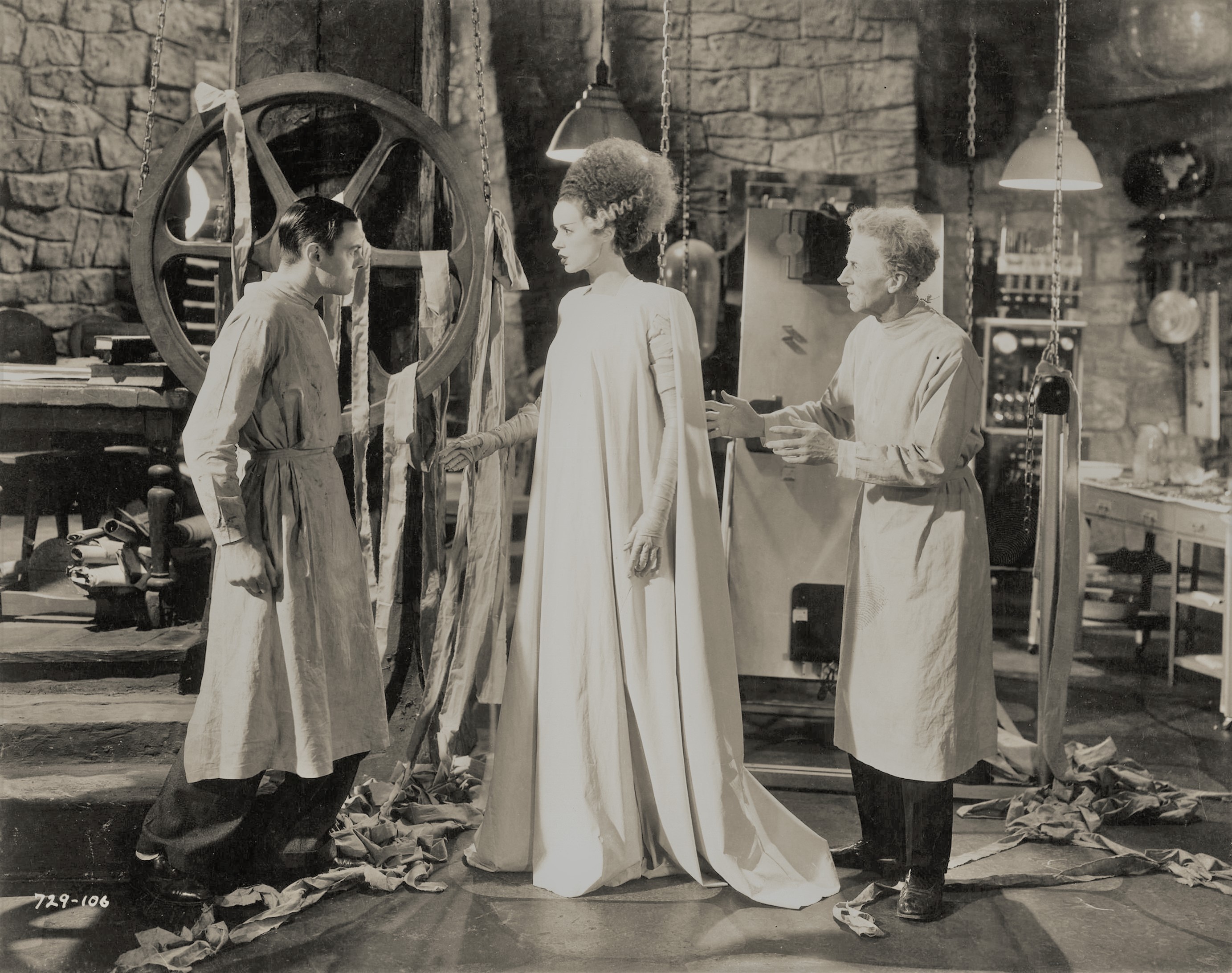
The mad scientist who made him, Dr. Victor Frankenstein, and his equally mad colleague, Dr. Pretorius, see that the monster is not happy. He is not fulfilled and is not living up to his full potential as a monster. After much thought and deliberation, the two mad scientists decide that the monster needs one thing above all others: a mate who will appreciate him for what he is and won’t be repulsed by the way he looks or by his crude manners. They toy with the idea of creating a male mate but that just doesn’t seem the thing, somehow, so they decide they will create for him a female mate.

Dr. Frankenstein sends his hunchback assistant, Fritz, out on a midnight graveyard run. From the graves of the newly dead, Fritz will gather the body parts needed to cobble together a female mate for the monster. He knows just the place, he says. Leave everything to him.

Now, Fritz has never been overly scrupulous about where he gets what he needs. He isn’t above going to the village and, seeing a lone woman standing on a corner singing a song, hitting her in the head to subdue her and then strangling her. When he makes sure she’s dead, he puts her in a burlap bag and throws it over his shoulder like a sack of potatoes and goes back to the castle. He knows Dr. Frankenstein will never ask questions as long as Fritz delivers the goods. The woman was just a nobody anyway. She’ll never be missed.

Dr. Frankenstein and Dr. Pretorius spend about two weeks creating what they think is a perfect mate for the monster. They take as much time as they need without rushing; they want to get every little detail just right. When the next violent thunderstorm occurs, they will be ready to harness the lightning.

They don’t have long to wait. All day long the next Saturday the sky is turbulent and dark. Finally, at night, a fearsome storm comes down the mountain, tearing at the castle walls. The wind howls and the rain falls as if a spigot has been opened in the sky. The lightning seems to be exactly on top of the castle, as if made to order. The two mad scientists place the as-yet lifeless body of the female mate on a table, connect the conductors that will attract the life-giving lightning, and hoist the table upwards through a hole in the ceiling.

The monster knows what is going on in the laboratory and paces his chamber nervously. Dr. Frankenstein has told him he must stay away until they are ready for him to see his mate. He combs his hair; he tries on several suits of clothes but nothing seems just exactly right. He fears that his mate will be afraid of him and will try to get away. He wonders if he will have to tie her up or club her in the head to be able to get a kiss from her. He lies on the bed and watches the storm out the window until there is a knock at the door; it’s the hunchback Fritz telling him that Dr. Frankenstein and Dr. Pretorius are ready for him to come to the laboratory.

When the monster sees his mate for the first time he is a little disappointed. She is standing between Dr. Frankenstein and Dr. Pretorius and she’s swaying from side to side as if she might fall over. Her hair is very high off her head and frizzy as if electrified; white strands on both sides resemble bolts of lightning. Dr. Pretorius has dressed her in a flowing white gown that goes all the way to the floor.

She tries to pull away when she sees the monster standing in the doorway, but Dr. Frankenstein and Dr. Pretorius hold her by the arms. As the monster walks across the room to her with a welcoming smile, she screams a piercing scream that rattles the castle to its very foundations. The monster is not put off by the scream but advances toward her. When he is face to face with her, Dr. Frankenstein and Dr. Pretorius let go of her arms and withdraw to the dark recesses of the room. She surprises the monster by hissing at him like a snake, which he finds very arousing. When she screams again, he puts his enormous hands around her throat to get her to shut up. And so begins a great romance.

Dr. Frankenstein proposes a toast and they all have a friendly glass of champagne. They break the champagne glasses in the fireplace for good luck and then Dr. Pretorius, who is also an ordained minister, marries the monster and his mate so there won’t be any question of immorality going on in the castle.

They all live happily for many years to come in Castle Frankenstein on their mountaintop. Eventually Dr. Frankenstein and Dr. Pretorius—even Fritz—all die because they are just ordinary men. The monster and his mate, however, live on and on. Through studying the writings of Dr. Frankenstein—and also Dr. Frankenstein’s father and grandfather—the monster has learned how to prolong his life and that of his mate for a very long time. The next thing he is working on is how to resurrect Dr. Frankenstein and Dr. Pretorius from the dead. If he is able to do that, there will be no stopping any of them.

Copyright © 2021 by Allen Kopp

Society Wedding

Society Wedding (2)

Society Wedding
~ A Short Story by Allen Kopp ~

(This is a re-post.)

On Saturday evening the sixth of August, marriage vows were solemnized between Ponselle de Fortenay von Hoople and Roger Melville Arcotte-Devaney III. The bride is the youngest daughter of Sebastian Fortescue de Fortenay von Hoople and Mitzi Upjohn de Fortenay von Hoople, both of whom are leading lights of café society and the yacht club set. The groom is a well-known champion polo player and scion of the Arcotte-Devaney manufacturing fortune.

The flower-laden ceremony was held in the lovely gardens of the palatial country estate of the bride’s parents, Forty Winks. The Right Reverend Everett Yawberry Lovell officiated, with a thousand invited guests in attendance, including the governor, Luther Addison Biggs, who is pleased to call himself friend of the family and business associate of the bride’s father. Also in attendance were the renowned novelist Miss Millicent Farquhar Meriwether (whose latest novel, Just Hurry Up and Die, is a huge success), and Broadway hoofer Miss Beulah Doakes.

The bride wore a lovely seventeenth century-inspired gown made entirely of Neapolitan lace that just about swallowed her up and made her look like the dress was walking down the aisle on its own. She chose as her maid of honor her lifelong friend and confidante, Miss Penelope “Pinky” Peebles, who, since she is a midget, was given a stool to stand on to make her as tall as everybody else. Those honored to be bridesmaids were Miss Vesta Cundiff (daughter of the well-known film actress Lola Lola), Miss Marguerite “Tiny” Cadwallader, Miss Fricka Wagstaff, Miss Beryl Belladonna-Stammers, Miss Veronica “Hambone” Turlock, and Miss Hildegard “Puffy” Mannering. In a unique twist for any wedding this season, and, in keeping with the outdoor setting, all the bridesmaids were dressed in costumes representing different birds, from the familiar robin to the sweet mourning dove.

The groom chose as his best man his brother, Mr. Bryce Errol Fennimore Arcotte-Devaney. Groomsmen were Mr. Antonio “Little Tony” Delessio, Mr. Justin Marburg Phipps IV, Mr. Franklin Lester Shumway, Mr. Percy Sherwood-Upjohn, Mr. Troy Biggerstaff, and Mr. Gideon Elijah Gottlieb. The men of the wedding party wore matching linen suits inspired by the planter of the pre-Civil War South, with broad-brimmed Panama hats and black patent-leather knee boots.

The bride’s mother, Mrs. Mitzi Upjohn de Fortenay von Hoople, was a standout among the ladies in her dress and hat made entirely of chicken feathers. She wasn’t able to speak with the beak she wore, but those who know her considered this a great advantage. The father of the bride, Mr. Sebastian Fortescue de Fortenay von Hoople, was the life of the party in his tuxedoed gorilla costume, complete with porkpie hat and cigar.

The mother of the groom, Mrs. Clara Tubbins Arcotte-Devaney, was dressed entirely in black in honor of her late husband, Mr. Roger Melville Arcotte-Devaney II, who died last fall when he fell into the ocean on his return trip to the United States from his travels abroad and was eaten by sharks.

The newly married couple departed on a honeymoon trip around the world on the luxury liner The Virgin Queen. When they return from their travels in about six months, they will reside in their renovated Fifth Avenue townhouse that reportedly cost twelve million dollars, a gift from the bride’s father. Part of the year they will reside in Palm Springs or in the chalet in Switzerland the groom inherited from his father.

This reporter had a chance to chat with the excited bride and groom before they ventured into the world on their own. The bride kissed this reporter on the cheek, leaving the imprint of her lips, and whispered in his ear, “I want a good write-up; no funny business, or my father will have you killed.” The groom gripped this reporter’s hand and, in his booming baritone voice, announced that he wanted him to come back in about ten years and see how many “little bluebloods” they have been able to “pop out” in that length of time. The bride squealed in mock outrage and punched her newly minted husband on the arm.

As the couple made their way to their waiting limousine, the assembled crowd shouted out their good wishes and threw handfuls of rice. The bride’s mother held a handkerchief to her beak and sniffled as the car drove down the winding drive and through the immense gates. She retired to her room in exhaustion as the guests began a drunken bacchanalia that would last until long after daybreak.

Copyright © 2021 by Allen Kopp

Death and the Afterlife: A Chronological Journey from Cremation to Quantum Resurrection ~ A Capsule Book Review

Death and the Afterlife: A Chronological Journey from Cremation to Quantum Resurrection ~ A Capsule Book Review by Allen Kopp

Death and what comes after have fascinated people for as long as people have existed. When we die, are we cast into a dark oblivion, or do our personalities survive in another place? Are we rewarded for our good deeds and punished for our bad deeds? Will we be born again in another body? Do heaven and hell exist? Where do we go if we’re not good enough for heaven and not bad enough for hell?

Death and the Afterlife will not answer any of these questions, but it is a book that deals with a wide range of topics associated with the science and sociology of death, dying and the afterlife, including such fascinating topics as vampires, zombies, euthanasia, embalming, executions, seances, reincarnation, resurrection, sin eaters, death masks, transhumanism, brain death, near-death experiences, electronic voice phenomena, quantum immortality, thanatourism (visiting sites of suffering and death such as Nazi death camps), death of the universe, and many other topics.

Each entry is only one page long, accompanied by an appropriate painting or drawing on the opposing (left-hand) page. At the end of the book is a list of references that might be consulted for further reading.

Did you know:

  • Certain cultures, going back to the Neolithic Age (13,000 years ago), practiced what was known as “sky burial.” This means that the bodies of the deceased were cut into small pieces, including the bones, and left out on a ledge or hilltop for scavenger birds to carry away.
  • Before Napoleon Bonaparte’s death in 1821 at the age of 51, he insisted that an autopsy be performed on his body, the results of which, he believed, would help his son. He was found, during autopsy, to have stomach cancer.
  • Since 1960, the number of autopsies has declined because doctors are afraid of medical malpractice suits.
  • During the 17th and 18th centuries, “plague doctors,” who often weren’t doctors at all, wore frightening “beak masks.” The idea was to fill the beak of the mask with aromatic spices or fragrant perfumes, which were thought to prevent the wearer from breathing the plague in through the nose or mouth.
  • Walking Corpse Syndrome (WCS) is a mental disorder in which the sufferer believes he is dead, but still living, or that some of his organs have been removed.
  • During the 18th century, fear of premature burial (burial of somebody who wasn’t really dead) led to the rise of “safety coffins,” equipped with air pipes and bells. (Make sure I’m dead first.)
  • In the 13th century, the bubonic plague, originating in Asia, swept through Europe, killing roughly two-thirds of the population. The plague, the greatest biomedical disaster in human history, was still causing problems in Europe five hundred years later.
  • Experiments show that the soul contained in a person’s body weighs seven-tenths (0.7) of an ounce. This weight was arrived at by weighing tuberculosis victims at the moment of death and comparing it with the weight before death.
  • Ondine’s curse is a mental disorder in which a person forgets to breathe while sleeping and dies. It’s named after a water nymph from folklore who is cursed with having to remember to breathe.
  • French painter James Tissot in 1890 painted a famous painting called What Our Lord Saw from the Cross. It is the artist’s vision of what Christ might have seen from the cross while being crucified.
  • While Joseph-Ignace Guillotine did not invent the guillotine (decapitation device), as many people have been led to believe, he promoted its use as a humane method of execution in France in the 1790s. “My machine will take off a head in a twinkling,” Dr. Guillotine stated, “and the victim will feel nothing but a refreshing coolness.”
  • Saint Vincent Pallotti (1795-1850) was an Italian saint who helped the poor in Rome. When his body was exhumed a hundred years after his death, it was found to show no signs of decay, a sign of true holiness.

Copyright © 2021 by Allen Kopp

The End of Eddy ~ A Capsule Book Review

The End of Eddy ~ A Capsule Book Review by Allen Kopp

The End of Eddy, by young French writer Édouard Louis (born 1992), is a novel set in a small factory town in the North of France in a region known as Picardy. Eddy Belleguere is the fictional narrator of the novel, and we learn from the background information of the novel’s author that the story, though fictional, is, in fact, an account of his own life. Eddy Belleguere is the fictional alter-ego of real-life Édouard Louis.

Despite the charm of the region in France where the story takes place, the lives of the factory workers and their families are anything but charming. Life is hard in the factory, and the men who toil there all their lives sometimes die at an early age. They drink to excess, beat their wives, and watch porn and Wheel of Fortune on TV. The women, who sometimes also work in the factory, are long-suffering custodians of the children. The children are unmotivated, unhygienic boobs who usually want nothing more out of life than to get a minimum of education and then get a job in the factory and live the same life of toil that their parents have lived.

Every now and then a boy comes along who isn’t like the others, and that boy is Eddy Belleguere, the protagonist of the novel. He isn’t comfortable with the masculine gender role (as personified by his father, his brothers and every other male in his sphere) that he is supposed to adopt for himself. Eddy has feminine gestures and is attracted to boys and men. His friends at school are all girls. He is brutally bullied and abused by older boys in school and has no way to fight back. As he gets older and realizes he is gay, he tries to “fit in” and be like all the other boys, but he knows (and we know) that it isn’t going to work out. Eddy has an identity crisis and it is never going to resolves itself until he escapes his family, his town and his environment.

The End of Eddy is a story about identity, conforming, belonging, and finding one’s own place in the world, whatever that might be. It’s a breezy novel, simply written, engaging, engrossing and not at all taxing to the brain. Highly recommended to those readers who appreciate a good story about being “a square peg in a round hole.” I think we have all been there, at least in one way or another, when we were young. (Remember how you loathed gym class, dreaded it for days in advance, and might even still have nightmares about it?)

Copyright © 2021 by Allen Kopp

Tchaikovsky, A Biography ~ A Capsule Book Review

Tchaikovsky ~ A Capsule Book Review by Allen Kopp

The great Russian composer Peter (“Petyr”) Ilyich Tchaikovsky was born in 1840 and died in 1893. He was a complex man who experienced many setbacks in his life, but one who, despite his fragile psyche, managed to write some of the great symphonic masterpieces of Russian music and of the nineteenth century, including six symphonies, three ballets, several operas, four serenades for orchestra, chamber music, songs, and (still) wildly popular concertos for piano and orchestra and violin and orchestra. His music is, today, still very accessible and popular and is performed and played wherever music is appreciated. Tchaikovsky never falls “out of favor” or becomes “passé,” as some composers do. (Writer-physician Anton Chekhov said during Tchaikovsky’s life that Tolstoy occupied the first place in Russian art while Tchaikovsky occupied the second place and Chekhov himself occupied the ninety-eighth.)

Tchaikovsky was born into a large and loving family (four brothers and one sister), in an isolated region of Russian where his father was a civil servant. His mother was rather cold to her children, but Tchaikovsky idolized her. Her death at age forty from cholera was a terrible blow from which he never fully recovered.

Tchaikovsky was morbidly sensitive with the soul of an artist, tending to be withdrawn and introspective. He was a homosexual who openly engaged in homosexual activity from the time he was a young student. (His turbulent inner life played a large part in the music he composed.) While not hiding his sexuality, or denying it, he always believed that it wasn’t “right.” After he became famous and successful, he lived in fear that he would be “exposed” and his career ruined or irreparably damaged. In his efforts to appear “normal,” he entered into a disastrous marriage with an unstable (possibly insane) woman named Antonina Milyukova. It turned out to be the biggest mistake of his life. He only lived with Antonina for two or three months, but she spent the rest of his life antagonizing and threatening him. He referred to her as a “demon” and “spawn of hell.” He could only assuage her, temporarily, by giving her money. She was a bitch on wheels.

About the same time as Tchaikovsky’s disastrous marriage to Antonina, another woman entered his life. Her name was Nadezhda von Meck. She was a wealthy widow, whose deceased husband had made a fortune in railroads. She had an almost obsessive admiration for Tchaikovsky and his music. She idealized him as the perfect artist, the perfect musician, the perfect man. She became his patron, which means she partly subsidized (supported) him while he composed. Madame von Meck was as eccentric in her way as Tchaikovsky was in his. The one condition of her financial support was that the two of them never meet in person. They corresponded for fourteen years, thousands of letters, and were both in the same place at the same time on many occasions, but they never met. Many of the letters they wrote to each other still exist.

Unlike many composers, Tchaikovsky achieved astounding success and popularity during his lifetime. His fame spread from his native Russia to Europe and the United States. Despite his never-ending personal struggles, his output of orchestral masterworks is extraordinary.

Peter Ilyich Tchaikovsky died unexpectedly in St. Petersburg in 1893 at the age of fifty-three. The official account of his death, and the one that was accepted for a century, was that he drank “unboiled water” and died of cholera during an epidemic. However, more than a hundred years after his death, new information came to light which strongly suggests that he deliberately ingested poison to kill himself.

Tchaikovsky, A Biography, by Anthony Holden, is an informative and engaging chronicle of the life and times of Russia’s greatest composer. It’s a long and exhaustively detailed biography, but never too long or too ponderously wordy. If Tchaikovsky’s music “speaks” to you, as it does to me, reading this book and understanding the life of this great man adds a new dimension to enjoyment of his music.

Copyright © 2021 by Allen Kopp

Hollywood Babylon ~ A Capsule Book Review

Hollywood Babylon ~ A Capsule Book Review by Allen Kopp

The silent screen’s greatest lover, Rudolph Valentino, was married twice, both time to lesbians, and neither marriage was ever consummated.

Movie director William Desmond Taylor was murdered in his Hollywood apartment in 1922. Investigation into his death revealed that he had been living a double life. All his colleagues were suspects in his death but, even with this plethora of potential murderers, the truth was never uncovered. The real murderer took the secret to his/her grave.

Silent screen comedian, jovial Roscoe “Fatty” Arbuckle, must certainly have wished he had never thrown a wild party in a San Francisco hotel room in 1921. The sexual shenanigans at the party led to the death of a trashy “starlet” named Virginia Rappe. Fatty was jailed and charged with first-degree murder in Rappe’s death. He was eventually cleared of the murder charge (after three lengthy trials), but his screen career was finished.

Thelma Todd, twenty-nine-year-old comedic actress (she starred with Laurel and Hardy and the Marx brothers), called the “Ice Cream Blonde,” was found murdered in the garage where she kept her car in 1935. Nobody ever found out what really happened, but Thelma was believed to have had an ongoing feud with gangster Lucky Luciano. Thelma Todd’s murder is one the most baffling unsolved murders in Hollywood history.

Twenty-five-year-old Olive Thomas, called “the most beautiful woman in the world,” was vacationing in Paris in 1920 with her husband Jack Pickford (brother of Mary Pickford) when, after a night of nightclubbing and drinking, she drank mercury from a bottle and died at a Paris hospital several days later. Evidence suggests that her poisoning was unintentional, but the story still persists that she killed herself on purpose.

In the late 1920s and early 1930s, Ramon Navarro was the biggest star in Hollywood. His most famous role was in the 1925 silent version of Ben-Hur. In 1968, age 69, he was brutally beaten to death in his Hollywood home by a pair of brothers out to rob him. The brothers were brought to justice but received only light sentences.

In 1932, would-be movie actress Peg Entwistle killed herself by climbing to the top of the famous “Hollywood” sign and jumping off. After her death, she became a symbol for Hollywood disillusionment and broken dreams.

Silent screen superstar Charlie Chaplin was quite a dog with the ladies. (Apparently he wasn’t too particular about which ladies.) In the 1920s, he impregnated sixteen-year-old, would-be actress Lita Grey. He did the right thing and married her, but the marriage was a disaster. It turned out that Lita Grey and her dear mama were planning on taking poor old Charlie for every cent he had.

Screen goddess Lana Turner’s sexy bad-boy boyfriend, Johnny Stompanato, was a shadowy underworld figure with an Oscar-sized tool in his pants. (Lana found him exciting.) In 1958, he was abusing Lana with his fists, when Lana’s fourteen-year-old daughter, Cheryl Crane, intervened with a big knife, stabbing pour Johnny to death in Lana’s Beverly Hills mansion. It was eventually ruled a “justifiable homicide,” but Lana and Cheryl experienced much unfavorable press coverage, not to mention the heartache.

Nearly every Hollywood scandal, from the silent era through the 1960s, is covered, however superficially, in the book Hollywood Babylon. It was banned when first published in 1965 but managed somehow to resurface ten years later. People find Hollywood Babylon objectionable because it makes no pretense of journalistic integrity. A lot of the purported “truth” in it is false, exaggerated, scurrilous, sensationalized and unfair. That’s not to say it doesn’t hold your interest from first page to last, though, as long as you read it with the proper attitude.

Copyright 2021 by Allen Kopp