
~ First Edition ~
~ E. L. Doctorow’s 1985 novel, World’s Fair ~
In near-perfect condition, including dust jacket.
Price to be determined.
If interested, e-mail me at:
allenkopp@sbcglobal.net

~ First Edition ~
~ E. L. Doctorow’s 1985 novel, World’s Fair ~
In near-perfect condition, including dust jacket.
Price to be determined.
If interested, e-mail me at:
allenkopp@sbcglobal.net

~ First Edition ~
~ Toni Morrison’s Pulitzer-Prize winning 1987 novel, Beloved ~
In mint condition, including dust jacket.
Price to be determined.
If interested, e-mail me at:
allenkopp@sbcglobal.net
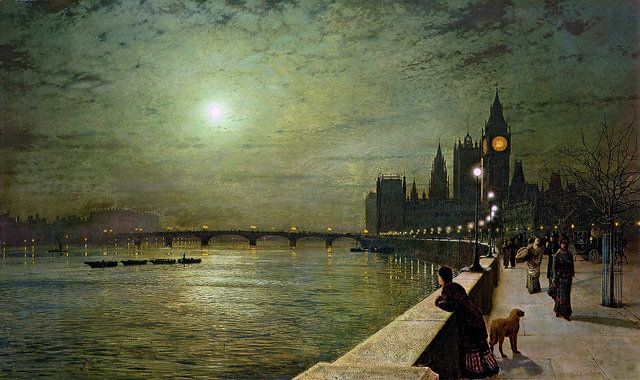
Reflection on the Thames (1880) by John Atkinson Grimshaw
John Atkinson Grimshaw (1836-1893) was a Victorian-era artist known for his city night scenes and landscapes. He painted Reflection on the Thames in 1880.
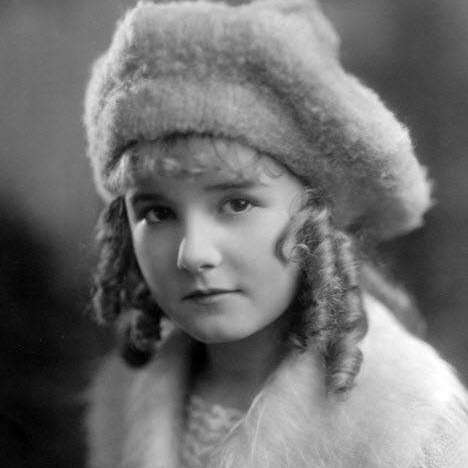
Sylvia Dell ~ A Short Story by Allen Kopp
In 1926 Mrs. Bertha Indelicato of Burbank, California, took her son, Sidney Indelicato, to a movie studio to audition for a part in a motion picture. She dressed him up in a light-blue jumper and a yellow shirt, with pork-pie hat and strapped, patent leather shoes. With Sidney’s cherubic face and naturally curly blond hair, he looked as much like a girl as a boy.
At the audition the casting director, a man named Perkins Belmont Perkins, wearing knickers and argyle stockings, separated the boys from the girls so he could get a better look. When Sidney was herded in with the girls, Mrs. Indelicato didn’t dare object, afraid that doing so might cost him a part in the movie.
When Perkins Belmont Perkins, eyeing Sidney critically, asked for the name, Mrs. Bertha Indelicato stepped forward quickly and gave the name as “Sylvia” Indelicato.
“She’s rather fat,” Perkins Belmont Perkins said, “but I think she has the “look” we’re looking for.”
“Oh, I’m so glad!” Bertha said.
“Have your daughter here at eight o’clock sharp on the fourteenth and I believe we’ll be able to use her.”
“Oh, thank you!” Bertha said. “We’ll be here! Of that you can be sure!”
After they left the studio, Bertha took Sidney to a drugstore down the street to get a banana split.
“Just think!” she said to him as he stuffed ice cream into his mouth. “We’re in!”
“In where, mama?” he asked.
“Why, didn’t you hear the nice man say they were giving you a part in the movie, honey?”
“What do I got to do?”
“Just look sweet and the director will tell you everything to do. Mama will be right beside you every step of the way.”
When Bertha’s husband, Buster Indelicato, came home from his job as a Ford salesman, Bertha told him the good news: Sidney landed a part in a movie.
“There’s just one thing,” she said. “They think Sidney is a girl.”
“What?”
“I had to think fast. I told them his name is ‘Sylvia’ Indelicato.”
“And they believed that?”
“Yes.”
“You always did dress him more like a girl than a boy.”
“If that’s the only way he can get a part in a movie, then a girl he will be!”
“Well, I always wanted a daughter, I guess,” Sidney said, reaching for a beer.
In the few days she had before the fourteenth, Bertha took Sidney shopping and outfitted him with complete feminine attire, down to the lacy bloomers. She fluffed out his hair and gave it some extra curl, insisting that she and Buster call him “Sylvia” at the dinner table and refer to him at all times as “she” and “her” instead of “he” and “him.”
“You’re going to confuse him,” Buster said, “and then we’ll have a mental case on our hands.”
“He’ll be fine,” Bertha said. “I guarantee it.”
“Why do I got to be a girl now?” Sidney asked.
“Because you are an actor,” Bertha said. “You will someday be a great actor. This will be your first acting lesson. Great actors pretend to be who and what they are not.”
“I don’t think I like being a girl.”
“Just remember that underneath the laces and frills you are still a boy. It’s only to the outside world that you are a girl.”
“If I’m an actor,” he said, “I want to be a cowboy.”
“That will come later, dear, after you are an established star.”
“What’s ‘established’ mean?”
On the morning of the fourteenth, Bertha had Sidney at the studio an hour early and was forced to wait nervously in an outer office to be called. Finally, when Sidney was called for a wardrobe fitting, Bertha was given a copy of the script. It was up to her to familiarize herself with the story and tell Sidney, as Sylvia, what he (she) was supposed to do.
The picture was called Baby Bountiful and starred that lovely young motion picture star, Arlette Joseph. She played a young mother who, when she loses her own baby to illness, goes with her handsome young husband to an orphanage to pick out another child. There are so many adorable children to choose from that the young couple can’t decide which one to take. That’s when the orphans show off their singing and dancing talents to help them make up her minds.
The young couple still can’t decide, so they go home, assuring the orphans they will return later and will, most assuredly, choose one of them to take home with them. That night, all the orphans dream of being the chosen one. The next day the young couple returns to the orphanage with some very exciting news. The young mother’s rich uncle has died and left her his millions. Since she will have all that money, she can take all the orphans and they will all live together on a fabulous Long Island estate with their new mommy and daddy.
Sidney was the orphan named Lulu. He wore a white dress and white stockings, a long wig with a large white bow. When the director told the orphans to jump up and down with excitement or to act sad, they did exactly as they were told.
Bertha stood behind the director and the camera, watching. She believed, of course, that Lulu stood out from the other orphans and that her acting was the most realistic. Her eyes brimmed with tears and her heart ached with pride. After all her years of dreaming, her own little Sidney was finally in motion pictures!
When filming was completed for Baby Bountiful, Arlette Joseph thanked all the children personally for playing orphans and everybody packed up to go home. A few days later Bertha received a fat check in the mail for Sidney’s appearance in the film. When she showed the check to Buster, he whistled and said, “That’s more than I make in a month!”
A week later the casting director from the studio called Bertha and asked if Sylvia was available to act in another picture. Bertha nearly dropped out her dentures on the kitchen floor in saying yes.
They hired Sylvia an agent, who promptly changed her name from Sylvia Indelicato to Sylvia Dell. The agent procured parts for her in five pictures the first year and seven the second year, with each part progressively larger than the one before it.
Buster quit his job and began staying home all the time, “seeing to things.” He managed Sylvia’s career from the sidelines with useless advice that nobody listened to. He began wearing double-breasted suits, smoking big cigars, and hosting luncheons at all the fancy restaurants around town.
Sidney, for his part, went along with what was expected of him. When he was at home he could be Sidney, but the minute he went outside the house he had to be Sylvia. Any time he became downhearted, Bertha presented him with a big bowl of ice cream and waved the most recent studio check in his face. When she went to the bank to cash his checks, she always took him along so he could see the big stacks of green and come to know how important they were to his family.
In 1929 the Hollywood studios stopped making silent films and converted to sound. Prepared as she was for any contingency, Bertha hired a diction coach to work with her Sidney. After all they had been through, she wasn’t going to let the advent of sound end her baby’s film career.
The diction coach, aware of how much money was to be made, declared Sylvia a “natural” after a few lessons. If he knew that Sylvia was really a boy instead of a girl, he never let on. He was accustomed to the ways of movie people and wasn’t squeamish about such things.
Sidney’s first sound picture was a big success. He had five lines, which he spoke with a convincing girlish intonation. After that, there were more offers for parts in other motion pictures. The money mounted up as Sylvia’s fame and popularity increased. Sylvia Dell fan clubs sprang up around the country. There were Sylvia Dell coloring books and dolls, an entire line of Sylvia Dell merchandise.
Sidney began to put on a lot of weight. The doctor advised Bertha to put him on a low-calorie diet, but she refused, certain the “pudginess” was part of his appeal. People had come to know him as fat and if he was no longer fat they would no longer know him.
When Sidney inevitably began to show outward signs of becoming an adult male, Bertha and Buster began to panic. They took him to a doctor and wanted to know if there was some way he, the doctor, could medically “alter” Sidney to enhance his feminine qualities and subvert the masculine ones.
“Are you suggesting I castrate him?” the doctor asked.
“If that’s what it takes,” Bertha said.
“Ask him if he wants to be castrated and I can almost assure you what his answer will be.”
“But he’s too young to know what’s best for him,” Bertha said. “He’s only a baby.”
“Good day to you!” the doctor said.
Luckily Sidney was fair-haired and the whiskers on his chin and cheeks could easily be covered up, but his deepening voice was more of a concern. Bertha began plying him with pills that she bought from a “medical consultant” and giving him cognac and whiskey toddies to “calm his nerves” and help him to sleep. In a few months he was a child alcoholic. He took to smoking prodigious numbers of cigarettes, even when he was in character as “Sylvia.” The sweet little girl had turned into a monster. The movie offers began to dry up.
Right before Sidney’s sixteenth birthday, he disappeared. Bertha believed he had been kidnapped and that soon the kidnappers would make their exorbitant demands for his return. She would pay any amount—every cent if she had to—for his return.
The police searched for Sidney but found no sign of him and after a year they gave up. They would keep his file on record, though, and if anything came up they would reopen the case. Bertha began walking the streets at night, looking for him in alleyways. She was certain he was all right and wasn’t very far away. All he needed was for her to find him.
Thirty years went by and Sidney didn’t return home. Bertha and Buster spent all the money and then there was no more. Buster died, leaving Bertha alone in her home with her memories. Her walls with lined with “stills” from Sylvia Dell movies. She never stopped thinking about Sidney.
Small packages began appearing on her doorstep, a packet with fifteen dollars in it and then one with twenty, a potted plant, a loaf of pumpernickel bread. She didn’t know who was leaving these little gifts, but when a box of chocolate-covered cherries appeared, she knew it had to Sidney. Only he would know that had always been her favorite kind of candy.
Copyright © 2016 by Allen Kopp

Luncheon of the Boating Party (1881) by Pierre-Auguste Renoir
French Impressionist painter Pierre-Auguste Renoir lived from 1841 to 1919. His famous painting Luncheon of the Boating Party (Le déjeuner des canotiers) was completed in 1881. Combining figures, still-life and landscape in one painting, it depicts a groups of Renoir’s friends relaxing on a balcony overlooking the Seine River in Chatou, France.

Dreaming (1928) by Maxfield Parrish
Maxfield Parrish was an American painter and illustrator who lived from 1870 to 1966. His painting Dreaming, which he completed in 1928, shows a young girl sitting underneath a tree beside a lake in a tranquil autumn setting.

The Sleeping Gypsy (1897) by Henri Rousseau
Henri Rousseau was a self-taught French painter who lived from 1844 to 1910. His 1897 painting The Sleeping Gypsy is a fantastical depiction of a lion musing over a sleeping woman with a full moon in the sky. It was a painting that was ignored for decades until it was justly recognized as a masterpiece in the 1920s.

Cradling Wheat (1938) by Thomas Hart Benton
Thomas Hart Benton (1889-1975) was one of a group of American artists who painted ordinary people in everyday settings. His 1938 painting Cradling Wheat shows three men and a boy harvesting grain. Their bent backs engaged in toil are echoed in the shape of the hills behind them and suggest a close relationship between the workers and their environment. The man on the left is using an old-fashioned cradling scythe, so the process of cutting wheat in this manner is called “cradling.”
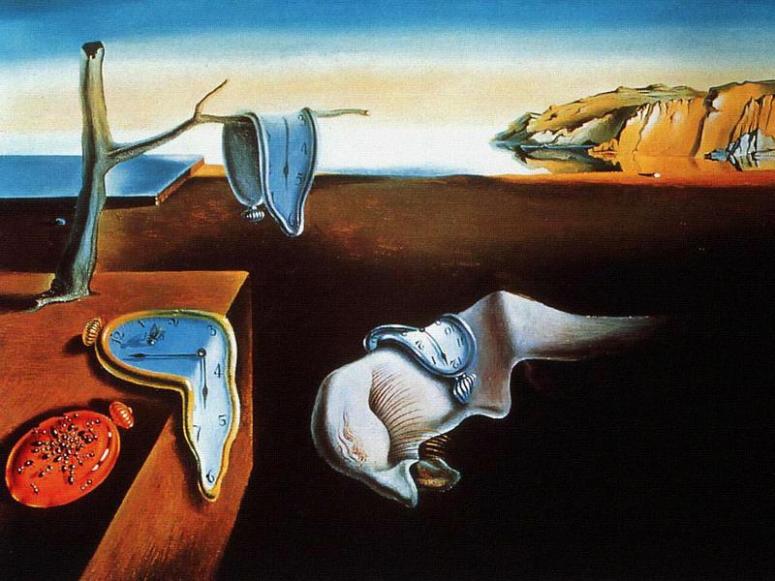
The Persistence of Memory (1931) by Salvador Dalí
Salvador Dalí was a Spanish surrealist painter who lived from 1904 to 1989. He often referred to his paintings as “hand-painted dream photographs.” The Persistence of Memory is his most famous work and thought to be one of the greatest paintings of the twentieth century. The eyes of the figure in the painting are closed, suggesting that what’s being observed is a dream state, unseen by the natural eye.

Undermajordomo Minor ~ A Capsule Book Review by Allen Kopp
Undermajordomo Minor is a novel by Patrick DeWitt set in an unidentified and unidentifiable time and place. It might be a European country and it might not. The characters travel by train, but there is no mention of cars, electricity or any other modern convenience, so it’s a story that could have or might have taken place a long time ago. It’s set almost entirely in a castle, Castle Von Aux, that is owned by the absentee (at first) Baron and Baroness Von Aux. A seventeen-year-old boy, Lucien “Lucy” Minor, has left his not-very-loving home and traveled by train to Castle Von Aux to take up a position there as a servant. Since his job will entail many and multifarious duties, his title is to be “undermajordomo.” The “majordomo” (if there is one) under which Lucy will be employed is an odd gentleman named Mr. Olderglough, who has been at the castle for many years. Lucy finds out that his predecessor, a Mr. Broom, met an untimely end, but he doesn’t find out for the longest kind of time exactly what happened to Mr. Broom because nobody wants to talk about it.
In the squalid village down the mountain from Castle Von Aux, Lucy meets an odd old man (everybody in this book is odd) named Memel. Memel is a pickpocket and thief of sorts and he has a daughter named Klara, with whom Lucy falls in love. There’s just one problem with Klara, though. She has a boyfriend, an “exceptionally handsome” man named Adolphus. In the inexplicable war that rages in the hills around Castle Von Aux, Adolphus is an important player, a general or something. Adolphus is forceful and is everything that Lucy is not. He claims to love Klara and doesn’t like it that Lucy loves her, too.
At Castle Von Aux, Lucy becomes aware of an oddly deranged man who skulks about the castle at night, filthy and practically naked. Lucy believes at first that this might be the mysterious Mr. Broom but discovers in time that it is Baron Von Aux. When Mr. Olderglough receives word that the long-gone Baroness Von Aux is returning for a visit, it’s up to him and Lucy to take Baron Von Aux in hand, get him cleaned up, and make him seem as “normal” as possible. (This isn’t going to be easy.)
Baroness Von Aux arrives with much fanfare and Lucy sees that she is very beautiful. He learns, then, that Mr. Broom was in love with Baroness Von Aux and took his own life by throwing himself into the “Very Large Hole” up the mountain from the castle. Much to Lucy’s surprise, though, Baron Von Aux has undergone a transformation and is ever so much more presentable than he expected him to be. He can even speak and wear clothes. When Baron and Baroness Von Aux entertain out-of-town guests, the Duke and Duchess and the Count and Countess, Lucy witnesses the strange goings-on of the three couples in the ballroom, which includes a sort of free-for-all sex orgy. Considering what Lucy already knows about Baron and Baroness Von Aux, he can’t be too surprised at their behavior.
Eventually Lucy’s jealousy for Adolphus leads him to the thought of murder. He attempts to kill Adolphus by pushing him into the Very Large Hole, but Adolphus sidesteps him and Lucy falls in himself. He falls for a very long way but, since he lands in water, the fall doesn’t kill him. What he finds in the Very Large Hole is unexpected but makes absolute sense in light of what has gone before.
Undermajordomo Minor is quirky and thoroughly engaging reading. It takes us where we hadn’t expected to go, but when we’re there we find it’s a good place to be. Like The Sisters Brothers, Patrick DeWitt’s earlier novel, it is breezy, almost effortless, reading and goes down like Rocky Road ice cream.
Copyright © 2016 by Allen Kopp

