


1958 Edsel Pacer Convertible
1958 Edsel Pacer Convertible

The Flatiron Building, New York City
Completed in 1902, the 20-story, triangular-shaped (with rounded corners) Flatiron Building in New York stands at the intersection of Fifth Avenue, Broadway and Twenty-third Street. It was originally named the Fuller Building, but “Flatiron” was the name it became known by.

A Head of Its Time

A Head of Its Time ~ A Short Story by Allen Kopp
(Published in Death’s Head Grin.)
Frankie Zell was not accustomed to the fast life. She grew up on a farm, where she lived plainly and simply with her mother, father and two brothers. Painfully shy and stick-thin, she was never pretty or attractive in the way other girls thought themselves and in fact she never gave much thought at all to the way she looked.
In her late teens, though, Frankie began to change. She lost her adolescent awkwardness; she became rounded in the places where she had always been angular. She developed flawless, pale skin and a head of lustrous, chestnut-colored hair. She turned into the beauty she was always meant to be, like the lowly caterpillar turning into the ravishing butterfly.
She began to attract the attention of young boys and older boys into manhood, some of them as old as forty or fifty years. When she would go into town on a shopping trip or to pay the light bill or see the dentist, people would stop what they were doing and look at her because they weren’t used to see so pretty a girl on the streets of such a dreary town. Some more astute observers said she ought to go to Hollywood and try out for the movies. She was as pretty as Rita Hayworth or Ava Gardner or any of those others.
Through a friend she became acquainted with a boy named Angus Persons who lived with his parents in the best neighborhood in town, where the finest homes were. His father was president of the bank and raised horses on a ranch he owned. Angus was the same age as Frankie and planned to be an attorney and one day go into politics. With his good looks and family connections, he would go far. He might one day be governor of the state or a senator in Washington. Frankie would be just the right kind of wife for him. They planned an elaborate June wedding to which everybody in town was invited.
Angus and Frankie indeed made a handsome couple. When they drove around town in Angus’s beautiful convertible sports car, they were like something out of a dream. People who saw them were admiring, envious, or maybe even a little bit jealous.
Frankie had never driven a car before but Angus taught her to drive. When he was busy working or at school and didn’t have time to spend with her, he let her drive his car as if it were her own. She enjoyed driving on the hilly, curvy country roads between the farm she lived on and the town where Angus lived. She liked nothing better than letting the top down on the car and driving as fast as she could and letting the wind blow her hair. She discovered that fast driving exhilarated her and made her feel free in a way that nothing else did.
On a brilliant May morning one month before Frankie and Angus were to be married, Frankie was driving in the hills and valleys she had known all her life. Bathed in the fresh morning sunlight as it was, the landscape was as beautiful as anything she had ever seen. Past fences and farms, horses and cows, and the occasional scenic barn or grain silo, she drove with abandon around curves and up hill and down dale. Her car—or rather Angus’s—was the only car on the road.
At one long downward hill with a sharp curve that wrapped around a scenic promontory of rock, signs warned prudent drivers to drive slowly and carefully. The treacherous curve could be difficult to negotiate even for the most experienced of drivers.
When Frankie Heywood came to the hill, she ignored the signs. She had driven the hill many times before and didn’t fear it. She sped up to experience once again the thrilling downward whoosh and the tension on the wheel as she struggled to keep the little car on the road.
In the middle of the curve, with her downward momentum and her accelerated speed, she lost control of the car as if an invisible hand had reached out and pulled the steering wheel sharply to the right. In the blink of an eye, the car left the road, became airborne, and sailed out over the tops of the trees. In her final seconds, Frankie had the time-stands-still sensation of being suspended above the earth—breathless and in defiance of the laws of gravity.
When she failed to appear for her luncheon date with Angus in town, he became alarmed and started calling all the places she might be, but nobody had seen her. He called her home and Frankie’s mother told him not to worry, that Frankie was probably enjoying herself too much—wherever she was—to be aware of the time. Deep down, though, Frankie’s mother believed that something bad had happened to Frankie.
The next day, when nobody still had not seen or heard from Frankie, her mother called the police and filed a missing person’s report. The police questioned Frankie’s mother and father and brothers extensively about Frankie’s habits and associations, but none of them were able to tell them anything that helped in finding her.
The police began an extensive search for Frankie between her home and the town. They theorized that she was living a secret life and had run away from home or that she had been abducted by a person or persons unknown. If they were able to find the car she had been driving, that at least might give them some clues.
Two days later a young police officer found a hubcap in the underbrush near the dangerous curve. Angus recognized the hubcap as belonging to his car. From this clue they were able to piece together what had happened to Frankie on the day she disappeared.
When they found the sports car a quarter of a mile or so from the road, concealed in the trees, Frankie’s body was in it. Her head had been sheared off at the shoulders, neatly and cleanly, as with a sharp blade.
Logic dictated that Frankie’s head would be not far from her body, but when police searched the surrounding area (and much farther away), they were never able to find any sign of the head. After a few days they gave up the search, telling Frankie’s mother and father that the head must have been carried off by wolves or some other wild animals. It was still possible, though, that the head would be found and, if so, whoever found it would be sure to report it to the police. Finding a head by itself was not that common an occurrence.
As distraught as Frankie’s mother was at having lost her only daughter, she was even more distraught at the idea of Frankie having to go to her grave without her head.
Frankie’s mother took an old china vase she had had for a long time that was roughly equivalent to the size and shape of a human head. On the front of the vase was painted a bouquet of flowers, but on the back was nothing, so on the back of this vase she painted a semblance of Frankie’s features using the watercolor paints that Frankie sometimes worked with. (Handles on the sides of the vase were a good approximation of human ears.)
When she was finished painting a fairly credible approximation of Frankie’s face on the vase, she put Frankie’s wig on it and then took it to the funeral parlor and asked the undertaker if he would put the vase where Frankie’s head should be. The undertaker was happy to comply, knowing that grief sometimes causes people to make unusual requests.
At the funeral-home visitation, people were surprised to see a painted vase in place of a real head, but most agreed the vase was less jarring than no head at all. The undertaker artfully arranged the collar of Frankie’s dress around the neck of the vase so that the vase did indeed look like a part of her body. He draped a veil across the open lid of the coffin to soften the effect, as he frequently did with the bodies of accident victims.
The entire town turned out for Frankie’s funeral, as they would have turned out for her wedding. Angus Persons, looking solemn and more handsome than ever, was impeccably dressed in a dark-blue suit and dark glasses that hid his eyes. Several young women, friends of Frankie’s who considered themselves fully capable of stepping into Frankie’s shoes, kept their eyes on Angus in the hope that he would look their way. Which one among them wouldn’t jump at the chance to marry the future governor?
Frankie’s head was never found. According to local legend, her ghost was said to walk along the highway at night near the dangerous curve, looking for her head. She wanted to find her head, the legend went, so she could stick it back on her body and go through with her wedding to Angus Persons. Every year at Halloween, different variations on the headless bride theme appeared at parties and on the streets of the town.
As for Frankie’s head, the truth was quite simple, as the truth often is. Not long after her head was separated from her body, a buzzard spotted her head lying in the brush about fifty feet from the wrecked car. It swooped down and picked up the head (by the hair) in its talons and flew away. Carrying its gruesome cargo, the buzzard was flying back to its lair (or wherever buzzards go when nobody sees them) when the weight of the head became too much and the buzzard dropped the head quite without meaning to.
The head landed in a tree, on a natural shelf formed by the convergence of several large branches thirty feet off the ground. The head was perfectly upright and lodged in such a way in the top of the tree that no amount of wind and weather would ever shake it loose. As long as the tree remained upright, the head would stay where it was and nobody would ever see it.
Crows pecked at the eyes until there was nothing left. Birds used the hair for their nests. Insects and other birds ate away at the flesh, tissue, and brain until, over time, the head was only a skull.
Several generations of chipmunks used the empty skull as their home. When the chipmunks moved on, as they inevitably do, the skull became a sanctuary for small birds, with one eye socket serving as a way into the skull and the other as a way out. As you see, nature always finds its own way to make use of things.
Copyright 2018 by Allen Kopp
A Boy and His Bicycle
He’s wearing his pedal-pushers.


The Way West ~ A Capsule Book Review
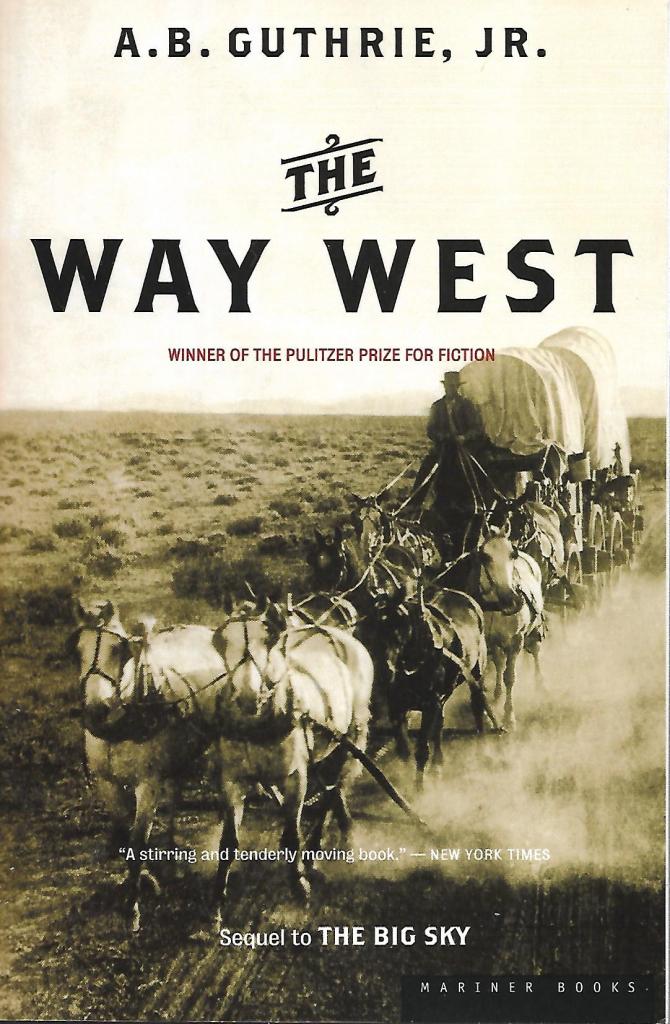
The Way West ~ A Capsule Book Review by Allen Kopp
For decades now, we’ve been able to get on a jet plane and fly from the middle of the country, Missouri, all the way to Oregon in the Pacific Northwest in a few hours. In the 1850s it wasn’t so easy. Back then, people traveled the distance in the most difficult way imaginable: in wagon trains of ten, fifteen or twenty wagons, usually one family to a wagon. The trains moved about ten to twelve miles a day, so the trip lasted for months. And the way was fraught with dangers and hardships, including canyons, wild rivers, mountains, vast distances without rest or water; extremes of heat, wind and cold; illness, disease and death; hostile, sometimes murderous, Indians; wild animals including buffalo and rattlesnakes (not to mention mosquitoes and other insects); the inevitable clash of personalities and all the jealousies and ugliness engendered by a group of human beings thrown together. The train comprises a microcosm, a world in miniature, the bad along with the good.
The Way West by A.B. Guthrie Jr. is the simple story of one such wagon train that sets out from Independence, Missouri, with its sites set on the storied land of Oregon. These wagon trains always had a “pilot,” an experienced man who usually knew what most of the travelers didn’t: the way was hard and dangerous and some of them weren’t going to make it. Dick Summers is the pilot in The Way West. He’s forty-nine years old, a widower, a mountain man who has traveled over the terrain before and knows what to expect. He always knows the best route to take, how to deal with the indigents, how to ford raging rivers, etc. Without him, the travelers would be doomed. Think of John Wayne.
Lije Evans was a farmer back in Missouri. Now he’s the captain of the wagon train. He tells the train when to stop and when to get a-goin’ again, but he relies heavily on Dick Summers for practical advice in all matters. Lije is traveling with his wife, Rebecca, his son, Brownie, and his faithful old dog, Rock. Lije is the central character in the novel. We see things through his eyes. His must deal with the usual collection of misfits and egocentric individuals who think they know more than he does. Thrown into the mix is a teenage temptress named Mercy McBee who—innocently enough, it seems—falls under the spell of a handsome married man, Curtis Mack, and ends up pregnant by him. Uh-oh! The leaders already said at the outset that they wouldn’t countenance adultery and fornication and would horsewhip any offenders.
The Way West is a solid, readable classic that won the Pulitzer Prize for fiction in 1950. It’s an American story about westward expansion and the search for a better life in the nineteenth century when the country just wasn’t big enough and people wanted to make it bigger. Now people are much softer. When I’m with a group of people and somebody is complaining about being cold in a stifling room or they want to have all the windows closed in an airless room because they’re afraid of bees getting in, I say, sarcastically, “That’s the pioneering spirit that made this country what it is today.” People today are whiny-assed crybabies who would never be able to suffer the hardship and discomfort of traveling across a continent in a covered wagon to live in an unknown place they’ve never seen before. Does everybody have their cell phones, and how on earth are we going to charge them? How about anti-anxiety pills? Does everybody have theirs? You’re certainly going to need them when an Indian tries to scalp you.
Copyright © 2018 by Allen Kopp
1950 ~ New York City
A study in contrasts, light and dark.


