Real-life World War II hero Audie Murphy plays a young Civil War soldier named Henry Fleming in the 1951 film adaptation, directed by John Huston, of Stephen Crane’s great American novel The Red Badge of Courage.
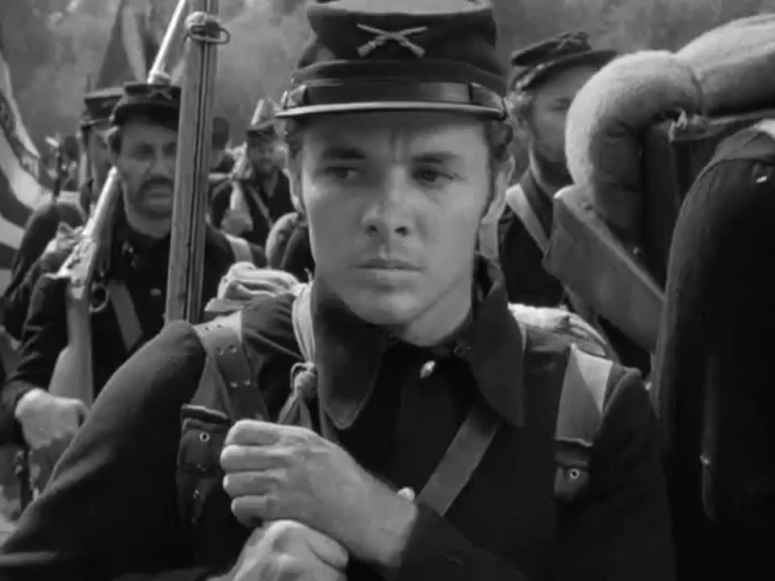

Real-life World War II hero Audie Murphy plays a young Civil War soldier named Henry Fleming in the 1951 film adaptation, directed by John Huston, of Stephen Crane’s great American novel The Red Badge of Courage.

The Hessian ~ A Capsule Book Review by Allen Kopp
The Hessian by Howard Fast is set in 1781, in Colonial America during the Revolutionary War. A group of Hessians (German mercenaries fighting for the British) has landed in Connecticut. There are only sixteen of them, plus a drummer boy and a commander, but they are up to no good and the Colonials are rightly afraid of them. Hessians have been terrorizing the Colonials all during the war. They are highly skilled warriors who soldier for pay; the mostly untrained American soldiers are no match for them.
The Hessians come upon a halfwit named Saul Clamberham. Because he has a slate in his possession with some marks on it, they deduce he is a spy, so they hang him from a tree. A twelve-year-old boy named Jacob Heather witnesses the hanging from a distance. He, of course, runs and tells everybody what he has seen. A citizen militia, armed with any kind of guns they can lay their hands on, lays in wait behind a fence and ambushes the Hessians. All the Hessians are killed, except for the drummer boy, a teen named Hans Pohl who drops his drum and runs off into the hills. He has a bullet wound in his shoulder and doesn’t get far. He ends up at the home of a Quaker family named Heather. At their peril, the Heather family hides Hans Pohl in an upstairs room of their house and cares for his wound. He might die because the wound has become infected. Sally Heather, the sixteen-year-old daughter of the Heathers, sits by his bed and falls in love with him, not caring that he is one of the enemy.
A local doctor named Evan Feversham treats Hans Pohl at the Heather house, secretly, of course. Dr. Feversham is something of an outcast in the neighborhood because he is an Englishman who has come over to the American cause. The Heather family are also outcasts because they are Quakers, so they have something in common with Dr. Feversham. They all know they will be in serious trouble for hiding and taking care of Hans Pohl, the Hessian.
Authorities soon discover that the Heather family is hiding Hans Pohl. The Heathers are forced to give him up, with the promise he will be tried before he is hanged. The trial, when it is held, is a farce. Hans Pohl is tried for the murder of Saul Clamberham because he was present when it happened. It doesn’t matter how young Hans Pohl is or how innocent he appears. Because he is a Hessian, one of the enemy during wartime, he can’t be anything other than guilty.
The Hessian is told in the first-person voice of Dr. Feversham, the man who doesn’t quite belong. He is a battle-hardened veteran who believes in the American cause but also believes that anybody deserves to be treated for his wounds. He is cynical and realistic and knows that in wartime people don’t behave rationally. It’s a story that won’t have, can’t have, a happy ending. You never really learn what life is about. When you die, you don’t understand it any better than you did when you were born.
Copyright © 2018 by Allen Kopp
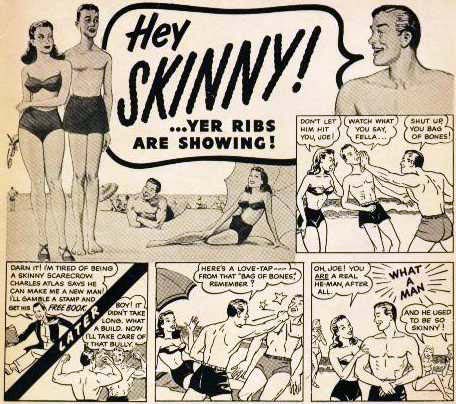
All it took was a stamp and Charles Atlas’s free book.

The Flatiron ~ A Capsule Book Review by Allen Kopp
New York’s iconic Flatiron Building stands at the intersection of Broadway, Fifth Avenue and Twenty-third Street. It’s a triangular-shaped building twenty-two stories tall, completed in 1902. Art critics and arbiters of good taste hated it from the moment it was completed, while the public loved it. The photographer Alfred Stieglitz said the Flatiron is to New York what the Parthenon is to Athens.
The Flatiron was one of the first skyscrapers in New York. Thanks to the use of the steel framework, skyscrapers could be built taller and taller because the lower walls were no longer supporting the weight of the structure. George Allon Fuller (1851-1900) was credited with the invention of the skyscraper. Tall buildings became the trademark of New York. Real estate prices were exorbitant and, the higher the building, the more money investors could get on their investments. It was, and is, all about money. Somebody figured out that a skyscraper doesn’t become profitable until the thirteenth floor.
George Allon Fuller had a daughter named Allon. She married a man named Harry Black and he eventually took over the Fuller Company started by his father-in-law and became a powerful force in the building trades in New York. (The Fuller Company became known as the “Skyscraper Trust.”)
Harry Black wasn’t an architect or an engineer but a businessman, a builder and a wheeler-dealer. He was responsible for many of the landmark buildings that still stand today, including the New York Public Library and the lavish Plaza Hotel. He figures prominently in the story of the Flatiron. He and his wife Allon were divorced after ten years of marriage. She remarried and died at age 37 of pneumonia. He also remarried and committed suicide in 1930 at age 68.
The Flatiron, by Alice Sparberg Alexiou, is a fascinating nonfiction account of the Flatiron Building and the times in which it was built. It was a time of great excitement and growth in New York City, punctuated, of course, by periodic economic “downturns.” Many things were going on during this time. The steal industry flourished with the increased demand for steal used in skyscrapers. Moving pictures were in their infancy; the public was fascinated by this newest—and potentially profitable—form of entertainment. President William McKinley was assassinated by an anarchist; his vice-president, Theodore Roosevelt, then became president. The labor movement was becoming more and more powerful, causing headaches for employers and builders. In the basement of the Flatiron Building was a restaurant that seated 1500 people. It eventually became known for its jazz, another new form of American entertainment. Of course, the good times couldn’t last. They never do. The United States entered the “Great War” in 1917. Prohibition soon after closed down a lot of popular nightspots that served liquor. In 1929, the Great Depression wiped out the fortunes of a lot of the fabulously wealthy. Millionaires became paupers overnight. Nothing ever stays the same. Everything is always in a state of flux. Here today, gone tomorrow. Enjoy it while it lasts.
Copyright © 2018 by Allen Kopp
Her hair looks like shit.