The End of Eddy ~ A Capsule Book Review

The End of Eddy ~ A Capsule Book Review by Allen Kopp

The End of Eddy, by young French writer Édouard Louis (born 1992), is a novel set in a small factory town in the North of France in a region known as Picardy. Eddy Belleguere is the fictional narrator of the novel, and we learn from the background information of the novel’s author that the story, though fictional, is, in fact, an account of his own life. Eddy Belleguere is the fictional alter-ego of real-life Édouard Louis.

Despite the charm of the region in France where the story takes place, the lives of the factory workers and their families are anything but charming. Life is hard in the factory, and the men who toil there all their lives sometimes die at an early age. They drink to excess, beat their wives, and watch porn and Wheel of Fortune on TV. The women, who sometimes also work in the factory, are long-suffering custodians of the children. The children are unmotivated, unhygienic boobs who usually want nothing more out of life than to get a minimum of education and then get a job in the factory and live the same life of toil that their parents have lived.

Every now and then a boy comes along who isn’t like the others, and that boy is Eddy Belleguere, the protagonist of the novel. He isn’t comfortable with the masculine gender role (as personified by his father, his brothers and every other male in his sphere) that he is supposed to adopt for himself. Eddy has feminine gestures and is attracted to boys and men. His friends at school are all girls. He is brutally bullied and abused by older boys in school and has no way to fight back. As he gets older and realizes he is gay, he tries to “fit in” and be like all the other boys, but he knows (and we know) that it isn’t going to work out. Eddy has an identity crisis and it is never going to resolves itself until he escapes his family, his town and his environment.

The End of Eddy is a story about identity, conforming, belonging, and finding one’s own place in the world, whatever that might be. It’s a breezy novel, simply written, engaging, engrossing and not at all taxing to the brain. Highly recommended to those readers who appreciate a good story about being “a square peg in a round hole.” I think we have all been there, at least in one way or another, when we were young. (Remember how you loathed gym class, dreaded it for days in advance, and might even still have nightmares about it?)

Copyright © 2021 by Allen Kopp

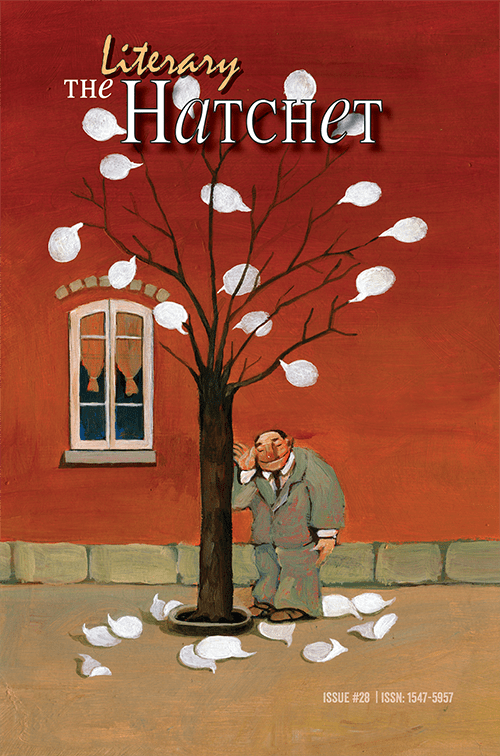
The Literary Hatchet, Issue 28

The Literary Hatchet
Issue #28

The Literary Hatchet is an independent international journal devoted to emerging and established voices crafting provocative short fiction and thoughtful poetry and prose. Published three times a year! (Stefani Koorey, editor; Eugene Hosey, editor; Michael Brimbau, editor.)

Contributing writers and artists for Issue #28 include: Luis Abbou Planisi, John Thomas Allen, Karen Boissonneault-Gauthier, Ananya Chatterjee, Barbara Demarco-Barrett, Michael Dittman, Eugene Hosey, Ahni Hurst, Michael Lee Johnson, Janne Karlsson, Gloria Keeley, George Kelly, Cindy Knoebel, Allen Kopp, Cristopher Locke, Denny Marshall, Fabiyas MV, Maurice O’Sullivan, Marshall Pipkin, Wayne Scheer, Dean Schreck, and Jim Windolf.

Available for purchase for $14 a copy at this link on Amazon:

The Literary Hatchet #28: Authors, Collective, Koorey, Stefani, Hosey, Eugene, Brimbau, Michael: 9798717684743: Amazon.com: Books

*****

(A little note: I have six short stories in Issue 28 of The Literary Hatchet: “For Sentimental Reasons,” “Maroon and Yellow,” “Not a Cough in a Carload,” “Since Anybody Lived Here,” “Under the Wide Western Sky,” “You May Know Him as a Ghoul.”)  

*****

Tchaikovsky, A Biography ~ A Capsule Book Review

Tchaikovsky ~ A Capsule Book Review by Allen Kopp

The great Russian composer Peter (“Petyr”) Ilyich Tchaikovsky was born in 1840 and died in 1893. He was a complex man who experienced many setbacks in his life, but one who, despite his fragile psyche, managed to write some of the great symphonic masterpieces of Russian music and of the nineteenth century, including six symphonies, three ballets, several operas, four serenades for orchestra, chamber music, songs, and (still) wildly popular concertos for piano and orchestra and violin and orchestra. His music is, today, still very accessible and popular and is performed and played wherever music is appreciated. Tchaikovsky never falls “out of favor” or becomes “passé,” as some composers do. (Writer-physician Anton Chekhov said during Tchaikovsky’s life that Tolstoy occupied the first place in Russian art while Tchaikovsky occupied the second place and Chekhov himself occupied the ninety-eighth.)

Tchaikovsky was born into a large and loving family (four brothers and one sister), in an isolated region of Russian where his father was a civil servant. His mother was rather cold to her children, but Tchaikovsky idolized her. Her death at age forty from cholera was a terrible blow from which he never fully recovered.

Tchaikovsky was morbidly sensitive with the soul of an artist, tending to be withdrawn and introspective. He was a homosexual who openly engaged in homosexual activity from the time he was a young student. (His turbulent inner life played a large part in the music he composed.) While not hiding his sexuality, or denying it, he always believed that it wasn’t “right.” After he became famous and successful, he lived in fear that he would be “exposed” and his career ruined or irreparably damaged. In his efforts to appear “normal,” he entered into a disastrous marriage with an unstable (possibly insane) woman named Antonina Milyukova. It turned out to be the biggest mistake of his life. He only lived with Antonina for two or three months, but she spent the rest of his life antagonizing and threatening him. He referred to her as a “demon” and “spawn of hell.” He could only assuage her, temporarily, by giving her money. She was a bitch on wheels.

About the same time as Tchaikovsky’s disastrous marriage to Antonina, another woman entered his life. Her name was Nadezhda von Meck. She was a wealthy widow, whose deceased husband had made a fortune in railroads. She had an almost obsessive admiration for Tchaikovsky and his music. She idealized him as the perfect artist, the perfect musician, the perfect man. She became his patron, which means she partly subsidized (supported) him while he composed. Madame von Meck was as eccentric in her way as Tchaikovsky was in his. The one condition of her financial support was that the two of them never meet in person. They corresponded for fourteen years, thousands of letters, and were both in the same place at the same time on many occasions, but they never met. Many of the letters they wrote to each other still exist.

Unlike many composers, Tchaikovsky achieved astounding success and popularity during his lifetime. His fame spread from his native Russia to Europe and the United States. Despite his never-ending personal struggles, his output of orchestral masterworks is extraordinary.

Peter Ilyich Tchaikovsky died unexpectedly in St. Petersburg in 1893 at the age of fifty-three. The official account of his death, and the one that was accepted for a century, was that he drank “unboiled water” and died of cholera during an epidemic. However, more than a hundred years after his death, new information came to light which strongly suggests that he deliberately ingested poison to kill himself.

Tchaikovsky, A Biography, by Anthony Holden, is an informative and engaging chronicle of the life and times of Russia’s greatest composer. It’s a long and exhaustively detailed biography, but never too long or too ponderously wordy. If Tchaikovsky’s music “speaks” to you, as it does to me, reading this book and understanding the life of this great man adds a new dimension to enjoyment of his music.

Copyright © 2021 by Allen Kopp