I Have Never Known the River Ishcabob to Flood

I Have Never Known the River Ishcabob to Flood ~ A Short Story by Allen Kopp

(I previously posted these three interconnected short stories separately, and now together.) 

***

Part 1

I was in a place where I had never been before. I was buying a house next to a rocky river. The house was four stories tall and there were four houses in a row, all the same shape and height. (Things seem to come in fours here.) Mrs. Goldoni was the woman from whom I was buying the house. She had white-blonde hair like Jean Harlow but that’s where the similarity ended. Her face was very wrinkled and, due to an arthritic condition, she sometimes walked parallel to the floor like an insect. Think of a cockroach or a cricket and there you have the image I’m trying to convey.

I was on the top floor looking out the window at the view. “What’s the name of the river?” I asked Mrs. Goldoni, who was standing on her hind legs fussing with the curtains.

“It’s the River Ishcabob,” she said.

“I don’t think I’ve ever heard of it,” I said.

“It’s a popular tourist attraction.”

“Does it ever flood?”

“Oh, no, sir!” she said. “Why would it flood?”

“Where I come from the rivers flood and cause a great deal of damage.”

“I’ve lived here all my life,” Mrs. Goldoni said, “and I’ve never know the River Ishcabob to flood.”

“That’s a relief,” I said. “I don’t like floods, especially if they inconvenience me.”

I had been talking to Mrs. Goldoni over my shoulder and when I turned and looked out the window again, I saw hundreds of workmen swarming over the river and on the rocky beach between the house and the river. Just a few seconds ago, they hadn’t been there. They were moving very fast so I couldn’t see what they were trying to accomplish.

“What are those workmen doing?” I asked Mrs. Goldoni.

“They’ve incurred debt, sir,” she said.

“What kind of debt?” I asked.

“Not the kind that has to do with money.”

“You mean like moral debt?”

She laughed her tinkling laugh. “I wouldn’t expect you to understand yet, sir.”

“Understand what? Am I missing something?”

Mrs. Goldoni chuckled and dropped to her tiny, clicking feet and skittered out of the room.

“What kind of arthritis is it that makes you walk like that?” I asked, but of course she was gone and didn’t hear me.

After lunch, I noticed a little room in my house that I hadn’t seen before. There were two steps going up to it and at the top of the steps were French doors just like my Aunt Susie had between her living room and dining room when I was a little boy. When you see the doors, you can’t keep from opening them.

“What’s in here?” I asked Mrs. Goldoni, who just seemed to appear from nowhere.

“Oh, we don’t go in there!” she said.

“This is my house!” I said “I think I’ll go wherever I want!”

When I opened the French doors, I could see they hadn’t been opened in a long time. Gobs of cobwebs came loose in artful drapes, and little chips of paint and tiny slivers of wood fell on my head.

Mrs. Goldoni was standing at my right shoulder looking anxiously on, and when I turned my head to look at her, I realized there were other people standing all around me.

“Who are they?” I asked Mrs. Goldoni.

“Oh, they’re always here,” she said. “They won’t bother you.”

“This is my house,” I said. “I came here to get away. I don’t want lots of strange people hanging around.”

“You’ll get used to them,” Mrs. Goldoni said, “and you’ll forget they’re even here.”

“Lord in heaven,” I said. “What have I got myself in to?”

I swung the French doors open as far as they would go and stepped inside the little room, which, to my surprise, had pink wallpaper on the walls. A tiny window kept the room from being without light. I took a few cautious steps into the room, with Mrs. Goldoni and the others behind me.

In the little room were hundreds of obviously very old, gold pocket watches suspended from gold chains, displayed on racks.

“What’s all this?” I asked.

I reached out to pick up one of the watches to get a better look and Mrs. Goldoni said, “I wouldn’t touch those if I were you!”

“Why not?” I said. “They’re in my house. Anything in my house belongs to me, doesn’t it?”

“They’re haunted,” she said.

I turned and looked at her, not sure if my ears were working right. “How can a watch be haunted?” I asked.

“If you don’t leave them alone,” she said, “you’ll find out the hard way.”

“I don’t know what you mean.”

“You’ll stir up some mean merde if you’re not careful!”

I knew just enough French to know what she was saying. I refrained from handling the watches any further while promising myself I’d find out more about them later.

After I reclosed the French doors and the crowd around me had dispersed, I decided to take a little walk outside and have a look at my immediate environs.

The “beach” between my house and the river wasn’t pretty. It was very rocky. You could walk on it, but only with sturdy shoes. I walked down close to the river and turned and looked at my house.

There they were: four, narrow, four-story houses of identical shape; almost like four pillars. The four houses were so close together, there wasn’t even room to park a car between them, but that didn’t seem to make any difference because nobody here seemed to have cars, anyway.

My house was the third house in the row, if you count from the left. I figured that all the other houses were occupied, but I knew nothing of the people who lived in them. All I knew was the fourth house in the row was a “bed and breakfast” run by an old woman who looked as if she had at some point in her life been smashed flat. I wasn’t quite sure what a bed and breakfast was, but I knew it to be some kind of commercial enterprise. I would have to let the smashed-flat woman know that I didn’t intend to take any kind of merde from anybody.

When I turned back to the river, I saw the workmen moving around furiously. One man who came near to me slowed down long enough for me to make eye contact with him.

“What are you doing?” I asked.

“You’re not supposed to ask questions,” he said.

“Why not?” I asked.

“You’re not supposed to talk to us.”

“What kind of a place is this?” I asked.

And then I went furniture shopping. There was a piece of furniture I wanted for my new house. I didn’t know what it was or what purpose it served, but I only knew I had to have it. After looking around for a long time in the store, I found one I liked. It looked like an old console TV in a wood cabinet, but nobody had those anymore. A salesman in a suit hovered near me. He spent a lot of time with me while I made my selection.

Finally I found the one I wanted to buy. The salesman said it cost four hundred dollars. I told him I’d take it and I wanted it delivered.

When I went to pay for the piece of furniture, the salesman told me it was four thousand and four hundred dollars.

“I thought you said four hundred,” I said.

“Oh, no, sir!” he said. “Its four thousand and four hundred.”

“That’s too much!” I said. “The thing’s not worth that much money.”

I found another one that I liked better that was nearer to the price I wanted to pay, and when I got home it was waiting there for me in a big box.

The pleasant-faced actor named Kyle Chandler was in a recent movie I had seen. He wasn’t the lead in the movie, but he played the brother of the lead. In the construct of the movie I saw him in, he had a congestive heart condition and died, even though he was only forty-five. We saw him dead in the hospital morgue when his brother, the lead character in the movie, showed up to identify the body.

Anyway, when I got home from buying my piece of furniture that looked like an old-fashioned console TV in a wood cabinet but wasn’t that because nobody had those anymore, Kyle Chandler was there and he was waiting to help me take the thing out of the box. We got the thing out of the box and were struggling with it to get it to the place in the room that was just right for it, when Kyle Chandler grabbed his chest and fell to the floor on his back.

Lying on the floor, his eyes were closed and he seemed to not be breathing. I leaned over and put my ear against his chest. There was no heartbeat. I realized then that all the people who had been standing around me when I opened the little room with the French doors were there again.

“Somebody get a doctor!” I said.

Nobody made a move to do anything, so I began thumping Kyle Chandler on the chest where I thought his heart must be, the way I had seen it done in the movies. I put one hand over his heart and hit the top of my hand with my other fist as hard as I could.

Kyle Chandler sputtered and opened his eyes. He looked at me and smiled. “What happened?” he asked.

“I think you were having a heart episode,” I said, “but you seem all right now.”

He stood up, smiling, not seeming to realize he would be dead if it hadn’t been for me.

At the end of the day I was lying on the floor with my biggest cat on top of me. He was purring and covered almost my entire body. I felt, as always, comforted by his warm and loving presence. We were listening to the fifties station on satellite radio and Little Richard was singing You Keep A-Knocking but You Can’t Come In!

There was a woman sitting behind a desk a few feet away from me, but she didn’t seem to notice me. I found it very easy to pretend she wasn’t there. Mrs. Goldoni was right—I was getting used to those people in my house and wasn’t bothered so much by their presence. I still didn’t know who they were or why they didn’t leave since it was my house, but I felt sure all would be revealed in time.

***

Part 2: Birth of the Dodo

The sky was overcast. No sunshine for days. I was sitting on the couch with my feet propped up, reading an article entitled “How to Take the Rigor Out of Rigor Mortis,” when Mrs. Goldoni came into the room. I heard her insect feet clicking long before she appeared.

I looked up from my magazine and said, “Why are you still here?” There was just a touch of malice in my voice, but nothing I said ever seemed to bother her.

“I’m staying on as housekeeper,” she said. “At least for a little while.”

“Did I say I need a housekeeper?”

“No, sir,” she smiled, “but I’ve lived in this house for many years, and I think it’s only fair that I stay on and help you until you’ve had a chance to get used to the place.”

“I can get used to the place on my own,” I said, “without any help from you or anybody else.”

“Yes, sir,” she said.

“And while we’re on the subject of ‘this place’,” I said, “yesterday I was downstairs and I noticed some rooms I hadn’t seen before. When I tried to go into them, I discovered to my disappointment that they were locked.”

“Yes, sir,” Mrs. Goldoni said.

“Isn’t this my house?”

“That cannot be disputed, sir.”

“I bought it, paid for it with every cent I had. You signed the papers transferring ownership to me.”

“That’s right, sir.”

“Rooms in my house belong to me, then, don’t they? I should be able to go into them whenever I want.”

“That’s true, sir, but this is not like any other house,” she said.

“In what way is it not like any other house?”

“You’re finding out, sir, as you go along.”

“As I go along,” I said.

“That’s the thing we all have to do. Learn as we go.”

“I tell you I don’t need a housekeeper!”

“I think you do, sir,” she said.

“Wouldn’t you say that I’m the boss and you’re the employee?”

I would expect these words to hurt Mrs. Goldoni’s feelings, but they seemed to have no visible effect on her.

“I’ll leave, sir, whenever you say.”

“What I want you to do,” I said, “is get the keys to the rooms that are locked so I can open the doors and see what’s inside the rooms.”

“That might not be so easy, sir,” she said.

“Why not?”

“As I’ve said before, it’s an old house and a different sort of a house.”

“Different, yes. I turned a corner yesterday and saw a strange woman walking toward me. She was holding her arms out stiffly at her sides and taking skating steps as though she walked on invisible skis. She was wearing a billowing white robe that went from her neck down to her feet. I just caught a glimpse of her face, but she had, I’m sure, the face of Kay Francis.”

Who, sir?”

“Kay Francis, the nineteen-thirties movie star. Long dead and mostly forgotten.”

“I don’t keep up with the movies,” Mrs. Goldoni said. “Did the lady speak to you?”

“No, Mrs. Goldoni, she didn’t. I wanted to ask her what she was doing in my house, but she was gone before I had a chance to say anything.”

Mrs. Goldoni laughed. “That’s the way things happen here.”

“How many times do I have to tell you I don’t want people in my house?”

“Is anybody bothering you, sir?”

I thought for a moment. “Well, no,” I said. “Not exactly.”

“If anybody bothers you, sir, you be sure and let me know and I’ll tell them to stop.”

“Yes, but who are they?”

She laughed and straightened the dust bonnet on her head, apparently casting about in her head for the right words. “So many people have lived in the world and have died. You are now in the place where you can see some of them.”

“I can hardly accept that as an answer,” I said with what I hoped was a measure of sternness.

“Yes, sir,” she said.

She gave me a wan little smile and maneuvered her legs about to leave the room.

“How’s the arthritis?” I asked.

“Oh, we manage!” she said cheerily.

“Sometime we’ll have a long talk over a cup of tea,” I said, “and you can explain to me how arthritis turns you into an insect.”

She was gone, though, so I was sure she didn’t hear me. Like a mother, she had the facility of not hearing what she didn’t want to hear, but always hearing what you wish she hadn’t.

Two days later, I was walking along an unexplored corridor on one of the lower floors in my house, when I turned a corner and saw several people, mostly women, crowded around the doorway of a room I had not had the pleasure of visiting.

“What’s going on here?” I asked.

Some of them turned and looked at me and, I swear, they dissolved into the air as soon as they saw me. There were still four or five people remaining, though, blocking my way and keeping me from going into the room.

“It’s all right,” I heard Mrs. Goldoni say. “Let him come in.”

The room was small with a bed; four women, including Mrs. Goldoni, were standing around the bed. There was a person in the bed and a sort of tent over the person made of bedsheets. The only parts of the person that weren’t underneath the tent were head and shoulders.

“What’s all this?” I asked.

“This is Lulu, your wife,” Mrs. Goldoni said. “She’s giving birth.”

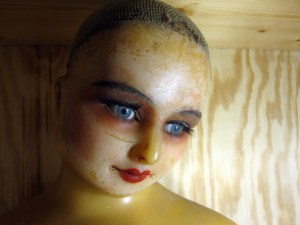
As astonished as I was at that statement, I was more astonished at Lulu in the bed. She was a human-sized doll with a painted face and a lacy Jane Austen cap on her head. Her lips were drawn on in the shape of a cupid’s bow and her cheeks were red. Her eyes were small and sparkling, with lashes like spiders’ legs.

“Very funny,” I said. “You know I don’t have a wife.”

“Well, if didn’t have a wife before, you have one now!” Mrs. Goldoni said.

“So, that’s the way marriage happens here?” I asked. “You’re not married and then you are married before you even know it?”

“Well, yes, if sometimes happens that way here.”

A woman standing at the foot of the bed was holding a stopwatch. “The pains are closer together now,” she said anxiously to Mrs. Goldoni.

Mrs. Goldoni said to me, “You can either go back upstairs where you’re comfortable, or you can stay here and witness the birth of the dodo bird.”

“’The birth of the dodo bird’,” I said. “I believe the dodo is extinct.”

“You’re about to find out!” Mrs. Goldoni said. “Here comes the head!”

Lulu the doll didn’t make a sound, but the women standing around the bed made encouraging little clucks with their tongues. I stood there watching, not sure what I was about to see. In about two minutes, Mrs. Goldoni pulled from underneath the sheet-tent a fully formed dodo bird. She held it up so I and the others could get a look at it.

“Is that really a dodo bird?” I asked in amazement.

“What do your eyes tell you?” Mrs. Goldoni said.

“Wait a minute!” I said. “A dodo is a bird and birds are hatched from eggs.”

“Not always!” Mrs. Goldoni said.

“Nobody has seen a dodo bird for hundreds of years,” I said with real and not fabricated wonder.

The dodo bird made pitiful little squeaks with its mouth. Mrs. Goldoni handed it off to one of the women and bent over Lulu with her ear to Lulu’s mouth. I didn’t hear a sound but I knew that Lulu was whispering into Mrs. Goldoni’s ear.

“She wants to know if the baby is all right,” Mrs. Goldoni said. “Yes, dear, the baby is a fine male dodo bird, exactly as you expected.”

I looked at Lulu’s face but saw no change in her expression because she was a doll and doll’s expressions remained the same, no matter if a dodo bird has just come out of their bodies.

“She’s wants to name him Sheridan,” Mrs. Goldoni said.

The women clapped their hands and gave little expressions of approval and Mrs. Goldoni turned to me.

“The baby needs to be fed and changed and I think it’s time for the poppa to go back upstairs.”

“I’m not really the father of a dodo bird,” I said. “I think you’re playing a joke on me.”

“You’ll have plenty of time to sort this all out before you’re through,” Mrs. Goldoni said.

“Through with what?” I asked, but she took hold of my elbow and ushered me out of the room and closed the door firmly.

I went back upstairs, excited at the prospect of being the father of a dodo bird. Nobody else I knew could claim the distinction. I wanted to take a picture of the dodo, my son Sheridan, because I was sure my friends were not going to believe me. (I was forgetting for the moment, I suppose, that I didn’t have any friends and wasn’t likely to make any new ones.)

I began looking through my things for the camera that I once owned, but had no luck finding it. I needed to buy myself a new one. It’s so seldom that you become a father, especially the father of a male dodo bird named Sheridan, that you must have pictorial documentation so that people may know you’re not going insane or are already there.

Out the windows on the upper floor of my house, I could see the scenic little town of New Garland nestled among the hills. Somebody had told me when I first came to the house that New Garland was a mile-and-a-half away. Since shank’s mare was my only means of getting anywhere, I would walk there tomorrow and find a shop that sells cameras and buy one.

In the morning after breakfast, I went to my room and dressed in outdoorwear, cap, jacket and hiking shoes. When I went back to the kitchen to tell Mrs. Goldoni I was going to be gone for at least a couple of hours, she was sitting at the table with Mrs. Woolwine, the smashed-flat woman who ran the bed and breakfast next door. They liked to have confabs a couple of times a week in which they exchanged gossip and talked about their various ailments.

“How are you, Mrs. Woolwine?” I asked.

“Feeling a little flat these days,” she said.

“How’s business?”

“We’re full up,” she said. “We’re always full up. People love to stay here on their way to some other place.”

“Wonderful!” I said.

“Are you going somewhere?” Mrs. Goldoni asked me.

“Yes, I’m going to walk to New Garland. I’m in the market for a camera. I want to take some pictures of Sheridan so people will believe that I really have a dodo bird in my house.”

“The proud poppa!” Mrs. Woolwine said with her flat smile.

“No, it’s not so much pride as it is amazement. You know and I know and everybody else knows that I can’t be the father of a dodo bird, except in the sense that I would be the father of a kitten that I found on the street and took home to raise into a cat.”

“I wouldn’t talk that way around Lulu if I were you,” Mrs. Goldoni said. “She’ll think you don’t love her anymore.”

“I don’t love her and never have loved her. She’s a doll. You know she’s a doll, I know it, and I’m sure Lulu knows it. Dolls don’t give birth to anything, but especially they don’t give birth to dodo birds.”

“Sometimes they do,” Mrs. Goldoni said.

“I might eat lunch in town,” I said, “so If I’m not back by lunchtime, go ahead without me.”

“New Garland is a long way to walk,” Mrs. Goldoni said. “Watch out for the Followers.”

“The Followers? The Followers of what?”

“The Followers of the Father of All Lies.”

“He’s also called by a lot of other names,” Mrs. Woolwine said.

“I don’t know what you’re talking about,” I said.

“They want your soul,” Mrs. Goldoni said. “They’ll take it, too, if you let them. You’ll be safe as long as you ignore them and don’t engage with them. They can’t take your soul without touching you, and they can’t touch you unless you allow it.”

“They try to seduce you,” Mrs. Woolwine said.

“It sounds like a story to scare children,” I said with a laugh. “Believe me, I’ll be fine.”

So, I set out in a northerly direction alongside the River Ishcabob toward the town of New Garland. After a half-hour or so of walking, I heard screaming and looked to the source of the screaming out in the middle of the river. It was a woman flailing about in the water, apparently drowning.

“Help me!” she screamed. “Save me! I’m drowning! Oh, I’m drowning!”

I stood on the banks of the River Ishcabob watching the drowning woman. I didn’t for one second consider trying to save her. My shoes were new and I didn’t know how to swim, anyway. I had had a scratchy throat for the last couple of days and I knew that getting myself all wet wouldn’t help it any.

The woman stopped screaming, stopped waving her arms, and went under for the last time.

“You’ll have to do better than that,” I said, hoping that if there were any Followers around they would hear me.

The town of New Garland was old and quaint. There were a few people on the streets, but they moved quickly and didn’t look at me. As I looked at the little shops on the main thoroughfare, I doubted that I would be able to buy a camera in this place.

After I walked a couple of blocks, I saw a place of business with a shining glass window on which was painted the legend Witherspoon’s Photographic Studio, and underneath that, Photographs of the Deceased. I went inside and was greeted by a tall man with a drooping mustache and a high collar.

“What might I do for you today, sir?” he asked with a friendly smile.

“I’m looking to buy a camera,” I said.

“A camera?” he asked. “You want to buy your own camera?”

“Yes. I had a camera before but I can’t seem to find it anymore.”

“They’re very expensive, I’m afraid, sir,” he said.

“What year are we in here?” I asked.

“Would you like to sit for your portrait?” he asked. “It only takes a few minutes.”

“Well, no, I wasn’t wanting a picture of myself. I have plenty of pictures of myself and I keep them hidden away. I have a dodo bird in my house and I want a picture of my dodo bird before it gets away or before something happens to it.”

“Do you have your dodo bird with you?” he asked, looking down at my feet.

“No, no!” I said, running out of patience. “I want to buy a camera so I can take my own picture of my dodo bird.”

“You can’t buy a camera here, I’m afraid, sir.”

“Well, where, then?”

“You could try the town of Gladstone.”

“And where is that?”

“It’s about twenty miles that way,” he said, thrusting his chin toward the street.

“I’m walking,” I said. “I obviously won’t be walking twenty miles to buy myself a camera.”

“Well, sir, since you’re here, would you like to sit for your photograph today?”

He took me into another room and I sat on a small dais that resembled the throne of an emperor. After the man and another man fussed with my hair and clothing, I was aware of a bright flash and then it was all over.

“Call for your picture in a week,” the man said. “You don’t have to pay until then.”

After I left the photography studio, I was hungry and thirsty. I spotted a place across the street with a sign that said Fine Eats, so I crossed over and went inside.

There was nobody else inside Fine Eats, so I sat down at a table next to a window overlooking the street. A very small woman came out from the back and set a glass of water down by my elbow and handed me a menu.

“Fried catfish today’s specialty,” she said. “Served with slaw and fried potatoes.”

I looked at the menu, but I couldn’t keep from looking at the tiny woman over the top of the menu. She had red wooly hair piled high on top of her head. Her ears stuck out very far on each side of her head and her eyes were blank but bright like the eyes of a doll. On the backs of her hands were what appeared to be the kind of spikes you would find on the back of a Gila monster in the Mohave Desert. I couldn’t help but believe that she had an affliction like the one that was causing Mrs. Goldoni to turn into an insect.

I glanced over the menu and said, “The fried catfish will do.”

She brought me a beer in a large glass container to keep me occupied until the fried catfish was ready.

The food was excellent, I had to admit. I couldn’t remember when I had food that tasted so good. I couldn’t, in fact, ever remember eating any food of any kind before, although I had a vague recollection of eating breakfast that morning. Something was happening to me and I didn’t know what it was. I was experiencing many things I had never experienced, including an uncharacteristic loss of memory. Maybe I too was turning into something other than what I started out to be.

The tiny woman waitress didn’t come back, so I paid for my lunch with Roman coins and left Fine Eats and went back out onto the street.

The clouds had dissipated and the sun was shining. The birds were singing. It was a spring day that reminded me of spring days when I was a small child. The thought of the long walk to get back home didn’t tire me. I breathed the pure air deeply into my lungs and set out with my left foot. I would keep my eye open for a present to take to Sheridan. Just what do dodo birds like? I wasn’t sure. I had no knowledge to go on since dodo birds had been extinct for so long. I would make it my business to find out, though.

***

Part 3: In My House are Many Rooms

For several days, rain and thunderstorms kept me inside, but I didn’t mind. I had always liked the rain. The sound of the thunder gently rolling over the hills was pleasing in a way I wouldn’t have been able to explain. I had no obligations to fulfill and so spent my time—for the first time in my life, it seemed—doing exactly as I pleased. I read, napped and, of course, I still had plenty to do putting my house in order.

Sometimes I liked getting out the hammer and nails and hanging a picture on the wall in a certain spot and then sitting for an hour or more looking at the picture, trying to decide what I had liked about it in the first place. Some of the pictures, and some of the books and other articles I took out of boxes, I couldn’t remember from my previous home. My memory continued to play tricks on me. I remembered things that hadn’t happened and forgot things I should be able to remember. I wondered if I should see a doctor, but, if I did, what kind of doctor would it be? Was I losing my mind? Mrs. Goldoni, when I bothered to ask, could offer no explanation. I told you it’s a different kind of house, she’d say.

In the evenings after supper I enjoyed sitting and reading with some music playing quietly in the background. We had no radio or television—Mrs. Goldoni explained we were too far away to get the signal—but I didn’t mind. Sometimes I would close my eyes and when I opened them again Lulu the life-sized doll and Sheridan, my dodo bird son, would be sitting in the room with me. When Sheridan saw I was looking at him, he’d give a playful squawk to let me know he knew I was there, and I was astounded all over again by his existence. I had had pets all my life, cats and dogs, but I never expected to own a real-live dodo bird. As for Lulu, she never made a sound and only moved when I wasn’t looking.

On the day one week after I had sat for my photographic portrait in the town of New Garland, I purposed to go back and get my finished portrait, as the man in the shop had told me it would be ready on that day. The rain had stopped, at least temporarily, so the day seemed auspicious for walking. I put on the same walking shoes and clothes I wore the first time I made the trip and then appeared in the kitchen to tell Mrs. Goldoni not to expect me for lunch as I intended to dine again at Fine Eats.

“I can go with you if you’d like,” she said.

I could barely suppress a smile, thinking about walking out anywhere with an old woman who was becoming an insect, with many legs to prove it. “It’s all right,” I said. “I don’t need a chaperone.”

“You have no experience with the Followers,” she said. “They can be especially nasty when they know you are uninformed. I know how to handle them.”

“Believe me, I’ll be fine. I remember: they can’t hurt me if they can’t touch me and they can’t touch me unless I let them.”

“Be suspicious of all,” she said.

“I can take care of myself.”

I was a half-mile or so from my house, walking toward the town of New Garland, when I saw a disturbing sight. A group of eight or so small children were pelting a man with rocks and clumps of mud. He, the man, was bent over, holding his coat up around his head. I don’t like getting involved in something that isn’t my business, but if I see a person or a thing being mistreated for no apparent reason, I must try to help if I can.

“Here, now!” I said, very loud, causing all the children to stop what they were doing and look at me. “Stop that! What has that poor fellow done for you to stone him?”

A grotesque girl of about eight, shoulders back and head thrust forward, approached me. She was very dirty and dressed in rags. Her matted hair hung about her head like tangled moss. I thought she was going to spit on me or jump at me and rip out my throat.

Here, now!” she said, imitating me. “Why don’t you mind your own damn business?”

The other children laughed and they all turned their attention on me. I saw at once they were Followers. The man they had been pelting looked helplessly at me across a distance of about thirty feet.

When I saw a small boy with a large, deformed head about to throw a rock at me, I held up my finger at him threateningly and said, “I have a gun in my pocket and, while I may not like to shoot children, I won’t hesitate for a second to shoot you if you throw that.”

The children laughed derisively at me, but the boy let the rock fall to the ground without throwing it. I picked a limb off the ground as big as a man’s arm and when I took a few steps toward them with the limb raised in the air, I could see they were afraid of me. They receded and retreated down a hole in the ground. A few seconds after they had all jumped in, the hole disappeared.

The man was sobbing softly. I approached him to see if I might be of help. “Are you hurt?” I asked.

His head was bleeding and the blood was running down the side of his face onto his neck. All I could do was take my handkerchief out of my pocket and hand it to him. Realizing that he might also be a Follower, I made sure my hand didn’t touch his.

“I’m new to this place,” I said. “Every day I see sights that surprise me.”

He managed a weak smile. “I’ve been her a while,” he said. “I don’t remember every being any place else.”

“Do you live around here?” I asked.

“I’m not sure.”

“How can you not know where you live?”

He shrugged his shoulders and I had a chance to look at him closely. He had red hair the color of a new penny, skin as white as alabaster, and a small, pencil-line mustache. His eyes were a clear blue, but they had dark rings around them, as though he had been ill. He seemed all right, but I still wasn’t sure he wasn’t a Follower.

“How did those children come to be throwing rocks at you?” I asked.

“They wanted me to play a game with me and I wouldn’t comply. The object of the game was to get me in a vulnerable position and then to snatch my soul and take it with them back to hell. That’s what they’ve been trained to do.”

“That seems highly implausible,” I said. “Small children?”

“Sometimes they’re worse than the adults.”

“And you’re not a Follower?” I asked.

“Do I look like one to you?”

“I couldn’t say. What’s your name?”

“Farina Alvarez,” he said.

“Well, Farina Alvarez, since you are obviously in a bad way, I’ll help you get to where you’re going.”

“I’m not going anywhere,” he said. “I’m only trying to keep away from the Followers.”

“I have a house,” I said, “on the banks of the River Ishcabob, which I have been told never floods.”

“I’m so happy for you,” he said, closing his eyes as though experiencing a wave of nausea.

“In my house I have many rooms,” I continued. “So many rooms that I haven’t even seen all of them yet.”

“What are you trying to say?”

“I think we could put you up for a while, at least until you find out where you live and where you’re going.”

“I wouldn’t want to put you out any,” he said.

“I have a housekeeper. Her name is Mrs. Goldoni. She has arthritis that’s turning her into an insect.”

“What kind of an insect?”

“I also have a son named Sheridan who is a dodo bird.”

“Aren’t they extinct?”

“Well, not all of them, I guess.”

“I have a wife named Lulu. She’s not my wife in the biblical sense. She’s a doll with a funny, old-fashioned cap on her head. I was in the room when she gave birth to Sheridan.”

“Quite a family you have there,” Farina Alvarez said.

“Well, with all the room we have, I was thinking you could come and stay with us for a few days. I don’t have any friends here and you seem like a decent sort, if we can fully establish that you’re not one of them.”

“I’ve already told you I’m not.”

“Mrs. Goldoni will know as soon as she lays eyes on you.”

“Where is this house on the banks of the River Ishcabob?” Farina Alvarez asked.

“It’s back that way,” I said, pointing with the index finger of my left hand.

“But you were headed this way,” he said, pointing in the opposing direction.

“Yes, I’m on my way to the town of New Garland on an errand. If you want, you can wait here for me and I’ll pick you up on my way back home. I don’t mean that in a literal sense, of course.”

“I don’t know,” he said. “If I wait around here, the Followers are sure to come back and get me.”

“Suit yourself,” I said.

“How long do you think it’ll be before you come back this way?” he asked.

“I’m not sure. Clocks and time don’t seem to have much meaning here. Let’s just say in about three hours.”

“I know what I’ll do,” he said. “I’ll find a hiding place in a tree or a cave and in three hours I’ll meet you here on this spot.”

“All right,” I said, “but if you’re not here, I’m not going to wait.”

I walked on to the town of New Garland and went straight to Witherspoon’s Photographic Studio. The same man with the drooping mustache and high collar greeted me at the door.

“Remember me?” I asked.

“Indeed, I do, sir!” he said with a smile. “You’re the one with the dodo bird son.”

“What a memory you have!”

“Not at all, sir. It’s only been one week.”

“Is my photo portrait ready for me to take home?”

“Yes, it is, sir. I have it right here.”

He bent over and produced a little photo album from underneath the counter, which he hastily wrapped in paper, tied up with a string. After he was finished wrapping the album, he put it inside a small drawstring canvas bag and handed it over the counter to me.

“For you to look at later, when you’re at home, sir,” he said.

I paid the man and thanked him and went across the street to Fine Eats. I sat at the same table as before and the same tiny waitress came out from the back. Her hair was higher and more triangular than before, her brilliant, round eyes staring and unblinking. I wasn’t sure how she was seeing me because she always seemed to be looking out the window at the street.

When I tried to get her to look directly at me and she didn’t, it occurred to me that she wasn’t a “she” but an “it.” She was a doll endowed with motion like my Lulu at home. Had the man in the photographic studio with the dropping mustache been a doll, too? Was I a doll? I was pretty sure Mrs. Goldoni wasn’t a doll because she was an insect. Was Sheridan a real dodo bird, or was he, too, a mechanical “thing.” I would be most disappointed to find out that he, above all the others, wasn’t what he appeared to be.

“Today’s special is pickled herring or spaghetti and meatballs served with a red wine and breadsticks,” the waitress intoned in her odd voice that seemed to be coming from another room.

“I’ll have the spaghetti,” I said, having no desire to engage her in further talk.

She brought the wine before the food was ready and I had two full glasses while I waited. As before, there was nobody else in the place. The street also was empty. I heard music coming from some faraway place. When I strained to hear the music better, it stopped and then when I stopped thinking about it, it started up again.

The waitress brought the food and set it down in front of me and I began eating. It was the best spaghetti and meatballs I ever had. The wine was the best I had ever tasted. When I finished eating and was ready to leave, I was a little wobbly on my legs from all the wine. I threw some money on the table and went back out onto the sunny street.

When I came to the spot where I had left Farina Alvarez, he was waiting there for me, sitting on a little hillock beside the road. He smiled and stood up and waved at me.

“No more trouble with Followers?” I asked.

“I think you scared them off for now,” he said.

After we had walked some little ways without speaking, I turned to him and said, “Are you a thing other than what you appear to be?”

“I don’t understand the question,” he said.

“Some of the people here are dolls.”

“I know it,” he said, “but I don’t think I’m one of them. And, another thing about these dolls, they can change their size really fast. One minute they’re full-sized and the next minute they’re small enough to fit into a shoebox.”

“What’s it all about?” I asked.

“I don’t know anything,” he said.

When we got to my house on the banks of the River Ishcabob, it had been raining on us for the last quarter mile or so. I didn’t mind so much because it was a warm rain and I knew I was near home and could dry off and get into clean clothes soon enough, but Farina Alvarez was freezing. His teeth chattered; he held the collar of his thin coat up around his ears. Still, I made him wait outside for a minute while I went into the house and got Mrs. Goldoni. I wanted her to look at him and confirm that he really wasn’t a Follower.

She took a step outside the front door and shaded her eyes with her hand, even though the sun wasn’t shining. Insect eyes are different from human eyes.

“Who do we have here?” she asked.

“His name is Farina Alvarez,” I said. “On my way to New Garland, I happened on a bunch of Followers taunting him and throwing rocks at him. I took pity.”

She made little clicking insect sounds with her mouth and looked him up and down. “Tell me, son,” she said. “What’s the Holy Trinity?”

“Father, Son and Holy Ghost,” Farina Alvarez said.

“He’s all right,” Mrs. Goldoni said. “He’s not a Follower.”

“You can tell just from asking that one little question?” I asked.

“Sure can,” she said. “If you ask a Follower a religious question, it makes them vomit.”

“So, he’s all right, then.”

“I just said he was, didn’t I?”

I smiled at Farina Alvarez and took him by the sleeve and pulled him into the house.

“He’s going to be staying with us for a few days,” I explained to Mrs. Goldoni. “Find a comfortable room for him to stay in.”

“Do you suppose I could get a bath?” Farina Alvarez asked.

Mrs. Goldoni took him by the arm and started to lead him away. “Give him a good room that has a view and that isn’t gloomy and scary,” I said, “and give him some of my clothes to wear. I have more clothes than I know what to do with. Let him take his pick.”

I was weary from my long walk to and from New Garland, so I laid down and had a little nap. In an hour or so, Farina Alvarez emerged, looking scrubbed and wearing some of my clothes. Mrs. Goldoni had fixed him up with a bandage on his head.

“Feeling better?” I asked.

“Except for a headache,” he said.

We sat down to supper and, as we ate, a tremendous thunderstorm shook the house and made the lights go off. Mrs. Goldoni appeared with an antique candelabra and set it in the middle of the table.

“I like I good thunderstorm,” Farina Alvarez said, “as long as I have a roof over my head.”

I could tell we were going to be friends.

After supper the lights came back on. Mrs. Goldoni washed the supper dishes and went to bed. Farina Alvarez retired to his room and I was left all alone. I remembered I hadn’t yet looked at the little photographic album wrapped in paper that I had carried home with me in a drawstring canvas bag from the photographic studio in New Garland.

I wasn’t prepared for what I saw in the album. The first picture was of me laid out dead in a coffin, my hands crossed over my chest. I’m wearing a dress suit, my hair is neatly parted and I have a tiny pencil-line mustache, but, more astonishingly, Sheridan the dodo bird is sitting on the half-open lid of my coffin looking down into my face. He is obviously dismayed at seeing me dead. His beak is open partway as if he is emitting one of his most pitiful squawks and his eyes look watery.

I turn the page and the second picture is equally surprising. It’s of Mrs. Goldoni, dead in a coffin, a lily in her crossed hands. Her mouth is drawn down at the corners and her hair is arranged in a severe style. I had only ever seen her with Jean Harlow hair, but this dead woman is obviously her.

On the third page is a picture of Farina Alvarez. I had only known him for a few hours, so I didn’t know why his picture would be in my photographic album. If I had learned anything in my new home, though, it was not to ask questions for which there were no answers.

On the other pages of the album were photographs of other dead people I didn’t know, even though a couple of them looked slightly familiar. The others were, I suppose, of people who somehow played a part in my long-ago life that I didn’t remember.

Then I remembered the letters on the window of the photographic studio: Photographs of the Deceased.

I could hear it raining through much of the night. Ordinarily the sound of rain acts as a soporific to me, but I had trouble sleeping. About daylight I got out of bed since I couldn’t sleep, took a long shower, and dressed. When I went into the kitchen, Mrs. Goldoni was cooking breakfast.

“We’re all dead, aren’t we?” I said to her by way of greeting.

She stopped what she was doing and looked at me. “I knew you’d figure it out on your own,” she said. “That’s what we all have to do.”

“Why didn’t you tell me when I first came here?” I asked.

“Because that’s not the way it works. For it to be meaningful, you have to find it yourself.”

“Like an Easter egg hunt?” I asked.

“We’re all put here to learn,” she said. “To find things out. You’re no different from any of the rest of us.”

“We’re in hell, aren’t we?”

“No, it’s not hell,” she said. “And it’s not heaven, either. It’s somewhere in between. It’s what the Catholics used to call Purgatory. We have to learn what we’re sent here to learn before we can advance to the next step.”

“What’s the next step?” I asked.

“Nobody knows.”

“Some people have been here for hundreds of years, if not longer. This is not a physical place. It exists in the spirit world. That’s why things are so different here from what you’re used to.”

“I have to tell you,” I said. “I don’t feel dead.”

“I know,” she said. “I don’t feel dead, either.”

“So, we just wait here and let things happen to us and try to escape from the clutches of the Followers and then, one day, we move on.”

“That’s right.”

“Why are you turning into an insect?”

“I wish I knew. It’s part of the plan of the one who made us all.”

“What will happen when you’re an insect and no longer a person?” I asked.

“I try not to think about it,” she said.

“You want to keep on being a person?”

“Yes. That’s why I say my trouble is arthritis. It’s a little conceit of mine. I don’t think insects get arthritis. If I can convince the world, and myself, that arthritis is the reason I’m turning into an insect, it makes me feel more human.”

I went and got the photo album and showed it to her. She turned the pages to the end, making the clicking sounds with her mouth.

“It’s the same for all of us,” she said.

She turned to her own picture and laid the album flat on the breakfast table.

“That’s you, isn’t it?” I asked.

“Have you asked yourself why I’m in your photographic album?” she asked.

“My mother died when I was five years old,” I said. “I don’t remember much about her.”

“I remember everything about you, though,” she said. “I remember the day you were born.”

“So, you’re telling me you’re my mother?”

“Yes.”

“Who is Farina Alvarez?”

“I suppose you’ll find out one day.”

I put the photographic album away and Farina Alvarez emerged from his room and we had breakfast. I wanted to ask him if he knew we were dead; I wanted to show him the photographic album, but I knew I couldn’t. He had to discover these things on his own, just as I had done.

I took Farina Alvarez on a tour of my four-story house. I showed him the room with the haunted watches and the room where Sheridan was born. I took him into the room where Lulu the human-sized doll and Sheridan my dodo bird son spent most of my time, and he seemed genuinely happy to see them. He was as astonished as I was at seeing a real-live dodo bird.

When I saw the people I didn’t know lurking in the hallways or standing in a doorway, he saw them too, and he saw them as they seemed to dissolve in the air. I explained to him that how they were always there but never bothered me. I showed him the River Ishcabob, which I had been told would never flood, and he saw the hundreds of workers on the river who moved so fast they were just a blur. I took him next door to the bed and breakfast and introduced him to the smashed-flat woman, Mrs. Woolwine. She gave us beer and we spent a couple of hours laughing and talking at her kitchen table.

In our long and serious conversations, Farina Alvarez told me he didn’t know how long he had been in this place and he couldn’t remember being in any other. I was gratified in a way to know that his experiences paralleled my own.

It continued to rain almost every day for two weeks and I started feeling sick. For a while I could keep my sickness hidden, but then I started to feel worse and couldn’t get out of bed. My days passed in a blur. I woke and slept and woke. I couldn’t tell the waking from the sleeping. At times I was aware that Mrs. Goldoni, Mrs. Woolwine, Farina Alvarez, and Lulu the doll were standing around my bed, looking anxiously on. Sheridan the dodo perched on the footboard, looking intently at me.

And then, once when I woke up, I was in a different place. I was in a high bed. To my right was a blue wall and to my left a bank of medical instruments. A man stood at the foot of the bed, looking down at something he held in his hands. He didn’t know I was awake so I spoke his name.

He looked at my face and smiled. He had red hair the color of a new penny and a pencil-line mustache and icy blue eyes. I was glad to see somebody there that I knew.

“Farina Alvarez,” I said again.

He came around to side of the bed where he was closer and I could see him better. “What did you say?” he asked.

“I just spoke your name. Are you going to tell me you don’t know who I am?”

“Yes, I know who you are,” he said. “You’re my patient. You’ve been very ill for a while.”

“I know,” I said. “You don’t need to tell me I’m dead because I already know it.”

“I could call you Sleepy Beauty, but since you’re a man, I guess I’ll have to settle for Rip Van Winkle.”

“Where’s Mrs. Goldoni? She needs to know where I am.”

“Is that somebody you know?” he asked.

“She’s my mother. She’s my housekeeper.”

“All right. Just keep yourself calm. We’ll bring you back by degrees.”

He turned to a woman all dressed in white. She stepped forward and took his place beside the bed. I felt a needle jabbed into my arm and then she began fussing with something I couldn’t see that was over my head.

“What is that place?” I asked.

“You’re in a hospital,” the woman in white said. “You’re going to be fine.”

“Where did he go? Where did Farina Alvarez go?”

“If you mean your doctor, he’ll be right back. He went to see another patient for a minute.”

“Tell him I need to see him. I need to tell him something.”

“You can tell me,” the woman in white said.

“I don’t want to be here! I want to go back to where I was! Tell him for me! Will you tell him for me? It’s very important!”

“Would you like to try to sit up?”

“No! I want to go back to where I was! I have people waiting for me. If I don’t come back, they’ll wonder where I am! I have to see my dodo bird and make sure he’s all right.”

“You’re very confused,” the woman in white said, “but that will pass.”

“No!” I said. “I don’t want it to pass. I want to go back to my home on the banks of the River Ishcabob.”

“There is no such place,” she said. “You’ve been dreaming. Imagining things.”

“No,” I said, more weakly this time. “I have a four-story house with many rooms on the banks of the River Ishcabob. I have family there and friends. They’ll be worried about me. I want to go back. I don’t want to be here. I want to be back there, in my home, with my friends and family.”

Farina Alvarez came back into the room and I felt comforted. He took my hand in both of his. He smiled at me and I smiled at him. He had hair the color of a new penny and a pencil-line mustache. His eyes were the bluest I had ever seen. He squeezed my hand and when he did I was borne away on a bank of black fog. I knew then that in just a few seconds I’d be back where I belonged.

Copyright © 2017 by Allen Kopp

Percy Picket Succumbs to Infirmities

Percy Picket

Percy Picket Succumbs to Infirmities ~ A Short Story by Allen Kopp

(Published in Abandoned Towers magazine.)

Mr. Percival “Percy” Francis Harrigan Picket, of Harmony Hill, entered into eternal rest on Thursday, the sixth of September, having attained the age of eighty-five years, four months, and sixteen days. He was preceded in death by his parents, Dewey Alonzo Picket and Alameda Hortense Fredericka (Wicket) Picket; and conjoined twin sons, Alfredo Joshua Torrance Picket and Alphonse Jerome Tyrone Picket. He was also preceded in death by his beloved wife of fifty-eight years, Louisa Maria Helena (Belladonna) Picket, with whom he had ten children.

Surviving children are Victor Hugo Pierce Picket (wife, the former Beatrice Carlotta Pogue Hinchcliff); Tammany Hector Guillermo Picket (wife, the former Magdalena Maybeetle Montclair); Lawson Jervis Wicket Picket (wife, the former Clara Beedle Champagne); George Emmett Grayson Picket (wife, the former Grace Gruber Grudnick); Georgiana Victoria Regina Chinn (husband, Chang Win Chinn); Albertina “June Bug” Dunleavy (husband, Dixie Clement Dunleavy); Alice “Tiny” Wigglesworth (husband, Charles Chandler “Chick” Wigglesworth); and Lucille Lucretia Faith-Winterhaven (wife of Montague Sidney Faith-Winterhaven III).

The deceased is also survived by a brother, Raleigh Gunderson Hartselle Picket; a sister, Adelaide Emmaline Picket Moncrief; and grandchildren Arundel, Woo, Lotus, Astoria, Polly Esther, Brigadier, Judson, Lupé, Xerxes, Chandler, Trixie Bell, Enar, Gunnar, Fritzie, Bongo, Hermes, Echo, Pan, Lou Anne, Jade, Opal, Bean, Babby, Rockwell, Belvedere, Zaza, and twins Jag and Dag. Great-grandchildren include Gaston, Pluperfect, Sasqueesha, Cavendish, Bump, Doral, Horatio, Hector, Eff, Bea-Elza, Vamoose, Lothario, Coriander, Barclay, Oona, Splurge, Penny Ante, Dosie Patootie, Nimbus, Torsten, Lala, Biffy, Maybelle, and quadruplets Choi, Chang, Chen and Ah-Choo.

Also surviving are many nieces and nephews, cousins, business associates, and friends, as well as a special companion with whom he enjoyed white-water rafting and five-card stud, Dinwiddie Oglethorpe-St. Clair, of Steamboat Springs, Colorado, and Council Bluffs, Iowa.

Throughout his long life, the deceased was known as a caring and philanthropic individual. In spite of his large family and his successful and distinguished career as a mannequin designer, he was always ready to don his white makeup, glittery nose, baggy tuxedo and red wig to transform himself into the beloved clown, Mr. Peevish Quackenbush. As this well-known clown character, he was often seen riding on floats in parades and lending a hand at charitable fund-raising events. He often stated to friends and family in later years that it was as Mr. Peevish Quackenbush that he felt most alive. He was frequently quoted as saying, “Mr. Peevish Quackenbush is more Percy Picket than Percy Picket is.”

And it was in mid-life that he launched his second career, that of a professional circus clown. Leaving behind family, home, and business, he traveled with the Fitch Brothers Circus for fifteen years as one of its star attractions. Mr. Otto Fitch, owner and founder of the Fitch Brothers Circus, has stated unequivocally that it was Mr. Peevish Quackenbush who saved the circus from bankruptcy. “We would have never made it through the hard times without Mr. Peevish Quackenbush bringing in new customers in every town,” Mr. Fitch stated. “He is what kept us on the rails.” A life-size statue of Mr. Peevish Quackenbush can be seen on display at the National Clown Museum and Hall of Fame.

In keeping with the wishes of the deceased, he will be interred in the clown car that he made famous in the clown section of the Cemetery of the Holy Ghost. He will lie in state in full clown regalia at the Seltzer Water Funeral Parlor tomorrow evening only from seven p.m. until closing. Tickets may be purchased at the door. Bring the entire family.

Copyright © 2017 by Allen Kopp

City Dump

City Dump image 1

City Dump ~ A Short Story by Allen Kopp

(This is a repost from November 2015 and has been published in 1947 Journal.)

When I was in the eighth grade, the Dutchman decided our old house needed a new roof. Instead of consulting the Yellow Pages to find a reputable roofer, he decided to save a few greenbacks by—no, not by doing the job himself—but by having a “friend” do it at a cut-rate price.

The price at which the friend agreed to replace the roof didn’t, oddly enough, include any clean-up. That means that pieces of the old roof dating from the time the house was built—boards, shingles, chunks of asbestos, nails, what-have-you—were scattered in the yard on all four sides of the house, looking like the scene of an unspeakable natural disaster. How many houses, I ask you, have a new roof while the old roof adorns the yard in the ugliest way imaginable?

The Dutchman’s solution to the clean-up was simple. He had a thirteen-year-old son: me. I weighed ninety-two pounds but was more than capable of picking chunks of debris out of the shrubs and off the lawn and placing them in a washtub. How many washtubs full does it take to hold the thousands of splintered pieces of an old roof? More than you can imagine.

He didn’t own a pickup truck so he borrowed one from another “friend.” (Where do all these friends come from?) It was an old dark blue truck that had seen better days. It was only a one-day loan, so that meant we only had one day to get rid of all the crap that surrounded the house. I was wishing I would lose consciousness and not regain it until well into the next week. I would rather have thirty hours of gym class than a day of enforced yard clean-up with the Dutchman.

After I got the washtub loaded up with stuff, it was too heavy to lift on my own. “Candy ass,” the Dutchman said. “You’re not worth the powder to blow you to hell.”

“I know,” I said. And I did know, as this phrase had been repeated to me in some form or another almost every day of my life.

The Dutchman saw that I could manage the loaded washtub only if he took the other handle. It occurred to him then for the first time that I didn’t have the strength of a grown man. Who knew?

With about eight tubs full of stuff, we had enough in the back of the truck to make a full load. I had to take a rake and distribute the stuff so we could get more in. Then, when the Dutchman was convinced the truck would hold no more, we headed for the city dump, about two miles outside of town. It felt good to sit down, even if the inside of the truck smelled like an old woman who never takes a bath.

At the city dump, the Dutchman carefully backed the truck as close to the edge of the embankment as he could get without going over the side, and we got out and started unloading. I stood up in the bed of the truck and tossed the stuff over the side but, of course, I wasn’t doing it fast enough to suit the Dutchman.

“Do you want to still be working at this at midnight?” he asked.

“I’m starting to feel sick,” I said.

By the time we got back to the house to begin work on the second load, it had started to rain the kind of rain you get in November: slow, cold and steady. The Dutchman made me put on a hat—not to protect my health but because he was thinking about how much money it might cost him if I got sick and had to see a doctor.

The second truckload to the city dump didn’t go any faster than the first one and, after two loads, we had made very little progress. This was taking a lot longer than the Dutchman thought it would. There weren’t going to be enough hours in the day. I was happy, maybe for the first time in my life, at the prospect of going to school the next day.

It was when we were working on the third load that an old man from the neighborhood stepped into the yard and motioned to us. The Dutchman stopped what he was doing and went over to him. I was near enough that I could hear.

“I know somebody that will take all that stuff away for you for a good price,” the old man said.

The Dutchman thought about it for a minute and shook his head. “No, thanks,” he said. “I can do it myself.”

“Looks like that boy there’s about worn out,” the old man said. He meant me, of course.

The Dutchman looked at me as though noticing me for the first time. “He’s stronger than he looks,” he said with a little laugh.

My mother came out of the house then in her plastic rain bonnet. “You know somebody that’ll do this hard work?” she asked.

“My nephew and his friend,” the old man said. “They’ve got themselves an old truck and will do little jobs here and there to earn enough money to fill it up with gas.”

“Does your nephew have a phone number?” she asked.

The old man gave the number and my mother said she would remember it without writing it down. She thanked the old man and he left.

“You come into the house,” she said to me, “and get cleaned up before supper.”

“He’s not going in,” the Dutchman said, “until the work is finished.”

“Says you,” she said.

She put her hand on my shoulder and drew me along with her into the house. It was one of the few times I ever saw her stand up to the Dutchman.

I took a bath as hot as I could stand it to get the roof grit off and put on my pajamas. I had the sniffles afterwards and there were some bleeding cuts on my hands, but I was happy and was sure I would be all right.

The next day when I came home from school, all the roof junk in the yard had been taken away. Mother told me she paid for it out of her own money and that it had been a real bargain. I was beaming with satisfaction at the dinner table that evening while the Dutchman looked unhappy and defeated, too dispirited even to complain that the mashed potatoes weren’t the way he liked them.

Copyright © 2017 by Allen Kopp

Visitors’ Day

visitors-day-image

Visitors’ Day ~ A Short Story by Allen Kopp

It was a Sunday morning in December. Freda and Julian were in the back seat of Daddy Earl’s car. Daddy Earl careened through traffic with ease, no obstacle too much for him to overcome. He had the radio tuned to some cheerful Christmas music because he knew Freda liked it. Julian held onto his teddy bear, although he insisted he didn’t need it, watching the passing scenery with absorption.

“Are you going to take that stupid bear inside with you?” Freda asked.

“Shut up!” Julian said. “I’ll do whatever I want.”

“Will they have her in handcuffs?” Freda asked the back of Daddy Earl’s head.

“I don’t think so,” Daddy Earl said. “Not on visitors’ day.”

The parking lot was full and Daddy Earl had to drive around for a long time before he found a place to park and, once he did, they had to walk a long way to the visitors’ entrance.

“This place gives me the creeps,” Freda said, as they waited to be searched and admitted.

Daddy Earl put his finger to his lips to tell her she should stop talking.

A man in a uniform took Daddy Earl, Julian and Freda into a large visiting room filled with people and showed them where to sit. He left and came back in a couple of minutes with mother.

Mother gave Daddy Earl a peck on the cheek and hugged first Julian and then Freda before sitting down.

“How’s my big boy?” she smiled at Julian.

“Mother, I don’t like for you to be in jail,” Freda said, on the point of tears.

“I know you don’t like it, dear. I don’t like it, either.”

“Why don’t you tell them to let you come home?” Julian asked.

“It doesn’t quite work that way, honey,” mother said. “I wish it did.”

“How are you doing, old girl?” Daddy Earl asked. It was one of the many names he had for her.

“I’m just peachy, darling!” she said.

“How are they treating you?”

“Like a queen.”

“How’s the cuisine?”

“Every meal like dining at the Ritz.”

“Do you need some money?”

“It would only be stolen.”

“Do you need anything?”

“Just one thing. To get out of this place and go home.”

“It feels funny having a criminal for a mother,” Freda said.

“I know, baby,” mother said. “And I apologize for it in every possible way.”

“Why don’t you just promise to stop shoplifting so they’ll let you out.”

“I’ll do that and see if it works.”

“Do you have a court date set?” Daddy Earl asked.

“No. You know what the courts are like.”

“Any chance you’ll be out by Christmas?”

“I don’t think so. No bail for me since it’s my third conviction. I’m a flight risk.”

“What does that mean?” Julian asked.

“Nothing for you to worry about, dear,” mother said.

“Is this place a hospital? Are you going to die here?”

“You don’t have a worry in the world, sweetheart. Mother will be home with you soon. If not before Christmas, then pretty soon after.”

“Are you sick?”

“No, I’m not sick. Everything is going to be fine.”

“I don’t know why you have to stay here if you’re not sick.”

“Shut up, Julian!” Freda said. “You’re only making things worse.”

“How am I making things worse?”

Mother took Julian on her lap, even though he was almost too big for it. “I don’t want you to be unhappy,” she whispered in his ear.

“I’m not,” he said.

“I’m so glad you came to see me today. This is the only good thing that’s happened me to since I’ve been here.” She hugged Julian and he hugged back. “The two of you are going to have a wonderful Christmas, with Santa and a tree and everything.”

“Maybe we don’t want those things while you’re in jail,” Freda said.

“Of course you want those things! And you’ll have them, too. Won’t they, Daddy Earl?”

“Santa already knows they’ll be at my house,” Daddy Earl said. “He’s not going to let us down.”

“I knew we could count on old Santa,” mother said.

“I’ve been thinking,” Daddy Earl said.

“About what?”

“Maybe they’d go easier on you if you were married.”

“What are you saying?”

“I’m saying I think we should get married.”

“Last I heard, you had a wife somewhere.”

“A minor technicality,” Daddy Earl said.

Mother laughed. “I hear they have a special place for bigamists over in the men’s prison.”

“What does that mean?” Julian asked.

“I know what it means,” Freda said.

“Never mind what it means,” mother said. “I was just making a joke with Daddy Earl.”

“I have the feeling they’re going to let you out in time for Christmas,” Daddy Earl said.

“Oh, baby, I wouldn’t count on that if I were you!” mother said.

“You’ll be calling me to come and get you, and I’ll get here so fast you won’t believe it!”

Mother began crying, no matter how hard she wanted to avoid it. “We have to be realistic,” she said. “I might be here for a long time. I might never go home again. I did such stupid things. I didn’t know what I was doing and I swear I’m done with all that!”

“Of course you are!” Daddy Earl said. He put his beefy arm across her shoulders. “You have to look on the bright side and keep your spirits up.”

“Yes, I’ll try,” mother said. She wiped her eyes with his monogrammed handkerchief.

A guard was watching them carefully and then he came over and told them it was time for them to leave; the visit was over.

Mother gave Daddy Earl a passionless kiss. When she hugged Julian and Freda, she started crying again, which made all of them cry.

“We’ll come again just as soon as we can,” Daddy Earl said.

“I want all of you to have a good Christmas,” mother said, “and don’t worry about me. I’ll be fine. I’ll be thinking of all of you.”

“We’ll be thinking of you, too, mother,” Freda said.

On the way to the car, Freda said, “I don’t think we’ll ever see her alive again.”

Julian began wailing, so Daddy Earl picked him up and carried him the rest of the way.

Freda turned to look at the windows of the prison, expecting mother to be there waving at them, but she saw only a gray blankness that told her that nothing good ever came out of there.

On the way home, they stopped and ate a chicken dinner with cherry pie for dessert and then Daddy Earl went to a place where he knew they could get a good, real-live Christmas tree. When they got home, he set the tree up in the living home, strung the lights expertly, and then let Freda and Julian do the rest of the decorating.

In their twin beds in Daddy Earl’s guest room at ten o’clock, they could hear sleet and rain hitting the windows.

“Maybe they’ll call school off tomorrow,” Julian said.

“Did you hear mother say that Daddy Earl already has a wife?” Freda asked.

“What of it?” Julian asked.

“His wife might come back from wherever she is and tell us we have to get out.”

“Why would she do that?” Julian asked.

“She’d be jealous, that’s why.”

“Daddy Earl could always punch her in the nose.”

“Maybe we could sneak mother out of prison and sneak Daddy Earl’s wife in there in her place.”

“How you gonna do that?” Julian asked.

“Didn’t you ever hear of chloroform?”

“No!”

He groaned and rolled over so that his face was inches from the wall. He didn’t want to think about school tomorrow, about mother being in jail, or about anything else. He pictured snow piling up outside, so much snow that school would be called off for the whole week. With that comforting thought, he was able to make himself go to sleep.

Copyright © 2016 by Allen Kopp

Verisimilitude

verisimilitude-image-5-jpg

Verisimilitude ~ A Short Story by Allen Kopp 

Irene Gribble hit her mother in the head with an iron and sent the old lady sprawling. She hit the far wall of the room, head first, and fell to the floor like a hundred-pound sack of flour. Irene, observing from the ironing board that she wasn’t moving, figured she was pretending, as she had always been a great one for self-dramatization.

“You can get up now, mother,” Irene said. “I know you’re not hurt.”

No sound issued from the recumbent old woman.

“If you don’t get up now and stop pretending, I’m going to pour a pitcher of water in your face. That’s what they always do in the movies.”

She went and stood over her mother, hands on hips, and nudged her with her foot. “Well, at least I got you to shut up for a while,” she said.

She finished her ironing, washed some dishes, threw away some rotten vegetables in the refrigerator, and in another few minutes she checked on her mother again. This time she knelt down beside her and put her ear to the old woman’s chest. She heard no sound of a beating heart but, then, she had always been certain there was no heart there, anyway. When she saw that her mother wasn’t breathing, though, she knew she was dead.

“Well, what do you know about that?” she said.

She stood up and took a deep breath. She felt surprisingly calm, considering that she had just killed her own mother. She sat down at the kitchen table, lit a Lucky Strike and thought about the phone call she needed to make.

“A song came on the radio that she liked and she was dancing,” Irene would tell the police. “She always loved to dance. Her eyes were closed and she had her arms around her imaginary partner. She didn’t see the rip in the carpet, caught her foot in it, and fell backward against the wall.”

No, that didn’t sound quite right. Whoever heard of anybody getting killed while they were dancing?

“I was outside in the back yard,” the story might go. “I found her like this when I came in from outside. She must have taken a terrific fall.”

Or this: “I don’t really know what happened. I was upstairs and I heard a crash. When I came running down, I saw that she had climbed on a chair to change a bulb in the ceiling fan. She must have fallen over backwards off the chair and hit the wall. She was taking a new medication that caused her to black out when least expected.”

A little better. I have to make it sound convincing. Give it verisimilitude. I always liked that word. That will be my word.

As she stubbed out her cigarette, she realized her hands were shaking and she erupted into a torrent of pitying tears, not for her mother but for herself. What if they don’t believe me? What if they suspect I killed her? I can’t let them think that. My own mother. It makes me sick just to think about it.

She felt more alone that she had ever felt before in her life. She had only one living relative, her brother Ernest, and, although the two of them had never been on the best of terms, he might help her to figure out the best way to handle the situation.

She called his number and was relieved that he was available; he answered his phone on the second ring.

“Ernest!” she said. “Something terrible has happened!”

“What?”

“It’s mother! I need you to come over right away!”

“Are you two fighting again? I told you I refuse to get involved.”

“No, it’s not that! It’s more than that! She’s down on the floor and I don’t think she’s breathing.”

“Call an ambulance.”

“I think it’s too late for that. I need some help.”

“With what?”

“Just come over and see for yourself.”

“I’ll be there in half an hour.”

An hour later he walked calmly into the house, removing his sunglasses. Irene was sitting on the couch in her bathrobe.

“Where is she?” he asked.

“In the kitchen.”

He went into the kitchen and a couple of minutes later came back into the living room. “She’s dead,” he said.

“I know she’s dead,” Irene said. She had taken tranquilizers, twice the recommended dosage, and felt calm, at least for the moment.

“Are you going to tell me what happened? The two of you were fighting, weren’t you? You think you might have killed her and you want me to help you cover it up.”

“That’s not quite true!” she said defensively. “You’re right about one thing, though. We were fighting.”

“I always said it would come to this. The two of you would end up killing each other.”

“Well, now she’s dead and I’m alive,” Irene said.

“You need to call somebody,” he said. “Call an ambulance, even if she is already dead.”

“How’s Malcolm?” she asked.

“Who?”

“Malcolm. Isn’t that his name?”

“His name is Martin and this is no time for small talk.”

“Are you two of you still living together?”

“Yes! And it’s not a crime!”

“Well, you don’t need to yell at me! I’ve had enough of that from her!”

“I knew it was a mistake for you to move in with her after your divorce.”

“She said she wanted me to. She said she was lonely.”

“The two of you have been fighting your entire lives.”

“I know, but it’s all over now. I feel a deep sense of relief, don’t you?”

“Well, at this moment, I can’t say relief is what I feel,” he said. “I’ve just seen my mother dead on the kitchen floor. That’s rather a shock in the middle of an uneventful day.”

“What do you think I should do?”

“Call somebody and tell them what happened. Call the police.”

“I’m scared!”

“Why?”

“I’m afraid they’ll think I was somehow responsible for what happened.”

“Weren’t you?”

“Well, in a way I suppose I was.”

“You’d better tell me exactly what happened.”

“She was a horrible person!”

“Yes, we’ve been through all that many times.”

“She always had to have somebody to fight with. Daddy or Aunt Jo, grandma when she was still alive, you, or me. Of course, now it’s me because I’m the one living with her.”

“Tell me what happened.”

“Well, a person can only take so much. She found fault with everything I did. I stay up too late at night and sleep too late in the morning. I smoke too much and I make slurping sounds when I eat soup. I’m not clean enough. I leave grease spots on the stove. I’m lazy. I don’t do my share of the housework. I’m a terrible daughter and a terrible person. I let my marriage fail. I take dope and I’m a shoplifter. I’m not a real woman because I never had any children. It goes on and on.”

“Same story, different day,” he said.

“I can take just about anything she heaps on, but when she accuses me of stealing money from her purse, that’s beyond the pale!”

“She said you stole money from her?”

“Two hundred dollars. Out of her purse when she while she was taking a nap.”

“Did you?”

“Of course not!”

“All right. The two of you came to blows over two hundred dollars that she said was missing from her purse.”

“I was ironing a blouse. She started screaming at me about the money. She called me a thief and whore and she said if I didn’t give it back she was going to call the police. When I told her I didn’t take the money and that she probably spent it and didn’t remember, she pulled a steak knife out of the drawer and threatened me with it. She held it to my stomach and said she was going to gut me like a fish and that it’s what she should have done the day I was born because I had always been a terrible curse to her. She kept on and on in that way and I hit her in the head with the iron to get her to shut up.”

“A hot iron?”

“It was on medium.”

“Then what happened?”

“I guess I hit her harder than I thought. I was so mad. It stunned her and she started falling backwards. It was really kind of funny, like the witch in The Wizard of Oz.”

“I don’t remember any witch falling over backwards in that movie.”

“For a few seconds it was like she was running backwards and then she slammed head first into the wall.”

He groaned and put his hands over his eyes. “What did you do then?”

“She didn’t move for a while. I figured she was all right and only pretending to be hurt to scare me. I finished my ironing and washed the dishes and then I went over to her and nudged her with my foot.”

“And nothing happened?” he asked. “She was already dead?”

“Well, I didn’t believe at first that she could really be dead. You know how melodramatic she’s always been and always making a play for sympathy.”

“When you realized she was dead, why didn’t you call an ambulance?”

“I was going to call, but then I thought how odd the whole thing must look to people who didn’t know what really happened. I was afraid they would come in and take a look around and just naturally assume that I killed her.”

“And you didn’t kill her?”

“No, it was an accident.”

“You have to call the police and let them decide if it was an accident or not. If she was threatening you with a knife, that’s self-defense, isn’t it? Weren’t you defending yourself?”

“It depends on what you choose to believe,” she said.

“I’d like to believe the truth,” he said.

“You know mother was always disappointed in you.”

“I know and I don’t care.”

“She wanted grandchildren,” she said.

“Tough,” he said.

“She called you all kinds of names. Not to your face, of course, but behind your back. To anybody that would listen.”

“Are you going to call the police or do you want me to do it?” he asked.

“She was a terrible person. Aren’t you at least a little bit glad she’s dead?”

“Right now the only thing I’m glad of is that I got away from home before it was too late.”

“You hate me for what happened, don’t you?”

“No, I don’t hate you. I’m worried about what’s going to happen to you.”

“I won’t go to jail,” she said. “I’ll kill myself first.”

“I’m going to call the police and tell them what you told me.”

“I have a better idea.”

“What is it?”

“We can wait until the middle of the night and drive down to the river and dump her in. Of course, we’d have to figure out a way to weight her down first.”

“Are you crazy? Do you think I want to be involved in covering up a murder?”

“I’d do it for you.”

He laughed. “Somehow I don’t think you would,” he said.

“There’s a space below the basement floor that has a metal covering over it,” she said. “Big enough to hide a body in. Nobody would ever find her there until long after we’re gone.”

“You should hear yourself! I can hardly believe what I’m hearing. You’re talking about hiding your mother’s body? What do you tell people when they come looking for her? That she just ‘stepped out’ and you don’t know when she’ll be back? I don’t think people are going to accept that.”

“Always such a pessimist!” she said.

“I’m going to call the police and try to explain what happened without sounding like a lunatic,” he said.

“No, you go on about your business,” she said. “I want to be alone for a while, to sit and think. To grieve for the lady who gave me life. I’ll call the police when I’m ready.”

“So you’re going to handle it on your own?”

“Yes.”

“And you’ll do what’s right?”

“Don’t I always?”

“I’m going to leave now. I’ll come back tonight around dark. I hope you’ll have called the police by then and tell them the truth about what happened.”

“Of course. You don’t have a thing to worry about. You’re the guiltless one, as ever.”

“Tomorrow I have a funeral to arrange,” he said, and then he was gone.

She drank a couple of vodka martinis and took a bath, her first in four days. When she was dressed again and her hair clean, she backed her car into the driveway, as close to the back door as she could get.

Taking the two spare tires out of the trunk—new and old—along with a jack and other tire-changing tools, some assorted rags, a flashlight, and other junk, she set them on the ground beside the car.

In the bottom of her trunk was a compartment underneath a panel held in place with thumb screws. She removed the screws and lifted out the panel and after she had done this she went back into the house.

She had thrown a blanket over her mother’s body, but it wasn’t enough. Thinking fast, she went upstairs to the walk-in closet and pulled down a large garment bag containing coats and dresses that hadn’t been worn in twenty years. She emptied the stuff out onto the floor and took the bag back downstairs.

Getting her mother’s body inside the bag and the bag zipped was easier than she anticipated. She dragged the bag to the back door and then, checking to make sure the woman next door was not snooping around in the back yard, she dragged it out the door and the few feet to the car. With one great heave and a shooting pain in her back, she lifted the bag off the ground and into the compartment, quickly replacing the panel with the thumbscrews and putting the spare tires and other stuff back into the trunk. She felt much better now, having removed the body from view.

Going back into the house, she sat down at the kitchen table and, cigarette in hand, wrote a note to Ernest, which he would see when he came by later. The note read, in part: Mother and I are going away for a while. I don’t know when, if ever, I’ll be back. The deed to the house, in your name, is in the safety deposit. Do what you think is right.

She packed a bag containing enough clothes for a few days, locked the doors, turned off the lights, and got into the car and drove away.

She drove all night and all day the next day, into the next state and then the next one after that. At dusk on the second day, she stopped in a small city that seemed like another world and spent the night in a beautiful old hotel on the bank of a river. In the morning, after a restful night’s sleep and a wonderful breakfast, she drove around for a while until she found a place where used cars were sold.

The car didn’t bring as much money as she thought it was worth, but she didn’t care to argue about price and accepted the first offer. She drove away in a newer model, only two years old, in almost perfect condition as if it had hardly been driven at all.

In her not-quite-new car, she continued driving in a westerly direction. She had always wanted to see the Grand Canyon, so she spent a couple of days there, enjoying the solitude and the wide-open spaces.

From the Grand Canyon, she drove to Las Vegas, a place she had heard about and dreamed about but never visited. She had a feeling of excitement to be there, just as she felt as a child when the whole family used to go to the beach or the amusement park.

In Las Vegas she checked into a hotel room with a magnificent view and locked herself in, ordering lavish meals from room service, charging all to a credit card. At night she would lie on the bed in her room, turn off the lights and open the curtains, drinking from a bottle of chianti. Looking out at the millions of other-worldly lights, she couldn’t remember ever feeling so contented and free from care in her life.

When she went out among the crowds, in the casinos or on the streets, she felt safe and anonymous. Nobody paid any attention to her. Everybody was there to enjoy themselves, just as she was.

On her fourth day in Las Vegas, she was walking on a crowded street when she saw an old woman up ahead in a bright yellow dress. It was the same stiff-jointed limp, the left shoulder lower than the right one, as her mother; the same hair tinted the color of apricot jam. She didn’t know how it could be, but she was sure it was her mother. She wasn’t dead after all! She had somehow got herself out of the trunk of Irene’s car and here she was, same as always! Just like a miracle!

In her happiness at seeing her mother alive, Irene started at an almost-run to catch up with her, but still she was two blocks away. With all the people milling about on the street, she lost sight of her for seconds at a time, but the yellow dress was like a beacon that she could not lose sight of.

Abandoning all caution, she stepped off a curb into traffic. She didn’t see the taxi cab that knocked her down and ran over her. The driver screeched his brakes and jumped out. A crowd gathered. Traffic became snarled. An ambulance came to take her away, but there was nothing to be done. She didn’t have any identification on her, so it took a while to piece together who she was and why she was running. Nobody had seen a thing out of the ordinary.

Copyright © 2016 by Allen Kopp

The Percy Costellos

the-percy-costellos-image-2

The Percy Costellos ~ A Short Story by Allen Kopp

(This short story is a continuation of “At the Mannequin Factory,” posted on September 4, and “The Celestial City,” posted on Sept. 16.)

She was without illusion. She was ugly. She would never be anything but ugly. Ugly was not without its compensations, though. People didn’t ask her for directions or to lift things down for them at the grocery story; they looked through her as if she wasn’t there. She had heard about women (mostly from watching the eye, which she didn’t bother with much, anymore) having terrible problems with boyfriends and husbands, or just men in general. And, then, of course, there were the children that resulted from the relationships with these men; the children were a whole different set of problems that one might avoid by being ugly. She didn’t choose to be ugly; it was just the way things happened. If she had been given a choice, would she have chosen to be beautiful with all its attendant problems? No, she would have chosen not to be born at all.

Shakespeare might have had any of a dozen women at the mannequin factory—and not just mannequin women, either, but real ones. He was, if not exactly good-looking, at least passable, with a good smile, abundant hair, clean fingernails and a flat stomach. Why he would pay any attention at all to Elma the Ugly was beyond her ken.

She was sitting at her desk when he came in and placed a chocolate bar with nuts in front of her. Her first instinct was to say she didn’t want it, but when she saw the way he was smiling at her she couldn’t bring herself to say it.

“What’s this for?” she asked.

“You don’t like chocolate?” he asked.

“Why me?”

“Because we’re friends.”

“No, we’re not.”

Her voice didn’t have quite the edge that it had before. She was softening toward him.

“Have lunch with me today,” he said.

“I never eat lunch.”

“I have something I want to discuss with you.”

“I don’t want to hear it.”

“Mr. Hilyer is out of town at a mannequin convention.”

“So?”

“Nobody will know if you step out for lunch today.”

“I’m not hungry.”

“I’ll come by about a quarter to twelve. We’ll go to a spaghetti place I know.”

“I don’t like spaghetti.”

 “I’ll see you at a quarter to twelve.”

She spent ten minutes in the ladies’ fluffing up her hair and painting her lips with a lipstick she had taken to carrying around with her. At a quarter to twelve, her heart was pounding and she felt nauseated.

He showed up exactly on time and she was waiting for him.

The spaghetti restaurant was a ten-minute walk from the mannequin factory. He walked leisurely, as if he had all day. She worried about how much time she was going to be away from the mannequin factory but said nothing.

Over a plate of spaghetti, he leaned forward and said, “You look different now. Better.”

“There is no reason for you to make personal remarks about the way I look,” she said.

“You saw the Celestial City,” he said. “That’s why you look different.”

“I will admit that I took the stupid pill you gave me because I was feeling very bad.”

“And you were looking for an escape.”

“I thought I was going to die and I wouldn’t have cared much if I had.”

“You saw the Celestial City.”

“I saw something. I don’t know what it was. I won’t ever do it again.”

“It made you feel better, though, didn’t it?”

“I don’t know why I don’t call the police and report you for the drug dealer that you are.”

“That’s not what I am.”

“I have to get back to the mannequin factory. I shouldn’t even be here.”

“Nobody will know you’re gone.”

“Thanks for the lunch,” she said. “Let’s not do it again.”

“I have something important I want to discuss with you,” he said.

“No matter what you have to say, I don’t want to hear it.”

“I want you to meet me after work on Friday.”

“How do I know you won’t murder me?”

He surprised her by laughing. “If I wanted to murder you,” he said, “I could have already done it. Remember, I know where you live.”

“Let’s just forget the whole thing,” she said. “Forget you’ve ever seen me. Forget you know where I live.”

“It’s about your parents.”

“You don’t know anything about them. They keep to themselves and so do I.”

“I don’t want to say more now than what I’ve already said. Meet me on Friday at five o’clock.”

“I won’t,” she said.

“Yes, you will.”

He was waiting for her at the door as she exited the mannequin factory on Friday. She sighed when she saw him but went with him to his Cadillac.

He drove out of the city into the country and stopped at an old cemetery, the Cemetery of the Holy Ghost.

“Is this where you’re going to kill me?” she said.

“If I was going to kill you, this would probably be the place to do it,” he said.

They got out of the car and he led her past a myriad of grave monuments, down a hill and then up another hill to a recent grave that didn’t have a headstone. The dirt was still mounded up and there were some remnants of old flowers.

“I need to get home,” she said. “I have things to do.”

“I’ll bet you’d never guess whose grave this is,” he said.

“No, and I don’t care.”

“It’s my mother. She died almost four months ago.”

“All right. Now that we’ve seen it, can we go?”

“Not just yet. She made me promise before she died that I’d find you and tell you the truth.”

“The truth about what?”

“Let’s find someplace to sit down.”

“I’d rather stand. That way I’m closer to leaving.

“Suit yourself. Do you want to hear this or not?”

“Do I have a choice, now that you’ve dragged me out here?”

“Your father is Percy Costello and your mother is Estelle Costello? Is that right?”

“How do you know their names?”

“When my mother was young, she was a baby snatcher and she was never caught.”

“She was a what?”

“Just let me explain. She made her living as a baby snatcher. She was never married to my father and she needed money to raise me.”

“What does that have to do with me?”

“Percy and Estelle Costello are not your real parents.”

“Are you crazy? What are you talking about?”

“When you were nine months old, my mother kidnapped you from your real parents and sold you to Percy and Estelle for a thousand dollars.”

“That’s not true.”

“The police looked for you but after about three years they figured you were dead and gave up. Your real parents were dead by then, anyway, killed in a plane crash, so there was no reason to keep up the search.”

“I don’t know what your game is, but I don’t believe a word you’re saying.”

“My mother told me all about it from the time I was old enough to understand. She never stopped feeling guilty over it. She used to sit at night and cry about it. She had newspaper clippings about your disappearance as a baby and how the police never had any leads.”

“I don’t believe you.”

“Your real name is Paulette Merriman. Your father was a policeman and your mother a high school teacher. You were an only child. You lived in Lincoln, Nebraska.”

“I was never in Nebraska.”

“Percy and Estelle wanted you to help around the house because they had trouble walking and doing things for themselves. They promised my mother they would never mistreat you and would give you a good home, like a puppy or a kitten. She told them she’d keep an eye on them to make sure they kept up their end of the bargain. If there was any reason for her to think you were being neglected or mistreated, she threatened to go to the police and tell them the whole story.”

“I think you have me confused with somebody else. I never knew anybody named Paulette Merriman. That’s not my name.”

“When I was in high school, we lived about three blocks from you and we both went to the same school. I used to see you at school every day. You were so shy you wouldn’t even look at me.”

“I don’t remember.”

“My mother used to park on the street and watch you go in and out of your house. She would ask me almost every day if I saw you at school. She would want to know what you were wearing and if you seemed clean and happy.”

“What did you tell her?”

“That you were like a little mouse afraid of being eaten by the cat.”

“I don’t believe any of this.”

“There was an English teacher with a fake nose. Her name was Miss Jilson.  I’ll bet you remember her, don’t you?”

“That doesn’t mean you went to the same school.”

“A boy a grade ahead of us got drunk and passed out on the highway at midnight and was hit by a car and killed. Everybody talked about it for weeks.”

“Ellis Persons,” she said. “That was his name.”

“Now do you think I’m lying?”

“Just because you know about Ellis Persons isn’t proof that what you’re saying is true.”

“Just think about what I’ve told you. I think it’ll all start to make sense after a while.”

“You’re a liar. Take me home now.”

“Ask Percy and Estelle if they’re your real parents. Ask to see your birth certificate. Ask them where you were born and when.”

“They’d only pretend they don’t know what I’m talking about. I’d never get the truth out of them.”

“Didn’t you always having the feeling there was something missing in the way Percy and Estelle behaved toward you? They didn’t mistreat you, but not mistreating you was the only good thing you could say about them.”

“How do you know so much about it? I want to go home now.”

On the way back to town, despite her objections, he stopped at a road house. They went inside and sat at a back booth, had chili and ribs. The place was quiet. She had her first beer out of a bottle and then a second.

She didn’t say anything for a long time and then she said, “All these years I’ve cleaned up after them, taken them their snacks, breathed their cigarette smoke, helped them to bed and to the toilet, and I’m not even related to them.”

“So, do you believe me now?”

“If it’s true—and I’m going to have to see some proof—I’m going to kill them.”

“No, you’re not. You’d go to prison.”

“Not if I do it right.”

“I have eighteen thousand dollars. That’s enough for you to go far away and live decently until you can find a job.”

“I don’t want money from you.”

“It’s not from me. It’s from the person who kidnapped you and ruined your life. I told her I’d see that you got it. She thought it would square her in heaven.”

He didn’t take her home until eleven o’clock, and when he pulled up in front of her house he shut off the engine.

“I want you to see my people,” Elma said.

“Percy and Estelle?”

“No. I mean my real people upstairs in my room.”

Momma and Poppa were sitting in front of the eye, puffing away in a fog of cigarette smoke. When Elma came into the house with a person they didn’t know and had never seen before, they didn’t even look up.

“Get me some cheese crackers!” Momma said.

“About out of smokes here!” Poppa said.

“Good evening, sir!” Shakespeare said. “How are you, ma’am?”

“They don’t hear you,” Elma said. “They’re in a trance. That’s what the eye does to them. And the Marlboros.”

“This is no way for a person to live,” Shakespeare said.

After Elma got Momma and Poppa the things they wanted, she took Shakespeare up the winding stairs to the rooms above and, once they were inside, she locked the door.

Shakespeare’s enthusiasm for the mannequins was equal to Elma’s own. He admired all the figures in her collection, their clothes and especially the way their faces made you feel that everything was going to be all right.

“I paint their faces, you know,” he said. “They speak to me in my dreams.”

Frankie, in the bed in the silk pajamas, was her favorite, she said. She pulled back the covers and picked Frankie up and set him on his feet beside the bed.

“I have another pair,” she said. “I want you to put them on and take Frankie’s place tonight.”

She took a pair of yellow-and-red silk pajamas out of the dresser drawer and handed them to Shakespeare. As he undressed, she turned away and prepared herself for bed.

So now she lay in bed, with Shakespeare beside her in Frankie’s favorite silk pajamas. She turned off the light and lay back and pulled the covers up to her chin. She didn’t need the Celestial City or anything else as long as he was there beside her, living and breathing.

(To be continued.)

Copyright © 2016 by Allen Kopp

The Celestial City

the-celestial-city-image-3

The Celestial City ~ A Short Story by Allen Kopp

(This short story is a continuation of “At the Mannequin Factory,” that I posted on September 4.)

Elma awoke, more than ever conscious that Frankie, in the bed beside her in silk pajamas, wasn’t a real person, but a mannequin with movable arms and legs. She groaned and sat up and covered Frankie with the blanket so she wouldn’t have to look at him. It was Monday morning and a squinty-eyed look at the clock revealed that it was already later than she thought.

On this morning she took more pains with her appearance than usual. She stood under a spray of scalding water and washed her hair; after it was dry, she brushed it vigorously in an attempt to give it some body. She had found an ancient tube of lipstick and this she dabbed to her lips, sparingly, to give her face a little color. When she was dressed, she tied a red-and-blue scarf around her shoulders, looking at herself in the smoky dresser mirror to determine if any of these little blandishments had made a difference.

At the mannequin factory, she didn’t say a word to anybody. She went to her desk and began doing the work that had been left to her by people she never saw and who treated her, not badly, but like a piece of the furniture.

In the middle of the morning, she was aware of somebody standing in the doorway looking at her. She turned toward the wall and blew her nose loudly into a wad of used tissue. When she turned back around, the person was still standing there, making clucking sounds with his tongue to get her attention. She looked up and when she saw it was Shakespeare, her heart gave a little lurch in spite of itself.

“Are you looking for someone?” she asked.

“Only you,” he said.

She bit her lip and said, “Humph!”

“You’re looking radiant today,” he said.

She knew how hideously ugly she was; she believed that anybody who suggested otherwise was making fun of her.

“Do you want me to tell Mr. Hilyer you’re here to see him?” she asked.

“I’m not,” Shakespeare said. “I’m here to see you.”

“How many times do I have to tell you?” she said. “I’m not interested in your little games.”

“You don’t mean that,” he said. “Your heart cries out.”

She stood up and walked to the door of Mr. Hilyer’s office and put her hand on the knob and started to open the door. It was the cue for Shakespeare to leave.

“I’ll see you later,” he said, waggling his fingers at her and disappearing around the corner.

She sat back down at her desk and Mr. Hilyer came out of his office. He was unused to hearing her speak at all, so he asked, “Who were you talking to?”

“Nobody,” she said. “Nobody here.”

At lunchtime she went down to the lunchroom to get a little carton of milk to have with her roll and apple. Shakespeare was sitting at one of the tables and when he saw her he jumped up and came toward her. She got her milk as fast as she could and turned her back to him, but he followed along behind her.

“Stay and talk for a little while,” he said. “Have a cigarette.”

“No!” she said. “Some of us have work to do!”

“Don’t you want to ask me anything?” he asked.

“Only why you’re bothering me!”

“So you want me to leave you alone, then?”

“Yes!”

“Well, why didn’t you say so?” He laughed and was gone.

When she left work at the end of the day, Shakespeare was waiting for her at the door, as if it was something he did every day.

She groaned and said, “I don’t want to see you!”

“I have a car today,” he said. “I’ll give you a ride home.”

“I don’t want it!”

Nevertheless, she let herself be led to his car, an old black Cadillac, and got in on the passenger side when he unlocked the door.

“At least it isn’t raining today,” he said as he got in and started the car. The car made a vroom-vroom sound and he said, “This is a classic. They don’t make them like this anymore.”

“You can let me out anywhere,” she said. “I’m used to walking.”

“You don’t want to have a drink with me?” he asked.

“No! I don’t drink!”

He turned and looked at her with a smile and she turned her face away.

“You don’t much like the way you look, do you?” he said.

“What business is it of yours?”

“I can help you if you’ll let me.”

“Let me out at the next corner.”

“All your life you’ve been told you’re ugly and they’ve got you believing it.”

“That’s enough. Let me out!”

“No, I don’t want to,” he said.

“Why do you persist in bothering me?” she asked. “Just look at me!”

“You know I spray paint mannequins at the mannequin factory?”

“I’m so happy for you!”

“No, you’re not. You’re very unhappy.”

“You know nothing about me.”

“I know more than you think I know.”

“If you don’t stop bothering me, I’m going to tell Mr. Hilyer.”

“What do you think he’d do? Is he your boyfriend or something?”

“You can let me out anywhere,” she said. “I’ve had enough of this and I’m going to walk the rest of the way.”

“Did you take the pill I gave you on Friday?”

“Pill?”

“Don’t you remember? In the bar after work I gave you a pill and told you to take it when you got home.”

“I remember saying I was going to flush it down the toilet.”

“Did you take it?”

“I flushed it down the toilet.”

“I wanted you to take it.”

“Why?”

“Because it will make you happy and beautiful, at least for a little while.”

“I was going to call the police and tell them you’re distributing illegal drugs, but I couldn’t remember your name and I didn’t think you were worth it, anyway.”

When he pulled up in front of her house, she realized she hadn’t told him where she lived. “How did you know?” she asked.

“I’m a good guesser.”

She opened the door and started to get out.

“Wait a minute,” he said. “I have something I want to give you.”

“I don’t want anything you have,” she said.

He took a pill out of a little bottle and put it in the palm of her hand. “Don’t flush this one down the toilet,” he said.

“What is it?”

“It wouldn’t help you to know the name.”

“You’re not going to make a dope fiend out of me, if that’s what your little game is.”

“It’s not like that,” he said.

“What will it do to me?”

“It won’t hurt you, I promise.”

“What will it do to me?”

“You’ll see the Celestial City.”

“Does that mean I die?”

“There is no death in the Celestial City.”

“I don’t know what you’re talking about, but the main thing is I don’t give a shit.”

“You will,” he said. “Give it time.”

For the rest of the week she didn’t see Shakespeare at the mannequin factory. She was both relieved and alarmed.

By the time the work week was over, she was sick. She had caught a cold and ached in every part of her body. When she tried to eat a little breakfast on Saturday morning, she threw up on the kitchen floor. After she cleaned up the mess, she locked herself in her room and went back to bed.

As she lay there, she remembered the pill that Shakespeare had given her. Without thinking too much about it, she arose from the bed, took it out of its hiding place in the dresser drawer, and swallowed it.

She lay back down on the bed, composing herself for death, legs straight out and hands over her abdomen. She knew she was taking a terrible chance by swallowing a pill that a person like Shakespeare had given her, but she was past caring. If she died, she would never have to see Momma and Poppa again or the mannequin factory, which had lately become more and more odious to her.

She felt nothing for a few minutes, but then the room began to move, not in a vertiginous but in a joyful, musical way. The people around her, the mannequins she had rescued from destruction at the mannequin factory, began to move around her in time to a beautiful melody. They were fluid in their motions, even the mustachioed outdoorsman and the little boy at play. She felt herself—saw herself—being lifted up from the bed, suspended in the air, surrounded by the mannequins in a circle of light and love. And just above her head, where the ceiling had been, the Celestial City opened up in a burst of brilliant light and untold beauty. A man stepped forward from the light, perhaps a mannequin and perhaps not; she wanted to go to him but was for the moment unable to move her arms and legs. Slowly the man dissolved into nothingness and she fell back on the bed in blackness and utter despair.

(To be continued.)

Copyright © 2016 by Allen Kopp

At the Mannequin Factory

the-mannequin-factory-image-4

At the Mannequin Factory ~ A Short Story by Allen Kopp

Poppa’s face was dry and lined, like old leather. The red pouches under his eyes made his eyes look half-closed, even when they were open all the way. His mouth was a thin, lipless line in which a Marlboro cigarette was inserted. For sixty of his seventy years, he had smoked Marlboros, an untold and uncalculated number of them.

He reclined in his chair that had molded itself to the shape of his body—or his body had molded itself to the shape of the chair. The room was dark and low, the perpetual cloud of smoke hanging like a pall between Poppa and the ceiling. A small lamp with a little cluster of red flowers painted on the lampshade, the only color in the room, sat on a table between his chair and Momma’s.

Poppa and Momma both puffed on their cigarettes. For them, puffing on a cigarette was part of the act of breathing. A breath wasn’t a breath without a puff to complement it. And while they puffed away they both kept their eyes on the screen a few feet in front of them. The screen was the eye on the world, the only eye, to which they had given their fealty. It didn’t matter what was on—a boxing match, a train wreck, news of the world, cowboys and Indians, romance, dancing, drama, music or laughter—it was all the same: they regarded everything the eye brought to them with the same fish-eyed blankness.

The door opened and Elma entered. Momma and Poppa didn’t look up but instead kept looking at the eye. Elma took off her coat and hat and stood in the middle of the room; she looked expectantly at Momma and Poppa, though the eyes through which she saw them were only slits.

“Beer, beer, beer!” Papa said.

“Popcorn, popcorn!” Momma said. “Peanuts, Peanuts!”

Elma went into the kitchen to get the things they wanted and took them back into the living room. When she set the bottle of beer on the table next to Poppa’s arm, he didn’t look up, but his arm reached out, seemingly of its own accord, and brought the bottle to his lips. He took a long drink and smacked his lips and set the bottle back down.

Elma had mixed the peanuts and popcorn together in one bowl, the way Momma liked them. Momma grabbed the bowl and began eating hungrily, never looking away from the eye. Elma opened a new carton of Marlboros and stacked the packs on the table, five on Poppa’s side and five on Momma’s, and when these things were done she went up the winding stairs to her own people.

The room seemed crowded now with twelve of them. They sat or stood about in different poses. Elma had dressed, wigged and hatted them according to her own whims. There was the society lady with the fox fur, the businessman with a pencil-line mustache, the small boy standing beside the dresser in play togs, ready to catch a ball, the lady with one leg canted out, hands on hips. They all had beautiful, painted-on, perfectly proportioned faces, luminous eyes and pearl-like teeth.

Some had movable arms and legs so they might be posed sitting or reclining. Elma liked these best because they seemed more real. To amuse herself, she would sometimes dress a man in a lady’s dress—including a hat with a veil—or a lady in a man’s work clothes or overalls. She also tried different wigs and hats to get a different look or feel. In this way she amused herself for hours and kept from being lonely.

There was one man in particular she liked to whom she had given the name Frankie. His arms and legs moved and his head swiveled from side to side. His skin was soft and pliable and warm to the touch. Elma dressed him in silk pajamas and put him beside her in the bed and covered him up. On cold nights, with the light off, she would have almost sworn there was a living, breathing man in the bed beside her. It gave her a feeling of well-being unlike anything else.

For twelve of her thirty-nine years, Elma had worked in the office of a mannequin factory. All day long she sat at a desk and typed letters or did small errands for the two bosses. They liked her because she always did what she was told to do without complaint, worked for very little money, never missed work, and didn’t mind working an hour or two over when the work was piling up. She was the very rare woman who had little to say and didn’t believe that her opinions were of any importance. If they could have ordered a dozen more like Elma, they would have.

Anytime a mannequin couldn’t be used or was defective in any way, Elma asked if she might have it to keep for her own. Nobody at the mannequin factory ever asked her why she wanted the mannequins or what she did with them, but they were always willing to comply. These mannequins that Elma rescued from the trash heap she added to her collection. When she carried one of the mannequins home, people stopped to look at her, but nobody ever suggested that she was doing something she shouldn’t do or that she should be stopped. Poppa and Momma, of course, never noticed what she did and never went up the winding stairs to her rooms.

One day Elma noticed a man looking at her at the mannequin factory. She discovered his name was Alexander A. Alexander but he went by the name of Shakespeare. She thought at first that he was looking at her because he was new and didn’t know anybody yet, but a week later he was still looking at her, although she didn’t know any reason why he should.

She was delivering a typed report to one of the bosses when she met Shakespeare face to face in an otherwise deserted hallway. Instead of veering away from her and keeping on his side, he stepped in front of her and stopped her in her tracks. He put his hand familiarly on the underside of her wrist and smiled.

“I believe I know you,” he said.

All she could do was shake her head and step around him and walk on. When she got back to her desk, she was breathless and a little confused. No man had ever paid any attention to her before and when she looked at herself in the mirror she knew why. By the kindest and most generous assessment, she was hideously ugly. Her nose was crooked, her hair mouse-brown, her eyes small and ferret-like, her teeth misshapen and brown. She could never remember a time in her life when she had cared much about the way she looked or about the effect that she might have on other people. If Shakespeare spoke to her again, she would ignore him or register a complaint.

On a blustery day in fall when she was walking home in the near-dark, she realized Shakespeare had fallen into step beside her. She hadn’t seen where he came from; he was just there.

“Leave me alone!” she said. “You don’t have any business bothering me!”

She looked at him and when she saw the hurt in his eyes, she knew she had been more unkind than she needed to be.

At home it was always the same. Momma and Poppa never looked at her or spoke to her. They just sat puffing and looking at the eye. She brought their food, which some days was only pretzels, candy, popcorn or beer. When she fixed them a sandwich or a bowl of soup, they hardly ever ate it and she ended up throwing it out.

In the evening after she saw they only wanted to be left alone with their cigarettes and with the eye, she retreated to her rooms and to the people there with whom she felt comfort and peace. She began to ask herself: What kind of life is this I’m living and do I plan on doing these same things every day of my life until I die? The answer, if there was one, did not make itself known.

For the first time in her life, her sleep was disturbed by nightmares, and during the day at the mannequin factory she began to be nervous and tense. She took much longer to do her work than usual and any time one of the bosses sent her on an errand, she usually managed to find a private place, in the ladies’ room or elsewhere, to stand quietly and stare at the wall for a half-hour or so in a trance-like state before returning to her desk.

She didn’t see Shakespeare for several days and wondered what had happened to him. Maybe he wasn’t suited to his job, spray-painting mannequins, and had already been fired. She was more than willing to put him out of her mind.

The next time she saw Shakespeare, it was not at the mannequin factory but on the sidewalk down the street. When she saw him coming toward her in a crowd, she looked away but, again, he stopped her in her tracks and put his hand on her arm.

“I believe we knew each other once,” he said.

She stepped around him and kept going, eyes to the ground.

“Have you ever thought about trying a little makeup?” he said in a loud voice.

“Mind your own business!” she snapped.

Then one day Elma found herself on a tiny elevator with Shakespeare, going up to the fourth floor. For a couple of minutes, at least, she was stuck with him in close quarters and couldn’t walk away.

“We knew each other in school,” he said.

She looked at him with distaste. “I don’t remember,” she said.

“It was a long time ago.”

“I never saw you before,” she insisted.

On a rainy Friday as she was leaving work, Shakespeare was going out the door at the same time she was.

“Would you like to talk?” he asked.

“No!” she said.

He walked along beside her and there was nothing she could do but keep walking with her eyes down and pretend he wasn’t there. When they came to an establishment where liquor was sold, he looked at her and inclined his head to indicate they should enter. Without knowing why, she let herself be led inside.

They sat side by side at a bar. She had never been inside a barroom before and only wanted to leave. When a beer in a glass was set in front of her, she looked at it and didn’t seem to know what she was supposed to do.

“It’s a small world,” he said. “Isn’t it?”

“I don’t know why you’re bothering me,” she said, “but I want it to stop.”

“Do you think whenever a person speaks to you, they’re bothering you?”

“I want to be left alone,” she said. “I have to be getting home.”

“Wait a minute,” he said. “I have something I want to give you.”

“I don’t want it.”

He gave her a tiny pill that he took out of a little brown envelope in his pocket. She looked at the pill in her palm and started to give it back. “What is it?” she asked.

“It’s something that will make you feel better. About the world and about life. Take it and see if it doesn’t.”

“You’re a dope dealer?” she asked.

He laughed, showing his long teeth. “All things are relative,” he said.

“I don’t know what that means,” she said. “I have to be getting home.”

“Put it in your pocket and take it with you. Tomorrow is Saturday and you don’t have to go to work. Take the pill in the morning when you’re alone and see if you don’t have a wonderful day.”

“I won’t take it,” she said. “I’ll flush it down the toilet.”

He laughed again. “Suit yourself!”

When she walked into the house, she was more than usually disgusted by the sight of Momma and Poppa sitting in their chairs staring at the eye and puffing on their cigarettes. She wanted to leave again but the thought of the bleak, wet, lonely streets leading nowhere stopped her. Without acknowledging to Poppa and Momma even that she was home, she went up the winding stairs to her rooms and to the only people in the world who knew and loved her.

(Continued in “The Celestial City”: https://literaryfictions.com/2016/09/16/the-celestial-city/

Copyright © 2016 by Allen Kopp

The End is Not as Good as the Beginning

The End image

The End is Not as Good as the Beginning ~ A Short Story
by Allen Kopp

“It’s a beautiful day,” Harmon Bracegirdle said as he approached Chaz Spurlock. He put his arm over Chaz’s shoulders and pulled him closer. “Thank you so much for meeting me here today!”

“Not at all,” Chaz said. “I’m free this afternoon.”

“I love the park, don’t you?” Harmon said.

“Indeed, I do!” Chaz said.

“I asked you here today, not so we could take in the scenery, but to have a little talk, just the two of us. A little private talk. There are so many interruptions at the studio, people coming in and out all the time.”

“I understand how it is, Mr. Bracegirdle, sir!”

“Please, Chaz! Call me Harmon!”

“All right, sir! Harmon!

They walked a little way and sat down on a bench at the edge of a scenic pond, home to a flock of geese and ducks.

“They’re so beautiful!” Harmon said. “Nature is so beautiful!”

“I quite agree, sir,” Chaz said.

“Whenever you begin to feel dehumanized by what you do for a living, just come here and forget your troubles and in a little while you’ll begin to feel inner peace.”

“Inner peace, sir. Yes, sir!”

“But I digress. I didn’t come here to discuss nature.”

“I didn’t think you did, sir.”

“The picture business is a cruel business,” Harmon said, looking over his shoulder up the hill to his car, where his two associates and his driver were waiting. “It’s 1935 and there have been so many changes.”

“Don’t I know it, sir!”

“First sound and then color, and God only knows what’ll be next.”

“You roll with the punches, sir. It’s all you can do.”

“It isn’t easy being head of the largest picture studio in the country.”

“I don’t imagine for a second that it is, sir.”

“I’m responsible for hundreds of jobs. My decisions affect hundreds of workers and their families. If I don’t make the right decisions, a lot of people will suffer.”

“I wouldn’t want that much responsibility on my shoulders, sir.”

“The studio isn’t as profitable as it once was. Competition is fierce!

“Terrible, sir! I’m sure it’s just terrible!”

“You were one of our most bankable stars for five or six years, Chaz, but your last three pictures have lost money.”

“Not my fault, sir! Those pictures just weren’t right for me.”

“I know. Each person has his own version of where things went wrong.”

“The studio is picking the wrong properties for me.”

“Do you think you could do better choosing your own scripts?”

“I’m sure I could, sir!”

“Well, that isn’t the way our system works. When you’re a contract player in a large studio, those decisions, whether right or wrong, are made for you.”

“I have high hopes, though, for my next picture.”

“The one based on the Russian novel?”

“Yes, sir.”

“Literary adaptations haven’t done well for us in the past, I’m afraid.”

“We have a couple of top-notch directors interested in the project and I’m pretty sure we can get Lola Lola to play the female lead.”

“Lola Lola won’t be available to appear in that picture.”

“I just spoke to her yesterday. She said…”

“She has commitments abroad.”

“Oh? She didn’t mention…”

“In fact, we won’t be making that picture at all, Chaz. I’m sorry.”

“Why not?”

“We just received word this morning that another studio has started production on that same story, using a different title.”

“Oh.”

“I know you’re disappointed, Chaz, but that’s the way things are in the picture business. As I said. Cruel.”

“There’ll be something else come along. What about that Western that everybody’s talking about?”

“I don’t think so.”

“I know I can be on top again with my next picture if I’m given the chance. I know I can!”

Harmon put his hand on Chaz’s leg and squeezed his inner thigh. “I’m afraid you’ve come to the end of your run, buddy. I’m sorry.”

“What are you saying? I’ve been with the studio twelve years! I have two years left on my contract!”

“We’re going to buy out your contract. Our lawyers are working on it now.”

“What if I say no?”

“The decision has already been made. I wanted to give you the news myself before you heard it from somebody else.”

“This is so unfair! My pictures have made a lot of money for the studio.”

“You’ve had three flops in a row. Last year alone, Intemperate Stranger and Rascal at Arms were our biggest box office flops. You’re only as good as your last picture.”

“I hope you’ll reconsider.”

“I’m afraid not. The die has already been cast.”

“Just one more picture. One more chance.”

“You have the very best wishes of all of us at the studio.”

“I’m just stunned. I don’t know what to say.”

Harmon gestured to his two associates up the hill, who were at that moment standing beside the front fender of the car smoking cigarettes. They came down in a wide arc so Chaz wouldn’t see them from where he was sitting.

“It’s going to be all right, buddy,” Harmon Bracegirdle said. “Just drink in the splendor of nature arrayed before you.”

“I think you’re making a big mistake,” Chaz said.

“That’s the nature of my job, kiddo. I have to make these hurtful decisions.”

Like children playing a game, the larger of the two men went up behind Chaz so as not to be detected. He waited for a signal from the other man, indicating that no one was watching, and when he received the signal he crept up behind Chaz, took a gun from inside his coat and shot him in the back of the head. One shot and Chaz lurched forward, dead before he hit the ground.

“Get his wallet and his wrist watch,” Harmon Bracegirdle said, standing up quickly. “That’ll satisfy the press.”

The news spread all over the world: Movie Star Shot Dead in Park. Robbery Suspected Motive.”

The funeral was well attended. Leading the pack of motion picture luminaries was studio head Harmon Bracegirdle, in dark glasses and tailor-made suit. On his arm was the great star Lola Lola, looking stunning as she wept behind her lace handkerchief. The picture of her placing one lily on the casket made all the pictures the next day.

Copyright © 2016 by Allen Kopp

Before His Time

Before His Time image

Before His Time ~ A Short Story by Allen Kopp

What can you say about addicts? That they engage in irrational behavior to get whatever it is they are addicted to? That they will kill if necessary, even if they don’t see themselves as killers? Did he really believe that going into a pharmacy with a gun and killing a woman and shooting another person was the right thing to do? Did he think nobody would know it was him? Did he really believe he would get away before he was caught?

His name was Gerald Lashley, but that wasn’t his real name. He broke his back in an accident. (It hurts so bad!) Doctors thought he might never walk again but he did. A long, slow recovery. He took pain killers for two years and came to depend on them. After two years, the doctor said to him, “You’re well enough now that you’re on your own. I will give you no more pain killers.”

Except that he still had pain. A lot of it. He tried to get along without the pain pills but he just couldn’t do it. He drank prodigious amounts of whiskey to take the place of the pills. Whiskey dulled the pain some but not enough. He began laying around all the time, drinking and not eating. Not washing himself and not speaking to anybody.

He saw himself many times going into a drugstore and stealing the pills he needed but he was afraid. He wasn’t the type of man to steal. He had been brought up in the church and had the fear of God in him.

Finally the pain got the best of him. When he called his doctor once again to try to get some help, the young girl who answered the phone told him the doctor was on vacation. (Do people still do that?) He slammed down the phone and sat on the couch and sobbed. He was thinking about the various ways that he might kill himself, but this, also, was against his moral beliefs.

He didn’t remember who the gun belonged to. Somebody in his family. It was still in an old wooden box in the basement along with some other junk. Also some bullets. He loaded the gun and put it in the pocket of his bathrobe and in that moment he felt better than he had felt in a long time. With hope in his heart, he went to sleep and when he woke up he knew exactly what it was he was going to do.

Except that it would never work without careful planning. There were drugstores anywhere but he would have to pick the right one. Not one in his hometown, either, where people knew him, but away, in some other town. And he would take the loaded gun along, of course, but never use it. It would just be to make sure people knew he meant business and to scare them. Not to hurt anybody.

After two weeks of planning he arrived at the “when,” the “where” and the “how.” The drug store was about twenty-five miles away in a town that was connected to the town he lived in by an old, seldom-used country road. He knew they had the kind of pain medicine he needed because he had called and asked. Yes, sir, the lady said, we have in a fresh supply; always happy to oblige. The pieces were falling into place for him.

He chose a Saturday morning at the end of winter. The sky was gray, threatening rain, like so many other days. He wore a lightweight coat with zip pockets and a knit cap pulled down to just above his eyebrows. That would make it harder for people to identify him later, if it came to that. He put the gun in the right-hand pocket—he was right-handed—and zipped it up.

Traffic was light, as he knew it would be. Not a lot of people out stirring on a dreary Saturday morning. He tried to look at the sky and concentrate on the scenery because when he thought about what he was about to do he felt light-headed and breathless. He believed his nerve might fail him, but only if he let it.

The town was nearly deserted. There were a few cars parked at the drug store and other businesses in the block, but not many. He drove around the block and parked on the street in the direction he would need to take to get away. He checked the gun in his pocket one last time and went inside.

The prescription counter was all the way in the back of the store. As he approached it, a female worker came forward, smiled, and asked if she could help him. He handed her the note he had written out beforehand and showed her the gun, holding it close to his side so nobody else would see it. She nodded her head, one time, and then turned away.

When she was gone for more than thirty seconds, he began to panic. She was taking too much time. She was telling somebody else what was happening. She would try to stall him while somebody in the back called the police. But then she reappeared from the back bearing a white plastic bag of the stuff he wanted and he felt relieved for the moment.

“Anything else?” she asked, and he knew she said this to every customer.

Before he took the bag from her, he said, “Put all the money from the cash drawer in there with the medicine.”

At that moment he was jumped from behind by somebody he didn’t see. His gun discharged with the reflex of his hand and he was aware that the bullet struck the female worker and she went down behind the counter as he was being pulled back.

The pain from the weight on his back nearly tore him in two, but he was able to throw the person off, which, he saw in just a moment, was a small old man with bent back and white hair. As the old man got up from the floor and began to charge him again, he fired the gun again. The bullet struck the old man in the upper thigh, taking him down.

Before the female worker went down, she had put at least some money in the white plastic bag with the stuff and the bag lay on the counter. He grabbed for it and ran for the front of the store, hearing gasps and screams as people in the store realized what was happening.

His hands were shaking as he opened the car door and started the engine. He sped away from the curb without even looking to see if the way was clear and drove through town.

As he was about to make the left-hand turn on the edge of town to get onto the highway, two speeding police cars appeared, their sirens deafening. One of them pulled around in front of him and stopped at an angle to keep him from going any farther and the other one stopped behind him. Officers swarmed from both cars and in a moment had him facedown on the ground. The whole thing had taken seventeen minutes.

He was taken to the town jail and then to the county jail. He was wailing and blubbering and couldn’t speak, so he was put on suicide watch and given a shot that made him feel like he was falling down a black hole that had no bottom. When he woke up he was questioned by a roomful of officers whose job it was to piece together what had happened.

During his various court appearances, he didn’t understand what was being said, but he knew there would be no trial since he had given a full confession. There would only a hearing to decide what to do with him. His lawyer told him it didn’t look good for him. The old man would recover, but the woman, mother of three, had died. The prosecution was seeking the death penalty.

After much wrangling between lawyers, he was spared the death penalty—due to “mitigating circumstances”—and sentenced instead to life in prison with no possibility of parole.

Twenty-two years went by in prison. He was an old man before his time. He walked with a terrible limp or not at all. One morning when he woke up he was too sick to get out of bed and was moved to the infirmary. That same day, as he lay dying, he saw a hill on his grandfather’s farm from his childhood. He looked up the hill and shaded his eyes to see if he saw there any sign of the forgiveness that he wanted more than anything else on earth.

Copyright © 2016 by Allen Kopp