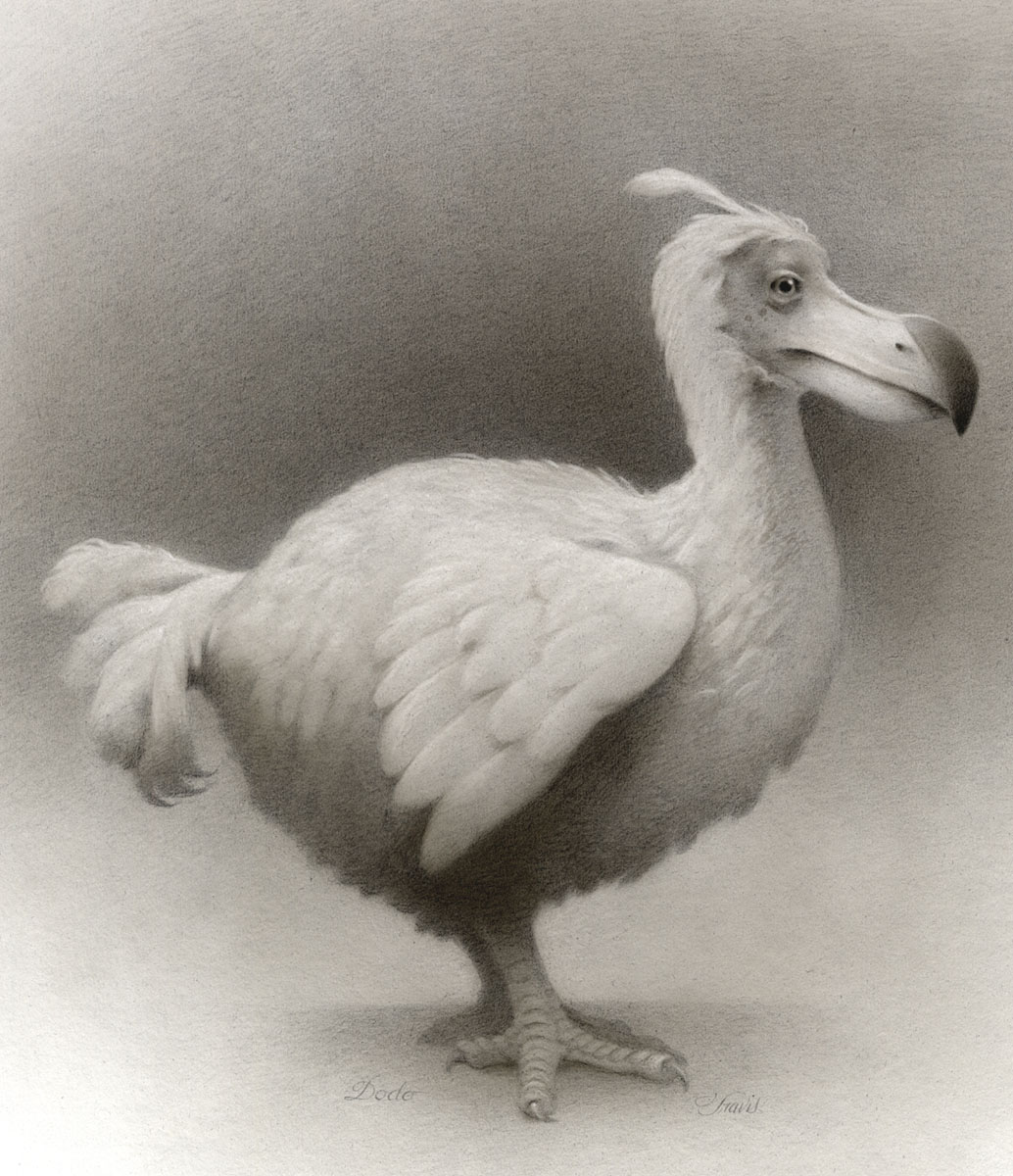
Birth of the Dodo ~ A Short Story

Dodo Bird 6
Birth of the Dodo
~ A Short Story by Allen Kopp ~

I was ill but I recovered. When I awoke, I was in a place I had never been before and found myself purchasing a house. A large house it was, many-windowed, a hundred yards or so up the hill from a river. The river, with its protruding rocks and swift current, provided a scenic background to the setting.

I didn’t remember choosing the house out of other houses but, here I was, turning over a fat envelope full of cash to the owner and seller of the house, a woman named Mrs. Goldoni. She had platinum blond hair like a Hollywood starlet and a thin, lipless mouth. Her face was shriveled like a Mayan mummy and, due to an arthritic condition (she said), she didn’t always walk upright, but parallel to the floor like an insect, which is to say a cockroach or cricket. I’m not sure how many legs she had, but I’d say at least six.

As soon as the house was transferred over to me, I thought Mrs. Goldoni, the bug woman, would clear out and leave me to it, but she seemed reluctant to leave. Her husband was dead, she said, and her many children scattered to the four winds.

“I don’t have any place else to go,” she said pitifully.

“Why did you sell your house then?” I asked.

I agreed to keep her on as housekeeper, at least until one of her innumerable daughters could arrange to take her in. I pictured her children and I wondered what form they had taken, if they were insects like their mother or something else entirely. I was probably better off not knowing.

The day after I moved in, I was in one of the upstairs rooms putting things away, when I stopped what I was doing and looked out the window at the river. I heard Mrs. Goldoni’s rapid, tapping little footsteps come up behind me and I turned and spoke to her.

“What is the name of that river?” I asked.

“What river, sir?”

“There’s only one river out there, Mrs. Goldoni!”

“It’s the River Ishcabob, sir.”

Ishcabob? I haven’t ever seen it on a map. Does it ever flood?”

“Oh, no, sir!” she said. “I’ve never heard of it flooding. Why ever would it flood?”

“Where I come from, rivers sometimes flood and cause a lot of trouble and damage.”

“Well, rivers may flood, but I’ve never known the River Ishcabob to flood.”

While I was watching the river, I saw a person, a man, floating along on the current. I could distinctly see his face and head and his struggling, flailing arms. In a few seconds there was  another man and then another one.

“Oh, I my Lord!” I said. “Somebody has fallen into the river and is being swept away on the current! Not just one but three! I saw three different men! They were naked and they were struggling to keep their heads above the water. We should try to get them some help for them before they drown!”

“Oh, bless my soul, sir!” Mrs. Goldoni said. “It’s nothing to be alarmed about. It happens all the time.”

“What does?”

“People in the river. Those are the Transgressors.”

“The what?”

 “You have to understand. Some poor souls are brought to the river.”

“What do you mean, brought to the river?”

“Is that the telephone phone ringing?” she asked.

“We don’t have a phone,” I said.

Mrs. Goldoni dropped to her tiny feet and skittered out of the room. I was left with the distinct impression she was evading my question.

“What kind of arthritis makes you grow extra legs and walk like a bug?” I asked, but of course she was gone and didn’t hear me.

While I was eating lunch, I noticed a small crowd of people standing in the doorway looking at me.

“Who are those people?” I asked Mrs. Goldoni, who was serving.

“Oh, they’re always here,” she said. “They won’t bother you.”

“Now, look here!” I said. “My privacy is important to me. I don’t want lots of strange people hanging around.”

“You usually have to be here a lot longer before you see them.”

“Who are they?”

“Don’t worry yourself about them, sir. After a while you’ll forget they’re here.”

“I still want to know who they are and why they’re here!”

“They’re always here,” she said. “We just don’t always see them!”

“Tell them to leave!”

After lunch I took a walk down the hill. It was the first time I had seen the river up close. I stood for a while close to the edge and looked down at its churning, blue-green depths. It was beautiful and mesmerizing but also frightening in a way because I had the feeling it (the river) had a will of its own and would suck me under if it could. I didn’t relish the thought of drowning—which I certainly would do if I ever fell in—or of being in uncontrollable water over my head. I suppose I had always had a fear of water. I would stay as far back from the river as I could.

While I was walking back up the hill, I noticed movement over to my left and turned and looked in that direction. What I saw was a clown dressed in a billowing red suit with a tremendous ruffled collar and enormous shoes. I was going to say something to the clown or at least wish him a good morning, but he was juggling a series of balls so fast while walking that they (the balls) were only a blur. He was the best juggler I had ever seen.

When I got back home, Mrs. Goldoni met me at the door. She was entertaining her good friend in the kitchen, Baby Estelle. Baby Estelle was not a baby but was instead a tiny, doll-like woman with flaming red hair and a twinkling smile. She curtsied and smiled demurely.

“Would you like to see me dance?” Baby Estelle asked.

“Um, I guess so,” I said.

She stood up and in the space between the table and the kitchen sink twisted and turned, jumped and dived, sashayed and pirouetted with absolute abandon. In five minutes she was out of breath and so completed her performance with an elaborate bow to the floor.

Mrs. Goldoni applauded enthusiastically. “Isn’t she a wonderful dancer?” she said. “I just don’t know how she does it!”

“I haven’t ever seen anything like that before,” I said.

“I was trained at the Sore Bone Academy,” Baby Estelle said.

“Isn’t that in Paris, France?” I asked.

“Of course not, silly!” Baby Estelle said. “It’s right here!”

“Right where?”

“Right under your nose,  Mr. Smarty Pants.”

I didn’t know what she was talking about, but I didn’t care to pursue it any further.

“And that’s not all!” Mrs. Goldoni gushed. “Baby Estelle’s husband is a clown!”

“I think I just saw him!” I said.

Where?” Baby Estelle asked.

“I walked down to the river and as I was walking back up the hill I saw a clown dressed in red off in the distance. I was going to speak to him, but he was juggling balls and he didn’t even know I was there.”

“That’s him!” Baby Estelle said. “The very one! That’s the clown in question! That’s Mr. Winklebottom!”

“Mr. Winklebottom is so handsome!” Mrs. Goldoni said. “So distinguished!”

“You must come and see us perform some night!” Baby Estelle said.

“I look forward to it,” I said.

Baby Estelle curtsied again and danced her way out the door.

“Baby Estelle is such a doll!” Mrs. Goldoni said. “I just love her to pieces!”

“I’m going to take a little nap,” I said. “Call me when dinner is ready.”

A couple of nights later I was sleeping soundly when Mrs. Goldoni knocked on my door and woke me up.

Sir!” she called. “Sir! Wake up! I thought you would want to know!”

“Know what?” I asked. “There’s not a fire, is there?”

“No, sir, there’s no fire. Your wife is giving birth!”

I jumped out of the bed and opened the door. I didn’t mind her seeing me only partially dressed after such an absurd statement.

“What did you say?”

“I said your wife is giving birth!”

“Very funny!” I said. “You know I don’t have a wife.”

“Come with me!”

I followed her into a part of the house I hadn’t seen before, down some stairs and into a dark corridor to a doorway. Standing around the doorway were several women I didn’t recognize. As Mrs. Goldoni and I approached the doorway, the women stood aside to let me enter.

The room was dark with only a couple of candles burning. There was a large, high bed, and in the middle of the bed was a human-sized female doll. The doll’s face was turned toward the candle. She had painted circles on each cheek. Her eyes were large and expressive and her eyelashes long and curved like spider’s legs.

“What is all this?” I asked. I still wasn’t happy about being woke up at such an hour.

“Why, don’t you recognize her, sir!” Mrs. Goldoni asked. “It’s your wife, Curlicue. She’s about to give birth.”

“How many times do I have to tell you I don’t have a wife? And even if I had a wife, I wouldn’t have a doll for a wife!”

“You don’t have to worry, sir. She’s in a good hands. All will be well.”

“I’ll wake up in a minute and discover I’m having a nightmare.”

“Why don’t you go back to bed, sir? I’ll call you as soon as the baby is safely delivered.”

“Call me for when breakfast is ready and, other than that, don’t call me at all!”

“Just as you wish, sir, but what shall we do about the baby?”

“Give it to Baby Estelle and Mr. Winklebottom! I’m sure they can make it part of their act!”

“Yes, sir, but I think you’ll change your mind when see you the little darling little thing!”

Despite my instructions to the contrary, Mrs. Goldoni came to my bedroom again at eight o’clock to tell me the news that Curlicue had been safely delivered of a baby at four o’clock in the morning.

“A baby what?” I asked.

“You’re going to want to see it, sir!”

I wasn’t dressed yet, but I pulled on my robe and followed Mrs. Goldoni again, down the same stairs and the same dark corridor to the same doorway to the same room where I had seen Curlicue lying in the middle of the big bed the night before.

Curlicue looked no different. She had the same half smile on her lips and the same dreamy, expressionless eyes of a doll.

“Very funny!” I said. “I don’t see a baby at all.”

With a pleased smiled, Mrs. Goldoni pulled out from under the covers a fully formed dodo bird. She held it up so I could get a good look at it. It gave out with a couple of pitiful peeps and flapped its flightless wings. I heard people behind me gasp in wonder.

“That can’t be a dodo bird!” I said. “They lived on the island of Madagascar and they’ve been extinct for hundreds of years!”

“It’s your very own son. Wouldn’t you like to hold him?”

Not waiting for an answer, Mrs. Goldoni thrust the dodo bird into my arms and I had no other choice but to hold him. He looked into my eyes and made little cooing sounds.

“Oh, he knows his daddy!” Mrs. Goldoni said. “Isn’t he the smartest boy? And already just as cute as a bug!”

While I was still holding the dodo bird, Mrs. Goldoni leaned over the bed and put her ear to Curlicue’s mouth.

“She’s wants to name him Sheridan and she wants to know if the name meets with your approval, sir.”

“I can’t think of a better name for a dodo bird,” I said. “Now, can I get some breakfast, please?”

By the time I was finished with breakfast, I was already thinking of the dodo bird as Sheridan, as a unique individual. Of course, I wasn’t his father—and I didn’t want anybody to entertain the notion that I was—but I felt a certain amount of pride and proprietary interest in him. I recognized the significance of having the rarest of rare birds in my possession: a bird that had been extinct for hundreds of years, a bird that no living person had ever laid eyes on, and it was in my very own house!

It occurred to me that nobody was going to believe that I had a real, living, extinct-no-longer dodo bird in my possession. People would think I was a dangerous lunatic if I tried to tell them. I had to have photographic proof! I wasn’t in possession of a workable camera at the moment, but I was a mile or so from the good-sized town of New Garland and was sure there would be a store there where I could buy one, no matter the cost.

I changed clothes and put on my walking shoes and told Mrs. Goldoni I was going to be gone for a while and not to await luncheon on my account. Then I set out walking. Still within sight of the house, I was passing the River Ischabob over to my left, intent on the long walk ahead of me, when I saw a sight in the middle of the river that stopped me in my tracks.

On one of the large rocks protruding from the water, Sheridan the dodo bird was perched at a perilous angle, struggling to keep from sliding into the raging water. How did he get out of the house and down to the river? Wasn’t anybody watching him? I couldn’t let him be swept away on the current!

I couldn’t swim a stroke but, without concern for my own safety, I started trying to make my way from one rock to another over to the rock where Sheridan was sitting. He looked at me pitifully and squawked and I knew he recognized and remembered me. He would come to me if only he wasn’t paralyzed by fear.

I was within five feet of Sheridan when he gave a couple of surprising hops away from me, until he was all the way across the river to the other side. He was safe, but I couldn’t say the same for myself.

It became impossible for me to hang onto my rock any longer and I found myself in the river, being carried away on the current like an insignificant piece of flotsam. I flailed my arms and legs, but I knew it was no use. As I was swept away, I clearly saw Mrs. Goldoni standing on the bank of the river looking at me, along with Baby Estelle and the juggling Mr. Winklebottom. Sitting in a wheelchair in front of Mrs. Goldoni was Curlicue the human-sized doll, her alarming eyes with their spiderly lashes turned in my direction. None of them did anything to help me.

The current carried me away and away. I had the sensation of drowning over and over until I could drown no more. All went dark and I was lost.

But I would wake again.

When next I came to myself, I was in a large cage and hundreds people, it seemed, were looking at me. I knew, somehow, that hundreds more were lined up outside waiting to look at me. To express my indignation, I squawked at a large woman in a disgusting hat and flapped my flightless wings. When I didn’t get the response I hoped for, I turned around backwards and tucked my head under my barely adequate wing and hid my face  the best I could.

Copyright © 2025 by Allen Kopp

Pass Without Paying ~ A Short Story

Pass Without Paying
~ A Short Story by Allen Kopp ~

Lester Fane had been to the store to buy a couple of items that his mother simply couldn’t do without. He was on his way back home, worrying about what other jobs she might decide to make him do, when he spotted Jingo Lanky and his homely sister, Lynette, standing on the street corner up ahead. He was going to turn around and walk home a different way, but he knew that Jingo and Lynette had spotted him so he kept on going.

Jingo Lanky was only a couple of years older than Lester, but he seemed much older. He was as tall as a grown man and he had whiskers and bulging biceps. He smoked cigarettes that he rolled himself; he was said to drink beer and even whiskey and do other adult things that Jingo had only a vague knowledge of. He lived in a falling-down house on the edge of town with his hag of a mother and his eight miserable brothers and sisters. He had been expelled from school and had been in jail more than once for drunken and disorderly conduct and for shoplifting candy and cigarettes and other small items that he attempted, not always successfully, to conceal in his clothing. Everybody who knew him believed he was on his way to living a useless and crime-ridden life and would one day end up in the state penitentiary.

Lynette was about twenty and had been in girls’ reformatory. She had pale, pockmarked skin and orange hair that could only come from a bottle. She wore falsies because her breasts had never developed the way they were supposed to and tight denim skirts that showed the contours of her buttocks.

Lester put his head down and walked faster, believing he could get past Jingo and Lynette without having to speak to them or even look at them. Maybe they wouldn’t even notice him.

“Well, well, well,” Jingo said, grabbing Lester by the upper arm and stopping him. Where in the hell do you think you’re going, you little punk?”

“Let me go!” Lester said.

“I asked where you’re going, you little turd.”

“I’m going home. My mother is waiting for me. She’s sick and I’ve got to take her some medicine.”

“She’s probably been sick ever since she gave birth to a little freak like you.”

“I’m not a freak!”

“What have you got there?” He pointed to the paper bag Lester was carrying. “You got anything to eat in there?” He grabbed the bag and unfolded the top and looked inside.

“Give me that!” Lester said. “It’s none of your business!”

“What is it?” Lynette asked, trying to see inside the bag.

“Looks like…toothpaste and some kind of pills,” Jingo said.

“It’s roach paste and suppositories for hemorrhoids, if you must know,” Lester said.

“What the hell?” Lynette said. “That’s some weird shit!”

“Hey, man, that’s disgusting!” Jingo said. “Who goes to the store and buys stuff like that?” He threw the bag back and Lester caught it.

“Ask him what his mother uses the roach paste for,” Lynette said. “Does she use in cooking when she wants to poison somebody?”

Lester started to run but Jingo grabbed him by the shoulder and held him. “You can’t go until you give me a dollar.” He squeezed Lester’s upper arm painfully.

“You’re hurting me!” Lester yelped. “I don’t have a dollar!”

“You don’t pass until you give me some money.”

“You don’t own the street!” Lester said. “I can pass without paying if I want to.”

“Leave him alone,” Lynette said. You’re going to make the poor little thing cry.”

“Hah-hah-hah!” Jingo laughed, shaking Lester by the shoulders. I wouldn’t want to make the little girl baby cry. You aren’t going to cry now, are you, sweetie pie?”

“You’re a dirty pig!” Lester said.

“Hey, man, you hurt my feelings. Why do you want to go and do that?”

“You’re hurting me!” Lester said. He squirmed to get loose, but Jingo held him immobile.

“Hey, man, do you want to have sex with my sister?

“Oh, come on, now,” Lynette said. “Don’t you think he’s a little young?”

“She’ll have sex with you if you pay her.”

Lynette laughed. “He wouldn’t have enough money to make me want to have sex with him,” she said.

“Let me go!” Lester said.

He saw an old man open his front door, look out, and close the door quickly.

“I’ll bet you’ve got some money,” Jingo said. “Don’t be stingy with an old pal.” He wrapped his arms around Lester and slipped his hands into his pockets. When he saw that his pockets were empty, he let him go. “Hey, you really don’t have any money, do you?” he said.

Lester tried to kick Jingo in the leg but missed. Jingo laughed and held up his hands in surrender.

“Come back in about ten years,” Lynette said haughtily.

“And next time you’d better have some money,” Jingo said, “or you don’t get past. Remember that.”

“Go to hell!” Lester said.

“Is that the best you can do, tough boy?” Jingo said.

“You’re a shit-faced hog and I hope you go to the electric chair!”

“Hah-hah-hah!”

“That’s pretty cruel,” Lynette said. “You ought to be ashamed of yourself for speaking to people that way.”

Lester was trying to think of other names he might call Jingo, when a white car came around the corner very fast and pulled up at the curb. Lester saw right away that it was Harry Harris, the town sheriff, driving the unmarked patrol car. When Harry Harris jumped out of the car without turning off the engine, Jingo Lanky started running.

“Hey, you!” Harry Harris yelled. “Come back here! I want to talk to you!”

Moving with surprising agility for a man of his years, Harry Harris began running after Jingo. In the middle of the next block, just as Jingo was about to cut across somebody’s lawn, Harry Harris overtook him and tackled him, knocking him face down on the ground.

Lester and Lynette watched as Harry Harris cuffed Jingo’s hands behind his back, jerked him to a standing position and brought him back to the patrol car. Lester thought he would enjoy seeing Jingo handcuffed and in the custody of the law, but he didn’t. Jingo was out of breath and his face had suddenly gone white. His nose was bleeding and starting to swell. He had the look of a trapped, injured animal.

When Harry Harris opened the rear door of the unmarked patrol car and began to push Jingo into the back seat, Jingo twisted around toward Lynette.

“Tell mother what happened,” he said, blood pouring from his nose into his mouth. “And tell her I don’t know when I’ll be home again.”

Lester suddenly felt sorry for Jingo and was sorry for what he had said about the electric chair. Maybe he really would go to the electric chair now.

“What did he do?” Lester asked Lynette as they watched the unmarked patrol car speed away.

“What didn’t he do?” she said, shrugging.

“I wonder what they’ll do to him,” Lester said, believing for the first time that maybe Jingo wasn’t so bad after all.

“I’m sorry for what I said about your mother poisoning people,” Lynette said. “I didn’t mean it. I was only making a joke.”

“That’s okay. I know you didn’t mean it. I’m sorry I called your brother a dirty pig.”

“It’s not the first time he’s been called that. Do you want a cigarette?”

“No, I’ve got to be getting home.”

“Maybe I’ll see you around sometime.”

“Yeah,” Lester said. “Maybe so.” When he turned to look at her he saw she was crying real tears. “Can you make it home all right?” he asked.

“What other choice do I have?” she said, cupping her hands around a match to light a cigarette.

Copyright © 2025 by Allen Kopp

If Mother Goes to the Penitentiary ~ A Short Story

If Mother Goes to the Penitentiary
~ A Short Story by Allen Kopp ~ 

(This short story has been published in The Bone Parade.)

Daddy Earl drove slowly on the night-time street, looking for an address. When he found the one he wanted, he parked the car under a street lamp and killed the engine.

“This looks like the place,” he said. “You two wait here. This shouldn’t take long.”

“What do you think Daddy Earl does on these calls he makes?” Freda said to Julian after Daddy Earl was gone.

“How should I know?” Julian said. He was lying on his back looking upside down out the window.

“Well, I hope this doesn’t take long. It’s boring just sitting here in the dark and it’s kind of scary.”

“I’m not scared,” Julian said.

“If anybody walking along the street tries to bother us, I’ll honk the horn to attract somebody’s attention.”

“What do you think mother’s doing right now?” Julian asked.

“She’s probably sitting on the bunk in her little jail cell in her plain gray prison dress, thinking about where she stashed those jewels.”

“What jewels?”

“The jewels she stole, silly. I just know she has them hidden away in a safe place and when she gets out of jail she’ll know right where they are and go and get them. Then we’ll have to go away to Mexico or Nicaragua or someplace like that to keep the police from locking her away in jail again.”

“Daddy Earl too?” Julian asked.

“No, I think Daddy Earl will stay here,” Freda said.

“Maybe mother and Daddy Earl will get married.”

“I don’t think so. I don’t think Daddy Earl gives mother much of a thrill. He’s nice and everything, but he’s not very good looking and he’s kind of dumb. He sleeps in his socks.”

“How do you know he sleeps in his socks?”

“Mother told me, silly. It’s to keep his feet warm. He doesn’t have good circulation, so his feet are cold all the time.”

“I sleep in my socks, too,” Julian said. “Sometimes.”

“That’s just because you’re ignorant and you don’t know any better.”

“You’re just as ignorant as I am.”

“Yes, but I’m trying to overcome my ignorance, but you’ll go through your whole life getting more ignorant all the time.”

Julian yawned and then coughed. “Do you see Daddy Earl coming?”

“It’s only been about two minutes,” Freda said. “He wouldn’t be back this soon.”

“Why did they put mother in jail?” Julian asked.

“It was her third conviction, that’s why.”

“What’s ‘conviction’?”

“It means she was caught three times stealing jewelry and stuff. On the third time, they lock you up to try to teach you a lesson.”

“What’s the lesson?”

“I don’t know. I guess it’s not to steal anymore.”

“I heard Daddy Earl telling somebody on the phone that mother’s shoplifting is a psychological addiction,” Julian said. “She can’t keep from doing it, even if it means she’ll have to go to jail.”

“Who was Daddy Earl talking to?”

“How should I know?”

“Maybe it was a lawyer.”

“He said she’s going to end up in the penitentiary if she’s not careful.”

“It’s kind of funny to have a criminal for a mother,” Freda said. “I mean funny in an odd way, not in a laughing way.”

“Hah-hah-hah,” Julian said.

“If mother goes to the penitentiary, I think I have a pretty good idea what will happen to us,” Freda said.

“Us?”

“Yeah, you and me, dumbbell! We’re minors. Do you think they’re going to leave us with Daddy Earl?”

“I don’t know.”

“Daddy Earl doesn’t want us for all the time. He’ll only let us stay with him until mother gets out of jail and then all bets are off.”

“All bets are off,” Julian said. “Maybe we can go live in the penitentiary with mother.”

“Do you think they let kids stay there?”

“I don’t know why not.”

“Well, that shows how much you know! You wouldn’t want to live in the penitentiary even if you could.

“Why not?”

“They eat gruel and stale bread every meal. There are rats and cockroaches everywhere and the people roaming around there would slit your throat just for looking at them. If the guards catch you doing something you’re not supposed to do, they lock you up in solitary confinement.”

“What’s solitary confinement?”

“It’s a dark place where they lock you away from everybody else and they only give you a little sip of water and a crust of moldy bread, and that’s all you get for the whole day.”

“Do they have TV in solitary confinement?”

“Of course not, silly! What would be the point in that? You don’t have books or newspapers or music or anything. That makes the punishment worse. Then when they finally let you out, you’re so grateful to be out that you promise you won’t ever act up again.”

“I don’t think I’d like it very much,” Julian said.

“No, if mother goes to the penitentiary, it’s off to foster care for you and me.”

“What’s foster care?”

“It means they put you in a place with strangers where they watch you all the time to make sure you’re not going to turn out to be a criminal, too. They make you scrub floors and wash dishes and go to church.”

“Why do they make you go to church?”

“Why do you think? They want to scare you into thinking you’re going to go to hell if you don’t try to be a good person.”

“I try to be a good person.”

“That’s because you’re only a small child. When you get older, you’ll get into things like gambling and drinking and chasing after women.”

“How do you know so much about it?”

“I’ve read a lot of books beyond my grade level and have watched a lot of TV. You find out about life from reading books and watching TV.”

“Like the Three Stooges?”

“No, I don’t mean like the Three Stooges. I mean real-life drama shows like detective shows and doctor shows and old movies that they show late at night.”

“Oh, I don’t like those.”

“You’ll never get past the Three Stooges phase, I’m afraid.”

The windows were starting to steam up. Freda swiped the sleeve of her coat across the glass.

“I wish he’d come on.” she said. “I want to get home.”

“Why?”

“It’s Saturday night and I’ve got a date.”

“Who with?”

“None of your business, that’s who with.”

“I’m going to tell mother!”

“Yeah, she’s in prison. Do you think she cares if I have a date?”

“She’d tell you you can’t go.”

“I’ll bet you didn’t know I had a boyfriend, did you?”

“Who cares?” Julian said. “What’s his name?”

“His name is Mickey Littlejohn, if it’s any of your business. He’s in the tenth grade, two years older than I am.”

“Is he the one with rotten teeth?”

“No, that’s Harvey Greaves. They’re nothing alike.”

“I don’t know him.”

“Mickey Littlejohn and I are going to run off and get married. We’re that much in love.”

“Mother won’t let you.”

“I don’t know how she can stop me, since she’s in prison.”

“She’ll tell Daddy Earl to stop you.”

“Did you ever notice how Daddy Earl doesn’t ever look right at us? He looks through us like we’re not even there. It’s like he’s thinking about something else all the time.”

“What’s he thinking about?”

“I don’t know. He’s a sphinx.”

“What’s a sphinx?”

“You’re too young to know.”

“I don’t care, anyway.”

Freda took a comb out of her purse and began combing her hair in the dark, imagining she was seeing herself in a mirror. “Mickey’s not going to like it when he comes by to pick me up tonight and I’m not at home because I’m waiting in some old car on some old street with my little brother.”

“Daddy Earl would chase him away.”

“Daddy Earl doesn’t know anything about Mickey and that’s the way I want to keep it.”

“Why?”

“Mickey Littlejohn is the one person in the world who will keep me from having to go to foster care when mother goes to live at the penitentiary.”

“How is he going to do that?”

“If they see I’m married and am living with Mickey in his own home with his parents, they’ll have to leave me alone. They won’t make me go to foster care because I’ll be a married woman living with my husband. It’s the law.”

“Can I come and live with you and Mickey Littlejohn?”

“Of course not, silly! You’ll have to go to foster care. A newly married woman doesn’t take her little brother along to live with her husband.”

“I don’t know why not!”

“It just isn’t done.”

“I’m not going to foster care,” Julian said.

“Oh, yes, you will! You’ll have to do what you’re told to do because you’re a minor. When you’re a minor, you don’t get to make any decisions for yourself.”

“Oh. I’ll go and live with my father, then.”

“You don’t have a father, dope!”

“Does he live in the penitentiary too?”

“Nobody knows where he is. Mother doesn’t know. He was just a brief infatuation for her.”

“I’ll put an ad in the paper and I’ll find him that way,” Julian said.

“He doesn’t want to be found, silly. That’s the way it is when you’re a man and a woman you’re not married to has a baby by you.”

“Don’t we have a grandma or an aunt or somebody that I could go live with?”

“All dead,” Freda said. “It’s foster care for you.”

“I’m not going!”

“When the time comes, they won’t ask you. They’ll pack you off no matter how much you cry and scream.”

“No, they won’t. I’ll buy a gun and kill them.”

Freda sighed deeply and knowingly. “Oh, well,” she said. “I wouldn’t worry about it if I were you. Mother’s not in the penitentiary yet and maybe she won’t even have to go.”

“She needs to promise she won’t ever steal any more jewels,” Julian said.

“She should never have become a mother in the first place,” Freda said, “but these things will happen.”

“I think I see Daddy Earl coming now,” Julian said.

“No,” Freda said. “It’s only a tree moving in the wind.”

Copyright © 2025 by Allen Kopp

Haunt, Part 2 (All the Spirits in the Place) ~ A Short Story

The Spirits in the Hotel image 3
Haunt, Part 2 (All the Spirits in the Place)
~ A Short Story by Allen Kopp ~

I always liked staying in a good hotel, even one that was falling apart and hadn’t seen a paying guest in fifty years. The Hotel Argyle was on the riverfront, in a cluster of other derelict buildings. It was twenty stories tall and could be seen from a long way off because the hotel name had been painted in huge letters on the side of the building. It stood as a symbol of urban blight. There’s nothing spirits love more than urban blight.

I walked into the lobby of the Argyle and was surprised to see a ghostly apparition at the registration desk. He seemed to be made of purple-and-green smoke. He gestured to the registration book and I knew what to do. It must have been somebody’s idea of a joke because spirits don’t use the names they had when they were alive. I made a little mark on the book. That seemed to satisfy him because he smiled his grotesque smile and gestured for me to take the stairs.

There were many vacancies at the Argyle. I would venture to guess that I could pick almost any room, on any floor, and it would be vacant. I went all the way to the top floor, the twentieth, and found the room I wanted at the end of the hall. It showed no signs of occupancy, so I took it as my own.

I was a tired old spook. I had traveled a long way to get here. I needed a rest, so I was happy for that reason that the hotel was quiet. The other spirits in residence were probably sleeping, since it was the middle of the day and the sun was shining brightly. If there’s anything a spirit hates, it’s bright sunlight.

I stared out the window at the skyline of the city for a while and then, hovering near the ceiling, I went into a trancelike state, which was as near as I ever came to sleeping. As long as I’m not disturbed, I can stay in this state for years at a time, but, of course, when you’re a spirit, a year means nothing. We think in terms of eternity. Time has no meaning.

In this trancelike state, I thought of—dreamed of—many things. I had been in the spirit world now for eighty years. I was only thirty-five when I crossed over. I had two wives when I was alive. I regret that I wasn’t very kind to either of them. I had a drinking problem. Luckily there were no children. I would have been a terrible father.

After my divorce, I had no job and no money, so I went back home to live with my mother. She and I never understood each other. We fought constantly. I should have known better, even if she didn’t. She nagged me about my drinking; she thought I could stop if I only tried. She wanted me to go to church with her the way I did as a child. She thought if I just read my Bible I’d be the kind of man God wanted me to be.

I got a part-time job driving a truck. I was never that keen on driving. I hated it. All my organs were pickled in alcohol. One hot July afternoon, my hundred-proof heart stopped when I was parked on a street downtown. I took off my shoes, put them side by side, laid down on the seat, and died. I knew I was dying and I didn’t care. I thought it was the best thing that could happen to me.

When I found myself in the spirit world, I was surprised there was any kind of existence after death. I thought it was punishment for all the bad things I had done. Everybody else went to heaven, I thought, but not me. That, of course, wasn’t true. The spirit world is teeming with spirits who never made it to heaven.

That night I met two of them. I was going out for a little city night life when I met them in the lobby of the hotel. I remembered them from before, a long time ago, in another incarnation. They went by the names Jocko and Howdy. They recognized me immediately and I them.

“We heard you were here,” Jocko said. “When did you get in?”

“A few days ago. I’ve been resting up in my room on the top floor.”

“We were just going out to do the town,” Howdy said. “Why don’t you join us for old time’s sake?”

“I’ll go if you promise not to scare me too much,” I said.

Hah-hah-hah!”

On our way downtown, Jocko, Howdy and I walked side by side, as if we were living instead of dead.  Howdy made a show of knocking people out of the way but, of course, they didn’t know he was there because he was invisible to them and, also, they were solid and he wasn’t. It’s only fair to mention that we met a few other spirits, but they were mostly in haughty groups and didn’t pay any attention to us. Howdy would get into a brawl with some of them if he could. He was a brawler and a mischief-maker.

On the way downtown, I asked Jocko and Howdy if the Hotel Argyle was a good place for a spook to live.

“It’s dead most of the time,” Jocko said.

“What do you mean?”

“Not much action there, man,” Howdy said.

“It seems perfect to me,” I said. “An abandoned hotel on the riverfront of a major city. Doesn’t it abound with ghosts?”

“Yeah, but ghosts are boring if they’re not doing anything,” Jocko said.

“So, you’re saying the ghosts in the hotel are all retired?”

“Well, something like that.”

“Don’t they like to scare little girls? Make them scream?”

“Yeah, but that’s the point. There aren’t any little girls to scare. What’s the fun of having the ability to scare people if there aren’t any people to scare?”

“You have to find out where the people are and scare them where they live,” I said.

“The people who own the hotel should turn it into a haunted-house attraction for Halloween,” Jocko said. “A lot of people would pay good money to tour a vintage hotel full of real ghosts instead of fake ones.”

“The people who own the hotel are dead,” Howdy said.

“The city owns the hotel,” Jocko said. “They’re just waiting for the right time to bring in the wrecking balls.”

“If they tear it down, they’re going to put a lot of ghosts out of a home,” I said.

“Not so many. Most of the spirits moved on a long time ago. Only losers stay at the Argyle now.”

“I was just beginning to like the atmosphere,” I said. “I had to leave my last home because a vengeful witch started throwing fireballs and burned the place down.”

“You have to watch out for those fireball-throwing witches!” Howdy said.

“The best way to deal with them is to cut off their heads and then burn their bodies,” Jocko said. “You have to be sure to remember to burn their bodies because some of them can go on living without a head.”

“Here, now!” Howdy said. “Let’s stop talking about witches and have some fun!”

Howdy was one of those spirits who engage in mayhem. He caused two cars to collide and then doubled over with laughter. When I asked him how he did it, he said it was a secret he learned during the war.

“What war was that?” I asked, but he didn’t answer me.

We couldn’t go to a bar or a restaurant and sit at a table the way other fellows do, so we walked all over downtown. We went into a movie theatre and watched part of the movie that was playing.

“I don’t like this movie!” Jocko said after a while. He then caused the projection equipment to break down when the movie was halfway through.

“That’s the way it’s done,” he said, laughing hysterically.

We entered a library and did some moaning and then we pulled down some shelves of books. Pretty tame stuff, but spirits have to make their own kind of fun.

Next we went to a dance hall where men buy tickets and use them to dance with weary-looking dames. It was a sorry-looking spectacle. I don’t know which was worse, the men or the women. What fools these mortals be.

We stood apart from the crowd against the wall. Knowing we were watching him, Howdy made as if to cut in on certain dancing couples, but he only brushed up against the ladies. They could feel it, of course, but not see it, so they were confused about what was happening to them. Some of them thought somebody was playing a trick on them. Maybe some of them knew it was spirits, but I doubt if any of them were smart enough to figure that out.

After the dance hall, we went to the oldest and biggest cemetery in the city. There were some really old corpses there—Civil War and before. The place needed some livening up. We built a small fire and joined hands and danced around it. We moaned and sang and chanted. Soon we had a couple of dozen spirits gathered around. They were delighted  we were there. They were happy to join in any kind of foolishness. They danced and sang and were happy.

Howdy, always the smooth operator, found himself a lady spirit. She was wearing a long, flowing white dress and a tiara on her head. She looked like a queen. She made eyes at Howdy, he made eyes at her, and then they joined hands and went off together into the darkness.

“How will we find him when it’s time to go?” I said to Jocko.

“Don’t worry about Howdy. He’ll make short work of her.”

We made merry in the cemetery until the first traces of dawn began to light up the eastern sky. Then the spirits reluctantly began to drift back to wherever they came from. Surprised that the night had passed so quickly, Jocko, Howdy, and I went back to the Argyle. It had been a most enjoyable evening.

We returned often to the cemetery, where we made some good friends. The spirits there were always happy to see us. We brought the good times with us. I had never had so much fun before.

I began spending all my evenings with Jocko and Howdy, resting in my room at the Argyle during the daylight hours. We took in all the attractions that the city had to offer. We spooked people left and right, sometimes causing them to doubt their own sanity. Howdy was a spirit who enjoyed mayhem, such as causing traffic lights to malfunction or streets to flood for no reason. Because we were with him, Jocko and I were more often than not willing to go along with him.

In the winter we had some excitement at the humdrum Argyle. A team of paranormal investigators set up shop in the old ballroom on the tenth floor. They were investigating the existence of life after death. It gave us all a good laugh.

All the spirits in the hotel were excited at the prospect of proving, beyond a shadow of a doubt, that they had lived and that they went right on living after they died.

The psychic investigators (or ghost-hunters as they came to be called) had ultra-sensitive sound-recording equipment that would pick up the sound of a mouse breathing. They all left to go home at night but left their sound-recording equipment running to pick up every infinitesimal (ghostly) sound. In the mornings when they returned, they listened to what had been recorded during the night.

From the first night, all the spirits went to the ballroom with messages for the ghost-hunters. Some of them sang songs or recited poetry. Others laughed, moaned, or gave out with nonsense words of their own devising. Some of the spirits swore or made farting sounds. It was a lot of fun for everybody and a way to express our disdain for the living.

Regardless of what they said about the Argyle, I was beginning to like to and to think of it as home. And then something bad happened, and it wasn’t the wrecking balls, either. A fire started on one of the lower floors and soon spread to every floor. When all the spirits in the place realized what was happening, they all escaped out the windows. We all gathered outside and watched the place burn like a torch and collapse in on itself, all twenty stories. Whatever the cause of the fire, it saved the city a lot of trouble.

Jocko, Howdy and I bucked up the other spirits and urged them not to be downhearted. We had a plan.

We took them all, a procession of two hundred spirits or more (like a parade of the dead), to the cemetery, where we had been made to feel welcome before. All the spirits in the cemetery were delighted we had returned and had brought along lots of new friends. Everybody was welcome. The old cemetery had everything a spirit could want, and more.

Copyright © 2025 by Allen Kopp

Haunt ~ A Short Story

Haunted House 4
Haunt
~ A Short Story by Allen Kopp ~

A spirit needs a house to haunt. I’ve haunted a church, a theatre, a department store and a graveyard, but there’s nothing like a house. A house is where people have lived. Where things have happened. Where tears have been shed. Where people have been born and people have died. A spirit can feel all of it and more.

After looking at thirty or forty houses, I found one I liked. It was large, with many rooms, three floors, built in the old style. It was abandoned, in an advanced state of neglect, but still plenty sturdy. The cellar was like a dungeon with chains hanging from the beams. Behind the house was an old cemetery. All in all, the house had much to recommend it.

As a spirit, all I needed to do to claim a house as my own was to move in and take possession. If anybody else was haunting it, all I had to do was kick them out.

I soon discovered other spirits in residence. There was a woman who committed suicide every night at midnight, with piercing shrieks, by hanging herself from the upstairs banister. I don’t know why she did it every night since she was already dead, but I suppose she enjoyed the drama. One night, just before midnight, I grabbed her by the throat and threw her out of the house. She didn’t see me, not knowing of the existence of other spirits, and didn’t know what had happened to her. She wandered around on the outside of the house, not knowing how to get back in. Finally she flew up into the trees, and as far as I know she’s still there.

Then I found an eight-year-old female spirit haunting the attic. When she was alive, her cruel mother locked her in the attic with the mice and spiders to punish her. She was deathly afraid of the dark. While locked in the attic and unable to free herself, her mother was stabbed to death in a quarrel with her young lover. The girl never knew what happened to her mother. She starved to death, waiting for her dinner.

The girl in the attic wasn’t as annoying as the woman who hanged herself every night. I didn’t know what to do about her. I didn’t think it was right to just throw her out. I opened the attic door so she could come out if she wanted to, but she stayed where she was. She had been in the attic so long it was all she knew.

The spirit of a very old man haunted the cellar. He owned the house when he was alive. After he died, he didn’t want anybody else living in the house. He rattled chains and moaned at night to try to keep anybody away, living or dead. He didn’t scare anybody except maybe himself. He was the kind of spirit other spirits laughed at.

There were two boys, twins, who haunted the whole house but most especially the upstairs rooms. They had both died there of scarlet fever. They didn’t know yet that they were dead, even though it had been over a hundred years. They were constantly playing tricks, trying to scare each other. I heard them laughing all the time. Anytime they saw me, they ran as if we were playing a game. I wanted to grab one of them in each hand and throw them out of the house.

I was an old spirit; I had been in the spirit world for eighty years or more. I had seen everything and done everything a spirit could do. Now I longed for the quiet, pastoral life, and I didn’t want a lot of other spirits around me. I came to this house hoping to escape the clamor of the spirit world, hoping to be alone.

At night when I tried to rest instead of haunt, I could hear the old spirit in the cellar kicking up a fuss. He knew there were other spirits in the house besides himself and he wanted to scare them away. He thought the louder he became, the scarier he would be. He didn’t scare me, though. He did annoy me, however, and I wanted him gone.

Through most of the night, I could hear the twins laughing and running up and down the stairs. I wondered why they never slept. Then I realized they slept during the daylight hours. That would be the best time to catch them and run them out of the house, but first I’d have to find out where they slept. Even though they were children, they had been in the spirit world longer than I had and they knew all the ways to protect themselves.

Then I started finding dead, rotting bodies all over the house. Some were only skeletons and others still wore part of their human bodies. All were long dead. I knew right away they were from the graveyard behind the house. Many of them still wore remnants of the fine clothes they had been buried in: men in white-tie-and-tails and women in ball gowns or wedding dresses. Oh, what a world!

First there were one or two bodies and then eight or ten and then dozens and then hundreds. Finally they filled the downstairs parlor from floor to ceiling. I was past the point of pretending they weren’t there. Even though I was a spirit myself, I didn’t like dead bodies. They were part of the physical world that I left behind long ago. A rotting body was an affront to me. Hundreds of rotting bodies were an abomination!

After two or three days of observation, I discovered the twins sleeping during the daylight hours in a barely noticeable niche in the wall of their bedroom. I stormed in on them, waking them from a stupor, and was able to grab each of them by the neck. Before they knew what was happening, I clapped their heads together like cymbals. While they were stunned and nearly immobile, I threw them out of the house.

While I was brushing my hands off and congratulating myself on a job well done, I realized somebody was standing on the stairs looking at me. It was the little starveling girl from the attic. Her face was a glowing white and her eyes completely engulfed in black circles. She surprised me by speaking.

“It wasn’t them,” she said.

“What?” I asked.

“They weren’t the ones who brought the bodies from the graveyard into the house.”

“Who was it, then?”

She mimed hanging herself, and I knew right away what she meant.

Every night there were more bodies in the downstairs rooms. I could hardly go into any of these rooms without becoming ill. I had seen many vile things during my existence, but now I had seen the worst.

I waited until the middle of the night, three hours past midnight and three hours before sunup. I went quietly downstairs at this unholy hour and, standing on the stairs about halfway down, I saw her come in from outside, dragging her burden of dead bodies, as many as she could manage at one time. It was the hanging woman. I wanted to throttle her. I wanted to finish her off. I wanted to make sure she was gone for good and would never come back.

“Just what do you think you’re doing?” I said, although it was obvious.

“It’s you!” she said. “What do I have to do to get you to leave my house?”

“Leave it yourself! It’s my house now! And make sure you clean up this mess before you go!”

She came at me then, teeth bared, but I was able to sidestep her. She hit her head on the banister with a crack that split the wood, but, without missing a beat, she got up and came at me again. Again I sidestepped her.

“You’re wasting your time!” I said. “I’m younger than you, stronger and smarter. You’re just a worn-out old hag of a spook. I think you were in your prime about the time of the Revolutionary War!”

“I’ll show you!” she said.

She hurled an unexpected fireball at me. I hadn’t counted on her being a witch, in addition to everything else.

The fireball was directed at my face and chest, but I was able to get out of the way just in time. It hit the wall behind me and set fire to it.

“You’re going to have to do better than that!” I said.

Next came a barrage of fireballs, more fireballs than I could count. Soon the wall and stairway behind me were a wall of fire. With her out-of-control emotions, she had set fire to the entire house in just a few seconds. All I could do was get out.

“Now look what you’ve done, you horrible old witch!” I said as I ran past her for the front door. “Now it’s nobody’s house!”

I went out to the road and watched the house as it burned all the way down to the foundation. I figured the hanging woman burned up in the house because I didn’t see her come out. Nobody can blame that one on me.

I stayed and haunted the cemetery for a few days, not knowing what else to do. Then I went to the city again and took up residence in a waterfront hotel. I had some friends there that I had known before. It was a good time for me.

Copyright © 2025 by Allen Kopp

A Short Life and a Merry One ~ A Short Story

A Short Life and a Merry One
~ A Short Story by Allen Kopp ~

I had my friend Calvin Pears. He was in my class at school. We were both twelve years old and had known each other since we were five. We spent a lot of time together. We were good friends because we were both shy and not popular in school.

Calvin and I always had a lot of things to talk about. We laughed a lot. We laughed about things that nobody else would have thought funny. We made fun of people behind their backs. Calvin was a good imitator. He imitated our teachers, whether they were male or female. He imitated the way they walked or talked or smoked. He wanted to have a show business career after he finished school.

It was a Friday evening in October. After being in school all week, it was time to get out of the house and have some fun. Calvin and I decided we’d rather go roller skating than see the western movie at the Bijou. I liked roller skating and could skate circles around Calvin. He usually said he was tired or his legs hurt and he wanted to call it a night.

We were a couple blocks from the roller rink when we saw two boys from high school standing on the street corner. I had seen them but didn’t know their names.

“Well, here’s a couple of little kids!” the taller of the two boys said when he saw us. “Does your mommy let you out after dark?”

“Hi, Lonnie!” Calvin said enthusiastically.

“How’s it going, little man?”

“I’m doing spectacularly well!” Calvin said.

“Well, glad to hear it! What’s your sister, Bimbo, up to these days?”

“Bimbo’s fine. She was rolling her hair up at the kitchen table when I left home.”

“She wasn’t going out on a date, was she?”

“No, I think she was just going to pop some popcorn and watch TV.”

“Well, you be sure and tell her old Lonnie said ‘hi’!”

“I will.”

Lonnie’s friend’s name was Brent. He had red hair and a sly look about him like a fox. When Calvin introduced me to Lonnie and Brent, they both shook my hand without irony. I was used to high school boys calling me names or making fun of me.

“Where you little hoodlums headed?” Lonnie asked.

“We’re going roller skating,” Calvin said.

“Well, that’s a kids’ thing, isn’t it?”

“I guess it is,” Calvin said. “It’s fun, though.”

“Yeah, I guess you would think it’s fun!”

“They are kids,” Brent said.

“Yeah, and we’re grown men, ain’t we?” Lonnie said. “Hah-hah-hah!”

“Let’s go!” Brent said. “I’m tired of just standin’ here!”

“Now, look here, you two little kids!” Lonnie said. “I’ve got my brother’s car parked over there. I don’t have my own car yet, but I will soon. We were just about to go for a little hell-raising adventure, if you two would care to join us.”

“What do we need them for?” Brent said.

“It’s just for a little while,” Lonnie said. “I need to find out some stuff about Bimbo.”

“Oh, you and your girls! You make me sick!”

“So, how about it?” Lonnie said. “Do you two little sixth graders want to go with us for a little ride?”

“Sure!” Calvin said.

“We’re not sixth graders,” I said. “We’re in the seventh.”

“Do you want to go?” Calvin asked me.

“I guess so. If you do.”

“Well, let’s get crackin’, then!” Lonnie said.

On the way to the car, Lonnie put his hand on Calvin’s shoulder and leaned down and talked in his ear. So, that’s what this is all about, I thought. Lonnie only pays any attention to Calvin and me at all because he’s interested in Calvin’s sister, Bimbo. I’d rather go roller skating.

Lonnie opened the door for Calvin and me to climb into the back seat. He and Brent got into the front seat and Lonnie started the engine and pulled away from the curb with a jerk.

“Where do you kids want to go?” Lonnie asked over his shoulder.

“Any place is fine with us,” Calvin said.

“Isn’t this fun?”

“I’ve never had so much fun in all my life!”

“Does Bimbo ever talk about me?” Lonnie asked. “I mean, like at the dinner table or anything?”

“I never pay any attention to anything Bimbo says,” Calvin said.

“Do you know if she’s seeing anybody right now?”

“Seeing anybody? I don’t know what that means.”

“Is she dating anybody regularly?”

“I don’t know. I don’t pay any attention.”

“Well, are there any guys that hang around?”

“I haven’t seen any. Except for the man who reads the gas meter.”

“If you see any, you be sure and let me know.”

“I will.”

We went through town, past the chemical plant, over the railroad tracks and the bridge, and in ten minutes we were out in the country. The road was dark, now, and hilly, with abrupt dips in the road and signs about watching for high water. There were sharp curves that couldn’t be seen until we were right up on them.

Lonnie angled around in the front seat so he could see Calvin’s face. “Does Bimbo go around much? With other girls, I mean?”

“Yeah, they have stupid slumber parties and they go to shows and things like that. They’re all hoping a talent scout from Hollywood will discover them and want to put them in the movies.”

“Yeah, I know what they’re like,” Lonnie said. “Completely unrealistic. I mean, how many people get discovered by talent scouts?”

“I never heard of anybody.”

“Watch this!” Lonnie said.

He got the speed up to sixty miles an hour (the limit was twenty-five) and then he turned off the headlights, and we found ourselves speeding blindly through absolute darkness. I held on to the door beside me and closed my eyes.

Oh, my god!” Calvin gasped.

“Isn’t that the wildest thing you’ve ever seen!” Lonnie said.

“That’s a stupid trick, man!” Brent said. “What are you trying to do? Get us all killed?”

“If you don’t like it, man, I can always let you out here!”

“No thanks, man! It’s a long walk back to town! Just slow down a little.”

“Now it’s time for the roller coaster!” Lonnie said. “Don’t you kids in the back seat just love roller coasters?”

“Sure!” Calvin said.

He took a series of small hills at a high rate of speed, engine roaring. At times we were flying, all four tires off the road at the same time. We could hear the bottom of the car scraping the road in the low places.

“I’m glad this is not my car!” Brent said.

“Oh, my brother does this all the time!” Lonnie said. “He’s the one that told me about it!”

There was a sharp curve in the road and then another one. Lonnie had to fight the wheel to keep the car on the road.

“This is so much fun!” Lonnie said. “I’m going to turn the headlights off again!”

“Don’t be a jerk, man!” Brent said.

He didn’t turn the headlights off, but he went faster. There was a curve on a hill and then another curve going down the hill. There was a straightaway, then another hill.

“Isn’t this living!” Lonnie said. “It feels just like flying!”

He didn’t see the next sharp curve until it was too late and the car left the road. He struggled to regain control, but it was too late. The car glanced off a tree and kept going to the next tree—down a gulley, up the other side, taking out fence posts and small trees as it went. Finally it came to rest on a huge flat rock ten feet below the level of the road, smashed flat like a stepped-on bug.

I was thrown from the car. I didn’t know where the others were. I knew I was dead, but I also knew that I was aware of what was happening and that the same thing had happened to me before at an earlier time. All this went through my head in the briefest of flashes.

I was present at my funeral, and I don’t mean just as a dead body in a closed-up box at the front of the church. I saw the whole thing from up near the ceiling. My mother sat on the front row, a stunned look on her face. My father, divorced from my mother since I was four, sat on the other side of the room. Everybody from my seventh-grade class was there, even the ones who didn’t like me.

My mother, sparing no expense, had me buried in the Methodist cemetery beside my great-grandfather, who died long before I was born. I was dead, now, and buried and the people who had known me would soon forget about me.

The one person who remembered me years later was my father, though I had hardly known him in my short life. Since I was the only child he ever had, he became sentimental about me in his old age. When he was over ninety and aware that he was nearing the end, he had my body (what was left of it) disinterred from the grave where it had lain in for fifty years, flown halfway across the country, and cremated.

When he died a short time later, he had my ashes, along with his own, interred in a niche in a columbaria. Both our names were inscribed on the niche, along with the dates we were born and the dates we died. He had a long life and I had a short one. Father and Son. Together Forever.

Copyright © 2025 by Allen Kopp

You May Know Him as a Ghoul ~ A Short Story

You May Know Him as a Ghoul
~ A Short Story by Allen Kopp ~

(This story has been published in The Literary Hatchet.)

Blaise DeBeulah awoke to the rising of the sun and switched on the radio beside his bed. Dark Eyes by the Vincent Lopez Orchestra was playing. The beautiful melody brought a smile to his face, making him forget for the moment that had to get out of bed, get dressed, and face another distasteful day. He was just drifting off to a warm, intoxicating dreamland awash in saxophones and violins, when Bertha DeBeulah came bursting into the room.

“Get out of that bed, you lazy slug!” she commanded. “Do you think the world owes you a life of comfort and ease?”

“No, mother. The world doesn’t owe me anything. I’m getting up now.”

“Your brothers and sisters are hungry! They want fresh meat! Now!

“I’m doing the best I can, mother. I’m not feeling very well.”

“Well, isn’t that just too bad?

“I was out last night until dawn. Fresh meat isn’t so easy to come by anymore.”

“I don’t want to hear any of your feeble excuses! And when I say fresh meat, I mean fresh! The longer a body has been buried, the worse it tastes! After a body has been dead three or four days, the embalming fluid ruins the taste! The ones you’ve been dragging home have been anything but fresh!”

“I know mother. I’m doing the best I can. I hang around the cemetery all day long, waiting for a funeral, but they have been few and far between.”

“I told you I don’t want to hear any lame excuses! If there haven’t been any funerals, you have to do the killing yourself! How about some nice, juicy, muscular gravediggers?”

“Would those be for you to eat, or for the brothers and sisters, mother?”

“Don’t you get fresh with me! I’ll tell your papa, Benedictus DeBeulah, you smarted out to me and he’ll knock your block off!”

“Yes, I know, mother. I know. He has knocked my block off so many times that my head no longer sits straight on my shoulders.”

“Well, it serves you right! And if you don’t bring home some fresh meat—and I mean fresh—I’ll let the brothers and sisters eat you!”

“I’m not exactly fresh, mother. I’m two hundred and thirty-seven years old.”

“You don’t have to tell me how old you are, Mr. Smarty Britches! I brought you into this world and I can take you out of it any time I choose!”

“Yes, mother, I know. You’d be doing me a blessing.”

“What was that?”

“I said I’ll be on my way as soon as I find my shoes.”

Though he was two hundred and thirty-seven years old, Blaise DeBeulah could pass for nineteen whenever he wanted to. He wrapped himself in a long trench coat and a scarf that, thanks to the icy wind, allowed him to cover the lower part of his face. He topped off the invisible man look with a broad-brimmed hat worn low over the eyes. Dressed in this way, he could pass for anybody, anywhere, without attracting any particular kind of attention.

To get to the cemetery, he had to pass through downtown. Since it was a college town, there were always lots of interesting people around his own age (not two hundred and thirty-seven, but nineteen), and he enjoyed seeing them and walking among them. He might even pass for one of them: a tall, well-dressed, rather stately young man, dignified and poised, aloof and intriguing.

He liked to linger outside a malt shop where people his age gathered. It had a red-and-white awning and exuded attractive smells such as cinnamon, chocolate and peppermint. The thing that attracted him most, though, was the music that was piped out to the sidewalk: the romantic dance bands and orchestras, the velvet-voiced crooners, the bouncy girl singers, the snappy dance numbers. It was like nothing he had heard before in his two hundred and thirty-seven years of a ghoul’s life.

He longed to go inside the malt shop, to sit at the counter and order a drink, maybe strike up a conversation with someone and end up slow-dancing on the dance floor with everyone watching. It was not going to happen, though. He had a ghoul’s hands and a ghoul’s legs. When people saw his face, they would know it was a ghoul’s face and they would run screaming from the place in terror. He would be more embarrassed than he could possibly imagine. Somebody would call the police and they would come and take him away and lock him up. He couldn’t let that happen.

With a lump of regret in his throat, he passed on to the cemetery, the music sounding in his head long after he could still hear it.

One small, poor-looking funeral was in progress on a hillside. A dozen or so black-garbed mourners gathered around an open grave. A priest said a prayer and when he was finished the mourners dispersed and a man standing by with a shovel began filling in the grave.

Blaise moved on. He wasn’t going to dig in the dirt with his hands just to get a freshly buried body. It would taste like embalming fluid, anyway, he was sure, and the brothers and sisters would gag. They could always tell a body that had been embalmed from one that hadn’t. He’d have to look elsewhere.

He knew that if he didn’t find a really fresh corpse he’d have to kill a man or a woman, or maybe a child, on his own. He hated the killing; he didn’t even like killing animals. He’d almost rather die himself.

He came to another funeral, a much larger one this time. A prominent man, a person of some fame, had died. There were maybe two hundred mourners on their feet around a dark-wood casket that gleamed in the sun. Some of the mourners cried and some smiled and laughed as if they were at a cocktail party. A holy man gestured over the casket with his arms and when the service was finished the people let out a gasp of relief like children released from school. They moved away quickly, some of them lighting cigarettes, toward cars dispersed along a scenic hillside.

Blaise stood behind a tree and watched. After a few minutes, all the mourners were gone and the casket was left unattended in the sun. The gravediggers hadn’t appeared yet to finish their job. The funeral director was nowhere to be seen; he was off someplace, probably having a cigarette or a nip from a bottle.

Without thinking what he was doing, Blaise approached the casket and lifted the lid. The deceased was an old man with a mottled face and a bald head. He appeared to have been ninety years old or older.

He scooped the old man up in his arms and, balancing the body against his right shoulder, managed to reclose the lid with his left hand. If all went well, the gravediggers would come and bury the empty casket, never suspecting that the body inside had been purloined.

He couldn’t exactly walk back through the streets of the town carrying a dead body, so he took it to the designated hiding place, a scooped-out trench along the north wall, hidden behind some bushes. He covered the body with dead leaves as an extra precaution and when he was finished he left the cemetery.

From a payphone downtown he called Daedalus, Bertha DeBeulah’s factotum, with his usual message in code: Some lovely peaches are to be had at the north wall. Daedalus would go and collect the body as soon as it was safe, take it back to the house and drop it down the meat chute in the kitchen wall, to the brothers and sisters who dwelt below.

Blaise walked the rest of the way home, then, relieved that he had delivered a body without having to kill it on his own and relieved, also, that he wouldn’t have another confrontation with Bertha DeBeulah at least for a day or two. Maybe something cataclysmic would happen in the meantime, such as a meteor colliding with earth.

He spent the rest of the day locked in his room, catching up on his sleep and dreaming about what his life might have been like if he had been born into a real family instead of a family of ghouls. He might have been one of those sleek college boys popping up soda pop rickeys to his heart’s delight. He might have driven a car and carried books under his arm.

About nine o’clock that night, he was listening to music on the radio when he heard a terrible commotion downstairs. He went to the top of the banister and looked down. Bertha DeBeulah and Benedictus DeBeulah were fighting, yelling at each other, throwing objects across the room. It was nothing new. He went back to his room and shut the door.

The fighting was not to be ignored, though. Bertha DeBeulah and Benedictus DeBeulah were engaged in all-out war, causing the old house to quake on its foundations. Blaise went downstairs, thinking to separate them and get them to stop fighting, but he could see it was no use. They were mad with rage. When he tried to get between them to pull them apart, Benedictus DeBeulah pushed him so hard against the wall that he went through to the next room.

“Stop it!” Blaise cried. “If you don’t stop it, I’m going to call the people from the insane asylum to come and get you and lock you up, where you belong! Then where would the brothers and sisters be?”

“I’m sick and tired of her!” Benedictus DeBeulah roared. “I’m going to kill the evil old bitch once and for all! Satan will be happy when she finally arrives in hell!”

“Kill me?” Bertha DeBeulah screeched. “I don’t think so! Not if I kill you first!”

Blaise could see they meant to do each other seriously bodily harm. He was going to run to the neighbors for help, but then he remembered they lived in a swamp and there weren’t any neighbors for miles.

Bertha DeBeulah and Benedictus DeBeulah had each other around the neck. There is nothing on earth like two old ghouls fighting to the death. They may destroy the earth, but one of them will live and the other one die.

Benedictus DeBeulah’s strength proved superior in the end, however. He pried Bertha DeBeulah’s fingers from around his neck and reared back and knocked her block off with so much force that her head flew off her shoulders and hit the wall like a bloody cabbage.

Bertha DeBeulah wasn’t finished yet, though. Her headless body rose up from the floor and produced from the air a ball of flame, a gift from her beloved Satan. She directed the ball squarely at the midsection of Benedictus DeBeulah and he became the ball of flame. He ran through the house, arms flailing, but he wasn’t able to extinguish the flames that engulfed him. He grabbed the dining room curtains and pulled them down on top of him. The curtains helped to extinguish the flames and keep the rest of the house from catching on fire, but they were of no use to Benedictus DeBeulah. He was not only clearly dead, but really most sincerely dead.

When it was all over, Blaise gathered up the charred remains of Benedictus DeBeulah and the headless remains of Bertha DeBeulah and dragged them into the kitchen and threw them down the meat chute. The brothers and sisters wouldn’t know that they were eating their own mother and father, but if they did know they wouldn’t care. Fresh meat is fresh meat.

After Blaise rested and had a cooling drink of water and some onions and herbs (he was trying to take up a vegetarian diet), he became fully aware of his good fortune. For the first time in his life, he was free of family exigencies, free to do as he pleased rather than as he was told.

He would buy a phonograph and all the latest recordings. He would buy a car and learn to drive and find the best tailor in town and have some stylish suits made to order. He would get to know some of those young college students and invite them to parties. He would tell them of his experiences in some of the bloodiest battles of the Civil War. They would love him. They would find him fascinating.

Just as he was contemplating his life to be, he heard the brothers and sisters howling below-stairs like the wild animals they were. They were well-fed, so what was wrong with them now? He would just ignore them and tomorrow, or maybe the next day, he would have a special treat for them.

Copyright © 2025 by Allen Kopp

Today I Quit My Job at the Factory

Today I Quit My Job at the Factory
~ A Short Story by Allen Kopp ~

The mother looked at the clock on the wall above the stove. Sloan was late. She worried about him driving home in rush-hour traffic. He was a safe driver, but other people weren’t so safe and something could always happen.

Finally she heard his car in the driveway and let her breath out that she had been holding in. She put the spaghetti in the boiling water and was facing the door when he came in from outside.

Her smiled faded when she saw that somebody had come in behind him.

“Mother,” Sloan said, taking off his hat and gloves. “This is my friend Gaston.”

Gaston stepped around Sloan to shake her hand.

“Gaston is going to be staying with us for a while.”

“Staying with us?”

“If I’m too much trouble,” Gaston said, “just say so.”

She was confused and shy. She hadn’t been expecting company.

“Why didn’t you call me and tell me you were bringing somebody?” she said to Sloan. “I would have at least dusted the furniture in the living room.”

“It’s all right!” Sloan said. “You can treat Gaston just like family.”

“Supper will be ready in a few minutes,” she called after them as they took their coats and hats into the other room.

During supper, Sloan and Gaston talked easily about the things they knew, but she couldn’t think of anything to say. When she looked at Sloan, the dearest and most familiar person in the world to her, she thought he looked different somehow, animated in a strange way with a spark in his brown eyes that she had never seen before.

“Did you have an interesting day today, son?” she asked.

“More interesting than most,” Sloan said, and then he and Gaston looked at each other and laughed.

“Why is that funny?” she asked.

“The spaghetti and meatballs are delicious!” Gaston said.

“I’m glad you like them.”

“Mother,” Sloan said, “I quit the factory today.”

“You what?”

“I said I quit my job today at the factory.”

“All right. What’s the joke?”

“No joke.”

“What are you saying?”

“I’m saying I quit my job today. What’s so hard to understand about that?”

“Why on earth would you quit the factory? It’s your future and your security.”

“Isn’t thirteen years in one hell hole long enough?”

“I thought you liked your job.”

“I always hated it!”

“You never told me that!”

“Well, I suppose it was all right in the beginning, but I came to hate it after a while. I want to do something else with the rest of my life.”

“Like what?”

“I don’t know yet, but it’ll come to me.”

She looked at Gaston, believing he had to have something to do with it. “Did you quit the factory today, too?” she asked.

“Gaston doesn’t work at the factory, mother,” Sloan said.

“Nope,” Gaston said. “I never worked in the factory.”

“What do you do, then? If you don’t mind my asking.”

“He’s a painter, mother,” Sloan said.

“He paints houses?”

“No, mother. Not that kind of a painter. He paints pictures.”

“What kind of a job is that?” she asked.

“It’s a job that most people would do if they could.”

“Do you have a wife?” she asked Gaston. “A family?”

“No, ma’am. I’ve never been married. My parents are still alive. They’re all the family I have.”

She wiped her mouth and pushed her plate aside. There would be no more dinner for her.

“Did the two of you just meet?” she asked.

“We’ve known each other for a while now,” Sloan said.

“Where did you meet?”

“Now, mother! Why are you asking so many questions?”

“I’m just trying to understand,” she said. “That’s all.”

“There’s nothing to understand.”

“Why would you quit your job after all these years? I’m afraid you haven’t put enough thought into it. You always were impulsive.”

“I’ve been thinking for years about quitting the factory,” Sloan said. “There’s nothing impulsive about it.”

“You might have at least told me you were thinking about quitting.”

“So you could tell me I shouldn’t do it?”

“How will you live? What will you do for money?”

“I have my savings. That will keep us happy for a while.”

Us?

“But now, though, I’m going to take a vacation.”

“For how long?” she asked.

“As long as I want.”

“And then what?”

“Don’t worry about it, mother. It’ll all be sorted out in the end.”

“What does that mean?”

“When we’re finished eating, Gaston,” Sloan said, “I’ll take you up and show you my room.”

Sloan stacked the dishes beside the sink and he and Gaston went upstairs, closing themselves up in Sloan’s room for the rest of the evening.

The next morning she was in the kitchen when Sloan came down alone.

“Where’s your friend?” she asked.

“He was a little late waking up. He’ll be down in a few minutes.”

“Good. I was hoping to have a chance to talk to you alone this morning.”

“What about?”

“You know what about. Who is that man and why did you quit your job?”

“His name is Gaston Pierce. He is my friend. I’ve known him for about five years. That’s all there is to say.”

“Did he have anything to do with your quitting your job?”

“No.”

“Why is he here?”

“I invited him. He’s my guest.”

“You never had a guest before.”

“Does that mean I can’t have one now?”

“Of course not!”

“This is my house, too, isn’t it? Just as much as yours?”

“If you put it that way, yes, it is.”

“Well, then. What more is there to say? Maybe I’m tired of always being alone.”

She was prevented from asking further questions by the arrival of Gaston from upstairs.

“I’ve starving!” he said, sitting down at the table.

She cooked the breakfast and set it on the table and busied herself while they ate. Sloan and Gaston sat at the table and spoke together quietly. She didn’t know what they were saying. Did they have secrets from her that she wasn’t supposed to know about? Her own son and his friend, about whom she knew nothing. In her own home. Things had certainly taken a disconcerting turn.

“It’s almost eight-thirty,” she said in a loud voice. “You’re going to be late for the factory, Sloan!”

“Did you forget, mother? No more factory for me.”

“Oh, yes. How could I forget? It must have slipped my mind for the moment.”

When they were finished with breakfast, Sloan and Gaston put on their coats and hats and left. “We won’t be here for lunch,” Sloan called to her. “Expect us for dinner, though.”

She went upstairs to Sloan’s room with the intention of tidying up, but everything was perfect. The bed was neatly made, the clothes all hanging in the closet, the shoes aligned side by side. The dresser and chest of drawers were straight and neat, not a sign of dust or clutter anywhere.

With no work to do, she sat down on the bed and ran her hands over the expensive light-green chenille bedspread that Sloan had picked out on his own.

Since there was only one bed in the room, it had to mean that Sloan and Gaston were sleeping together. What does it mean when two unrelated men sleep in the same bed together? She had heard of such things, of course, but had never been confronted with it in her own house.

She had to remind herself that Sloan was no longer a child. He was her boy and would always be her boy, but he was no longer a child of seven or eleven or seventeen. She knew she would one day lose him, but she thought it would be to marriage.

Should she ask him if he and Gaston were sleeping in the same bed? Of course not! He was thirty-five years old. She was sixty. Nothing was the same as it was when she was young. Younger people no longer cared what older people thought. They wanted to live their own lives.

She fixed fried chicken and mashed potatoes for dinner, things Sloan had always liked. She still had hope and her hope of the moment was that when Sloan came home he’d be alone. At a few minutes before six, the time Sloan would have arrived home from work if he had gone to work, the two of them came into the house, talking and laughing.

“Hello, mother,” Sloan said.

“Good evening, Mrs. Millett,” Gaston said.

“Did you go to the factory after all, Sloan?” she asked.

He gave her a sad look and shook his head. “You still don’t believe I quit, do you?”

“Where did you go all day if you didn’t go to the factory?”

“This morning we went to a museum. Then we had lunch in a restaurant and after that we went to a movie. Then we did some shopping.”

“I’m exhausted,” Gaston said, collapsing onto the chair. “This son of yours has a lot more energy than I do!”

“Is that what you plan on doing every day for the rest of your life?” she asked.

“I don’t know,” Sloan said. “I haven’t thought about it.”

That evening after dinner they left again without telling her where they were going or when they’d be back. This was the prerogative of the grown child, she told herself. She busied herself with paying bills and little jobs in the kitchen and went to bed early, having tired herself out.

She slept until nine o’clock the next morning and when she awoke and went downstairs, Sloan and Gaston were in the kitchen, putting away the groceries they had just bought.

“What’s all this?” she asked, pointing to the bags on the table.

“It was Gaston’s idea,” Sloan said. “He has some notion that he needs to contribute.”

“I can’t take without giving,” Gaston said.

“Isn’t that just too sweet?” Sloan said, laughing.

She wanted to object but could find nothing to object to. Without speaking, she set the water on the stove for tea and set about cooking breakfast.

After two weeks of Gaston in the house, she decided it was time to confront Sloan. Gaston was taking a bath and would be out of earshot at least for a few minutes.

“How much longer is he going to be here?” she asked.

“Who, mother? Who are you talking about?”

“How much longer is Gaston going to be here?”

“I don’t know. We haven’t discussed it.”

“Doesn’t he have home of his own to go to?”

“He does, but now he’s here.”

“I want this to end.”

“You want what to end, mother?”

“I want us back the way we were before he came here.”

“What are you saying, mother? Are you saying you want Gaston to leave?”

“I don’t want to have to force him to leave. There must be a tactful way to handle it.”

“You can’t stand to see me happy, can you?” Sloan asked.

He makes you happy? How does he make you happy in a way you weren’t happy before?”

“Taking control of my own life is what has made me happy.”

“I thought we were happy before,” she said.

“Maybe you were.”

“If something was bothering you, you could have talked to me about it. I’m your mother. What exactly is he to you?”

“I know I would never be able to make you understand, mother. People grow up and change. It wasn’t possible for me to always remain an adolescent.”

“I always gave you the space I thought you needed. I kept house for you and cooked your food and kept your clothes clean. I thought you had all you needed and wanted in life. I hoped, of course, you’d find a nice young woman one day and get married and have children, but I accepted a long time ago that you weren’t inclined in that direction.”

“Oh, please, mother! You’re giving me a headache!”

The next morning Sloan and Gaston loaded their suitcases into the car. Gaston shook Mrs. Millett’s hand, thanked her for her hospitality and went out the door, leaving a hundred-dollar bill on the kitchen counter under the sugar canister.

“You’re leaving with him?” she asked Sloan.

“Yes, mother.”

“Where will you go?”

“I don’t know yet. I’ll let you know when we get there.”

She watched the car until it was out of sight and then she sat down at the table and had breakfast. He’ll be back, she thought, and when he comes back he will be alone. A boy will choose his mother over his friend every time.

And if he’s lonely (she reasoned), we’ll find a lovely young woman for him. I’ve noticed the girls looking at him when we’re out together. He’s a very striking-looking boy and so smart!

It was in a terrible moment of weakness that he quit his job at the factory. A couple of phone calls will fix everything. They will welcome him back with open arms. He’s such an asset to the company they won’t want to let him go. Everything will work out according to God’s plan, just as it always does.

Copyright © 2025 by Allen Kopp

Far Down the Hill ~ A Short Story

Far Down the Hill
~ A Short Story by Allen Kopp ~

The summer he was twelve, Seaton Knox had been visiting his grandparents on their farm. He was down in the far pasture to see the cows when a sudden thunderstorm blew up. He didn’t go back to the house the way he should have. He liked storms.

When the rain became so intense it hurt his skin, he took refuge under a huge oak tree growing along the fence row. Lightning struck the tree and split it in two. Half of the tree fell one way and the other half fell the other way.

Seaton didn’t see the lightning. When the tree split, he heard a tremendous cracking sound, but he didn’t know what it was. If he had known the tree was coming apart, he might have been able to get out of the way. One-half the tree came down upon him.

Nobody found him for six hours. It was almost dark when the people back at the house wondered why they hadn’t seen him for so long. His grandfather and his uncle went out looking for him and found him in the far pasture, underneath the fallen tree. They rushed into town to the hospital, but there was nothing to do; he was already one with the ages.

In the midst of life we are in death, they said, but it didn’t help. People who knew Seat0n Knox were terribly saddened by his unexpected death. Hundreds of people attended his funeral. The city was awash in tears.

Sparing no expense, his parents bought him a grave in the best cemetery in the city. It was a garden cemetery, known for its beauty, its statuary and its lush greenery. It boasted the remains of war heroes, celebrated writers, well-known musicians and politicians. And now it boasted the remains of Seaton Knox.

Lovely as Seaton’s grave was, it was in a very crowded part of the cemetery. It had other graves all around it on all sides. Someone’s feet touched the top of his head, while his own feet touched the top of someone else’s head—a person he didn’t know and didn’t care to know. If it had been up to him, he would have had acres and acres to himself, where he could stretch out without ever feeling another person nearby.

In the beginning, his family kept flowers on his grave almost all the time, to show how much he was loved and missed. There was flowers for Christmas, birthday, Decoration Day, a patriotic spray for the Fourth of July, and any other special occasion that presented itself, such as National Biscuit Day and Dominion Day.

But then, inexplicably, the flowers stopped. The little attentions to his grave stopped. There were no more trimming of the margins; no more pulling of extraneous weeds. He wondered what happened to his family. Why did they seem to just forget about him? Didn’t they miss him anymore? Didn’t they feel sorry that he was dead? Had they forgotten that he ever existed?

He became lonely, believing that nobody cared about him anymore. Why had his mother stopped visiting his grave, bringing flowers? Was she dead herself? Wouldn’t he have heard?

He began talking more to other spirits. Most of the other spirits had been dead longer than he had, so he didn’t have much in common with any of them. They wanted to talk about what the world was like when they were alive. They loved talking about wars they had fought in and things that happened to them long ago. He found their conversation singularly uninteresting. They were just weren’t good company.

One day, though, he heard some news that captured his attention. A lot of the graves were going to be moved to make way for a highway extension. Nobody knew yet which graves would be moved or when, but still it was disconcerting news. A grave should be permanent. A grave should never be moved. Graves are more important than highways. Doesn’t everybody know that?

The rumor, if rumor it was, turned out to be true. An army of workmen came and systematically dug up Seaton’s grave and hundreds of others, making a wide swath all the way through the cemetery. None of the spirits were happy about it, but what can a spirit do? No matter how much a spirit complains, nobody listens.

The old graves were moved to the new part of the cemetery, which had recently been cleared. It was a in a flat place without any of the Old World charm the cemetery was known for. The worst part was that it was perpetually soggy. No spirit likes lying in a wet grave.

Seaton tried to give the new location the old college try, but after a few nights of reposing in a puddle, he decided he was pulling out. It wasn’t conventional, but he would be unconventional and find a different location, a dry one. Didn’t he deserve at least that?

In the rich people’s part of the cemetery were some elaborate family mausoleums that looked like little chapels. They had been built at great expense by the wealthiest families in the city, serving as the final resting place for each new generation. They were private and exclusive. They were only for family.

Seaton shyly approached the most elaborate of the family mausoleums. Having been a spirit for so long, he knew how to get into a place where he didn’t belong. He insinuated himself and, in the politest of ways, pretended to belong.

There was an old man, the grandfather, who built the mausoleum, his wife, his sons and daughters, their sons and daughters and even a couple of family pets. It was a large and growing family, growing in the sense that somebody was always dying and joining the group. Seaton pretended to belong and it was easy for him. He met each family member in turn, and they were all welcoming and loving. Nobody asked him who he was or how he came to be there. Nobody asked to see his credentials. They were his family and he belonged. The only thing was they called him Frederick. He really didn’t mind. After a while he began to think of himself as Frederick. My name is Frederick. I’m so happy to see you again.

Copyright © 2025 by Allen Kopp

Single Man in Large House ~ A Short Story

Single Man in Large House
~ A Short Story by Allen Kopp ~

They both died in their rooms upstairs, first the mother and then the father, only six months apart. The father was eighty-eight and the mother ninety-one. They left behind their only son, Gunter, age fifty-four. He was a gray, colorless man, a man without attachments or issue. He was a man who, in certain respects, barely existed.

Now that his parents were dead, the fourteen-room house belonged to him and him alone. For the first time in his life, he had absolute freedom. He could stay in bed all day if he wanted to, or eat dinner in front of the television, watching cartoons or old westerns. He could indulge any whim, such as putting on lipstick or wearing his mother’s wig just to see what it looked like.

The top floor of the old house was very hot during the summer. He liked to go up to the small bedroom all the way at the top of the house, spread a blanket on the floor, and sleep naked in front of the open windows. With the lights turned off, it was like sleeping outside. He would listen to the nightbirds and small animals doing whatever they do at night. He could feel the scented breeze wafting through the trees. The best part was when there was a thunderstorm with lighting, wind and rain. He would feel a tingle all over his body, as if he was part of the storm without a single drop of water touching him.

After his mother died, he went on a spending spree. He had always wanted a tuxedo, so he bought one, even though he didn’t need one and had no place to wear it. He would be buried in it, if nothing else.

He bought an expensive couch and matching chair and had the trash collector take away the old couch and chair. He bought all new linens for bath and bed, all new underwear and socks. He bought himself six pairs of silk pajamas in a variety of colors, including pink. He bought wine glasses and an expensive set of china. The list went on and on.

He always hated going to the grocery store and buying food. He never knew what to buy. There were too many choices and he wasn’t good at making decisions. He would end up buying impractical items, such as a three-pound box of candy or four bottles of wine because he thought the labels were pretty. After one trip to the store, he realized he hadn’t really bought anything he could eat for dinner, so he sat down and made out a list and went back to the store and bought only the things he had written down.

One day when he was in the store, surrounded by crowds of people and at least two screaming babies, the idea came to him to hire a woman as cook and housekeeper. He could afford it. It would have to be an older woman, a motherly type. She could vacuum the stairs, wash the clothes, dust the furniture and buy all the food. Then after she had bought the food she could carry it home and cook it. It was a wonderful idea and it put a crazy smile on his face.

The next day he placed an ad in the newspaper: Single man in large house seeks experienced cook, housekeeper for light housekeeping duties. Since he hated talking to people on the phone, he asked interested applicants to respond to a post office box. Within a week, he received sixteen replies.

After carefully reviewing all the applicants, he chose one out of all the others. She was an overweight, forty-five-year-old widow, an Austrian woman named Alma Bergner. She had lots of experience and glowing references, but, above all, she knew how to make genuine apple strudel. She agreed to his terms, he offered her a generous salary, and she started to work the next day.

The first day he gave her a list of items he wanted from the grocery store. When she returned from the store, she put away the groceries, made a delicious stew for dinner and did all the laundry that had been piling up for weeks. She vacuumed the stairs, cleaned the upstairs bathroom, and organized the kitchen pantry. He was so impressed with her quietly effective way of working that he wondered why he had waited as long as he did to hire her. She was unlike his own mother as a pig is from a giraffe.

One night, in the middle of the night, he awoke with the feeling that he wasn’t alone. Startled, he came partly awake and sat up in the bed.

“Who’s there?” he said.

He heard a muffled voice but couldn’t make out any words.

“If there’s anybody there, you’d better identify yourself!”

“It’s me, Vera, your mother,” a raspy voice said, and when he focused his eyes on the space at the foot of his bed, he could indeed see his mother standing there.

“My mother’s dead!” he said.

“Yes, my body is dead,” she said, a little more coherently, “but I’ve never left your side this whole time.”

He reached out to turn on the lamp beside the bed, but the lamp had vanished. It was like a dream he had when he was eight years old.

“Go away and leave me alone!” he said.

He covered up his head, but her voice only became louder.

“Look who’s giving the orders now!” she said. “Mr. Big Shot!”

“I’m so glad you’re dead!” he said. “I thought you’d never die!”

“I want that woman gone!”

“What woman?”

“That foreign woman!”

“Do you mean Alma?”

“Do you know she’s stealing from you?”

“She wouldn’t do that!”

“I saw her take a stick of butter out of the refrigerator and put it in her purse as she was leaving. Another time I saw her steal a stamp from your desk.”

“Why don’t you stop spying on people and stick to the business of being dead?”

“She’s going to poison you when she gets the chance.”

What? Why would she do that?”

“She’s going to get you to marry her and then she’s going to poison you so she can have the house.”

“Please believe me, mother, when I tell you I have absolutely no interest in being married to Alma or anybody else!”

“She’ll trick you.”

“She wouldn’t do that.”

“I know what she’s like!”

“All right. I’ll ask her tomorrow if she plans to marry me and then kill me so she can take the house.”

“You don’t think she’d tell you the truth, do you?”

“Not everybody’s a liar like you are, mother! Some people actually have some integrity.”

“I know how much you’re paying her and it’s far more than she deserves! You’re throwing my money away! Before you know it, there won’t be any left!”

“It’s my money now, mother! You have nothing to say about it!”

Just then, Tom, his father, came stumbling into the room. He looked disheveled and confused. He was wearing what looked like a choir robe.

“What’s all the turmoil about?” he said, rubbing his head. “You woke me from my nap.”

Gunter groaned. “Get out of here, both of you!” he screamed. “It’s the middle of the night. You’re both dead and you’re both crazy! Now that I’m finally free of the pair of you, I won’t have you intruding on my life and on my privacy! I won’t have you barging into my bedroom at all hours, interrupting my sleep!”

“You wouldn’t even have this house if it wasn’t for me!” his father said. “You wouldn’t even be alive if it wasn’t for me!”

“He’s right, as much as I hate to admit it!” his mother said. “You wouldn’t even be alive if it wasn’t for us!”

“You’ve both lived your lives and now it’s time for me to live mine!”

“I can cut off your money, you ingrate!” she said.

“How are you going to do that, mother? You’re dead!”

His mother and father both faded into the wall then, and that was the end of the dream, if a dream is what it was.

A few days later Gunter went downtown to see his lawyers. He was gone all morning and when he got home he had a terrible shock waiting for him. Alma was lying unconscious at the foot of the stairs. When he saw she was still breathing, he called an ambulance. They came and took her away and a few hours later she died at the hospital of a broken neck.

Nobody could be really sure what happened because she was alone at the time, but apparently Alma had tripped when she was vacuuming and fell the entire length of the stairs. After a thorough investigation, police ruled it an accident. Gunter wanted to tell them that there might be more to the “accident” than there appeared to be, but he knew that doing so would raise questions for which he had no answers.

Alma had no family living in the United States, so Gunter paid for her funeral and burial. He couldn’t help feeling at least partly responsible for her death.

Three days after Alma’s death, when Gunter got up in the morning, on his bathroom mirror was scrawled this message in lipstick: It was no accident. You’re next.

Now, why would a dead mother threaten to kill her living son? That was the foremost question in his mind. He had no answer, except that his mother and father were awfully strange when they were alive. Not like anybody else. Outside the norm. They wanted him dead, or gone, so they could have the house to themselves to haunt on their own. He, alive as he was, was in their way. He didn’t fit in with their future plans. His whole life, he had felt he wasn’t wanted, that he was an inconvenience. Looking back on his life, he wondered why one of them, his mother or his father, hadn’t killed him at some point in his childhood. It would have been so easy when he was a baby.

A few nights later he received a message in a dream: Look in the attic.

His mother never threw anything away. If there was something she no longer needed, she didn’t discard it the way most people would; she stored it in the attic.

He hadn’t been in the attic for years. When he opened the door, the cobwebs swirled and the mice ran for cover.

There were trunks, boxes, and barrels of stuff he had never seen before; shelves loaded with wrapped parcels. It was like opening the tomb of an Egyptian pharaoh. He didn’t know where to begin, so he started with the nearest thing at hand, an old-fashioned trunk, what they used to call a portmanteau.

The trunk was full of books and papers on the subject of Satan worship, witchcraft, demonology, spells and incantations, black sabbath. His mother’s name was on all the books. He never had an intimation that she was interested in any such subject.

In the next trunk he found photo albums containing pictures of his mother and father performing Satanic rituals with other people. Some of the pictures were taken in their basement, where they had constructed a kind of altar. The most embarrassing aspect of these photos was that all the people, including his parents, were naked. He didn’t know how anybody could ever get his father to pose naked; it was so unlike him. They were probably in their late fifties or early sixties at the time.

Other pictures included his father fellating a man wearing a devil costume and his mother slavering over a goat. He was embarrassed for them. Such undignified behavior. He supposed it was all part of what they were required to do, but it made him want to vomit.

So, his parents were Satan worshipers. He never suspected, although it made perfect sense. They used to host parties for special people when he was growing up, but his mother always made sure he went to the movies or spent the evening at a friend’s house. There were the weekend trips to some undisclosed location, mysterious phone calls at odd times, heavy packages arriving by messenger. One time his parents took him on a trip with them to Mexico. He was excited about seeing a foreign country, but he saw nothing of it because they left him locked in a hotel room.

As for the altar in the basement, it was still there, or at least part of it was. When he was a child, his mother wouldn’t let him go down to the basement. He never knew why.

He began seeing his mother and his father every night when he was awakened from sleep. They floated over his bed, made a clatter on the stairs, or moaned and rattled chains. They were definitely taunting him.

Now, the question was how he might make his mother and father depart from the house so he could go on living there? It was the only house he had ever known, and he wanted to stay. It was a comfortable, commodious house. It was home. Hadn’t his parents lived in the house long enough? Now it belonged to him.

Again, it came to him in a dream: consult a professional spiritualist who had experience dealing with people who linger on the earth plane after they’re dead. He didn’t have a lot of confidence in spiritualism, but he supposed it couldn’t hurt to try.

Not knowing where else to begin, he read the classified ads in the newspaper. Right away one ad jumped out at him. It was a woman named Beatrice Corn. She was, according to her ad, a licensed, certified, reputable spiritualist, with one-hour consultations starting at $175.

Beatrice Corn agreed to come the next day at ten o’clock. When he told her what he wanted, she said she had seen many cases like it before. It wasn’t always easy to get an entrenched spirit to vacate the premises that they knew so well in life. She preferred the house to be as quiet as possible while performing her consultation. Also, she liked to be paid in cash but would accept a check.

She was an eighty-year-old eccentric dressed in an army uniform from the First World War and a gentleman’s top hat. He showed her the pictures of his parents engaged in Satanic worship and the books with his mother’s name on them about witchcraft, demonology, and spells and incantations. She clucked her tongue and asked to see the rest of the house.

When she went into his mother’s room, she said she felt a very strong psychic presence.

“The mother is definitely present in the house. The father too. There are also at least two other spirits in residence.

“Who are the other two?”

“I’m not sure. A couple your parents met in the afterlife, possibly. They all want you gone. I think their intention is to kill you in a horrible way so they can deliver your soul up to Satan.”

“They killed my housekeeper. I don’t have any proof that they killed her, but I know they did. They wrote on my bathroom mirror that I was next.”

“How long did your parents live in this house?” she asked.

“Over sixty years.”

“Then they won’t leave willingly.”

“Is there any way to get them to leave?”

“Burn them out.”

“What do you mean?”

“Burn the house down.”

“I’m obviously not going to do that.”

“I’d advise you to sell your house and get far away from here, for your own good. Otherwise something terrible will happen. You’ve seen what they’re capable of.”

“If I leave, how do I know they won’t come after me?”

“From all you’ve told me, I would say they’re not interested in you. They want the house and they want you out of it. Spirits are always unpredictable. I would advise you to do what your instinct tells you to do.”

He thanked Beatrice Corn for her professionalism and her sensible advice. She gave him her business card and told him to call her any time, day or night. He paid her her fee and she left.

Two days later he put the house up for sale. Within a week, a funeral home agreed to his price of two million dollars. They had two funeral homes in other locations and wanted to open a third one. They were eager to close the deal and take possession of the house as soon as possible.

He made his new home in the Old World. He lived in Paris for a while and then in the Italian countryside. He could live in style wherever he wanted. The world was finally opening up for him.

Copyright © 2025 by Allen Kopp