Cold in July ~ A Capsule Movie Review

Cold in July

Cold in July ~ A Capsule Movie Review by Allen Kopp 

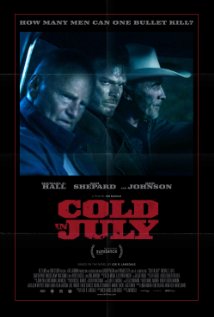
Cold in July starts out as a story about revenge but turns into something else. The time is 1989 and the place East Texas. Michael C. Hall (who I remember so well as the uptight mortician in the great HBO series Six Feet Under) plays regular guy Richard Dane. There’s nothing heroic about Richard Dane. He owns a small business and has a wife and son. When an intruder breaks into the Dane home in the middle of the night, Richard goes to investigate with a loaded gun. He ends up shooting and killing the intruder on the spot. The police arrive and identify the intruder as one Freddie Russell, a known felon. As it is an open-and-shut case of self-defense, Richard isn’t charged with any crime. He believes the ugly incident is over until Freddie Russell’s father, Ben (Sam Shepard), recently released from prison himself, shows up and begins making subtle threats, threatening specifically Richard Dane’s young son, Jordan.

When Richard sees a wanted poster showing the real Freddie Russell, he knows that wasn’t the person he shot and killed. The police, for some reason, are covering up. They want the world to believe that Freddie Russell is dead when they know in fact he isn’t. Richard saves Ben’s life when the police try to kill him by drugging him and placing his body on railroad tracks. He wants to convince Ben that it wasn’t his son he killed, but Ben, of course, doesn’t believe him. When they go and exhume the body of the person believed to be Freddie, they find a mutilated corpse with its teeth ripped out and its fingertips cut off. Ben knows from the face, however, that the body is not that of his son.

Richard and Ben are joined by good-old-Texas-boy Jim Bob (Don Johnson), a private investigator who wears cowboy boots and drives a flashy red convertible. Jim Bob and Ben go way back, having served in Korea together. The three of them set out to find out what is really going on and why the police are obfuscating the mystery. What they uncover is the stuff of which nightmares are made.

Cold in July is based on a novel by Joe R. Lansdale. It’s well-made, with some interesting, likeable characters. The character Ben Russell is frightening at first but turns out to be a decent, if eccentric, fellow. It’s his decency that drives the story to its violent end. The one thing that bothers me is how two men are able to dig up a recently buried body in a cemetery and not be seen. Isn’t that a crime in itself? Also, why is the body only a couple of feet down instead of the customary six? I guess these are things that don’t matter because movies don’t always deal in reality.

Copyright 2014 by Allen Kopp

Penny Dreadful ~ A Capsule Review

Penny Dreadful

Penny Dreadful ~ A Capsule Review by Allen Kopp 

Three episodes have aired so far of the new Showtime series, Penny Dreadful. It’s set in London in the 1890s and has a gallery of interesting characters. Sir Malcolm Murray (Timothy Dalton) plays a wealthy explorer whose daughter, Mina, is missing. She seems to have fallen into the clutches of a fiend or a really bad person along the lines of Count Dracula. In an ongoing effort to rescue his daughter, Sir Malcolm has joined forces with a woman known as Vanessa Ives (Eva Green), who, we are told, “is affected by forces outside our world.” Sir Malcolm and Vanessa have engaged the services of one Ethan Chandler (Josh Hartnett), an American sharpshooter traveling in England with a Wild West show; his unerring deadly aim might come in handy. For any medical services, Sir Malcolm enlists the aid of Dr. Victor Frankenstein (Harry Treadaway).

Victor Frankenstein is my favorite character. He has a sort of soulful intensity and the dimple in his chin doesn’t hurt either. He lives in a dark hovel and experiments with creating “men” from parts culled from cadavers. When the series begins, we find that the “creature” he has created is doe-eyed, sweet and gentle, not at all a “monster.” Victor names him “Proteus” from Shakespeare. (My favorite scene is when Victor realizes during a thunderstorm that Proteus is up and walking around, meaning that he is “alive.” Victor is so astounded he is breathless.) Just when Victor and Proteus are getting on so well, Victor’s first “creature” (that we didn’t know about until that moment) returns and kills Proteus. He is much scarier than Proteus and knows how to spread mayhem to get what he wants. He is befriended by an actor drawn to freakish people who gives him a job as a sort of stage hand in the Grand Guignol theatre, which specializes in theatrical bloodletting and gory stagecraft. The actor gives him the name “Caliban,” also from Shakespeare.

Penny Dreadful is a horror story with elements of other famous horror stories interwoven—Dracula and Frankenstein to name two—with a subplot involving an Egyptologist, the Egyptian Book of the Dead, an ancient curse from a couple of Egyptian deities who are upset about something, and a cadaver with Egyptian hieroglyphics written on it (or in it). Also thrown in (to what purpose we don’t know this early in the story) is Dorian Gray, the principal character from Oscar Wilde’s novel The Picture of Dorian Gray, a man who, while steeped in venality and vice, maintains his youthful appearance while his portrait displays the ravages of corruption.

Even if Penny Dreadful isn’t groundbreaking in its originality, it is still beautifully appointed in every detail, beautifully written and acted, and fun to watch. Quality TV for the viewer with discriminating tastes. My only complaint is that some of the night scenes (and it’s mostly all night scenes) are so dark that you sometimes don’t know what’s going on. It’s the darkness that’s the mood and theme of the show.

Copyright © 2014 by Allen Kopp 

Fancies and Goodnights by John Collier ~ A Capsule Book Review

Fancies and Goodnights cover

Fancies and Goodnights by John Collier ~ A Capsule Book Review by Allen Kopp 

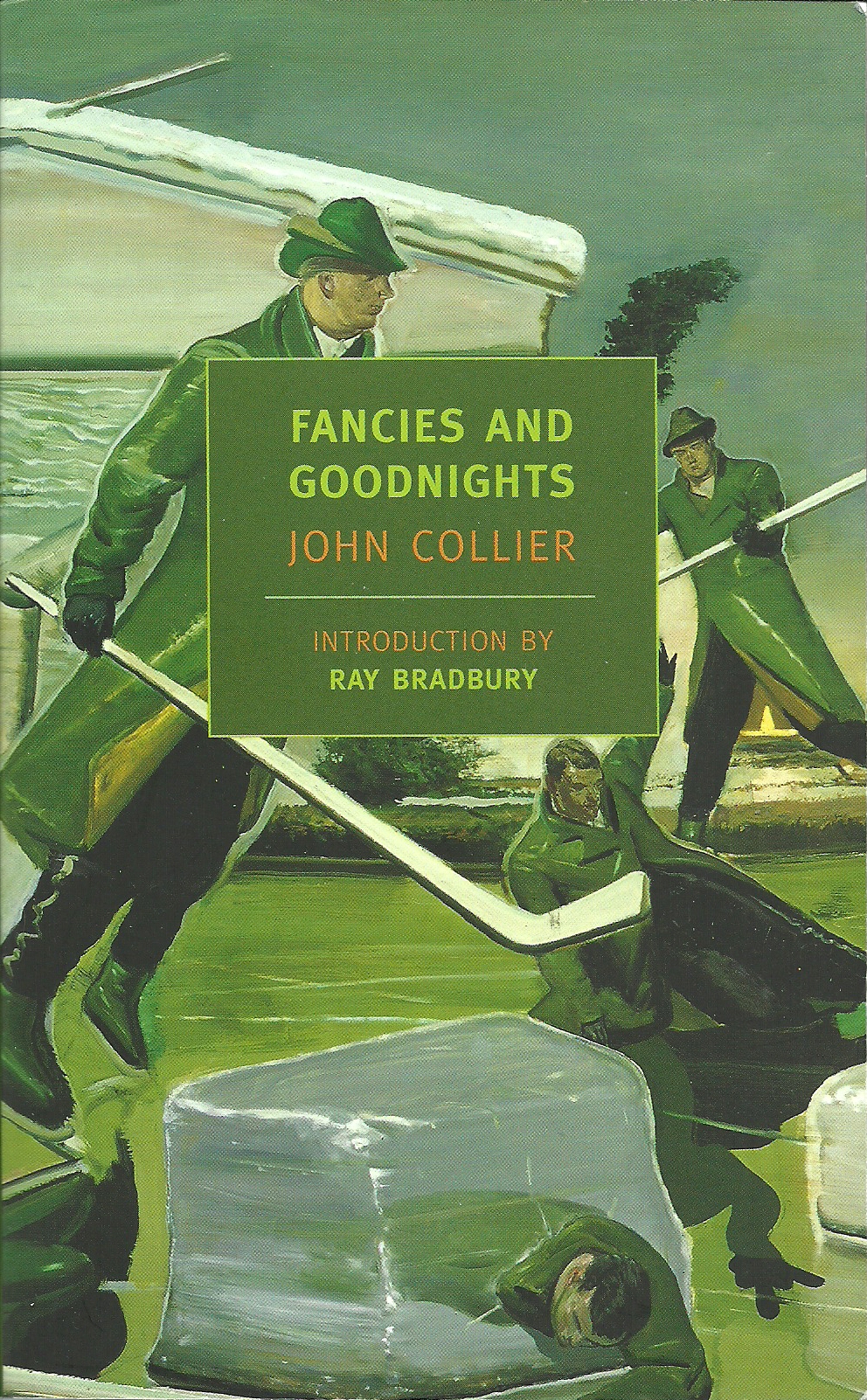
English writer John Collier’s (1901-1980) most famous short story is “Wet Saturday.” I remember reading this story in tenth grade, which was, of course, the first I had heard of John Collier. “Wet Saturday” is for John Collier what “The Lottery” is for Shirley Jackson and “Metamorphosis” for Franz Kafka. “Wet Saturday” is a sly story about a murder, a crime of passion from a person who is ordinary passionless, and the efforts on the part of the murderer’s father to find somebody to pin the murder on. It’s such a famous and well-known story because it’s simple to understand, a lot of the action is revealed in dialogue, and it packs a memorable punch at the end.

John Collier’s short story collection, Fancies and Goodnights, which was first published in 1951, is a collection of fifty short stories (including “Wet Saturday”) with Collier’s signature wit and dark, ironic humor. Most of these stories are not grounded in reality but in flights of fancy. There are demons from hell, an orchid that absorbs people into it, a man who spends an evening with his wife after she has just died, a man obsessed with a store mannequin, a doctor who murders his wife, a strange talking bird that reveals a secret to its owner that the owner would have been better off not to know, a man who pretends to be twins so he can marry two woman, a flea that takes Hollywood by storm, and on and on. As Ray Bradbury says in the introduction, “Anything can happen in a story by John Collier and it usually does.”

Of the fifty stories in Fancies and Goodnights, a few are about fifteen or twenty pages, but most of them are much shorter and can be read in one sitting or in a matter of minutes. It’s interesting to note that several of John Collier’s stories were adapted for TV in the 1950s and ‘60s, most notably for Alfred Hitchcock Presents.

John Collier considered himself a “third-rate writer,” but he was clearly a master of the short story form. Students of writing can learn a lot from his stories.

Copyright © 2014 by Allen Kopp

Neighbors ~ A Capsule Movie Review

Neighbors

Neighbors ~ A Capsule Movie Review by Allen Kopp 

A couple in their thirties, Mac and Kelly Radner (played by Seth Rogen and Rose Byrne), spend all their money to buy a house in a comfortable neighborhood. Everything is fine with them until the house next door is turned into a fraternity house. (Apparently a college is nearby, although it’s never mentioned.) Mac and Kelly try to be “hip” and “with it,” but they realize right away that having a fraternity next door is not going to be in their best interests.

When they are being kept awake by the late-night, raucous partying, Mac and Kelly decide to confront the rowdies themselves, instead of calling the police, and ask the fraternity boys to “keep it down.” They meet party-boy Teddy (Zac Efron), the muscular “president” of the fraternity who charms them in a way to make them think he cares about them. They enter into an agreement with Teddy whereby they won’t call the police if they are again bothered by the noise; all they have to do is call him and ask him to “keep it down.” Thereafter they are known by the fraternity as “the old people.”

The partying continues unabated. Mac, Kelly and their baby are being kept awake far into the night. Mac tries to call Teddy to ask him to “keep it down,” but Teddy isn’t available after ten or so tries, so Mac calls the police, even though he promised he wouldn’t. Teddy, of course, knows it was Mac who called and not somebody else in the neighborhood. Thereafter a sort of “war” exists between the fraternity and Mac and Kelly, the “old people.” Mac takes an axe to a pipe on the fraternity house, causing the basement to flood; he hopes that will be enough to get the fraternity to move. When the fraternity boys use the flooded basement to their own advantage, Mac resorts to other measures. He and Kelly pay a thousand dollars to a mousey college boy to claim that he was “hazed” by the fraternity. This ploy also backfires.

You won’t need to use your brain at all when you see Neighbors, which has humor deriving from college kids who never attend class or study, sex, pot smoking, drug use, breast milk, dildos, condoms, etc. It’s a likeable, harmless movie if that’s what you’re looking for. It’s also a huge success with the public. It made back its production costs on the first day of its release and is the number one movie right now. Draw your own conclusions.

Copyright © 2014 by Allen Kopp

The Railway Man ~ A Capsule Movie Review

The Railway Man

The Railway Man ~ A Capsule Movie Review by Allen Kopp 

In 1980 Eric Lomax (Colin Firth) is a pleasant-seeming, middle-aged man who meets a recently divorced woman named Patti (Nicole Kidman) while indulging in his passion for railways (“I’m a railway enthusiast,” he says.) After they are married, Patti discovers that Eric has deep psychological scars from his experiences in World War II. She wants to help him but doesn’t know how. She is afraid he will commit suicide, as did one of his friends who was with him during the war.

As a young British officer, Eric was held in a Japanese prisoner of war camp. He and other captured Allied soldiers were forced to work for the Japanese to build a railway from Thailand to Burma, a job that was deemed almost impossible—and very cruel—because of the mountain and jungle terrain. It was a hellish life from which most of the men were expected to die.

By stealing different radio parts, Eric secretly builds a small radio receiver so he and his fellow captives can hear something of the outside world. They hear news from home, particularly how the war is going. (“We’ve got Hitler on the run!”) When the Japanese guards find the radio, Eric admits that he built it and that it was his idea, to spare his fellow officers from punishment. The Japanese believe the radio is a transmitter to send information about them to their enemies. Eric is beaten savagely and tortured. His body eventually heals but his mind never does.

Eric discovers, all those years later, that his principal Japanese tormentor and torturer in the prison camp, one Takeshi Nagase, is still alive. He operates the World War II prison camp where Eric was held as a sort of tourist attraction. In other words, he is profiting from his war crimes. Eric travels from England to confront him and to somehow exact revenge. He wants, above all, to let Nagase to know he also is still alive and how his treatment at the hands of the Japanese affected his life after the war.

The Railway Man is a true story, based on a book by the real-life Eric Lomax, who died in 2012. Those seeking light-hearted, escapist entertainment will not find it here. The scenes of torture are grim and graphic. It’s a story about the brutality of war, but, more than that, it’s about the scars that are left behind long after the war has ended. 

Copyright © 2014 by Allen Kopp

The Godfather ~ A Capsule Movie Review

The Godfather poster

The Godfather ~ A Capsule Movie Review by Allen Kopp 

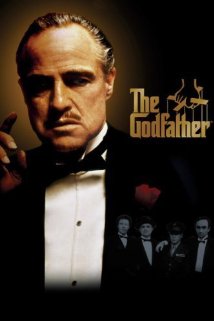
In any list of the best American movies of all time, The Godfather is always near the top, along with Citizen Kane, Casablanca, and The Wizard of Oz. It was a huge critical and financial success at the time of its release and still resonates with audiences forty-two years later. It’s a multi-generational story about the American dream that touches on the themes of loyalty, honor and family; an epic gangster film on a lavish scale with a running time of almost three hours.

The Godfather covers the period from 1945 to about 1955. Marlon Brando plays Vito Corleone, the humble Italian immigrant who becomes one of the most feared and respected crime bosses in America—the Don, the Godfather. People kiss his hand as if he is a pope or a king. They come to him for “justice,” for favors that only he can grant. He doesn’t do their bidding, however, without expecting something in return—loyalty and friendship, if nothing more.

When we first meet Don Vito Corleone, he is old, nearing the end of his productive years. He has three sons: the hothead stud Sonny, the fool Fredo, and straight-arrow Michael, who has a Barbie doll-like girlfriend and an illustrious war record. One of the sons will one day take over the family business. He also has a daughter, Connie. When the story begins, the family is celebrating her marriage. Her choice of a husband, however, proves, in time, to not be a happy one.

When Don Corleone is shot five times by his rivals early in the movie while buying fruit, his son Michael (played by Al Pacino) steps in and takes charge of things, even though he seems constitutionally unfit to lead a criminal empire. He is sensitive and seems physically slight in comparison to his brother Sonny. He wants to marry his girlfriend and have a quiet, peaceful (crime-free) life, but he is being pulled in the opposite direction. When he shoots and kills two of his father’s rivals, he hides out in Sicily for an extended period, where he falls in love with, and marries, a young Italian girl. When she is murdered by a car bomb that is meant for him, he eventually returns to the United States, a hardened man, determined to take his place as head of the Corleone family. He becomes the new Don as his father (who recovered from his gunshot wounds but was never the same again) recedes into the background and eventually dies of a heart attack.

Of course, there’s much more to the story that we see in The Godfather. Two years later, in 1974, there was The Godfather Part II, which explores the early life of Vito Corleone, and The Godfather Part III in 1990. It’s a story that goes on and on.

The Godfather has been digitized and restored and looks flawless in its current iteration on the Cinemax network. If you haven’t seen it in a long time, as I hadn’t, it’s worth seeing again, if for no other reason that to see how much Al Pacino, Diane Keaton, James Caan, and others, have changed in forty-two years. Abe Vigoda, at the current age of 93, still looks about the same. Some people never change.

Copyright 2014 by Allen Kopp

Heaven is for Real ~ A Capsule Movie Review

Heaven is for Real

Heaven is for Real ~ A Capsule Movie Review by Allen Kopp 

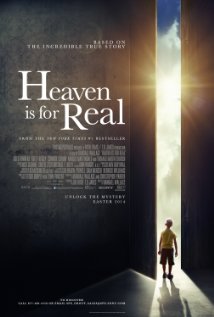
Heaven is for Real is based on a book and is supposedly a true story. Greg Kinnear plays a down-to-earth, small-town Nebraska minister named Todd Burpo. (I know—that’s kind of an absurd name.) He has a wife and two children. His son, named Colton, becomes inexplicably sick with a high fever. When Todd and his wife take Colton to the hospital after four days (why didn’t they take him sooner?), doctors find he has a ruptured appendix. They rush him into surgery but he is seriously ill and might not live. He eventually recovers, though, and the life of the family resumes as it was before Colton’s illness.

Soon, however, Colton begins to speak in a matter-of-fact way about things he saw when he was sick. He says he left his body (how could a four-year-old understand an out-of-body experience?) and saw himself on the operating table from above. He knew where his parents were and what they were doing while he was unconscious. He saw winged angels flying down toward him and when he was in heaven, he sat on Jesus’ lap and the lap of his long-dead great-grandfather. He met a little girl in “heaven” who, we find out later, was his sister who died before she was born, an event that Colton never knew about.

Were these “visions” just a childish fantasy, or did Colton really experience them? How is this story going to affect the community and Todd’s family? Believers continue to believe, but there’s plenty for scoffers to scoff at. Questions of faith are raised. Do you believe blindly, “taking out your brain and replacing it with the Bible,” as one character says, or do you harbor a certain amount of skepticism? When one child lives and another dies, what is the reason? Of course, there aren’t any answers to these questions, but people continue to ask them. Colton’s mother says at one point, during all the attempts at analysis, “Why can’t it just be a mystery?”

Heaven is for Real is a portrait of a family and a community. Like The Son of God earlier this year, it’s the kind of mainstream movie you don’t usually see at the multiplex. With all the Spiderman, Captain America, and X-Men movies being fed to the public these days, it’s good to see a movie every now and then that examines questions of faith and other issues that actually affect people’s lives.

Copyright © 2014 by Allen Kopp

Color TV

L111455

Color TV ~ By Allen Kopp 

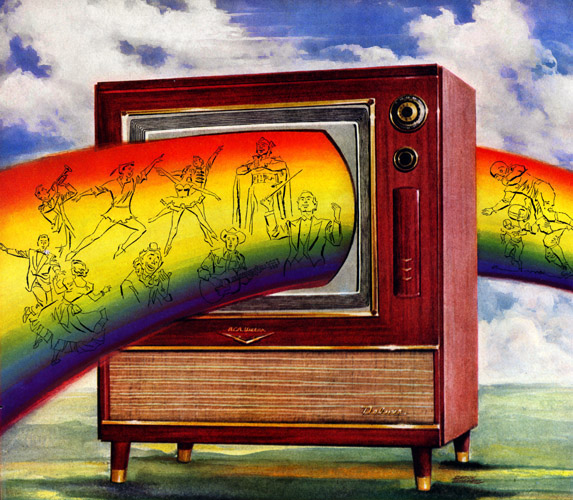
In the early 1960s everybody wanted a color TV, but few people had them. They were expensive and, in the small town where we lived, not easy to get. You had to pay a nonrefundable deposit of twenty-five dollars to get your name on a waiting list to purchase one, which might take six months to a year, depending on how fast the dealer could get them from the factory. And, even if you had a color set, you were still going to be watching black-and-white TV most of the time because there were only three shows on in color. When you think of the early years of color TV, you think of The Wonderful World of Disney and Bonanza on Sunday nights and Hazel in the middle of the week. (I was never able to understand the appeal of Bonanza, in color or black and white.)

Color TV was so much to be desired that Woolworth’s offered a low-cost (cheap) solution to those who wanted a color set but, for whatever reason, didn’t have one. For one dollar, the lucky shopper could have the illusion of color TV with a cheesy little item that was essentially a sheet of plastic with three bands of horizontal colors; the top band was blue to represent the sky; the middle band green for trees or grass; the bottom band brown for the ground. You attached this sheet of plastic over your black-and-white TV screen with adhesive and, if you squinted hard enough, almost closing your eyes, you might have been able to convince yourself you were watching color TV. Of course, if you were watching indoor scenes where you don’t see the sky, trees or the ground, the colors didn’t make much sense, but who’s to quibble with such innovation? Our next-door neighbors had one of these things and their cat, apparently not liking it, shredded it with his claws.

My grandparents were the first to have a real color TV. They were modestly well off and had only themselves to look after, so they bought themselves a top-of-the-line model. It was a squat metal cube with a twenty-four-inch screen with rounded corners. It sat on four spindly legs canted outward, making it look like a Martian spaceship that had landed on earth. If we were ever at their house on one of the nights that a color show was on, we were thrilled (well, I was, anyway) to see TV in color. It was a real novelty. It didn’t matter what the show was; its being in color was the thing that made it cry out to be seen. I could tell everybody about it at school the next day and watch their grimaces of envy.

As thrilling and desirable as color TV was, though, it wasn’t without its problems. The color had to be adjusted every time the TV was turned on. This meant bending over and fiddling with knobs to try to get the color just right. With one knob you adjusted the color of the color. You waited for a face to appear on the screen and then turned the knob until the face was as close to the color of flesh as possible, which turned out to be about the color of baloney. With another knob you adjusted how much color you wanted. Did you want the color to look like it was just barely color, or did you want it to jump out at you in a blatant, unnatural way whenever you entered the room?

By the mid-to-late sixties, everything on TV was in color, so it was no longer the novelty that it once was; it was just one more thing to take for granted like electric lights and the internal combustion engine. TV technology improved, of course, but it would still be many years before we had more than three (five at the most) choices of what to watch. We had a channel for each of the three broadcast networks, an “educational” channel that had shows about such things as blue babies and dentistry, and one “independent” channel that was fuzzy all the time because it had a “weak signal” but had the huge advantage of showing The Three Stooges every weekday afternoon.

Things have come a long way in fifty years. TVs now are sleek and lightweight. Gone are the heavy cabinets and consoles that weighed two or three hundred pounds. No more “picture tubes” (and other small tubes) that burn out like light bulbs and have to be replaced periodically. No more fiddling to adjust the color. No more knobs. No more metal TV antennas on roofs—most people are now connected to some cable or satellite system that offers hundreds of choices instead of just a handful. There’s a “niche” channel for every interest.

Old  black-and-white movies (movies made before the wide-screen format became the norm) are shown on a high-definition TV with the same proportions as they had on the movie screen (with a black space on both sides of the picture), or you can see them “stretched,” in which case they cover the entire rectangular screen and you lose some of the crispness of the picture. Recent movies look much the same as they do in a movie theatre. With a high-end, high-definition, flat-screen TV, it’s almost like having a miniature movie screen in your living room. And the best thing about it is that movies are broadcast as they were meant to be seen. We no longer have to put up with movies being cut up to allow for endless, idiotic commercials and “reformatted” in dreadful “pan and scan.” There are some people who apparently care about the integrity of the art form. That’s the kind of innovation we don’t often see.

Copyright 2014 by Allen Kopp

Chauncey Peeps

Chauncey Peeps image 2

Chauncey Peeps ~ A Short Story by Allen Kopp 

From the time she was a small child, Juniper Trent wanted to be a mother. She was a lonely child and so treated her roomful of dolls like living children or like the younger brothers and sisters she was never to have. She gave them all names, scolded them when scolding was needed—dressed, bathed, fed them—and treated them with the kindest loving care of which she was capable. In short, she taught herself how to be a mother, and, by the time she was in her early twenties, believed she was ready to embark on real—rather than pretend—motherhood.

She married the first boy who asked her, one Frederick Peeps, and, in a little over a year, she had her own real-live baby. He was a fine animal specimen in every way but not exactly what she or her husband expected. He was covered in dark hair, had a snout and a long tail, a large mouth and perfectly formed teeth. He resembled a baby ape more than a human child and, in fact, an ape is what he was. The doctor explained in his dry manner that these things sometimes happened, a little trick of nature, but there was no reason to believe that the monkey baby wouldn’t live a full and happy life.

She named him Chauncey and, after she recovered from the shock of his being so different from what she expected, she was delighted with him, as pleased and as proud as a mother could be. Her husband was a little pouty at first, wondering just who this woman was who could produce such a child, but took only a few days to get used to the idea of having a son unlike any other and came to love him as much as a father could, taking singular pride in his first steps, his first words and in his first bicycle ride.

Mrs. Peeps took Chauncey with her wherever she went. She soon became used to people staring and whispering, of wanting to get a closer look. Just about everybody who saw him wanted to touch him, to take his picture, or to have him grip their thumb with his furry little hand. They cooed in his face and made faces at him and, in so doing, made complete fools of themselves. Soon Mr. and Mrs. Peeps were receiving invitations to parties and dinners on the condition that they bring their unusual little Chauncey with them. They were invited to join the country club, the lodge and several church congregations, none of which held any appeal for them. They weren’t in any way “group” people or the joining kind.

Chauncey developed rapidly, physically and emotionally. He could read the newspaper at age three, recite Tennyson at age four, and, before he was five, perform the soliloquy from Hamlet. The summer before he started to school, he was juggling and doing acrobatics, singing, dancing and performing pantomime skits. His mother believed he was a natural-born performer.

When it came time for Chauncey to go to school, Mr. and Mrs. Peeps took a long, hard look at the situation. They had both attended public school as children and they knew what a cruel place it can be for someone who is different. They couldn’t stand to think of Chauncey being bullied, taunted, mistreated and made unhappy. They would rake together the money and send him to a special school for oddly turned, one-of-a-kind or freakish children.

He became a student at the Sore Bone Academy when he was six years old. For his entrance examination, he recited The Gettysburg Address (with much feeling) and did impressions of movie stars, including Marie Dressler and Zasu Pitts. The examining board, of course, was delighted, and accepted him on the spot without the usual expect-to-hear-from-us period. (They were privately thinking about the notoriety that such a talented and unusual child might bring to their school.)

At the Sore Bone, for the first time in Chauncey’s life, he had the chance to consort with other children who were as unique as he was. His classmates included an albino boy, Siamese twin girls, a boy with webbed hands and feet, a girl with a “twin” sticking out of her side, another girl with telekinetic powers who could make objects fly around the room, a boy with an exoskeleton and a tail, a girl who was covered all over with silky white hair, a boy whose head was attached backwards to his body, a girl with four working arms but no legs, a boy with the bodily proportions of a beach ball, and on and on. After one came to know them, they were more than just “freaks.” They were all bright and friendly in their own way and all fortunate to be shut away from the cruel world at the Sore Bone. Chauncey fit right in and became a student leader.

He excelled in all his studies and was encouraged to become the clown that he knew he was always meant to be. As he grew older, he began living his life as a clown instead of just as a monkey boy. He developed his “Mr. Peeps” persona that would serve him well in the years to come.

He had a complete clown wardrobe that his mother ran up for him on her sewing machine in her little attic room at home. And what a wardrobe it was, complete with junkyard tuxedos, top hats, the traditional red-and-white striped one-piece suits with ruffled colors, oversized suits containing compartments inside for the traditional rubber chicken and other clown paraphernalia, hobo pants with patches in the knees and seat, a long frock coat that dragged five feet behind him as he walked, and female clown dresses with voluminous padding for boobs and hips for when he performed in drag.

The school years passed happily and then it was time for graduation. Of all the clown students in his class, Chauncey (alias “Mr. Peeps”) was at the top of his clown class. As he accepted his diploma in his deep-purple cap and gown festooned with rubber chickens, his mother and father sat in the audience and beamed their happy smiles.

With school behind him, Chauncey had some important decisions to make. Was he going to be a clown all his life, or was he going to set his clownhood aside and pursue some more serious profession, such as lawyering or doctoring? He knew that many doctors and lawyers are also clowns, but he didn’t think he had it in him to combine the two professions. It had to be one or the other.

Just when he was beginning to enjoy his summer vacation, a bad thing happened. His father was run over by a pie wagon in Philadelphia. It was one of those events that just happens for which no planning is possible. After the funeral, Chauncey promised his mother that he would never leave her, no matter what. He would abandon all thoughts of pursuing a profession to stay at home with her. They had plenty of money and he was tired of the world anyway.

“We will defer all important matters for the time being,” his mother said. “I want to take a little vacation and get away from it all.”

They planned on going to a spa in the mountains to take the curative waters when, on the day before they were to catch their train, Chauncey received a telephone call from the Valeria Brothers Combined Shows. They knew his work, were great admirers, and were prepared to offer him a lucrative clown contract. He and his mother put off their trip for the time being, and he traveled alone two days later to meet with Valeria Brothers to discuss the job.

They gave him more money than he ever imagined and for his very first job! He knew that if he signed with them he was going to have to travel around from place to place, wherever the circus was performing, and he wasn’t altogether happy with that prospect. When he expressed a reluctance to leave his mother behind, they told him he could bring her along if she didn’t object to the nomadic life. The circus might even employ her in some capacity if she was interested.

When he told his mother the news, she was happy for a fresh start in life. What had seemed like the end of things was really the beginning of a new kind of life for her and her monkey boy.

Chauncey’s first experience at performing with the Valeria Brothers Combined Shows was a swing through the Southern states. And he was an instant success! As word of him spread, the Valeria Brothers saw their box-office receipts increase wherever they went. His mother became a sort of wardrobe mistress for Chauncey and for some of the other performers. She repaired their costumes when needed and saw that they were cleaned and pressed and ready for the next performance.

It was in the circus that Chauncey found true love. He was instantly drawn to a midget fat-lady clown who went by the name of Ima Pigg. She was about the same age as Chauncey and very naïve, having been sheltered by her wealthy family. When her father died and her mother remarried, she had stepped out into the world on her own and joined the circus and never looked back. Chauncey was her first romantic attachment and she was his.

In a few months, Ima Pigg became Ima Peeps. The wedding was  performed before a capacity audience in the middle of the regular show. The Valeria Brothers realized they could have sold three times as many tickets if only they had had the space for that many people. They considered making marriage ceremonies part of the regular show.

Within a year, Ima Peeps gave birth to her own little monkey boy and named him Chauncey Junior. He was a tiny duplicate of his father. Chauncey and Ima were very happy, as was Chauncey’s mother, the wardrobe mistress.

But the work of performing in the circus came first. The Valeria Brothers were constantly pushing Chauncey to try new routines. They didn’t want him to get stale. They had him juggling swords and live hand grenades and hanging from his teeth from a trapeze thirty feet in the air. It wasn’t enough for him just to be a clown anymore. The audience expected more from him. He had to do things that had never been done before.

One night to a packed house, when Chauncey and several of his clown colleagues were performing a stunt with rings of fire, the fire got out of control and began to spread very fast. All the lights had been turned off, making the situation more frightening for the audience when they began to see the fire coming toward them. They began screaming and running for the exits, trampling whoever got in their way. Eight people died and many others were injured without the flames ever getting to them.

Of the performers, Chauncey and three other clowns were killed. Those who were present stated later that Chauncey was a hero. He was able to get several people out of the way of the flames at the expense of his own life.

His mother left the circus and went home. She was heartbroken, of course, but not alone. Ima Peeps went with her and her grandson, Chauncey Junior. When she looked at him, she saw her monkey boy and she knew he wasn’t really dead. When she took him out into the world with her, she witnessed the stares and whispers. She was there for his first words, his first steps and his first time alone on a bicycle. Everything that had happened before was happening again.

Copyright © 2014 by Allen Kopp

Transcendence ~ A Capsule Movie Review

Transcendence

Transcendence ~ A Capsule Movie Review by Allen Kopp 

Transcendence has all the elements of a summer movie and it isn’t even summer yet: a one-word title, a big-name movie star (Johnny Depp) and a fast-paced techno plot with plenty of action. Johnny plays Dr. Will Caster (a part that almost any actor could have played). Dr. Caster works in the field of artificial intelligence. He and his team (including his wife, Evelyn, and his best friend, Max) are working on a computer system so advanced that it far surpasses human capabilities. The potential for helping mankind, curing illnesses, healing the planet, etc., are staggering. The one problem they can’t seem to figure out, though, is how to make the AI system “self-aware.”

A radical group wants to end the study of artificial intelligence, believing it has the potential to bring about the end of the human race, and murders some of the researchers. When Dr. Caster is shot, the gunshot doesn’t kill him, but it seems the bullet that entered his body was treated in some way to cause him radiation poisoning. He has only a short time to live. Before he dies, though, he will “upload” his consciousness into the computer system, providing the missing element of self-awareness that has hitherto been lacking. His fellow researchers, Evelyn and Max, are complicit in this plan. Evelyn sees it as a way for Dr. Caster to live on after his physical body has died. Max is more skeptical.

So, Dr. Caster is dead but his intellect and consciousness live on in the sophisticated, highly advanced artificial intelligence computer system. His wife is delighted at first that she can still talk to him and interact with him, but after a couple of years she sees where the whole thing is headed: he has a god complex. He believes he is so far superior to “simple organic” life (meaning humans) that he comes to see himself (the computer system) as the future and the human race as a thing that is completely unnecessary. He is sort of a modern-day Dr. Frankenstein in that he ventures into an unknown place where man is perhaps better off not to go.

Transcendence is engaging enough (more in the first half than in the second) for what it is, but there’s nothing unique about it. It’s in the cookie cutter mold of American movie making. There are other movies with the same look and feel. Now that summer is coming on, there will be lots of them because they make a ton of money and then are quickly forgotten until they turn up on TV.

Copyright © 2014 by Allen Kopp