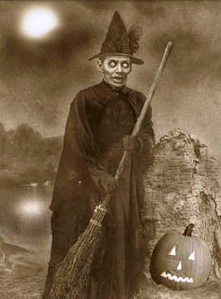
In a Cemetery on Halloween Night

In a Cemetery on Halloween Night ~ A Short Story by Allen Kopp

(This short story was published in Creaky Door Magazine and is a re-post on my website.)

When we were younger, the three of us were fascinated by the subject of death. We had lengthy discussions about the possibility of a continued existence after life has ended. We all wanted to believe in such an existence. Since Halloween is the one day in the year that the veil between the living and the dead is supposed to be at its most transparent, we decided to put all talk aside and conduct a little experiment.

There were no fewer than eighteen cemeteries in our county, some of them tucked away in forgotten corners. Each of the three of us would select a cemetery to spend the night in—the night of October thirty-first. We believed it was important for each of us to be alone, as spirits were more likely to make themselves known to an individual rather than to a pair or a group. We would meet the next evening and discuss our experiences. We hoped that at least one of us would have the proof we longed for.

I chose the Cemetery of the Holy Ghost because I remembered my grandmother telling me when I was a child that some of her family were buried there, and I also had a vague recollection of being there a time or two with my grandparents when I was in grade school.

It was a once-fine cemetery that had fallen out of vogue about a hundred years ago. It contained many interesting mausoleums, above-ground crypts, stones and monuments. Some of the illustrious (but now forgotten) inhabitants of the cemetery included governors of the state and their “consorts,” a United States senator or two, a celebrated writer (all of his books out of print for fifty years), several war heroes, an actress who appeared on the stage in both New York and London, and a notorious multiple murderer. In checking the records, I discovered that the cemetery had not received a newly deceased person in almost fifty years.

In the early evening of October thirty-first, I drove my car out into the country. I made sure I knew the way before I started and found the cemetery without any trouble. I parked the car in a low spot where it couldn’t be seen from the road (if anybody happened to be passing by, which was unlikely), and went in. There was an iron fence all the way around the cemetery that had fallen down in places. Nobody who wanted in was going to be kept out. I walked around for a while, taking in the sights as much as I could before it was too dark to see.

I found a good place under a big maple tree to sit down where the ground was covered with fragrant, dry leaves. The spot had the advantage of making me feel safe from anything or anybody that might approach me in the dark, so I planned on staying there most of the night until daylight when I would get back into my car and go home again. I took the things out of my backpack that I had brought—a flashlight, some drinking water and snacks, a lightweight blanket, a paperback book in case I became bored with the whole scene—and as I made myself comfortable on the ground under the tree, I realized just how peaceful and lonely an abandoned country cemetery is on a beautiful autumn evening.

I sat with my back against the tree as night came on. I wasn’t especially afraid of the dark but I had to admit that every sound I heard made my heart beat a little faster. Was the snap of a twig or the crunch of leaves someone—or something—coming toward me? What if I really did have an encounter with a spirit of some kind? Would my nerve fail me? Whatever happened, I promised myself that I would leave and go home if the situation became too unpleasant.

Once when I heard a sudden rustling sound right above my head, I jumped up with a little yell, ready to defend myself. When I realized that it had only been an owl—in fact, a pair of owls—I felt a little foolish and was glad nobody was there to see how skittish I was.

I sat underneath the tree for what seemed several hours. I had to get up several times to get the circulation going in my legs and to keep warm. The balmy evening had turned into a chilly night. I was a little disappointed—but not altogether surprised—to see that a country cemetery on Halloween night is the same as on any other night. The dead are sleeping peacefully and there is nothing to be seen or felt. The only thing I was sure of was that it was without a doubt the loneliest place I had ever spent a night in.

When I looked at my watch and saw it was only a few minutes before midnight, I longed to go home and go to bed, but I didn’t. I just didn’t want the night to end that way, with my leaving long before I was supposed to because I wasn’t having any fun. Instead I wrapped myself in my blanket like a cocoon and laid down on the bed of leaves with my head a couple feet from the tree. If I could spend a few hours sleeping, it would be dawn when I woke up and I could go home and have a good breakfast and sleep until noon.

I was more tired than I thought and lying on the ground was more comfortable than I expected it to be. In a very short time I was lost in sleep.

I woke up long before dawn to what sounded like the strings being plucked on a musical instrument. I gasped, believing for a moment I was choking, and sat up.

“That’s Edith playing her ukulele,” a male voice said.

Since it was too dark for me to see anything, I reached for the flashlight but wasn’t able to find it. “Who’s there?” I asked.

“I’m right here,” the voice said.

I squinted into the darkness but couldn’t see anything. Then, as my eyes seemed to adjust a little bit, I could see what seemed to be the blurry outline of a person. After a few seconds I could see the features of a face—nose, eyes, a mouth—but they were very faint. I seemed to be looking at a person who was there and not there at the same time. Lit from within, he seemed to be, as when you put a small lighted candle inside a large paper sack.

“Who are you?” I asked.

“I belong here,” he said. “You don’t.”

“Who’s Edith?”

“She’s my daughter. Ukulele player extraordinaire.”

As soon as her name was mentioned, a small girl “lit up” beside the man. Apparently they were able to turn the light on and off at will.

“Is there anybody else here?” I asked stupidly, running my hand across my eyes.

“My son Tom is here and several others who are just now hearing about you.”

A boy of about fifteen made himself known to me the way Edith had done. Then several others behind him did the same thing. As I looked out at them over the man’s shoulder, I saw that they were not quite touching the ground but “floating” above it.

“What are you doing here?” the man asked. I could hear the amusement in his voice.

“Do you know what day it is?” I asked.

“Time doesn’t mean anything here,” he said.

“Well, it’s Halloween,” I said.

“Oh, that,” he said, as if disappointed.

“So you understand the significance of the holiday?”

“Yes. And you are one of those who believe that Halloween is the one day in the year you will be able to see for yourself that we exist.”

“It sounds rather silly when you put it that way.”

“Are there others here also?”

“No. I’m by myself.”

“Are you some kind of medium between the world of the living and the world of those who have passed over?”

“No! Oh, no!”

“Then why are you seeing us right now?”

“This isn’t really happening. It’s just a dream. I’m afraid I’ve fallen under the spell, the romance, of being in an old country cemetery on Halloween.”

There was a murmur among the spirits behind the man. He listened to them for a moment and then turned back to me.

“They’re saying we can’t let you go like this,” he said.

“Why not?” I asked.

“They think, and I agree, that you’ll go back and spread the word that you’ve seen proof of life after death and then this place will never be the same. There’ll be people coming out here in droves—curiosity seekers like yourself and newspaper men and the like. I haven’t been dead so long that I don’t remember what people are like!”

“I won’t tell a soul.”

“No, indeed, you will not!”

I couldn’t help noticing that the spirits had increased in number. Before there were just a few but now there were dozens and behind them dozens and maybe hundreds more. I began to feel a little afraid at what they were going to do to me.

“Why are there so many of you here?” I asked.

“They all want to get a look at you,” he said.

“That’s not what I mean. Why haven’t you moved on in the spirit world? Do you have to stay here because this is where your bodies are interred?”

I heard faint laughter but couldn’t see who was doing the laughing.

“Of course not,” he said. “We’re everywhere. We can go wherever we want. There are no restrictions. That’s what being a spirit is. Some choose to stay here because their loved ones are here; others don’t want to leave because they’ve been here so long they don’t remember any other place.”

“You don’t like living people like me coming around bothering you, do you?”

“Most spirits choose to remain solitary or with other spirits. We would prefer that you left us alone. Nothing good comes out of it for us when you try to prove that we exist.”

“So, are you going to scare me to death so I won’t go back and tell people that I’ve seen you?”

“No, I have to tell you that a spirit can’t kill a living person unless it’s by suggestion. I’ve also heard of spirits causing heavy objects to fall on living people, but that doesn’t happen very often.”

“Well, I think I’ll get into my car now and drive home, then, if it’s all the same to you. And I promise you I’ll forget I was ever here.”

“You’ll go back to sleep. You’ve never really woken up. At dawn you’ll wake up and leave this place. You’ll forget any of this ever happened. You’ll have nothing to report to your friends.”

“I won’t remember any of this,” I said, “because it’s a dream and I never remember dreams after I wake up.”

Just as the sun was coming up I awoke to the enthusiastic singing of birds. As I stood up from my bed of leaves and folded my blanket, I was relieved that morning had arrived, I had survived the night intact and it was time to go home. I had done what I said I would do, which was spend Halloween night alone in a country cemetery. I wondered if my friends had fared as well as I had.

I walked to my car, started the engine, and turned on the heater. By the time I got out to the highway, morning was well on its way and the sky a brilliant autumnal blue.

I didn’t see the deer that came rushing out of the brush toward me like the angel of death. All I saw of it was its back legs as it sailed over the hood of my car. I suppose I had been thinking too much about bacon and pancakes and wasn’t paying as much attention to my driving as I should have. I swerved the car sharply to avoid colliding with the deer. Since I was going about sixty miles an hour, I lost control and ran the car off into a deep culvert that, lucky for me, had no water in it. I hit my head and was knocked out cold.

Somebody passing by on the highway saw my car in the ditch and called for help. An ambulance came and took me, still unconscious, to the hospital. The police had my car towed into town.

While I was still unconscious, I could hear a song being played on the ukulele. I didn’t know what the song was, but it was the same song over and over. A ukulele is not an instrument I’m used to hearing or would expect to hear. It forced me to recall in vivid detail the dream I was supposed to forget. When I regained consciousness, I asked for a pencil and some paper. I knew I had to write it down while I remembered it or risk losing it forever.

Copyright © 2014 by Allen Kopp

Celeste

Celeste image 1

Celeste ~ A Short Story by Allen Kopp

(This short story was published in Gothic City Press: Gas Lamp and is a re-post on my website.)

She owed everything to M and F. They brought her into the world, fed and clothed her, educated her, gave her a wonderful childhood. When the world was against her, M and F were always in her corner.

After she grew up, she married and left M and F. The marriage didn’t last, though, and after it came to its sad end she moved back home. M and F were growing old by then and needed her in the same way she needed them when she was a little girl growing up. She would never leave them again.

She did everything for them. They were helpless without her. She got them up in the morning, dressed them, sat them in their chairs, turned the TV or radio on for them. She read the newspaper to F and helped M with all the housework. She loved them so much that she told them all her secrets, like the time she pushed a girl down a long flight of stairs or the time at the lake when she could have saved a drowning boy but instead let him die.

On a beautiful autumn day, when the leaves were bright colors and the air held that wonderful crispness that can only mean the end of October, she bundled M and F up in their coats. F looked so sweet in the knit cap she made for him and M seemed to glow with the prospect of the fun they were going to have.

With M and F snuggly secured in the back seat, she drove out to the country road that she remembered from her childhood. They used to take long drives on Sunday afternoons in autumn, stopping to pick bittersweet or wild flowers or a few persimmons off a scraggly tree. She laughed to remember how eating a persimmon would make the inside of her mouth so puckery that she would have to spit it out on the ground. Autumn was her favorite time of year.

The road was just as she remembered it, the hills, curves, and sudden dips that made the stomach turn over. In fact, everything was exactly the same. There was the old red barn, there the grain silo and over there the horses grazing in a field behind a fence. The rickety old bridge still spanned the creek and the old country store still sold ice-cold drinks and pumpkins.

She looked away for a moment and when she looked back a porcupine was running across the road in front of the car. Porcupines don’t run very fast. If she had run over it and killed it, she would have been upset for the rest of the day. She swerved the car too much and lost control. The car careened off the road, across a ditch and into a tree.

Her first thought was for M and F. They had slid off the seat onto the floor but were unhurt. After she tended to them, she got out of the car to assess the damage. She had hit the tree squarely; water was dripping out of the radiator. She could not drive the car another inch in its present state.

It was too far to walk to town and, besides, she couldn’t leave M and F in the car alone. She could think of nothing else to do but stand by the side of the road and wait for somebody to come along and help.

There wasn’t much traffic and the few people who went by just stared at her as if she were a lunatic and went on past. Finally a police officer in a patrol car came along and, seeing her and the car smashed into the tree, pulled off onto the shoulder and got out.

“Anybody hurt?” the officer asked.

“No,” she said.

“I’ll call a tow for you.”

“Thank you.”

He spotted M and F in the back seat of the car. “Are they all right?” he asked.

“I think so,” she said.

He went closer to the car and leaned over to get a better look. “Why, they’re wax figures!” he said. “Aren’t they?”

“They’re…my family,” she said.

He straightened up and looked closely at her to see if she was making a joke. “Are you made of wax, too?”

“They’re surrogates.” she said.

“They’re what?”

She was wearing an old coat that belonged to F. She thrust her hands into the pockets and felt in the right-hand pocket a small knife that F used to use for whittling. She brought the knife out and stabbed the officer in the forearm.

He yelped with surprise. When she saw the knife sticking into his arm, she turned and started to run, but he grabbed onto her and wrapped his arms around her to subdue her. He pushed her toward the patrol car, opened the back door and shoved her inside.

“What do you think you’re doing?” she said. “I haven’t done anything wrong!”

“Shut up!” he said.

He slammed the door, locking her inside.

“Let me out of here!” she said. “They need me!”

The officer went over to her car and opened the back door. F tumbled out onto the ground head-first in a very undignified manner. The officer picked him up by the arm and tossed him back inside.

She winced as if she had been struck and then laughed at herself because she knew then that it wasn’t the real F. They—the real F and the real M—were asleep in a big trunk in the basement. Only she knew where they were. Nobody else would ever know. She was so much smarter than she had ever been given credit for.

Copyright © 2013 by Allen Kopp

On the Face of It

On the Face of It image 13

On the Face of It ~ A Short Story by Allen Kopp

(This short story was published in Gaia’s Misfits Fantasy Anthology and is a re-post on my website.)

In the morning when Blanche Mims stepped outside to sweep away the autumn leaves that had gathered around her front door, there was a very small man dressed in black formal attire, a midget, standing in the yard looking at her. She stopped sweeping, adjusted her glasses, and snorted through her nose.

“Looking for somebody?” she asked.

“I’ve found her,” he said.

So, he was one of those! He had heard about her in town and wanted to see for himself. She went back inside as fast as she could, slamming the door. She peeked out at him as he got back into a long gray car and drove away. Oh, but he had an evil grin!

She was not like other women, so she had good reason for caution. She had what was, by any measure, a monstrous deformity: her face was not in front of her head but on top. Her nose was exactly at the top of her head, her mouth tucked in underneath her nose. Since her eyes were always pointed skyward, she had to wear a special kind of glasses made with tilted mirrors so she could walk upright and see in front of her. On the sides of her head, all the way around (covering her ears), was thick hair, the color and texture of a lion’s mane. For several years she had been a headliner in a traveling freak show and was, for a time, billed as The Lion Woman. (To her credit, she was, except for the misplacement of her face, exactly the same as anybody else.)

She continued to see the midget every day for nearly two weeks. He either drove by slowly or stopped the car and got out and stood looking at the house for a while before driving on.

“There’s been a strange man hanging around outside for several days now,” she said casually to her mother, Olga Mims, one evening when they were getting ready for bed. “A tiny man.”

Olga laughed. “I’ve seen the little bastard,” she said. “That’s a hearse he’s driving. He’s an undertaker.”

“What’s he looking for?”

“Maybe he’s trying to drum up some business.”

“In Scraptown? Nobody comes to Scraptown if they don’t have to.”

“Why don’t you ask him the next time you see him?” Olga said as she removed her wig and put it on the head of the mannequin that she kept by her bed to keep her company at night.

All day long the next day Blanche kept an eye out for the little man, but she didn’t see him. The day after, though, he parked his hearse under the trees across the road and got out and stood in the front yard and looked up at the house. He was wearing a top hat and a cape as if he thought he was Spencer Tracy in Dr. Jekyll and Mr. Hyde and was smoking a cigarette in a long holder. She decided it was time to confront the little son of a bitch. She ran her fingers through her mane-like hair to smooth it down and went out the door.

“May I help you?” she asked in a too-loud voice.

He took off his hat, took the cigarette holder out of his mouth, made a sweeping gesture with his arm and bowed. “I am so pleased to finally make your acquaintance,” he said. “Allow me to introduce myself. I am Ferris Peabody, mortician. At your service.”

“What makes you think I need a mortician?” she asked.

“I don’t,” he said. “This is purely a personal call, rather than a professional one.”

“All right,” she said. “I think you’d better state your business and be quick about it, or I’m going to call the sheriff and have you removed from my property.” She bent over from the waist so she was really facing him, rather than looking at him through the mirror glasses.

“You have a lovely face,” he said. “It’s too bad the world doesn’t see more of it.”

“What’s the gag? Do you have a hidden camera somewhere?”

“Nothing of the kind, I assure you.” He bowed again as though addressing a queen.

“If this is some kind of trick, I don’t think it’s the least bit funny and I want you to know that I keep a loaded gun in the house.”

“No gag and no trick,” he said.

Hearing their voices, Olga came out of the house. She was wearing a seventy-year-old sailor suit that was too big for her, complete with hat. She smiled at the little man and saluted like a real sailor.

“How-do, ma’am,” he said. “Ferris Peabody at your service.”

“Charmed, I’m sure,” Olga said.

“You are, I take it, the young lady’s mother?”

“I was the last time I looked.”

“You have a sense of humor, ma’am, I can see. I like that and I think it’s so important in this cruel world we live in.”

Already Olga was fascinated by the little man and found him inexpressibly piquant.

“You still haven’t told me what your business is,” Blanche said.

“I come to pay a social call.”

“Why would you do that? I don’t even know you.”

“So that we may come to know each other.”

“If you’re selling funeral plans, we’re not interested.”

“I’m not, I swear.”

“Well, come on inside,” Olga said. “We don’t have to stand out here like a bunch of statues.”

Blanche opened her mouth to object but she saw no reason to be overly rude and, besides, she was curious enough to want to know what the little mortician was going to say.

They went into the parlor and sat down, Blanche and Olga on the old horsehair sofa and he on the overstuffed easy chair facing the sofa. Since he was about the size of a three-year-old child, he had some difficulty getting on the chair but, once he was settled, he smiled broadly, pleased to have been asked inside.

“I have some beer on ice, if you’d like one,” Olga said.

“I’d love one,” he said.

Blanche sat upright on the sofa so that when he looked at her all he could see was the lion’s mane. She was deliberately being cold to him, which he could read in her posture.

“You’re probably wondering how I drive the hearse,” he said to Blanche with an ingratiating smile, “being deprived of height the way I am.”

“I haven’t given it a single thought.”

Olga came back from the kitchen. She had poured the beer into a glass, which she only did for special guests. She handed it to him and watched carefully as he took a sip of the beer.

“Ah, so refreshing!” he said.

She smiled, ever the gracious hostess, and sat back down.

“Now, to get on with my story,” he said.

“I didn’t know you were telling one,” Blanche said.

“I became acquainted with your cousin, Philandra Burgoyne, about a year ago when she came to me for her after-death needs.”

“Oh, yes,” Olga said. “How is dear Philandra?”

“She’s fine,” he said. “She’s dead.”

“Isn’t that odd? I hadn’t heard that she had passed over.”

“She was very large at the end of her life. There was no coffin available that would accommodate, so we had to bury her in a piano crate.”

“I would have gone to the funeral, had I only known.” Olga said.

“The funeral was quite spectacular, if I do say so myself, but that’s not what I came to tell you. To get right to the point, I had many deeply heartfelt conversations with Philandra in the last few months of her life. I was her spiritual advisor, in a way, as there was no one else to fill that position.”

“You must have been a great comfort to her,” Olga said.

When Blanche sighed with boredom, he turned and faced her. He had no way of knowing if she was even listening to him. It was rather like talking to a mop. “When Philandra told me about you, I knew I had to come and pay you a visit, get to know you any way I could.”

“How flattering,” Blanche said. “I still don’t understand where you’re going with this.”

“I have a successful business,” he said. “I began The Ferris Peabody Mortuary and Funeral Parlor from the ground up. I have a very select clientele. People like us.”

“People like what?”

“Unique people. People like you and me and your cousin Philandra. People that the world thinks of as freaks.”

“Oh, well, thank you very much for calling me a freak!”

“To the world that’s what we are because the world only sees what’s on the outside and never considers what’s on the inside.”

“Ho-hum,” Blanche said, covering her mouth to yawn.

“I’ve taken care of the after-death needs of Hortense the Hippopotamus Girl, Isador the Invisible Irishman, Allesandro the Monkey Boy, Lulu the Flipper Baby, and Otto Osgood the Only Human on Earth with an Exoskeleton, to name but a few.”

“Otto and I used to be sweethearts,” Olga said. “He was very proud of his physical endowments.”

“I don’t believe you ever knew him,” Blanche said.

“Well, maybe not.”

“The point I’m trying to make,” he said, “is that my business is successful and getting more so. I have everything I need, except for one thing, and that’s where you come in.”

“You want me to die,” Blanche said, “and let you take care of my after-death needs so you can drop my name whenever and wherever it’s convenient, the way you drop the names of those other freaks? You little name-dropper, you!”

“I want someone to share my success with.”

“Get a dog.”

“The clock is ticking away. I’m no longer young and neither are you.”

”Speak for yourself!”

“You would complement my business in a way that nobody else could. My clients would feel comfortable with you. The women folk like it better if a woman is seeing to the arrangements. You know, what shroud goes with the casket lining and all that. What panties to wear. What shoes.”

“Are you offering me a job?”

“More than that. I’m offering to marry you.”

Phht! And wouldn’t we make a fine pair! A woman whose face is in the wrong place and a man who doesn’t even measure up to the yard stick! We could put on a show for Halloween, but I don’t know what we’d do the rest of the year.”

“You’ve been hurt by life and so have I,” he said.

“Me too,” Olga said. “I’ve been hurt by life a lot.”

“In my world you wouldn’t be an outcast. You wouldn’t have to hide yourself away in a little house built into the side of a hill because you wouldn’t be any more freakish than anybody else.”

“Oh, and where is this world, anyway, where everybody’s a freak but doesn’t know it?”

“It’s closer than you think.”

“It sounds delightful, your world, but there’s just one problem.”

“What?”

“How can I believe you? How do I know you’re not just some evil dwarf come to carry my soul to hell?”

He laughed heartily. “I assure you I’m not,” he said.

“I think you should listen to what he’s saying,” Olga said.

“I want to show you something,” he said. “Maybe it will help to convince you.”

He took her by the hand and led her to a mirror on the wall. After he had positioned a chair behind her to stand on so they were of more or less equal height, he placed his hands on both sides of her head and said, “Watch closely.”

She adjusted her mirror glasses and sighed. All she saw was her lion mane of hair, which is what she expected to see, but after a few seconds she saw something different. Her face was somehow projected on the front of her head so that she looked like a normal person whose face was where it should be and not a freak.

“How do you do that?” she said.

“Never mind how I do it. Just know that I can.”

The image in the mirror faded and she turned around and looked at him as he got down off the chair. “That’s just a trick,” she said. “I’ve had enough tricks in my life.”

“I think there’s something to that,” Olga said.

“Come with me now,” he said.

“I can’t marry you without knowing anything about you.”

“We can put off marrying for as long as you like.”

“And you won’t touch me?”

“You’ll have your own private boudoir with the strongest lock you ever saw on the door.”

“And I can come back home if I so choose.”

“It’s not a prison.”

“Can she come too?” Blanche asked, tilting her head toward Olga.

“I can’t leave now,” Olga said. “Poor Butterfly is about to have her babies.”

“She loves her cats more than anything,” Blanche said.

“We can come back and get her and her cats, too, just as soon as she’s ready,” he said.

“That will give me time to get my wig washed and styled and get my nails done,” Olga said. “What should I wear?”

“You can wear whatever you want,” he said.

“Can I come as a clown? I’ve always loved clowns.”

“You can come as a clown, a sailor, a chicken, or anything you want.”

“I have the cutest clown getup you ever saw!”

“Do I need to pack a bag?” Blanche asked.

“No,” he said. “You’ll have everything you need when we get to where we’re going.”

“What are we waiting for, then?”

Suddenly Blanche Mims seemed in a hurry to leave her little house built into the side of a hill in the section of town known as Scraptown. She gave Olga a little squeeze about the shoulders and followed the tiny mortician outside to his long gray hearse waiting for them under the trees.

Olga stood and watched as they drove away, waving and blowing kisses. She saw the hearse as it disappeared from view down the hill in the lane. Unlike other cars, though, it just never reappeared at the top of the next hill.

Copyright © 2014 by Allen Kopp

Gone Girl ~ A Capsule Movie Review

Gone Girl poster

Gone Girl ~ A Capsule Movie Review by Allen Kopp 

Gone Girl might more appropriately be titled Gone 33-Year-Old Woman. It’s a slick mystery filmed in and around Cape Girardeau, Missouri, and directed by David Fincher, who directed The Social Network and The Curious Case of Benjamin Button. It’s a story about a mismatched couple and the disastrous consequences of their terrible marriage. Ben Affleck is Nick Dunne, the feckless husband, and Rosamund Pike is Amy, the not-what-she-seems wife.

Nick Dunne is a small-town, average man. He owns a not-very-successful bar with his twin sister, Margo. His blond wife, Amy, is everything he’s not. She comes from a wealthy family, is sophisticated, cultured, and accomplished, a Harvard graduate and author of a series of children’s books. After the sexual attraction between the two of them wears thin, Nick and Amy discover they can’t stand each other. Nick grows increasingly more hostile toward Amy and she claims to be afraid of him. On their fifth wedding anniversary, Nick is going to ask Amy for a divorce, but when he comes home he finds she is gone; the house is in disarray, suggesting a struggle. Nick goes to the police and a large-scale search for Amy begins.

The apparent abduction of Amy becomes the subject of intense media scrutiny and a kind of national obsession. Nick Dunne is a little too glib and facile; he doesn’t seem too broken up over the disappearance of his wife. (He admits in private that he is relieved she’s gone.) He is, in fact, found to have been having an adulterous affair with a woman half his age. He becomes the most hated man in America. He has, in a way, been tried and convicted in the court of public opinion.

We (the audience) aren’t kept guessing too long. I don’t want to give away too much here, except to say that, as much of a jerk as Nick is, he’s relatively blameless compared to Amy. She is a despicable, manipulative monster, a regular psychopath. In the unsatisfying ending, we are left with the impression that Amy is exactly what Nick deserves. These are not likeable characters and there’s nothing here I care to see. I think I want my money back and the two-and-a-half hours out of my life.

Copyright © 2014 by Allen Kopp
The Spoils of Poynton ~ A Capsule Book Review

The Spoils of Poynton cover

The Spoils of Poynton by Henry James ~ A Capsule Book Review by Allen Kopp 

Henry James was an American writer who lived from 1843 to 1916. If he seems more an English writer than American, that’s because he did most of his work while living in England and, late in his life, gave up his American citizenship and became a British subject. He wrote about twenty novels, the most famous of which are The Golden Bowl, Wings of the Dove, and Portrait of a Lady. He is one of the key figures of nineteenth century literary realism.

The Spoils of Poynton is a short (for Henry James) novel first published in 1897 that touches on the themes of greed, friendship, the nature of love and the strength of familial connections. Mrs. Gereth is a headstrong widow who lives on her estate called Poynton. Poynton is filled with “treasures” (these are the “spoils” of Poynton) that Mrs. Gereth and her late husband collected, including furnishings, tapestries, old china, paintings, object d’arts, etc. According to a silly and unfair English law, all the things in Poynton (including the house and estate) belong (upon the death of Mrs. Gereth’s husband) to her son, Owen. Owen can do as he pleases with his mother. He can put her out of the house of he wants to. He is under no legal obligation to her.

Owen is engaged to be married to one Mona Brigstock, whom Mrs. Gereth, his mother, loathes. Mrs. Gereth can’t stand to see Mona installed in Poynton with all the “things” that she considers her own. She would do almost anything to keep Owen from marrying Mona. This is where Fleda Vetch enters the picture. She is a friend of Mrs. Gereth’s and Mrs. Gereth’s choice for Owen to marry instead of Mona. After Owen and Fleda meet a few times, they admit they have “feelings” for each other. Could it be love?

Mrs. Gereth moves out of Poynton at the prospect of her son’s marriage to Mona and takes up residence in a place called “Ricks.” Ricks is all right in its own way but far inferior to Poynton. To mollify his mother, Owen tells her she may have a few (a dozen or so) of her favorite pieces from Poynton. She surprises everybody by taking literally everything. Owen is outraged and threatens legal action. (Apparently the desire for earthly possessions is more important than the mother-son bond.) Mona tells Owen the marriage is off until the things are returned to Poynton. She wants to marry Owen, it seems, only if Poynton and everything in it are part of the bargain.

Mrs. Gereth’s friend, Fleda Vetch, is faced with a dilemma. She loves Owen and he apparently loves her, but she believes it would be improper for her to take him away from Mona. The only way she will get Owen herself is if Mona chooses to break off with him. Owen believes it his duty to follow through on his marriage to Mona, even though he seems at times to prefer Fleda. Which way will he go? Will Mona tell him she no longer wants to marry him? What will happen to the “spoils” of Poynton?

Somebody once said that Henry James could find more drama in a raised eyebrow than most people could find in an earthquake. The Spoils of Poynton is a simple and engaging story told in Henry James’s inimitable grand literary style. If a thing could be said in five hundred words, he will more than likely use five thousand. Let’s see…how many ways are there to say the same thing?

Copyright © 2014 by Allen Kopp

On This Day

On This Day image 3

On This Day ~ A Short Story by Allen Kopp 

Traffic was light. Billie Rose Flint arrived at the cemetery at five minutes after three on a bright October afternoon. She knew the cemetery well and parked the car in the same familiar spot, underneath an old oak tree that at the moment was so suffused with sunstruck color that it was as pretty as any picture in a magazine. She breathed deeply of the pleasant leafy smell and, not even bothering to lock the car, walked up the hill that she knew so well, past the gravestones whose names she knew by heart.

By the time she came to her son’s grave, she was winded and her legs ached; she was, after all, getting old. She spread the blanket on the ground, kicked off her shoes and sat down facing the gravestone. It was a simple red-granite affair, not as showy as some of the others, with the name, Randall Wallace Flint, the date of his birth and the date of his death.

As always when she was in the cemetery and there was no one else around, she began to feel sleepy. She reclined on her back and looked up into the trees. The breeze on her face was fragrant and cooling. A little hump in the ground pressed comfortably into the small of her back as if it had been placed there especially for that purpose.

She dozed and in a moment she was aware of someone standing beside her. She opened her eyes and looked up into his face but the sun kept her from seeing him. He smiled and sat down beside her on the edge of the old quilt.

“How have you been keeping yourself?” he asked.

“Just peachy keen,” she said.

“I had a feeling you’d be here today.”

“It’s a special anniversary,” she said.

“Anniversary of what? You can say it.”

She looked at him and saw he was trying to keep from laughing, as if it was all a joke to him.

“Thirty years ago today,” she said, “you hanged yourself from a rafter in the garage after school.”

“Go on,” he said.

“I found you when I opened the door to pull the car in. You were just hanging there. There was a tipped-over chair. I knew right away it was too late.”

“And then what did you do?”

“I screamed. The woman who lived next door, Doris Ellsworth, was in her backyard and heard me. She came running to see what was wrong. When she saw what had happened, she closed the garage door and took me into the house and called an ambulance.”

“And then what?”

“They came and cut you down. By then, all the neighbors had gathered around to watch. The paramedics carried you out on a stretcher and put you into the back of the ambulance. They were moving very slowly because they knew there was nothing to be done.”

“What did you do then?”

“I drank a glass of scotch and called your father and told him he needed to come home.”

“And did he?”

“He was there in a few minutes. At first he didn’t believe you were really dead. He wanted to see to make sure for himself. They let him see you, with all those people watching, and then he turned to the ambulance driver and very calmly told him to take you to the funeral home. Then he made me get into the car with him and we drove there behind the ambulance and bought you a casket. Your father wrote a check to pay for it.”

“It was some funeral, though, wasn’t it?” he said.

“Yes, it was a big funeral.”

“Everybody from school was there. Standing-room only. There wasn’t a dry eye in the place. Suddenly everybody likes you when you’re dead.”

“They liked you before you were dead but you didn’t see it.”

“I was going through an adolescent phase. I thought I couldn’t go on.”

“If only there had been some way to help you before it was too late.”

“It doesn’t do any good to think that way. What’s done is done.”

“Was your life really so unbearable?”

“I was a misfit. I was failing algebra. I had acne. I couldn’t take being chosen last for basketball any more. Do you know how much I despise basketball to this day?”

“Those things would have passed. If you had only talked to me about what was bothering you, I could have helped.”

“Maybe not,” he said. “Who knows?”

“Insanity has always run in my family,” she said.

He laughed. “Do you think that’s what was wrong with me?”

“Who can say?”

“If that helps you to understand what I did,” he said, “I guess it’s as logical an explanation as any.”

“Do you think about all the things you missed?”

“Not much,” he said. “ I think more about the things I avoided. Like having to get a job, paying taxes and having a bad marriage.”

“What makes you think you would have had a bad marriage?”

“I don’t know. Aren’t all marriages bad in one way or another?”

“It depends on who you talk to, I guess.”

“You and father had a terrible marriage.”

“I wouldn’t say it was terrible.”

“You fought all the time.”

“Did we? I don’t remember.”

“I call that ‘convenient forgetting’,” he said.

“Anyway, it’s all in the past now and no longer matters.”

“Yes, all in the past.”

“I’m just glad you’re not in torment for what you did,” she said.

“No, not in torment. Not in heaven, either.”

“I won’t ask you what it’s like where you are because I don’t want to know. All I want to know is that you’re not being made to suffer for what you did.”

“Of course I’m not. There isn’t any such thing as hell.”

“Now you’re forty-five,” she said. “Or you would be if you had lived. When I look at you, I see a forty-five-year-old man. You look a little like your father but more like my side of the family.”

“You see what you want to see,” he said.

“The unhappy fifteen-year-old is gone. I can no longer even see his face.”

“Good riddance,” he said. “I never liked him much, anyway.”

“Are you sorry for what you did? I mean, ending your life before it even had a chance to begin?”

“If you say so, mother.”

She heard voices and when she turned her head to see who it was, she saw two very old ladies hovering over a fresh grave nearby. When she turned back to her son, he was gone. The spell was broken. He wouldn’t have wanted anybody else to see him.

She picked up her blanket and walked over to where the old ladies were and greeted them. One of the old ladies had an excess of makeup caked on her face and the other wore a man’s hat and suit, as if they had just come from a costume party.

“Lovely day,” the woman dressed as a man said.

“Fall is my favorite time of the year,” makeup face said.

“A sad day for me,” Billie Rose Flint said. “My son died thirty years ago today.”

“Oh, my!” makeup face said. “How sad! How old was he?”

“Fifteen.”

“Aww.”

She picked up a lily from the flowers that were left on the fresh grave and handed it to Billie Rose Flint. “In remembrance,” she said.

Billie Rose Flint took the flower and, in spite of herself, began crying uncontrollably, trying to cover her face with her handkerchief to keep the old ladies from looking at her. She opened her mouth to speak again but instead hurried off with the flower before she felt compelled to tell them the whole story.

Copyright © 2014 by Allen Kopp
Absalom, Absalom ~ A Capsule Book Review

1936 first edition cover

Absalom, Absalom by William Faulkner~ A Capsule Book Review by Allen Kopp 

William Faulkner (1897-1962) is arguably the best American novelist of the twentieth century, the supreme literary stylist. His works are deep, cerebral, rich and complex. His style is dense, sometimes fragmented, wordy and difficult to read. He has the longest sentences and the longest paragraphs of any other writer. If you are trying to follow the thread of a sentence, you might have to go back and break it down into its many parts to figure out exactly what is being said. If reading a novel by Faulkner is frustrating and tedious at times (a painful slog), you must also know that it is worth the effort or you wouldn’t be doing it.

When I first started reading Faulkner’s 1936 novel, Absalom, Absalom, I found the first chapter (told in the voice of Miss Rosa Coldfield in 1909 when she is 64 years old) so difficult that I almost gave up. If you are able to make it through the first chapter, however, the following chapters are easier. Not easy, but not quite as difficult. (There’s no linear structure to the novel.)

Absalom, Absalom is the multilayered family saga of the Sutpen and Coldfield families in the American South in the decades leading up to the Civil War. Thomas Sutpen confounds the town of Jefferson, Mississippi—and particularly the Coldfield family—when he comes from nowhere and acquires a huge tract of land, called the Sutpen Hundred (square miles, not acres), and builds an enormous house on the edge of a swamp with the help of his band of wild black men and a French architect, who he more or less treats as a captive.

For years after the house is built, Thomas Sutpen entertains a band of his male friends with wild hunting and drinking parties and wrestling matches, until the day arrives when he decides he wants to acquire respectability in the form of a wife and children. He drives away his male friends and proposes to a town girl named Ellen Coldfield. (Faulkner compares her throughout the novel to a butterfly.)

To the unlikely union between Thomas Sutpen and Ellen Coldfield are born Henry and Judith. (Thomas Sutpen also has a half-black daughter named Clytemnestra, or “Clytie,” that he had with a slave woman.) Ellen Coldfield has a sister, Miss Rosa Coldfield, who is twenty-seven years younger than she is (younger than her own children). The first part of the story is being told by the elderly Rosa Coldfield to Quentin Compson, whose grandfather was the best friend of Thomas Sutpen. The part that Rosa Coldfield plays in the novel is more of an observer than active participant in what is going on.

When Henry Sutpen is grown (or almost grown), he goes away to college in Oxford, Mississippi. There he meets and becomes good friends with one Charles Bon. Charles is older and more worldly-wise and sophisticated than Henry. (Henry is clearly infatuated with Charles Bon. Faulkner later suggests more than just simple friendship between the two, especially on Henry’s part.) When Henry writes home about Charles Bon, his mother immediately sees Charles as a likely husband for Judith. Charles visits the Sutpen home with Henry on more than one occasion. His interest in Judith seems perfunctory. Will he propose to her or won’t he? We learn later a dark secret about Charles Bon, which I won’t reveal here, and that his association with the Sutpen family is part of an elaborate scheme of revenge. This element of the story drives the narrative for much of the second half of the novel.

The Civil War obtrudes upon the lives of the characters. The three principal male characters (Thomas Sutpen, Henry Sutpen, Charles Bon) all find themselves in battle. (Thomas Sutpen achieves the rank of colonel.) The war, of course, doesn’t turn out the way many Southerners hoped it would or expected it would. (Faulkner points out that the Southern army had the highest mortality rate of any army in history.) The men who survive, defeated not only in war but also in spirit, return home starving and in tatters to discover that everything they loved or cared about has been swept away. It is this defeat that is subtext to everything else.

Absalom, Absalom (the name derives from a character in the Bible) is a dark story, full of revenge, incest (or almost incest), miscegenation, family secrets, hubris, intentions gone awry, class distinction, loss and suffering. There’s no redemption for anybody, no life-affirming conclusion. Nobody writes about these things (or about the South) the way Faulkner does. 

Copyright © 2014 by Allen Kopp
A Conversation Between Two Mothers

A Conversation Between Two Mothers image 5

A Conversation Between Two Mothers ~ A Short Story by Allen Kopp

(I posted a slightly different version of this short story in April 2013.)

It was Madge’s turn to host the card party and she still had much to do. She had put her hair up in curlers and was tying a scarf around her head to make herself presentable to go and buy some last-minute items, when there came a knock at the back door. She huffed with impatience, snuffed her cigarette out in the garbage pail, and opened the door to a short, toad-like woman with frazzled red hair.

“Mrs. Simple?” the woman said.

“It’s Semple,” Madge said.

“Well, Simple or Semple or whatever it is, I need to have a word with you.”

“What about?”

“You have a son named Dakin?”

“That’s right.”

“He’s been picking on my Leslie.”

“Picking on your what?”

“On my son Leslie, dodo bird!”

“Oh. And who are you?”

“My name, if it should happen to be of any interest to you, is Mrs. Felton. My son is Leslie Felton.”

Madge sighed and stepped out the back door. “Maybe you’d just better tell me what happened,” she said.

“Leslie was riding his bicycle on the sidewalk, minding his own business. Dakin jumped out from behind a tree and yelled and scared him and caused him to wreck his bike. He cut a big gash in his leg that was pouring blood.”

“I’m sure that’s an exaggeration.”

“And that’s not all. When Leslie was lying on the ground howling in pain, Dakin took his bicycle.”

“Oh, he’s just playing. That’s what boys do.”

“Oh, is that so? Well, if you want to know the truth, I think Dakin is a lunatic! Only a lunatic enjoys inflicting pain on others.”

“Now, hold on a minute!” Madge said. “You don’t have any right to speak to me that way about my child!”

“Then when Leslie finally got his bike back, it had some scratches on it that weren’t there before. Caused by your brat!”

“Wait a minute!” Madge said. “Did you see Dakin do any of this?”

“He did it all right!”

“Did you see him do it?”

“Well, no, I was in the house, tending to my little girl.  She’s got a rash all over her body and we don’t know what’s causing it.”

“If you didn’t see Dakin do it, how do you know he did?”

“Because Leslie said so. If you could have seen how upset he was, it would have broken your heart. If you have a heart.”

“Maybe Dakin didn’t do it. There are lots of boys in the neighborhood.”

“Leslie said he did it and if Leslie says a thing, it’s true! He came into the house crying with the blood dripping down his leg. He was so upset he couldn’t speak. When I held him on my lap and got him to calm down, he told me what happened.”

“So, you’re taking Leslie’s word that Dakin did it?”

“Hell, yes!”

“You can’t always go on what kids say. They have a way of distorting the truth. Sometimes you have to find out what happened on your own.”

“So you’re saying my boy is a liar?”

“Look, Mrs. Whatever-your-name-is, I’m very busy at the moment and I don’t have time to stand here and jaw with you all day, as lovely a prospect as that is. When Dakin comes home, I’ll speak to him and I’ll find out what really happened. If he did what you say he did, he will be made to apologize.”

“And that’s all?”

“You want a written confession in blood?”

“I have a good mind to call the police.”

“They’ll just laugh at you for being so trivial.”

“You tell that little ham-handed troglodyte of yours to stay away from Leslie and Leslie’s bike and anything that belongs to Leslie.”

“You’d better watch who you’re calling names! You’ve got a lot of nerve coming to my door and raising such a fuss over nothing!”

“So now you’re saying it’s nothing? First Leslie is a liar and now it’s nothing!”

“I told you the matter will be taken care of! Now, so help me, if you don’t get off my property right now, I’m going to throw something at you!”

“My, aren’t we hoity-toity, though? You think you’re better than me, don’t you? Well, I’ll tell you something. I have no intention of getting off your property until I’m good and ready.”

Oh!” Madge said. She ran into the kitchen, looking for something to throw. The first thing that came to hand was a bag of grapefruits. She carried the bag out the door and began lobbing grapefruits at the woman, one after the other. The first one hit her in the chest but the rest missed her.

“I see where Dakin gets his craziness from!” the woman said. “Only crazy people throw fruit!”

When Madge had run out of grapefruits, the woman, as deft as a monkey, rushed her and punched her in the chin with her fist. The blow almost knocked her off her feet but she caught herself on the doorframe.

“I’ll give you fifteen seconds to get off my property,” she said. “That’s how long it’ll take me to go to the bedroom closet and get the loaded gun my husband keeps there.”

“Oh, my!” the woman said, taking a few mincing steps and waggling her hips in a demonstration of hoity-toity. “You can see how scared I am, can’t you?”

“You are the most repulsive woman I’ve ever seen!”

“Well, that goes double for me!”

The gun was in the exact spot in the closet where Madge thought it would be, high up where the kids wouldn’t find it. She checked to make sure it was loaded and then before she knew what she was doing she was outside again, pointing the gun at the woman.

When the woman saw the gun, she didn’t leave as Madge hoped she would but bent over from the waist and made a raspberry sound with her tongue and lips. Then she stuck her thumbs in her ears and waggled her fingers.

“Hah-hah-hah!” she said. “Are you supposed to be scaring me with that little pea shooter? I’ve had bigger guns than that pointed at me!”

The first bullet struck the woman in the breastbone, the second knocked her off her feet. She was lying on the ground, struggling to stand up, as Madge fired all the bullets in the gun at her, six in all.

When she was sure the woman was dead, she dragged her body by the ankles into the bushes in the overgrown neighboring yard where the house just happened to be vacant. It would be a while before anybody found her and, when they did, they wouldn’t know what had happened.

She put the gun back in the closet and checked herself in the mirror. No, she didn’t look as if she had just killed somebody. She went out to the garage and backed the car out and zoomed up the street, waving and smiling at some of the neighbors. It was getting late and she had to get to the store before they were out of the best cuts of meat.

Copyright © 2013 by Allen Kopp

Cotton

Cotton image 4

Cotton ~ A Short Story by Allen Kopp 

There were five of us: me, a brother and three sisters. When we were old enough, we were taken away one after the other. I think my mother was a little glad to see us go. She was getting old and wanted only to lie in the sun and take uninterrupted naps.

As with all of us, a big one came to get me. He smelled funny but he handled me gently as he put me into a carrier and closed the door. I cried a little and pulled at the door with my paws but I knew it wouldn’t do any good—I wouldn’t be let out again until I was in my new home.

The car ride made me sleepy and made me forget that I had to pee. I had ridden in a car before on a couple of different occasions and I knew how it either makes you want to throw up or go to sleep. I curled up in a tight ball, making myself as small as I could, and went to sleep.

The car went a long, long way from where we started but finally it came to a stop. When the big one got out, I stood up in anticipation of being let out. I was knocked off my feet again, though, when he picked up the carrier, carried it inside the house and set it down on the floor. (A rough but short ride.) Right away I smelled all kinds of awful smells that I couldn’t identify. Was it the smell of another cat? My heart started to pound. All I wanted was to go back to the safety of my mother.

When the big one saw I didn’t want to come out of the carrier, he stuck his big hairless, pink face through the door and spoke the terrifying language that to me sounded like a dog barking. I crouched down and backed up into the corner.

He upended the carrier—I tried holding on but there was nothing to hold to—and I went sliding out against my will. I stood up and took a few steps, stretched my muscles and licked my paw. The big one seemed to approve.

Just then a different big one, a “she” big one, came out of nowhere and scared me with her loud voice. I started to run for cover but she scooped me up in her paws. Now, I have to tell you it’s an odd sensation to be picked up by something fifty times bigger than you are. I meowed a couple of times to let her know I didn’t like what she was doing to me, but she nuzzled me and started scratching my neck and ears. In spite of the bad smells that made me want to gag, I began to purr a little.

The “he” big one said something to the “she” and they both made that hideous sound that I was to recognize later as laughter. They gave me some water out of a little red bowl and, after I took a good long drink, I was directed to the litter box, which I was very glad to see. I scratched in the box for a few seconds, sat on my haunches, made a tiny wet spot and covered it up so it didn’t show.

The two big ones began playing with me, even though I was in no mood. They had a toy mouse on a string that they dangled in front of my face. I thought I smelled another cat on the toy mouse, but I obliged them anyway by batting at it with my paw and trying to catch it in my mouth. After they tired of this game, they gave me some food, which I was barely able to eat because it didn’t smell like anything I had ever eaten before. I guess I was still too nervous to eat, anyway.

Later on they left me alone to do some exploring on my own. I went into the next room and then the room after that. I jumped up on a big table but there was nothing there that interested me so I jumped down. I walked the length of the couch and the chairs in the living room, exploring every inch of the stinky fabric; I stuck my paws in the dirt of some plants and then I climbed on the TV. I crawled under the couch and came out with dust stuck in my whiskers that caused me to sneeze. I jumped onto the counter in the kitchen, nosed into the sink and took a couple of licks out of a greasy skillet on the stove.

I went into the bedroom, which seemed to be the best room of all. The bed was soft with enough room for a hundred cats like me. As good as the top of the bed was, the underside was even better. It was dark and there were some boxes and things that offered complete concealment from any dangers that might still be lurking. I was thinking it would make a good place for a nap when Finley jumped out at me and scared me so bad I jumped sideways and took a few spider-like steps backwards. The fur ruffled up on my back and my tail puffed out to three times its normal size.

Finley was a young cat, not quite full grown, but bigger than me. He was a long-haired cat that made him seem bigger than he was and he had a mane like a lion. He let out a couple of guttural meows that to me sounded like war cries and came running toward me. I wouldn’t let him get near me, though. I ran into the other room with him chasing me. I didn’t know if he was going to kill me or just hurt me.

I dove under the couch and I knew right away it was a smart move because Finley wouldn’t fit. He could see me, though, and he knew I wasn’t going anywhere and that if I came out he would know it. Every now and then he stuck his paw under to try to grab at me, but I pulled away out of his reach.

I discovered then that Finley was the most patient cat in the world. He stood guard there, stalking me, for the rest of the day and most of the night. I was hungry and thirsty and I had to use the litter box, but I was still too scared to come out. When the big one tried to coax me out by shining a flashlight in my face, I just ignored him.

Finally, in the morning, with the big one there to keep Finley at bay, I came out. The big one picked me up and set me on the table in the kitchen to feed me. He spooned some food into a bowl and I began eating. When Finley, who knew everything that was going on, realized I was eating what he thought of as his food, he tried to get at me to push me away. The big one had to make him stay away from me so I could eat. (That’s when I learned how to eat and growl threateningly at the same time.) After I ate, I had a good drink of water and a satisfying couple of minutes in the litter box, while the “she” big one held Finley in her arms and whispered in his ear.

After a couple of days I was feeling more courageous and I stood up to Finley, nose to nose. Instead of hurting me, as I thought he was going to do, he licked me on the face and head. I guess I discovered then that he wasn’t as bad as I thought he was going to be. What I thought at first was meanness and aggression was more curiosity and playfulness, with just a little jealousy thrown in.

I was still leery of him for a week or so, keeping my distance and hiding from him if I found him a little too overbearing, but I began to get used to him after a while. If he wants the spot on the couch that I’ve made warm, he makes no qualms about trying to take it from me, but more often than not I’m willing to move to another spot and let him have it.

Cold weather was coming on. Cats, as you probably know, are always looking for extra warmth. Finley makes a really good sleeping partner. Not only is he warm, but he has the softest fur I’ve ever felt. Sometimes we sleep head to head or cheek to cheek or crossed over each other like a couple of earthworms. Sometimes I use his belly for a pillow or he uses mine. When winter comes and the nights are really cold, the big one lets us sleep under the covers with him in the bed. There is no warmer place in the house.

Finley and I are now inseparable friends. We play together a lot and keep each other company. We’re a lot alike but also a lot different. Sometimes we eat together out of the same bowl, but most of the time he lets me eat first before he eats. If anybody ever knocks on the door, I run and hide but Finley stays right there to find out what is going on. When we both are taken to the doctor at the same time, I’m still scared but not as scared as I would be if Finley wasn’t with me. When I hiss, he hisses, like two parts of the same hissing machine.

Copyright © 2014 by Allen Kopp

A Journal of the Plague Year ~ A Capsule Book Review

A Journal of the Plague Year cover

A Journal of the Plague Year ~ A Capsule Book Review by Allen Kopp

English author Daniel Defoe (1660-1731) was a literary late bloomer. He wrote his three famous novels (Robinson Crusoe, Moll Flanders and A Journal of the Plague Year) after the age of sixty. A Journal of the Plague Year was first published in 1722 and is an account of the London plague epidemic in 1665, when Defoe was only five years old.

A Journal of the Plague Year is fiction but is told in first person, as if the narrator is there at the time of the epidemic. The fictional narrator doesn’t leave London when he has the chance when the plague starts, as many sensible people do, but stays behind. He is spared the infection but witnesses firsthand the horrors of the epidemic and lives to tell about them. Defoe supposedly drew on the journals of his uncle, one Henry Foe, in writing the novel. That is obviously what gives the story its sense of authenticity and immediacy.

People can have the plague and not even know it, so are spreading it to everybody they come into contact with. Is it airborne or does it come about only through contact with an infected person? In 1665, nobody seemed to know for sure. Those who have someplace to go outside the city leave before the epidemic takes hold. It’s mostly the poor people who have to stay behind, so they are the principal victims.

So many people are dying during the height of the epidemic that the niceties of burying the dead in coffins are dispensed with. With a thousand or more people dying a day, “dead-carts” are dispatched to round up the dead and dump them into a huge pit. The only requirement for the pits is that the dead be buried at least six feet deep. As the lucky people who collect the bodies sicken and die themselves, new people have to be found all the time to fill the job. (It sounds even worse than a job as a technical writer for a restaurant chain.)

As with any human tragedy, there are stories of heroism and sacrifice along with the stories of opportunism and charlatanism. Quack doctors prey on the poor and uneducated, selling them fake “medicines” that are supposed to be a surefire remedy against the plague. Houses of the sick are ransacked by thieves. Unscrupulous “nurses” murder the sick people they have been hired to care for. Infected people willingly spread the disease to those they know are uninfected. On the other hand, caring people risk their own lives to stay behind and care for the sick in the “pest houses.” Charities are set up that provide food and necessities to the poor to see them through the epidemic.

There isn’t much plot or story to A Journal of the Plague Year, but that doesn’t mean it’s dull reading. A plague epidemic in a large seventeenth-century city is dramatic enough without much embellishment. Once you get used to the old style of sentence structure, it’s a fascinating reading experience. I bought a paperback of the novel when I was in college for sixty cents (new, not used—so you know how long ago that was). I read a hundred or so pages of the novel back then but for some reason didn’t finish it. That’s why I undertook to read the entire book (a breezy 240 pages) this summer, and I’m glad I did.

Copyright © 2014 by Allen Kopp