The Deuce ~ A Capsule TV Review

The Deuce ~ A Capsule TV Review by Allen Kopp

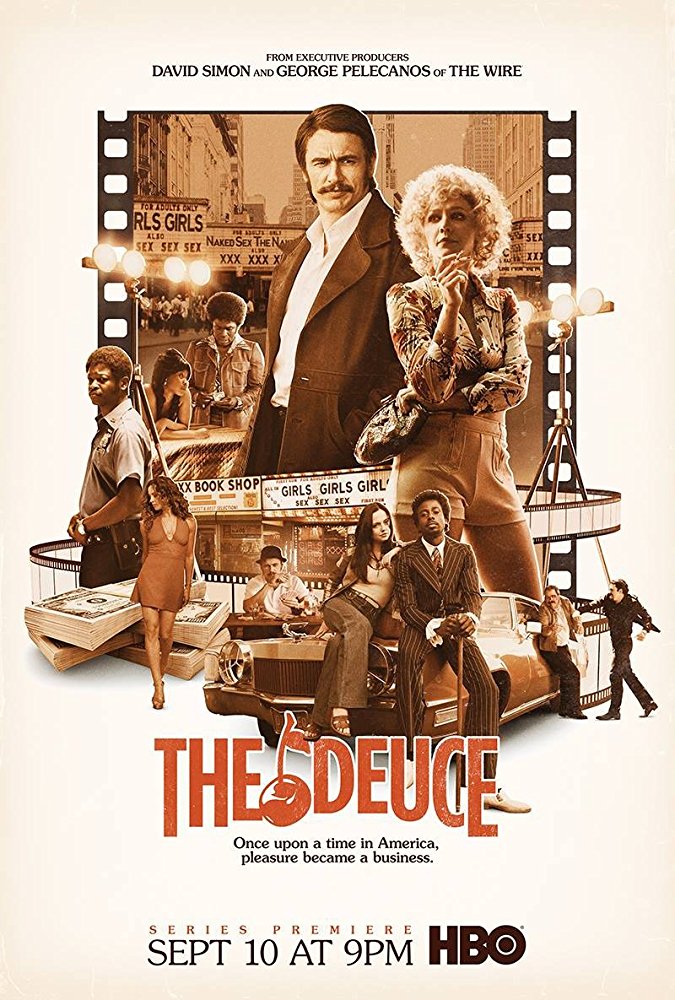
The new HBO series, The Deuce, set in New York City in the early 1970s, shows us the underside of the city: the sleaze of Times Square, the sex for sale, the rampant drug use, the pornography. If you go a little deeper, you see the lives of the people involved in these activities. Twins Vincent and Frankie (both played by James Franco) live on the edge. Vincent is a barman with an unfaithful wife (he is also unfaithful to her), two small children, and a load of debts. Frankie is an irresponsible gambler, in debt to loan sharks, who doesn’t mind leaving his gambling debts for Vincent to pay. Vincent is looking to improve his lot in life and be his own boss; he takes over the management of an unpopular bar and believes he can turn it around by making his waitresses wear skimpy outfits while they serve the customers. Neither Vincent or Frankie are the opera-loving, wine-sipping types with stock portfolios.

The most interesting character is “Candy” (played by Maggie Gyllenhaal.) Candy, whose real name is Eileen, is a not-so-young prostitute who works the streets of Times Square at night. Some of the “pimps” want to manage Candy, but she works independently. We know that Candy is taking a terrible chance every night, but she seems to know how to take care of herself and she has a young son to support. When Candy sees how lucrative pornography is for some people, but not for others, she takes steps to become involved in the pornography industry, which is a step up from being a whore.

The other whores, besides Candy, have pimps to “manage” them. The pimps are alternately caring and viciously brutal if something goes amiss with their money, so the whores are, with good reason, afraid of their pimps, while, at the same time, adoring them. When Lori gets off the bus from Minnesota, the pimp named C.C. takes her under his wing. Lori is no innocent, though; she has been whoring in Minnesota since she was sixteen and can teach C.C. a thing or two. Ashley, one of C.C.’s proteges, is jealous of Lori because of the interest that C.C. shows in her. Innocent-seeming Darlene, whore though she is, becomes interested in great literature through one of her “regulars.” Abby is a college dropout, who, while drifting, drifts into Vincent’s sphere. Will she become Vincent’s new girlfriend or will she herself turn to prostitution?

The world of The Deuce is the world of Taxi Driver and Midnight Cowboy. These are people living on the fringe, outside the law. Three episodes have aired so far, so there is much more to come and, after season one, there’ll be a season two. We’re definitely hooked.

Copyright © 2017 by Allen Kopp

Jesus, a Biography from a Believer ~ A Capsule Book Review

Jesus, A Biography from a Believer ~ A Capsule Book Review by Allen Kopp

Jesus, A Biography from a Believer by Paul Johnson is exactly what it says it is: a concise, reverent chronicle of the life and times of Jesus of Nazareth, the most influential person who ever lived. He was without politics or national identity. He was a revolutionary, a threat to the status quo because they didn’t understand him. They didn’t understand that his kingdom was not of the world, but a kingdom of heaven. He didn’t come to the earth to lay down a set of rules for people to follow. He came to prepare people, anyone who believed in him, for the next world. He extolled the lowly and the powerless among men, the weak and the poor. Whoever is last shall be first, he said. He loved people from all strata of society and would always take the time to talk to anybody who wanted to speak to him. He spoke in a way that was easy for people to understand. His speech was poetic but never lofty or scholarly. People were drawn to him because of his easy and open manner. And then there were the miracles. He performed miracles sparingly and only when he thought the occasion warranted it. He didn’t want to be thought of as a wizard or a magician. Those who saw him perform miracles became easy believers, but he knew that most people would never have the benefit of seeing the miracles firsthand. In people, what he most admired were humility, sincerity, but, above all, faith.

If there’s nothing much new in this book that we didn’t already know, we at least get a feeling of what Jesus was really like as a man. He knew that people were weak and flawed and corrupt—he lived in a corrupt world—but he forgave those who could believe in him. If you already have faith, reading this book will strengthen your faith.

Copyright © 2017 by Allen Kopp    

Boy Erased ~ A Capsule Book Review

Boy Erased ~ A Capsule Book Review by Allen Kopp

Boy Erased is a nonfiction book, a “memoir,” by a writer named Garrard Conley. It is a first-hand account of a Christian-based therapy program whose goal is to turn homosexual people (male and female) into heterosexual people.

In 1973, the American Psychiatric Association declassified homosexuality as a mental illness. However, that didn’t stop the formation of Love in Action (LIA), a nondenominational fundamentalist Christian organization that promised to cure all LGBT (lesbian, gay, bisexual, transgender) congregants of their “sexual addictions.”

Garrard Conley is the “boy” in question. He is from a strictly religious, Missionary Baptist family in Arkansas. His father is a fundamentalist minister who believes in a strict interpretation of God’s word. When Garrard realizes he’s gay, he has to keep it a secret because he knows his parents will never understand or accept his sexuality. They discover the truth about him when he is a college student. They view homosexuality as a “condition” or an “addiction” like alcoholism that can be “cured” through prayer and counseling. (LIA uses some of the techniques of Alcoholics Anonymous.) Garrard’s father tells him he will not continue to finance his education unless he submits to “ex-gay” therapy and becomes “cured.”

The therapy consists of first writing about and then talking through one’s sexual feelings in front of a group of strangers, feeling contrite and ashamed, and praying that God will make you “pure.” The idea is to remove all temptation and sinful thoughts that lead to sinful acts that will assure the practitioner will spend eternity burning in the fires of hell. It is a kind of brainwashing that sometimes leaves participants suicidal. There is no evidence, from a scientific point of view, that a person’s sexual orientation can be changed in this way.

Boy Erased is an interesting story about what one young man went through in an effort to please his parents and make himself acceptable in the eyes of the world. A better idea might have been to provide “re-orientation” therapy and counseling to the parents to get them to accept their son and his sexuality. The upshot of the book is that ex-gay therapy doesn’t work and apparently does more harm than good.

Copyright © 2017 by Allen Kopp  

It ~ A Capsule Movie Review

It ~ A Capsule Movie Review by Allen Kopp

Early in It, a small boy named Georgie has an encounter with a strange, though interesting, clown in a storm drain during a rainstorm. That’s the last that’s seen of little Georgie. His older brother Bill misses Georgie terribly and refuses to believe he’s dead. Bill and his group of adolescent friends (all troubled in some way) believe there’s something terrible going on in the little town of Derry, Maine, in the late 1980s. There are far too many missing kids and nobody knows what’s happened to them. The self-absorbed adults in the town don’t seem very interested in solving the mystery, so it’s left to Bill and his friends to confront the evil force, whatever it is. Welcome to the world of Stephen King. It is based on his massive, 1200-page novel.

There’s a pattern to the bad things that happen in the town. In 1908, an ironworks exploded, killing over a hundred people. Every twenty-seven years since 1908, tragedies have occurred. It’s now 1989 and that’s twenty-seven years since the latest town tragedy in 1962. By studying maps, the boys figure out that the places where the tragic events occurred all have something in common: they are all connected via the town’s sewer system and a thing called the well house. Just where is this well house, and how do the boys find it?

The clown, Pennywise, is by far the most interesting character in It. He is the personification of the evil force in the town. He lives in the town’s labyrinthine sewer system. Depending on your own perception of clowns (I like them), Pennywise is grotesque, scary, fascinating, creepy, compelling, or silly. Maybe all of these things.

Most of the characters in It are like cardboard cutouts. Some of the kid actors who play the parts talk so fast that we don’t understand a lot of what they say and they aren’t very convincing or likeable, with the exception of stuttering Bill and the one girl in the group, Beverly, who has to fight off the advances of her creepy, leering father.  If you are a Stephen King fan, you will probably love this film adaptation of one of his most famous works. If you are not a Stephen King fan, you might find the onscreen horror of the ho-hum, obvious kind involving thirteen-year-olds and things jumping out at you in the dark.

We don’t know until the end of It that we have just seen chapter 1 of the story, meaning there will be more. The young girl who plays Beverly in the movie looks very much like the fortyish actress Amy Adams, so I’m figuring that Amy will be in the next movie playing Beverly as she would now look in the year 2017. And Pennywise? He’ll be back! He may be down but not out. Oh, that clown!

Copyright © 2017 by Allen Kopp

Suffused with Light

Suffused with Light ~ A Short Story by Allen Kopp

Phillip Call awoke at the usual time, washed the sleep from his eyes, brushed his teeth and dressed himself. He went into the kitchen, expecting to see his mother sitting at the table drinking coffee, but she wasn’t there. Neither was she on the couch in the living room, in her bedroom, or anyplace else in the house. She hadn’t told him she was going to be gone. He wondered where she was but he wasn’t worried.

He was twelve years old and in the seventh grade. He didn’t like school very much but he tried to make the best of it. He was a fair student, better in English and reading than in math and science. In a few years when he was finished with school, he wanted to go into the navy and have a different kind of life where he would see places like Italy and South America.

He never knew his father. His mother had been married, but not to Phillip’s father, and then the man she was married to left and was seen no more. He knew she wasn’t a very good mother. She took pills, chain-smoked cigarettes, and drank whiskey and wine. Some days she didn’t even get out of bed or she laid on the couch all day in front of the TV. She had moods where she cried and yelled at him for no reason, only because he was there, and at those times he tried to stay away from her.

He had a piece of toast with jelly and set out to school. He was going to write his mother a note for her to see when she came home, but she would know that he got himself up and off to school and would be home at the usual time.

The day at school was uneventful. In his usual quiet way, he didn’t speak to anybody and nobody spoke to him. He had a spelling test, on which he scored a hundred percent, and a math quiz. Two eighth grade boys got into a fistfight in the cafeteria and had to be pulled apart. He spent the hour in study hall reading out-of-town newspapers on sticks. All in all, a very routine day. Nothing to write home about.

When he got home, his mother still wasn’t there. He looked for a note that she might have written, but there wasn’t any. He dug up something to eat for supper, did his homework and watched TV until bedtime. He expected her to come home all evening but she didn’t.

The next morning when he got up, she was sitting on the couch in her bathrobe. She was crying, smoking her Camels and drinking shots of whiskey. When he walked into the room, she didn’t look at him.

“Where were you, mother?” he asked. “I was worried.”

“I couldn’t take care of a kid,” she said, sobbing. “I hated to do it but I couldn’t go on any longer.”

“What?”

He stood right in front of her and still she didn’t look at him.

“I’ll have to tell them it was an accident. That I found him that way.”

“I don’t know what you’re talking about,” he said.

“I didn’t really poison him. He took those pills by mistake. He had a toothache and he thought it was something for the toothache.”

“Who are you talking about?” he asked.

He spoke in a very loud voice and she didn’t hear him. He waved his arms and she didn’t see him.

“Then he turned over and his face was smashed into the pillow,” she sobbed. “He couldn’t breathe. Poor little thing!”

“Mother!” he said. “Why won’t you answer me?”

“Now I can get away somewhere and start over. I’ll just have myself to take care of and I’ll get along fine. I’ll get myself cleaned up and forget all this happened.”

Somebody came quietly up behind him and touched him on the shoulder. When he turned to look, he saw a man whose face was a bright spot of light. He could only see the outline of the head, ears and a neat brown haircut.

“Who are you?” Phillip asked. “How did you get in?”

“It doesn’t matter,” the man said.

“Are you my grandpa?”

“No.”

“Why can’t I see your face?”

“You’re to come with me now.”

“Where?”

“Away from here.”

As the man began to lead him away with a gentle pressure on the shoulder, Phillip turned for a last look at his mother, who saw and heard nothing.

“What about her?” Phillip asked.

“She’s already said her goodbyes,” the man said.

Copyright © 2017 by Allen Kopp

Rabbit is Rich ~ A Capsule Book Review

Rabbit is Rich ~ A Capsule Book Review by Allen Kopp

John Updike (1933-2009) was an American writer who wrote compellingly about ordinary people. He was a chronicler of his age, in much the same way that F. Scott Fitzgerald and John O’Hara were of their age.

Updike’s series of four “Rabbit” novels (Rabbit Run, Rabbit Redux, Rabbit is Rich, Rabbit at Rest) are about the different stages in the life of one Harold (Harry) “Rabbit” Angstrom: high school basketball star, linotype operator, husband, son, father, brother, lover, and Toyota dealer.

Rabbit Angstrom is a sort of contemporary antihero. He is flawed. He is less than admirable. He is sentimental. He is sex-obsessed (as Updike male characters always are). In Rabbit is Rich, he is forty-six years old and overweight, in what you might call the third quarter of his life. He has reached the stage of his life where he knows affluence for the first time, thanks to his father-in-law, Fred Springer, who brought him into his Toyota dealership in Brewer, Pennsylvania, and then conveniently died, leaving Rabbit in charge. Rabbit and his ditzy wife Janice live with his crabby, Charlie’s Angels-loving mother-in-law, Bessie, in her stately house.

Rabbit and Janice have a son, Nelson, a confused and rebellious young man who dropped out of Kent State one year short of graduating. Nelson has just married pregnant Pru (whose real name is Teresa). Pru and Nelson seem mismatched. We know it’s a union that isn’t going to last. Rabbit is sexually drawn to Pru. (When it comes to sex, nothing is off limits with these people.) Nelson doesn’t want to return to college but instead wants to work at the not-very-successful-these-days Toyota lot with his father. Rabbit will have to let one of his long-term employees go to make a place for Nelson and he doesn’t want to do that. The women in his life (his mother-in-law and his wife) are pressuring him to bring Nelson on. He knows that Nelson will mess it up, as he has messed up everything else in his life.

Rabbit thinks a lot about death. He can’t stop thinking about his deceased working-class parents and about the other people in his life who have died. He and Janice had an infant daughter named Becky who Janice accidentally drowned in the bathtub when she was drunk. Rabbit has, or believes he has, an illegitimate daughter from an affair he had twenty years ago. He is sentimental about his supposed illegitimate daughter; he fantasizes about encountering her and introducing himself to her as her father, even though she believes another man holds that title.

Rabbit is Rich is a slice of late-1970s life. It’s a rich reading experience about marriage, disillusionment, mortality, fatherhood and success. It shows us how good contemporary American literature (after Hemingway, Steinbeck, Faulkner, and Fitzgerald) can be in the hands of a master. If you are a reader, you owe it to yourself to read all four of the Rabbit novels in order.

Copyright © 2017 by Allen Kopp

The Other ~ A Capsule Book Review

The Other ~ A Capsule Book Review by Allen Kopp

The Other is a gothic horror novel by actor-turned-writer Thomas Tryon (1926-1991) that has become something of an American classic and has sold millions of copies. It is set in 1935 in a small Connecticut town.

The Perry family has had more than its share of tragedy. The father died accidentally when a trap door fell on him as he was going down stairs to a cellar. His widow, Alexandra, is fluttery and nervous and can’t leave her room. A visiting cousin, named Russell, falls on a pitchfork concealed in hay while playing in the barn and dies. A neighbor woman dies mysteriously and her body isn’t discovered for a week. A newborn baby disappears and a frantic search is underway to find her. Alexandra is badly injured when she falls down the stairs. What is going on here?

Niles and Holland are twins, age thirteen. Alexandra is their mother and Ada, Alexandra’s mother, is their grandmother. Ada is the matriarch of the family. She is a Russian immigrant and speaks with an accent. She brings superstitions with her from the old country. She teaches Holland and Niles a game of transference in which they imagine they are something or someone other than themselves. This game of transference is an important plot point.

Even though Holland and Niles shared the same womb for nine months, they are very different. Holland is cruel and sadistic. He enjoys hurting and killing people and animals. Niles is just the opposite. He is a ray of sunshine and a help to his shut-in mother and his elderly Russian grandmother. Niles worships Holland. The good drawn to the bad. A moth to flame.

The Other is a breezy and clever (you might say, gimmicky) 288 pages and full of atmosphere. Can you guess the secret of The Others? If you can’t, the secret is revealed about three-quarter of the way through the novel. It has to do with twins Holland and Niles and the game of transference their grandmother teaches them. Holland gets what he deserves, but does angelic Niles deserve what he gets? It is, in a way, a story about mental illness.

Copyright © 2017 by Allen Kopp

A Prayer for Owen Meany ~ A Capsule Book Review

A Prayer for Owen Meany ~ A Capsule Book Review by Allen Kopp

John Irving’s 1989 novel, A Prayer for Owen Meany, is a story about friendship, faith and destiny. It takes place from the early 1950s through the late 1960s and into the turbulent Vietnam War years. The story is told in the first-person voice of John Wheelwright, best friend of Owen Meany. John and Owen live in the small town of Gravesend, New Hampshire. They both have things that set them apart. John was “born out of wedlock” and doesn’t know who his father is. (John and Owen spend many years trying to figure it out.) John lives with his pretty mother and snooty grandmother in a large, imposing house; his grandmother has plenty of money. Owen is very small and, when he grows to adulthood, will only be about five feet tall and weigh one hundred pounds. His voice is described as an arresting “falsetto” that doesn’t change and deepen as he gets older, as other boys’ voices “change.”

Owen doesn’t have the advantages that John Wheelwright has. He lives with his ignorant parents near a granite quarry, where there is always dust in the air. His father is in the granite and gravestone business. Owen is an only child. His mother, who might be retarded, sits and stares and doesn’t say much. The Wheelwright family practically adopts Owen; he almost spends more time in their home than he does in his own. When Owen and John are about ten years old, Owen is the unwitting cause of John’s mother’s death.

Despite his limitations, Owen is smart and funny and people love him. He feels terrible about what happens to John’s mother, but John doesn’t blame him. “It was an accident,” John says. John’s grandmother, who doesn’t like many people, likes Owen. She comes to be his benefactor in many ways. Another major character is Dan Needham, John’s stepfather and a widower now that John’s mother is dead. The Reverend Lewis Merrill, the stuttering minister, also figures prominently in the story.

The most important thing about Owen Meany is that he has an unshakeable faith in God. He seems himself as God’s instrument. He has a destiny to fulfill, he believes, and he will fulfill it, despite any obstacles placed in his way. John, who is at first an unbeliever, comes to believe in God because of his association with Owen. Owen’s odd father tells John toward the end of the book that they believe Owen was a “virgin birth.” Owen is different in so many ways and touches many lives. You have to read the book to know what a miraculous character Owen is.

A Prayer for Owen Meany is long (617 pages), too long at times, especially toward the end. The liberal 1980s politics that the narrator interjects seem out of date and unnecessary. (I cringe at the mention of the “Iran-Contra” affair of the 1980s. That doesn’t belong in this story. The politics of the Vietnam War era are at least relevant to the story.) Another quibble I had while reading the novel was the crude character Hester, John’s cousin to whom he is sexually drawn and Owen’s “girlfriend.” I for one could have done without her. The “cringe factor” of A Prayer for Owen Meany is small, though, and doesn’t ruin a generally compelling story. It’s fast, light reading that doesn’t require a lot of deep concentration.

Copyright © 2017 by Allen Kopp

The Door That’s Always Closed

The Door That’s Always Closed ~ A Short Story by Allen Kopp

My name is Charles Anson. I moved in with my mother after my father died. At first I hated the idea of living with my mother at the age of thirty-seven, but soon I got used to it and thought of her home as my own. And I have to admit, my life was easier there. She had a cook and a housekeeper, so I no longer had to buy or cook my own food or do any housecleaning, which I was never very good at, anyway.

My mother was in her mid-forties when I was born. She was always older than the mothers of my friends, more like a grandmother. She had developed a bad heart in the years after my father’s death and told me she was happy to have me there with her—I was her only family that counted, she said—even though we argued at times about things I did that she didn’t like: I drank too much and I sometimes didn’t bother to call her when I wasn’t coming home. At those times, I had to remind her that I was no longer fifteen years old. She had to relinquish what she considered her “rights” as a mother and treat me with the respect I deserved as an adult.

She was known for her temper, which my father could tell you about if he was here. I remember when I was little and heard them fighting in the night. It wasn’t unusual to hear yelling, breaking glass or splintering of wood. When my father got enough of my mother goading him, he would end up throwing a vase or something at her head. In the morning when I asked what had happened, my mother would laugh and say my father had a little accident while sleepwalking. I knew it wasn’t the truth but it was a good way to gloss over an ugly situation.

I went to work every day and when I came home my mother was there and dinner was on the table and all was well. After dinner, I would usually step out if I felt like it, even though I knew my mother was jealous if I didn’t spend all my free time with her. In the evenings she watched old movies on TV and was happy to have me sit and watch with her, but it wasn’t my idea of a good time. I can only take so many Depression-era comedies with wisecracking dames and maids masquerading as madcap heiresses.

Most of the time when I came home from a night on the town, sometimes at one or two in the morning, my mother would have the TV and all the lights on, but would have retired to her room. This made her feel safer when she was alone, she said. I would turn everything off, starting with the TV, and make my way to bed, sleep for about four hours, get up and begin my day all over again, as so many of us working stiffs do. My mother had told me I didn’t even need to work, that she had plenty of money for us both to live on, but I couldn’t see myself hanging around all day with just her to talk to and having to ask her for money anytime I wanted to go out and have a few drinks.

On weekends I always tried to spend either Saturday or Sunday with my mother, just the two of us. She liked to go for a drive and I would very often take her to the cemetery where my father was buried and then take her to a good restaurant for lunch. If it was a Sunday, we would try to take in a museum or a concert. If I ever had the idea of going to a movie theatre and seeing a movie, she said she preferred seeing them on TV. When I told her that most people who liked movies wanted to see them at the theatre and not on TV, she only shook her head. The movie screen gave her a headache, she said, and she didn’t like the smell of popcorn.

All in all, my life was agreeable. I didn’t spend most of the money I made, so I was able to invest. The market was doing well, so I did well. I didn’t miss the things I didn’t have that other people had, like a marriage and children. I had learned early in life that not everybody in the world is the same and I found it out more and more as I got older. What’s right for most people is not right for everybody.

My mother went on for years with her bad heart, but she came to a point where she couldn’t go on any longer. She looked pale and drawn all the time and spent most of her time lying down. She stopped fixing herself up and having her hair done up. Some days she didn’t even bother to get dressed.

She went to the hospital for a few days and when she came home she said she was never going back, no matter what. She wanted to be in the privacy of her own home and not have a bunch of strangers around her at the end. I hired a nurse to be with her during the day when I was at work and a different nurse at night. They just did their work quietly and effectively and didn’t bother me. I paid them when the time came and left them to do whatever needed to be done.

I decided to quit my job in early summer. I didn’t need to work, as I said before, and all the time I was away I was worried that the end would come for my mother and I wouldn’t be there when she needed me. I dismissed both nurses and told them I would take over from there.

My mother moved into one of the guest bedrooms—she didn’t want to mess up her own room where all her treasures were—and became entirely bedridden. Her doctor sympathized with her desire to be at home and gave me lots of pills to give to her. He told me I didn’t have to hold back in administering her medicine and nobody would ever know the difference. I knew what he was saying without further explanation.

We kept her heavily sedated and I knew she wasn’t in any pain. Every so often she would open her eyes and look at me and I knew she was happy with the way things had turned out. She died peacefully on a hot afternoon in August. She was breathing and then she wasn’t. I hoped that when my time came, I would die so simply and easily.

When a loved one dies, there are certain things that need to be done. I was supposed to call the doctor and get a death certificate and then call the funeral home and have them come and take her body away. I found I wasn’t able to do those things, though. I could not speak the words to anybody that she was dead. All I did was close the heavy drapes in the room where she lay and close the door to the room and lock it. I placed a beautiful Chinese screen she was fond of in front of the door to make it seem there was no door there at all.

I knew I would eventually have to have her taken away, but for now I just wasn’t able to disturb her at her rest. The bed in which she lay seemed more the place for her than a casket on display in a funeral home and then a grave. Some people would say I was crazy to do what I did, and maybe I was. It was my way of keeping her with me.

I suppose I was lonely and always had been. I realized after my mother was dead that she was the only person in the world who ever kept me from feeling lonely. I had friends, of course, but not close friends, and when I was away from them I didn’t care if I ever saw them again. I was indifferent toward them, as I had been indifferent toward many things and people in my life.

I kept the apartment dark and I started drinking heavily and taking my mother’s medications. If I didn’t know what they were for, it didn’t make any difference. If I took too many and didn’t wake up, it was all the same to me. I was in a state between living and dying.

Then, after a few weeks, I suppose I snapped out of it, at least partway. I looked at myself in the mirror and vomited. After that, I cleaned myself up and went out and had a good meal in a restaurant. The next day I hired some cleaning people to come in and clean the apartment and air everything out from top to bottom. I kept the door to my mother’s room locked, of course.

I began eating regular meals again and gained some weight. I bought some cook books and learned to fix dishes I had never fixed before, like standing rib roast and lemon trout almondine. I bought myself some new clothes and began going out more, but almost always alone. I walked farther than I ever walked before. I went to movies and different restaurants that were new to me and sometimes I went to church and sat in the back and listened and watched the people.

In the evenings I would pass the time reading novels, listening to classical music or watching old movies on TV as my mother had loved to do. I became as knowledgeable in movie lore as she had ever been. I saw the films of Ramon Novarro, Ruth Chatterton, and Kay Francis.

To keep from feeling so alone, I bought a life-sized human female doll. It was supposed to be a substitute companion for lonely men, but that’s not what I wanted it for. I wanted it to resemble my mother. I put makeup on it to make it look older, put one of my mother’s wigs on it and dressed it in my mother’s clothes. I created an illusion. At night in the dark, with just the light from the TV screen, it seemed as if my mother was sitting there. I knew she would have been pleased.

From there I took the next logical step and began dressing in her clothes myself. It made me feel close to her as though I were absorbing her essence into my body. She wasn’t a rotting corpse behind a closed door. She was right there with me and had been all the time.

After I dressed in her clothing a few times, I started experimenting with makeup. I applied it to my own face exactly as she would have applied it to her own. She had a couple of wigs on the top shelf of her closet and I got them down and tried them with different outfits. I would spend the entire day dressed as her. If it made me feel better and less alone, what did it hurt?

As I stood and looked at myself in her full-length mirror, I realized for the first time how much like her I was. My face was the same shape as hers, down to the dimple in my chin, and I had the same coloring. My beard stubble was light and nonexistent for at least a day after I shaved. I was the embodiment of my mother. I saw nothing of my father in me. He had been large with fleshy ears and a nose like a lump of cauliflower. When I was a child, I used to wonder how the two of them ever came to be together.

I spent hours practicing her walk, her laugh, the way she spoke, lit a cigarette or downed her vodka and tonic. I could match her signature so well that nobody would have been able to tell it wasn’t hers. But why was I doing all this? Was it just passing the time and keeping myself from feeling lonely, or was it something else?

One day when I was feeling brave and more than a little bold I decided to try a little experiment. Dressed as my mother—in her clothes, shoes, wig, hat and coat—I went down in the elevator and down the street to the market on the corner and bought a bag of groceries. I expected people to take one look at me and know I was a charlatan. If anybody noticed me at all, though, they didn’t give me a thought. It was exactly the effect I hoped for.

On my way home, a neighbor woman put her hand on my arm and stopped me on the sidewalk.

“I heard you were sick, Mrs. Anson,” she said. “I’m glad to see you looking so well.”

“I’m much better now,” I said. “My son has been taking care of me.”

I began going out more as my mother. People who had known her for years weren’t able to tell the difference. I kept them from looking at me too closely but, even if they had, I don’t think they would have suspected anything. People see what they want to see and are not all that observant.

Take my mother’s lawyer, for example. He had some documents he wanted her to sign. Now, my mother and her lawyer had known each since high school. Making him believe I was her would be the ultimate test. I was sure I could do it, but I was little anxious he would take one look at me and think I was attempting to perpetrate some kind of swindle. I knew I was taking a chance, but I was willing to risk it.

I didn’t need to worry. The lawyer held onto my gloved hand longer than was needed and led me to a chair in front of his desk.

“I’ve never seen you looking so radiant,” he said.

“Thank you,” I said, looking away.

“I don’t know how you do it.”

“Broccoli and blueberries.”

“It has to be more than that.”

“Well, we all have our little secrets.”

“You can’t fool me about your age. I know exactly how old you are because I’m the same age.”

“It’s only a number,” I said. “I stopped counting a long time ago.”

After I signed the papers, he invited me to lunch but I lied and told him I had an appointment to see my doctor. I wasn’t sure I could keep up the illusion through a long, liquor-infused lunch.

When I went out of the apartment now, about half the time it was as my mother. People were attentive and polite to a well-dressed woman alone. I got the best tables in restaurants and some man or other was always more than willing to give me a seat on a crowded subway or bus. People lit my cigarettes, opened doors for me and held elevators. I could always get a smile out of even the most sour-faced old buzzard.

Sometimes, but not often, I thought about my mother lying on the bed in that room behind the screen. I couldn’t visualize her as a rotting corpse. You hear stories about a dead body being closed up in a house and people realizing it’s there only because they can smell it. There had been no odors in my apartment and no complaints from any of the neighbors. I had heard stories about the bodies of saints that aren’t subject to the laws of decay. I could almost believe that my mother was one of those. Wondrous are the workings of heaven and not of nature.

I dreamed often about my mother, a happy dream in which I could hear her voice and see her laughing face. She was always excited about something she had seen or read, a trip she was taking, a play she was going to see or an old friend she had met again by chance. She was the only truly good person I had ever known. Everybody loved her.

When I was myself, Charles, I felt dull and uninteresting. My clothes were ill-fitting, no matter how much I paid for them or with what care I chose them. In dealings with other people, I was a nonentity. I had no desire to see them or be with them.

I went to a lecture on Nebuchadnezzar at the museum, not as my mother but as myself. There I ran into an old acquaintance named Freda Hobart. We had gone around together for a while right after college. It was never what I would have called a romance but more just something I did back then because it’s what everybody else was doing. After the lecture we had a drink and talked over old times. Freda told me she had been married and divorced two times. When I asked her if she thought she was ever going to get it right, she just laughed.

She gave me her phone number and a few days later, when I was feeling low, I called her and we spent the next couple of hours filling each other in on our lives. We went out to dinner the next day and a couple of days after that we went to a piano recital. She told me on our second outing that she had never stopped thinking about me and hoped we would somehow meet again. When I said I was surprised that she had ever given me another thought, she laughed and said my modesty was one of the things she had always loved about me.

We started spending a lot of time together. Since we were both alone, getting married seemed the next logical step. I was no way in love with her, but we were compatible and I didn’t relish the idea of spending the rest of my life with nobody to talk to or eat dinner with. When I asked her if she’d like to get married, she didn’t hesitate before saying yes.

She started making demands on me, though, telling me how “things” were going to be after we were married. When she told me I’d have to give up the apartment, I refused.

“We don’t need ten rooms for just the two of us,” she said.

“I’m not moving,” I said. “This is my mother’s apartment. She expects me to keep it up for her while she’s away.”

“Isn’t your name on the lease?”

“It doesn’t matter if it is or not. I’m not moving.”

“You’re being childish.”

“Women always say that men are being childish when they refuse to do as they’re told.”

We had a terrible argument, during which she demanded that I open the door to the room behind the Chinese screen.

“It hasn’t been opened in years,” I said.

“I want to see what’s in it.”

“Maybe it’s none of your business. Did you ever think of that?”

“It seems that since we’re to be married,” she said, “your business is my business.”

“Not always,” I said.

She cried, said I was “unnatural,” said she was glad she found it out before she made the mistake of marrying me. She threw a Chinese figurine at my head and stormed out the door. The next day when she called—or any day after that—I wouldn’t accept her calls.

It was for the best, I knew. A bad marriage was worse than no marriage at all. I didn’t feel like giving up half of everything I had to her in a divorce settlement. It was never going to happen.

After that, I came to an important decision. I drowned Charles in the bathtub, burned his tuxedo as a symbolic gesture, and vowed to live the rest of my life, however long that might be, as Margaret, mother of Charles. She would be so happy to know she was living again through me. If anybody asked me about Charles, I would say he had gone abroad to pursue his own interests and I didn’t know when he would be coming back.

I knew that one day I would die and there would be nobody to close the door and lock it for me the way I had done for her. That day might come sooner than I expected because of the way I had abused my body. I didn’t like to think about strangers coming into my house and finding me and then finding her and learning our secret.

After eight years, I unlocked the door and opened it. I stood there in the doorway of the darkened room, dust particles swirling around my head, and looked at her lying in the bed. She looked lovely, exactly as she had looked on that day in August when she stopped breathing.

I picked her up in my arms and carried her into the living room and set her on the couch, propping her up with the big pillows she had bought herself. Her head tilted forward a little and I knew she was comfortable. I sat down beside her and put my arm around her.

“I have so much to tell you,” I said.

With a gesture of impatience, she let me know she wanted to save the talk for later. Now she wanted to watch TV. It had been such a long time.

An old black-and-white movie from the 1930s was just beginning. We had seen it before, but it didn’t matter. I was the kind of thing we liked. I took off my shoes, brought my feet up, and nestled my head on her shoulder. The bad times were gone. The good times were back again.

Copyright 2017 by Allen Kopp

London Under ~ A Capsule Book Review

London Under ~ A Capsule Book Review by Allen Kopp

London Under, written by Peter Ackroyd, tells the story what’s going on underneath the ground of one of the largest, busiest and oldest cities in the world. In two thousand years of continuous occupancy, a lot of history has happened on the site. The Romans first established the city as Londimium in 43 A.D. Its location was desirable because of its proximity to the Thames river, allowing ships access by sea. During medieval times, toilets emptied into the river, making life generally unpleasant, with diseases such as cholera, typhoid, plague, and assorted fevers. Millions of people have been buried under the ground and then forgotten, with nothing to tell succeeding generations of their existence.

London has the oldest subway system in the world, going back 150 years. It’s a system that has developed a mythology and superstition of its own. When excavations began, certain superstitious people believed that a dark world, the world of the devil, was being unleashed on the world. There are many abandoned and unused subway tunnels—mysterious passages and stairways going nowhere—that have become home to thieves and murderers, those who dwell in the darkness; not to mention rats and a whole host of unpleasant creatures that dwell in the darkness. People claim to have seen spirits in the subways, especially at sites where fatal accidents have occurred. During World War II, many Londoners used subway tunnels for shelter during air raids. This led to a kind of psychosis whereby a person does not feel safe aboveground.

Ancient underground rivers vie for space beneath London with a vast sewer system that must accommodate a city of millions. (It must take a certain kind of person to be able to work in the dark world of sewers to service and maintain them.) Also, there are vast myriads of underground fiber optic cables, pipes, conduits, etc., for communications and utilities. An entire subterranean world exists that most people, casual visitors to the city, will never know about.

Copyright © 2017 by Allen Kopp