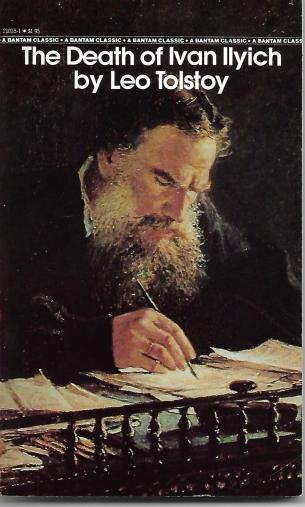
The Death of Ivan Ilyich ~ A Capsule Book Review

The Death of Ivan Ilyich ~ A Capsule Book Review by Allen Kopp

The Death of Ivan Ilyich, written by Russian master Leo Tolstoy (1828-1910) in 1886, is a character study and a somber contemplation of death. Ivan Ilyich is a magistrate with a wife and two children, a grown daughter of marriageable age and a schoolboy son. He is ambitious and rises through the ranks of his profession. He and his wife enjoy their place in society afforded by his success.

The thing about Ivan is that, as a magistrate deciding cases in court, he isn’t always as human as he might be. He is incapable of deep feeling or self-contemplation. He has no inner life. To him, duty is more important than feeling, compassion and sympathy. Would you want to be tried by this bastard in court?

In young middle-age, Ivan is seeing to all the details of furnishing and decorating a new home when he falls off a ladder and sustains a blow to his side. He thinks little of it at the time, but this is the beginning of an illness that results in his death. Whether the blow he receives to the side has anything to do with his illness is never established.

Ivan becomes ill and believes at first he will recover. As time progresses, however, he becomes sicker and sicker, until he realizes at last that he is coasting toward a premature death. Doctors, even “celebrated” ones, are ineffectual at finding what’s wrong with him or in finding ways to make him better. All they can do is make him believe he will recover, but after a while he sees this as a lie.

In the state of illness he’s in, Ivan takes a look back on his life. Is he being punished with a horrible illness that will claim his life because he’s been bad? Wait a minute, though; he has done all the things he was supposed to do, so what might he have done differently that would have spared him his undeserved fate?

Instead of accepting what is happening to him and seeking peace within himself, Ivan rails against it. Why has God forsaken him? His mental anguish becomes as great as his physical anguish. He doesn’t get the sympathy he thinks he deserves from his wife, family and friends. They only want to be rid of him so they can get on with his lives. Only his ten-year-old son and a kindly servant named Gerasim seem truly sad to see him in the state he’s in. After a terrible illness, death claims Ivan Ilyich at the age of forty-five. There is no beauty, dignity, or redemption in his death.

The Death of Ivan Ilyich is death from the point of view of the dying man. He isn’t able to find relief, comfort or sympathy in his illness as he sinks toward his inevitable fate. He is unable to look back on his life and say it’s been a life of success and fulfilment, even though it’s being cut short. It’s a simple story, universal because death touches everybody. Although set in nineteenth century Russia, it might be any place at any time.

Copyright © 2018 by Allen Kopp    

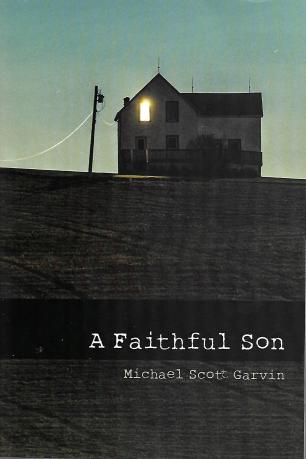
A Faithful Son ~ A Capsule Book Review

A Faithful Son ~ A Capsule Book Review by Allen Kopp

A Faithful Son is a novel by a writer named Michael Scott Garvin. It begins in the late 1950s with the character Zach Nance as an adolescent boy. (Zach is narrating the story in his own voice.) He lives in a small Colorado town with his parents and two sisters. They are a religious, traditional, conservative family.

Zach and his two sisters, Katie and Laura, have an idyllic childhood, doing all the things that kids of this period love to do. They climb mountains and hike in the woods and play and catch the bus every morning to go to school. They have what almost seems to be a perfect life until tragedy strikes. Zach’s younger sister, Katie, is killed in an automobile accident in which the father is driving. In his grief, he turns to the bottle and becomes an irresponsible alcoholic.

Eventually the father drifts out of the family, leaving Zach and his remaining sister Laura and their mother to fend for themselves. Zach grows up the way all boys do, but he has a secret that he knows his mother, sister and the people of his community will never understand: he is gay.

He grows to adulthood, keeping his secret to himself. He works and begins drinking a lot, just as his father and grandfather did (it’s in his genes). He has clandestine dalliances with some of the local boys (one of them serious) but they always drift away and Zach ends up alone. He dates girls but, of course, this is only for show and will never work out.

Finally Zach leaves home and ends up in Los Angeles. He becomes a professional landscaper/gardener, starting out small at first and then growing into a real business where he employs other workers. At a gay bar, he meets a handsome boy named Doug. They seem to hit it off and begin a “relationship.” All the time Zach feels insecure, though, in his sexuality, believing that Doug will find somebody he likes better and leave. In the meantime, Zach’s drunken father has died back in Colorado and his mother develops cancer. It’s just one thing after another.

A Faithful Son is a breezy novel, so easy to read you’ll almost feel like you’re not reading at all. It’s a so-so story, nothing new, a story that has been told many times before. For this reason, I was a little surprised to see the list of awards it has won. The writing contains lots of misplaced (or dangling) modifiers, and it makes you wonder why the publisher didn’t employ an editor to fix these. Since it’s told in the first-person voice of Zach Nance, I suppose the feeling is that misplaced modifiers are just part of colloquial language and are acceptable. Also, there are some troubling anachronisms in the story concerning cell phones, microwave ovens and phone answering machines. I don’t know the age of the writer, Michael Scott Garvin, but I’m guessing that a lot of young people don’t remember a time when there weren’t cell phones, microwave ovens and phone answering machines and assume those things have always been around, like electricity. It is my fervent belief that there were no microwave ovens or answering machines until the 1980s, and cell phones weren’t in widespread use until the 1990s. But, then again, what do I know?

Copyright © 2018 by Allen Kopp
Lady Bird ~ A Capsule Movie Review

Lady Bird ~ A Capsule Movie Review by Allen Kopp

Lady Bird (whose real name is Christine) is going through a bad time, a little thing called adolescence. She has a boyfriend, but she finds out, the hard way, that he’s gay.  She has a pudgy friend named Julie, with whom she goes to Catholic school, where most of the teachers are nuns. (Julie has a crush on the handsome algebra teacher, one of the teachers who isn’t a nun.) She and Julie eat communion wafers like potato chips. “You’re not supposed to eat the wafers,” a classmate says. “They haven’t been consecrated yet,” Lady Bird explains.

It’s 2002 and Lady Bird’s family has been affected by difficult economic times. Her past-middle-aged father has lost his job. They live, Lady Bird says, “on the wrong side of the tracks,” in a house she’s ashamed of. She pretends to live in a large, two-story, well-tended house she likes, which happens to belong to the grandmother of her boyfriend (the one who turns out to be gay). She tells a friend that when she and the boyfriend get married, the house will belong to them when the grandmother dies. “Won’t the parents get it?” the friend asks. “Oh, yeah,” Lady Bird says. “We’ll have to kill them. And the older brother.”

Lady Bird lives in Sacramento, California, “the Midwest of California,” she says. She longs to get away from her home town and her family, but especially her exasperating, critical mother, and go to a college on the East Coast, “where there’s culture.” She doesn’t have the money to go to a “good” school, though, and might end up going to the local community college. She longs to be like the rich, stylish girls in her school who look like fashion models and seem to have it all.

There’s some wry humor and clever dialogue in Lady Bird that manages to rise above the level of TV sitcom. When a teacher asks Lady Bird if that is her “given” name, she says, “Yes, I gave it to myself.” Lady Bird and some of her friends at their Catholic school put a sign on the back of the nuns’ car that says, “Just married to Jesus.” One of the nuns informs Lady Bird later that she didn’t “just” marry Jesus but has been married to him for forty years. “He’s a lucky guy,” Lady Bird says.

Saoirse Ronan, who played an Irish girl who immigrates to America in Brooklyn, plays Lady Bird. Her mother is played by Laurie Metcalf, of TV sitcom fame (Roseanne and Getting On). As in real life, mother and daughter are prickly with each other and aren’t good at understanding each other’s problems. These are characters that seem like real people. How many mothers and daughters have you known that don’t get along very well? It seems to be an epidemic.

Lady Bird is a pleasant enough way to spend ninety-four minutes at the movies on a winter afternoon, even though it covers territory that seems all too familiar. (How many coming-of-age movies have there been about contentious child-parent relationships?) Is it worthy of all the accolades it’s receiving? Probably not. You be the judge.

Copyright © 2018 by Allen Kopp

If Mr. Shinliver Dies

If Mr. Shinliver Dies ~ A Short Story by Allen Kopp

I arrived late to work and as soon as I walked into the office I heard laughter and loud voices. I knew something unusual had happened. Ramona Sugarman, the receptionist, sat at her desk filing her fingernails.

“What’s going on, Ramona?” I asked.

“Mr. Shinliver had a heart attack,” she said casually.

“Oh, my gosh! Is he all right?”

She shrugged her shoulders and trained her cross-eyed gaze on her little finger. “How should I know?”

As I proceeded to my cubicle, all the way in the back by the window, a football whizzed by my head, followed by a burst of laughter.

“Uh-oh,” Chick Chapwick said. “Tremaine is here. Do you think he’s going to tell on us?”

Irvine Beasley caught the ball, gripped it with both hands and pretended to throw it right at my face. “No, Tremaine won’t tell,” he said. “Not if he knows what’s good for him.”

“I’m not seeing this,” I said.

“That’s the spirit!” Chick Chapwick said.

I entered my cubicle and set my briefcase on the desk. Felice Belladonna poked her head up over the partition that separated my cubicle from hers. She held a lighted cigarette in the corner of her mouth like a death row convict.

“I didn’t know you smoked, Felice,” I said.

“I don’t. Until now.”

“Why now?”

“Haven’t you heard the good news?”

“No, I haven’t heard any good news this morning.”

“You know that Mr. Shinliver had to go to Fairfield on business this week and took with Miss Wagstaff with him, don’t you?”

“Who doesn’t know?”

“Well, Mr. Shinliver had a heart attack. Can you believe it?”

“Oh, my goodness!” I said. “Is he all right?”

“They say he was in Miss Wagstaff’s room when it happened. You can only imagine what they were doing.”

“I’d rather not.”

“He’s on one of those machines that does his breathing for him.”

“Sounds serious.”

“It’s the best thing that’s happened around here in a long time.”

“Depends on how you look at it,” I said.

“He’ll be out at least for a couple of weeks. That is, if he doesn’t die. If that happens, he’ll never be back! Hurray!”

“You’re terrible, Felice!

“If the old buzzard dies, you should become the boss.”

“Not me,” I said, yawning. “I don’t want to be the boss.”

“If you want to go back home and go back to bed, I’ll cover for you.”

“No thanks, Felice. Now that I’m here, I’ll stay.”

Nobody was doing any work. Everybody was excited, talking and laughing but mostly speculating about how bad Mr. Shinliver’s condition was and, if he should happen to die, who would take his place.

I heard Ramona Sugarman scream, following by a crash. I figured the football had hit one of the ornamental planters in the reception area and knocked it over.

Somebody went for donuts and then everybody converged on the break room for a donut party. I waited a few minutes and then I went in for my morning cup of tea.

“Did you hear the good news?” Ricky Spears asked me. He was eating an iced jelly donut, jelly dripping down his chin.

“Yes, I heard, Ricky.”

“If Mr. Shinliver dies, you should be the new boss.”

“I don’t want to be the boss, Ricky. Maybe it’ll be you.”

“Not me,” he laughed. “I miss too much work.”

While I heated the water for my tea, I stood and looked over the tray of donuts. I was happy to see that there was still one left that was oozing red jelly out the side like a glorious wound. As I picked the donut up and bit into it, somebody clapped me on the shoulder from behind.

“Well, well, well!” a booming voice said. “Look who bothered to show up for work today!”

“I’m always here, Melville,” I said as I turned around and tried to smile. “I never miss work.”

It was Melville Herman, of course. Mr. Big. The blowhard. The blatherskite. The man who managed to make himself offensive to everybody in the world, including a string of ex-wives.

“Did you hear the good news?”

“About Mr. Shinliver, you mean?”

“If the old boy buys the farm, guess who your new boss will be?”

“I wouldn’t even venture a guess,” I said. I took a step away from him so I wouldn’t have him breathing in my face.

“It’ll be me, you fool!” he said. “Who else?”

“What makes you think so?”

“It’s all but in the bag. Who’s the person with any competence around here? Who keeps this place afloat?”

“I don’t know. Miss Wagstaff?”

“Wagstaff’s just a puppet! And she’s a lesbian, besides.”

“Really? I didn’t know that. I heard that she and Mr. Shinliver were an item.”

He laughed his hyena-like laugh. “You are so funny!” he said. “Nobody talks like that anymore!”

“Like what?”

“I’m going to take some measurements in Mr. Shinliver’s office and see how my furniture is going to fit in there. I think I’m going to want some new curtains, too. The old ones smell like old man Shinliver.”

After Melville left, I sat down at one of the little round tables in the break room and looked out the window. I envied the birds flying across the sky because they were free and didn’t have to work in an office.

In a few seconds, Flora Upjohn was upon me like a charging rhino. Any time I ever found myself near her, I always imagined she was going to crush me. She weighed three hundred and fifty pounds and had an elaborate Louie the Fourteenth hairdo.

“Well, look who’s here!” she said, smacking her hand down on the table, causing me to jump.

“Leave me alone,” I said.

“Heard about Shinliver?”

“Everybody has heard, Flora.”

“Nobody is doing any work.”

“Including me,” I said. “And you.”

“So, what do you think is going to happen with Shinliver?”

“I don’t know, Flora. I left my crystal ball at home this morning.”

“I heard that if Mr. Shinliver dies, you’re going to get a big promotion. I’ll bet you’ve already been in his office taking measurements, haven’t you?”

“That’s Melville Herman,” I said. “He’s picking out new drapes.”

“That clown? He’ll never be boss. Nobody likes him.”

“Nobody likes Mr. Shinliver either, but that hasn’t kept him from being the boss.”

“You’d make a good boss. Everybody looks up to you.”

“No, they don’t. They hate me because I hate them.”

Hah-hah-hah!” she said. “You were always so funny!”

“I can’t be the new boss because I’m leaving this place.”

“What? Have you found a better job?”

“I didn’t say that. I said. I. Am. Leaving. This. Place.”

“Well, you don’t have to be so smart-ass about it.”

“I’m not being smart-ass. I just don’t like having people asking me questions.”

After lunch we were in full party mode. Somebody brought in a radio and put it next to the coffee maker and tuned it to a dance station. One person began dancing and then two and then just about everybody in the office. Men danced with other men and women danced with woman. I think there is nothing more disquieting than seeing mousey accountants dressed all in black and white—one of them wearing red socks—shaking all over, tilting their heads back and closing their eyes in ecstasy.

“They’ve all gone crazy,” I said.

“Their oppressor is gone,” Flora said. “They’re experiencing a heady moment of freedom.”

“It won’t last. Mr. Shinliver will be back or somebody even worse, like Captain Queeg.”

“Captain who?”

A few minutes after three o’clock, I received a call. When I picked up the phone, it was Bertha Wagstaff on the line, Mr. Shinliver’s right-hand man.

“Is this Tremaine?” she said in her foghorn voice.

“Yes, ma’am! What can I do for you?”

“Bertha Wagstaff here.”

“Yes, Miss Wagstaff!”

“I have some news about Mr. Shinliver.”

“Are you sure you don’t want to speak to Melville Herman?”

“No, you’re the one,” she said.

“The one what?”

“Everybody looks up to you. Everybody likes you.”

“No they don’t!” I said defensively.

She imparted her news and then at the end of the conversation instructed me that I was to call everybody into the big conference room and tell them what she had told me.

It took about ten minutes to round everybody up and when I had them all in the conference room, about fifty in number, they thought it was just part of the ongoing party.

I didn’t like euphemisms or stringing people along for dramatic effect, so, after I got everybody quieted down, I told them straight out: “Mr. Shinliver died at eight minutes past noon today.”

There was a stunned silence. The room became so quiet I could hear the blood coursing through my veins. The loud mouths like Melville Herman were quiet for a change. After they had had a couple of minutes to absorb the news, I told them the rest.

“The company ceases to exist as of today.”

What?

“Mr. Shinliver was the company,” I said. “With no Mr. Shinliver, there’ll be no company. It’s the way he wanted it.”

“Where does that leave us?” somebody asked.

“Unemployed,” I said.

What?

“I’m sorry to be the one to deliver this news, but somebody had to do it.”

There were no goodbyes for me. I got away as quickly as I could and, as I left Shinliver and Company for the last time, I felt light with happiness and relief. I stopped at a bakery and bought myself a strawberry pie. I gave a five-dollar bill to an old fellow who asked me for change. All at once I loved the world and everybody in it.

Copyright © 2018 by Allen Kopp

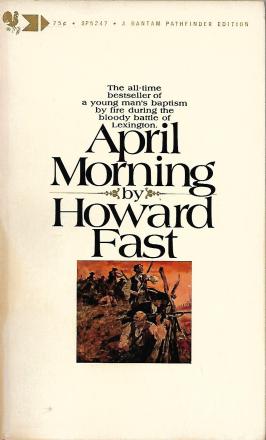
April Morning ~ A Capsule Book Review

April Morning ~ A Capsule Book Review by Allen Kopp

The American Revolutionary War began on April 19, 1775, with the Battles of Lexington and Concord. It was professional British troops, numbering in the thousands, against non-professional Colonials, numbering in the hundreds. The British were marching from Boston to procure military supplies the Colonials had stockpiled in Concord. The Colonials didn’t want to fight but were forced to it. They only wanted the English invaders to leave their land and let them live in peace.

April Morning is a historical novel by Howard Fast, told in the first-person voice of one Adam Cooper, fifteen years old. Adam lives with his family in the village of Lexington in the Massachusetts Bay Colony. On the morning of April 19, 1775, the people of Lexington receive word that the British army, possibly two thousand men, is headed toward them. They assemble a small body of “committeemen” to meet the British. The committeemen are underequipped, of course, and they know they are no match for the professional British army. They believe, naively, that all they will need to do is reason with the British to get them to desist and return to Boston.

The British immediately begin firing on the villagers on the “common” of Lexington before a word can be exchanged. (This is “the shot heard ‘round the world.”) Our young protagonist, Adam Cooper, witnesses his father being among the first to be shot. The Colonials fight back, with much bloodshed on both sides. Adam has an inadequate firearm that shoots birdshot, but still he does his part. In the course of one day, he goes from being a boy to being a man.

April Morning is not a serious examination of war, but is more a personal story of how the beginning of a war affects one person, one family, and one small village. It abounds with clichés and at no time has an authentic eighteenth century feel to it, in the way, for example, of Mackinlay Kantor’s historical novel, Valley Forge. Still, it’s an engaging enough book in its own way that has become a much-read classic, especially by younger readers.

Copyright © 2017 by Allen Kopp

I, Tonya ~ A Capsule Movie Review

I, Tonya ~ A Capsule Movie Review by Allen Kopp

Figure skater Tonya Harding is a high school dropout, a self-professed redneck girl. She’s crude and unsophisticated; she just doesn’t fit in with the American ideal of what a female champion female figure skater should be. The acorn doesn’t fall far from the tree. Her mother is a foul-mouthed, cigarillo-smoking harridan with the social graces of a rattlesnake. From the time Tonya is four years old, her mother (the figure skating equivalent of a stage mother) pushes her to be the best, spending all the money she makes as a waitress on training for Tonya.

Then Tonya meets Jeff Gillooly, a beautiful but dumb young man who, through nincompoopery, all but sabotages Tonya’s figure skating career in a few short years. Jeff has a very short temper; he punches and slaps Tonya on very little provocation, which Tonya confesses she believes she deserves. (She is then forced to cover her facial abrasions with makeup.) Jeff and Tonya get married, and it’s a tumultuous union, with much yelling, hitting, slapping and discharge of firearms.

Regardless of what’s wrong in Tonya’s life, she is good at figure skating. What she does on the ice is a kind of magic. She executes the extremely difficult “triple axel,” the first female skater to perform this move in competition, and earns a spot on the U.S. Olympic team for the 1992 Olympics in France. She doesn’t do so well in the Olympics, however; she comes in fourth. “When you come in fourth,” she says, “you get the six a.m. shift at Spud Heaven.”

After the Olympics debacle, Tonya believes she is finished with figure skating, but her star rises again and she has a shot at the next winter Olympics in Norway. Faced with stiff competition as she is, her husband and his idiotic friend, Shawn Gerhardt, try to help her by sabotaging, ineptly, one of her principal competitors. This doesn’t work out very well and results in criminal charges, a huge scandal, and the end of Tonya’s skating career.

I, Tonya stars Margot Robbie, who I remember from The Wolf of Wall Street, as Tonya Harding; Sebastian Stan, a Romanian actor who speaks American perfectly, as Jeff Gillooly; and the ubiquitous Allison Janney as Tonya’s she-wolf mother. They are all perfect. Never a dull moment. It upholds my belief that trashy, redneck characters are a lot more interesting than wine-sipping, angst-ridden, self-absorbed yuppies who have stock portfolios and Masters of Arts degrees. I know them and they bore me to death.

Copyright © 2018 by Allen Kopp

Mengele: The Complete Story ~ A Capsule Book Review

Mengele: The Complete Story ~ A Capsule Book Review by Allen Kopp

Dr. Josef Mengele (1911-1979) embodied the strange duality seen in other high-profile members of the Nazi party during the Third Reich. As physician at the Auschwitz concentration camp in Poland, he was capable of the most barbaric cruelty and scathing disregard for human life, while at the same time loving animals, trees, flowers, music and poetry. He was father, husband and beloved of his close-knit family and his loyal friends and supporters.

After World War II was over the Nazis were defeated, Dr. Mengele became the most sought-after and most reviled man of the twentieth century. While many of the infamous members of the Nazi party were brought to justice and executed, including Adolf Eichmann, Mengele somehow managed to escape justice, not for lack of trying on the part of the governments of Germany and Israel and several intrepid “Nazi hunters.”

Dr. Mengele was interested in anthropology and genetics. He believed that a super-human German race was possible through genetic engineering and scientific manipulation. At the Auschwitz concentration camp, he had unlimited human subjects on which to conduct his experiments. He was especially interested in twins, dwarves, and people with physical defects and disabilities. He would infect children with diseases and then wait for them to die so he could dissect them. He experimented with dyes to change eye color on his subjects, and the result was often blindness and death. His experiments were often bizarre, cruel, and medically useless. He was a real-life mad scientist.

If Dr. Mengele’s medical experiments at Auschwitz weren’t enough, he was also one of the Nazi officers to perform “selections” of prisoners as they exited the train cars: Go to the right and you live. Go to the left and you die. These selections were based on the physical appearance and age of the prisoner and nothing more. Dr. Mengele seemed to enjoy the job of making selections; he was always looking for new subjects for his experiments.

Dr. Mengele always maintained that he did nothing wrong at Auschwitz; he was only following orders, only doing his duty. According to him, he saved many lives and helped many victims of the diseases that were prevalent in concentration camps, such as typhus. However, there were many eyewitnesses who survived the camp who told a much different story; he was not called “the Angel of Death” for nothing. He was cruel and callous, without sympathy for his victims. If he had ever been brought to trial, the testimony of the witnesses would have convicted him.

After the war, Dr. Mengele’s life became a strange odyssey of escape, pursuit and evasion. He got away to South America; first Argentina and then Paraguay and then Brazil. He had lots of Nazi sympathizers to help hide him who refused to believe the stories about him. On the other hand, there were many people who would have given almost anything to have him brought to justice. At one time there was a reward of ten million dollars on his head. A kind of mythology grew up around his ability to escape; he became known all over the world as the one Nazi who got away. The Mengele story was fed by lies, exaggerations, misinformation and the pursuit of notoriety. Mengele “sightings” were reported in places where he could not possibly be.

This is not to say that Dr. Mengele lived a life of luxury and ease as a fugitive in South America. To remain hidden, he often lived in squalid conditions and in isolated places, separated from his family. He lived in constant fear that he would be recognized and maybe even kidnapped, as Adolf Eichmann had been. In 1979, Dr. Mengele died at age 67 of a stroke while swimming and was buried in a modest grave in Brazil. His remains were disinterred in 1985 to provide positive identification. So ended the life of an elusive monster.

Mengele: The Complete Story by Gerald L. Posner and John Ware is an exhaustive factual account of the wartime activities of Dr. Josef Mengele and his postwar life in South America as a fugitive. Dr. Mengele was a relatively young man during the war, only in his thirties, so he lived a long postwar life. The exhaustive details of the political machinations in South America, particularly in Paraguay, to keep him from being extradited, are too much information for the casual reader, like me, but, except for some tedious details and far too many difficult South American names thrown in, Mengele: The Complete Story is a fascinating account of one of the most infamous figures of World War II.

Copyright © 2018 by Allen Kopp

And That Includes Cab Fare

And That Includes Cab Fare ~ A Short Story by Allen Kopp

Mrs. Deal was eighty-five and had more cobwebs in her head than the basement and attic combined. She could no longer be trusted to stay at home by herself. She had been known to leave the front door open all night in the winter or turn the burners on in the kitchen and let dangerous amounts of gas escape into the room before she noticed the blue flame hadn’t come on the way it was supposed to. Her daughter, Patsy Ruth, age sixty-three, left her latest husband in the city and went to live with Mrs. Deal in her old-fashioned house on a corner lot in a small provincial town a good five-hour drive away.

Patsy Ruth had smothering emphysema from a lifetime of smoking Camel cigarettes, but her more immediate problem was her fragile nerves. She took little yellow pills her doctor had prescribed, sometimes twice the number she was supposed to, but still, no matter how many pills she took, Mrs. Deal tried her nerves almost beyond endurance. Mother and daughter had never been on the best of terms anyway, going all the way back to the beginning, and it was an almost impossible situation with them both living under the same roof. Mrs. Deal was stubborn on principle; it if was mealtime, she wasn’t hungry and refused to eat. At bedtime she refused to have the light off. Patsy Ruth thought at times about taking the whole bottle of yellow pills at once and getting into her big four-poster bed and going to sleep and never waking up, or going down to the railroad trestle and jumping into the shallow, muddy water a hundred feet below.

“I’m not a well woman,” she was fond of saying to anybody that would listen. “I still have my own life to live.”

To have an occasional “day off,” Patsy Ruth had to engage the services of a “woman” who was willing to spend a day, or at least part of an afternoon, sitting with an impossible old woman and keeping her from doing any harm to herself or to the house. When Mrs. Ida Stroud answered Patsy Ruth’s newspaper ad the first day it appeared, she seemed ideal; she had sat with old people before, she said, had some nursing experience, and lived only a short distance away. Patsy Ruth would have to pay for her to take a cab, though; Mrs. Stroud was fat, had painful varicose veins, and wasn’t able to walk very far.

“I guess we can manage the cab fare,” Patsy Ruth blatted into the phone, delighted that she had found the right person so easily and on the first day.

On Saturday, Patsy Ruth was going to visit the dentist, meet a friend for lunch and see a two o’clock matinee movie. She arranged with Ida Stroud to come on that day.

Patsy Ruth was gratified that Ida Stroud arrived on time on Saturday morning but was a little dismayed to see that she had brought her thirteen-year-old daughter, Stella, along with her.

“Stella don’t cause no trouble,” Ida said. “I can’t leave her at home by herself. She gets into too much mischief.”

Stella Stroud was a pale, skeletal girl with a permanent scowl on her face and dark circles around her eyes. Refusing to say hello to Patsy Ruth or to Mrs. Deal, she slumped down on the couch, folded her arms and yawned.

“We’ll all get along just fine!” Ida gushed. “We’re going to have a fine time, aren’t we? Everything will be just fine.”

“I’ll be back around six,” Patsy Ruth said.

“Don’t give us a thought!” Ida said. “We’ll all be just fine!”

“Do you mean I have to stay in this hell hole all day until six o’clock?” Stella asked after Patsy Ruth was gone.

“Find something to do,” Ida said. “Go outside and commune with nature.”

“I don’t want to go outside!” Stella said. “I didn’t want to come here in the first place!”

“Sit there and be miserable, then! I don’t care!”

“You’re just a horrible old woman, you know that?” Stella said.

Of Ida’s eight children, Stella at thirteen was the youngest. Mr. Stroud had been dead for many years, the victim of a bad heart passed down to him through father, grandfather and great-grandfather.

Ida beamed at Mrs. Deal. “You certainly are a lucky woman,” she said. “You have your daughter to look after you and you live in this fine, big house. That’s as much as any Christian woman might expect.”

“I’m a Methodist,” Mrs. Deal said.

“Where’s your husband?” Stella asked.

“He died.”

“What did he die of?”

“Shut up!” Ida said. “You’re not supposed to ask questions like that!”

“Well, I just wondered!”

 “Would you like a piece of butterscotch?” Mrs. Deal asked. “My daughter buys this butterscotch candy for me when she goes to the store.”

“No, thank you, dear,” Ida said.

“Haven’t you got any peppermint?” Stella asked. “I hate butterscotch.”

Ida gave Stella a warning look. “If you can’t be nice,” she said. “I’m going to slap you silly.”

“Well, let’s talk about something interesting,” Stella said. “I have sleep apnea. I could die in my sleep any night.”

 “Nobody wants to hear about that,” Ida said.

“Well, I don’t know why the hell not! I think it’s very interesting!”

“You think it’s interesting because it’s about you! You need to learn that the world doesn’t revolve around you! And I told you not to use words like that!”

“Words like what?”

“You know perfectly well what I’m talking about!”

“Well, pardon the hell out of me! I have to go to the bathroom! Where is it?”

“Ask Mrs. Deal,” Ida said. “It’s her house.”

“All right. What’s her first name?”

“You’re not supposed to use her first name, silly! Call her ‘Mrs. Deal’.”

“All right. Mrs. Deal, honey, I need to use your bathroom. Is that okay?”

“What?” Mrs. Deal said.

“She wants to know where the bathroom is,” Ida said.

“Oh. Go through the dining room into the back part of the house.”

Stella leapt to her feet. “It’s always so interesting to see other people’s bathrooms!”

“And don’t break nothing, either,” Ida said.

When Stella had gone out of the room, Ida gave Mrs. Deal a sad smile. “Kids!” she said. “This girl has given me more trouble than all my others put together. From the time she was born, she was trouble with a capital T, morning, noon and night. She would lie in her crib and scream all day long and all night. I told my husband I wasn’t having any more children because I was afraid they’d turn out like her. He didn’t care if we had another dozen because I did all the work of takin’ care of them. He made the living for the family, but that was all he ever did. At home he never lifted a finger.”

“I had three children,” Mrs. Deal said, “but only one of them is still alive.”

“All of mine are still alive!” Ida said. “I rue the day! Now, let me tell you, that Stella has had a rough time of it her whole life. When she was just a baby, she had yellow jaundice, whooping cough and I don’t know what all. You name it, she had it. And from the time she started to kindergarten, it’s been one problem right after another. She wet her pants just to defy the teacher and she refused to sit still and pay attention. Finally the school gave her a test and they said she wasn’t right in the head and they put her out! Can you imagine putting a child out of school? Then we had to send her to a special school in another town and, believe me, it cost a lot!”

“Maybe it’s just better not to have any children,” Mrs. Deal said. “I had three and both my boys are dead. One died two days after he was born.”

“Oh, isn’t that a shame! But it’s such a blessing to you that you still have your daughter. She lives with you and takes care of you.”

“She wants to put me in a nursing home so she can get married again. She’s been making a lot of calls, asking questions. She thinks I don’t know what she’s up to, but I’m not as stupid as she thinks I am.”

“I’d have you come and live with me,” Ida said, “but we live in such a small house. Not big like this one.”

“She’s still married to that last husband of hers, but here she is scouting around for the next one. She’s had I don’t know many husbands.”

“No!” Ida said. “And she seems like such a nice woman!”

“One of them she was married to twice.”

“Some people is like that. Can’t seem to find what they’re looking for.”

“My son was married two different times,” Mrs. Deal said. “He was an alcoholic and died at age thirty-five. Even younger than his father.”

“Isn’t that sad! Well, I guess we learn tribulation through our children if nothing else.”

“That’s what I mean,” Mrs. Deal said. “It’s probably better not to have any children at all.”

“Then we’d be alone, I guess, and that might be even worse.”

Stella came back from the bathroom smiling and wiping her hands on the seat of her pants.

“What were you doing in there so long?” Ida asked.

“Wouldn’t you like to know?”

“You weren’t smoking, were you?”

“Don’t be re-dick! I don’t have any cigarettes!”

“Mrs. Deal and I were just swapping stories about our children.”

“I bet you told her how awful I am, didn’t you?” Stella said.

“Wouldn’t you like to know?”

“I’m not ever having any kids. I don’t want the little son-of-a-bitches.”

“You shouldn’t say that,” Ida said. “You don’t know what the future holds for you. You’ll meet a wonderful man.”

Hah-hah! Where?”

“You’ll get married and live in lovely little house and you’ll realize after a while that something is missing and that something is little ones. After you’ve had one, you’ll want another and then another and then another.”

“You are so full of shit!” Stella said.

“Hey! I warned you about using that kind of language! One more word like that, and you’re going to have to wait outside on the front porch until six o’clock. Do you understand what I’m saying to you?”

“Oh, you know what you can do, don’t you?”

“I don’t want to hear another word out of you!”

“I just remembered,” Stella said. “Today is my birthday.”

“No, it ain’t, either,” Ida said. “Your birthday is in April. This is October.”

“I can make today my birthday if I want, can’t I? It’s such a boring, terrible day, I can say it’s my birthday just to help make it a little bit special, even if it’s not really my birthday.”

“No, you can’t, or if you do, just do it silently and don’t say anything!”

“I wonder if I’ll get any presents?”

“No, you won’t, so just forget about it!”

“When I get a little older, I’m going to run away from home!”

“Why wait?” Ida said. “Go now! Go anytime! You have my blessing!

“I’m not going to hang around this stupid, dead town and have a bunch of ugly babies and be just like everybody else. I’m going to Hollywood and I’m going to be a big movie star and when that happens, you’ll be sorry you were ever mean to me!”

“Send me a postcard!”

“You’d like that, wouldn’t you? You’d like to be rid of me!”

“You try the patience of a saint!”

Stella said to Mrs. Deal, “You see what a crazy old bitch my mother is, don’t you? And she never stops being crazy! She’s crazy twenty-four hours a day, seven days a week! It’s a wonder I just don’t shoot myself!”

Ida stood up, took three elephantine steps, and in one deft motion, slapped Stella across the mouth. “I don’t want to hear another peep out of you for the rest of the day!”

Stella sobbed and rubbed her cheek and was sullen for the rest of the morning.

At noontime, Ida went into the kitchen to fix lunch, leaving Stella and Mrs. Deal alone together.

“My mother says you’re a tiresome old woman,” Stella said.

“She can leave any time,” Mrs. Deal said.

“Did you ever see anybody talk as much and not say anything at all? She’s like a big gas balloon with a leak. And did you ever see anybody so fat in all your life? Lord God! I’m embarrassed to be seen walking down the street with her.”

“Stick a pin in her,” Mrs. Deal said.

“Did you know I have a boyfriend? I’ll bet you’re kind of surprised to hear that about me, aren’t you? He’s sixteen and he has his driver’s license. He hasn’t got his own car yet, but he can borrow his brother’s car any time he wants. He’s coming to pick me up tonight. My mother doesn’t want me to go out with him, so I’ll tell her I’m going to a girlfriend’s house. She’ll never know the difference. And me and my boyfriend? We’ll drive out someplace to a secluded, romantic spot, and when we’re sure there’s nobody around we’ll get into the back seat and make love. Doesn’t that sound romantic? I’m a very romantic person, but I guess you can tell that just by looking at me.”

When lunch was ready, Ida took one of Mrs. Deal’s arms and Stella took the other arm and helped her into the kitchen.

“I’m not helpless, you know!” Mrs. Deal said.

Lunch was canned tomato soup and dainty little baloney sandwiches with the crust cut off. Ida was of the opinion that bread crust made old people choke.

“I don’t like tomato soup,” Stella said.

They ate in silence. Stella discovered she could eat the tomato soup as long as she soaked bread in it first. When Mrs. Deal was finished eating (hardly anything at all), she said she was sleepy and wanted to take her nap. Ida helped her into her bedroom, covered her up with an afghan and went back into the kitchen.

Stella was still sitting at the kitchen table, looking at something she held in the palm of her hand.

“What is that you’ve got there?” Ida asked her.

“Nothing,” Stella said.

Ida grabbed Stella by the wrist and made her drop what she was holding. It was a pair of little gold earrings.

“Where did you get those?” Ida asked.

“I found them in the bathroom.”

Stole them in the bathroom is more like it.”

“It doesn’t concern you.”

“It concerns me if that daughter knows that you’ve been stealing from them and fires me. It’s not a lot of money, but it’s all I have coming in right now.

“She’ll never know I took them.”

“Put them back right now or I’m going to shake your head so hard it’ll fall off your shoulders.”

“Not on your life! You get paid for sitting around this dump all day, while I get nothing! Isn’t my time worth something? I’ll be lucky to get five dollars for these. I’m not even sure if they’re real gold.”

“It breaks my heart to know I have an unrepentant thief for a daughter.”

“There’s worse things.”

“If Mrs. Deal and her daughter find out you do such things, they’ll think you’re just terrible!”

“They won’t find out.”

“When that daughter comes back, I want you to tell her you found those earrings on the floor and then give them back to her. Then she’ll know you’re acting in good faith.”

“Screw good faith! I’m not gonna tell her anything!”

“If you won’t tell her, I will! Do you want her to know you’re a thief?”

When Patsy Ruth returned home, she was in a happy frame of mind, with smiles all around. “I’ve had the most relaxing day,” she said. “Sometimes all a person needs is to get away from home for a few hours.”

“I know just what you mean,” Ida said. “We had a lovely visit with your dear mother and the time just flew by.”

Patsy Ruth paid Ida, plus cab fare, plus an extra five dollars since everything went so well.

“Now I can pay the light bill,” Ida said.

Ida and Stella put on their coats and made ready to leave.

“Stella has something she wants to tell you before we go,” Ida said to Patsy Ruth.

“What is it, dear?”

“Go ahead and tell her while I call the cab,” Ida said.

Stella hesitated until Ida was in the kitchen, where the phone was. “I just wanted to say…”

“Yes?” Patsy Ruth said.

“I just wanted to tell you there’s a bad smell in your bathroom. I think it might be coming from underneath the floor.”

“Oh, really? I haven’t noticed any smell.”

“Some people can smell things that other people can’t.”

In just a minute, Ida came back into the room. “The cab will be here in two shakes,” she said.

“Finally, I can go home!” Stella said.

Patsy Ruth opened the front door and gave Ida a friendly pat on the shoulder as she passed through. Stella refused to look at her or return her smile.

Patsy Ruth sat down on the couch facing Mrs. Deal and lit a cigarette. Her smile had turned into a scowl, the scowl that Stella wore as she went out the door. The happiness she felt when she came home had left her. The good day was at an end and now it was time to return to the ugly reality of living in the same house with her mother.

Copyright © 2018 by Allen Kopp

Insidious: The Last Key ~ A Capsule Movie Review

Insidious: The Last Key ~ A Capsule Movie Review by Allen Kopp

Successful horror movies spawn sequels. First there was Insidious and then Insidious 2, then Insidious 3, and now there’s Insidious: The Last Key. Where will it all end?

The character Elise Rainier (played by Lin Shaye) is a woman in her seventies. She is at the center of all the Insidious movies, even if she is not the main character, because she is a psychic and has spent her life battling malevolent demons who are always out to do harm to the living. In Insidious: The Last Key, Elise Rainier revisits her childhood in a house in New Mexico. The year is 1953 and ten-year-old Elise sees ghosts all around her; the house that she and her family live in is in fact haunted. Her mother understands her, but her brutal, TV-watching father thinks that all Elise needs is a good beating every now and then. He forces her to lean against a wall and beats her on the back with a cane. It turns out there’s a malevolent demon haunting the Rainier home that forces Elise’s father to beat her and do other bad things that we find out about later in the movie.

The demon kills Elise’s mother and then Elise and her younger brother are left with the cruel father. When Elise is sixteen, she gets enough of her father’s brutality and leaves home, never to return. Then we fast-forward to 2010 when Elise is quite a bit older. She gets a call from a man who says his house is being taken over by evil spirits and needs her help to get rid of them. When the man gives Elise his address, she recognizes it as the haunted house in New Mexico where she lived as a child. She travels to the house with her two comic-relief sidekicks, Specs and Tucker, ghost hunters who have been in all the Insidious movies.

The current owner of the house is a working-class man named Ted Garza. He lives in the house alone, but, as we learn as the movie progresses, he does some of the same bad stuff that Elise’s father did decades earlier in the same house, courtesy of the malevolent demon who has taken up residence. As in all the Insidious movies, Elise must go head-to-head with an unspeakably evil supernatural monster. Its good versus evil.

The first Insidious movie is one of the best horror movies ever made, a truly creepy journey to the other side, which in this instance is called “the Further.” Each sequel in the series, though, is less effective than the one before it. Insidious: The Last Key shows that maybe the series is wearing thin and it’s time to retire it. Why is the demon with its long fingers never really explained? Why does it haunt the house in New Mexico? What is the significance of the keys? What about the little boy whose ghost plays with Elise’s toys? How did he die in childhood? Why is the prison where criminals are executed mentioned and shown at the beginning of the movie and then never again? Does the prison have anything to do with the demon? Insidious: The Last Key would have been a better movie if all these dangling plot points had been explained.

Copyright © 2018 by Allen Kopp

The Greatest Showman ~ A Capsule Movie Review

The Greatest Showman ~ A Capsule Movie Review by Allen Kopp

He was a dreamer who refused to live the dreary, conventional life that most of us live. He was Phineas Taylor (P.T.) Barnum, a show business impresario who lived from 1810 to 1891. He grew up poor and, as a man, had difficulty finding his place in the world. After several failed attempts at earning a living, he opened a museum of oddities (wax figures and a guillotine) in New York, but, when nobody wanted to see it, he added live “curiosities,” which, in the parlance of the age, was known as a “freak show.” He hired a Tom Thumb midget, a bearded lady who could sing, a fat man (he’s 500 pounds but we’ll add some padding and say it’s 750), a lady albino, Siamese twins, a dog boy, a tattooed man, a giant (he’s really tall but we’ll add even more to his height), and other oddities that people, loving the macabre and the “different,” would pay money to see. The freak show was the beginning of P.T. Barnum’s success.

Of course, it was no time before Barnum began receiving unfavorable press coverage for his “exploitation” of the “unfortunate” individuals in his show. People threw rocks in the street at the “freaks.” The show was considered lowbrow and tasteless, but that didn’t keep the crowds of people from flocking to see it. Soon, P.T. Barnum achieved the kind of notoriety he had always wanted. He bought a splendid mansion on the same street where his wife’s parents lived. Taking his show to London to meet Queen Victoria was the pinnacle of his success. In London, he met the famous singer, Jenny Lind, known as the “Swedish Nightingale.” He brought the beautiful Miss Lind across the Atlantic to tour the United States and began what many perceived as a love affair with her, adding marital infidelity to his growing list of transgressions.

He had other problems, of course, including a fire in his theatre, financial reverses that resulted in the loss of his home, and, always, being snubbed and dismissed by “society.” In the way of movie musicals, though, he is able to overcome adversity with his winning smile and his genuine affection for people. “There is no more noble pursuit,” he said, “than making people happy.”

The Greatest Showman is a singing and dancing extravaganza that is more a fantasy than the realistic story of a man’s life. The music and dancing are definitely of the modern variety and do not reflect the styles or tastes of nineteenth century America. It’s not the traditional movie musical like My Fair Lady, but is more like La La Land or Moulin Rouge. For two hours, forget you are a raging sophisticate and enjoy the sights and sounds of the pretty people on the big screen singing and dancing themselves into a frothing frenzy.

Copyright © 2018 by Allen Kopp