Where Trouble Sleeps ~ A Capsule Book Review

Where Trouble Sleeps ~ A Capsule Book Review by Allen Kopp

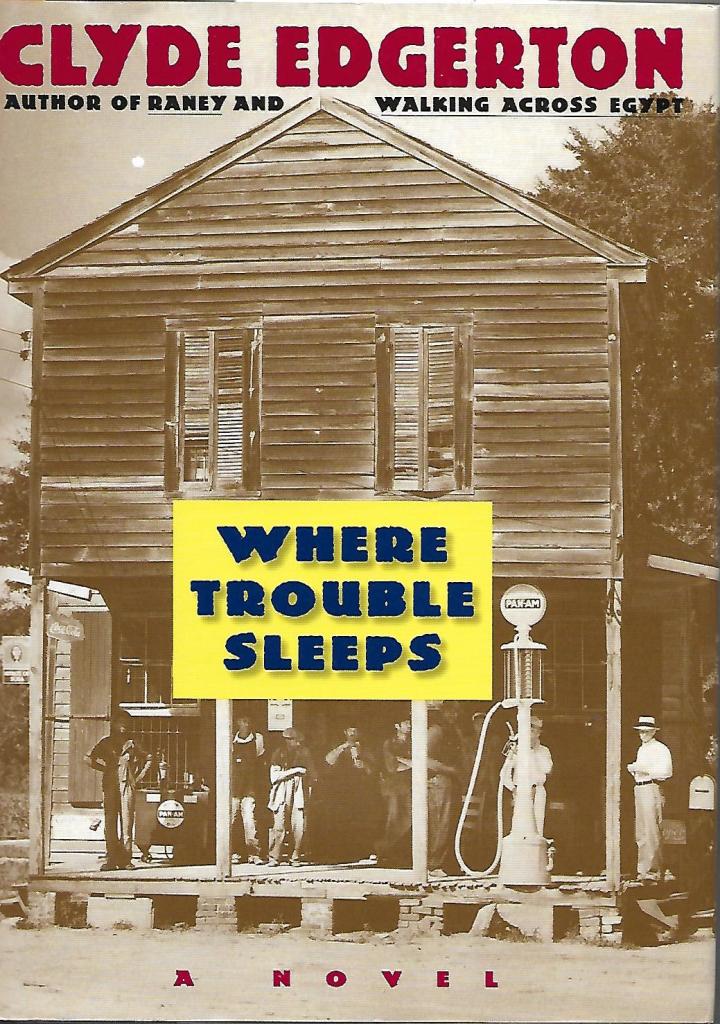
Clyde Edgerton’s Where Trouble Sleeps is an unserious novel about small-town Southern life, set in Listre, North Carolina, in the innocent year of 1950. The town of Listre is so small it has one blinker light at its main intersection. The houses, church and small businesses of the town are arranged in the four corners around the blinker light.

There’s an interesting story about how the blinker light came into being. I’m glad you asked that question. You see, there was this runaway mule that didn’t want to do any more plowing and, as it was running to try to get away, it collided head-on with a truck. Sadly, the mule was killed but the good part of the mule-truck head-on collision was that the blinker light came into being.

For such a small town, there are plenty of colorful characters to go around. There are the three Blaine sisters—Bea, Mae and Dorothea—who own a tiny store (they live in the basement underneath the store). They are three dedicated spinsters, but when Dorothea was 58 years old (she’s 70 when the action of the story takes place), she decided to marry a man named Claude T. Clark. The two remaining sisters think the marriage is a mistake and they don’t think much of Claude T. Clark because he wears a big diamond ring and buys a new Cadillac every year. Dorothea is secretary at the Baptist church and, since she has a sprained ankle, she decides to live in her office at the church, an arrangement that causes a certain amount of consternation among church members.

Train’s garage/filling station is a place for men of Listre to gather, swap stories, and stand around drinking Blatz beer. Train is paralyzed and confined to a wheelchair, having been injured in World War II. Train owns a 16-year-old bulldog named Trouble who lives at the station and sleeps a lot. He infallibly predicts the weather by his choice of sleeping spots: if he sleeps inside, it will rain; if outside it won’t rain.

Alease Toomey is a respectable, Christian woman with a six-year-old son named Stephen and a no-account, alcoholic brother named Raleigh who causes her plenty of trouble. She doesn’t have a very happy marriage because her husband, Big Steve, works all the time and doesn’t pay enough attention to her. Alease is not above being attracted to the handsome stranger in town and flirting a little bit and maybe going even farther than flirting.

Cheryl Daniels is a pretty, nineteen-year-old waitress who lives with her parents and her younger brother named Terry. Whenever men see Cheryl, they want to stick around Listre. The Baptist minister, Preacher Crenshaw (fat wife and five children), has developed a very strong attraction for Cheryl and convinces himself he is in love with her. He must struggle with temptation the same way Christ did in the desert. When he writes a love letter to Cheryl (which he doesn’t mail), it’s seen by the church secretary, Dorothea Clark, setting Preacher Crenshaw up for some possible big trouble.

Into this morass of innocence and small-town respectability comes Jack Umstead (calling himself Delbert Jones), driving a stolen Buick Eight. Jack Umstead/Delbert Jones has trouble in mind and he’s definitely looking to score in Listre, one way or another. Might he accomplish this with blackmail or with out-and-out, old-fashioned robbery? He ingratiates himself to the people of Listre, even going so far as to join the Baptist church, but, of course, everything he tells them about himself is falsehood. He begins romancing Cheryl Daniels and establishes an ongoing flirtation with Alease Toomey. When he decides to rob the Blaine sisters’ store during a thunderstorm, he has probably taken on more than he can handle, or, as my mother would say, he bit off more than he could chew.

Southern writer Clyde Edgerton can count me among his fandom. He’s written about ten books, I’ve read all of them, and I wish he would write more. His last book, The Night Train, came out in 2011, so possibly he is finished writing novels. At age seventy-four, maybe he has decided to take a rest.

Copyright © 2018 by Allen Kopp

Redeye ~ A Capsule Book Review

Redeye ~ A Capsule Book Review by Allen Kopp

The “Redeye” in Redeye is a dog. He belongs to a bounty hunter named Cobb Pittman. Cobb Pittman carries Redeye in a bag hanging from his saddle. Redeye has just one eye. The eye that he doesn’t have is red, making people think he’s some kind of a devil dog. He’s vicious when he needs to be, latching on to the nose with his teeth of any unfortunate animal that riles him. He can also latch on to the nose of a man if he wants to.

Redeye is set in Colorado in the 1890s, making it a “western.” There’s not much plot to speak of, mostly just a collection of quirky characters doing quirky things. In the small Colorado town of Mumford Rock, Billy Blankenship and P.J. Copeland are businessman and entrepreneurs. They have learned embalming in Denver, apparently in a very short time, and hope to open a mortuary parlor in the town of Mumford Rock. To show the dangers of a body that has not been embalmed, they arrange to have the body of a dead Chinaman “explode” at the train station. This will scare people, they believe, into viewing embalming as a necessity.

Near Mumford Rock are cliff dwellings that were occupied by Indians hundreds of years ago. The cliff dwellings are on a mesa, nearly inaccessible, so there are still Indian “artifacts” left behind. P.J. Copeland sees the commercial possibilities inherent in the artifacts. If he can mount an expedition that can bring back a lot of the artifacts, tourists will pay money to see them. Hold on a minute, though! The U.S. government already has plans for those artifacts. Wouldn’t you just know it?

P.J. Copeland and company have already brought back two mummies, one of a woman and one of a baby. His superannuated mother, Grandma Copeland, believes the baby mummy is one of her long-lost children and won’t part with it. Some of the more dimwitted of the bunch try to bring the woman mummy back to life by wiring an electrical charge to her heart (or the place where her heart would have been). It sets her on fire.

Star Copeland, niece of P.J. Copeland, is new to the West, having just come to Colorado from South Carolina after the death of her dear mama. She learns the ways of the West quickly enough and falls in love with a young, tubercular Englishman named Andrew Collier, who is in Colorado studying Indian culture. While cavorting with Andrew Collier, Star also fields an offer of marriage from an oft-married Mormon, Bishop Thorpe. (In the 1890s, the Mormons had to follow U.S. law on marriage, meaning one wife for each man.)

There’s a subplot in Redeye involving Mormons and the massacre of a wagon train of settlers from Arkansas that occurred in 1857, some thirty-five years earlier. A group of Mormons using Indian wiles attacked a wagon train of pioneers near Salt Lake City, killing all of them. Orders from Brigham Young, the Mormon leader, were to leave none of the settlers alive to tell what happened. One of the Mormons instrumental in the attack was a man named Calvin Boyle, who, all those years later, is living under an assumed named, Bishop Thorpe. (He’s the same Bishop Thorpe who proposes to Star Copeland.) It seems that the bounty hunter Cobb Pittman has been trailing Bishop Thorpe, unknown to anybody else, for years to make him pay for his part in the massacre.

In Redeye, Clyde Edgerton, one of my favorites writers, uses the literary technique used by William Faulkner to great effect in his novel As I Lay Dying, that of allowing each character to speak in his or her own voice. That makes for a fast-paced, entertaining, easy-to-read book. You can read this book without expending too much brain power and have fun while you’re doing it. What’s more fun than mummies?

Copyright © 2018 by Allen Kopp

Something Wicked This Way Comes ~ A Capsule Book Review

Something Wicked This Way Comes ~ A Capsule Book Review by Allen Kopp

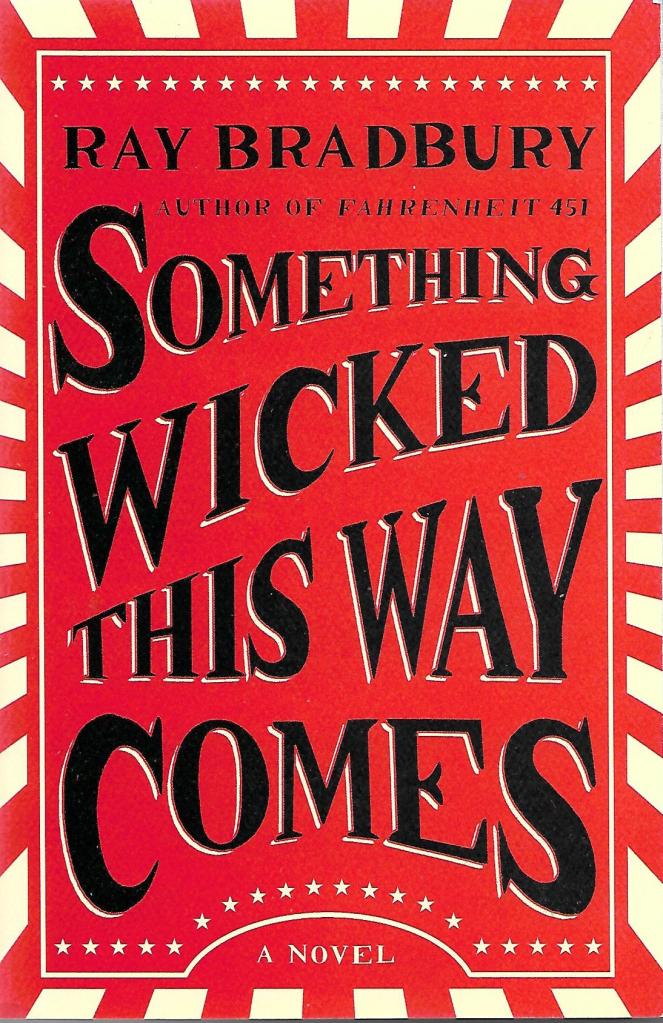
A carnival comes to a small Illinois town in October. Carnivals don’t usually come after Labor Day, but this carnival is different. It’s Cooger & Dark’s Pandemonium Shadow Show. It’s been in business for hundreds of years, traveling around from place to place, feeding on people’s sorrow, despair and tears. It makes empty promises and gets unhappy, sorrowful people to give up their souls. And what do these people get in exchange for their souls? They get NOTHING! You’d be surprised how easy it is to get some people to give up everything for nothing.

Mr. Dark is also known as the Illustrated Man. He’s the driving force behind the carnival. Every inch of his body is covered with tattoos of sinister creatures that move (or seem to move). Mr. Cooger, the other owner of the carnival, doesn’t have much to say. He has ridden on the carousel that makes people younger as it goes backward and older as it goes forward. When we see him, he might be a tiny child or he might be over two hundred years old. But, wait a minute! Isn’t Mr. Cooger also Mr. Electrico, the man who has been cooked in the electric chair as part of the show? One never seems to know about Mr. Cooger.

There’s a Mirror Maze in the carnival that, when people enter, sucks the souls right out of them. Once you enter the mirror maze, you may never be the same again, or you might not come out at all. There are freaks whose distorted bodies reflect their sins; a calliope that plays music backwards; big tents, sideshows, cotton candy and everything else you’d expect from a carnival.

Jim Nightshade and Will Halloway are inseparable friends living next door to each other. They are not quite fourteen, one of them having been born one minute before midnight on Halloween and the other one minute after. They are very much alike except that Jim’s personality is “dark” and Will’s is “light.” They are drawn to the unusual carnival and right away they know, or think they know, its sinister intentions.

Will’s father, Charles Halloway, is an old man, fifty-four, janitor at the library. He likes working nights at the library when nobody is there. He is an unusual kind of father, philosophical and understanding. He reads some books on the subject of evil when he is alone at night in the library and uncovers information about carnivals such as Cooger & Dark’s Pandemonium Shadow Show. He realizes that Jim and Will, and other people in the town, are in danger. Mr. Dark wants their souls. The carnival loves all things “dark,” but if there’s anything it hates it’s laughter and happiness: a simple thing that might be enough to make the carnival move on. You can’t have any souls in this town. Of course, laughter and happiness won’t put the carnival out of business; all it has to be is move someplace else where laughter and happiness don’t exist.

Something Wicked This Way Comes, by Ray Bradbury, was first published in 1962. Its language is nearly poetic, a little overblown at times, with a sometimes tiresome stream of metaphors, as shown in this passage where Jim and Will first encounter Mr. Dark: This second man was tall as a lamp post. His pale face, lunar pockmarks denting it, cast light on those who stood below. His vest was the color of fresh blood. His eyebrows, his hair, his suit were licorice black, and the sun-yellow gem which stared from the tie pin thrust in his cravat was the same unblinking shade and bright crystal as his eyes.

Something Wicked This Way Comes is a story of good versus evil, dark versus light, happiness versus sadness, one of the seminal works of dark fantasy that has influenced a whole generation of writers. So, if you are the kind of person who can always find something to be unhappy about (I’ve known a few of these), you are making yourself more susceptible to evil, and the boogeyman (or Mr. Dark) might just come and snatch away your soul.

Copyright © 2018 by Allen Kopp

The Hessian ~ A Capsule Book Review

The Hessian ~ A Capsule Book Review by Allen Kopp

The Hessian by Howard Fast is set in 1781, in Colonial America during the Revolutionary War. A group of Hessians (German mercenaries fighting for the British) has landed in Connecticut. There are only sixteen of them, plus a drummer boy and a commander, but they are up to no good and the Colonials are rightly afraid of them. Hessians have been terrorizing the Colonials all during the war. They are highly skilled warriors who soldier for pay; the mostly untrained American soldiers are no match for them.

The Hessians come upon a halfwit named Saul Clamberham. Because he has a slate in his possession with some marks on it, they deduce he is a spy, so they hang him from a tree. A twelve-year-old boy named Jacob Heather witnesses the hanging from a distance. He, of course, runs and tells everybody what he has seen. A citizen militia, armed with any kind of guns they can lay their hands on, lays in wait behind a fence and ambushes the Hessians. All the Hessians are killed, except for the drummer boy, a teen named Hans Pohl who drops his drum and runs off into the hills. He has a bullet wound in his shoulder and doesn’t get far. He ends up at the home of a Quaker family named Heather. At their peril, the Heather family hides Hans Pohl in an upstairs room of their house and cares for his wound. He might die because the wound has become infected. Sally Heather, the sixteen-year-old daughter of the Heathers, sits by his bed and falls in love with him, not caring that he is one of the enemy.

A local doctor named Evan Feversham treats Hans Pohl at the Heather house, secretly, of course. Dr. Feversham is something of an outcast in the neighborhood because he is an Englishman who has come over to the American cause. The Heather family are also outcasts because they are Quakers, so they have something in common with Dr. Feversham. They all know they will be in serious trouble for hiding and taking care of Hans Pohl, the Hessian.

Authorities soon discover that the Heather family is hiding Hans Pohl. The Heathers are forced to give him up, with the promise he will be tried before he is hanged. The trial, when it is held, is a farce. Hans Pohl is tried for the murder of Saul Clamberham because he was present when it happened. It doesn’t matter how young Hans Pohl is or how innocent he appears. Because he is a Hessian, one of the enemy during wartime, he can’t be anything other than guilty.

The Hessian is told in the first-person voice of Dr. Feversham, the man who doesn’t quite belong. He is a battle-hardened veteran who believes in the American cause but also believes that anybody deserves to be treated for his wounds. He is cynical and realistic and knows that in wartime people don’t behave rationally. It’s a story that won’t have, can’t have, a happy ending. You never really learn what life is about. When you die, you don’t understand it any better than you did when you were born.

Copyright © 2018 by Allen Kopp

The Flatiron ~ A Capsule Book Review

The Flatiron ~ A Capsule Book Review by Allen Kopp

New York’s iconic Flatiron Building stands at the intersection of Broadway, Fifth Avenue and Twenty-third Street. It’s a triangular-shaped building twenty-two stories tall, completed in 1902. Art critics and arbiters of good taste hated it from the moment it was completed, while the public loved it. The photographer Alfred Stieglitz said the Flatiron is to New York what the Parthenon is to Athens.

The Flatiron was one of the first skyscrapers in New York. Thanks to the use of the steel framework, skyscrapers could be built taller and taller because the lower walls were no longer supporting the weight of the structure. George Allon Fuller (1851-1900) was credited with the invention of the skyscraper. Tall buildings became the trademark of New York. Real estate prices were exorbitant and, the higher the building, the more money investors could get on their investments. It was, and is, all about money. Somebody figured out that a skyscraper doesn’t become profitable until the thirteenth floor.

George Allon Fuller had a daughter named Allon. She married a man named Harry Black and he eventually took over the Fuller Company started by his father-in-law and became a powerful force in the building trades in New York. (The Fuller Company became known as the “Skyscraper Trust.”)

Harry Black wasn’t an architect or an engineer but a businessman, a builder and a wheeler-dealer. He was responsible for many of the landmark buildings that still stand today, including the New York Public Library and the lavish Plaza Hotel. He figures prominently in the story of the Flatiron. He and his wife Allon were divorced after ten years of marriage. She remarried and died at age 37 of pneumonia. He also remarried and committed suicide in 1930 at age 68.

The Flatiron, by Alice Sparberg Alexiou, is a fascinating nonfiction account of the Flatiron Building and the times in which it was built. It was a time of great excitement and growth in New York City, punctuated, of course, by periodic economic “downturns.” Many things were going on during this time. The steal industry flourished with the increased demand for steal used in skyscrapers. Moving pictures were in their infancy; the public was fascinated by this newest—and potentially profitable—form of entertainment. President William McKinley was assassinated by an anarchist; his vice-president, Theodore Roosevelt, then became president. The labor movement was becoming more and more powerful, causing headaches for employers and builders. In the basement of the Flatiron Building was a restaurant that seated 1500 people. It eventually became known for its jazz, another new form of American entertainment. Of course, the good times couldn’t last. They never do. The United States entered the “Great War” in 1917. Prohibition soon after closed down a lot of popular nightspots that served liquor. In 1929, the Great Depression wiped out the fortunes of a lot of the fabulously wealthy. Millionaires became paupers overnight. Nothing ever stays the same. Everything is always in a state of flux. Here today, gone tomorrow. Enjoy it while it lasts.

Copyright © 2018 by Allen Kopp

A Head of Its Time


A Head of Its Time ~ A Short Story by Allen Kopp

(Published in Death’s Head Grin.)

Frankie Zell was not accustomed to the fast life. She grew up on a farm, where she lived plainly and simply with her mother, father and two brothers. Painfully shy and stick-thin, she was never pretty or attractive in the way other girls thought themselves and in fact she never gave much thought at all to the way she looked.

In her late teens, though, Frankie began to change. She lost her adolescent awkwardness; she became rounded in the places where she had always been angular. She developed flawless, pale skin and a head of lustrous, chestnut-colored hair. She turned into the beauty she was always meant to be, like the lowly caterpillar turning into the ravishing butterfly.

She began to attract the attention of young boys and older boys into manhood, some of them as old as forty or fifty years. When she would go into town on a shopping trip or to pay the light bill or see the dentist, people would stop what they were doing and look at her because they weren’t used to see so pretty a girl on the streets of such a dreary town. Some more astute observers said she ought to go to Hollywood and try out for the movies. She was as pretty as Rita Hayworth or Ava Gardner or any of those others.

Through a friend she became acquainted with a boy named Angus Persons who lived with his parents in the best neighborhood in town, where the finest homes were. His father was president of the bank and raised horses on a ranch he owned. Angus was the same age as Frankie and planned to be an attorney and one day go into politics. With his good looks and family connections, he would go far. He might one day be governor of the state or a senator in Washington. Frankie would be just the right kind of wife for him. They planned an elaborate June wedding to which everybody in town was invited.

Angus and Frankie indeed made a handsome couple. When they drove around town in Angus’s beautiful convertible sports car, they were like something out of a dream. People who saw them were admiring, envious, or maybe even a little bit jealous.

Frankie had never driven a car before but Angus taught her to drive. When he was busy working or at school and didn’t have time to spend with her, he let her drive his car as if it were her own. She enjoyed driving on the hilly, curvy country roads between the farm she lived on and the town where Angus lived. She liked nothing better than letting the top down on the car and driving as fast as she could and letting the wind blow her hair. She discovered that fast driving exhilarated her and made her feel free in a way that nothing else did.

On a brilliant May morning one month before Frankie and Angus were to be married, Frankie was driving in the hills and valleys she had known all her life. Bathed in the fresh morning sunlight as it was, the landscape was as beautiful as anything she had ever seen. Past fences and farms, horses and cows, and the occasional scenic barn or grain silo, she drove with abandon around curves and up hill and down dale. Her car—or rather Angus’s—was the only car on the road.

At one long downward hill with a sharp curve that wrapped around a scenic promontory of rock, signs warned prudent drivers to drive slowly and carefully. The treacherous curve could be difficult to negotiate even for the most experienced of drivers.

When Frankie Heywood came to the hill, she ignored the signs. She had driven the hill many times before and didn’t fear it. She sped up to experience once again the thrilling downward whoosh and the tension on the wheel as she struggled to keep the little car on the road.

In the middle of the curve, with her downward momentum and her accelerated speed, she lost control of the car as if an invisible hand had reached out and pulled the steering wheel sharply to the right. In the blink of an eye, the car left the road, became airborne, and sailed out over the tops of the trees. In her final seconds, Frankie had the time-stands-still sensation of being suspended above the earth—breathless and in defiance of the laws of gravity.

When she failed to appear for her luncheon date with Angus in town, he became alarmed and started calling all the places she might be, but nobody had seen her. He called her home and Frankie’s mother told him not to worry, that Frankie was probably enjoying herself too much—wherever she was—to be aware of the time. Deep down, though, Frankie’s mother believed that something bad had happened to Frankie.

The next day, when nobody still had not seen or heard from Frankie, her mother called the police and filed a missing person’s report. The police questioned Frankie’s mother and father and brothers extensively about Frankie’s habits and associations, but none of them were able to tell them anything that helped in finding her.

The police began an extensive search for Frankie between her home and the town. They theorized that she was living a secret life and had run away from home or that she had been abducted by a person or persons unknown. If they were able to find the car she had been driving, that at least might give them some clues.

Two days later a young police officer found a hubcap in the underbrush near the dangerous curve. Angus recognized the hubcap as belonging to his car. From this clue they were able to piece together what had happened to Frankie on the day she disappeared.

When they found the sports car a quarter of a mile or so from the road, concealed in the trees, Frankie’s body was in it. Her head had been sheared off at the shoulders, neatly and cleanly, as with a sharp blade.

Logic dictated that Frankie’s head would be not far from her body, but when police searched the surrounding area (and much farther away), they were never able to find any sign of the head. After a few days they gave up the search, telling Frankie’s mother and father that the head must have been carried off by wolves or some other wild animals. It was still possible, though, that the head would be found and, if so, whoever found it would be sure to report it to the police. Finding a head by itself was not that common an occurrence.

As distraught as Frankie’s mother was at having lost her only daughter, she was even more distraught at the idea of Frankie having to go to her grave without her head.

Frankie’s mother took an old china vase she had had for a long time that was roughly equivalent to the size and shape of a human head. On the front of the vase was painted a bouquet of flowers, but on the back was nothing, so on the back of this vase she painted a semblance of Frankie’s features using the watercolor paints that Frankie sometimes worked with. (Handles on the sides of the vase were a good approximation of human ears.)

When she was finished painting a fairly credible approximation of Frankie’s face on the vase, she put Frankie’s wig on it and then took it to the funeral parlor and asked the undertaker if he would put the vase where Frankie’s head should be. The undertaker was happy to comply, knowing that grief sometimes causes people to make unusual requests.

At the funeral-home visitation, people were surprised to see a painted vase in place of a real head, but most agreed the vase was less jarring than no head at all. The undertaker artfully arranged the collar of Frankie’s dress around the neck of the vase so that the vase did indeed look like a part of her body. He draped a veil across the open lid of the coffin to soften the effect, as he frequently did with the bodies of accident victims.

The entire town turned out for Frankie’s funeral, as they would have turned out for her wedding. Angus Persons, looking solemn and more handsome than ever, was impeccably dressed in a dark-blue suit and dark glasses that hid his eyes. Several young women, friends of Frankie’s who considered themselves fully capable of stepping into Frankie’s shoes, kept their eyes on Angus in the hope that he would look their way. Which one among them wouldn’t jump at the chance to marry the future governor?

Frankie’s head was never found. According to local legend, her ghost was said to walk along the highway at night near the dangerous curve, looking for her head. She wanted to find her head, the legend went, so she could stick it back on her body and go through with her wedding to Angus Persons. Every year at Halloween, different variations on the headless bride theme appeared at parties and on the streets of the town.

As for Frankie’s head, the truth was quite simple, as the truth often is. Not long after her head was separated from her body, a buzzard spotted her head lying in the brush about fifty feet from the wrecked car. It swooped down and picked up the head (by the hair) in its talons and flew away. Carrying its gruesome cargo, the buzzard was flying back to its lair (or wherever buzzards go when nobody sees them) when the weight of the head became too much and the buzzard dropped the head quite without meaning to.

The head landed in a tree, on a natural shelf formed by the convergence of several large branches thirty feet off the ground. The head was perfectly upright and lodged in such a way in the top of the tree that no amount of wind and weather would ever shake it loose. As long as the tree remained upright, the head would stay where it was and nobody would ever see it.

Crows pecked at the eyes until there was nothing left. Birds used the hair for their nests. Insects and other birds ate away at the flesh, tissue, and brain until, over time, the head was only a skull.

Several generations of chipmunks used the empty skull as their home. When the chipmunks moved on, as they inevitably do, the skull became a sanctuary for small birds, with one eye socket serving as a way into the skull and the other as a way out. As you see, nature always finds its own way to make use of things.

Copyright 2018 by Allen Kopp

The Way West ~ A Capsule Book Review

The Way West ~ A Capsule Book Review by Allen Kopp

For decades now, we’ve been able to get on a jet plane and fly from the middle of the country, Missouri, all the way to Oregon in the Pacific Northwest in a few hours. In the 1850s it wasn’t so easy. Back then, people traveled the distance in the most difficult way imaginable: in wagon trains of ten, fifteen or twenty wagons, usually one family to a wagon. The trains moved about ten to twelve miles a day, so the trip lasted for months. And the way was fraught with dangers and hardships, including canyons, wild rivers, mountains, vast distances without rest or water; extremes of heat, wind and cold; illness, disease and death; hostile, sometimes murderous, Indians; wild animals including buffalo and rattlesnakes (not to mention mosquitoes and other insects); the inevitable clash of personalities and all the jealousies and ugliness engendered by a group of human beings thrown together. The train comprises a microcosm, a world in miniature, the bad along with the good.

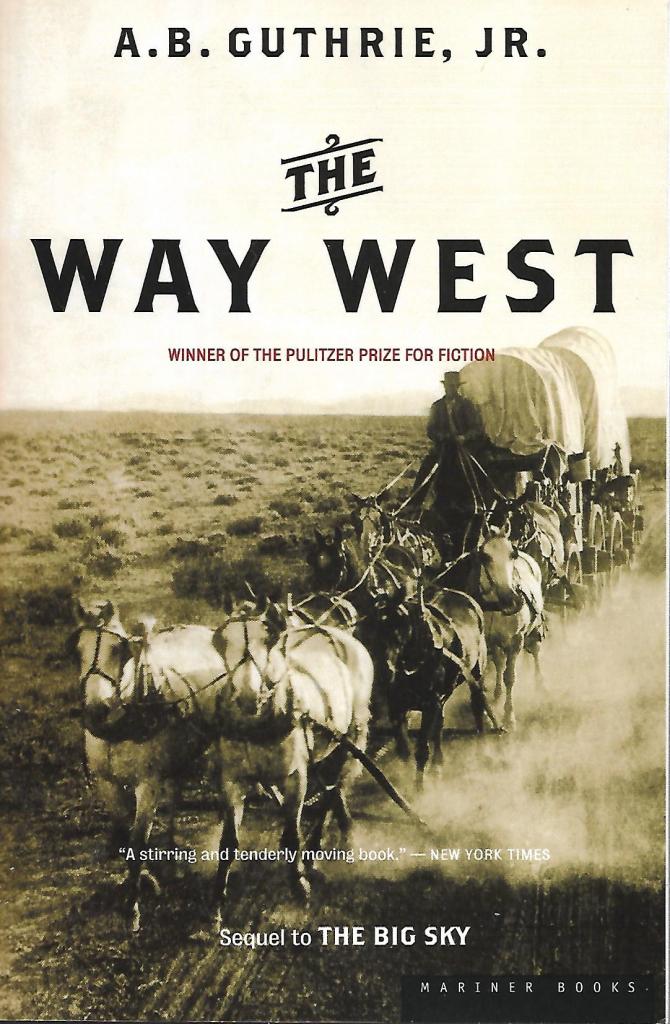
The Way West by A.B. Guthrie Jr. is the simple story of one such wagon train that sets out from Independence, Missouri, with its sites set on the storied land of Oregon. These wagon trains always had a “pilot,” an experienced man who usually knew what most of the travelers didn’t: the way was hard and dangerous and some of them weren’t going to make it. Dick Summers is the pilot in The Way West. He’s forty-nine years old, a widower, a mountain man who has traveled over the terrain before and knows what to expect. He always knows the best route to take, how to deal with the indigents, how to ford raging rivers, etc. Without him, the travelers would be doomed. Think of John Wayne.

Lije Evans was a farmer back in Missouri. Now he’s the captain of the wagon train. He tells the train when to stop and when to get a-goin’ again, but he relies heavily on Dick Summers for practical advice in all matters. Lije is traveling with his wife, Rebecca, his son, Brownie, and his faithful old dog, Rock. Lije is the central character in the novel. We see things through his eyes. His must deal with the usual collection of misfits and egocentric individuals who think they know more than he does. Thrown into the mix is a teenage temptress named Mercy McBee who—innocently enough, it seems—falls under the spell of a handsome married man, Curtis Mack, and ends up pregnant by him. Uh-oh! The leaders already said at the outset that they wouldn’t countenance adultery and fornication and would horsewhip any offenders.

The Way West is a solid, readable classic that won the Pulitzer Prize for fiction in 1950. It’s an American story about westward expansion and the search for a better life in the nineteenth century when the country just wasn’t big enough and people wanted to make it bigger. Now people are much softer. When I’m with a group of people and somebody is complaining about being cold in a stifling room or they want to have all the windows closed in an airless room because they’re afraid of bees getting in, I say, sarcastically, “That’s the pioneering spirit that made this country what it is today.” People today are whiny-assed crybabies who would never be able to suffer the hardship and discomfort of traveling across a continent in a covered wagon to live in an unknown place they’ve never seen before. Does everybody have their cell phones, and how on earth are we going to charge them? How about anti-anxiety pills? Does everybody have theirs? You’re certainly going to need them when an Indian tries to scalp you.

Copyright © 2018 by Allen Kopp

The Doctor Dispenses Drugs from His Office

The Doctor Dispenses Drugs from His Office ~ A Short Story by Allen Kopp

Verna Shelton’s husband was long gone. The only thing she had to remember him by was a son, Cullen, and a daughter, Corinne. The three of them—Verna, Cullen and Corinne—lived in a small frame house in a seedy neighborhood on the edge of town near the railroad tracks. Verna had a job as office assistant for an osteopathic doctor, Dr. Bunch, on the upper floor of an old building across from the county courthouse. All day long she answered phones and coordinated a steady stream of people in and out of the doctor’s two examining rooms.

As a single mother, Verna did the best she could but she sometimes she felt she wasn’t equal to the task. The problems were unrelenting. One day it was a fever and a sick stomach and then the next day a chipped tooth, a new pair of shoes, a note from the teacher demanding money, or an injured ankle that needed to be x-rayed. The money she made never went far enough.

Her personal life was no more rewarding than her professional one. She was lonely, she wanted a companion, a mate, but she had an abysmal record with the unfathomable (to her) male of the species. To make it through her difficult days, she took handfuls of tranquilizers that kindly old Dr. Bunch provided to her free of charge and without a prescription. She frequently augmented the pills with wine, beer or whiskey straight out of the bottle.

And then Cary Mulvihill drifted into town from parts unknown. He was thirty-one years old, trim-waisted, dark-haired, blue-eyed, angel-faced. As soon as Verna saw him, her heart skipped a beat and she knew she was gone. He seemed equally taken with her. He asked her out on a date and, when that went well, he asked her out again and again.

All at once she developed a new outlook on life. She woke up in the morning with a smile on her face that lasted all day long, even through the most difficult days of car troubles, payments in arrears, and three-day measles. The number-one thought in her mind was when she was going to see him again. She was—dare she even speak the words?—in love.

He had a room in a hotel outside of town, causing her to think he wouldn’t be around long. When she asked him what his business was and what he did for a living, he told her he was a writer, traveling around gathering research for a book. When she asked him what the book was about, he told her she’d find out but not until it was published and sold in bookstores everywhere.

Unlike other men of her acquaintance, Cary was always a gentlemen. He held doors for her, helped her with her wrap, lighted her cigarettes. When they were alone, he never behaved inappropriately. Not only was he good-looking, he was smart and cultured; he knew about good food, good music, foreign films, books and paintings. He was a good dancer, fond of animals and children, and spoke lovingly of his mother. He was all the things she might have hoped for in a man and never expected to find.

One Friday at the end of October, he picked her up at Dr. Bunch’s office at the end of the day. With a headache, cough and sore throat, she was out of sorts and not feeling at all well.  How can you work in a doctor’s office with people coming and going all the time and not catch whatever is going around?

Cary was sympathetic. He smiled at her and put his arm around her and drew her close in the car. “I have just the thing that will make you feel better,” he said.

He reached into the back seat and brought forth a little leather case. He opened it and took out a syringe and a little bottle of liquid.

“What is that?” she asked.

“Trust me,” he said. “It’s just the thing you need for what ails you.”

She didn’t think to resist but rolled up her sleeve dutifully. He found her vein easily enough. It was over in a few seconds.

“You surprise me,” she said. “Are you a doctor?”

“Of course not,” he said, “but I’ve done this a lot.”

They went on to dinner and the injection, whatever it was, made her feel wonderful. She reveled in the food, the music, the dancing and the wine. The feeling of well-being lasted all through the evening. When Cary took her home at two in the morning, she believed she had just passed the most best evening of her life. She awoke in the morning happy, certain the happiness would last forever.

There were other injections, of course, any time motherhood was getting her down, a tooth was bothering her, it was her time of the month, or Dr. Bunch put extra work on her. And the injections always cast their magic spell. Whenever she asked him what the injections were that made her feel so good, he smiled and told her she asked too many questions. She came to see the injections as part of the wonderment of Cary Mulvihill, unexpected and delightful.

She had every reason to believe that Cary would ask her to become his wife. She invited him for a special dinner that she cooked herself so that he might see her domestic side. Cullen and Corinne loved him, as she knew they would, and he had a special way with them. He brought Corinne a stuffed elephant and Cullen a telescope.

It was all too wonderful! She had met the man of her dreams and he was going to rescue her from her dreary life. Cullen and Corinne would at last have the father they deserved and advantages in life they wouldn’t ordinarily have: travel, good schools, a promising future. Their names would appear in the society columns.

Finally Cary asked Verna to spend the night with him in his hotel room. She knew it was coming and was thrilled beyond measure. She saw it as the prelude to marriage. She arranged for a teenage sitter to stay overnight with Cullen and Corinne, packed an overnight bag, and waited out front for Cary to pick her up. She had bought all new underwear and sleepwear so he wouldn’t see her shabby stuff.

First they had a wonderful dinner, where they laughed and danced and relaxed. When she thought about what was to come later in his hotel room, her heart pounded with excitement. It was all so romantic!

After dinner, they went for a drive through town. Cary stopped his car on the street in front of Dr. Bunch’s office.

“I though it’d be fun to see where you spend your days,” he said.

“It’s not very exciting, I’m afraid.”

“Please.”

She took the keys out of her purse and unlocked the downstairs door and they went up the stairs in the dark, laughing and holding hands.

“Better not turn on too many lights,” she said, slurring her words.

When they were in the doctor’s office, he grabbed her and kissed her in the dark. She giggled, pushed away from him and turned on the lights.

“This is it,” she said.

He looked around admiringly. “I like being in a daytime place at night after everybody has gone home, don’t you?”

He wanted to see the examining rooms where the doctor saw patients. She took him into one and then the other. There was the table, cabinets, a sink, two chairs, a small, heavily curtained window.

“I’m impressed,” he said.

“We should go,” she said. “If the night watchman sees the lights, he’ll wonder what’s going on.”

“I want to see where the drugs are kept,” Cary said.

“What?”

“Didn’t you say the doctor dispenses drugs from a large closet.”

“Oh, yes. It isn’t much to see. Just shelves of stuff.”

She opened the door to the drug closet and turned on the light. Cary whistled. “That is a lot of drugs,” he said.

“Three-quarters of a million dollars worth,” she said. “That’s why we keep the door locked at all times.”

“I like it,” he said. “I like the whole layout. I’d like anyplace where you worked.”

When at last they were in his hotel room, he ordered a bottle of champagne in a bucket of ice, just like in the movies. They sat on the couch, drinking the champagne, talking in throaty voices. She nestled closer to him, took his arm and draped it around her shoulders. He kissed her and she purred like a kitten.

“Would you like an injection?” he asked after a while.

“Everything is perfect already,” she said. “I don’t know how it could be any better.”

“It will release you from your inhibitions.”

He gave her the injection and, as she was starting to feel it, he picked her up in his strong arms and carried her over to the bed and laid her on it.

“What are you doing?” she asked.

“I just want you to be comfortable,” he said.

“What about you?”

“Just rest. Everything will be fine.”

When she awoke, it was daylight. Fully clothed, she lay in the same position on the bed where Cary Mulvihill had placed her. She gasped and sat up, not at all sure of what had happened.

He left her a note that read: Please be out of the room by noon. I’m leaving you money for cab fare.

When she saw a hundred-dollar bill sticking out of the top of her purse, she knew he was gone. Gone and not coming back. She ran into the bathroom and heaved up the contents of her stomach.

Cary Mulvihill—with help from compatriots, of course—took Verna’s keys and cleaned out the drug closet in Dr. Bunch’s office in the early hours of the morning while the night watchman was napping. Three-quarters of a million dollars worth of drugs.

When Dr. Bunch arrived to open the office, he saw what had happened. Verna’s not showing up for work at the usual hour aroused his suspicions. He called her at home and when he didn’t get her he called the police. They were waiting for her as she got out of the cab in front of her house.

Copyright © 2018 by Allen Kopp

Herman Melville ~ A Capsule Book Review

Herman Melville ~ A Capsule Book Review by Allen Kopp

Herman Melville, by brainy Melville scholar Elizabeth Hardwick, is a short (158 pages) biography in the “Penguin Lives” series. It is an overview of Melville’s life and a dissection of each of his major works, beginning with Redburn, Omoo, Mardi, Typee, and on to Moby Dick and later works such as the short story “Bartleby the Scrivener” and the short novel Billy Budd.    

In a nineteenth century American novel class in college, they had us read Herman Melville’s massive and difficult novel Moby Dick. We had a week to read it, study it, and uncover its secrets. The next week we were to move on to Henry James’ The Ambassadors, which is also a very difficult novel to read. (What is wrong with these people?)

While Moby Dick is notoriously difficult to read, most people in the know agree that it is the greatest American novel ever written. Its central character, Captain Ahab, is a driven megalomaniac. In an earlier encounter with the monster white whale, Captain Ahab lost a leg. Now, spurred onward by vengeance, he will risk his ship, The Pequod, and all the men on it for another chance to bring down the whale that has come to be known as Moby Dick. The whale is a symbol for something. Just what it is a symbol for has never quite been established. Of course, the question has sparked endless speculation.

By all accounts, Herman Melville (1819- 1891) did not have a happy life. When he was young, he worked on a whaling ship, abandoning ship once in Liverpool. This shipboard experience gave him the experience he needed for his books. He lived with his family in New York in shabby gentility. He always had money worries and was frequently on the verge of bankruptcy. He met the by-then established writer Nathaniel Hawthorne, who was fifteen years older than Melville; the two of them became acquaintances, if not the best of friends. He was unhappily married, while his sexual interests seemed to lie elsewhere. (His writing is full of “homoerotic yearnings.”) He was the prolific (and fast) writer of many books, but he was never commercially successful during his lifetime. Of his four children (two boys and two girls), one of his sons committed suicide at age eighteen and the other died in faraway California at age thirty-five. Of his two daughters, one was debilitated by rheumatoid arthritis.

When Herman Melville died at age seventy-two, he was mostly forgotten, spending the last nineteen or so years of his life working as a clerk for a meager salary. It wasn’t until the 1920s that there was a great revival of interest in him and his work, particularly the novel Moby Dick and two shorter works, “Bartleby the Scrivener” and Billy Budd.

Copyright © 2018 by Allen Kopp
Hereditary ~ A Capsule Movie Review

Hereditary ~ A Capsule Movie Review by Allen Kopp

The Grahams are a middle-aged couple who live in a big house in the woods. Annie Graham (an overwrought Toni Collette) is a sort of artist who makes dollhouses and miniatures. Her husband, Steve (Gabriel Byrne), doesn’t seem to do much of anything except stand around and be fatherly to the two Graham children: a very odd thirteen-year-old girl (inexplicably) named Charlie and Peter, a dope-smoking high-schooler.

Annie Graham’s strange (“strange” is the operative word here) mother dies. Annie speaks at her mother’s funeral, explaining how “private” her mother was in her “associations.” (We find out later the reason for this.) Annie’s mother had a special bond with the little girl Charlie. At one point Charlie says that her grandmother wanted her to be a boy, which might explain her being given a boy’s name.

Charlie is not the usual thirteen-year-old girl. She is distant and preoccupied, with a face that is mask-like. Also, she has a peanut allergy, which is an important plot point to remember later. When Peter, Charlie’s brother, is invited to a teenage party, his mother makes him take Charlie along, which she will sadly regret later. What happens to Charlie, which I will not give away here, is the most disturbing image in the movie.

Grieving, Annie meets Joan, an older woman who seems sympathetic. (Joan, as we discover later, is not what she seems to be.) Joan is also grieving; her son and grandson have both died in a drowning accident. These two women seem to have a lot in common.

At a later date, Annie meets Joan when she is out shopping. Joan feels so much better, she says, because she has met a spiritual medium who has shown her how to get in touch with her grandson in the spirit world. Annie is skeptical, of course, but eventually drawn in.

When Annie is going through some boxes of her dead mother’s possessions, she finds some pictures that she can’t explain and also a book with some of its passages highlighted that tell how a demonic spirit is looking for the body of a human boy to occupy on earth. These fleeting images help to explain what is going on. If you’re not paying attention during these few seconds, you will miss it because it won’t be explained later.

Hereditary is a better-than-average summer movie. It’s slow-moving at times, especially during the first third, and is probably a little too long at 127 minutes. It takes a long time getting to the payoff, but when it comes (to music that sounds like Wagner’s “Entrance of the Gods into Valhalla”), we find that it was well worth the wait.

Copyright © 2018 by Allen Kopp