JoJo Rabbit ~ A Capsule Movie Review

JoJo Rabbit ~ A Capsule Movie Review by Allen Kopp

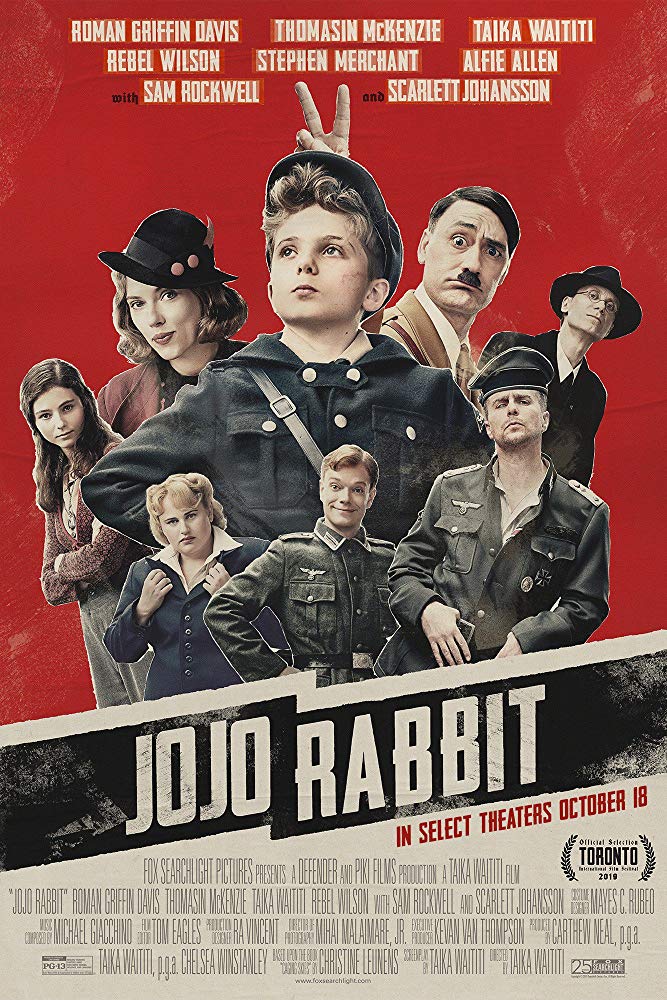
Johannes “JoJo” Betzler is a winsome, ten-year-old boy living with his unconventional mother in Nazi Germany during World War II. His father is fighting in Italy, unseen for two years and presumed dead. JoJo has an “imaginary” companion, who turns out to be none other than the Fuehrer himself, Adolf Hitler. Caught up in the fervor of his time and place, JoJo believes he is a loyal Nazi, until he starts seeing things in a different way.

The Hitler of JoJo’s imagination is funny and endearing, or at least that’s the way JoJo sees him. He has a funny accent and a comical mustache and he’s fun to be with and to talk to, a really nice fellow. Sometimes when he’s talking he lapses into his “fiery speech” mode. JoJo has some growing up to do before he sees Hitler for what he really is and becomes disenchanted with him.

Jews are the enemy, according to Germans of the era, the cause of all the world’s woes. JoJo is more than willing to go along with the hatred of Jews until he discovers that his own mother is hiding one of them in her house, a teen girl named Elsa. JoJo and Elsa becomes friends. After JoJo becomes friends with a Jew, he comes to see the race in an entirely different light. (“What will you do when the war is over and you no longer have to hide?” JoJo asks Elsa. “Dance,” she says.) JoJo wants Elsa to tell him all about the Jews because all he knows about them is the stereotypes. He plans on writing a book that will be the definitive book on how Jews are different from Aryans. JoJo is intelligent beyond his years.

The war isn’t going well for Germany. Allied forces are closing in. The Russians are on Germany’s doorstep. Realistic Germans see the war is lost. The time for believing in miracles is past. When JoJo’s mother pays the ultimate sacrifice for hiding a Jew in her house, JoJo finds himself all alone in the world. Suddenly the war has ended. What do JoJo and Elsa do now? Isn’t it time to dance?

New Zealand actor Taika Waititi plays Hitler in JoJo Rabbit. (I saw Taika Waititi in a little-seen, crazy, funny and dark movie from New Zealand about vampires called What We Do in the Dark.) Taika Waititi also wrote the screenplay for JoJo Rabbit from a novel by Christine Leunens. Taika Waititi also directed JoJo Rabbit. (Give the multi-talented Taika Waititi an Oscar.) A child actor named Roman Griffin Davis is perfect as JoJo Rabbit (so-named because he refuses to strangle a rabbit early in the movie). He’s cute without being cloyingly cutesie-pie. Archie Yates is another child actor who plays JoJo Rabbit’s pudgy, well-meaning friend, Yorki. There’s something reassuring and endearing about Yorki. He’s the perfect friend to be with if you’re stuck in a war.

Copyright © 2019 by Allen Kopp

Psycho ~ A Capsule Book Review

Psycho ~ A Capsule Book Review by Allen Kopp

Alfred Hitchcock’s 1960 movie, Psycho, is a slice of pure cinema. In the directorial hands of a master, it’s a movie where all the different parts—writing, acting, music, film editing, sound, set design, directing—come together in just the right way to create an enduring film masterpiece that has easily stood the test of time. In the hands of a less talented director, it could easily have been just another schlocky, soon-to-be-forgotten stab movie with breasts, a scintillating boudoir scene, and a sensational shower scene, complete with blood going down the drain.

Psycho is a horror movie about a cross-dressing, knife-wielding, multiple-personality maniac, but it’s a high-class horror movie that somehow manages to be tasteful, eschewing blood and cheap horror for a more subtle brand of thrills. It broke new artistic ground and set the standard for movies of its kind. It has been copied, imitated, parodied and emulated, but the one thing it never has been is equaled.

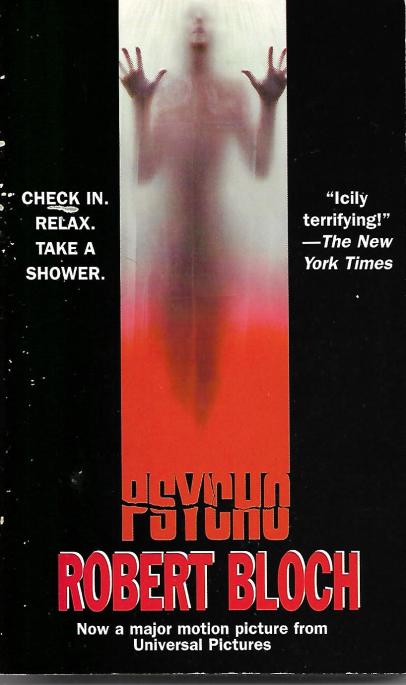
There never would have been the movie Psycho without the novel Psycho by Robert Bloch. Before the movie comes the novel. When Alfred Hitchcock chose the novel to make into a movie, he plucked it from almost certain obscurity. Not that it wasn’t read by readers of its day, but if would never have lasted the way it has if the Hitchcock movie hadn’t made it famous. It is “pop” fiction with little literary merit, except that it makes entertaining reading.

We all know the story. Norman Bates is an odd boy-man who runs an obscure motel on an out-of-the-way California highway. The Bates Motel doesn’t get many guests, except one rainy night, a runaway girl who has lost her way stumbles onto the motel and decides to spend the night. She has just stolen forty thousand big ones from her employer and is on her way to her debt-ridden boyfriend in Fairvale, California.

If the runaway girl, Mary Crane (Marian in the movie), has a secret, Norman Bates has an even bigger one. He has always had a mother fixation. He murdered his dear old mother out of jealousy (she had a lover, you see), but mother’s not resting in her grave. Years earlier, Norman stole her body from her grave and keeps it in the creepy old house behind the motel. He has a split personality. He’s Norman, but he’s also mother. He dresses up in her clothes and wears her wig and, as mother, stabs Mary Crane to death as she’s taking a shower. He hides the body, of course, crying to cover up mother’s crime. Then he has the arduous task of keeping people from finding out what he is and what he has done.

All right, if you want some light reading and you want to read a story that by now is familiar to you, you can’t go wrong with Robert Bloch’s Psycho. It’s not Sister Carrie, but it’s plenty engaging and will keep you turning the pages. The movie follows the novel closely, but, as I said, it makes a much better movie than it does a novel. The movie is distinctive and the novel is not.

Copyright © 2019 by Allen Kopp
The Lighthouse ~ A Capsule Movie Review

The Lighthouse ~ A Capsule Movie Review by Allen Kopp

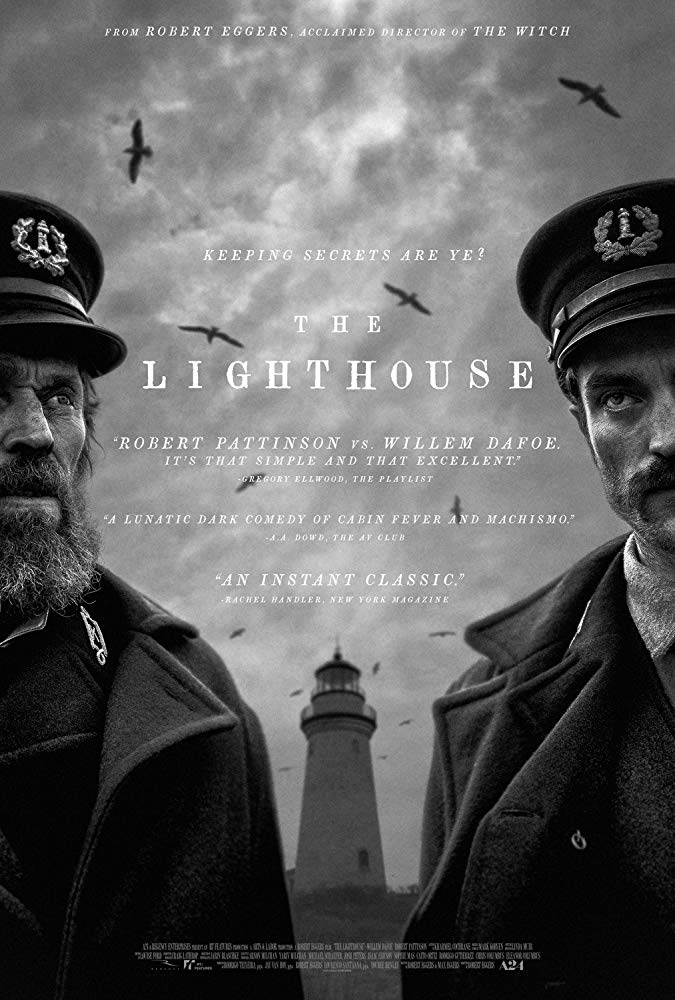
The Lighthouse has to be the most unusual new movie of the year. It’s set in 1890 and shot in black and white, with an aspect ratio of approximately 1.19:1, which means the picture is practically square (instead of elongated, which is what we’re used to) to emulate early motion picture photography. The music score (with a nod to the classic film scores of Bernard Hermann) is made up of a foghorn, horns and pipes, glass harmonica and an ocean harp (a stainless steel bowl with bronze rods around the rim that gives off an ethereal sound when used struck a friction mallet). The dialogue spoken by the two characters is based on the “local color” poems and writings of Sarah Orne Jewett. All these filmmaking elements come together to spell “A-R-T” instead of a commercial project designed to generate box office revenue. (You know, like about 98% of the movies released during the year.)

The only two characters in The Lighthouse are two very different men, one younger (Robert Pattison) and the other older (Willem Dafoe). Both men are named Thomas (although the younger man lies and says his name is Winslow). The older Thomas used to be an old seafaring man and is now a lighthouse keeper who knows all about tending the light. The younger Thomas has a murder on his conscience from when he worked in logging (he let a fellow worker die when he could have saved him). He is hired for a period of four weeks to be lighthouse assistant.

The film is set entirely in and around a lighthouse on the Atlantic seacoast of the United States. It’s not an inviting, scenic or hospitable place. The work the younger Thomas does is backbreaking labor and very often involves nasty chores, such as emptying chamber pots and cleaning out the cistern. “I did not take this post be a housewife or slave,” he says defiantly. The older Thomas is something of an uncouth swine and, understandably, gets on the younger Thomas’s nerves. They sleep in very cramped quarters and are always together. The older Thomas talks incessantly, sometimes in soaring soliloquies that don’t make much sense.

The loneliness and isolation begin to play on the younger Thomas’s mind. The four weeks he was supposed to be at the lighthouse are up, but a terrible storm sets in and the person who was supposed to relieve him doesn’t show up. So, now there’s a psychological element in play. Is any of this really happening or is it all just in the younger Thomas’s head? He’s already killed one man. Will he be driven to kill again?

The Lighthouse is not for everybody, of course. If you see it, you might think it’s not your cup of tea, but you can honestly say it isn’t like anything you ever saw before. Remember The Artist in 2011, a silent, black-and-white movie set in the 1920s? The Lighthouse is as uniquely memorable as The Artist, but in its own special way.

Copyright © 2019 by Allen Kopp