




The Moving Picture

The Moving Picture ~ A Short Story by Allen Kopp
People said we didn’t need an opera house, but an opera house we had, and it was smack in the middle of a row of commercial buildings in the downtown district, between a furniture store and the bank. Two or three times a year the opera house opened its doors for a “serious” play or for a semi-famous author who gave a “reading” from a book he had written in an attempt to boost sales of said book. The vast majority of people in the town were happily ignorant of these, and all, cultural events.
I had been in the opera house on a couple of earlier occasions. The first time was to hear a lecture on the Egyptian pyramids and the second time for a political rally given by a candidate for the United States Senate. (He lost.) Now, here I was at the opera house again, for the third time, to witness for myself the miracle, in the year of our Lord nineteen hundred and twelve, the innovation called the “moving picture.” People in places like New York City would already be familiar with this phenomenon, but out here in the hinterlands of the North American continent, we were still as uninitiated as pygmies in the wilds of Africa.
Standing on the sidewalk, I looked up at the less-than-impressive edifice of the opera house and shivered in the wind. I paid my twenty cents admission to the pompadoured lady behind the window out front and went inside.
The cave-like interior of the opera house smelled like every old attic or damp basement I had ever been in. About half the seats were already taken (a surprising turnout for this town), at fifteen minutes before the moving picture was even supposed to start, so I went down close to the front and took a seat on the aisle.
The first thing I noticed after sitting down was that a tarpaulin or large canvas had been stretched across the stage. It didn’t take a genius to know, I suppose, that the moving picture would be projected onto the canvas, which glowed as if a lamp were burning behind it. (It occurred to me when I saw the glow that the opera house might be on fire and nobody knew it yet.)
In a few minutes, a young man in a frock coat came down the aisle; the audience knew instinctively that he had something to do with the moving picture and stopped talking and shuffling about. The young man took a seat at an upright piano to the right of the stage, struck a few chords of music, and the moving picture began right before our eyes. (The piano music will be continuous throughout the moving picture. The music will reflect and embellish what’s going on in the moving picture.)
The moving picture is called Cleopatra: The Romance of a Woman and a Queen. I wouldn’t be surprised if most of the people in this town had never heard of Cleopatra, but I knew she was a Queen of Egypt who lived a long time ago in biblical times. I didn’t find her unsavory life all that compelling, but I could see that there were people who found her interesting enough to make a moving picture about her, and I was sure there would be plenty of other people on the receiving end willing to put forward their twenty cents to see it.
The Cleopatra of the moving picture is as broad and tall as a man, a formidable woman and a force to be reckoned with. She has copious amounts of black hair gathered around her face and hanging down her back to her waist. She wears a loose-fitting gown almost down to her ankles and strapped sandals. The tiniest hint of cleavage shows. Her armpits are shaved; we know this because she gestures a lot with her arms, raising them above her head.
Pharon also gestures a lot with his arms. He is thin and young, dressed in a short tunic that shows his legs. He is in love with Cleopatra, but it won’t matter because he is, not only a fisherman, but also a slave. He can only worship Cleopatra from afar and gather flowers that he hopes to give her. Iras, attendant to Cleopatra, is in love with Pharon and is jealous of his love for the queen.
When Cleopatra discovers that Pharon is in love with her, she decides she will kill him. But—wait a minute—she will give him another chance. She will give him ten days of bliss with her, in her arms, at the end of which he must kill himself. He readily agrees to die at the end of the ten days.
Cleopatra likes Pharon more than she expected to, but, a bargain is a bargain, so at the end of ten days she poisons him. The attendant Iras, loving Pharon as she does, goes to him and revives him by giving him an antidote to Cleopatra’s poison. Iras lies to Pharon and tells him that Cleopatra wanted her (Iras) to save Pharon’s life and he believes her. With Pharon once again among the living, Iras tells him he must leave Alexandria. He is taken to the outskirts of the city and released.
Marc Antony, Roman general, has heard all about Cleopatra and wants to meet her. He has heard rumors that she has been conspiring against Rome. He summons her to come to Tarsus to meet with him. She is late but finally arrives in her stately barge. When Cleopatra steps off her barge and Marc Antony looks into her seductive eyes, he falls instantly in love her. He can’t keep his hands off her. Then he is easily swayed to go back to Alexandria with Cleopatra and live with her in adulterous sin. To hell with Rome and its politics!
Marc Antony and Cleopatra are happy together at Cleopatra’s home in Alexandria, but the happiness can’t last. A messenger arrives to inform Marc Antony that his wife Flavia is dead and Rome is in turmoil. He says he doesn’t care and won’t go, but Cleopatra entreats him to go and take care of matters at home, even though she loves and will miss him terribly.
Cleopatra waits months for Marc Antony to return, but he doesn’t come back for the longest kind of time. Finally she receives word that he has taken another wife, this one named Octavia, and is arming for war. She agrees to send her warships to help him at a place called Actium.
Well, the Battle of Actium doesn’t go well and Marc Antony is defeated and terrifically embarrassed. He returns to Alexandria and here is where the slave Pharon re-emerges. He takes an assassin’s arrow in his chest meant for Marc Antony because he knows how much Cleopatra loves him (Marc Antony). Cleopatra sees the sacrifice that Pharon has made her and decides he is an all right fellow.
Marc Antony can’t live with the humiliation of his defeat at Actium and kills himself by “running” on his own sword. He apparently dies without pain and makes a beautiful corpse.
Cleopatra doesn’t want to go on living without her boyfriend Marc Antony. A sympathetic friend gives her a basket of figs with a tiny, poisonous asp (snake) in it. She picks up the basket of figs, the asp bites her, and she dies with her body draped across the body of Marc Antony.
The piano music ended with a flourish, the canvas across the stage became a piece of canvas again, and everybody in the audience got up and left. I walked home with a feeling of satisfaction, knowing I had seen my first moving picture. Was it something I would tell my grandchildren about, or something I would forget about in one week?
Moving pictures caught fire (not literally but figuratively) in the United States and around the world. In a few years, the opera house was converted into a moving picture theatre. Moving pictures became the most popular form of entertainment in our town, surpassing the dance hall, the tavern, the church and the whorehouse.
In 1920 I got on a train and traveled across the plains and the desert to get to Hollywood, California, the moving picture capital of the world, and I stayed there for the rest of my life. I became employed in the moving picture business, not as an actor, but as a publicist and then a scenario writer, and it all began in the little opera house in my home town on an autumn night in 1912 when I first met Cleopatra.
Copyright © 2020 by Allen Kopp
Give Us a Kiss ~ A Capsule Book Review
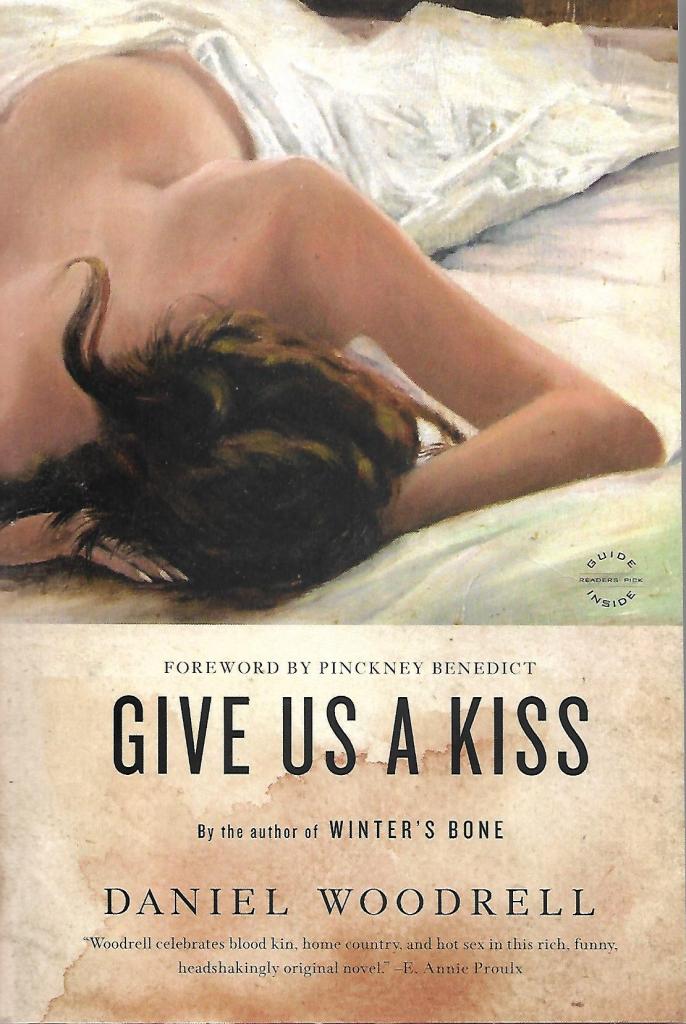
Give Us a Kiss ~ A Capsule Book Review by Allen Kopp
Daniel Woodrell’s 1996 novel, Give Us a Kiss, is set in the fictional Missouri Ozarks town of West Table. It is the story of a hillbilly family, and specifically the story of two hillbilly brothers: Doyle Redmond, age 35, and his 39-year-old brother, Smoke. Doyle is the main character in the book and is telling the story in his first-person voice.
Doyle is something of a conflicted hillbilly. He can never get away from his hillbilly roots, but after he left the town of West Table he became something more than a hillbilly: he went to college, became a semi-successful writer with four non-selling books to his credit, and was once married to a striving, snooty bitch named Lizbeth. (The name alone says it all.)
When Doyle returns to West Table after an absence of several years, he embraces all that is hillbilly and all that he left behind (as exemplified by his elderly grandfather, Panda). He moves in with his brother, Smoke, and Smoke’s girlfriend, Big Annie, in their trailer home out in the country. Big Annie has a beautiful 19-year-old daughter named Niagra (after the movie of the same name with Marilyn Monroe). Despite the age disparity (Doyle is 35 and Niagra is 19), we know the two of them are going to be a hot item.
We learn that Doyle and Smoke, in their younger days, were hell-raisers of the highest order and were frequently on the wrong side of the law (typical of their family). Now, as men approaching middle age, they grow a marijuana crop out in the woods where they believe it will never be detected. They nurture the crop until it is ready to harvest and process into saleable pot bricks (with the aid of a trash compactor and large bottles of Coca-Cola). Just as they are ready to sell the crop and get the long-awaited bundle of money the crop will bring, they are betrayed and fall afoul of a nasty hillbilly family called the Dollys. (Murder and Mayhem are the Dolly family’s stock in trade.) The Dollys and the Redmonds have a history of bad blood between them going back many years and several generations.
Daniel Woodrell is the leading exemplar of hillbilly fiction in American letters. Give Us a Kiss is another fast-paced page-turner from him about rednecks living the hillbilly dream. And aren’t the lives of hillbillies a lot more fun and so much more interesting (as Mr. Woodrell has proved in book after book) than college professors, Wall Street brokers, doctors and lawyers? Those people bore me unto death. Who wants to read about them?
Copyright © 2020 by Allen Kopp