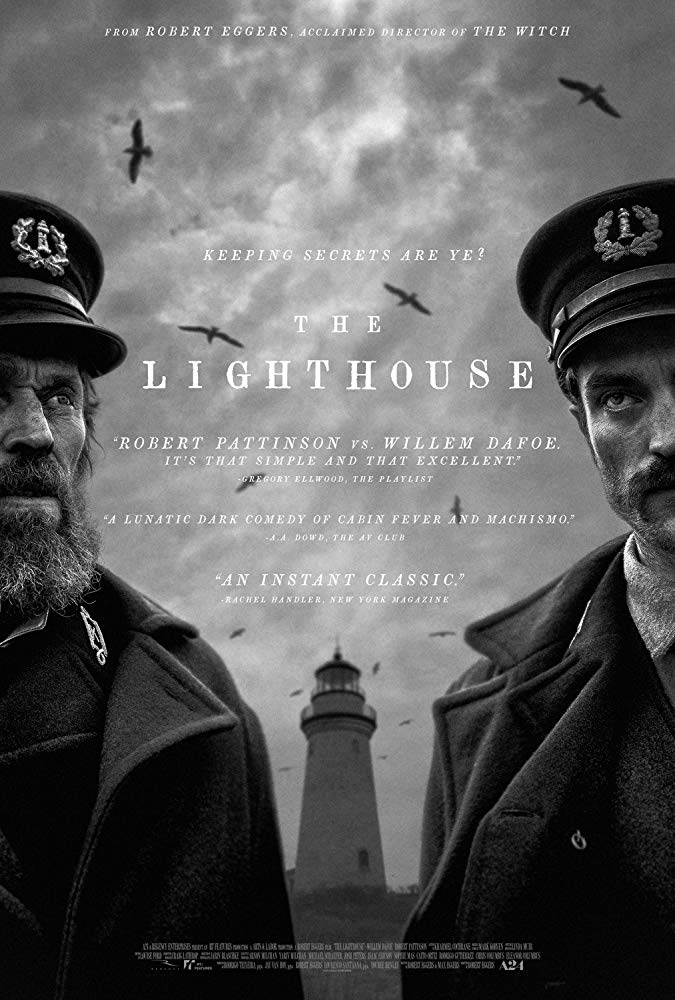
The Lighthouse ~ A Capsule Movie Review

The Lighthouse ~ A Capsule Movie Review by Allen Kopp

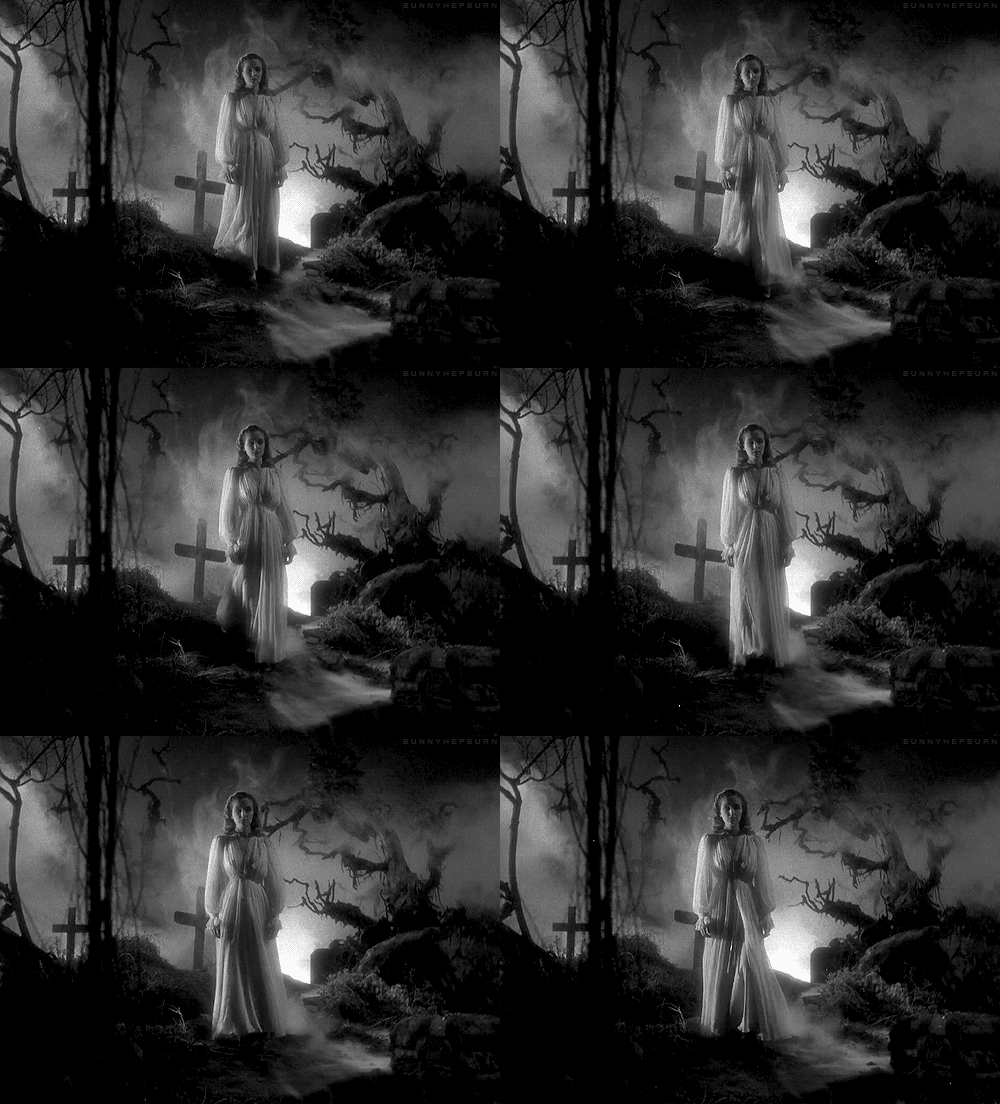
The Lighthouse has to be the most unusual new movie of the year. It’s set in 1890 and shot in black and white, with an aspect ratio of approximately 1.19:1, which means the picture is practically square (instead of elongated, which is what we’re used to) to emulate early motion picture photography. The music score (with a nod to the classic film scores of Bernard Hermann) is made up of a foghorn, horns and pipes, glass harmonica and an ocean harp (a stainless steel bowl with bronze rods around the rim that gives off an ethereal sound when used struck a friction mallet). The dialogue spoken by the two characters is based on the “local color” poems and writings of Sarah Orne Jewett. All these filmmaking elements come together to spell “A-R-T” instead of a commercial project designed to generate box office revenue. (You know, like about 98% of the movies released during the year.)

The only two characters in The Lighthouse are two very different men, one younger (Robert Pattison) and the other older (Willem Dafoe). Both men are named Thomas (although the younger man lies and says his name is Winslow). The older Thomas used to be an old seafaring man and is now a lighthouse keeper who knows all about tending the light. The younger Thomas has a murder on his conscience from when he worked in logging (he let a fellow worker die when he could have saved him). He is hired for a period of four weeks to be lighthouse assistant.

The film is set entirely in and around a lighthouse on the Atlantic seacoast of the United States. It’s not an inviting, scenic or hospitable place. The work the younger Thomas does is backbreaking labor and very often involves nasty chores, such as emptying chamber pots and cleaning out the cistern. “I did not take this post be a housewife or slave,” he says defiantly. The older Thomas is something of an uncouth swine and, understandably, gets on the younger Thomas’s nerves. They sleep in very cramped quarters and are always together. The older Thomas talks incessantly, sometimes in soaring soliloquies that don’t make much sense.

The loneliness and isolation begin to play on the younger Thomas’s mind. The four weeks he was supposed to be at the lighthouse are up, but a terrible storm sets in and the person who was supposed to relieve him doesn’t show up. So, now there’s a psychological element in play. Is any of this really happening or is it all just in the younger Thomas’s head? He’s already killed one man. Will he be driven to kill again?

The Lighthouse is not for everybody, of course. If you see it, you might think it’s not your cup of tea, but you can honestly say it isn’t like anything you ever saw before. Remember The Artist in 2011, a silent, black-and-white movie set in the 1920s? The Lighthouse is as uniquely memorable as The Artist, but in its own special way.

Copyright © 2019 by Allen Kopp

God’s Secretaries ~ A Capsule Book Review

God’s Secretaries ~ A Capsule Book Review by Allen Kopp

England’s Queen Elizabeth I died in 1603, after a reign of forty-four years. She failed to produce an heir, a successor, during her lifetime, so James I of Scotland succeeded her to the English throne. He was the son of Elizabeth’s cousin and political rival, Mary Queen of Scots. The twenty-two years that he sat on the throne of England is called the “Jacobean Age” because “Jacobus” is Latin for James.

Hundreds of years ago in England, religion was of the utmost importance, much more important than it is today. People were willing to fight and to die for their religion. There was much in-fighting between Catholics and Protestants and between other sects and splinter groups. It was about this time that a small group of religious dissenters who weren’t happy with the way they were treated in their own country came to the “New World” for a fresh start in a new place where they could decide the dictates of their own religion. They were what we today might call the “lunatic fringe.”

Early in his reign (which turned out to be fairly disastrous for the country), King James I commissioned a new translation of the Bible. There were existing translations of the Bible, of course, including the Geneva Bible and the Bishops’ Bible, but they were considered inadequate (for whatever reason) and there was a perceived need for a uniform Bible. The King James translation of the Bible was to be a Bible for all the people, not just for the elite and educated. It was to be written in elegant, yet accessible to everyone, Jacobean English.

The translation was a huge undertaking, involving some fifty Translators and taking about eight years. The Translators were not writers or journalists but high-level churchmen, bishops and ministers. They used as their source material existing versions of the Bible, principally that of William Tyndale. King James, who had taken a personal interest in the translation, kept a close watch on the project through to its completion in 1611.

The King James translation of the Bible was not an immediate success. For many years, people still preferred other translations. However, it still remains the “standard” Bible translation hundreds of years later. There are more modern translations but, for millions of people, the stately, soaring language of the King James Bible is the voice of Christianity.

God’s Secretaries by Adam Nicholson is not only about the King James Bible but about the times in which it was written, the king who brought the translation about, and the political climate of the times. It was a time in which the government was in charge of religion; church attendance was mandatory; religion played a central role in everyday life. Churchmen were some of the most powerful people in the country. People lived and breathed the Scriptures. If you were not of the proper faith, you just mind find yourself dead. How different the times are in which we live today!

Copyright © 2019 by Allen Kopp