

Month: August 2019
Querelle ~ A Capsule Book Review
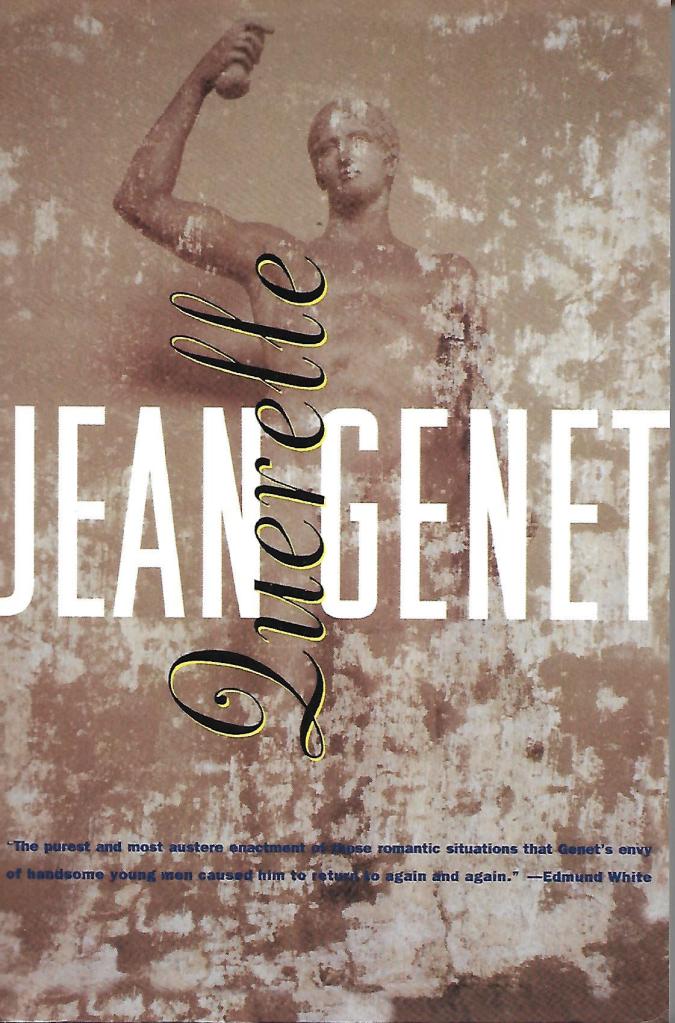
Querelle ~ A Capsule Book Review by Allen Kopp
“The notion of murder often brings to mind the notion of sailors and the sea.” This is the opening sentence of the novel Querelle by French author Jean Genet (1910-1986). Querelle (also known as Querelle de Brest) was written in 1945 and published anonymously in 1947. It was controversial for the 1940s (thus the anonymous publication), involving, as it does, homosexuality, murder, romantic obsession and prostitution.
Georges Querelle is a young, muscular, good-looking French sailor, in the French seaport town of Brest where the action of the novel takes place. His good looks make him a sort of magnet for almost anyone who sees him. His being a sailor and moving around from place to place makes him able to escape detection for the murders and thefts he commits. He has a look-alike brother, Robert, who is a gigolo in the local brothel in Brest called La Feria. There is this persistent theme running throughout the novel of the two brothers, Querelle and Robert, being so much alike that the love they have for each other is self-love, and the two brothers are, in fact, one and the same person.
The only female character in the book is Madame Lysiane. She is the madame of the Brest brothel, La Feria; Robert, Querelle’s brother, is her lover. Madame Lysiane is married to the owner of the brothel, whose name is Nono. Nono likes to roll dice with the young sailors who frequent his establishment. If Nono wins the throw of the dice, he takes the sailor into the back room and has sex with him. In this way, Querelle becomes Nono’s lover.
Lieutenant Seblon is an officer on the ship that Querelle serves on. He keeps to himself as much as he can and confides to his diary how much he loves, and lusts after, Querelle. Querelle figures out that Lieutenant Seblon loves him and, with this knowledge, exercises a sort of control over him. Lieutenant Seblon imagines scenes in which he and Querelle are in love and live together always.
Gilbert Turko is a young mason in Brest and an acquaintance of Querelle’s. He murders a coworker who taunts him and flees to an abandoned prison. Querelle helps him by bringing him food and encouraging him. In the meantime, Querelle has murdered a fellow sailor and left his body in the weeds to be found later. Querelle is able to make it appear that Gilbert Turko murdered the sailor that Querelle himself murdered, since Gilbert Turko is already known to have murdered a coworker. Querelle helps Gilbert Turko to get away by train but notifies police where he can be found before the train pulls out of the station.
Querelle is a walk on the wild side, a dark excursion down a fog-enshrouded alleyway. There’s nothing romantic about it, or charming or uplifting; it’s the dark side of human nature. Querelle might be thought of an agent of the devil with the face of an angel and the body of a god. People are drawn to him for his beauty, often at their own peril. He’s pretty poison. He has no equal in twentieth century literature.
Copyright © 2019 by Allen Kopp
Once Upon a Time in Hollywood ~ A Capsule Movie Review
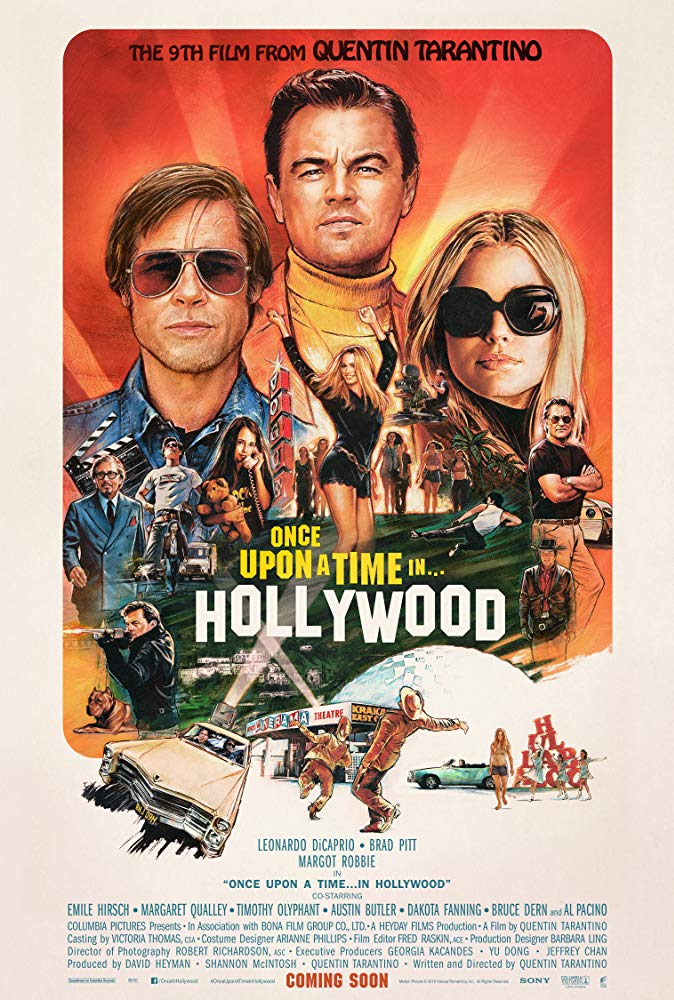
Once Upon a Time in Hollywood ~ A Capsule Movie Review by Allen Kopp
If you are an adult with a brain and you’re fed up with all the youth-oriented fluff at the multiplex this summer, you might want to see director Quentin Tarantino’s Once Upon a time in Hollywood. It’s not comic book superheroes, cute talking animals, a sequel to a previous movie, or a female-oriented melodrama. It’s a completely fictional story, set in Hollywood in 1969, although some of the characters are (or were) real people, principally Sharon Tate. And, no, the story is not a bloody recreation of her murder exactly fifty years ago and the murder of five other people (including Sharon’s unborn baby) at the hands of a group of Charles Manson-inspired hippies. Writer-director Quentin Tarantino presents an “alternative history” version of the crime in which the only people who die are the ones who deserve it. If you saw his movie Inglourious Basterds (misspelling intentional), you know this is not the first time he has fabricated an alternate ending, for the very simple reason, I suppose, that he’s in charge and he’s making a lot of stuff up because that’s what an “artist” does. It’s called “poetic license.”
Leonardo DiCaprio plays Rick Dalton, a TV cowboy star, with a successful series called Bounty Law. Brad Pitt is Cliff Booth, Rick Dalton’s stunt man, friend and factotum. They are likeable fellows, trying to navigate the nearly unnavigable waters of 1969 Hollywood. (Cliff isn’t popular among movie people because he has, presumably, killed his wife and gotten away with it.) Rick rents a house in the Hollywood Hills next door to budding actress Sharon Tate and her movie director husband Roman Polanski. She has been in a few movies by this time in 1969, including Valley of the Dolls. Roman Polanski is very “hot” in 1969 because he directed the hit movie Rosemary’s Baby the previous year.
There’s not a lot of story in Once Upon a Time in Hollywood. Cliff Booth commiserates with his pal Rick Dalton and rides around Hollywood a lot in Rick’s yellow Cadillac. He meets and is obviously (inexplicably) attracted to an underage female hippie named Pussy. When he gives her a ride back to her hippie commune (or whatever it’s called), he has a tense encounter with a band of repellent hippies, who, we find out later (or maybe we just deduce it) are in the thrall of creepy Charles Manson. I think this is the best sequence in the entire movie.
Rick Dalton, in the meantime, drinks a lot and stands by helplessly while his acting career fizzles out. He gives up his successful TV series in pursuit of a movie career, which never really takes off the way he wishes it would. He ends up going to Italy to make “spaghetti westerns.” When he returns to Hollywood, he has more money than he had before and an Italian wife who doesn’t speak English, but his career is still in the doldrums and will probably never get any better.
In the absence of good summer movies, Once Upon a Time in Hollywood is worth seeing and will probably be a big hit with its “star power” and its “name” director. It’s colorful and nostalgic, if you happen to feel nostalgic for 1969 miniskirts, blasting period music, powerful cars, hippies, 75-cent movies, smoking anywhere, no Internet, no cell phones, and no political correctness. The ending is violent, with a special kind of bizarre, grotesque violence that is the trademark of any Quentin Tarantino movie. The punishment that Cliff Booth metes out to the invading hippies is gratifying and almost worth the price of admission alone. Will somebody please shut her up?
Copyright © 2019 by Allen Kopp
 Literary Fictions