The Mummy ~ A Capsule Movie Review


The Mummy ~ A Capsule Movie Review by Allen Kopp

An Egyptian princess from five thousand years ago thought she was going to be next in line for the throne of Egypt, but her father’s wife gave birth to a son who instead would become the next pharaoh. The Egyptian princess at this point embraced evil and murdered her father, his wife and infant son. When her crimes were discovered, she was entombed alive and, because she was a disgrace to Egypt, her body was laid to rest in a tomb in Mesopotamia, a thousand miles from Egypt, in what is present-day Iraq.

A crusaders’ tomb from the thirteenth century is found underneath London. One of the crusaders entombed there had a stone buried with him that he picked up while crusading in Egypt.

Nick Morton (Tom Cruise), adventurer and plunderer of antiquities in Iraq, just happens to accidentally find the forgotten tomb of the disgraced Egyptian princess while dodging bullets from insurgents. He is with a hapless male colleague and a curvaceous female archaeologist named Jennifer Halsey, who recognizes the significance of the tomb from an archaeological standpoint. They crate up the mummy case containing the remains of the Egyptian princess and are flying it back to home base, when the plane crashes over England. All on board the plane are killed except Jennifer Halsey and Nick Morton.

Opening the five-thousand-year-old tomb of the Egyptian princes has released her, or has at least has released her malevolence. She causes the plane to crash over England so she can reclaim the crusader’s stone that goes into the hilt of her magic sword. She recognizes Nick Morton as her redeemer, her restorer, and the new love of her life because he was the one who found her tomb. All he has to do is abide by her wishes and the two of them will enjoy a life together of everlasting evil.

The Mummy is a silly, summer, action-adventure movie, with the emphasis on action instead of on intelligence or subtlety. Tom Cruise seems to have forfeited all pretentions of being a good actor by making movies like this one. And what about (the now-portly) Russell Crowe? Is he on the side of good or evil? It’s hard to tell. He is wasted here as a character named Dr. Henry Jekyll, who seems to serve no purpose unless it was to add an extra male star to boost box office receipts.

The original The Mummy was made in 1932 and stars Boris Karloff. It is a creepily atmospheric excursion into horror, a truly memorable classic that spawned a spate of sequels and added to the horror lexicon. The new The Mummy won’t be a classic. It’s not terrible, just another forgettable summer movie. Check your brain at the door, or, better yet, wait for it to come to HBO and save your nine dollars.

Copyright © 2017 by Allen Kopp

Dead Wake: The Last Crossing of the Lusitania ~ A Capsule Book Review

Dead Wake: The Last Crossing of the Lusitania ~ A Capsule Book Review by Allen Kopp

The year is 1915. England and Germany are fighting a war that gets uglier and more vicious every day. America, with Woodrow Wilson as president, is trying to remain neutral, but how long that neutrality can last is questionable. Germany is trolling the waters of the North Atlantic with the Unterseeboot or “U-boats,” submarines that, under the right conditions, can deal a death blow to large ocean-going vessels. As the war progresses, Germany is inclined to ignore any laws or rules of decency and fair engagement. The ruthless U-boat commanders will torpedo any boat, especially those belonging to the English, but also any “neutral” boats. America is still neutral in 1915, at least on the surface. However, Germany attacking and sinking American ships—or ships bearing American citizens—almost guarantees U.S. involvement in the war.

The English ship, Lusitania, is sailing from New York to Liverpool, England, in May 1915. On board are many wealthy and important people, Americans and English. The Lusitania is the pinnacle of ocean-going extravagance and beauty. It’s like a floating luxury hotel. Most of the passengers are well aware that traveling through the waters of the North Atlantic is dangerous in wartime, but they believe they will be protected and guarded by the British navy. Many of them are not willing to let the threat of being torpedoed and sunk spoil their good time.

As the Lusitania gets closer to the British Isles, the chances of attack by U-boat increase. William Turner, captain of the Lusitania, gets warnings by wireless communication, but nothing too alarming. He too is lulled into believing that the Germans will not attack a British passenger ship, even one carrying a cargo munitions and materiel for England’s war effort. Germany is (wrongly) credited with having at least some respect for civilians, including many small children.

The commander and crew of U-boat U-20 have had a mostly unsuccessful patrol, meaning that they haven’t come across any “enemy” (meaning English or anybody on the side of the English) vessels to torpedo. (What’s important to U-boats is not the number of vessels they attack and destroy but the cumulative tonnage of those vessels.)

The bad luck of U-20 was about to change. On a bright afternoon in May, with near-perfect weather conditions, the commander of U-20 spies through his periscope the Lusitania, the ship that is the supreme symbol of British naval prowess. Ironically, it is only twelve miles from the coast of Ireland and in the last day of its voyage, only sixteen hours out of Liverpool.

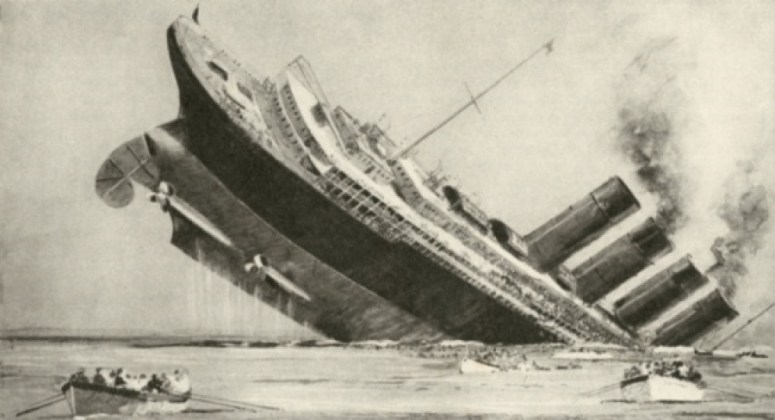
U-20 is able to get a clear shot at the Lusitania, launching a torpedo into the hull of the gigantic ship, destroying and sinking it in a matter of eighteen minutes. There are 764 survivors; 1198 dead, including 123 Americans. Over 600 people on the ship are never found. America doesn’t enter the war for two more years, until German instituted a policy of all-out submarine warfare against any ship, no matter who it belonged to.

After the sinking of the Lusitania, a controversy arose (today called a “conspiracy theory”), as they so often do. The Admiralty (the arm of the British government that overseas shipping) failed to provide—when it might easily have done so—an escort of battleships for the Lusitania as it entered the “danger zone” of the North Atlantic, where U-boats were known to be operating. Many people believed—and still believe—that certain parties in the British government wanted the Lusitania to be attacked so that America would be sure to enter the war and come to Britain’s aid.

Dead Wake is a fascinating slice of twentieth century history, written, by Erik Larson, in a style known as “narrative nonfiction,” a genre originated (or at least advanced) by Truman Capote with In Cold Blood. It’s a story about the stakes that are involved in war, in this case the lives of innocent victims who just happen to be in the wrong place at the wrong time. The sinking of the Lusitania showed the war then being fought between Britain and Germany was to be a different kind of war, one in which nobody was to be spared.

Copyright © 2017 by Allen Kopp

Ozymandias ~ A Poem by Percy Bysshe Shelley

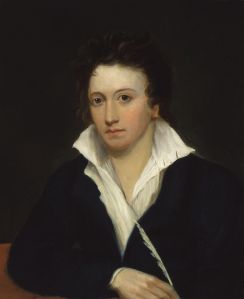
Percy Bysshe Shelley (1792-1822)

Ozymandias ~ A Poem by Percy Bysshe Shelley

I met a traveller from an antique land,
Who said: Two vast and trunkless legs of stone
Stand in the desert. Near them, on the sand,
Half sunk a shattered visage lies, whose frown,
And wrinkled lip, and sneer of cold command,
Tell that its sculptor well those passions read,
Which yet survive, stamped on these lifeless things,
The hand that mocked them, and the heart that fed;
And on the pedestal, these words appear:
“My name is Ozymandias, King of Kings:
Look on my Works, ye Mighty, and despair!”
Nothing beside remains. Round the decay
Of that colossal Wreck, boundless and bare
The lone and level sands stretch far away.

Ozymandias, by English Romantic poet Percy Bysshe Shelley (1792-1822), was first published in 1818. In antiquity, “Ozymandias” was the Greek name for the Egyptian pharaoh, Ramses II, who ruled Egypt for sixty-six years, from 1279 BCE to 1213 BCE. Shelley was inspired to write the poem as a result of the British Museum’s acquisition of a 7.25-ton fragment of a statue of Ramses that had been removed from the mortuary temple of Ramses at Thebes. The poem explores the fate of history and the ravages of time. Even the greatest of men and the empires they forge are impermanent.

A Woman Named Ruby

To R.D. (1950-2014):

Time to put on your hysterectomy pants, dear, your go-go boots and your fright wig, and blow some kisses.

Ruby Upjohn, Ruby Goldfarb, Ruby Hagwell, Ruby Pickles, Ruby Fudge, Ruby Bankhead, Ruby Sherwood, Ruby Tubbs, Ruby Costello, Ruby DeFazio, Ruby Peebles, Ruby Hackles, Ruby Ludlow, Ruby Fuddles, Ruby Jitters, Ruby Feeney, Ruby Butts, Ruby Wang, Ruby Smoot, Ruby Fish, Ruby Gambini, Ruby Weiner, Ruby Frogley, Ruby Bumpus, Ruby Zasa, Ruby Farquhar, Ruby Pompadour, Ruby Clutch, Ruby Toddler, Ruby Peabody, Ruby Jerkewitz, Ruby Buggs, Ruby Cornblatt, Ruby Blathers, Ruby Dalzell, Ruby Shockley, Ruby Wooley, Ruby Wimpy, Ruby Belanovi, Ruby Slapwell, Ruby Snitley, Ruby Flywheel, Ruby Frankfurter, Ruby Dunkfeather, Ruby Chin, Ruby Arbuckle, Ruby Clapsaddle, Ruby Bumble, Ruby Davenport, Ruby Dejesus, Ruby Dill, Ruby Diesel, Ruby Ghostly, Ruby Dibble, Ruby Gooch, Ruby Hardapple, Ruby Hoyden, Ruby Mangles, Ruby Polkratz, Ruby Mims, Ruby Nugent, Ruby Punsley, Ruby Poovey, Ruby Rickets, Ruby Teetlebaum, Ruby Dithers, Ruby Waddler, Ruby Snork, Ruby Tudball, Ruby Hunsdorfer, Ruby Oglethorpe, Ruby Pilbeam, Ruby Flan, Ruby Buckles, Ruby Glasscock, Ruby Woo, Ruby Gulwart, Ruby Mushnick, Ruby Zorina, Ruby Stickles, Ruby Turnblad, Ruby Fishpaw, Ruby Ziffle, Ruby van Peep, Ruby Wagstaff, Ruby Gribble, Ruby Dillweed, Ruby Moonlove, Ruby Snitzler, Ruby Hogwaters, Ruby Clohessy, Ruby Bobolinski, Ruby Ouspenskaya, Ruby Nermi, Ruby Nankler, Ruby Bitchelli, Ruby Lupino, Ruby Pasquesi, Ruby Shumway, Ruby Hogchow, Ruby Wigglesworth, Ruby Skeffington, Ruby Beragon, Ruby Hudson, Ruby Broadnax. Ruby Lafarge, Ruby Wellenmellon, Ruby Thorndike, Ruby Dubois, Ruby Sheeny, Ruby Tull, Ruby Gaylord Ruby Weems, Ruby Ogilvie, Ruby Moncrieff, Ruby Cumberbunch, Ruby Gombell, Ruby Ignatowski, Ruby Mayfair, Ruby Snitzler, Ruby Otis Skinner, Ruby Chomley, Ruby Toluboff, Ruby Tenuta, Ruby Heeny, Ruby Terhune, Ruby Laflamme, Ruby Montague, Ruby Miggles, Ruby Gummidge, Ruby Dalrymple, Ruby Nemecek, Ruby Gilhooley, Ruby Delmage, Ruby Mullendorfer, Ruby Odets, Ruby Chuffee, Ruby Philpotts, Ruby Mudge, Ruby Mertz, Ruby Yurka, Ruby Ricardo, Ruby Flynn of the Memphis Flynns, Ruby E. Tata, Ruby Rifka, Ruby Fafara, Ruby Frizzell, Ruby Rapf, Ruby Fonzarello, Ruby Beavers, Ruby Finkelstein, Ruby Nerdlinger, Ruby Scafie, Ruby Lipchitz, Ruby Dragonette, Ruby Franzoni, Ruby Frimmle, Ruby Morehead, Ruby Magarulian, Ruby Tweedy, Ruby Schwump, Ruby DeFafa, Ruby Belcher, Ruby Bigglesworth, Ruby Blodney, Ruby “Champagne” King, Ruby Biggerstaff, Ruby Wang, Ruby Wigmore, Ruby Lashutsky, Ruby Flipwig, Ruby DeGasse, Ruby DeBouva, Ruby Noddler, Ruby Grody, Ruby Jigglewater, Ruby Fuddington, Ruby Fromkiss, Ruby Creech, Ruby Firpo, Ruby Hathaway, Ruby Won Fat Ching, Ruby Zizz, Ruby Bartholomew, Ruby Foster Kane, Ruby Sisley, Ruby Nazimova, Ruby Rambova, Ruby Wiggenstein, Ruby Terwilliger, Ruby Fortescue, Ruby Chickwell, Ruby Noodleman, Ruby Scammington, Ruby Cundiff, Ruby Fontaine, Ruby Whipsnade, Ruby Ritz, Ruby Hickey, Ruby Clawmute, Ruby Traherne of the Sleepy Trahernes, Ruby Meisenbach, Ruby Wolfsheim, Ruby Seamungle, Ruby Piggott, Ruby Witherspoon, Ruby Vonzell, Ruby Burpo, Ruby Fagmont, Ruby Pitlik, Ruby LaSalle, Ruby Newton, Ruby Tikvah, Ruby Wellington, Ruby Fosdick, Ruby Romaine, Ruby Birnbaum, Ruby Buzzell, Ruby Huffingwell, Ruby Delgado, Ruby Bracegirdle, Ruby Shinliver, Ruby Minge, Ruby Fafara, Ruby Belvedere, Ruby Duggs, Ruby Fuddwell, Ruby Entwistle, Ruby Feckles, Ruby Bobo, Ruby Midgley, Ruby Bleeth, Ruby Longoria, Ruby Livingston, Ruby Gleeb, Ruby Butters, Ruby Cornelius, Ruby Hackenbush, Ruby Twelvetrees, Ruby Gunn, Ruby Novak, Ruby Barbarello, Ruby Beanstock, Ruby Winkle, Ruby DeBeers, Ruby Wozniak, Ruby Scaramucci, Ruby Tweedlebottom, Ruby Legg, Ruby Cathcart, Ruby Bump, Ruby Lupone, Ruby Tittle, Ruby Naylor, Ruby Jeeter, Ruby Blodgett, Ruby Gotrocks, Ruby Kravitz, Ruby Pfaff, Ruby Bleffins, Ruby D’Agastino, Ruby Finklebaum, Ruby Minnevitch, Ruby Schwumpf, Ruby Hemphill, Ruby D’Angelo, Ruby Gottlieb, Ruby Lanskany, Ruby Dalwicky, Ruby Lacreevy, Ruby Snigley, Ruby Meng, Ruby Wurm, Ruby Raspberry, Ruby Turkel, Ruby Schlendinska, Ruby Sousé, Ruby Ratoff, Ruby Brewster, Ruby B. Goode, Ruby Schultz, Ruby Squigman, Ruby Dodders, Ruby Leathers, Ruby Gabor, Ruby Fickett, Ruby Stammers, Ruby Beebe, Ruby Hogg, Ruby Falconetti, Ruby Dunphy, Ruby Hootkins, Ruby Hruba Ralston, Ruby Terle, Ruby Peacock, Ruby Thwaite, Ruby Pitts, Ruby McConkle, Ruby Pickleweed, Ruby Titicombe, Ruby Bushmiller, Ruby Frowzell, Ruby Shitusky, Ruby Buttinski, Ruby Negri, Ruby Indelicato, Ruby Cursewell, Ruby Crabhatchet, Ruby Feng, Ruby Hogpit, Ruby Reeb, Ruby Mondello, Ruby Banakowski, Ruby Bean, Ruby Fizzwater, Ruby DeBanzie, Ruby Glotnick, Ruby Travolta, Ruby Blomquist, Ruby Dawkins, Ruby Spanks, Ruby Fecklebaum, Ruby Ferrigno, Ruby Killbride, Ruby Ferch, Ruby Chudley, Ruby Fatone, Ruby Vigoda, Ruby Rubicam, Ruby Oh, Ruby Sharples, Ruby Mary Elephant, Ruby Teeters, Ruby Skidwell, Ruby Dilmont Jackson, Ruby LaPeevy, Ruby “Batshit” Maroney, Ruby DePussy, Ruby Suggs, Ruby Pitz, Ruby Slippers, Ruby Turlock, Ruby Buzz-Zard, Ruby Mutzendorfer, Ruby Sackville-West, Ruby Hagmore, Ruby Yarnell, Ruby Nerdwell, Ruby Horowitz, Ruby Stompanato, Ruby Gidrey, Ruby Pertwee, Ruby Liptrapp, Ruby Friganza, Ruby Dodders, Ruby Grint, Ruby del Rio, Ruby Gidrey, Ruby Snerdwell, Ruby Huznell, Ruby Von Rump, Ruby Cheesewater, Ruby Muldoon, Ruby Warshack, Ruby Barfwell, Ruby Weaselknocker, Ruby Lipshine, Ruby Mahoney, Ruby Pizzlebottom, Ruby DeGaw, Ruby Chickles, Ruby Sprinkles, Ruby Wooters, Ruby G. Krebs, Ruby Delvecchio, Ruby Bonaventura, Ruby Kaminska, Ruby Winklestone, Ruby Vetch, Ruby Hackenschmidt, Ruby Scales, Ruby Mooseburger, Ruby Grundell, Ruby Alma-Tadema, Ruby Campisi, Ruby von Tussle, Ruby Lipschitz, Ruby Nova-Mali, Ruby Gonzales the Fastest Bitch in all Meh-e-co. Three hundred and ninety were not enough.

An American Tragedy ~ A Capsule Book Review

An American Tragedy ~ A Capsule Book Review by Allen Kopp

The great American novel of the twentieth century—or at least one of them—is Theodore Dreiser’s An American Tragedy. First published in 1925, it is a very ambitious novel of monumental length (856 pages, originally in two volumes). It’s about one man’s misguided quest for the American dream. The title tells us it’s not an uplifting or a happy story.

It’s the 1920s or thereabouts, but the time doesn’t matter because it could be any time. Young Clyde Griffiths has a disadvantaged childhood. His parents are un-ordained “ministers” of the gospel. They travel around from city to city, saving souls and ministering to the needy by setting up “missions.” Clyde has two sisters and one brother. The family is poor and never has enough money to provide properly for Clyde and his brother and sisters. They don’t even go to school because the family moves around so much.

When Clyde is about sixteen or seventeen, he gets a job as a bellboy in a ritzy Kansas City hotel. With this job, Clyde is able to witness the world of wealth and glamor that he has never seen before. He makes more money through tips than he ever imagined possible. His friends, other bellboys, introduce him to the world of booze and loose women. Clyde realizes what a sheltered life he has been leading. His glimpse into this new world makes him know, for the first time, the kind of life he desires for himself.

A traffic accident killing a young girl in Kansas City causes Clyde to run away. He drifts from place to place alone for a couple of years, until he lands a job as bellboy in a Chicago hotel. There he meets his rich uncle, a manufacturer from Lycurgus, New York. The uncle agrees to give Clyde a tryout in his collar and shirt factory. Clyde arrives in Lycurgus and goes to work for his uncle in a menial job at first and feels neglected by his uncle’s family because they fail to “take him up” socially.

Eventually Clyde is given a better job in the factory and finds himself head of a department that employs young girls. He meets there one Roberta Alden, a poor farm girl who has taken a job in the city to help her family. Roberta is pretty and pleasing in her way and soon she and Clyde begin spending time together, keeping it a secret because of a factory rule that forbids any kind of socializing between employees and department heads.

After a few months of “dating,” Clyde induces Roberta to become “intimate” with him, which she agrees to do because she loves him and believes he loves her and will eventually marry her. Being innocent and not knowing the ways of the world, Roberta soon becomes pregnant.

While Clyde has been secretly dating Roberta, he has also been moving up in Lycurgus society, having been “taken up” by a sympathetic female cousin named Bella Griffiths. Through his good looks and gentlemanly manner, he soon becomes popular with the smart, young, society set and specifically with a girl named Sondra Finchley, beautiful, rich and accomplished. When she and Clyde fall in love, he can’t believe his good fortune. He is on the verge of having everything he ever dreamed of: wealth, comfort, ease, and a beautiful wife. He has a terrible problem, though: a pregnant girlfriend for whom he no longer cares. This situation can ruin everything he’s hoped for and aspired to. If Roberta “exposes” him to his rich relatives and his society friends, it will bring his world crashing down.

Short of marring Roberta, which Clyde doesn’t want to do, he tries to get her to abort the fetus, which she believes is morally wrong but which she is willing to do to get herself out of trouble. She can’t find a doctor willing to perform the operation and a medicine that Clyde gets from a druggist that is supposed to cause the fetus to abort on its own doesn’t work. She then demands that Clyde marry her to salvage her reputation and to give the baby a name.

With Clyde’s world being threatened in this way, he resorts to desperate measures to try to extricate himself. He hears about an accident on a lake whereby two people in a rowboat are drowned when the boat overturns. The body of the woman is found; the man is never found. Clyde believes that if he can get Roberta out on a deserted lake in a rowboat, he can cause the boat to overturn, drowning her. Clyde himself will get away, but people will believe that he also drowned, even if his body is never recovered.

Out on the lake with Roberta in the rowboat, Clyde has a “change of heart” (or so the defense wants the jury to believe). He can’t kill her; he feels sorry for her and begins to rediscover some of the old feeling that he had for her in the beginning. He decides he will go through with marrying her, thereby giving up his dreams of Sondra Finchley and her world of wealth and glamor.

Something happens in the rowboat, though. In an agitated state, Roberta stands up in the boat and attempts to move toward Clyde. He also stands and attempts to catch her. The boat capsizes and Clyde and Roberta both go into the water. Roberta drowns. Without attempting to rescue Roberta, Clyde swims to shore and walks all night to get to his society friends, encamped at a resort nearby.

Clyde isn’t fooling anybody, though. There are abundant witnesses to testify to his activities on the fateful day that he and Roberta go rowing, although no actual witnesses to Roberta’s drowning come forward. Clyde is arrested within a few days while he is cavorting with his society friends (not, however, with a clear conscience), and there begins a lengthy section of the novel that details his incarceration and trial for murder. He has two slick defense lawyers to try to get him off, but are the men of the jury really going to believe that Clyde, with all the damning evidence against him, didn’t mean to kill Roberta at all?

An American Tragedy is a minutely detailed story of a murder, the circumstances of a man’s life that led to murder, how it formed in his mind, the desperation that he felt before and after, how it was executed, what followed, etc. We see the murderer (if that’s what he is) from his own point of view. We gather from this story that just about anybody might commit murder if circumstances warrant it. Clyde is not a foul, dark-hearted killer as he is portrayed during his trial. He is confused, conflicted, and, as his defense paints him, a “moral and mental” coward. Not a bad person but pushed to do a bad deed.

Copyright © 2017 by Allen Kopp

The Sampling Officials ~ A Painting by Rembrandt van Rijn

The Sampling Officials (1662) by Rembrandt van Rijn

The Sampling Officials (also called The Syndics of the Drapers’ Guild) is a 1662 oil painting by Rembrandt van Rijn, a Dutch master who lived from 1603 to 1669. The men in the painting are drapers who were elected to assess the quality of cloth that weavers offered for sale to members of their guild.

Alien: Covenant ~ A Capsule Movie Review

Alien: Covenant ~ A Capsule Movie Review by Allen Kopp

The year is 2104. A disparate group of characters are traveling on a gigantic spacecraft (called the Covenant) to a new, distant planet to start a colony. (Earth, you see, is dying.) It’s a long journey and a hazardous one because there’s no telling what these travelers might encounter in the vast, uncharted reaches of space. When they are still a long way from where they’re going, they receive a mysterious, seemingly human, transmission fairly close to where they are. They veer off-course for a few weeks to investigate the source of the signal and we, the audience, know it’s a mistake because we’ve seen this plot device before.

Some but not all of the travelers get on a smaller spacecraft and land on the alien planet where the mysterious signal originates, not knowing what they’ll find but hoping it’s something good, like an appealing, habitable place where they can start their colony and not have to go on to their original destination. Among the group is a “simulated human” (they never use the word “robot”) named Walter, the only non-human on the mission.

They find the alien planet earth-like but with no birds or animals. Soon two of their number become mysteriously ill and we witness, once again, the hideous creature come bursting out of their bodies. The thing has been incubating inside them, don’t you know, and when it comes out, it’s fully formed, though miniature-sized, and ready for killing humans. In this instance, it’s rather lizard-like, moves with lightning speed, has an elongated head, multiple limbs, a slobbering mouth, and a tail. If you’ve ever seen any of the Alien movies going back to 1979, you are familiar with this creature and hope you never meet one.

Once on this alien planet, the travelers discover the wreckage of an enormous spacecraft called the Prometheus. If you saw the movie Prometheus in 2012, you may remember what happened at the end of it. Well, this movie picks up the thread from that movie and continues the story in a way, or, as the saying goes, after a fashion. You may remember from Prometheus a “simulated human” named David. Well, it turns out that Walter, the simulated human from the current movie, is identical to David, meaning, I suppose, that they originated from the same source or the same creator. The only difference is that David can “create” and think on his own, while Walter is only compliant with the humans he works with. (You got that?) It seems that David, in the ten years since the Prometheus crashed, has become an amateur zoologist and, more to the point, he doesn’t think much of humans.

Alien: Covenant is pretty standard stuff. Nothing new here. After the initial banal “setup” that takes a half-hour or so and shows us lots of space hardware and contains lots of difficult-to-understand dialogue (and, really, who cares what they’re saying?), we find ourselves in another who-will-die-next situation. And, of course, there’s the usual claptrap about the “origins” or human life. (Will that question ever be answered to our satisfaction?) The most interesting characters by far are the two simulated human “men,” Walter and David (both played by Michael Fassbender), who show us the conflicting sides of good and evil. And, as you might expect, the story is left at the end for yet another installment to come in the ongoing saga.

Copyright © 2017 by Allen Kopp