The Third Day of Winter ~ A Short Story


The Third Day of Winter image 4
The Third Day of Winter
~ A Short Story by Allen Kopp ~

(This short story has been published in Offbeat Christmas Story and The Literary Hatchet.)

They had a little party at work, complete with cake and champagne (Here’s to another successful year!), and then everybody was allowed to leave for the day. It was the day before Christmas and nobody had to be back to work for three days. What a festive mood the downtrodden workers were in! There was dancing on tabletops, furtive kissing in corners, drunken laughter.

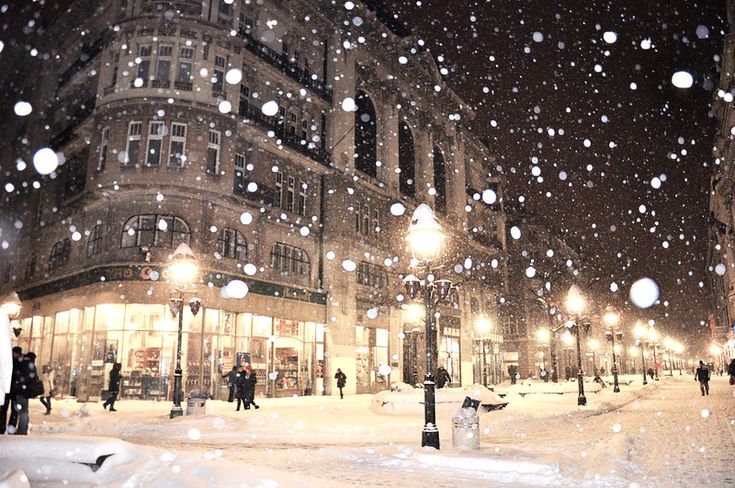
As Vesper left the office, it was just beginning to snow so she decided to walk home instead of taking the bus. She had always liked snow, especially at Christmastime, and had seen too little of it in recent years. She stopped on the way home at a little market and bought a dozen oranges and a small box of chocolate-covered cherries. As she was paying for her purchases, the old man behind the counter gave her a sprig of mistletoe.

When she reached her building, she felt agreeably fatigued and slightly frostbitten. As she climbed the stairs to her third-floor apartment, she couldn’t help noticing how quiet the building was. The usual loud voices, TVs, crying babies and yapping dogs were absent. She seemed to be the only tenant who hadn’t gone out of town for the holiday.

She unlocked the door, kicked off her wet shoes and hung up her coat. It was just beginning to get dark outside so she turned on all the lights. She tied a ribbon around her mistletoe and hung it in the doorway between the kitchen and the living room; plugged in the lights on her little artificial Christmas tree that was made to look real but wasn’t fooling anybody with its brown-and-green plasticity. She stood back and admired the comfort, the appeal, of her little home. It was the first home she had ever had that was hers and hers alone without belonging to somebody else.

“I’m really very lucky,” she said to herself as she stood in the middle of the room.

Already she was missing her friend Marlene at work, even though she had just left her a short time earlier. She wanted to call her and tell her about walking home in the snow and about the mistletoe. She knew that Marlene would enjoy hearing those things and would laugh at them in her usual way.

She went to the phone, not to call Marlene—she would be busy now with family—but to call somebody else.

“Hello?” she said when she heard her mother’s voice, sounding very faint and far away.

“Who’s that?” her mother said.

“It’s Vesper.”

“Is anything wrong?”

“No. I just got home from work and I wanted to call you and wish you a merry Christmas.”

 “You know I don’t go in for that stuff very much.”

“I know. Did you get the silver pin I sent you?”

“Yes, I got it.”

“I thought it would look good on your black coat.”

“Oh, I don’t have that coat anymore. It was a little too funereal for me.”

“It was a beautiful coat.”

“If I had known you liked it so much, I would have given it to you.”

“It doesn’t matter. How’s Stan?”

“We’ve separated. I haven’t seen him since summer.”

“Are you getting a divorce?”

“Oh, I don’t know. There’s a new man in my life now. His name is Milt. He’s talked about marrying me, but I don’t think I want to get married again. I’ve been down that road too many times.”

“Any news of Weston?”

“Nothing, except that he’s living the bohemian life and wants nothing to do with his family.”

“When you see him, tell him I said hello.”

“I will, dear. I really have to run now. I’m meeting some people for dinner. I have a terrible headache and don’t really feel like going out, but I said I’d go and I don’t want to break my word.”

“All right, mother. Goodbye.”

As Vesper hung up the phone she was aware of the hurtful omissions in the conversation. Her mother hadn’t bothered to ask her how she was or what plans she had for Christmas, if she had someone to spend it with or if she was going to be alone. Those things wouldn’t occur to her—she simply didn’t bother herself too much with her grown children. She had delivered them safely to adulthood and that’s all that anybody could reasonably expect.

Vesper went into the kitchen to see what she might dig up for dinner, but the prospect of having the usual everyday fare on Christmas Eve and then dozing on the couch in front of the TV until time to go to bed was suddenly dismaying to her. She didn’t have to do what she always did, just because she always did it. She could make Christmas Eve into something special, even if she did have to spend it alone.

She went into the bedroom and changed her clothes quickly before she gave herself the chance to change her mind. She made herself ready to go out again (boots, scarf, gloves, coat) and turned off all the lights except for one small lamp beside the door.

She began walking, not knowing for certain where she was going. The snow had accumulated to three or four inches and was still coming down, the wind blowing it along the sidewalk and causing it to drift along the building fronts. Nothing made it seem more like Christmas.

Two blocks from her building she came upon two men, an older and a younger one, standing with their hands over a barrel in which a small fire burned. Both men looked down into the barrel, but when she passed near them they turned and looked at her. The older man was the nondescript sort that one sees on the street every day, ragged and undernourished. The younger man was thin, medium-tall and sturdy-looking. He wasn’t wearing a hat (in the light from the fire his hair had a reddish tint) and he wore an enormous overcoat that went down past his knees, with the collar turned up to partly cover his ears. On his cheek was a crescent-shaped scar as if once, long ago, he had been gouged by a shard of glass or the blade of a knife. These details about him registered on her brain in the few seconds she looked at him and then she looked away.

She came to a brightly lighted drugstore and stopped and looked through the frosty window at the rows of displays and the people moving about as if they were underwater. After a moment of indecision, she went inside, passing a perfume display over which two fat women were talking loudly, and went to a rack of magazines in the back. She picked up a magazine, thumbed through it and put it back.

The wall behind the magazine rack was a mirror. As she reached out her hand to put a magazine back on the rack where she had found it, she saw the reflection of a man in the mirror. He was half-a-foot taller than she was and standing behind her, to her right, as though looking over her shoulder. Thinking herself in the way, she stepped aside to give the man more room and that’s when she realized it was the same young man with the scar on his face who had been standing over the fire in the barrel. She felt embarrassed at the thought that he might speak to her, so she left the drugstore and went back out into the freezing night.

She walked on from the drugstore for a block-and-a-half and when she had to stop at a corner with a clot of other people to wait for the light to turn, she took a quick glance over her shoulder to see if the young man had come out of the drugstore after her. She didn’t see him, so she was sure he wasn’t following her. Why would she have ever thought he was?

A little restaurant with the smell of garlic and twinkling lights in the window attracted her attention. It was a place that ordinarily would have been too expensive for her, but she was tired of walking and went inside.

The lights in the restaurant were very dim, giving the place a dreamlike quality after the snowy street. A smiling waiter seated her at a small table near the front and helped her remove her coat. He handed her a menu and when she seemed to be having trouble making up her mind, he suggested fried calamari and polpette di baccala. She didn’t know what it was but readily acceded to his suggestion anyway. Since it was Christmas, she was glad to be able to order something unusual and exotic that she could tell Marlene about.

When the waiter asked her if she wanted a bottle of wine, she said yes and as soon as he brought it she started drinking copious amounts of it and eating delicious garlicky breadsticks out of a little basket while she waited for her food.

The food was very much to her liking but what she liked most was the wine. She ended up drinking the entire bottle before, during and after the meal.

When all the food on her plate was gone, she felt happy and fortunate, happy to be alive and fortunate to have a good-paying job that would allow her to have an extravagant meal on a special occasion. She thanked the waiter effusively, gave him a more-than-generous tip, and wished him a merry Christmas. He helped her into her coat and opened the door for her as she left.

In the next block she slipped on an icy spot on the sidewalk and fell sideways into a pile of snow, unhurt, but attracting some unwelcome attention. As a small crowd of people gathered around to see if she was all right and to help her to stand up again, she saw coming toward her the man in the long coat with the scar on his face. Someone blocked her view for a few seconds and when the way was clear again he was gone. Was she seeing people who weren’t really there? It must have been a result of drinking all that wine.

It was not late at all for Christmas Eve and, in spite of the snow and cutting wind, she wasn’t ready to go home just yet. She would make a night of it. She would have lots to tell Marlene and her other friends at work how she spent Christmas Eve while they were all with their families. They wouldn’t exactly envy her but would admire her for having a good time on her own without having to depend on somebody else.

Four or five blocks farther on was the Odeon movie theatre. She was delighted to see that the show was just about to begin. She paid her admission and went inside and took a seat in the orchestra among a handful of other people. She dozed during the previews of coming attractions and a featurette about a Christmas tree farm, but when the feature began she was fully awake.

In the feature presentation, a woman named Mildred was released from a mental hospital at Christmastime. She had to become reacquainted with her children because she had been away so long they almost forgot she existed. She tried to resume her role in life as wife, mother and society hostess, but she had terrible nightmares and hallucinations that showed she should never have been released from the mental hospital at all. What was even worse, though, was that her fifteen-year-old daughter, Veronica, was showing signs that she had inherited Mildred’s mental illness. She would put her dress on backwards without even knowing it and stand up during mealtimes and scream there were Martians on the roof. These were the exact same things that Mildred had done that caused her to be sent to the mental hospital in the first place when Veronica was in grammar school.

When the picture was over, Vesper sighed heavily, put on her coat and went back out into the cold. She was feeling tired now and the movie, although she had enjoyed it, made her feel like crying. It had been a lovely evening, though.

It was nearly eleven o’clock. The snow had stopped but it seemed colder now because the wind was blowing. When she thought of the long way she had to walk to get back home, she wished she was already there, relaxing in her pajamas, drinking hot chocolate and listening to Christmas music on the radio.

The streets that had been so crowded before were almost deserted now. Everybody had gone home to celebrate Christmas. A drunk stepped out of the shadows and asked her for a dollar but she sidestepped him and kept going without looking back.

Two blocks from her building she came upon two men, an older and a younger one, standing with their hands over a barrel in which a small fire burned. Both men looked down into the barrel, but when she passed near them they turned and looked at her. The older man was the nondescript sort that one sees on the street every day, ragged and undernourished. The younger man was thin, medium-tall and sturdy-looking. He wasn’t wearing a hat (in the light from the fire his hair had a reddish tint) and he wore an enormous overcoat that went down past his knees, with the collar turned up to partly cover his ears. On his cheek was a crescent-shaped scar as if once, long ago, he had been gouged by a shard of glass or the blade of a knife.

As she walked past these two men, looking straight ahead, the younger man disengaged himself from the older and began following her. She didn’t hear  a sound—his footsteps in the snow were silent—but she knew, she felt, that he was a few paces behind her.

She came to her building and climbed the stairs to the third floor, opened the door with her key, let herself in, and reclosed the door without locking it.  Without turning on any lights, she went to the window overlooking the front of the building and looked down. Standing there in the snow, looking up at her, was the young man in the long overcoat with the crescent-shaped scar on his cheek.

She wrote on a piece of note paper from beside the phone these words: Come up, apartment 320. She wadded the paper into a little ball and opened the window just wide enough to insert the ball of paper and let it drop to the ground. She stood there in the dark and watched the man approach the paper, pick it up and read it. She took a couple of deep breaths and in a few seconds she heard his footsteps on the stairs, exactly in time to the beating of her own heart.

Copyright © 2024 by Allen Kopp

 

Another Christmas Eve ~ A Short Story

I Want to Spend Christmas with You
Another Christmas Eve 
~ A Short Story by Allen Kopp ~ 

My parents got their divorce the summer I was fifteen and sold the house we lived in. My mother, my little brother, and I moved into a small, four-room flat in an old apartment building downtown. It was on the fifth floor and there were no elevators, so that meant we were constantly walking up and down the stairs.

The flat wasn’t big enough for me to have my own room, so we moved my bed into a little space off the kitchen, which was originally meant to be a pantry. It was tiny and cramped, but the best thing about it was that I had my own window with a good view of buildings and trees far off in the distance. I liked to lay in bed at night and look out at the sky. The best nights were when there was a full moon. When there were thunderstorms, it felt like the lightning was going to come in through the window and zap me into oblivion.  

Now it was Christmas again, or almost. Our first Christmas in the apartment. Our Christmas tree stood in the corner of the front room, aglow with multi-colored lights and loaded down with tinsel and ornaments, stacks of presents beneath its branches. A sprig of holly hung in the doorway into the kitchen. On the front door was a wreath that would probably be stolen before Christmas morning ever arrived.

My little brother Georgie, age six, jumped up and down on the couch and screamed. He was wholly invested in Christmas. It was snowing out, he didn’t have to go back to school until after New Year’s, and he believed that Santa was going to be especially generous with him this year.

“You’d better calm down,” I said. “Santa will pass you by if he gets word that you’ve been bad.”

“I haven’t been bad!” he screeched.

My mother came in from her bedroom, where she had been putting on makeup and fixing her hair. She was afraid I was going to divulge the great secret that Santa doesn’t really exist.

“What did you just say to him?” she asked, looking at me threateningly.

“I didn’t say anything,” I said. “I just told him he’s giving me a headache.”

“Get down from there, Georgie! You know you’re not supposed to use the couch as a trampoline! The couch is for sitting, not for jumping.”

“All this Christmas stuff is making me puke,” I said. “A person can only take so much.”

“Well, it’s too bad you’ve forgotten what it’s like to be excited about Christmas,” she said. “I guess you’ve grown too sophisticated for your family.”

“He’s grown too sophisticated!” screamed Georgie.  

“Shut up!” I said.

“When do we get to open the presents?” Georgie screamed.

“For the eighty-seventh time, we will open the presents on Christmas morning after we’ve had a good breakfast.”

“Why do we have to wait so long?”

“Because I said so, that’s why!” She sat on the other end of the sofa and patted her hair in back.  

“I want to open one now!”

“No! We’ve been all through that a dozen times. You have to wait like everybody else.”

“Tomorrow’s Christmas and we haven’t heard anything from daddy yet,” I said.

“No, and you probably won’t, either. He’s probably laying up in some hotel room, drunk as a skunk.”

 “Drunk as a skunk!” Georgie screamed.

 “I thought he’d send at least send us a present.”

 “You’re old enough to know you can’t count on him for anything.”

“We always had a good Christmas with him,” I said.

“I know, but those days are over. Your daddy is out of the picture now. He was the one that wanted the divorce.”

“I’m going to the movies tonight,” I said. “It’s a Christmas Eve horror double feature.”

“I don’t care what it is,” she said. “You’re not going to the movies on Christmas Eve. You’re going to spend the evening with your family.”

“But I’m meeting someone.”

“Call whoever it is and tell them you can’t make it.”

“Is he going to be here?”

“He has a name, you know.”

“Is Regis going to be here?”

“Yes, he’s going to be here in time to eat dinner with us and later we’re all going to church.”

“I don’t feel like going to church.”  

“You feel like going to the movies but you don’t feel like going to church?”

“Church gives me a headache.”

“You’re insane.”

“If I am, I get it from you. Insanity runs in your family.”

“I think Regis is going to ask me to marry him.”

“Why would you want to marry Regis?”

“Why shouldn’t I marry him? He’s the sweetest, kindest man I’ve ever met and he’s got a good job.”

“He sells washing machines in an appliance store.”

“Someday he’ll be manager. There’s really good money in that.”

“What about daddy?”

“What about him?”

“You’re going to marry Regis without telling daddy first?”

“You’re a smart boy, but you just don’t seem to understand. There is no longer any connection between me and your daddy. We are kaput!”

“What does that mean?”

“Your daddy and I are finished with each other. All ties are severed.”

“All ties are severed!” Georgie shrieked.

“If you marry Regis, does that mean we can move out of this crummy apartment?”

“Not right away. Regis will probably move in here with us. His business hasn’t been so good lately. He’s a little strapped for cash at the moment. He expects things to pick up next year, though.”

“If Regis moves in here with us, I’m moving out.”

“Why don’t you like Regis?”

“He belongs to a bowling league.”

“A lot of men belong to bowling leagues.”

“He’s old!”

“He’s forty-three.”

“He wears cologne that smells like bug spray.”

“I’ll get him to stop wearing it after a while.”

“He has hairs sprouting out of his ears. Haven’t you ever noticed that?”

“Of course, I’ve noticed it. His grooming isn’t the best. That’s because he lives alone. All that will change after we’re married.”

“I think you should check with daddy first before you marry Regis. He might want to come back. If you marry Regis, it’ll be too late.”

“Your daddy is not coming back. Ever.”

“You might be surprised.”

“It’s time for you to face reality.”

“I am facing reality and I don’t like it.”

“I think I see Santa way up in the sky over there,” Georgie said, standing at the window.

“You’re hallucinating again,” I said.

“It’s too early for Santa,” mother said. “He won’t come until we’re all asleep. He doesn’t like for people to look at him.”

“I can certainly see why,” I said.

“I hope he remembers everything I wanted,” Georgie said.

Mother went back into the bedroom and in a little while came back out in her red Christmas dress that in my opinion was too tight. She had dowsed herself in perfume. When she saw me lying on the couch staring at the ceiling, she decided I needed something to do.  

“I want you to go down to Friedlander’s market and buy a carton of eggnog for tonight,” she said, digging in her purse for some money. 

“I don’t like eggnog,” I said.

“Well, are you the only one here? Regis says it’s not Christmas without eggnog.”

“Regis says. Regis says. What else does Regis say?”

“Can I go to the store, too?” Georgie asked excitedly.

“No! You stay here and help me wrap Regis’s present.”

“Regis, Regis, Regis,” I said as he went out the door. “He’s certainly a big man around here, isn’t he?”

The snow was falling heavier now. Cars made hissing sounds on the pavement as they passed by. Last-minute shoppers were still keeping the stores busy. With the setting of the sun, Christmas Eve had officially arrived.

The store only had one carton of eggnog left, so I grabbed it and went and stood in the long line to pay. When the cashier smiled at me and wished me a merry Christmas, I gave him a sour look.   

When I got back home, Regis had arrived with presents for all of us. He was throwing Georgie up near the ceiling and then catching him on the way down. Georgie squealed with delight. Mother stood at the stove and beamed her approval.

Regis had brought Georgie a stuffed elephant and some other toys. My present from him, still wrapped in a big box with a red bow, was at my place at the table. Before I sat down, I picked up the box and set it on the floor.

“Aren’t you going to open your present from Regis?” mother asked.

“I’ll open it later. I have a headache now.”

When we were all seated at the table, mother insisted we join hands while Regis said grace. Regis’s hand felt clammy and unclean in mine. When he finally let go, I wiped my hand back and forth along my leg before I touched any food.

While we ate, I could see that mother was wearing a diamond engagement ring. This, of course, would be her Christmas present from Regis. So, it was official, then. He had proposed and she had said yes.

Regis talked about his day at work and laughed while we ate. Mother didn’t say much. Georgie kept looking out the window for signs of Santa. When Regis seemed to have run out of things to say for the moment, mother looked at me and said she had something she wanted to tell me and Georgie.

“What is it?” I asked with a sick feeling.

“Regis has asked me to be his wife and I’ve consented. We’re going to be married on New Year’s Eve.”

“What’s the rush?” I asked.

“I think it’s so romantic to be married on New Year’s Eve,” she gushed. “It will be a new start of a new year for all of us.”

She turned and looked at Regis. There were tears in her eyes. Regis took hold of her hand and pulled her in for a kiss. I knew he was getting ham grease all over her.

“I think I hear Santa’s sleigh outside!” Georgie said.

After we finished eating, mother told me to go put on my dress pants and a white shirt for church. She would help me with my tie before we left for church.

Except there wasn’t going to be any church for me. I grabbed my coat and hat and ran out the front door before she had a chance to see what I was doing.

The snow must have been five or six inches by that time. I still had on my tennis shoes and I could feel the snow soaking through to my socks after a few steps, but I didn’t mind. I needed to talk to daddy.

I knew that Colson’s Drug Store, about four blocks down from where we lived, had a pay phone. I had a pocket full of change especially for that purpose.

Right after the divorce, daddy gave me his private number where I could reach him any time. If I ever needed him, all I had to do was give him a call.

There were a lot of people at Colson’s, mostly at the pharmacy counter. Nobody paid any attention to me as I went all the way to the back, where the pay phone was.

I was sure he would answer. He would probably figure it was me calling on Christmas Eve.

The phone rang ten or twelves times, but finally he answered.

“Hello,” a little groggily.

“Daddy?” I said. “Is that you?”

“Who is this? Is this Evan?

“Yeah, it’s me. Evan.”

“I couldn’t hear you very well at first.”

“Can you hear me better now?”

“Yeah, I hear you fine now.”

“Well, since it’s Christmas Eve, I wanted to call and wish you a merry Christmas.”

“Merry Christmas to you, Evan!”

“Do you know where we’re living now?”

“No.”

“In an apartment downtown, on the fifth floor of an old building.”

“I’ve been wanting to come and visit you and Georgie, but I wasn’t sure where you were living. How’s Georgie?”

“He’s fine. Waiting for Santa to bring him everything he asked for.”

“Where are you now?”

“I’m in Colson’s Drug Store, near where we live. Do you know where that is?”

“Yeah, I’ve been to Colson’s a few times. Don’t you have a phone in the apartment?”

“We do, but I didn’t want mother to know I was calling you.”

“How is your mother?”

“She’s fine, but she’s the main reason I wanted to talk to you.”

“She’s not sick, is she?”

“No, she’s not sick. She’s getting married on New Year’s Eve.”

Daddy was silent for a moment and then he laughed. “Who is she marrying?”

“His name is Regis. He’s a creep. He smells funny. I don’t like him.”

“Maybe that’s because you don’t know him very well.”

“I want you to come and get me.”

“What?”

“I said I want you to come to Colson’s Drug Store and get me. I want to spend Christmas with you.”

“Wait a minute, Evan! I’m afraid that’s not possible. I’m not living in a very nice place. I don’t even have a tree.”

“That’s all right. I don’t need a tree.”

“If your mother doesn’t know where you are, she’ll be worried.”

“I’ll call her from your place.”

I started to cry like a blubbery crybaby. I hadn’t meant to cry, but I couldn’t seem to help myself.

“Is it that bad?” he asked.  

“Mother just isn’t herself. I don’t want to be around her. She acts like Regis is some kind of a god. They make me sick.”

“All right. If it’s that bad, I’ll come and get you.”

“How long? How long will it take?”

“Give me a half-hour or so.”

“Colson’s Drug Store. I’ll be waiting outside for you.”

It was still snowing, harder than ever now, but I didn’t mind waiting in the snow for a half-hour. People coming in and out of Colson’s looked at me and then looked away. Maybe some of them thought I was going to try to rob them. I tried leaning back against the building, crossing my legs and putting my hands in my pockets. I tried to look casual, but I felt conspicuous. 

I wasn’t sure what kind of car daddy would be driving, but I looked at every car. One of them would be him.

The half-hour passed and then an hour and then two hours. I was determined to wait as long as it took. I would wait all night. I would still be waiting on Christmas Morning if I had to. My fingers and toes were numb. I could no longer feel them. I wasn’t sure if they would ever work right again or not. I didn’t much care.

Copyright © 2024 by Allen Kopp

A Mate for the Monster

The mate for the monster.

A Mate for the Monster
~ A Short Story by Allen Kopp ~

The monster is seven and a half feet tall and as strong as ten men. He walks in a frightening, slow-gaited, halting manner. He has a bolt in his neck; his face is stitched onto his enormous head. He probably doesn’t know that he is made up of body parts from dead people (and if he did know he wouldn’t care). No matter where he goes or what he does, he scares people without even trying. That’s what makes him a monster.

He lives in a lonely castle on a mountaintop. He has no friends and his days are empty and pointless. His brain is not so addled that he can’t ask himself why he was ever created in the first place. He has recently taken to talking a bit and, when he’s not smoking cigars, drinking wine, or running around the countryside scaring people, he says things like, “Love dead—hate living.” This is not a good sign.

The mad scientist who made him, Dr. Victor Frankenstein, and his equally mad colleague, Dr. Pretorius, see that the monster is not happy. He is not fulfilled and is not living up to his full potential as a monster. After much thought and deliberation, the two mad scientists decide that the monster needs one thing above all others: a mate who will appreciate him for what he is and won’t be repulsed by the way he looks or by his crude manners. They toy with the idea of creating a male mate but that just doesn’t seem the thing, somehow, so they decide they will create for him a female mate.

Dr. Frankenstein sends his hunchback assistant, Fritz, out on a midnight graveyard run. From the graves of the newly dead, Fritz will gather the body parts needed to cobble together a female mate for the monster. He knows just the place, he says. Leave everything to him.

Now, Fritz has never been overly scrupulous about where he gets what he needs. He isn’t above going to the village and, seeing a lone woman standing on a corner singing a song, hitting her in the head to subdue her and then strangling her. When he makes sure she’s dead, he puts her in a burlap bag and throws it over his shoulder like a sack of potatoes and goes back to the castle. He knows Dr. Frankenstein will never ask questions as long as Fritz delivers the goods. The woman was just a nobody anyway. She’ll never be missed.

Dr. Frankenstein and Dr. Pretorius spend about two weeks creating what they think is a perfect mate for the monster. They take as much time as they need without rushing; they want to get every little detail just right. When the next violent thunderstorm occurs, they will be ready to harness the lightning.

They don’t have long to wait. All day long the next Saturday the sky is turbulent and dark. Finally, at night, a fearsome storm comes down the mountain, tearing at the castle walls. The wind howls and the rain falls as if a spigot has been opened in the sky. The lightning seems to be exactly on top of the castle, as if made to order. The two mad scientists place the as-yet lifeless body of the female mate on a table, connect the conductors that will attract the life-giving lightning, and hoist the table upwards through a hole in the ceiling.

The monster knows what is going on in the laboratory and paces his chamber nervously. Dr. Frankenstein has told him he must stay away until they are ready for him to see his mate. He combs his hair; he tries on several suits of clothes but nothing seems just exactly right. He fears that his mate will be afraid of him and will try to get away. He wonders if he will have to tie her up or club her in the head to be able to get a kiss from her. He lies on the bed and watches the storm out the window until there is a knock at the door; it’s the hunchback Fritz telling him that Dr. Frankenstein and Dr. Pretorius are ready for him to come to the laboratory.

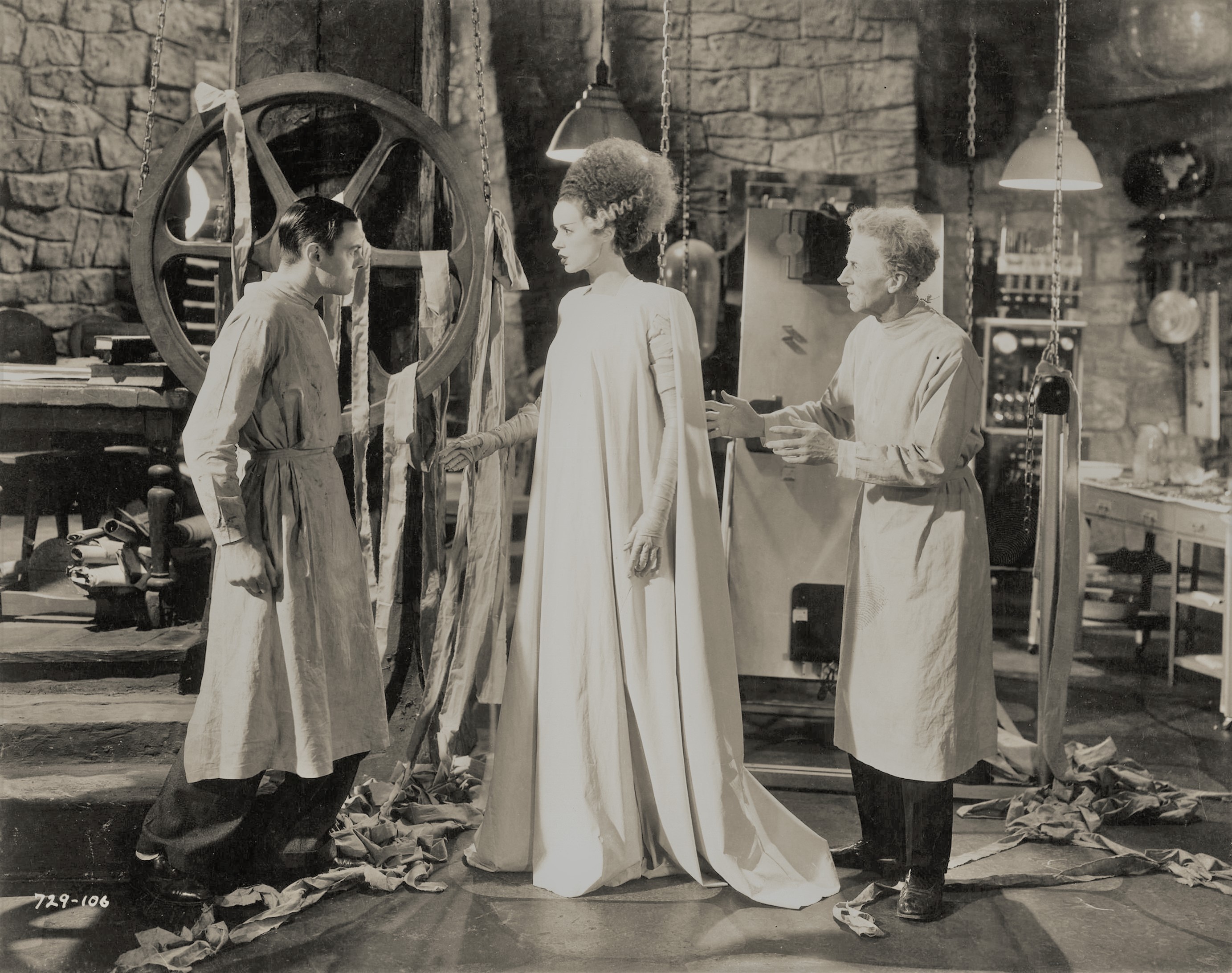
When the monster sees his mate for the first time he is a little disappointed. She is standing between Dr. Frankenstein and Dr. Pretorius and she’s swaying from side to side as if she might fall over. Her hair is very high off her head and frizzy as if electrified; white strands on both sides resemble bolts of lightning. Dr. Pretorius has dressed her in a flowing white gown that goes all the way to the floor.

She tries to pull away when she sees the monster standing in the doorway, but Dr. Frankenstein and Dr. Pretorius hold her by the arms. As the monster walks across the room to her with a welcoming smile, she screams a piercing scream that rattles the castle to its very foundations. The monster is not put off by the scream but advances toward her. When he is face to face with her, Dr. Frankenstein and Dr. Pretorius let go of her arms and withdraw to the dark recesses of the room. She surprises the monster by hissing at him like a snake, which he finds very arousing. When she screams again, he puts his enormous hands around her throat to get her to shut up. And so begins a great romance.

Dr. Frankenstein proposes a toast and they all have a friendly glass of champagne. They break the champagne glasses in the fireplace for good luck and then Dr. Pretorius, who is also an ordained minister, marries the monster and his mate so there won’t be any question of immorality going on in the castle.

They all live happily for many years to come in Castle Frankenstein on their mountaintop. Eventually Dr. Frankenstein and Dr. Pretorius—even Fritz—all die because they are just ordinary men. The monster and his mate, however, live on and on. Through studying the writings of Dr. Frankenstein—and also Dr. Frankenstein’s father and grandfather—the monster has learned how to prolong his life and that of his mate for a very long time. The next thing he is working on is how to resurrect Dr. Frankenstein and Dr. Pretorius from the dead. If he is able to do that, there will be no stopping any of them.

Copyright © 2024 by Allen Kopp

All Hallow’s Eve ~ A Short Story

Halloween 2021 3

All Hallow’s Eve
~ A Short Story by Allen Kopp ~ 

Mother stood over him while he ate his dinner of liver and onions. When she decided he had eaten enough, she told him he could go. He ran up the stairs to his room and put on his Halloween costume. A ghost this year, same as last year. Next year he was going to have to be something different. Wearing the same costume more than two years in a row was terrible.

His false face still had dried spit around the mouth, but it was his own spit so he didn’t care. He put it on and checked the entire effect in the mirror, costume, mask and all. Something was missing. Oh, yes, the old derby hat. It was the one thing that made his costume look just a little bit creepy and scary. Without the hat, the costume was just a cheap little-kid’s getup.

Mother was in the living room when he came down the stairs. “Come here, Buster, and let me take a look at your outfit,” she said.

“It’s a costume,” Buster said.

“Oh, don’t you look cute!”

“I’m supposed to look scary!”

“So, where are you going tonight? What are you plans?”

“I’m going tricking-or-treating, mother, the same as every Halloween.”

“Who are you going with?”

“I don’t know. Some of the kids from my class, I guess.”

“What are their names?”

“You want the names of all the kids in my class?”

“Of course I don’t. You’ll be careful, now, won’t you?”

“Yeah, I’ll be careful.”

“Make sure you’re not alone. Wherever you go, go in a group.”

“I don’t care.”

“What?”

“I said okay, I’ll go in a group.”

“Be home by ten o’clock.”

“Mother! It’s Halloween and tomorrow is Saturday!”

“All right, then. Eleven.”

When he finally got out the door, he broke into a run. The evening air felt good after the stuffy house and smelled good, like leaves and burning candle wax. It wasn’t all the way dark yet, but trick-or-treaters were everywhere, mostly little kids accompanied by their mothers.

He met his friends at the corner by the park. Eric was a skeleton, Stan a hobo, and Squeamy the Lone Ranger. Squeamy’s sister, Oda May, stood apart from the others, smoking a cigarette and looked bored. She carried a rubber-and-fur gorilla mask loosely in her hand like a rag.

“What’s Oda May doing here?” Buster asked.

“My mother wouldn’t let me go out without an adult,” Squeamy said.

“She’s fifteen!”

“I guess that’s enough of an adult.”

“Let’s get going, you losers,” Stan said, “before all the good candy is gone!”

Oda May flipped away her cigarette and put on the gorilla mask and they headed for the neighborhood on the other side of the park where all the best houses were.

It was a lucrative neighborhood. Three-quarters of the houses had their porch lights on. When people took one look at adult-sized Oda May in her gorilla mask, their smiles usually faded.

The treats were good, Hershey bars and popcorn balls instead of stale jelly beans. After three blocks, their bags were starting to get heavy. They sat down on the curb to rest for a while.

“That’s how it’s done,” Oda May said, hefting the bag of candy appreciatively between her legs. “If they’re just a little bit scared of you, they’ll fork over the candy quick enough so they can get rid of you.” She lit a cigarette without taking off the gorilla mask.

“Where to now?” Buster asked.

“I don’t know about you little turds,” Oda May said, “but I’m going to go meet my boyfriend.”

“What about us?” Stan asked.

“You’re on your own. I’ve played nursemaid long enough.”

“It’s all right,” Squeamy said. “We don’t need her.”

“And don’t follow me,” she said, “or somebody’s gonna lose some teeth!”

“Leave the mask on!” Squeamy called after her. “Your boyfriend might like you better that way!”

“What will she do with all that candy?” Buster asked.

“Probably give it to her boyfriend.”

“Who is this boyfriend, anyway?” Eric asked. “Why don’t we get to meet him?”

“He’s a criminal, I think,” Squeamy said. “She doesn’t want me to see him because she’s afraid I’ll tell on her. He’s twenty-three years old. I’ll bet he’s really terrible looking, like a convict.”

“I’d like to see him,” Stan said.

“Hey, I stole some of her cigarettes when she wasn’t looking,” Squeamy said, passing them around and lighting them.

“Boy, I like smoking!” Eric said. “I inhale the smoke deep down into my lungs and let it stay there.”

“Me too,” Stan said. “I’m always going to smoke for as long as I live.”

“My mother told me if she ever caught me smoking a cigarette she’d knock it down my throat,” Squeamy said.

“Doesn’t she smoke?” Eric asked.

“Of course she does. They all smoke.”

“Then why does she care?”

“Because I’m in fifth grade.”

“She’s a hypocrite,” Stan said.

Buster had never smoked before except for a quick puff off his mother’s cigarette when she wasn’t looking. He didn’t like the taste of it, but he wasn’t going to be the only one not to smoke.

Several times, he took the smoke into his mouth and quickly blew it out again. He wanted to have the others see him with smoke coming out his nose like a dragon, but he wasn’t sure how to do it without inhaling.

“Don’t you like smoking, Buster?” Squeamy asked.

“Yeah, I like it all right. I smoke all the time when my mother isn’t looking.”

“Well, finish your cigarettes, ladies,” Eric said. “We’ve still got a lot of territory to cover.”

They went over a couple of blocks to another neighborhood where the treats were bound to be good. They covered several blocks, both sides of the street, in just under an hour.

“My bag is getting really heavy,” Squeamy said. “I think I’d probably better go on home now.”

“Somebody gave me a guitar pick as a treat. Isn’t that weird?”

“Hey, it looks like it’s going to rain! If our bags get wet, they’ll bust through on the bottom and all our candy will spill out!”

“What time is it?”

“I think it’s about a quarter to ten.”

“I think we should call it a night.”

Some older kids, sixteen and seventeen, came up behind them with the intention of stealing their candy, so they began running furiously into the dark to get away from them. Stan knew the neighborhood better than the others, so they all followed him.

He led them around in a circuitous loop over to Main Street, where there were lots of lots of lights, people and cars.

“I think we outran them!” he said.

“Can you imagine the nerve?” Eric said. “We’ve been out all night trick-or-treating for our candy, and somebody thinks they can just come along and take it from us? What is the world coming to?”

Some of the businesses on Main Street were giving out treats. A lady at a bakery gave them day-old pumpkin cookies, which they devoured like hungry wolves.

A man standing in front of a tavern was giving out treats from a large plastic pumpkin. “You kids need to be home in bed,” he said.

“If we come inside, will you give us a beer?” Stan asked.

“Come back in ten years,” the man said.

There was a big crowd at the Regal Theatre, a long line of people waiting to buy tickets to the Halloween double feature: Bride of the Gorilla and The Terror of Tiny Town. Anybody in costume could get in for half-price.

“If we had enough money, we could go,” Stan said.

“Aw, I can’t stay out that late,” Buster said. “My mother would come looking for me.”

They were about to walk past the theatre, but Squeamy spotted Oda May in the ticket line in the gorilla mask and stopped. She wasn’t alone, either.

“She’s with a little kid and he’s a cowboy!” Squeamy said. “Her boyfriend is a child and a cowboy! That’s why she didn’t want us to meet him!”

From where they were standing, they all had a good look at the little cowboy. When he turned around to look at the line behind him, Buster saw his face. “That’s no little kid,” he said. “That’s a midget!”

“A what?”

“Oda May’s boyfriend is a midget and his face is all wrinkled! He must be thirty years old!”

“Oh, boy!” Squeamy said. “I’m really going to tell on her now!”

“I think we should go over and say ‘hi’ to her,” Eric said.

“No!” Squeamy said. “She’ll think we’ve been following her!”

They stood and watched Oda May and the midget cowboy move up in the line. When it was their turn, Oda May moved around behind the midget, put her hands on his waist and lifted him up so he could buy the tickets and then set him down again. Several people in line behind them laughed, but they seemed not to notice.

“Now I’m seen everything!” Squeamy said. “Can you imagine what their children will be like? I don’t even want to think about it.”

“Let’s go,” Stan said. “It’s ten o’clock and it’s starting to rain again.”

They decided to walk home with Stan, since he lived the closest. The interesting thing about Stan was that his father was an undertaker and the family lived above the funeral parlor. It was a subject of endless fascination to Stan’s friends.

“I think I’m going to call it a night,” Stan said when they were at the corner near his house. “Thanks for walking me home.”

“Do you mean you’re not going to ask us in after we’ve come all this way?” Squeamy said.

“Do you have a body in a casket we can look at?” Eric asked.

“Stan’s right,” Buster said. “I should be getting home, too.”

“I have to go to the bathroom,” Squeamy said. “I don’t think I can wait until I get home.”

“Oh, all right!” Stan said. “You can come in but you have to wipe your feet first.”

Stan’s parents were out for the evening, so they had the place to themselves. Stan took them down to the basement to show them around but made them promise not to touch anything. First he showed them the room where the embalming was done with its white cabinets full of jars and bottles and then a separate room where bodies were dressed and prepared for burial. The most impressive part of the tour was the casket room, where more than fifty caskets were opened up so people could see inside them. Eric, Buster and Squeamy took turns taking off their shoes and getting into a casket to see what it felt like, while Stan closed the lid on each of them for a few seconds and then made them get out.

“My dad wouldn’t like it if he knew we were down here,” he said.

“Let us know when there’s a body so we can come back and see it,” Eric said.

“I’ve seen plenty of dead bodies. It’s people you don’t know. You don’t feel anything looking at them.”

“You are so lucky! I’ve never seen a dead body!”

“I need to get home,” Buster said. “It’s getting late.”

Buster walked part of the way home with Squeamy and Eric, but they left him at the corner by the church and he had to walk the last four blocks alone. He held his bag of candy in his arms because it was heavy and soggy and he didn’t want the bottom breaking through. He didn’t see a single other person on his way home. Everybody was finished for the night. Halloween was over for another year.

Mother was sitting on the couch in her bathrobe and slippers watching a Charlie Chan movie on TV. “Did you have a nice time?” she asked.

“Yeah, it was okay.”

“I’m glad you’re home.”

“Why?

“I always worry about you when you’re out by yourself.”

“I wasn’t by myself.”

“There’s an escapee on the loose killing people. I just heard it on TV.”

“We just missed him.”

“Now don’t eat all that candy at once. You’ll make yourself sick. You still have to eat your fruits and vegetables.”

“I know. I want to go to bed now. I’m tired.”

She was saying something else as he went up the stairs, but he didn’t hear what it was.

He weighed himself on the bathroom scale, first without the bag and then with it. He weighed eighty-four pounds without the bag and ninety-five pounds with it. Eleven pounds of candy. One pound for every year of his life.

He undressed and put on his pajamas and set the bag of candy on top of the chest of drawers where he could see it from the bed. He got into bed, took one last look at it, turned off the light. Before he could have counted to ten, he was asleep.

Copyright © 2024 by Allen Kopp

Mother Witch, Father Ghoul ~ A Short Story

Mother Witch, Father Ghoul
~ A Short Story by Allen Kopp ~

Jock and Lena had been married for eighteen years when their first child came along, a boy they named Finley. They had resigned themselves to being childless, so Finley was something of a surprise. Lena was sick the whole time she was carrying Finley and she wondered secretly if childbirth was worth all the trouble and fuss. She had been happy without children and wondered if she would ever be happy again.

Always a reader, she read book after book on child-rearing and parenting, hoping that the words on the printed page would make her feel inspired, but they had no effect in that direction. She woke up every morning during her pregnancy hoping that the little thing growing inside her would—if not exactly die—just not be there at all.

When Lena told Jock she was going to have a baby that neither of them expected, he was so dismayed he couldn’t speak. He shook and felt weak and had to sit down. When he recovered his senses, he demanded a scotch and soda and a steak medium-rare and accused Lena of having a secret affair with the obese man who cleaned the carpets.

The birth was a difficult one and Lena thought she would die. When the nurse at the hospital placed Finley in Lena’s arms for the first time, Lena fainted and fell out of bed; the nurse caught Finley just in time before he hit the floor. When Lena woke up from her faint, she had temporarily lost her senses.

Jock and Lena readied an upstairs room in their spacious house for the baby. They bought all the requisite furniture and all the little things they thought a baby would like. They had the room painted a cheerful yellow color and bought new curtains with elephants and giraffes on them; they spared no expense.

On the day Lena brought Finley home from the hospital, a few curious neighbors dropped in to see him. Lena wore a tight smile and welcomed the visitors graciously. Jock locked himself in his study and drank whiskey and wrote atrocious poetry.

Finley was a beautiful, perfect child with abundant light-brown hair and a full set of teeth. It was his strange, green-and-amber eyes, though, that people noticed first. He looked searchingly at any visitor who came into the room, as if he were studying them and knew things about them that nobody else knew. When people talked, he moved his lips and smiled, pretending he too was talking. Frequently he pointed at something across the room and when people turned to look at what he was pointing at, there was nothing there except the blank wall. He was seeing things that nobody else saw.

At about three weeks old, Finley began moving objects around the room by pointing at them with his tiny index finger and pursing his lips. If a floppy yellow bunny was sitting on the chest of drawers, he could make it fall to the floor or float across the room and fall into his bed, at which time he would grab it and stick it in his mouth. When a wasp came into this room, he pointed at it and flicked his tongue and the wasp fell dead in mid-flight.

“I don’t see anything of myself in him,” Jock said. “Nobody in my family ever had eyes that color.”

Lena was hurt anytime Jock suggested that somebody else was Finley’s father. The marriage, which before had been tolerable, was strained to the breaking point. Jock went out of the room when Lena entered and spoke to her only when it couldn’t be avoided. He blamed her for Finley’s existence and came to see their marriage as a mistake. He tried to warm up to Finley but believed that the two of them would only ever be strangers. He couldn’t visualize Finley living in his house for twenty or so years until reaching adulthood.

Despite Lena’s misgivings about parenthood, she tried to be a good mother to Finley. She fed him, bathed him and spent most of her waking hours looking out for him. There was always something about him, though, that to her didn’t seem right. It seemed he didn’t need her. He was attuned to something or someone else besides her. At times he would look longingly outside the window and point his finger and warble at something that only he could see.

At six months, Finley was walking and at nine months talking in complete sentences. He asked for pencil and paper and began drawing pictures of birds, castles, airplanes and elephants.

“How could you know about such things?” Lena asked.

When Finley was less than a year old, a relative gave him a picture book with farm animals and jungle animals. He looked appreciatively at all the pictures and then asked for a book with words.

“What kind of a book would you like?” Lena asked, stunned that a baby would make such a request.

“It doesn’t matter,” Finley said. “Just something I can hold in my tiny hands and turn the pages.”

She didn’t want to give him anything too “adult,” so she gave him a juvenile book about the Pilgrims and the first Thanksgiving. He read the book in one afternoon and asked for another one.

“Where did you learn to read?” Lena asked. “You haven’t been to school yet.”

“Some people are just born knowing things, I guess,” he said.

At one year, Finley was dressing and bathing himself and getting his own food. Lena kept a little stepstool within easy reach of the refrigerator. He never dropped any crumbs or spilled anything on the floor, and when he was finished eating he washed his own dishes, standing on a chair at the sink.

He learned to turn on the TV when nobody was around and watch on his own. He wasn’t interested in anything where people were talking. He wanted to hear music and see movement: pictures of animals, cars, airplanes, trains—anything but people.

One day, when Finley was one year and two months old, someone knocked on the door in the middle of the afternoon. Opening the door, Lena saw a strange-looking man and woman standing on the porch peering in at her. The man was very thin and pale and dressed in formal attire. (He seemed like a holdover from the Third Reich.) The woman was taller and broader than the man and wore a very old-fashioned kind of lady’s hat with a red feather and a veil. The chimpanzee she held by the hand wore an aviator cap with goggles and a little leather coat.

“You have the wrong house,” Lena said.

“I’m Mrs. Miggles and this is my husband, Julian.”

“Charmed,” Julian said.

“Whatever you’re selling, I’m not interested.”

“We’re not selling anything, but we would like to speak to you.”

“I’m very busy right now.”

“You’re going to want to hear this,” the woman said. “It concerns your son.”

When Mrs. Miggles said the words your son, she inclined her head toward the chimpanzee.

Lena allowed them into the living room and asked them to sit down. The woman began by saying, “The boy’s name is Armand. Say hello to the lady, Armand.”

The chimpanzee took two steps toward Lena and held out his hand for her to shake.

“How do you do?” Lena said.

Armand rolled his lips back over his teeth and gave a little squawk.

“Is your husband at home?” Mrs. Miggles asked. “We really wanted to speak to both of you.”

“He’s out right now,” Lena said. “Just what is this about?”

“I don’t know quite how to say it.”

“Just say it. Isn’t that usually the best way?”

“Well, you can probably tell we’re not like anybody else. I’m a witch and my husband here is a ghoul.”

“A ghoul?”

“Yes, a ghoul.” Mrs. Miggles faltered and then continued. “You had a son on the last day of August last year, I believe.”

“How do you know that?”

“I also had a son on that day.”

“And you’re a witch?”

“Yes, ma’am.”

“Witches have children?”

“Sometimes they do.”

“All right. So you had a son on the same day as me. How does that concern me?”

“Well, to put it bluntly…”

“Yes.”

“I have your child and you have mine.”

“What?”

“The child that you have that you think is yours is really mine. He’s half-witch and half-ghoul.”

“All right, if that’s true, then where is my child?” Lena asked.

“This is him,” Mrs. Miggles said, picking Armand up and setting him on her lap.

“You’re telling me I gave birth to a chimp?”

“Oh, no, no, no! You gave birth to a human child on the same day that I gave birth to my child, who isn’t really human in the sense that you mean it.”

“Then where is my child?” Lena asked.

“I just told you! Your child is Armand!”

“I’m going to have to ask you to leave my house now.”

“Well, perhaps I should backtrack and explain a little further.”

“I think you must!” Julian said in his odd croaking voice.

“When your attention was diverted for just a tiny second, my sister, who is also a witch, stole your baby and replaced him with mine.”

“That’s not possible.”

“Oh, witches can trick you very easily, I assure you!”

“I don’t believe a word of this!”

“She switched babies, and then do you know what she did? To get back at me for something I did to her a long time ago, she turned your baby into a chimp!”

Mrs. Miggles and Julian both laughed heartily.

“Nobody took my baby,” Lena said. “If such a thing had happened, I would have known.”

“It has taken me all this time to find you!” Mrs. Miggles said. “Of course, I had to torture my sister to get it out of her!”

“I’m going to call the police,” Lena said.

“And what do you think they’ll do, my dear!”

“My husband is behind all this, isn’t it? He’s playing an elaborate Halloween hoax on me because he never wanted a baby in the first place.”

“I’ve never spoken to your husband.”

Lena looked down at Armand who was sitting at Mrs. Miggles’ feet. When he realized he was being looked at, he smiled sweetly and yawned.

“So, if your sister turned my child into a chimp,” Lena asked, “why can’t she turn him back again?”

“That is a very reasonable question, my dear,” Mrs. Miggles said. “The truth is that the spell was hers and I don’t know how to reverse it.”

“Can’t you get her to reverse it?”

“Oh, no! I had to kill her!”

“You killed your own sister?”

“Oh, my, yes! She was a terrible trickster! If I hadn’t killed her, she would have killed me in the end!”

“She was a poor jealous thing,” Julian said. “She couldn’t have children of her own.”

“So, if you’ll just go and get your little fellow, whatever his name is,” Mrs. Miggles said, “we’ll make the switch and be on our way!”

“Do you think I’m going to turn my baby over to a couple of crazy people and take a chimp in return?” Lena asked.

“We prefer that you didn’t call him that,” Julian said.

Finley, who had been standing at the top of the stairs the whole time hearing every word, came running into the room.

“Mother! Father!” he said. “I knew you’d come for me on Halloween!”

During the embraces and kisses, Mrs. Miggles turned to Lena and said, “Now do you believe me?”

Armand went and stood beside Lena and took her by the hand. She reached down and picked him up in her arms and he kissed on her cheek, the way Finley was doing with Mrs. Miggles and Julian.

“At last, everything is right in the world!” Mrs. Miggles said.

Copyright © 2024 by Allen Kopp

Miss Wessel ~ A Short Story


Miss Wessel
~ A Witching Short Story by Allen Kopp ~

Rain had threatened all day but no rain came. Ragged horizontal clouds took on strange shapes in the sky and then merged with other shapes and moved on. The sun showed its face every now and then but mostly kept hidden. A gentle breeze blew into the third-floor classroom like a sigh, ruffling some papers, barely noticed.

It was Friday, the last day of October, Halloween. The children were restless. They wanted to be released from their bondage so they could don their ghost, devil, or cowboy costumes and go out into the world and make mischief and collect enough candy to last them through the winter that was coming.

Their teacher, Miss Wessel, also longed to be released. It was her day. She had been teaching ten-year-olds for decades. She was leaving for good, once and for all, at the end of the day. The time had come for her to fly off and live the rest of her life the way she wanted to live it. The children didn’t know they’d have a new teacher come Monday morning. That was the way Miss Wessel wanted it. Say good-bye to no one.

There was no need on this day to do any work, to put on a good face. She had designated this, her last afternoon, as a time for silent meditation. This meant reading, thinking, looking out the window, or whatever one wanted to do, as long as one did it quietly. If one wanted to sit and doze at one’s desk, so much the better.

All was quiet, but there seemed to be an unwritten rule that says a roomful of ten-year-olds cannot be perfectly still for more than a few minutes at a time, no matter what. An unusually large number asked to be excused to go to the restroom. Miss Wessel was inclined to tell them to hold on to it, but in every case she let them go because she simply didn’t care. If they didn’t come back right away she didn’t get up to go see what was keeping them. If they were wandering around the halls doing things they weren’t supposed to be doing, some other teacher would see them and send them back; if they never came back, that was all right, too.

A boy named Terry Hughie got up to sharpen his pencil and fell on his backside like the clown he was, causing everybody to laugh uproariously, which was exactly the response he was hoping for. A little while later, two boys were scuffling in the back of the room, apparently trying to strangle each other. When Miss Wessel threw a blackboard eraser at them, somehow managing to hit them both, they immediately desisted and sat back down in their seats.

With order restored, Miss Wessel slumped down at her desk and was just about to go to sleep when she heard footsteps approaching and someone standing beside her, breathing audibly. Opening her eyes, she saw Francine Quince standing inches away, looking at her with her strange dark eyes.

“Yes, Francine,” she said. “What is it? Can’t you see I’m busy?”

“I need to talk to you,” Francine said.

“What’s stopping you?”

“In private.”

“Can’t it wait until Monday?”

“No.”

With a sigh Miss Wessel stood and motioned for Francine to follow her into the cloakroom. She turned and faced Francine beside the fire extinguisher, clasping her hands in front of her to resist the urge to slap her. Of all the students in her class, she liked her the least.

“Did one of the boys draw an unflattering picture of you again?” she asked.

“Yes,” Francine said, “but that’s not what I wanted to talk to you about.”

Standing close to Francine, Miss Wessel realized—and not for the first time, either—what an odd child she was. She was taller than the other children and seemed older in some unidentifiable way; more worldly, somehow, than her years would have allowed her to become. She had a very long neck and pale skin and, in spite of the pinched-up features of her face, enormous dark eyes that were like pinpoints zeroing in on all she saw.

“I’m listening,” Miss Wessel said, when Francine seemed to hesitate.

“I don’t know quite how to say this,” Francine said.

“Did you have a naughty accident? Do you need to go home?”

“No, nothing like that. I just wanted to tell you that I know what you are and I know what you’re going to do at the end of the day today.”

“I don’t know what you’re talking about!” Miss Wessel said, mustering as much indignation as she could on such short notice.

“I want you to take me with you.”

“Now why would I take you anywhere?”

“Because I’m one of your kind.”

“And what kind is that?”

Francine laughed her grown-up laugh. “I’ve seen,” she said. “I know.”

“Francine,” Miss Wessel said sternly, not caring if the other children heard, “I don’t have the time or the inclination for this kind of nonsense! Please return to your seat and don’t talk of this again!”

“Everybody who knows me would be glad if I went away and never came back. They’d look for me, of course, because that’s what they’re supposed to do, but after a while when they didn’t find any trace of me they’d figure I ran away or was abducted by aliens or something.”

“Would you like to spend the rest of the day in the principal’s office?” Miss Wessel asked, not knowing what else to say.

“No.”

“Then return to your seat.”

“All right. I will. But I still want you to take me with you.”

The afternoon continued to its inevitable conclusion without further incident. When the bell rang to go home, Miss Wessel stood at the classroom door and handed everybody a paper bag of candy as they left. She made a point of looking them all in the face and calling them by name, as she would never see any of them again, and wishing them all a happy Halloween.

When everybody had left and there was one bag of candy left, Miss Wessel realized that Francine Quince was still in the room with her, sitting quietly at her desk. She had forgotten for the moment about Francine. She held the bag of candy above her head and smiled.

“There’s one bag left, Francine,” she said, “and it’s got your name on it. Happy Halloween!”

“I don’t want it,” Francine said.

“Then take it and give it to your little brother.”

“He doesn’t want it either.”

“Go home, Francine! School is over for the day and it’s time for all of us to leave. Your mother will be expecting you.”

“My mother’s a drunk and a whore who doesn’t even know what day it is.”

“Suit yourself. If you’re still here when the janitor comes in to straighten up, he’ll make you leave.”

“I’m going with you.”

“Francine, do you think I want to be responsible for the disappearance of a young girl? I think that’s a fairly serious charge.”

“It shouldn’t matter to a witch.”

“Witch or not, I have some scruples.”

“I’ll bet you’ve cast many spells on people and turned lots of men into toads!”

“It isn’t like that!”

“Then take me with you so I may know what it’s really like. You can make me your protégé.”

“Francine, I don’t even like you. Why would I want you with me all the time?”

“If you don’t take me with you, I’ll go to the police and tell them everything I know about you.”

“Why should that make any difference? I’ll be so far away they’ll never find me and they wouldn’t even know where to look.”

“Then take me with you.”

“I’m leaving now, Francine, and you’re leaving, too, but not with me.”

“I’ll kill myself if you don’t take me.”

“Do you know what it’s like to fly a broom? It takes skill and coordination, not to mention balance.”

“I can learn. You can teach me.”

“Good-bye, Francine. You have my sincere good wishes.”

Miss Wessel went out of the room, turning off the lights and closing the door. She knew that Francine was still inside, but she didn’t care; she was finished with her. When she walked down the hall to the seldom-used door to the attic, she knew that Francine was right behind her.

“You’re not supposed to be in the building after school hours, Francine,” she said.

She went up the dark, narrow steps to the attic, brushing away cobwebs. Francine was right behind her like a shadow. At the top of the steps, the fluttering of bat wings caused Francine to let out a little scream.

“If a few little bats scare you,” Miss Wessel said, “you’re not really a witch.”

“I just wasn’t expecting them,” Francine said.

“If you’re going to be a witch, you’ll learn to expect anything.”

Miss Wessel changed into a long, flowing black dress. After she had fastened all the buttons and smoothed the dress over her bony hips, she put on a black pointed hat with a wide brim. Her face, at that moment, took on a different look. Her nose and chin became more pointed, more prominent; her skin, always the color of ivory, took on a greenish tint. The wart on her chin that was barely visible before became enormous, complete with a tuft of bristling hair.

With her preparations complete, Miss Wessel pointed a long index finger at Francine and laughed a cackling laugh. “Are you quite sure you want to do this, my dear?” she asked.

Francine, in spite of herself, drew back. “Yes, I’m sure,” she said.

“Then follow me.”

She picked up her broom and climbed the ladder that was built into the attic wall and pushed open the trap door that led to the roof. After they had both gone through the trap door and were standing on the roof, Miss Wessel let the door slam back into place. Then, with Francine watching her closely, she straddled the broom with her legs.

“Get on,” she said, “and hold on. I would advise you not to look down until you get used to flying.”

Francine got onto the broom behind Miss Wessel and wrapped her arms around Miss Wessel’s waist.

“Are you ready?” Miss Wessel asked.

“Yes,” Francine said.

“Do you want me to put a curse on your mother before we go?”

“No. Her life is already cursed enough.”

“Very well, then. We’re off!”

The broom lifted, carrying its two passengers. Miss Wessel flew in a broad sweep over the school and the town so they could take one last look at the place that had been their home for so many years. Then, with the full moon as a backdrop, they flew away to points unknown, never to be seen or heard from again.

Copyright © 2024 by Allen Kopp

At the Time of His Disappearance ~ A Short Story

At the Time of His Disappearance image 7
At the Time of His Disappearance
~ A Short Story by Allen Kopp ~

Trent arrived home from school at the usual time. He threw down his school books and went into the kitchen. His mother was sitting at the kitchen table, reading a magazine and smoking a cigarette. Without a word of greeting, he ate some cookies and drank a glass of water, standing between the table and the back door. When he was finished, he set the glass on the table and went out the door.

“Dinner in an hour!” she called, but he gave no indication of having heard her.

It was October and the yard was full of golden sunlight and the smell of leaves. The yard was a refuge for squirrels and birds and other small animals. It was, by far, the best place to be on an autumn afternoon. And it was private. Nobody ever came snooping around. The nearest neighbor was over a mile away. The boy had it all to himself.

Abutting the yard at the south side was an old cemetery. The boy spent a lot of time in the cemetery. He loved the old gravestones and the elaborate growth of trees, bushes, vines and weeds. It was a private world unto itself. The newest grave that he had found so far was fifty years old. If there were any graves more recent than that, he had yet to find them. It was a lost world with all those long-ago dead people. He imagined some of them in their graves, exactly as they were when they were when they were alive. He could hear them laughing and whispering. Sometimes they reached out and touched him on the shoulder or the back.

From the bay window in the dining room, his mother watched him go into the cemetery. She told him to stay out of there, but since he turned twelve he had a mind of his own and he did exactly as he pleased. That was the problem with children getting older, she thought.

She believed he was developing a morbid interest in the dead because of all the time he spent in the cemetery. Any time she didn’t know where he was, it only took one guess to figure it out. One night she heard him talking long after he should have been asleep, and when she opened his door and asked him who he was talking to, he said he was talking to a sixteen-year-old boy who died in a flood in 1893.

It was time for the evening meal, and still the boy hadn’t come back. She was going to have to have a very serious talk with him. He might at least show some respect for her after all the trouble she went to to cook the dinner.

She put on a sweater and went out the back door to try to find him. She went all the way around the house, calling his name, but she knew he wasn’t there; he was in the cemetery.

She went to the entrance to the cemetery and stopped. She called his name, but she knew he wouldn’t answer, even if he could hear her. He loved playing tricks on her. It would be just like him to jump out at her from behind a gravestone and make her jump and scream. And of course he’d laugh at her and call her a panty waist.

It was almost dark now. She went back to the house and sat down at the table and began eating the food she had fixed. She could only manage a few bites. She was nearly in tears. She was a little worried about him, but she assured herself he was all right and had just lost track of time, as children do.

By ten o’clock, his customary bedtime, he still hadn’t returned. She got her flashlight out of the drawer and went outside. She walked all the way around the house, calling his name, shining the light into the darkest places. She didn’t see any sign of him. She knew the cemetery was the place to look.

She had been in cemeteries before, but never at night and never alone. She assured herself that the cemetery was full of people long dead. There were no ghosts, nothing  to bother her or cause her worry. She had to find her son, and she couldn’t be a big baby about it. Maybe he was in trouble. He might have fallen and broken his leg or something.

She gathered her courage and, walking slowly, shone her light all around, at the tops of the trees and all over the ground. Some of the gravestones were huge slabs, and others were so small you might easily trip over them if you weren’t paying attention. She called his name every few feet, but her voice was drowned out by the wind and the rustling leaves.

There was nothing out of the ordinary in the cemetery. Just the graves of those long forgotten. There were no signs of the boy having been there. All she could think to do was go back to the house and wait for him to return.

Rather than go to sleep in her bedroom upstairs, she took a comforter out of a closet and made a bed for herself on the couch in the living room. If he came in the back door, left unlocked for him, she would hear him. He would come back, she believed, with a wild story about having been abducted by a spaceship. He had quite an imagination. She would be torn between laughing at him and wanting to slap his face for scaring her so.

She spent a nearly sleepless night. Any time she almost went to sleep, she would be awakened by what she thought was the back door opening and closing, or by his calling out to her across a vast distance.

At seven in the morning she called the police and told them her twelve-year-old son never came home yesterday. Within a few minutes, two uniformed officers appeared at her door. One of them was old and the other one young.

Sobbing intermittently, she told them what happened: Her twelve-year-old son disappeared in the yard and/or cemetery the day before and didn’t come home all night. She went looking for him with a flashlight and even called his name repeatedly, but it was all to no avail.

The older officer said, “In about fifty percent of these cases, the adolescent runs off on his own and comes back on his own when he gets hungry enough. Do you think he might be one of these?”

“Oh, no! I don’t think so.”

“Has he ever run off before?”

“He hasn’t run off now.”

“Might he have been abducted by strangers?”

“I don’t have any reason to think that.”

“Was he having trouble at school?

“No!”

“Was he being bullied?”

“No, I don’t think so. No.”

“Did he ever use drugs or alcohol?”

“Of course not! He’s twelve years old!”

“What about the boy’s father?”

“My husband and I are divorced.”

“Was the boy upset when you got your divorce?”

“No. He was four years old at the time.”

“Do you ever see or hear from your ex-husband?”

“No.”

“Might your ex-husband have had anything to do with the boy’s disappearance?”

“Certainly not!”

The older officer had been writing her responses on a yellow legal pad. He stopped writing and, with his pencil poised above the paper, turned and looked at the younger officer. “Can you think of anything else?” he asked.

“Was the boy, um, I mean, is the boy sexually active?” the younger officer asked.

“Of course not! He’s a child!”

“Do you have a recent picture of him?”

She stood up, walked a few feet, opened the drawer of a desk, took out a picture and handed it over to the older officer.

“We’ll need to keep this picture.”

“Of course.”

“What was he wearing at the time of his disappearance?”

“A shirt and pants. A jacket. A cap.”

“Does he have any distinguishing features?”

“A small mole on his right cheek.”

“Height?”

“What?”

“How tall is the boy?”

“I couldn’t say for sure. He’s rather small for his age. I’d say about four feet, six inches.”

“Can you tell us anything else about him?”

“He loves to spend time in the cemetery.”

The older officer shifted his big legs and coughed. “And why is that?”

“We have an old cemetery adjoining our property. My son has been fascinated by it for years.”

“Why is that?”

“I’m not sure. I always told him he should stay out of there.”

“And what did he say when you told him to stay out?”

“He said he felt close to some of the dead people. Don’t ask me why. He’s a lot like  his father, I suppose.”

“Would you say he is obsessed with death?”

“No, I wouldn’t say he’s obsessed with death. He’s going through a phase.”

They’d keep a close watch out for him, the officer assured her. They’d send the boy’s picture and his description to every law enforcement agency in the state. They’d talk to every person in a ten-mile radius. If anybody saw anything, they’d say so.

“We’ll find him,” the older officer said.

She wanted to believe the boy would be found, but something about the way he disappeared defied logical explanation. It was going to take somebody smarter than the local police to figure it out.

They sent a team of men and boys to search the cemetery, the woods and the fields. After five days of finding nothing, they called off the search. The search would resume at a later date.

The story appeared in newspapers and on television. There was an outpouring of interest and sympathy. The mother’s phone rang all the time. Most of the calls were from well-meaning people, but a few of them were crank calls. One person claimed to know where the boy was and would divulge his location for five thousand dollars.

After the boy had been missing for a week, the mother received a phone call from a woman named Hortense Rathbone. She said she was a psychic who had been helping locate missing children for sixty years. She would do a “reading” for a hundred and fifteen dollars.

“I don’t believe in that sort of thing,” the mother said.

“I can tell things about the boy just by looking at his picture.”

“What things?”

“You’re not his real mother. You adopted him.”

“Nobody knows that. Not even he knows that.”

“Also, he’s a very old soul.”

“What does that mean?”

“It means his soul is prized.”

“Prized by whom? What are you talking about?”

“I can come to your house and do a reading. You have nothing to lose. I won’t charge you a penny if you get no results.”

“What results? Do you mean you can find him?”

“I don’t know, but I can try. No charge. This is an interesting case.”

“All right. This is Thursday. You can come on Saturday morning. And if  you’re another crackpot, I’ll throw you out and I won’t be nice about it.”

“I’ve been called a lot of things,” Hortense Rathbone said.

She was a very old woman, dressed in a man’s suit and wearing combat boots. She drove a fifty-year-old Cadillac, once white but now many other colors. When she walked into the house, she wanted to walk from room to room, but she especially wanted to spend time in the boy’s room, absorbing his “essence,” as she said. She wanted a shirt of his that he had recently worn. She wadded up the shirt into a ball and held it over her mouth. She lay down on the bed where he slept and closed her eyes.

“I’ll leave you alone,” the mother said. “Come back downstairs when you’re finished.”

The psychic wanted to know every detail about the boy’s disappearance: time of day, what he said before he left the house, what he was wearing. Did he mention any other person by name? What was his mental state at the time of his disappearance?  When the mother told the old woman about the cemetery, she said she needed to see it right away. It might contain an important clue that nobody else was able to see.

She spent four hours crisscrossing the cemetery, and when she came out she looked happy.

“I’ve had a breakthrough in the case,” she said. “I know what happened to the boy.”

“You know where he is?” the mother said.

“I don’t know where he is, but I know what happened to him.”

“What are you talking about?”

“There’s lots of psychic activity in that old cemetery.”

“Yeah? What about my son?”

“You said he spent a lot of time there?”

“Yes.”

“He’s passed through a portal. I can hear his voice. He’s calling for you to help him. He wants out.”

“What are you talking about? What portal?”

“It’s not something in the ground, but in the air. Think of it as being a door into another dimension.”

“Another dimension? That sounds too fantastic!”

“Well, believe it or not, portals are everywhere. People, especially children, will fall into them. It doesn’t happen very often, but it does happen.”

“But how do we get him back here?”

“I wish I knew, honey.”

The mother half-believed, half-disbelieved, the old woman’s version of what happened to her son. It made sense in a way, but it strained credulity. Another dimension? Is such a thing possible?

She began going to the cemetery every day. She wanted to find the portal that her son had fallen into. She wanted to hear his voice, pleading with her to get him out. If she just heard his voice, she’d do anything in the world to get him back home. She didn’t know how to look for a portal, but if it was there she’d find it. Being in the cemetery made her feel  close to him. She’d sit for hours, listening to the wind and hoping to hear his voice.

The police investigation was going nowhere. An officer called her occasionally to report nothing at all, but also to reassure her the case would remain open.

Sometimes she caught a fleeting glance of the boy out the window, turning a corner of the house. Other times, she heard him moving around in his room late it night. He was there. She was sure of it.

Copyright © 2024 by Allen Kopp
You Were Kind to Me ~ A Short Story

You Were Kind to Me image 1
You Were Kind to Me
~ A Short Story by Allen Kopp ~

The once-every-two years carnival was in town. Anybody who was anybody would go at least one night. Vicki-Vicki LaGrasse went on Saturday night, accompanied by two friends from high school, Pansy Dowd and Mary Lee Kaiser. When they arrived at the fairgrounds, it wasn’t quite dark yet and the crowds were thin.

“I want to go on the Ferris wheel first thing,” Pansy said.

“Before it’s even dark?” Mary Lee said.

Mary Lee was afraid of heights and, so she sat in the middle and kept her eyes closed the whole time.

“What good does it do you to ride the Ferris wheel if you don’t look down?” Pansy said.

“With my eyes closed it feels like I’m flying. I don’t have to have my eyes open to appreciate it.”

“When we get all the way to the top, I’ll push you out, and then you can really get the sensation of flying!”

After the Ferris wheel, they went to the House of Mirrors and howled with laughter at their ridiculous, distorted images. The three of them together looked three times sillier than one.

“We look like freaks!” Pansy laughed.

“Well, isn’t that what we are?” Mary Lee said.

“Say, I’m starting to get hungry. Let’s go get something to eat.”

They went to the food pavilion and ordered hot dogs and Cokes. While they were waiting for their food, they saw a tall boy across the way who seemed to be looking at them.

“Hey! Do you know him?” Pansy said. “He’s kind of cute.”

“I don’t know him,” Vicki-Vicki said without looking up.

“He’s been following us since the mirrors,” Mary Lee said.

“He’s not looking at me,” Pansy said.

“He’s not looking at me, either,” Mary Lee said. “I think he’s looking at Vicki-Vicki.”

“He’s not looking at me,” Vicki-Vicki said.

“He’s an older boy,” Pansy said. “He’s got whiskers.”

“Are you sure you don’t know him, Vicki-Vicki?”

“No, I said I don’t know him.”

“I never saw him before in my life,” Pansy said.

“He is definitely looking at Vicki-Vicki,” Mary Lee said.

“Well, I don’t want to be looked at,” Vicki-Vicki said. “So why don’t we just forget about it and go ride the Tilt-a-Whirl?”

They rode twice until Mary Lee began vomiting and the attendant had to stop the thing and let her off.

“I always get sick when I ride the Tilt-a-Whirl,” Mary Lee said.

“Then why do you ride it?” Vicki-Vicki asked.

“I’ll be all right once my head stops spinning.”

They found a place to sit quietly for a while until Mary Lee felt better. While they were sitting doing nothing, the tall boy walked past, eating from a box or popcorn.

“There he is again,” Pansy said. “It’s no coincidence that he keeps popping up.”

“Just ignore him,” Vicki-Vicki said. “He obviously just wants attention.

“He is so cute!”

“I don’t see anything about him that’s appealing.”

“Maybe you’re not looking at him in the right way.”

“I don’t want to look at him at all.”

“I’m feeling better now,” Mary Lee said. “Let’s do the Haunted House.”

“Are you sure?” Vicki-Vicki said. “I don’t want you vomiting on me again.”

“I only vomited on your shoes,” Mary Lee said. “I said I was sorry.”

They stood in a long line at the Haunted House. When they finally got in, they were surrounded by screaming younger kids.

“I didn’t know this was such a kiddie attraction,” Pansy said. “They need to be at home in bed.”

The Haunted House was screaming ghouls, severed heads, clanking chains, puffs of air, moaning corpses, flashing lights, and lots of screaming. Mary Lee admitted that she wet her pants when a monster jumped out at her but that it would dry on its own as soon as she got out into the air.

After the Haunted House, they were on their way to get some cotton candy when they stopped to watch the “Dunk the Clown” booth. A clown with an enormous nose and a painted-on mouth sat on a swing over a pool of water. For twenty-five cents, anybody could try to hit the target with a baseball that would dump the clown into the water. While the clown was in the water, he gestured to the crowd and made faces, eliciting screams and jeers. After a while he climbed out of the water and got back on the swing again for somebody else to try.

“Can you imagine being the clown?” Pansy said. “So degrading!”

“It’s his job,” Vicki-Vicki said. “Like any other job.”

“Wait a minute,” Mary Lee said. “There’s that guy again.”

“What guy?”

They all turned their heads toward the person trying to knock the clown into the water. There were lots of people standing in the way, so they had to wait for somebody to move before they could get a good look.

“Yes, it’s him,” Pansy said. “He’s there and then he’s here. He’s everywhere.”

He hit the target effortlessly with the baseball and the crowd roared. A carnival worker man handed him his prize of a stuffed animal, and the next person in line took his place.

“Now we’ve seen everything,” Pansy said.

“Let’s get some cotton candy,” Mary Lee said.

“No, he’s coming this way,” Pansy said. “He’s looking right at us.”

“Just ignore him,” Vicki-Vicki said. “He might be looking for somebody to knife.”

“I don’t think so,” Pansy said. “He looks very sweet.”

Ignoring Pansy and Mary Lee, he walked up to Vicki-Vicki and smiled at her. He towered over her.

“You don’t remember me, do you?” he said.

“I don’t think we’ve met,” she said with a tight smile.

“I remember you.”

“I don’t think so.”

“Here. I want to give you this stuffed toy.”

“Thanks, but I don’t accept stuffed animals from strangers.”

“You really don’t remember me, do you?”

“I’m with a couple of my friends from school. We were just leaving.”

“That’s all right,” he said. “Don’t let me intrude.”

She looked at the stuffed animal in her hand and gave it back to him.

When she turned to go, he said, “It was in sixth grade.”

“What was in sixth grade?”

“When we knew each other.”

“That was years ago.”

“I know,” he said, “but I always remembered you.”

“I think you have me mixed up with somebody else.”

“It was Miss Spengler’s class. She had white hair and she looked just like the picture of George Washington hanging on the wall.”

“It wasn’t me. It was somebody else.”

“No, it was you, all right.”

Pansy and Mary Lee were standing behind Vicki-Vicki, taking in every word. Mary Lee giggled and Pansy pinched her on the arm.

“Maybe if you told me your name, I might remember.”

“It’s Harry.”

“Harry what?”

“Just Harry.”

“You don’t have a last name?”

“I was living in a foster home. I moved around a lot. I left school after a few months to go someplace else.”

“You sat in the back of the room?”

“Yes, I did.”

“You were taller than anybody else in the class.”

“I think you remember me now.”

“You were the only one in the class who could spell the hardest words.”

“That was me.”

“You had fried chicken for lunch. Everybody else had junk food.”

“What a memory you have!” he said.

She blushed, in spite of herself, and turned to Mary Lee and Pansy for support.

“Since you remember me now, I wonder if you’d let me give you a ride home.”

“What? Oh, no! As I said, I’m with some friends.”

“I can give them a ride, too.”

“I don’t think so. My friend’s mother is going to pick us up.”

“How about if you go with me, and your two friends can go with your friend’s mother.”

“I don’t think I should go off and leave them.”

“Surely they wouldn’t mind. Just this once. It’s a beautiful evening. There’s a full moon. We can go for a ride in the country. Tell me that doesn’t sound good.

“I’m sorry. I can’t.”

“Why not?”

“I just don’t think I should leave my friends.”

“Ask them.”

She turned away and consulted with Mary Lee and Pansy. They shook their heads and shrugged, showing how indifferent they were to Vicki-Vicki’s comings and goings.

In a minute she returned to him. “It’s all right,” she said. “My friends think I should go with you.”

She knew that if she didn’t accept his offer, there might never be another one. Never as in not ever. She’d die a dried-up old spinster, playing bingo in the church basement on Friday nights while smoking Marlboro cigarettes. She would be forced to remember that she had once been asked but had foolishly declined.

He drove far out into the country, twenty miles or more. She didn’t ask where they were going. She didn’t tell him she had to be home by a certain time. She didn’t care about any of that.

Finally he stopped on a bluff overlooking a river.

“I didn’t even know this was here,” she said, trying to keep her voice from shaking.

“People don’t know about it,” he said. “It’s private. That’s why I like it.”

“It’s kind of scary in the dark. You don’t know what’s lurking in those trees over there.”

“Maybe an owl or two.”

After a while she asked him about his life since sixth grade. He lived in foster homes until he was sixteen and then he struck out on his own. After he got his high school diploma, he said, he no longer needed to live with strangers.

“You’re self-sufficient. Most boys your age are still such adolescents.”

He reached her for and began kissing her. He smelled of soap and peppermint. She resisted a little bit, but not much.

“I like you,” he said. “I’ve liked you since sixth grade.”

“It’s funny how people meet again after years. When somebody appears unexpectedly in your life, I always think there’s a reason.”

“I know you didn’t think about me after the sixth grade, but I thought about you a lot. You made a very favorable impression on me.”

“Why me out of all the others?”

“You were kind to me. Nobody else bothered.”

“I’ve never done this before with a boy.”

“It’s all right. I won’t hurt you.”

Soon she was on her back and he was on top of her.

When he drove her back to town, it was almost three in the morning. She was relieved to see that her house was all dark, meaning that her mother had gone to bed. She opened the door of the truck. Before she got out, he said, “I want to marry you.”

It was the last time she ever saw him.

In a few weeks she knew that something was happening with her body. She missed one cycle and then another. She was pretty sure what was wrong, but she hoped it was something else. When she told the school nurse the symptoms she was having, the nurse gave her a test to do on herself when she got home. When she saw the results of the test, she felt a stab of panic. She was going to have to tell her parents about the carnival, the boy from sixth grade, and all the rest of it. She couldn’t keep it a secret forever.

Copyright © 2024 by Allen Kopp

Map of the World ~ A Short Story

Map of the World image 3

Map of the World
~
A Short Story by Allen Kopp ~ 

On the first day of the new school term, Joanne Torrance was sullen and unhappy. She wasn’t ready for summer vacation to be over; she wanted to be able to stay at home and do as she pleased all the time. It wouldn’t have mattered to her if school had never taken up again for as long as she lived. She was sure she could learn all she needed to know from reading books and magazines and seeing lots of movies and watching the really important shows on TV like Superman and Lassie and The Three Stooges.

As soon as she met her new teacher for the first time—one Ruby Chinn—she hated her on sight. She had long yellow teeth that showed even when her mouth was closed. She had dyed hair the color of beets that she wore pulled into a severe bun on top of her head that resembled a cake made out of hair and that showed the fleshy folds on the sides of her face and neck. Joanne could have told her how she might adopt a more flattering hairdo to complement her round face, but she didn’t care how ridiculous a person’s hair looked when she despised that person as much as she despised Miss Chinn.

Since it was the first day of the new term and people didn’t know each other very well, Miss Chinn had each person write his (or her, as the case may be) name on the blackboard in colored chalk. After writing his or her name, the person was to turn around and face the class and introduce himself (or herself) in a loud clear voice. The boys were then supposed to bow from the waist and the girls to curtsey. This was a chance for everybody to get to know what face went with what name. Miss Chinn referred to this exercise as an ice breaker.

When Joanne’s turn came, she went to the blackboard and picked up the pink chalk and wrote her name in a neat cursive script underneath the babyish scrawl of the person who went before her. Then she turned around and bowed from the waist instead of curtseying. A howl went up from the class and she flushed with embarrassment.

“No, no, no!” Miss Chinn said impatiently with her forefingers extended, two feet apart, as though measuring the length of a fish she had caught. “What do girls do?”

“Curtsey!” the class said in unison.

“And what do boys do?”

“Bow from the waist!”

“That’s right! Now, Joanne, I have a simple question for you and it isn’t that difficult. Are you a girl or a boy?”

Again a howl of laughter erupted from the class. They were enjoying her discomfort, which went a long way toward relieving the tedium of the first day of class.

“I’m a girl,” she said in a small voice.

“What was that?” Miss Chinn said. “I can’t hear you!”

“I said I’m a girl!”

“Well, you certainly look like a girl, but we all just saw you do the thing that boys do. Now, can you prove that you’re a girl and do what girls do?”

“No.”

“What do you mean ‘no’?”

“I mean I would rather not.”

“And why would you rather not?”

“It’s silly.”

“Not as silly as you are in refusing to do it.”

“I don’t think I have to do it just because you tell me to do it.”

Miss Chinn rolled her eyes and the class laughed again. “If there is one thing I will not tolerate in the classroom,” she bellowed, “it is insolence!”

“You and me both,” Joanne said, but not loud enough for Miss Chinn to hear it.

“You are wasting precious time! Sit down this instant! We’ll deal with this matter later.” She opened her grade book. “I could send you to the principal’s office, but I know he’s busy on the first day and would rather not be bothered, so I’m giving you a failing grade for the day. You may be the only student in the history of this school to get a failing grade for the first day of the new term.”

“Whoo-whoo-whoo!” went the class.

Joanne returned to her seat, wishing she had a pirate dagger to plunge far into the heart of Miss Chinn and everybody else in the class.

The next person to the blackboard to write her name was Veronica Kennedy. She had blonde hair and dimples and a beauty mark on her right cheek. People said she looked like a movie star and would go far in life. She already had breasts and was wearing a brassiere, the outline of which could be clearly seen through her lovely yellow blouse. She wrote her name beautifully with yellow chalk (yellow seemed to be her color) underneath Joanne’s name, and then she turned and faced the class and executed a perfect curtsey, holding her skirt out just far enough so that the edge of her underpants showed. The class erupted in cheers and applause.

“You see?” Miss Chinn said triumphantly. “That is what girls do!”

“Yaw-yaw-yaw!” went the class as Veronica Kennedy smirked with superiority and resumed her seat.

Later in the day, during the social studies lesson, Miss Chinn pulled down a map of the world like a window shade and stood before it with her pointer.

“Now,” she said, “who can tell me where Peru is?”

Joanne was the only person in the class who raised a hand.

“Come now,” Miss Chinn said. “Doesn’t anybody know where Peru is?”

Joanne raised her hand even higher. She was all the way at the back of the room, so maybe Miss Chinn hadn’t noticed her.

“Nobody?” Miss Chinn asked. “Can’t anybody tell me where Peru is? No? It’s in South America. Can anybody tell me where South America is?”

“I can!” Joanne said, waving her hand.

“Who said that?” Miss Chinn asked.

“I did!” Joanne said.

“I believe I’m had quite enough of you for one day,” Miss Chinn said. “You should know by now that we don’t speak in class until we’ve been called on. You haven’t been called on.”

“Hoo-hoooooo!” went the class.

“Now, can anybody tell me where South America is?”

Joanne lowered her hand and slumped down in her chair.

“Nobody? Shame on you! It’s right there!” She pointed to South America, outlining it with the pointer. “And there is Peru!”

During lunch in the school cafeteria, Joanne sat by herself facing the wall. She heard sniggers behind her back and knew they were coming from the next table where Veronica Kennedy and her coterie of followers were sitting. Somebody threw a wet bread ball and hit her in the side of the head, followed by a volley of snorting laughter. She was only half-finished with her lunch, but she didn’t feel like eating the rest of it and so stood up and emptied her tray and went outside.

Rosalie Dunphy was leaning against the side of the building with her head tilted back against the brick and her eyes closed, like a cat sunning itself. She was a large, silent girl with wild unkempt hair who was a couple of years older than anybody else because she had been held back two grades. Joanne knew her slightly from the year before. When she walked up to her, Rosalie opened her eyes and looked at her but didn’t move her head.

“I’d like to poison Miss Chinn,” Joanne said.

Rosalie reached in her pocket and took out a folded-up piece of paper and handed it to Joanne. “I drew this,” she said.

Joanne unfolded the paper and saw there a picture of a witch flying on a broomstick with her heels up in the air and a leer on her face. She was wearing a pointed hat and had a hump on her back and a wart on her chin with hairs coming out of it. It was a perfect likeness of Miss Chinn.

“That’s pretty good,” she said, handing the drawing back to Rosalie.

“I like to draw.”

She stood next to Rosalie against the wall and she somehow felt better and not so alone. “I hate everybody in this school,” Joanne said after a while.

“Come with me,” Rosalie said. “I have something I want to show you.”

She led the way around the building to the long flight of concrete steps that went down from the school grounds to Main Street. The steps were strictly off-limits during school hours, but that didn’t make any difference to Rosalie. She went down near the bottom of the steps and sat down. Joanne followed her and sat next to her.

“You have to promise not to tell anybody about this,” Rosalie said.

“I won’t,” Joanne said.

She reached into her pocket again and took out a package of Lucky Strike cigarettes and a little box of kitchen matches.

Joanne wanted to say is that all, but she said nothing because Rosalie surprised her by taking a cigarette out of the pack and putting it in her mouth and lighting it as expertly as if she had been smoking her whole life.

Rosalie took a deep drag on the cigarette and inhaled the smoke into her lungs. “Ah, that is so good,” she said.

After another drag, she held the cigarette out to Joanne. “Try it,” she said.

“I haven’t ever smoked before,” Joanne said.

“Try it.”

She took the cigarette from her and drew a little of the smoke into her mouth and breathed it out. “That tastes awful,” she said.

“It takes some practice before you’re any good at it,” Rosalie said.

They smoked the cigarette, handing it back and forth, until it was smoked down to the filter. Joanne didn’t like the taste of it at all, but she smiled every time she handed the cigarette back as if she approved and was enjoying it. When they heard the bell ring to go back inside, Rosalie flipped the cigarette butt away out to the street and they went back up the steps unnoticed.

That evening when Joanne was having dinner with her mother, she had been going to tell her that she had smoked her first cigarette at school that day, but she decided it wouldn’t be a good idea. She had already had enough disapproval for one day. Instead she asked her mother if she knew where Peru is.

“Isn’t that in South America?” her mother asked. “They have those strange animals with the long necks.”

“Llamas,” Joanne said.

“That’s it!”

“I’m going to murder Old Cakehead.”

“Who’s that?”

“Miss Chinn, my new teacher.”

“Well, all right,” her mother said. “Just don’t get caught. The trick is to try to make it look like an accident or to make it look like somebody else did it. Somebody you don’t like.”

At ten o’clock Joanne got into bed, but before she turned off the light she looked at the map on the wall of her room that had been there for as long as she could remember. It was somehow reassuring to look at it every night before she went to sleep. She loved the colors—the pinks, oranges, browns, greens, yellows—surrounded by a dazzling expanse of blue that was the ocean. And, yes, from looking at the map every night of her life, she knew where Peru was and just about every other country in the world. She knew a lot more than some people were willing to give her credit for.

Copyright © 2024 by Allen Kopp

At the River ~ A Short Story

Floating,In,San,Marcos

At the River
~
A Short Story by Allen Kopp ~ 

(This short story has been published in The Sim Review.)

All day long he had nothing to do. His legs didn’t work so well anymore; neither did his eyes or his ears. He slept at night and got up in the morning and there was somebody always there, sometimes a stranger he had never seen before, to help him get himself into the bathroom and dressed and downstairs to breakfast, where he sat with thirty or forty others just like him, making a mess of his oatmeal and eggs and not saying anything. After breakfast somebody always sat him down in a comfortable spot in the solarium or the TV room and he just sat there, usually all day, until they came and got him for the next meal. After that it was time to get into bed and sleep again and wake up again and get dressed and go down for breakfast and do the same thing all over again; again and again as if that was what he was put on the earth for: a lot of nothing that seemed to have no end. Whoever said life was short?

He wondered what happened to the people he used to know. Didn’t he have a wife and a couple of children? Didn’t he have at one time some grandparents, uncles and aunts, a mother and father, a sister and a couple of brothers? What happened to all of them? Did he just dream them up? Oh, yes, that’s right: one after the other they all died. He came to see life as a kind of lottery: the winners went on ahead and the losers had no other choice but to stay behind. In the end there would be one loser left, and he was it. When they were children and they played tag or kick-the-can or hide-and-seek, somebody always had to be “it.” He didn’t like being “it” then, and he didn’t like it now.

Since he had no current life to speak of, he dwelt mostly in the past. Once, when he was eight years old, he and his whole family—including grandparents, aunts, uncles and cousins—went on a camping trip to a river. The men went fishing while the women went in swimming. He had never fished and wasn’t interested in learning, so he stayed with the women. His mother told him he didn’t need to be embarrassed about staying with the women, but somebody always teased him about it and it hurt him enough that he thought he should probably learn to fish so it wouldn’t happen again. His mother took his swimming trunks out of her suitcase and gave them to him and told him to go into the tent and take everything off and put on the trunks and come back out as soon as he could because they were all waiting to go in swimming.

After he put on the trunks, he was ashamed of the way he looked. His arms and legs were a pale yellow color and as thin as sticks. His chest was ugly and not at all manly. His stomach stuck out farther than he would have liked. He imagined that he looked like a monkey without any hair, a shaved monkey. He couldn’t let anybody see him almost naked with just a strip of red cloth around his middle. He stayed in the tent until his mother came and pulled him out, looking plenty silly herself in her green swimsuit and matching bathing cap that wrinkled the skin on her forehead. When he insisted that he had to stay in the tent because he felt sick, she slapped at him and told him she was in no mood for any of his nonsense. He slapped her back on the arm, which later he regretted. He could tell that she wasn’t quite herself; her tongue seemed thick in her mouth and her movements were jerky; she had been drinking. She dragged him out into the sunlight and held him to her hip as if she thought he might get away if she let him go.

Nobody looked at him in his silly red swimming trunks so he started to relax. He went into the water up to his elbows and then got back out and sat on a towel in the shade on the bank. The women were splashing around in the middle of the river, talking and laughing. The older kids were playing in a spot farther off, screaming and trying to hold each other under. He wanted no part of any of them.

He realized after a while that he couldn’t just sit there all day while everybody else was having fun, so he went back to the water. He waded in slowly until he was up to his chest and then, taking a quick look over his shoulder, began walking downriver. He walked until he was out of sight and hearing of the others.

He went farther and farther, staying in the middle of the river. The farther he went the deeper the water became. It was up to his breastbone and then past his shoulders to his neck. When he looked down all he saw was green-black murkiness; he could no longer see his feet, but still he kept going.

Every couple of feet he advanced, the water came closer to swallowing him up. It was up to his chin and then to just beneath his mouth. If he stepped off a drop-off that he couldn’t see, he would go under. He knew the drop-off was there, up ahead, waiting for him; he could see it without seeing it. All he had to do was keep going and he would find it. He would drown because he had never learned to swim. And even if he had had a chance to yell before he drowned, nobody would hear him because they were all too far away. He knew, even at his young age, that he was flirting with death.

As he stood in the water up to his mouth—unable to swim if he should go under—he looked over at the river bank; at the sky and the wild foliage that began on the other side of the trees. He was watching some birds doing acrobatic loops in the air when he noticed a smell in the air, a smell that he realized had been hanging over him all day. It seemed to him to be the smell of death. He thought for a moment that it was his own death he had been smelling, but as he turned around and began walking back upriver he knew it was somebody else’s.

When he got back to camp, everybody who had been in the water earlier was now out. His mother, as he was soon to find out, had had an argument with her younger sister and swam off by herself to another part of the river. Everybody expected her to come back in a few minutes, after she cooled off, but more than an hour had gone by and nobody had seen her. They were starting to get a little worried.

After another hour or two, they were certain something bad had happened, or she would have come back on her own. Somebody drove to the nearest phone and called for help. The police came in due time and, after they had asked their myriads of questions, conducted a search of the river. They found her body near some bluffs where it had been swept by the current and become lodged against some rocks. The green bathing cap was what they saw that led them to her.

His mother’s drowning was the terrible event of his life, the one event by which all other events were measured; the event that changed everything. It was his primer in death—the death that prepared him for all the others, including his own.

Not a day—and barely a waking hour—had gone by in his life that he didn’t think of her. She was and always would be the unknowable thirty-three-year-old wife and mother of four and he, the frightened eight-year-old boy clinging to her memory. He had—and always would have—unanswered questions that only she could answer.

After dinner he had a sinking spell; he blacked out on the way to his room and fell in the hallway. The nurses got him to his room and into bed and called his doctor.

He had been dozing in the darkened room when he opened his eyes and saw a nurse he had never seen before standing beside his bed. He smiled at her and she smiled back.

“I knew you would come,” he said.

“Of course I came.”

“Where’s the green bathing cap?”

“This is my day not to wear it.”

“You don’t look a day older.”

“That’s the way it is. You look much older.”

“Isn’t it awful?”

“Don’t talk now. The doctor is on his way.”

She straightened the blanket around his shoulders and went to the window and pulled back the curtain and looked out. “It’s starting to rain,” she said.

“You won’t leave again?” he asked.

“No,” she said. “I’ll be right here.”

Copyright © 2024 by Allen Kopp