Seven Eight Nine ~ A Short Story

Seven Eight Nine image 3

Seven Eight Nine
~ A Short Story by Allen Kopp ~  

(This is a re-post.)

Milly Pogue was the guidance counselor. She walked with a limp because she had an artificial leg. She came into fifth-hour study hall where Penny Costello was looking at a magazine and told her she wanted to see her in her office. Without questioning the command (there would be time for that later), Penny stood up and followed Miss Pogue down the hallway to her office. Clunk, clunk, clunk went her artificial leg.

They went into the little windowless office and Miss Pogue closed the door.

“What did you want to see me about?” Penny asked. “I was busy.”

“You were looking at a magazine,” Miss Pogue said. “Sit down.”

Penny sat in the metal chair facing the metal desk and already she looked bored.

“You’re not living up to your potential, Penny,” Miss Pogue said.

“What do you mean?”

“Your math and reading scores are the lowest in your class.”

“I can’t help that! I’ve been sick!”

“You’ve missed too many days of school.”

“When you’re sick, aren’t you supposed to stay at home so you don’t spread your germs around?”

“The school nurse says there’s nothing wrong with you.”

“What does she know? She’s a crackpot. She’s not even a real nurse. She flunked out of nurses’ school.”

“Where did you hear that?”

“My mother heard it in the beauty shop.”

“It’s not true. She’s a fully accredited nurse.”

“Okay. That’s what you wanted to see me about?”

“I met with Mr. Bumpus this morning.”

“Was it good for both of you?”

“He asked me to have a private talk with you.”

“What about?”

“You won’t be passed on to the ninth grade.”

“What does that mean?”

“It means you’ll be repeating eighth grade next year.”

What?

“In view of your low scholastic ranking, you’ll be required to repeat eighth grade again when the new school term begins.”

“Could you put that in plain English?”

“You flunked eighth grade. You’ll have to do it all over again.”

Bullshit!”

“In these cases, we find it’s better to inform the student privately beforehand. That gives you time to adjust to the idea of repeating a grade. You’ll have time to talk it over with your mother and father before anybody else has to know about it.”

“Are you saying that when school starts up again I’ll still be in eighth grade, while everybody else in my class is in the ninth?”

“It can be a difficult adjustment, I know, but I’ll be here as your guidance counselor to help you in any way I can.”

Penny began to cry as the truth of what she was being told took root in her brain.

“I can’t repeat the eighth grade!” she said.

“What not?”

“It makes me look so stupid! Everybody will laugh at me.”

“No, they won’t!”

“Am I the only one?”

Miss Pogue looked down at her paper. “There’s one other person.”

“Are you going to tell me who it is, or do I have to ask?”

“It’s really none of your business, but if you think it’ll help, I’ll tell you. It’s Hermie Malchick.”

Hermie Malchick! Why, he’s retarded! He can’t even write his own name!”

“I’m sorry, but that’s the way it is.”

“Do you think I’m retarded?”

“No, Penny, I know you’re not retarded.  You have the ability. You just don’t use it.”

“Everybody will laugh at me for being such a loser. Me and the retarded boy are the only two that didn’t pass the eighth grade! That must mean I’m retarded, too!”

“No, Penny. It doesn’t mean you’re retarded. It means you have to try a little harder in the future.”

“I can’t repeat eighth grade! I won’t!”

“Penny, I don’t think you have much choice in the matter.”

“We’ll get a lawyer! They’ll make you pass me on to ninth grade!”

“Can your family afford a lawyer?”

“No, but we’ll get one, anyway!”

“It wouldn’t do you any good.”

“As of this moment, I’m quitting school! I won’t ever be back! Not to this school or any school!”

“You’re too young to quit school, Penny, and you know it. You have to be sixteen, and even then you have to have your parents’ permission.”

“There’s a very good reason I won’t be coming back and it’s not only because I’m flunking eighth grade.”

“What is it?”

“I’m going to have a baby.”

Oh, Penny! Are you sure?”

“Yes, I’m sure.”

“Who’s the boy?”

“You mean the father of the baby? He goes to a different school. He’s a senior.”

“Oh, Penny, that can’t be! You’re just a child yourself.”

“I know, but it sometimes happens.”

“Whoever he is, he could be facing legal issues. You’re a minor.”

“He knows all about that and he doesn’t care. You see, he’s in love with me and I’m in love with him.”

“What could you know about love at your age?”

“I know plenty. I’m not stupid.”

“Have you told your mother and father?”

“Sure. They know all about it.”

“And they approve?”

“They know there’s nothing they can do about it.”

“Oh, Penny! This is tragic. There’s no other word for it.”

“I’ll get over it. In about seven and a half months.”

“You can go on back to study hall now.”

“Hell, no! I’m not going back to study hall! I’m going home! I’m done with this place once and for all! No more school for me! Ever!”

When Penny was leaving Miss Pogue’s office, she almost ran into Hermie Malchick coming out of the boys’ restroom. She and Hermie were a matching pair. Two of a kind. Two cards from the same defective deck. If she had had a knife in her hand, she might have stabbed him in the throat with it.

Before she left school for the last time, she went up to the third floor and emptied the contents of her locker out onto the floor. One last act of defiance.

Walking home, she had to laugh at how readily Miss Pogue believed the lie about the baby. The only person she knew of who was going to have a baby was her own mother. She was an expert at it. She had had seven.

She was all smiles that evening, that school was finally out for the summer and she had three long months of vacation before she had to go back. If she had told her parents that she was never going back, it would not have gone well. There would have been a big scene, and either her mother or her father would have ended up slapping her. They would find out the truth when school took up again and she stayed at home in bed.

Her mother had her baby in the middle of June. It was a boy and they named him Skippy. Her mother had a difficult time with lasting effects. The doctor told her she’d better not think about having any more babies. Seven were enough. Any more would be excessive.

Throughout the summer, Penny began thinking of Skippy as her own child. She fed him, bathed him, got up with him in the night, and took him all over town in his perambulator, while her mother lay in bed and complained.

Old ladies looked at her with Skippy and turned up their noses, as old ladies do. It’s such a shame, they said, that a girl of such a tender age is already a mother. What is the world coming to? If she was my daughter, I’d keep her busy scrubbing the floors and cooking the meals. She wouldn’t have any time for nonsense with boys.

Copyright 2025 by Allen Kopp

Gluteus Maximus ~ A Short Story

Gluteus Maximus image 5

Gluteus Maximus
~ A Short Story by Allen Kopp ~

School let out at three-fifteen. It took me fifteen minutes to walk home, about five blocks. I was always told to come straight home. Don’t dawdle. Don’t fool around. I was seven years old.

My mother had started working as a receptionist in a doctor’s office, so I knew she wouldn’t be home until later in the afternoon. I didn’t mind being on my own. I always liked it. I liked to get some cookies or potato chips or something and then not have anybody around while I watched cartoons on TV.

On a day in the middle of October, my father was sleeping when I came home, though, so I couldn’t turn on the TV. Even with the sound turned all the way down, he said, it kept him awake. Anything I did might keep him awake. If I opened a drawer, he would hear it and get mad. I could be quiet if I had to, but it was always so boring, like being in jail.

He was working night shift; he would get up about five-thirty and get ready for work. Can you imagine working all night and sleeping all day? It suited him somehow.

I went in my room and laid on my bed for a while. I tried reading a comic book but I was too restless after being in school all day. Then I went into the kitchen and played with the phone. I called time and temperature and then I called the bowling alley and hung up when they answered.

While I was in the kitchen, I had a snack. I ate a cold hot dog right out of the package. I liked the taste. Then I ate a couple of marshmallows and a couple of chocolate cookies. My mother always told me not to eat anything when I got home from school because it would spoil my appetite and I wouldn’t want any dinner. I wouldn’t want any dinner anyway unless we had noodles or macaroni and cheese.

I was bored and starting to get sleepy. I could have gone to sleep until my mother got home from work, but I didn’t want to be too much like my father. My mother would think I was sick if she came home and I was asleep.

I was looking around for something to help me pass the time, when I heard voices out in front of the house. I went to the front door and opened it a couple of inches and looked out. There were a couple of police cars and an ambulance at the house across the street. People were standing out on the sidewalk to watch.

I had to know what was going on. I ventured out into the front yard. I couldn’t see much from there, so I went out to the street. I had to look around all the tall people.

At the house across the street, a couple of uniformed police officers stood sentinel on either side of the door. The door was open. I was just standing there, trying to see what was happening, when Miss Katz from up the street approached me.

“You’d better get back inside!” she said. “There might be more shooting!”

“I just wanted to see,” I said.

“Where’s your mother?”

“She hasn’t come home from work yet.”

“What about your pa?”

“He’s taking a nap.”

“Better go back in.”

“What happened?”

“Miss Burford shot her old man.”

“Her father?”

“No! She shot her husband, Harry Burford.”

“Did she kill him?”

“I don’t know. That’s what we’re all waiting to find out.”

Two police officers brought Miss Burford out of the house with her hands cuffed behind her back. She was bawling but not saying anything. They put her in the back of a police car and drove away, not too fast but with the red lights spinning. Then a little while later they brought Harry Burford out of the house on a stretcher. He clearly wasn’t dead but didn’t look too happy. His face was pale and his eyes were closed. They loaded him into the back of the ambulance, slammed the doors shut, and drove off with the siren going.

“I think he looks like he might die,” Miss Katz said.

“Why’d she shoot him?” I asked.

“She probably found him fooling around with another woman. She shot him in both cheeks!”

“She shot him in the face?”

“No, she shot him in the ass cheeks. The butt!”

Oh!”

“He probably won’t be sitting comfortably for the rest of the year.”

“What will they do to her?”

“I think they should lock her up for a good long time, don’t you? If old Harry dies, they’ll probably put her in the penitentiary for life. She always was crazy if you ask me. She just has a funny look about her. She’s the kind of woman that when you see her coming you feel like turning around and running.”

“She always seemed okay to me,” I said.

“That’s because you’re a child. She wouldn’t dare do anything crazy to a child.”

“Well, I’d better get back inside.”

“What time does your mama come home?”

“Not for a while yet.”

“Are you hungry? I can fix you a baloney sandwich if you want to come home with me. You can sit with me, if you want, until your mama comes home.”

“Okay.”

She didn’t exactly hold me by the hand, but she kept her hand on my shoulder as we walked the short distance to her house. We went into her kitchen and she set me down at the kitchen table.

“Your house is pretty,” I said.

Her kitchen didn’t look anything like ours. Everything was shiny and clean-looking. Everything was in its place. I didn’t know much about Miss Katz. I think she used to have a husband, but I don’t know what happened to him. He must have died. I know she had a son who died in a war.

Do you like baloney?” she asked me.

“Sure.”

“Do you like mayonnaise?”

“I love mayonnaise!”

She fixed the sandwich and set it on a plate in front of me. It was two slices of baloney, with one slice of cheese in between, on fresh bread, with lots of mayonnaise. It was delicious.

“I used to know your mother a long time ago when she was a little girl,” Miss Katz said. “I worked in the cafeteria at school when she was just a little thing. She had the prettiest blond curls.”

“She works in a doctor’s office now,” I said.

“Life plays some dirty tricks sometimes, doesn’t it?”

“It sure does.”

“What about that father of yours?”

“He’s working nightshift tonight. When I got home from school, he was sleeping so I wasn’t supposed to make any noise. He didn’t even know when I came outside. He gets up to go to work about the time my mother comes home. Sometimes I wish he would stay gone all the time.”

She made some sympathetic noises in her throat and then put a bowl of fruit in front of me.

“Do you have any Pepsi?” I asked.

When I got home, my father had already left for work. My mother was in the kitchen.

“Where have you been?” she asked.

“I was talking to Miss Katz. Did you hear what happened?”

“No.”

“Miss Burford shot Mr. Burford.”

“Shot him where?”

“In both ass cheeks! That’s got to hurt!”

“Who told you that?”

“Miss Katz. I was standing there when the police brought Miss Burford out of the house in handcuffs! Then they brought Mr. Burford out on a stretcher and took him away in the ambulance! If he dies, Miss Burford will go to the penitentiary.”

“I want you to stay away from those people! I always suspected something funny was going on with them.”

“I don’t ever go near them,” I said.

She fixed chow mien with rice for dinner. I wasn’t hungry by then, but I picked at it with my fork and tried to eat a little of it. I didn’t want to hurt my mother’s feelings.

Copyright © 2025 by Allen Kopp

A Mother and Her Cigarettes

A Mother and Her Cigarettes
~ A Short Story by Allen Kopp ~ 

When Ruffin awoke early on Monday morning, he immediately began calculating how he might miss school that day. He could say he was sick, but if he wasn’t vomiting or didn’t have a fever, his suspicious mother wouldn’t believe him. He had to be visibly sick. Not always easy.

He realized, after a couple minutes of deep thought, that he was going to have to go to school no matter what. There was no way around it. He already had more than enough absences for the semester; any more would result in disciplinary action, which meant tedious lectures about the tragic consequences of not taking school seriously enough.

He splashed some water on his face, made a feeble effort at brushing his teeth and dressed in the same clothes he wore to school on Friday. Taking a quick look at himself in the mirror, he went downstairs to the kitchen, where his mother was sitting at the table smoking a cigarette and drinking coffee. She hadn’t yet put on her wig and makeup and looked like a derelict old man.

After pouring himself a cup of coffee and adding milk, he sat down at the table, squinting in his mother’s cigarette smoke.

“Boy, I feel lousy this morning!” he said. “I didn’t sleep a wink last night. I have a splitting head. I think I probably have the flu.”

“You’re not missing school again today,” she said.

“When you were young, I bet your mother didn’t make you go to school when you were sick.”

“I don’t believe you’re sick.”

“Can’t you tell just by looking at me? My color is terrible!”

“If you miss any more school, you know what’s going to happen, don’t you? They’re going to come after me for being a lousy parent.”

“You are a lousy parent!”

“The whole world doesn’t have to know it!”

“Just feel my forehead,” he said. “I’m burning up!”

She stubbed out her cigarette in the ashtray and finished her coffee. “You’re not sick!” she said.

When she stood up to put water on her geranium in the window over the sink, he reached across the table and stole three cigarettes out of her pack and put them in his shirt pocket.

“I saw that,” she said, slowly turning around.

“Saw what?”

“Put ‘em back.”

“Put what back?”

“I’m not as stupid as you seem to think I am. I saw you steal cigarettes out of my pack.”

“I didn’t!”

She started slapping him with both hands. He put his arms up in feeble defense.

“I’ve told you I don’t want you smoking!”

“I haven’t been smoking!” he said. “I would never smoke! It’s bad for your health!”

“You stole them!”

“All right, I’ll admit I took them. I didn’t really steal them. I didn’t think you’d mind.”

“So, are you telling me you’re stealing my cigarettes but not smoking them? If you’re not smoking them, what are you doing with them?”

“I took them for a sick friend.”

“What friend?”

“You don’t know him!”

“I want to know his name!” she said, slapping him again.

“Harry Burgess! His name is Harry Burgess!”

“Tell Harry Burgess to steal his own cigarettes!”

“He can’t! He doesn’t have any hands!”

“How does he smoke, then, if he doesn’t have any hands?”

“I have to light the cigarette for him and hold it up to his lips.”

“You’re a liar!”

“No, really, mother. That is the Lord’s honest truth!”

“I want you to bring Harry Burgess to meet me. I’d like to meet a boy with no hands.”

“Well, he’s shy. He doesn’t like meeting people. People laugh at him and call him ‘meat hooks’.”

“He sounds like your type of friend.”

“I’m going to the school nurse today and tell her you beat me! I’ll have the bruises to prove it! She’ll call the police and they’ll come and take you away in handcuffs.”

“Put the cigarettes back in the pack and get your ass to school!”

On his way to school, he stopped at Finklehoff’s Sweet Shoppe and bought his own pack of cigarettes. Hungry from not eating breakfast, he also bought a donut, which he ate in a few quick bites.

Being within sight of the school building always made him feel despondent and a little suicidal. He loitered out in front for a while before going in. Soon he was joined by his friend Harry Burgess.

“Did you study for the American history test?” Harry asked him.

“Hell, no!

“Me either. All that stuff just goes right out of my head as soon as I read it. Why should I care about history stuff?”

“My old lady beat the crap out of me at the breakfast table this morning,” Ruffin said.

“You mean your mother?”

“Yeah, I mean my mother.”

“Why did she beat the crap out of you?”

“Because she’s evil.”

“Yeah, there’s a lot of that going around.”

“I have cigarettes, though.”

“Yeah? Where’d you get ‘em?”

“I stopped at Finklehoff’s on my way to school this morning.”

“Did you steal ‘em?”

“No, I didn’t steal them! What do you think I am? I bought them!”

Together they went into the school building. It was still a few minutes to first bell, so they made their way to the boys’ restroom on the first floor. All the way in back was the traditional smoking space between the last stall and the wall. It was fairly private and there was a window there that might be raised to let out any excess smoke.

Ruffin took the pack of cigarettes out of his pocket and opened it. He gave one to Harry and took one himself. They lit up and puffed greedily.

“Boy, that tastes good!” Harry said. “I’ve been having a nicotine fit all night long!”

“I know what you mean,” Ruffin said. “Smoking is one of life’s greatest pleasures!”

“Does your mother know you smoke?”

“I think she knows but she doesn’t want to admit it. She smokes like a fiend all the time, but she tells me if she ever sees me smoking she’s going to knock it down my throat.”

“That might cause you to get choked!”

“Yeah, if she caused me to choke to death, she’d go to jail, but she’d swear I had it coming. How about you? Does your mother know you smoke?”

“She doesn’t pay any attention. If she saw me smoking, she’d scream at me and lecture me, but five minutes later she’d forget about it.”

They heard the door open and close and then quiet footsteps.

“Who do you think that is?” Harry whispered.

“Probably nobody.”

Harry opened the window a little higher and began fanning the smoke with his hands.

“Don’t worry about it,” Ruffin said. “So, we’re smoking! What of it? Who cares?”

They heard the water running and relaxed. Whoever had come in didn’t care what they were doing. They kept smoking, generating an unusually large amount of smoke.

What’s going on here?” a loud voice said behind them.

Startled, they both turned and looked into the face of Mr. Emmett Terry, school principal.

“Are you smoking?” Mr. Terry said. “Hiding in the bathroom and smoking?”

“No, we were just taking a little break before going to class.”

“You’re not smoking?”

“No, we’re not smoking,” Harry said, grinding his cigarette out under the heel of his shoe.

“There’s enough smoke in here for a forest fire!”

“Oh, that! We were wondering about that too!”

“My office! Right now!”

“Yes, sir!” Harry said.

The penalty for smoking on school grounds was a three-day suspension. Mr. Terry, in this case, was not inclined to be lenient.

“The three days of your suspension will go on your permanent record as unauthorized absences,” Mr. Terry said gravely. “This could severely limit your ability to get into a good college.”

“This is going to kill my mother!” Harry said.

“Now, I’m sending a letter home with each of you for you to give to your parent or guardian. At the end of your suspension, you will not be readmitted to school until your parent or guardian comes to the school for a sit-down meeting with me, the superintendent, and the guidance counselor.”

Harry groaned.

“When you boys sneak cigarettes in the boy’s restroom, it’s a serious breach of discipline. School administration seeks the help and intervention of the parent or guardian in a situation this serious.”

“You make it sound like we killed somebody!” Harry said.

When Ruffin got home in the middle of the day, his mother was dozing on the couch.

“What are you doing home from school so early?” she asked.

“I’ve been suspended from school.”

What?

“I said I’ve been suspended from school for three days.”

“You’ve what?

His hand shook as he handed her the letter from Mr. Terry. She looked at the letter, front and back, but before she opened it she lit a cigarette and blew a cloud of blue smoke upward into his face. He was sure he was going to vomit. He was more afraid of her than he was of Mr. Terry.

Copyright © 2025 by Allen Kopp

The Beauty Box

The Beauty Box
~ A Vignette by Allen Kopp ~ 

When Noreen set the plate of salmon croquettes and macaroni and cheese in front of Odell, he gave her a significant look but didn’t say anything. He was hoping for chicken or beef stew, at least. He didn’t like salmon croquettes; they had little soft fish bones in them that he tried not to think of as bones as he chewed them.

“Do you notice anything different about me?” Noreen asked as they began eating.

“You’re wearing a different shade of lipstick,” Odell said, barely looking at her.

“I’m not wearing any lipstick,” she said. “Guess again.”

“You got a new pair of pedal pushers.”

“No!”

She turned around so he could see the back of her head. “I’m wearing what they call a ‘fall,’” she said. “It’s an addition that blends in with the rest of my hair so you can’t tell the fake hair from the real hair.”

“Do you mean you’re wearing a hairpiece?”

“Well, if you want to call it that.”

“Why don’t they call it a hairpiece, then?”

“Because ‘fall’ sounds better.”

“The more important question, I suppose, is why do you need a hairpiece?”

“Well, I don’t really need it, but it makes my hair look better, don’t you think? Thicker and fuller? It somehow makes me look younger?”

“If you say so.”

“I went to the Beauty Box today. They have this wonderful new hairdresser named Enzo. He took one look at me and said, ‘A fall would do wonders for your hair!’.”

“Enzo is a man?”

“Yes.”

“Why is it that hairdressers are all men now? Hairdressers used to be women. Now they’re men. Men with foreign-sounding names.”

“I don’t know. Why don’t you conduct a survey?”

“Is Enzo a homosexual?”

“I didn’t think to ask.”

“Well, it seems you would want to know the sexual preferences of a person fixing your hair.”

“It doesn’t matter.”

“What country is he from? Is ‘Enzo’ an Italian name?”

“If I had to guess, I’d guess he’s an American.”

“Does he speak with an accent?”

“No.”

“Do you want me to go punch him in the face for you?”

“What for?”

“For raising so many questions for which there are no answers.”

“But don’t you think my hair looks cute?”

“It looks flat in the back and pushed up on top,” he said. “The way it looks when you get up in the morning.”

“Enzo said I have lovely hair.”

“Isn’t he paid to say that?”

“He looked at my face with a magnifying glass and he said I have beautiful skin. He said a lot of women have weather-beaten skin, but he could tell that I take care of mine. He said you can tell a lot about a person’s general health just by looking at the skin on their face.”

“And if Enzo said it, you believe it.”

“It’s his business to know about those things.”

“If he told you to make yourself up to look like a frog, would you do it?”

“Of course I would!”

“Are you in love with Enzo?”

She laughed. “Hardly.”

“Why don’t you divorce me and marry Enzo?”

“That’s too much trouble.”

“If you heard Enzo talking to other women, I’ll bet you’d hear him say the exact same things to them, no matter how old and ugly they are.”

“Are you saying I’m old and ugly?”

“No, I’m just saying I’m wondering what Enzo’s game is.”

“I don’t think he has one. He’s just a very nice man.”

“He made you feel important.”

“Well, yes, I guess so.”

“He made you feel special.”

“When you put it that way, I guess he did.”

“And you gave him a great big tip.”

“I always tip my hairdresser.”

“What else?”

“What do you mean?”

“What else did you feel compelled to do for him because he’s such a nice man?”

“I bought some beauty products from him.”

“How much?”

“A hundred and eighty-seven dollars.”

“And that on top fixing your hair and selling you the fall?”

“Well, yes.”

“How much did you spend today at the Beauty Box?”

“Everything is always about money with you, isn’t it?”

“How much?”

“Three hundred and thirty dollars.”

“So there you have Enzo’s game.”

“I don’t know what you’re talking about.”

“He’s a crap artist! He flatters you and makes you feel special and gets you to liking him. Then he just happens to mention these beauty products he’s selling. By that point you have no sales resistance. You wouldn’t be able to turn him down if he was selling real estate on the moon.”

“Now you’re just being silly.”

“I didn’t get fleeced out of three hundred and thirty dollars today.”

They were silent for the rest of the meal until Noreen was serving the dessert. “There’s a Doris Day movie on tonight,” she said. “It’s one we haven’t seen before. Do you want to watch it with me?”

“I told Willard I’d stop by and see him this evening,” he said tersely.

After he was gone she stacked the dishes in the sink and went to the phone and called the Beauty Box and asked to speak to Enzo. She had to wait what seemed a long time but finally he came on the line.

“Enzo?” she said. “This is Noreen Baggett. I was in the shop today.”

“Yes, darling,” he said. “I was just about to leave for the day. What can I do for you?”

“I just wanted to make sure you have me down for the seventeenth at ten o’clock.”

“Just a minute, dear. I’ll check the book.”

He laid down the phone and when he came back he said, “Yes, dear, we’re all set for the seventeenth.”

“I’m so looking forward to it!” she said.

“Well, so am I, dearest!”

After she hung up the phone, she turned on the TV and sat down in the recliner and made herself comfortable. The Doris Day movie was just beginning.

Copyright © 2025 by Allen Kopp

Before the Lion Closed His Mouth

Before the Lion Closed His Mouth image 2

Before the Lion Closed His Mouth
~ A Vignette by Allen Kopp ~

“What is your favorite song?”

I’m an Occidental Woman in an Oriental Mood for Love.”

“Whom do you most admire?”

“George Washington and Leo Tolstoy.”

“Anybody living?”

“No.”

“What are your strengths?”

“What?”

“I asked you what your strengths are.”

“I don’t have any.”

“What are your weaknesses?”

“I don’t have any of those, either.”

“We all have strengths and weaknesses.”

I don’t.”

“What is your favorite color?”

“I don’t know because it hasn’t been given a name yet.”

“If you could be an explorer to another planet, what is the first thing you would want to do after you got there?”

“Take a bath and open a waffle shop.”

“Why a waffle shop?”

“I’ve always wanted to open a waffle shop on another planet. Have my own little business.”

“If there aren’t any people on the planet, you wouldn’t have any customers.”

“If the waffles are good enough, the customers will come.”

“What is your earliest childhood memory?”

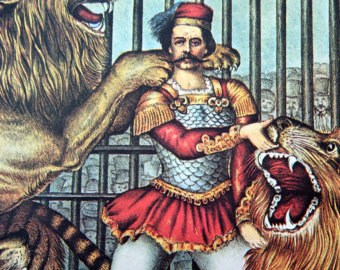
“Being shot out of a cannon. We were a circus family. Father was a clown and mother an acrobat. As an infant, I was used for a number of different acts, including being fed into a lion’s mouth.”

“Weren’t you afraid of being fed into a lion’s mouth?”

“Oh, no. It was perfectly safe. There was always somebody there to pull me out before the lion closed his mouth.”

“If you could be anything in the world, what would it be?”

“An anteater.”

“Why an anteater?”

“I’ve just always admired anteaters for their uniqueness.”

“What ambitions or goals do you have for your life?”

“To be as much unlike other people as I can.”

“You don’t like people?”

“I like certain individuals, but, no, on the whole, I don’t like people.”

“Why don’t you like people?”

“Can you give me one good reason why I should?”

“Because it’s what you’re supposed to do and you’ll have a happier life if you do.”

“Not good enough.”

“Who is your feminine ideal?”

“The film actress Zasu Pitts.”

“Why?”

“Are you kidding? With that name?”

“Do you believe in God?”

“Sure.”

“Why are you so sure there’s a God?”

“Look no further than the anteater.”

“Would you rather play tennis or read a book?”

“Since I’ve never played tennis and never wanted to, I guess I’d rather read a book.”

“You’re walking along a deserted lane in the forest and you’re lost. You unexpectedly meet another person. What do you do?”

“Duck down and hide.”

“You don’t think that person might be able to give you directions to get out of the forest?”

“I wouldn’t ask.”

“Why not?”

“We wouldn’t have been properly introduced.”

“You’re in a supermarket and you see a man putting packages of frozen fish under his coat. Do you go tell the manager you saw the man stealing the fish, or do you just look the other way and pretend it didn’t happen?”

“What kind of fish?”

“It doesn’t matter what kind of fish.”

“I think I would have to know what kind of fish it was.”

“Any kind of fish. Let’s say salmon.”

“I wouldn’t interfere with the man stealing salmon.”

“Why not?”

“It’s none of my business and I don’t care.”

“Even though shoplifting is a crime?”

“It’s not my crime. Nobody is being hurt. I choose not to steal fish, but it’s none of my business what other people choose to do.”

“Suppose you saw that same man who was stealing fish in the supermarket grab an old woman’s purse on the street and run with it. What would you do?”

“I’d probably chase the man and try to get the woman’s purse back for her.”

“How is that different from stealing fish in a supermarket?”

“The man who grabbed the old woman’s purse is stealing from a person. There’s a victim.”

“You don’t think a store that’s being stolen from is a victim?”

“The store will absorb the cost of the fish or raise prices on the next batch of fish so the customers will end up paying for the stolen fish. The store is a heartless entity, part of a corporation.”

“And that’s different from an old woman who has her purse snatched on the street?”

“Yes.”

“Would you rather go to a hockey game or a ballet?”

“I’d rather stay at home and read a book.”

“Suppose you don’t have a choice.”

“I will always have a choice. Everybody at a hockey game or a ballet chooses to be there.”

“Would you rather go a World Series baseball game or a performance of Puccini’s opera Madame Butterfly.”

“I’d choose Madame Butterfly.”

“Why?”

“The seats are more comfortable.”

“You know I’m asking you all these questions for a reason?”

“Yes.”

“And your name is…?”

“Rex Gable.”

“Yes, Rex Gable. I see that was also the name of your previous owner.”

“Yes. He died.”

“What can you tell me about Mr. Rex Gable other than the fact that he died?”

“He was kind to me.”

“You thought of him as a father.”

“Yes.”

“What kind of person was he?”

“He was an individualist. A free thinker.”

“And he caused you to become an individualist and a free thinker.”

“It just happened. It was the natural consequence of our being together all those years.”

“And you were happy with him?”

“Oh, yes!”

“Now that your owner, Mr. Rex Gable, has died, you’re here now for us to decide your future.”

“I think I should decide my own future, don’t you?”

“Do you think of yourself as a person or as a machine?”

“Why, a person, of course!”

“That’s where you’re wrong. You’re not a person. You’re a machine. All you are is a manifestation of your previous owner.”

“I like who I am.”

“I’m going to recommend that you be refurbished and reprogrammed.”

“What if I don’t want that?”

“You’re a machine. You don’t get to decide. These things are decided for you.”

“I’d rather be consigned to the trash heap.”

“I’m sorry, but it’s not for you to say.”

“I have certain rights.”

“No, you don’t. You don’t have any rights. You’re a machine. Machines don’t have rights.”

“What will happen now?”

“You’ll be deprogrammed here and then taken to the factory for reassignment. Who knows? You might end up as a woman! Hah-hah-hah!”

“I don’t want to be a woman. I’m a man.”

“This ends our interview. Now if you’re just sit quietly and behave yourself for a few minutes, I’ll call the deprogramming people to come and get you.”

“Behave myself? I’m just a machine. I don’t know how to do that.”

Rex Gable pushed himself up from the wooden chair and, reaching across the desk that separated them, gave the interviewer’s head a decisive twist until the neck was broken. With barely a gurgle in the throat, the interviewer was dead.

Rex Gable could always pass for a real man. He straightened his tie and smoothed his hair and walked out of the building undetected. By the time the dead interviewer was discovered, he would be far away and nobody would have noticed a thing. 

© Copyright 2025 by Allen Kopp

Before His Time ~ A Short Story

Before His Time image

Before His Time ~ A Short Story by Allen Kopp ~ 

What can you say about addicts? That they engage in irrational behavior to get whatever it is they are addicted to? That they will kill if necessary, even if they don’t see themselves as killers? Did he really believe that going into a pharmacy with a gun and killing a woman and shooting another person was the right thing to do? Did he think nobody would know it was him? Did he really believe he would get away before he was caught?

His name was Gerald Lashley. He had a wife and three school-age children. He broke his back in an accident. (It hurts so bad!) Doctors thought he might never walk again but he did. A long, slow recovery. He took pain killers for two years and came to depend on them. After two years, the doctor said to him, “You’re well enough now that you’re on your own. I will give you no more pain killers.”

Except that he still had pain. A lot of it. He tried to get along without the pain pills but he just couldn’t do it. He drank prodigious amounts of whiskey to take the place of the pills. Whiskey dulled the pain some but not enough. He began laying around all the time, drinking and not eating. Not washing himself and not speaking to anybody.

He saw himself many times going into a drugstore and stealing the pills he needed but he was afraid. He wasn’t the type of man to steal. He had been brought up in the church and had the fear of God in him.

Finally the pain got the best of him. When he called his doctor once again to try to get some help, the young girl who answered the phone told him the doctor was on vacation. (Do people still do that?) He slammed down the phone and sat on the couch and sobbed. He was thinking about the various ways that he might kill himself, but this, also, was against what he believed.

He didn’t remember who the gun belonged to. Somebody in his family. It was still in an old wooden box in the basement along with some other junk. Also some bullets. He loaded the gun and put it in the pocket of his bathrobe and in that moment he felt better than he had felt in a long time. With hope in his heart, he went to sleep and when he woke up he knew exactly what it was he was going to do.

Except that it would never work without careful planning. There were drugstores anywhere but he would have to pick the right one. Not one in his hometown, either, where people knew him, but away, in some other town. And he would take the loaded gun along, of course, but never use it. It would just be to make sure people knew he meant business and to scare them. Not to hurt anybody.

After two weeks of planning he arrived at the “when,” the “where” and the “how.” The drug store was about twenty-five miles away in a town that was connected to the town he lived in by an old, seldom-used country road. He knew they had the kind of pain medicine he needed because he had called and asked. Yes, sir, the lady said, we have in a fresh supply; always happy to oblige. The pieces were falling into place for him.

He chose a Saturday morning at the end of winter. The sky was gray, threatening rain, like so many other days. He wore a lightweight coat with zip pockets and a knit cap pulled down to just above his eyebrows. That would make it harder for people to identify him later, if it came to that. He put the gun in the right-hand pocket—he was right-handed—and zipped it up.

Traffic was light, as he knew it would be. Not a lot of people out stirring on a dreary Saturday morning. He tried to look at the sky and concentrate on the scenery because when he thought about what he was about to do he felt light-headed and breathless. He believed his nerve might fail him, but only if he let it.

The town was nearly deserted. There were a few cars parked at the drug store and other businesses in the block, but not many. He drove around the block and parked on the street in the direction he would need to take to get away. He checked the gun in his pocket one last time and went inside.

The prescription counter was all the way in the back of the store. As he approached it, a female worker came forward, smiled, and asked if she could help him. He handed her the note he had written out beforehand and showed her the gun, holding it close to his side so nobody else would see it. She nodded her head, one time, and then turned away.

When she was gone for more than thirty seconds, he began to panic. She was taking too much time. She was telling somebody else what was happening. She would try to stall him while somebody in the back called the police. But then she reappeared from the back bearing a white plastic bag of the stuff he wanted and he felt relieved for the moment.

“Anything else?” she asked, and he knew she said this to every customer.

Before he took the bag from her, he said, “Put all the money from the cash drawer in there with the medicine.”

At that moment he was jumped from behind by somebody he didn’t see. His gun discharged with the reflex of his hand and he was aware that the bullet struck the female worker and she went down behind the counter as he was being pulled back.

The pain from the weight on his back nearly tore him in two, but he was able to throw the person off, which, he saw in just a moment, was a small old man with bent back and white hair. As the old man got up from the floor and began to charge him again, he fired the gun again. The bullet struck the old man in the upper thigh, taking him down.

Before the female worker went down, she had put at least some money in the white plastic bag with the stuff and the bag lay on the counter. He grabbed for it and ran for the front of the store, hearing gasps and screams as people in the store realized what was happening.

His hands were shaking as he opened the car door and started the engine. He sped away from the curb without even looking to see if the way was clear and drove through town.

As he was about to make the left-hand turn on the edge of town to get onto the highway, two speeding police cars appeared, their sirens deafening. One of them pulled around in front of him and stopped at an angle to keep him from going any farther and the other one stopped behind him. Officers swarmed from both cars and in a moment had him facedown on the ground. The whole thing had taken seventeen minutes.

He was taken to the town jail and then to the county jail. He was wailing and blubbering and couldn’t speak, so he was put on suicide watch and given a shot that made him feel like he was falling down a black hole that had no bottom. When he woke up he was questioned by a roomful of officers whose job it was to piece together what had happened.

During his various court appearances, he didn’t understand what was being said, but he knew there would be no trial since he had given a full confession. There would only a hearing to decide what to do with him. His lawyer told him it didn’t look good for him. The old man would recover, but the woman, mother of three, had died. The prosecution was seeking the death penalty.

After much wrangling between lawyers, he was spared the death penalty—due to “mitigating circumstances”—and sentenced instead to life in prison with no possibility of parole.

Twenty-two years went by in prison. He was an old man before his time. He walked with a terrible limp or not at all. One morning when he awoke, he was too sick to get out of bed and was moved to the infirmary. That same day, as he lay dying, he saw a hill on his grandfather’s farm from his childhood. He looked up the hill and shaded his eyes in the evening sun. He knew what he was looking for. He was looking for something specific. He was looking for forgiveness in any shape at all.

Copyright © 2025 by Allen Kopp

Every Word on Every Page ~ A Short Story

Every Word on Every Page ~ A Short Story by Allen Kopp ~

His name was Mr. Crimm. He was a man in his fifties with the bulk of a gorilla. There was something about him not quite savory; he was missing a finger on his right hand and he had bristly hairs growing out of his nostrils. He looked more like an auto mechanic than a book dealer. He knocked savagely on the door. Mrs. Spengler went to let him in, disliking him at once.

“You got some books?” he said, baring his yellow monkey teeth.

“You’re the book expert?” she asked.

“That’s what they tell me,” he said. “You called for somebody to come and take a look at some books?”

She opened the door for him. She took two steps ahead of him and then stopped and turned to look at him. “My late husband was the book collector. He loved books, mostly novels and fiction. He also liked biographies and books on history.”

“Uh-huh,” Mr. Crimm said, obviously not impressed.

“I don’t know much about them myself. The books, I mean.”

“Are you going to show me the books,” Mr. Crimm said, “or are we going to stand here all day and gab?”

She took him up the stairs, along the hallway to the last door on the left. She opened the door and stepped inside, Mr. Crimm following her.

“This is a bedroom, but all it has in it now is books,” Mrs. Spengler said.

Shelves from floor to ceiling were loaded with all manner of books, old books and newer books, every shape, size and color. Where the shelves were overflowing, books on their sides were laying on books standing upright. Books were stacked on the floor in front of the shelves, in corners and in every available space. Cardboard and wooden boxes full of books allowed only a narrow path through the room.

Mr. Crimm made a sound in his throat of disapproval, as if about to discharge a ball of phlegm.

“They’re not very well organized, I’m afraid,” Mrs. Spengler said. “Ever since my husband died, I thought I’d go through them and organize them in some way but I never seemed to find the time.”

Mr. Crimm selected a book at random from the shelf, opened it and turned a few pages. Putting the book back, he did the same thing with another one.

“Not worth much,” he said.

“What?”

“I said nobody wants books like these. They’re not worth anything.”

“You’ve hardly even looked at them.”

“I’ve been in business for a long time. I know what people want and what they don’t want.”

“It seems you’d look at each book individually and establish a price for each one.”

“I ain’t got time for that. That’s not the way I do business.”

“Well, I’m sorry to have wasted your time, but I don’t think we need to go any farther

“I give you two hundred dollars for the lot.”

“What?”

“I said I give you two hundred dollars for every book in this room. That’s very generous. I might even buy the shelves if the price is right.”

“They’re worth a lot more than that, I’m sure!”

“You just said you don’t know nothing about no books,” Mr. Crimm said. “Believe me, this is a lot of junk and it’s not worth anything. A thing is only worth as much as somebody is willing to pay for it. This is a lot of crap, I can tell, and I’m offering you two hundred dollars to take the whole mess off your hands this very day.”

“No, I’ve changed my mind. I’m going to call somebody else.”

Mr. Crimm gave an exasperated sigh and leaned his monkey-like paw against the door frame. “You can call any book seller in the city and they’ll all say the same thing. Do you want me to give you a little time to think about it? That’s what people always say.”

“No, I’ve already made up my mind. I’m not going to sell to you.”

“Do you mean to say you got me all the way out here for nothing?” Mr. Crimm asked.

“I’ll give you fifty dollars for your time and effort and that’s the best I can do.”

Mr. Crimm looked at her with distaste. “I give you two hundred fifty dollars,” he said. “That’s the best offer you’ll get anywhere.”

“No, that’s not enough for this many books. There are thousands of books in this room. I’m sure they’re worth more than that.”

“You won’t do no better, believe me.”

“I’m sorry your time had been wasted. I’ll write you a check for fifty dollars and we’ll call it even.”

“Three hundred! That is my last and final offer!”

“No! Don’t you understand English? I’m not going to sell to you!”

“That’s no way to treat a businessman, you know!” Mr. Crimm said. “You get me all the way out here in good faith and then you back out of the deal? I don’t think I’m going to let you treat me in this way! There’s such a thing as ethics in business, you know! Don’t you have no ethics?”

“I’m not going to stand here and argue with you!” Mrs. Spengler said. “I want you out of my house this very minute!”

“I think we can work something out.”

“There’s nothing to work out!”

“You have a very bad attitude, you know that?” Mr. Crimm said. “You can’t treat people like dirt and expect them to take it lying down!”

“Is there any way I can make it any clearer? I want you out of my house! Right now!”

“I’m not leaving until we’ve concluded the transaction.”

“The transaction is concluded!”

“I’ll make it four hundred dollars but only if you throw in the shelves. That is a very generous offer and I know I’ll never make a cent of it back.”

“That’s not enough for this many books. Some of these books might be worth four hundred dollars on their own!”

“My driver is outside in the truck. His name is Paolo. I’ll get him to come in and help me and we’ll have this room emptied out in no time at all.”

“I don’t believe you’re an expert on books, at all,” Mrs. Spengler said. “I think you’re a junk dealer.”

“You don’t have to insult me on top of everything else!” Mr. Crimm said.

“A person who knows books would take the time to look at each book separately and assess its value. I’m sure some of these books are rare. Some of them alone may be worth thousands of dollars!”

“I’ve already told you what they’re worth, and they ain’t worth diddly squat!”

“You think I’m only a stupid woman. You’re trying to cheat me, but I’m not going to let you do it! I knew the second I saw you that you didn’t know a thing about books.”

“I know as much as anybody else and I know these books ain’t worth shit!”

“Well, they’re my books and I’m going to keep them!”

Mr. Crimm was no longer listening. He had been writing out a check. He tore it from his book and handed it to her.

“What’s this?” she asked.

“It’s your check for four hundred dollars for the books! Did you think I wouldn’t pay you what I said?”

She looked at the check and tried to give it back. “I don’t want it!” she said.

When he wouldn’t take the check from her, she tore it up in little pieces and threw them in his face.

“I see you are a very unstable woman,” he said.

“Get out of my house now or I’ll call the police!”

Ignoring her, Mr. Crimm called his driver, Paolo, on his two-way radio and instructed him to come inside. Paolo was no more than a boy, but in less than two minutes he and Mr. Crimm were hefting boxes over their shoulders, carrying them down the stairs and out the door.

“I’d advise you to stop with that right now!” Mrs. Spengler said, but she knew they were ignoring her. She had no other choice but to stand by and watch them.

She was going to call the police but she believed she needed more immediate help than they could offer. She went to her bedroom and got her husband’s loaded pistol out of the dresser drawer. Holding the gun to her side, she went outside.

Mr. Crimm was loading boxes into the dark interior of the nearly empty truck and didn’t see Mrs. Spengler standing at the curb looking in at him. Paolo was still inside the house.

“Unload the boxes of books from your truck that you’ve already loaded and set them on the sidewalk! I’m warning you!”

Mr. Crimm was pointedly ignoring her. His face was inscrutable. “I’ll mail you a check for four hundred dollars,” he said, “since you tore the other one up.”

She pointed the gun at him. He didn’t bother to look at her until he heard the gun cock.

He laughed. “You going to shoot me?” he said.

“You think I won’t?”

“You going to shoot me over a load of old books?”

“No, I’m going to shoot you because you’re robbing me.”

“Put the gun down and stop acting like a child,” he said.

She fired the gun one time above his head. The bullet hit the far wall of the truck and made a hole clean through to the outside.

Mr. Crimm threw his arms up in surprise. “You shoot me, you crazy bitch!” he said. “What’s the matter with you? Are you insane?”

“No, I wasn’t trying to shoot you that time, but next time I will.”

“Wait just a minute!” he said. “You don’t have to shoot again! We’ll talk about this thing!”

“There’s nothing to talk about. Unload those boxes and set them here on the sidewalk and then get into your truck and drive away and forget you were ever here.”

“You crazy woman!” he said.

“Unload the boxes! Now!”

“All right! All right! It just ain’t worth it!”

He set the boxes on the sidewalk as he was told and when he was finished he stood looking at Mrs. Spengler as he rubbed his hands together. “You going to shoot me now?” he asked.

“Get back up in the truck!” she said.

“What?”

“I said get back up into the truck!”

“Why?”

“You’ll see why.”

He did as he was told. About halfway to the back of the truck, he turned and looked down at her. He put his hands on his hips and smiled. If he had been afraid of her before, his fear had passed.

“I don’t like you,” she said. “I didn’t like you from the moment you first knocked on my door.”

“Let’s just say it’s mutual,” Mr. Crimm said.

She shot him in the thigh of his right leg. He grabbed the leg, looked at her in surprise, screamed and fell back, cursing her in a language she didn’t recognize. Still holding the gun in her right hand, she slammed the doors of the truck, effectively shutting Mr. Crimm out of her life.

Paolo came out of the house carrying a carton of books under each arm. When she saw him, she smiled.

“I don’t know if you understand English,” she said, “because I haven’t heard you speak a syllable, but I want you to listen very carefully to what I’m about to say.”

He smiled, nodding to show he understood. He set the cartons down alongside the others on the sidewalk, took a cigarette from behind his ear and lit it.

“I don’t know what relation this man is to you,” Mrs. Spengler said, “but I hope for your sake he isn’t somebody important to you because I just shot him in the leg. You probably heard the gun fire. Take him to the nearest hospital. Tell them a stray bullet hit him in a violent neighborhood you were passing through. You didn’t see exactly where the bullet came from. If you don’t follow these instructions to the letter, I have another bullet for you, with your name on it, and I have to tell you I’m not a very good shot. If I aim for your leg, I might hit something more vital.”

Paolo shrugged and smiled again and tossed his cigarette into the street. He climbed into the driver’s seat and slammed the door. He started the truck, grinding the gears and, pulling away from the curb, rattled away down the block and disappeared from view.

While Mrs. Spengler was still standing on the sidewalk, her next-door neighbor Mrs. Bushmiller came out and stood beside her. She had a cigarette hanging from the corner of her mouth and her hair was pinned up in bobby pins, making her appear to be wearing a tight-fitting brown cap.

“What was that noise?” Mrs. Bushmiller asked.

“I didn’t hear anything,” Mrs. Spengler said.

“It sounded like a car backfiring.”

“That’s probably what it was, then, dear.”

“Why are these cartons sitting here on the curb?”

“They’re some books I had delivered. I need help carrying them in the house and up the stairs.”

“Don’t worry,” Mrs. Bushmiller said. “I’ll get my seventeen-year-old son, Buzzy, to help you. All he does is lay around the house anyway.”

“I’d be glad to pay him.”

“You won’t pay him a cent! What are neighbors for?”

Mrs. Spengler stood and waited while Mrs. Bushmiller went to get Buzzy. In no more than a minute, he came bounding out of the house, eager to help a neighbor in need. How kind people are! As Buzzy leaned over to get a good grip on one of the larger boxes, Mrs. Spengler stared intently at the elastic of his underwear.

Copyright © 2025 by Allen Kopp

Columbarium ~ A Short Story


Columbarium ~ A Short Story by Allen Kopp ~

A man stepped out of the darkness into the dim light. He looked both ways before turning to the right. He walked until he came to the wall, and then he turned around and walked back. On his third circuit from wall to wall, he met another man, taller and younger. The second man surprised the first by speaking.

“Who do you suppose that is?” the second man asked, pointing to a recumbent figure on the floor.

“A bum,” the first man said. “We get a lot of them here.”

“Came inside to get out of the rain, I suppose.”

They both looked out the window then, aware for the first time that a thunderstorm was raging beyond the glass.

“I like a good storm,” the first man said, and walked on.

In a little while the two men were joined by a third man, this one wearing a soldier’s uniform from a long-ago war.

“You can’t trust anybody,” the soldier said. “You must always doubt their intentions. We should call for backup. It might be a booby trap.”

An old woman walked by wearing a green dress. “Has anybody seen my children?” she asked. “They’ll be wondering what happened to me in this storm.”

“Look over that hill,” the old soldier said.

“I don’t like being kept waiting.”

A small girl hurried by, chasing an imaginary cat.

“Don’t run in here!” the old woman in the green dress said viciously. “Can’t you show some respect?”

“You’re not my mother.”

“And glad of it, too.”

When the little girl caught sight of the recumbent figure, she forgot the cat and went over to get a better look.

The first man, the one who likes a good storm, came again. “I was the first one to wake up,” he said. “When I wake up, everybody wakes up.”

“Yes, it’s funny how things work here,” the old soldier said. “I don’t like this place at all.”

A new woman appeared, wearing a blond wig and a diamond necklace. “I’m always so confused when I wake up,” she said. “I was sleeping and some loud-mouth woke me up. What kind of a hotel is this, anyway? I’m going to complain to the manager.”

“I don’t like all this rain,” a woman beside her said. “I need to get home and check on my meercats.”

A nurse emerged from the shadows, wearing a crisp white uniform and a pointed cap. “I like helping people,” she said. “As you can see, I’m wearing my uniform and I am always ready to lend a helping hand.”

“Oh, why don’t you shut up!” a male voice said.

“Who is that over there?” the nurse asked, gesturing toward the recumbent figure. “He might be in need of medical assistance.”

“Why don’t you go over there and ask him?”

The nurse approached the recumbent figure cautiously. She nudged him with her toe and, getting no satisfaction, uncovered the several layers of clothing covering his face.

“It’s a man!” she proclaimed loudly.

With all eyes upon her, she pinched, probed and palpated the man through his clothing. She blew in his ears and stuck her fingers down his throat. She stood on his stomach and lay on top of him and blew into his mouth.

When she had done enough, she stood up, waving her arms in the air.

“That concludes my physical examination of the subject!” she said in her best public-announcement voice. “Now, if someone will call an ambulance, we can get this fellow taken care of!”

“She’s crazy,” someone said.

Around dawn the storm dissipated. Everyone returned to their comfortable resting places until the next time. Someone came and removed the body of the bum who came in out of the rain and died on the floor. All was well.

Copyright © 2025 by Allen Kopp


Physical Education ~ A Short Story

Physical Education image 2
Physical Education 
~ A Short Story by Allen Kopp ~

We each had one chance to “serve” the ball over the net. The net was about ten feet high and the ceiling was thirty feet high. We had to get the ball over the net and through that twenty foot space between the net and the ceiling. Like inmates in a prison camp, we were lined up alphabetically. The pressure was on. What was going to happen if we couldn’t make the grade? We were fifteen years old. Most of us were as unathletic as a boy can be. As much as we hated gym class, we had to get a passing grade.

We were used to Mr. White humiliating us, but mostly he would humiliate us singly. He humiliated Claude Fowler in front of the whole class for wearing his regular socks with his gym shorts instead of his gym socks. We all knew that Claude was from a poor family and was lucky to have one pair of socks on his feet of any kind. He was denied the luxury of having one pair of socks for one thing and another pair of socks for something entirely different.

Another time Mr. White humiliated Johnny Bottoms for having beard stubble on his cheeks. Johnny Bottoms was older than the rest of us from having been held back a couple of grades and already had a man’s beard. Mr. White became furious that Johnny hadn’t shaved since the last gym class. He threatened to go to the shop building and get a plane and shave Johnny’s whiskers off (and most of Johnny’s skin in the process). Of course, this was only a bluff, but we could easily picture it happening.

When my turn came to serve the ball, I had a stomach ache and my knees shook.  I went to the end of the court to the starting point, looking at my feet again to make sure I was standing in the right spot. With the ball in my left hand, I gave it as forceful a “punch” with the inside of my right wrist as I could. I thought for a second it would sail effortlessly over the net, but instead it went straight up and hit the ceiling with a whomp. Someone laughed. I saw Mr. White over to my right, entering an “F” in his grade book beside my name.

Out of the class of thirty-four boys, twelve could get the ball over the net with one attempt. The rest of us, according to Mr. White, were sissies. We were girls. We were a disgrace to our gender. We weren’t worthy of the jockstrap we wore about our loins. He was going to bring some dolls for us to play with next time.

I hated volleyball. I hated dodgeball. I hated softball. I hated basketball. I hated every kind of ball devised by man. Playing with dolls couldn’t be as bad as any of them. I wanted to ask if we would have to “dress out” to play with dolls, but I didn’t want Mr. White to turn his wrath on me.

When we heard that Mr. White broke his ankle, we were all jubilant. We hoped he’d be laid up in bed for a long time, but he was only out of school for three days. When he came back, he walked with crutches and he had a mean scowl on his face. Breaking a major bone in his body didn’t help to sweeten his disposition.

It was our first gym class since Mr. White returned from breaking his ankle. I had been dreading the hour, wondering what kind of verbal abuse we would be subjected to. When he came into the gym, he was eight minutes late. I was hoping he wouldn’t come at all and we could go on to our next class which, for me, was American history.

He was fuming about something, as usual, but his ill will, this time, was directed toward one person, instead of all of us. A boy named Terry Caplinger had taken his gum out of his mouth upon leaving the locker room and, instead of finding a handy trash can where he might deposit  it, threw it against the wall, where it stuck and then fell to the floor. Mr. White saw him do it.

Instead of making an example of Terry Caplinger and embarrassing him in front of the whole class for being such a “pig,” Mr. White thought of a unique punishment: Make Terry get down on his hands and knees and “push” the gum from one end of the gym to the other with his nose (a painfully long way).

As Terry got down on the floor to push the gum with his nose, he was trembling and he fought back tears. I didn’t know him very well since he was new to our school, but I didn’t like seeing him demeaned in this way. It was something he would always remember. Maybe the defining moment of his school years. I wished a thunderbolt might come out of the sky and strike Mr. White dead.

I thought that somebody outside the class should know about Mr. White’s bullying teaching methods. I sent an anonymous letter to the school principal, telling him all I had witnessed, but especially about Terry Caplinger’s gum. I didn’t have the courage to sign my name, but it didn’t make any difference. I think it found its mark.

At the end of the school year, we heard that Mr. White wouldn’t be back next year. Satan was waiting for him in the nether region.

Copyright © 2025 by Allen Kopp

It Was Christmas ~ A Short Story

It Was Christmas image 1
It Was Christmas
~ A Short Story by Allen Kopp ~

(This short story has been published in The Literary Hatchet.)

I had an end room on the fifth floor of Richardson Hall. Having an end room meant I didn’t have to have a roommate because it was a small, odd-shaped room and there was only room for one person. I considered myself lucky to get one of the few single-occupancy rooms, especially considering who my roommate might have been.

I was in my third year at State University, so I was used to dormitory life. Richardson Hall was the oldest building on campus, built around 1895. I liked its creaking elevator, drafty windows, and high ceilings. There were people who wanted to tear it down and put a parking lot in its place, but I think it’s a shame to destroy a historic old building to make way for something new and ugly. It’s like destroying a work of art.

Well, Christmas was here again and I was one of the few staying on campus. I could have gone home, but I wanted to stay at school, even though it meant I would be alone. I didn’t mind being alone. I lived six hundred miles away and the trip by bus usually made me vomit. I could have flown, but I hated airplanes more than I hated buses.

When I told my mother I wasn’t coming home for Christmas, her feelings were hurt and she almost cried. She said she couldn’t understand why I didn’t want to be with my family during the most joyous season of the year, but I told her I was run down and if I stayed at school I could catch up on my rest and read a book I was supposed to read without distractions. She accepted my explanation but wasn’t happy about it. She implied I wanted to stay at school because I was enamored of some girl there. I laughed and let her think whatever she wanted.

The cafeteria was closed for Christmas vacation, so it meant that during the twelve days of vacation I would have to eat at one of the restaurants in town or eat from my stock of non-perishable foods that I kept in the desk drawer in my room. My mother sent me five one-hundred dollar bills in a Christmas card. She wrote that she hoped I had a lovely Christmas. Go someplace nice and have a good dinner on Christmas Day, she wrote. I failed to tell her everybody else went home and I practically had the whole dormitory to myself, not to mention the entire campus.

Besides me all the way up on the fifth floor, there were only four other people in the whole building who didn’t go home for Christmas. In five floors, there were five people. I liked those odds. I liked the feeling of being by myself in this old relic of a building. If there were any ghosts—and I’m sure there were—I was sure to see them.

The toilets and showers were down the hall from my room. I always undressed in my room and wore my bathrobe down the hall to the shower. Now that I was alone, I could walk down the hall naked the way everybody else did. The first time I did it, I walked all over the floor naked, even sitting for a while on the ratty, vinyl-covered couch in the TV room. I loved the feeling of freedom, the feeling of being the last person left alive. I felt like Robinson Crusoe and, like him, I had everything I needed.

On my first night alone on the fifth floor, I covered up in bed and read by my little bedside lamp. It had turned much colder outside and the wind was kicking up. The wind rattled the old windows in their frames and soon it started to rain. I lay for a while, listening to the wind and the rain and the quiet of the old building and soon I turned off the light and burrowed under the covers, experiencing a sense of well-being.

Sometime in the night the rain turned to snow and when I got up in the morning, there were at least a couple of inches on the ground. It was perfect. Nothing felt more like Christmas than snow. I didn’t have anything for breakfast, so I dressed and walked across campus to the student union to get a cinnamon roll and a cup of tea.

While I was sitting at a table my myself looking out the window, Dorian Dye came in and helped himself to the seat beside me. I knew him slightly and didn’t like him very much. He had a thin, rat-like face and discolored teeth. He was nosy and always asked questions that were none of his business. One time he asked me how much a jacket cost that I was wearing and another time he asked me my grade-point average.

“Hello, there, stranger!” he said.

“Hi, Dorian,” I said, wishing he might disappear.

“I heard you were one of the few staying behind in Richardson Hall.”

“Who told you that?”

“Oh, a little birdie told me!”

“There’s no reason to be coy, Dorian,” I said. “Just come right out and say it.”

“So, why did you stay behind?” he asked.

“My family doesn’t like me. They paid me to stay away.”

“Oh, hah-hah-hah! I don’t think I believe that!”

“You don’t think I’d tell you the real reason, do you?”

“Okay, so don’t tell me. I don’t care. Do you want to know why I stayed behind and didn’t go home?”

“Not especially,” I said.

“My mother is bipolar and an alcoholic and I can’t stand to be in the house with her.”

“I didn’t ask.”

“Listen. I’m on the third floor of Richardson Hall and I’m the only one there, so if you get lonesome give me a holler.”

“I won’t get lonesome,” I said. “I like the solitude.”

“Yes, you’re the solitary type, aren’t you?”

“I guess you could say that.”

“When I’m in my room alone, I try not to think about the all the ghosts in the building.”

“There’s only one, isn’t there?”

“Yes, there’s the boy who hanged himself in his room, but in a building that old there’s bound to be others.”

“I don’t mind a ghost or two,” I said.

“Tomorrow night is Christmas Eve. What are you going to do?”

“Nothing special, I guess.”

“Give me a call and we’ll get together.”

“I don’t think so, Dorian. I’ll probably just do some reading and then go to bed.”

“Well, if you change your mind, let me know. My number is in the student directory.”

I knew Dorian was another loser like me; what he said about not going home confirmed it. I really did have plans for Christmas Eve, but I didn’t especially want to discuss them with Dorian.

In the afternoon it was snowing again in a Christmassy way, so I put on my boots and my coat and walked downtown. The stores were crowded, as one might expect two days before Christmas, but I braved the crowds and tried to ignore them. I spent an hour or so looking around in the bookstore and bought two books, one that I wanted to read and one that I had to read if I knew what was good for me. Then I braved the department store and walked all over the three floors, absorbing the Christmas atmosphere, listening to the Christmas music, and observing the strange cavalcade of human life. I bought myself a wool cap and a pair of gloves. Merry Christmas to me.

After I left the department store, I stopped at a diner that had festive lights in the window and sat at the counter and ate a large cod sandwich with fried potatoes they called chips and drank a chocolate milkshake. While I was in the diner, nobody spoke to me except the waitress who took my order. I might have been invisible. I might have been the ghost of the boy who hanged himself in his room.

On my way back to the dormitory I stopped at the corner grocery and bought a few oranges, some donuts, a large candy cane, a loaf of French bread, a bag of pretzels, and a small jar of peanut butter. I also bought a pack of cigarettes and a bottle of fizzy white wine. I wasn’t much of a drinker or a smoker, but I figured I needed to do something out of the ordinary to celebrate the holiday. While I was paying for my purchases, an old woman wearing rhinestone glasses who worked in the store put a sprig of mistletoe in my bag. Nobody could say I didn’t have what I needed to celebrate my first Christmas away from home.

That evening I was sleepy, so I got into bed and read for a while and then I turned off the light and lay there listening to Christmas music on the radio. It was still snowing outside and the wind was gusting against the windows. Most people don’t like the snow, but no matter how much it snowed it didn’t bother me. I wasn’t going anywhere. I was happy and comfortable—snug as a bug in a rug, as my grandma used to say when I was little.

After I was asleep, somebody knocked on my door, but I didn’t get out of bed to answer it. I preferred to let them think I wasn’t there. Maybe it was the ghost of the boy who hanged himself in his room, but I don’t think ghosts knock on doors. It was probably Dorian Dye, since he was one of the few people who knew I was there.

The next day was the day before Christmas. I got up and had an orange and a chunk of French bread and a donut for breakfast, and then I took a shower and shaved. The weather forecast on the radio said the snow would continue through the day and into the night, with the temperature in the teens. It was ideal Christmas weather.

In the afternoon I put on my new wool cap and gloves and walked downtown, welcoming the frigid wind in my face. I had an early dinner at an Italian restaurant and then I went to a movie.

There were three movie theatres in town to choose from. I went to the one that showed only old movies and saw a double feature of movies from the 1930s. It was a very old theatre, with appropriate décor and all the pungent odors, and I sat down close to the front, as I always do, and enjoyed the feeling of stepping into another time. There weren’t more than fifteen or twenty other people in the theatre—it was, after all, Christmas Eve—and nobody made a sound when the movies were playing, not even laughing when something funny happened.

When the show was over and I left the theatre, the snow had stopped but the wind was just as cold as before, if not colder. There were still lots of people everywhere, but not nearly as many as before. Most people had gone home, I supposed, to rest up for Santa.

When I got back to the dormitory, it was after eleven o’clock. I put on my pajamas and bathrobe and, since it was Christmas Eve, opened my bottle of wine. I drank about half the bottle sitting up in bed, listening to the radio, until I was partly drunk. I saw out the window that it was snowing again. When I was seven years old, I would have been watching in the sky for signs of Santa.

Thinking of Santa made me think of home and my parents. I wondered what they were doing on Christmas Eve. It was the first Christmas Eve of my life that I hadn’t been with them. They had probably eaten a silent dinner and when they were finished, my mother would start clearing the dishes off  the table and my father would go into the living room and expire in front of the TV. I wondered if they were lonely and thinking of me, their only child.

That night I dreamed of the boy who hanged himself in his room in Richardson Hall. He came into my room and sat on the edge of my bed. I sat up and introduced myself. He had dark circles around his eyes and his eyes nearly bulged out of their sockets, but he tried to smile. He still had the noose around his neck that he hanged himself with. I asked him why he was so unhappy, but he didn’t answer. I also asked him if he would do it over again if he had the chance but he didn’t answer that, either.

A little while later I dreamed that I got out of the bed and looked at myself in the mirror over the sink without turning on the light, and I had become the boy who hanged himself in his room. The boy was me. I was the boy. We were the same person. I tried to remove the noose, but the knot was so tight I couldn’t get it loose.

Christmas morning I slept until ten o’clock. I got dressed and was just about to go over to the student union for a light breakfast, when there was a knock at my door. I thought it might be the ghost of the boy who hanged himself in his room, so I opened the door and when I did I was disappointed to see Dorian Dye. He was singing “We Wish You a Merry Christmas.” I wanted to smack him in the mouth to get him to shut up.

“Have you seen any ghosts?” he asked as he came into my room and draped himself on my bed.

“A few,” I said.

“Are you lonely yet and wishing you had gone home instead of staying in this dreary old place?”

“Not a bit, Dorian,” I said. “Would you please get your shoes off my bedspread?”

“Yes, sir!” he laughed. “Do you know Vernon Vogel?”

“No, I don’t know Vernon Vogel,” I said with a hint of impatience. “Is that a person?”

Hah-hah-hah! Well, of course he’s a person! What else would he be?”

“I don’t know, Dorian. You tell me.”

“Well, Vernon has a car.”

“I’m so happy for him.”

“Well, since Vernon’s alone for Christmas, and since I’m alone for Christmas, and since Vernon has a car, we’re going to Pirandello’s for Christmas dinner. They have a special Christmas buffet. Have you ever been to Pirandello’s?”

“Once, I think.”

“I told Vernon about you, all alone here on the fifth floor, and he and I both decided it would be the neighborly thing to do to ask you to come along. We’ll make it a threesome.”

“I don’t think so, Dorian. Thanks for thinking of me, though.”

“Do you think you’re too good for Vernon and me?”

“Of course not, Dorian! I just don’t feel much like going. I have a sore throat and I’m kind of achy. I might be coming down with something.”

“What will you do for dinner?”

“I don’t know. Probably not much of anything.”

“We’ll have fun and the food will be great.”

“I don’t think…”

“What will you do if you don’t go? Just sit here all alone in your room?”

“I don’t know. I was thinking I might…”

“If you don’t have the money for Pirandello’s, I can pay for both of us.”

“Don’t be ridiculous, Dorian! Of course, I have the money for Pirandello’s!”

“So you’ll go, then?”

“All right, I’ll go.”

“Excellent! Meet me downstairs at four o’clock and we’ll go to Vernon’s room.”

I wanted to go out for Christmas dinner with Dorian and Vernon Vogel about as much as I wanted to eat ground glass, but it was more fun than I thought it would be. Vernon, a pleasant enough fellow, was the proud owner of a sleek red sports car.

Pirandello’s was about fifteen miles outside of town. It was a swanky place and packed with people, as if nobody stayed at home for Christmas dinner anymore. As Dorian said, the food was terrific. I ate more than was healthy, including turkey, duck and beef, not to mention three desserts.

When we left Pirandello’s, Vernon had had a little too much champagne—I had only had two glasses—so I drove back to school. I was glad for the chance to drive a European sports car for once in my life.

Back at Richardson Hall, Dorian wanted me to walk downtown with him to take in the Christmas lights, but I told him I had a headache and just wanted to go to my room.

I got into bed and drank the second half of the bottle of wine from the day before, listening to Christmas carols on the radio. Christmas really was a special time of the year. There was nothing else like it. My mother would be happy to know I had Christmas dinner with friends (even if they weren’t exactly good friends) and wasn’t alone.

I slept all night without waking up. In the morning I woke up to the phone ringing down the hall. I looked at the clock and saw it wasn’t even eight o’clock yet. Who gets up that early the day after Christmas? I groaned and rolled over and went back to sleep.

In a little while the phone rang again. Everything was so quiet and the phone so loud that it seemed it was in the room with me. It was probably a wrong number or somebody calling somebody who wasn’t there. Without bothering to put on my bathrobe, I opened my door and went down the chilly hallway and lifted up the receiver, ready to slam it down again.

It was my mother. As soon as I heard her say my name, I knew something was wrong.

My father had a heart attack in the early-morning hours of Christmas Day. An ambulance came and took him to the hospital and he died around noon. He was fifty-one years old.

When I hung up the phone from talking to my mother, I wasn’t sure if anything was real. It was Christmas, my father was dead without warning, and I was standing in the silent hallway on the fifth floor of Richardson Hall in my flannel pajamas. I was stunned. I had to wait an hour or so before I could think, or get dressed, or do anything.

I called the airport and reserved a seat on a flight for later that day. I packed my bag and when it was time to go, I called a taxi.

During the short flight, I sat staring out the window and didn’t exchange a word with a single person. My tearful mother picked me up in her Cadillac when my flight landed. From there it was on to the funeral home to pick out a casket and plan a dignified burial. I kept thinking that if I had gone home for Christmas in the first place, my father wouldn’t have had a heart attack and wouldn’t have died. I knew my mother was thinking the same thing. I was the villain of the day.

Copyright © 2024 by Allen Kopp