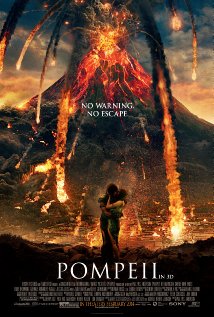
Pompeii ~ A Capsule Movie Review

 Pompeii

Pompeii ~ A Capsule Movie Review by Allen Kopp 

In the 79th year of the Christian era, the town of Pompeii, on the Italian Mediterranean not far from Naples, was destroyed and covered over by volcanic ash, mud and lava when scenic Mount Vesuvius erupted, and it wasn’t “re-discovered” until the late 1700s. Today it’s the most popular archaeological site in the world and is visited by two million people a year. The fascination never wanes.

The new movie, Pompeii, has a fictional story attached to a real historical event, as other movies, such as From Here to Eternity and Titanic, have done effectively in the past. Cassia (played by Emily Browning) has just returned to Pompeii after a year in Rome. She is the daughter of wealthy parents (they live in a magnificent seaside villa) but she seems wise beyond her years and is plenty capable of standing up for herself. A muscular slave named Milo (Kit Harrington) catches her eye when he comes to the aid of an injured horse. As her servant girl, Ariadne, says, Cassia didn’t show that much interest in any of the men of Rome.

Milo has not had a happy life. He was from one of the “horse tribes” of Britannia and saw his parents slaughtered by the Romans when he was a child. Seventeen years later he is a slave, a “gladiator” who must fight and kill or be killed by others just like him for the amusement of the sporting crowd. He is naturally bitter against Rome and Romans. He has every reason to hate Cassia and all she represents but is drawn to her as she is to him.

The villain (isn’t there always at least one?) is one Senator Corvus (Kiefer Sutherland with a faux British accent), a snarling bastard who claims to be interested in financing improvements in Pompeii but is more interested in making Cassia his wife. Understandably, Cassia wants nothing to do with Senator Corvus but she may have no other choice but to comply with his wishes since he has threatened to kill her entire family. He personifies all that is vile and corrupt about Rome and its new emperor, Titus.

Looming over everything is the “higher power,” in this case, Mount Vesuvius, which is about to erupt. The people of Pompeii have heard the rumblings coming from the mountain and have felt the earth shake, but, as one character says, “Sometimes the mountain speaks,” so the people have apparently grown complacent and don’t believe the volcano represents any real threat. They are about to find out differently. What fools these mortals be!

There isn’t much depth to Pompeii. The story is simple and you won’t have to strain your powers of deduction to know what’s going on. It’s not Shakespeare or George Bernard Shaw. It’s fast, escapist entertainment with plenty of action and a so-so love story that plays out as expected. The real star of the movie is death-dealing Vesuvius as it spews balls of fire, billowing smoke, and enough lava to bury an entire city, rending the earth and making the ocean turn back on itself as people try to escape by boat. And, as always when it comes to death and destruction, the good people suffer the same fate as the bad.  

Copyright © 2014 by Allen Kopp
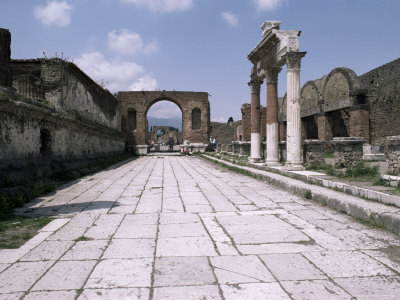
Pompeii ~ The Fabled Buried City


Pompeii ~ The Fabled Buried City

Imagine yourself living in an upscale seaside resort town of about 20,000 people, with a scenic mountain as a backdrop. The mountain, as it so happens, is an active volcano. On a day in August the volcano erupts with unexpected fury and, in a short time, the town is covered underneath layers of volcanic ash and pumice. A few of the residents of the town are able to escape, but most of them die. But that’s not the end of the story. The remarkable part is that the town, buried underneath all that muck, was all but forgotten until it was accidentally discovered about 1700 years later and became the archaeological find of the age. We’re talking, of course, about the fabled Italian city of Pompeii, lying on the Bay of Naples in the region of Campania.

Pompeii was founded about 700 years before Christ by the Oscans, a people of central Italy. (It’s difficult for us to imagine a town being in existence for hundreds of years.) Early in its history it was captured by the Etruscans. Between 525 and 474 B.C., it was captured by the Greek colony of Cumae, which was allied with Syracuse. In the 5th century B.C., the Samnites conquered it, imposing their architecture and enlarging the town. After the Samnite Wars in the 4th century B.C., Pompeii was forced to accept the status of socium of Rome and remained faithful to Rome during the Second Punic War.

Pompeii took part in the war that the towns of Campania initiated against Rome, and was besieged by Roman General Lucius Cornelius Sulla in the year 89 B.C. In 80 B.C., Pompeii was forced to surrender after the conquest of Nola, resulting in many of Sulla’s soldiers being given land and property and many people who went against Rome being stripped of their property. Pompeii became a Roman colony and an important passage for goods that arrived by sea.  

Pompeii during this time underwent a period of expansion and development. In addition to an amphitheatre being built, there were a palaestra (gymnasium) with a central swimming pool, an aqueduct that provided water for street fountains, public baths, businesses, and private houses. There were a forum, a vast food market, a sort of bar that served hot and cold drinks, restaurants, and a large hotel. For those people with the means to enjoy the amenities of the town, life must have been very pleasant. Many affluent Romans had their vacation villas there.

Then, in August of 79 A.D., a tragedy of alarming proportions occurred. Mount Vesuvius erupted, destroying Pompeii and its sister town, Herculaneum. Pompeii was lost to the ages for many centuries and, when it was accidentally rediscovered and excavated in the 18th century, it provided an astonishingly rich treasure trove of artifacts. The forum, the baths, many houses and some out-of-town villas were remarkably well-preserved, due to the lack of air and moisture. A large number of well-preserved frescoes allowed the modern world a glimpse of what everyday life was like just a few decades into the Christian era.  

Today the site of Pompeii is one of the most interesting and popular tourist destinations in the world. Anybody who has ever been fortunate enough to visit Pompeii agrees that there is else nothing quite like it anyplace in the world.

Copyright © 2011 by Allen Kopp