Train Movies


Train Movies

I love trains. Not the way they are now but the way they used to be. People used to travel everywhere by train. There weren’t any jets yet and air travel was limited. It would take three days to go from New York to Los Angeles by train; it must have been a hot and exhausting trip, but what better way was there to see the country? Imagine going to sleep in your own little room on a train moving through the night with the landscape unfolding outside your window. What would we know about the romance of trains in today’s world if it wasn’t for the movies? Here is my list of movies in which trains play a significant part. 

At the Circus (1938)

The Marx Brothers are with a circus that travels by train. Groucho sings “Lydia the Tattooed Lady” onboard the train. Watch for Harpo’s sneeze in the midget car. Look out!

Berth Marks (1929)

Stan Laurel and Oliver Hardy are a couple of bumbling (what else?) musicians in this early sound short. Due to a mix-up with a female passenger (who has a very jealous husband), they wreak havoc among the passengers on a train and end up being forced to share an upper berth for the night. (Oddly enough, it appears to be broad daylight throughout the entire proceedings.) They try to remove their clothes to go to sleep while confined to the berth, but of course it’s hopeless.

Double Indemnity (1944)

Fred McMurray is an insurance salesman and Barbara Stanwyck is bad news in 1940s Los Angeles. Fred sells Barbara’s husband an insurance policy and then the two of them hatch a plot to kill the husband. Fred pretends to be Barbara’s husband, who has a broken foot, and gets on a train (so there’ll be witnesses) and pretends to jump off the back of the moving train to commit suicide. Meanwhile, they’ve already killed Barbara’s husband. Edward G. Robinson is an insurance investigator who just doesn’t buy their story. Whoever heard of a person jumping off the back of a slow-moving train to commit suicide?  

Some Like it Hot (1959)

Jack Lemmon and Tony Curtis are a couple of hapless musicians in 1929 Chicago who inadvertently witness the St. Valentine’s Day Massacre and are being pursued by vengeful gangsters. They disguise themselves as women and get jobs in an all-girl band and take a memorable train trip to Florida with Marilyn Monroe. The scene with Jack Lemmon and Marilyn in a berth on the train is one of the funniest ever. 

Dr. Zhivago (1965)

The Russian revolution has made mincemeat of their lives. Doctor-poet Yuri Zhivago, his wife, son, and father-in-law flee Moscow by train to go to his wife’s family estate. Since Russian is such a big country, they’re on the train for an extended period in less-than-ideal traveling conditions with hundreds of other people. Lots of pretty scenery as the tragic story plays out. 

Anna Karenina (1935)

In Imperial Russia, society lady Anna Karenina (played by Greta Garbo) causes a scandal when she leaves her dull husband for handsome Count Vronsky. Things do not go well for her. The classic “fallen woman” story. If you don’t know how the train figures into the story, you need to watch the movie, or, better yet, read the magnificent 850-page novel by Leo Tolstoy.

Murder on the Orient Express (1974)

In this film adaptation of an Agatha Christie novel, a tycoon (played by Richard Widmark) has been murdered on the glamorous Orient Express as it makes its way across Europe. There is a whole trainload of suspects, and it’s up to Belgian detective Hercule Poirot (played by Albert Finney) to find out who did it. Great cast including Anthony Perkins, Ingrid Bergman, Sean Connery, Vanessa Redgrave, and Lauren Bacall. Aces in all departments.

The Lady Vanishes (1938)

On a European train, a young woman named Iris Henderson befriends a friendly old woman named Miss Froy. After a while, Iris no longer sees Miss Froy on the train, and it seems that none of the other passengers have any recollection of Miss Froy ever being on the train. Did Iris just imagine Miss Froy, or is there something more sinister afoot? Something involving SPIES? This was one of Alfred Hitchcock’s best English films before he started making movies in America.

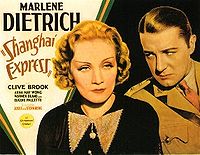
Shanghai Express (1932)

Marlene Dietrich and Anna May Wong are shady ladies on a train going across China with a group of disparate passengers, including a former boyfriend of Marlene’s (“They don’t call me Shanghai Lily for nothing.”). The passengers are caught up in political turmoil and the train is waylaid by a Chinese warlord. One of the best examples of classic cinematic art from Hollywood’s early Golden Age. Pure cinema.  

Polar Express (2004)

Charming and beautifully photographed Christmas-themed animated movie about a boy who is just old enough to doubt the existence of Santa Claus. A train (the Polar Express) magically appears outside his house on a snowy night and takes him (along with other doubting children) on a special expedition to the North Pole to meet the real Santa. This movie should be a perennial holiday classic.

Strangers on a Train (1951)

Professional tennis player (played by Farley Granger) meets a charming playboy (Robert Walker) on a train and they exchange life stories. It seems the tennis player has a wife he’d rather do without and the playboy hates his father. The playboy suggests to the tennis player that they “swap” murders: the playboy will kill the tennis player’s wife and the tennis player will kill the playboy’s father. The tennis player thinks it’s a joke but the playboy is serious. Watch for the memorable scene in the amusement park where the tennis player’s wife meets her fate at the hands of the playboy. They don’t call Alfred Hitchcock the Master for nothing.

Copyright © 2011 by Allen Kopp 
Prison Movies

Prison Movies

Most of us will never know what it’s like to be in prison. We have the movies, though, and through them we can get a glimpse of what life behind bars is really like. Prison movies have long been a staple of American films and they remain enduringly popular because they’re entertaining and full of human interest. Most of them are well-made and the better of them not only tell a story but have an underlying message, such as “the system is corrupt and needs to be reformed,” or “decent people are made indecent if they’re kept locked up long enough,” or “no matter what happens, you gotta have hope.” Here is my list of memorable prison pictures:

Caged (1950)

The best “women behind bars” movie ever. Naïve young woman (played by Eleanor Parker) must learn the harsh realities of prison life when she’s sentenced to a stretch behind bars for her part in a forty-dollar robbery. To make matters worse she’s expecting a baby, which is taken from her as soon as it’s born in prison. In the end, the system fails her. When she’s finally released years later, she’s no longer her sweet young self. She has become hardened and has picked up a few tricks from the despicable cons she came to know in the jug. She’ll be back!

Each Dawn I Die (1939)

What would prison movies be without James Cagney? He plays a reporter named Frank Ross who is framed for a crime he didn’t commit after he writes a story about corrupt city politicians. He thinks he’ll prove his innocence and walk out of the jail a free man, but the system doesn’t work in his favor. He begins to give in to despair until he meets fellow inmate Hood Stacey (played by George Raft), who just might hold the key to his release. One of the best of the Warner Brothers prison dramas of the 1930s.

The Big House (1930)

Seminal prison drama that set the standard for other prison pictures that followed. Weak-willed 24-year-old Kent Marlowe (played by Robert Montgomery) is sentenced to ten years in prison for manslaughter. He has two seasoned cons as cellmates: “Machine Gun” Butch Schmidt (played by Wallace Beery) and John Malone (Chester Morris), a decent fellow who got all the wrong breaks. Kent Marlowe has a difficult time adjusting to prison and can’t seem to learn the appropriate conduct to get along. He is responsible for John Malone losing his parole, but John Malone escapes and falls in love with Kent’s sister. Malone is recaptured and returned to prison in time to participate in a daring breakout attempt. The movie that started the “life behind bars” genre.   

Pardon Us (1931)

Parody of “The Big House,” released the year before. During Prohibition, Stan Laurel and Oliver Hardy (in their first full-length feature film) decide they’ll become bootleggers, and the result is that they end up in behind bars. Stan has a buzzing tooth that causes him no end of trouble but earns him the respect of a tough prison inmate named the Tiger. Stan and Ollie manage to escape and end up in black-face as workers on a Southern plantation. (Ollie sings “Lazy Moon.”) A chance meeting with the warden (and his daughter) from the prison they escaped from results in their being sent back. Their part in thwarting an escape attempt, however, earns them a parole.

Brute Force (1947)

Westgate Penitentiary is run by a brutal, music-loving guard named Captain Munsey (played by Hume Cronyn). The inmates fear him and hate him. He has been responsible for the death of more than one prisoner. He has met his match, though, in tough inmate Joe Collins (played by Burt Lancaster). When Joe Collins and others are assigned to hated drainpipe detail as punishment, they plan a daring escape attempt, storming the prison tower as though they’re fighting a war. These things never work out, but, as horrible as prison life is, you can’t blame them for trying. Maybe they’d rather try to escape and die trying than to spend all their days behind bars.  

Escape from Alcatraz (1979)

Alcatraz prison was for the most hardened criminals and was thought to be escape-proof—and it was—with one notable exception. Clint Eastwood plays Frank Morris, the one inmate who, in 1962, successfully escaped from Alcatraz. (Anybody else who ever tried it died in the attempt.) Frank Morris happens to be just a little bit smarter than everybody else. Through an elaborate ruse and after months of planning, he successfully escapes the island prison. No traces of him were ever found. Makes you believe that, with enough determination, anything is possible.

The Shawshank Redemption (1994)

Andy Dufresne (played by Tim Robbins) is sentence to life in prison for killing his wife and her boyfriend. Is he guilty or isn’t he? As terrible as prison is and as hopeless as his life may seem, he never loses hope. He was a banker on the outside and, after he has been in prison for a while, he ingratiates himself to the corrupt warden by running his illegal money-laundering operation. Over the years, through his cunning, he devises an elaborate scheme to not only escape from prison but to escape the country so he’ll never be caught and sent back. He bankrolls his life as an escapee by embezzling funds from the slimy warden. Once he is free, he meets up in Mexico with a fellow inmate whom he befriended in prison named Ellis “Red” Redding (played by Morgan Freeman). This is an unusual prison movie in that the protagonist is successful in escaping. He beats the system, something that doesn’t happen very often.       

I Want to Live (1958)

Susan Hayward took home Oscar gold for her role as real-life Barbara Graham, a good-time party girl who gets mixed up with the wrong crowd. She gets all the wrong breaks, ends up being charged with murder, and is sentenced to die in the gas chamber. If things had gone just a little differently for her, she could have been a decent mother and had a decent life. The final scenes are harrowing and touching. Not for the squeamish. Susan deserved her Oscar.

The Green Mile (1999)

A prison picture with a dash of fantasy. Tom Hanks plays a sympathetic guard in a death row cellblock. John Coffey (played by Michael Clarke Duncan) is not like the other prisoners. He’s set to die in the electric chair for a double murder that another prisoner committed. The most interesting thing about him, though, is that he has healing powers. He heals the guard of a kidney infection. He restores a pet mouse that has been crushed to death. He heals the wife of the warden who has a brain tumor. A memorable movie based on the Stephen King serial novel.  

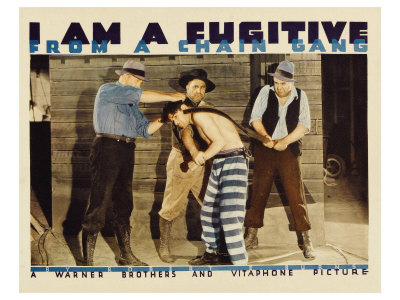
I Am a Fugitive from a Chain Gang (1932)

The thirties was a great decade for prison movies and for movies in general. In this gritty Depression-era prison drama, Paul Muni plays a decent fellow who just happens to be in the wrong place at the wrong time. For his unwitting participation in a diner holdup, he’s sentenced to a stretch in a nightmarish chain-gang prison, where inmates are routinely beaten, over-worked, and mistreated. He manages to escape but is betrayed by a jealous woman and returned. He is ultimately double-crossed by prison officials and ends up spending a lot more time in prison than he bargained for. Seems you can’t trust anybody. An exposé of the brutal prison system and a seminal classic film from Hollywood’s early Golden Age.

Cool Hand Luke (1967)

Paul Newman plays Luke, a likeable ne’r-do-well who ends up in a Southern chain-gang prison, where convicts must work all day in the heat building roads. Luke wins the hearts of the other prisoners, but he just doesn’t handle authority very well and can’t seem to abide by the strict rules of the place. Things don’t go well for him. He tries once too often to break out of prison, with tragic results. A classic “one man against the system” story. 

Midnight Express (1978)

Based on a true story. Young American Billy Hays (played by Brad Davis) attempts to smuggle a small amount of hashish out of Turkey to sell to his friends when he gets back home. He is caught before he can leave the country and is sentenced to three and a half years in a hellish Turkish prison, where prisoners are routinely tortured and live in conditions that make American prisons look like country clubs. When he has less than two months to go on his sentence, the Turkish court decides to change his sentence to a life sentence–seems they want to make an example of him. Never mind prisoners’ rights because they don’t have any. The lesson here is simple: Don’t try to smuggle drugs out of Turkey, even small amounts. You already knew that, though, didn’t you?   

Copyright © 2011 by Allen Kopp