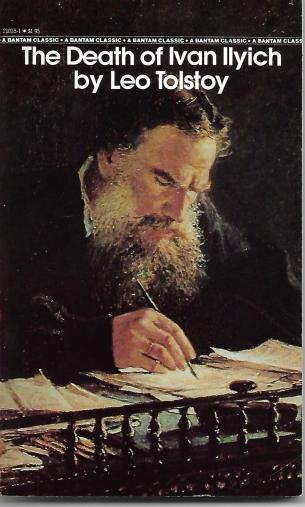
The Death of Ivan Ilyich ~ A Capsule Book Review

The Death of Ivan Ilyich ~ A Capsule Book Review by Allen Kopp

The Death of Ivan Ilyich, written by Russian master Leo Tolstoy (1828-1910) in 1886, is a character study and a somber contemplation of death. Ivan Ilyich is a magistrate with a wife and two children, a grown daughter of marriageable age and a schoolboy son. He is ambitious and rises through the ranks of his profession. He and his wife enjoy their place in society afforded by his success.

The thing about Ivan is that, as a magistrate deciding cases in court, he isn’t always as human as he might be. He is incapable of deep feeling or self-contemplation. He has no inner life. To him, duty is more important than feeling, compassion and sympathy. Would you want to be tried by this bastard in court?

In young middle-age, Ivan is seeing to all the details of furnishing and decorating a new home when he falls off a ladder and sustains a blow to his side. He thinks little of it at the time, but this is the beginning of an illness that results in his death. Whether the blow he receives to the side has anything to do with his illness is never established.

Ivan becomes ill and believes at first he will recover. As time progresses, however, he becomes sicker and sicker, until he realizes at last that he is coasting toward a premature death. Doctors, even “celebrated” ones, are ineffectual at finding what’s wrong with him or in finding ways to make him better. All they can do is make him believe he will recover, but after a while he sees this as a lie.

In the state of illness he’s in, Ivan takes a look back on his life. Is he being punished with a horrible illness that will claim his life because he’s been bad? Wait a minute, though; he has done all the things he was supposed to do, so what might he have done differently that would have spared him his undeserved fate?

Instead of accepting what is happening to him and seeking peace within himself, Ivan rails against it. Why has God forsaken him? His mental anguish becomes as great as his physical anguish. He doesn’t get the sympathy he thinks he deserves from his wife, family and friends. They only want to be rid of him so they can get on with his lives. Only his ten-year-old son and a kindly servant named Gerasim seem truly sad to see him in the state he’s in. After a terrible illness, death claims Ivan Ilyich at the age of forty-five. There is no beauty, dignity, or redemption in his death.

The Death of Ivan Ilyich is death from the point of view of the dying man. He isn’t able to find relief, comfort or sympathy in his illness as he sinks toward his inevitable fate. He is unable to look back on his life and say it’s been a life of success and fulfilment, even though it’s being cut short. It’s a simple story, universal because death touches everybody. Although set in nineteenth century Russia, it might be any place at any time.

Copyright © 2018 by Allen Kopp    
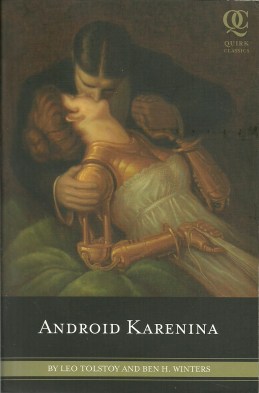
Android Karenina ~ A Capsule Book Review

Android Karenina

Android Karenina ~ A Capsule Book Review by Allen Kopp

Android Karenina is set in Russia, but it’s not the Russia that exists or that ever existed at any time in history. It’s a “steampunk” world, an “alternate universe” where every person over eighteen has a “beloved-companion” Class III robot that is a combination pet, servant, confidante, counselor and alter-ego; where ill people are put into orbit around Venus to help them recover; where people vacation on the moon; where robot technology has become so sophisticated, thanks to the discovery of a metal called “groznium,” that every task is performed by a robot and robots have advanced to the stage where they are unidentifiable from humans. The Tsars are gone, the horse and carriage are gone, old-fashioned steam-engine trains are gone; people travel on a conveyance called the Grav that runs on a magnetic bed. A group of lizard-like aliens erroneously called the “Honored Guests” threaten the world and the human race while incubating inside the bodies of sick people. This is the “Age of Groznium,” the world of Android Karenina.

Of course, proper credit must be given to Tolstoy’s classic novel Anna Karenina. A writer named Ben H. Winters has taken this masterpiece of Russian literature and cleverly transformed it into a steampunk, sci-fi adventure, using Tolstoy’s characters and situations but making them original enough to claim a lot of credit on his own. Beautiful society lady Anna Karenina is married to the cold, mechanical Alexei Karenin, an important official in the government. Karenin doesn’t appreciate Anna and can’t love her the way she wishes to be loved. When Anna meets dashing Count Vronsky, she enters into an illicit love affair with him that shocks society and humiliates her husband. She finds out then just how villainous her husband can be. His bitterness toward his wife makes him take revenge on the entire country by trying to nullify the Age of Groznium and returning to the old ways of doing things: steam-driven trains, telegrams as a means of communicating, horses and buggies for getting around in, real people doing the menial jobs that heretofore had been done by robots. Most cruel of all, he takes away everybody’s Class III “beloved-companion” robots, including Anna’s beloved Android Karenina, because he believes that robots are antithetical to the direction he wants the country to move in. Instead of moving forward, he wants to revert to the past. Wait a minute, though. Maybe Anna Karenina has a higher purpose in life than just being an unfaithful wife. Maybe she has been chosen, because of who her husband is, to render a service to her country and to the human race. We must read through to the end to find out what is really going on.

Like Anna Karenina on which it is based, Android Karenina is a pleasure to read. A little bit on the long side, at 538 pages, but well worth it. It’s a clever hybrid (a combination of two worlds), not for everybody, but certainly engaging, especially if you are a fan of the original novel and also an aficionado of the offbeat, the unusual, the quirky and the imaginative. You might end up envying the Class III robots and wishing you had one of your own to always agree with you, sympathize with you and do anything you want without complaint.

Copyright © 2016 by Allen Kopp