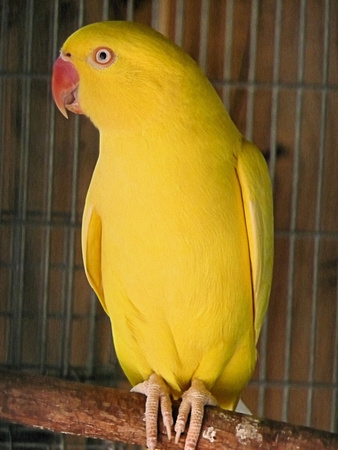
Yellow Bird ~ A Short Story

Yellow Bird image 1
Yellow Bird
~ A Short Story by Allen Kopp ~

(This short story has been published in The Literary Hatchet.)

Lonnie awoke to the smell of cooking food. When he got out of bed and went into the kitchen, mother turned from the stove and smiled at him. She was wearing her red silk dress with the white buttons instead of the usual old chenille bathrobe.

“Sit down and have some bacon and eggs,” she said.

“Why are you so dressed up?” he asked.

“Eat your breakfast while it’s hot.”

While he ate, she sat across from him and drank coffee and smoked her cigarettes.

“What are you going to do today?” she asked.

“I don’t know. Read comics and watch some TV, I guess.”

“Don’t you think you should get outside and get some exercise and fresh air?”

“I might ride my bike to the park.”

“Don’t you have anybody to go with?” she said. “Isn’t it more fun with friends?”

“Sure. Is anything wrong? You’re acting funny.”

“We need to have a little talk.”

“What about?”

“Do you remember my friend Tony? You met him once when we were having lunch downtown.”

“Yeah, I remember.”

She looked down at her hand holding the cigarette. “Well, he and I are going away together this morning. He’s coming by to pick me up.”

“Going away? What do you mean, going away? Where are you going?”

“I don’t know yet.”

“Will you be back in time for supper?”

“No.”

“Does father know?”

“I wrote him a letter. He’ll read it when he gets home from work.”

He looked at her searchingly, as if her face might reveal something her voice wasn’t saying.

“So, when will you be back? Next week sometime?”

“I don’t think so, honey.”

“Why not?”

“I think it’s time for father and me to go our separate ways. I’m going to file for divorce so I can marry Tony.”

“Can’t I go with you?”

“Father and I discussed it and we decided it would be better for you to go on living here. Father wants you to stay with him.”

“I’d rather be with you, though.”

“Don’t you want to keep going to the same school you’ve gone to since kindergarten?”

“I don’t care if I go to school or not.”

She laughed and flattened her cigarette out in the ashtray. “You don’t mean that,” she said.

“Yes, I do.”

“Now, I need you to be a good boy and not a difficult boy. This is hard enough as it is.”

“But why can’t I go with you, wherever you’re going?”

“See, that’s the thing. Tony and I are going to be unsettled for a while. I don’t know where I’ll be while I’m waiting for my divorce.”

“Can’t you stay here while you’re waiting for your divorce?”

“It doesn’t work that way, honey. One of us has to leave and it has to be me.”

“Is it something I did?”

“Of course not! I don’t ever want you to think that.”

“Is it something father did?”

“No, it isn’t anything father did, either. It’s grownup stuff. I wouldn’t know how to explain it to you if I could. When you’re older, you’ll understand better.”

“But why Tony?”

“Because I love him and I believe he loves me. He’s the man I should have married in the first place.”

“Then why did you marry father?”

“I was young and I didn’t know him very well.”

“So, is that what grownup people normally do?”

In a little while there was a honk out front. Mother went into the bedroom and came out carrying her suitcase and the jacket that went with the red dress.

“I want you to come out on the porch and see me off,” she said, taking Lonnie by the hand.

Tony had parked his shiny blue car at the curb. When he saw mother and Lonnie come out of the house, he got out of his car and smiled and waved. He was wearing a coat and tie like church. He stood beside the car smiling, looking like a picture in a movie magazine.

Mother let go of Lonnie’s hand on the porch and bent over so that her face was close to his. She didn’t have to bend very far because he was almost as tall as she was.

“Everything will be all right,” she said with what she thought was a reassuring smile. “I just need to get away.”

“But for how long?” he asked. He was about to cry but didn’t want to with Tony looking  on.

“I don’t know,” she said. “I’m sorry.”

“When will I see you again?”

“I don’t know that, either. I’ll call you just as soon as we get to where we’re going and we can talk on the phone. I’ll know more then.”

He nodded his head and looked away.

She opened her purse and took out some money and put it in his fist. “Here’s a little mad money,” she said. “Buy yourself something special. Something impractical.”

She laughed for no special reason then and gave Lonnie a kiss on the cheek and held him for a few seconds in a squeeze and when she let go of him she ran to Tony like a schoolgirl.

On any other day, Lonnie would love having the house to himself, but with mother leaving unexpectedly it felt lonely and empty. He tried watching TV but wasn’t used to watching during the daytime and wasn’t interested in any of the shows that were on, so he took mother’s advice and rode his bike to the park.

He saw some people he knew but didn’t speak to them; he didn’t want to have to talk to anybody. He went to the most secluded part of the park near the war memorial and sat under a tree. It was so quiet and breezy that he almost went to sleep and ants started crawling on him, so he got up and went back home.

He hoped mother would somehow be there, having changed her mind and forcing Tony to bring her back, but everything was just as he left it. He ate some leftover fried chicken for lunch and wondered how to spend the rest of the day.

When father came home from work at the usual time, he found the letter from mother on the kitchen table. He unfolded the letter and pulled out a chair and sat down and read it.

“Did she tell you about this?” father asked Lonnie.

“A little,” Lonnie said. He shrugged and opened the refrigerator door to see what they would have for supper.

“Did you see what’s-his-name?”

“You mean Tony? Yeah, I saw him.”

“I have grounds for divorce now,” father said. “She ran off with her lover.”

“She said she’d call.”

“I don’t know what to think about a mother who abandons her only child.”

“It’s all right with me,” Lonnie said, “if it’s what she wants.”

“When she calls, tell her I’m going to see a lawyer to start divorce proceedings.”

“I think that’s what she wants, anyway.”

“I hope she rots in hell.”

In August for his fourteenth birthday, Lonnie  received a large bird cage with a yellow parakeet inside, delivered by a white truck that pulled up out in front of the house with a screech of brakes. It was a most unusual and unexpected gift. Mother wrote on the card: Thought you could use a pet. Much love, as always.

He didn’t know how to take care of a parakeet so he walked downtown and bought a book on the subject and a couple of different kinds of birdseed that the woman in the store said any bird would like. If he won’t eat none of it, the woman said, bring it back and we’ll try something else.

In the attic was an old birdcage stand with a hook. Lonnie had seen it before but never knew what it was for. He was surprised somebody hadn’t thrown it out long ago, but he was glad now they didn’t. Everything eventually has its purpose if you wait long enough.

He named the bird Toppy. It didn’t mean anything; it just seemed like a good name for a bird. Toppy hopped around inside his cage, sang little musical trills, drank water, ate birdseed and pooped aplenty. He seemed happy enough.

Lonnie hoped every day that mother would come home, but he knew it was an unrealistic hope. In the real world, mothers didn’t return home after running off with another man. It didn’t even happen in the movies.

Everybody thought father would get married again after the divorce, but he liked being single, he said. When marriage-minded ladies called to invite him over for a home-cooked Sunday dinner, he told Lonnie to tell them he was in Moscow or in the hospital for a lung operation.

He got an old woman, a Mrs. Farinelli, to come in two or three days a week and clean the bathroom and the kitchen, wash the clothes, shop, and usually cook a little food. She had a son on death row in prison and another son who was a priest. He paid her money in cash so she wouldn’t have to pay income tax on it. She was neat and quiet and never complained.

Mother called Lonnie a couple of different times when she knew father was still at work. When Lonnie asked where she was, she said they were still moving around, still unsettled. She sounded distant, preoccupied, not the mother he remembered. He believed at last that she didn’t care for him and was trying to phase him out of her life because she had a whole new life now.

Summer ended and Lonnie started ninth grade. He mostly didn’t like school—he never had from the very beginning—but he knew he had to make decent grades and get through to the end; there was no other choice anymore. Only dopes and losers quit high school.

A couple of times, on his way to and from school, he thought he saw mother in passing cars, but he knew later it couldn’t have been her. She would have at least waved to him.

On Christmas and birthdays, he always received cards from her with money in them. He couldn’t send a card to her in return because he didn’t have her address, but he knew that’s the way she wanted it.

As the months and years went by, he stopped thinking so much about her. He stopped thinking long ago that she would return and father would forgive her and everything would be just as it was.

Lonnie and father never had much to say to each other. They had occasional arguments and disagreements but for the most part they stayed out of each other’s way and got along as well as any father and son living alone in a house had a right to.

Toppy lived inside his cage and thrived and seemed happy. Lonnie sometimes felt sorry for him because he lived in such a small space and didn’t have the company of other birds. He thought about opening the window and letting him fly away, but he knew the world would be too much for Toppy and he wouldn’t survive on his own for very long.

Lonnie came to the end of high school and was glad for that that phase of his life to be over. Father dressed up in his one blue suit and came to the graduation ceremony by himself and sat toward the back of the auditorium surrounded by strangers. Lonnie thought several times about mother and wished she could be there to see him get his diploma.

He didn’t care to go on to college, at least not right away; he had had enough of school for a while. He thought vaguely that one day he would get married and have children of his own, but he was in no hurry and didn’t much care one way or another. He didn’t like the idea of having a marriage that would one day end in divorce.

A few weeks after graduation, he got a job in a hardware and paint store. He didn’t like it very much, but he got used to it and after a year or so he got a promotion and a raise in pay. He moved into sales and found it more to his liking than working at a counter and answering questions from customers.

As for mother, Lonnie didn’t hear from her again after the card he received on his nineteenth birthday. He didn’t know where she lived or if she was alive or dead. The best thing he could do, he told himself, was to stop thinking and wondering about her.

The years went by and Lonnie found himself at age twenty-one. He still lived with father in the house he grew up in. He went to work every day, as did father, and the two of them went their separate ways and lived their separate lives.

On a Friday morning in October father collapsed soon after arriving at work. He was rushed to the hospital, where he died two hours later. He had an enlarged heart and had smoked cigarettes, a lot of them, since he was thirteen. He was forty-seven.

The funeral was well-attended, despite a steady downpour. Relations of father’s that Lonnie had never seen before came from out of town, with stories of father when he was a child. The company father worked for sent an impressive arrangement of flowers. Father’s boss and a couple of his coworkers came and introduced themselves to Lonnie, slapped him on the shoulder, expressed their condolences, and told him what a great guy father was.

At the gravesite the rain kept up. Lonnie wore a raincoat and an old man’s hat he found in the closet and used a borrowed umbrella to keep himself dry. The minister droned a few words and the casket began its slow descent into the earth, indicating that the service was concluded and it was time for everybody to go home.

As the crowd was dispersing and Lonnie was about to make his getaway, a woman emerged from the crowd and approached him. She was wearing a long coat, dark glasses, and a scarf wound around her head like a refugee. It wasn’t until she came toward him, stopped and smiled that he knew it was mother.

“You’re all grown up now,” she said.

He looked at her, feeling almost nothing. He brought the umbrella down in front of his face to keep her from looking at him, sidestepped, and sprinted for his car as fast as he could before she had a chance to come after him.

At home, he felt a tremendous sense of relief now that the funeral was over and all those people had gone away. He was truly alone now, for the first time in his life, and he wasn’t sure what he was going to do with himself. The house was his now and there would be some insurance money after the funeral expenses were paid. He was a family of one, a free agent. He might never return to his job at the paint and wallpaper store.

He went into his bedroom and closed the door and took Toppy out his cage and lay on his back on the bed, holding the bird on his chest. Toppy tried his wings a couple of times as if confused at being out of the cage and then settled down and nestled on Lonnie’s sternum contentedly. His little eyes blinked and he looked with what seemed like comprehension right into the eyes of the only human person he had ever known.

“Don’t ever leave me,” Lonnie said. “Please don’t ever leave me.”

Copyright © 2023 by Allen Kopp

Enough About Me ~ A Short Story

Enough About Me image 1

Enough About Me
~ A Short Story by Allen Kopp ~

Mrs. Doris “Dodie” Cunningham sat alone in her darkened house in a cloud of cigarette smoke. It was a summer day, late in July. She was aware of some unusual sounds in the back yard and she didn’t know what it was. Oh, yes, she remembered now. Little Leland was having some friends over. They were playing a game or something, as children do, with all the requisite screaming.

After a half-hour or so the sounds ceased suddenly, so she went to the back door and opened it to make sure the children weren’t getting themselves into any mischief or hurting each other. After all, she was the mother and she was supposed to keep the little brats in line.

Opening the door revealed a small boy sitting hunched over on her back steps. He had short brown hair and wore a striped shirt. When she stepped out the back door, he turned around and looked at her.

“Hello,” she said. “Do I know you?”

The boy shook his head and looked away.

“Well, since I don’t know you, I might ask you why you’re sitting there on my back steps.”

“We were playing but they left,” he said.

“Who left?”

“Leland and Jonathan.”

“Well, I know who Leland is since he lives here, but I don’t know who Jonathan is.

“He’s just a smart-aleck kid.”

“So, the three of you were playing and in the middle of it Leland and Jonathan left. Is that right?”

“Yes.”

“Where did they go?”

“I don’t know. They played a trick on me. They told me to hide my eyes and when I did they ran off and didn’t come back.”

“That wasn’t very nice, was it?”

“No.”

“Little Leland invited you and this Jonathan kid over to play and then Leland and Jonathan abandoned you?”

“I don’t mind.”

“It would be my guess that you don’t like Little Leland very much.”

“You’re right. He’s an asshole.”

“You have this feeling way down deep in your interior parts that he’s not to be trusted.”

“How did you know?”

“What about Jonathan?”

“He’s even worse.”

“Why do you play with them?”

“I don’t know. I don’t know that many people.”

She flipped her cigarette over the porch railing. “Can’t you just go on home? I mean, instead of waiting for those two little shits to come back?”

“My mother told me to stay here until three o’clock. She’s coming to pick me up then.”

“Can’t you walk home?”

“It’s too far and I’m not sure if I remember the way. I’d get lost and then my mother would be upset with me.”

“You’re new in town, I take it.”

“Yeah.”

“I can drive you home if you’d like.”

“No, that’s all right. That would only confuse my mother.”

“Well, you might as well come in, then. You can’t sit out there in this awful heat until three o’clock.”

She led him into the living room and pointed to the couch where he might sit.

“Would you like me to call your mother for you and tell her she needs to come a little earlier than planned?”

“No, she’s not at home. She had an appointment.”

“Oh, I see.”

Realizing the room was depressingly dark for a July afternoon, she opened the blinds.

“Would you like a soda or a drink?” she asked.

“No, but I would like to use the bathroom.”

“Well, make yourself at home,” she said. “It’s through the dining room and down the hall.”

He was gone for about two minutes and when he came back his shirt was tucked neatly into his pants.

“I just realized I don’t know your name,” she said.

“It’s Ricky.”

“Richard?”

“Yeah, but everybody calls me Ricky.”

“Well, that’s a good name. I never met a Ricky I didn’t like. How old are you, Ricky?”

“Eleven.”

“You’re getting close to that dangerous in-between age.”

“What’s that?”

“It’s where you’re halfway between childhood and adulthood. You like to think of yourself as all grown up, but the adults around you keep telling you you’re still a child.”

“Oh.”

“Well, just relax,” she said. “You might as well enjoy yourself while you can. I’m not a wicked witch in spite of appearances to the contrary.”

He laughed feebly and leaned his head all the way back. “You have a pretty house.”

“Well, I like to think so.”

“It’s big.”

“Yes, it’s big. When Big Leland buys a house, he buys the biggest and the best that money can buy.”

“Who’s Big Leland?”

“He’s my husband. He’s Little Leland’s father.”

“Do you have a dog?”

“No, I don’t have a dog. I have two children and that’s enough in the way of pets. Besides Little Leland, there’s Cecelia. She’s only eight. You probably don’t know her, do you?”

“No.”

“Her character has already been formed. At her young age, you can tell exactly the kind of woman she’ll be, and it’s not a pretty picture.”

“Oh.”

“Well, now that the whole can of worms has been opened, I might as well tell you that I’m not really the mother of Little Leland and Cecelia. I’m their stepmother.”

“Oh.”

“Don’t you find that interesting?”

“Yes.”

“I’ll bet Little Leland never told you he had a stepmother, did he?”

“No, he didn’t. What happened to his real mother?”

“Well, the rumor is that she died, but I have reason to believe she’s hiding out someplace.”

“Why would she do that?”

“If you knew Big Leland, Little Leland and Cecelia, you’d already know the answer to that question.”

“I have a dog,” he said.

“What’s his name?”

“Skippy.”

“What kind of a dog is Skippy?”

“I think he’s part collie and part something else.”

“So he’s a big dog.”

He leaned forward and held his hand two feet from the floor. “About this big.”

“Do you let Skippy stay in the house?”

“He can come into the basement as long he leaves his fleas outside.”

“A good policy.”

“Except he doesn’t have any fleas because he wears a flea collar.”

“I’ve always liked animals,” she said. “They’re innocent and pure, whereas people are corrupt and vile.”

She leaned forward and lit a cigarette and blew the smoke out in a cloud above her head. “I’m a little drunk right now,” she said. “Maybe more than a little. Your mother would probably be shocked to know that I invited you into my house while I’m drunk. Maybe we should just keep that between ourselves.”

“I don’t mind,” he said.

“You’re a good sport. I could tell that the moment I laid eyes on you.”

He watched her as she walked over to a side table and poured herself a shot of whiskey. “I’d ask you to join me, but I think we’d be a little premature on that one. Maybe when you’re older.”

“You drink whiskey?” he asked.

“Oh, my, yes!” she said. “I’m the champion whiskey drinker.”

“Does it taste good?”

“No, it tastes like crap, but I don’t drink it for the taste.”

“What do you drink it for?”

“Oh, it helps to get me through the day, I suppose. It gives me the courage I lack.”

“Oh.”

“I’ll bet your mommy doesn’t drink straight whiskey, does she?”

“I’ve never seen her if she does.”

“What about your daddy? Is he a good father?”

“I guess so.”

“What does he do for a living?”

“He’s a painter.”

“You mean landscapes and portraits and things like that?”

“No, he paints houses and sometimes he drives out into the country and paints barns.”

“Is there a lot of money in painting barns?”

“I don’t know.”

“Of course not. You wouldn’t know. When you’re eleven years old, you don’t think about things like that, do you?”

“No.”

“I’d like to be eleven again,” she said. “I’d live my life in an entirely different way. I wouldn’t marry for money. I’d go away somewhere and be an artist. That’s what I’ve always wanted to do. Some women aren’t cut out for the domestic scene. I’m one of them.”

He yawned.

“But that’s enough about me,” she said. “Tell me about yourself. What do you like to do?”

“I don’t know. Watch TV and read my comics, I guess.”

“You’re a reader?”

“Yeah.”

“I’m a reader, too. When I was younger, I’d read a novel a week and I mean the good stuff too. Not cheap junk that passes for fiction nowadays. It’s good that you’re a reader. It teaches you to think and figure things out for yourself. I don’t think Big Leland has ever read a book in his life. And just try to get Little Leland or Cecelia to read a book on their own! Impossible!”

“My sister reads books from the library. Books she doesn’t have to read.”

“How old is she?”

“Thirteen.”

“Do you get along well with her?”

“Sure.”

“Any other brothers or sisters?”

“I have a brother, Harvey. He plays tricks on me and makes fun of me. He calls me names.”

“How old is Harvey?”

“Sixteen.”

“You don’t like Harvey very much, do you?”

“Not at all.”

“You’d like to punch him the face. Hurt him.”

“Yes, I would.”

“One day Harvey will get exactly what he deserves and you’ll be there to see it. One day he’ll come groveling to you because he wants something from you, and you won’t be inclined to give it to him because he wasn’t nice to you when mattered.”

“Yeah,” he said.

“When I married Big Leland and took on his two kids as my own, I knew I would live to regret it, and I have. Regretted it, I mean. I’m thankful that the first Mrs. Big Leland had sense enough to stop after two kids. She had her tubes tied after Cecelia was born, you know. Otherwise there might have been half a dozen.”

“I’m not ever having any kids,” he said.

“That’s very wise. More people in the world should adopt that attitude.”

“I want lots of animals around me.”

“Live on a farm, maybe?”

“Yeah. Out in the country.”

“Where people like Little Leland and your brother Harvey can’t do mean things to you?”

“Yeah.”

“And since we’re back on the subject of Little Leland—or at least I am—I have to warn you about him.”

“What about him?”

“You’re a smart, sensitive boy. You don’t need friends like Little Leland. He’ll never do you anything but harm. You’d be better off to have no friends at all.”

“What do you mean?”

“He will lead you astray, hurt you or cheat you.”

“Why will he do that?”

“Because that’s what he does. People like him. And when you think that he’s only a child and just getting started, it’s frightening. What will he be like when he’s a grown man? I pity anybody who falls under his spell.”

“I don’t know what that means.”

“Of course you don’t. You’re too young and innocent, but the more you associate with Little Leland the more you’ll see it.”

“I don’t know. He seems all right to me.”

“That’s how his kind always gets started. He seems all right at first so you aren’t able to see the terrible thing that’s coming. I know this because Big Leland is exactly the same way. Little Leland is a miniature version of Big Leland.”

“Why do they both have the same name?”

“Big Leland wanted an exact duplicate of himself.”

“Oh.”

“And that’s exactly what he got.”

“They’re both turds, aren’t they?”

“I couldn’t have said it better myself,” she said. “If I had a criminal nature and wasn’t afraid of going to jail, I’d sneak into his room at night when he’s asleep and strangle him with the drapery cord.”

“Big Leland?”

“No, first I’d take care of Little Leland and then I’d go to work on Big Leland.”

“You could poison both of them. That might be better.”

“Yes, I’ve thought of that, but it would have to be a poison that can’t be traced. I don’t want, under any circumstances, to go to jail.”

“I have an uncle in jail,” he said. “He didn’t kill anybody, though. I think he stole some checks.”

“But you know what? I don’t have to kill Big Leland and his demonic offspring. I have something better than that.”

“What is it?”

“Do you know what an embezzler is?”

“No.”

“It’s a person who systematically steals money from his employer. Small amounts, to be sure, but over time the small amounts turn into big ones.”

“Oh.”

“Big Leland is an embezzler. In the last three or four years, he has embezzled a half-million dollars from his employer.”

“And he doesn’t want anybody to know?”

“That’s right, he doesn’t want anybody to know, but soon the whole world will know because I’m going to tell them! I have the phone number for the FBI right beside my phone!”

“Won’t Big Leland be mad if you tell?”

“Of course he’ll be mad, but by the time he finds out he’ll be locked up in the hoosegow!”

“What’s that?”

“You are young, aren’t you? It’s the jailhouse.”

“Oh.”

“And when Big Leland goes to jail, Little Leland and Cecelia will come crashing down, too. They will  no longer have the life of privilege and ease that they have now. Little Leland will go to military school and Cecelia will go into the convent. And not only that, but they will both have to live with the stigma of having a convicted embezzler for a father.”

“Did you hear that?” he asked.

“Hear what?”

“I think I heard my mother’s car horn.”

“I didn’t hear anything.

When the horn sounded again, they both stood up. She went to the front door and opened it and looked out.

“What kind of car does your mother have?” she asked.

“A black station wagon with red trim.”

“Well, this is her, then.”

“Would you like a drink of water before you go?”

“No thanks.”

“I’ve enjoyed our little talk. Will you come and see me again?”

“I guess so, if you want me to.”

He was ready to go out the door when she surprised him by taking his hand and shaking it.

“Tell your mother she’s a very lucky woman.”

“Why is she lucky?”

“To have you for a son.”

“I don’t think she would agree.”

She watched him go out and get into the station wagon with a blonde-haired woman and then she closed the door and locked it.

It was only a few minutes after three o’clock. There were still several hours of summer daylight before the nighttime drinking could begin. She emptied her old bottle and opened a new one and took a small sip straight from the bottle. In a little while she’d go into the kitchen and make a pitcher of martinis.

Copyright 2023 by Allen Kopp

Cemetery Christmas

Cemetery Christmas
~ A Short Story by Allen Kopp ~

Calvin Horne took the wreath out of the back of his car and walked down the hill with it slung over his shoulder like a garden hose to his parents’ grave. It was the day before Christmas and he didn’t want to be in the cemetery; didn’t want to be reminded of death on a joyous holiday. Christmas was about birth, about what’s good in the world.

He hadn’t been especially close to either of his parents. His mother, dead two years, was a difficult and obstinate old woman. The two of them, Calvin and his mother, could hardly be in the same room together without a clash of wills. His father had been dead for twenty years and was only a distant memory.

He trudged down one hill and up another one. It was there, at the top of the next hill, where his parents were buried. His mother had generously offered to buy the plot for him on the other side of her, but he declined the offer. (He wanted simply to vaporize into the air as if he never existed at all.) Now that space was occupied by a stranger that his mother, in all probability, wouldn’t have liked.

His parents had a large and rather ostentatious granite headstone as tall as a man’s head that his mother bought and paid for. In the middle of the stone, at the top, the name Horne was etched in large letters. Below were the names, birth and death dates of Byron and Julia. Under the names were two intertwined hearts with an arrow shot through them and, in fancy script, the ironic words Together Forever. They were together, he was sure, only in the sense that they were both dead.

He took a deep breath, a little winded from his climb up the hill, and pushed the legs of the wreath’s tripod into the soft earth in front of the headstone. Now, if his sister or any other family members came snooping around, they wouldn’t be able to say he hadn’t discharged his duty to his parents at Christmas.

The wreath seemed secure enough to withstand any winter blasts, so he pulled his gloves back on over his frozen fingers and was just about to retrace his steps back to the car, when he heard someone coming.

“I hear voices in the cemetery, don’t you?” a voice said.

He turned and saw a large woman in a fur coat and fur hat coming toward him. “What?” he asked.

“I said I hear voices when I’m in the cemetery. Don’t you?”

He thought she might be making a joke, but he wasn’t sure.

“No, I don’t hear any voices,” he said. “All I hear is quiet.”

“Yes, the quiet of the grave,” the woman said. “Do you need any help?”

“Why, no,” he said. “I was just leaving.”

“What are you doing here today?”

“I came to put a Christmas wreath on my parents’ graves.”

The woman looked down at the headstone and nodded. “They’re dead,” she said.

“Yes, that’s why they’re buried in the cemetery.”

“I’ll bet you were a good son.”

“Well, I can say I at least tried.”

“Do you have other family?”

“A sister and a son.”

“How old’s your son.”

“Twenty-two.”

“What happened to your wife?”

“We got divorced. She’s married to somebody else now.”

“What does she…

“I think that’s enough questions,” he said. “Especially since we don’t know each other.”

“Are you in a hurry to get away?” she asked.

“No more questions, I said.”

“I’ll bet you have a girlfriend waiting for you someplace, don’t you? Or maybe a boyfriend?”

“Let’s just say that’s for me to know and you to find out.”

“Okay. I get the picture. You don’t want to talk to me.”

“Well, it’s cold and it is Christmas.”

“Not today. Today is the day before Christmas. Tomorrow is Christmas.”

“Yeah. Enjoy your walk through the cemetery, or whatever it is you’re doing. I’ve got to be going.”

“Can’t you stay and visit a while?”

“No. I did what I came to do and now I need to go.”

“Haven’t we met before?” she asked. “A long time ago.”

“It isn’t likely.”

“I feel as if I’ve always known you.”

“We’ve never met, I’m sure of it.”

“Do you find me at all attractive?” she asked.

“What kind of a question is that? Of course I don’t!”

“What’s wrong with me?”

“I have to be going.”

He started to move away and she stepped in front of him.

“Could you spare me some change?” she asked.

“No, I can’t spare you any change. I don’t have any change. I might ask why you need change in a cemetery, wearing a fur coat, but the honest truth is I don’t care.”

“That’s not very nice. I thought at first you were a nice man.”

“Well, I’m not!”

“Where is your Christmas spirit?”

“It disappeared as soon as you started talking to me.”

“Don’t you like me?”

“I have no opinion of you one way or the other.”

“My brother, Ogden, will be along to pick me up any minute. He went to buy some cigarettes. When I tell him how you insulted me, he’ll be awfully mad.”

“I didn’t insult you!”

“You did! You said you found me unattractive and you didn’t want to talk to me.”

“If you hadn’t spoken to me first, I would never have said anything to you at all!”

“Well, how are people supposed to get to know one another?”

“They’re not!”

“Can I come home with you?”

“No!”

“I’ll bet you have a beautiful home, don’t you?”

“None of your business!”

“I’ll do anything you want!”

“None of your… I don’t want anything from you except for you to stop annoying me!”

“If you get to know me, I’m sure you’ll like me.”

“Dear Lord, why me?”

She lifted her arms up and put her hands behind his neck, locking her fingers at the back of his head.

“Stop that!” he said. “What do you think you’re doing?”

He took hold of her wrists and forced her to release her grasp.

“You don’t like women at all, do you?” she asked.

“It isn’t any of your business what I like! When I leave here, I’m going straight to the police station and tell them there’s a crazy woman in a bearskin coat accosting people in the cemetery. They’ll send a squad car out here and pick you up.”

“Well, you don’t have to be so unkind about it!”

Down the hill she saw Ogden, her brother, lurking behind a tree. She called to him, he spotted her and began walking up the hill. In less than a minute, he was standing before them.

“Who’s this bozo?” Ogden said with a sneer. With his fat face, fur coat and fur hat, he was the male equivalent of the woman.

“He wanted to leave, but I kept him here,” she said.

“Good work, Bootsie girl!” Ogden said.

“Your names are Bootsie and Ogden?” Calvin asked.

“Yeah, what of it?” Ogden said.

“He insulted me, Oggie!” Bootsie said.

“Oh, he did, did he? How did he insult you?”

“He doesn’t like me. I offered to go home with him and do anything he wants, but he said he’s not interested.”

“Well, that’s not very gentlemanly, is it?”

“Oh, I get it.” Calvin said. “She’s a whore and you’re her pimp.”

Ooh! Some words are so ugly, don’t you think?” Ogden said.

He pulled a small gun out of his jacket and pointed it at Calvin.

“You’re wasting your time robbing me,” Calvin said. “I only have about two dollars.”

“Prove it!” Ogden said. “Give me your wallet!”

Calvin removed his wallet and handed it to Ogden as if it was something he did every day. Ogden opened it; after he had thoroughly examined its interior, he looked back at Calvin with hatred.

“You’ve got two lousy dollars? And no credit cards? What kind of a loser doesn’t have any credit cards?”

“I always pay for everything in cash.”

“You’re a deadbeat, you know that?”

“I told you it wouldn’t do you any good.”

“How about if I drive you to your bank and you withdraw about two thousand dollars from your account and give it to me and Bootsie here as a Christmas present?”

“What makes you think I have two thousand dollars in the bank?” Calvin said.

“Fellows like you always have lots of money in the bank.”

“The bank is closed for the Christmas holiday.”

“Well, isn’t that that just too convenient!”

Bootsie whispered in Ogden’s ear. His bewildered expression faded and he smiled. “I’ll bet you’ve got an expensive watch, haven’t you?”

“I have a Timex. It cost twenty-nine dollars and ninety-five cents and I’ve had it for six years.

“All right, Mr. Smart Aleck! Hand it over!”

Calvin unfastened the watch and gave it to Ogden with a smile.

“All right!” Ogden said. “I have two dollars from you and a cheap watch. If that’s the best you can do, I’m going to have to kill you and if I do nobody will find your frozen body at least for a couple of days, since it’s a holiday and all.”

“No, don’t kill him,” Bootsie said reasonably. “He’s not worth it. Just let him go.”

“And he’ll go straight to the police.”

“We’ll be long gone by the time they get here.”

“He knows what we look like, for Christ’s sake!”

“So what? Do you really want to spend the rest of your life in the penitentiary? I don’t think I do! Only a crazy person would kill a guy over two dollars and a cheap watch.”

“I can’t just let him go without doin’ nothin’ to him,” Ogden said.

“Just kick his ass good.”

“No, I know!” Ogden said. “I’ll make him strip naked and he’ll have to walk home with his best parts on display for all the world to see.”

“You really are sick, you know that?” Bootsie said. “Nobody’s going to strip naked! It’s too damn cold for that shit!”

“Hey! You know what?” Calvin said. “I just saw two police cars turn into the cemetery. They’ll be on top of us in about one minute!”

Ogden and Bootsie turned all the way around in confusion and, seeing nothing, began running down the hill to get away.

A couple of professional criminals!” Calvin said to himself and laughed.

He picked up the gun where Ogden had dropped it beside the trunk of a tree and slipped it into the pocket of his coat. He doubted the gun would even shoot, but it would be an interesting piece of evidence to turn over to the police so they could know he wasn’t just making the whole thing up.

Copyright © 2023 by Allen Kopp

My Christmas Eve That Year ~ A Short Story

I Want to Spend Christmas with You
My Christmas Eve That Year
~ A Short Story by Allen Kopp ~ 

My parents got their divorce the summer I was fifteen and sold the house we lived in. My mother, my little brother, and I moved into a small, four-room flat in an old apartment building downtown. It was on the fifth floor and there were no elevators, so that meant we were constantly walking up and down the stairs.

The flat wasn’t big enough for me to have my own room, so we moved my bed into a little space off the kitchen, which was originally meant to be a pantry. It was tiny and cramped, but the best thing about it was that I had my own window with a good view of buildings and trees far off in the distance. I liked to lay in bed at night and look out at the sky. The best nights were when there was a full moon. When there were thunderstorms, it felt like the lightning was going to come in through the window and zap me into oblivion.  

Now it was Christmas again, or almost. Our first Christmas in the apartment. Our Christmas tree stood in the corner of the front room, aglow with multi-colored lights and loaded down with tinsel and ornaments, stacks of presents beneath its branches. A sprig of holly hung in the doorway into the kitchen. On the front door was a wreath that would probably be stolen before Christmas morning ever arrived.

My little brother Georgie, age six, jumped up and down on the couch and screamed. He was wholly invested in Christmas. It was snowing out, he didn’t have to go back to school until after New Year’s, and he believed that Santa was going to be especially generous with him this year.

“You’d better calm down,” I said. “Santa will pass you by if he gets word that you’ve been bad.”

“I haven’t been bad!” he screeched.

My mother came in from her bedroom, where she had been putting on makeup and fixing her hair. She was afraid I was going to divulge the great secret that Santa doesn’t really exist.

“What did you just say to him?” she asked, looking at me threateningly.

“I didn’t say anything,” I said. “I just told him he’s giving me a headache.”

“Get down from there, Georgie! You know you’re not supposed to use the couch as a trampoline! The couch is for sitting, not for jumping.”

“All this Christmas stuff is making me puke,” I said. “A person can only take so much.”

“Well, it’s too bad you’ve forgotten what it’s like to be excited about Christmas,” she said. “I guess you’ve grown too sophisticated for your family.”

“He’s grown too sophisticated!” screamed Georgie.  

“Shut up!” I said.

“When do we get to open the presents?” Georgie screamed.

“For the eighty-seventh time, we will open the presents on Christmas morning after we’ve had a good breakfast.”

“Why do we have to wait so long?”

“Because I said so, that’s why!” She sat on the other end of the sofa and patted her hair in back.  

“I want to open one now!”

“No! We’ve been all through that a dozen times. You have to wait like everybody else.”

“Tomorrow’s Christmas and we haven’t heard anything from daddy yet,” I said.

“No, and you probably won’t, either. He’s probably laying up in some hotel room, drunk as a skunk.”

 “Drunk as a skunk!” Georgie screamed.

 “I thought he’d send at least send us a present.”

 “You’re old enough to know you can’t count on him for anything.”

“We always had a good Christmas with him,” I said.

“I know, but those days are over. Your daddy is out of the picture now. He was the one that wanted the divorce.”

“I’m going to the movies tonight,” I said. “It’s a Christmas Eve horror double feature.”

“I don’t care what it is,” she said. “You’re not going to the movies on Christmas Eve. You’re going to spend the evening with your family.”

“But I’m meeting someone.”

“Call whoever it is and tell them you can’t make it.”

“Is he going to be here?”

He has a name, you know.”

“Is Regis going to be here?”

“Yes, he’s going to be here in time to eat dinner with us and later we’re all going to church.”

“I don’t feel like going to church.”  

“You feel like going to the movies but you don’t feel like going to church?”

“Church gives me a headache.”

“You’re insane.”

“If I am, I get it from you. Insanity runs in your family.”

“I think Regis is going to ask me to marry him.”

“Why would you want to marry Regis?”

“Why shouldn’t I marry him? He’s the sweetest, kindest man I’ve ever met and he’s got a good job.”

“He sells washing machines in an appliance store.”

“Someday he’ll be manager. There’s really good money in that.”

“What about daddy?”

“What about him?”

“You’re going to marry Regis without telling daddy first?”

“You’re a smart boy, but you just don’t seem to understand. There is no longer any connection between me and your daddy. We are kaput!”

“What does that mean?”

“Your daddy and I are finished with each other. All ties are severed.”

“All ties are severed!” Georgie shrieked.

“If you marry Regis, does that mean we can move out of this crummy apartment?”

“Not right away. Regis will probably move in here with us. His business hasn’t been so good lately. He’s a little strapped for cash at the moment. He expects things to pick up next year, though.”

“If Regis moves in here with us, I’m moving out.”

“Why don’t you like Regis?”

“He belongs to a bowling league.”

“A lot of men belong to bowling leagues.”

“He’s old!”

“He’s forty-three.”

“He wears cologne that smells like bug spray.”

“I’ll get him to stop wearing it after a while.”

“He has hairs sprouting out of his ears. Haven’t you ever noticed that?”

“Of course, I’ve noticed it. His grooming isn’t the best. That’s because he lives alone. All that will change after we’re married.”

“I think you should check with daddy first before you marry Regis. He might want to come back. If you marry Regis, it’ll be too late.”

“Your daddy is not coming back. Ever.”

“You might be surprised.”

“It’s time for you to face reality.”

“I am facing reality and I don’t like it.”

“I think I see Santa way up in the sky over there,” Georgie said, standing at the window.

“You’re hallucinating again,” I said.

“It’s too early for Santa,” mother said. “He won’t come until we’re all asleep. He doesn’t like for people to look at him.”

“I can certainly see why,” I said.

“I hope he remembers everything I wanted,” Georgie said.

Mother went back into the bedroom and in a little while came back out in her red Christmas dress that in my opinion was too tight. She had dowsed herself in perfume. When she saw me lying on the couch staring at the ceiling, she decided I needed something to do.  

“I want you to go down to Friedlander’s market and buy a carton of eggnog for tonight,” she said, digging in her purse for some money. 

“I don’t like eggnog,” I said.

“Well, are you the only one here? Regis says it’s not Christmas without eggnog.”

“Regis says. Regis says. What else does Regis say?”

“Can I go to the store, too?” Georgie asked excitedly.

“No! You stay here and help me wrap Regis’s present.”

“Regis, Regis, Regis,” I said as he went out the door. “He’s certainly a big man around here, isn’t he?”

The snow was falling heavier now. Cars made hissing sounds on the pavement as they passed by. Last-minute shoppers were still keeping the stores busy. With the setting of the sun, Christmas Eve had officially arrived.

The store only had one carton of eggnog left, so I grabbed it and went and stood in the long line to pay. When the cashier smiled at me and wished me a merry Christmas, I gave him a sour look.   

When I got back home, Regis had arrived with presents for all of us. He was throwing Georgie up near the ceiling and then catching him on the way down. Georgie squealed with delight. Mother stood at the stove and beamed her approval.

Regis had brought Georgie a stuffed elephant and some other toys. My present from him, still wrapped in a big box with a red bow, was at my place at the table. Before I sat down, I picked up the box and set it on the floor.

“Aren’t you going to open your present from Regis?” mother asked.

“I’ll open it later. I have a headache now.”

When we were all seated at the table, mother insisted we join hands while Regis said grace. Regis’s hand felt clammy and unclean in mine. When he finally let go, I wiped my hand back and forth along my leg before I touched any food.

While we ate, I could see that mother was wearing a diamond engagement ring. This, of course, would be her Christmas present from Regis. So, it was official, then. He had proposed and she had said yes.

Regis talked about his day at work and laughed while we ate. Mother didn’t say much. Georgie kept looking out the window for signs of Santa. When Regis seemed to have run out of things to say for the moment, mother looked at me and said she had something she wanted to tell me and Georgie.

“What is it?” I asked with a sick feeling.

“Regis has asked me to be his wife and I’ve consented. We’re going to be married on New Year’s Eve.”

“What’s the rush?” I asked.

“I think it’s so romantic to be married on New Year’s Eve,” she gushed. “It will be a new start of a new year for all of us.”

She turned and looked at Regis. There were tears in her eyes. Regis took hold of her hand and pulled her in for a kiss. I knew he was getting ham grease all over her.

“I think I hear Santa’s sleigh outside!” Georgie said.

After we finished eating, mother told me to go put on my dress pants and a white shirt for church. She would help me with my tie before we left for church.

Except there wasn’t going to be any church for me. I grabbed my coat and hat and ran out the front door before she had a chance to see what I was doing.

The snow must have been five or six inches by that time. I still had on my tennis shoes and I could feel the snow soaking through to my socks after a few steps, but I didn’t mind. I needed to talk to daddy.

I knew that Colson’s Drug Store, about four blocks down from where we lived, had a pay phone. I had a pocket full of change especially for that purpose.

Right after the divorce, daddy gave me his private number where I could reach him any time. If I ever needed him, all I had to do was give him a call.

There were a lot of people at Colson’s, mostly at the pharmacy counter. Nobody paid any attention to me as I went all the way to the back, where the pay phone was.

I was sure he would answer. He would probably figure it was me calling on Christmas Eve.

The phone rang ten or twelves times, but finally he answered.

“Hello,” a little groggily.

“Daddy?” I said. “Is that you?”

“Who is this? Is this Evan?

“Yeah, it’s me. Evan.”

“I couldn’t hear you very well at first.”

“Can you hear me better now?”

“Yeah, I hear you fine now.”

“Well, since it’s Christmas Eve, I wanted to call and wish you a merry Christmas.”

“Merry Christmas to you, Evan!”

“Do you know where we’re living now?”

“No.”

“In an apartment downtown, on the fifth floor of an old building.”

“I’ve been wanting to come and visit you and Georgie, but I wasn’t sure where you were living. How’s Georgie?”

“He’s fine. Waiting for Santa to bring him everything he asked for.”

“Where are you now?”

“I’m in Colson’s Drug Store, near where we live. Do you know where that is?”

“Yeah, I’ve been to Colson’s a few times. Don’t you have a phone in the apartment?”

“We do, but I didn’t want mother to know I was calling you.”

“How is your mother?”

“She’s fine, but she’s the main reason I wanted to talk to you.”

“She’s not sick, is she?”

“No, she’s not sick. She’s getting married on New Year’s Eve.”

Daddy was silent for a moment and then he laughed. “Who is she marrying?”

“His name is Regis. He’s a creep. He smells funny. I don’t like him.”

“Maybe that’s because you don’t know him very well.”

“I want you to come and get me.”

“What?”

“I said I want you to come to Colson’s Drug Store and get me. I want to spend Christmas with you.”

“Wait a minute, Evan! I’m afraid that’s not possible. I’m not living in a very nice place. I don’t even have a tree.”

“That’s all right. I don’t need a tree.”

“If your mother doesn’t know where you are, she’ll be worried.”

“I’ll call her from your place.”

I started to cry like a blubbery crybaby. I hadn’t meant to cry, but I couldn’t seem to help myself.

“Is it that bad?” he asked.  

“Mother just isn’t herself. I don’t want to be around her. She acts like Regis is some kind of a god. They make me sick.”

“All right. If it’s that bad, I’ll come and get you.”

“How long? How long will it take?”

“Give me a half-hour or so.”

“Colson’s Drug Store. I’ll be waiting outside for you.”

It was still snowing, harder than ever now, but I didn’t mind waiting in the snow for a half-hour. People coming in and out of Colson’s looked at me and then looked away. Maybe some of them thought I was going to try to rob them. I tried leaning back against the building, crossing my legs and putting my hands in my pockets. I tried to look casual, but I felt conspicuous. 

I wasn’t sure what kind of car daddy would be driving, but I looked at every car. One of them would be him.

The half-hour passed and then an hour and then two hours. I was determined to wait as long as it took. I would wait all night. I would still be waiting on Christmas Morning if I had to. My fingers and toes were numb. I could no longer feel them. I wasn’t sure if they would ever work right again or not. I didn’t much care.

Copyright © 2023 by Allen Kopp

Haunt, Part 2 (All the Spirits in the Place) ~ A Short Story

The Spirits in the Hotel image 3
Haunt, Part 2 (All the Spirits in the Place)
~ A Short Story by Allen Kopp ~

I always liked staying in a good hotel, even one that was falling apart and hadn’t seen a paying guest in fifty years. The Hotel Argyle was on the riverfront, in a cluster of other derelict buildings. It was twenty stories tall and could be seen from a long way off because the hotel name had been painted in huge letters on the side of the building. It stood as a symbol of urban blight. There’s nothing spirits love more than urban blight.

I walked into the lobby of the Argyle and was surprised to see a ghostly apparition at the registration desk. He seemed to be made of purple-and-green smoke. He gestured to the registration book and I knew what to do. It must have been somebody’s idea of a joke because spirits don’t use the names they had when they were alive. I made a little mark on the book. That seemed to satisfy him because he smiled his grotesque smile and gestured for me to take the stairs.

There were many vacancies at the Argyle. I would venture to guess that I could pick almost any room, on any floor, and it would be vacant. I went all the way to the top floor, the twentieth, and found the room I wanted at the end of the hall. It showed no signs of occupancy, so I took it as my own.

I was a tired old spook. I had traveled a long way to get here. I needed a rest, so I was happy for that reason that the hotel was quiet. The other spirits in residence were probably sleeping, since it was the middle of the day and the sun was shining brightly. If there’s anything a spirit hates, it’s bright sunlight.

I stared out the window at the skyline of the city for a while and then, hovering near the ceiling, I went into a trancelike state, which was as near as I ever came to sleeping. As long as I’m not disturbed, I can stay in this state for years at a time, but, of course, when you’re a spirit, a year means nothing. We think in terms of eternity. Time has no meaning.

In this trancelike state, I thought of—dreamed of—many things. I had been in the spirit world now for eighty years. I was only thirty-five when I crossed over. I had two wives when I was alive. I regret that I wasn’t very kind to either of them. I had a drinking problem. Luckily there were no children. I would have been a terrible father.

After my divorce, I had no job and no money, so I went back home to live with my mother. She and I never understood each other. We fought constantly. I should have known better, even if she didn’t. She nagged me about my drinking; she thought I could stop if I only tried. She wanted me to go to church with her the way I did as a child. She thought if I just read my Bible I’d be the kind of man God wanted me to be.

I got a part-time job driving a truck. I was never that keen on driving. I hated it. All my organs were pickled in alcohol. One hot July afternoon, my hundred-proof heart stopped when I was parked on a street downtown. I took off my shoes, put them side by side, laid down on the seat, and died. I knew I was dying and I didn’t care. I thought it was the best thing that could happen to me.

When I found myself in the spirit world, I was surprised there was any kind of existence after death. I thought it was punishment for all the bad things I had done. Everybody else went to heaven, I thought, but not me. That, of course, wasn’t true. The spirit world is teeming with spirits who never made it to heaven.

That night I met two of them. I was going out for a little city night life when I met them in the lobby of the hotel. I remembered them from before, a long time ago, in another incarnation. They went by the names Jocko and Howdy. They recognized me immediately and I them.

“We heard you were here,” Jocko said. “When did you get in?”

“A few days ago. I’ve been resting up in my room on the top floor.”

“We were just going out to do the town,” Howdy said. “Why don’t you join us for old time’s sake?”

“I’ll go if you promise not to scare me too much,” I said.

Hah-hah-hah!”

On our way downtown, Jocko, Howdy and I walked side by side, as if we were living instead of dead.  Howdy made a show of knocking people out of the way but, of course, they didn’t know he was there because he was invisible to them and, also, they were solid and he wasn’t. It’s only fair to mention that we met a few other spirits, but they were mostly in haughty groups and didn’t pay any attention to us. Howdy would get into a brawl with some of them if he could. He was a brawler and a mischief-maker.

On the way downtown, I asked Jocko and Howdy if the Hotel Argyle was a good place for a spook to live.

“It’s dead most of the time,” Jocko said.

“What do you mean?”

“Not much action there, man,” Howdy said.

“It seems perfect to me,” I said. “An abandoned hotel on the riverfront of a major city. Doesn’t it abound with ghosts?”

“Yeah, but ghosts are boring if they’re not doing anything,” Jocko said.

“So, you’re saying the ghosts in the hotel are all retired?”

“Well, something like that.”

“Don’t they like to scare little girls? Make them scream?”

“Yeah, but that’s the point. There aren’t any little girls to scare. What’s the fun of having the ability to scare people if there aren’t any people to scare?”

“You have to find out where the people are and scare them where they live,” I said.

“The people who own the hotel should turn it into a haunted-house attraction for Halloween,” Jocko said. “A lot of people would pay good money to tour a vintage hotel full of real ghosts instead of fake ones.”

“The people who own the hotel are dead,” Howdy said.

“The city owns the hotel,” Jocko said. “They’re just waiting for the right time to bring in the wrecking balls.”

“If they tear it down, they’re going to put a lot of ghosts out of a home,” I said.

“Not so many. Most of the spirits moved on a long time ago. Only losers stay at the Argyle now.”

“I was just beginning to like the atmosphere,” I said. “I had to leave my last home because a vengeful witch started throwing fireballs and burned the place down.”

“You have to watch out for those fireball-throwing witches!” Howdy said.

“The best way to deal with them is to cut off their heads and then burn their bodies,” Jocko said. “You have to be sure to remember to burn their bodies because some of them can go on living without a head.”

“Here, now!” Howdy said. “Let’s stop talking about witches and have some fun!”

Howdy was one of those spirits who engage in mayhem. He caused two cars to collide and then doubled over with laughter. When I asked him how he did it, he said it was a secret he learned during the war.

“What war was that?” I asked, but he didn’t answer me.

We couldn’t go to a bar or a restaurant and sit at a table the way other fellows do, so we walked all over downtown. We went into a movie theatre and watched part of the movie that was playing.

“I don’t like this movie!” Jocko said after a while. He then caused the projection equipment to break down when the movie was halfway through.

“That’s the way it’s done,” he said, laughing hysterically.

We entered a library and did some moaning and then we pulled down some shelves of books. Pretty tame stuff, but spirits have to make their own kind of fun.

Next we went to a dance hall where men buy tickets and use them to dance with weary-looking dames. It was a sorry-looking spectacle. I don’t know which was worse, the men or the women. What fools these mortals be.

We stood apart from the crowd against the wall. Knowing we were watching him, Howdy made as if to cut in on certain dancing couples, but he only brushed up against the ladies. They could feel it, of course, but not see it, so they were confused about what was happening to them. Some of them thought somebody was playing a trick on them. Maybe some of them knew it was spirits, but I doubt if any of them were smart enough to figure that out.

After the dance hall, we went to the oldest and biggest cemetery in the city. There were some really old corpses there—Civil War and before. The place needed some livening up. We built a small fire and joined hands and danced around it. We moaned and sang and chanted. Soon we had a couple of dozen spirits gathered around. They were delighted  we were there. They were happy to join in any kind of foolishness. They danced and sang and were happy.

Howdy, always the smooth operator, found himself a lady spirit. She was wearing a long, flowing white dress and a tiara on her head. She looked like a queen. She made eyes at Howdy, he made eyes at her, and then they joined hands and went off together into the darkness.

“How will we find him when it’s time to go?” I said to Jocko.

“Don’t worry about Howdy. He’ll make short work of her.”

We made merry in the cemetery until the first traces of dawn began to light up the eastern sky. Then the spirits reluctantly began to drift back to wherever they came from. Surprised that the night had passed so quickly, Jocko, Howdy, and I went back to the Argyle. It had been a most enjoyable evening.

We returned often to the cemetery, where we made some good friends. The spirits there were always happy to see us. We brought the good times with us. I had never had so much fun before.

I began spending all my evenings with Jocko and Howdy, resting in my room at the Argyle during the daylight hours. We took in all the attractions that the city had to offer. We spooked people left and right, sometimes causing them to doubt their own sanity. Howdy was a spirit who enjoyed mayhem, such as causing traffic lights to malfunction or streets to flood for no reason. Because we were with him, Jocko and I were more often than not willing to go along with him.

In the winter we had some excitement at the humdrum Argyle. A team of paranormal investigators set up shop in the old ballroom on the tenth floor. They were investigating the existence of life after death. It gave us all a good laugh.

All the spirits in the hotel were excited at the prospect of proving, beyond a shadow of a doubt, that they had lived and that they went right on living after they died.

The psychic investigators (or ghost-hunters as they came to be called) had ultra-sensitive sound-recording equipment that would pick up the sound of a mouse breathing. They all left to go home at night but left their sound-recording equipment running to pick up every infinitesimal (ghostly) sound. In the mornings when they returned, they listened to what had been recorded during the night.

From the first night, all the spirits went to the ballroom with messages for the ghost-hunters. Some of them sang songs or recited poetry. Others laughed, moaned, or gave out with nonsense words of their own devising. Some of the spirits swore or made farting sounds. It was a lot of fun for everybody and a way to express our disdain for the living.

Regardless of what they said about the Argyle, I was beginning to like to and to think of it as home. And then something bad happened, and it wasn’t the wrecking balls, either. A fire started on one of the lower floors and soon spread to every floor. When all the spirits in the place realized what was happening, they all escaped out the windows. We all gathered outside and watched the place burn like a torch and collapse in on itself, all twenty stories. Whatever the cause of the fire, it saved the city a lot of trouble.

Jocko, Howdy and I bucked up the other spirits and urged them not to be downhearted. We had a plan.

We took them all, a procession of two hundred spirits or more (like a parade of the dead), to the cemetery, where we had been made to feel welcome before. All the spirits in the cemetery were delighted we had returned and had brought along lots of new friends. Everybody was welcome. The old cemetery had everything a spirit could want, and more.

Copyright © 2023 by Allen Kopp

Haunt ~ A Short Story

Haunted House 4
Haunt
~ A Short Story by Allen Kopp ~

A spirit needs a house to haunt. I’ve haunted a church, a theatre, a department store and a graveyard, but there’s nothing like a house. A house is where people have lived. Where things have happened. Where tears have been shed. Where people have been born and people have died. A spirit can feel all of it and more.

After looking at thirty or forty houses, I found one I liked. It was large, with many rooms, three floors, built in the old style. It was abandoned, in an advanced state of neglect, but still plenty sturdy. The cellar was like a dungeon with chains hanging from the beams. Behind the house was an old cemetery. All in all, the house had much to recommend it.

As a spirit, all I needed to do to claim a house as my own was to move in and take possession. If anybody else was haunting it, all I had to do was kick them out.

I soon discovered other spirits in residence. There was a woman who committed suicide every night at midnight, with piercing shrieks, by hanging herself from the upstairs banister. I don’t know why she did it every night since she was already dead, but I suppose she enjoyed the drama. One night, just before midnight, I grabbed her by the throat and threw her out of the house. She didn’t see me, not knowing of the existence of other spirits, and didn’t know what had happened to her. She wandered around on the outside of the house, not knowing how to get back in. Finally she flew up into the trees, and as far as I know she’s still there.

Then I found an eight-year-old female spirit haunting the attic. When she was alive, her cruel mother locked her in the attic with the mice and spiders to punish her. She was deathly afraid of the dark. While locked in the attic and unable to free herself, her mother was stabbed to death in a quarrel with her young lover. The girl never knew what happened to her mother. She starved to death, waiting for her dinner.

The girl in the attic wasn’t as annoying as the woman who hanged herself every night. I didn’t know what to do about her. I didn’t think it was right to just throw her out. I opened the attic door so she could come out if she wanted to, but she stayed where she was. She had been in the attic so long it was all she knew.

The spirit of a very old man haunted the cellar. He owned the house when he was alive. After he died, he didn’t want anybody else living in the house. He rattled chains and moaned at night to try to keep anybody away, living or dead. He didn’t scare anybody except maybe himself. He was the kind of spirit other spirits laughed at.

There were two boys, twins, who haunted the whole house but most especially the upstairs rooms. They had both died there of scarlet fever. They didn’t know yet that they were dead, even though it had been over a hundred years. They were constantly playing tricks, trying to scare each other. I heard them laughing all the time. Anytime they saw me, they ran as if we were playing a game. I wanted to grab one of them in each hand and throw them out of the house.

I was an old spirit; I had been in the spirit world for eighty years or more. I had seen everything and done everything a spirit could do. Now I longed for the quiet, pastoral life, and I didn’t want a lot of other spirits around me. I came to this house hoping to escape the clamor of the spirit world, hoping to be alone.

At night when I tried to rest instead of haunt, I could hear the old spirit in the cellar kicking up a fuss. He knew there were other spirits in the house besides himself and he wanted to scare them away. He thought the louder he became, the scarier he would be. He didn’t scare me, though. He did annoy me, however, and I wanted him gone.

Through most of the night, I could hear the twins laughing and running up and down the stairs. I wondered why they never slept. Then I realized they slept during the daylight hours. That would be the best time to catch them and run them out of the house, but first I’d have to find out where they slept. Even though they were children, they had been in the spirit world longer than I had and they knew all the ways to protect themselves.

Then I started finding dead, rotting bodies all over the house. Some were only skeletons and others still wore part of their human bodies. All were long dead. I knew right away they were from the graveyard behind the house. Many of them still wore remnants of the fine clothes they had been buried in: men in white-tie-and-tails and women in ball gowns or wedding dresses. Oh, what a world!

First there were one or two bodies and then eight or ten and then dozens and then hundreds. Finally they filled the downstairs parlor from floor to ceiling. I was past the point of pretending they weren’t there. Even though I was a spirit myself, I didn’t like dead bodies. They were part of the physical world that I left behind long ago. A rotting body was an affront to me. Hundreds of rotting bodies were an abomination!

After two or three days of observation, I discovered the twins sleeping during the daylight hours in a barely noticeable niche in the wall of their bedroom. I stormed in on them, waking them from a stupor, and was able to grab each of them by the neck. Before they knew what was happening, I clapped their heads together like cymbals. While they were stunned and nearly immobile, I threw them out of the house.

While I was brushing my hands off and congratulating myself on a job well done, I realized somebody was standing on the stairs looking at me. It was the little starveling girl from the attic. Her face was a glowing white and her eyes completely engulfed in black circles. She surprised me by speaking.

“It wasn’t them,” she said.

“What?” I asked.

“They weren’t the ones who brought the bodies from the graveyard into the house.”

“Who was it, then?”

She mimed hanging herself, and I knew right away what she meant.

Every night there were more bodies in the downstairs rooms. I could hardly go into any of these rooms without becoming ill. I had seen many vile things during my existence, but now I had seen the worst.

I waited until the middle of the night, three hours past midnight and three hours before sunup. I went quietly downstairs at this unholy hour and, standing on the stairs about halfway down, I saw her come in from outside, dragging her burden of dead bodies, as many as she could manage at one time. It was the hanging woman. I wanted to throttle her. I wanted to finish her off. I wanted to make sure she was gone for good and would never come back.

“Just what do you think you’re doing?” I said, although it was obvious.

“It’s you!” she said. “What do I have to do to get you to leave my house?”

“Leave it yourself! It’s my house now! And make sure you clean up this mess before you go!”

She came at me then, teeth bared, but I was able to sidestep her. She hit her head on the banister with a crack that split the wood, but, without missing a beat, she got up and came at me again. Again I sidestepped her.

“You’re wasting your time!” I said. “I’m younger than you, stronger and smarter. You’re just a worn-out old hag of a spook. I think you were in your prime about the time of the Revolutionary War!”

“I’ll show you!” she said.

She hurled an unexpected fireball at me. I hadn’t counted on her being a witch, in addition to everything else.

The fireball was directed at my face and chest, but I was able to get out of the way just in time. It hit the wall behind me and set fire to it.

“You’re going to have to do better than that!” I said.

Next came a barrage of fireballs, more fireballs than I could count. Soon the wall and stairway behind me were a wall of fire. With her out-of-control emotions, she had set fire to the entire house in just a few seconds. All I could do was get out.

“Now look what you’ve done, you horrible old witch!” I said as I ran past her for the front door. “Now it’s nobody’s house!”

I went out to the road and watched the house as it burned all the way down to the foundation. I figured the hanging woman burned up in the house because I didn’t see her come out. Nobody can blame that one on me.

I stayed and haunted the cemetery for a few days, not knowing what else to do. Then I went to the city again and took up residence in a waterfront hotel. I had some friends there that I had known before. It was a good time for me.

Copyright © 2023 by Allen Kopp

Five-Finger Discount ~ A Short Story


Five-Finger Discount
~ A Short Story by Allen Kopp ~

(This short story has been published in Superstition Review.)

Dot loved her binoculars. Through them she looked at anything and everything. She looked at the sky and the clouds, the moon and the stars. If she saw a bird in flight, she followed it until it flew out of sight. She looked at herself in the mirror and at her feet as she walked; at her sister as she ate tuna fish from the can and as she put on lipstick; at squirrels as they played underneath the trees and the tom cat as he walked slowly from the shed to the house and back again; her mother as she slept in the bed and as she stirred soup on the stove; Toots as he cracked walnuts or pushed a wheelbarrow full of fertilizer from one side of the yard to the other; cars on the road, coming toward her with startling clarity; the dog as it scratched its fleas; trains going by on the tracks behind the house.

A few days after acquiring the binoculars (she stole them from a parked car at the fairgrounds), Dot was lying on her stomach in the back yard watching a pair of identical starlings drinking from the dog’s water pan. They sat on the edge of the pan about six inches apart and took turns drinking. When they weren’t drinking, they were looking around to make sure they were safe. They didn’t know it yet, but the gray striped cat known as Dutch was stalking them from behind the trunk of a tree about fifteen feet away. He was crouched down, his back legs quivering, ready to pounce when the time was right. Just then, and far too noisily, somebody came up behind Dot from the house. The starlings flew off and the cat jumped into the bushes. Dot didn’t have to turn around to know it was her sister Lennie.

“Don’t you ever get tired of looking through those spy glasses?” Lennie asked.

“No,” Dot said. “Look what you did.”

“I want you to go to town with me,” Lennie said. “Put your jacket on.” She dropped the jacket over Dot’s shoulder.

“I don’t want to go to town,” Dot said. “I’m busy.”

“Come on. Get up off the ground. Toots is giving us a ride.”

“Oh, all right. Do you have any money?”

“A little,” Lennie said.

“Will you buy me a goldfish?”

“What do you want with a goldfish?”

“For a pet. What else?”

“The cats will eat it. You know cats.”

“I don’t care. I want one anyway.”

“What’s the use of spending money on a goldfish if it’s going to end up in a cat’s stomach?”

“Come on!” Toots yelled from the porch. “I haven’t got all day!”

Dot stood up and put the binoculars on their string around her neck. She slipped into her jacket and she and Lennie went and got into the truck. Dot, since she was the youngest, sat next to Toots and Lennie sat next to the window. Toots started the engine and headed out for the highway into town.

“I think I’ll fix my hair in a French roll,” Lennie said.  “What do you think?”

“It doesn’t matter to me,” Dot said. She was watching oncoming cars through the binoculars.

“I want to get some new panties and some lipstick and some emery boards and some conditioner for my hair,” Lennie said.

“I want to get a goldfish,” Dot said. “I think I’ll get two. A boy and a girl.”

“You two are never satisfied, are you?” Toots said. “Always wanting things you can’t have.”

“Who says I can’t have them?” Lennie asked.

Toots let Dot and Lennie out at the intersection where the bank and the used car lot were. “You’ll have to walk back home,” he said, “or hitch a ride with somebody, because I’m not going to be back until tonight.”

“Where’s he going?” Dot asked Lennie as he drove away.

Lennie shrugged and opened her purse and took out some cigarettes. She took one out of the pack for herself and one for Dot. They lit up and headed down the street to where the good stores were.

They went first to the cut-rate department store known as Dunlap’s. They threw their cigarettes into the gutter in front of the store and went inside and found their way to the ladies’ department on the second floor. A fat saleslady with a round face and little pinched-up eyes went over to them as soon as she saw them and asked if they needed any help. Lennie looked at the woman and shook her head and walked on.

She found a round table full of ladies’ underpants and picked up a pair of pink ones and a pair of yellow ones and handed them to Dot. Dot slipped them inside her jacket and they walked on to the swimsuits.

Lennie picked up a brightly colored two-piece swimsuit. She held the two pieces of the swimsuit up against her body to see how it was going to look on her. “How do I look?” she asked.

Dot stood back a few feet and looked at Lennie through the binoculars.  “You look like you should be arrested,” she said.

Lennie put the swimsuit back and they walked on to a table of ladies’ rubber swim caps; there were many laid out on the table in a lot of different colors and styles. Lennie picked up a yellow one with green scallops that looked like flowers. She looked at it inside and out and then set it back down and looked at Dot and nodded her head. Dot went over to it and picked it up and hid it inside her jacket along with the underpants.

They were headed toward the stairs to go back down to the first floor, when the same saleslady as before came out of nowhere and held her hand out to stop them. Her face was hard and sour. She leaned over toward Dot to keep anybody else from hearing. “Did I just see you put something inside your jacket?” she asked.

“No,” Dot said, shaking her head emphatically.

“Well, I’m pretty sure you did, but I’ll give you the benefit of the doubt this time. I just want to warn you, though, if I ever see you in this store stealing things or trying to steal things, I will call the law. Do you understand me? Shoplifting is a very serious crime.”

Lennie smiled coolly at the woman and took Dot’s hand protectively and the two of them started down the stairs.

“I’ll be keeping my eye out for you!” the woman said. “I wasn’t born yesterday!”

“Imagine that,” Lennie said when they were outside the store.

“What does ‘born yesterday’ mean?” Dot asked.

“It’s just something grownups say to make them think they’re smarter than you are,” Lennie said.

“I didn’t like her. She scared me.”

“I didn’t like her either.”

“Do you think she’ll tell on us?”

“I don’t know how she could. She doesn’t know who we are.”

They went down the street to the variety store and went inside. Lennie went to the cosmetics counter and Dot to the back part of the store where they kept the pet supplies. She found the goldfish tank and stood in front of it looking at the myriads of goldfish swimming around inside. Some were black, some white, some gold, and others were combinations of spotted and speckled colors. Some were no more than three-quarters of an inch long, while others seemed very big in comparison. A few of them had long tails that seemed to drag them down as they swam. Dot watched with fascination.

A high school girl named Freda Stamm worked in the pet department. She was a big girl with a fuzzy head of hair growing down almost to her eyebrows, causing her to have the nickname “werewolf.” When she saw Dot looking at the fish, she went over to her and asked if she could be of assistance.

“I’d like two goldfish,” Dot said. “A boy and a girl.”

“Do you know which two, or just any two?” Freda asked. She picked up a little net with a long handle on it and started to stick it into the tank.

“Oh, I guess I’m just looking today,” Dot said. “I’m with my sister and I don’t have any money.”

“Well, you’ll have to come back when you have some money, then, won’t you?” Freda said.

“If I buy a boy and a girl, will they have babies?”

“Under the right conditions they would. We’ve got a little book that tells all about them.”

“How much is the book?”

“It’s included in the price of the fish.”

Lennie came up behind Dot and tapped her on the shoulder. “I knew right where you’d be,” she said. “Looking at those silly old goldfish.”

“Did you ever see anything so beautiful?”

“Well, yes, I believe I have.”

“I want one that’s all different colors.”

Lennie handed Dot some things she had picked up, a comb and a little package of emery boards and a bottle of nail polish and a pack of gum. Dot took them and hid them inside her jacket.

“While we’re here, don’t you want to get anything for yourself?” Lennie asked.

“No,” Dot said. “The fish is all I want.”

They left the variety store and when they were outside again on the sidewalk, Dot took the swim cap out of her jacket and tugged it onto her head. “How do I look?” she asked, pushing her hair up inside.

“You look like a crazy person,” Lennie said.

“How about if you give me this?” Dot asked. She stopped to admire her reflection in a window, turning her head from side to side.

“I’m not giving it to you, but I’ll let you wear it sometime.”

“Oh, what do you need a swimming cap for?”

“Well, I guess I need it about as much as you do!”

They headed down the street in the direction of the drug store. Lennie, when she saw a boy she recognized from high school coming toward her on the sidewalk, hurried to get a cigarette out of her purse. She wanted the boy to see her smoking and think she was sophisticated. She got the cigarette lit and gave him a breezy little smile just in time before he passed by, but he didn’t even look at her.

When they went inside the drugstore, a woman in a tight skirt up on a ladder behind the counter turned and looked at them. Lennie saw right away that the woman had her hair arranged in a French roll. She tugged Dot’s arm to get her attention.

“That’s how I want my hair to look,” Lennie said. “Isn’t it stunning?”

“Oh, what’s so hot about that?” Dot said. She was bored already. She went over to look at the magazines.

Lennie went to the cosmetics counter and began looking at the display of lipsticks. She picked up a tube and took the cap off to get a better look. The woman got down off the ladder and stood behind the counter in front of Lennie.

“What color would you recommend for my complexion?” Lennie asked her.

“Something dark,” the woman said. She looked much worse up close than she had from a distance. She had pockmarks on her face and an ugly misshapen nose like a prizefighter. She reached over and plucked a tube off the display and handed it to Lennie. It was something called flaming orange. “Go ahead and try it if you want,” she said.

Lennie tilted the oval mirror on the counter so she could get a better look at herself. She coated her lips with the flaming orange and blotted them on a piece of tissue the woman gave her.

“How does it look?” she asked.

“Oh, I think it’s just the appropriate shade for your coloring,” the woman said.

“It makes you look like a clown,” Dot said. She had come up behind Lennie carrying a couple of comic books she wanted to buy.

“Oh, who asked you?” Lennie said.  “I’m sure you don’t know the first thing about it.”

“Would you like to try a different color?” the woman asked.

“No, I’ll take this one,” Lennie said.

“Will that be all today?”

“I want these,” Dot said. She laid the comic books on the counter. One was Submariner and the other was The Invincible Iron Man.

“Oh, all right,” Lennie said. “I want a pack of Pall-Malls, too.”

“I thought you smoked Luckys,” Dot said.

“Well, today I’m smoking Pall-Malls.”

Lennie paid for the things out of the scant stash of money in her purse, and she and Dot went back out to the glaring sunshine of the street.

“I bet you could have got that lipstick without paying for it,” Dot said.

“With that woman looking at me the whole time?”

“You could have pretended to have a fit and when the woman went to get a doctor you could have slipped the lipstick inside your underwear.”

“Don’t you think that’s a lot of trouble to go to for a tube of lipstick?”

“Well, it depends on how much you want it, I guess.”

They walked around aimlessly for a while, looking at window displays, until they found themselves in front of the Blue Note Café, where they could smell hamburgers cooking.

“I’m hungry,” Dot said. “Can we get something to eat?”

“Why not?” Lennie said. “You only live once.”

“What does that mean?”

They went inside and sat at a booth near the front. A waitress in a pink uniform brought them each a glass of water and waited for them to say what they wanted so she could write it down.

“I want a hamburger,” Dot said, looking at the waitress through the binoculars, “a Coke and a hot-fudge sundae for dessert.”

The waitress wrote that down and turned to Lennie.

“I just want a grilled cheese sandwich,” Lennie said. “I’m watching my figure.”

“Anything else?”

“You can get me an ashtray, honey, if you don’t mind.”

The waitress went to a nearby table and picked up an ashtray and set it down in front of Lennie.

“I know you,” Lennie said to the waitress.

“What?”

“Don’t you go to Calvin High?”

“I used to. I graduated.”

“I used to see you every day at school.”

“Funny,” the waitress said, “I don’t think I’ve ever noticed you before.”

“Do you think they’d hire me here? As a waitress?”

“Well, I don’t know. You could talk to the manager about it. I think they only want girls with experience, though.”

“I’ve got lots of experience,” Lennie said.

After the waitress went away to place their order with the cook, Lennie said, “That snooty bitch! We used to be good friends in school, and now she pretends to not even know who I am.”

“Maybe she doesn’t recognize you with that orange lipstick,” Dot said. “And why did you tell her you have experience? You know that’s a lie.”

“Well, I do have experience, but I didn’t say what kind of experience. You haven’t learned yet how you can bend the truth a little without ever telling a lie. You’ll learn that as you get older.”

“Lurlene is right,” Dot said. “You are a bad influence on me.”

“Well, we do what we must,” Lennie said, checking her reflection in the window and lighting a cigarette.

After they finished their lunch and the waitress brought the check, Lennie discovered she didn’t have enough money to pay since buying the things in the drugstore.

“Don’t worry,” Dot said. “We’ll just make a run for it.”

The lunch rush was over, and most of the people who were in the café earlier had left. There were just four or five old ladies sitting at a table toward the back, drinking coffee and gossiping. Only one waitress was behind the counter, and the cashier had stepped out back for a moment to have a cigarette. When a clatter of dishes erupted from the kitchen, obviously signaling an accident of some kind, the waitress disappeared through the swinging doors in the back.

“Now!” Dot said.

She bent over from the waist, as though that would make her less noticeable, and made for the door, with Lennie right behind her. When they were outside, they ran down to the next block and turned the corner, in case somebody from the café was coming after them.

“I think we just had a free lunch,” Dot said with a laugh.

“I hope that waitress has to pay for it herself,” Lennie said. “That would just about serve her right for pretending she didn’t know me.”

They went down to the end of the street to where the dance hall and casino used to be before they burned down. They turned the corner and there, up ahead at the next intersection, they saw where a crowd of people had gathered.

An old man in a blue sedan had swerved to avoid hitting a small boy on a bicycle and ran his car up on the sidewalk and smashed into a light pole. The old man was waving his arms and berating the boy while a policeman tried to calm him down. The boy stood behind the policeman and smirked at the old man, ready to run if need be.

Lennie didn’t want to go too near the crowd but Dot wanted to go see what was going on. She left Lennie standing underneath an awning while she pushed her way forward to get a good look. Bored with the whole scene, Lennie took a cigarette out of her purse and was lighting it when she felt a tap on the shoulder. She turned and saw Newton Milbank looking at her with his strange orange eyes.

“Hello, sweetness!” Newton said.

“Newton, what are you doing here?” Lennie asked, genuinely surprised to see him.

She knew Newton from high school. She never liked him very much. He wasn’t very good-looking and he always had a funny smell. His ears stuck out and he was from one of the notoriously poor families in town with at least a dozen brothers and sisters. He looked better to her now, though, somehow. His complexion had cleared up and his hair looked clean. She didn’t mind flirting with him a little bit. She looked up at him and blew smoke in his face. She hoped he would notice the orange lipstick.

“I just met with my parole officer,” Newton said.

“Oh, my goodness!” Lennie said. “Are you some kind of a big-time hoodlum? Do I need to be afraid?”

“You would never need to be afraid of me,” Newton said. “I was always hoping to meet up with you again, ever since high school. I’ve thought about calling you up.”

“Well, why didn’t you just do it, then? I’m in the book.”

“Would you like to go someplace and have a drink with me?”

“Do you mean right now?”

“What better time?”

“I’ve got my little sister with me and we were just about to go home.”

“We can drop her someplace and go on from there. Wait a minute. There’s somebody I want you to meet.”

He walked a few feet away and came back pulling a dark-haired young man by the arm. “Lennie,” he said, “this is my friend, Stegg Lucy. Stegg, this is Lennie Miggles. I’ve known her since high school.”

“Hello,” Stegg said, looking past Lennie’s shoulder.

“How do you do?” Lennie said.

As Stegg shook Lennie’s hand, a kind of electrical charge went through her, from the top off her head to the tip of her toes. She was immediately taken with him, from his sullen eyes and his pouty mouth to the black stubble on his face.

“Lennie has her sister with her,” Newton said to Stegg. “I was just telling her we could swing by and take the sister home and then go on to the party from there.”

“The sister can come, too, if she wants,” Stegg said.

“I’m afraid she’s still quite a child,” Lennie said, happy to have a reason to speak directly to Stegg.

“Oh,” Stegg said, turning away with disinterest.

“You didn’t say anything about a party,” Lennie said.

“Well, we hadn’t definitely decided on going,” Newton said. “We didn’t want to go unless we had dates.”

“Ask her if she’s got a friend,” Stegg said to Newton.

The incident involving the old man and the boy on the bicycle was coming to a conclusion and the crowd beginning to disperse. Dot saw where Lennie was standing talking to Newton and went over to her.

“That was great!” she said. “I thought that old man was going to kill that kid.”

“I want you to meet some friends of mine,” Lennie said to Dot, “Newton and Stegg.”

“Hi there!” Newton said.

“I’m ready to go home now,” Dot said, ignoring Newton.

“She is kind of young,” Stegg said speculatively. “Why does she wear that thing on her head?”

Lennie laughed a little too loud. “Oh, you know kids,” she said. “She always likes to do that which is odd and unexpected.”

“I like it,” Dot said. “I’m going to sleep with it on tonight. Tomorrow I’m going to stick my head under water with it on and see if it keeps my hair dry.”

“She’s just at that age, you know,” Lennie said.

“When are we going home?” Dot asked.

“Well, there’s been a change of plan,” Lennie said. “You’re going home, but I’m not.”

“What do you mean? Where are you going?”

“I’m going to a party with these two gentlemen.”

“What kind of a party?”

“A social gathering of friends. Isn’t that what a party is?”

“Lurlene won’t like it.”

“Oh, she won’t mind,” Lennie said. “She’s always saying she wished I would get out of the house more often.”

“Who’s Lurlene?” Newton asked.

“She’s our mother,” Dot said, looking down at the ground.

“Well, what are we waiting for?” Stegg said. “Let’s get this show on the road.”

Newton’s car was parked a couple of blocks away. As they were walking toward it, Dot pulled on Lennie’s arm.

“I don’t want to go with them,” she said.

“You can walk home, then,” Lennie said. “You know the way. You’re not a baby.”

“I don’t want you to go with them, either.”

“Well, now, isn’t that just too bad?”

When they came to Newton’s car, Lennie, Stegg and Newton piled into the front seat while Dot got into the back. Newton started the car with a roar and a satisfied grin and they were off.

“Just where is this party?” Lennie asked.

“It’s at a friend’s house,” Newton said. “You don’t know him. We’ll introduce you.”

“Will there be lots of people there?”

“I think it will be kind of intimate,” Stegg said.

“Now, wait a minute,” Lennie said. “Who will be there besides you two and this friend?”

“There’ll be other people there,” Newton said. “Don’t worry about it.”

“Will there be other girls there besides me?” Lennie asked with a laugh.

“Well, of course there will be,” Newton said. “What do you think I am?”

“I don’t think you should go,” Dot said from the back seat. “You’ve got things to do at home.”

“What things?” Lennie asked.

“You’re supposed to wash your hair tonight.”

“I can do that anytime, silly.”

Lennie gave Newton directions, and in just a few minutes he came to her house and pulled up at the front gate. He put the car in gear and revved the engine and he and Stegg laughed for some unknown reason.

“I’ll be home after while,” Lennie said to Dot to let her know she was supposed to get out.

“What do you want me to tell Lurlene?”

“Tell her whatever you want,” Lennie said. “Tell her not to wait up.”

Newton and Stegg laughed again.

“Something about this just doesn’t seem right,” Dot said as she got out of the car and closed the door, but Lennie didn’t hear her because Newton was saying something funny about the shock absorbers on his car.

For the moment Dot had forgotten about the binoculars but, when she remembered them on the string around her neck, she raised them and watched Newton’s car as it receded into the distance. She saw the three heads, Lennie’s head between Newton’s and Stegg’s. She saw Stegg put his arm around Lennie and Lennie turn toward him. Then she saw Stegg and Lennie kissing on the lips, just as plain as day, exactly as it was done in the movies.

“They were just waiting for me to get out of the car so they could do that,” Dot said to Dutch, who went to meet her when he saw her getting out of Newton’s car.

When she went into the house, Lurlene was making a pitcher of martinis.

“Where’s Toots?” she asked, a glass in one hand and the pitcher in the other.

“I don’t know,” Dot said. “He doesn’t tell me anything.”

“Where’s Lennie?”

“Don’t ask me.”

She went into her bedroom as fast as she could and closed the door before Lurlene had a chance to ask any more questions. She knew the next question was going to be about the swim cap and she didn’t want to have to explain.

 She kicked off her shoes and lay down on the bed and looked up at the ceiling and took a few deep breaths. She was feeling tired after her afternoon in town and it felt good to be at home, in her own room, by herself at last.

She heard Lurlene singing to herself in the other room. She closed her eyes and imagined Lurlene sitting down on the couch with her drink and putting her feet up and lighting a cigarette. After a couple of minutes, she opened her eyes and picked up her new comic book, The Invincible Iron Man, and opened it. She turned to page one and began reading from the beginning. By suppertime she would have read nearly the whole thing. She was not going to be able to resist it.

Copyright © 2023 by Allen Kopp

The Moving Picture ~ A Short Story

The Moving Picture
~ A Short Story by Allen Kopp ~

People said we didn’t need an opera house, but an opera house we had, and it was smack in the middle of a row of commercial buildings in the downtown district, between a furniture store and the bank. Two or three times a year the opera house opened its doors for a “serious” play or for a semi-famous author who gave a “reading” from a book he had written in an attempt to boost sales of said book. The vast majority of people in the town were happily ignorant of these, and all, cultural events.

I had been in the opera house on a couple of earlier occasions. The first time was to hear a lecture on the Egyptian pyramids and the second time for a political rally given by a candidate for the United States Senate. (He lost.) Now, here I was at the opera house again, for the third time, to witness for myself the miracle, in the year of our Lord nineteen hundred and twelve, the innovation called the “moving picture.” People in places like New York City would already be familiar with this phenomenon, but out here in the hinterlands of the North American continent, we were still as uninitiated as pygmies in the wilds of Africa.

Standing on the sidewalk, I looked up at the less-than-impressive edifice of the opera house and shivered in the wind. I paid my twenty cents admission to the pompadoured lady behind the window out front and went inside.

The cave-like interior of the opera house smelled like every old attic or damp basement I had ever been in. About half the seats were already taken (a surprising turnout for this town), at fifteen minutes before the moving picture was even supposed to start, so I went down close to the front and took a seat on the aisle.

The first thing I noticed after sitting down was that a tarpaulin or large canvas had been stretched across the stage. It didn’t take a genius to know, I suppose, that the moving picture would be projected onto the canvas, which glowed as if a lamp were burning behind it. (It occurred to me when I saw the glow that the opera house might be on fire and nobody knew it yet.)

In a few minutes, a young man in a frock coat came down the aisle; the audience knew instinctively that he had something to do with the moving picture and stopped talking and shuffling about. The young man took a seat at an upright piano to the right of the stage, struck a few chords of music, and the moving picture began right before our eyes. (The piano music will be continuous throughout the moving picture. The music will reflect and embellish what’s going on in the moving picture.)

The moving picture is called Cleopatra: The Romance of a Woman and a Queen. I wouldn’t be surprised if most of the people in this town had never heard of Cleopatra, but I knew she was a Queen of Egypt who lived a long time ago in biblical times. I didn’t find her unsavory life all that compelling, but I could see that there were people who found her interesting enough to make a moving picture about her, and I was sure there would be plenty of other people on the receiving end willing to put forward their twenty cents to see it.

The Cleopatra of the moving picture is as broad and tall as a man, a formidable woman and a force to be reckoned with. She has copious amounts of black hair gathered around her face and hanging down her back to her waist. She wears a loose-fitting gown almost down to her ankles and strapped sandals. The tiniest hint of cleavage shows. Her armpits are shaved; we know this because she gestures a lot with her arms, raising them above her head.

Pharon also gestures a lot with his arms. He is thin and young, dressed in a short tunic that shows his legs. He is in love with Cleopatra, but it won’t matter because he is, not only a fisherman, but also a slave. He can only worship Cleopatra from afar and gather flowers that he hopes to give her. Iras, attendant to Cleopatra, is in love with Pharon and is jealous of his love for the queen.

When Cleopatra discovers that Pharon is in love with her, she decides she will kill him. But—wait a minute—she will give him another chance. She will give him ten days of bliss with her, in her arms, at the end of which he must kill himself. He readily agrees to die at the end of the ten days.

Cleopatra likes Pharon more than she expected to, but, a bargain is a bargain, so at the end of ten days she poisons him. The attendant Iras, loving Pharon as she does, goes to him and revives him by giving him an antidote to Cleopatra’s poison. Iras lies to Pharon and tells him that Cleopatra wanted her (Iras) to save Pharon’s life and he believes her. With Pharon once again among the living, Iras tells him he must leave Alexandria. He is taken to the outskirts of the city and released.

Marc Antony, Roman general, has heard all about Cleopatra and wants to meet her. He has heard rumors that she has been conspiring against Rome. He summons her to come to Tarsus to meet with him. She is late but finally arrives in her stately barge. When Cleopatra steps off her barge and Marc Antony looks into her seductive eyes, he falls instantly in love her. He can’t keep his hands off her. Then he is easily swayed to go back to Alexandria with Cleopatra and live with her in adulterous sin. To hell with Rome and its politics!

Marc Antony and Cleopatra are happy together at Cleopatra’s home in Alexandria, but the happiness can’t last. A messenger arrives to inform Marc Antony that his wife Flavia is dead and Rome is in turmoil. He says he doesn’t care and won’t go, but Cleopatra entreats him to go and take care of matters at home, even though she loves and will miss him terribly.

Cleopatra waits months for Marc Antony to return, but he doesn’t come back for the longest kind of time. Finally she receives word that he has taken another wife, this one named Octavia, and is arming for war. She agrees to send her warships to help him at a place called Actium.

Well, the Battle of Actium doesn’t go well and Marc Antony is defeated and terrifically embarrassed. He returns to Alexandria and here is where the slave Pharon re-emerges. He takes an assassin’s arrow in his chest meant for Marc Antony because he knows how much Cleopatra loves him (Marc Antony). Cleopatra sees the sacrifice that Pharon has made her and decides he is an all right fellow.

Marc Antony can’t live with the humiliation of his defeat at Actium and kills himself by “running” on his own sword. He apparently dies without pain and makes a beautiful corpse.

Cleopatra doesn’t want to go on living without her boyfriend Marc Antony. A sympathetic friend gives her a basket of figs with a tiny, poisonous asp (snake) in it. She picks up the basket of figs, the asp bites her, and she dies with her body draped across the body of Marc Antony.

The piano music ended with a flourish, the canvas across the stage became a piece of canvas again, and everybody in the audience got up and left. I walked home with a feeling of satisfaction, knowing I had seen my first moving picture. Was it something I would tell my grandchildren about, or something I would forget about in one week?

Moving pictures caught fire (not literally but figuratively) in the United States and around the world. In a few years, the opera house was converted into a moving picture theatre. Moving pictures became the most popular form of entertainment in our town, surpassing the dance hall, the tavern, the church and the whorehouse.

In 1920 I got on a train and traveled across the plains and the desert to get to Hollywood, California, the moving picture capital of the world, and I stayed there for the rest of my life. I became employed in the moving picture business, not as an actor, but as a publicist and then a scenario writer, and it all began in the little opera house in my home town on an autumn night in 1912 when I first met Cleopatra.

Copyright © 2023 by Allen Kopp

Standing at the Gate ~ A Short Story

Standing at the Gate
~ A Short Story by Allen Kopp ~

Harry Hawkins had not lived an exemplary life. He was frequently harsh and impatient with his wife and children, with the result that his wife was afraid of him and his two sons grew up hating him. He despised his wife’s mother and her other family members and was jealous of his wife’s devotion to them. He was intolerant of anybody whose political or religious views were different from his own. He complained and found fault with everything and everybody, nearly every minute of every day. In short, he was a joyless man who led a joyless life.

In the last few years of his life, with his health deteriorating, he was afraid of dying and going to hell. Believing that religion might save him, he joined a splinter religious group and believed everything that representatives of the group (essentially salesmen) told him. He was promised a place in heaven by these godless know-nothings, if only he would do as they told him to do for as long as he lived. Since he lived in a fine house and seemed to have enough money, they persuaded him the best thing was for him to donate, every month, a certain percentage of his income to the church. This he readily agreed to do, surprising his wife, his sons and anybody who knew of his parsimonious nature—he had always been known how to pinch a penny until it cried for mercy.

Every month at the first of the month he sat down at the kitchen table and wrote out a sizeable check (enough to support an ordinary family of four) to the church. He believed he was “storing up treasure in heaven.” (What the church did with the money was not known, but the church fathers were known for their penchant for little jaunts to Mexico.)

He attended every church service and was always on call when somebody from the church needed a service he might perform, such as a ride to the doctor or a few dollars for medicine or to pay the light bill. If a special kind of cake was needed for a church dinner, he didn’t mind going to the bakery and buying an elaborate and expensive cake made to order, which he paid for out of his own pocket. He never complained, never balked at anything the church asked him to do. If, however, his wife or one of his sons asked him to do something for them, he was always too tired or was running a fever and needed to be in bed.

For the first time in Harry Hawkins’ life, he was beloved. He wanted to love back, but he didn’t know how. It didn’t matter that he didn’t love, though; he was doing more than enough to get what he wanted.

Harry Hawkins suffered a heart attack and then another and then another. After he was discharged from the hospital and feeling much better, the church fathers paid him a call. He had never let them down. He had proven himself to them time after time. He might always be relied upon. They had decided to go one step farther and make him one of them. There was a special (secret) ordination ceremony in which he re-affirmed his unshakeable belief in the teachings of the church. After the ceremony was over, he believed he had done everything he needed to do. He would certainly be admitted into heaven. Easily.

After a few more months of precarious life, he succumbed to his various afflictions while a patient in the hospital. After a period of darkness (let’s say three days), he found himself standing outside the gate of heaven. He waited patiently with a forbearing smile for someone to come and let him in. From what he could see from where he stood, heaven was everything he expected: golden light, feathery clouds, celestial music.

Finally the gate keeper came out of hiding and peered at him through the golden bars of the gate.

“How may I help you?” the gate keeper said with a hint of impatience.

“Are you going to let me in?” Harry Hawkins asked.

“Are you sure you’re in the right place?”

“Of course, I’m in the right place! Open the gate and let me in!”

“People are sometimes misdirected, you see.”

“Well, I’m not!”

“How do you come to be here?”

“I died and then I came here. End of story. What more do you need to know?”

“Where is your spirit guide? Did he bring you here?”

“I don’t have a spirit guide! I don’t even know what a spirit guide is.”

“You shouldn’t have come here without being directed by your spirit guide.”

“Listen! Who are you anyway?”

“I’m the gate keeper.”

“I want to speak to your superior!”

“I’m afraid you’ll have to talk to me.”

“This is heaven, isn’t it? You have no right to tell me I can’t come in! You’re just a nobody!”

“I’m terribly sorry, sir, but I believe you’ve been misdirected. We’re expecting no new arrivals at this time.”

“If I could reach you through these bars, you ass, I’d push your face in! Open these doors right now and let me in!”

“I’m afraid I can’t do that, sir.”

“Why not?”

“You’re not supposed to be here, sir. You’ve been misdirected.”

Harry started stammering and was about to cry. “Now, listen, fella! I know you’re a right guy and I know I’m in the right place. I’ve known for years that I would go to heaven when I died. I was promised a place in heaven.”

“Who promised you?”

“Some very important people in my church, that’s who!”

“Oh, I think I’m beginning to understand! Was this promise somehow based on lucre?”

“What does lucre mean? You need to speak English here!”

“Was money involved? Were you promised a place in heaven depending on how much money you gave to the church?”

Bingo! You’re not as dumb as you look, Jocko! You are absolutely correct! I gave mucho money to the church over the years! Look it up!”

“I don’t wish to be rude to you, sir, but you’re not supposed to be here. You’ve been misdirected.”

Harry covered his face with his hands and began crying. When he was able to speak again, he said, “So, what am I supposed to do, then? Am I supposed to stand here by this goddamn gate like a crazy person throughout all eternity?”

“No, sir. You don’t have to do that,” the gate keeper said. “Your bus will be along shortly.”

“Bus? You have buses here?”

“Yes, a bus will come along in a little while. All you need to do is get on the bus and it will take you where you belong.”

“Another part of heaven? Is that where the bus will take me?”

“Just get on the bus.”

Harry opened his mouth to ask another question, but the gate keeper was gone.

He wiped away his tears and composed himself, gratified at what the gate keeper had said. A bus would be along to take him where he needed to go. Another part of heaven, no doubt. What else could it be?

In a little while, an enormous bus parted the clouds and came roaring to a stop in front of the gate. With a smile and without a moment’s hesitation, he got on the bus, ready to be kind to everybody.

The other people on the bus were faceless nonentities, but he didn’t care. He didn’t feel like talking to anybody, anyway. He took a seat about halfway back and continued to smile, happy that his problems were over.

From where he sat, though, he could see the face of the driver in the mirror above the driver’s head. The driver, who seemed to be the only person on the bus with a face, was looking at him, watching him, in the mirror. The bus swerved to avoid hitting a porcupine and he was thrown a little off-balance. He caught himself on the back of the seat in front of him, and when he again looked at the driver’s face in the mirror he knew he had seen those eyes before: they were the eyes of his own father.

His father was a difficult and unlikeable man, dead for thirty years. It all came back to him, then: how he hated that man when he was growing up;  how that man belittled him, called him names, and how he made him feel he was less than nothing.

He wasn’t looking only at his father, though. He was looking at himself, seeing himself, for the first time, as he really was.

“How cruel is life!” he said. “I never wanted to be like him! It wasn’t my fault!”

But the other passengers on the bus paid no attention. They all had problems of their own.

A sudden rain storm came up and the bus trundled on.

Copyright © 2023 by Allen Kopp

Sylvia Dell ~ A Short Story

Sylvia Dell

Sylvia Dell
~ A Short Story by Allen Kopp ~

In 1926 Mrs. Bertha Indelicato of Burbank, California, took her son, Sidney Indelicato, to a movie studio to audition for a part in a motion picture. She dressed him up in a light-blue jumper and a yellow shirt, with pork-pie hat and strapped, patent leather shoes. With Sidney’s cherubic face and naturally curly blond hair, he looked as much like a girl as a boy.

At the audition the casting director, a man named Perkins Belmont Perkins, wearing knickers and argyle stockings, separated the boys from the girls so he could get a better look. When Sidney was herded in with the girls, Mrs. Indelicato didn’t dare object, afraid that doing so might cost him a part in the movie.

When Perkins Belmont Perkins, eyeing Sidney critically, asked for the name, Mrs. Bertha Indelicato stepped forward quickly and gave the name as “Sylvia” Indelicato.

“She’s rather fat,” Perkins Belmont Perkins said, “but I think she has the ‘look’ we’re looking for.”

“Oh, I’m so glad!” Bertha said.

“Have your daughter here at eight o’clock sharp on the fourteenth and I believe we’ll be able to use her.”

“Oh, thank you!” Bertha said. “We’ll be here! Of that you can be sure!”

After they left the studio, Bertha took Sidney to a drugstore down the street to get a banana split.

“Just think!” she said to him as he stuffed ice cream into his mouth. “We’re in!”

“In where, mama?” he asked.

“Why, didn’t you hear the nice man say they were giving you a part in the movie, honey?”

“What do I got to do?”

“Just look sweet and the director will tell you everything to do. Mama will be right beside you every step of the way.”

When Bertha’s husband, Buster Indelicato, came home from his job as a Ford salesman, Bertha told him the good news: Sidney landed a part in a movie.

“There’s just one thing,” she said. “They think Sidney is a girl.”

“What?”

“I had to think fast. I told them his name is ‘Sylvia’ Indelicato.”

“And they believed that?”

“Yes.”

“You always did dress him more like a girl than a boy.”

“If that’s the only way he can get a part in a movie, then a girl he will be!”

“Well, I always wanted a daughter, I guess,” Sidney said, reaching for a beer.

In the few days she had before the fourteenth, Bertha took Sidney shopping and outfitted him with complete feminine attire, down to the lacy bloomers. She fluffed out his hair and gave it some extra curl, insisting that she and Buster call him “Sylvia” at the dinner table and refer to him at all times as “she” and “her” instead of “he” and “him.”

“You’re going to confuse him,” Buster said, “and then we’ll have a mental case on our hands.”

“He’ll be fine,” Bertha said. “I guarantee it.”

“Why do I got to be a girl now?” Sidney asked.

“Because you are an actor,” Bertha said. “You will someday be a great actor. This will be your first acting lesson. Great actors pretend to be who and what they are not.”

“I don’t think I like being a girl.”

“Just remember that underneath the laces and frills you are still a boy. It’s only to the outside world that you are a girl.”

“If I’m an actor,” he said, “I want to be a cowboy.”

“That will come later, dear, after you are an established star.”

“What’s ‘established’ mean?”

On the morning of the fourteenth, Bertha had Sidney at the studio an hour early and was forced to wait nervously in an outer office to be called. Finally, when Sidney was called for a wardrobe fitting, Bertha was given a copy of the script. It was up to her to familiarize herself with the story and tell Sidney, as Sylvia, what he (she) was supposed to do.

The picture was called Baby Bountiful and starred that lovely young motion picture star, Arlette Joseph. She played a young mother who, when she loses her own baby to illness, goes with her handsome young husband to an orphanage to pick out another child. There are so many adorable children to choose from that the young couple can’t decide which one to take. That’s when the orphans show off their singing and dancing talents to help them make up her minds.

The young couple still can’t decide, so they go home, assuring the orphans they will return later and will, most assuredly, choose one of them to take home with them. That night, all the orphans dream of being the chosen one. The next day the young couple returns to the orphanage with some very exciting news. The young mother’s rich uncle has died and left her his millions. Since she will have all that money, she can take all the orphans and they will all live together on a fabulous Long Island estate with their new mommy and daddy.

Sidney was the orphan named Lulu. He wore a white dress and white stockings, a long wig with a large white bow. When the director told the orphans to jump up and down with excitement or to act sad, they did exactly as they were told.

Bertha stood behind the director and the camera, watching. She believed, of course, that Lulu stood out from the other orphans and that her acting was the most realistic. Her eyes brimmed with tears and her heart ached with pride. After all her years of dreaming, her own little Sidney was finally in motion pictures!

When filming was completed for Baby Bountiful, Arlette Joseph thanked all the children personally for playing orphans and everybody packed up to go home. A few days later Bertha received a fat check in the mail for Sidney’s appearance in the film. When she showed the check to Buster, he whistled and said, “That’s more than I make in a month!”

A week later the casting director from the studio called Bertha and asked if Sylvia was available to act in another picture. Bertha nearly dropped out her dentures on the kitchen floor in saying yes.

They hired Sylvia an agent, who promptly changed her name from Sylvia Indelicato to Sylvia Dell. The agent procured parts for her in five pictures the first year and seven the second year, with each part progressively larger than the one before it.

Buster quit his job and began staying home all the time, “seeing to things.” He managed Sylvia’s career from the sidelines with useless advice that nobody listened to. He began wearing double-breasted suits, smoking big cigars, and hosting luncheons at all the fancy restaurants around town.

Sidney, for his part, went along with what was expected of him. When he was at home he could be Sidney, but the minute he went outside the house he had to be Sylvia. Any time he became downhearted, Bertha presented him with a big bowl of ice cream and waved the most recent studio check in his face. When she went to the bank to cash his checks, she always took him along so he could see the big stacks of green and come to know how important they were to his family.

In 1929 the Hollywood studios stopped making silent films and converted to sound. Prepared as she was for any contingency, Bertha hired a diction coach to work with her Sidney. After all they had been through, she wasn’t going to let the advent of sound end her baby’s film career.

The diction coach, aware of how much money was to be made, declared Sylvia a “natural” after a few lessons. If he knew that Sylvia was really a boy instead of a girl, he never let on. He was accustomed to the ways of movie people and wasn’t squeamish about such things.

Sidney’s first sound picture was a big success. He had five lines, which he spoke with a convincing girlish intonation. After that, there were more offers for parts in other motion pictures. The money mounted up as Sylvia’s fame and popularity increased. Sylvia Dell fan clubs sprang up around the country. There were Sylvia Dell coloring books and dolls, an entire line of Sylvia Dell merchandise.

Sidney began to put on a lot of weight. The doctor advised Bertha to put him on a low-calorie diet, but she refused, certain the “pudginess” was part of his appeal. People had come to know him as fat and if he was no longer fat they would no longer know him.

When Sidney inevitably began to show outward signs of becoming an adult male, Bertha and Buster began to panic. They took him to a doctor and wanted to know if there was some way he, the doctor, could medically “alter” Sidney to enhance his feminine qualities and subvert the masculine ones.

“Are you suggesting I castrate him?” the doctor asked.

“If that’s what it takes,” Bertha said.

“Ask him if he wants to be castrated and I can almost assure you what his answer will be.”

“But he’s too young to know what’s best for him,” Bertha said. “He’s only a baby.”

“Good day to you!” the doctor said.

Luckily Sidney was fair-haired and the whiskers on his chin and cheeks could easily be covered up, but his deepening voice was more of a concern. Bertha began plying him with pills that she bought from a “medical consultant” and giving him cognac and whiskey toddies to “calm his nerves” and help him to sleep. In a few months he was a child alcoholic. He took to smoking prodigious numbers of cigarettes, even when he was in character as “Sylvia.” The sweet little girl had turned into a monster. The movie offers began to dry up.

Right before Sidney’s sixteenth birthday, he disappeared. Bertha believed he had been kidnapped and that soon the kidnappers would make their exorbitant demands for his return. She would pay any amount—every cent if she had to—for his return.

The police searched for Sidney but found no sign of him and after a year they gave up. They would keep his file on record, though, and if anything came up they would reopen the case. Bertha began walking the streets at night, looking for him in alleyways. She was certain he was all right and wasn’t very far away. All he needed was for her to find him.

Thirty years went by and Sidney didn’t return home. Bertha and Buster spent all the money and then there was no more. Buster died, leaving Bertha alone in her home with her memories. Her walls with lined with “stills” from Sylvia Dell movies. She never stopped thinking about Sidney.

Small packages began appearing on her doorstep, a packet with fifteen dollars in it and then one with twenty, a potted plant, a loaf of pumpernickel bread. She didn’t know who was leaving these little gifts, but when a box of chocolate-covered cherries appeared, she knew it had to Sidney. Only he would know that had always been her favorite kind of candy.

Copyright © 2023 by Allen Kopp