The Ruined City

revolution (1)

The Ruined City ~ A Short Story by Allen Kopp

It was a Friday in wintertime. I had to stay late at my job and missed the last train. I wasn’t sure if I had the strength to walk home in the cold but I was going to try. I was alone on the dark street—only one streetlamp in ten was lit—when I heard the whirring of the night patrol transport under the wind. I ducked into an alleyway but I was spotted and before I knew what was happening two men were on me, hitting me with clubs.

“It’s after curfew!” one of the men said. “Show me your identity card!”

My hands were shaking and I began coughing uncontrollably, but I managed to get the card out and thrust it toward his face. “I was just going home,” I said. “I thought I could catch the last train but it was gone.”

“Shut up!” he said. He shone the light on the card and looked at it and then at me. “It’s not valid!” he said, pulling me to my feet. “We’re ordered to shoot on sight any revolutionaries.”

“I’m not a revolutionary,” I said.

“You’ll have to come along with us to the magistrate.”

“But I didn’t do anything!”

When they shoved me into the back of the transport, I couldn’t see anything. The only thing I knew was that I was moving very fast through the city. Ten minutes later, I was pulled out and taken into a building and put into a holding cell with ten or twelve others just like me.

My turn came and I was taken into a small room and put in a chair facing a desk. Behind the desk was a man with reddish hair and a round face. He had a scar running from the side of his mouth to his ear. He grinned at me with a lopsided mouth.

“What do you have to say for yourself?” he said.

“I was on my way home. I didn’t do anything.”

“You know about the curfew laws?”

“Yes.”

“If you are out after curfew, we must assume you are one of the enemy intent on doing us harm.”

“I’m not.”

“Then why were you out after curfew?”

“Some of the machinery broke down at work. I had to stay and fix it to keep production going.”

“You are a mechanic?”

“A factory worker.”

“A factory worker who also fixes machinery?”

“Yes.”

“Your identity card is not valid.”

“I don’t understand. It was valid when it was checked yesterday.”

“Are you saying that someone has sabotaged your identity card without your knowing it?”

“I don’t know. Yes, anything is possible.”

“Do you know what can happen to you when you are out after curfew with an invalid identity card?”

“I was on my way home. If my identity card isn’t valid, I have no explanation.”

“Is that the only excuse you have?”

“Yes.”

“It sounds very weak.”

“Nevertheless.”

“You are not with the revolutionary forces?”

“Absolutely not!”

“Where do you live?”

“Outer sector twenty-three.”

“What are your political views?”

“I don’t have any.”

“Did you vote for Leonhardt in the election?”

“No.”

“Leonhardt received ninety-eight perfect of the vote. Are you telling me you were among the two percent who voted for the opposition?”

“No, I didn’t vote for the opposition. I didn’t vote.”

“Why not?”

“I was in the hospital with fever.”

“You were supposed to vote. Everybody votes in this state.”

“I was out of my head.”

“Things look very bad for you. You were skulking about in the dark after curfew. You have an identity card that isn’t valid. You didn’t vote in the election.”

“I want to speak to someone.”

“Revolutionary forces are trying to take over the city and the state. That’s why we have a curfew. Anybody violating curfew is presumed to be a revolutionary and will be shot on sight. I’m surprised our men even brought you to me. They should have killed you outright.”

“I’ve done nothing!”

“So you all say.”

“You can call my employer. He’ll vouch for me. You can call my wife and son. They’ll swear I’m not a revolutionary. I spend my life working in a factory. When I’m not working, I’m at home resting up to go to work the next day. I have no time or energy to be a revolutionary.”

“I will call no one! Why should I believe anything that anybody said about you?”

“Of what am I being accused?”

“Espionage, sedition, spying, treason, plotting to overthrow the government. All of those things.”

“I’m innocent!”

He took a deep breath and looked into my eyes. “I hereby find you guilty,” he said.

“I’ve done nothing!”

“According to the evidence, you are an enemy of the state. You will be hanged by the neck until dead at six o’clock in the morning.”

“Don’t I have a chance to speak to someone?”

“I am that someone.”

“Don’t I get a trial?”

“You’ve just had it. I’ve examined the evidence thoroughly and have found you guilty. The judgment of the court has been rendered.”

I was removed from the room and thrown into a dark, solitary cell. All that was left for me to do was to wait to die. I was like a fly caught in a spider web.

I lay down on the filthy cot and tried to calm myself. I told myself that dying this way wasn’t such a bad thing. It would be quick and I had heard it was painless. All my problems would go away; my feet and back would no longer bother me. No, I didn’t hate it so much for myself but mostly for my wife and son and my mother and brother who lived far away. They would have a hard time learning the truth of what happened to me. They would know in their hearts, though, that I did nothing wrong and that I went to my death like a man and not a cringing coward.

I heard the steady drip of water somewhere for a couple of interminable hours and after a while I began to hear something else. A low, steady drone like the buzzing of insects that slowly grew louder. Could it be that planes were approaching the city? What did it mean?

When the bombs began to fall, I stood up and began banging on the door of the cell and calling for somebody to come and let me out. I didn’t want to be squashed like a bug if the building was blown to bits, even if it was preferable to having my neck snapped. No matter how much noise I made, though, nobody came.

The first blast that hit the building knocked me to the floor. I crawled under the cot, my only refuge. Other blasts followed and finally the walls came down around me. I was certain I was going to die, but my fear was gone. I was strangely calm. I had seen this all happen in a dream and I knew how it was going to turn out.

When the blasts stopped and I realized I wasn’t dead, I began to try to pull myself free of the rubble. My legs were pinned but not too badly injured, I felt, and, with a great amount of effort, I was able to free them. I pulled myself to a sitting position and rested for a few moments. I figured it was useless to try to dig my way to the outside, though. If I displaced a board here or a chunk of plaster there, it only made more stuff rain down on me. I was buried alive but I still believed it wasn’t as bad as hanging from the end of a rope. A slow death instead of a fast one.

Then I felt something on my face I hadn’t expected: a tiny puff of wind and the smell of the outdoors. It smelled like freedom. I began digging my way toward the smell slowly, so as not to bring everything down on my head.

After what seemed like a very long time but was probably only a few minutes, I pulled myself out a hole in the wall that was just big enough and no bigger—as if the hole was made especially for me. I didn’t stop to question it or wonder why. I only began running.

The city was in chaos. Many buildings burning or reduced to piles of debris. People screaming and running every which way. Dead bodies everywhere, some of them blown to bits. Others who weren’t dead cried out pitifully for help.

As I ran, I realized there were others running with me. I had become part of a group of running men. One of them thrust a rifle into my hands. I took it gladly, if only to have something to hold onto that seemed real.

“We got that bastard pig Leonhardt,” the man who gave me the rifle said.

“What?” I asked.

“Leonhardt is dead. They bombed the presidential palace.”

“Who did?”

“The Northlanders. They’re in it to help us.”

“Who are the Northlanders?” I asked, but he ran on ahead and didn’t hear me.

It seemed as if we had run for miles but finally we came to a place where we could stop and look back on the burning, ruined city. There were about a dozen of us. We were all panting for air. Some of us collapsed on the ground.

“I haven’t run like that since I was twelve years old,” one man said, laughing.

“What’s happening?” I asked.

“We’re taking back the state,” another said. “No more dictators! From now on we’re a democracy again.”

They thought I was one of them, so I didn’t ask any more questions that would give me away. By morning it was as if I had known them all my life. I learned to shoot the gun and became one of them. With my wife and son dead, as I was to learn later, I had nothing else to live for.

Copyright © 2014 by Allen Kopp

After You’ve Gone

After You've Gone image 2

After You’ve Gone ~ A Short Story by Allen Kopp

Around midnight Dorothy “Doodles” Plover heard a disturbing sound in the house and went downstairs to investigate. When she saw her husband, Reginald, sitting in the leather wingback chair in the living room, she let out a little scream and jumped back a couple of feet because he had been dead for eighteen months. When she recovered her senses enough to speak, she turned on a light and said, “Just what do you think you’re doing?”

“I’m sitting here,” he said. “What does it look like?”

“Still a smart ass, I see,” she said.

“You’ve put on some weight, haven’t you?” he asked. “And what have you done to your hair?”

“After you died,” she said, “I went in for different things. I changed my hair color. Don’t you like it?”

“I can’t say I have a particular fondness for orange hair.”

“Never mind my hair. I want to know why you’re here.”

“Aren’t you glad to see me?”

“No, I can’t say I am, considering you’re dead. When a person dies, you’re not supposed to see them anymore.”

“You haven’t felt my presence in the house these many months?”

“At first I did.”

“And then you didn’t?”

“I guess I just got used to your being gone.”

“In such a short time?”

“You’re not really here at all. I’m only dreaming.”

“That would explain it, wouldn’t it?”

“If you are here, shall we say that are you a ghost?”

“Use whatever word you feel comfortable with.”

“All right, let’s say you’re a ghost. I’m seeing the ghost of my dead husband. But why? Why are you here? Did you forget something?”

“I’m here because this is my home.”

“Not anymore. Your home is someplace else now.”

“You really don’t know anything about it, now, do you?”

“This is one of those dreams that seems like it’s really happening and you don’t know for sure it’s a dream until you wake up.”

“Whatever you say, dear.”

“I’m going to take my pill and go to sleep and when I wake up I’ll know for sure it was a dream.”

“You already took a pill. Two, in fact. That’s probably why you’re seeing me. Those pills always did funny things to your head.”

“They’re for my nerves. Dr. Renault prescribes them.”

“He’s not a competent doctor. He didn’t go to a school that other doctors go to. You only keep going to him because he reinforces you in all your neuroses.”

“You don’t know anything about it.”

“He’s built up a lucrative practice catering to neurotic housewives who believe they’re ill when in truth they are not. If he gave you a sugar pill you’d think it was a wonderful curative for all that ails you because that’s what you want to believe.”

She opened her bottle of pills and made a show of taking one out and placing it on her tongue and swallowing it. “I’m going to sleep now,” she said, “and when I wake up in the morning I will have forgotten this ever happened.”

“One day you’ll take one pill too many and you won’t wake up at all.”

“You don’t need to worry about that. You’re dead.”

“Dead is a relative term. You don’t really understand what being dead means until you are yourself dead.”

“No offense, but I really hope I don’t see you again. I’m getting along just fine without you. And, quite truthfully, now that it’s been this long, I’m glad you’re gone.”

“But I’m not gone. Not really.”

“Goodbye. Have a safe trip.”

The next time she saw him she was in the supermarket. She picked up a box of donuts and placed them in her cart along with her sweet rolls, candy and ice cream.

“That’s why you’ve put on so much weight,” he said in her ear.

She dropped the donuts into the cart and turned on him. “Why are you doing this to me?” she said, her voice trembling.

“Doing what?”

“It’s bad enough that I’m seeing you in my own home, but now I’m seeing you in public?”

“I’m wherever you are.”

“Don’t I have anything to say about it?”

“Apparently not.”

“Well, I want you to stop it!”

In the checkout line she knew he was right behind her. She would have felt him breathing down her neck if he had breathed. On the way to her car, he was walking along beside her.

“I could find a policeman and tell him you’re bothering me,” she said.

“He’d think you were crazy because he wouldn’t see me.”
“Are you saying that only I can see you?”

“That’s the way it works.”

“Why don’t you go haunt somebody else and leave me alone?”

“I have to tell you I’m hurt that you take that attitude. We were married for over twenty-five years and now you’re willing to turn it off so easily.”

“It turned itself off when you died. I didn’t ask you to die. I didn’t make it happen. It was one of those things over which I have no control.”

“Well, you needn’t take that tone! I haven’t done anything that I need to be scolded for.”

“Why do you want to be here when you can be in heaven? Heaven must be wonderful. You’ll have to tell me all about it some time, but not now. If you’ll excuse me, I have an appointment to see my doctor.”

When she got into the car and drove away, she was relieved that Reginald stayed behind. She didn’t want him interfering with her time alone with Dr. Alonzo J. Renault.

She had to admit she had developed a romantic attachment to Dr. Renault. When she arrived at his office, she freshened her lipstick and brushed her circus clown hair back from her face before going inside. Her knees were shaking and she felt a little short of breath. She was happy to see there were no other patients waiting to see him.

When Dr. Renault knew she was there, he dismissed his nurse and personally escorted her into the examining room. With his thrilling bedside manner, he made her feel as if she was his only patient, the only woman in the world worth anything. He sat her in a chair and pulled his chair around close to her so their knees were almost touching.

“How have you been, dear Doodles?” he asked, leaning forward so his face was just inches from hers. He was as smooth as Charles Boyer ever was.

“Not so good,” she said, sniffling into a handkerchief for effect. “I’ve been having these headaches.”

“Still?”

“Yes, but now they’re even worse. And, if that’s not bad enough, I’m seeing things that aren’t there.”

“What things?”

“I’m seeing ghosts!” She was surprised to find that she was sobbing.

He leaned forward and enveloped her in his arms as though she was a child who had just fallen off her roller skates. “We both know there’s no such thing as ghosts,” he said.

“Tell that to the ghost!” she said.

“Do you want a stronger pill?”

“If you think that’ll help.”

“I’ll give you a pill that I guarantee will make any ghosts go away and leave you alone.”

“While I’m here,” she said, “could you give me another one of those special pick-me-up shots?”

“Of course I will!” he said. “Anything that will make you feel better.”

When she heard that he had recently become divorced from his most recent wife, a woman half his age, she saw the field as being wide open. She called him one afternoon and invited him to come to her house for dinner to get a jump on his other female patients.

The evening alone with him was everything she hoped it would be. He was much more romantic when it was just the two of them. He held her in his arms on her French sofa before the fireplace while they listened to the patter of rain on the window. (Always a gentleman, though, he didn’t try to take advantage of the situation.)

He spoke to her in an intimate way she treasured. He told her all about his life, how he had been raised by his grandmother in a small town and how he struggled to get through medical school by posing nude for painters and picking up odd jobs wherever he could. When he segued from his youth to recent financial reverses, his voice trembled and his brown eyes filled with tears. He took her hand in both of his and faced her solemnly as if to make a confession.

“I don’t know how I dare ask it of you,” he said.

“Ask me what?” she asked.

“I was wondering if you might lend me a hundred and fifty thousand dollars for six months.”

“Of course I will, darling,” she said.

“I promise to pay you back with interest.”

“Are you sure a hundred and fifty thousand will be enough?”

She gave him the money and they began seeing each other frequently. He was attentive and considerate in a way she never believed possible. He lit her cigarettes for her, held car doors, and helped her on and off with her fur coat, like a gentleman of the old school. He took her on little overnight trips to places she had never dreamed of going. And, always, always, he provided her with the pills she needed and pick-me-up shots. She trusted him so completely she never even thought to ask what the shots were.

She reached the dizzying point in her friendship with him where she would do anything he asked of her. One night he called her at midnight when she was sleeping.

“I’m so sorry to awaken you, dearest,” he said, “but I have a favor to ask of you.”

“Can’t it wait until morning?” she asked.

“I’m afraid it can’t. I need you to stop by my office and pick up a little package and deliver it to a patient downtown.”

“I’m afraid to drive downtown by myself at this hour.”

“Nonsense! You’ll be perfectly safe. We can’t go through life afraid of our own shadows, now, can we?”

“Well, all right, if you say so.”

She began delivering packages for him all over the city and then in a fifty-mail radius of the city. Soon she was traveling to other states by airplane, always to pick up or deliver a small package. She didn’t mind these trips because she had always liked to travel and it gave her a chance to see new places and stay in beautiful hotels at somebody else’s expense. She felt as if she was living somebody else’s life, a dream life.

It wasn’t until she went to Mexico City that she thought to question what was in the packages. The first couple of runs went smoothly but on the third trip some men were waiting to pick her up when she landed back in the U.S. They humiliated her by treating her as a common criminal. They went through her baggage and took the package she had gone all that way to pick up. When she professed her innocence, they just ignored her; one of them even made as if to slap her. They took away her clothes, jewelry and money, locked her in a cell and told her she’d better hire herself a good lawyer because she was in plenty of trouble. “But I didn’t do anything!” she wailed. She gave them—or tried to give them—Dr. Renault’s address and phone number. “He can explain everything,” she pleaded, “if you will only call him.”

After several days in jail, she still hadn’t been able to get through to Dr. Renault. She didn’t want to believe he wasn’t willing to come to her aid. There had to be a perfectly logical explanation, she told herself, although, for the life of her, she couldn’t imagine what it was.

One night after lights-out as she lay on her bunk in her jail cell in the almost complete darkness, she realized there was somebody near her, just inches away. When she raised herself on her elbows, she saw Reginald, her deceased husband, looking down at her. He was wearing a cowboy hat and western attire.

“What’s with the getup?” she asked.

“Never mind,” he said. “It’s a long story.”

“He’s not coming to help me, is he?”

“I tried to tell you he was a rat. Worse than that. He wanted your soul and he almost got it.”

“If you hadn’t died, none of this would have ever happened.”

“I didn’t want to die. Nobody asked me.”

“You were the one that was always steady. You always knew what to do. You took care of me.”

“You realize that now.”

“After you died, I couldn’t manage on my own.”

“I thought you were doing pretty well without me.”

“I don’t know what’s going to happen to me now. I’m afraid. I don’t want to go to prison. It seems that just telling people I didn’t know what was going on isn’t going to work.”

“Do you want me to get you out of this?”

“More than anything. I don’t like being in jail.”

“You know what it means?”

“Yes.”

“And you don’t mind?”

“No, as long as I can be with you.”

He reached out and put one hand on her chin and pinched her nostrils together with his other hand. She felt nothing. Her limbs relaxed and in just a minute she stood up and smiled at him. He took her by the hand and they drifted away together like a little puff of cigarette smoke.

In the morning the guard found her dead in her bunk. A doctor examined her, found she had had a heart attack in her sleep, and signed the death certificate. Nobody ever claimed her body, so she ended up in the morgue. It didn’t matter to her, though, because she had gone to a better place.

Copyright © 2014 by Allen Kopp

Head in a Bottle

Head in a Bottle image x

Head in a Bottle ~ A Short Story by Allen Kopp

(I posted this story in September 2013 with a different title.)

A girl named Oubliette lived with her grandmother in a remote mountain area in the wildest part of a wild state. The house they lived in was older than anybody could remember and had a hundred or more rooms. Oubliette loved the house, as it was the only home she had ever known. She felt safe and happy there, knowing she never had to venture out into the world. Grandmother had taught her that the world is an ugly and evil place, with myriad dangers waiting to snare the unsuspecting, and those who live apart from it are the luckiest people alive.

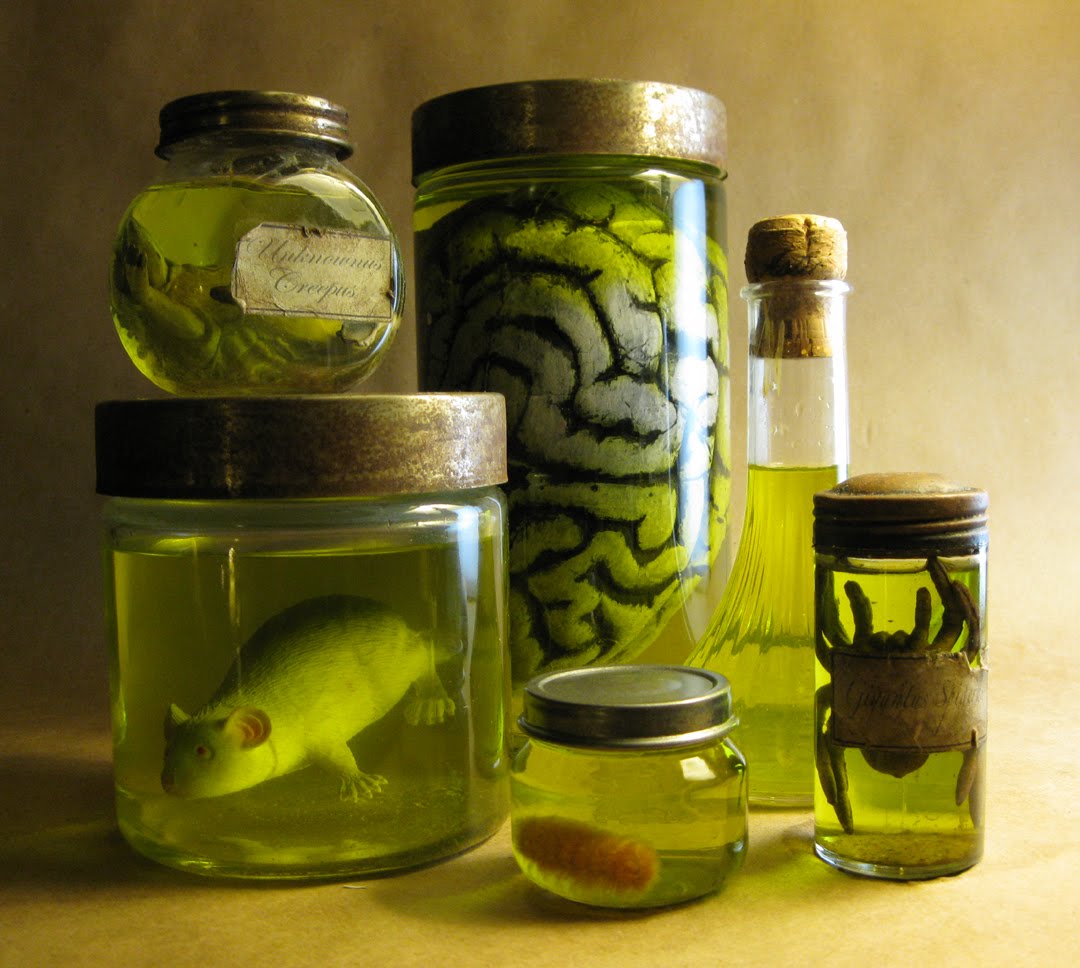
Oubliette didn’t miss going to school the way other children do because she always had plenty to do to keep her body and mind occupied. The house was filled with many interesting things. One enormous room on the top floor was filled with specimens floating in formaldehyde in large bottles. One bottle held a pair of smiling Siamese twins that appeared to be hugging. Oubliette liked to think of them as living in the bottle. She was sure they were as happy in their snug little world as she was in hers. Another bottle that she was always drawn to held the head of a man with his hair floating out from his head like seaweed. His eyes were open wide and his lips were parted as if he had been trying to speak at the moment his head was severed from his body. What exactly had he been going to say? Oubliette liked to put her ear against the cold glass next to his mouth in the hope that she would hear him speak but she never did. It was a tantalizing mystery, though.

Other bottles held a heart, a liver, a brain, eyes, and a set of lungs, not to mention a dodo bird that had been extinct for hundred of years, an octopus, a python snake, side-by-side scorpion and tarantula, a dinosaur egg that was millions of years old, a coelacanth, baby shark and alligator, and on and on. Not in jars but in opposite corners of the room as if they were keeping watch were two complete human skeletons suspended from hooks. The room and everything in it was as familiar and beloved to Oubliette as her own hand.

Another part of the house was filled with departed family members who had walked the earth long before Oubliette was born. One of Grandmother’s sons, the one she didn’t like to talk about very much, had been a taxidermist. His name was Sheridan and he was Oubliette’s great uncle. He had left home many years ago and nobody knew anymore if he was even still alive. Instead of stuffing animals as most taxidermists do, Uncle Sheridan stuffed deceased family members. It had become a sort of tradition in the family that when one died one would be stuffed and mounted instead of being buried in the ground the way most dead people are. And Sheridan prided himself on the lifelike appearance of his subjects: Uncle Julius, for example, was dressed in evening dress, cape and top hat and was just stepping from a carriage as he did so often in life. Baby Margaret sat up in her perambulator, eyes shining and mouth opened slightly in baby laughter, showing tiny, pearl-like teeth.  Grandfather Beauchamp sat in his favorite armchair beside a stock ticker, carefully studying the narrow stream of paper issuing from it. Cousin Grace was dressed in a shimmering gown as Juliet, a part she had triumphed in on the stage. Uncle Cowan, a gifted musician in life (killed by a lightning bolt at age 19), was playing the violin with a look of intense concentration. His sister, Marigold, was sitting at a vanity table brushing her golden hair. Aunt Clytemnestra, Grandmother’s sister, sat at a writing table with pen poised over paper. (She had been a celebrated writer of serials for women.) Eccentric cousin Ludlow, a member of a circus in life, was dressed as a clown with white face paint, a round red nose and a huge grinning mouth. Cousin Melba on Grandfather’s side of the family was on her knees with her hands folded in front of her in an attitude of prayer, asking for forgiveness because she had taken her own life. Melba’s husband, Gustave, having been a doctor, was dressed in a medical gown, with a stethoscope around his neck and a raven on his shoulder (why a raven, nobody could say). Grandmother’s daughter, Meredith (she died on her sixteenth birthday of a brain hemorrhage), was sitting in a rocker beside a birdcage with a book in her hand, looking exactly as she had looked on the day before she died.

Oubliette loved every one of them as if they were alive. She had come to understand at an early age that “dead” is a relative term. Just because you are “dead” in one place doesn’t mean you are “dead” in all places. There are the unseen worlds that living people aren’t supposed to know about. Her only sorrow was that Uncle Sheridan wouldn’t be there to stuff her and Grandmother when their time came. She supposed they would just have to go into the ground the way ordinary dead people do.

She worried sometimes about Grandmother. Nobody knew exactly how old she was, but she had to be over a hundred. Recently she had stopped doing many of the things she loved to do and had taken, about every other day, to staying in bed all day. That wasn’t like her at all. She probably needed a doctor but didn’t like doctors and wouldn’t allow one in the house. She said the only doctor worth anything was nature. When it was her time to go to the other world, she would go, without having any quack doctors fussing around her and expecting to be paid for it.

Oubliette refused to think about Grandmother leaving her. She knew that everybody leaves the corporeal world for the ethereal one, but she somehow believed it wouldn’t happen to Grandmother as long as Oubliette needed her to be there with her. Grandmother was, after all, her only loved one and the only person she had ever spoken to in all her life. They were like two separate parts of the same body. As much as she loved the specimens in the bottles, the skeletons, and the stuffed family members, they were really nothing without Grandmother. She had come to be of the opinion that when Grandmother left the corporeal world, she was going to leave it too.

Grandmother had been thinking along the same lines. One day at tea time she asked Oubliette to come into her bedroom and have tea with her because she had something she wanted to talk to her about.

“I taught you the story of Adam and Eve,” Grandmother said, propped up with a mountain of pillows on her bed.

“Yes,” Oubliette said.

“We all die because of them.”

“Yes.”

“Do you know how old I am?”

“No.”

“The clock is winding down for me, as it does for all of us. The moment we are born, we begin to die.”

“I suppose that’s true,” Oubliette said.

“I’ve given you a good life, haven’t I?”

“Of course.”

“Have you thought about what your life will be after I’m gone?”

“No.”

“Because you are so young, the do-gooders will come and get you.”

“And do what with me?”

“They’ll make you a ward of the state. They’ll put you in a home for children without families where you will have to associate with riff-raff the likes of which you cannot even imagine.”

“Can you explain ‘riff-raff’ to me?”

“Girls with bugs and diseases. Filthy-minded boys who want to take away your innocence.”

“That’s not going to happen.”

“No, indeed, it will not, if I have anything to say about it.”

“You’re not going to die,” Oubliette said. “You’ll still be here twenty years from now when I’m a grown-up person.”

“We both know that’s not true,” Grandmother said. “I’ve already lived longer than any person has a right to live.”

“What can I do about it?”

“In the corner of your medicine cabinet in your bathroom you will find a tiny bottle.”

“What’s in it?”

“Some white powder to be mixed with water and ingested. I’ve been told it is instantaneous and absolutely painless.”

“Oh.”

“It is, of course, completely up to you whether or not you use it. I know you’re a smart girl and will make the right decision.”

“Do you want me to try to contact Uncle Sheridan to come home and do for you what he did for the others?”

“Sheridan’s dead,” Grandmother said. “I saw it in a dream.”

Grandmother lived for a few more months but finally, one day in the spring, she departed this life, in her own bed, with Oubliette beside her holding her hand.

After a period of mourning lasting one day, Oubliette wrapped Grandmother carefully in a pink blanket like a mummy, using large safety pins, and pulled her off the bed onto the wheelchair. She rolled her into the specimen room and dumped her into a large vat of formaldehyde that she had made ready and sealed it shut as fast as she could.

She wasn’t ready to accept that Uncle Sheridan was dead, anymore than she was ready to accept that Grandmother was going into the ground and she would never see her face again. She would find him and make him come home. Since the two of them shared the same blood, she believed that a bond must exist between them, no matter how slight. She would contact him any way she could.

She called every newspaper in the telephone book (five of them) and placed an ad in the “personals” section of each one: Uncle Sheridan, please come home. Grandmother needs you. Signed, Oubliette.

Of the private investigators in the book, she called the one with the nicest-sounding name, Byron Montague, and asked him to conduct an investigation to find Uncle Sheridan, who might be anyplace in the world, if not dead. Byron Montague asked her many questions, most of which she couldn’t answer, but he agreed to explore every avenue and to send her a bill with the results of the investigation as soon as it was completed.

But that wasn’t all. Being a firm believer in the power of the occult, she conducted a séance. She had only a vague idea of what a séance should be, but she did the best she could with what she had. At midnight in the room with the stuffed family members, she sat before a mirror with a lighted candle between her and the mirror. She stared into the flame until it was the only thing that existed for her in the world. Putting both hands to her temples, she willed (a kind of praying) with all her might to enlist the aid of the departed.

“If Uncle Sheridan is there,” she said, “give me a sign. If he’s not there and is still among the living, let him know in any way you can that he’s needed at home.”

The candle went out at that moment in a room that was absolutely airtight, but she didn’t know what it meant. Was it the sign she asked for that Uncle Sheridan dwelt in the land of the dead, or was it an acknowledgment that she was getting through? The results were inconclusive and unsatisfying.

The next night she climbed all the steps in the house with a hundred rooms to the little flat place on the roof that in olden times had served as a lookout. When she was younger, she loved the lookout because it was so secret and private a place and was impossibly high off the ground. She used to spend hours there in agreeable weather reading a book, surrounded by her dolls and stuffed animals, or looking off into the distance, wondering vaguely what the world out there was really like. Whenever Grandmother couldn’t find her, she always looked for her on the lookout.

A light rain was falling but she didn’t mind. She had always liked the rain and, since it had been an especially warm day, it felt cooling on her skin. She looked into the sky and spoke a prayer to God (if God was anywhere, he had to be there) to send Uncle Sheridan home to her. He could stuff Grandmother the way she deserved to be stuffed and he could keep the do-gooders from taking Oubliette to an orphanage with all the riff-raff. It didn’t seem like a lot to ask.

She caught a terrible cold after that, but she didn’t mind very much. She stayed in bed for three days, napping and reading and wishing that Grandmother was there to keep a watch on her temperature and fix her tempting things to eat.

Weeks went by. She recovered from the cold and kept herself busy in the big, silent house, but she missed Grandmother terribly. She had never understood loneliness before. Now nothing was the same. She took to sleeping on a pallet on the floor of the specimen room next to the vat that held Grandmother, with the smiling Siamese twins at her head and the octopus at her feet.

Summer went by slowly and then it was autumn again. Oubliette was as low as she had ever been in her brief life. She couldn’t stand the thought of a winter alone in the house with its howling wind over the mountain and its dark, abbreviated days.

The day came when she didn’t even bother to get out of bed at all. She slept through the day, dreaming pleasant dreams about Grandmother and the way it used to be, and woke up in the early evening to the dark reality of her life. She knew she had reached the end of her tether and it was time to take the powder.

She cleaned herself up, combed her hair and washed her face, and put on her best nightgown that Grandmother made for her and gave her as a Christmas present the Christmas before she died. She filled a glass with water and took the little bottle of powder out of the medicine cabinet and emptied it into the water. She waited for the powder to dissolve and then drank it down.

She didn’t know how long she had so she hurried and got back into bed and pulled the covers up to her chest. Soon she began to feel a pleasant drowsiness and she knew the powder was taking effect. Her last thought before she passed over into that other realm was that it would be years before anybody found her body and when they did she would be a skeleton in the bed, with mice running in and out of her eye sockets. Maybe her ghost would haunt the house and people would be afraid to come anywhere near it, a prospect she found thoroughly enchanting.

She fell into the oblivion of sleep. Hours later (or was it minutes?) when she awoke she knew that something in the room had fundamentally changed but she didn’t know what it was. She sat up in bed and, turning on the light, saw a man standing at the foot of the bed looking at her. He had a black moustache and green eyes, the same color eyes as Uncle Cowan’s. She took that as a very good sign.

“Uncle Sheridan?” she said.

The man took his derby hat off and held it in his hand. “No,” he said.

“Am I dead or am I dreaming?” she asked.

“Any one of us could ask that very same question,” he said.

She pushed back the covers and swung her legs over the side of the bed, caring nothing about modesty. “If you’re not Uncle Sheridan,” she said, “who are you?”

“Does the name Byron Montague mean anything to you?”

“The private investigator?”

“One and the same.”

“Did you find Uncle Sheridan?”

“No, I didn’t. I’m sorry.”

“How did you know where to find me?”

“You gave me your address to send you my bill, remember?”

“You deliver your bill in person?”

“This is the first time.”

“My next question might be to ask why you are in my room in the middle of the night and if you are really here or if I am only imagining it.”

“It’s difficult to explain.”

“Do the best you can.”

“After I spoke to you on the phone, I started thinking a lot about your situation. It wasn’t what you told me that concerned me but what you didn’t tell me. I knew that you needed help and it came to me that I was the one to help. When I tried to put it out of my mind, it always came back to me, as if I was being impelled in some way, but who or what impelled me, I couldn’t say.”

“How did you even get through the front door? It’s always locked.”

“I knocked repeatedly and when nobody came I was about to leave when the thought occurred to me that a key might be hidden somewhere. People very often do that, you know. I started looking around and found a key high up in a tiny niche—more a crack, really—to the right of the door. I had come this far, so I just had to come inside and look around, although I might have been taken for a burglar and shot.”

“You’re not a taxidermist are you?” she asked. “In addition to being a private investigator?”

“Yes, I am,” he said. “How did you know?”

“Have you ever stuffed dead people instead of animals?”

“Well, once or twice,” he said, “but I think as a practice it’s generally looked down upon.”

“I have something I want to show you,” she said.

She put on her dressing gown and took him into the room with the stuffed family members. At first he thought he was looking at wax figures until he put his face up against their faces and sniffed them like a dog.

“This is very good work,” he said. “Quality craftsmanship.”

“I’ll bet you’ve never seen anything like it before.”

“No, indeed, I have not. Who did it?”

“Uncle Sheridan.”

“I get a chill when I look at them. They’re dead yet still they live. They ought to be in a museum.”

“We would never agree to display them in a museum, Grandmother and me.”

“Is she here now?”

“She’s waiting just down the hall. If you come with me, I’ll take you to her.”

Copyright © 2014 by Allen Kopp

Cigarettes

Cigarettes image 10

Cigarettes ~ A Short Story by Allen Kopp 

When Lester Bright awoke on Monday morning, he thought about how he might skip school that day. He could say he was sick, but he had used that excuse—when was it?—not two weeks ago. He groaned and rolled out of bed. After performing his morning ablutions, he dressed himself in the same clothes he wore on Friday and went downstairs.

His mother, Loyce, was sitting at the kitchen table, a cigarette in one hand and a cup of coffee in the other. She barely looked at him when he came into the room.

“I sure do have a headache this morning,” he said, as he poured cornflakes into a bowl and splashed some expired milk on them. “I’m sick at my stomach, too. I think I’m going to vomit.”

He looked at her to see what effect his words might be having, but she was ignoring him. Her eyes were baggy and she hadn’t put on her wig yet or any makeup. She looked like a scary old man. Was it any wonder his friends were afraid of her?

He sat down at the table across from her and eyed her Pall Mall menthol cigarettes while he chewed. Three of them were sticking up invitingly out of the pack. When she got up from the table and went to the sink to rinse out her cup, he reached across and took two of them, sticking them in his shirt pocket.

She turned around from the sink, or maybe whirled around from the sink would have been more like it. “I saw that!” she said. “Put ‘em back!”

“Put what back?” he said.

“Those cigarettes you just stole from me.”

“I didn’t steal any…”

She was on him before he knew what was happening. She moved across the room awfully fast for such a big woman. She grabbed for his pocket and took the cigarettes, ripping his shirt. Any defensive movement on his part would have been useless.

“Have you been smoking?” she asked.

“Of course not!” he said. “I would never smoke!”

“You’re stealing cigarettes from me but not smoking them?”

“I didn’t think you’d mind!”

“What do you mean taking my cigarettes when my back is turned? Are you insane?” She began slapping at him with both hands.

He tried to cover his head with his arms. “You’re hurting me!”

“If I ever see you smoking a cigarette, I’ll cram it down your throat! You’re thirteen years old!”

“I wasn’t taking them for me! I was taking them for a sick friend.”

She stopped the slapping. “Who?” she asked.

“You don’t know him!”

“I want to know his name! Now!”

“He lives down by the river. His name is Harry Burgess.”

“Well, you tell Harry Burgess to get his own damn cigarettes or he’ll be a lot sicker than he ever imagined!”

“I’m going to the school nurse today and tell her you beat me! I’ll have bruises to prove it!”

He had some money he had found on his mother’s dresser, so he stopped at the mini-mart on the way to school and bought a doughnut and a pack of his own Pall Malls. After eating the doughnut in three quick bites, he wiped his hands on his pants and went on to school.

It was still a few minutes before first bell, so he unwrapped his pack and lit up just outside the school gate. His friend Harry Burgess had just stepped off his bus and ran over.

“Where’d you get the cigs?” Harry asked.

“Bought ‘em.”

“I bet you stole them. You never have any money.”

“You don’t know anything.”

“Well, are you going to offer me one like the gentleman you are?”

Harry took one from the pack and was about to light it when the bell rang. “I’ll smoke it during third period,” he said, putting it in his pocket.

At the beginning of third period, when they were supposed to be in study hall working on their American history project, they went to the boys’ restroom on the first floor. After the other boys had gone on to their classes and they were alone, they went over to the row of windows beyond the stalls and lit up, first Lester and then Harry from the same match.

“Oh, tastes so good!” Lester said.

“I’ve been dying for a fag all morning!” Harry said.

After a couple of minutes they were engulfed in a cloud of smoke, so they opened a window a few inches to let some of it out. They were each on their second cigarette when they heard a sound behind them that told them they were not alone. Mr. Phegley, the school principal, had just come in and was looking at them. He had a look on his face that neither of them would ever forget.

Lester didn’t mind the three-day suspension so much—he was always glad for a reason to not go to school—but the bad thing about it was that he was going to have to tell his mother. There would be no way to make a three-day smoking suspension sound like anything other than what it was.

When he got home before noon, she was dozing on the couch. He stood looking at her until she opened her eyes.

“What are you doing home from school so early?” she asked.

“I have something I have to show you,” he said, holding out the letter detailing the terms of his suspension.

“Oh, no!” she said, pulling herself to a sitting position. “What have you done now?”

She reached for a cigarette, lit it and blew a big cloud of smoke in Lester’s face. He inhaled deeply and experienced a few moments of absolute giddiness before she took the letter out of the envelope and unfolded it.

Copyright © 2014 by Allen Kopp
I’ll Do It but I Won’t Like It


1538R-62197

I’ll Do It but I Won’t Like It ~ A Short Story by Allen Kopp 

I wonder about people who work in offices, and I especially wonder about people who work in offices and like it. I’ve worked in quite a few offices over the long years and I guess I can say I’m stronger for having done it. (That which doesn’t kill us makes us stronger). I have to admit, though, that most of the time I didn’t like it. It has mostly been my experience that “office” is just another word for “hell” or “prison.” The best offices to work in are the ones where you have lots of freedom and the worst are the ones where freedom, as a word and a concept, is completely unknown.

I’ve worked at a number of contract positions, meaning that I was part of the organization but not “altogether” a part of the organization. I was, of course, expected to abide by all the rules of the company (start times, codes of conduct, breaks, dress code, etc.) but was excluded from company benefits, social functions and perquisites. If the company was closed for the afternoon so employees could attend the funeral of a fallen executive, for example, I would, as a contractor, have my pay docked, while the regular employees didn’t. Also, being a contractor means that one is completely expendable. If a contract employee’s work is in any way unsatisfactory (and even if it isn’t), he can be removed so fast he won’t even know what happened, with as little fanfare as the changing of a light bulb. So, in a phrase, being a contractor means I am a disposable commodity. If I have human feelings, they’re going to be trampled on.

The best contract position I had lasted for three years. I know I was a fool for hanging around that long, but I was promised a permanent position that never happened. I liked the job—or anyway, could tolerate it—because we had a company cafeteria and a four-day work-week, but also because I had a boss who didn’t much care what I did as long as I did the work I was supposed to do. It was a congenial—some might even say permissive—environment and I probably would have stayed until I died in harness, but my boss (the man who hired me and authorized my pay) was fired for some naughtiness or other, and the corporate robot who took his place decided there was no room in the company for me. (He never liked me, anyway, and the feeling was mutual.)

If you are NOT a contractor, of course, that means you are a “regular” or a “permanent” company employee, which in corporate language very often means “slave” or “possession that we can do with as we please.” At company XYZ, for example, I was never supposed to think for myself or make decisions—that was done for me by a person far superior to me, a manager. I almost felt like I was in third grade again because the manager was breathing down my neck all the time, watching my every move, chewing me out for any little thing. (When I was on kitchen duty, for example, I was chewed out for going to the kitchen to clean up too early, because the three of us who were assigned were supposed to do it as a “team.”) We had endless meetings, some of them conducted over the phone, where we had to sit and listen to some blowhard gasbag of a manager (one of those “superior” people) think out loud, sometimes for as long as two-and-a-half hours. (Of course, nothing was ever accomplished at these meetings.) When the meeting was finally over, I found I had fallen behind on meeting my “deadline.” Guess what the solution was to that? I was supposed to catch up on the work on my own time! (Why else did I have that laptop computer that I was supposed to carry around with me all the time?) If they could figure out a way to get people to work in their sleep, they would do it. They’re working on it, I’m sure.

Of course, managers are notoriously cloven-hooved nincompoops who have no clue about human psychology or how to deal with people. (Some of them don’t even know the difference between “there and “their,” let alone “affect” and “effect.”) They don’t seem to realize that if they treat people like shit, they will get shit in return. You reap what you sow. The good manager, and there are a few of them, knows to treat people the way he himself wants to be treated. It’s so simple. If a manager is liked and respected, he will get so much more from people than if he is hated.

The office, for me, is a very unnatural environment that brings out the worst in people. When you are thrown in with a bunch of office people, strangers with whom you have nothing in common, you learn almost by instinct which ones are to be avoided. You are naturally distrustful of the people who “love” their jobs (or say they do) and believe the company is sacrosanct. (I call these people “abiders”—for them there is no other religion.) They have usually been brainwashed to the point where you can no longer have any possible human connection with them. They believe that every company rule, no matter how stupid, is to be obeyed. If they see you committing some minor infraction or other (he took two ink pens instead of one), they will more likely than not tell on you, just like on the playground in second grade. They cringe if you indulge in any kind of bitchy humor at the expense of the company or its management. They take their jobs so seriously that they become overwrought and face potential nervous collapse if something isn’t done the way they think it should be. They are the watchdogs of those of us who don’t give a shit. Stay away from these people. If you ever hand one of them a knife, you will be sure to find it sticking in your back.

A common question that’s asked in job interviews is, “What is your ideal work environment?” One time when I was asked this question, I said to the female interviewer, “Freedom.” To which she responded, “We don’t have any.” I didn’t get the job, even though I was well qualified for it.

And that brings me to my favorite kind of job, the job where there are no ringing phones, no yak-yakking people, no meetings with a nauseating number of clichés and buzz words spoken, no people (mostly women) complaining about how cold they are while I am dying from how hot it is in the place, no getting up extremely early in the morning, no traffic jams going to or from work, no petty jealousies, no backbiting, no whining, no adult babies, no wishing I was someplace else, no clockwatching, no pretending to be busy when I’m not, no pretending I like something or somebody I don’t, no “Sunday blues” because I have to go to work on Monday, no evenings getting ready for—and dreading—the next day of hell. I control the temperature (a little on the cool side, summer or winter). If my phone is ringing, I don’t have to answer it because it is, after all, my phone. I can work in my bathrobe all day, take extra long lunches, and can take a nap whenever I feel like it. I can have music playing (Mozart, Bach, Glenn Miller, Peggy Lee, Paul Whiteman, or whatever) while I work—or not—and I control what kind of music I listen to without having to defer to anybody else’s preferences. This sounds like heaven, doesn’t it? It sounds a lot like home.

Copyright © 2014 by Allen Kopp

Mr. Woodbine is Here

Mr. Woodbine is Here image 1

Mr. Woodbine is Here ~ A Short Story by Allen Kopp

The nurse came in and took Erwin’s blood pressure. He opened one eye and looked at her and asked if he was dead yet. She ignored him and a little while later she was back again, fussing with the equipment beside the bed, turning dials and flipping switches and writing things down on her clipboard.  A clear bag of liquid hung on a pole beside the bed and drained into his arm. He wanted to ask what it was but he was too weak to get the words out. He was sure he was dying, but he told himself he didn’t really mind. Life was far too much trouble, anyway.

In between times when the nurse was fussing someplace else, he saw people in the room with him. They moved quietly around the bed, as if they were keeping watch or waiting—for what he didn’t know. He couldn’t see them very well, but he knew they were there. (Sometimes one of them would lean over and look closely into his face.) If he tried to speak to them, they withdrew. He wanted only to say hello.

One morning after he had been given a sponge bath (he was beyond embarrassment), he opened his eyes and saw a strange man standing at the foot of the bed looking at him—strange because Erwin had never seen him before but strange also because he was wearing a double-breasted, pin-striped suit with a red carnation.

“Who are you?” Erwin asked in his faint voice.

“How are you feeling, kid?” the man asked.

“Feel stupendous.”

“You know you were shot three times?”

“Feels like more.”

“You know who did it?”

“Not telling.”

“You had surgery to remove the bullets.”

“They didn’t need to bother. I know I’m going to die.”

The man shrugged his shoulders. “I’m not here to say one way or another.”

“You a doctor?”

“No, my name is Mr. Woodbine.”

“You the angel of death?”

“No, but I appreciate the compliment.”

“The undertaker?”

“No, no, no.” He took a cigar out of his pocket, rolled it around between his fingers, and lit it.

“You’re not supposed to smoke.”

“Well, I won’t tell if you don’t.”

“You’re police, aren’t you?”

“No, but I will tell you that I’m closer to being the angel of death than an officer of the law.”

“I give up then. I don’t feel like guessing anymore.”

“You give up too easily,” Mr. Woodbine said with a little laugh. He puffed on the cigar and blew a big cloud of blue smoke out over the bed.

“That ugly old nurse with the red hair is really mean,” Erwin said. “If she comes in and sees you smoking, she’ll probably stab you.”

“I’m not worried about her.”

“Who are those people standing behind you?”

“Oh, they’re nobody.”

“Well, if they’re there, they must be somebody.”

“They’re just curious. They don’t have much to do with their time and they want to know what’s going on.”

“That doesn’t tell me who they are.”

“They’re people you don’t ordinarily see unless you’re in the state you’re in.”

“Dying, you mean?”

“You said it. I didn’t.

“Tell me more.”

Mr. Woodbine opened his mouth to speak again, but the ugly nurse with the red hair came in and he left. When she pulled back the sheet and started poking at Erwin’s legs, he said, “Do you smell cigar smoke?”

“Why? Have you been smoking?”

“Not me.”

“If you smoke in this room, you’ll set off the sprinklers and that will make certain people very unhappy.” She pointed at the ceiling.

“I’ll tell him.”

“Who?”

“That man that was just here.”

“If anybody was smoking,” she said, “I would know it. I’ve got a nose like a bloodhound.”

“Am I going to die?”

“You don’t think I’d tell you, do you?”

He went to sleep again and a large, indeterminate chunk of time passed, maybe days or maybe only hours. Once when he awoke, he was aware of rain pattering against the window and then of Mr. Woodbine sitting in the chair beside the bed smoking his cigar.

“How are you feeling now, son?” Mr. Woodbine asked.

“How do you get in here all dressed up like that, smoking that cigar? Don’t the nurses try to stop you?”

“They don’t see me.”

“Well, that must be convenient. You’ll have to let me in on some of your secrets.”

“There’s nobody around. I thought we could talk a little more.”

“What time is it?”

“Does it matter?”

“No.”

“Tell me how you came to be shot.”

“An argument over money.”

“Ah!”

“And not very much money, either.”

“Not worth dying for?”

“If I live, I’m going to go find the rat that shot me and shoot him. Only I’m going to do it right. I’ll make sure he’s dead.”

“How do you know he’s not in police custody already for shooting you?”

“Maybe he is. I don’t know anything about what’s going on out there.” He pointed feebly toward the window. “The police were here asking me questions but I wouldn’t tell them anything. I want to take care of that rat myself. I never liked that guy anyway.”

“Revenge will be sweet?”

“It already is, just thinking about it.”

“What if I told you he’ll be taken care of and you don’t need to bother yourself?”

“I’m still going to kill him, except I’m going to make him suffer.”

“The way you’re suffering now?”

“Only worse.”

“Even if you live, you might not walk again.”

“I can kill the son of a bitch from a sitting position.”

“I have no doubt.”

“Why am I telling you all this?” Erwin said. “I don’t even know who you are!”

“It’s all right, because I know you.”

“I never saw you before in my life.”

“You have, many times, but you aren’t able to remember. I was there the time you nearly drowned in the swimming pool in high school. Remember?”

“I remember the incident but I don’t remember you.”

“Some of our memories are blocked out. The ones we’re not supposed to remember, for one reason or another.”

“You’re talking nonsense.”

“Not the first time and certainly not the last.”

“Tell those people to stay away from me. They’re getting on my nerves.”

“You just rest now. I think I hear that mean nurse coming.”

Anytime he was conscious, he expected to see Mr. Woodbine again, but Mr. Woodbine came no more.

Finally the day came when he arose from the bed on his own without any nurses fussing around him. His clothes were there, draped neatly over the chair. His wallet, glasses and keychain were on the table beside the bed where he would be sure to see them. He knew that he was being allowed to leave the hospital. Everything that was wrong with him had been fixed. He was renewed. He was going to have a fresh start. All his thoughts of revenge were gone. He didn’t even remember what had brought him to the hospital in the first place. He couldn’t wait to get outside and breathe the fresh air, even if it did smell like bus fumes. He jumped into his clothes excitedly.

He was going to tell the nurses goodbye as he walked past, but they were busy and didn’t look at him. Instead of waiting for the elevator, he walked down the five flights of stairs to the street. It felt so good to use his legs! Who said he might not ever walk again?

It was a brilliantly sunny day. As he walked down the broad steps of the hospital, he saw Mr. Woodbine waiting for him at the curb. They got into a waiting car and, as the car sped away, he lowered the window to feel the rush of air in his face. He was leaving pain and suffering behind. His problems, at last, were at an end.

Copyright © 2014 by Allen Kopp

People are Talking

People are Talking image 4

People are Talking ~ A Short Story by Allen Kopp 

It was a slow day. A boy came in to buy a reed for his clarinet. A woman brought her daughters in to look at pianos with no intention of buying. A man came in to inquire about selling a violin he had that belonged to his brother who had just died. A couple of other people came in looking for certain classical recordings, one Bach and one Sibelius. Then it was time for lunch.

Roberta was alone in the shop, so she couldn’t leave. She sat on a high stool behind the counter, where she could see the door, and ate the lunch she had brought. While she ate, she looked over the morning paper. When she was just about finished, the wife of the store’s owner came in.

“Good afternoon, Mrs. Doheny,” Roberta said pleasantly.

“I want to have a talk with you,” Mrs. Doheny said. “I’m glad there’s no one here.”

“Whatever would you want to talk to me about?” Roberta asked, her smile fading because Mrs. Doheny seemed angry about something.

“I’ll bet you already know.”

“Why, no, I don’t!”

“You know, of course, that my husband is a married man?” Mrs. Doheny said. She leaned forward on the counter, her face uncomfortably close to Roberta’s.

“Yes.”

“I just wanted to make sure you are aware of that fact.”

“I’ve worked for him for two years. How could I not know he’s married?”

“And we have two children in high school.”

“Yes.”

“I own half of this store. I have as much say over what goes on here as my husband does.”

“Yes?”

“I could fire you without batting an eyelash but I thought it only fair to warn you first. If you don’t heed the warning, then I fire you!”

“Warn me about what?”

“Your relationship with my husband is to remain purely a professional one. If it goes any farther than that, I have no other choice but to take action.”

“What action? I don’t know what you’re talking about.”

“You and my husband were seen together, more than once, outside the store.”

“Seen by whom?”

“Never mind who it was. You just need to know that people are not as stupid as you seem to think they are.”

“What makes you think I have any interest in your husband?”

“People are talking!”

“What people?”

“Those in a position to know.”

“Oh, I think I’m starting to see it now. I’ll bet it’s that girl, that Stephanie, that he fired a while back for stealing things when she was alone in the store, isn’t it? She’s your niece or something, as I remember.”

“You don’t think I’d tell you who it is, do you?”

“I knew she was stealing and I told her if she didn’t stop I was going to tell on her. The next time I knew she was doing it, I went to Mitchell and told him about it and he fired her, niece or no niece.”

“Oh, it’s ‘Mitchell’ now, is it?”

“If you’ll excuse me, Mrs. Doheny, I’m not going to talk to you any further. This conversation is at an end.”

“You’re not going to get rid of me that easily!”

“If you have suspicions about anything, why don’t you talk to your husband about it and leave me out of it?”

“You don’t think I’d believe his lies, do you?”

“You’re a very disturbed woman, Mrs. Doheny. I feel sorry for your husband. He’s a nice man.”

“Why, you stupid little bitch! I could buy and sell you ten times over!”

A customer came in and Mrs. Doheny went into the back of the store where no one could see her. When the customer left a few minutes later, she re-emerged, her face pale and puffy from crying.

“You don’t look very busy,” she said as she prepared to leave. “I don’t think you’re earning your pay.”

She pushed over a display case with glass shelves, causing a tremendous crash. The display case broke and the merchandise scattered over a good part of the store.

“That will be deducted from your pay, of course!” she said, as she went out the door.

While Roberta was sweeping up the mess, she cut the first two fingers of her right hand. She went into the bathroom to hold her hand under the faucet, not caring if anybody came in or not—if they did, they could help themselves to anything they wanted as far as she was concerned.

The rest of the afternoon passed slowly. Right before closing time, Mitchell Doheny came in. He noticed right away that the display case was gone.

“What happened?” he asked.

“It fell over and broke,” Roberta said.

“By itself?”

“I was nowhere near it when it happened.”

“I’ll have to order a new one,” he said.

As she was preparing to leave for the day, he came up behind her and put his hands on her shoulders. She wasn’t used to being touched and flinched.

“Would you like to have dinner with me to celebrate?” he asked.

“Celebrate what?”

“The end of the week, I suppose.”

“I have nowhere else I have to be,” she said.

Instead of having hamburgers at the diner, they went to an Italian restaurant with real Italian cuisine, live music, and checkered tablecloths.

“How did things go for you in the store today?” he asked, as they sipped wine and waited for their food.

“All right,” she said. “A little slow.”

“I’m thinking about opening another store across town. How would you like to manage it?”

“We’ll see. Could we talk about something other than business?”

“What else is there?”

“I want to show you something,” she said.

She opened her purse and held up the small handgun she always carried, wrapped loosely in a headscarf.

He laughed when he saw the gun. “Are you planning on shooting somebody with that?” he asked.

“Only if I have to.”

“Be sure and tell me if it’s going to be me,” he said. “At least give me a chance to run.”

It was just starting to rain when they left the restaurant. She could easily have walked home, but he insisted on taking her.

When they pulled up in front of her building, she turned to thank him for the ride.

“I could really use a cup of coffee,” he said, “to clear my head.”

“You know I don’t drink coffee,” she said.

“Yes, I know, but you keep some on hand for guests, don’t you?”

“Guests like you?”

“Yes.”

“Would you like to come up?”

“I can see we’re thinking along the same lines.”

She turned on all the lights in the little apartment and turned on some music they both liked, a small ensemble with Benny Goodman so mellow on clarinet. While the coffee brewed, he made himself comfortable on the couch.

She went and sat beside him. He put his arm around her and started to pull her toward him, but she disengaged herself and got up and went back into the kitchen. When she came back with his cup of coffee, he took a sip and set the cup down. He reached for her and began kissing her, hurting her in a way, but she didn’t make him stop as she had always done before.

Copyright © 2014 by Allen Kopp  

One Way

One Way image 1

One Way ~ A Short Story by Allen Kopp 

There she was, Mrs. Velda Millis, age seventy-eight, taking a bus trip on her own. Her hairdo was beauty-parlor fresh and she was wearing a new dress, bought on sale for the occasion. She had her purse, her ticket and her suitcase and was wearing her comfortable shoes. All she had to do was sit and wait for her bus.

The bus station scared her a little. It was too big, there were too many people moving too fast, too much noise. The noise alone set her on edge; every time an announcement was blatted over the loudspeaker, she jumped as if a gun had been fired behind her head. When a woman with a screaming baby sat down near her, she got up and moved to a different seat farther away.

She watched the minutes ticking away on a clock high up on the wall until her vision blurred. She was bored and wasn’t used to being bored. How did people stand to wait for hours in such a place?

Her hand started to cramp and when she looked down she realized she was holding onto her ticket for dear life. She wouldn’t need the ticket until time to board the bus. She slipped it into her purse and massaged her thumb. “Calm down,” she told herself. “You’re going to make it through this.”

Her daughter, Teresa, had given her the ticket and some instructions. What were they? Oh, yes, she was supposed to wait until two-fifteen (or was it three-thirty?) and then make her way over to gate five (or was it gate three?) and wait there until they announced over the loudspeaker that she could get on board. She hoped the announcement was in English. If it was in any other language, she wouldn’t know what they were saying.

It was only eleven-thirty. She still had hours to go. She closed her eyes and took a few deep breaths and thought about her son’s house where she was going to live.

Julian was a successful businessman and had a large house with an upstairs where she could have her own room. She would make herself useful by helping Susie, Julian’s wife, with the housework and by minding the two kids. She hardly even knew her grandchildren and was looking forward to getting acquainted.

She had lived with Teresa for the last two years and Teresa didn’t want her anymore. They got on each other’s nerves and had taken to quarreling over little things. She realized for the first time that she didn’t like Teresa very much and that the feeling was mutual. After one of their fights that lasted several days, Teresa told her she wanted her out of her house and was going to put her in a nursing home. Teresa had a long conversation with her brother Julian that night on the phone, the upshot of which was that they were going to put mama on a bus and send her to him.

“It’s your turn to deal with her,” Teresa had said to him with mama sitting right there. “I’m at the end of my tether. Maybe you can talk some sense into her.”

“Talk some sense into me about what?” she asked when Teresa hung up the phone.

“None of your business!” Teresa snapped. “Oh, to have some privacy again in my own home!”

When Teresa presented her with the bus ticket, she saw right away that it was marked One Way. She was going away from her home and never coming back.

When she was realistic and looked the facts in the face, she knew she wasn’t going to have her own room at Julian’s place and be able to help with the housework and the children. Telling her that was just a trick, she saw now. Julian and Susie would be there to take her off the bus, all right, but they would then whisk her off to one of those places where blank-eyed old people sit in chairs and wait to die, forced to surrender control of their lives to absolute strangers. She was not to be given any choice in the matter.

Now that she knew what they were going to do to her, wasn’t it her last chance to escape? She didn’t have to get on that bus, just because snooty Teresa had bought her a ticket. There was something else she could do.

She picked up her suitcase that sat at her feet and opened it. Underneath the clothes were her Bible and a bulky manila envelope. These were the things that gave her strength and comfort: the Bible because the words in it sustained her in times of trouble and the envelope because it contained one hundred and eighty one-hundred-dollar bills. (She had counted them over and over.)

She found the money in the bottom of one of Teresa’s dresser drawers when she was cleaning and took it as her own. Teresa would say she stole it, of course, while she maintained it was money due her. For what? For keeping herself from slapping Teresa across the room all the times she had wanted to.

Having decided she wasn’t going to take that bus, she couldn’t stand being in the bus station another minute. She went outside, finding herself on an unknown city sidewalk. She followed her nose, as the saying goes, to the old Windsor hotel, which sparked some memories for her of long ago. She went inside and engaged a room, registering under the name of Ann Harding, the name of a long-ago movie actress. Nobody would ever know it was her.

After she was shown to a room by a dwarfish bellboy, she kicked off her shoes and called room service and ordered a steak sandwich and a bottle of beer. When the boy came with her order, she tipped him generously. She had money and money will take you a long way in this world.

Copyright © 2013 by Allen Kopp

Broomstick

Broomstick image 1

Broomstick ~ A Short Story by Allen Kopp 

She was old and stayed shut up inside her castle high on a lonely mountaintop. There was one night in the year, though, that she had to go out into the world, and that night was Halloween. She wouldn’t be much of a witch if she didn’t fly on Halloween.

As the sun sank behind the mountains in the west, she woke up her old black cat, Lucifer, who was sleeping in front of the fire, and told him to get up and have a snack and wash his face in preparation for leaving.

“I’m not going with you this time,” he said.

“Why not?” she asked.

“I’ve seen enough of the world. I’ve flown with you on countless Halloweens. I just want to be left in peace.”

“Well, suit yourself,” she said. “You’ll be missing a good time.”

“I’ll guard the castle while you’re gone,” he said, going back to sleep.

As she flew off on her broomstick, she realized she hadn’t flown since the previous Halloween. She really needed to get out more. She was a little wobbly at first, as if she might fall off, but soon she hit her stride and did a couple of loop-the-loops and reverse maneuvers to prove to herself that she still could.

After she had flown a good distance away from her castle, she felt an urgent need to do something bad, to cause some mischief and mayhem, as witches do on Halloween. Seeing a church in a village, she threw a ball of fire that caused the steeple to burst into flame. Then, outside the village, she caused some railroad tracks to buckle so that the next train to come along would derail. She turned a cow standing in a field into stone and two small children into white mice. Feeling less than fulfilled, she redirected a creek so that it would flood some farmland. These things were nothing, though, compared to what she did next: Hovering over the roof of a maternity hospital, she cast a spell that would cause the next baby to be born to have two heads. Now there was a fiendish accomplishment!

As good a time as she was having, she felt that something was missing. In the old days of her witchery, she always had somebody with her; if not a victim, then a fellow witch. Doing bad things just wasn’t as much fun if there wasn’t somebody along to tell her how terrible she was. She needed to hunt up the old gang to see what they were up to.

She flew on until she came to the environs of her youth, the place where she got her start as a witch. The forests, mountains, and rivers all looked the same. The village was much the same but had grown shabbier and poorer. The witches’ nightclub, Eye of Newt, was still there, thank goodness! She went inside, carrying her broomstick in her hand.

A hunchback dwarf greeted her at the door. She recognized him at once.

“Raphael, is that you?” she said.

The dwarf squinted up at her in the dim light. “Have we met?” he asked.

“It’s Mignonette, the witch. Don’t you remember me?”

“Oh, yes! Mignonette! Of course, I remember you, but I thought you were dead.”

“Not yet.”

“My eyes are not what they used to be.”

“Any of the old crowd here?”

“I think you’ll find a few of them at the table in the corner.”

As she made her way through the crowd to the last table against the wall, nobody turned to look at her. There was a time when she could command an entire room with her presence.

Two witches and a ghoul were sitting at the table. She recognized the two witches from the long-ago, but she didn’t know the ghoul.

“And who might you be?” one the witches, the one known as Hildegard, asked.

“Why, it’s Mignonette,” she said. “Your old friend.”

“I don’t remember anybody by the name of Mignonette,” Hildegard said stubbornly.

“Why, of course you remember her!” the other witch said. (Her name was Carlotta.) “There was the time that Mignonette was the toast of the town.”

“Oh, yes, I remember now,” Hildegard said. “She tried to kill me once.”

“Only once?” the ghoul asked, standing to hold the chair out for Mignonette as she sat down.

He was Erich, a holdover from the Third Reich. (People always wanted to hear the stories about his association with Herr Hitler.) He wore a top hat and pince nez. With his long, emaciated body, skin the color of ivory and black circles around his eyes, he was every inch the ghoul.

“I’m so happy to make your acquaintance, mademoiselle,” he said in his smooth continental accent, taking Mignonette’s hand in his own and kissing it.

“Likewise, I’m sure,” Mignonette said.

He motioned for the waiter and ordered a round of witches’ brew.

“So, I’m wondering where all our old friends are this evening,” Mignonette said. “Ethelbert, Lulu, Patsy, Lucille, Laverne and the others.”

“Oh, haven’t you heard?” Carlotta asked.

“Heard what?”

“Lucille and Patsy are dead. Ethelbert got married and went back to the Old Country. Lulu’s in a hospital for the criminally insane and, last I heard, Laverne was in jail for something or other.”

“So, it’s just the two of you left in our little coven?” Mignonette asked.

“I’m afraid so.”

“There are lots of new young witches coming along,” Carlotta said, ever the optimist. “I’m thinking we can recruit some of them to join us in our crusade of evil.”

At the mention of young witches, they all turned to look at the crowd that was hemming them in against the wall. The young witches were nothing like the older generation, which included Mignonette, Carlotta and Hildegard. They were sleek and didn’t go in for scary ugliness as the older generation had done. They had done away with the long black dresses, pointed hats, green skin, facial hair, and warts. Some of them didn’t even look like witches. They seemed to be more interested in flaunting their assets than in casting spells and riding around on broomsticks.

“I’m afraid things have changed,” Hildegard said.

“The old ways are still the best,” Mignonette said. “We can still have fun doing what we always did.”

“My motto exactly!” Erich said.

“It’s the one night in the year that witches should be having a good time.”

“Yes, yes, that’s so true,” Hildegard said.

“You’re not going to sit here all evening and drink witches’ brew, are you?”

“Well,” Carlotta said, “Hildegard and I were thinking about kidnapping a couple of teenagers from lovers’ lane and scaring the hell out of them. Make them think we’re going to kill them and then let them go at the last minute.”

“We’ve done all that,” Mignonette said. “Time and again. Maybe it’s time of think of other things to do.”

“Like what?”

“May I make a suggestion?” Erich asked. “Forget your teenagers. Some friends of mine, fellow ghouls, are getting up a party in the Cemetery of the Holy Ghost for around midnight. It’ll be a lot of fun. Skeletons dancing around a fire and that sort of thing. I’d be happy for the three of you lady witches to accompany me. And you won’t have to fly on your broomsticks. I have my car outside.”

“Can you imagine three witches and a ghoul in a car on Halloween night?” Carlotta said. “What do we do if a policeman stops us?”

“You either turn him into a toad or we tell him we’re on our way to a costume ball,” Erich said.

“It really isn’t any of his business,” Hildegard said.

“You three run along,” Mignonette said. “I don’t think I’ll come along.”

“Why not?” Carlotta asked.

“I think my time as a witch has passed. Do you know that I haven’t even left my castle since last Halloween night? My black cat, Lucifer, didn’t feel like coming with me tonight. It just isn’t the same without him.”

“Oh, I haven’t had a black cat for years,” Hildegard said.

“I have another suggestion,” Erich said. “The two of you run along and I’ll stay here with Mignonette. I’ll even lend you my car. You know how to drive, I trust?”

“Well, I like that!” Hildegard said. “She’s still doing it, after all these years! Stealing away all the men!”

“I’m not stealing away anybody,” Mignonette said.

“It’s parked just down the street,” Erich said. “You can’t miss it. It’s a 1932 Cadillac V16 Fleetwood sedan. The keys are in the ignition.”

“Let’s go,” Carlotta said. “I haven’t been to a cemetery party in years. We’ll have the pick of the men there.”

After Hildegard and Carlotta were gone, Erich ordered more drinks and moved his chair over as close to Mignonette as he could get. He put his arm around her waist and whispered in her ear.

“My place is very cozy,” he said. “I have embalming fluid.”

“Why me?” she asked. “I’m just as old and ugly as they are.”

“No, you’re not,” he said. “You’re different.”

“I’m not.”

“Wouldn’t you like to see my collection of Nazi memorabilia?”

“If I go with you, will you tell me all about Herr Hitler?”

“Would you be surprised if I told you I have his body in a trunk in my bedroom?”

“What for?”

“We’re going to try to bring him back to life.”

“Who is?”

“Come along with me and you can meet them.”

She blushed and pulled the brim of her hat down farther so her eyes were hidden. He stood up and took her by the hand.

She hadn’t had a passenger behind her on her broomstick for many years, especially a man. As he leaned forward and put him arms around her waist, she felt a quickening in her blood that she thought was long dead. He was a gentleman, she could see, and a Nazi gentleman at that. It was turning out to be a very fine evening after all.

Copyright © 2013 by Allen Kopp

Celeste

Celeste image 1

Celeste ~ A Short Story by Allen Kopp

She owed everything to M and F. They brought her into the world, fed and clothed her, educated her, gave her a wonderful childhood. When the world was against her, M and F were always in her corner.

After she grew up, she married and left M and F. The marriage didn’t last, though, and after it came to its sad end she moved back home. M and F were growing old by then and needed her in the same way she needed them when she was a little girl growing up. She would never leave them again.

She did everything for them. They were helpless without her. She got them up in the morning, dressed them, sat them in their chairs, turned the TV or radio on for them. She read the newspaper to F and helped M with all the housework. She loved them so much that she told them all her secrets, like the time she pushed a girl down a long flight of stairs or the time at the lake when she could have saved a drowning boy but instead let him die.

On a beautiful autumn day, when the leaves were bright colors and the air held that wonderful crispness that can only mean the end of October, she bundled M and F up in their coats. F looked so sweet in the knit cap she made for him and M seemed to glow with the prospect of the fun they were going to have.

With M and F snuggly secured in the back seat, she drove out to the country road that she remembered from her childhood. They used to take long drives on Sunday afternoons in autumn, stopping to pick bittersweet or wild flowers or a few persimmons off a scraggly tree. She laughed to remember how eating a persimmon would make the inside of her mouth so puckery that she would have to spit it out on the ground. Autumn was her favorite time of year.

The road was just as she remembered it, the hills, curves, and sudden dips that made the stomach turn over. In fact, everything was exactly the same. There was the old red barn, there the grain silo and over there the horses grazing in a field behind a fence. The rickety old bridge still spanned the creek and the old country store still sold ice-cold drinks and pumpkins.

She looked away for a moment and when she looked back a porcupine was running across the road in front of the car. Porcupines don’t run very fast. If she had run over it and killed it, she would have been upset for the rest of the day. She swerved the car too much and lost control. The car careened off the road, across a ditch and into a tree.

Her first thought was for M and F. They had slid off the seat onto the floor but were unhurt. After she tended to them, she got out of the car to assess the damage. She had hit the tree squarely; water was dripping out of the radiator. She could not drive the car another inch in its present state.

It was too far to walk to town and, besides, she couldn’t leave M and F in the car alone. She could think of nothing else to do but stand by the side of the road and wait for somebody to come along and help.

There wasn’t much traffic and the few people who went by just stared at her as if she were a lunatic and went on past. Finally a police officer in a patrol car came along and, seeing her and the car smashed into the tree, pulled off onto the shoulder and got out.

“Anybody hurt?” the officer asked.

“No,” she said.

“I’ll call a tow for you.”

“Thank you.”

He spotted M and F in the back seat of the car. “Are they all right?” he asked.

“I think so,” she said.

He went closer to the car and leaned over to get a better look. “Why, they’re wax figures!” he said. “Aren’t they?”

“They’re…my family,” she said.

He straightened up and looked closely at her to see if she was making a joke. “Are you made of wax, too?”

“They’re surrogates.” she said.

“They’re what?”

She was wearing an old coat that belonged to F. She thrust her hands into the pockets and felt in the right-hand pocket a small knife that F used to use for whittling. She brought the knife out and stabbed the officer in the forearm.

He yelped with surprise. When she saw the knife sticking into his arm, she turned and started to run, but he grabbed onto her and wrapped his arms around her to subdue her. He pushed her toward the patrol car, opened the back door and shoved her inside.

“What do you think you’re doing?” she said. “I haven’t done anything wrong!”

“Shut up!” he said.

He slammed the door, locking her inside.

“Let me out of here!” she said. “They need me!”

The officer went over to her car and opened the back door. F tumbled out onto the ground head-first in a very undignified manner. The officer picked him up by the arm and tossed him back inside.

She winced as if she had been struck and then laughed at herself because she knew then that it wasn’t the real F. They—the real F and the real M—were asleep in a big trunk in the basement. Only she knew where they were. Nobody else would ever know. She was so much smarter than she had ever been given credit for.

Copyright © 2013 by Allen Kopp