Robinson Crusoe ~ A Capsule Book Review

Robinson Crusoe cover
Robinson Crusoe
~ A Capsule Book Review by Allen Kopp ~

English author Daniel Defoe lived from 1660 to 1731. He was a prolific writer whose most famous work is the novel Robinson Crusoe, published in 1719. Robinson Crusoe is generally considered the first English novel and has appeared in many reprints and translations. It is the famous story of an “everyman” who is shipwrecked alone on an uninhabited island in the Caribbean, as all his shipmates perish.

As a young man, Robinson Crusoe (the man, not the novel) can’t decide what profession to take up. Against the better advice of his father, he becomes a sailor. After a brief (and might have been successful) stint as a plantation owner in Brazil, he goes to sea on a commercial voyage to the Caribbean. There is a terrible storm and (you guessed it), the ship that Robinson is on is wrecked. All his shipmates drown but he, miraculously, survives. He washes up on a tiny, uninhabited, isolated, tropic island in the Caribbean, which turns out to be forty miles from Trinidad.

At age twenty-six, Robinson has never learned how to be on his own and he doesn’t know how to do much of anything; he doesn’t have what we might call “survival skills.” Luckily he is able to retrieve some essential supplies from the shipwreck, such as tools, rum, gunpowder, guns, clothes, and some food items. He has also salvaged some seeds for planting, which will prove useful to him later on.

Alone on this terrible island, he must learn to survive, or he will die. He must construct a shelter of some kind to protect himself from the tropical rainstorms, hurricane winds and sweltering heat. When he first comes to the island, he lives in fear that he will be devoured by wild animals or eaten by cannibals, which, he believes, live nearby. He must learn to find enough food to eat to keep himself alive. He must cope with isolation, loneliness and his own fear. He lives always with the hope that he will see a friendly ship on the horizon, coming his way.

As the novel progresses, we see how Robinson Crusoe is transformed. He must learn to do the things he never imagined he would have to do, such as killing animals for food, planting crops, making bread, making pottery, baskets and building himself a sturdy shelter to protect himself from whatever might be out there. He comes to realize after being on the island for years that God played a part in his salvation, when all the others on board his ship died. He sees how God played a part in providing everything he needed to sustain life. Without God helping him, he would have died. How he changes, how he is transformed from one kind of man into another kind, is the emotional core of the novel.

It’s many years before Robinson Crusoe finds a way off the island. He endures and somehow he thrives and becomes stronger. He finds happiness, comfort, peace and contentment. The irony is that he probably wouldn’t have had those things if he had stayed at home in England where he was born.

Copyright © 2021 by Allen Kopp
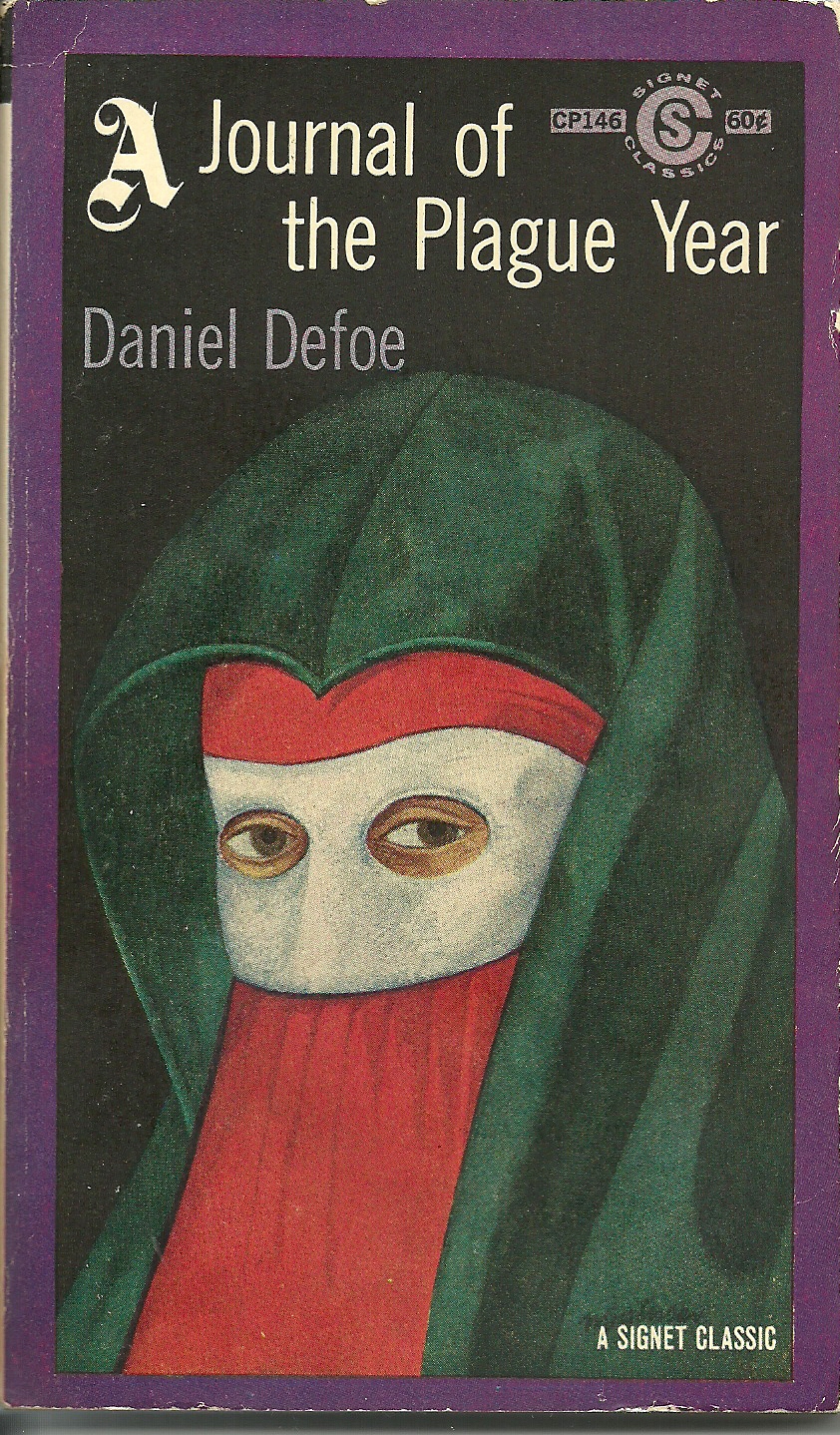
A Journal of the Plague Year ~ A Capsule Book Review

A Journal of the Plague Year cover

A Journal of the Plague Year ~ A Capsule Book Review by Allen Kopp

English author Daniel Defoe (1660-1731) was a literary late bloomer. He wrote his three famous novels (Robinson Crusoe, Moll Flanders and A Journal of the Plague Year) after the age of sixty. A Journal of the Plague Year was first published in 1722 and is an account of the London plague epidemic in 1665, when Defoe was only five years old.

A Journal of the Plague Year is fiction but is told in first person, as if the narrator is there at the time of the epidemic. The fictional narrator doesn’t leave London when he has the chance when the plague starts, as many sensible people do, but stays behind. He is spared the infection but witnesses firsthand the horrors of the epidemic and lives to tell about them. Defoe supposedly drew on the journals of his uncle, one Henry Foe, in writing the novel. That is obviously what gives the story its sense of authenticity and immediacy.

People can have the plague and not even know it, so are spreading it to everybody they come into contact with. Is it airborne or does it come about only through contact with an infected person? In 1665, nobody seemed to know for sure. Those who have someplace to go outside the city leave before the epidemic takes hold. It’s mostly the poor people who have to stay behind, so they are the principal victims.

So many people are dying during the height of the epidemic that the niceties of burying the dead in coffins are dispensed with. With a thousand or more people dying a day, “dead-carts” are dispatched to round up the dead and dump them into a huge pit. The only requirement for the pits is that the dead be buried at least six feet deep. As the lucky people who collect the bodies sicken and die themselves, new people have to be found all the time to fill the job. (It sounds even worse than a job as a technical writer for a restaurant chain.)

As with any human tragedy, there are stories of heroism and sacrifice along with the stories of opportunism and charlatanism. Quack doctors prey on the poor and uneducated, selling them fake “medicines” that are supposed to be a surefire remedy against the plague. Houses of the sick are ransacked by thieves. Unscrupulous “nurses” murder the sick people they have been hired to care for. Infected people willingly spread the disease to those they know are uninfected. On the other hand, caring people risk their own lives to stay behind and care for the sick in the “pest houses.” Charities are set up that provide food and necessities to the poor to see them through the epidemic.

There isn’t much plot or story to A Journal of the Plague Year, but that doesn’t mean it’s dull reading. A plague epidemic in a large seventeenth-century city is dramatic enough without much embellishment. Once you get used to the old style of sentence structure, it’s a fascinating reading experience. I bought a paperback of the novel when I was in college for sixty cents (new, not used—so you know how long ago that was). I read a hundred or so pages of the novel back then but for some reason didn’t finish it. That’s why I undertook to read the entire book (a breezy 240 pages) this summer, and I’m glad I did.

Copyright © 2014 by Allen Kopp