In the Heart of the Sea ~ A Capsule Movie Review

In the Heart of the Sea

In the Heart of the Sea ~ A Capsule Movie Review by Allen Kopp

In the Heart of the Sea was directed by Ron “Opie” Howard and is based on a non-fiction book by Nathan Philbrick called In the Heart of the Sea: The Tragedy of the Whaleship Essex. It’s a true-life story that happened in 1820-21 and that thirty years later inspired Herman Melville to write his epic sea novel, Moby Dick.

The movie is structured as a flashback. The young author Herman Melville (played by Ben Whishaw, who was poet John Keats in Bright Star) visits a grizzled, middle-aged sea veteran named Tom Nickerson (Brendan Gleeson), who, thirty years earlier, at age fourteen, sailed on the whaleship Essex. Melville intends to write a novel about the Essex, but especially about the monster whale that was said to have rammed the ship and destroyed it, leaving its crew members stranded in the southern Pacific Ocean for more than ninety days. Nickerson doesn’t want to talk about his experiences on the Essex, but Melville (and Nickerson’s wife) persuades him to loosen his tongue and the two men spend all night talking about what happened, with Melville taking notes.

The captain of the ship, George Pollard (Benjamin Walker, who played Lincoln in Abraham Lincoln, Vampire Hunter) and the more-experienced first mate Owen Chase (Chris Hemsworth) don’t like each other very much. Captain Pollard, from an old navy family, doesn’t let Owen Chase, the son of a farmer, forget that he is in charge and has final authority in all matters. Pollard has promised investors that he will return with his ship full of whale oil (which might take as long as two or three years) and isn’t interested in taking precautions that Owen Chase believes are necessary to protect the lives of the men on board. What’s a life here or there when there’s money to be made?

They go out to isolated areas of the ocean and find whales and kill them (I know, it’s cruel), cut them open and extract oil from them. After several months at sea, they haven’t found enough whale oil to satisfy Captain Pollard, so he is willing to risk going to an area in the southern Pacific that he has been warned against. The Essex has an encounter with a giant white whale a hundred feet long, but the men are not able to kill it because it’s so big. (When it’s man against nature, man always loses.) They succeed in angering the god-like whale and it eventually “stoves” the ship, leaving all surviving crew members to toddle around in life boats thousands of miles from the coast of South America.

For those of us of a literary bent, In the Heart of the Sea is interesting because of its connection to Herman Melville and the creation of an American literary masterpiece, Moby Dick. It’s an old-fashioned kind of movie that could have been made in the 1940s or ‘50s (using the latest in 3D technology, of course) and for that reason it’s not going to be for everybody. (For my money, a true-life seafaring adventure like this one is much more interesting than a fabricated, flight-of-fancy piece of fluff like The Martian.) During the action sequences, the dialogue is almost unintelligible, so we can only get the gist of what’s being said, but that’s usually all we need. Christ Hemsworth as the star is not as commanding or charismatic as other male actors (for example, Tom Hardy in Mad Max Fury Road), but that’s only my opinion. Those considerations aside, there’s plenty in In the Heart of the Sea to recommend it to the discriminating moviegoer.

Copyright © 2015 by Allen Kopp

Krampus ~ A Capsule Movie Review

Krampus

Krampus ~ A Capsule Movie Review by Allen Kopp

If you like Christmas movies and also horror movies, Krampus is a combination of both. A boy named Max lives with his family in their beautiful suburban home. As Max sees all the Christmas superficiality around him, he wishes that Christmas could be the way it used to be. When his creepily androgynous cousins tease him at the dinner table about still believing in Santa and one of them steals and reads Max’s letter to Santa out loud, Max has what my mother would call a fit and says he hates Christmas and all his relatives. That’s when things begin to change for the family. A monster blizzard hits the neighborhood, the streets become impassable, the power goes off, it’s still a couple of days before Christmas and the house is crammed with sickening relatives.

In Austro-German folklore, Krampus is a demonic spirit who is the opposite of Santa Claus. If Santa rewards you for being good during the year, Krampus punishes you for being bad. Max has a German-speaking grandmother who, we see via animated flashback, had her own experience with Krampus when she was a little girl during World War II. Max’s declaration that he is through with Christmas brings down the hideous Krampus, the antithesis of Santa and the opposite of holiday cheer, on himself and his family. Krampus starts out as a shadowy, hulking being that jumps from house to house in the neighborhood, and things only get worse from there. The nearly silent grandmother makes sure the fire is kept burning hotly because she knows that if Krampus enters, it will be through the chimney.

Krampus is full of creepy snowstorm effects (I like snowstorms) and demons galore, including murderous Christmas cookies. Besides Krampus himself (itself?), there is a whole host of hideous elves to help him wreak havoc. In the not-very-likeable family, most of us will probably recognize some of our own relatives, especially in the grouchy aunt and the nasty-at-the-core cousins. With a nod toward Dickens, Krampus resolves itself at the end in the expected way. We’re all going to wake up and everything will be all right, won’t it?

Copyright © 2015 by Allen Kopp

Victor Frankenstein ~ A Capsule Movie Review

Victor Frankenstein

Victor Frankenstein ~ A Capsule Movie Review by Allen Kopp

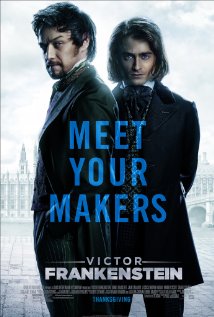
There have been dozens of movies with the word “Frankenstein” in the title, some of them memorable and some not. The latest variation on the Frankenstein myth is Victor Frankenstein, which stars James McAvoy as the titular mad scientist and Daniel Radcliffe as the person who comes to be known as Igor.

The Daniel Radcliffe character is a nameless hunchback who has always been with the circus, where he’s mistreated and locked in a cage. When a female acrobatic artist named Lorelei, with whom he is secretly in love, has a bad fall while performing, Dr. Victor Frankenstein just happens to be on hand. When he sees how the nameless clown hunchback keeps Lorelei from dying, he realizes what a talented (self-trained) physician the pitiful hunchback is. He arranges for the young man to leave the circus with him and thereafter takes charge of him. He recognizes right away that the hunchback isn’t really a hunchback but is suffering from an abscess on the spinal column with a huge sac of fluid. When he drains the fluid from the hunchback’s spine, the hunchback is a hunchback no longer and he begins, with the help of a back brace, to stand upright. Dr. Frankenstein gives him the name of Igor, after a “flat-mate” of his who, we later discover, has died of a drug overdose and been frozen in a block of ice by the doctor.

Igor soon realizes that he owes everything in his life to Dr. Frankenstein, who rescued him from his degrading life in the circus. (Therefore Dr. Frankenstein is, in a way, the creator of Igor.) When Dr. Frankenstein realizes what a talented, though self-educated, physician Igor is in his own right, he lets him in on his secret of creating life in the laboratory, thereby conquering death. The first example of his laboratory-created life is a hideous, uncontrollable, ape-like creature, but it is just successful enough to attract a wealthy investor, who, we learn later, has base ulterior motives. The wealthy benefactor also has in his possession a family castle in an isolated part of Scotland where Dr. Frankenstein and Igor might conduct their experiments away from prying eyes. From what source might they draw enough electricity to spark life into their new creation? Why, from lightning, of course.

Igor, in his transformed, non-hunchback self, reunites with Lorelei and she acknowledges that she owes her life to him and falls in love with him. They all reconvene to the castle in Scotland where the two mad scientists, in a sort of anti-climax, do in fact create a gigantic “homunculus” that has the potential to change the world. It needs a little more work, though, doesn’t it? It only wants to kill and maim. This is not good.

Victor Frankenstein is not one of the best movies of the year, but if you like escapist, period films set in the Victorian era about mad scientists who challenge the accepted order or things, then you will find it passable entertainment, better in the first half than in the second. If nothing else, it’s pretty to look at.

Copyright © 2015 by Allen Kopp

Brooklyn ~ A Capsule Movie Review

Brooklyn

Brooklyn ~ A Capsule Movie Review by Allen Kopp 

Brooklyn is a small movie, an “art film,” set in, you guessed it, Brooklyn, New York, in the early 1950s. Saoirse Ronan (who was in Atonement, The Lovely Bones and Grand Budapest Hotel) plays Eilis (pronounced AY-lish), a sweet, decent Irish girl who leaves her devoted sister, Rose, and her widowed mother and goes to America in search of a better life. She is seasick on the boat going over because nobody bothered to tell her she shouldn’t eat on the first day and, once she gets to America, she finds it a disappointment. She lives in a rooming house with several other girls and a bossy landlady named Mrs. Kehoe (Julie Walters) who takes it upon herself to provide moral instruction for the girls. The landlady likes Eilis, though, and after a while she gives her the best room with its own entrance.

Eilis experiences acute homesickness in her strange new world and is unhappy. She gets tearful letters from her sister, Rose, but they don’t help much. She works as a saleslady in a department store and has a hard time making the customers feel important so they’ll keep coming back. She doesn’t want to spend her life behind a sales counter so she goes to night school a couple nights a week with the thought of someday becoming an accountant. Soon she meets Tony (Emory Cohen), a sweet, decent Brooklyn boy who is a plumber. Eilis and Tony fall in love and this is when her unhappy life begins to take on a different hue. Things go along smoothly for her until she gets word that her sister, Rose, has died back in Ireland of an undisclosed ailment. Eilis is heartbroken because she can’t be there for the funeral. She decides to go soon after Rose’s death and see her bereft mother, who isn’t very cheerful to be around. Before she leaves Brooklyn, though, her boyfriend Tony insists that she marry him so she’ll be sure and come back.

When Eilis goes back to Ireland for what is supposed to be a brief visit, she doesn’t tell anybody she married Tony back in America. Her mother and her old friends begin to expect that she’s back to stay and won’t want to return, since her mother now has no one left but her. A boy in Ireland named Jim Farrell (Domhnall Gleason, who was in Anna Karenina and Unbroken) becomes interested in her. She likes him but doesn’t want to encourage him too much because she’s secretly married. Then an accounting job opens up for her that she can have on a permanent basis if she’s willing to stay. Ireland suddenly seems so much more appealing than it did before and she is faced with a dilemma: will she stay in Ireland where things are finally working out for her, or will she return to her husband in Brooklyn?

Brooklyn is about the immigrant experience and about finding oneself. It is like the period in which in is set, the 1950s: sweet and innocent and so much different from what life is like now. Like all art movies, it is for a “niche” audience, so it’s not for everybody. If you’re looking for laughs or thrills, you won’t find them here, unless it’s the thrill of solid storytelling.

Copyright © 2015 by Allen Kopp
Bridge of Spies ~ A Capsule Movie Review

Bridge of Spies

Bridge of Spies ~ A Capsule Movie Review by Allen Kopp

In the 1950s and ‘60s, the United States and the Soviet Union are at war. It isn’t the kind of war that’s waged on a battlefield, but a war of intelligence. Both sides are desperately trying to get military and strategic superiority through secret information that has to be stolen or gained surreptitiously by spies. It is a game of one-upmanship: If you can steal our secrets, we can steal yours.

In 1957 American agents capture a Soviet spy named Rudolf Abel (played by Mark Rylance) in Brooklyn. He isn’t what you would expect a spy to be. He is in his mid-fifties, soft-spoken, self-effacing and an artist who paints pictures. When a Brooklyn lawyer named Jim Donovan (Tom Hanks) takes on the unpopular job of defending Rudolf Abel (on the theory that everybody, no matter what they’ve done, is entitled to due process and a fair trial), the two men become unlikely friends. When Abel is tried and found guilty, the popular sentiment is to send him to the electric chair, but Jim Donovan argues, successfully, that Abel might be used as a bargaining tool in the event that the Soviets capture an American spy.

American pilots are at this time flying spy missions over the Soviet Union in U2s. The U2 flies at 70,000 feet and is supposed to be undetectable, but one of them is shot down and the pilot, Gary Francis Powers, is taken prisoner. The Soviets hope to get all the valuable information they can from him before they let him go. The American side proposes a spy swap: we’ll give you Rudolf Abel if you give us Gary Francis Powers.

Bridge of Spies is about the negotiations between the U.S. and the Soviet Union to swap one spy for another, which turns out to be a delicate balancing act and one that might never come off, even when it seems it will. The Soviets, after all, are as tricky as they are allowed to be and don’t always play by American rules. Jim Donovan, the lawyer who defended Rudolf Abel, is the unofficial negotiator for the American government without being employed by the government in any capacity.

The spy swap is further complicated by the capture of an American college student in East Berlin named Frederic Pryor, just when the wall is being built. He’s in a very bad place at a bad time; the Soviets believe he is a spy and are in no hurry to release him. The American negotiator in the Abel-Powers spy swap makes the release of Frederic Pryor a condition of the trade. Will the Soviets comply, or will they engage in some of their nasty Cold War games?

Bridge of Spies is a weighty movie (as opposed to fluffy or brainless) on a weighty subject, so, if you’re looking for laughs, this is probably not what you’re looking for. It’s a “prestige” picture, directed by Steven Spielberg, the most famous of all current movie directors. (It’s interesting that Joel and Ethan Coen wrote the screen play.) It’s a thoroughly satisfying movie, beautifully made in every detail, for the serious-minded among us. Talky at times but talking the talk that is worth hearing. You’re looking at a man who likes talking to a man who likes to talk.

Copyright © 2015 by Allen Kopp

The Martian ~ A Capsule Movie Review

The Martian

The Martian ~ A Capsule Movie Review by Allen Kopp

Liberal gasbag Matt Damon is my least favorite actor in the universe. He plays fictional astronaut Mark Watney in director Ridley Scott’s fictional sci-fi fantasy, The Martian. I stress the word “fictional” because I heard that a lot of people believe it’s a true story. Just when did they think we put people on Mars? Don’t they think they would have heard about such an important event?

Anyway, Matt Damon is one of six American astronauts (three boys and three girls and, no, they’re not there to reproduce) living in what they call the “hab” on Mars, earth’s nearest planetary neighbor in the cosmos, but still fifty million miles away. When all six astronauts are outside the “hab,” a sudden violent storm blows up and a large piece of debris hits Mark Watney in the abdomen and sends him flying (very little gravity on Mars). It’s time for the astronauts to get the hell out and go back to earth, so the five remaining astronauts head on out, certain that Mark Watney is dead. The thing is, though, he’s not dead—only knocked unconscious. When he regains consciousness a day or so later, he discovers he’s stranded there on Mars alone with very little food, water and air, and the next scheduled manned flight back to the Angry Red Planet from earth is not for four years. Mark Watney will either die within a few days or weeks or figure out a way to go on living until the time he can meet up with some other earthlings to take him back home.

Remember the movie Gravity from a couple years ago? The Martian is a lot like that, only much longer, with more characters, and has a man instead of a woman in an I’m-probably-going-to-die-unless-I-can-figure-out-a-way-to-save-myself situation in space. Yes, there are overwhelming odds to overcome and, yes, he does overcome them, and, yes, we knew all along he could do it. Besides Gravity, there are elements of other movies in The Martian, including Robinson Crusoe on Mars from the 1960s, the “mission control” nonsense of Apollo 13 (cheering people doing the Rocky victory arm pump), and Airport, a 1970 movie with Burt Lancaster. I was especially reminded of Airport by the cardboard cutout characters at NASA. What is Kristen Wiig doing here?

I see on IMDb that The Martian was filmed in the Jordanian desert, which is, presumably, an appropriate stand-in for the Martian terrain. We see some beautifully photographed (simulated) Martian landscapes, and I like the idea of being the only man on an entire planet. What solitude! I also like the idea of being able to float weightlessly wherever you want to go, as we see in the scenes of space travel. Think how much easier that would be than walking.

Copyright © 2015 by Allen Kopp

The 33 ~ A Capsule Movie Review

The 33

The 33 ~ A Capsule Movie Review by Allen Kopp

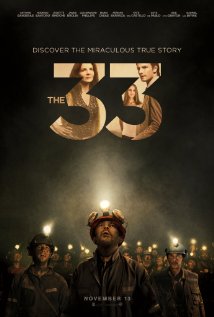
In August 2010, a cave-in at a Chilean gold mine trapped 33 miners 2300 feet underground (it took a hundred years for the mine to get that deep). The 33 is the story of the unfortunate miners and the heroic efforts to get them out of the mine, a weeks-long endeavor that wavered from hope to despair and back to hope again. Antonio Banderas plays Mario Sepulveda, the leader of the miners who maintains a semblance of order among the desperate men (rationing what little food and water they have) and who refuses to believe they are all doomed to die.

It’s many days after the mine cave-in before the people on the surface know that the miners are still alive. Meanwhile, the families of the miners build a kind of tent city on the site, unwilling to go home and wait to hear if their loved ones will, by some miracle, be brought out alive, or if the mine will be sealed forever with the bodies of the dead. The minister of mines, Laurence Golborne (Rodrigo Santoro), representing the Chilean government, assures the families that every effort will be expended to bring the miners to the surface, but even he knows there is little chance of success. The president of Chile seems mostly concerned with the political ramifications for him if the miners die.

Discovering that the miners are alive after 16 days gives new hope to the families and to those involved in the rescue effort. Drilling begins with three drills running 24 hours a day. It takes days for the drills to get that far down and when they do, they miss the open space where the miners are located. Just when they are about to give up, they decide to use the deviation to their advantage and try again. Finally they drill a shaft right over where the men are. They can get food and water to them through the shaft, but the problem still remains of how to get them out. It’s a race against time because an enormous rock with twice the mass of the Empire State Building, the rock that caused the initial cave-in, is pressing down on the mountain and threatens to slide down even farther to where the men are.

We already knew the miners were brought to the surface alive after 69 days, but The 33 shows how it was done and at what cost. The success of the undertaking could be largely attributed to two men: Mario Sepulveda, the leader of the miners below, and Laurence Golborne, the Chilean Minister of Mines, both of whom refused to give up in the face of overwhelming evidence that the cause had been lost.

There are a few familiar faces in The 33, but most of the actors who play the parts are unknown and speak in heavily accented (though mostly understandable) English. Juliette Binoche, barely recognizable, plays the sister of one of the young miners. Lou Diamond Phillips, surprisingly effective, plays the mining safety engineer trapped with the men, who must deal with his guilt because he knew the aging mine wasn’t safe. Irish actor Gabriel Byrne seems an odd choice to play the Chilean mining engineer in charge of the rescue effort.

The 33 is not flashy or over-produced but is just a straightforward telling of a true-life story that captured the attention of a large part of the world back in 2010. I found it much more engrossing and involving than the mountain-rescue movie, Everest. And the underlying theme is simple: don’t give up, even when nothing is going the way you think it should; or, to put it another way, God helps those who help themselves.

Copyright 2015 by Allen Kopp

Crimson Peak ~ A Capsule Movie Review

Crimson Peak

Crimson Peak ~ A Capsule Movie Review by Allen Kopp 

Crimson Peak is the kind of new movie we don’t see very often, a costume drama set in a long-ago time (early 1900s), when the automobile was a novelty and a lot of the streets weren’t paved yet, at least in America. It’s a combination gothic love story, Victorian ghost story and horror fantasy, with touches of Henry James, Edith Wharton and Charlotte Bronte thrown in.

Edith Cushing (Mia Wasikowska) lives with her well-to-do father, Carter Cushing, in a beautiful house in Buffalo, New York. When she is ten years old, the ghost of her mother appears to her (a black, horrible, decaying ghost) to give her a warning about “crimson peak.” She doesn’t know what it means but she knows it has some meaning that will be revealed to her at a later time. Fourteen years later she is an aspiring novelist who has the usual problems that novice writers have—she’s not writing about what she knows or feels and she can’t get a publisher interested in her work. She has an old friend named Alan McMichael who is an ophthalmologist. While Alan is romantically interested in Edith, she doesn’t seem to reciprocate his feelings. Then along comes a handsome aristocrat from England. He’s a baronet and his name is Sir Thomas Sharpe (Tom Hiddleston). He’s in America with his forbidding sister, Lady Lucille Sharpe (Jessica Chastain), trying to get funding for a machine he has invented that extracts clay from the earth that is used in brick-making.

Edith’s father doesn’t like Sir Thomas Sharpe and, not only does he turn him down for funding for his machine, he has him investigated when it becomes apparent that Sir Thomas and Edith are becoming romantically involved. The investigation turns up some dirt on Sir Thomas and his sister, but it’s no less than Edith’s father suspected. He gives the Sharpes a sizeable check to leave America and go back to England, thereby breaking Edith’s heart and insulting her writing in the bargain.

Soon Edith’s father is brutally and mysteriously murdered, leaving Edith the recipient of all his money. Just when we thought Sir Thomas had gone back to England with his sister, he turns up again. With Edith’s father out of the way, he is free to marry Edith and take her to his family home, a decaying gothic mansion that sits on top of a clay mine in an extremely isolated region in England. The place is in such disrepair, we learn, because the once-wealthy Sharpe family is now poor. Edith’s money is going to come in very handy here.

Edith is visited by another hideous ghost in the Sharpe mansion, delivering yet another warning. (It turns out to be the ghost of Sir Thomas and Lucille’s mother, whom Lucille murdered). In a series of startling and distasteful revelations, Edith discovers that she is just one in a succession of “heiresses” who have fallen prey to the Sharpes. She also discovers that Lucille, who has always been too eager to have her drink a cup of tea, has been poisoning her. That’s why she hasn’t been feeling very well lately. Soon, however, her admirer from America, Dr. Alan McMichael, shows up unexpectedly. Will he be able to rescue Edith, or will he also fall prey to the Sharpes’ machinations?

Crimson Peak has a throwback-to-an-earlier-time feel to it, so, for that reason, a lot of people probably aren’t going to like it. If you are one of those who can suspend disbelief and put away your skepticism for a couple of hours, you might enjoy it. Besides ghosts, there are some fabulous sets and period costumes, and who can do evil better than Jessica Chastain? If you don’t want to kill her when her back is turned, well, you’re just not a very feeling person.

Copyright © 2015 by Allen Kopp

Everest ~ A Capsule Movie Review

Everest

Everest ~ A Capsule Movie Review by Allen Kopp

Why do ordinary people risk death and injury, spend lots of money and tolerate untold pain and discomfort for months at a time in some of the harshest weather conditions on earth to climb Mount Everest, the highest mountain peak on earth? Have they been deprived of something in life, or they just looking to fill some inexplicable empty spot? Whatever the reasons, there are plenty of people who try it and fail. Failure means never making it to the summit or never making it back home alive.

Everest chronicles one such expedition in 1996 to the top of Mount Everest by a group of people who might be our next-door neighbors. There’s the Texan (Josh Brolin) who has a “dark cloud of depression following him around all the time”…except for the time that he’s on a mountain. There’s the New Zealander (Jason Clarke) with the pregnant wife (Keira Knightley) back home; he’s the leader of the expedition and it’s up to him to watch out for the others. There’s the 47-year-old Japanese woman who has been to six of the seven highest peaks on earth; Everest will be her seventh. There’s the divorced loser (John Hawkes) who delivers the mail and is out for the thrill of a lifetime. There’s the nouveau hippy (Jake Guyllenhaal) badly in need of a shave and a haircut who seems to serve no purpose other than to be annoying. Back at the base camp is the “surrogate mother” (Emily Watson) who tries to help the climbers through radio transmissions and who suffers vicariously with them. We know at the outset that some of them will make it and some of them won’t. If all of them had made it back alive, there wouldn’t be a movie being made about them almost twenty years later.

For movie fans there are lots of familiar faces in Everest, but the characters don’t matter. The people are ciphers. It’s like filling the SS Poseidon with the likes of Shelley Winters, Gene Hackman, Roddy McDowell, Stella Stevens, Carol Lynley, Red Buttons and Ernest Borgnine and then turning the ship over in a storm. We know some of the characters will make it and some will not. Figuring out who will and who won’t make it might help you to pass the time during all the dialogue that, no matter how inane it is, you can’t understand it anyway.

Everest is a predictable action-adventure movie with some beautiful scenery and a spectacular storm (I like storms). It’s another one of those man-versus-nature stories where nature wins. No matter how much star power they put on the screen with no matter how many Oscar nominations, the real star is the mountain. Nature wins. Man loses. Now, if the mountain had been Godzilla or an alien from outer space, man would most certainly have come out on top.

Copyright © 2015 by Allen Kopp

Black Mass ~ A Capsule Movie Review

Black Mass

Black Mass ~ A Capsule Movie Review by Allen Kopp

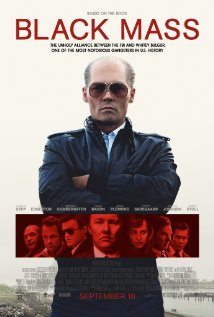
For decades James “Whitey” Bulger was an organized crime boss in Boston, head of the Boston Irish mob known as the Winter Hill Gang. He demanded absolute loyalty from his associates and, if he didn’t get it, he was prepared to kill without compunction. In the 1970s he made a deal with shady FBI agent John Connolly to become an informer with the purpose of bringing down a rival mob run by Italians. He hated informers, he said, but he became one to do to his rivals what they deserved. If you rat on somebody who deserves it (so his reasoning went), it isn’t so bad.

In Black Mass Johnny Depp plays Whitey Bulger with receding hairline and crazed, blue-eyed intensity. (How do they get his eyes to look that way? At times he looks like an evil doll.) And, as psychotic as he is, he has his sweet side. He has a young son whom he loves, he allows his elderly mother to cheat him at gin rummy and he’s kind to the old ladies in the neighborhood. For those who knew him, though (even for their whole lives), he was to be feared. You never knew what he was thinking or what he might do. He was inclined never to forget even the smallest slight or insult.

Joel Edgerton, who last year played Pharaoh Ramses II in Exodus: Gods and Kings (with plenty of eye makeup), looks bloated as FBI guy John Connolly. (At times his Boston accent seems over the top.) Of course, associating himself with Whitey Bulger isn’t a good career move for him. While he is ostensibly on the side of “good,” things don’t work out well for him.

There’s a great cast of supporting players in Black Mass, including Rory Cochrane (who conveys a lot of feeling without words) as Steve Flemmi and Jesse Plemons as dough-faced Kevin Weeks (not very bright but a game player). Benedict Cumberbatch, last seen as gay Alan Turing in The Imitation Game, plays Whitey Bulger’s straight-shooting (or is he?) politician brother, Billy Bulger. Juno Temple, always a standout, plays a hooker/drug addict who meets a not-very-pleasant end at the hands of Whitey Bulger, just when she was beginning to think he was on her side.

Adding to the irony of this story is that Whitey Bulger, regardless of the number of souls he dispatched to the next world, still lives in this one. After sixteen years as a fugitive, he was captured in California, living under an assumed name in 2011. He was put on trial and today serves as an inmate in a federal prison in Florida. He is 86 years old.

What makes Black Mass so interesting (if maybe a little reminiscent of other crime movies, including The Departed) is that it’s a true story rather than a fictional one. After a summer of youth-oriented fluff in movie theatres, isn’t it refreshing to see a movie that is actually about something?

Copyright © 2015 by Allen Kopp