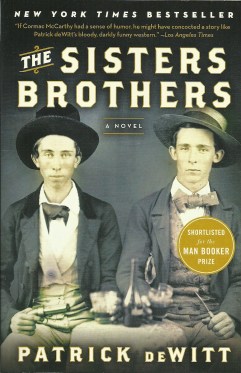
The Sisters Brothers ~ A Capsule Book Review

The Sisters Brothers

The Sisters Brothers ~ A Capsule Book Review by Allen Kopp 

The Sisters Brothers by Patrick DeWitt is a novel set in the American West in the 1850s. Eli and Charlie Sisters are hired guns (glorified errand boys) working for a powerful man in Oregon City known simply as “the Commodore.” The story is related in the first-person voice of Eli Sisters. Eli is more passive and inward-directed than his brother Charlie. He is sympathetic toward animals and doesn’t take very well to killing. Charlie, on the other hand, is an expert marksman and doesn’t mind killing whenever the occasion calls for it. Eli is on the fat side and has freckles. Although we aren’t told much about the way he looks, we get the impression that Charlie is better looking and has better luck with the ladies than Eli. Charlie is the leader and Eli the follower.

The Commodore has his panties in a bunch over what he refers to simply as “the formula,” which he doesn’t bother to explain to Eli and Charlie. He only tells them he wants the formula and he sends them to San Francisco to get it. He has previously sent a hireling known as Morris to get it, but Morris has apparently defected to the other side, as represented by one Hermann Kermit Warm, the inventor of the formula. Eli and Charlie have picaresque adventures as they travel from Oregon to California and, once they are in San Francisco and find Morris and Warm, they discover, through a “journal” left behind by Morris (how convenient!), what the formula is all about.

California has recently been gripped by gold rush fever. Thousands of people are flocking to the West with the hope of becoming rich. The prospectors who don’t extract the gold from the ground pan for it in mountain streams, a tedious pursuit, at best. The formula is a toxic mix of chemicals that, when poured into the river, cause the gold nuggets to “light up” in such a way that they can be easily extracted from the dirt and rock. There are some problems with the formula, however. The gold lights up for only about fifteen minutes, and the formula, when it comes into contact with human skin, is highly corrosive, causing painful, oozing blisters and serious injury.

Morris and Hermann Kermit Warm have a story of their own. When Morris was back in “civilization,” he was a perfumed “dandy,” rather effeminate and obviously gay, although that word is never used. He and Warm have discovered they are simpatico and have allied themselves with each other. It is an unusual “friendship” for the time and place. Although Eli and Charlie are supposed to kill Morris for the Commodore, they join up with Morris and Warm in an alliance that they believe will make them rich and independent of the Commodore.

The Sisters Brothers is a “noir western,” definitely on the dark side but with a touch of “gallows” humor. What happens to Eli’s horse, Tub, is not in the least funny; nor is the fate that befalls Morris and Warm or Charlie’s shooting hand. All in all, though, it’s a breezy and entertaining 325 pages. For the compulsive reader like me, it’s a compulsively readable novel.

Copyright © 2016 by Allen Kopp
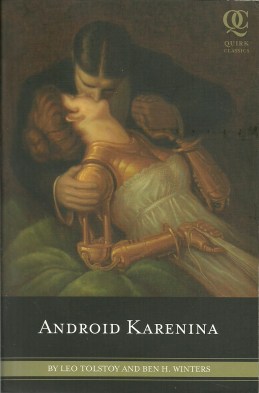
Android Karenina ~ A Capsule Book Review

Android Karenina

Android Karenina ~ A Capsule Book Review by Allen Kopp

Android Karenina is set in Russia, but it’s not the Russia that exists or that ever existed at any time in history. It’s a “steampunk” world, an “alternate universe” where every person over eighteen has a “beloved-companion” Class III robot that is a combination pet, servant, confidante, counselor and alter-ego; where ill people are put into orbit around Venus to help them recover; where people vacation on the moon; where robot technology has become so sophisticated, thanks to the discovery of a metal called “groznium,” that every task is performed by a robot and robots have advanced to the stage where they are unidentifiable from humans. The Tsars are gone, the horse and carriage are gone, old-fashioned steam-engine trains are gone; people travel on a conveyance called the Grav that runs on a magnetic bed. A group of lizard-like aliens erroneously called the “Honored Guests” threaten the world and the human race while incubating inside the bodies of sick people. This is the “Age of Groznium,” the world of Android Karenina.

Of course, proper credit must be given to Tolstoy’s classic novel Anna Karenina. A writer named Ben H. Winters has taken this masterpiece of Russian literature and cleverly transformed it into a steampunk, sci-fi adventure, using Tolstoy’s characters and situations but making them original enough to claim a lot of credit on his own. Beautiful society lady Anna Karenina is married to the cold, mechanical Alexei Karenin, an important official in the government. Karenin doesn’t appreciate Anna and can’t love her the way she wishes to be loved. When Anna meets dashing Count Vronsky, she enters into an illicit love affair with him that shocks society and humiliates her husband. She finds out then just how villainous her husband can be. His bitterness toward his wife makes him take revenge on the entire country by trying to nullify the Age of Groznium and returning to the old ways of doing things: steam-driven trains, telegrams as a means of communicating, horses and buggies for getting around in, real people doing the menial jobs that heretofore had been done by robots. Most cruel of all, he takes away everybody’s Class III “beloved-companion” robots, including Anna’s beloved Android Karenina, because he believes that robots are antithetical to the direction he wants the country to move in. Instead of moving forward, he wants to revert to the past. Wait a minute, though. Maybe Anna Karenina has a higher purpose in life than just being an unfaithful wife. Maybe she has been chosen, because of who her husband is, to render a service to her country and to the human race. We must read through to the end to find out what is really going on.

Like Anna Karenina on which it is based, Android Karenina is a pleasure to read. A little bit on the long side, at 538 pages, but well worth it. It’s a clever hybrid (a combination of two worlds), not for everybody, but certainly engaging, especially if you are a fan of the original novel and also an aficionado of the offbeat, the unusual, the quirky and the imaginative. You might end up envying the Class III robots and wishing you had one of your own to always agree with you, sympathize with you and do anything you want without complaint.

Copyright © 2016 by Allen Kopp   

The Call of Cthulhu ~ A Capsule Book Review

The Call of Cthulhu

The Call of Cthulhu ~ A Capsule Book Review by Allen Kopp

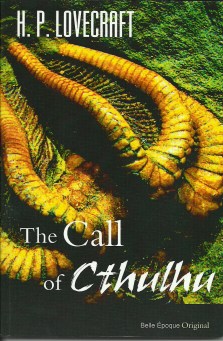
H. P. Lovecraft (1890-1937), like Edgar Allan Poe, is one of those American writers who achieved little success or recognition during his lifetime but whose fame and worldwide reputation grew after his death. This “Belle Époque Original” contains Lovecraft’s novella The Dream Quest of Unknown Kadath and the short stories “The Call of Cthulhu,” “The Statement of Randolph Carter” and “The Doom that Came to Sarnath.”

“The Call of Cthulhu” is one of Lovecraft’s most famous stories. A race of gigantic beings from beyond the stars once ruled earth before men existed. (They have dragon-like bodies, wings, and tentacles on their faces.) An earthquake or cataclysmic event caused the beings to become submerged in the ocean in a fabulous city. Though they are gone for the present, they are only sleeping and will one day return to their position of prominence on the earth. One of these beings, Cthulhu, controls the dreams of certain super-sensitive individuals (humans) who will keep the “Cult of Cthulhu” alive until the time that it (the beings) will rise again.

“The Statement of Randolph Carter” is a slight, though interesting, story of two friends who, while conducting unexplained “experiments” with the dead in a very old cemetery, encounter more than they bargained for.

“The Doom that Came to Sarnath” is a about a fabulous ancient city called Sarnath, the most glorious city on earth. For Sarnath to come into being and prosper, a race of undesirable beings from the moon (“in hue as green as the lake and the mists that rise above it; with bulging eyes, pouty, flabby lips, curious ears and without voice”) had to be conquered and eliminated. The moon beings never forget what happened to them, though, to make way for Sarnath and, after a thousand years, return to wreak their vengeance.

The Dream Quest of Unknown Kadath is too long to be a short story, so it must be a novella. It is a fantastic dreamscape that takes place entirely in the mind (dreams) of one Randolph Carter (the same name as in one of the short stories). In his wild and very imaginative dreams, Randolph Carter is on a quest to find the gods atop unknown Kadath and the “marvelous sunset city they so strangely withhold from his slumbers.” In his dreams he encounters many dangers and many hideous, unearthly creatures such as shantaks, night-gaunts, zoogs, moon-beasts, gugs, ghouls, etc. As repulsive as the ghouls are, they aid Carter in his quest because he facilitates the rescue of some of them who are being tortured by the moon-beasts. The quest to find what he is looking for is so difficult and dangerous that we have to wonder if it’s worth it or not, but apparently to Carter it is, possibly because he knows he is only dreaming and is never in any real physical danger.

The Dream Quest of Unknown Kadath is one continuous narrative with no chapter or section breaks. As usual with Lovecraft, the writing is dense and wordy, with long and effusive description, sometimes almost entirely description. I’m not a big fan of fantasy writing in this style, but Lovecraft is the grand master of the genre. He is such a good writer that he elevates genre writing to another level.

Copyright © 2016 by Allen Kopp  
The Immortal Nicholas ~ A Capsule Book Review

The Immortal Nicholas

The Immortal Nicholas ~ A Capsule Book Review by Allen Kopp 

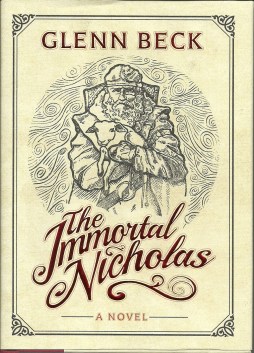
The Immortal Nicholas by Glenn Beck is an unusual Christmas-themed novel that never mentions the word “Christmas” and isn’t any traditional Christmas story as we’ve come to know it. The main character is a man named Agios (Ah-GEE-os). He is embittered because his wife dies and then his young son dies through what he believes is his own carelessness while harvesting frankincense from trees growing on a mountainside that he himself has protected from intruders with poisonous snakes. He has no hope in life and wants only to die. When he is forced to leave his home, he encounters in his travels a young man named Krampus who is physically handicapped and who has been tortured by the Romans. He immediately takes up with Krampus and becomes his protector and, in a way, his father. His knowledge of frankincense and his possession of a small amount of the precious substance eventually leads him into the company of three “kings” (Balthazar, Melchior and Caspar) who are following a star that they believe will lead to the foretold Messiah who will save the world.

Agios finds himself in Bethlehem with the three kings at the stable where Jesus lay as a tiny baby. He wholeheartedly believes in the promise of Jesus’ birth and from that moment vows to protect Jesus, Mary and Joseph from those who would do them harm. He and Krampus follow Jesus around through the years, always staying in the background. He loses sight of Jesus until Jesus is a grown man and is going around ministering to the masses. Agios hears of Jesus’ ability to heal the lame and sick and he somehow believes that Jesus can cure Krampus of whatever is wrong with him if Agios can get him close enough to him. Agios and Krampus are present at the Sermon on the Mount but are not able to get very close to Jesus because of all the people. Finally, after all they go through to keep an eye on Jesus while staying always on the fringes of what is going on, they are there to witness the crucifixion. Agios is deeply stirred by the cruel death of the savior and goes away an embittered man. He believes that is the end of the promise that the birth of Jesus Christ gave to the world.

For some reason Agios doesn’t die but lives for centuries, to watch Krampus die and everybody else he ever cared about. While living as a hermit in the mountains centuries after the death of Jesus, he befriends a shepherd boy named Nicholas and learns from him that Jesus arose after his crucifixion, proving that his promise to the world was true and that he overcame death. From that moment on, Agios’ life is different. Despite his desire to not want to be near other people, he and Nicholas become close and Agios becomes a surrogate father to him. As Nicholas grows into adulthood, he becomes a priest with a very generous spirit and out of that the legend of Saint Nicholas grows, with a direct link back, through Agios, to the ministry of Jesus Christ.

The notes on the dust jacket tell us that Glenn Beck expanded The Immortal Nicholas into a novel for adults that started out as a children’s story. It’s simply written but smart and engaging enough for adults. It took a few surprising turns for me. When I started reading it, I didn’t know how a story about a man who lived at the beginning of the Christian Era could have anything to do with Saint Nicholas. I deliberately didn’t want to read any synopsis or summary while reading the book because I wanted to find out for myself where it would lead. Think what you will of Glenn Beck and his conservative principles, he is a very effective fiction writer.

Copyright © 2015 by Allen Kopp

Slade House ~ A Capsule Book Review

Slade House

Slade House ~ A Capsule Book Review by Allen Kopp

Slade House is a horror/mystery/fantasy novel by English novelist David Mitchell. There’s something very peculiar about the house in Slade House. To the casual observer, it doesn’t even exist in this “small English city.” The place where the house is (or was), however, has been the scene of several unexplained disappearances. On the last Friday in October in 1979, a middle-aged woman, Mrs. Bishop, and her adolescent son, Nathan, disappear without a trace. Then, nine years later, on the last Friday in October in 1988, a young, divorced policeman named Inspector Detective Gordon Edmonds disappears. Then, nine years later, in 1997, it’s an unhappy, overweight college girl named Sally Timms (along with several “friends” who are exploring psychic phenomena). In 2006, it’s Sally Timms’ lesbian, journalist sister, Freya Timms, who is trying to uncover some clues into the disappearance of her sister. We learn that all these people who vanished have something in common: they are all “Engifteds,” meaning they have a special “sense” that allows them to see beyond the veil of the unknown.

Gradually we learn the secret of the house, which I won’t give away too much here. There are two “proprietors” of the house and they are twins, Jonah and Norah Grayer, who are well over a hundred years old. They are “soul vampires,” but they won’t be satisfied with just any souls—only the souls of the rare people who are the “Engifteds” will do.

The secret of the house is ingenious: the real house that sat on the site was destroyed by German bombs in World War II. The “house” of Jonah and Norah Grayer exists in what is called an “orison,” which is a “reality bubble.” The people whom Jonah and Norah choose to come to them are able to find the “aperture” in the brick wall in the alleyway; the aperture, a small iron door, is a “portal” into the orison in which the house exists. Each of those lured in have (or think they have) a special reason for wanting to get in. Once inside, they are tricked into eating or drinking a substance called “banjax” that will make it easy for Jonah and Norah to extract their souls. (They must have a soul every nine years to continue to exist.)

Slade House is a fascinating, compulsively readable novel, spare and concise in its 238 pages. It’s also smart and ingenious, not quite like anything I ever read before—a new twist on the traditional haunted house story. Now, if somebody will just make a quality movie out of it that’s as intelligent as the book, that’s a movie I would certainly pay money to see. Just don’t put Sylvester Stallone in it.

Copyright © 2015 by Allen Kopp

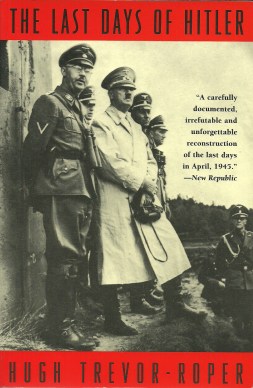
The Last Days of Hitler ~ A Capsule Book Review

The Last Days of Hitler

The Last Days of Hitler ~ A Capsule Book Review by Allen Kopp 

One of the most compelling and improbable chapters in the history of the twentieth century is the rise of Adolf Hitler in Germany in the 1930s. Hitler had no formal education to speak of and no military training (he had been a soldier in the First World War), but with surprising ease he was able to take control of the government, industry and military, and transform Germany into a Nazi state. His goal was to destroy European culture and create a new barbaric empire, with world domination his ultimate objective. His early successes made him believe he was the greatest military strategist the world had ever known. Everybody would bow down to him, he believed; he could do nothing wrong and was, in fact, a god in mortal form. The people who could have stopped him before he got started stood by and did nothing, but that’s a different story.

In 1944 and 1945 the Nazi empire began to unravel. Germany was losing the war and, in spite of the self-delusion of Hitler and his inner circle, there was to be no turning tide that would change their fortunes. The Third Reich that was supposed to last a thousand years came to a hellish end in April 1945 when the Russian army invaded Berlin and Hitler killed himself. The Last Days of Hitler by British historian Hugh Trevor-Roper is a fascinating account of the last ten days of Hitler and his inner circle in the Fuehrerbunker fifty feet below ground in Berlin. This small group of corrupt, inept and self-serving individuals who once believed they could not lose now saw that the end was near. Some of them sought to end their lives, while others ironically hoped to continue to serve in a reformed Nazi government that would survive after the war. They didn’t seem to realize that they would be viewed by the world as villains and war criminals and, no matter what they did or what they promised, they would never be able to redeem themselves.

Hitler was bitter at the end. He believed he was let down by his generals and betrayed by some of his most-trusted confidantes, including Heinrich Himmler. He wanted to punish the German people for not doing more to win the war. When he saw the end was coming and that the army that would arrive to save him was only one of his delusions, he envisioned a grand, Wagnerian “Twilight of the Gods” ending in which he and some of his followers would die a ritual soldier’s death. After he married his long-time (possibly purely platonic) girlfriend, Eva Braun, the two of them committed suicide, she by poison and he by gunshot to the mouth. When it was all over, he instructed his people to take his and Eva’s bodies outside and burn them with large quantities of gasoline so that his body would never be displayed, vilified or exploited by the enemy. Before his death he was able to envision, or at least to believe possible, a rebirth of Nazism with himself as its ritual, martyred head. The scariest man in the world is the  megalomaniac who believes he can do no wrong.

The Last Days of Hitler is a readable 270 pages, focusing on the end of the Nazi dream (a dream for a few and a nightmare for millions of others). The end was inevitable from the beginning, and the fact that it took place in a hole in the ground in Berlin is altogether fitting and appropriate. In the history of the world, dictators are successful in the beginning, if they are successful at all, but they never last. There is no such thing as a dictatorial government lasting a thousand years. Dictators always come crashing down, done in by their own hubris and corruption or by the belief in their own invincibility.

Copyright © 2015 by Allen Kopp

After Alice ~ A Capsule Book Review

After Alice

After Alice ~ A Capsule Book Review by Allen Kopp

Gregory Maguire is famous for his “Oz Series” of four books, the best of which is the first, Wicked. His latest novel is After Alice, a clever take on Lewis Carroll’s Alice in Wonderland. On the summer day that little Alice Clowd disappears from her home in Oxford, England, in the 1860s, one Ada Boyce, her unhappy friend, goes looking for her and finds herself disappearing down a hole by the riverbank and ending up in Wonderland, where the two girls have separate but simultaneous adventures.

The whole time Ada is in Wonderland, she is looking for Alice but she doesn’t have much luck in finding her for the longest kind of time. In the meantime, we get a glimpse of Ada’s life and the life of her family. Her father is a vicar, her mother a disconnected “dipsomaniac” and her little brother a tiny infant who screams all the time, little Boyd Boyce. He seems to get all the attention in the family, leaving none for Ada. She has some kind of physical deformity involving her spine that forces her to wear a kind of corset under her clothes. The corset is worth mentioning because it plays an important part in how the story is resolved. Ada also has a governess, the formidable Miss Armstrong, who seems to turn up when she is least wanted and seems to know everybody’s business. Miss Armstrong is secretly in love with Ada’s father, the vicar, and doesn’t always do a very good job of concealing it.

Then there is Lydia, Alice’s older sister, age fifteen. She isn’t very interested in where Alice is and is quietly contemptible of Miss Armstrong when she comes along looking for Ada and Alice. On that same summer afternoon, Lydia also meets a handsome young American named Mr. Winter. He is traveling with and assisting the famous Dr. Charles Darwin, who is paying a call on Alice and Lydia’s father. Mr. Winter has a small black child with him named Siam, who is a runaway American slave. Soon Siam disappears, as Alice and Ada did before him, and he also—what a coincidence!—ends up in Wonderland.

After Alice is a breezy 273 pages. It’s a fantasy, skewed toward adults. That doesn’t mean it’s inappropriate for children; it means that children would probably be bored by it. The pleasure of reading After Alice is in the subtlety of the language.

Copyright © 2015 by Allen Kopp

The Dunwich Horror ~ A Capsule Book Review

The Dunwich Horror cover

The Dunwich Horror ~ A Capsule Book Review by Allen Kopp

P. Lovecraft (1890-1937) and Edgar Allan Poe (1809-1849) are often mentioned in the same sentence. Poe belonged to the nineteenth century and Lovecraft to the twentieth, and while their writing styles are dissimilar and reflect the times in which they lived, the two writers share certain similarities. Lovecraft was an avowed fan, if not an imitator, of Poe. They were both New Englanders and trod upon some of the same ground, principally in Providence, Rhode Island. They both wrote about the dark world that most of us never see. Poe wrote about murder, death, sadness and alienation and Lovecraft wrote about unseen terrors and monsters from another realm. They were neither very successful in their own lives but both are more famous long after they lived than they might have ever imagined being when they were alive.

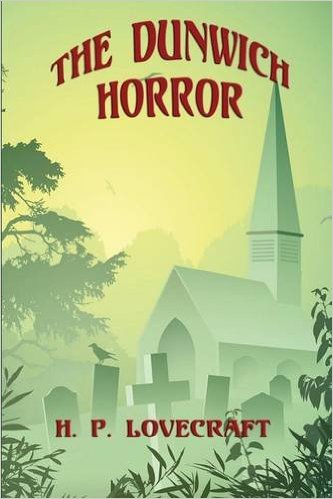
The Dunwich Horror is one of Lovecraft’s most famous stories. It’s either a very long short story or a very short novel, so let’s say for the sake of argument that it’s a “novella” or a “novelette.” It’s set in the Miskatonic Valley in Massachusetts in a remote village known as Dunwich in the early twentieth century. Dunwich is old and seedy and is not a pleasant place to visit. Something odd is going on in Dunwich that people can’t explain. The Whateley family is strange, even by Dunwich standards. Old man Whateley is a wizard of some kind. When his weird albino daughter gives birth to a “child,” Wilbur Whateley, speculation is rife as to who the father is.

Wilbur Whateley is hideously ugly. Before he is one year old, he walks and speaks. When he is three years old, he seems as old as twelve and he grows a beard. Long before he is old enough to be of adult height, he is seven-and-a-half and then eight feet tall. More odd than his appearance, though, is his behavior. He can barely speak English but deals in ancient forbidden texts. Strange noises come from underneath the ground at the Whateley home and whippoorwills, ordinarily a serene and peaceful bird, trill violently all night long, as though trying to convey a warning.

As the story progresses, we learn that Wilbur Whateley is not human but is only in human form (he’s not fooling anybody). He is one of an alien race of “elder beings from another dimension” that wants to kill all human, animal and plant life on the earth and then “strip the earth and drag it away from the solar system and cosmos of matter into some other plane or phase of entity from which it had once fallen, vigintillions of eons ago.”

Wilbur is killed by a guard dog, however, when he breaks into a library late at night to gain access to one of the “forbidden books” that contains ancient spells he needs. After that, three “experts,” one of them a professor from the university, travel to Dunwich to confront the evil that threatens the world.

The Dunwich Horror was first published in Weird Tales magazine in 1929. It is classic American science fiction, by a master of the genre. It has some wordy descriptions, typical of Lovecraft, and some mildly annoying conversations in the mountain dialect, but they’re not that hard to get through. All in all, an interesting reading experience. I haven’t seen the movie version that came out in 1970, but from the description I read of it, it seems to bear little resemblance to the original story. They’ve concocted a “love interest” for Wilbur Whateley (in the person of Sandra Dee) that doesn’t seem to fit at all. So much for movie versions of books.

Copyright © 2015 by Allen Kopp

The Canterbury Tales ~ A Capsule Book Review

The Canterbury Tales

The Canterbury Tales (A Prose Version in Modern English) ~ A Capsule Book Review by Allen Kopp

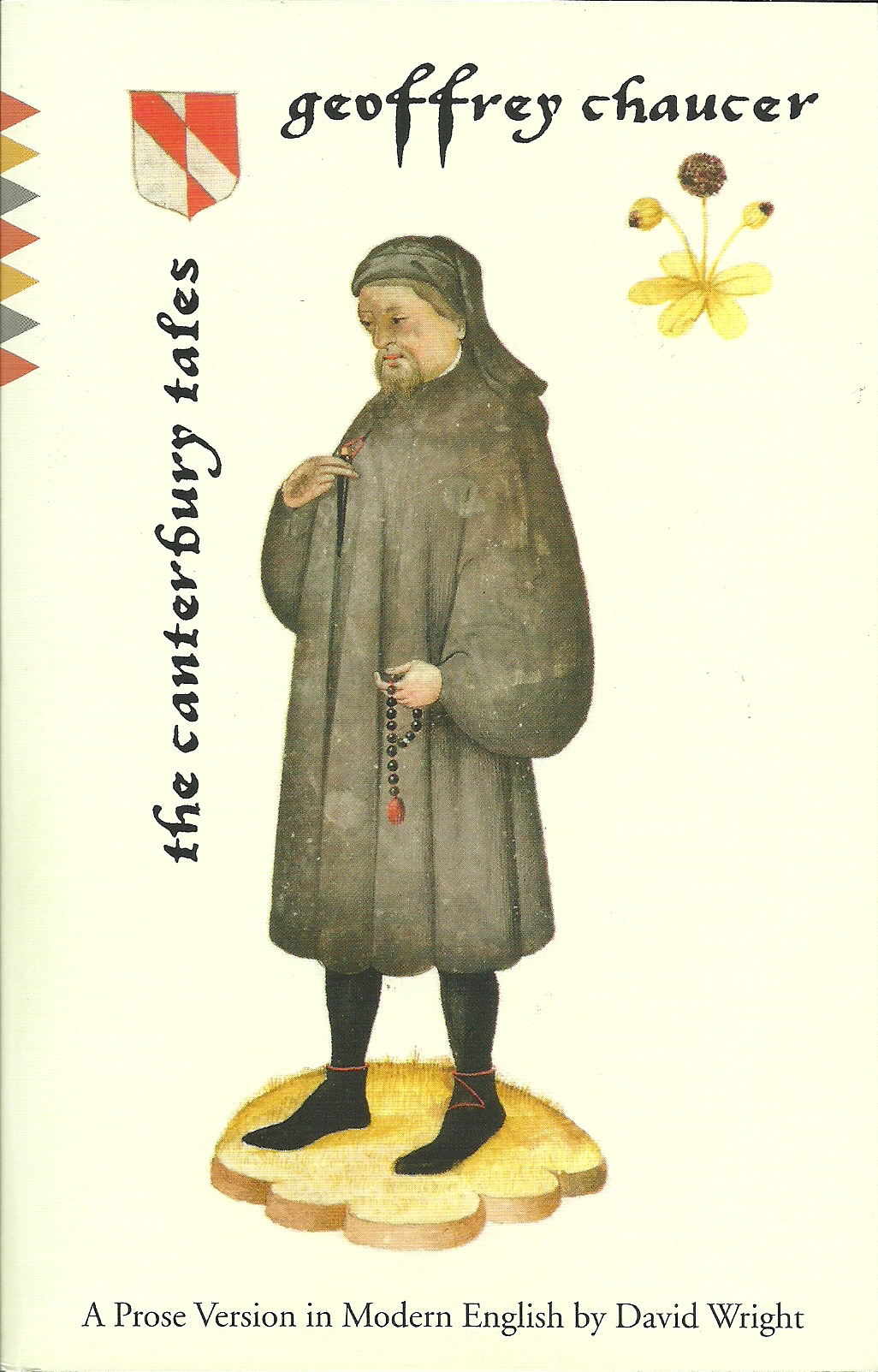
Geoffrey Chaucer (1343-1400) lived during the Middle Ages, almost two hundred years before Shakespeare. The English spoken at the time he lived is called Middle English, to distinguish it from Old English and Early Modern English (the language that Shakespeare spoke and wrote in). Chaucer’s most famous work is The Canterbury Tales, a collection of about twenty stories (some in prose but most in verse) with a simple premise: A group of diverse “pilgrims” (a nun, a knight, a miller, a priest, a doctor, a pardoner, a “wife,” etc.) on their way to Canterbury to pay homage to Thomas Becket (who “helped them when they were sick”) tell stories to pass the time and relieve the tedium of the road. Each pilgrim is required to tell a story, whether they want to or not. The stories range from bawdy, low humor to tragedy and give us a picture of what life was like in England at the end of the fourteenth century.

No matter how you’ve been spending your time lately, you probably haven’t been reading The Canterbury Tales in its original Middle English, unless, of course, you’re a graduate student preparing a thesis on the subject. If you’ve ever heard Middle English spoken, it’s beautiful to hear but not that easy to understand for modern speakers of English. A lot of the words are the same and are easily recognizable, but a lot of the words no longer exist in the language. (If you’d like to hear an example of spoken Middle English, here is an easy link to “The Nun’s Priest’s Tale” from The Canterbury Tales on YouTube: https://www.youtube.com/watch?v=3C6rS0aL0DM

Since Middle English is beyond the ken of most people (including me), there’s this “Prose Version in Modern English” by David Wright. A lot of the “feel” of The Canterbury Tales, I’m sure, is lost is this translation (sort of like the “modern American translation” of the King James’ version of the Bible), but if you need to read The Canterbury Tales and you want to be able to understand it, this is the best, most accessible way. Of course, you have to be a dedicated reader if, like me, you’re reading it only for enjoyment and out of curiosity and not because you have to. After all these years since high school English class, I finally know what the Wife of Bath is all about.

Copyright © 2015 by Allen Kopp

The Confidential Agent ~ A Capsule Book Review

The Confidential Agent image 2

The Confidential Agent ~ A Capsule Book Review by Allen Kopp

The hero/protagonist of Graham Greene’s novel The Confidential Agent is referred to only as “D.” That’s how confidential he is. He’s a middle-aged man (think Charles Boyer), a foreigner, travelling in Britain, and he’s not there to see the sights, either. He is a lecturer in the Romance Languages, a scholar and peace-loving man, but things haven’t been going so well for him. His country is at war, he’s been in prison for two years apparently because he was on the wrong side, and his wife was shot and killed by the enemy. He’s in Britain to negotiate a coal deal with the owner of a huge coal-mining conglomerate, a certain Lord Benditch. His side must have the coal to have a chance of winning the war. If the enemy gets the coal, D.’s side is certain to lose. Well, guess what? There’s another “confidential agent” from the other side, known to us as “L.” who also wants the coal. Will “L.” kill “D.” to keep him from getting the coal, or will “D.” kill “L.” to keep him from getting it? It’s a cat-and-mouse game from the beginning. D. is badly beaten (although it doesn’t seem to stop him) and his papers that establish his identity are stolen, and this is just the beginning of the obstacles that are placed in his way.

We realize early that the business about the war or D.’s side needing the coal doesn’t really matter. We learn nothing of the politics of the war or who is fighting whom. This is only a device to propel the plot. Don’t waste any time or expend any brain power trying to figure out the war.

Of course, there always has to be a “femme fatale” in a story like this. In this case she is the daughter (what a coincidence!) of Lord Benditch, the coal magnate, and her name is Rose Cullen (think Lauren Bacall). She seems to know D. and to know the importance of his mission, but where do her loyalties lay? Is she to be trusted? After a while she claims to be in love with D., in spite of their age difference and also in spite of his not being very lovable. Can D. make a go of it with Rose Cullen or he is only deceiving himself? Will they have a future together after the war business is settled, or is she only sucking up to him, seeking his vulnerable side to knife him in the back? In a story like this, you can never be sure.

We are told that Graham Greene wrote The Confidential Agent in 1939 in a matter of a few short weeks, fueled by Benzedrine (whatever that is), and that he wrote it for money. After it was finished, he was so unhappy with it that he wanted to disavow it and publish it under a pseudonym, but it was published under his own name and it turned out to be well-received by critics and the reading public alike. It’s rather formulaic, a “thriller” (in other words, “light” reading), but it lives up to its subtitle: An Entertainment.

Copyright © 2015 by Allen Kopp