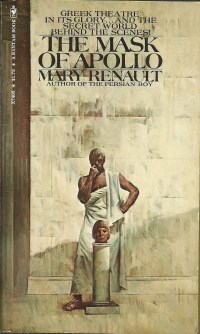
The Mask of Apollo ~ A Capsule Book Review

The Mask of Apollo cover

The Mask of Apollo ~ A Capsule Book Review by Allen Kopp

Mary Renault’s 1966 novel, The Mask of Apollo, is historical fiction, based, in large part, on historical fact. The main character is Nikeratos (“Niko” to his friends), an Athenian actor who is relating the story in his first-person voice. Nikeratos is a fictional construct, but most of the other characters and incidents, including a very young Alexander the Great at the end of the story, are real.

The setting is Greece about four hundred years before Christ. Nikeratos, being the son of an actor, is born into acting. He finds success in his calling early in life and moves up through the ranks of desired actors. To me the most interesting parts of the novel are the descriptions of the stagecraft of the period, which, even by today’s standards, were very elaborate and sophisticated. Plays were the entertainment of the masses, instead of just the cultured few. Theatres seated as many as fifteen or twenty thousand people and plays often began before dawn, with the rising sun sometimes used as an effect in the play. Only men were allowed to act on the stage, so men played in women’s roles. People in the audience never saw the faces of the actors during a performance because they wore elaborate masks (mask-making was a craft in itself). Underneath the masks the actors spoke the lines the playwrights had written. The best and most successful actors became celebrated.

If Nikeratos’s life isn’t interesting enough as an actor, he becomes involved in political intrigue in Syracuse, a powerful Greek city state at the tip of the island of Sicily. Syracuse has been controlled by despots, first by Dionysius, and then after his death by his son, Dionysius the Younger. Nikeratos befriends Dion, a moderate politician and pupil of the philosopher Plato. (They never become “lovers” in the Greek sense because they are of different worlds, but there is definitely an attraction going on there.) Dion is trying to bring stability and democracy to Syracuse by teaching Dionysius the Younger about more tolerant forms of government. Dion entrusts Nikeratos to convey sensitive political documents between Syracuse and Athens. Plato and Dion attempt to restructure the government of Syracuse along the lines of Plato’s Republic, with Dionysius the Younger as the archetypal philosopher-king. Of course, things don’t work out the way they had hoped.

The Mask of Apollo is a readable classic, somewhere between pop fiction and literature. It’s plenty engaging enough, but for me the political intrigue began to grow thin and meandering toward the end of the book. History tells us that things didn’t end well for Plato and Dion, but the last hundred pages or so seemed kind of anticlimactic. It might have been gripping but isn’t. All in all, though, it’s an interesting and informative journey to the ancient world, an escape from the dreary times we live in.

Copyright © 2016 by Allen Kopp
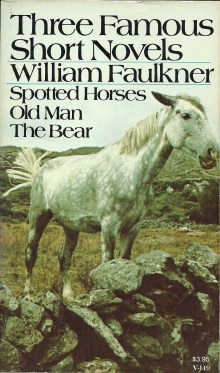
Three Famous Short Novels ~ A Capsule Book Review

Three Famous Short Novels

Three Famous Short Novels ~ A  Capsule Book Review by Allen Kopp

William Faulkner (1897-1962) is arguably the greatest American writer of the twentieth century. He was a genius, a literary stylist and innovator; there has never been anybody else quite like him. While some of his books are more accessible than others (As I Lay Dying, Sanctuary), his work is notoriously challenging to read. It helps sometimes, when reading Faulkner, to have a “study guide” or at least a synopsis of the chapters to be able to keep up with what is going on. He switches around from one time period to another, and the relationships among his numerous characters are often difficult to keep straight. There might, at times, even be different characters with the same name or with very similar names.

In this volume are three of Faulkner’s shorter, standalone works: Spotted Horses, Old Man, and The Bear. Not much happens in Spotted Horses. It’s about poor country people at an auction of some very wild Texas horses in Mississippi. These people are so poor that buying a horse for five dollars places a terrible financial burden on them. The thing about the horses is that they are so wild they can’t be caught after they’re sold. You don’t want to spend your last five dollars in the world for a horse you can’t catch. “Give me back my money. I wasn’t able to find the horse I bought.” “The owner of the horses took your money and has gone back to Texas. Too bad.” A fool and his money are soon parted.

The “old man” in Old Man is the Mississippi River. This readable and entertaining short novel is set in the Mississippi Delta in 1927, during a terrible flood in which there is much destruction of property, loss of human and animal life. (Faulkner renders a wonderfully vivid and evocative description of the flood.) Local officials enlist the aid of prison labor to help with sandbagging. Enter a stolid convict whose name we never know, in prison for the old-fashioned (even in the 1920s) crime of train robbing. He is soon swept away in a small boat on rising flood waters. He wants to get back before they think he has escaped, but he is not in control of where he goes. Eventually he rescues a woman who—guess what?—is about to have a baby. He saves her life (and the life of her baby) and with his strength is able to keep the boat upright. The man, the woman, the baby, and the boat end up very far away from where they started out. The prisoner wants nothing more than to get back to the relative comfort of the prison to finish his term. The irony is that he gets ten additional years tacked on to his sentence for his adventuring. Talk about gratitude! After all he went through, he should have been released from prison as long he promised not to rob any more trains.

Then we come to the short novel The Bear, which is notoriously difficult reading, at least in the fourth and fifth sections of its five sections. The time is the 1880s, when the wounds of the Civil War and slavery are still felt in the South (more about that comes later in the story). Every November all the hunters track the legendary bear, Old Ben, but there seems to be kind of an unspoken agreement not to kill him. Old Ben has been shot many times but never brought down. Tracking him is a sort of sport, not unlike a boxing match or some other sporting event. Young hunter Isaac McCaslin (“Ike” for short) grows up in the woods, becoming a more accomplished woodsman and hunter than most grown men while still a child. He comes to revere Old Ben as a sort of god. In one fateful encounter with a “legendary” dog, however, Old Ben has met his match. When one of the hunters, Boon Hoggenbeck, sees that Old Ben is about to kill the dog, he steps in and kills the bear with a knife instead of a gun. So much for the unspoken pledge not to kill the bear.

The death of Old Ben comes at the end of the third section of the novel. For the next two sections, Faulkner switches gear for some reason, making the story seem uneven. (He must have had his reasons; after all, he was the genius.) Fast forward to 1888, when Ike is twenty-one. He and his cousin, McCaslin Edmonds, are in the plantation commissary, looking at some old ledgers in which Ike’s father and Ike’s father’s twin brother, McCaslin’s father, recorded some semi-literate entries about slaves they had bought and sold before the Civil War and Emancipation. Ike and McCaslin read the ledger entries and we (the reader) read them too. They go on and on and are not all that interesting. Ike and McCaslin then engage in a long and dense discussion of how wrong slavery was for the South and how the South and everybody in it is cursed because of it. There are some very long sentences here and some very long paragraphs (one single sentence is 1600 words). You have to be a dedicated reader to wade through all this.

Faulkner is Faulkner and he is the one and only. Nobody else even comes close. You either find his work rewarding or completely incomprehensible. After you’ve read one of his sentences or one of his paragraphs, you might have to go back and break the sentence or the paragraph down into its various parts to understand what he is saying. And, as wordy and dense as his work is, he is also the master of the unspoken. Read him and you’ll see what I mean.

Copyright © 2016 by Allen Kopp

The Picture of Dorian Gray ~ A Capsule Book Review

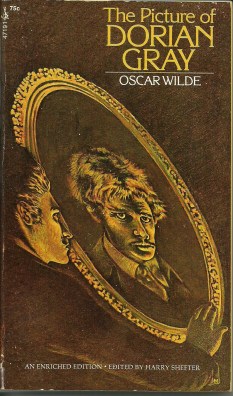
The Picture of Dorian Gray cover

The Picture of Dorian Gray ~ A Capsule Book Review by Allen Kopp

London in the 1880s: Not only is Dorian Gray young, innocent, and fabulously wealthy (he doesn’t have to earn his daily bread), he is also extravagantly beautiful. When sometimes-mediocre painter Basil Hallward meets the beautiful young Dorian, he becomes obsessed and infatuated. “Gay attraction” and “love” are never mentioned, but isn’t that what we’re talking about here? After all, it’s Oscar Wilde.

Basil Hallward rises above his own mediocrity when he paints Dorian’s portrait. It is, everybody agrees, his masterpiece. He could sell it for a tidy sum but decides to give it to Dorian. Dorian mouths an innocent (or not so innocent) prayer to the effect that he wishes he could always remain young and beautiful, while his portrait would show the inevitable signs of aging and living. In a touch of “magic realism” (how else do you explain it?), he gets his wish.

Early in the story, Dorian meets Lord Henry Wotton, a character who could be Wilde himself. He’s worldly, cynical, intelligent, and in possession of a scathing wit. He speaks in epigrams (“The only thing worse than being talked about is not being talked about.”) and doesn’t believe in goodness or much of anything else. He becomes an important character in the story because he is a corrupting influence on Dorian in his youth. Dorian admires him and is drawn to him and seeks to emulate him, even though he has a lot of the devil in him.

Dorian begins to live recklessly. He “falls in love” (or believes he does) with a young Shakespearean actress named Sybil Vane. Sybil’s biggest failing is that she doesn’t know what Dorian is all about or what she is getting herself into. Dorian believes she is a divinely talented actress and says he wants to marry her. When he brings his friends to the theatre to see her in a performance of Romeo and Juliet, she is terrible. She disappoints Dorian and embarrasses him in front of his friends. When he sees her after the performance, he is cruel to her. He tells her she is not what he thought she was and he can’t marry her and doesn’t want to see her again, while she says that her happiness at being his betrothed has robbed her of her “art.” He leaves her heartbroken and the next day discovers that she has committed suicide.

From Sybil Vane’s suicide, Dorian goes on to do other bad deeds. People are naturally drawn to him because he’s so attractive, but he turns out to be poison to everybody who comes into his sphere, male and female alike. Several young men are “ruined” because they acquire the taint of scandal from being Dorian’s “intimates.” (Homosexuality is still a crime in England at this time.) There are ruined careers and other suicides. Dorian immerses himself in a world of vice and degradation, frequenting opium dens and other low places of ill repute. Eventually he commits murder.

While Dorian becomes more and more immersed in sin, he remains young-looking and beautiful. At age thirty-eight, he still looks the same as he did at twenty-three. We (the reader) know what his secret is if nobody else does. The portrait that Basil Hallward painted of him (which he keeps locked away in the attic of his house) bears his shame and the marks of his vice and sin. It becomes more and more hideous while Dorian himself remains unscathed. The painting is, in a way, his soul and his conscience. We know this isn’t going to end well for Dorian.

There are elements of Stevenson’s The Strange Case of Dr. Jekyll and Mr. Hyde in The Picture of Dorian Gray; also elements of Poe, although The Picture of Dorian Gray is generally easier reading than Poe. (We are told in the introduction that it started out as a shorter piece until Wilde expanded it into a novel.) It’s a readable classic, worth revisiting, if you read it once a long time ago, as I did, and want to experience it again now that you’re older and wiser. (If you’re interested in the life and too-early death of Oscar Wilde, the 1997 British movie, Wilde, makes for fascinating viewing.)

Copyright © 2016 by Allen Kopp

The Best Short Stories of Edgar Allan Poe ~ A Capsule Book Review

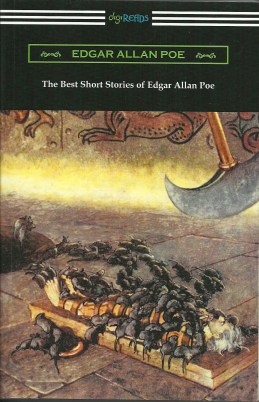
The Best Short Stories of Edgar Allan Poe

The Best Short Stories of Edgar Allan Poe ~ A Capsule Book Review by Allen Kopp

In this collection are twenty-eight short stories by Edgar Allan Poe, from the really well known (“The Tell-Tale Heart,” “The Pit and the Pendulum,” “The Fall of the House of Usher”) to the less well known (“A Tale of the Ragged Mountains,” “The Sphinx,” “The Imp of the Perverse”). Poe’s best stories are the ones where he gets right to the story and doesn’t theorize or provide dry, unnecessary information, as in the first couple of pages of “The Murders in the Rue Morgue,” a fine story if you start reading about the third page. And, no, there’s no morgue in this story where dead bodies are kept. The “Rue Morgue” is a street in Paris where two women, mother and daughter, are brutally murdered, stumping police, especially since the body of the daughter is stuffed up inside a chimney. The 1932 movie version of the story, a vehicle for Bela Lugosi, bears little or no resemblance to the original story. Yes, there’s a killer ape in the story and also in the movie, but that’s where the similarity ends.

The movies have not been kind to the works of Edgar Allan Poe. His stories just aren’t cinematic. Maybe some day somebody will make a movie from one of his stories that is faithful to the original story. In the 1960s, somebody thought it would be a good idea to make a series of movies based on the works of Poe starring that master of horror, Vincent Price. These movies were not serious attempts to translate the works of Poe to the screen but were mostly a way for filmmakers to make money, and I’m sure they succeeded in this goal, or there wouldn’t have been so many of them. To know what the stories of Poe are really like, you have to read them in their original form and not watch cheesy “B” movies.

Poe wrote on subjects that probably most other writers of his generation would have found too distasteful: mutilation murder, lunacy, drug addiction, being interred alive, being closed up in a wall to die, rotting corpses, rats, catacombs, disease, jealousy, revenge, etc. He was preoccupied with dying and death and the dark side of things; he probably suffered from some sort of undiagnosed mental illness. He didn’t write about monsters from another realm as H. P. Lovecraft did, but about monsters that exist right here on earth that you might just bring upon yourself if you’re not careful. In “The Imp of the Perverse,” a man commits a successful murder and has an easy life living on the money from the person he killed. Everything is going well for him, but he just can’t keep from confessing the murder and he ends up on the gallows. In “The Premature Burial,” a man who experiences catalepsy (trances that resemble death) has a morbid fear of being buried alive. In “The Black Cat,” an alcoholic who loves animals begins to have a consuming hatred for, and fear of, a certain black cat. In “The Facts in the Case of M. Valdemar,” a “Mesmerist” hypnotizes a man who is on the brink of death from tuberculosis. As an experiment, he keeps the dying man in a state of suspended, hypnotic animation, neither alive or dead, for a period of seven months. “The Pit and the Pendulum” is about a prisoner of the Spanish Inquisition being tortured in a fiendish and cruel way. In “Hop-Frog,” one of Poe’s best stories, a dwarf who is court jester for a cruel king exacts his revenge in the most dramatic way possible.

Poe elevated and legitimized the short story. In some ways, he is the father of the American short story. If you read his stories now, you will see why he endures. The best of his stories are the best ever written.     

Copyright © 2016 by Allen Kopp 

Tinseltown: Murder, Morphine, and Madness at the Dawn of Hollywood ~ A Capsule Book Review

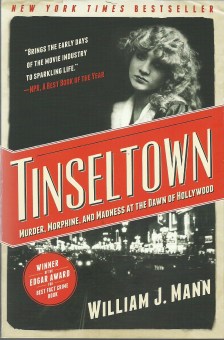
Tinseltown cover

Tinseltown: Murder, Morphine, and Madness at the Dawn of Hollywood ~ A Capsule Book Review by Allen Kopp 

In the early 1920s sound was still several years off, but the movies didn’t need sound; they were more popular than ever after the First World War. Even without sound, movies were becoming more technically advanced and were evolving into a truly American art form. Every town in America had its own movie theatre. Every movie-goer had his or her favorite star and was willing to plunk down hard cash to see them on the screen. Stars made huge sums of money and their movies reaped enormous profits for the movie studios. Overseas markets held huge potential for additional profits. What a business!

All was not sunny in sunny Hollywood, however. Movie stars lived extravagantly and were often seen by the world at large as unprincipled and immoral. Then, as now, everybody loved a juicy scandal. Just a hint of scandal involving a famous person elicited sensational headlines. Mabel Normand, for example, was a huge comedic star at the top of her game, but she was also a notorious party girl who became as well known for her appetites for booze and cocaine as for her screen performances. Roscoe “Fatty” Arbuckle was a popular comedic actor even more famous than Mabel Normand. He hosted a wild party that didn’t turn out so well. A young starlet named Virginia Rappé was seriously injured at the party and later died. There were those who said Fatty Arbuckle raped her, although he vehemently denied it. Popular star Wallace Reid, known for his wholesome good looks, developed a morphine habit. He had morphine delivered to his home every day and died at a tragically young age in a sanatorium. Beautiful young star Olive Thomas died of an accidental poisoning in Paris after an evening of drug- and booze-fueled partying in Paris nightclubs. The effect of all these scandals was to galvanize reformers and do-gooders into calling for censorship and stringent regulation of the movie industry by the government.

The biggest scandal of them all, however, was the murder, in early 1922, of distinguished movie director William Desmond Taylor in his own home. People outside of Hollywood had never heard of William Desmond Taylor, but after he was murdered everybody heard of him. His murder and its solution became a national obsession. This scandal was just one more reason, reformers said, for measures to be taken to “clean up” Hollywood. If the things actors did on the screen weren’t bad enough, their own private lives were ten times worse.

The murder of William Desmond Taylor is the scandal at the center of Tinseltown: Murder, Morphine, and Madness at the Dawn of Hollywood by William Mann. All the other scandals paled in comparison. What made the Taylor scandal so sensational and so intriguing to so many people was that it was all but insoluble. Did Mable Normand kill Taylor? She was his “best friend.” Because she was the last to see him alive, she immediately became a suspect. Or could it have been Mary Miles Minter, the little blonde star not yet twenty who was obsessed with Taylor and believed herself in love with him, even though he was almost thirty years older? More likely than not, it was Charlotte Shelby, Minter’s mother. She was known to have a raging temper and was vehemently against her daughter’s association with the much older man. How about light-fingered Edward Sands, Taylor’s former valet, who had a criminal past? Or maybe it was Henry Peavey, Taylor’s swishy valet at the time of his death. If he had a reason for killing Taylor, what might it have been?

And then there was Hollywood bottom feeder Margaret “Gibby” Gibson (otherwise known as Patricia Palmer), a would-be actress who struggled for years to become a star and never made it. She seemed to be willing to do almost anything to get ahead and was known to associate with low-life “bunco” artists who made a living by “shaking down” millionaires. (Just mention the Mann Act and they were almost certainly willing to pay any amount to stay out of trouble.) Did she kill Taylor as part of a scheme hatched by one of her nefarious friends?

Tinseltown: Murder, Morphine, and Madness at the Dawn of Hollywood is a fascinating true crime story with a rich cast of real-life characters. For those interested in the dazzled and dazzling 1920s (before the bad old Depression) and specifically in the still-young movie industry, this book is going to be hard to resist. I could hardly put it down and that’s something I can’t say about very many of the thousands of books I’ve read in my lifetime. It’s not great literature, but it will transport you to another time and place for a while and there’s a lot to be said for that.

Copyright © 2016 by Allen Kopp

The Sympathizer ~ A Capsule Book Review

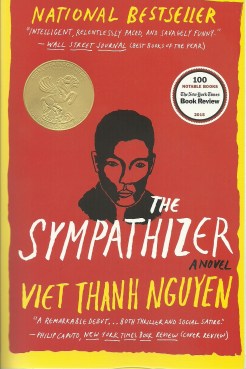
The Sympathizer cover

The Sympathizer ~ A Capsule Book Review by Allen Kopp

The Sympathizer by first-time novelist Viet Thanh Nguyen is this year’s Pulitzer Prize winner for fiction. It’s about the Vietnam War, the Vietnam era and, in particular, one man’s role in the whole mess. (What ever happened to the rule about novels having to be about American life to be considered for a Pulitzer Prize?) It’s 400 (almost) densely packed pages (no quotation marks; the dialogue is blended in here and there wherever it occurs). The Vietnam War and the Vietnam era would not be on my list of favorite subjects for fiction, but, for me, the saving grace of The Sympathizer is that it’s so good and such accessible, interesting reading.

The story of The Sympathizer is being told in the first-person by a narrator whose name we never know. We learn toward the end of the book that he is writing this whole thing as a confession while in solitary confinement as part of his “re-education” (another word for torture) at the hands of the communists. He is the bastard son of an illiterate Vietnamese woman and a French priest. Since he has spent part of his youth in America, he is “Americanized” and knows English well, but, in spite of that, he never feels like an American but always a bastard, the unwanted foreigner. After the fall of Vietnam and his narrow escape, along with many others, to America, he and many of his fellow countrymen want only to return to help liberate their country. What is more important that freedom and independence? The answer is nothing. (Nothing becomes a very important word to him at the end of the book.) Wait a minute, though! There’s something funny about this man. He claims to be on the side of the anticommunists, but the truth is he’s a secret communist agent. Where is he going with that? Is it safe to say he is conflicted? In the interview at the end of the novel, the author of the book, Viet Thanh Nguyen, says he deliberately wants to rattle the reader. I wouldn’t exactly say I was rattled, but only a little mystified.

For me the best parts of the book are the harrowing escape (by the narrator and his friends) from Saigon on the day it falls and the long section in the middle of the book where the narrator travels to the Philippines with an American movie crew to work as consultant on a movie that is being shot about the Vietnam War. (Ostensibly the movie is Apocalypse Now.) He wants to ensure that Vietnamese people are treated fairly in the movie but falls far short of that goal. There are a few lighter moments in The Sympathizer, as when the narrator is “dating” a much older Japanese woman who doesn’t care for him as much as he cares for her and, later, his infatuation with a beautiful Vietnamese girl named Lana (Lan); but there are also some horrible things, such as a couple of murders, a gang rape, people being dismembered by land mines, torture and other terrible things humans do to other humans in the name of some noble cause. This is a book, after all, about war. Did I need to read a book about Vietnam? Probably not, but now that I’ve read it through to the end, I’m glad to be done with it. If anybody ever asks me, I may be the only person in the room to have read it.

Copyright © 2016 by Allen Kopp 

Nausea ~ A Capsule Book Review

Nausea

Nausea ~ A Capsule Book Review by Allen Kopp

Jean-Paul Sartre, French writer and philosopher, lived from 1905 to 1980. His philosophical novel Nausea, first published in 1938, is one of the landmark works of twentieth century French literature and Sartre’s most famous work. In it, the fictional character Antoine Roquetin (Sartre himself?) is a Parisian writer who is in the medium-sized French city that he calls “Bouville” (means “Mudtown” and is probably Le Havre), researching the life of—and writing a historical book about—an eighteenth-century aristocrat and political figure, the Marquis de Rollebon. The novel is set in 1932 when Antoine Roquetin is thirty years old.

There is really not much of a story or plot to Nausea. It is told in the form of diary entries and is mostly the stream of consciousness impressions of Roquetin as he goes about living from day to day. He observes the people around him and the things they say and do, whether he’s in a café, his hotel, the library or some other place. He anticipates reuniting with an old girlfriend from his past named Anny. He has a superficial dalliance with a waitress. He takes long walks in the fog. He contemplates, at great length, portraits hanging in the library of the city’s founding fathers. He befriends a man whom he calls the Self-Taught Man, who is reading all the books in the library in alphabetical order.

Roquetin is afflicted with a sort of moral paralysis that he calls “nausea.” It’s not a physical malady but a degeneration of the spirit. Human life to him is unnecessary. Existence is pointless and there is no God, which is the essence of the philosophy known as “existentialism.” He eventually gives up his writing and research in Bouville to return to Paris to—what?—probably just waste away. Aren’t we all going through the paces of living just so we can die? Seems that way, doesn’t it? But, wait a minute! If we were to write a song that will be remembered long after we die, or to sing that song on a recording that will be listened to for a long time to come, maybe that (or something like it) is enough is rescue us from the awful pointlessness of existence. What do you think?

Nausea is philosophical treatise disguised as fiction. It’s fitfully interesting, fascinating at times and tedious at other times. If you’re a student of French literature or a student of Sartre, it’s going to be essential reading. If you are just looking for a good “story” because you enjoy reading, Nausea probably isn’t it. Not exactly painful reading, but you’ll almost certainly be glad when you reach the last page. I think I’ll take my diary and turn it into a depressing philosophical novel. It won’t matter that it doesn’t have a story, a beginning, a middle or an end, will it? Everything is pointless, anyway.   

Copyright © 2016 by Allen Kopp

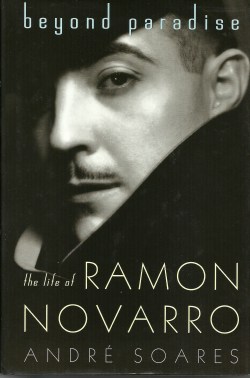
Beyond Paradise ~ A Capsule Book Review

Beyond Paradise

Beyond Paradise ~ A Capsule Book Review by Allen Kopp

Most people today will not have heard of Ramon Navarro, or, if they’ve heard of him at all, it’s because of his vicious murder at the hands of two “male hustlers,” Paul and Tom Ferguson, in 1968, and the sensational trial that followed. With his death, Navarro’s closely guarded, decades-long secret was out: he was a Hollywood homosexual and, in his later years, was in the habit of inviting “male escorts” to his home and paying them for sex. With his sexual predilections and his uncontrolled alcoholism (many run-ins with the law for drunk driving), he was, as one of the lawyers said at his murder trial, an “accident waiting to happen.”

Ramon Novarro (née Ramon Gil Samiengo), was born in Durango, Mexico, in 1899, into a large, devoutly Catholic family. As a teen, he made his way to Hollywood and, after a series of lucky breaks (bit parts and dancing stints), he became the protégé of Rex Ingram, an influential director of silent movies. Ingram used Navarro to great effect in some of the popular movies he directed in the 1920s and—if not overnight, at least pretty fast—Navarro became a bona fide “star,” with a loyal and devoted legion of fans at home and abroad. Between 1925 and 1932, he was THE top male movie star in the world. In 1925, he starred in Ben-Hur, the biggest and most expensive movie made during the silent era.

When movies switched to sound in the late 1920s, it was with his pleasant (though heavily accented) speaking and singing voice that Ramon Navarro segued into sound movies, while many of his contemporaries in silent films were not able to make the transition. Though small of stature (5 feet, six inches) and slightly pudgy, he had other assets that made him a favorite of audiences: a handsome face, an undeniable charm and appeal, coupled with a genuine talent for screen acting. Women loved him and men did not feel threatened by him.

Every star that rises, however, must fall. After 1932, his bosses at MGM (Mayer and Thalberg) began putting him in movies that were not only unsuitable for him (at age 32, he played a college football player in a movie called Huddle) but were almost destined from the start to fail. After a series of box office flops, the studio dumped him in 1935 and, at age 36, he was washed up. He tried for decades to recapture his box office magic, but nobody wanted him anymore and he was relegated to playing small parts in cheap productions. He was successful for a while on the concert circuit and in summer stock, but soon his heavy drinking began to undermine everything he attempted. From the age of 36 to the end of his life at 69, he was merely a “once-was” or a “has-been.” Many of the once-great stars of his generation shared the same fate.

Beyond Paradise by André Soares is the fascinating and unforgettable story of a likeable star (to some a hero) who, in the end, became a tragic figure. Ramon Navarro’s story is a story of the twentieth century and of one of the defining industries of that century. Beyond Paradise reads like a novel, is never boring and is never bogged down in extraneous detail the way some nonfiction books are. The final chapters that cover Navarro’s murder and the subsequent trial are gripping. Highly recommended for those interested in Hollywood biography and lore from the golden age of movie making. A time and place that are no more and will never be again.

Copyright © 2016 by Allen Kopp
Versailles ~ A Capsule Book Review

Versailles

Versailles: A Biography of a Palace ~ A Capsule Book Review by Allen Kopp 

The Palace of Versailles is possibly the most famous structure of its kind in the world. Situated about twelve miles outside of Paris, it was built in the 1680s by Louis XIV. For the next roughly hundred years it served as the seat of French government and home for the royal families and royal courts under three kings: Louis XIV, Louis XV and Louis XVI. Versailles: A Biography of a Palace, by Tony Spawforth, is a history of the Palace of Versailles, a history of the people who lived there, good and bad, the court intrigues, the adulterous affairs, the arrogance, the corruption, the extravagance and the bad press that eventually brought down the monarchy and replaced it with a republic. After Louis XVI and his queen, Marie Antoinette, were deposed and eventually guillotined in the 1790s, the Palace of Versailles came to represent tyranny and extravagance to the French people. There were calls for it to be demolished as a hated symbol of the repressive past, but it still stands today, a monument to what once was and never will be again.

Louis XIV, who built Versailles and made it what it would be for about the next hundred years, was a monarch down to his fingertips. He believed in the divine right of the French king, that the kind should live extravagantly and luxuriously. Up until the time of Louis XIV, the seat of French government had been the Louvre in Paris, but Louis wanted something different. He moved to the French countryside outside of Paris, to a little town known as Versailles. He destroyed three small villages to build what would become the sprawling palace that housed thousands of people at one time: courtiers and aristocrats, family of the king and queen, office holders, ministers and functionaries, appointees, cooks and lackeys, servants and attendants. Many of the people who lived in the palace were essentially leeches and served no real purpose, but were part of the elaborate system that comprised the king’s court.

After Louis XIV’s death, the reputation of the king and royalty in general began to deteriorate with the public and the press. Whereas Louis XIV was beloved and an inspiration to his people, Louis XV, his successor, was less punctilious in his kingly duties. He wasn’t so particular about his public image and openly engaged in adulterous affairs with many women, including the infamous Madame de Pompadour and Comtesse du Barry. He would flaunt his affairs of the heart to the world and didn’t seem to care about the ramifications. The image of the monarchy began to suffer.

Upon Louis XV’s death from smallpox in the year 1774, his grandson Louis XVI became king. Louis XVI resembled a pudgy schoolboy and wasn’t much interested in being king. He seemed feckless and completely bereft of the attributes necessary to run a great country. The worst thing that ever happened to him was being married off to an Austrian princess, who would later become known as Marie Antoinette. After her function of providing a male heir to the king was fulfilled, she indulged in her whims and mostly locked herself away from court functions and her role as queen. She wanted her own privacy and a good time and she didn’t care who knew it. She developed a terrible reputation with the public and in the press, which only became worse as her extravagances were revealed, and this while many “regular” people were starving because economic conditions were so bad in the country. Fairly or not, she came to represent the excesses of the monarchy at their worst. She and her husband, Louis XVI, were eventually beheaded in a cruel public spectacle. She was hated and reviled for years after her death but  remains a compelling figure to this day, around whom a cult of admiration has developed.

If you’ve ever visited the Palace of Versailles, as I have, Versailles: The Biography of a Palace will make compelling reading, but it will even if you haven’t been there. It’s a readable history for the “casual” historical reader, never dull or academic; full of anecdotes and the “small” moments that history is made of. If you are a fan of the 1938 MGM movie, Marie Antoinette, you can’t help imagining Robert Morley and Norma Shearer as Louis XVI and Marie Antoinette, and Tyrone Power as the queen’s would-be boyfriend, Count de Fersen, who remained sympathetic to the end. As Count de Fersen hears the cheers of the crowd as the queen is beheaded, tears fill his eyes and he looks off into the middle distance, filled for the moment with thoughts of what might have been.

Copyright © 2016 by Allen Kopp
Undermajordomo Minor ~ A Capsule Book Review

Undermajordomo Minor

Undermajordomo Minor ~ A Capsule Book Review by Allen Kopp 

Undermajordomo Minor is a novel by Patrick DeWitt set in an unidentified and unidentifiable time and place. It might be a European country and it might not. The characters travel by train, but there is no mention of cars, electricity or any other modern convenience, so it’s a story that could have or might have taken place a long time ago. It’s set almost entirely in a castle, Castle Von Aux, that is owned by the absentee (at first) Baron and Baroness Von Aux. A seventeen-year-old boy, Lucien “Lucy” Minor, has left his not-very-loving home and traveled by train to Castle Von Aux to take up a position there as a servant. Since his job will entail many and multifarious duties, his title is to be “undermajordomo.” The “majordomo” (if there is one) under which Lucy will be employed is an odd gentleman named Mr. Olderglough, who has been at the castle for many years. Lucy finds out that his predecessor, a Mr. Broom, met an untimely end, but he doesn’t find out for the longest kind of time exactly what happened to Mr. Broom because nobody wants to talk about it.

In the squalid village down the mountain from Castle Von Aux, Lucy meets an odd old man (everybody in this book is odd) named Memel. Memel is a pickpocket and thief of sorts and he has a daughter named Klara, with whom Lucy falls in love. There’s just one problem with Klara, though. She has a boyfriend, an “exceptionally handsome” man named Adolphus. In the inexplicable war that rages in the hills around Castle Von Aux, Adolphus is an important player, a general or something. Adolphus is forceful and is everything that Lucy is not. He claims to love Klara and doesn’t like it that Lucy loves her, too.

At Castle Von Aux, Lucy becomes aware of an oddly deranged man who skulks about the castle at night, filthy and practically naked. Lucy believes at first that this might be the mysterious Mr. Broom but discovers in time that it is Baron Von Aux. When Mr. Olderglough receives word that the long-gone Baroness Von Aux is returning for a visit, it’s up to him and Lucy to take Baron Von Aux in hand, get him cleaned up, and make him seem as “normal” as possible. (This isn’t going to be easy.)

Baroness Von Aux arrives with much fanfare and Lucy sees that she is very beautiful. He learns, then, that Mr. Broom was in love with Baroness Von Aux and took his own life by throwing himself into the “Very Large Hole” up the mountain from the castle. Much to Lucy’s surprise, though, Baron Von Aux has undergone a transformation and is ever so much more presentable than he expected him to be. He can even speak and wear clothes. When Baron and Baroness Von Aux entertain out-of-town guests, the Duke and Duchess and the Count and Countess, Lucy witnesses the strange goings-on of the three couples in the ballroom, which includes a sort of free-for-all sex orgy. Considering what Lucy already knows about Baron and Baroness Von Aux, he can’t be too surprised at their behavior.

Eventually Lucy’s jealousy for Adolphus leads him to the thought of murder. He attempts to kill Adolphus by pushing him into the Very Large Hole, but Adolphus sidesteps him and Lucy falls in himself. He falls for a very long way but, since he lands in water, the fall doesn’t kill him. What he finds in the Very Large Hole is unexpected but makes absolute sense in light of what has gone before.

Undermajordomo Minor is quirky and thoroughly engaging reading. It takes us where we hadn’t expected to go, but when we’re there we find it’s a good place to be. Like The Sisters Brothers, Patrick DeWitt’s earlier novel, it is breezy, almost effortless, reading and goes down like Rocky Road ice cream.

Copyright © 2016 by Allen Kopp