April Morning ~ A Capsule Book Review

April Morning ~ A Capsule Book Review by Allen Kopp

The American Revolutionary War began on April 19, 1775, with the Battles of Lexington and Concord. It was professional British troops, numbering in the thousands, against non-professional Colonials, numbering in the hundreds. The British were marching from Boston to procure military supplies the Colonials had stockpiled in Concord. The Colonials didn’t want to fight but were forced to it. They only wanted the English invaders to leave their land and let them live in peace.

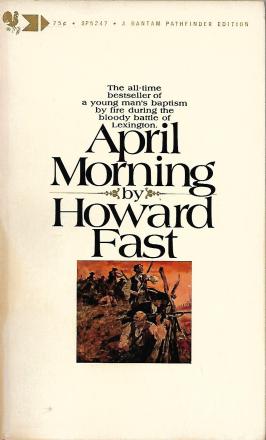
April Morning is a historical novel by Howard Fast, told in the first-person voice of one Adam Cooper, fifteen years old. Adam lives with his family in the village of Lexington in the Massachusetts Bay Colony. On the morning of April 19, 1775, the people of Lexington receive word that the British army, possibly two thousand men, is headed toward them. They assemble a small body of “committeemen” to meet the British. The committeemen are underequipped, of course, and they know they are no match for the professional British army. They believe, naively, that all they will need to do is reason with the British to get them to desist and return to Boston.

The British immediately begin firing on the villagers on the “common” of Lexington before a word can be exchanged. (This is “the shot heard ‘round the world.”) Our young protagonist, Adam Cooper, witnesses his father being among the first to be shot. The Colonials fight back, with much bloodshed on both sides. Adam has an inadequate firearm that shoots birdshot, but still he does his part. In the course of one day, he goes from being a boy to being a man.

April Morning is not a serious examination of war, but is more a personal story of how the beginning of a war affects one person, one family, and one small village. It abounds with clichés and at no time has an authentic eighteenth century feel to it, in the way, for example, of Mackinlay Kantor’s historical novel, Valley Forge. Still, it’s an engaging enough book in its own way that has become a much-read classic, especially by younger readers.

Copyright © 2017 by Allen Kopp

Mengele: The Complete Story ~ A Capsule Book Review

Mengele: The Complete Story ~ A Capsule Book Review by Allen Kopp

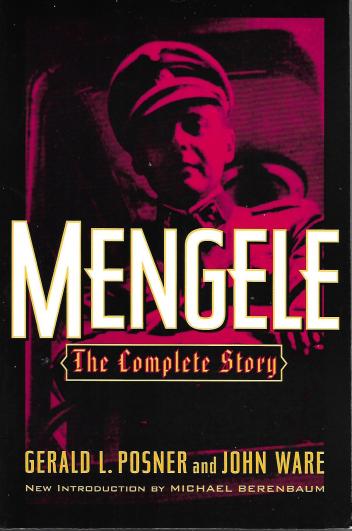
Dr. Josef Mengele (1911-1979) embodied the strange duality seen in other high-profile members of the Nazi party during the Third Reich. As physician at the Auschwitz concentration camp in Poland, he was capable of the most barbaric cruelty and scathing disregard for human life, while at the same time loving animals, trees, flowers, music and poetry. He was father, husband and beloved of his close-knit family and his loyal friends and supporters.

After World War II was over the Nazis were defeated, Dr. Mengele became the most sought-after and most reviled man of the twentieth century. While many of the infamous members of the Nazi party were brought to justice and executed, including Adolf Eichmann, Mengele somehow managed to escape justice, not for lack of trying on the part of the governments of Germany and Israel and several intrepid “Nazi hunters.”

Dr. Mengele was interested in anthropology and genetics. He believed that a super-human German race was possible through genetic engineering and scientific manipulation. At the Auschwitz concentration camp, he had unlimited human subjects on which to conduct his experiments. He was especially interested in twins, dwarves, and people with physical defects and disabilities. He would infect children with diseases and then wait for them to die so he could dissect them. He experimented with dyes to change eye color on his subjects, and the result was often blindness and death. His experiments were often bizarre, cruel, and medically useless. He was a real-life mad scientist.

If Dr. Mengele’s medical experiments at Auschwitz weren’t enough, he was also one of the Nazi officers to perform “selections” of prisoners as they exited the train cars: Go to the right and you live. Go to the left and you die. These selections were based on the physical appearance and age of the prisoner and nothing more. Dr. Mengele seemed to enjoy the job of making selections; he was always looking for new subjects for his experiments.

Dr. Mengele always maintained that he did nothing wrong at Auschwitz; he was only following orders, only doing his duty. According to him, he saved many lives and helped many victims of the diseases that were prevalent in concentration camps, such as typhus. However, there were many eyewitnesses who survived the camp who told a much different story; he was not called “the Angel of Death” for nothing. He was cruel and callous, without sympathy for his victims. If he had ever been brought to trial, the testimony of the witnesses would have convicted him.

After the war, Dr. Mengele’s life became a strange odyssey of escape, pursuit and evasion. He got away to South America; first Argentina and then Paraguay and then Brazil. He had lots of Nazi sympathizers to help hide him who refused to believe the stories about him. On the other hand, there were many people who would have given almost anything to have him brought to justice. At one time there was a reward of ten million dollars on his head. A kind of mythology grew up around his ability to escape; he became known all over the world as the one Nazi who got away. The Mengele story was fed by lies, exaggerations, misinformation and the pursuit of notoriety. Mengele “sightings” were reported in places where he could not possibly be.

This is not to say that Dr. Mengele lived a life of luxury and ease as a fugitive in South America. To remain hidden, he often lived in squalid conditions and in isolated places, separated from his family. He lived in constant fear that he would be recognized and maybe even kidnapped, as Adolf Eichmann had been. In 1979, Dr. Mengele died at age 67 of a stroke while swimming and was buried in a modest grave in Brazil. His remains were disinterred in 1985 to provide positive identification. So ended the life of an elusive monster.

Mengele: The Complete Story by Gerald L. Posner and John Ware is an exhaustive factual account of the wartime activities of Dr. Josef Mengele and his postwar life in South America as a fugitive. Dr. Mengele was a relatively young man during the war, only in his thirties, so he lived a long postwar life. The exhaustive details of the political machinations in South America, particularly in Paraguay, to keep him from being extradited, are too much information for the casual reader, like me, but, except for some tedious details and far too many difficult South American names thrown in, Mengele: The Complete Story is a fascinating account of one of the most infamous figures of World War II.

Copyright © 2018 by Allen Kopp

Valley Forge ~ A Capsule Book Review

Valley Forge ~ A Capsule Book Review by Allen Kopp

Valley Forge, Pennsylvania, was where the Continental Army spent the winter of 1777-1778, while waiting for more favorable weather to continue the war with the British, now occupying Philadelphia eighteen miles away. The weather was miserably cold and the army was ill-equipped, with not enough food or clothing to go around. Many of the men went without shoes. A lot of times they went without eating or ate what they could forage. Makeshift huts for shelter were constructed out of logs. More than 2500 American soldiers died at Valley Forge by the end of February 1778, from exposure, starvation, malnutrition, or disease.

Valley Forge is a novel by American writer Mackinlay Kantor. Instead of being a novel in the traditional sense, it’s more a collection of interconnected stories: a young deserter named Mum decides to return to his regiment after being treated kindly by a sixteen-year-old girl (we learn at the end of the book what became of Mum); a seven-year-old slave girl brings General Washington some apples and potatoes because she has heard he doesn’t have enough to eat; a defector is hanged while calling out for his mother; a young cobbler who has his leg amputated wonders how he will pursue his trade after the war; a gang of foragers deals with recalcitrant civilians; a young man with a horse he loves named John must deal with having the horse taken away from him by an officer (the horse John reappears at the end of the book); a group of young girls find what they believe is a litter of puppies, but what they don’t know is the puppies are really wolves and the mother will kill the girls if she finds them messing around with her babies; a young officer has a torrid love affair with an older widow who always keeps her face covered. The one person who appears throughout the book is General George Washington, the commander of the American forces on whose shoulders rests the success or failure of the war with the British. General Washington refuses to have comforts for himself while his men are living miserably at Valley Forge. He is a true American hero.

Valley Forge is an interesting, little-read book. It’s not about war or warfare but about the small moments in the lives of mostly insignificant people who are engaged in the titanic struggle for independence from a repressive, invading foreign power. Although it’s fiction, it’s well-researched and based on fact, as the bibliography at the end of the book attests.

Copyright © 2018 by Allen Kopp
The Immortal Nicholas ~ A Capsule Book Review

The Immortal Nicholas

The Immortal Nicholas ~ A Capsule Book Review by Allen Kopp 

(This is a repost.)

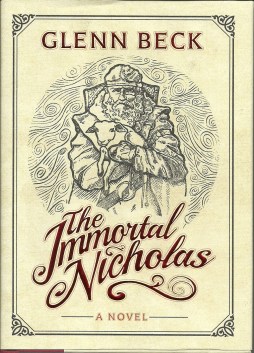
The Immortal Nicholas by Glenn Beck is an unusual Christmas-themed novel that never mentions the word “Christmas” and isn’t any traditional Christmas story as we’ve come to know it. The main character is a man named Agios (Ah-GEE-os). He is embittered because his wife dies and then his young son dies through what he believes is his own carelessness while harvesting frankincense from trees growing on a mountainside that he himself has protected from intruders with poisonous snakes. He has no hope in life and wants only to die. When he is forced to leave his home, he encounters in his travels a young man named Krampus who is physically handicapped and who has been tortured by the Romans. He immediately takes up with Krampus and becomes his protector and, in a way, his father. His knowledge of frankincense and his possession of a small amount of the precious substance eventually leads him into the company of three “kings” (Balthazar, Melchior and Caspar) who are following a star that they believe will lead to the foretold Messiah who will save the world.

Agios finds himself in Bethlehem with the three kings at the stable where Jesus lay as a tiny baby. He wholeheartedly believes in the promise of Jesus’ birth and from that moment vows to protect Jesus, Mary and Joseph from those who would do them harm. He and Krampus follow Jesus around through the years, always staying in the background. He loses sight of Jesus until Jesus is a grown man and is going around ministering to the masses. Agios hears of Jesus’ ability to heal the lame and sick and he somehow believes that Jesus can cure Krampus of whatever is wrong with him if Agios can get him close enough to him. Agios and Krampus are present at the Sermon on the Mount but are not able to get very close to Jesus because of all the people. Finally, after all they go through to keep an eye on Jesus while staying always on the fringes of what is going on, they are there to witness the crucifixion. Agios is deeply stirred by the cruel death of the savior and goes away an embittered man. He believes that is the end of the promise that the birth of Jesus Christ gave to the world.

For some reason Agios doesn’t die but lives for centuries, to watch Krampus die and everybody else he ever cared about. While living as a hermit in the mountains centuries after the death of Jesus, he befriends a shepherd boy named Nicholas and learns from him that Jesus arose after his crucifixion, proving that his promise to the world was true and that he overcame death. From that moment on, Agios’ life is different. Despite his desire to not want to be near other people, he and Nicholas become close and Agios becomes a surrogate father to him. As Nicholas grows into adulthood, he becomes a priest with a very generous spirit and out of that the legend of Saint Nicholas grows, with a direct link back, through Agios, to the ministry of Jesus Christ.

The notes on the dust jacket tell us that Glenn Beck expanded The Immortal Nicholas into a novel for adults that started out as a children’s story. It’s simply written but smart and engaging enough for adults. It took a few surprising turns for me. When I started reading it, I didn’t know how a story about a man who lived at the beginning of the Christian Era could have anything to do with Saint Nicholas. I deliberately didn’t want to read any synopsis or summary while reading the book because I wanted to find out for myself where it would lead. Think what you will of Glenn Beck and his conservative principles, he is a very effective fiction writer.

Copyright © 2023 by Allen Kopp

Letourneau’s Used Auto Parts ~ A Capsule Book Review

Letourneau’s Used Auto Parts ~ A Capsule Book Review by Allen Kopp

Letourneau’s Used Auto Parts by Carolyn Chute is set in Maine. Big Lucien Letourneau is the patriarch of a large family of uneducated miscreants and malcontents. Big Lucien has had many wives and many children. Whatever else these characters may be lacking in life, they always have plenty of children. Big Lucien has a “heart of gold.” He has lots of cats and he will give a place to stay to just anybody who needs it, family or otherwise.

Big Lucien owns a salvage yard containing rows and rows of wrecked cars. He barely makes enough money to keep going, but he employs several earthy men. As one of Big Lucien’s employees says, the salvage yard is the “goddamndest hellhole I’ve ever worked in.” I’ve felt that way about some of the jobs I’ve had, so I know exactly what he’s talking about.

Blackstone Babbidge (“Gene”) is one of Big Lucien’s employees at the salvage yard. He lives in a trailer park called Miracle City. His wife, Lillian Greenlaw, is one of Big Lucien’s former wives. Lillian’s freewheeling daughter, Junie Greenlaw, is one of Big Lucien’s many children. Gene Babbidge is Junie’s stepfather. Junie has been “messing around” with her stepfather (these people don’t bother with social conventions), so she is pregnant by him. Her mother doesn’t know who the father of Junie’s baby is, only that she is pregnant with a pregnancy that makes her sick a lot of the time.

Crude, foul-mouthed Maxine Letourneau is also one of Big Lucien’s former wives. Her children by Big Lucien include Norman, who marries a hippie woman, and Little Lucien, a sullen fifteen-year-old bodybuilder.

Severin Letourneau is Big Lucien’s half-Indian nephew. When he is sixteen, he impregnates Gussie Crocker, also sixteen, and they get married. Severin is also one of Big Lucien’s employees at the salvage yard. Severin and Gussie don’t have the money to pay their rent and are evicted. Big Lucien sets them and their two small children up in a thrown-together house in the woods that doesn’t pass code. That’s another of Big Lucien’s problems: the “code man” is after him for his various code violations.

Letourneau’s Used Auto Parts is a funny and engaging exploration of the lives of people living at the bottom of the socioeconomic heap. I read this book once before and fondly remembered it enough through the years to go back and read it again. We wouldn’t want the feckless Letourneaus living in our neighborhood, but we can wallow in their lives on the printed page and come away unscathed. That’s the magic of books.

Copyright © 2017 by Allen Kopp 

Andrew Jackson and the Miracle of New Orleans ~ A Capsule Book Review

Andrew Jackson and the Miracle of New Orleans ~ A Capsule Book Review by Allen Kopp

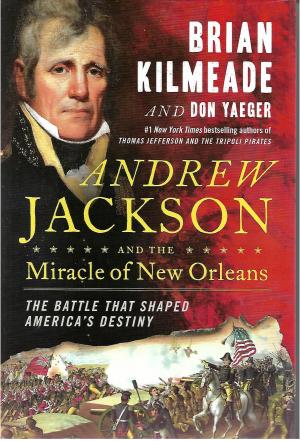
Thirty or so years after the American Revolutionary War, America fought the Second War of Independence with the British. This was the War of 1812. The hero of that war was Andrew Jackson of Tennessee, an Indian fighter who didn’t have much experience as a strategic war planner, but who possessed a natural instinct for defeating a mighty foe. The British army was the best equipped and best trained army in the world. They had defeated the mightiest armies of Europe (the Battle of Waterloo was yet to come, in 1815). They had their sights set on New Orleans, a city of strategic importance at the mouth of the Mississippi River. If they could conquer that city—and they were fully confident they could—they could take possession of the entire country west of the Mississippi and make it their own…or so they thought.

The British forces assembled a few miles to the east of New Orleans and prepared to move on that city. The wealth and plunder that New Orleans possessed was to be shared by all of the invading force. They expected only token resistance from the Americans, as they had when they burned the city of Washington. After all, weren’t they (the British) skilled in warfare and superior in numbers and in weaponry? The one element the British didn’t count on was General Andrew Jackson.

The area east of New Orleans known as the Chalmette Plain is where the Battle of New Orleans was fought. General Jackson pulled together a diverse amateur army of farmers, old and young, country people and city people of all nationalities, blacks, woodsmen, riverboat men, and even some pirates who pledged their support to protecting the country from British invasion. Some of them didn’t even have weapons. This “inferior” army overwhelmed the British forces through tenacity and strategic planning on the part of General Jackson. Though he was wounded and far from well, he fought side by side with his men and wouldn’t allow them to become discouraged and complacent.

The terrain—boggy swamps, marshes and bayous—was unkind to the British; they weren’t used to fighting in three feet of water. General Jackson and his army stopped them from advancing on New Orleans. British losses were heavy, while American losses were minimal. Demoralized and defeated, the British army withdrew.

Andrew Jackson was the man of the hour. He was seen as saving, not only New Orleans, but the Union. He was to this war what George Washington had been to the Revolutionary War. The unpopular war was at last redeemed in the eyes of the American people and President James Madison left office on a high note. And, of course, Andrew Jackson a few years later himself became the seventh president of the United States.

Andrew Jackson and the Miracle of New Orleans, by Brian Kilmeade, is American history made entertaining. In under 270 pages, we get a glimpse of wartime America in 1812-1814 and of the resolve that won a war against overwhelming odds. The British, after two wars fought on American soil, would not come calling again.

Copyright 2017 by Allen Kopp

A Separate Peace ~ A Capsule Book Review

A Separate Peace ~ A Capsule Book Review by Allen Kopp

John Knowles’ 1959 novel, A Separate Peace, has become a modern classic, has sold millions of copies, and is regularly found on high school reading lists. It’s a coming-of-age story about life in a boys’ prep school in New Hampshire in 1942, focusing on two boys in particular, Gene and Phineas. Gene is an introspective intellectual with a dark side and Phineas an outgoing star athlete, liked by all. As different as they are, they are best friends and roommates.

The sixteen- and seventeen-year-old boys at the Devon School are on the threshold of adulthood, but they are also on the threshold of something else: World War II is raging, in Europe and elsewhere, and it is a given that all of the boys are preparing in some way to enter the war when they finish school. The war influences everything they do and think. Will they make it through alive? Will they be brave, or will they follow their natural instincts and preserve their own lives at any cost? These are questions that young men have been asking themselves for as long as wars have been waged.

Through Gene Forrester’s first-person voice narration, we get a sense of how different Phineas and Gene are. Phineas seems to be above rivalry or competitiveness (or any “ugly” emotion), but is there something in Gene’s nature that would force him to deliberately hurt Phineas because Phineas is always the best at any athletic endeavor and in a way insufferable? An incident involving a tree during the last fateful summer at school causes a tragedy that fuels the second part of the story and forces Gene, and others, to question his motives and his character.

A Separate Peace is a readable classic, just under 200 pages, on the universal themes of friendship and growing up. It has a feeling of truth and authenticity to it; that’s why people are still reading it sixty years after its first publication.

Copyright © 2017 by Allen Kopp

Hiddensee ~ A Capsule Book Review

Hiddensee ~ A Capsule Book Review by Allen Kopp

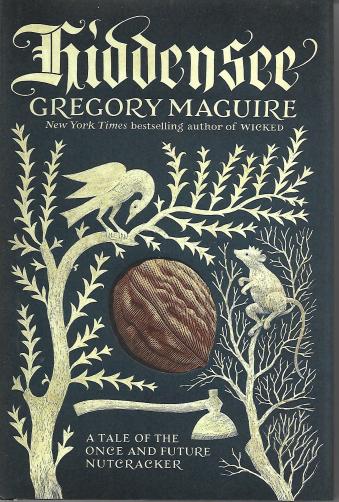
Author Gregory Maguire takes fairy stories or well-known fantasy stories such as The Wizard of Oz and “reinterprets” them for a grown-up audience. His latest novel is Hiddensee, all about the life of the fictional character Herr Dirk Drosselmeier, woodcarver and toy maker who made from wood “the nutcracker.” Yes, it’s the same nutcracker as the one in the story popularized by Tchaikovsky’s ballet, which was taken from a short story by E.T.A. Hoffmann, which was itself adapted from a story “The Nutcracker” by Alexandre Dumas. As you can see, this is a story with deep literary roots, none of which you need to know to enjoy the book.

Hiddensee is set in the 1800s in the Black Forest in Bavaria, southern Germany, a magical place even when nothing happens there. Dirk Drosselmeier is a foundling child never knowing his parents or where he came from. He is brought up in a tiny house deep in the woods by an old man and an old woman, who, we find out toward the end of the book, are really Hansel and Gretel. He never has any contact with any other person in his life besides this old man and old woman. They treat him kindly until he is about ten years old and they decide to kill him. When Hansel takes him out into the woods to kill him with his axe, the killing isn’t successful, except in the sense that Drosselmeier dies and comes back to life. It’s a fantasy story, remember.

Drosselmeier, for obvious reasons, gets away from Hansel and Gretel and spends the rest of his childhood with a minister, who takes care of him but is mostly indifferent to him. Do you see a trend here? He doesn’t have a very happy life and doesn’t seem to belong anywhere. One important plot point that must be remembered is that Drosselmeier, when he leaves Hansel and Gretel, takes a crutch with him that he made for Hansel. The crutch is of no apparent use to him, but he takes it with him everywhere he goes, anyway.

After he leaves the minister he finds himself as a sort of servant with a wealthy family, where he befriends the young musician Felix Stahlbaum. He and Felix remain friends as long as they both live. He gets into trouble when it is assumed that he impregnated a young servant girl (he didn’t) and has to leave. He ends up with a paper maker with a strange Persian wife and two small boys. He befriends the family and begins making toys and entertaining the two boys with stories he heard as a child. Eventually he falls in love with the paper maker’s wife. This, of course, does not end happily.

Anyway, the story follows Drosselmeier’s life through to the end. He makes a nutcracker from the crutch he took away from Hansel and Gretel. He sets up a shop in Munich and makes a living as a toy maker. His friend Felix Stahlbaum has two sons of his own and Drosselmeier becomes their godfather.

Felix’s family is the only family Drosselmeier has ever known. Felix dies and Drosselmeier continues being friendly with his widow and two sons. One of the sons grows up and has children of his own, including a daughter Klara. Klara is sickly and might die. The story takes us to a Christmas Eve when Klara is gravely ill and Drosselmeier presents her with the nutcracker he made years earlier and a magical castle that can be opened only with a golden key that is kept inside a walnut concealed on the Tannenbaum. What happens when Klara is alone in the room with the nutcracker, some mice, and the magical castle forms the basis for the story’s conclusion.

I’ve read all of Gregory Maguire’s books. Hiddensee is not my favorite, but it’s engaging and beautifully written throughout, if you, like me, are willing to suspend disbelief for three hundred pages. For a book by Gregory Maguire that seems truly inspired, however, read Wicked or Confessions of an Ugly Stepsister.

Copyright © 2017 by Allen Kopp

Ancient Egypt: Everyday Life in the Land of the Nile ~ A Capsule Book Review

Ancient Egypt: Everyday Life in the Land of the Nile ~ A Capsule Book Review by Allen Kopp

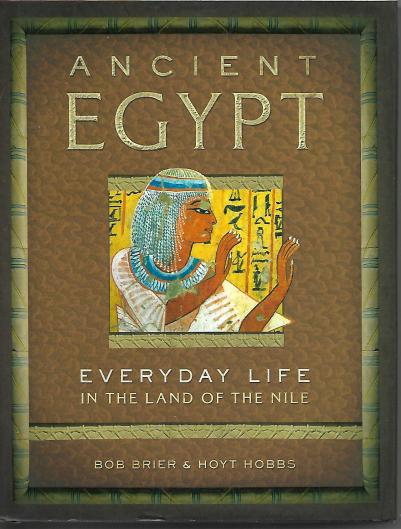
Ancient Egypt is one of the oldest cultures in the world, going back more than five thousand years. The Egyptians were some of the most innovative and inventive people in the world. They built the largest stone structure ever constructed anywhere in the world (Pyramids at Giza) and the largest temple of worship (Karnak Temple), using sophisticated engineering techniques but without machines and with tools that we consider primitive. They advanced art and architecture and invented writing, even though only about five percent of ancient Egyptians could read and write. They waged war, wove cloth, sported fashionable clothes, grew and irrigated abundant crops, built furniture and beautiful decorative items, practiced medicine (even though they knew nothing about germs or bacteria), and adorned their tombs with riches beyond imagining. They worshipped many gods, but the pharaoh was the supreme being, the living god. Everything the people did was in tribute to the pharaoh.

The Egyptian civilization would have never existed if it hadn’t been for the Nile. Every spring the river flooded and when the floodwaters receded, fertile soil was left behind. The raising of plentiful crops was relatively easy, giving the people plenty of time to do other things, such as wage war against their neighbors for their pharaoh and engage in massive building projects. Instead of a necessity, war was a given in ancient Egypt. The most revered pharaohs were the ones who waged the most successful military campaigns. Egypt wasn’t interested in adding to its territory but in stealing the plunder of the vanquished.

Over its thousands of years of history (the longest-lasting civilization anywhere in the world), Egypt’s fortunes rose and fell, depending a lot on whoever happened to be in charge at the time. Some pharaohs were effective leaders, while others led the country to chaos. At Egypt’s highest point, it was the richest country and the most feared superpower in the known world.

Ancient Egypt: Everyday Life in the Land of the Nile by Bob Brier and Hoyt Hobbs is an interesting and informative overview of what life was like for the three million or so souls who called Egypt their home thousands of years before Christ. Did you know there was one pharaoh who sat on the throne for ninety-four years, a record that still stands for any king or monarch in any country in the world? Did you know that, through the complex rules regarding succession, there was one woman, Hatshepsut, who was pharaoh? We know Egypt in modern times mostly through the fabulous treasures that were uncovered in Tutankhamen’s tomb in the 1920s. The truth is that Tutankhamen was a minor pharaoh as pharaohs go, a “boy king” with a misshapen body who sat on the throne for only ten years. He was considered so insignificant that, in the years after his reign, he was almost forgotten, almost erased from historical records. Most of the pharaohs’ tombs were plundered in ancient times, no matter what measures were taken to secure them, but Tutankhamen’s tomb was left untouched by robbers because, the truth was, most people didn’t even know he had existed. When his tomb was opened in the 1920s, it provided a snapshot of ancient Egypt at the apex of its glory. So much for a “minor” pharaoh.

Copyright © 2017 by Allen Kopp

Losing Battles ~ A Capsule Book Review

Losing Battles ~ A Capsule Book Review by Allen Kopp

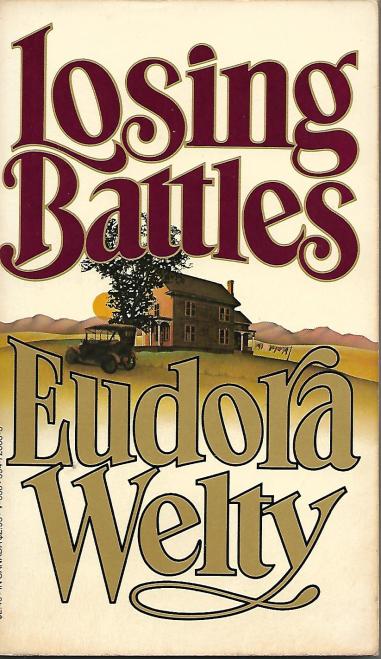
It’s Granny Vaughn’s ninetieth birthday. Her large Mississippi family has gathered on a hot Sunday in August to mark the occasion. It’s the Depression era, 1930s, and nobody has much money, but Beulah Renfro, Granny Vaughn’s granddaughter, spreads a sumptuous meal for the hundred or so attendees. They eat like it’s going out of style.

Jack Jordan Renfro is the star of the reunion. He has plenty of aunts, uncles, cousins—besides his parents, his sisters and his granny—to fawn over him. He just got out of the penitentiary. We learn that he escaped the day before he was supposed to be released because he didn’t want to miss granny’s birthday celebration. He also has a wife named Gloria and a baby daughter, Lady May. Gloria was his schoolteacher he married before he went into the penitentiary. Gloria was an orphan child; nobody knows for sure who her parents were. One of the surprising things that’s revealed during the reunion is that she and Jack might be first cousins.

There are some surprise guests at the reunion, some old-time preaching, some arguing and much laughter, but, more than anything, there’s talk: talk about how Jack came to be sent to the penitentiary; talk of an old-maid schoolteacher, Miss Julia Mortimer, who has just died and whose funeral will be the day after the reunion; almost everybody at the reunion went to school to Miss Julia and they have stories to tell of her hardness and her dedication to teaching. There’s also talk of hard times and good times and bad times, births and deaths. Everybody likes to talk and they all have much to say.

Losing Battles is an unconventional novel because it takes place all in one day and part of the next day, which means there isn’t much story or plot. Get a hundred people from your family together for one day and then write down everything they say and do during that one day, and you’ll know what I mean. It’s an interesting book because of its setting (the South during the 1930s) and because it was written by a venerated American writer (her last novel), but it could have been more interesting if the action had been opened up a little bit, making the story less static.

Copyright © 2017 by Allen Kopp