Night Watch ~ A Capsule Book Review

Night Watch book cover
Night Watch ~ A Capsule Book Review by Allen Kopp ~  

Night Watch by Jayne Anne Phillips is a period novel set in the state of Virginia in the period after the Civil War. A woman named Eliza Connolly lives with her daughter (whose name is also Eliza but is called ConaLee) in an isolated, rough, mountain setting, impassable in winter. Her husband has gone off to fight in the Civil War; she doesn’t know if he is still alive. An old woman named Dearbhla lives near them. She knows all the old conjuring ways, although she claims to not be a conjurer. She helps Eliza Connally and her young daughter and looks after them. Dearbhla is the mother (maybe) of Eliza’s husband.

These people living on their mountain are removed from the war, but every now and then the war intrudes on their lives. A man shows up with evil intent. He appears to be a straggler from the war, or maybe a deserter. He goes away, but then he comes back because he has taken a liking to the woman Eliza Connolly. He calls himself Papa. We never know him by any other. He finds that the remote mountain is a good place for  him to hide out, so he will stay as long as he needs to. After a while, Mrs. Connolly has a baby by Papa and then twins. (He forced himself on her.)

After a period of years, Mrs. Connoly stops talking and seems to have lost her mind, while ConaLee takes care of the babies. Papa, apparently desirous of moving on to greener pastures, takes the two of them (Mrs. Connolly and ConaLee) to the Trans-Allegheny Lunatic Asylum and drops them off. (The TALA is built on the grand Kirkbride model of lunatic asylums, popular at this time.)

Contrary to expectations, Mrs. Connolly is treated well in the lunatic asylum and seems to blossom. She is allowed to keep ConaLee with her as her “attendant.” (She doesn’t tell anybody that ConaLee is her daughter.) They have pleasant accommodations, and the staff are most helpful and courteous, especially the head of the institution, who develops a romantic interest in her.)

There’s one man at the asylum who will play an important part in the story. He’s the “gatekeeper” of the place, the first person there whom Mrs. Connolly and ConaLee meet. They call him “Night Watch,” which is also the title of the book. His face is disfigured, but nobody knows his story because he doesn’t remember it himself.

Soon an unexpected (and unwanted) person shows up at the asylum. Will this person bring the unpleasant past to life and jeopardize Mrs. Connolly’s progress? All will be revealed.

Night Watch won this year’s Pulitzer Prize for fiction. If you are a thinking person with an interest in good writing, I think you will find it well worth your time and effort. It’s a story about surviving (war, hardship, life) when you think it just might be easier to stop trying and lay down and die.

Copyright © 2024 by Allen Kopp

In Memoriam ~ A Capsule Book Review

In Memoriam book cover

In Memoriam
~ A Capsule Book Review by Allen Kopp ~

It has been said that the “Great War” (World War I) wiped out an entire generation of young men in England. We meet a few of these (fictional) young men in the novel In Memoriam by Alice Witt.

(Sidney) Ellwood and (Henry) Gaunt are students at a boys’ boarding school in England. (The students at this school go mostly by their last names.) Gaunt, it seems, joins the army at the beginning of the war with Germany because of his same-sex feelings for Gaunt. (We have to remember that homosexuality is a crime in England at this time.) Whatever feelings Gaunt has for Elwood, they are enthusiastically reciprocated.

Soon, Ellwood also “signs up,” along with many of the other “boys” (men) from the school he and Gaunt have attended. They cannot pass up the chance to experience the excitement and exhilaration of fighting in a war. They will all soon discover, however, that war experienced first-hand is not quite the same as they envisioned. The death toll mounts, as does the list of the grievously injured.

Ellwood and Gaunt are soon together at the front, but it’s not the same as it was at school, of course. Hell, even when experienced with one’s beloved, is still hell. Ellwood is present when Gaunt is shot in the chest. Ellwood is sure Gaunt is dead, but he himself is under fire, so he can’t stay behind to see. He runs for cover, believing that Gaunt has died.

So, Ellwood is left alone, to grieve for his beloved Gaunt. However, he has other, more immediate, problems on the front lines. He sees many of his friends and acquaintances killed or horribly injured. Soon, he himself is shot in the face. He loses one eye and part of his jawbone. Will he live, or will he join his beloved Gaunt in death?

In Memoriam engaged me fully, from the first page. It is a novel with an early-twentieth century sensibility. It might have been written in the 1920s or ‘30s by E. M. Forester or Evelyn Waugh. The gay angle of the story is downplayed and very tastefully handled. Homophobes needn’t be alarmed. In Memoriam is highly recommended, especially if you are interested in the War to End All Wars, as I am.

Copyright © 2024 by Allen Kopp

Goyhood ~ A Capsule Book Review

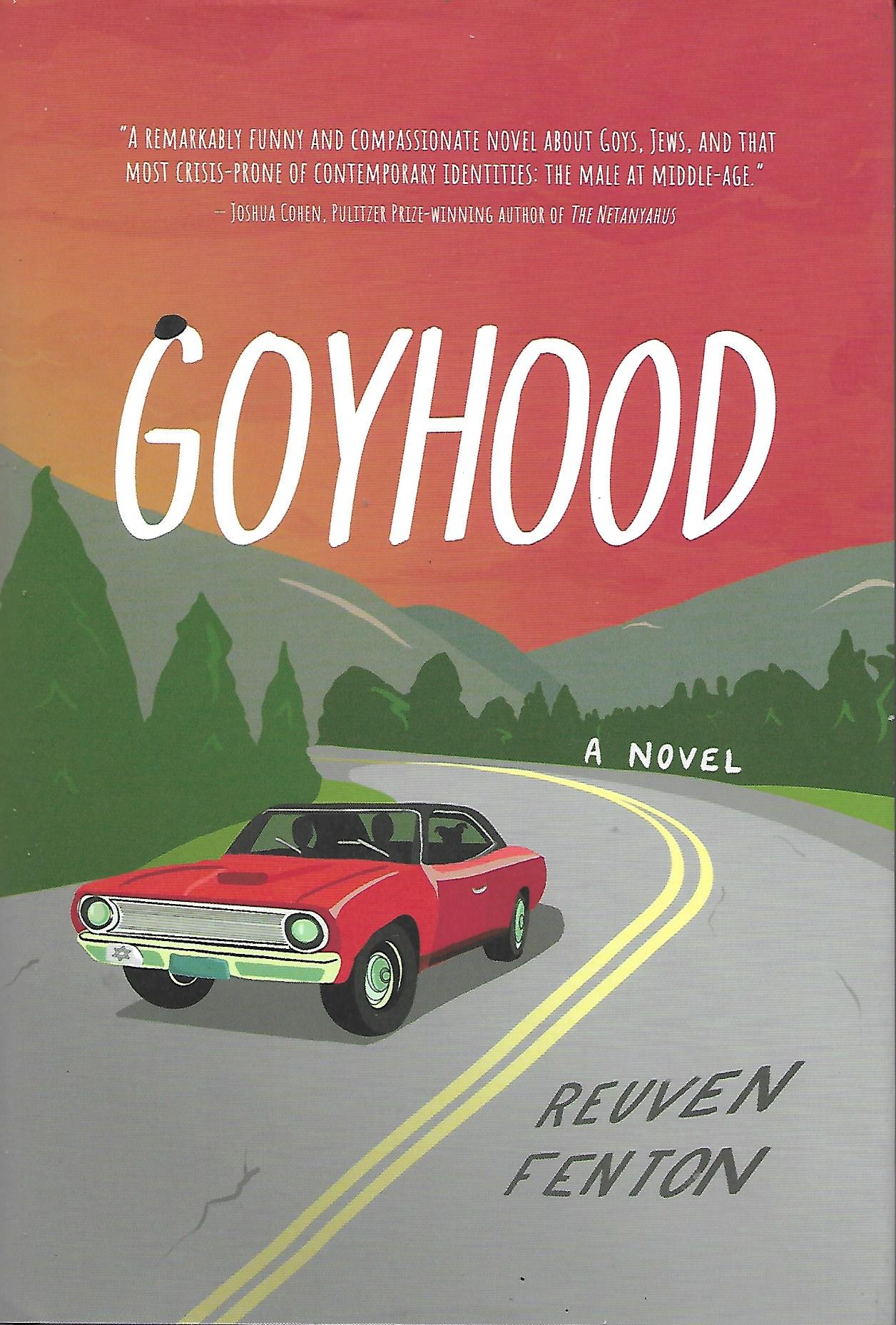
Goyhood cover
Goyhood
~ A Capsule Book Review by Allen Kopp ~

The main characters in Goyhood are twin brothers Marty (later Mayer) and David Belkin. They live with their eccentric mother, Ida Mae, in the small town of New Moab, Georgia. When they are ten years old, Ida Mae informs them they are Jewish. Devil-may-care David doesn’t really care if he is Jewish or not. Marty, however, is shaken to the core by this revelation. He changes his name to Mayer and becomes an Orthodox Jew, making a profession of studying the Torah. When he becomes a man, he marries a Jewish woman named Sarah, whose father is a famous rabbi.

Years later, when Mayer and David are in their forties, they receive word that their (by-now) enormously obese mother has committed suicide. (Mayer lives in Brooklyn and David in Atlanta.) They both converge on their hometown of New Moab, Georgia, to attend the funeral. However, they learn there will be no funeral because their mother has been cremated. They are presented with an urn containing her ashes, which they, quite sensibly, refer to as Ida Mae. That’s not all, though. She has left Mayer and David a suicide not in which she reveals that they aren’t really Jewish after all.

Mayer is shattered. He has been living a lie, albeit an unwitting lie. He isn’t a Jew; he’s a gentile. He’s a fake; he’s a liar, he’s a sham. He only wants to get back to Brooklyn to convert to Judaism and make thing right with Sarah. His brother David, though, has other ideas. How about a road trip through the South? They can have some adventures, and it will give them some time to reconnect as brothers. Mayer reluctantly agrees against his better judgment. They rent a jazzed-up, red, retro car that David names Daisy.

Right away on their travels, Mayer and David encounter a lovable stray dog alongside the highway. David wants to keep the dog, but Mayer is against it. David wins, and they take the dog wherever they go, even into restaurants. David names the dog Popeye because he has been mauled in a fight and only has one eye. Despite his rough appearance, Popeye is very sweet, and both brothers fall in love with him.

The brothers spend several days in New Orleans, where David encounters an old friend named Charlayne Valentine. She is black and is on her way to hike the Appalachian Trail, which is over 2,000 miles long. She becomes a significant addition to the duo and a major character.

During the trip, Mayer unwinds a little and has some startling self-revelations: For one thing, he realizes he has been married to the wrong woman for eighteen years. And the question about his Jewishness is an obvious one. Even though he isn’t really a Jew, he can become one. We are what we think we are, even when we are (unwittingly) something else.

Goyhood is a first novel by New York Post writer Reuven Fenton, who writes some very smart dialogue. I had a little trouble with some of the Hebrew words and phrases, but that’s a minor quibble. It’s an entertaining novel, filled with droll humor, some surprising twists and turns, and a minimum of heart-rending tragedy. Highly recommended for summer reading or reading at any other season.

Copyright © 2024 by Allen Kopp