When My Turn Comes

When My Turn Comes ~ A Short Story by Allen Kopp 

In the air is the smell of rubbing alcohol, or, as it is more commonly known, “shot medicine.” It’s shot day and Miss Goldsmith, the school nurse—along with her huge female assistant with bulging arms, affectionately referred to as “the Angel of Death”—is alone in the narrow nurse’s room on the third floor with the door, usually opened, now closed.  The ghoulish pair requires solitude while they lay out on the table the cotton balls, syringes, frightening-looking bottles of serum, and hundreds of needles required to vaccinate the students of Harmony Hill elementary school against the dreaded scourge of disease. When they are ready to begin, the door will re-open and the Angel of Death will issue forth with a bunch of the blue “shot cards” in her dimpled hands to collect the first lucky recipients of the largess of the state health department. We wait in our stifling classroom, pretending to be paying attention to our social studies lesson, but instead consumed with worry about when the Angel of Death will appear at our door and begin calling out the names of those of us who must submit to the needle.

Miss Joyce, our teacher, pauses in midsentence when there is a knock at the door. We all sit bolt upright, knowing our moment has come. The door opens and there is the Angel of Death proffering her stack of blue cards as she steps into the room. She has a satisfied grin on her lipsticked mouth as Miss Joyce gives her the go-ahead and she begins calling out the names, in seemingly random—rather than alphabetical—order: Eddie Fuller, Ramona Peabody, Roy Babb, Emory Dalton, Felicity Fleming, Curtis Welch, Norman Hardy, Betty Ray, Travis Fletcher, George Abney…

By the time my name is called, I have a lump of dread in my stomach, but I stand up and walk jauntily to the front of the room and take my blue shot card from the Angel of Death with a smile on my face as if getting stuck in the arm with a needle is the one thing in the world I’m longing to do today.

When all the names have been called (about half in the room) and we are all lined up ready to go, the Angel of Death leads us out of the room, down the long hallway and up the stairs. We don’t make a sound except for the clomping of our shoes on the old wooden floors.  

While we are standing in the nurse’s room in a line that goes all the way out into the hallway, Wanda Gilroy, who I don’t know very well because she’s in another grade, wets her pants and begins wailing. One of the older girls leads her away by the arm—as if wetting her pants has somehow affected her ability to see—while the Angel of Death puts some paper towels on the floor to soak up the urine so the rest of us won’t have to walk through it. Wanda might have thought that wetting her pants would get her out of getting the shot, but she’ll have to get back in line as soon as she dries herself off.  

I’m about twenty people back, and the line seems to be moving very slow (is this going to take all day?), when there’s a commotion at the front of the line. Leroy Meinhardt is putting up a fuss just as Miss Goldsmith is wiping his stringy little arm with the alcohol-soaked cotton ball. It seems that Leroy has decided at the very last moment that he can’t and won’t tolerate getting a shot today. He keeps saying, “No! No! No!” As he tries to pull away, Miss Goldsmith holds him and says, “There, now, this isn’t going to hurt at all.” She finishes swabbing his arm and when Leroy sees the syringe she’s holding in her hand, he breaks away. He dives under the little hospital bed against the wall, but he’s no match for the Angel of Death. She grabs him by the ankles and pulls him out easily on the slick tile floor. She jerks his little ass to a standing position and sets him down in easy reach of Miss Goldsmith with her needle.

“You’re making this much harder than it needs to be,” Miss Goldsmith says grimly. “I’m just as determined to give it as you are not to get it!”

Leroy appears to be about to acquiesce; he is holding still but making little sobbing sounds. Miss Goldsmith holds his arm in her vise-like grip and swabs it again. When she has the needle not more than three inches from his arm, he breaks away again but the Angel of Death grabs him before he has a chance to get very far. She sits down and pulls him toward her and holds him between her massive thighs. She puts her arms around his upper body as if she is a bear and, in this way, with her arms and legs, holds him immobile. He is making “yah-yah,” sounds, but he can’t move so he is essentially helpless, eyes shut tight, holding his breath and gritting his teeth. 

Miss Goldsmith grabs the flesh of his upper arm in her left hand and with the other hand sticks the needle in. She pushes the plunger on the syringe, emptying the life-saving serum into his arm, and withdraws the needle.

Leroy grows limp; his head lolls forward on his shoulders. The Angel of Death continues to hold him because it seems he will slump to the floor if she doesn’t, but in a few seconds he opens his eyes and looks around as if he is just coming out of a trance. The room is absolutely still, with everybody watching him. When he realizes he is half-sitting on the Angel of Death’s lap, he pushes away and stands up and smiles broadly. Everybody in the room claps and cheers, jubilant that the ordeal is over and has ended in success.    

When my turn comes, I look out the window at the sky and let my body go as limp as I can to still remain standing. I don’t look at the needle going into my arm and I won’t show that I feel it. I believe, even at my young age, in the principle of simple human dignity. I would never want anybody to see me making a scene, crying and screaming, the way Leroy Meinhardt does. He will always be remembered, even decades later, as a whiny crybaby and a person to be avoided.

I get my lemon sucker, the kind with the soft loop—so if you fall flat on your face while you’re eating it you won’t push it out the backside of your head—and go back downstairs to Miss Joyce’s room. I’m not supposed to eat the sucker until recess, so I put it in my shirt pocket for safe keeping. I’m happy to have the shot over with. I don’t see what all the fuss was about; it didn’t hurt at all. I’ll try to remember that for the next time, but I probably won’t.

Copyright © 2011 by Allen Kopp

The Last Hour of the Day


The Last Hour of the Day ~ A Short Story by Allen Kopp 

(Published in The Santa Fe Writers’ Project Journal, March 2011)

Holton had come a long way from the city. He hadn’t seen another person for three days. For the first time in longer than he could remember, he felt at ease in his surroundings. He sat down on the riverbank underneath a tree and looked at the sky. The clouds had lifted and the sunlight glinted in gold on the water. There was still beauty in the world.

He took a tiny sip of water from the canteen. He didn’t have much left and he knew he was going to have to get more, and soon. He could go for a long time without food but water was a different matter. He would never get thirsty enough to drink from the river. If drinking from the river didn’t kill him, it could make him sick enough that he might never recover.

He took a tiny bundle from his pack and unwrapped it carefully; it contained the last of his food—a carrot, a piece of bread, a chunk of dried meat, and some candy. He wrapped the bread around the meat and began taking tiny bites. He chewed slowly to make it last longer.

Would building a fire and boiling some water from the river make the water safe for drinking, he wondered? If he was going to build a fire, he might as well stay the night. He was weighing these considerations in his mind when a sound startled him. He looked up to see a man walking toward him and he realized the sound he heard was the man singing. He grabbed for his pack and thrust his hand inside to where his gun rested on the bottom.

“I don’t have anything you want,” he said, when the man was close enough to speak to.

“Don’t worry,” said the man, who went by the name of Clement. “I’m not going to bother you. I only want to rest here for a while.”

“I’d like it better if you were to move along. There’s nothing here for you.”

“No doubt,” Clement said with a little laugh. He took off his boots and lay on the ground with his feet toward the river, just to the right of Holton. He was wearing clean white socks.

“I have a gun here and I know how to use it,” Holton said. “Just in case you have any ideas about trying to steal what I have.”  

“I’m not going to steal anything. You have nothing I want.”

“What do you want then?”

He looked at Holton as if studying him. “I don’t want anything from you,” he said. “I’m not going to do you any harm.”  

“What’s your game, then?”

“I don’t have one. Maybe I just want to hear the sound of a voice other than my own. Is that too much to ask?”

“I’m not much for talking. I really ought to be on my way.”

“Where exactly is it you’re headed?”  

Holton relaxed a little and forgot about drawing the gun. He didn’t have bullets anyway. “I got out of the city and just kept going,” he said. “This is where I ended up. I don’t know where I am. I don’t even know if I’m in the same state or in another one.”

“Geographical boundaries don’t seem to matter much now.”

“Everybody in the city was dying. I knew I would die, too, if I stayed there. Once I left the city, I just kept going until I ended up here.” 

“How long ago was that?” Clement asked.

“A week. Maybe longer. I seem to have lost some time and I don’t know how much.”

“Are you sure you don’t have the sickness?”

“I know what the symptoms are,” Holton said, “and I don’t have them yet.”

“But you expect to have them?”

“We heard the enemy dropped bombs with the sickness in them on every city. The people in the city would die first and then the sickness would spread to the spaces between the cities and the people there would die too.”

“You had family in the city?” Clement asked.

“I was new to the city. I have a wife and child but they’re far away in another place.” 

“Are they all right?”

“I don’t know. There’s no way for me to find out now. I had in my mind that if I just kept going as long as I could I might come to a place where the sickness hadn’t reached or couldn’t reach for some reason, and there would be people there like me.”

“People without the sickness?”

“Yes. Or maybe people who know how to keep from getting the sickness.”

“You’re witnessing the death of the human race,” Clement said. “Not just the decline but the end. God brought it into existence and now He’s ending it.”

“You believe in God?”

“Yes. Don’t you?”

“I don’t know what I believe. If there’s a God, why is he doing this to us?”

“He’s not doing anything to us. It’s just something that happens. Do you know how many extinct species there are in the history of the world? There’s about to be another one, that’s all. Man is no more important than any of the other species that have become extinct. We’re important to ourselves but that’s all. This planet was here a long time before we came along, and it will be here long after we’re gone.”

“There might be places where people will survive the sickness. We don’t know yet.”

“They might survive for a while, but it will eventually catch them in the end.”

“How do you know so much about it?” Holton asked, suddenly suspicious. 

“I don’t know any more about it than anybody else. I’m just repeating what somebody else has told me.”

“Maybe they’re wrong,” Holton said. “Maybe you’re wrong.”

“It sounds like you want to go on living,” Clement said.

“If I didn’t, I wouldn’t have left the city.”

“Maybe we’ve reached the end. Maybe there’s no point in going on. We could go on for another day or another month or even longer, but the end result is going to be the same. Why prolong it?”

“You haven’t told me yet where you’re going or where you’ve been,” Holton said.   

Clement cleared his throat and looked out at the river. “I’m staying a couple of miles from here, over in those hills,” he said, as he pointed over his shoulder away from the river. “I stopped running shortly after the bombs fell. I figured there was no use trying to outrun the sickness. I wanted to spend my last days in relative comfort.”

“You have shelter?” Holton asked.

“Yes.”

“Food and water?”

“Food enough to last for as long as I need it and plenty of water. There’s a well nearby. It has the coldest, purest water you ever saw.”

“And there’s nobody else around?” Holton asked.

“It’s so far back in the hills nobody would ever find it.”  

“How did you find it, then?”

“It’s a place I’ve known about since I was a child.”  

The sun was going down behind the trees beyond the river and there was a sudden chill in the air. Holton thought about moving on but was too tired to even get up off the ground.

“I need clean water,” he said carefully. “I was just thinking about boiling some water from the river when you came along.”

“Don’t think about drinking that muck,” Clement said. “It has enough contaminants in it to kill the entire population.” He laughed at the irony of his remark. “I doubt if boiling would ever make it safe enough to drink.”

“I might have no other choice,” Holton said. “If I don’t get water soon, I’ll be dead from something other than the sickness.”

“You can come to the place where I’m staying,” Clement said, “if you don’t mind tramping a couple of miles through the woods. There’s as much water there as you could want.”

“I have nothing to trade for it.”

Clement snorted with amusement. “It’s not my water,” he said. “It was there when I came along and it will still be there after I’m gone. You might as well get yourself some of it while you can.”

Holton agreed to go with Clement, so, without another word, Clement put his books back on. When he had them laced up, he stood and motioned for Holton to follow him.

In a short time after they entered the dense forest, Holton was sure they were lost but Clement kept going without hesitation. The terrain was rough and rocky in places and they seemed to be going upward most of the way, as if they were climbing the side of a mountain. Finally, after what seemed two hours or more of very difficult walking, they came to a clearing with a little cabin in it.

Clement took Holton inside the cabin, which was two little rooms, and pointed to one of his two canvas chairs and told him to sit down and rest. While Holton was taking off his shoes and socks, Clement brought him a pitcher of water and a tin cup. Holton drank most of the water in the pitcher so Clement filled it again.

Clement had a little cook stove in one corner of the cabin that served as the kitchen. He told Holton to go out behind the cabin and get himself washed while he prepared the food. He gave Holton a shirt and pair of pants that were like new to put on after he had washed and told him to keep them because he had no use for them.

After Holton had made himself as clean as he could and put on the clean shirt and pants, he went back inside the cabin. Clement was just putting the food on the little table. He gestured for Holton to sit down.

They dined silently on canned soup, beans, spinach, and tomatoes. Holton ate his fill and leaned back in the chair with contentment. He was thinking that he should leave and not prevail too much on Clement’s hospitality, but he knew he would never find his way back down the mountain in the dark.  

“You’ll want to stay the night now,” Clement said, as if he was reading Holton’s thoughts. “The forest is not safe at night if you’re not familiar with it.”

“Not safe,” Holton said. He thought about those words and then laughed.

After they were finished eating and Clement had cleared away the food and washed up the dishes, they went outside and sat on the step of the little cabin. It was so dark they couldn’t see more than five feet in front of them. Clement offered Holton a cigarette but he declined it, not liking himself in the role of the taker who had nothing to offer.

They talked about pleasant things that they knew before all the trouble came about. They talked about dogs and cats they had owned and books they had read and music they liked and trips abroad they had taken. Holton told Clement about his ten-year-old son and about how he and his wife planned to divorce, but if she was dead now, as he figured she was, there would be no need for the divorce. He said this with irony as if the thought amused him, but then he began to cry uncontrollably.

“It’s all right,” Clement said, unembarrassed, putting his arm around Holton’s shoulder. “I think you just need to let it out and then you’ll feel better.”

When they were back inside the cabin and Clement had rolled himself in his sleeping bag on the floor and Holton was lying on the cot, Clement started talking about the end that he knew was coming. He didn’t mind dying so much, he said; he had had a good life, what there was of it. He had seen the world and known true happiness. His greatest fear now was that there would be no one to bury him properly when he died. His body would be left lying out to rot in the open air where flies and other insects and starving animals would feast on it down to the bones. He could see himself, he said, one week after he was dead, one month, one year. It was too horrible to contemplate. He had seen and smelled rotting corpses in the war and he believed there was nothing worse. If he had a way to make himself evaporate in the air, to no longer exist, he would do it.

“I was hoping to find somebody I could rely on to bury me when the time comes,” he said.

“Maybe you won’t die,” Holton said. “As long as you’re alive, there’s hope you’ll go on living.”

“No, I’ve got the sickness in my bones. I can feel it. It won’t be long now.”

To humor him, and to repay Clement for his kindness and generosity, Holton agreed to stay for a few days and, if Clement died during that time, he would see that he was buried properly, in as deep a hole as Holton could dig. He would pile large rocks on the grave to make sure no animals could ever dig it up. He would even read some verses from the Bible if that’s what Clement wanted. In his heart, however, he was sure that things would not play out that way.  

They slept soundly that night and the next day had a pleasant time relaxing in the sun-dappled shade outside the cabin, talking and laughing and forgetting the terrible state the world was in. By the evening, twenty-four hours after he had arrived at Clement’s cabin, Holton was starting to show symptoms of the sickness. His vision was blurred and his face wore a deathly pallor. He was vomiting blood and babbling incoherently.

Holton passed a very bad night on the cot in the little cabin. Clement tended him the best he could, but there wasn’t much he could do for him; he had no medicine. He gave him drinks of water, bathed his face in cold water, and tried to soothe his fears the best he could. Toward morning his body began turning black and he died just as the birds were waking up in the trees outside the cabin.

As soon as Clement realized Holton was dead, he went outside and began digging the grave under the trees in the clearing, in the spot he had set aside for his own grave. When he was satisfied the grave was the appropriate depth, he went back inside the cabin and put Holton’s body in the canvas bag that he had planned would contain his own body when the time came. Then he carried the bag outside and carefully arranged it on the floor of the grave so Holton was facing up. Gasping for air—realizing he was no longer as young as he once was—he said a silent prayer for Holton and, when he was finished, he filled in the grave.

All day long and during the night he expected to begin to see the symptoms of the sickness in himself, but the symptoms didn’t appear. When he awoke the next morning, he felt fine and was very hungry. He ate an enormous breakfast, washed himself at the pump and put on clean clothes.

Two days later he still felt well and healthy. He looked at his face in the mirror for any signs of change but saw none. He felt as well as he had ever felt in his life, in spite of the reduced circumstances in which he was living. He began to think that he was being spared the sickness for some reason or another.  

That night a voice seemed to speak to him in a dream. He didn’t know if it was Holton’s voice or somebody else’s, but it was a voice he knew—maybe a voice from his distant past. The voice was telling him to go to the river and follow it south all the way to its end where it emptied into the sea—hundreds of miles. At the end of that journey he would find some kind of answer—perhaps not the answer he wished for—but an answer nonetheless.

He awoke in the morning with a resolve he hadn’t felt in a long while. The resolve had taken the place of the resignation he had felt since the bombs fell. He put as much food as he could carry into his pack, two canteens of water, and a change of clothes. He took one last look around the cabin and went out its door for the last time. With the slap of the screen door still in his ears, he looked toward the mound of dirt under the trees in the clearing and gave a little salute of farewell. Then he was gone, melding into the trees of the forest as if he had never existed.   

Copyright © 2011 by Allen Kopp

Pompeii ~ The Fabled Buried City


Pompeii ~ The Fabled Buried City

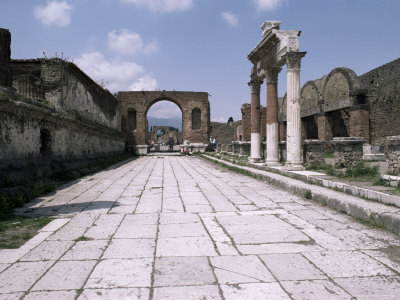
Imagine yourself living in an upscale seaside resort town of about 20,000 people, with a scenic mountain as a backdrop. The mountain, as it so happens, is an active volcano. On a day in August the volcano erupts with unexpected fury and, in a short time, the town is covered underneath layers of volcanic ash and pumice. A few of the residents of the town are able to escape, but most of them die. But that’s not the end of the story. The remarkable part is that the town, buried underneath all that muck, was all but forgotten until it was accidentally discovered about 1700 years later and became the archaeological find of the age. We’re talking, of course, about the fabled Italian city of Pompeii, lying on the Bay of Naples in the region of Campania.

Pompeii was founded about 700 years before Christ by the Oscans, a people of central Italy. (It’s difficult for us to imagine a town being in existence for hundreds of years.) Early in its history it was captured by the Etruscans. Between 525 and 474 B.C., it was captured by the Greek colony of Cumae, which was allied with Syracuse. In the 5th century B.C., the Samnites conquered it, imposing their architecture and enlarging the town. After the Samnite Wars in the 4th century B.C., Pompeii was forced to accept the status of socium of Rome and remained faithful to Rome during the Second Punic War.

Pompeii took part in the war that the towns of Campania initiated against Rome, and was besieged by Roman General Lucius Cornelius Sulla in the year 89 B.C. In 80 B.C., Pompeii was forced to surrender after the conquest of Nola, resulting in many of Sulla’s soldiers being given land and property and many people who went against Rome being stripped of their property. Pompeii became a Roman colony and an important passage for goods that arrived by sea.  

Pompeii during this time underwent a period of expansion and development. In addition to an amphitheatre being built, there were a palaestra (gymnasium) with a central swimming pool, an aqueduct that provided water for street fountains, public baths, businesses, and private houses. There were a forum, a vast food market, a sort of bar that served hot and cold drinks, restaurants, and a large hotel. For those people with the means to enjoy the amenities of the town, life must have been very pleasant. Many affluent Romans had their vacation villas there.

Then, in August of 79 A.D., a tragedy of alarming proportions occurred. Mount Vesuvius erupted, destroying Pompeii and its sister town, Herculaneum. Pompeii was lost to the ages for many centuries and, when it was accidentally rediscovered and excavated in the 18th century, it provided an astonishingly rich treasure trove of artifacts. The forum, the baths, many houses and some out-of-town villas were remarkably well-preserved, due to the lack of air and moisture. A large number of well-preserved frescoes allowed the modern world a glimpse of what everyday life was like just a few decades into the Christian era.  

Today the site of Pompeii is one of the most interesting and popular tourist destinations in the world. Anybody who has ever been fortunate enough to visit Pompeii agrees that there is else nothing quite like it anyplace in the world.

Copyright © 2011 by Allen Kopp
Map of the World

Map of the World ~ A Short Story by Allen Kopp

On the first day of the new school term, Joanne Torrance was sullen and unhappy. She wasn’t ready for summer vacation to be over; she wanted to be able to stay at home and do as she pleased all the time. It wouldn’t have mattered to her if school had never taken up again for as long as she lived. She was sure she could learn all she needed to know from reading books and magazines and seeing lots of movies and watching the really important shows on TV like Superman and Lassie and The Three Stooges

As soon as she met her new teacher for the first time—one Ruby Chinn—she hated her on sight. She had long yellow teeth that showed even when her mouth was closed. She had dyed hair the color of beets that she wore pulled into a severe bun on top of her head that resembled a cake made out of hair and that showed the fleshy folds on the sides of her face and neck. Joanne could have told her how she might adopt a more flattering hairdo to complement her round face, but she didn’t care how ridiculous a person’s hair looked when she despised that person as much as she despised Miss Chinn.   

Since it was the first day of the new term and people didn’t know each other very well, Miss Chinn had each person write his (or her, as the case may be) name on the blackboard in colored chalk. After writing his or her name, the person was to turn around and face the class and introduce himself (or herself) in a loud clear voice. The boys were then supposed to bow from the waist and the girls to curtsey. This was a chance for everybody to get to know what face went with what name. Miss Chinn referred to this exercise as an ice breaker.

When Joanne’s turn came, she went to the blackboard and picked up the pink chalk and wrote her name in a neat cursive script underneath the babyish scrawl of the person who went before her. Then she turned around and bowed from the waist instead of curtseying. A howl went up from the class and she flushed with embarrassment.

“No, no, no!” Miss Chinn said impatiently with her forefingers extended, two feet apart, as though measuring the length of a fish she had caught. “What do girls do?”

“Curtsey!” the class said in unison.

“And what do boys do?”

“Bow from the waist!”

“That’s right! Now, Joanne, I have a simple question for you and it isn’t that difficult. Are you a girl or a boy?”

Again a howl of laughter erupted from the class. They were enjoying her discomfort, which went a long way toward relieving the tedium of the first day of class.  

“I’m a girl,” she said in a small voice.

“What was that?” Miss Chinn said. “I can’t hear you!”

“I said I’m a girl!”

“Well, you certainly look like a girl, but we all just saw you do the thing that boys do. Now, can you prove that you’re a girl and do what girls do?”

“No.”

“What do you mean ‘no’?”  

“I mean I would rather not.”

“And why would you rather not?”

“It’s silly.”

“Not as silly as you are in refusing to do it.”

“I don’t think I have to do it just because you tell me to do it.”

Miss Chinn rolled her eyes and the class laughed again. “If there is one thing I will not tolerate in the classroom,” she bellowed, “it is insolence!”

“You and me both,” Joanne said, but not loud enough for Miss Chinn to hear it.

“You are wasting precious time! Sit down this instant! We’ll deal with this matter later.” She opened her grade book. “I could send you to the principal’s office, but I know he’s busy on the first day and would rather not be bothered, so I’m giving you a failing grade for the day. You may be the only student in the history of this school to get a failing grade for the first day of the new term.”

“Whoo-whoo-whoo!” went the class.

Joanne returned to her seat, wishing she had a pirate dagger to plunge far into the heart of Miss Chinn and everybody else in the class.

The next person to the blackboard to write her name was Veronica Kennedy. She had blonde hair and dimples and a beauty mark on her right cheek. People said she looked like a movie star and would go far in life. She already had breasts and was wearing a brassiere, the outline of which could be clearly seen through her lovely yellow blouse. She wrote her name beautifully with yellow chalk (yellow seemed to be her color) underneath Joanne’s name, and then she turned and faced the class and executed a perfect curtsey, holding her skirt out just far enough so that the edge of her underpants showed. The class erupted in cheers and applause.  

“You see?” Miss Chinn said triumphantly. “That is what girls do!”

“Yaw-yaw-yaw!” went the class as Veronica Kennedy smirked with superiority and resumed her seat.

Later in the day, during the social studies lesson, Miss Chinn pulled down a map of the world like a window shade and stood before it with her pointer.

“Now,” she said, “who can tell me where Peru is?”

Joanne was the only person in the class who raised a hand.

“Come now,” Miss Chinn said. “Doesn’t anybody know where Peru is?”

Joanne raised her hand even higher. She was all the way at the back of the room, so maybe Miss Chinn hadn’t noticed her.

“Nobody?” Miss Chinn asked. “Can’t anybody tell me where Peru is? No? It’s in South America. Can anybody tell me where South America is?”

“I can!” Joanne said, waving her hand.

“Who said that?” Miss Chinn asked.

“I did!” Joanne said. 

“I believe I’m had quite enough of you for one day,” Miss Chinn said. “You should know by now that we don’t speak in class until we’ve been called on. You haven’t been called on.”

“Hoo-hoooooo!” went the class.

“Now, can anybody tell me where South America is?”

Joanne lowered her hand and slumped down in her chair.

“Nobody? Shame on you! It’s right there!” She pointed to South America, outlining it with the pointer. “And there is Peru!”   

During lunch in the school cafeteria, Joanne sat by herself facing the wall. She heard sniggers behind her back and knew they were coming from the next table where Veronica Kennedy and her coterie of followers were sitting. Somebody threw a wet bread ball and hit her in the side of the head, followed by a volley of snorting laughter. She was only half-finished with her lunch, but she didn’t feel like eating the rest of it and so stood up and emptied her tray and went outside.

Rosalie Dunphy was leaning against the side of the building with her head tilted back against the brick and her eyes closed, like a cat sunning itself. She was a large, silent girl with wild unkempt hair who was a couple of years older than anybody else because she had been held back two grades. Joanne knew her slightly from the year before. When she walked up to her, Rosalie opened her eyes and looked at her but didn’t move her head.

“I’d like to poison Miss Chinn,” Joanne said.

Rosalie reached in her pocket and took out a folded-up piece of paper and handed it to Joanne. “I drew this,” she said.

Joanne unfolded the paper and saw there a picture of a witch flying on a broomstick with her heels up in the air and a leer on her face. She was wearing a pointed hat and had a hump on her back and a wart on her chin with hairs coming out of it. It was a perfect likeness of Miss Chinn.

“That’s pretty good,” she said, handing the drawing back to Rosalie.

“I like to draw.”

She stood next to Rosalie against the wall and she somehow felt better and not so alone. “I hate everybody in this school,” Joanne said after a while.

“Come with me,” Rosalie said. “I have something I want to show you.”

She led the way around the building to the long flight of concrete steps that went down from the school grounds to Main Street. The steps were strictly off limits during school hours, but that didn’t make any difference to Rosalie. She went down near the bottom of the steps and sat down. Joanne followed her and sat next to her.

“You have to promise not to tell anybody about this,” Rosalie said.

“I won’t,” Joanne said.

She reached into her pocket again and took out a package of Lucky Strike cigarettes and a little box of kitchen matches.

Joanne wanted to say is that all, but she said nothing because Rosalie surprised her by taking a cigarette out of the pack and putting it in her mouth and lighting it as expertly as if she had been smoking her whole life.

Rosalie took a deep drag on the cigarette and inhaled the smoke into her lungs. “Ah, that is so good,” she said. 

After another drag, she held the cigarette out to Joanne. “Try it,” she said.

“I haven’t ever smoked before,” Joanne said.

“Try it.”

She took the cigarette from her and drew a little of the smoke into her mouth and breathed it out. “That tastes awful,” she said.

“It takes some practice before you’re any good at it,” Rosalie said.

They smoked the cigarette, handing it back and forth, until it was smoked down to the filter. Joanne didn’t like the taste of it at all, but she smiled every time she handed the cigarette back as if she approved and was enjoying it. When they heard the bell ring to go back inside, Rosalie flipped the cigarette butt away out to the street and they went back up the steps unnoticed.  

That evening when Joanne was having dinner with her mother, she had been going to tell her that she had smoked her first cigarette at school that day, but she decided it wouldn’t be a good idea. She had already had enough disapproval for one day. Instead she asked her mother if she knew where Peru is.

“Isn’t that in South America?” her mother asked. “They have those strange animals with the long necks.”

“Llamas,” Joanne said.

“That’s it!”

“I’m going to murder Old Cakehead.”

“Who’s that?”

“Miss Chinn, my new teacher.”

“Well, all right,” her mother said. “Just don’t get caught. The trick is to try to make it look like an accident or to make it look like somebody else did it. Somebody you don’t like.”

At ten o’clock Joanne got into bed, but before she turned off the light she looked at the map on the wall of her room that had been there for as long as she could remember. It was somehow reassuring to look at it every night before she went to sleep. She loved the colors—the pinks, oranges, browns, greens, yellows—surrounded by a dazzling expanse of blue that was the ocean. And, yes, from looking at the map every night of her life, she knew where Peru was and just about every other country in the world. She knew a lot more than some people were willing to give her credit for.  

Copyright © 2011 by Allen Kopp
Grace Metalious ~ A Sensational Life

Grace Metalious ~ A Sensational Life

Grace Metalious, American author of Peyton Place and other works, was a Yankee girl. She was born Mary Grace de Repentigny in Manchester, New Hampshire, on September 8, 1924. At the age of nineteen she married her childhood sweetheart, George Metalious. They settled in the New Hampshire town of Gilmanton, which, coincidentally, was also the birthplace in 1861 of one Herman Mudgett, who gained notoriety under the name of Dr. H. H. Holmes in the 1890s as America’s first serial killer.

Grace hated the hypocrisy, dissembling, and closed-door intrigues of small-town life. It was this atmosphere or repression that led her to write her first and most famous novel, Peyton Place.  

Peyton Place was turned down by virtually every publisher in New York. Publishers found its unsophisticated prose and explicit sexuality unfit for the sanitized 1950s. Finally it was accepted by the publishing house Julian Messner, where it was so heavily edited that Grace’s authorship was called into question. 

When the book was released, it became an unprecedented success, selling eight million copies in hardback and twelve million in paperback. In the 1950s it was exceeded in sales only by the Bible. It stayed on the New York Times bestseller list for over a year and made Grace Metalious a celebrity and a wealthy woman. 

In 1957, Peyton Place was turned into a surprisingly tasteful and artful movie starring Lana Turner. The movie was a critical and box-office success and added to the luster of the novel and its author. A best-selling sequel called Return to Peyton Place was penned by Metalious (she used a ghostwriter for this one), published in 1959, but she was never able to duplicate the success of Peyton Place, which for her was had been the pinnacle of her success. Subsequent novels, The Tight White Collar and No Adam in Eden were not successful. 

Grace Metalious’s private life was just as sensational and interesting as any of the characters in her books—some would argue more so. She did not handle fame and fortune well. She divorced her first husband (only to remarry him and divorce him again) and had two other failed marriages. She squandered much of her wealth and drank heavily. She attracted a series of lovers who were interested in her only for her money and fame. Her self-destructive tendencies continued for the rest of her life, until she died of liver disease at the age of thirty-nine on February 25, 1964. 

Grace Metalious was not an accomplished or a polished or a sophisticated writer, but she achieved the kind of success that few writers ever achieve. With the success of her books, the focus in publishing shifted from literary merit and critical praise to shrewd marketing and sensationalism. She began the trend for so-called “tell-all” books that continues to this day. For that reason, she was one of the most influential writers of the twentieth century.

Copyright © 2011 by Allen Kopp
Train Movies


Train Movies

I love trains. Not the way they are now but the way they used to be. People used to travel everywhere by train. There weren’t any jets yet and air travel was limited. It would take three days to go from New York to Los Angeles by train; it must have been a hot and exhausting trip, but what better way was there to see the country? Imagine going to sleep in your own little room on a train moving through the night with the landscape unfolding outside your window. What would we know about the romance of trains in today’s world if it wasn’t for the movies? Here is my list of movies in which trains play a significant part. 

At the Circus (1938)

The Marx Brothers are with a circus that travels by train. Groucho sings “Lydia the Tattooed Lady” onboard the train. Watch for Harpo’s sneeze in the midget car. Look out!

Berth Marks (1929)

Stan Laurel and Oliver Hardy are a couple of bumbling (what else?) musicians in this early sound short. Due to a mix-up with a female passenger (who has a very jealous husband), they wreak havoc among the passengers on a train and end up being forced to share an upper berth for the night. (Oddly enough, it appears to be broad daylight throughout the entire proceedings.) They try to remove their clothes to go to sleep while confined to the berth, but of course it’s hopeless.

Double Indemnity (1944)

Fred McMurray is an insurance salesman and Barbara Stanwyck is bad news in 1940s Los Angeles. Fred sells Barbara’s husband an insurance policy and then the two of them hatch a plot to kill the husband. Fred pretends to be Barbara’s husband, who has a broken foot, and gets on a train (so there’ll be witnesses) and pretends to jump off the back of the moving train to commit suicide. Meanwhile, they’ve already killed Barbara’s husband. Edward G. Robinson is an insurance investigator who just doesn’t buy their story. Whoever heard of a person jumping off the back of a slow-moving train to commit suicide?  

Some Like it Hot (1959)

Jack Lemmon and Tony Curtis are a couple of hapless musicians in 1929 Chicago who inadvertently witness the St. Valentine’s Day Massacre and are being pursued by vengeful gangsters. They disguise themselves as women and get jobs in an all-girl band and take a memorable train trip to Florida with Marilyn Monroe. The scene with Jack Lemmon and Marilyn in a berth on the train is one of the funniest ever. 

Dr. Zhivago (1965)

The Russian revolution has made mincemeat of their lives. Doctor-poet Yuri Zhivago, his wife, son, and father-in-law flee Moscow by train to go to his wife’s family estate. Since Russian is such a big country, they’re on the train for an extended period in less-than-ideal traveling conditions with hundreds of other people. Lots of pretty scenery as the tragic story plays out. 

Anna Karenina (1935)

In Imperial Russia, society lady Anna Karenina (played by Greta Garbo) causes a scandal when she leaves her dull husband for handsome Count Vronsky. Things do not go well for her. The classic “fallen woman” story. If you don’t know how the train figures into the story, you need to watch the movie, or, better yet, read the magnificent 850-page novel by Leo Tolstoy.

Murder on the Orient Express (1974)

In this film adaptation of an Agatha Christie novel, a tycoon (played by Richard Widmark) has been murdered on the glamorous Orient Express as it makes its way across Europe. There is a whole trainload of suspects, and it’s up to Belgian detective Hercule Poirot (played by Albert Finney) to find out who did it. Great cast including Anthony Perkins, Ingrid Bergman, Sean Connery, Vanessa Redgrave, and Lauren Bacall. Aces in all departments.

The Lady Vanishes (1938)

On a European train, a young woman named Iris Henderson befriends a friendly old woman named Miss Froy. After a while, Iris no longer sees Miss Froy on the train, and it seems that none of the other passengers have any recollection of Miss Froy ever being on the train. Did Iris just imagine Miss Froy, or is there something more sinister afoot? Something involving SPIES? This was one of Alfred Hitchcock’s best English films before he started making movies in America.

Shanghai Express (1932)

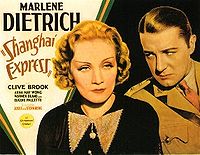
Marlene Dietrich and Anna May Wong are shady ladies on a train going across China with a group of disparate passengers, including a former boyfriend of Marlene’s (“They don’t call me Shanghai Lily for nothing.”). The passengers are caught up in political turmoil and the train is waylaid by a Chinese warlord. One of the best examples of classic cinematic art from Hollywood’s early Golden Age. Pure cinema.  

Polar Express (2004)

Charming and beautifully photographed Christmas-themed animated movie about a boy who is just old enough to doubt the existence of Santa Claus. A train (the Polar Express) magically appears outside his house on a snowy night and takes him (along with other doubting children) on a special expedition to the North Pole to meet the real Santa. This movie should be a perennial holiday classic.

Strangers on a Train (1951)

Professional tennis player (played by Farley Granger) meets a charming playboy (Robert Walker) on a train and they exchange life stories. It seems the tennis player has a wife he’d rather do without and the playboy hates his father. The playboy suggests to the tennis player that they “swap” murders: the playboy will kill the tennis player’s wife and the tennis player will kill the playboy’s father. The tennis player thinks it’s a joke but the playboy is serious. Watch for the memorable scene in the amusement park where the tennis player’s wife meets her fate at the hands of the playboy. They don’t call Alfred Hitchcock the Master for nothing.

Copyright © 2011 by Allen Kopp 

Prison Movies

Prison Movies

Most of us will never know what it’s like to be in prison. We have the movies, though, and through them we can get a glimpse of what life behind bars is really like. Prison movies have long been a staple of American films and they remain enduringly popular because they’re entertaining and full of human interest. Most of them are well-made and the better of them not only tell a story but have an underlying message, such as “the system is corrupt and needs to be reformed,” or “decent people are made indecent if they’re kept locked up long enough,” or “no matter what happens, you gotta have hope.” Here is my list of memorable prison pictures:

Caged (1950)

The best “women behind bars” movie ever. Naïve young woman (played by Eleanor Parker) must learn the harsh realities of prison life when she’s sentenced to a stretch behind bars for her part in a forty-dollar robbery. To make matters worse she’s expecting a baby, which is taken from her as soon as it’s born in prison. In the end, the system fails her. When she’s finally released years later, she’s no longer her sweet young self. She has become hardened and has picked up a few tricks from the despicable cons she came to know in the jug. She’ll be back!

Each Dawn I Die (1939)

What would prison movies be without James Cagney? He plays a reporter named Frank Ross who is framed for a crime he didn’t commit after he writes a story about corrupt city politicians. He thinks he’ll prove his innocence and walk out of the jail a free man, but the system doesn’t work in his favor. He begins to give in to despair until he meets fellow inmate Hood Stacey (played by George Raft), who just might hold the key to his release. One of the best of the Warner Brothers prison dramas of the 1930s.

The Big House (1930)

Seminal prison drama that set the standard for other prison pictures that followed. Weak-willed 24-year-old Kent Marlowe (played by Robert Montgomery) is sentenced to ten years in prison for manslaughter. He has two seasoned cons as cellmates: “Machine Gun” Butch Schmidt (played by Wallace Beery) and John Malone (Chester Morris), a decent fellow who got all the wrong breaks. Kent Marlowe has a difficult time adjusting to prison and can’t seem to learn the appropriate conduct to get along. He is responsible for John Malone losing his parole, but John Malone escapes and falls in love with Kent’s sister. Malone is recaptured and returned to prison in time to participate in a daring breakout attempt. The movie that started the “life behind bars” genre.   

Pardon Us (1931)

Parody of “The Big House,” released the year before. During Prohibition, Stan Laurel and Oliver Hardy (in their first full-length feature film) decide they’ll become bootleggers, and the result is that they end up in behind bars. Stan has a buzzing tooth that causes him no end of trouble but earns him the respect of a tough prison inmate named the Tiger. Stan and Ollie manage to escape and end up in black-face as workers on a Southern plantation. (Ollie sings “Lazy Moon.”) A chance meeting with the warden (and his daughter) from the prison they escaped from results in their being sent back. Their part in thwarting an escape attempt, however, earns them a parole.

Brute Force (1947)

Westgate Penitentiary is run by a brutal, music-loving guard named Captain Munsey (played by Hume Cronyn). The inmates fear him and hate him. He has been responsible for the death of more than one prisoner. He has met his match, though, in tough inmate Joe Collins (played by Burt Lancaster). When Joe Collins and others are assigned to hated drainpipe detail as punishment, they plan a daring escape attempt, storming the prison tower as though they’re fighting a war. These things never work out, but, as horrible as prison life is, you can’t blame them for trying. Maybe they’d rather try to escape and die trying than to spend all their days behind bars.  

Escape from Alcatraz (1979)

Alcatraz prison was for the most hardened criminals and was thought to be escape-proof—and it was—with one notable exception. Clint Eastwood plays Frank Morris, the one inmate who, in 1962, successfully escaped from Alcatraz. (Anybody else who ever tried it died in the attempt.) Frank Morris happens to be just a little bit smarter than everybody else. Through an elaborate ruse and after months of planning, he successfully escapes the island prison. No traces of him were ever found. Makes you believe that, with enough determination, anything is possible.

The Shawshank Redemption (1994)

Andy Dufresne (played by Tim Robbins) is sentence to life in prison for killing his wife and her boyfriend. Is he guilty or isn’t he? As terrible as prison is and as hopeless as his life may seem, he never loses hope. He was a banker on the outside and, after he has been in prison for a while, he ingratiates himself to the corrupt warden by running his illegal money-laundering operation. Over the years, through his cunning, he devises an elaborate scheme to not only escape from prison but to escape the country so he’ll never be caught and sent back. He bankrolls his life as an escapee by embezzling funds from the slimy warden. Once he is free, he meets up in Mexico with a fellow inmate whom he befriended in prison named Ellis “Red” Redding (played by Morgan Freeman). This is an unusual prison movie in that the protagonist is successful in escaping. He beats the system, something that doesn’t happen very often.       

I Want to Live (1958)

Susan Hayward took home Oscar gold for her role as real-life Barbara Graham, a good-time party girl who gets mixed up with the wrong crowd. She gets all the wrong breaks, ends up being charged with murder, and is sentenced to die in the gas chamber. If things had gone just a little differently for her, she could have been a decent mother and had a decent life. The final scenes are harrowing and touching. Not for the squeamish. Susan deserved her Oscar.

The Green Mile (1999)

A prison picture with a dash of fantasy. Tom Hanks plays a sympathetic guard in a death row cellblock. John Coffey (played by Michael Clarke Duncan) is not like the other prisoners. He’s set to die in the electric chair for a double murder that another prisoner committed. The most interesting thing about him, though, is that he has healing powers. He heals the guard of a kidney infection. He restores a pet mouse that has been crushed to death. He heals the wife of the warden who has a brain tumor. A memorable movie based on the Stephen King serial novel.  

I Am a Fugitive from a Chain Gang (1932)

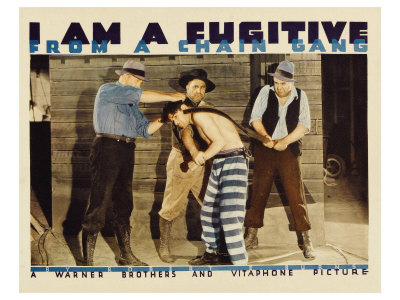
The thirties was a great decade for prison movies and for movies in general. In this gritty Depression-era prison drama, Paul Muni plays a decent fellow who just happens to be in the wrong place at the wrong time. For his unwitting participation in a diner holdup, he’s sentenced to a stretch in a nightmarish chain-gang prison, where inmates are routinely beaten, over-worked, and mistreated. He manages to escape but is betrayed by a jealous woman and returned. He is ultimately double-crossed by prison officials and ends up spending a lot more time in prison than he bargained for. Seems you can’t trust anybody. An exposé of the brutal prison system and a seminal classic film from Hollywood’s early Golden Age.

Cool Hand Luke (1967)

Paul Newman plays Luke, a likeable ne’r-do-well who ends up in a Southern chain-gang prison, where convicts must work all day in the heat building roads. Luke wins the hearts of the other prisoners, but he just doesn’t handle authority very well and can’t seem to abide by the strict rules of the place. Things don’t go well for him. He tries once too often to break out of prison, with tragic results. A classic “one man against the system” story. 

Midnight Express (1978)

Based on a true story. Young American Billy Hays (played by Brad Davis) attempts to smuggle a small amount of hashish out of Turkey to sell to his friends when he gets back home. He is caught before he can leave the country and is sentenced to three and a half years in a hellish Turkish prison, where prisoners are routinely tortured and live in conditions that make American prisons look like country clubs. When he has less than two months to go on his sentence, the Turkish court decides to change his sentence to a life sentence–seems they want to make an example of him. Never mind prisoners’ rights because they don’t have any. The lesson here is simple: Don’t try to smuggle drugs out of Turkey, even small amounts. You already knew that, though, didn’t you?   

Copyright © 2011 by Allen Kopp

What is Paranormal Ectoplasm?

What is Paranormal Ectoplasm?

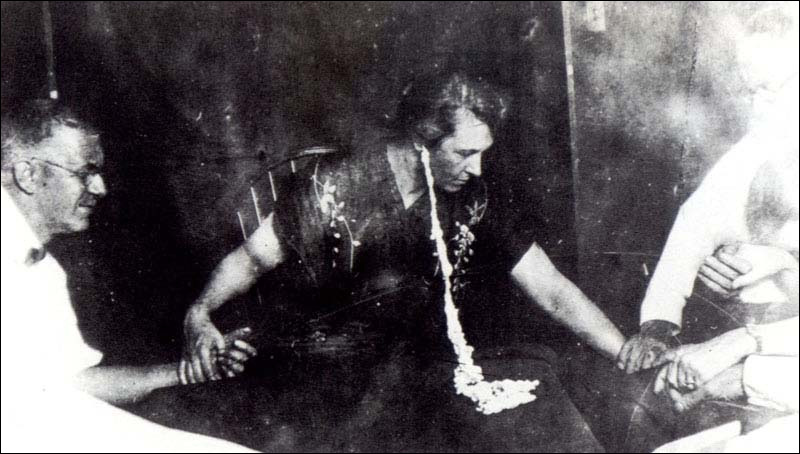
In the 2009 movie, “Haunting in Connecticut,” there’s a scene where a teenage boy, who is a “physical medium” between the living and the dead, is conducting a séance. A white substance starts to come out of the boy’s mouth, in slow motion, and forms above his head. It’s hard to describe the substance. It’s not really like a cloud or a puff of smoke but is more solid than that—more like cooked egg whites suspended in air. If you saw this scene, you will probably remember it. It’s a movie special effect, of course, but it’s sure to give you the creeps if you are at all susceptible.   

The white substance is known as “ectoplasm,” or, more accurately as “paranormal ectoplasm.” The word “ectoplasm” is derived from the Greek work ektos, meaning “outside” and “plasma,” meaning something formed or molded. Simply stated, “paranormal ectoplasm” is a substance excreted from the orifices (ears, mouths, noses) of physical mediums when they are in a trance state. Spiritual entities (ghosts) are said to drape this substance over their nonphysical bodies to allow themselves to interact in the physical world.

Paranormal ectoplasm has not been proved or accepted by the scientific world, so there is good reason to be skeptical of its existence. Substances that were purported to be ectoplasm have been studied and found to be much more mundane substances, such as human skin or chiffon. People who have actually witnessed paranormal ectoplasm firsthand—or believe they have—believe it’s truly a ghostly emanation, but the rest of us aren’t so sure. It’s like believing in UFOs or haunted houses or guardian angels. Either you believe it or you don’t.

Copyright © 2011 by Allen Kopp