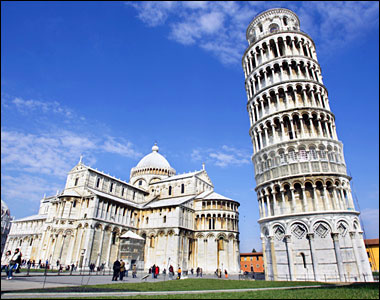
The Leaning Tower of Pisa

The Tower of Pisa ~ Why Does it Lean? 

Have you ever wondered why the world-famous Leaning Tower of Pisa appears to be in danger of falling over? Is the angle at which it leans to the side intentional or accidental?

The tower is the campanile, or freestanding bell tower, of the cathedral in the Italian city of Pisa. It stands behind the cathedral and is the third-oldest structure in Pisa’s Cathedral Square (the Cathedral and the Baptistry are older). It’s tilted at an angle of 3.99 degrees and stands 183 feet high on the lowest side and 186 feet high on the highest side. That is roughly equivalent to the height of an 18-story building.

Construction on the Tower of Pisa was begun in August of 1173, during a period of military success and prosperity. By the time the very slow construction had progressed to the third floor in 1178, the tower began to sink because of a poorly constructed foundation that was set in unstable subsoil. The Republic of Pisa was by this time engaged in wars with Genoa, Lucca and Florence, so construction was halted for almost a century. (Can you imagine a construction project being halted for a century nowadays?) This century-long delay allowed for the soil to settle; if not, the tower would almost certainly have fallen over.

Construction was resumed in 1272 under the architect Giovanni di Simone. To compensate for the tilt, engineers began building upper floors with one side taller than the other, making the tower lean in the other direction. Because of this, the tower is actually curved. In 1284, construction was halted again when Genoa defeated the Republic of Pisa in the Battle of Meloria.

In 1319, the seventh floor of the tower was completed, but the chamber where the bells were housed was not added until 1372. There are seven bells in the tower, one for each note of the musical major scale. The largest bell was installed in 1655.

The Italian government in 1964 requested aid in keeping the tower from falling over, but, whatever measures were taken to keep it standing upright, the tilt that had become so famous had to be preserved. An international task force of engineers, mathematicians, and historians was assigned to study and analyze the problem. A period of structural strengthening to halt the ever-increasing tilt began in 1990 and lasted about eleven years, after which the tower was declared stable for at least another 300 years. Today the tower is undergoing gradual surface restoration to repair corrosion and blackening caused by wind and rain.

The Leaning Tower of Pisa remains a popular tourist destination for anyone fortunate enough to be traveling in Italy. Seeing the tower and going to the top of it is surely an experience not to be forgotten.

Copyright © 2012 by Allen Kopp

Jupiter’s Moons

The Moons of Jupiter

Earth has one moon, as we earth dwellers know. Jupiter, that mysterious “gas giant” that is the fifth planet in order from the sun and the largest planet in the solar system, has—count them—63 moons. Many of these moons, however, are not moons as we think of moons. Only eight are “regular satellites,” with prograde (a direction of rotation counterclockwise as viewed from the north pole of the sky or a planet) and nearly circular orbits not greatly inclined with respect to Jupiter’s equatorial plane. The other 55 moons are “irregular satellites” whose prograde and retrograde (moving in a direction contrary to that of similar objects) orbits are much farther from Jupiter and have high inclinations and eccentricities.

Of the eight “regular satellite” moons, four are called the Galilean moons because they were discovered by the astronomer Galileo in 1610. They are among the largest objects in the solar system and would be considered dwarf planets if they revolved around the sun instead of around another planet. They are Io, Europa, Callisto, and Ganymede and were the first objects discovered to orbit a body other than the earth or the sun. (The other four “regular satellite” moons are much smaller and closer to Jupiter, serving as sources of the dust that makes up Jupiter’s rings.)

Ganymede, the largest of the four Galilean moons, is the largest natural satellite in the solar system (larger than the planet Mercury) and the only satellite known to possess a magnetosphere (a region of space surrounding a planet that is dominated by the planet’s magnetic field so that charged particles are trapped in it). Ganymede is made up mostly of silicate rock and ice. A salt-water ocean is believed to lie underneath its surface, sandwiched between layers of ice. The surface has two types of terrain—highly cratered dark regions and younger (though still ancient) regions with many grooves and ridges. There is a thin oxygen atmosphere that includes ozone and some atomic hydrogen.

The second largest of the four Galilean moons is Callisto, ranking as the third largest moon in the solar system. Callisto is made up of approximately equal amounts of rock and ice, which makes it the least dense of the Gallilean moons. It has a very thin atmosphere of carbon dioxide and molecular oxygen. The likely presence of a subsurface ocean of liquid water suggests that Callisto can or could harbor life. Callisto is the most likely place for a human base for future exploration since it is farthest from the intense radiation of Jupiter.

Of the four Galilean moons, Io is the one closest to Jupiter and is the fourth largest moon in the solar system. With over 400 active volcanoes, it is the most geologically active object in the solar system. The surface of Io is dotted with more than 100 mountains, some of which are higher than Mount Everest on earth. Most moons (or satellites) in the outer solar system have a thick coating of ice, but Io is made up primarily of silicate rock surrounding a molten iron or iron sulfide core. Io has a thin atmosphere and is bombarded with radiation and magnetic fields from Jupiter.

Europa is the second closet to Jupiter of the four Galilean moons and is the smallest of the four—slightly smaller than earth’s moon. It is one of the smoothest objects in the solar system, with a layer of water surrounding the mantle of the planet. The smooth surface includes a layer of ice, while the bottom of the ice is theorized to be liquid water. The smooth appearance of the surface of Europa has led scientists to believe that a water ocean exists beneath it, conceivably serving as an abode for life. The prominent reddish-brown markings that crisscross Europa indicate low topography, meaning that few craters exist because its surface is tectonically active and young. Europa is made up primarily of silicate rock and likely has an iron core. Its tenuous atmosphere is composed primarily of oxygen.

All four of the Galilean moons are bright enough that they could potentially be seen from earth with the naked eye, but the brightness of Jupiter obscures them. They are, however, visible with even low-powered binoculars if the person looking through the binoculars knows where Jupiter is and knows exactly what he or she is looking for.

Copyright © 2012 by Allen Kopp

The Raven ~ A Capsule Movie Review


The Raven ~ A Capsule Movie Review by Allen Kopp

The new movie, The Raven, is a fictional and highly speculative account of the mysterious final days of Edgar Allan Poe. Nobody has ever been able to figure out exactly why Poe died at the relatively young age of forty in Baltimore in 1849, so it’s a subject that lends itself to invention and speculation. He was found on a park bench, critically ill, and died a few days later in a Baltimore hospital.

John Cusack plays Poe. He was, to paraphrase an editor of a newspaper that published some of his work, a man to whom God gave a great gift, with more than his share of misery thrown in. His genius as a poet and inventive creator of murder stories is entirely at odds with his private life. He was plagued his whole life by what was in the nineteenth century called melancholy. (The truth is he probably suffered from some kind of undiagnosed mental illness.) He was also an unregenerate drunk who never seemed to have any money—he lowered himself to cadging drinks from the local saloon whenever he was short of funds.

In the movie, Poe is in love with a young woman named Emily Hamilton (Alice Eve), whose father (Brendan Gleeson) violently disapproves of Poe. Emily might be the only thing that can save Poe from his demons. He has already lost one young wife and longs to marry Emily, but her father would gladly kill Poe if given the chance.

A “serial killer” (a phrase that wasn’t a part of common English usage in 1849) is at work in the city of Baltimore. The killer, whoever he is, is using methods of killing described by Poe in his stories. A twelve-year-old girl and her mother are mutilated for no apparent reason. A literary critic who unkindly criticized Poe’s work in the past is sliced in half by a pendulum, as in the story The Pit and the Pendulum. A murder victim’s tongue is sliced out and replaced with a pocket watch. The police suspect at first that Poe is behind the murders, but he is soon found to have had nothing to do with them. He can, however, assist police in finding the murderer. He is especially motivated to help the police when the murderer kidnaps Emily and keeps sending Poe cryptic messages about the horrible things he might be doing to her.

The story is neatly wrapped up at the end, with a conclusion that seems as logical as any conclusion might have been. It’s not a happy ending, but we find out who the murderer is, and, in a neat twist at the end, the police detective (Luke Evans) who befriended Poe in the course of the investigation exacts a satisfying revenge.

The Raven is a mainstream movie and is not a serious examination of the life and work of Poe. It is lightweight entertainment and would not be nearly as interesting if not for Poe. If you like a fast-paced cinematic mystery with lots of period touches and atmosphere (not to mention an interesting music score), however, it’s probably going to be well worth your time and effort to see it. You could do a lot worse.

Copyright © 2012 by Allen Kopp   

The Midnight Hideaway

The Midnight Hideaway ~ A Short Story by Allen Kopp 

The phone rang several rings before Tully was awake. He had been dreaming about when he was seven years old and saw a fat woman in a blue flowered dress having an epileptic seizure on the street; she lay on her back and twitched and moaned like a ghost but the thing that scared him the most was the foaming at the mouth. He was still having nightmares.

He picked up the receiver without turning on the light and almost dropped it. He could still see the woman’s face, the twitching. “Hello,” he said. “Tully here.”

“Tully, is that you?” a man’s voice said.

“I just said it was,” he said. He managed to look at the clock and see that it was nearly two in the morning.

“Got a job for you.”

“Who is this?”

“Wellington.”

“Couldn’t it have waited until morning?”

“Manners says it’s urgent. You know how he is.”

“Don’t you ever sleep like a normal person?”

“Yeah, I sleep sometimes.”

“Well, what is it then? I want to go back to sleep and see how my nightmare turns out.“

“You’re not going to like this job, I’m afraid. It’s the sort of thing you hate.”

“Just tell me what it is without the editorial comment.”

“They want you to kill a guy.”

He felt a contraction in his chest. “I’m listening,” he said.

“His name is Sidney Keen. He’s twenty-three years old. I’m going to send you over a couple of pictures.”

“Anything else I need to know?”

“He works at the Paradise movie theatre downtown and gets off work around midnight. He sometimes goes to a bar on his way home and stays there a couple of hours. Should be easy for you to pick off.”

“Who wants him dead and why?”

“You know we’re not supposed to ask.”

“When am I supposed to do this dirty deed?”

“Tomorrow night. You know the drill.”

“Okay.”

“Call me when it’s finished. And no slip-ups this time!”

Tully was still awake a couple of hours later when the runner slipped the envelope under his door. He got out of bed, turned on the light, opened the envelope and studied the pictures of the person he was supposed to kill. The first was of a young man in a tuxedo with a blonde in a black dress on his arm, all smiles, off to the country club dance. The other picture was of the same young man dressed in a baseball uniform with a big smile, standing at home plate swinging a bat; obviously just a pose because the uniform was too clean to be real and the young man’s hair too perfectly combed. He was a kid like a million others, not ugly and not pretty. No distinguishing characteristics but a good face with a strong chin and a straight nose.

Tully had killed anonymously before, but not often, and he hated doing it. Each time he had to tell himself there was nothing personal in it; he hoped somehow to convey that sentiment in the last few seconds, without words, to the person he was killing.

He stayed at home all day the next day; went out about seven o’clock in the evening and bought a newspaper. After checking the time of the last show at the Paradise theatre, he had a steak at his favorite restaurant and after that still had plenty of time to go to a hotel bar not far from the theatre and have a couple drinks to give him courage.

Ten minutes before the last show started, he walked to the Paradise and stood in line and bought a ticket. As soon as he entered the theatre lobby, he saw Sidney Keen, smiling at people as he took their tickets. There could be no mistake it was him: the same face as the one in the pictures, the same lock of dark hair falling forward on the forehead.

“Good evening, sir,” Sidney said to Tully as he tore his ticket in half.

“Show any good tonight?” Tully asked just to have something to say.

“Everybody’s crazy about it,” Sidney said. “I’ve seen it three times myself.”

“Must be good, then,” Tully said as he moved on.

About half the seats were filled; a fairly large crowd for the late show. Tully took a seat on the aisle in the shadows close to the back and took off his hat and rested it on his knee.

The picture was about a group of misfits pulling off a jewelry heist. They were naïve enough, or dumb enough, to believe they were going to succeed. The main character, who was the head of the gang, was going to go straight after he made the one final haul that would allow him to get away from all the things in the world he hated, such as women who wear too much lipstick and people who mistreat animals.

When the picture was over, Tully stood up, put on his hat and filed out with the others. He stood out in front of the theatre and smoked a cigarette and waited. In a few minutes the marquee went dark and the ushers and other people who worked in the theatre came out and, saying their good nights, went their separate ways.

Sidney separated himself from the others, took a few steps and stopped to light a cigarette. Then he walked briskly off into the night, trailing a stream of smoke. Tully waited until Sidney was about fifty yards away and then began following him.

The street after midnight was deserted, so Tully could have popped Sidney in the back right then and there without being seen, gone home and gone to bed and reported the next morning that all went well. It was too easy, though—he couldn’t quite bring himself to do it. Killing an unarmed, unsuspecting man that way just seemed too dishonorable. There had to be a better way, one that would let him sleep nights and live the rest of his days in relative peace.

Sidney came to a small bar about three blocks from the theatre called The Midnight Hideaway and went inside. Tully waited about five minutes and then went in himself.

The place was smoky and dark, lit by blue lights that barely allowed people to see where they were going. There were a few drunks sitting at the bar, some couples sitting at tables. Canned jazz music played softly in the background, punctuated by low conversation and drunken female laughter.

Sidney had taken a seat at the bar. Tully sat in the seat two over from Sidney and lit a cigarette. When the bartender asked him what he wanted, he ordered a scotch and soda.

“You were following me from the theatre, weren’t you?” Sidney said, turning to his left to face Tully.

“What’s that?” Tully said. Playing innocent was easy.

“I said you were following me from the theatre.”

“No, not at all.” He downed his drink and the bartender served him again.

“Then why are you here?”

“Everybody’s got to be someplace.”

“How did you like the picture?”

“I was a little disappointed in the ending. I’m always hoping the crooks get away with it and live happily ever after.”

“They can’t do that. Have stories turn out that way, I mean. It’s against the code of morals and ethics. People who commit crimes have to be punished.”

“You seem to know a lot about it.”

“I’ve been in the motion picture business now for two years, first behind the candy counter and then as an usher.”

“Sounds like you’ve got a real career going for you.”

“No, I’m going to quit soon. I don’t have to work if I don’t want to. I’ve only been doing it this long to have someplace to go in the evenings to get out of the house.”

“Independently wealthy?”

“My father is in the final stages of heart disease. I’m the principal beneficiary of his will.”

“Why are you telling all this to a complete stranger?”

“I’m not sure. I think I felt some kind of connection with you the minute I first saw you in the lobby of the theatre. You were looking at me in a way I’ve never been looked at before.”

“Don’t get the wrong idea. I’m not that sort.”

“What sort is that?”

“If you don’t know, I’m not going to explain it to you.”

“No, it’s nothing like that. It’s on a higher plane than that.”

“I don’t know anything about planes. But I do you know you should be careful who you spill your guts to. The enemy is everywhere.”

“That’s an odd thing to say.”

“I’m an odd sort of a fellow, I guess.”

“I have this stepmother, though. She’d like to see me dead.”

“Why do you say that?”

“My father’s will stipulates that I get the bulk of his estate. I think it has something to do with guilt over the way he treated my mother. There’s this other woman, though, that he’s has been married to for about five years, my darling stepmother. While she’s mentioned in his will, she’s not sitting as pretty as I am. The only way she can get the whole caboodle is if I die.”

“If something happened to you, wouldn’t the stepmother be the first to be suspected?”

“Well, yes, but she’d make sure there was never a shred of evidence connecting her to my death. People could suspect all they wanted to, but it would never go any farther than that. If she could arrange it, she’d make it appear that I was killed randomly by a crazed escapee from an insane asylum or in an accident. A runaway bus that just happened to run up onto the sidewalk where I was walking and flattened me would be the answer to her prayers.”

“Maybe she’s not as bad as you think.”

“She’s ten times worse. She’s Satan’s doxy. She’d sell her own young to the highest bidder.”

“Why did your father marry her?”

“He was afraid of being alone. She was available.”

A drunk fell noisily to the floor, pulling a chair over with him. Everybody turned to see what the disturbance was. Sidney took advantage of the lull in conversation to stand up in preparation for leaving.

“It was a pleasure talking to you,” he said. “I hope I didn’t bore you too much with my problems.”

“No, it’s all right,” Tully said. “I wasn’t bored.”

“Could I give you a lift somewhere? I have my car.”

“No, thanks. I’ll get a cab.”

“You won’t be able to find a cab this late, I’m afraid.”

“All right. You can drop me off downtown.”

When they left the bar, Sidney told Tully to wait for him on the street corner while he went to get the car. Tully waited so long he believed Sidney wasn’t coming back, but finally he pulled up at the curb and stopped for Tully to get in.

Tully, sitting on the seat two feet away from Sidney, fingered the gun in his pocket. He thought about how easy it would be to shoot Sidney in the head and be done with it. He thought about the freshly laundered sheets on his bed and how good it would feel to get between them and shut out the world, to have his work behind him and have nothing to think about.

“Now, maybe you can tell me who you really are and why you were following me,” Sidney said.

“I already said I wasn’t following you.”

“What’s your racket?”

“I don’t have a racket.”

“Did she send you to kill me?”

“Of course not.”

“I knew you weren’t there to see the show. All we get for the late show are smooching couples and giggling adolescents. People like you have better things to do than come to a third-rate theatre late at night to see a second-rate feature. What’s your story?”

“I don’t have one.”

Sidney surprised him by pulling a gun out of his clothing and pointing it at him.

“Put the gun away,” Tully said with a little laugh. “You don’t need it.”

“I started carrying a gun when I realized my life was in danger.”

“Why don’t you go someplace far away where nobody knows you? Change your name if you have to. Then when your daddy dies you can collect your inheritance and give the evil stepmother the boot.”

“It’s not that easy. I need to stay around and keep an eye on things.”

“Why don’t you go to the police and tell them your stepmother is trying to have you killed?”

“I don’t have any proof. They would just say I’m imagining things.”

“Look, just drop me downtown and I’ll forget you threatened to shoot me.”

“You still haven’t told me who you are.”

“I’m nobody.”

“What brings a nobody like you to this part of the city this late at night?”

“I have trouble sleeping. I’m a roamer. I like to roam around and go places I’ve never been before. I stop at a bar I’ve never been to before and have a couple of drinks and then I go back home and go to sleep.”

“I don’t believe you. Why were you at the theatre tonight?”

“People usually go to a theatre to see a show.”

“That’s not why you were there. I could see it on your face. When you saw me, you recognized me. Have we met someplace before?”

“No.”

“Are you a friend of my stepmother’s?”

“Of course not.”

“If you don’t tell me, I’m going to shoot you in the leg.”

“Why don’t you just stop the car right here? I’ll get out and we’ll forget we ever had this conversation.”

“And then you’ll come back tomorrow night and finish the job?”

“You’ve been seeing too many movies, sonny.”

To Tully’s surprise, Sidney shot him in the thigh. Tully pulled his gun out from where he had it hidden against his chest and pointed it at Sidney.

“You little bastard!” he said. “I’m going to blow your head off!”

“I’m driving fifty miles an hour. If you shoot me, and, if you survive the crash, don’t you think you’d have some explaining to do?”

“Just pull over and I’ll kill you properly, the way I should have done when I had the chance.”

“Now we’re getting down to cases. You are a hired killer, aren’t you?”

“I’m an operative. I do what I’m told.”

“And that involves killing people you don’t know?”

“It beats working in a factory. I’m going to bleed to death if you don’t stop the car and let me out so I can see a doctor.”

“It’s a flesh wound. I could have shot you in the knee and you would have walked with a limp for the rest of your life.”

“What makes you so tough?”

“It’s a rotten, stinking world. You’re either tough or you’re dead.”

“You’re just a kid. That’s why I didn’t kill you as soon as you left the theatre. I felt bad about killing somebody who looks so young.”

“How much did my stepmother pay you to kill me?”

“I don’t know anything about that, or even if it was your stepmother. It could have been somebody else, maybe your boss at the theatre or a girl friend you’ve wronged. The higher-ups make the arrangements and then give the assignments to the operatives to carry out.”

“If you don’t kill me, they’ll send somebody else?”

“There’s always somebody else.”

“Just go ahead and kill me, then, but not in the car or on the street. I’ll get a room in a cheap hotel and lie down on the bed and you can plug me in the head and leave quietly afterwards. Just make it quick.”

Tully put his gun away. “Drop me off at the hospital. My leg hurts like hell and I’m bleeding all over your upholstery.”

“And you’ll come back tomorrow night and kill me?”

“I won’t but somebody will. If you want to go on living, you’ll take my advice. Don’t go back to the theatre or the bar. Go into hiding for the time being. Hire a couple of body guards. Somebody paid ten thousand dollars to have you killed. That’s all I can tell you. When that much money is involved, there’s determination to get the job done.”

“And what about you?”

“I’ll be fine after I get the bleeding stopped.”

After Tully had his leg wound treated, it was seven o’clock. He stopped by a diner and had breakfast and then went home. He hadn’t been home more than a few minutes when the expected call came.

“Everything go all right?” Wellington asked.

“Couldn’t have been easier,” Tully said.

“The subject was dispatched as we discussed?”

“You have nothing to worry about.”

“I’ll let Manners know.”

He figured he had at least a day or two before they discovered the truth. When they came looking for him, he would be so far away it would be as if he never existed.

Copyright © 2012 by Allen Kopp

The Hunger Games ~ A Capsule Movie Review


The Hunger Games ~ A Capsule Movie Review by Allen Kopp

The new movie The Hunger Games is set in a post-apocalyptic, far-distant future America that is now called Panem. Each of the twelve districts of Panem is required, once a year, to select, by lottery, one teenage boy and one teenage girl to travel to the Capitol and participate as contestants in the Hunger Games. These games are like the gladiatorial contests of ancient Rome in which the participants—through cunning, skill, and endurance—kill each other: Twenty-three will die; only one will survive. Everyone is required to watch the games on TV. It’s sort of a national yearly celebration that everybody seems to enjoy tremendously, except, of course, those who will die like hunted animals.

When the movie begins, participants are being selected in District 12 for the 74th Annual Hunger Games. When a young girl named Primrose Everdeen is selected to represent her district as the female contestant, her older sister, Katniss (played by Jennifer Lawrence), volunteers to take her place. She doesn’t want to be a contestant anymore than anybody else does, but she sacrifices herself to save her sister. Katniss wants to win so she can return home to her mother and sister, and she just might have the “fire” and the will to live that it takes to survive the Hunger Games. Whether she wins or not, we can see she’s going to make her mark.

The male contestant from District 12 is Peeta Mellark (Josh Hutcherson). He and Katniss know each other but don’t seem to like each other very much. They are taken in hand to prepare for the games by the very odd Effie Trinket (Elizabeth Banks) and a gone-to-seed previous winner of the games, Haymitch Abernathy (Woody Harrelson). Haymitch would rather get drunk than anything else, but he makes sure Katniss and Peeta  benefit from his experience so they might have a real chance of winning—and surviving.

The games themselves take place in the wild, or in a virtual wild that the people back at the command center have complete control of. They can create a forest fire for the contestants to deal with, poison berries, a nest of deadly hornets, vicious animals, or any number of other obstacles. Every move the contestants make while in the “wild” is being eagerly watched on TV by the entire country. Within the first eight hours, eleven of the twenty-four contestants are killed. When a contestant falls, a cannon booms.

The Hunger Games is a lot of fun, even though the ending is going to seem kind of predictable to a lot of people, with enough of a twist, though, to make it interesting and believable. The games themselves seem to go on a bit too long; the movie seems to sag about three-quarters of the way through but revives for the conclusion.

My favorite part of The Hunger Games is when the action shifts to the Capitol. It is in complete contrast to the place where Katniss and Peeta come from. It’s interesting to see how movie makers portray a city of the far-distant future. The fashionable people of the Capitol are a spectacle that must be seen. The hairdos and makeup seem to have a decidedly 17th century influence. The unctuous TV host of the games (Stanley Tucci) has a blue hairdo that defies description. It must be seen to be appreciated.

Copyright © 2012 by Allen Kopp

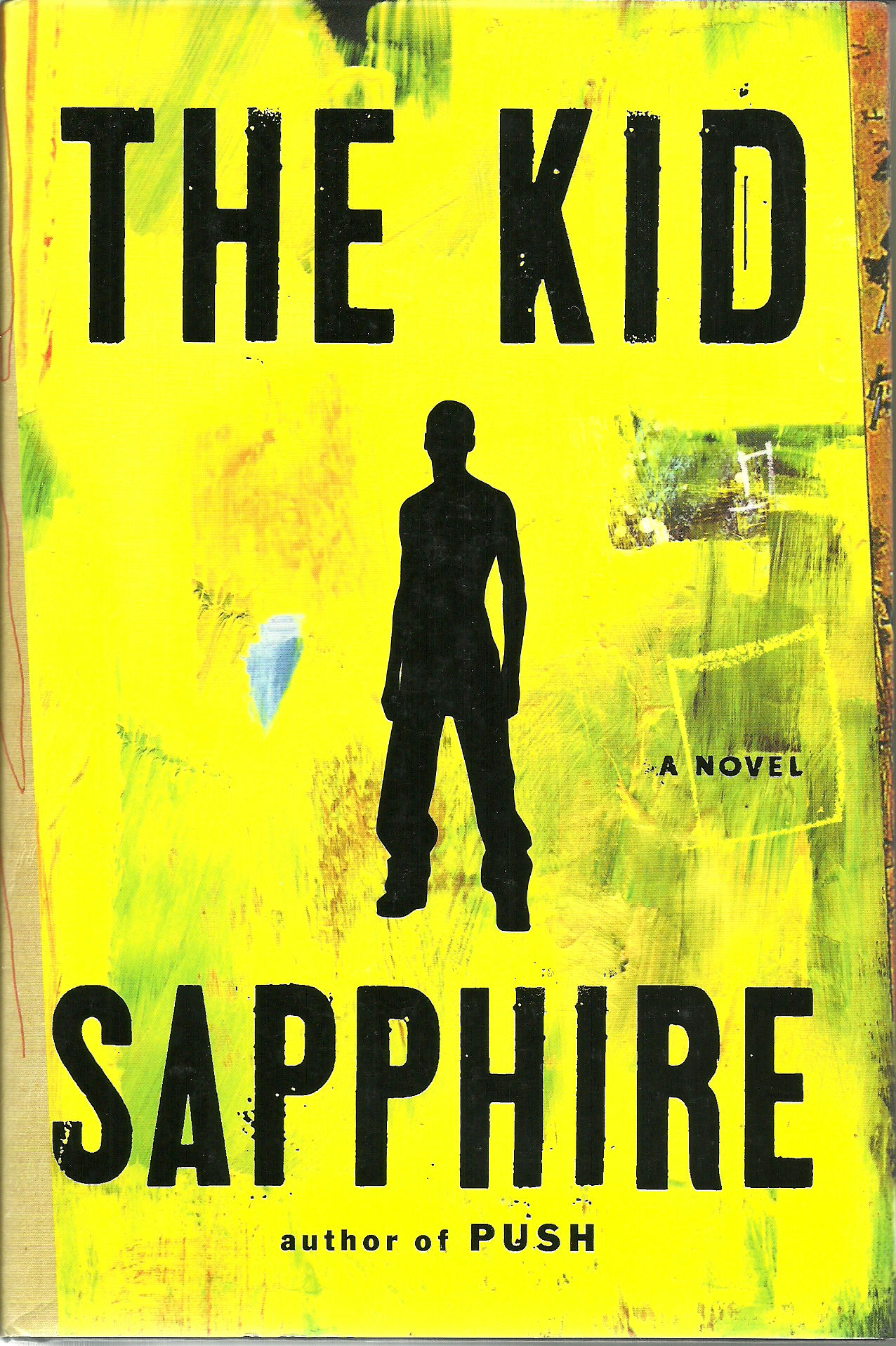
The Kid ~ A Capsule Book Review

The Kid by Sapphire ~ A Capsule Book Review by Allen Kopp

We first met the character Precious Jones in the novel Push by Sapphire. It was made into an excellent movie in 2009 with the title Precious. (It seems that Push had already been used as a title for a different movie.) In the novel and the movie, Precious Jones is black, overweight and illiterate at the age of sixteen.  She has a foul-mouthed, welfare-recipient mother who regularly heaps abuse on her head and a father who routinely rapes her. By the age of sixteen, she has given birth to two children by her father, the first of which was a girl with Down’s syndrome called Mongo.

The second baby Precious gives birth to is a boy that she names Abdul. The novel The Kid begins when Abdul is nine. His mother, Precious Jones, has died at age twenty-seven of AIDS that she contracted from her own father. Abdul has no known family, so he becomes an orphan, a ward of the state. He is put into a foster home with an indifferent foster mother, where he is beaten and sexually assaulted by an older boy. After he recovers from his injuries, he is placed in St. Ailanthus, a Catholic boys’ school.

Abdul comes to regard St. Ailanthus as his home, even though he is sexually assaulted regularly by the “brothers” who run the home (it seems this is something he must tolerate just to get along). In spite of all that, though, there are benefits to living in the home: it’s clean and there’s plenty of food to eat; also there’s an education to be had for those willing to take advantage of it.

It’s while Abdul is at St. Ailanthus that he is exposed by accident one day to African dance. After that, becoming a dancer is the one driving force in his life. He intends to overcome all the obstacles put in his way to get the education and training he needs to become a professional dancer. His path is about to become more difficult, however: He is accused of sexually assaulting a younger boy at St. Ailanthus and is expelled. He believes he is being falsely accused so the brothers in charge of the home can somehow use him as a scapegoat to sidestep their own culpability.

After he leaves St. Ailanthus, he is sent to live with a great-grandmother that he didn’t even know he had. She lives in a filthy, roach-infested apartment and seems to not be in full possession of her faculties. She hasn’t seen Abdul since he was a baby. Abdul refuses to admit he is related to her.

Through all the ups and downs of his young life, Abdul never stops wanting to be a dancer. He lives for a while with an older, effeminate dance instructor. He finds himself in a dance troupe (of sorts) with an Asian girlfriend who calls herself My Lai; his feelings toward her seem to be ambiguous at best, especially after he finds out what she wants him to do for her.

The Kid is a fast, almost effortless reading experience. Those readers who read and liked the novel Push or saw the movie Precious will probably be interested in this story of young Abdul Jones’ troubled life. Although it held my interest throughout its 373 pages, I was a little disappointed in the rather unsatisfying ending. The book seems to just stop, rather than end, with Abdul at age twenty in another terrible jam that he may or may not be able to overcome. It seems another book is needed to tell us what happens to him from there on. Does he overcome all the bad stuff and become a successful dancer? Does he find someone who appreciates him for what he is without using him? These questions are yet to be answered.

Copyright © 2012 by Allen Kopp

Threes

Threes ~ A Short Story by Allen Kopp

It was late fall, getting close to Thanksgiving. I was eleven and in the sixth grade. I came down with a terrible cold that settled in my chest. I had a rattling cough and a fever. My chest hurt and my swallowing mechanism wasn’t right. My mother had taken a sliding fall on the street and was in the hospital with a brain concussion. She was out of commission until further notice. Daddy, who ordinarily didn’t like being bothered with kid problems, was in charge in my mother’s absence. He never understood me, even at the best of times. He thought I was faking it even when I wasn’t. I was too young to stay at home by myself all day long, the thinking went, so my cold was ignored (by him, anyway) and I was sent packing off to school.

Miss Smalls noticed right away there was something wrong with me. I couldn’t stop coughing. I could hardly hold my head up. She held her hand to my forehead and then walked me up to the nurse’s office.

Miss Millie Deal, the school nurse, looked in my eyes and ears and down my throat. She put a thermometer under my tongue and then unbuttoned my shirt and listened to my heart. “You’ve got a lot of congestion in the lungs,” she said. (No fooling.) “You should have stayed at home today and rested.”

“There’s nobody there,” I said around the little glass tube in my mouth.

“Are you afraid to stay by yourself?”

“No. It wasn’t my idea.”

She took the thermometer out of my mouth and turned toward the window to get a better look. “A hundred and two,” she said. “If left untreated, your condition could be dangerous.”

“What?”

“I think you might have the start of pneumonia. You feel rotten, don’t you?”

“Yes.”

“Any vomiting or cramps?”

“No.”

“You’re not coughing up blood, are you?”

“No,” I said anxiously. “Will I?”

There was a small, metal hospital bed—more like a cot, really—against the wall. It looked like it might have been used in World War I or before. She pulled down the covers and told me to take off my shoes and get into the bed. After I had done so, she took my glasses from me and covered me up.

“Just stay there,” she said, “until I tell you to get up.”

The sheets smelled liked peppermint. The pillow was soft and fit my head perfectly. I turned my face to the wall and covered up my head. By the time Miss Deal came back from telling Miss Smalls she was keeping me in her office “for observation,” I was sound asleep.

I slept all morning and through lunch. When the lunch-is-over bell rang, I woke up briefly and then went back to sleep. When school was over for the day, Miss Deal woke me up and told me it was time to go home. Before I left she handed me a note she had written for me to give to daddy: Your son needs to see a doctor before he returns to school.

Daddy wasn’t happy about the note, but he didn’t do more than the usual amount of crabbing. After a dinner (that I didn’t want) of fish sticks and macaroni and cheese, he made me go straight to bed without any TV. A little shit as sick as I was, he said, needed to be in bed.

In the morning he took me to Dr. Vermilion’s office on his way to work. He sat there beside me silently, looking at a magazine, while I waited my turn to see the doctor. When my name was called, he didn’t go in with me, as my mother would have.

I had been going to Dr. Vermilion all my life and I wasn’t too scared of him. He was old but he knew how to laugh and joke around. The thing I hated most about going to the doctor was having to take off my clothes. This time he let me keep on my undershirt and my pants while he examined me, so already I felt better.

He used a tongue depressor to look as far down my throat as he could; listened to me front and back with the stethoscope. My temperature was still about a hundred and two.

“What girls have you been kissing?” he asked.

“None!” I said emphatically.

“I think you’ve picked up a germ somewhere.”

“It wasn’t from any girl.”

“How do you know that?”

I was trying to think of an answer but he laughed then, so I knew he was just playing with me.

He gave me a shot, a bottle of pills, and cherry cough syrup. He said I was to stay home from school for the rest of the week and stay in bed as much of the time as I could. Drink plenty of fluids, stay warm and dry, avoid chills. If I wasn’t better in four or five days, he would do an x-ray of my lungs. The part I liked best was staying home from school.

When I told daddy what the doctor had said, he grabbed me by the wrist and pulled me out to the car before I had a chance to put on my coat. I had already screwed up his entire morning, he said, but, by god, he had no intention of letting the entire day go to waste.

He drove me to grandma’s house and dropped me off and sped away in the car. I wasn’t sure if grandma was even at home, but when I rang the bell she opened the door with a smile. I told her what had happened, that I had been to see the doctor, but she already knew somehow.

She put me to bed in her big front bedroom that was only used for overnight company. She put her portable TV at the foot of the bed and turned it on for me. Then she went into another part of the house and told me to just give her a holler if I needed anything.

I wasn’t used to being able to watch anything I wanted on TV with no grownups around, especially during the day. I watched cartoons, game shows, and a soap opera that I thought was stupid. Then it was time for lunch. Grandma fixed me a hamburger and I went into the kitchen and sat at the table and ate it. After lunch I went back to bed and took a two-hour nap and then I watched TV some more. The life of the invalid suited me fine.

When it was just starting to get dark outside, grandma came into the bedroom and woke me up. I started to get up, figuring daddy had come to pick me up to take me home, but she told me to stay put. She would call me when it was time for dinner.

I learned later that daddy had had an accident at work. He was hurrying to get something done and fell off a ladder and broke his leg in two places. They had operated on him and were going to keep him in the hospital for a few days. I would be staying at grandma’s for the time being. I told her I was old enough to stay by myself, but she swatted me playfully with the newspaper and told me not to even think such a thing. If anything happened to me in that house alone, she would never be able to forgive herself.

Bad luck always comes in threes, she said. She had seen it happen too many times. After my mother’s brain concussion, daddy’s broken leg was bad luck number two. Number three was just waiting to happen and when it happened it would be sure to happen to me.

Copyright © 2012 by Allen Kopp

At the River

At the River ~ A Short Story by Allen Kopp

(Published in The Sim Review.)

All day long he had nothing to do. His legs didn’t work so well anymore; neither did his eyes or his ears. He slept at night and got up in the morning and there was somebody always there, sometimes a stranger he had never seen before, to help him get himself into the bathroom and dressed and downstairs to breakfast, where he sat with thirty or forty others just like him, making a mess of his oatmeal and eggs and not saying anything. After breakfast somebody always sat him down in a comfortable spot in the solarium or the TV room and he just sat there, usually all day, until they came and got him for the next meal. After that it was time to get into bed and sleep again and wake up again and get dressed and go down for breakfast and do the same thing all over again; again and again as if that was what he was put on the earth for: a lot of nothing that seemed to have no end. Whoever said life was short?

He wondered what happened to the people he used to know. Didn’t he have a wife and a couple of children? Didn’t he have at one time some grandparents, uncles and aunts, a mother and father, a sister and a couple of brothers? What happened to all of them? Did he just dream them up? Oh, yes, that’s right: one after the other they all died. He came to see life as a kind of lottery: the winners went on ahead and the losers had no other choice but to stay behind. In the end there would be one loser left, and he was it. When they were children and they played tag or kick-the-can or hide-and-seek, somebody always had to be “it.” He didn’t like being “it” then, and he didn’t like it now.

Since he had no current life to speak of, he dwelt mostly in the past. Once, when he was eight years old, he and his whole family—including grandparents, aunts, uncles and cousins—went on a camping trip to a river. The men went fishing while the women went in swimming. He had never fished and wasn’t interested in learning, so he stayed with the women. His mother told him he didn’t need to be embarrassed about staying with the women, but somebody always teased him about it and it hurt him enough that he thought he should probably learn to fish so it wouldn’t happen again. His mother took his swimming trunks out of her suitcase and gave them to him and told him to go into the tent and take everything off and put on the trunks and come back out as soon as he could because they were all waiting to go in swimming.

After he put on the trunks, he was ashamed of the way he looked. His arms and legs were a pale yellow color and as thin as sticks. His chest was ugly and not at all manly. His stomach stuck out farther than he would have liked. He imagined that he looked like a monkey without any hair, a shaved monkey. He couldn’t let anybody see him almost naked with just a strip of red cloth around his middle. He stayed in the tent until his mother came and pulled him out, looking plenty silly herself in her green swimsuit and matching bathing cap that wrinkled the skin on her forehead. When he insisted that he had to stay in the tent because he felt sick, she slapped at him and told him she was in no mood for any of his nonsense. He slapped her back on the arm, which later he regretted. He could tell that she wasn’t quite herself; her tongue seemed thick in her mouth and her movements were jerky; she had been drinking. She dragged him out into the sunlight and held him to her hip as if she thought he might get away if she let him go.

Nobody looked at him in his silly red swimming trunks so he started to relax. He went into the water up to his elbows and then got back out and sat on a towel in the shade on the bank. The women were splashing around in the middle of the river, talking and laughing. The older kids were playing in a spot farther off, screaming and trying to hold each other under. He wanted no part of any of them.

He realized after a while that he couldn’t just sit there all day while everybody else was having fun, so he went back to the water. He waded in slowly until he was up to his chest and then, taking a quick look over his shoulder, began walking downriver. He walked until he was out of sight and hearing of the others.

He went farther and farther, staying in the middle of the river. The farther he went the deeper the water became. It was up to his breastbone and then past his shoulders to his neck. When he looked down all he saw was green-black murkiness; he could no longer see his feet, but still he kept going.

Every couple of feet he advanced, the water came closer to swallowing him up. It was up to his chin and then to just beneath his mouth. If he stepped off a drop-off that he couldn’t see, he would go under. He knew the drop-off was there, up ahead, waiting for him; he could see it without seeing it. All he had to do was keep going and he would find it. He would drown because he had never learned to swim. And even if he had had a chance to yell before he drowned, nobody would hear him because they were all too far away. He knew, even at his young age, that he was flirting with death.

As he stood in the water up to his mouth—unable to swim if he should go under—he looked over at the river bank; at the sky and the wild foliage that began on the other side of the trees. He was watching some birds doing acrobatic loops in the air when he noticed a smell in the air, a smell that he realized had been hanging over him all day. It seemed to him to be the smell of death. He thought for a moment that it was his own death he had been smelling, but as he turned around and began walking back upriver he knew it was somebody else’s.

When he got back to camp, everybody who had been in the water earlier was now out. His mother, as he was soon to find out, had had an argument with her younger sister and swam off by herself to another part of the river. Everybody expected her to come back in a few minutes, after she cooled off, but more than an hour had gone by and nobody had seen her. They were starting to get a little worried.

After another hour or two, they were certain something bad had happened, or she would have come back on her own. Somebody drove to the nearest phone and called for help. The police came in due time and, after they had asked their myriads of questions, conducted a search of the river. They found her body near some bluffs where it had been swept by the current and become lodged against some rocks. The green bathing cap was what they saw that led them to her.

His mother’s drowning was the terrible event of his life, the one event by which all other events were measured; the event that changed everything. It was his primer in death—the death that prepared him for all the others, including his own.

Not a day—and barely a waking hour—had gone by in his life that he didn’t think of her. She was and always would be the unknowable thirty-three-year-old wife and mother of four and he, the frightened eight-year-old boy clinging to her memory. He had—and always would have—unanswered questions that only she could answer.

After dinner he had a sinking spell; he blacked out on the way to his room and fell in the hallway. The nurses got him to his room and into bed and called his doctor.

He had been dozing in the darkened room when he opened his eyes and saw a nurse he had never seen before standing beside his bed. He smiled at her and she smiled back.

“I knew you would come,” he said.

“Of course I came.”

“Where’s the green bathing cap?”

“This is my day not to wear it.”

“You don’t look a day older.”

“That’s the way it is. You look much older.”

“Isn’t it awful?”

“Don’t talk now. The doctor is on his way.”

She straightened the blanket around his shoulders and went to the window and pulled back the curtain and looked out. “It’s starting to rain,” she said.

“You won’t leave again?” he asked.

“No,” she said. “I’ll be right here.”

Copyright © 2012 by Allen Kopp

Phiz

 Phiz ~ A Short Story by Allen Kopp 

(Published in Bewildering Stories.)

I’m not allowed any visitors. I said my goodbyes to my parents a week ago on my eighteenth birthday. My mother cried and my father was without emotion. They were told I was to be made one with the essence of the Nonpareil, which means I’ll be gassed and my body placed in a thick block of cement that will be used in one of the public works projects. Maybe someday the cement containing my body will crumble and my bones or whatever is left of me will again be exposed to the light of day.

I’m in a little room somewhere but I’m not sure where I am. I have nothing to do but wait for the end. A utility robot brings me food three times a day but I don’t eat much. Since I have no future, I try not to think about anything and try not to feel anything. I have a little window up high and I spend most of the daylight hours looking at the blue sky, at the tops of the trees off in the distance and at the birds flying from tree to tree. Occasionally I see an airship moving ponderously across the sky and wish I was on it. At night I love looking at the stars and sometimes I catch a glimpse of the moon.

How I came to be here is a long story. I was the only child of my parents and a disappointment to them. From the very first, I did not take well to the teachings of the Nonpareil. I was rebellious and moody and I refused to march in lock-step with other children my age. I was in constant trouble at school until my father was told to make some other arrangement for my education. I was placed in another school and then a succession of schools after that.

My parents were determined to find out what was wrong with me. They took me to a series of doctors who subjected me to every physical and psychological test known to man. After a period of time, the doctors found that I had no mental or physical impairments that would keep me from conforming the way I was supposed to conform. I was a healthy boy and there was no reason I couldn’t be like the other boys my age: a wholesome example of obedience and loyalty to the Nonpareil and all he espoused. There was no reason I wouldn’t live to pass on my seed of obedience to the next generation. The doctors advised more rigorous mind control and an aggressive drug regimen to be administered by the state.

My father knew that, in spite of everything that could be done to change me, I would never be what he wanted me to be. When I was ten years old, I overheard a conversation he had with my mother late at night in which he stated that he had given up on me and was ready to see me made one with the essence of the Nonpareil before I caused him further trouble and heartache. My mother pleaded with him and begged him to give me another chance. It was only after she threatened to leave him, disgracing him, that he agreed.

It was when I was fifteen years old that my rebellion took shape and developed a purpose. I was introduced at that time to one of the underground “secret societies” that detested mind control and conformity and advocated the overthrow of the Nonpareil and a return to a free and democratic society and form of government. The secret society was a place of free thought and free speech where the forbidden ways of the Old Time were revered. I knew finally what it was I had always longed for.

I discovered a whole new world in the secret society. I was made to feel welcome, for the first time in my life, with a group of people who thought as I thought. I was surprised at the many people of all ages and backgrounds who belonged. We studied the ways of the Old Time and longed for the day when we would be free. Many of us believed the overthrow of the Nonpareil was only an airy dream that would never happen, while others were sure the day of deliverance was close at hand.

Membership in the secret society was, of course, a serious offense to the Nonpareil and was strictly prohibited. Cells of secret societies were constantly being flushed out (many times from the tips of anonymous paid spies) and members gassed (or, made one with the essence of the Nonpareil). These events were always highly publicized to make examples of the members and to discourage other miscreants from wanting to join.

Over the years I had accumulated some books and texts on the ways of the Old Time. I had traded them with other members of the secret society and had in some cases bought them on the black market that operated on the fringes of the law. I kept them locked in a foot locker under my bed. When I was alone in my room at night, I would take them out and read them and study the pictures and dream about what life in the Old Time was like—and what life might someday be like again. My mother discovered these books—not by accident but by prying open the foot locker with a crowbar—and that’s when things went really bad for me. She informed my father that I was in possession of forbidden materials; he called the police and I was arrested that night. I was incarcerated in a correctional facility where I was forced to submit to electroshock therapy that was supposed to “reorder” my thinking.

I was kept locked in a tiny white cell (white was thought to be purifying and cleansing) for over a year. During that time, I saw only utility robots and had no contact with anyone. My mother was allowed to speak to me on the picture phone for a few minutes once a month, during which time she cried and attempted to get me to reform, to confess to all my wrongdoings and apologize for all the trouble I had caused. My father refused to expend further effort on my behalf.

During all this time, of course, no one had been able to “break me.” I remained true to what I had always been and that was the only thing I had. No matter what they did to me or in what way they threatened me, I was not going to change and become the boy they wanted me to be. Not now. Not ever.

After I still showed no signs of “improvement,” my father requested (he had the legal right to do so) that I be made one with the essence of the Nonpareil, and the court, after reviewing my case, complied with his request. So, I was brought here to wait for the end of my life. My parents were told I would be here for three or four days—a week at the most—but that I would be treated well and fed regularly (like an animal locked in a cage), no matter how long it took.

I’ve been here now for a week and two days. I have no calendar and no clock, but I’m still able to keep track of how many days have gone by. Not that it matters much. Every day I think will be my last. Every time I hear the door being opened, I think it will be them coming to get me. I’ve been told it will be easier for me if I don’t resist. When the time comes, I’m going to be cool and calm; I’m going to show them I don’t feel anything at all. They can kill me but they can’t hurt me. I’ve rehearsed it in my mind a thousand times.

On my ninth night in the little room—it must have been two in the morning—I woke up to the moonlight streaming through the window. I was surprised at how bright the moonlight was but I thought no more about it and turned over to go back to sleep. That’s when I realized it was not the moonlight that woke me up—but a sound—and someone was coming quietly into the room.

I propped myself on my elbows in the bed, thinking my time had come. I saw a dark figure coming toward me and when I started to get out of the bed he held up his hand.

“Don’t make a sound,” he said.

“What is it?” I asked sleepily. “Who are you?”

“Get out of the bed and put these on,” he said, handing me a small bundle of clothing.

I did as I was told and discovered that what he handed me was a black tunic, a pair of soft black trousers and a pair of black leather boots.

“What is this about?” I asked.

“Don’t ask questions,” he said. “Just do as I tell you if you want to live past tonight.”

After I was dressed, I could see his face better in the dim light. I had never seen him before.

“Who are you?” I asked again.

“It’s better if you don’t know who I am,” he said. “And anyway, it doesn’t matter. I’m an interested party who knows what is about to happen to you.”

“What are you talking about?”

“Tonight is your last night. They would have come for you in about an hour or so. I’m offering you a chance to escape if you just take it.”

“Why would you want me to escape? Who are you?”

“Be quiet and just listen to what I’m going to say.”

I sat down on the bed and laced the boots while he continued to stand.

“I’ve sent the two guards on a small errand that will take them five minutes or less,” he said. “That’s all the time you have to escape.”

“You’re letting me escape?” I asked.

“I’m going to walk away from this room without re-locking the door. One minute after I’ve left, you may go out the door and to your left down the hallway to a flight of stairs. Go down the stairs and at the bottom of the stairs go to your right down the long hallway. At the end of the hallway is a door. You may leave by that door.”

“What then?”

“Walk away from the building for about a quarter of a mile until you come to a gravel road. Turn left on that road and stay on it until you come to a paved road called the Hyphen Road. Start walking on it toward the east.”

“How do I know this is not a trick?”

“You don’t, but it’s your only chance. Stay on the Hyphen Road east for five miles, at which time you will see an airship docked at a small airfield. The airship will leave exactly at dawn and it won’t wait for you if you’re not there.”

“Why would anybody take me on board? An escaped miscreant?”

“Tell them your name is Lloyd David and that Mr. Thackeray sent you. Can you remember that?”

“Yes.”

“Can you walk five miles without stopping?”

“I haven’t ever tried.”

He gave me an identification tag to show in case I was stopped along the way, and then, without speaking another word, he was gone.

I waited for what seemed a minute and then I went out the door and down the hallway to the left as he had said. I walked calmly—not fast and not slow—as if I belonged there. I went down the stairs and down the long hallway to the door at the end. In less than a minute I was outside the building, breathing in the night air.

I crouched down in the shadow of the building for a minute or two to make sure there was nobody around who might spot me, and then I began walking away from the building. I found the gravel road and stayed on it until I came to the paved road, the Hyphen Road, and began walking on it toward the east. I knew that five miles was a long way to walk without stopping, but I was moving forward almost without effort. My legs seemed almost to be working independently of my body.

I had to admit that it felt good to be someplace other than locked in a small room. The night, with its smells and sounds, was delightful. Only once did I encounter other people: I saw two men walking toward me—they apparently didn’t see me—and crouched down in the tall grass beside the road until they had passed.

I first saw the docked airship from about a half-mile away. It seemed enormous, like a huge sleeping animal. I felt my heart beat faster as I came closer to the airship. I was happy that the thing hadn’t left without me but also apprehensive with the feeling that anything might happen. I still believed my “escape” might be something other than what it appeared to be.

I was surprised to see no one around the airship, no workmen or crew preparing for flight. One lone man was standing at the bottom of the steps that went up into the airship. As I approached, I could see that he was a strikingly handsome boy a year or two older than me with pale skin and tousled brown hair. When he looked at me and smiled, I saw from his slightly luminous eyes that he was a robot. For a moment I couldn’t believe what I was seeing because he was by far the most lifelike robot I had ever seen, a welcome change from the utility ‘bots I had become accustomed to for the last couple of years.

“I’m Lloyd David,” I said. “Mr. Thackeray sent me.” My own voice sounded to me like somebody else’s voice.

He gave me a salute and stood aside and gestured for me to board the airship. I went up the ladder on shaky legs, with him right behind me, and when we were both inside he gestured for me to follow him. He took me down a small flight of stairs through a passageway and down a corridor to a door. He opened the door and stepped aside for me to enter and when I had gone inside he closed the door again and was gone.

I found myself in a small but comfortable cabin. There was a cot, a small table and two chairs and not much else. I could see through the one porthole in the cabin that it was starting to get light outside. I sat down and was taking off my boots when the robot opened the door again and came back into the room.

“We’ll be taking off in a few minutes,” he said.

“Who are you?” I asked.

“My name is Phiz,” he said.

“Where are we going?”

“It’s going to be a long flight, so just make yourself comfortable.” He closed the partition over the porthole, blocking out the light, and then he was gone again.

I lay down on the cot and fell into a deep sleep, during which I dreamt of the room I slept in at home when I was a child; the room was high up in the house where we lived and I used to pretend it was a cabin on an airship bound for exotic ports.

I don’t know how long I had been asleep when I awoke with a start. Phiz, the robot, was standing at the foot of the cot looking at me. He had a strange way of seeming to come alive when I looked at him; he was at other times, I suppose, in a dormant state to conserve his energy supply.

“Where are we?” I asked. “Have we landed?”

“Still airborne,” he said, raising the partition over the porthole.

“When will we land?”

“Not for a long time yet. Would you like some food?”

“Yes, and something to drink.”

He was gone no longer than five minutes and when he came back he was carrying a tray with a covered plate on it. When he put the tray on the table and removed the cover, I could see the plate held some kind of roasted fowl surrounded by vegetables. I sat down at the table and began eating. He left again and in a moment came back carrying a bottle of wine and a glass. He opened the bottle and poured the glass full and handed it to me. The wine was light and delicious, unlike any I had ever tasted before.

He sat down across from me at the little table. “Would you like me to sing to you while you eat?” he asked.

“I’d rather talk,” I said.

“Of course. What would you like to talk about?”

“Why haven’t I seen any other people on this airship since I came aboard?”

“You and I are the only ones here,” he said.

“Somebody has to be steering,” I said. “Somebody has to be navigating. The thing just doesn’t fly itself.”

“If you must know, I’m steering and I’m navigating.”

“Oh, I see. And who cooked this food?”

“I did.”

“You do everything?”

“Yes.”

“I’d like to see the captain,” I said. “I want to know where we’re going.”

He looked at me as I stood up from the table and went out the door of the cabin. I had been in airships before and I knew where the control room was. I ran to the front of the airship and up a stairway to where I believed the captain and navigator
would be. I opened a hatch and stepped into a large empty space. There were no steering device, no navigating instruments, and no crew.

I ran back to my cabin and looked out the porthole. I hoped to see a mountain, river, or city—some feature that might tell me where we were. Clouds were all I saw; we were in a thick cloudbank.

“I know all about you,” Phiz said, “from the day you were born.”

I turned and looked at him. “Who are you?” I asked.

“Don’t you know?”

“No.”

“I’m the Nonpareil.”

I let out a little snort of laughter. “The Nonpareil is a robot named Phiz?” I asked.

“The Nonpareil is different things to different people.”

“I want you to turn this ship around and take me back to where we were.”

“That isn’t possible. We’ve passed through the portal. There’s no going back.”

“What portal?

“The portal from one plane of existence to another.”

I sat down heavily on the bed. “So this is what it’s like to be dead,” I said.

“Do you feel any less alive than you did?”

“I want to go back.”

“I just told you. You can’t go back. And, believe me, where you are now is better than where you were.”

“I’ll figure out how this thing operates and turn it around.”

“You would be wasting your time to even try.”

“I’ll open the door and jump out.”

“You would drift forever in purgatory. It’s a horrible existence.”

He sat down beside me on the bed. I could hear the slight whir coming from inside his chest, the robot equivalent of a heartbeat.

“I don’t want to be here,” I said, “with a robot. I’ll figure out a way to bring this thing down, even if it kills both of us.”

He smiled sympathetically. “You’re not making sense,” he said.

“Where are we going and when will we land?” I asked. “I want to know!”

He gripped the back of my neck gently in his hand and, in spite of myself, I leaned into him and put my head on his shoulder. If I had had a knife, I would have ripped his beautiful face apart and done him some real damage.

“This is what you always dreamed about, isn’t it?” he asked. “Just drifting among the clouds, without a care in the world?” He began making little cooing noises, which I found strange in a robot, and pretty soon I began feeling drowsy. The next time I woke up it was dark but I could see his luminous eyes looking right at me. 

Copyright © 2012 by Allen Kopp
A Good Clown is Worth Repeating

A Good Clown is Worth Repeating ~ A Short Story by Allen Kopp

(Published in Short Story America.)

Polly Wollydoodle sat at her dressing table on an early summer evening, getting herself ready for a night on the town. After covering her face with white powder, she drew her lips on in a wide arc and applied glittery blue eye shadow halfway up her forehead to her eyebrows. Then she opened her box of noses and selected a glittery red one appropriate for evening wear.

The dress she had chosen had large blue polka dots on a white background. After she had stepped into the dress and did it up, the puffy collar covered her neck and made it almost appear as if she had no neck at all. The cuffs on the ends of the sleeves were also puffy, nearly hiding her hands but affording her the use of them nonetheless. The voluminous padding built into the dress made falling down and sitting on hard surfaces much more comfortable than otherwise.

When she finished dressing, she saw from the chicken clock on the wall that it was nearly seven o’clock and her heart began beating faster and her throat constricted with dryness. She said a little prayer to the patron saint of clowns as she stepped into her size thirty-eight clown pumps. She hoped her nerve wasn’t going to fail her.

She was going out on a date with no one less than Mr. Noah Zark. He was only the most eligible clown bachelor in Clown Town—the handsome, dashing, ambitious, accomplished, much-desired and much sought-after clown-about-town. When he called her on the hamburger telephone and asked her to go out with him, she believed at first that her brother Jocko Wollydoodle (kidder that he was) was playing a trick on her but, after speaking to him for a couple of minutes, she knew it was the real Noah Zark and he was asking her to go out with him. She could hardly believe her good fortune.

She checked her reticule and made sure she had all the items essential for a date: the squirt bottle filled with seltzer, the rubber chicken, the feather-duster floral bouquet, six multi-colored balls for juggling, the horn with the squeeze bulb and, most importantly, the custard pie. If the date went well, she would hit Noah Zark in the face with the custard pie when he took her home at the conclusion of the date. She felt weak in the knees at the thought of it.

When Polly went downstairs, Clemmie Dibble Wollydoodle, her poppa, and Boombah Wollydoodle, her brother, were sitting in front of the TV watching Calling All Clowns and didn’t pay any attention to her when she came into the room. Eata Banana Wollydoodle, her plain older sister, was sitting in a chair to the side of the sofa. She wasn’t looking at the TV but was looking instead at a spot on the wall with her hand covering her mouth. She had been crying and, instead of being happy for Polly that she was going out with Noah Zark, she was angry and jealous. She refused to look at Polly or compliment her on her appearance.

Wishing to be seen, Polly went and stood in front of the TV and did a little pirouette, followed by a curtsey with her forefinger under her chin.

“Hey!” Boombah said. “Get out of the way! I can’t see the TV.”

“How do I look?” she asked coquettishly, holding still as though posing for a picture.

“Now, just what do you think you’re doing?” Clemmie Dibble asked, irritated at having his favorite TV show interrupted.

“Oh, don’t you remember, dearest, our little girl clown is stepping out tonight?” Clarabelle Wollydoodle, Polly’s mother, said from the doorway to the kitchen. She had a rubber chicken draped over each shoulder and a piglet in one hand and a meat cleaver in the other. She was happy and excited that her Polly had been invited to step out with Noah Zark. It might be the beginning of big things for her.

“No, she’s not,” Clemmie Dibble said. “Not tonight.” He had a way of laying down the law.

“What?” Polly asked, panic-stricken.

Eata Banana looked up with interest, a little smile forming on her lips.

“I said you’re not going out tonight,” Clemmie Dibble said, “and that’s final.”

“Oh, dearest,” Clarabelle said. “Don’t be an old silly. It’s too late to cancel now. A young clown is coming to pick her up.”

“Well, why didn’t you say so?” Clemmie Dibble asked. “Is a clown poppa to know nothing about his clown children?”

“I told you, dearest,” Clarabelle said. “You must not have been listening.” She turned and went back into the kitchen, trying to calm the piglet down.

“He’s late,” Eata Banana said gleefully. “I don’t think he’s coming.”

“He’s probably just tied up in rush-hour traffic,” Polly said. “I’ll just sit down and wait.” She settled her padded rump in the middle of the sofa between Clemmie Dibble and Boombah and put her arm around Boombah.

“Gee, you look pretty,” Boombah said. He reached up and touched the end of her glittery red nose with the tip of his finger.

“Aren’t you sweet!” Polly said. “I’m glad somebody in this family has something approving to say.” She kissed Boombah on his white cheek, leaving the imprint of her lips.

She wanted to appear cool and collected, but she was terrified that Eata Banana was right and Noah Zark wasn’t coming after all. Her heart was beating way too fast and she was having a little trouble breathing. She looked at the TV, not really seeing it, and time dragged on. Finally, at half-past seven, when she had begun to abandon all hope, the doorbell rang.

“I’ll get it,” Boombah said. He bounded off the sofa with accustomed exuberance and went to the door and flung it open.

All of them, Eata Banana included, turned and looked at Noah Zark standing in the doorway. He held his hat in his hand against his chest. He looked so handsome standing there, dressed in the latest clown fashion. He smiled shyly and said to Boombah, “Is this the Wollydoodle residence?”

“Come in,” Boombah said, looking Noah Zark up and down.

Polly stood up and gave Noah Zark a nervous little smile and curtseyed, her forefinger under her chin.

“Good evening, Miss Polly,” Noah Zark said in his resonant voice.

“Who do we have here?” Clemmie Dibble asked, a note of jeering skepticism in his voice.

“Poppa, I’d like for you to meet Noah Zark,” Polly said. “I’m stepping out with him this evening.”

Clemmie Dibble gave Noah Zark an appraising look and held out his hand. Noah Zark shook it forcefully and, instead of letting go of Clemmie Dibble’s hand at the end of the handshake, he held onto it and pulled him to his feet. Before Clemmie Dibble knew what was happening, he and Noah Zark were standing nose to nose.

“Just what do you think you’re doing there?” Clemmie Dibble asked gruffly. “I’m not a yo-yo!”

“It’s a very great honor to meet you, sir,” Noah Zark said. “I have heard so much about the great Clemmie Dibble Wollydoodle.”

“You have?” Clemmie Dibble asked, instantly charmed.

“Your reputation as the greatest of clowns precedes you, sir.”

“Well, I don’t know about that.

“This is my little brother, Boombah Wollydoodle,” Polly said.

“How do you do?” Noah Zark said, shaking Boombah’s hand.

“Hello,” Boombah said.

“And this is my older sister, Eata Banana Wollydoodle,” Polly said.

Eata Banana stood up and sniffled and offered Noah Zark a pitiful smile. He took her hand and bent over it and kissed it.

“It’s an honor to meet you, Miss Eata Banana,” Noah Zark said.

“Hello,” Eata Banana said in her pained voice.

Clarabelle, having put the piglet back into his little cage, came in from the kitchen.

“Oh, and this is my mother,” Polly said.

“Well, well, well,” Noah Zark said. “I would have said she was your sister. How do you do, madam?”

“Very well, thank you, Noah Zark,” Clarabelle said. She blushed as Noah Zark took her hand and kissed it.

“Well, we’d better be off,” Noah Zark said, turning to Polly and rubbing his hands together. “We have a reservation for eight o’clock at Clown Rendezvous. That’s all the way over in Crazy Town.”

“Can I come along?” Boombah asked.

“You’d better take a wrap, dear,” Clarabelle said.

“Oh, mother, I’ll be fine,” Polly said.

“Be good to our little clown,” Clarabelle said to Noah Zark.

“Mother, please!” Polly said.

“And be home at a respectable hour!” Clemmie Dibble said with a laugh, as though he didn’t mean it at all.

“Good evening to you all,” Noah Zark said. “It was such a very great pleasure to meet all of you.”

After they left, Clemmie Dibble turned to Clarabelle and said, “That young clown seems like a very sensible and decent chap. I think I like him.”

“And he’s so handsome,” Clarabelle said, “in his junk-yard tuxedo with the enormous baggy pants with the suspenders and his smashed top-hat and his wide red tie.”

Eata Banana began bawling uncontrollably. Clemmie Dibble and Clarabelle and Boombah turned and looked at her in surprise. When she realized everyone was looking at her, she ran upstairs to her boudoir and slammed the door.

“Now, what do you suppose is the matter with her?” Clemmie Dibble asked, sitting down again.

“I think I know,” Clarabelle said, “but I don’t think you would understand.”

“I know what’s the matter with her,” Boombah said. “She’s a girl!”

In Noah Zark’s clown car, Polly sat as close to him as she could get. She was sitting so close, in fact, that he could hardly move his arms to steer. When he turned his eyes away from the road and looked at her, she gave him a simpering smile and her eyes were moist. He could smell her perfume, which was something called Clown Parisienne and was very expensive.

“I hope you’re hungry, Miss Polly,” Noah Zark said, not being able for the moment to think of anything else to say.

“Oh, I could eat an elephant.” In truth, she had been too nervous to eat all day and now had a raging appetite.

“I wouldn’t advise it,” Noah Zark said and laughed. Polly didn’t understand what he meant, but she laughed appreciatively anyway to show that her wit was as sharp as his.

She watched the unreeling scenery for a couple of minutes and then she turned to Noah Zark and said, “Gee, it must be wonderful to have your own clown car and be able to drive all over Clown Town, or beyond, whenever you feel like it.”

“It’ll do for now, I suppose,” Noah Zark said dispiritedly. “I’d rather go around in a chauffeur-driven limousine like your poppa, though.”

Polly felt oddly flattered that Noah Zark recognized her poppa’s significance in the scheme of things. “Maybe some day you will,” she said.

“Oh, yes, Clemmie Dibble Wollydoodle is a very important clown. Every clown in Clown Town knows that.”

“Yes, I suppose that’s true,” Polly said, wishing to change the subject. She had been with Noah Zark for ten minutes and he hadn’t said a thing about how pretty she looked.

“Why, he practically runs the Jerkus Circus. He can make or break a clown. One favorable word from him and a young clown’s career is made.”

“Uh-huh,” Polly said.

“As a rodeo clown,” Noah Zark said, “I’m on the road most of the year and I don’t even have a home I can call my own. I want to settle down. My goal is to get a berth with an established concern like the Jerkus Circus and move up through the clown ranks.”

At the words “settle down,” Polly believed that Noah Zark had marriage in mind and was laying the groundwork to propose to her. She couldn’t expect him to propose on their first date together—that would be rushing things too much—but maybe by their second or third date.

“Everybody looks up to rodeo clowns,” she said. “You are the hero of many.”

“That may be true,” Noah Zark said, “but there’s more to life than the admiration of one’s fellow clowns.”

“My brother Jocko wants to be a rodeo clown,” she said, feeling a little thrill as her leg brushed against Noah Zark’s leg.

“Why does he not follow in your poppa’s footsteps?”

“Jocko and poppa never got along,” Polly said. “Jocko is very head-strong. He doesn’t like to be ordered about, and poppa can be a bit overbearing at times.”

“Well, I hope Jocko knows the life of a rodeo clown is a lonely life. I hope he knows what he’s getting himself into.”

“I’m sure it has its rewards,” Polly said. “It must be exciting to travel and be in a different town every night. I’ve never even spent a single night away from home.”

“Believe me, after a while all towns look alike, and you wish desperately to be back in Clown Town where you feel you belong. The romance of the road is vastly overstated.”

“Well, the Jerkus Circus moves around a lot, too,” she said.

“That’s true,” Noah Zark said, “but they stay in one place a lot longer than the rodeo does.”

Soon they were in Crazy Town and Noah Zark turned off the road onto the parking lot at Clown Rendezvous and a uniformed clown valet appeared to park the car. After the valet had driven off, Polly took Noah Zark’s arm and they went inside.

She was impressed that the maitre‘d recognized Noah Zark as soon as he saw him. He made a checkmark next to Noah Zark’s name in his big book and then, bowing and scraping, he personally escorted Noah Zark and Polly to their table. As they walked through the crowded nightclub, Polly  felt clowns looking at the two of them—at Noah Zark because of who he was and at her because she was with Noah Zark.

When they were seated at their table, Noah Zark ordered a bottle of champagne and before it came he took Polly by the hand and pulled her out onto the dance floor. She wasn’t accustomed to dancing, but she soon saw that Noah Zark’s skill and polish made up for her not knowing what she was doing. He held her close in a slow number and then twirled her around the dance floor when the orchestra played The New Tiger Rag, a very fast number. He literally tossed her away and then pulled her back, bent her over backwards until the top of her head touched the floor, lifted her up into the air and slid her along the floor between his legs, spun her left and spun her right until she was dizzy and believed she might be sick. When the number ended, they went back to their table amid a smattering of applause.

“My, you’re such a good dancer!” Polly said with a laugh. She felt as if she had just been inside a cocktail shaker, but she also felt happy and, well, important. She was sweating and panting a little, but she noticed that Noah Zark was perfectly composed.

“Oh, it’s nothing,” Noah Zark said. “A clown in my position has to learn many things.”

He poured her a glass of champagne and handed it to her and then poured one for himself and drank it down and poured another. She took a tiny sip of the champagne and smacked her lips.

“You like?” Noah Zark asked.

“I like,” she said.

She drank down her champagne the way Noah Zark had done and he poured her another glassful. After the waiter came and took their order for dinner, Polly excused herself and stood up and made her way on wobbly legs to the powder room.

Inside the powder room, she sat down in front of one of the big mirrors encircled with light bulbs and opened her reticule and took out her comb and fixed her hair that had become disarranged during her wild dance with Noah Zark. Then as she was touching up her makeup, two more clowns came into the powder room. They made their way to the other end of the row of mirrors. One of them sat down in front of the mirror and the other stood behind her, looking at her face in the mirror. They were engrossed in conversation and didn’t seem to notice Polly sitting there.

“And did you notice that dress?” the sitting clown asked. Her name was Arma Geddon. She was short and fat and had flaming-orange hair. Her lips were painted on in a cupid’s bow and her eyebrows inverted V’s.

“How could I miss it?” the other clown said. “She looks like she raided her grandmother’s closet!” This clown’s name was Bozinda. She was tall and skinny; she wore a skirt that was slit up the side and ended in the middle of her calf, showing horizontally striped stockings.

“And that nose!” Arma Geddon exclaimed. “Nobody wears those glittery things anymore. They went out with the horse and buggy.”

Polly had her hand to her nose when the remark about glittery noses registered in her brain. She pulled her hand away as though she had touched a hot stove. She realized the two clowns were talking about her. She stood up and was making her way for the door as unobtrusively as she could when the two clowns noticed her and stopped talking.

“Oh, miss!” Bozinda said, just as Polly had her hand on the door to push it open.

Polly turned toward Bozinda and gave her an innocent look. “Me?” she asked, touching her breastbone.

“Yes, you, dearie! Might we have a word with you?”

“I suppose so,” Polly said.

“We saw you dancing with Noah Zark,” Bozinda said.

“Yes?”

“How much do you know about him, dear?”

“I know he’s a very fine, accomplished gentleman,”

“Hah!” Arma Geddon exclaimed. “You are a sweet innocent!”

“You’re probably thinking right now that he’s the man of your dreams,” Bozinda said, laughing up her sleeve. “Most of the girl clowns in Clown Town and Crazy Town and the surrounding environs have thought the same thing at one time or another.”

“You need to be made aware of what a scamp he is,” Arma Geddon said, pulling at her false eyelash.

“Let’s face it, darling,” Bozinda said. “You just aren’t his type at all, but you probably can’t see that because you don’t know what type is his type the way we do.”

“Just what is it you’re trying to tell me?” Polly asked, beginning to understand all too clearly.

“Well, since you aren’t his type,” Bozinda said, “I’d say he wants something you have that he doesn’t have. He wants you to do something for him that would further his career.”

“He has a way of always getting what he wants from girl clowns,” Arma Geddon said in her know-it-all way.

“Yes, and after he gets what he wants from you,” Bozinda said, “he’ll cast you aside like a pair of old boots.” With that, she looked down at her own army-issue boots and shook her foot as though trying to dispel a cramp.

“Take a piece of friendly advice,” Arma Geddon said, batting her eyelashes and turning away from the mirror and facing Polly. “Get what you can out of him—a night on the town, a few drinks, a good time, a few laughs. But when it comes right down to it, my dear, don’t fall for his suavity and his line of smooth talk. If you do, you’ll end up wishing you hadn’t.”

“I’m sure I do not know to what you are referring,” Polly said quietly. Believing the conversation had come to an end, she gave Bozinda and Arma Geddon a little curtsey and then left the powder room.

When she got back to her table, Noah Zark pulled the chair out for her. She sat down without looking at him and picked up her glass of champagne and drank it down and reached over for the bottle and poured herself another glass.

“Are you quite all right, Miss Polly?” Noah Zark asked. “You look a little peaked.”

“I was feeling a little sick,” Polly said, “but now I’m all right.”

“I so want to get to know you better,” Noah Zark said. He reached across the table for Polly’s hand but she pulled it away quickly before he could touch it.

The waiter brought their food and they began eating. Before they were finished with the soup course, the floor show began. First there was a girl clown singer who stood in front of the orchestra and belted out a couple of clown ballads and then there was a troupe of midget tumblers. They leapt and bounced and buffeted about the stage as if the laws of gravity didn’t apply to them. When the tumblers left the stage to enthusiastic applause, a couple of identical twin clowns came on who juggled bottles of milk; first one juggled the bottles and then the other, and then they juggled the bottles back and forth between them so fast they could hardly be seen. The audience gasped with delight and appreciation.

As soon as the floor show was over, Noah Zark asked Polly if she was finished eating and if she would care to dance again.

“Yes and no,” Polly said. “Yes, I’m finished eating and, no, I wouldn’t care to dance again.”

“Why, what’s the matter, Miss Polly?” Noah Zark asked. “You seem so different. Are you not feeling well?”

“I just think it’s time for all good girl clowns to be at home,” she said. She couldn’t bring herself to tell him that all the glamour and excitement had gone out of the evening for her.

“Do you mean you want to leave already?”

“Well, we’ve had dinner and we’ve seen the floor show. What else is there?”

“Are you not enjoying my company?”

“I would just like to leave, Noah Zark, if you don’t mind.”

Noah Zark called for the check in his customary showy manner. He threw a handful of clown money down on the table and then he helped Polly out of her chair.

When they were once again in Noah Zark’s clown car, he looked over at Polly, now sitting as far from him as the car seat would allow, and said, “Would you like to go someplace for a nightcap?”

“That means more liquor, doesn’t it?” Polly asked. “I think I’ve had enough champagne. If I drink any more than I’ve already had, I think I may be quite ill in the morning.”

“Maybe a drive in the country, then?” Noah Zark asked. “It’s a beautiful evening and still early.”

“Oh, all right,” Polly said, “as long as you don’t go too far out of Clown Town.”

“I know just the place,” he said.

He steered the clown car in the direction of the Mountain Road between Crazy Town and Clown Town. He knew of a secluded spot to stop and park that looked out over the city. He hoped to get Polly to thaw out because he had a favor he wanted to ask of her. He had never yet known a female clown that wouldn’t melt into his arms when he turned on the charm.

For her part, Polly opened her reticule and slipped her hand inside and felt around until she found the socket wrench that she carried with her at all times. She closed her hand around it, ready to pull it out. She would clonk Noah Zark on the head if she had to.

Noah Zark pulled the car off the Mountain Road at Lookout Point. Polly was relieved to see there were already several other clown cars with clown couples in them parked there. If Noah Zark tried to get too fresh, she could scream for help and someone would hear her. Maybe she wouldn’t even need to clonk him on the head.

Noah Zark parked the clown car and turned off the engine and put his arm up over the back of the seat. Polly shrank from his arm as if it was a rattlesnake.

“It’s a lovely evening,” Noah Zark said. “The moon and the stars and the city spread out before you in a lovely panorama of glittering lights.”

“How poetic!” Polly said, altogether unimpressed.

“I trust you’ve had a pleasant evening,” Noah Zark said. “I hope that stepping out with me this evening has been a worthwhile experience for you.”

“Well, I always wanted to go to Clown Rendezvous.”

“Miss Polly, I must confess I have a little favor to ask of you.”

“Just a little one?” she asked.

“Miss Polly, have you ever heard the expression, ‘It’s not what you know—it’s who you know’?”

“No, I don’t believe I’ve ever heard that expression.”

“I’ve called your poppa on the telephone several times and I’ve written him a couple of letters.”

“Whatever for?”

“He won’t return my calls and doesn’t respond to my letters.”

“Oh, “Polly said, “I think I’m beginning to understand.”

“I was wondering if you might arrange it so that I might be placed in the way of your poppa in a situation where he wouldn’t be distracted by other matters.”

“You want his help in getting a berth with the Jerkus Circus?”

“One word from him is all it would take.”

“You want me to invite you to dinner at my house, where the talk would inevitably turn toward your career and what a great benefit your talents would be to the Jerkus Circus?”

“That would be splendid!”

“Well, I…”

“You don’t have to give me an answer now. Just think about what I’m saying and let me know if what I’m asking is going to be possible.” He reached inside his coat pocket and pulled out a card and handed it to her. “Here’s my agent’s business card. He’ll know how to get in touch with me. And please remember, this is urgent. The sooner you are able to arrange it, the better.”

She took the card and looked at it and slipped it inside her glove. “I think I’d like to go home now, Noah Zark, if you please,” she said.

When he pulled up in front of the house where she lived, he turned off the engine and put his arm up over the back of the seat the way he had done at Lookout Point. He thought again that she would melt into his arms and, if she did so, he would reward her with a big sloppy clown kiss, but again she failed to do as expected.

“Well, good night,” she said, putting her hand on the door handle. “Thank you for a very lovely evening. I don’t think I’ll ever forget it.”

“Wait just a second,” he said. “I’ll walk with you up to your front door.”

“That’s not necessary. I’m a grown clown. I can find my way to my front door in the dark. I’ve done it many times before. I’m not as helpless as everybody seems to think me.”

“You’ll call my business agent, then?” he asked. “You won’t forget?”

“I don’t think I will be seeing you again,” Polly said.

“Why ever not?”

“Noah Zark,” she said, “have you ever heard the expression, ‘There’s none so blind as those who will not see’?”

“I don’t think I ever heard that expression. What does it mean?”

She got out of the clown car and stood beside it, but before she closed the door she pulled the business card he had given her out of her glove and tore it into tiny pieces and flicked the pieces at him across the front seat.

Two days later in the middle of the afternoon Polly was sitting at the table in the kitchen polishing the silver and listening to music on the radio, her mind pleasantly devoid of thought. Clarabelle was standing at the counter putting frosting on a cake. Clemmie Dibble was upstairs taking a clown nap, Boombah was at a Clown Scouts meeting, and Jocko was in the back yard practicing his juggling routine. Suddenly Eata Banana, who had been moping around the house all week, burst into the room. She was uncharacteristically happy and excited.

“Guess who just called me?” she said, hardly able to keep from jumping up and down.

Who did?” Clarabelle asked, turning from her cake, her frosting-laden knife in the air.

“Noah Zark!” Eata Banana said. “Noah Zark called me on the telephone just now!” She was trembling and her eyes shone with excitement.

“What did he want?” Clarabelle asked.

“He asked me to go to a clown ball with him at the Clown Country Club on Saturday night!”

“Are you going?”

“Am I going? Well, of course, I’m going!” Eata Banana said. “I’d be crazy not to go! He’s a rodeo clown! He’s just the most exciting clown bachelor in all of Clown Town.”

“What are you going to wear?” Clarabelle asked.

“I don’t know,” Eata Banana said. “I think now that things are finally happening for me I’m going to need to buy a whole new wardrobe. Maybe he’ll ask me to marry him!”

Polly smiled and dabbed her rag into the silver polish and rubbed it on the silver serving tray that had belonged to her Grandmother Lulu. She realized that Clarabelle and Eata Banana were both looking at her, expecting her to say something. She said nothing, though, only singing along with Life is Just a Bowl of Cherries, which was just then playing on the radio. She knew very well that Eata Banana wasn’t Noah Zark’s type, either, but she said nothing to that effect. Eata Banana would just have to find out on her own, in her own way and in her own time.

Copyright © 2012 by Allen Kopp