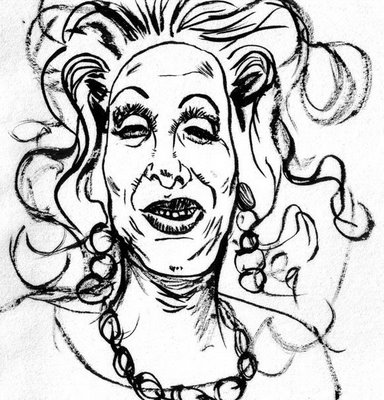
True Blood, Season 5 ~ A Capsule Review

True Blood, Season 5 ~ A Capsule Review by Allen Kopp 

HBO’s Southern gothic vampire series, True Blood, is in its fifth season. Sookie Stackhouse, the Louisiana waitress, is still deeply involved with vampires, good and bad. The good vampires want to “mainstream” with humans, while the bad vampires want to enslave humans and use them as a source of food, by way of their blood. These two factions of vampires are frequently at odds with each other. The bad vampires—that is, members of the “Sanguinista” movement—are personified by one Russell Edgington, a vengeful, gay vampire thousands of years old. In the previous season, he made an impromptu appearance on a TV newscast, in which he ripped out the spine of the newscaster and vowed to “eat the children” of humans, after which he would eat everybody else. “And now time for the weather. Tiffany?” Good stuff.

Anybody familiar with the character of Sookie Stackhouse knows that she is no ordinary waitress. She is a “telepath” (she can read the thoughts of others) and a kind of fairy. It seems that vampires have long had an affinity with fairies and believed fairies to be extinct. Fairies taste and smell especially sweet to vampires and can, at times, enhance their power.

Since the beginning of the series, Sookie has had an on-again, off-again “relationship” with one Bill Compton, one of the good vampires, who has only been a vampire since the Civil War, a relatively short time. Vampire Bill is a soft-spoken Southern gentleman whose vampire nature is frequently at odds with his human nature and his desire to “mainstream” with humans. I can’t tell you how many times Sookie has been in deadly peril and Vampire Bill has come to her rescue. Any other vampire might have just killed her right off and been done with her, but not Vampire Bill.

Sookie has a handsome, dimwitted brother named Jason. He has a good heart but seems to lack judgment and, at times, good sense. He knows his own faults better than anybody and wants to live a better life but doesn’t seem to know how. He is waiting for somebody to show him the way. His libido seems to always lead him down the path of danger.

Sookie’s lifelong best friend is Tara Thornton, a black girl with an unhappy history and her own share of woes. Her latest travail is that she was shot in the head while trying to protect Sookie (it’s a long story) and, to keep her from dying, Sookie and Lafayette (Tara’s gay, restaurant cook cousin) enlist the aid of the sardonic girl vampire, Pam, to turn her into a vampire. It was either that or death. Tara is not happy about having been “turned” and will never forgive Sookie and Lafayette. She has always hated vampires and has had more than her share of scary experiences from her association with them. She’d rather be anything than a vampire.

There are other interesting characters, not the least of whom is Eric Northman, a perfectly formed Nordic type who was a “Viking” at the time he was turned into a vampire a thousand years ago. His “maker” was Godric, a good vampire, who immolated himself in sunlight on the roof of a hotel during one of the earlier seasons. He was over two thousand years old. Then there’s Jessica, the teen girl that Vampire Bill “turned” by orders from the vampire “magister.” Vampire Bill had to “turn” Jessica as a kind of penalty for one of the times he saved Sookie’s life. Jessica was a hellion of a girl vampire at first but seems to have calmed down a lot, thanks to the influence of her “maker,” Vampire Bill, and is mainstreaming with humans. She had a human boyfriend named Hoyt Fortenberry (who can’t seem to get out from under his mother’s influence), but they broke up. Sam Merlotte is the owner of the honky-tonk (roadhouse and bar) where Sookie works as a waitress. Sam is an all-around good guy and can usually be counted on to help out when trouble is brewing, but he is a “shape shifter” and has his own share of troubles, including a werewolf girlfriend and a trashy family. Arlene is a ditzy waitress at Merlotte’s with beet-red hair and an odd husband, Terry Bellefleur, who can’t seem to shake his wartime experiences. Andy Bellefleur is the sheriff and cousin of Terry Bellefleur. He is a recovering addict and a not-very-effective law enforcement officer, frequently bewildered by all the supernatural goings-on in the town.

True Blood is based on a series of novels by Charlaine Harris. While it is sometimes silly (as in the case of Sookie being more in love with Vampire Bill or with Eric Northman), it’s never boring. There are at least two dozen characters and most of them are interesting in their own way. The plot line is constantly shifting. If something is going on that you find not all that interesting, wait about two minutes and the story will shift to something else. With lots of sex scenes and lots of swearing and gore, it’s definitely not for everybody and not for the younger set. What it is, though, is inventive, surprising, suspenseful, well written and well acted. Those Southern accents are impeccable.

Copyright © 2012 by Allen Kopp  

See a Show, Smoke a Lucky

See a Show, Smoke a Lucky ~ A Short Story by Allen Kopp 

Miss Bobbie Bouchard lived in an air-conditioned apartment on the fifteenth floor in an apartment building in the city. When her mother went into the hospital for an extended stay during the summer, she sent Bobbie to stay with her aunt and uncle on their farm a hundred miles from the city. Bobbie rode all that way on the bus by herself, feeling very grown-up and wishing she had bought along a pack of cigarettes to smoke on the way. When the bus stopped midway through the trip for a rest stop at a little café, she went inside and sat at a booth by herself and ordered a tuna salad sandwich and a Coke just like a seasoned traveler.

Uncle Floyd and Aunt Bernice had two children of their own, cousins of Bobbie Bouchard. Bobbie liked them well enough, even though they were younger than she was and they seemed awfully naïve. There was a girl named Freda, who was fourteen, and a twelve-year-old boy named Floyd Junior, who was just called Junior. Neither of them had ever gone to a show, smoked a cigarette or kept a secret from their mother. The only family secret was that Junior occasionally wet the bed, still, at his age. The doctor said it was an adolescent phase and that Junior would eventually stop doing it. In the meantime he advised Aunt Bernice to buy a rubber sheet.

Bobbie was just as naïve about the farm as Freda and Junior were about the way things were done in the city. She thought chickens were strange, exotic creatures and a pig was a kind of dog that might bite her if she got too close. She could hardly believe that you could go all day on the farm and not see any people or cars and hear nothing except the wind in the trees and the sounds the farm animals made. At night the crickets kept her awake, but after three or four nights she didn’t notice them as much.

When Bobbie saw in the newspaper that there was a show in the town of Delford, about ten miles from the farm, and that they had a two o’clock matinee on Saturday, she asked Aunt Bernice if she and Freda and Junior might go. Wanting Bobbie to have as much fun as possible during her stay on the farm, Aunt Bernice agreed.

Saturday was the day that Aunt Bernice had to see her doctor in the city for her female trouble; Uncle Floyd would be driving her in his pickup truck. They left at nine o’clock in the morning and wouldn’t be back until evening. Before she left, Aunt Bernice gave Bobbie a wad of bills from her egg money and put her in charge of the trip to Delford to see the show, since she was the oldest. She was to watch out for Freda and Junior and make sure they were careful and that nothing bad happened to them.

After breakfast and after Uncle Floyd and Aunt Bernice had left, Bobbie and Freda were still sitting at the kitchen table. Bobbie was telling Freda a funny story about a family of midgets that lived in her apartment building in the city. There was a write-up about them in the newspaper. They had tiny furniture made especially for them, a tiny bed, table, sofa and chairs just a little bit larger than doll furniture. They had a special-made door on their apartment, with the knob and the lock about knee-high to a normal-sized person.

Bobbie stopped mid-sentence and looked appraisingly at Freda. “You have hardly any eyebrows at all,” she said.

“What?” Freda asked. She had difficulty making the transition from midgets to eyebrows that fast.

“Hold on a minute!” Bobbie said.

She ran into the bedroom she shared with Freda and when she came back she was carrying a makeup kit. She unzipped it and took out an eyebrow pencil and gently penciled in where Freda’s eyebrows would be if she had any.

“You look just like Joan Crawford!” she said when she was finished, handing Freda a mirror.

“Like who?” Freda asked.

When Bobbie saw the effect of a little eyebrow pencil, she wasn’t going to stop there. She endowed on Freda’s face a full complement of makeup, including rouge, lipstick, mascara and eye shadow. Not too much but just the right amount; if she had learned anything at all in the city, it was how to apply makeup. Freda had never worn makeup before and was amazed at the way it made her look. When she looked at herself in the mirror, she saw a much older, more sophisticated girl looking back at her.

“Mother would die if she saw me like this,” she said.

“You look great!” Bobbie said. “Your hair ruins it, though.”

She seemed to have a solution for everything. She just happened to have a curly blond wig in her suitcase. She went to the bedroom and brought it back to the kitchen and put it on Freda’s head, covering up her own lank, colorless hair with it, tugging it until it was in place and pushing the stray strands underneath.

“There!” she said, handing Freda the mirror. “Now you look like somebody.”

“That’s not me,” Freda said.

Junior came into the kitchen with his hair slicked back, wearing his favorite blue plaid shirt. When he saw Freda, he said, “Who are you supposed to be?”

“Doesn’t she look glamorous?” Bobbie said.

“Daddy is going to kill her!”

“He’ll never know about it,” Bobbie said.

“And you’d better not tell him!” Freda said. “If you do, I’ll tell him and mama about how you skipped Sunday school.”

“I didn’t skip Sunday school,” he said. “I just didn’t go.”

“I hope I don’t see anybody at the show who knows me,” Freda said. “They’re bound to tell on me.”

“You look so different nobody would ever know who you are,” Bobbie said with a laugh.

They walked half-a-mile up the highway to the crossroads to catch the bus to Delford. Bobbie carried a big patent leather handbag that contained the money to ride on the bus and see the show, along with a headscarf, cough drops, lipstick and some other things she might need. She still had not been able to come by any cigarettes since she had been on the farm, though. Freda felt funny at first in the wig and makeup, but after a while when she realized people weren’t staring at her she felt more comfortable.

The bus ride to Delford, at about fifteen minutes, was all too short for Bobbie Bouchard. After being on the farm for several days, she was happy to be moving again and to see people. There were hardly any people on the bus and they were very quiet, absorbed in their own thoughts. Nobody paid any attention to Bobbie, Freda and Junior. Junior sat in a seat by himself and looked out the window at the passing scenery as if he had never seen it before. Bobbie talked the whole time about motion pictures she had seen and about her favorite motion picture actors and actresses. She found it very nearly incredible that Freda and Junior had gone their entire lives and hadn’t seen a motion picture. She felt sorry for them and didn’t know how they could have stood such a life.

The bus let them out at a little gas station on the edge of the Delford downtown business district. It was an easy walk to get to the show and the stores that lined the two streets, Main Street and First Street. Bobbie told Freda and Junior to wait for her for a minute while she went into the gas station. They thought she needed to use the restroom, but when she came out they saw that she had bought a pack of Lucky Strike cigarettes, with a complementary book of matches, which she ostentatiously placed inside the patent leather handbag.

Bobbie was a little disappointed that the movie that was playing was a western—she much preferred musicals or love stories—but she was willing to see the western for Freda and Junior’s sake and not complain about it. If she had been in the city, she would have had four or five movies to choose from. In a little town like Delford, though, when a western was playing, a western is what you saw.

There was lots of action in the movie, lots of riding and shooting. When the characters in the movie, mostly men, weren’t sitting around in the saloon talking and drinking beer while they played poker around a big table, they were riding horses through the desert or getting into fights or shooting at each other from behind big rocks. The sheriff of the town had a red-haired girlfriend with big breasts who was always crying and begging him to take her away and marry her. She had a brother with a big scar on the side of his face that gave him a lopsided grin. He was a cattle rustler and a murderer and the mortal enemy of the sheriff. The red-haired, big-breasted woman was torn between her love for the two men, one her brother and the other her sweetheart. In the end there was the inevitable showdown between them, the struggle between good and bad.

When the show was over, they still had plenty of time before their bus back to the farm, so they went to the Idle Hour Café across from the courthouse. They sat at a booth next to a window. After an elderly waitress in a black-and-white uniform came and took their order, Bobbie opened her purse and took out her cigarettes and lit one as if it was the most natural thing in the world.

“Did you like the show?” she asked Junior.

“I liked it fine,” he said. He never seemed to have too much to say about anything. “Can we go again sometime?”

“I don’t think your mother would like it if she knew you were smoking,” Freda said, looking over her shoulder to make sure nobody was looking.

“She’s not here, though, is she?” Bobbie said. “Would you like to try one?”

“No.”

“I’d like to try one,” Junior said.

“You’re twelve years old,” Freda said.

“Go ahead and take a puff,” Bobbie said. “Nobody’s looking.”

“Only if Freda does it first,” he said. “Then she can’t tell on me if I do it.”

“I’m not going to do it,” Freda said.

“Then I won’t either,” Junior said.

Bobbie placed the cigarette on the ash tray and slid it across the table to Freda. “Nobody’s looking,” she said.

“Go ahead,” Junior said.

Freda picked up the cigarette and took a small puff and blew the smoke out as quickly as she took it in.

“It doesn’t count if you don’t inhale,” Bobbie said.

Bobbie took the cigarette back from Freda and showed how to take the smoke into the mouth and draw it down into the lungs before letting it out. Freda tried doing what Bobbie had done but started coughing.

“It tastes terrible,” she said, “and it burns my throat.”

“You get used to it after a while,” Bobbie said.

“Now let me try,” Junior said.

He took a couple of preliminary puffs before making a show of trying to inhale.

“I don’t think you did it right,” Freda said.

“Close enough for twelve,” Bobbie said.

“Can they put you in jail for smoking?” Junior asked.

“Smoking is silly,” Freda said. “I don’t know why anybody wants to do it.”

“It’s very sophisticated,” Bobbie said. “All the best people do it.”

While they were eating, an older gentleman with a big belly and a toupee stepped up to the table and snapped Freda’s picture with a camera he had hanging around his neck. “Pardon me,” he said. “I wonder if I might have a word with you.”

Freda looked at him, bewildered. She thought it had something to do with the cigarette. “Yes?” she said. She put down her hamburger and wiped her fingers. She half-expected to be handcuffed and led away.

“I couldn’t help noticing you sitting there in front of that window. Your face stands out above all the others.”

“What?” she asked. “I was just sitting here.”

“The way the light shines through the window behind your head, I think you would photograph very well.”

“I, uh—“

“What are you talking about, mister?” Bobbie asked. “You’re scaring the poor girl.” She had learned how to deal with his type in the city.

“May I?” the man asked, stepping closer to Freda. He put his finger under her chin and lifted her face. “You have a very interesting physiognomy,” he said.

In the excitement of riding on the bus, seeing the show and eating in a restaurant, Freda had forgotten she looked like somebody completely different from who she was. “I, uh, this is not me,” she said.

“I’m a casting director for a motion picture production company,” he said, handing her his card. “We’re shooting a picture locally and want to hire some non-professional actors for some of the smaller speaking parts. I think you might be right for one of the parts.”

“A part in a movie?” Bobbie asked.

“Well, perhaps,” he said. “That is, if she’s available and interested.”

“I, uh, I don’t know,” Freda said.

“Are you a minor?”

“What?”

“He’s asking you your age, dumbbell,” Bobbie said.

“I’m fourteen,” Freda said.

The man took a step back. “You look older than that,” he said. “You look about sixteen or seventeen.”

“That’s what I’ve been telling her,” Bobbie said.

“No matter,” he said. “Since you are a minor, have your parent or guardian call us at the number on that card and we’ll arrange a time for you to come in and talk to us.”

“She sure will, mister!” Bobbie said. “And thanks.”

The man tipped his hat and walked away.

“What just happened?” Junior asked.

“Imagine that,” Bobbie said. “A part in a movie!” She didn’t know whether to be jealous or terribly happy for Freda, so she was both.

Freda laughed. “They wouldn’t want me if they knew what I really look like underneath.”

“Don’t be silly,” Bobbie said. “They don’t care about underneath. They care about what they can see.”

“It’s just about the silliest thing that’s ever happened to me,” Freda said, flushing with embarrassment.

“I told you you looked great and you didn’t believe me.”

“Are they going to make you a movie star?” Junior asked.

“It’s too ridiculous,” Freda said.

“You’ll call, won’t you?” Bobbie asked. “Just as soon as you get home?”

“No,” Freda said. “I can’t call. It’s not me they want. It’s somebody who doesn’t even exist.”

“Have Aunt Bernice call.”

“I can’t have her know about this. She’d just about die.”

“So does that mean you’re not going to call?”

Bobbie considered calling herself and saying she was the girl the man saw in the restaurant, but she didn’t know if she would be able to pull it off. He would know as soon as he saw her that she was somebody else, the “other girl” who didn’t even rate a second look.

When they left the Idle Hour Café, they still had more than an hour before their bus, so they walked around, looking in store windows. Bobbie smoked on the street and tried to get Freda and Junior to light up, but they refused. They had smoked once already and that was enough. All the fun had gone out of it.

Bobbie tried repeatedly to talk Freda into calling the number on the card, but Freda wanted no part of it and she refused to let Bobbie call on her behalf and pretend to be Aunt Bernice. She wanted to forget all about it, she said, but, above all, she wanted to keep Uncle Floyd and Aunt Bernice from ever knowing about it. She made Junior promise not to ever mention it. If he should forget and let it slip, she would tell them he had smoked. Never mind that she had smoked, too.

Bobbie believed that Freda was passing up the chance to be a big star, maybe even bigger than Linda Darnell, Rita Hayworth, or Susan Hayward. She believed a chance like that only comes along once in a lifetime. A part of her, deep down, though, was glad. She wouldn’t have to go through life seeing Freda a movie star while she herself was something less. She believed that things always work out for the best.

A few days later, Bobbie received a call from her mother. She was going home from the hospital and she wanted Bobbie to come home and help take care of her while she recuperated from an operation. Bobbie hated the thought of being cooped up at home taking care of her mother, but she promised to come back to the farm as soon as she could. For the next trip, she would think of all kinds of fun things for the three of them to do. She had some secret pictures she would bring along next time to show them.

Copyright © 2012 by Allen Kopp 

Abraham Lincoln: Vampire Hunter ~ A Capsule Movie Review

Abraham Lincoln: Vampire Hunter ~ A Capsule Movie Review by Allen Kopp

Abraham Lincoln: Vampire Hunter is based on the genre-bending (part horror, part historical fiction, part fantasy) novel of the same name by Seth Grahame-Smith. In the movie and the book, Abe Lincoln is an intrepid vampire killer, due in part to the notion that his mother was killed by vampires when he was at the impressionable age of only nine years. He soon discovers that vampires are everywhere, waiting to become the dominant species.

Abe is assisted in his hunt for vampires by one Henry Sturgess, who, Abe discovers, is a vampire himself but also a sworn enemy of all vampires. It seems that vampires can’t kill each other, so Henry uses Abe as his instrument in bringing down select vampires. Abe doesn’t use firearms against vampires, but instead prefers a silver-edged axe. There is much severing of heads and spurting of blood.

As Abe grows into manhood, he meets and marries Ann Todd from Springfield, Illinois. He becomes a lawyer and becomes interested in politics. He abhors slavery and sees the growing struggle between the North and the South as a struggle between vampire and non-vampire. Vampires want a nation of their own, it seems, and the vampire nation will become the separate nation formed if the South is victorious over the North in the epic War Between the States. When Abe becomes president, he has the monumental task of keeping the Union together and making sure the vampire nation does not become a reality.

I was a fan of Abraham Lincoln: Vampire Hunter, the novel, when I read it a couple of years ago. For my money, the movie version doesn’t work as well as the book. We don’t really feel Abe’s anguish and experience his personal misfortune the way we did in the book. We don’t feel the threat the vampires pose (to Abe, his family and the country at large). Also, the ending in the movie seems rather flat, as if they squandered the book’s ironic ending. It could have been a great movie but isn’t. Still, it’s not a bad summertime movie if you like that kind of movie, a toss-away, that you see and forget about. It could have been a lot more than that.

Copyright © 2012 by Allen Kopp 
Never Marry

Never Marry ~ A Short Story by Allen Kopp 

Mrs. Shockley had been a widow for many years. Just when she was thought to be past such things, she began “keeping company” with an old man named Wallace Timpkins, who worked as a janitor at the grade school. Nobody was more chagrined at Mrs. Shockley’s recent flowering than her forty-year-old unmarried daughter, Edith. She watched in disbelief as her mother and Wallace sat on the couch on the evenings when he came for dinner, whispering and grappling together like a couple of adolescents. Edith was embarrassed for her mother. She knew that she, of all people, had to rescue her from the spell that Wallace seemed to have cast over her.

When Wallace Timpkins proposed marriage to Mrs. Shockley and she told him she needed a few days to think about it, Edith knew the situation was spiraling out of her control. Having dinner together and sitting on the couch afterwards was one thing, but talk of marriage seemed to be taking it a step too far. She had hoped her mother would come to her senses about Wallace but, if she married him, it would be too late; she would be stuck with him for as long as she lived and where would that leave Edith? She had no intention of being put out of her home.

One rainy Saturday morning when Edith had washed Mrs. Shockley’s hair at the kitchen sink and was putting it up in rollers at the table, she broached the rather sensitive topic of a union with Wallace.

“You wouldn’t really marry him, would you?” she asked.

“I don’t know why not,” Mrs. Shockley said. “He’s free and I’m free. We’re both of age.”

“Yes, but why would you even want to marry him?”

“Why does anybody get married?”

“I know why he wants to marry you.”

“Why?”

“He needs a cook, laundress and housekeeper and he can’t afford to hire one.”

“What a terrible thing to say!”

“How do you know he isn’t already married?”

“His wife died. He told me all about it.”

“How did she die?”

“She was hit by a train.”

“How do you know he didn’t push her?”

Mrs. Shockley sputtered with laughter and turned around so she could see Edith’s face. “Why would he do that?”

“So he would be free to marry you.”

“Oh! This conversation is getting out of hand!”

“You know nothing about him.”

“I know enough.”

“How long as he worked at the school?”

“Six years.”

“Where was he before that? Has he ever been in prison?”

“Why don’t you ask him yourself? He’s coming over tonight for dinner.”

With that revelation, Edith went upstairs to her room and locked herself in, refusing to finish rolling up her mother’s hair. Let her do it herself for once and see how she likes it, she thought.

For the rest of the morning and most of the afternoon, Edith remained in her room. She didn’t come down for lunch but instead sampled generously from a box of chocolate candy she kept in her dresser drawer. After that she took a long nap, waking up to a pounding headache and the smell of cooking food. She went downstairs silently and set the dining room table for three.

Wallace arrived just as dinner was ready. He seemed, Edith thought, to have a sixth sense where food was concerned. As she brought the chicken in from the kitchen and set it in the middle of the table and Wallace pulled out her chair for her to sit down, she thought: the dinner is already ruined for me. Mrs. Shockley was giggling like a schoolgirl and Wallace had only been there for five minutes.

Edith sat and nibbled at her food (what appetite she had was gone), looking coldly at her mother and Wallace. Mrs. Shockley spread some butter on a roll and held it up to Wallace; when he took a bite of it, the butter rolled down his chin. He began laughing to himself and when Mrs. Shockley asked what was so funny, he leaned over and whispered something in her ear, which caused her to erupt into a fit of laughter. When Wallace’s left hand wasn’t engaged in stuffing food into his maw, it was usually someplace or other on Mrs. Shockley’s body. Edith thought she was going to be sick. She needed to say something to remind them that she was also in the room.

“Being a janitor at a school must be terribly exciting,” she said, with an archness that Wallace and her mother both missed.

“What was that?” he asked, taking his eyes off Mrs. Shockley to look directly at Edith.

“I said it must be so exciting to be a janitor.”

“No, it’s not exciting,” he said. “It’s a living, that’s about all I can say. There are the good days and the bad days.”

“How long do you intend to be a janitor?” Edith asked.

“Until I retire, I guess.”

“And when might that be?”

“I don’t know yet.”

“Why all the questions?” Mrs. Shockley asked.

“I don’t know,” Edith said. “I guess I’m just trying to get better acquainted.”

“Yes, that’s a good idea,” Wallace said, “since we’re all going to be living in the same house together.”

“Why do you say that?” Edith asked.

“I haven’t told her yet, dear,” Mrs. Shockley said.

“Told me what?” Edith asked.

“I’ve accepted Wallace’s proposal of marriage. We’re going to be married in about six weeks, when school is out.”

Edith wasn’t even mildly surprised. She had been expecting the news. “This is rather sudden, isn’t it?” she asked.

“We decided the time is right,” Wallace said. “We neither one of us are getting any younger.”

“Do you think it’s wise for two people of your age to get married?” Edith asked.

“You’re beginning to sound rude,” Mrs. Shockley said, reaching over and taking Wallace’s hand in hers. “I was hoping you would be happy for us.”

“I am happy for you,” Edith said. “I just think there are some practical considerations that must be taken into account.”

“Like what?” Mrs. Shockley asked.

“Where are you going to live?”

“Wallace is going to move in with us, dear,” Mrs. Shockley said. “He lives in a rented place. We own our home.”

“I see,” Edith said. “And where does that leave me?”

“Why, what do you mean?”

“Where am I supposed to live?”

“You’ll live here with us, of course.”

“Why would I want to do that?”

“This has always been your home. I never thought of having it any other way.”

“I see,” Edith said, tears forming in her eyes. “While the two of you are mooning around, giggling and pawing at each other in a nauseating fashion, I’ll be doing all the housework, all the cooking, cleaning, washing and sewing. I’m to be relegated to the role of unpaid servant, is that right?”

“Well, of course not!” Mrs. Shockley said. “What a ridiculous notion!”

“I think she just needs some time to get used to the idea,” Wallace said. “It’s a bit of a shock for her.”

“I just might be getting married myself,” Edith said defiantly.

“Who would marry you?” Mrs. Shockley said with a laugh.

“Do you realize how insulting that is?” Edith asked. “As if nobody in the world would ever want to marry me!”

“I didn’t mean it that way,” Mrs. Shockley said. “It’s just that we’ve already gotten so used to the idea that you will never marry. It seems your time has come and gone.”

“Oh!” Edith said. “So that’s what you think of me, is it?”

“I think we just need to calm down and take a deep breath and watch what we say,” Wallace said.

“You don’t need to be giving me orders in my own house!” Edith said.

“There’s no need to be so touchy about everything!” Mrs. Shockley said.

“Let’s talk about something more pleasant,” Wallace said, “and talk about the marriage stuff later. There’s no hurry.”

“My mother and I own this house,” Edith said. “If she dies, the house belongs to me. If she marries you, does that mean you own the house?”

“We haven’t thought about anything like that,” Mrs. Shockley said.

“We can work out those details later,” Wallace said. “Let’s not spoil this lovely dinner.”

They sat in silence for a few moments, with Edith snuffling back tears. When it was time to serve the dessert, Mrs. Shockley started to get up to go into the kitchen.

“You just stay put,” Edith said, “and keep Mr. Timpkins company. I’ll get the dessert and make the coffee.”

“All right, dear,” Mrs. Shockley said.

Edith went into the kitchen and squeezed the tears out of her eyes. She took the banana cream pie out of the ice box where it was chilling and sliced three big pieces. While she was waiting for the coffee to brew, she took the flashlight out of the drawer and went quietly down the basement steps.

She went to the far corner of the basement—shining the light in the murk—behind the furnace and past the hot water heater, to the little shelf where her father used to keep paint cans. Now the shelf was empty except for a box of rat pellets that her mother had bought when she mistakenly believed she saw a rat under the basement steps. She shook two of the pellets into her hand and went back upstairs.

The pellets were hard like stale cookies. She crumbled them up with a butter knife and, after she had poured three cups of coffee, dissolved the rat pellets into one of the cups. She put the three slices of pie and three cups of coffee on a tray—the cup with the rat pellets in it separated from the other two—and took them into the dining room.

Her mother was talking about a murder case she had been reading about in the paper and Wallace was, as usual, hanging on her every word. After Edith set the coffee and pie in front of Wallace, she resumed her seat and watched him closely after he began taking small bites of the pie and sipping the coffee. She didn’t know how many pellets it would take to kill him but, if he was going to die, she hoped he would not die until later, until after he had gone home. Maybe the small amount she had used would only make him sick. Maybe it would have no effect at all.

When they were finished eating, Mrs. Shockley began clearing the table, but Edith told her to take Wallace into the living room and have a nice “visit” with him while she washed all the dishes herself and put everything away. Mrs. Shockley readily complied, believing that Edith was over the “unpleasantness” that had occurred earlier.

While Edith was in the kitchen, she could hear her mother and Wallace talking and laughing in the front room. He played the piano while she sang in her quivery soprano. After a while she heard nothing, so she was sure they were locked in an intimate embrace on the couch. In that way did all their evenings conclude.

She went upstairs to her room and read for a while and then readied herself for bed. She was aware when Wallace Timpkins left to go home about eleven-thirty. She heard her mother come upstairs a short time after that and go into her bedroom and shut the door.

She slept well and soundly and was awakened at dawn by the ringing of a bell. It took her a few seconds to realize the ringing was the phone in the hallway, halfway between her room and her mother’s room.

After several rings, her mother opened her door and come out into the hallway to answer the phone. Edith listened carefully to the voice of her mother as it went from a barely audible murmur to a gasp and a cry of distress. She turned over on her side and covered up her head. When her mother came into her room to tell her the news, she would pretend to be asleep and would not be smiling.

Copyright © 2012 by Allen Kopp

The Borgias, Season Two ~ A Capsule Review

The Borgias, Season Two ~ A Capsule Review by Allen Kopp  

The Borgias, on Showtime, is nearing the end of its second season. Anybody who has seen any part of The Borgias knows it is a lavish and beautifully photographed series about the Borgia family during the time of the Italian Renaissance. The Borgia family is not billed as “the original crime family” for nothing; it seems there is nothing they won’t do to get what they want or to hold onto their considerable power.

Pope Alexander VI (played by Jeremy Irons), whose name is Rodrigo Borgia before he becomes pope, is the patriarch of the Borgia family. To achieve his ends and to maintain his position on the papal throne, he is aided by his loyal son, Cesare, who becomes a cardinal when his father becomes pope. Like his father, Cesare will stop at nothing to achieve his ends (or his family’s). Also like his father, he seems driven by the belief that he is always right and always justified in his actions, no matter how brutal or ruthless they might seem. More often than not, he is aided in his dirty work by his faithful friend, Micheletto, who was bred on the streets of Rome and who has some secrets of his own.

Pope Alexander’s beautiful daughter, Lucrezia Borgia, started out as a young innocent but was soon disillusioned when she was married off to a boorish nobleman in an alliance that was supposed to help her family (it didn’t). She has a dalliance with a handsome, illiterate stable boy, Paolo, that results in a son. Paolo meets a violent end at the hand of Lucrezia’s brother, Juan.

Juan Borgia, Cesare’s younger brother, is an oversexed hellion who is, more often than not, an embarrassment to his family. He is cruel, arrogant and foolish, frequently caught up short by his rash actions. When he is sent away to Spain for a while to get him out of the way, he returns with a wife and a case of syphilis, for which there is no cure.

Pope Alexander was never married to the mother of his children (played by Joanne Whalley), so, to avoid the appearance of impropriety when he becomes pope, he sends her to live elsewhere. She remains a player in the family, however, even though Pope Alexander has taken up with the beautiful Julia Farnese, whom he quickly installs in the papal palace as his mistress.

Pope Alexander has an arch-enemy, one Cardinal Della Rovere (played by Colm Feore), who seems motivated entirely by his hatred of the Borgia family and by his desire to see Pope Alexander removed from the papal throne. He will rally the pope’s enemies against him if he can, or he will see the pope poisoned (or otherwise murdered) if there is no other way.

Another enemy of the Borgias is the religious zealot Savonarola. He despises Pope Alexander (and what he sees as his excesses and extravagance) as much as Cardinal Della Rovere does. He travels around the country preaching fiery, anti-Borgia sermons to anybody who will listen. He and Pope Alexander are destined to clash in one way or another. Pope Alexander will burn him at the stake as a heretic if he has his way.

There’s no shortage of sex and violence in The Borgias, sometimes in the same scene. (In one telling scene, Lucrezia Borgia tries to murder her brother Juan by letting a chandelier tall on him while he is engaged in a sex act with a prostitute). There is also spurting blood, severed heads and limbs, stuffed cadavers, torture and ceaseless warfare. It’s TV for grown-ups. It’s also fascinating to watch, intelligently acted and written, and beautiful to look at. The sets and costumes are lavishly detailed and amazing to see. The photography, especially in the outdoor scenes, is gorgeously reminiscent of Italian Renaissance painting. The Borgias is a feast for the eyes.

Copyright © 2012 by Allen Kopp
Prometheus ~ A Capsule Movie Review

Prometheus ~ A Capsule Movie Review by Allen Kopp

The new movie, Prometheus, is a highly speculative (don’t take it too seriously) story about the search for the origins of human life on earth, the premise being that humans on earth originated on another planet in a distant galaxy. It was directed by Ridley Scott, whose impressive credits include the sci-fi classics Alien and Blade Runner and the Oscar-winning Gladiator.

As the movie begins, a spectacular spacecraft called Prometheus is nearing its destination, an alien planet (with an atmosphere sort of like earth) so far away that it has taken nearly two and a half years to get there. The human crew has been asleep, or in a state of suspended animation, during the long flight. Only David, the creepy human-like android, has been awake to keep the ship in order. David (played by Michael Fassbender) is my favorite character in the movie. He is unflappable because he doesn’t have human emotions, but he has a fey quality about him not unlike Peter O’Toole in Lawrence of Arabia. With his perfectly combed blond hair and his soft voice, he is probably up to something, but we don’t know right away what it is.

When some of the crew members leave the Prometheus to investigate an enormous pyramid-like structure on the alien planet, they find the remnants of a humanoid race that seemed to have died out precipitously for some reason. Did they (the humanoids) sew the seeds of their own destruction with their secret “weapon” that was supposed to help them subdue their enemies? It seems the crew members have stumbled on something they hadn’t bargained for and don’t understand. There is the same sense of creepy foreboding as in the classic Alien. The body count begins to mount. Who will live and who will die? Are the humans a match for what they have uncovered? Wouldn’t they have been better off to remain on earth?

Prometheus is a great-looking movie in 3D. It has some eye-popping visuals, as you would expect from a movie like this. We have plenty of opportunity to see the interior of the spacecraft Prometheus and we see it wouldn’t be a bad place to spend a few years, as long as you’re guaranteed a safe return, which, of course, the characters in the movie are not. My one quibble is the mix of accents. A lot of the dialogue, especially during the action sequences, is indistinguishable. I’m a person who likes to hear every word that’s said. When Prometheus is shown on TV, I’ll turn on the closed captions (or subtitles if it’s DVD) and hear what I missed. I look forward to seeing it again in a year or so.

Copyright © 2012 by Allen Kopp

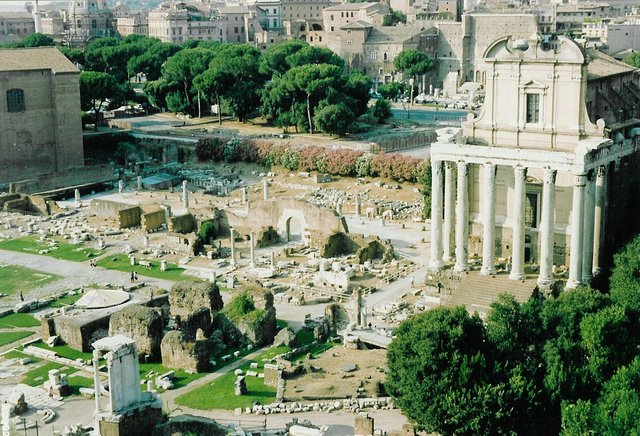
When in Rome…Visit the Palatine Hill

When in Rome…Visit the Palatine Hill

The Palatine Hill is the centermost of the Seven Hills of Rome and is one of the old parts of the city. It stands above the Roman Forum on one side and the Circus Maximum on the other. The world “palatine” is the origin of the world “palace.”

According to Roman mythology, the Palatine Hill is where Rome began. There was a cave there known as the Lupercal, where twin boys Romulus and Remus were cared for and kept alive by a female wolf. The shepherd Faustulus found the infant boys and, with his wife Acca Larentia, raised them. When Romulus and Remus were older, they murdered their great-uncle, who had seized the throne from their father, and built a new city on the banks of the Tiber River. They ended up having a violent argument with each other and Romulus killed Remus. The name “Rome” is derived from “Romulus.”

Excavations have shown that people have lived on the Palatine Hill since one thousand years before Christ. The historian Livy wrote that the original Romans lived there. Many affluent Romans of the Republic Period (510 B.C. to 44 B.C.) had their homes there. During the period of the Empire (27 B.C. to 427 A.D.), many emperors had their palaces there. You might say that the Palatine Hill was the best neighborhood in Rome.

In July 2006, archaeologists discovered the Palatine House, which is believed to have been the birthplace of Augustus, Rome’s first emperor. A section of corridor and other fragments were discovered under the Palatine Hill, which one archaeologist described as “a very aristocratic house.” The two-story house was built around an atrium, with frescoed walls and mosaic flooring, and is situated on the slope of the Palatine that overlooks the Coliseum and the Arch of Constantine.

Extending across the Palatine Hill and looking out over the Circus Maximus is the Flavian Palace, which was extended and modified by several emperors. The greater part of the palace was built during the reign of the emperor Septimius Severus (146 B.C.-211 B.C.). Adjacent to this palace is the Hippodrome of Domitian, which was kind of a small stadium for foot races.

Today the Palatine Hill and the Roman Forum beneath it are a large open-air museum and welcome thousands of visitors a day. If you are going to “do” Rome anytime soon, the Palatine Hill should be well worth the time and effort it takes to see it.

Copyright © 2012 by Allen Kopp 

Amazing! Colossal! Stupendous!

Amazing! Colossal! Stupendous!

France had hosted the 1889 Paris Exposition, and it had been an enormous success, the largest fair ever of its kind. The Eiffel Tower had been built for the Paris Exposition and had quickly become a world-famous engineering wonder. A few years later, America was planning a World’s Fair of its own to be held in Chicago. American prestige was on the line. Would an American fair be able to outdo the Paris Exposition? Would Chicago, the second-largest city in the country, be able to put on as good as fair as New York, if New York had been chosen to host the fair?

The planners of the Chicago World’s Fair wanted a structure built that would rival the Eiffel Tower and become the centerpiece of the fair, as the Eiffel Tower had been of the Paris fair. After considering many proposals, they chose the design of a young bridge-builder from Pittsburgh named George Washington Gale Ferris, Jr.

The “Ferris Wheel,” as it came to be called, was, at 264 feet, the largest structure of the sprawling Chicago World’s Fair. It quickly became enormously popular and well-known. As the planners had hoped, it became the symbol for the fair, recognized all over the world.

The wheel rotated on a 71-ton, 45.5 foot axle that weighed 89,320 pounds and was at the time the largest hollow steel forging that had ever been done. There were 36 cars, each able to accommodate 60 people—up to 2160 passengers at one time. The ride on the “Ferris Wheel” cost fifty cents and made two revolutions in twenty minutes.

After the Chicago fair ended, the “Ferris Wheel” was dismantled and stored for a time. It was reassembled on Chicago’s North Side, near Lincoln Park, where it operated from 1895 to 1903. After that, it was dismantled once again and used in the 1904 St. Louis World’s Fair. After it was no longer needed, the “Ferris Wheel” that had brought so much notoriety to the 1893 Chicago World’s Fair was destroyed by controlled demolition in 1906.

Copyright © 2012 by Allen Kopp 

The Leaning Tower of Pisa

The Tower of Pisa ~ Why Does it Lean? 

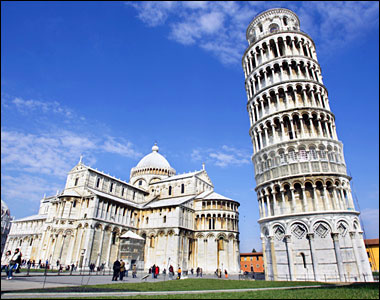
Have you ever wondered why the world-famous Leaning Tower of Pisa appears to be in danger of falling over? Is the angle at which it leans to the side intentional or accidental?

The tower is the campanile, or freestanding bell tower, of the cathedral in the Italian city of Pisa. It stands behind the cathedral and is the third-oldest structure in Pisa’s Cathedral Square (the Cathedral and the Baptistry are older). It’s tilted at an angle of 3.99 degrees and stands 183 feet high on the lowest side and 186 feet high on the highest side. That is roughly equivalent to the height of an 18-story building.

Construction on the Tower of Pisa was begun in August of 1173, during a period of military success and prosperity. By the time the very slow construction had progressed to the third floor in 1178, the tower began to sink because of a poorly constructed foundation that was set in unstable subsoil. The Republic of Pisa was by this time engaged in wars with Genoa, Lucca and Florence, so construction was halted for almost a century. (Can you imagine a construction project being halted for a century nowadays?) This century-long delay allowed for the soil to settle; if not, the tower would almost certainly have fallen over.

Construction was resumed in 1272 under the architect Giovanni di Simone. To compensate for the tilt, engineers began building upper floors with one side taller than the other, making the tower lean in the other direction. Because of this, the tower is actually curved. In 1284, construction was halted again when Genoa defeated the Republic of Pisa in the Battle of Meloria.

In 1319, the seventh floor of the tower was completed, but the chamber where the bells were housed was not added until 1372. There are seven bells in the tower, one for each note of the musical major scale. The largest bell was installed in 1655.

The Italian government in 1964 requested aid in keeping the tower from falling over, but, whatever measures were taken to keep it standing upright, the tilt that had become so famous had to be preserved. An international task force of engineers, mathematicians, and historians was assigned to study and analyze the problem. A period of structural strengthening to halt the ever-increasing tilt began in 1990 and lasted about eleven years, after which the tower was declared stable for at least another 300 years. Today the tower is undergoing gradual surface restoration to repair corrosion and blackening caused by wind and rain.

The Leaning Tower of Pisa remains a popular tourist destination for anyone fortunate enough to be traveling in Italy. Seeing the tower and going to the top of it is surely an experience not to be forgotten.

Copyright © 2012 by Allen Kopp

Jupiter’s Moons

The Moons of Jupiter

Earth has one moon, as we earth dwellers know. Jupiter, that mysterious “gas giant” that is the fifth planet in order from the sun and the largest planet in the solar system, has—count them—63 moons. Many of these moons, however, are not moons as we think of moons. Only eight are “regular satellites,” with prograde (a direction of rotation counterclockwise as viewed from the north pole of the sky or a planet) and nearly circular orbits not greatly inclined with respect to Jupiter’s equatorial plane. The other 55 moons are “irregular satellites” whose prograde and retrograde (moving in a direction contrary to that of similar objects) orbits are much farther from Jupiter and have high inclinations and eccentricities.

Of the eight “regular satellite” moons, four are called the Galilean moons because they were discovered by the astronomer Galileo in 1610. They are among the largest objects in the solar system and would be considered dwarf planets if they revolved around the sun instead of around another planet. They are Io, Europa, Callisto, and Ganymede and were the first objects discovered to orbit a body other than the earth or the sun. (The other four “regular satellite” moons are much smaller and closer to Jupiter, serving as sources of the dust that makes up Jupiter’s rings.)

Ganymede, the largest of the four Galilean moons, is the largest natural satellite in the solar system (larger than the planet Mercury) and the only satellite known to possess a magnetosphere (a region of space surrounding a planet that is dominated by the planet’s magnetic field so that charged particles are trapped in it). Ganymede is made up mostly of silicate rock and ice. A salt-water ocean is believed to lie underneath its surface, sandwiched between layers of ice. The surface has two types of terrain—highly cratered dark regions and younger (though still ancient) regions with many grooves and ridges. There is a thin oxygen atmosphere that includes ozone and some atomic hydrogen.

The second largest of the four Galilean moons is Callisto, ranking as the third largest moon in the solar system. Callisto is made up of approximately equal amounts of rock and ice, which makes it the least dense of the Gallilean moons. It has a very thin atmosphere of carbon dioxide and molecular oxygen. The likely presence of a subsurface ocean of liquid water suggests that Callisto can or could harbor life. Callisto is the most likely place for a human base for future exploration since it is farthest from the intense radiation of Jupiter.

Of the four Galilean moons, Io is the one closest to Jupiter and is the fourth largest moon in the solar system. With over 400 active volcanoes, it is the most geologically active object in the solar system. The surface of Io is dotted with more than 100 mountains, some of which are higher than Mount Everest on earth. Most moons (or satellites) in the outer solar system have a thick coating of ice, but Io is made up primarily of silicate rock surrounding a molten iron or iron sulfide core. Io has a thin atmosphere and is bombarded with radiation and magnetic fields from Jupiter.

Europa is the second closet to Jupiter of the four Galilean moons and is the smallest of the four—slightly smaller than earth’s moon. It is one of the smoothest objects in the solar system, with a layer of water surrounding the mantle of the planet. The smooth surface includes a layer of ice, while the bottom of the ice is theorized to be liquid water. The smooth appearance of the surface of Europa has led scientists to believe that a water ocean exists beneath it, conceivably serving as an abode for life. The prominent reddish-brown markings that crisscross Europa indicate low topography, meaning that few craters exist because its surface is tectonically active and young. Europa is made up primarily of silicate rock and likely has an iron core. Its tenuous atmosphere is composed primarily of oxygen.

All four of the Galilean moons are bright enough that they could potentially be seen from earth with the naked eye, but the brightness of Jupiter obscures them. They are, however, visible with even low-powered binoculars if the person looking through the binoculars knows where Jupiter is and knows exactly what he or she is looking for.

Copyright © 2012 by Allen Kopp