Training Wheels

Training Wheels image 2

Training Wheels ~ A Short Story by Allen Kopp

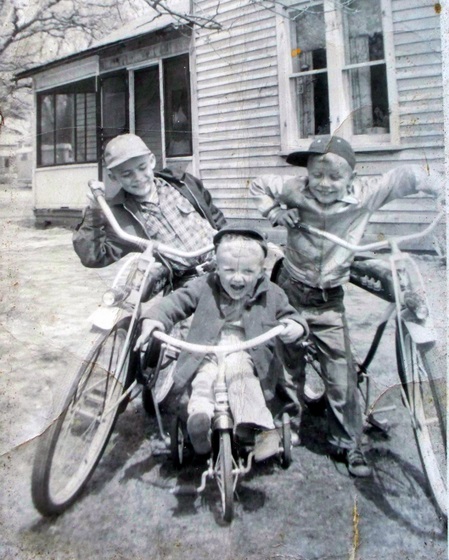
Gee was allowed to ride four blocks on the sidewalk toward the school to the stone fence and back. He didn’t want to go any farther than that, anyway, because the Hedgepeth brothers were just beyond that. They threw rocks at him and called him names and he was afraid of them.

He didn’t have a full-sized bike yet because he was only seven and small for his age. He had a half-sized bike. It was really a girl’s bike but he didn’t mind because it was comfortable and easy to ride. The bike had been equipped with training wheels up until a few days ago, but a bigger kid in the neighborhood took them off for him. He was proud of being able to ride without them.

He had just reached the stone fence and was about to turn around and go back when he noticed a man leaning against the fence looking at him. He was in the shade under an overhang of leaves, so Gee couldn’t see his face very well.

“Hello,” the man said, as Gee was making the turn-around maneuver on the narrow sidewalk.

“Hi,” Gee said, looking quickly at the man and then looking away.

“How are you today?”

“I’m all right,” Gee said.

“I bet you don’t know who I am.”

“Who?”

“Would it surprise you very much if I told you I’m you, fifty years from now?”

Gee laughed a little bit because he didn’t know what else to do. “That’s silly,” he said.

“Why is it silly?”

“How could you be me when I’m right here?”

“I don’t know,” the man said. “Except to say that time is a river.”

“I don’t know what that means,” Gee said.

“I know you don’t. I don’t know what it means, either. It’s just what I’ve been told.”

“Do you live in that house?” Gee asked, pointing to the house with the stone fence around the yard.

“No,” the man said. “I don’t live anywhere around here anymore.”

“So you’re just visiting?”

“Yes, I’m visiting you.”

“Does my mother know you?”

“Yes, she knows me. About as well as anybody could.”

“I’d better get going. If I don’t come back right away, she’ll come looking for me.”

“Tell her hello for me.”

“What’s your name?”

“My name is the same as yours.”

Gee looked at the man’s face but still couldn’t see it very well. “I don’t know what you’re talking about,” he said. “Are you a friend of the family?”

The man laughed. “In a way,” he said. “You’ll understand when you’re older.”

“I think I’ve heard that one before,” Gee said.

“Before you go, I want to tell you something that won’t mean anything to you now but will when you’re older.”

“What is it?” Gee asked.

“You’ll be married three times. You’ll save yourself a lot of grief if you skip the first one.”

“I’m not ever getting married.”

“Don’t go into business with a partner named Alonso. He’s a crook. The business fails and you lose all your money.”

“I don’t know anybody named Alonso.”

“After your father dies, your mother will want to marry a man named Bartlett. Whatever you do, don’t let that marriage take place. He wants to marry her for all the wrong reasons.”

“Would you like to come home with me and tell her yourself?”

“No, I can’t do that.”

“Why not?”

“I’m here to see you. Not her.”

“Okay. I’m going now.”

“Try to remember the things I told you, even though they don’t mean anything to you now. Write them down when you get home and put them away someplace safe where you’ll be able to see them in twenty or thirty years.”

“Twenty or thirty years?” Gee said. It seemed to him like all the time in the world. His young mind couldn’t grasp that much time.

That evening when they were having dinner, mother said, “Millie called me and told me she saw you talking to an old man on the sidewalk today.”

“Yes,” Gee said. “He was just standing there on the sidewalk when I rode past on my bike.”

“What did he say to you?”

“Nothing much. He just asked me how I was and he told me he used to live here a long time ago.”

“He wasn’t trying to mess with you, was he?” daddy asked.

“No.”

“Did he say anything dirty to you?” mother asked.

“No! He was just a nice old man.”

“You’ll be sure and tell me if anybody bothers you, won’t you?”

“He didn’t bother me.”

“I’m going to call the sheriff and tell him there’s an old man hanging around the neighborhood bothering kids,” daddy said. “They can at least keep an eye out for anybody that looks suspicious.”

“I don’t think he’ll be back,” Gee said.

He watched his father chewing and he knew he wasn’t paying any attention; he was already in some other place. His mother sipped her iced tea daintily with a cigarette in her fingertips as a fly buzzed around the table and lighted on the plate of sliced tomatoes.

Copyright © 2013 by Allen Kopp

The Rainbow ~ A Capsule Book Review

The Rainbow cover

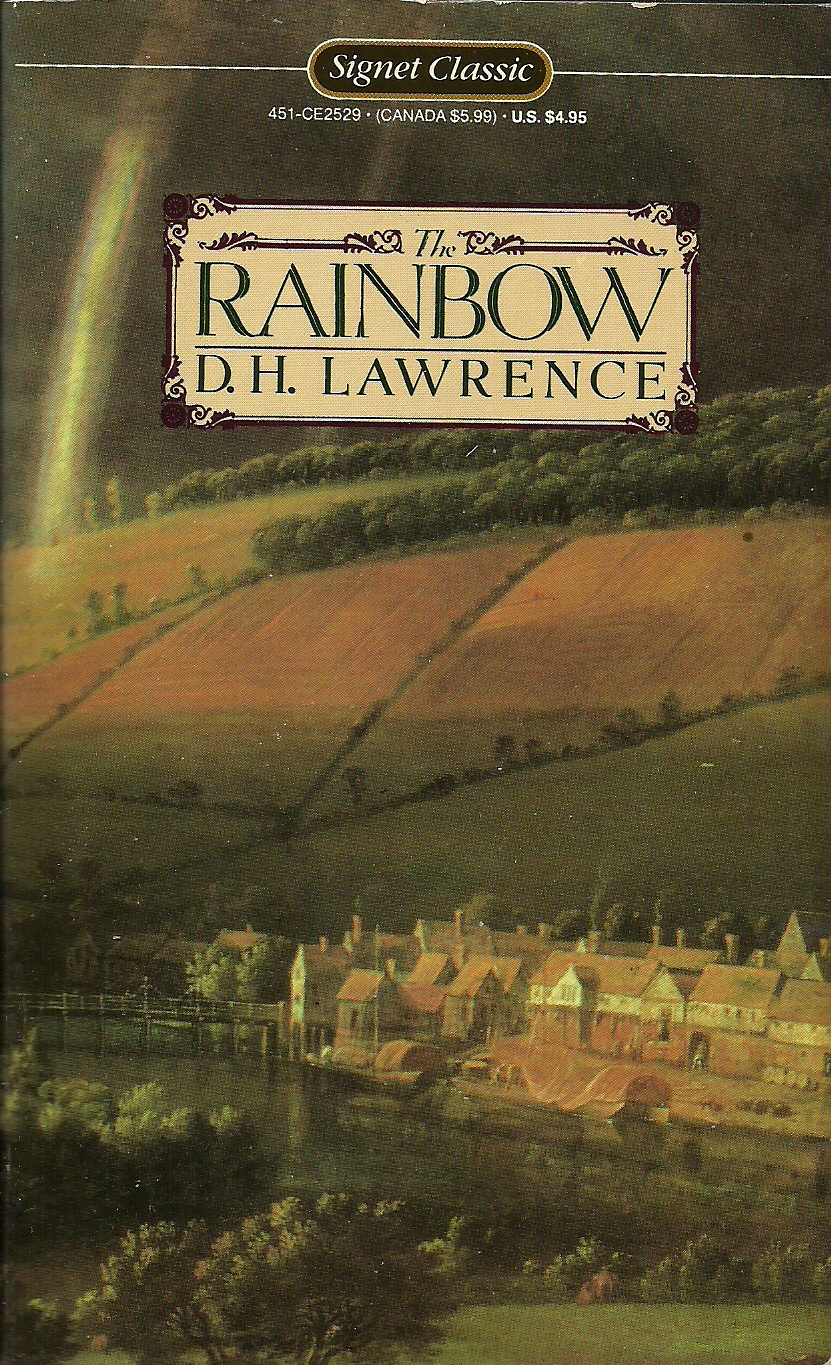
The Rainbow by D. H. Lawrence ~ A Capsule Book Review by Allen Kopp 

When English writer D. H. Lawrence’s novel, The Rainbow, was first published in 1915, it was hailed as obscene and Lawrence himself was labeled a pornographer. The book was banned in many quarters while the righteous of the day took great pleasure in making a public display of burning it. It wasn’t available in England and the United States for many years after its publication, except in an “expurgated” version, meaning that somebody went through the book and took out the parts they considered “offensive.”

Readers nowadays will not understand what all the fuss was about when The Rainbow was first published nearly a hundred years ago. We live in a permissive age where any words might be spoken for public consumption; anything might be seen on TV or in movies or written about in magazines, newspapers and books. All the rules, all the taboos, seem to have been lifted, and nothing is sacred anymore. The Rainbow seems very mild by today’s standards. Lawrence only suggests that his characters engage in sexual activity. (He was, possibly, the first “mainstream” English writer to do this; thus all the furor.) His heroine in The Rainbow, Ursula Brangwen, sees her boyfriend (to whom she is engaged but doesn’t marry) naked while he is bathing, sleeps with him in his hotel room while pretending to be his wife, and has outdoor sex with him. There are no steamy details; the sex is only implied. This is no Peyton Place. Any of the words connected with sex are never used.

The Rainbow is a multi-generational story of a fictional English family, the Brangwens. It begins with Tom Brangwen, a gentleman farmer who marries a strangely detached Polish woman named Lydia. She is a widow, older than Tom, with a daughter from her previous marriage named Anna. When Anna is older, she marries her stepfather’s nephew, Will Brangwen. If Anna and Will have nothing else together, they have sexual compatibility; they end up having nine children, the oldest of whom is Ursula. She becomes the focal point of the second half of the novel.

As Ursula Brangwen becomes older, she longs to break free from the conventions and constraints that she believes have held women back for so long. She isn’t content to live as other women of her class have lived. She is a “modern” woman of the early twentieth century. She seeks a teaching career (with disastrous results), a college degree (she fails her final exams), and marriage (she decides she can’t go through with it) to a handsome young military man named Anton Skrebensky, a veteran of the Boer War. After The Rainbow ends, Ursula’s story is continued in the novel Women in Love, which was published in 1920.

Much of The Rainbow is taken up with the interior lives of its characters, meaning that we are constantly being told what they think and how they feel, rather than what they are doing or saying or what they are having for dinner. If this sounds like tedious reading, it isn’t. It isn’t a difficult book to read for those who are so inclined, although a little long at 515 pages.

D.H. Lawrence was plagued by ill health throughout much of his life and died at age 45 of tuberculosis in 1930. If he failed to achieve the acclaim and success that he deserved during his lifetime, he is today hailed as a giant of twentieth century English writing. The Rainbow is one of his most famous and enduring works. 

Copyright © 2013 by Allen Kopp

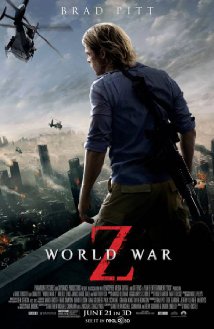
World War Z ~ A Capsule Movie Review

World War Z poster

World War Z ~ A Capsule Movie Review by Allen Kopp 

In World War Z, zombies (otherwise known as the “undead”) are attempting to take over the world. We never learn where they came from or how they got started, only that they have overrun entire cities almost before anybody knew what was happening. These zombies are repulsive, slavering, tooth-snapping, unthinking beasts. Their skin looks like it is covered with boils or pustules and their eyes are vacant and bug-like. They are very aggressive and make a kind of croaking sound when they are thwarted in their desires or when one of their number is killed. Their one intent is to infect the uninfected. After a person is bitten, it takes him or her about twelve seconds to turn into a zombie. Once turned, a zombie’s one mission in life is to make other zombies. If these zombies eat flesh, we never see it.

As always in movies of this kind (whether the attacker is an alien life form, giant bugs, reawakened prehistoric monsters, vampires, the undead, an unknown virus, etc.) there is a protagonist who is (or becomes) a reluctant hero. The reluctant hero in World War Z is Brad Pitt (badly in need of a haircut). And, as you might expect, he has a perky wife in tight blue jeans and two adorably precious daughters who you know are going to be in deadly peril before too long. (It’s usually girls in these movies because girls scream louder than boys and register fear more dramatically.)

Brad Pitt plays Gerry Lane, a former United Nations employee who, we are told (if you can follow the mumbled dialogue), was present during several dangerous “crises” throughout the world and helped to diffuse them. (We assume, then, that he was a kind of problem solver for the U.N.) When the movie begins, though, he has had some kind of trouble in his job and has left it, becoming, instead, a pancake-cooking, stay-at-home daddy. When the zombie crisis heats up just a few minutes into the movie, he is recruited by his former boss at the U.N. to lend his talents to the fight. He reluctantly leaves his wife and children aboard a naval destroyer two hundred miles out from New York City to go and see how he might save mankind.

In witnessing zombie attacks, Gerry Lane discovers that zombies seem to leave certain individuals alone. These individuals are unappealing to zombies because, he ascertains, they are ill in some way. (Predators, we are told, will pass up potential prey that is ill or dying.) This gives him the idea of infecting people with a deadly but curable disease to make them immune to zombie attacks. No matter how horrible it is to be injected with a disease, it’s still not as bad as being turned into a zombie. If his theory works, it could turn the tide in the zombie war.

World War Z is the first big-budget ($175 million) zombie movie in 3D with a big star in the lead. With its obvious clichés, it has a few scary moments, as when the zombies make a mountain out of themselves (like very nasty ants) to scale a very high wall to get to the humans on the other side or when zombies take over an aircraft and bring it down. The zombies themselves aren’t all that scary until you see them up close, and that doesn’t happen until the second half of the movie. If you’re expecting a lot of blood and gore and people being devoured, you’re going to be disappointed. Even when Gerry Lane cuts off the hand of a young Israeli soldier to save her life after she has been bitten by a zombie, we never see the severed hand or any blood. Maybe the scariest thing in World War Z is Brad Pitt’s hairdo.

Copyright © 2013 by Allen Kopp

Man of Steel ~ A Capsule Movie Review

Man of Steel poster

Man of Steel ~ A Capsule Movie Review By Allen Kopp 

I’m not a fan of big-budget summer movies, especially if they’re based on comic books. Superman has been around for a long time and has been told any number of ways. How many Superman movies and TV shows have there been? Don’t people ever get tired of the same old stuff? Well, I guess the idea behind a new Superman movie is to tell it in a different way, make it fresh, give people something they haven’t seen before. That, I suppose, is the aim of Man of Steel.

Man of Steel gives us the lowdown on how Superman came to be Superman. (The “S” that he wears on his chest is only an “S” on earth; on the planet Krypton, where he comes from, it is a symbol of hope.) When the man who becomes Superman is an infant, the planet Krypton is dying. His father, a brilliant scientist (Russell Crowe), devises a method to send his infant son out into space to another planet in a kind of rocket ship. Where does the rocket ship bearing the child land? It lands on earth, of course. A Kansas farm couple (Kevin Costner and Diane Lane) find the baby and raise him as their own son, knowing he is “special” but making sure the world doesn’t know it until the right time.

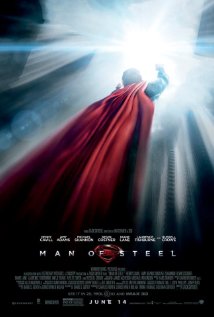
In Man of Steel, Superman (played here by Henry Cavill) is a Christ-like figure. More than one reference is made to his “coming to earth to save mankind.” At one point he is referred to as the “living embodiment” of a higher intelligence. He is 33 years old, the age Christ was when He was crucified. Even the poster for the movie seems to suggest ascension into heaven. I’m not sure if the Christ parallels are accidental or deliberate, but I have a feeling the filmmakers knew what they were doing. In one scene, Superman (as Clark Kent) goes to a church and speaks to a minister. While he is talking, a stained-glass window bearing the image of Christ is in the background. (We don’t very often see Christian imagery in mainstream movies.) Also, the villain in the movie, one General Zod (played by the ever-creepy Michael Shannon), is a very good characterization of Satan. He wants to turn earth into a new Krypton, which would, of course, kill all earth people. In one scene toward the end of the movie, he admits he will do anything to achieve his ends, even if he must use violence and cruelty. While Superman is “good” (siding with humans), General Zod is all bad, but only doing what he believes he was created to do. He and Superman must battle each other to the finish.

Amy Adams plays Lois Lane, the spunky girl reporter who works for The Daily Planet. She’s an independent gal who can hold her own with the men and who doesn’t mind using a few naughty words when the occasion calls for it. She is, of course, Superman’s love interest. When the movie ends, Superman has taken a job (as Clark Kent) as a reporter on The Daily Planet to try to “blend in” with humans. He is wearing a pair of horn-rimmed glasses, so, of course, Lois Lane and the others don’t recognize him as Superman. Doesn’t the dimple in his chin give them any clue? How long will it be before they catch on? Probably not until the sequel comes out and maybe not even then.

Copyright © 2013 by Allen Kopp

Behind the Candelabra ~ A Capsule Movie Review

Behind the Candelabra poster

Behind the Candelabra ~ A Capsule Movie Review by Allen Kopp 

Whether you like Liberace or not, you have to admit he was one of a kind. He had an innate musical ability, which he combined with his charisma, charm, and personality to make him one of the most famous and recognizable entertainers of the twentieth century. For twenty years, from the 1950s to the 1970s, he was the highest-paid entertainer in the world. Most of us knew him from his many performances on TV, but people all over the world flocked to his stage performances. As he says in the movie about his life, Behind the Candelabra, he was all about giving people a good time and making them happy.

There were always rumors about Liberace being gay, which he vehemently denied in public (even concocting a “romance” between himself and Sonja Henie). When he died of AIDS in 1987, the truth about his sexual orientation could no longer be hidden. Even his wily agent wasn’t able to sell the story that he died of heart failure brought on by overwork and fatigue.

Behind the Candelabra is about the sordid part of Liberace’s life that he most certainly would not have wanted to be made public. It’s based on a book written by one Scott Thorson who, for six years, was Liberace’s live-in “boyfriend.” Scott Thorson was all of forty years younger than Liberace. At one point in their relationship, Liberace was going to “adopt” Thorson because he always regretted not being a father, even though Thorson was an adult at the time. Thorson even consented to having his face made over by a creepy Hollywood plastic surgeon (Rob Lowe) to make himself resemble Liberace or to create the illusion that they were related by blood.

Liberace showered Thorson with expensive gifts, jewelry, and cars. They shared the same bed and spent many hours alone together in the Jacuzzi. After a few years, though, the relationship began to sour, as one might expect. Turned off by Thorson’s drug use, Liberace began to pursue his interest in other sexual partners. The  “houseboy,” Carlucci, tells Thorson early in his relationship with Liberace that there have been a whole string of “boyfriends” and they have all, for one reason or another, been sent packing. (Liberace never dumps them himself; his agent does it for him.)

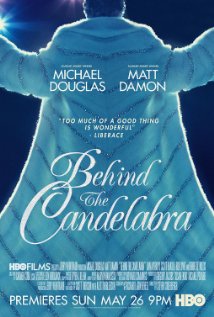
Behind the Candelabra is being shown on HBO in the U.S. because, according to IMDb, it’s “too gay” for theatrical release. Michael Douglas plays Liberace. While I’ve never been a Michael Douglas fan, I think he makes a really good Liberace. (Could anybody else have done it better?) Matt Damon plays Scott Thorson. Even though he’s too old for the part, he makes it work (with makeup and what is obviously some computer enhancement). A barely recognizable Debbie Reynolds plays Liberace’s mother.

Behind the Candelabra is fun, flashy, and entertaining to watch if you like behind-the-scenes showbiz stories, but do we really need to know about the secret sex life of a beloved entertainer who has been dead for more than twenty-five years? If you’re the type who would rather remember Liberace as the smiling, likeable gentleman who appeared on TV during his heyday, then Behind the Candelabra is probably not for you.

Copyright © 2013 by Allen Kopp

Queen for a Day

Queen for a Day image 1

Queen for a Day ~ A Short Story by Allen Kopp

The year is 1958 and Mrs. Thelma Caswell has applied to go on the TV show Queen for a Day. That’s the show where four contestants, all women, go in front of a studio audience and tell their unhappy stories. Delivery is everything because the audience votes for the saddest, most deserving story, with its applause; that is, the loudest applause determines the winner. (There can be no doubt about which story garners the loudest applause because it’s registered on a scientific instrument known as the “applause-o-meter.”)

The lucky winner is given what she wants and needs most to make her difficult life more bearable, whether it’s a wheelchair or a washing machine or an iron lung—sometimes all those things. The losers are given a basket containing colorful little bars of soap, a set of shot glasses, and coupons for reduced prices on lobster dinners.

One month after applying to be on the show, Thelma is asked to come to the television studio where the show is produced for what they call an “initial interview.” The “producers” of the show (a fat man and a mannish woman) want to speak to her to make sure she is “telegenic” enough and won’t “freeze up” in front of the television cameras and the studio audience. Thelma is told at the end of the interview, which takes an entire afternoon, that she will be notified of the producers’ decision regarding her suitability to be a contestant on the show.

In the days and weeks that follow, she won’t allow herself to become excited at the possibility of being on Queen for a Day. In fact, she tries to put it out of her mind because there is a very real possibility they won’t want her. For that reason, she doesn’t tell her husband, her children, or any of her friends or family; she will tell them if and when she is chosen to be on the show.

Finally, when she least expects it, she receives the phone call. She is requested to be at the television studio at ten o’clock for a twelve o’clock taping of Queen for a Day on Thursday. When she hangs up the phone, her hands are shaking and for a few minutes she doesn’t know what she’s doing. She seems to be walking on air. When she regains control of her senses, she immediately starts going through her closet to see what she has to wear. She doesn’t see anything that she can stand anymore, so she goes shopping.

She tries on many dresses in the store but has a hard time deciding. Since the show is in black and white (color is still a few years away), she thinks she will look better in a light color, although black or navy blue will make her appear thinner. (She has put on a lot of extra weight in the last couple of years and she has heard somewhere that TV cameras add fifteen or twenty pounds to a person’s appearance.) She settles on a simple white silk dress with peach-colored trim, elegant but not flashy. She can’t think about how much it cost.

On the day before the taping, she spends six hours in the beauty parlor, availing herself of all the services they have to offer. She gets a henna rinse, a cut, and a permanent wave that makes her hair look like a poodle dog, but still she believes she looks better than she has ever looked in her life.

That night she hardly sleeps at all. She didn’t think she would be nervous, but now that it’s getting so close she feels as if she might die. She feels alternately sick with dread and giddy with excitement. In the morning she’s up long before she needs to be and spends hours on getting dressed, “putting on her face,” and getting her hair just so. When finally it’s time to leave for the TV studio, she feels thoroughly exhausted.

She can’t find a place to park so she squeezes her car in at the end of a block too close to a fireplug. She is sure she will have a parking ticket when she comes out but that’s a trivial matter, she believes, that she will deal with when the time comes.

She expects the emcee of the show, Durwood Sherwood, to be there to greet her with a little hug and a peck on the cheek, but instead she is directed to a third-floor office where she finds herself before a middle-aged woman behind a desk with facial hair and big glasses that make her look like an unhappy owl. The woman gives Thelma a stony look and bites down on her dentures.

“May I help you?” she asks.

“I’m here to be on the show,” Thelma says.

“What show might that be?”

“Why, Queen for a Day!”

“I know,” the woman says with a laugh. “I was just messing with you. Queen for a Day is the only show taping today. What’s your name?”

“Thelma Caswell.”

“All right. Have a seat. I’ll let them know you’re here.”

Thelma sits on an orange plastic couch while the woman picks up a phone and murmurs into it words that Thelma is not able to make out. In a few minutes a door opens and the fat man who Thelma met earlier as one of the producers of the show emerges.

“How nice to see you again, Miz Caswell!” he says, holding out his hand for her to shake. “Please follow me.”

He takes hold of her arm as if she is blind and leads her down a hallway.

“Are you excited about being on Queen for a Day?” he asks.

“Oh, yes!” she says.

“Well, right this way.”

He takes her around a corner and stops at another door. He opens it and gives her a little shove inside. “Well, have fun!” he says and then he’s gone.

The other three contestants are sitting in chairs against the wall like in a doctor’s waiting room, smiling at her wanly. She sits down with them, making four. It’s quiet in the room and nobody is saying anything, as if they are in a church. It doesn’t seem to Thelma like the kind of room they put you in before you go on TV. She wonders if she is in the right place or if they have mistaken her for somebody else.

Soon a man with a clipboard comes in and gives them nametags that he instructs them to put on their chests over their hearts. There’s Buffy, Chichi, Peaches, and Thelma.

“We use only first names,” he says. “You’ll be up in alphabetical order, but you don’t need to worry about that. Durwood will cue you. Now, if we’re all ready, we’ll go in and meet the studio audience.”

They all stand up as if they are one and follow the man out of the room. He takes them through a labyrinth of dark passages lined with what looks like clutter until they come to a black curtain. He arranges them in a line in reverse alphabetical order (Thelma, Peaches, Chichi, and Buffy), opens the curtain and motions for them to go through it.

The studio audience, numbering about five hundred, has already been sitting for two hours. They have been “primed” and are relaxed and ready to be entertained. They are cued to applaud at the entrance of the four contestants.

“And here they are!” Durwood Sherwood announces in his sonorous voice. “There are four of them! They are all worthy! But only one of them will be. Queen! For! A! Day!”

The audience applauds wildly again while the contestants take their places behind four little podiums bearing their names. Two cameras roll forward to beam their movements to the millions of people watching at home.

After Durwood has dispensed with the preliminaries, it’s time to get down to the business of hearing from the contestants. Buffy is first.

“I think you have a very special story to tell us, don’t you, Buffy?” Durwood cues her.

“Well, Durwood,” she says, “I used to be a bareback rider in the circus.”

“Ohhhhhh!” sighs the audience.

“During a performance to a packed house two years ago, the horse I was riding stumbled and fell. I, of course, was thrown forward. Two clowns tried to catch me but they missed. I landed on a low wall that was used to separate the audience from the performers. I had serious neck injuries.”

Here she pauses for effect and points to her neck brace that is, oddly enough, the same color green as the dress she is wearing, making it look as if she has no neck at all. Her black hair interspersed with gray is splayed over the neck brace to her shoulders. Her mouth is a wide, grim, lipless line. As she stares into the TV camera, she looks like a frog about to catch a fly.

“I was in a coma for two weeks,” she continues. “When I woke up, my doctors told me I would never ride again. Bareback riding was all I knew. There I was, my livelihood taken away, with two children and no husband. My daughter desperately wants to go to modeling school. She is so pretty and everybody who has ever seen her believes she has a future in modeling. If we had enough money to put her through school, she could get herself a good job and support the family while I get myself back on my feet.”

The audience is here cued to applause. The applause is interspersed with whistles and cheers.

“Now we have Chichi,” Durwood says. “Chichi, won’t you tell us your story?”

“Well, Durwood,” Chichi says in a breathy whisper, “my husband and I have eight children.”

“Ahhhhhh!” sighs the audience.

“We were always able to get along quite well on my husband’s salary, but he got into a fight with the foreman at the factory where he worked and got fired. That was six months ago. He hasn’t been able to find another job. When his unemployment runs out, we won’t have any income. He’s depressed and has been drinking quite heavily. I think he’s seeing another woman.”

Here she lowers her head and squeezes her eyes shut. The camera moves in for a close-up, showing the ugly splotches on her face and bare upper arms. For a few seconds she can’t speak at all.

“I know this is difficult,” Durwood says sympathetically.

When she speaks again, her voice is a-tremble. “If we had the money for my husband to go to trade school, he could get a good job as an auto mechanic and everything would be all right again. It would give him a new purpose in life and would make him stop drinking and running around so much.”

“That’s wonderful!” Durwood says, holding up his arms to indicate that Chichi is finished. The audience applauds.

“Now let us hear from Peaches,” he says. “Peaches, won’t you tell us your story?”

“Well, Durwood,” she says, her fleshy chin wobbling. “My husband Stan and I have four beautiful children, two boys and two girls. The oldest is twelve and the youngest four.”

“And there’s something quite different about your husband Stan, isn’t there?” Durwood prompts her.

“Yes,” she says in a kind of drawl, ”Stan is four foot tall. He’s a midget!”

Here a picture of a tiny, smiling man is flashed on the screen. He’s wearing a tuxedo and top hat and is carrying a cane. The audience applauds and cheers.

“And I couldn’t love him more if he was six-and-a-half foot tall!” Peaches shrieks.

“Ahhhhhh!” sighs the audience.

She pivots her head from side to side, obviously enjoying the attention. Her eyes are tiny slits and her cheeks apple-like, her head an inverted black bowl.

“I’ve always been a short woman,” she says, “but I’m a whole foot taller than he is!”

The camera pans out over the audience to show how much they are enjoying this moment.

“All is not well, though, at your house, is it, dear?” Durwood asks.

“No,” Peaches says, a handkerchief at the ready. “Stan works as a bouncer in a nightclub. The pay is meager, at best, but he works very hard and loves all of us very much.”

“Ahhhhhh!” sighs the audience.

“Our youngest son, Leroy, is four,” she says.

“And is Leroy a midget, too?” Durwood asks.

“No, he isn’t. He’s normal-sized. Although he’s only four, he’s almost as tall as his father and is going to be a big man some day.”

“Bless his heart!” Durwood says.

She waits a moment for the laughter to subside before she continues. “The problem is not with his height but with his eyes. He has a rare eye disorder and will go completely blind in the next few years if he doesn’t have an eye operation. We aren’t able to afford the operation on the money Stan makes as a bouncer. We already have a second mortgage on our house and can’t borrow another cent until we pay off the debts we already have. That will take years and it might be too late to save little Leroy’s eyesight.”

She begins crying uncontrollably, covering her eyes, and the audience almost swoons with sympathy.

Durwood gives a big sigh and looks directly into the camera. His eyes are moist. “We’ll all be rooting for little Leroy, won’t we?” he says earnestly, and the audience breaks into thunderous applause.

After a few seconds he holds up his hands to bring the applause to an end. “And, now,” he says, “that brings us to our final contestant, Thelma. Thelma, won’t you tell us your story?”

“Well, Durwood,” she says, feeling more at ease than she expected, “I don’t know where to begin. My husband is in prison and has no hope of getting out for at least six more years. We spent all the money we had for his defense. I have a sixteen-year-old daughter, Lulu, who is a paranoid schizophrenic. She believes aliens from outer space are trying to kidnap her and she needs constant supervision. My eleven-year-old son, Raphael, is an albino. He’s very smart but he has to go to an expensive special school because the kids in public school would kill him.”

“Ohhhhhh!” sighs the audience.

“Our house is heavily mortgaged and we’re behind in the payments,” she continues. “The bank is about to foreclose. I’d like to have enough money to make the back payments to keep us in the house for a few more months until I can finish the novel I’m writing and get it published. It’s sure to be a bestseller.”

“Well, well, well,” Durwood says. “We wish you and your family all the best!” He faces the audience and raises his arms as a signal for them to applaud.

When the applause subsides, he holds the microphone in both hands and looks reflectively at the floor. “Well, ladies and gentlemen,” he says, “we’ve heard the stories from our four contestants. Now the time has come for members of our studio audience to vote with their applause for the contestant they believe is most worthy to be crowed Queen for a Day!”

There’s a little bit of stage resetting as Durwood retreats to the left away from the contestants and the TV camera rolls in for close-ups. The first close-up is of Buffy. The picture the audience sees at home is Buffy’s face with the applause-o-meter on the bottom half of the screen. The audience applauds, with some cheering and whistling interspersed. The needle on the applause-o-meter goes over about three quarters of the way. The same with Chichi. Then Peaches. Then Thelma. There is a drum roll. All four contestants are nearly tied, but the judges determine that the needle advanced just a little more for Peaches than for the others. Peaches is Queen for a Day! It was the blind baby and the midget husband that did it!

Peaches is crowned and robed to the cheering of the audience. She cries, screams, and jumps up and down. When the hoopla subsides, Durwood announces in an excited voice that little Leroy will have an eye operation at the finest eye clinic in the country and his eyesight will be saved, all because his mother was crowned. Queen! For! A! Day!

Thelma gets away just as soon as she can. She doesn’t want anybody looking at her. She is the loser, along with Buffy and Chichi, and there’s no joy in that. She wishes now that she had never gone on such a show that’s obviously aimed at imbeciles. She sees now that she’s smarter than that, better than that.

While she’s driving home, her hands are shaking and her mouth is dry. She wants to find a hole and crawl inside and die. She cringes at the thought of her mother and her friends seeing the show and laughing at how insipid she is, along with those others. She has humiliated herself in front of millions of people, bared her soul, and then lost to a fat little woman with slit eyes and a midget for a husband. She can hear the world laughing at her! Woman, thy name is Fool!

By the time she gets home, it has started to rain so she pulls the car into the garage. With the motor still running, she gets out of the car and closes the garage door before any of the neighbors have a chance to see her.

It’s comforting, somehow, with the rain on the roof and the purr of the engine. It feels intimate, restful, secluded. Her own little world. Leaving the car door open, she stretches out on the seat with her feet under the steering wheel and the top of her head against the passenger-side door. Soon she begins to feel drowsy. She has never known a sweeter feeling.

Copyright © 2013 by Allen Kopp

The Borgias, Season 3 ~ A Capsule Review

borgias-two

The Borgias, Season 3 ~ A Capsule Review by Allen Kopp 

The Borgias is now in its third season on Showtime. I’ve seen every episode, and what I like most about it is the way it looks. It is, of course, set in Italy during the Renaissance (late 1400s). The sets and costumes are lavish and authentic-looking in every detail. The Vatican looks the way you imagine it must have looked over 500 years ago. How do they do it? Doesn’t it take tons of money just to achieve that “look”? It is photographed in a way to make it look like paintings of the period, with lots of soft reds and yellows. Every scene is like a painting in motion. Even the outdoor scenes are stunningly beautiful. If you don’t like the story or get tired of too many sex scenes and too much intrigue, just turn down the sound and enjoy the way it looks.

At the end of season 2, Pope Alexander Sixtus, the “Borgia Pope” (played by Jeremy Irons) was poisoned by his archenemy, Cardinal Della Rovere, with a poison called cantarella. We had to wait until season 3 to see if he survived the poisoning, but I had a feeling he would. He did survive, thanks to some quick thinking on the part of his daughter, Lucrezia, who administered charcoal as an antidote.

Cardinal Della Rovere was captured and imprisoned for his part in the attempted assassination of the pope, but he was released from prison by a “friend” and escaped. When the pope discovers that some of his cardinals (members of the “consistory”) were involved in the plot to kill him, he strips them of their offices and considerable wealth and prestige. Even with the cardinals gone who want to murder him, the pope still has lots of enemies.

While Cardinal Della Rovere was Pope Alexander’s archenemy in seasons 1 and 2, he has now receded into the background since the assassination attempt failed. The pope’s new archenemy is one Catherina Sforza, a powerful and power-hungry dame who lives in a castle at Forli and who will do anything to bring down the Borgias. The pope calls her “the Great Arachne.” She is constantly trying to bring influential “friends” into her alliance against the pope and his family, using whatever means they have at their disposal. She would rather slit a Borgia’s throat than to look at him.

Pope Alexander is the father of a brood of “bastard” children, meaning he was never married to their mother, although the mother remains a part of the “family.” (She must endure the pope’s string of “mistresses.”) Principal among the Borgia children are Cesare Borgia, a one-time cardinal who is his father’s most loyal ally, and Lucrezia Borgia, who gave birth to an illegitimate son fathered by a sweet stable boy, whom her brother, Juan, had murdered. Cesare and Lucrezia are both young and stunning-looking. They continue to have an unwholesome interest in each other, even though Lucrezia has just taken her second husband and Cesare has a new wife from France. (The evil and dangerous Juan Borgia was murdered in season 2 by his brother, Cesare. The pope doesn’t know yet who murdered Juan, his favorite son, even though Cesare has dropped a few hints.)

While the Borgias are motivated by ambition, they also seem, in large part, to be motivated by their love for each other. This keeps them, I suppose, from being all bad. If they are to survive in a swamp full of poisonous snakes, they must be snake-like themselves. Life can’t be simple for a family that holds immense power and has no intention of giving it up.

Copyright © 2013 by Allen Kopp

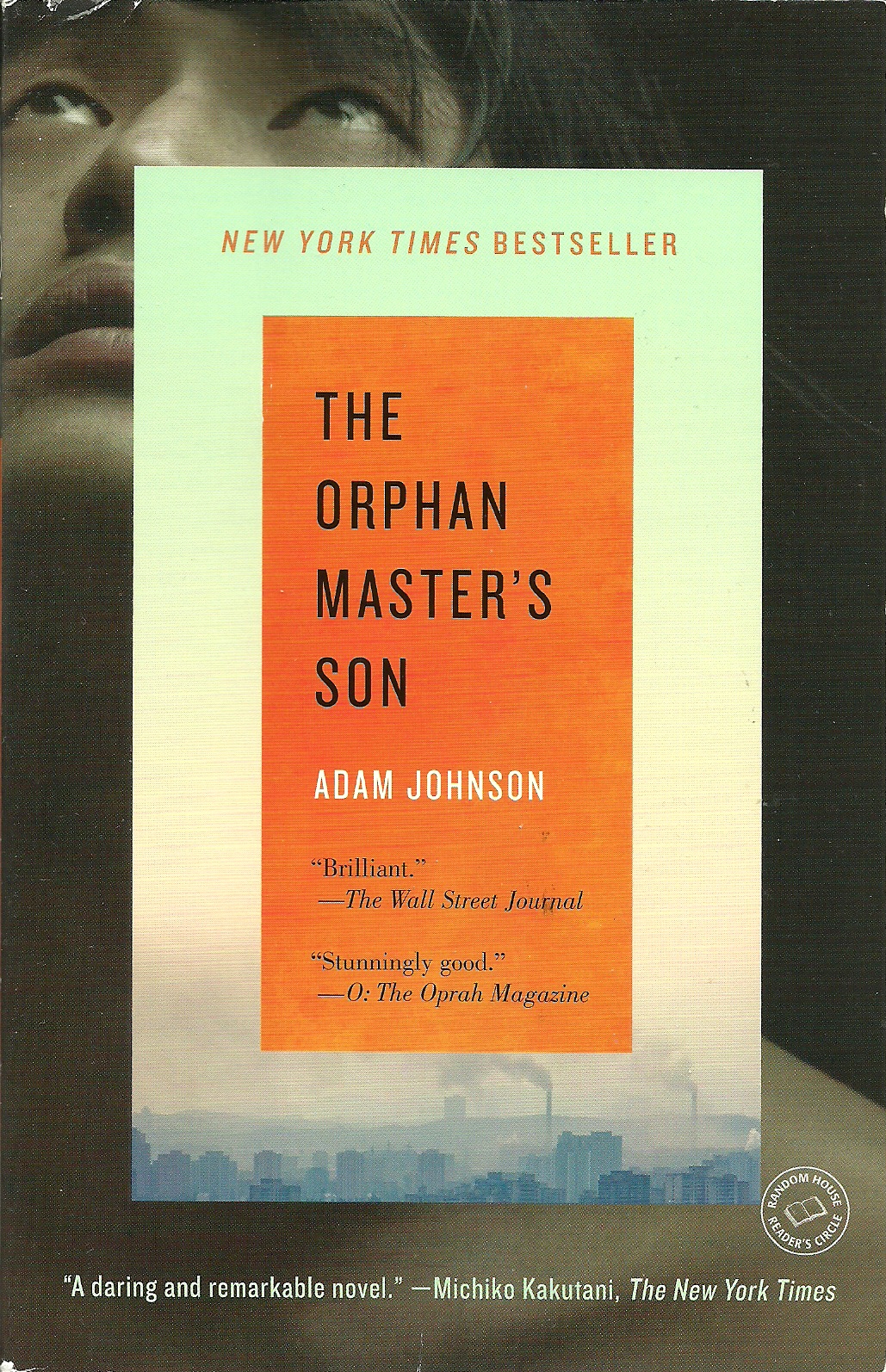
The Orphan Master’s Son ~ A Capsule Book Review

The Orphan Master's Son cover

The Orphan Master’s Son by Adam Johnson ~ A Capsule Book Review by Allen Kopp 

Every year I read the work of fiction (usually a novel but sometimes a volume of short stories) that wins the Pulitzer Prize for Fiction. For me, there have been many high points (Ironweed, Martin Dressler, The Hours, The Mambo Kings Play Songs of Love, The Road, A Confederacy of Dunces) and some low points (anything involving yuppie angst or “relationships”). It seems that some years the winner is based more on “suitability” or “political correctness” rather than merit.

This year’s winner is The Orphan Master’s Son by Adam Johnson. It is set in North Korea, the one country on earth that is like no other. I had never given much thought before to North Korea. It is a communist totalitarian society. People are routinely tortured or imprisoned in horrible prison camps where they are certain to die in a few months. There is no religion other than worship of the “Dear Leader” and the state. The simple freedoms we take for granted in the United States are absent. It is a crime punishable by death to own certain items, such as a Bible or an unauthorized radio. People “disappear” overnight, for no apparent reason, and nobody ever knows what happened to them. People must act and think at all time for the good of the collective. There is no individuality.

The protagonist of The Orphan Master’s Son is a young man named Jun Do. He grows up in an orphan asylum, although he claims he has one parent living, the “orphan master.” In young adulthood, he is conscripted to help kidnap people who happen to be unlucky enough to be in the wrong place at the wrong time. (What they do with these kidnapped people is not fully explained.) When he is older he ends up as a radio operator on a North Korean fishing vessel. What happens to him on the fishing vessel drives the narrative for the rest of the novel.

Only married men are allowed to work on fishing vessels. Their wives’ likenesses are tattooed on their chests. If any of them dare to defect to Japan or some other country, their wives and families can be tortured and killed. Since Jun Do doesn’t have a wife, the men on the fishing vessel tattoo on his chest the likeness of Sun Moon, Korea’s national actress and a favorite of the Dear Leader, who has made her what she is. All her films are propaganda disguised as entertainment.

Sun Moon’s husband is the mysterious and powerful Commander Ga. We don’t know much about Commander Ga, except that he is cruel and feared. Through a quirk of fate (or many quirks of fate), Jun Do kills Commander Ga and assumes his identity. From that point on in the story, Jun Do becomes Commander Ga. In pretending to be Sun Moon’s husband (and father to her two children), he falls in love with her and finally, through many twists and turns, determines her fate. He is inspired by the story of the movie Casablanca, in which “the honorable man stays behind.”

While The Orphan Master’s Son is easy to read and held my interest for much of its 443 pages, the reading of it seemed interminable to me. After about page 300, I was ready for it to end. Too much torture and unrelieved grimness. I mostly came away with the impression that I sure am glad I wasn’t born in North Korea. I don’t think I’d last a whole day there and it’s a world I don’t want to revisit anytime soon.

Copyright © 2013 by Allen Kopp 

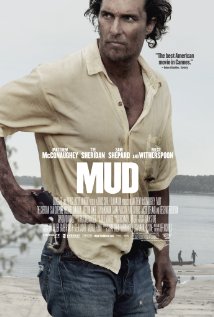
Mud ~ A Capsule Movie Review

Mud

Mud ~ A Capsule Movie Review By Allen Kopp 

Mud is a contemporary story set almost entirely on an unnamed Arkansas river. Fourteen-year-old Ellis lives with his parents on a sort of houseboat and they make their living from the river. His parents are decent people but they seem unhappy. His mother wants to separate from his father and move into town. Their way of life on the river is coming to an end.

One day when Ellis and his friend Neckbone take their boat to an apparently uninhabited island on the river, they discover a boat, intact, about twenty feet off the ground lodged in a tree. It came to be there from a recent flood. When they climb up into the boat, they find signs that someone has been living in it. Soon after, they meet a man who is known only as Mud (Matthew McConaughey). He is dirty and hungry but friendly. Ellis is drawn to him and wants to help him but Neckbone is more skeptical. Mud makes a deal with Ellis and Neckbone whereby they will help him get the boat out of the tree in exchange for his .45 caliber pistol. He plans to use the boat to escape up the river, but first he is waiting for someone to come to him, a girl named Juniper (Reese Witherspoon), with whom he has been in love since he was a child.

Mud has to hide out on the island because he has killed a man who had wronged Juniper. The man’s brother and father are after Mud, intent on killing him. They are terrorizing Juniper because they believe she knows where Mud is and can lead them to him. If Mud can get the boat out of the tree and get it in running order, he and Juniper can run away together, he believes.

When Ellis and Neckbone see Juniper, they see why Mud loves her. Ellis begins taking letters to Juniper from Mud and generally helping Mud in any way he can in his plan to escape. They devise a plan whereby they will take Juniper to Mud, but she doesn’t show up at the appointed time. This is when Ellis begins to see things as they really are. Juniper is just a floozy who will take up with any man. She says she loves Mud but Ellis begins to doubt it. The perfect love that he thought held Mud and Juniper together doesn’t exist at all. He begins to see that Mud has only used him and Neckbone. This disappointment parallels the disintegration of his own family and their way of life on the river. Even his own romance with a slightly older girl named May Pearl ends in disappointment.

Mud is a story about the South that might have been written by William Faulkner or Erskine Caldwell. It’s a coming-of-age story but also a story about friendship, family, and lost love. There are no special effects, no computer-generated razzle-dazzle. Just believable characters and solid storytelling.

Copyright © 2013 by Allen Kopp
The Great Gatsby ~ A Capsule Movie Review

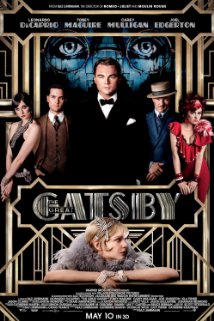
The Great Gatsby poster

The Great Gatsby ~ A Capsule Movie Review by Allen Kopp 

The Great Gatsby stars Leonardo DiCaprio as the fabulously wealthy, mysterious Jay Gatsby and Carey Mulligan as Daisy Buchanan, the woman who Gatsby has lost and attempts to regain, with tragic results. It is told by Gatsby’s one true friend and confidante, Nick Carraway (Tobey Maguire), who innocently falls under Gatsby’s spell. The Great Gatsby is directed by Baz Luhrmann in a grand visual style (remember Moulin Rouge a few years ago?) that never gets in the way of the story. There have been other film versions of the venerable American novel by F. Scott Fitzgerald, but this one is by far the best.

The story is set in the 1920s. No other decade could have spawned such a story. Not only did the 1920s roar, but they also boomed. There were fabulous amounts of money to be made. It was a time of great optimism. The bubble seemingly would never burst. Jay Gatsby is the perfect figure for the times. He lives in an enormous seaside “palace” on Long Island. He drives a custom-made yellow convertible. He gives lavish parties that he doesn’t attend but observes from a distance. He conducts shadowy business deals over the phone. Because nobody knows much about him, he is the object of much speculation.

Five years earlier, at the end of World War I (before Gatsby made his fortune), he had met and fallen in love with one Daisy Fay of Louisville, Kentucky. Daisy loved him in return but was not going to marry a man without money. She ended up marrying a brutish lout of a man named Tom Buchanan, heir to one of the largest fortunes in the country, and they took up residence on Long Island.

During the five years that Gatsby and Daisy are apart, he never forgets her and never stops believing that the two of them can be together, even though she is married to another man. Now immensely wealthy, he buys the estate just across the bay from Tom and Daisy and spends a lot of time standing on the pier looking across the bay, reaching for the green light that represents for him what is unattainable. He gives lavish parties, to which nobody is invited but goes to anyway, because he’s hoping that Daisy will just “appear” at one of them. Nick Carraway, callow and humble bond salesman, rents the caretaker’s cottage near Gatsby’s home and befriends Gatsby. Learning that Nick is a cousin of Daisy Buchanan, Gatsby gets Nick to arrange a reunion. When Gatsby and Daisy meet again, the old spark of five years earlier is reignited. Will she divorce Tom and marry Gatsby? In the end, it seems she hardly knows what she wants.

Fans of Fitzgerald’s novel, of which I am one, will not be disappointed with this movie adaptation. It is faithful to the novel but, for me, the best thing about it is its lavish visual style. It is, first and foremost, a visual experience (in 3D, no less), especially for those who know the story so well and know what is coming. My favorite scene is Gatsby’s party with everybody happy and dancing to Gershwin’s Rhapsody in Blue, with fireworks exploding in the sky. I want to see it again.

The Great Gatsby does not have a happy ending but it couldn’t have been any other way. The grand future that Gatsby envisioned with him and Daisy happily in love is not meant to be. The bubble always bursts, but it sure was fun while it lasted.

Copyright © 2013 by Allen Kopp