My Sunshine Away ~ A Capsule Book Review

My Sunshine Away

My Sunshine Away ~ A Capsule Book Review by Allen Kopp

My Sunshine Away, by first-time novelist M. O. Walsh, is set in Baton Rouge, Louisiana, in the late 1980s. The unnamed narrator (referred to only by pronouns) lives in a pleasant middle-class housing development with his mother, his philandering father (he has a girlfriend younger than his daughters), and his two older sisters, Hannah (killed in a traffic accident in her twenties) and Rachel. The narrator harbors an unhealthy adolescent obsession for a girl in the neighborhood named Lindy Simpson. He thinks about her day and night. He fantasizes about her. He climbs into a tree in her yard and spies on her with binoculars. He tries to impress her in the way he cuts his hair and the way he dresses. He envisions a future with her. Everything for him is Lindy, Lindy, Lindy. If you think this doesn’t get tiresome after a couple hundred pages, you are mistaken.

On a summer evening when the narrator and Lindy are sixteen, Lindy is raped. It’s an unusual crime for the neighborhood. The narrator is a suspect for a while (he didn’t do it), as is nearly every other male in the neighborhood. The police are not able to find out who did it. Lindy didn’t get a good look at her assailant. The most tragic consequence of the crime is that Lindy changes: from a sweet, pleasant girl into a rebellious, sullen, foul-mouthed idiot. (Know anybody like this?)

Despite Lindy’s change for the worse, however, the narrator’s obsession for her only grows stronger. (She seems increasingly unworthy of his adulation.) He tries to find out who raped Lindy and in a way carries a burden of guilt because he was outside on the dark night of the rape, saw a male figure lurking around, and was too scared to do anything about it. He doesn’t find an answer until many years later when he and Lindy are in their thirties. Will it help Lindy, even at that late stage, to know who raped her? Probably not.

Being set in Baton Rouge doesn’t make My Sunshine Away a “Southern novel.” While there is some “local color” involving heat, swamps, bugs, crepe myrtle trees and hurricanes, it’s a story that could take place anywhere, in New Mexico or New Jersey. If you want to read a real Southern novel, read As I Lay Dying by William Faulkner, The Heart is a Lonely Hunter by Carson McCullers or Wise Blood by Flannery O’Connor.

My Sunshine Away is a beautifully written first-person narrative, highly readable, if a little wordy and repetitive at times. I liked it a lot when I first started reading it and a lot less about two-thirds of the way through. Where the story starts to go south for me is the mutual telephone masturbation scene between the narrator and Lindy. (I think this is what they call “phone sex.” Yuck.) Anyway, the last one-third of the book was a chore for me to get through. The narrator’s obsession with Lindy began to grow thin for me at the point where she turns into such a jerk and such an unlikeable person. His mostly absent father should have taken him aside and told him that Lindy was bad news and that he was wasting his time and emotional energy on her. She will cause you nothing but heartache. Don’t put yourself through that if you don’t have to. Or words to that effect.

The last thirty or forty pages of the book, while compellingly written (as the whole book is), are a little treacly and female-oriented for my taste, as if the writer is going for a female audience here. If you don’t roll your eyes through these pages (rhapsodizing about pregnancy, parenthood and love), you have a much stronger constitution that I do.

Copyright © 2015 by Allen Kopp

His Last Good Time

His Last Good Time

His Last Good Time ~ A Short Story by Allen Kopp 

He stepped off the bus onto the hot asphalt and looked around at the strange place he was in that he had never seen before. He walked a few blocks and was amazed at the sight of the monoliths that rose hundreds of feet into the air and blotted out the sun. Other people didn’t look up and didn’t seem to notice anything at all other than what was in front of their faces and maybe not even that. When he spotted a well-dressed old couple walking toward him—his idea of mother and father—he took off his hat and approached them with a smile. “Where do people go around here to die?” he asked. The woman looked insulted and the man angry and they passed on as quickly as they could. He didn’t see anything wrong with asking this question. The rebuff was his first experience with the coldness of the city.

His name was Ellis Gage and he had ridden six hundred miles for two days on the bus. It was incumbent upon him to leave home because he had killed his stepfather. He had seen enough movies to know that nobody gets away with killing another person and he wouldn’t get away with it either.

This is how it happened. His mother was away tending to a sick relative and he was left alone in the house with the man who had been his stepfather for five years, Nelson Niles. Nelson had been drinking all day, as he often did. In the evening after supper, a thunderstorm came up. Rain pelted the house and lightning ripped the sky. Nelson became blubbery. He said he was lonely. He didn’t like to admit it, he said, but he had always been afraid of thunderstorms.

“Go to bed and sleep it off,” Ellis said. “The thunderstorm is nothing.”

The lights went off but Ellis didn’t mind. He liked storms and he planned on getting into bed and listening to the rain. There’s no sweeter music to drop off to sleep by.

“I want you to sleep in my bed with me,” Nelson said.

“What?”

“I don’t like sleeping alone.”

“Mother will be back in a few days,” Ellis said.

“Yes, but she’s not here now. I want you to sleep with me.”

“Just get into bed and close your eyes and soon you’ll be asleep.”

“You’re like a son to me.”

“You sleep in your bed and I’ll sleep in mine.”

“There’s nothing wrong with it. Nobody will ever know.”

“I’ll know!”

“We can have us a fine time.”

“What are you saying?”

“I’m sorry.” He rubbed his head as with a headache. “I can see how you misunderstand. It’s the liquor talking.”

“Why do you drink so much?”

“I was born this way. My daddy was an alcoholic and his daddy before him and his before him. All the way back to Adam.”

“That’s no excuse.”

“Not excusing. Only explaining.”

“I’m going to bed now and I think you should do the same,” Ellis said.

He went into the kitchen to make sure the door was closed and locked and then he went up the stairs. By the time he was at the top, though, Nelson was right there behind him in the dark, quick as a cat. He grabbed Ellis in a hug and tried to put his mouth on his in a drunken semblance of a kiss.

Ellis was caught off-guard. “Get off me!” he said. “What’s the matter with you?”

Nelson was not to be deterred this time, though. Even though he let go of Ellis, he wouldn’t let him pass into his room. “When your mother and I got married,” he said, “you were underage, but you’re not underage anymore. We can do whatever we want. I’ve always been drawn to you in a way that nobody ever knew about. When I found out your ma was going to be gone for a few days, I knew the time had come to do the thing I’ve always wanted to do.”

“You stink!” Ellis said. “You make me sick! I could kill you and no jury would ever convict me after I told them what you just said to me.”

“Oh, don’t push me away!”

They grappled at the top of the stairs. When Nelson tried to kiss Ellis again, he pushed him, not to hurt him but only to get away. Nelson misjudged the distance between himself and the top of the stairs. He staggered and tried to right himself and in doing so lost his balance and fell headlong to the bottom. Ellis believed he could hear his bones cracking as he fell.

A tremendous lightning flash rocked the house. Ellis went down the stairs slowly, feeling his way along the wall. He didn’t want to touch Nelson but he did so only to the extent that he had to. He put his ear to Nelson’s chest and wasn’t able to detect a heartbeat; his face to Nelson’s face and could feel no movement of air.

He had never been in any kind of trouble with the law. He believed they would put him in jail now and never let him out. They wouldn’t believe it had been an accident. They would think he had meant to do it. They might even execute him. It would be the end for his mother. Her husband and her son both gone. She’d take to her bed and never get up again.

After a night of thinking, he decided what he would do. He would go away to spare his mother and do away with himself. He wasn’t sure how he would do it, but he would figure it out when he needed to. It would be better to take care of his own end, he believed, than to be captured and hauled off to jail. He couldn’t stand the thought of being locked up. There was only one way out and he was going to take it.

Packing a small bag, he took what money he had out of his dresser drawer and left the house before dawn. The rain had stopped but there were still a tumult of clouds in the sky and a low rumble like a growl. He walked the three miles into town to the bus station. By the time he was able to get on the bus, he was so exhausted from a night without rest and from his long walk that he fell asleep next to a window with the hot wind in his face.

In the city, he checked into a modest hotel and on his first night there he counted his money out on the bed. Factoring in the cost of the room per day and of eating every meal in a restaurant, he figured he would last about a week in the city. It took him more than a year to save that money, but it didn’t matter. He would have as good a time as he could in the time left to him because it would be the last good time he would ever have.

The first couple of days he spent mostly in his room, lying on the bed and smoking cigarettes. (He had recently picked up the habit in spite of his mother’s objections.) He thought about his life but mostly he thought about his mother coming home after her trip and finding Nelson (dead for several days by then) at the bottom of the stairs. Of course, she would wonder where Ellis was, but he hoped she didn’t connect his being gone with Nelson’s death in any way. She would think that Nelson had fallen down the stairs because he was drunk while Ellis was away visiting his friend Delroy, who had a cabin on the river.

When he became so hungry he could no longer stand it, he would go out and get something to eat. There was a restaurant on the first floor of the hotel but, finding the food there tasteless and overpriced, he preferred to go to a café three or four blocks from the hotel where there was a waitress named Rosalie.

Rosalie was older than him, about thirty, and married, but it didn’t make any difference. She made him feel good because she smiled at him and told him what was good from the bill of fare and what wasn’t. She had thick auburn hair and when she smiled she showed front teeth that overlapped. She joked with him and asked him questions, not too personal, about where he was from and where he was headed. He told her he had always wanted to see the city and had decided finally to have his little fling. She laughed when he said the word fling as if she had never heard it before and set down a piece of apple pie in front of him with vanilla ice cream on top. She told him if he wanted anything else to give her a holler. He wanted to ask her to go someplace with him other than the café where they might talk, but he saw the wedding ring on her finger and knew that doing so would be too forward and might spoil the friendly feeling between them. He always left her a tip, though, more than he could afford, and would catch her eye and give her a friendly wave as he left.

As his days in the city began to pile one of top of the other, he began to think about how he might do himself in. He didn’t want to create a public spectacle, so that eliminated the possibility of jumping out a window or throwing himself in front of a bus. He had heard about people going to sleep and not waking up from the right combination of strong liquor and pills. He could get himself a bottle of whiskey, all right, all right, but he didn’t know what kind of pills to get and if he knew he wasn’t sure he could get them.

He began walking the streets to see as much of the city as he could before checking out. He visited a museum, where he looked at some paintings; when he discovered a park with a zoo, he began to spend a lot of his time there with the monkeys and lions. People rarely spoke to him, as if he wasn’t there at all, but when they did they were cordial and friendly enough; they had no reason not to be. Rosalie remained the only person in the city, though, with whom he had any real connection.

The day came when he realized, on counting his money again, that he only had enough to make it through the next day, which was Sunday. Sunday seemed a good day to die.

He didn’t want to spend Saturday night, his last night on earth, moping around in his room, so he spent the whole night walking the streets, which were always thronging with people. And in everything he saw—drunks and prostitutes, a bar brawl spilling out into the streets, two women engaged in a fistfight,  a well-dressed crowd pouring out of a theatre, a taxicab smashing into the back of a truck—he was as detached as a ghost. At a newsstand, when he saw a length of thin rope on top of a pile of newspapers, he asked the vendor if he might have it. The vendor thought for a moment and told him he could take it for the price of thirty cents.

When he got back to his hotel room, the sun was just coming up. He was glad to see it was going to be a sunny day. He ate a light breakfast and went up to his room and took a hot bath. He slept for a couple of hours and when he awoke he put on his clean clothes and sat down at the desk to write his mother a farewell letter.

With pen in hand, he couldn’t think of what to write. Trying to explain to her what he was going to do and why didn’t make any sense. If it didn’t make any sense to him, it certainly wouldn’t to her. He could simply apologize and tell her goodbye, but he believed she deserved more than that.

The only thing that would do would be for him to speak to her on the phone one last time. And he wouldn’t tell her what he was going to do because that would only alarm her. Just hearing her voice, though, would give him the courage he needed. It would be the fitting end to his time on earth that he needed.

His heart was pounding as he picked up the phone. He had to go through the hotel switchboard to make the call, but it only took a minute and after the phone rang just two rings his mother answered.

“Did I wake you up, mother?” he asked casually.

“Ellis, is that you?”

“Yes, it’s me.”

“Where in the world are you?”

“Delroy invited me up to his cabin. I’ve been here for a few days.”

“Thank goodness. We didn’t know where you were.”

“We?”

“Nelson and me.”

“Nelson?”

“Yes, he was drunk and had a bad fall while I was gone but he’s better now. He broke his shoulder and three ribs. He’s such a baby. He wants his pain pills regularly. I don’t know what he’d do if he ever had any real pain.”

“You said Nelson?”

“Yes. Who else? Are you all right? You sound a little funny.”

“I’m fine now.”

“Nelson didn’t remember a thing because he was so drunk. He said you were in the house before he fell and gone after he fell. He didn’t know where you were. He was worried about you.”

“I’m fine, mother.”

“When are you coming home?”

“I don’t know. In a day or two.”

“So you’re having a good time?”

“The best time I’ve ever had. I’d like to stay for a few more days but I’m afraid I’m out of money.”

“Oh, honey! Do you want me to send you some?”

“No, that’s all right, mother. I don’t want to take your money.”

“Well, it certainly is good to hear your voice, son, and I’m so relieved you’re all right.”

“Why wouldn’t I be all right?”

“I guess I still think of you as my little boy, as big as you are.”

“I’ll be home soon, mother. Don’t worry about me.”

He hung up the phone and laughed. He danced around the room as if he had an invisible waltzing partner, as there was no one there to see him. How happy he was! How agreeably his dilemma had resolved itself! He loved his mother so much and, yes, he even loved Nelson. He loved Rosalie, his friend Delroy, the news vendor who sold him the rope and everybody else he had ever seen or known.

He put on his shoes, his hat and jacket and took the elevator down to the hotel lobby. He went out to the sidewalk. He would go down to Rosalie’s café and have a good lunch. She would be happy because he was happy. Maybe she would sit down across from him while he ate and talk to him. Maybe she wasn’t really married but only wore the ring to discourage any unwanted advances from male customers.

He had to cross the street but was too impatient to wait until he got to the intersection so he crossed in the middle of the block. He looked both ways but didn’t see the speeding taxicab. When it hit him, he was thrown through the air about ten feet. A woman screamed. People ran toward him. Somebody covered his face. There was nothing else to be done.

Copyright © 2015 by Allen Kopp  

Penny Dreadful, Season Two ~ A Capsule Review

Penny Dreadful- Victor Frankenstein

Penny Dreadful, Season Two ~ A Capsule Review by Allen Kopp 

My favorite character on Showtime’s Penny Dreadful is Dr. Victor Frankenstein. He’s nothing like Colin Clive or Basil Rathbone. He’s slender, young and handsome with a dimple in his chin. He doesn’t look like a mad scientist or somebody who enjoys reanimating dead tissue. He’s brilliant in his work but uncomfortable, since he is a Victorian gentleman, when it comes to things like picking out a lady’s undergarments. In season one he created a sweet doe-eyed monster out of parts from cadavers, only to have an earlier creation—one who didn’t turn out so well—return, kill the sweet monster and start making demands. This earlier monster, who calls himself John Clare, is lonely—if Dr. Frankenstein will create a mate for him, he promises he will go away and not cause any more trouble. Dr. Frankenstein tells him to be patient and he will go to work on the problem. While John Clare is waiting, he goes out into the cruel real world and finds a job. First he works at a Grand Guignol theatre, where bloodletting is the order of the day. That ends in tragedy, so, in season two, he secures employment at a wax works. The kindly owner of the wax works has a blind daughter to whom John Clare is drawn. She feels perfectly comfortable with him because she cannot see how strange he looks.

In season one of the show, the only American character in the cast, Ethan Chandler (in London with a Wild West show), had a girlfriend from the lower English classes named Broma Croft. He was in love with her but, alas, she had consumption and soon died. Dr. Frankenstein secures her body with the intention of turning her into the mate for his monster. He puts her in a pickling solution and waits for the terrific thunderstorm that will reanimate her. When the storm occurs and he is able to bring her back to life, she is disoriented and remembers nothing of her former life. He names her Lily (the flower of rebirth and resurrection) and tells her she is his cousin and that they grew up together. He has to teach her everything about the world, as she is like a newborn baby. He dyes her hair blond to give her a different identify from the one she had when she was Broma Croft and enlists the aid of Vanessa Ives to buy her some clothes to wear.

Of course, other things are going on simultaneously. Vanessa Ives, who was revealed at the end of season one to be Sir Malcolm Mallory’s out-of-wedlock daughter, is now living in his house with him and his African man-servant Sembene. She is, and always has been, much tormented, subject to visitations by the darkest of forces. (Is she a witch or what?) We have recently learned that Satan desires her above all others. (What he will do with her when he gets her we can only imagine.) Satan has sent his consort (one of them?) to earth in the guise of one Mrs. Poole. She has a collection of naughty “daughters” who are also minions of Satan who will do her (and his) bidding. Their one goal is to get Vanessa Ives for Satan. (Why he can’t get her himself has not been revealed.) Sir Malcolm has begun a flirtation with Mrs. Poole (not as innocent as he thinks), not knowing who, or what, she really is.

Then there’s youthful Dorian Gray. He has a new love interest, named Angelique, who, on first acquaintance, appears to be a woman but—wait a minute—“she” is really a “he.” (Dorian knew right away it was a man; men are what he is most interested in.) When Angelique inquires about Dorian’s age, he tells her he is older than he looks. (We already know how he keeps his youthful appearance.) There’s a scene where Dorian and Angelique are playing a game called gossamer tennis (ping-pong to us), a game newly brought over from India by returning soldiers.  Angelique bests Dorian in every game, even though the place where they are playing is lit by electric light, not very flattering to a “girl’s” complexion, as Angelique says.

Penny Dreadful is set in Victorian London, but it’s not the London of Charles Dickens. It’s a mélange of horror movie themes, dark and forbidding, with dark forces everywhere afoot. It’s classy, well-made, intellectually stimulating and a feast for the eyes. How do they do those fabulous sets that are only seen for a second or two? If it’s all computer-generated graphics, it’s still impressive because it looks so real. Seeing it is to step out of the mundane world we live in into another time and place that is fun to visit, even though you probably wouldn’t want to live there if it meant you had to do without the Internet.

Penny Dreadful, Season Two

Copyright © 2015 by Allen Kopp

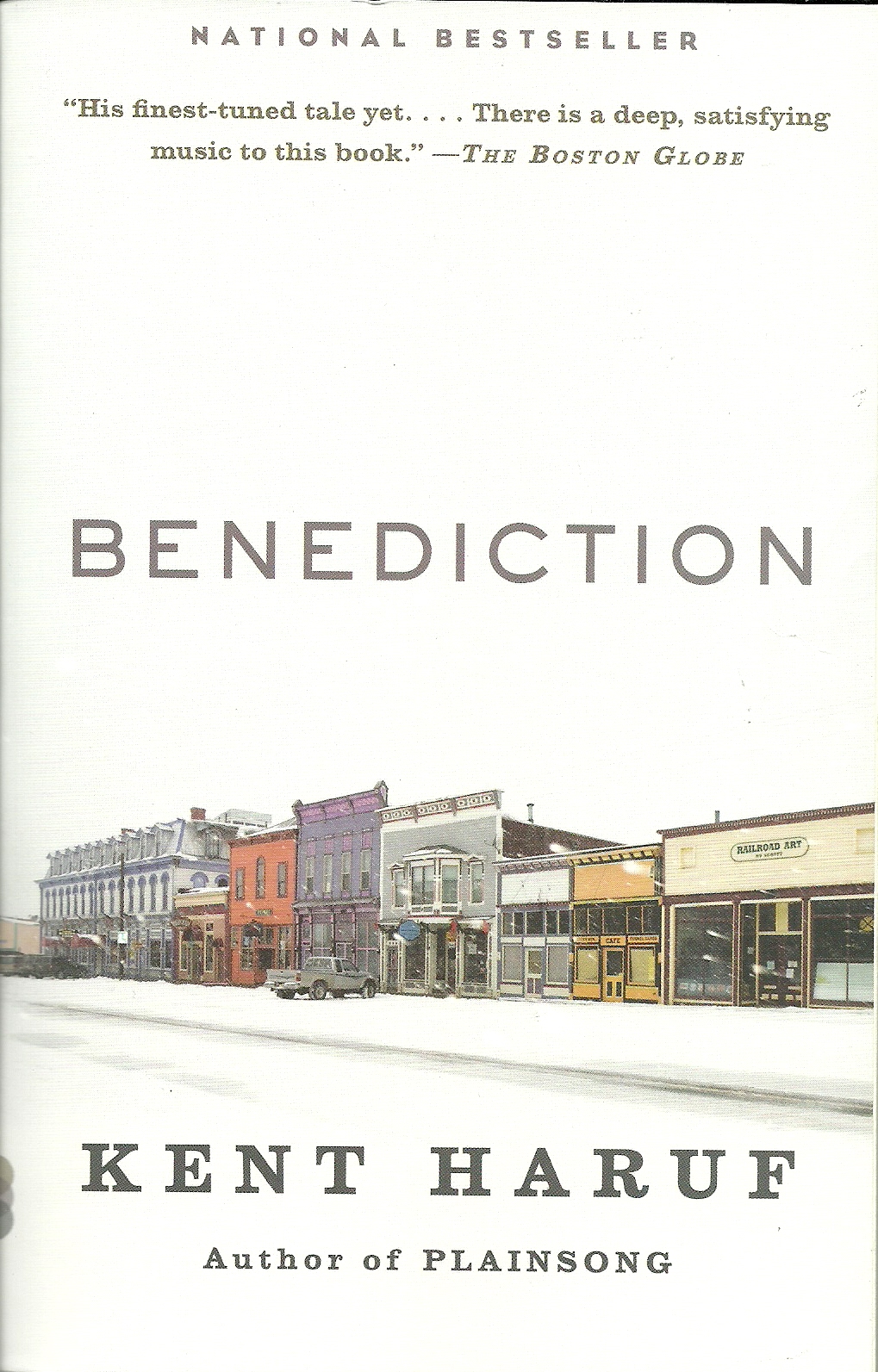
Benediction ~ A Capsule Book Review

Benediction

Benediction ~ A Capsule Book Review by Allen Kopp 

I met writer Kent Haruf at one of his book-signing events in St. Louis. We spoke for a minute about Cormac McCarthy and Oscar Hijuelos and I came away with a signed copy of his novel Plainsong to add to my collection of signed books. His 2013 novel Benediction continues his string of quietly impressive books set on the high plains in the fictional town of Holt, Colorado. The main character here is Dad Lewis (we never know his first name), lifelong owner of the town’s hardware store. He has a faithful wife named Mary and two children, Lorraine and Frank. When we meet him, he is old and sick and doesn’t have long to live. His daughter Lorraine, now middle-aged, returns home to be with him in his final stretch. He longs to reconnect with his estranged son Frank before he dies, but Frank is gay and he and Dad have never hit it off very well.

Then there’s Reverend Lyle, new to Holt from Denver. His wife and son are unhappy with small-town life and they never pass up a chance to remind him. (His wife was having an extramarital affair in Denver and that was one of the reasons they left.) When Reverend Lyle preaches a sermon in the Congregational Church about loving one’s neighbors and turning the other cheek, it doesn’t go over well with small-town folk, especially during wartime. (He’s only stating what the Bible says, but most people seem to think he’s siding with the enemy.) He is so disliked after this sermon, it seems there is no way he can survive attempts to have him fired or reassigned. After his unsympathetic wife leaves him and his son attempts suicide, what’s left for Reverent Lyle in the town of Holt?

Other characters include Berta May, the old lady who lives next door to Dad and Mary Lewis, raising her young granddaughter, Alice, after the girl’s mother dies; Tanya, the wife of a fired employee who Dad Lewis helps (without expecting anything in return, although sex is offered) after her husband commits suicide; Willa Johnson and her fifty-six-year-old daughter Alene, a teacher who once had an unhappy love affair with a married man that she was never quite able to get over. On a hot day the ladies (Mary Lewis and her daughter Lorraine, Willa and Alene Johnson, Berta May and her granddaughter Alice) take off all their clothes and get into the stock tank. I might have expected them to be more modest than that, especially in the company of a young girl, but it seems that woman aren’t as modest as men.

Benediction is a slice of small-town life, understated in the way of the man who wrote it. There’s nothing bombastic or larger than life here, just solid storytelling told in uncluttered language with plenty of drama (but no drama queens) just underneath the surface. It’s people living out their good-and-bad lives, forcing us to wonder—and not for the first time, either—what it’s all about.

Copyright © 2015 by Allen Kopp 

Far From the Madding Crowd ~ A Capsule Movie Review

Far From the Madding Crowd

Far From the Madding Crowd ~ A Capsule Movie Review by Allen Kopp 

This is the second film adaptation of Thomas Hardy’s 1874 novel. The first was in 1967 and starred that mod girl Julie Christie. This one is better, though. It has Carey Mulligan (who played Michael Fassbender’s disturbed sister in Shame and Daisy Buchanan in The Great Gatsby) as Bathsheba Everdene. The story is set in rural England in 1870. Bathsheba is that rare animal in Victorian England, a free-thinking woman who doesn’t believe that a woman has to be dependent on a man to get along in the world. She has, as she says, an education and nothing else. When handsome sheep farmer Gabriel Oaks (Matthias Schoenaerts) proposes marriage to her on very short acquaintance, she tells him she doesn’t want a husband. That isn’t the end of him, though. Just about the time he loses his own small farm through a cruel twist of fate, she inherits a farm of her own from an uncle. Since she knows nothing about running a farm, she employs Gabriel Oaks to help her.

Meanwhile, Bathsheba has caught the eye of wealthy landowner William Boldwood (Michael Sheen). He has a large, impressive house and anything a girl could want in the way of earthly possessions, but he’s dour, middle-aged and unexciting. When he proposes marriage to Bathsheba (as, with Farmer Oaks, on very short acquaintance), she turns him down, explaining that she doesn’t want to be any man’s property. Farmer Boldwood doesn’t give up easily, though; he believes he might be able to get her to change her mind.

A third man comes onto the scene and almost literally sweeps Bathsheba off her feet. He is handsome Sergeant Francis “Frank” Troy. With his red uniform, pale skin, perfect physique and black mustache, he is too much for Bathsheba to resist. She enters into a hasty, ill-informed union with him, only to regret it almost the same day as the marriage. It turns out that he was supposed to marry another girl named Fanny Robbin (played by Juno Temple, who plays Texas-accented Dottie in Killer Joe), but when Fanny goes to the wrong church on the day of the wedding, she literally leaves him standing at the altar. When Frank meets Fanny again after he is married to Bathsheba, she is destitute and carrying his child. She and the child both die and Frank is grief-stricken. He tells Bathsheba that Fanny meant more to him that she (Bathsheba) ever could. He commits suicide (or seems to) by removing his uniform and swimming far out into the ocean. There’s a heavy dose of irony in how the story is resolved.

With this cast of characters and the setting, how could you go wrong? If you are of a literary bent and especially if you have read the books of Thomas Hardy, you will love this satisfying, beautifully photographed, perfectly cast version of Far From the Madding Crowd. Unless, of course, you prefer Fast and Furious 7, which is, I imagine, a lot like Fast and Furious 1, 2, 3, 4, 5 and 6. Where will it all end?

Copyright © 2015 by Allen Kopp

The Stranger ~ A Capsule Book Review

The Stranger

The Stranger ~ A Capsule Book Review by Allen Kopp

French writer Albert Camus was born in Algiers in 1913 and died in an automobile accident in 1960 at the age of 47. His novel The Stranger was published in 1942 and first appeared in English in 1946. It’s the simple story of an ordinary French Algerian, named Meursault, and the act of senseless violence that changed his life.

When the story begins, Meursault’s mother has died in the rest home where he put her because he couldn’t take care of her properly at home. When he travels to her funeral it is a very hot day. He loved his mother in his own way but is not able to cry over her death. In the ordeal of sitting up with her body overnight and the funeral the next day, he shows no emotion. He stands before her coffin, drinking coffee and smoking cigarettes, observing the other mourners. His lack of emotion is noted by those in attendance and plays a significant part in what is to come.

Meursault has a friend named Raymond Sintès. When Raymond has a dispute with an Arab girlfriend, Meursault helps Raymond by writing her a letter. This leads to an altercation between Raymond and the girl, which leads to Raymond hitting her. A few days later when Meursault and Raymond go to the beach with some friends, the girl’s brother is waiting for them. There is a fight, during which Raymond is slightly injured. Meursault takes Raymond’s gun from him to keep him from doing anything rash. Later in the day, after they have all calmed down, Meursault returns to the beach with the gun and shoots the Arab five times and kills him. Meursault can’t explain why he killed the man, except to say that it was very hot.

Meursault is put in prison to await trail. He is detached about prison as he is about everything else. He is appointed a lawyer, who assures him that he will be acquitted. When the trail begins, it doesn’t go well for Meursault. The prosecution brings in all the people from Meursault’s mother’s funeral who testify that Meursault didn’t cry. The prosecutor in his eloquence portrays Meursault is a cold, calculating murderer and an unfeeling monster. The jury finds him guilty and he is sentenced to die by the guillotine. While awaiting death he allows himself to imagine some miracle occurring by which he is acquitted, but he knows it isn’t going to happen.

Meursault confides to a prison chaplain that he believes in nothing, that life is meaningless and random. There is no plan, no design that gives life a larger meaning. Meursault believes he understands the indifference of the universe toward man, and this allows him to come to terms with his own death. “…I opened myself to the gentle indifference of the world,” he says. “Finding it so much like myself—so like a brother, really—I felt that I had been happy and was happy again. For everything to be consummated, for me to feel less alone, I had only to wish that there be a large crowd of spectators the day of my execution and that they greet me with cries of hate.”

The Stranger is divided into two parts, before the murder and after. It’s a first-person narrative, told in Meursault’s own voice. We’re being told Meursault’s version of what happened. This makes the story seem immediate and relevant. While Meursault is detached in all things, his story is not detached and the reader doesn’t feel detached either. It’s a very readable classic, never dull or ponderous. In tenth grade when we were given a list of books to read to write a report on, I chose Pride and Prejudice. If I had known then how good The Stranger is, I would have chosen it instead. The Bennett sisters are chloroform in print.

Copyright © 2015 by Allen Kopp

Mad Max: Fury Road ~ A Capsule Movie Review

Mad Max Fury Road

Mad Max: Fury Road ~ A Capsule Movie Review by Allen Kopp 

Mad Max: Fury Road is set in a post-apocalyptic world (yes, another one), in an arid desert wasteland, where warring factions made up of grotesques battle each other in enormous vehicles (1000 horsepower) called “war rigs” that seem to be made up of parts of old cars and trucks. These people have reverted to a kind of primitive state in which one person, named Immortan Joe (the most grotesque of them all), “owns” all the people because he “owns” all the water. A woman named Furiosa has “stolen” some of Immortan Joe’s “breed stock” (five scantily clad girls, one of whom is carrying his child) to free them and also to take them with her to the “green place” of her birth. We can see that Furiosa has not had an easy time of it; her left arm is missing below the elbow. She keeps the girls hidden in her war rig as she tries to flee with them.

Enter Max Rockatansky, or Mad Max (Tom Hardy). Max tells us right at the beginning that he is driven by his instinct for survival in this hellish world and is haunted by the people he wasn’t able to save, including, apparently, his own small daughter who appears in his vision at odd times. This is about all we ever learn of Max. He is taciturn in the way of movie heroes, not nearly as menacing as the other men in the movie, and is more than capable of taking care of himself and anybody else he wants to take care of. He joins forces with Furiosa and the breed stock girls, helping them to get to where they think they want to go and flee from their menacing pursuers. We see that Furiosa likes Max but there’s no room here for romance—everybody is in too much danger and too hot and sweaty.

Mad Max: Fury Road has everything you would expect from an action-adventure movie: loudness, fiery explosions, a pulsating music score, unintelligible dialogue, lots of frenetic action, death-defying stunts, and good against not-so-good. This one also has character names such as Slit, Nux, Rictus Erectus, and Toast the Knowing. I see on IMDb that it’s not a remake of the 1979 Australian movie with Mel Gibson but a different story using the concept and setting of the earlier movie. Everything that was at one time a movie hit (that is, made money) will eventually find its way into the forefront again if you give it enough time.

Copyright © 2015 by Allen Kopp

All the Light We Cannot See ~ A Capsule Book Review

All the Light We Cannot See

All the Light We Cannot See ~ A Capsule Book Review by Allen Kopp

This year’s Pulitzer Prize winner for fiction is All the Light We Cannot See by Anthony Doerr. It’s a World War II story (yes, another one) set mostly in the small French coastal town of Saint-Malo. Marie-Laure LeBlanc is a French girl, blind from the age of six. She lives with her widowed father, who is employed as a locksmith at an enormous Paris museum. Marie-Laure is very bright and seems to live life to the fullest despite her blindness. She reads books in Braille—Jules Verne is her favorite writer—and she and her father are happy in their lives. All of that changes, however, when Germany occupies France and Marie-Laure and her father flee to the town of Saint-Malo and the home of Marie-Laure’s father’s uncle, whose name is Etienne.

Marie-Laure and her father are happy in Saint-Malo with Uncle Etienne and his housekeeper, Madame Manec, in spite of the deprivations of war. After a time, though, Marie-Laure’s father is called back to Paris by his employer (apparently a trick) and is captured and imprisoned by the Germans. Marie-Laure has no other choice but to continue to stay with her great-uncle in the narrow, six-story house in Saint-Malo. The town is right in the way of the fighting, though, so war comes to their doorstep when the Allied forces invade France to liberate it from the Germans. Etienne is forced to give up any radio transmitter in his home, but he keeps one secretly and continues to broadcast information that will be of help to the resistance movement. Marie-Laure is also part of the resistance, as she carries information, baked into loaves of bread, that he can transmit.

Marie-Laure’s story is juxtaposed with that of a German boy named Werner Pfennig. Werner and his sister Jutta live in an orphan home in a dreary mining town in Germany. Werner is also very bright and teaches himself the principles of mechanics and radio technology. When people see that he can repair radios that nobody else can, he is chosen to go to a “Hitler Youth” school. He has been looking for a chance to escape his dreary, futureless existence (and an enforced job in the coal mine when he turns fifteen) and this is his one chance, although he isn’t at all political and he hates to leave behind his sister, Jutta, as she is his only family.

Werner and his small contingent happen to be in Saint-Malo when it is heavily bombarded. They are buried for many days beneath a hotel that has collapsed. With what little he has to work with, he is able to put together a radio receiver that allows him to hear radio transmissions. He hears the voice of Marie-Laure as she reads from Jules Verne. When he and the others miraculously and unexpectedly escape from their imprisonment, he goes looking for the girl whose voice he heard. We knew all along that his life and Marie-Laure’s life were in some way going to intersect. He plays an important role in her life, but not in the way one might expect.

All the Light We Cannot See is a very readable book, with short chapters, most no more than two or three pages long. It’s not what you would call a long-winded book despite its 530 pages. The characters are engaging and believable and, even though it’s a wartime story, it’s not about war but about innocents whose lives are caught up in war. World War II continues to provide an unending source of storytelling material. What would the twentieth century be without war? Not nearly as tumultuous or as interesting.

Copyright © 2015 by Allen Kopp

Suicide Hotel

Suicide Hotel
Suicide Hotel ~ A Short Story by Allen Kopp

(This is an expanded version of a short story I posted before.)

Margaret Pendler was to be passed over again for promotion, after seventeen years with the company. A younger, prettier girl named Stephanie with only three years got the nod. Stephanie with her blond hair and tight skirts that showed the contours of her can; shapely, nylon-clad legs that she was all too willing to show off; a touch of cleavage, perfect teeth and lips the color of a valentine.

After Margaret received the news right before morning coffee break, she sat at her desk holding a pencil in her right hand, her left hand on her cheek, barely moving. Not even pretending to do any work. When the girls, all atwitter at Stephanie’s promotion, went for coffee, Margaret stayed behind.

In one minute or less, she had lost all interest in everything around her. When Mr. Dauphin came in, she didn’t even look up and smile as she always did. He was her favorite and she had even believed, at infrequent intervals, that she was in love with him. Never mind that he had been married three times and was working his way through all the pretty young things in the office.

At lunchtime she was still sitting exactly as she had been two hours earlier. Her coworkers had been giving her curious glances but she ignored them. If anybody had said anything to her, she might have pulled a knife out of the drawer and stabbed them.

Finally, when the lunch hour was almost over, she stood up and said, to no one person in particular, “I have no wish to be here.” She took her purse and her raincoat and left, without bothering to straighten the clutter on her desk or even to push the chair in. Without a word to anybody, she went down the stairs and out the building, her intention being never to return.

At home her mother, Georgina, was going through trunks, trying on clothes and wigs for a social function she was going to go to at her lodge. She held up a forties-vintage green dress with huge fabric-covered buttons and a long red wig and said, “What do you think of this?”

“Is it a costume party?” Margaret asked.

“No. I just want to look different from anybody else there.”

“That ought to do the trick.”

“What do you think of these?” She held up a silk Pagliacci lounging set.

“Oh, I think you ought to put those on now,” Margaret said.

“I think I will.”

Georgina went behind the screen to change. “I think I’m getting married again,” she said in a too-loud voice, believing that if she wasn’t seen she wasn’t heard.

“Who’s the lucky fellow?” Margaret asked.

“His name is Herman Mudge. I don’t think you’ve had the pleasure. He hasn’t actually asked me yet, but I think he will.”

“Let me be the first to congratulate you.”

“What do you think about having a stepfather?” Georgina asked, stepping out from behind the screen and turning around one time so Margaret could see the silk Pagliacci lounging set.

“Stunning,” Margaret said. “Is he younger than you?”

“Is who younger than me?”

“Herman Mudge.”

“He’s eighty-three. I’m seventy-nine. I think that’s a nice age difference, don’t you? My father was four years older than my mother.”

“Where are you going to live after you get married?”

“Why, here, of course. He’s got a small room in a hotel. You don’t think a newly married couple can live there, do you?”

“Well, I hope you’ll both be very happy,” Margaret said.

“I want cornflakes for supper and macaroons,” Georgina said.

After the evening meal was finished and the dishes washed and put away, Georgina installed herself on the couch in front of the television set for her endless parade of police dramas and situation comedies. Soon she was asleep with her head thrown back, her mouth open because she had trouble breathing through her nose. Her dentures had slipped down and were partway out of her mouth, giving her a rather strange and unnatural appearance.

Margaret went upstairs to her bedroom, threw some clothes into a suitcase and left the house, her intention being never to return. She took a taxi to the bus station where she stood in line for fifteen minutes to buy a ticket to the nearest large city. After she had her ticket, she sat on a hard plastic chair for nearly two hours until time for her bus.

When her bus was finally announced, she stood up and ran for the door as if it might leave without her. Heart pounding, she boarded and took a seat next to the window near the back. As the bus roared off, she laughed, relieved that the ordeal of waiting was at an end.

She slept at intervals during the trip but it was a troubled sleep, the kind she had when she was sick with one of her bronchitis infections. At about four-thirty in the morning the bus arrived at its destination. Stiff from the long hours of sitting, she had a cup of coffee and a light breakfast in the coffee shop of the sprawling bus depot and set out walking, not certain where she was going.

The St. George Hotel had nothing to recommend it other than its neon sign glowing invitingly in the early-morning light and its height of fifteen stories. She went inside and asked for a room on one of the upper floors. When the desk clerk asked her how long she would be staying, she said she didn’t know.

Her room on the twelfth floor was dark and musty-smelling like a long-undiscovered tomb. She turned on the lights, hung her coat in the closet and slung her suitcase on the bed. Crossing the room to the lone window, she pulled back the heavy curtain and looked down at the street a hundred and twenty feet below. She calculated the approximate spot on the sidewalk where she would land when she jumped. Someone would scream (they always did in the movies). There would be loud excited voices, a screech of brakes. She wouldn’t hear any of it.

But she didn’t have to be in any hurry. She would work up to the thing, to the jumping. When she decided the time was right, she would do it. She had the nerve all right, the nerve to just let go. And it would all be over in a matter of seconds. Lights out. Lower the curtain. What was any of it for, anyway?

She stayed in the room for two days and on the third day she ventured out to have dinner in the restaurant downstairs. The day after that she took a walk, had lunch in a diner, bought a pair of gloves and two books and went to a movie. It was when she was having a drink in the bar before going to her room and going to sleep that he approached her. He was a small man, about thirty-five, dark hair and three or four days of stubble on his face. He stood beside her and offered to buy her a drink.

“I have a drink,” she said, not looking at him.

“Are you having a good time?” he asked.

“I was until you came along.”

“I saw you the day you checked in,” he said. “I was sitting in the lobby watching you but you didn’t see me.”

“What of it?”

“Women don’t usually check into this hotel alone. They’ve usually got kids with them or a man.”

“I’m waiting for my husband to get here.”

“What does he look like? Maybe I’ve seen him.”

She stood up abruptly. “I don’t know what your game is,” she said, “but I’ll thank you to leave me alone.”

She brushed past him and took the elevator up to her room.

The next day she saw him and the day after that. She didn’t look directly at him but she knew he was there. He seemed to just appear wherever she was. Once when she saw him standing by the elevator, she asked the desk clerk who he was.

“I don’t see anybody there, ma’am,” the clerk said. “The person you’re talking about must have gone up.”

The next night at ten o’clock she was in her room, getting ready to get into bed when there was a soft knock at the door. “Who is it?” she asked. When no one answered, she went to the door and opened it a couple of inches. She wasn’t surprised when she saw him standing there.

“Can I come in?” he asked.

“No, you may not.”

He pushed the door open farther and when she did nothing to stop him, he came inside and closed the door again as if it were his door to do with as he pleased.

“My husband went to get some cigarettes,” she said. “He’ll be back in just a minute.”

“You don’t have a husband. You know it and I know it.”

She looked at him and took a deep breath. She wondered why she wasn’t more afraid.

“Who are you?” she asked. “Are you a murderer who preys on women alone?”

He laughed and took off his hat, took a step toward her. “Now, do I look to you like a person who would do that?”

“Did my mother send you? Are you a private detective?”

“I could be just about anything, I suppose. Anything or nothing.”

“If it’s money you want, I don’t have any.”

He surprised her by taking hold of her arm and leading her to the window. “Look down,” he said. “It’s a long way to the sidewalk. Your body bursts like a balloon, but instead of water it’s blood. Those who see it never forget. You’ll be dead but they’ll have to carry the horror of what you did around with them for the rest of their lives.”

“Why should you care about that?”

“That’s not the question you should be asking.”

“Get out my room or I’m going to call for help.”

When he made no move to leave, she picked up the phone and put it to her ear. A few clicks and then someone came on the line.

“There’s an intruder in my room,” she said. “Yes. A man. Room twelve sixty-eight. Yes. Thank you.”

She put the phone back in its cradle and said to him, “They’re sending someone up. You’d better be gone when they get here.”

He crossed the room to the door and opened it.

“Wait!” she called. “Don’t go!”

“You change your mind awfully fast.”

“I’m afraid I won’t see you again and I won’t ever know who you are.”

He reclosed the door. “You don’t know?”

“If I knew, would I be asking?”

“I’m the devil come to take your soul back to hell.”

“Where’s your pitchfork?”

“I’m an angel sent to try to keep you from destroying yourself.”

“Which is it? You can’t be both!”

“I’m whatever you want me to be. Maybe I’m nothing at all. Maybe I’m not even here.”

“I’m not in the mood for riddles,” she said. “Just go. I want you to stop bothering me.”

“I’ll go,” he said. “If that’s what you want.”

Instead of leaving, though, he leaned against the wall near the door, hands in pockets, and looked at her. He was like a man waiting for a bus or doing nothing in particular, as if time were nothing at all.

She went to the window and pushed the curtain out of the way and looked down to the street once again. How long would it take her to reach the sidewalk? She would close her eyes so she wouldn’t have to see anything. Just a few seconds and it would all be over.

The window wouldn’t raise as she thought it would, no matter how hard she pushed and pulled. So, there it was, a pane of glass, the only thing between herself and oblivion. It wasn’t going to stop her, though. Nothing was going to stop her now.

She kicked at the glass and hit it with her fists until it shattered, letting in the noise from the street and a sickening stench of gasoline, asphalt and burning rubber.

With the glass gone, the way was open for her. It was so easy now. The only question remaining was if she should go out feet first or head first. Would somebody cover her up right away or would people stand and gape at her until an ambulance arrived? What would her mother say when she received the phone call? Who would call her mother, anyway? Would she come and identify the body? Would sweet Mr. Dauphin with his doe-like eyes and the other people from the office come to her funeral?

“Are you losing your nerve?” he asked from across the bed over by the door.

“What did you say?”

She had forgotten he was in the room with her and, remembering, felt a little embarrassed, as though a stranger were watching her in her most private and intimate moment.

“I asked if you were having second thoughts.”

“I asked you to leave.”

“You’re bleeding.”

She hadn’t realized that blood was pouring from the juncture of her thumb and forefinger. She held out her hand and watched the blood as it dripped onto the floor.

He got a towel from the bathroom. “Here,” he said. “You probably need some stitches.”

“You’re with me in my final moments,” she said. “The only one.”

“You’re not going to jump,” he said.

“I’m not?”

“You’re going to go down to the desk and apologize for breaking the window and you’re going to offer to pay for it.”

“What did you say your name is?”

“You can call me by any name you like.”

She knelt on the floor and leaned against his leg because it was the closest object. “You thought I was going to jump out the window?” she asked.

“It looked that way.”

“Take me away from here, will you?”

“Where to?”

“A place so far away I’ll never get back.”

“Oblivion?”

“No, not there. Farther away than that.”

Copyright © 2015 by Allen Kopp

Bettyville ~ A Capsule Book Review

Bettyville

Bettyville ~ A Capsule Book Review by Allen Kopp 

Bettyville is a memoir by a writer named George Hodgman set in the small town of Paris, Missouri. Paris is an insignificant town in a state full of insignificant towns. George is a middle-aged man and is gay, always feeling that there is something wrong with him or he doesn’t quite measure up. (“The people who feel okay in the world,” he says, “don’t understand those of us who don’t feel okay.”) He knows his conservative parents will never understand or embrace his sexuality, so he chooses to never discuss it with them. He becomes adept at secrecy and at hiding his true feelings. At the age of forty, when he finally admits to his mother that he’s gay (“Surely you must have known.”), she replies, “Well, then, I guess you’ll go your way and I’ll go mine.” She doesn’t make it easy for him.

Knowing he will never fit in or be accepted in his home town, George goes to New York, where he embraces the “gay lifestyle.” He spends summers on Fire Island. He has a series of “relationships,” somehow never managing to make one of them last for the long haul. He works for publishing houses as a book editor or at places like Vogue magazine. He turns to drugs to help him cope with his demanding job and eventually becomes an addict. In spite of all this, though, he manages to go back to Missouri a couple of times a year to visit his family.

When George’s father dies (George senior), his mother, Betty, is left alone. As she gets older and more frail, it is up to George, an only child, to care for her. He would like to put her in a nursing home so he can live his own life, but, as expected, she won’t hear to it. After George loses his job (making him feel like more of a failure than ever), he moves back home with his mother and takes on the difficult job of caring for her full-time. So, a fifty-year-old repressed, secretive man is taking care of his failing, often difficult, emotionally reserved ninety-year-old mother who has dementia. He wants to “do right” by her and see her through to the end, whatever the end is. That’s what Bettyville is about: acceptance of one’s own failings, putting another person’s interests before one’s own, and doing it all with humor and grace.

Bettyville is almost effortless reading and is full of humor. When George takes his mother to see the art film The Master, she says in a loud voice, “Why would anybody want to make a movie like that?” When they go to the Muny Opera in St. Louis to see The Music Man, George’s father sings along, embarrassing George and Betty. In drug rehab, when somebody asks George when he became aware that his emotions had shut down, he replies, “I don’t think they were ever opened up.” George is a clever man who uses self-deprecating humor to keep people from seeing what he really is, as if what he is needs covering up.

Copyright © 2015 by Allen Kopp